• Skip to primary navigation
  • Skip to main content
  • Skip to primary sidebar
  • Home
  • About Us
    • Privacy Policy
    • Comment Policy
    • Disclosures & Disclaimers
  • Resources
    • Links, Essays & Articles
    • Fandomology!
    • CLAMP Directory
    • BlogRoll
  • Features & Columns
    • 3 Things Thursday
    • Adventures in the Key of Shoujo
    • Bit & Blips (game reviews)
    • BL BOOKRACK
    • Bookshelf Briefs
    • Bringing the Drama
    • Comic Conversion
    • Fanservice Friday
    • Going Digital
    • It Came From the Sinosphere
    • License This!
    • Magazine no Mori
    • My Week in Manga
    • OFF THE SHELF
    • Not By Manga Alone
    • PICK OF THE WEEK
    • Subtitles & Sensibility
    • Weekly Shonen Jump Recaps
  • Manga Moveable Feast
    • MMF Full Archive
    • Yun Kouga
    • CLAMP
    • Shojo Beat
    • Osamu Tezuka
    • Sailor Moon
    • Fruits Basket
    • Takehiko Inoue
    • Wild Adapter
    • One Piece
    • After School Nightmare
    • Karakuri Odette
    • Paradise Kiss
    • The Color Trilogy
    • To Terra…
    • Sexy Voice & Robo
  • Browse by Author
    • Sean Gaffney
    • Anna Neatrour
    • Michelle Smith
    • Katherine Dacey
    • MJ
    • Brigid Alverson
    • Travis Anderson
    • Phillip Anthony
    • Derek Bown
    • Jaci Dahlvang
    • Angela Eastman
    • Erica Friedman
    • Sara K.
    • Megan Purdy
    • Emily Snodgrass
    • Nancy Thistlethwaite
    • Eva Volin
    • David Welsh
  • MB Blogs
    • A Case Suitable For Treatment
    • Experiments in Manga
    • MangaBlog
    • The Manga Critic
    • Manga Report
    • Soliloquy in Blue
    • Manga Curmudgeon (archive)

Manga Bookshelf

Discussion, Resources, Roundtables, & Reviews

Reviews

Andromeda Stories, Vols. 1-3

May 26, 2010 by Katherine Dacey

Ah, Keiko Takemiya, how I love your sci-fi extravaganzas! The psychic twins. The giant spiderbots. The evil, omniscient computers. The sand dragons. The fantastic hairdos. Just think how much more entertaining The Matrix might have been if you’d been at the helm instead of the dour, self-indulgent Wachowski Brothers! But wait… you did create your very own version of The Matrix — Andromeda Stories. Your version may not be as slickly presented as the Wachowski Brothers’, but you and collaborator Ryu Mitsuse engage the mind and heart with your tragic tale of doomed love, lost siblings, and machines so insidious that they’ll remake anything in their image—including the fish.

But I’m getting ahead of myself.

Mitsuse and Takemiya invert the normal order of events in a classical drama and begin Andromeda Stories with a wedding — a royal wedding, to be exact, forging an alliance between Cosmoralia and Ayoyoda, two kingdoms on the planet Astria. On the eve of the ceremony, newlyweds Prince Ithaca and Princess Lilia spot a mysterious blue star pulsating in the night sky. Shortly after the star’s appearance, a meteorite crashes through Astria’s atmosphere with a deadly cargo: an army of nanobots seeking human hosts. Only Il, a fierce female warrior, and Prince Milan, Lilia’s devoted brother, realize that these cyber-critters are rapidly transforming Cosmoralia’s population into a Borg-like race of automatons. Il and Milan set out to liberate Cosmoralia from the grips of this cyber-invasion force before the contagion of violence and fear spreads to Ayoyoda.

As Il soon discovers, there’s a small resistance movement led by the Murat, an alien race who lost their homeworld to the same invading force eight generations earlier. The survivors settled on Astria and married into Ayoyoda’s royal family with the goal of preventing the Astrians from becoming technologically sophisticated enough to attract the nanobots’ attention — and if that effort failed, doing whatever they could to defeat the machines. The Murat’s secret weapon against the nanobots are Jimsa and Affle, twins born to Princess Lilia and kept apart for over twelve years to escape detection by the new regime. Jimsa and Affle both possess the power to kill with a thought, a power amplified when the two fight side by side. Of course, there’s a drawback to so much empathetic energy: if one is injured, the other feels his pain, just like the Corsican Brothers. Then, too, there’s that pesky issue of trust: will Jimsa and Affle ever see themselves as sibilings, or have their separate upbringings driven a permanent wedge between them, thus thwarting the Murats’ hope?

In other words, it’s Star Trek by way of Anne McCaffrey, with a dash of Wagner and a little Arthur C. Clarke for good measure.

One of the things I love most about Takemiya’s work is the way she freely commingles sci-fi and fantasy elements in an effort to suggest the setting: a long time ago, in a galaxy far away. Her characters carry swords and wear togas, and live in castles with turrets, yet employ the kind of gadgetry—mind-reading computers, laser guns—that wouldn’t be out of place on the Death Star. Art-wise, the spirit of Osamu Tezuka lingers over many pages in Andromeda Stories, especially in its busier scenes. The Cosmoralian marketplace, for example, comes alive thanks to Takemiya’s vivid caricatures of merchants, wrestlers, farmers, dancing girls, snakes, and sloe-eyed dinosaurs, while many of the full-page cityscapes suggest the future worlds of Phoenix and Apollo’s Song, with their abundant towers and tubular skywalks. Though Takemiya’s principal characters clearly belong to the world of 1970s shojo with their flowing manes, gypsy outfits, and sparkling eyes, some of her supporting characters — especially Balga, a Bluto-esque bodyguard — look like refugees from Buddha or Dororo. (In a sly nod to the kind of anachronistic humor that Tezuka loved, Takemiya depicts Balga playing with a Rubix’s cube while standing watch outside Princess Lilia’s chambers. 1980, you are so busted!)

Takemiya also demonstrates a Tezukian flair for staging short, effective action sequences that make creative use of panel shapes to convey movement, speed, and distance. Midway through volume one, for example, Il leaps through the canopy of a forest in an effort to investigate a mysterious crater not far outside the Cosmoralian walls:
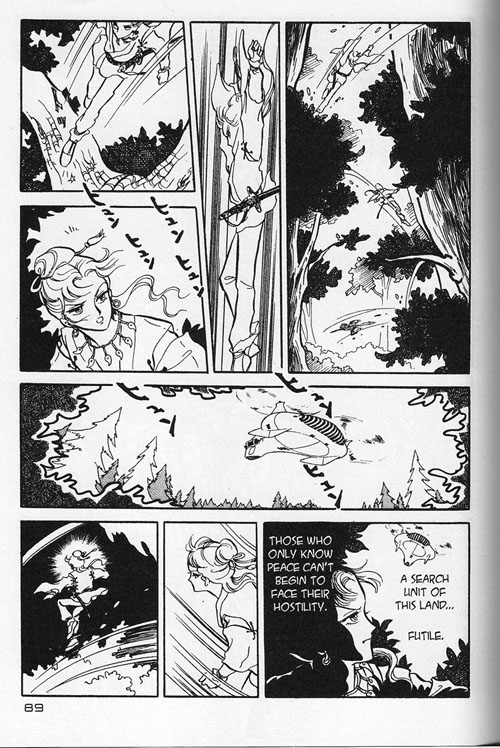
andromeda_page

In just four panels, we can gauge how far she’s traveled and how high off the ground she is — a point underscored by the tapered edge of the top row’s middle panel. The diagonal border amplifies the effect of the vertical speedlines, drawing the eye downwards in an rapid fashion that mimics Il’s motion. As Derik Badman observes in a concise analysis of this same page, Takemiya uses a number of tricks — drawing two iterations of the same character in one panel, using panel shape to direct the reader’s eye through the sequence, allowing sound effects to bleed outside the panels — to help us trace Il’s path through the tree tops, showing us, in compressed form, how many jumps it takes for her to reach a secure perch. It’s a technique that Tezuka perfected in works like MW, Ode to Kirihito, and Swallowing the Earth, where he gooses very basic components of the layout — especially panel shapes — to evoke the speed and energy of, say, a sword fight or a car chase.

At times, the richness of Takemiya’s visual imagination camouflages the more pedestrian aspects of the story, such as its one-dimensional principals. Lilia, in particular, is the kind of beautiful, virtuous, and long-suffering creature that seems to exist only in old-school Disney movies, while Il is a classic lone wolf, answering to no one, even when it might benefit her cause; the only real novelty here is that Mitsuse and Takemiya assign a stereotypically male role to a female character. The plot is simpler and more transparently allegorical than To Terra‘s, touching on a variety of standard science fiction themes, from the dangers of relegating too much responsibility to machines to the evils of totalitarianism. None of these themes are developed with the same level of sophistication as they are in To Terra, as the characters are generally too busy dodging death rays and mechanized piranha to wax poetic about their inner lives.

If Andromeda Stories never reaches the grand, operatic heights of To Terra, it nonetheless proves entertaining, building steady momentum over its 600+ page run, pausing occasionally to meditate on the nature of free will, creation, and individual responsibility. And c’mon… what’s not to like about a manga that looks like a 1979 cover of Heavy Metal magazine?!

This review is a synthesis of two shorter reviews that originally appeared at PopCultureShock on 10/3/07 and 1/31/08, respectively.

Filed Under: Manga, Manga Critic, REVIEWS Tagged With: Classic, Keiko Takemiya, Magnificent 49ers, Sci-Fi, Vertical Comics

An Introduction to Keiko Takemiya’s To Terra

May 23, 2010 by Katherine Dacey


Welcome to the May Manga Movable Feast! On the menu: Keiko Takemiya’s award-winning sci-fi epic To Terra. If you’ve never dined with us before, here’s how the MMF works: every month, the manga blogging community holds a week-long virtual book club in which we discuss a particular series or one-shot. Each day, the host shares links to new blog entries focusing on that work, while building an archive for the entire week’s discussion. At the end of the week, the group then selects a new host and a new “menu” for the following month.

Our “feast” has two goals. The first is to promote intelligent, in-depth analysis of manga we love (or, in some cases, hate). Previous contributions have run the gamut from straightforward reviews to an interview with Sexy Voice and Robo editor Eric Searleman, a guided tour through Kaoru Mori’s “Emmaverse,” and an essay contrasting Urushibara’s Mushishi with Lovecraft’s Cthulhu Mythos. The second goal is to foster a sense of community among avid manga readers. Everyone is invited to take part in the MMF, regardless of whether you’ve participated before. If you have your own blog, simply send me the link to your To Terra-themed post, whether it’s a brand new essay written expressly for the MMF or an older review that you’d like the share with the community, and I’ll include it in my daily round-up. If you don’t have a blog, send me your text and I’ll post your ideas here. (Click here for my email.) Discussion begins today and will run through the week until Sunday, May 30th.

Below, I’ve provided an overview of the series’ publication history, plot, and place in the manga canon. You can follow the discussion by checking the daily blog posts, clicking on the Manga Movable Feast tag, or visiting the MMF archive: http://mangacritic.com/?page_id=4766.

TO TERRA: THE PUBLICATION HISTORY

To Terra debuted in 1977 in Gekkan Manga Shonen. During its three-year run, To Terra nabbed two honors: the Shogakukan Manga Award and the Seiun Award, an annual prize for the best new science fiction published in Japan. (To Terra was the first manga to receive a Seiun Award; later winners would include Appleseed, Domu: A Child’s Dream, Urusei Yatsura, Cardcaptor Sakura, Planetes, and 20th Century Boys.)  The series was originally issued in tankubon format in 1980 by Asahi Sonorama, and reissued again in 2007 by Square Enix, around the same time Vertical, Inc. released the first English-language edition.

To Terra has enjoyed considerable popularity in Japan, thanks, in part, to several adaptations: a 1979 NHK radio drama; a 1980 movie, produced by Toei Animation; and a 2007 animated television series, produced by Aniplex.

TO TERRA: THE STORY

toterra2To Terra unfolds in a distant future characterized by environmental devastation. To salvage their dying planet, humans have evacuated Terra (Earth) and, with the aid of a supercomputer named Mother, formed a new government to restore Terra and its people to health. The most striking feature of this era of Superior Domination (S.D.) is the segregation of children from adults. Born in laboratories, raised by foster parents on Ataraxia, a planet far from Terra, children are groomed from infancy to become model citizens. At the age of 14, Mother subjects each child to a grueling battery of psychological tests euphemistically called Maturity Checks. Those who pass are sorted by intelligence, then dispatched to various corners of the galaxy for further training; those who fail are removed from society.
The real purpose of these checks is to weed out an unwanted by-product of S.D.-era genetic engineering: the Mu, a race of telepathic mutants. After decades of persecution, the Mu fled Terra, seeking refuge beneath the surface of Ataraxia. Under the leadership of Soldier Blue, they escaped detection by humans. But Soldier Blue is frail and dying (though he has chosen to project a youthful, sparkly-eyed appearance), and seeks a successor in Jomy Marcus Shin, a 14-year-old who possesses both the telepathic ability of a Mu and the hardier constitution of a human. As the series unfolds, we watch Jomy develop into a formidable leader, capable of inspiring passion, loyalty, and sacrifice among the Mu as they struggle to return to their homeworld. Running in counterpoint to Jomy’s story is that of Keith Anyan, an elite solider-in-training and future Terran leader. Keith enjoys a privileged position in human society. Yet he is plagued by doubt: why doesn’t he remember his childhood? Or his foster parents? And why does Mother refuse to eradicate the Mu when the state has deemed them a threat to mankind?

What makes this unabashedly Romantic mash-up of Star Trek, Star Wars, and 2001 both entertaining and moving is the richness of Keiko Takemiya’s universe. On the surface, To Terra is a beautifully illustrated soap opera, the kind of manga in which the heroes have terrific hair, wear smart jumpsuits, and keep psychic squirrels as pets. But To Terra can also be read a cautionary tale about mankind’s poor custodianship of the Earth; a scathing critique of eugenics and social engineering; a meditation on the relationship between memory and identity; and, most significantly, a critique of adult hypocrisy. It’s this multivalent quality that elevates To Terra from a mere allegory to an epic space opera as engaging, beautiful, and thought-provoking as Tezuka’s best work. (This review originally appeared at PopCultureShock on July 16, 2007.)

TO TERRA: ITS PLACE IN THE CANON

As anyone with a passing familiarity with the Magnificent 49ers knows, the 1970s were a watershed in the development of shojo manga. Not that shojo manga was an invention of the 1970s, of course; shojo manga traces its roots back to the 1910s, when girls’ magazines began running short, one-page gag strips, and underwent several major stages of development before evolving into the medium we know today. Until the mid-1960s, however, shojo manga was written by men for pre-teen girls; the stories were sweet, sentimental, and chaste, often revolving around family, class, and identity in the manner of a Frances Hodgson Burnett story. In an interview with manga scholar Matt Thorn, Keiko Takemiya’s former roommate Moto Hagio remembers the manga from this period:

In the girls’ comics, you would have stories in which the woman you thought was the mother turns not to be the mother, and the real mother is actually somewhere else. There was a variety of settings. For example, the poor child in the story turns out to actually come from a rich family, or the child of a rich family turns to have been adopted from a poor family. And one of the standard device was amnesia… It appeared so often, it makes me think that what with the war and the harsh social conditions, people had an unconscious desire to forget everything. So the heroine goes off in search of her real mother, but along the way she develops amnesia, and ends up being taken care of by a string of kind strangers.

Another popular motif was ballet. There was quite a boom in girls’ comics about ballet for a while. For example, the heroine would be a girl from a poor family who’s really good at ballet, but she loses the lead to an untalented girl from a rich family. In the standard story, there would be a mean girl and a kind-hearted heroine, and there would be a very clear-cut struggle between good and evil.

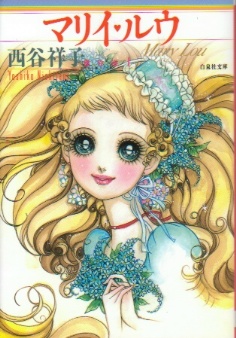
maryloubunkoIn the mid-1960s, pioneering female artist Yoshiko Nishitani began writing stories aimed at a slightly older audience. Nishitani’s Mary Lou, which made its debut in Weekly Margaret in 1965, was one of the very first shojo manga to document the romantic longings of a teenage girl. (As Thorn notes in “The Multi-Faceted World of Shoujo Manga,” the heroines of early shojo stories were too young for crushes and dates, so romance was the provenance of older, secondary characters.) Though tame by contemporary standards, Mary Lou’s emphasis on the heroine’s emotional life and relationships proved highly influential, paving the way for other artists to write stories that focused on the everyday concerns of teenagers, rather than the melodramatic travails of poor little rich girls.

Nishitani was a pioneer in another sense as well: she inspired dozens of women to enter what had been an overwhelmingly male profession. Those artists who followed Nishitani into the field in the 1970s — women like Takemiya, Hagio, and Ryoko “Rose of Versailles” Ikeda — built on her legacy, helping complete the transformation of shojo manga from staid stories about good girls to a multi-faceted storytelling medium capable of dramatizing the characters’ inner thoughts as forcefully as their physical actions. The 49ers embraced genres such as science fiction and fantasy, and developed new ones as well: the entire boys’ love industry owes a debt to Hagio and Takemiya for ground-breaking stories such as “The Heart of Thomas” and The Song of the Wind in the Trees. Whatever the subject matter, however, the 49ers used the comics medium to explore fundamental questions about identity — what constitutes family? what does it mean to be female? what distinguishes the child from the adult? — and love in all its manifestations, from maternal to carnal.

To Terra, which addresses many of the themes found in Takemiya’s other works, is significant precisely because it isn’t shojo; Takemiya was one of the first female artists to write for a boys’ magazine, bringing a distinctly shojo sensibility to her portrayal of Keith and Jomy’s emotional lives. The popular success of To Terra created opportunities for other manga-ka to cross over as well, a trend important enough for Frederick Schodt to make note of it in Manga! Manga! The World of Japanese Comics (1983). Contemporary artists such Rumiko Takahashi, CLAMP, Yellow Tanabe, and Hiromu Arakawa owe a debt to Takemiya, as she helped demonstrate what seems patently obvious to us now: that women are just as capable of writing for male audiences as men are. Oh, and we can draw a pretty bitchin’ space ship if the story calls for one.

FOR FURTHER READING

Aoki, Deb. “Interview: Keiko Takemiya, Creator of To Terra and Andromeda Stories.” About.com: Manga. January 22, 2008. (Accessed 5/23/10.)

Thorn, Matt. “The Moto Hagio Interview.” The Comics Journal 269 (July/August 2005). (Accessed 5/23/10.)

Thorn, Matt. “The Multi-Facted Universe of Shoujo Manga.” Conference paper. 2008. (Accessed 5/23/10.)

Filed Under: Classic Manga Critic, Manga, Manga Critic, REVIEWS Tagged With: Classic, Keiko Takemiya, Magnificent 49ers, Sci-Fi, Shonen, vertical

AX, Vol. 1: A Collection of Alternative Manga

May 21, 2010 by Katherine Dacey

The next time someone dismisses manga as a “style” characterized by youthful-looking, big-eyed characters with button noses, I’m going to hand them a copy of AX, a rude, gleeful, and sometimes disturbing rebuke to the homogenized artwork and storylines found in mainstream manga publications. No one will confuse AX for Young Jump or even Big Comic Spirits; the stories in AX run the gamut from the grotesquely detailed to the playfully abstract, often flaunting their ugliness with the cheerful insistence of a ten-year-old boy waving a dead animal at squeamish classmates. Nor will anyone confuse Yoshihiro Tatsumi or Einosuke’s outlook with the humanism of Osamu Tezuka or Keiji Nakazawa; the stories in AX revel in the darker side of human nature, the part of us that’s fascinated with pain, death, sex, and bodily functions.

Founded in 1997, AX was a direct descendant of Garo (1964-2002), Katsuichi Nagai’s seminal avant garde manga magazine. As historian Paul Gravett explains in his introduction to A Collection of Alternative Manga, both publications served an essential purpose, providing artists a place to break free of the influence of commercial manga publishing — its rigid house styles, tight deadlines, strong editorial presence, and reader polls — and find more idiosyncratic forms of expression. At the same time, Gravett argues, Garo and AX gave artists a platform for speaking out against the dominant culture, to loudly question the truth that everyone can and should be “doing one’s best” while trying hard to fit in.

The thirty-three stories in A Collection of Alternative Manga nicely illustrate Gravett’s thesis, encompassing a true diversity of styles and subject-matters. At one end of the spectrum are artists such as Yuka Goto, whose work reflects a heta-uma, or “bad-good” aesthetic, with crudely-drawn figures in absurd situations (her feuding neighbors resolve their differences with a judo match), while at the other are artists such as Takato Yamato, whose intricate, naturalistic style becomes a vehicle for juxtaposing pornographically beautiful human bodies with explicit images of decay and rot. Most of the work in AX falls somewhere in between: the magical realism of Akina Kondo (“Rainy Day Blouse and The Umbrella”); the primitivist abstraction of Otoya Mitsusashi (“Sacred Light”); the horror-comedy of Kazuichi Hanawa (“Six Paths of Wealth”); the kawaii-grotesque of Mimyo Tomozawa (“300 Years”). Then there are stories which are parodies in the truest sense, borrowing the visual language of shonen manga for dark farce: Namie Fujieda’s “The Brilliant Ones,” in which an earnest group of students tries to help the class loser find a way to shine — even after his body has exploded into a thousand small parasites — and Tomohiro Koizumi’s “Stand By Me,” a story about a pair of peeping teens caught in the act.

For me, the biggest obstacle to enjoying the collection — as opposed to appreciating it — is that for every story like Ayuke Akiyama’s lovely, folkloric “In the Gourd” or Toranasuke Shimada’s historical phantasmagoria “Enrique Kobayashi’s El Dorado,” there are two that read like stunts, deliberate attempts to provoke, and maybe even disgust, the audience by rubbing its nose in taboo subjects and uncomfortable truths. Such confrontational art can be thought-provoking, to be sure, making us reconsider socially determined categories such as “parent,” “teacher,” and “child”: Yusaku Hanakuma’s “Puppy Love” is one such example, a bizarre, funny, upsetting story in which a woman gives birth to a litter of puppies and resolves to raise them as normal children. The struggles she and her “sons” face remind us of how difficult it is for anyone to raise a child whose behavior or appearance makes others uncomfortable; it’s With the Light, minus the easy sentiment (and with a dollop of David Cronenberg’s perverse sense of humor).

The need to elicit a strong, visceral response from the reader can also inspire puerile excess. Shigiheru Okada (“Me”), Saito Yunosuke (“Arizona Sizzler”), Kataoko Toyo (“The Ballad of Non-Stop Farting”), and Takashi Nemoto’s (“Black Sushi Party Piece”) repeated depictions of body parts and bodily fluids reminded me of sixth graders testing out every permutation of a new swearword to see which ones had the greatest shock value. Other stories, such as Yoshihiro Tatsumi’s “Lover’s Bride,” inspire an immediate ewwwww, and maybe a chuckle, but not much else: what deeper truths could possibly be gleaned from a sad-sack character’s decision to woo a primate instead of a human?

My other stumbling block to fully embracing AX is the way in which female characters are depicted in stories such as Yuichi Kiriyama’s “A Well-Dressed Corpse,” Hiroji Tani’s “Alraune Fatale,” and Osamu Kanna’s “The Watcher.” The female characters often seem more like receptacles for male anger, sexual aggression, or disappointment than they do actual human beings. I suppose one could argue that these artists are simply exaggerating a tendency found in manga across the spectrum, making explicit what’s normally implicit in a lot of material directed at male audiences. Yet none of these artists seem to be critiquing the male gaze in any meaningful way; they cast a pitiless, often lascivious eye on their female subjects, reducing them to a monstrous assortment of breasts and mouths and legs. It’s to editor Sean Michael Wilson’s great credit that he includes so many distinctive female voices in the anthology as well, preventing AX from becoming too dourly macho or grossly juvenile.

Yet for all my discomfort and distance from the material, I can’t look away. As a historian, AX excites me, providing a meticulously curated introduction to Japan’s underground comics scene. As a reader, AX challenges me to move beyond my notion of what constitutes manga, helping me understand what artists like Yoshihiro Tatsumi and Yoshiharu Tsuge were trying to do in the 1950s and 1960s with their “manga that isn’t manga”: to push the medium outside its comfort zone, to show us ugly truths, to make us laugh with recognition and discomfort, and to encourage artistic expression that, in Gravett’s words, is “as personalized as handwriting or a signature.” Recommended.

Review copy provided by Top Shelf. AX, Vol. 1: A Collection of Alternative Manga will be released on July 15, 2010.

AX, VOL. 1: A COLLECTION OF ALTERNATIVE MANGA • EDITED BY SEAN MICHAEL WILSON, WITH AN INTRODUCTION BY PAUL GRAVETT • TOP SHELF • NO RATING • 400 pp.

Filed Under: Manga, Manga Critic, REVIEWS Tagged With: Alt-Manga, Top Shelf

The Times of Botchan, Vols. 1-4

May 19, 2010 by Katherine Dacey

Reading The Times of Botchan reminded me of watching Alexander Sakurov’s cryptic 2002 film Russian Ark. Both employ a similar gambit: a literary figure from the country’s past wanders through a landscape populated by real people who played pivotal roles in its modernization. In Russian Ark, the author/protagonist role is filled by the Marquis de Custine, a French aristocrat who published Empire of the Czar: Journey Through Eternal Russia in 1839, while in The Times of Botchan the role is fulfilled by Soseki Natsume (1867-1916), the defining novelist of the Meiji Restoration. Neither Ark nor Botchan employs a clear, linear narrative; both works are episodic — even, at times, picaresque — in nature as their principle characters rub shoulders with poets, composers, czars, and politicians.

When we first meet Natsume, he is writing a novel called Botchan, a short, satirical work about a energetic young man who suffers from a Holden Caufield-esque desire to expose phoniness wherever he goes. Nastume hopes Botchan will help him achieve catharsis from a vague but nagging sense of anxiety brought on by the period’s social, political, and economic upheavals, from the Freedom and People’s Rights Movement to the first murmurs of suffragism.1 Though we occasionally see Natsume in his study drafting chapters, or admiring the inky paw prints left behind by his cat, much of the manga is devoted to Natsume’s travels through Tokyo, which brings him into contact with historical figures from An Jung-Geun, an activist who assassinated the Korean governor in 1909, to Hiruko Haratsuka, a feminist active in the Seito suffrage movement of the 1910s, to Lafcadio Hearn, a Western journalist whose fascination with old Japan inspired him to write Kwaidan: Stories and Studies of Strange Things.

Some of these encounters are the jumping off point for vignettes about Westerners living in Japan, or the state of Japanese literature, while others are mere coincidence and treated in just one or two panels. The resulting manga feels like a tableau, or the Japanese equivalent of a guided tour through Colonial Williamsburg, as our unseen narrator identifies the sprawling cast of characters and mentions key events in Meiji-era history.

Despite its historical ambitions, The Times of Botchan is best read for its quieter moments. Jiro Taniguchi creates intimate scenes that require little or no dialogue to convey their nuance: two acquaintances walking silently through a snowing streetscape, Natsume working in his study. Small details capture the transitional nature of the period, and speak volumes about the characters’ ambivalent relationship with the West, with some embracing European dress, others flatly rejecting it, and most, like Natsume, striking a compromise, combining a yukata with a button-down shirt and bowler hat.

Sekikawa’s script, however, is less artful than Taniguchi’s visuals, as the omniscient narrator often supplies the reader with information that can be readily inferred from the pictures. In one scene, for example, the writer Rintaro “Ogai” Mori2 returns to his family after a prolonged stay in Europe. He intends to tell his parents that he loves — and plans to marry — a young German dancer named Elise Weigert, but cannot bring himself to do so now that he is back on Japanese soil. Taniguchi’s illustrations instill in us a powerful sense of Mori’s estrangement from his roots, using his characters’ body language and placement within the picture plane to convey the emotional distance between Mori and his parents, but Sekikawa’s narrator intrudes on the scene:

At that moment, Ogai felt, for the first time, that he was back in Japan. In this country, individualism was not regarded as a personal virtue, the ‘family’ had to be considered. Ogai was unable to speak the words he had prepared and became mute as a fish.

Such heavy-handed interjections suggest that Sekikawa doesn’t trust us to decode moments of mystery, poetry, or ambiguity on our own; at least the Marquis de Custine never bothered to explain why Nicholas II and victims of the Kursk disaster haunted the same wing of the Hermitage.

The Times of Botchan‘s other great flaw is its deadly serious tone. The two novels that Natsume wrote during the period portrayed in the manga, I Am a Cat and Botchan, are both satirical, filled with wry observations about human nature and sharp critiques of pomposity, greed, toadyism, and empty-minded embrace of Western mores.3 Though the manga is filled with visual signifiers for both works — cats, in particular, are a recurring motif throughout the first two volumes — the manga lacks the delicate touch of either novel; one might reasonably conclude from Sekikawa’s narration that Botchan was a Zola-esque expose on the evils of Westernization, rather than a comedy about a young teacher coping with the inept faculty at a podunk boys’ boarding school.

From time to time, however, the narrative snaps out of its staid, vaguely pompous tone. In one genuinely funny scene, for example, Japan’s leading literary figures gather in the home of a prominent politician for a meeting of “The Perpetual and Immutable Literary Circle.” Two are asked to compose a poem on the spot. The first, intoned by the host, is greeted with respectful, if vague praise (“It reminds one of the tranquility and beauty of Turner’s paintings,” one opines):

The great canon is heard from afar
On the left diagonal of the hands that hold the horse’s reins.

The second stuns them into uncomfortable silence:

When the cowherd makes a poem
A new air rises in the world.

A lively debate follows, with some detecting a whiff of socialism in the cowherd’s profession, and others praising it for its direct simplicity; not until the group’s acknowledged expert interprets both poems does the group reach consensus on their quality. The punchline comes in the final panel, when one member acknowledges that the first poem made no sense. In that brief scene, Sekikawa and Taniguchi capture the spirit of Botchan without slavishly recreating a scene from it; one could almost imagine the savage nicknames that a younger, less pretentious member of the circle might lavish on his elders as they debated the merits of both poems.

In another rare moment of levity, Natsume witnesses a young suffragette making out with her paramour in a restaurant, noting the length — three and a half minutes — and intensity of their kiss. Taniguichi draws that kiss in almost pornographic detail, with panel after panel of the two lovers’ mouths drenched in saliva, in essence showing us how Natsume views their contact, with a mixture of prurient fascination and revulsion. Sesikawa and Taniguchi then takes things a step further, borrowing a page from Milos Foreman’s Amadeus to suggest how this brief, everyday experience found its way into the pages of Botchan, with the suffragette morphing neatly into the Madonna, a social-climbing temptress who switches romantic allegiances when it suits her interest.

Given the didactic tone and frequent allusions to unfamiliar historical figures, I’m hesitant to give The Times of Botchan an unequivocal endorsement. Some readers will find the book long-winded, confusing, and perhaps even a little boring. But for those already enamored of Taniguchi’s superb draftsmanship or well-versed in Japanese culture, The Times of Botchan offers readers a lovely reward: a window into one of the most fascinating periods in Japanese history, and the creative process of one its most important voices.

NOTES

1. The Freedom and People’s Rights Movement in Japan began in the 1870s. Building on the reforms established in the Charter Oath of 1868 (which abolished Japan’s rigid class structure, among other provisions), urban intellectuals lobbied for the drafting of a constitution and the creation of a parliament.

2. Ogai Mori is best known to Western audiences for his novels The Wild Geese and Sansho the Bailiff, the latter being the basis of Kenji Mizoguchi’s 1954 film.

3. As translator Joel Cohn notes, Botchan (the novel) occupies a similar place in the Japanese canon as Catcher in the Rye and Huckleberry Finn, and is a standard text in most high schools. See the introduction to Natsume Soseki, Botchan, Translated by J. Cohn (New York: Kodandsha International, 2005).

Review copy of volume four provided by the publisher. This is an expanded version of a review that appeared at PopCultureShock on 6/5/2007. The original review focused on volumes 1-3 of the series.

Filed Under: Manga, Manga Critic, REVIEWS Tagged With: Fanfare/Ponent Mon, Historical Drama, Jiro Taniguchi, Natsume Soseki

Future Lovers Available on Kindle

May 18, 2010 by MJ 2 Comments

One press release that got pushed to the bottom of my inbox during last week’s manga industry shakeup came from Animate USA, announcing two more Libre Publishing yaoi titles for the Kindle. Libre’s jump to Kindle is not news and it’s been reported here before, but what is news is the inclusion of one of my all-time favorite yaoi titles, Saika Kunieda’s Future Lovers.

Future Lovers is one of those few yaoi titles fans of the genre can feel confident recommending to non-fans, standing alongside works by est em and Fumi Yoshinaga. It’s a rare brand of yaoi, featuring a couple of schoolteachers who fall in love and must deal with what that means for them at home, at work, and in the bedroom. It’s both sexy and down-to-earth, a combination not at all easy to come by. Not convinced? Check out my reviews of volumes one and two, or better yet, this fantastic review by Manga Curmudgeon David Welsh. …

Read More

Filed Under: REVIEWS Tagged With: future lovers, manga, press releases, yaoi/boys' love

We Were There, Vol. 10

May 17, 2010 by MJ 1 Comment

By Yuki Obata
Viz, 200 pp.
Rating: T+ (Older Teen)

After volume nine’s jump to the future, We Were There returns again to the past. This volume follows Yano in his first year away from Nanami as seen through the eyes of a classmate, Sengenji. While things continue to decline for Yano’s mother, Yano strives desperately to cling to his long-distance relationship with Nanami, even if this means shutting her out of everything he’s going through. Meanwhile, Yamamoto enters the picture once again and Sengenji battles her own feelings for Yano.

So much of this series revolves around questions of trust, and once again Yano falls short–not in terms of his own trustworthiness, but rather in his inability to trust Nanami with the things she most needs to know. Though he tries to justify this as concern for her, it’s obvious that what he’s really protecting is himself. “Even if wounds heal, scars are left behind,” he says to Takeuchi over the phone, following a labored metaphor about broken plants created to justify shielding Nanami from further truth. “So it’s better not to experience hardship if you don’t have to.”

Even watching Yano stumble, however, it’s impossible not to feel for him, and it’s exactly this kind of emotional ambiguity that this series handles so well. Every poor choice and heartfelt miscalculation is perfectly in-character, forcing readers to examine their own reactions just as in real life.

With its thoughtful tone and exceptional insight into the human mind and heart, We Were There continues to be a must-read for fans of mature shojo.

Review copy provided by the publisher. Review originally published at PopCultureShock.

Filed Under: MANGA REVIEWS Tagged With: manga, we were there

Saturn Apartments, Vol. 1

May 16, 2010 by Katherine Dacey

If I’ve learned anything from my long love affair with science fiction, it’s this: there’s no place like home. You can boldly go where no man has gone before, you can explore new worlds and new civilizations, and you can colonize the farthest reaches of space, but you risk losing your way if you can’t go back to Earth again.

In Saturn Apartments, the physical distance between us and our terrestrial home is small, but the emotional distance is great. The story takes place in a future where environmental devastation has prompted humans to decamp the Earth’s surface for its atmosphere, where they build an elaborate structure that encircles the planet. That floating city resembles Victorian London in its rigid class system and physical organization: the poorest people live in its bowels, in an artificially lit environment, while the richest live on the uppermost levels, enjoying natural light and unspoiled views of Earth.

Our guide to this stratified world is fourteen-year-old Mitsu, a professional window washer who lives on the lowest level. By virtue of his job, Mitsu has access to the entire city. For a boy who’s joined the workforce at an early age, who lives in a cramped room with few possessions, and whose neighbors suffer the ill effects of chronic light deprivation, his clients, most of whom live on the top floors, seem ridiculous and exacting. At the same time, however, they intrigue Mitsu; not only do they give him a glimpse into a more affluent way of life, they also own things — animals, machines, plants — that connect them to the Earth’s abandoned surface.

As these organisms and objects suggest, all of Saturn‘s characters suffer a strong sense of terrestrial homesickness. Midway through volume one, for example, Mitsu meets an eccentric zoologist who maintains an enormous private aquarium in his apartment. The man’s aquarium and his bizarre request that Mitsu splash water on the windows — something that’s impossible to do at an altitude of 35,000 kilometers — initially seem like a wealthy man’s whims; that is, until Mitsu learns that the zoologist is trying to create a more congenial environment for the aquarium’s prized specimen, the last surviving whale from a failed effort to reintroduce mammals into Earth’s oceans.

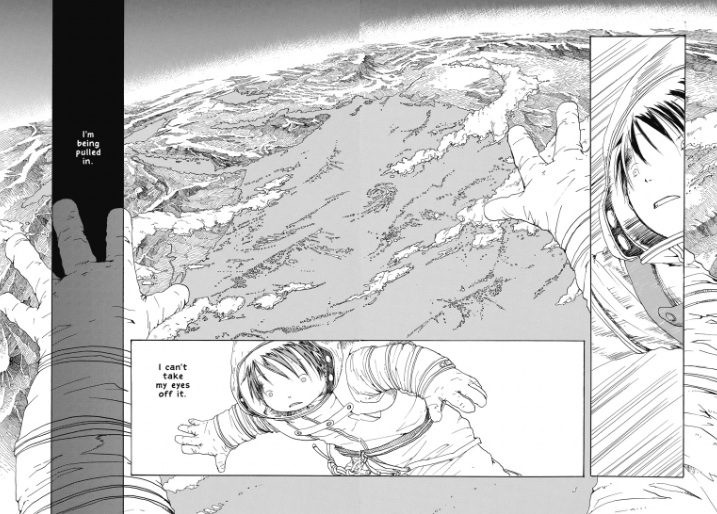
In other chapters, the characters’ longing to go home is more palpable. When Mitsu tackles his first assignment, for example, he finds himself at the very site where his father Akitoshi, also a window-washer, plunged to his death. Mitsu sees evidence of his father’s presence — a frayed rope, handprints on the side of the building — and though he interprets the evidence as proof of Akitoshi’s desperate struggle for survival, Mitsu is briefly seized by the thought that his father wanted to die, that Akitoshi cut the safety line so that he might fall back to Earth. Mitsu himself struggles with that same impulse; caught off guard by a strong solar wind, he finds himself dangling precariously above the Earth, mesmerized by the sight of the African continent spreading below him:

saturn_earth

Only the intervention of Jin, an experienced co-worker, snaps Mitsu out of his dangerous reverie and spurs the boy to take corrective action. Once safely tethered to a lift, however, Mitsu peers over the side for another glimpse of the surface, resolving to one day “find the spot down there where Dad landed.”

Like Planetes, Saturn Apartments is less a tale of intergalactic derring-do than of ordinary people doing extraordinarily dangerous, tedious work in extreme environments. Most of what we learn about the characters comes from observing them on the job, as they banter with co-workers, perform routine tasks, and respond to crises. In Saturn Apartments, Akitoshi’s death — an event that took place five years before the story begins — casts a long shadow over the window washer’s guild. The mystery of what happened to Akitoshi plays an important role in advancing the plot, to be sure, but most of the story explores the way in which Mitsu comes to terms with his father’s death through learning Akitoshi’s profession and befriending Akitoshi’s colleagues.

The other thing that Saturn Apartments and Planetes have in common is beautiful, detailed artwork that conveys a strong sense of place. Hisae Iwaoka’s landscapes bustle with activity, showing us how the apartment dwellers go about their daily business. Each level has its own distinctive appearance, from the basement tenements — where Mitsu and Jin live — to the middle level — a tidy grid of schools and mid-rise buildings dotted with grassy parks — to the very top — a collection of spacious lofts with enormous windows. Iwaoka renders all of these environments in gently rounded, slightly imperfect lines that make the complex look warmly inviting, rather than sterile and prefabricated; even the very lowest levels of the complex are appealing, their close yet friendly quarters reminiscent of fin-de-siecle Delancey and Mulberry Streets.

Saturn Apartments is many things — a coming-of-age story, a set of character studies, a meditation on man’s place in the greater universe — but like all good space operas, its real purpose is to affirm the truth of T.S. Eliot’s words, “We shall not cease from exploration/And the end of all our exploring/Will be to arrive where we started/And know the place for the first time.” Highly recommended.

Review copy provided by VIZ Media, LLC. Volume one of Saturn Apartments will be released on May 18, 2010. To read the first eight chapters online, visit the SigIKKI website.

SATURN APARTMENTS, VOL. 1 • BY HISAE IWAOKA • VIZ • 192 pp. • TEEN (13+)

Filed Under: Manga, Manga Critic, REVIEWS Tagged With: Sci-Fi, SigIKKI, VIZ

Kimi ni Todoke: From Me to You 4 by Karuho Shiina: A-

May 16, 2010 by Michelle Smith

When Sawako Kuronuma was ostracised by her class due to her gloomy disposition and resemblance to a character from a horror movie, she never would have guessed that there are so many nuances to interactions with other people. Because of her inexperience in this area, she hasn’t learned to be distrustful, and so accepts as genuine the friendly advances of Kurumi, a girl who wants Kazehaya-kun for herself.

Kurumi does everything within her power to convince Sawako, who is growing increasingly curious about the depth of her feeling for Kazehaya, that what she feels for him isn’t anything special, and that she ought to try chatting up some other guys for the sake of comparison (then arranges for Kazehaya to witness this, of course). Things backfire for Kurumi, though, as Sawako manages to interpret this advice in the best possible light and ends up confirming and accepting that what she feels for Kazehaya is genuine love.

This is a huge step for Sawako, and her happiness at this achievement in self-discovery is contagious. In fact, the depiction of her thought process as she works this out is simply terrific throughout, as is that of Kazehaya as he realizes that, no matter what he may personally feel, Sawako is still not ready to begin dating anyone. The skill with which nonverbal and internal storytelling convey these revelations to the reader elevates Kimi ni Todoke beyond other sweet love stories and into the realm of great manga.

Review copy provided by the publisher. Review originally published at Manga Recon.

Filed Under: REVIEWS Tagged With: Karuho Shiina, shojo beat, VIZ

Kimi ni Todoke: From Me to You 3 by Karuho Shiina: A

May 16, 2010 by Michelle Smith

From the back cover:
Sadako finally becomes friends with her classmates, instead of scaring them off. Even Kurumi, the cutest girl in school, wants to be her friend. But will this new friendship make Sadako realize that her feelings for Kazehaya might be more than just friendly?

Review:
I was bowled over by the surfeit of cute in this volume of Kimi ni Todoke. Let us count the ways!

1. Sawako has begun doing things after school with Yano and Yoshida, and is absolutely thrilled. Her parents are also adorably excited for her.

2. Sawako is beginning to realize that Kazehaya is a boy, and that she likes him in a way that is different from how she likes her other new friends. This results in her being somewhat flustered in his presence, which leads to him being flustered right back. Seriously, when these two are together, they just glow, and the art and pacing really make these moments special.

3. Yano and Yoshida are extremely awesome, and nudge Sawako into doing things like calling Kazehaya on the phone or dropping the -kun when she addresses him. Her reactions are cute, but Kazehaya’s are especially telling. Yano and Yoshida are kind of evil in how much they tease him, but their machinations result in a story that shows these characters’ feelings for each other rather than simply telling us about them.

4. Sawako’s friends have to inform her that she has earned the right to call them by their first names, because she’d never presume to do so otherwise. In fact, there’s a lot of emphasis on honorifics in this volume, making it a great candidate to prove why it’s necessary to retain them in translations.

I continue to love that friendship is so important to Sawako. Though she’s finally beginning to realize her romantic feelings for Kazehaya, her friends play a big part in that, encouraging her to reach out to him a little more and putting the two of them in situations where they can interact. Yano and Yoshida are at least tied with Hanajima and Uotani from Fruits Basket in the category of Best Best Friends.

A rival for Kazehaya’s affections—Kurumi, a girl he knew in junior high—also appears in this volume. I like that she’s not as over-the-top villainous as some rivals have been, but is still somewhat scheming. Happily, Sawako balks at Kurumi’s request to help her get together with Kazehaya; it’s evident that Kurumi thought Sawako was so self-effacing she’d just bend over backwards to accommodate her new friend’s request. It’s clear, too, that Kurumi knows exactly how Kazehaya feels about Sawako, thanks to some more excellent nonverbal storytelling.

In the end, this volume solidly establishes Kimi ni Todoke as one of my current shoujo favorites. I liked the first two volumes a lot, but now that Sawako and Kazehaya are hesitantly moving closer to a relationship, it has escalated to a new level of greatness.

Review copy provided by the publisher.

Filed Under: REVIEWS Tagged With: Karuho Shiina, shojo beat, VIZ

Ode to Kirihito, Part One

May 12, 2010 by MJ 4 Comments

Ode To Kirihito, Part One
By Osamu Tezuka
Published by Vertical Inc.
Rated ages 16+


Buy at RightStuf | Buy at Amazon

Kirihito Osanai, a young doctor with a prestigious university hospital, is deeply engaged in the study of Monmow Disease, an endemic condition that has overtaken the remote village of Doggodale. The disease reshapes the skeleton of its victims until they resemble dog-like creatures, ultimately resulting in death. Though Kirihito’s superior, Dr. Tatsugaura, has banked his career on Monmow being caused by a contagious pathogen, Kirihito believes it is an organic disease–a belief shared by his old friend and colleague, Dr. Urabe.

Urged on by Dr. Tatsugaura, Kirihito reluctantly leaves home to spend a month researching the disease onsite in Doggodale–a trip from which he is not meant to return. Thanks to Dr. Tatsugaura’s machinations, not only do the villagers repeatedly attempt to kill him, Kirihito also contracts the disease. And when his research finally leads him to the truth about the condition’s origin, a frantic call home reveals that Dr. Tatsugaura has erased his identity from the hospital records, leaving him helpless in his beast-like state.

Unrecognizable and alone, Kirihito becomes caught up in a series of increasingly degrading experiences that lead him across much of Asia. Meanwhile, in an effort to discover what happened to his friend, Dr. Urabe begins to uncover the depth of Dr. Tatsugaura’s corruption, leading him to truths he’s not fully prepared to handle.

Ode to Kirihito explores man’s darkest and most primitive urges–not by way of those whose bodies have literally turned to beasts, but rather through the increasingly hideous impulses of men who remain outwardly “normal,” most of whom represent depravity in one sense or another. Even Dr. Urabe, whose professional loyalties remain untainted by ambition, is unable to rise above his ugliest desires, ultimately rendering him no more civilized than the corrupt establishment he eventually attempts to fight.

Despite its undeniably somber tone, the series’ first volume is briskly paced and well-plotted, with brutally honest characterization and razor-sharp dialogue that goes a long way towards preventing the story’s messages from becoming irretrievably heavy-handed. What really brings it all together, however, is Tezuka’s artwork, which is wildly ambitious and (thankfully) just as successful.

There are two aspects of this series’ artwork that are particularly effective on an emotional level. First, the meticulous detail in Tezuka’s landscapes and backgrounds create what can only be described as a thick emotional tapestry–not just panel by panel but panel to panel. Tazuka uses shape and texture to cast emotion over multiple pages at a time, imposing cutting rain and angry teeth over the huddled curves of human agony, and lulling his characters (and his readers) into a sense of false comfort with the orderly flow of well-kept farmland.

Second, is the power of the series’ human imagery. A scene, for instance, in which a young nun with advanced Monmow is being displayed as a specimen to an auditorium full of physicians is so striking in its portrayal of her nobility in the face of unrelenting humiliation–her lone, proud figure standing against the sneering darkness–it easily moved me to tears. Tezuka’s artwork depicts both the cruelty and vulnerability of man with a combination of stark honesty and true compassion that makes it impossible to ignore either in favor of the other. His characters are both repulsive and sympathetic, often at the same time.

If these descriptions read as hyperbole, be assured that they are not. The quality of Tezuka’s imagery is truly this stunning, so much so that it’s difficult to return to other comics afterwards without feeling that something crucial has been lost. As lovely and emotionally resonant as much manga art can be, it is rare to find such rich visual storytelling in which the artwork and the narrative are so deeply merged.

Best of all, though Ode to Kirihito is artistically ambitious, it is also completely accessible. Readers intimidated by the author’s legendary status can rest easy in the knowledge that Tezuka is revered not just as a pioneer but as a powerful storyteller, and good storytelling is good storytelling, regardless of its origins.

Newly re-released by Vertical in two digestible volumes, Ode to Kirihito is a remarkable example of the power of sequential art.

Review copy provided by the publisher.

Filed Under: MANGA REVIEWS Tagged With: manga, ode to kirihito

Hikaru no Go, Vol. 19

May 5, 2010 by MJ 3 Comments

Hikaru no Go, Vol. 19
By Yumi Hotta and Takeshi Obata
Published by Viz Media
Rated All Ages


Buy at RightStuf | Buy at Amazon

With Hikaru’s pro career now in full swing, he’s anxious to begin competing with high-level players, but his early string of forfeits has put him behind. When an 18-and-under international team tournament is announced, Hikaru is determined to earn a place on the Japanese team. With Akira already selected, only two spots remain. Can Hikaru live up to his own expectations?

Though the end of volume seventeen felt very much like a series climax, volume nineteen demonstrates the series’ true strength as it takes Hikaru and Akira past the consummation of their epic rivalry and on to the rest of their lives as professional Go players. This volume’s lesson is that life is a string of new beginnings–that the completion of each challenge naturally leads to the next one. “I’ll take it one step at a time and keep advancing until I attain the divine move,” Hikaru says, in the heat of a typical battle with Akira. This is not just Hikaru’s lesson, however. Akira, Waya, Isumi, the Haze Junior High Go Club–even the older, more jaded players have no choice but to move on from challenge to challenge.

This may seem like a heavy-handed lesson, but careful detail and subtlety keep all potential preaching in check. As always, Hotta’s characterizations are wonderfully nuanced, and it’s the small moments that do the real heavy lifting. Even as Hikaru makes grand declarations in true shonen style, it’s his mother’s late-evening excursion to to replace the bathroom light bulb that somehow brings the message home. Life moves on for all of us, and so we must move with it.

On an unrelated note, with the senior members of the Haze Go Club moving on to cram school and high school entrance exams, this seems the time to mention just how many Manga Bookshelf Brownie Points this series has earned for having a non-skinny, non-conventionally attractive young female character who is portrayed as smart, athletic, and generally to be admired. Though Kaneko is likely to fade from this story as Hikaru moves further and further from his former middle-school life, she’s provided a real breath of fresh air as a decidedly stocky teenaged girl in a medium (and genre) heavily influenced by the same narrow standards for female beauty that pervade most First World popular culture.

With four volumes left to go, this series shows no sign of losing momentum. More importantly, it retains the unexpected elegance that has long made it a standout in its genre. Highly recommended.

Review copy provided by the publisher.

Filed Under: MANGA REVIEWS Tagged With: hikaru no go, manga

My Girlfriend’s a Geek, Vol. 1

May 5, 2010 by Katherine Dacey

The prince who turns out to be a toad is a staple figure in romantic comedies: what Jane Austen novel didn’t feature a handsome, wealthy suitor who, in the final pages of the story, turned out to be ethically challenged, penniless, or engaged to someone else? My Girlfriend’s a Geek offers a more up-to-the-minute version of Mr. Willoughby, this time in the form of a nice young woman who looks like a dream and holds down a responsible job, but has some rather unsavory habits of mind.

The hapless protagonist of My Girlfriend’s a Geek is Taiga Motou, a perpetually broke, somewhat flaky college student who aspires to be a novelist. Taiga is on a quest to find the perfect job, one that “pays big” and is “close to college and easy to do and not too sweaty”; bonus points if the staff includes “a beautiful, hard-working big sis-type chick.” When he stumbles across a clothing company with a “Help Wanted” sign in the window and an attractive manager in the office, he jumps at the chance. Once employed, Taiga does his best to flirt with the beautiful Yuiko, though his opportunities are few and far between: a chance encounter in the lunch room, an after-hours search for missing inventory. Yuiko’s signals are hard to decode — she blows hot and cold, and ditches him to fiddle with her VCR — but she eventually agrees to go on a proper date with him.

Taiga doesn’t have much opportunity to savor his conquest, however, as Yuiko makes a startling confession at the end of dinner: she’s a geek. But not a run-of-the-mill geek; she’s a self-proclaimed fujoshi with a butler fetish and a tendency the slash the hell out of every shonen manga she reads. Taiga tries to play along with her interests for a while, but quickly finds her exasperating, with only Yuiko’s cougarness to keep him invested in their relationship. (The author never states their age difference, though we’re clearly meant to see her as a few years Taiga’s senior.)

Yes, we’ve been to this well before with series like Fujoshi Rumi in which a “normal” person tries to make sense of an otaku’s ecstatic and excessive behavior, and indeed, some of Geek‘s jokes have a been-there, done-that quality to them: is it really news that fujoshi like butler cafes? Other gags, however, hit the mark. In one scene, for example, Yuiko manipulates Taiga into writing fanfic by appealing to his authorial ambition — “I was really hoping I could read a novel written by you,” she tells Taiga — while in another, an innocent conversation between Taiga and his studly pal Kouji leaves Yuiko trembling in anticipation, as she hears their exchange as a prelude to a steamy make-out session.

Though the source material for My Girlfriend’s a Geek is told from a male point of view — Pentabu, the original novel’s author, writes about his girlfriend with a mixture of awe, fear, and confusion — the manga has a decidedly more feminine tone. The artwork has a strong shojo flavor, with pretty male characters, close-ups of blushing faces, and flowery and starry backdrops galore. Artist Rize Shinba pulls off the neat trick of showing us events from both the regular-guy and fujoshi perspectives: when Taiga puts on his glasses, for example, Shinba represents him first as a college student in corrective lenses, then as a handsome seme superimposed on a bed of sparkles and roses. The humor, like the artwork, is a little gentler and cleaner than the original novel’s (to judge from the excerpt that appears at the end of volume one, at least), though it’s clear Yuiko harbors some disturbing fantasies; if you wondered what sort of person would squee over Ciel Phantomhive, Yuiko’s behavior provides an important clue.

From what I’ve been able to glean from web sources, it looks like My Girlfriend’s A Geek is a two-volume series, which seems just right for its fujoshi-say-the-darndest-things premise: long enough for us to develop an interest in the leads and chuckle at Taiga’s folly, but short enough to avoid repeating the same jokes with minor variations. I can’t say it’s the funniest or most original thing I’ve encountered, but it’s a quick, entertaining read, perfect for the beach or a plane trip.

Review copy provided by Yen Press. Volume one will be released on May 18, 2010.

MY GIRLFRIEND’S A GEEK, VOL. 1 • ART BY RIZE SHINBA, STORY BY PENTABU • YEN PRESS • 192 pp. • RATING: OLDER TEEN (16+)

Filed Under: Manga, Manga Critic, REVIEWS Tagged With: Fujoshi, Romance/Romantic Comedy, yen press

Twin Spica, Vol. 1

May 3, 2010 by Katherine Dacey

Asumi Kamogawa is a small girl with a big dream: to be an astronaut on Japan’s first manned space flight. Though she passes the entrance exam for Tokyo Space School, she faces several additional hurdles to realizing her goal, from her child-like stature — she’s thirteen going on eight — to her family’s precarious financial position. Then, too, Asumi is haunted by memories of a terrible fire that consumed her hometown and killed her mother, a fire caused by a failed rocket launch. Yet for all the pain in her young life, Asumi proves resilient, a gentle girl who perseveres in difficult situations, offers friendship in lieu of judgment, and demonstrates a preternatural awareness of life’s fragility.

If Asumi sounds like a stereotypically optimistic manga character, a can-do kid who maintains a positive attitude through every set-back, the first volume of Twin Spica reveals her to be more complex and damaged than her firm resolve might suggest. Mr. Lion, her imaginary friend, is proof of the wounds she carries: she “met” him when she was six, never quite outgrowing the need for his counsel or company. When Asumi suffers a traumatic flashback to the Yuigahama disaster, for example, she calls out Mr. Lion’s name; when her father responds angrily to the news that she passed the space academy’s placement test, she asks Mr. Lion if she should enroll or abandon her dream of becoming “a driver on a rocket.”

Though Asumi’s story ran in Comic Flapper, a seinen magazine, Twin Spica works surprisingly well for both adults and teens. The storytelling is direct and simple without being didactic, filled with the kind of characters that younger readers will recognize and embrace as true to their own experiences. At the same time, however, Twin Spica‘s subtexts are rich enough to sustain an adult’s interest, as the supplemental stories “2015: Fireworks” and “Asumi” attest. Both explore Asumi’s response to her mother’s death, acknowledging and validating Asumi’s curiosity about her mother’s appearance (Mom suffered disfiguring burns) and about dying itself. (Six-year-old Asumi scandalizes funeral-goers by leaning over her mother’s casket to see what death “smells like.”) Without a trace of mawkishness, Yaginuma shows us how Asumi makes sense of what happened to her mother, recognizing his young heroine’s keen emotional intelligence in the way she chooses to honor her mother’s memory. Tween and teen readers may well find these passages moving, as they touch on one of childhood’s most primal fears, but adult readers will find them more unsettling, as they remind us of our inability to protect children from painful experiences, and of the moment when we first grasped death’s finality.

The artwork, like the narrative, has a direct, expressive quality that keeps the focus on the characters’ interactions, rather than the gizmos and laboratories where their training takes place. Yaginuma draws his tyro astronauts in a simple, stylized fashion that treats them as collection of distinctive geometric shapes: Fuchuya, one of Asumi’s classmates, sports a ‘do evocative of Eero Saarinen’s iconic TWA terminal, while Asumi resembles a kokeshi doll with her exaggerated round head and tiny body. The characters’ slightly awkward proportions register as a deliberate artistic choice — call it studied naivete or primitivism — though at times the art seems a little clumsy and flat; readers will be forgiven for thinking Yusinuma’s storytelling skills outstrip his draftsmanship.

Whatever conclusions the reader reaches about Yusinuma’s style, it’s impossible to deny the emotional power of Twin Spica as a coming-of-age story about one girl’s journey from childhood to adulthood, and one nation’s journey from terrestrial power to space race competitor. A beautiful, thought-provoking book for star gazers of all ages.

Review copy provided by Vertical, Inc. Volume one of Twin Spica will be released on May 4, 2010.

TWIN SPICA, VOL. 1 • BY KOU YAGINUMA • VERTICAL, INC. • 192 pp. • NO RATING

Filed Under: Manga, Manga Critic, REVIEWS Tagged With: Sci-Fi, Space Exploration, Vertical Comics

Bokurano: Ours, Vol. 1

May 1, 2010 by Katherine Dacey

Among the most discussed scenes in the new Kick-Ass film is one that pits a tweenage assassin against a roomful of grown men. To the strains of The Banana Splits theme song, thirteen-year-old Hit Girl dispatches a dozen gangsters with a gory zest that has divided critics into two camps: those, like Richard Corliss, who found the scene shocking yet exhilarating, a purposeful, subversive commentary on superhero violence, and those, like Roger Ebert, who found it morally reprehensible, a kind of kiddie porn that exploits the character’s age for cheap thrills. What’s at issue here is not children’s capacity for violence; anyone who’s run the gauntlet of a junior high cafeteria or cranked out an essay on Lord of the Flies is painfully aware that kids can be beastly when the grown-ups aren’t looking. The real issue is that Hit Girl seems to be enjoying herself, raising the far more uncomfortable question of how children understand and wield power.

Mohiro Kitoh, creator of Shadow Star and Bokurano: Ours, likes to muck around in this uncomfortable space. In Shadow Star, for example, Kitoh pairs teens with powerful supernatural allies — in this case, “shadow dragons” — who become instruments not for fighting evil but for exacting revenge on their masters’ peers and asserting their masters’ primacy in the school pecking order. Shadow Star‘s graphic violence and sex scenes clearly made some folks uneasy, as a few of the later chapters were censored here in the US. (Dark Horse dropped the series before completing it.) Bokurano: Ours hasn’t crossed that line — at least not yet — but once again finds Kitoh subverting a familiar manga trope to suggest the darkness of the underage psyche. This time, he takes a stock shonen formula — kids piloting giant robots to save Earth from aliens — and gives it a nasty twist: the pilot of a successful sortie dies after completing his mission.

The first volume of Bokurano: Ours is neatly divided into three acts, the first explaining how Kokopelli, a mysterious computer programmer, dupes fifteen kids into “playing” this lethal game; the second profiling Waku, a brash jock who pilots the first mission; and third profiling Kodama, a ruthless loner who leads the second. In just a handful of pages, Kitoh establishes both boys’ personal histories and personalities with efficiency and nuance. Waku, for example, views his mission in the same light as a soccer match, as something to be won, while Kodama views his sortie with calculated detachment: by stomping flat an entire neighborhood, he hopes to create work for his father’s construction business. (He’s a youthful Donald Trump, minus the comb-over.)

As these first two sorties suggest, Kitoh seems intent on laying bare the unspoken truth about the giant-robot genre, that kids’ power fantasies are seldom as heroic and self-abnegating as we’d like to think; given the opportunity to control an enormous, destructive piece of machinery, many kids would just as soon turn it on others as save the day. His point is well-taken, but is driven home with such grim determination that it feels more punitive than insightful. The same could be said for his fight scenes, in which he meticulously documents the destructive effects of the children’s behavior. Kitoh’s robots look more like flesh-and-blood creatures than machines, making every body blow and puncture as viscerally real as a wound. The fights aren’t exciting; they’re exhausting, grim spectacles with terrible consequences for everyone caught in the crossfire.

Which brings me back to Kick-Ass: if a story’s tone is serious and dour, rather than cheeky and excessive, how are we to process the sight of young children committing terrible acts of violence? I wouldn’t go as far as Ebert and pronounce Bokurano: Ours morally reprehensible, as I think Kitoh recognizes that a child’s capacity for inflicting — and enjoying the sight of — pain comes from a different place than an adult’s, something that’s less self-evident in the Kick-Ass movie. At the same time, however, there’s something undeniably exploitative about Kitoh’s fondness for depicting children in peril; he seems to take pleasure in stomping all over the idea that children are more innocent and pure than adults, even though he’s devised an unfair scenario for testing that hypothesis. (As I note above, the kids are tricked into “playing” what they believe is a game, with no way to renege on their contract.) I’m not sure if his aim is to shock or simply tell unpleasant truths, but either way, his relentlessly pessimistic view of human nature wears thin fast.

BOKURANO: OURS, VOL. 1 • BY MOHIRO KITOH • VIZ • 200 pp. • RATING: OLDER TEEN

Filed Under: Manga, Manga Critic, REVIEWS Tagged With: Mecha, Mohiro Kitoh, Seinen, SigIKKI, VIZ

Crown of Love, Vol. 2

April 28, 2010 by MJ 2 Comments

Crown of Love, Vol. 2
By Yun Kouga
Published by Viz Media
Rated T+ (Older Teen)

Buy at RightStuf | Buy at Amazon

With Hisayoshi’s help, Rima crams for the Hakuo High entrance exam. Terrified of losing the opportunity to spend time with her, Hisayoshi attempts to suppress his true intentions but is thrown off-guard by unwelcome attention from another idol with whom he’s been cast in a commercial. With the spotlight narrowing decidedly on Hisayoshi, can Rima ever see him as anything but a hated rival?

This series’ hero, Hisayoshi, continues to be both intensely creepy and surprisingly relatable. It’s a combination guaranteed to make most readers uncomfortable, but it’s also one of the series’ greatest strengths. Watching Hisayoshi perilously straddle the line between crushing teenager and bona fide stalker quickly becomes a rather terrifying series of “There, but for the grace of God,” moments for anyone who has experienced unrequited love (in other words, roughly everyone). His inner thoughts echo the kind of late-night self-confessions that rarely see the light of day, tucked firmly away in those dark, hidden corners where shame and denial conveniently coexist.

Meanwhile, Rima remains full of contradiction. Certain at every moment that the entertainment world is poised to chew her up and spit her out, she feels threatened by everyone. She is also desperate for approval, even from those she fears most. Her own obsessive crush reads closer to poignant than creepy, but even there she’s filled with resentment more than anything else.

Kouga’s art really shines in this series, putting her knack for pretty faces to great use, while maintaining a subversive undertone. With the unevenness of the series’ first volume behind her, Kouga continues on with a lot of clean paneling, breaking into more free-form shojo-stylings only in the story’s most dramatic moments.

It’s truly a pleasure to see a new shojo series making good on the promises of its first volume. For teenage romance with a dark, cynical bite, check out Crown of Love.

Review copy provided by the publisher.

Filed Under: MANGA REVIEWS Tagged With: crown of love, manga

  • « Go to Previous Page
  • Page 1
  • Interim pages omitted …
  • Page 311
  • Page 312
  • Page 313
  • Page 314
  • Page 315
  • Interim pages omitted …
  • Page 346
  • Go to Next Page »
 | Log in
Copyright © 2010 Manga Bookshelf | Powered by WordPress & the Genesis Framework