• Skip to primary navigation
  • Skip to main content
  • Skip to primary sidebar
  • Home
  • About Us
    • Privacy Policy
    • Comment Policy
    • Disclosures & Disclaimers
  • Resources
    • Links, Essays & Articles
    • Fandomology!
    • CLAMP Directory
    • BlogRoll
  • Features & Columns
    • 3 Things Thursday
    • Adventures in the Key of Shoujo
    • Bit & Blips (game reviews)
    • BL BOOKRACK
    • Bookshelf Briefs
    • Bringing the Drama
    • Comic Conversion
    • Fanservice Friday
    • Going Digital
    • It Came From the Sinosphere
    • License This!
    • Magazine no Mori
    • My Week in Manga
    • OFF THE SHELF
    • Not By Manga Alone
    • PICK OF THE WEEK
    • Subtitles & Sensibility
    • Weekly Shonen Jump Recaps
  • Manga Moveable Feast
    • MMF Full Archive
    • Yun Kouga
    • CLAMP
    • Shojo Beat
    • Osamu Tezuka
    • Sailor Moon
    • Fruits Basket
    • Takehiko Inoue
    • Wild Adapter
    • One Piece
    • After School Nightmare
    • Karakuri Odette
    • Paradise Kiss
    • The Color Trilogy
    • To Terra…
    • Sexy Voice & Robo
  • Browse by Author
    • Sean Gaffney
    • Anna Neatrour
    • Michelle Smith
    • Katherine Dacey
    • MJ
    • Brigid Alverson
    • Travis Anderson
    • Phillip Anthony
    • Derek Bown
    • Jaci Dahlvang
    • Angela Eastman
    • Erica Friedman
    • Sara K.
    • Megan Purdy
    • Emily Snodgrass
    • Nancy Thistlethwaite
    • Eva Volin
    • David Welsh
  • MB Blogs
    • A Case Suitable For Treatment
    • Experiments in Manga
    • MangaBlog
    • The Manga Critic
    • Manga Report
    • Soliloquy in Blue
    • Manga Curmudgeon (archive)

Manga Bookshelf

Discussion, Resources, Roundtables, & Reviews

Reviews

Ill-Fated Relationship

April 10, 2011 by MJ 12 Comments

Originally hosted at Manhwa Bookshelf.

Ill-Fated Relationship | By Hwang Joon-Ho | Published by iSeeToon | Platform: iOS (iPhone only) – A man and woman meet in the big city, brought together by chance and undefinable desire. While this is not an uncommon premise in any kind of fiction, what distinguishes their story from others is what the two have in common. They’re both serial killers.

There are so many ways in which a story like this could go wrong. It could try too hard to be funny or sympathetic, trivializing both the characters’ mental illness and the suffering of their victims, all in the name of entertainment. It could also lean to the other extreme, reveling in a level of “realism” that ultimately borders on sick voyeurism. Or, more unfortunately, it could simply be dull, wrapped up in clinical analysis that engages no one, save a few idle academics. Thankfully, Ill-Fated Relationship avoids all of these traps, studying its characters with interest that steers safely clear of both fetishization and cold objectivity.

Hwang introduces his characters simply, avoiding coy humor or cheap surprises. A serial killer boards a public bus, looking for his next victim. He observes his surroundings quietly, even dispassionately, a sense enhanced by the comic’s drab color palette of blues, blacks, and grays (with the occasional red for emphasis). After leaving the bus, he’s confronted by a lost boy looking for his mother. “Should I feel pity for this child?” the killer asks himself. “Maybe not,” he finally determines, walking away from the scene. The boy turns then to a woman in the crowd, who takes him home to kill him. This brief chain of events, beginning with the first killer’s decision not to help the boy, serves as the catalyst for bringing the two killers together, ultimately leading them to their fate as described in the story’s title.

Though the plot of the story revolves around the two “helping” each other in various ways, the real point of the series has little to do with plot at all. All in all, there’s nothing new here, and certainly nothing unexpected. After all, the title alone pretty much gives away the ending, if in somewhat vague terms. And likewise, though the story’s philosophical and psychological trajectory is well-trodden ground (How does childhood trauma contribute to antisocial behavior? Are people essentially cruel and amoral beings?), again that’s hardly the point. For, despite its starkly unsentimental tone and ambivalent POV, Ill-Fated Relationship is, at its core, an intensely personal story.

The real heart of this manhwa lies in the personal journeys of its characters, how they became what they are, and how their experience with each other influences the way they view themselves and what they do. And though it is their differences that, in many ways, cause them to seek each other out (he’s drawn to her care-free worldview, while she’s drawn to his emotional vulnerability), it is the way in which they most closely connect that ultimately seals their fate, and perhaps even gives them meaning, something that Hwang manages to explore with surprising subtlety.

Hwang’s style is sparse, both visually and narratively, creating an environment that feels both intimate and detached at the same time. While the limited use of color suggests a similarly subdued emotional palette, the lack of detail (both background and foreground) brings each emotional beat into sharp focus. With just the sparest detail gracing the page, every small shift becomes significant, both in movement and expression. And with narration and dialogue used even more sparingly, it is these carefully-executed visual cues that do most of the heavy lifting.

With its clear, simple art style and minimal dialogue, this series is unusually well-suited to the iPhone’s small screen, but to limit its reach that way really does seem a shame. I’d love to see this manhwa on the iPad as well, and even more so on the web, which would substantially increase its potential for an English-speaking audience. In the English-language manhwa market, currently dominated by conventional romance and action series, Ill-Fated Relationship provides a welcome alternative for fans of indie comics and manga who are interested in exploring the largely untapped wealth of Korean webcomics.

Complete in twenty chapters (with a short parody comic as an extra), Ill-Fated Relationship‘s compelling characters and well-crafted narrative provide an exceptionally satisfying, compact read. Recommended.

Advance copy provided by the publisher. Editing not yet final. Short previews from the publisher available here.
Filed Under: Manhwa Bookshelf, MANHWA REVIEWS Tagged With: ill-fated relationship, iseetoon

The Best Manga You’re Not Reading: Kekkaishi

April 7, 2011 by Katherine Dacey

I have a challenge for all you Shonen Jump readers: pick up a copy of Kekkaishi. It may not be as sexy as Death Note, or as goofy as One Piece, or as battle-focused as Bleach, but what it lacks in flash, it makes up in heart, humor, and good old-fashioned storytelling.

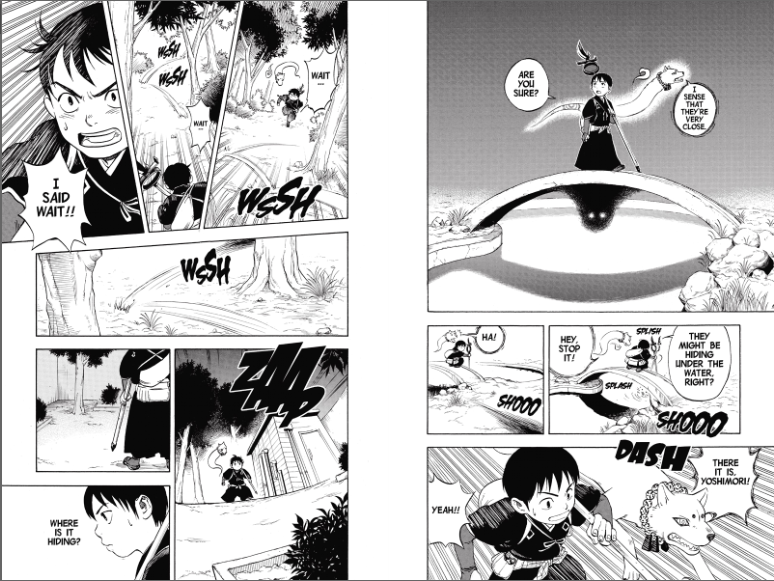
The premise of Kekkaishi is simple: Yoshimori Sumimura, a seemingly unremarkable fourteen-year-old boy, is a kekkaishi, or barrier-master. When he isn’t consuming unhealthy amounts of coffee-flavored milk, dozing off in class, or baking architecturally magnificent cakes (one of his pet obsessions), he’s patrolling the grounds of his school, which sits atop the Karasumori, a locus of magical energy that proves irresistible to ayakashi (demons) looking to augment their power. Yoshimori traps unwanted visitors within cube-shaped barriers, then vaporizes them, barrier and all.

Joining him on patrol are his sixteen-year-old neighbor Tokine Yukimura—a more disciplined kekkaishi whom Yoshimori secretly adores—and a small complement of demons that includes two dog spirits, Madarao and Hakubi, and a half-human, half-ayakashi, Gen Shishio. Further complicating matters are the families themselves: the Sumimuras and Yukimuras detest one another. Though their clans have been tasked with protecting the Karasumori for nearly 500 years, the oldest generation carries on an energetic feud, making it difficult for Yoshimori and Tokine to work together harmoniously. In short, Kekkaishi reads like an entertaining mash-up of Bleach, InuYasha, and Romeo and Juliet. (Or maybe Romeo Must Die. Take your pick.)

Each volume unfurls at a brisk clip, in part because Tanabe doesn’t feel the need to explain the entire mythology of the Karasumori site all at once. Nor does she resort to the kind of lazy, expository dialogue found in many shonen series with complicated backstories. (You know the kind: “As you know, Tokine, we’ve been combating ayakashi together for almost a year, and our faithful demon dog sidekicks have played an indispensable role in helping us rid the site of ayakashi. Don’t you think, childhood friend and neighbor of mine?”) Instead, Tanabe reveals details about the Karasumori site’s past gradually as she introduces new characters and confronts her principal cast members with new demonic challenges. In fact, the kekkaishis’ greatest adversaries—the Kokuburo, a group of powerful demons whose plan for world domination involves taking over the Karasumori site—don’t even appear in the first volume of the series.

What makes Kekkaishi such a joy to read is Yellow Tanabe’s consummate skill as both an illustrator and storyteller. Her artwork is clean and attractive, with bold lines and nicely composed pictures. Though her character designs are immensely appealing—and seem ready-made for the inevitable assortment of lunchboxes, t-shirts, shijikis, and coffee milk drinks that the series inspired—it’s her action sequences that really shine. Kekkaishi is one of the few shonen series where the fight scenes are (a) dynamic (b) thrilling (c) easy to follow (d) essential to the plot and (e) just the right length. There’s also a wonderful sense of play in Tanabe’s combat. Yoshimori and Tokine use kekkaishi not only as traps, but also as aerial stepping-stones that allow them to pursue demons mid-air.

There’s another appealing—and slyly didactic—aspect to these fight scenes as well. Though Yoshimori possesses greater spiritual powers than Tokine, it’s Tokine who frequently saves the day. Why? Because she practices creating barriers with the same diligence as she does her homework. Yoshimori, on the other hand, struggles to master his powers, sometimes embarking on marathon training sessions and other times neglecting to practice at all.

Kekkaishi offers readers more modest pleasures as well. Tanabe creates a colorful cast of supporting characters that include Yoshimori and Tokine’s sparring grandparents, who prove surprisingly spry for a couple of sexagenarians; Yoshimori’s father, who reminds me of James Dean’s apron-clad dad in Rebel Without a Cause; Masahiko Tsukijigaoka, a genial ghost who was a baker in life; Heisuke Matsudo, a nattily-dressed friend of Yoshimori’s grandfather with a specialty in weird science; and Mamezo, the grouchy guardian spirit of the Karasumori site who looks a bit like Kermit the Frog on a bender. Tanabe’s villains are a less colorful and distinctive bunch than, say, Naraku’s various incarnations, but I find that refreshing. For once the hero—and pals—are as vivid and appealing as the bad guys without having sordid or unnecessarily complicated backstories.

Like all shonen series, Kekkaishi suffers from an occasional dry spell. In volumes seven and eight, for example, the series seemed to have lost its mojo; I found the fight scenes tedious and felt Tanabe had fumbled in her depiction of Tokine, who went from being an appealing, competent character to a mere tag-along. But Tanabe quickly righted the ship in volume nine, introducing new characters, fleshing out the Kokoburo’s motives for capturing the Karasumori, staging some ecological intrigue at the Colorless Marsh, and revealing that Yoshimori’s dad has some demon-busting skills of his own. Though volume nine features two dramatic fight scenes, it’s the quieter, character-building moments that really shine, raising the emotional stakes by revealing unexpected facets of the heroes’ personalities; what happens in volume ten is all the more devastating because Tanabe makes us care deeply about her characters’ welfare.

If I still haven’t persuaded you that Kekkaishi is more fun than a barrel of demon monkeys, let me sing the praises of Yellow Tanabe’s omake. I don’t usually read sidebars or gag strips for reasons that David Welsh so aptly summarized in a memorable blog entry:

The content is generally pretty repetitive. They’re working really hard, and they’re sorry they’re behind on their fan mail. This volume isn’t as good as they’d have liked, but they’re trying, and reader support keeps them going. They wish they had a kitty. That sort of thing.

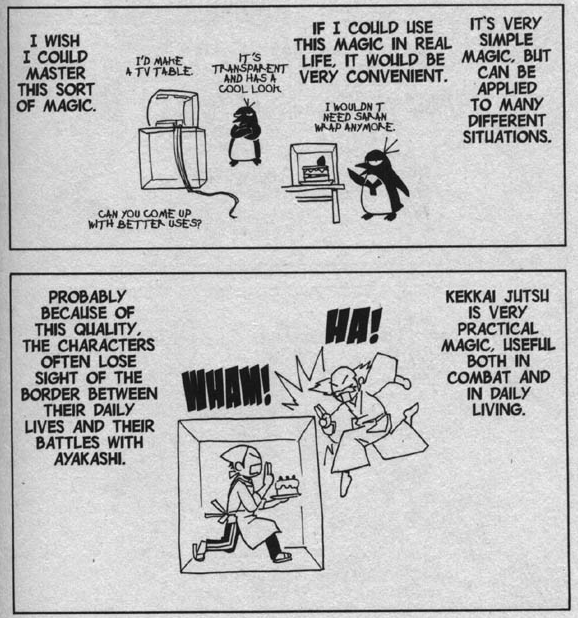
Tanabe’s omake steer clear of the usual bowing and scraping before the fandom. Instead, she depicts herself as a slightly tubby penguin with a perpetual scowl and an implacable panda for an editor. Not much happens in a typical strip, but the back-and-forth between penguin and panda is amusing and, for anyone who’s ever been on the receiving end of editorial criticism, all too true. She also has a lot of fun explaining her creative decisions:

And if you’re still on the fence, let me pull out my trump card: Kekkaishi is complete. Done. Finished. Finito.

After a successful eight-year run in Weekly Shonen Sunday, the series wrapped on April 6th with the publication of its 334th chapter. And by successful, I mean successful in Japan, where the series inspired a 52-episode television series and a robust assortment of video games, and nabbed nabbed the 2007 Shogakukan Award for Best Shonen Series. Here in the US, however, Kekkaishi has barely made a ripple. VIZ has been making a concerted effort to promote the series, featuring sample chapters on its Shonen Sunday website, licensing broadcasting rights to Cartoon Network, and releasing two budget editions: one digital (for the iPad), and one print. (Look for the first three-in-one edition on May 3, 2011.) I’m not sure why Kekkaishi hasn’t caught on with American audiences yet, but now is a great time to jump into this addictive series. I dare you not to like it!

This is a revised version of an essay that originally appeared at PopCultureShock on 5/14/07.

Filed Under: Manga, Manga Critic, Recommended Reading, REVIEWS Tagged With: Horror/Supernatural, Shonen, shonen sunday, VIZ, Yellow Tanabe, Yokai

From the stack: Tokyo Is My Garden

April 7, 2011 by David Welsh

Let me start by saying that Tokyo Is My Garden (Fanfare/Ponent Mon) has clearly been created with talent and professionalism. It’s attractive to look at, thanks to Frédéric Boilet, and it’s got a readable script by Boilet and Benoît Peeters. It paints a vivid picture of urban life in Tokyo. It’s even got “gray tones” by Jiro Taniguchi, whatever that means.

On the down side, it’s got one of those male protagonists I find grating: the lazy schlub who dates way out of his league. This isn’t always an implausible proposition, but you have to work a lot harder than Boilet and Peeters have to sell it. Maybe that’s my problem rather than a serious flaw in the comic, but we can’t help how we engage a work, and as I’ve tried to draft this review in my head, I keep constructing, not an assessment of the work’s value, but a conversation with a theoretical straight woman friend (TSWF).

So here we go:

TSWF: Who’s that?

ME: (Looking. Grimacing.) Oh, that’s David. He’s from France.

TSWF: Really? That’s kind of… interesting.

ME: (After a moment.) Oh, honey, no.

TSWF: What? It’s just an observation.

ME: It’s a fraught observation.

TSWF: Well, what’s wrong with him?

ME: He’s one of those types that assume things will work out without any effort on his part.

TSWF: What, romantically? Professionally?

ME: In every way. And the worst part is that things do work out for him.

TSWF: Is he dating anyone?

ME: Of course he is. He’s dating this hot fashion publicist named Kimie, who he started dating about five minutes after he got dumped by a hot model.

TSWF: What’s next? Techno enka cabaret singer?

ME: Probably.

TSWF: What does he do for a living?

ME: He claims he’s really a novelist.

TSWF: Has he written anything?

ME: Probably title pages and future reviews of his works.

TSWF: (Snorts.) Ow. Gin burns when it comes out through your nose. What does he really do?

ME: A cognac company is paying him to open up the Japanese market for their brand.

TSWF: That sounds fabulous.

ME: Doesn’t it? But he doesn’t do anything related to that. He dates, and he works at a fish market.

TSWF: Seriously? Like a shop, or one of those warehouse things?

ME: Warehouse things. I’m sure it’s all part of some literary scheme to inform his future prose with the working person’s perspective.

TSWF: So he could be hanging out in clubs and giving people free booze for a living, but he’d rather haul dead fish?

ME: Isn’t that deep?

TSWF: Until you think about it for eight seconds. Can I have his real job?

ME: Me first. Apparently, his boss is coming to Tokyo, and he’s all worried that his Bérnaise train is about to go off the rails.

TSWF: All because he’s never done a lick of the work he’s supposed to be doing. That’s so unfair.

ME: I know! And then he’ll have to go back to France. Can you imagine?

TSWF: God. This economy is cruel.

ME: Don’t worry too much. He got dumped by a beautiful woman only to wind up with a beautiful, smart woman. I’m sure he’ll end up accidentally getting a promotion before his boss goes back to France.

TSWF: Okay, so the down side is he’s a big pile of slack, but at least he’s an extremely lucky pile of slack. A woman could do worse.

ME: Or better. Much, much better.

The end.


Filed Under: REVIEWS

The Red Snake

April 5, 2011 by Katherine Dacey

The Red Snake isn’t the most disturbing manga I’ve read — that honor belongs to Mr. Arashi’s Amazing Freak Show, a book so intent on celebrating taboo behavior that I was certain I’d be arrested for having a copy in my house. But The Red Snake earns a special place on my manga-reading list for being one weirdest horror stories I’ve read, a grim fable about a family obsessed with bugs, boils, chickens, and snakes.

The book opens with the narrator wandering the halls of a sprawling house. “For as long as I can remember, I’ve wanted to get away from this house,” he explains. “Something evil lurks within these walls.” As lugubrious as the corridors and empty rooms may be, the inhabitants are even scarier: the grandfather is a tyrant who lavishes more attention on his poultry than on his family; the grandmother believes she’s a chicken and sits on a gigantic nest, attacking anyone who threatens her “territory”; the sister has an almost erotic fascination with insects; and the mother is a virtual slave, forced each day to massage and drain the pus from an enormous boil on the grandfather’s face. (Perhaps they’re the kind of people Tolstoy had in mind when he famously opined that “every unhappy family is unhappy in its own way”?)

What follows the prologue is hard to classify as a story; it’s more a string of loosely connected vignettes, all increasingly horrific, in which:

  • Snakes violate the sister in almost every way imaginable;
  • The sister kills chickens and drinks their blood — straight from their dripping necks;
  • The grandmother transforms into a chicken with a human head;
  • The mother gives birth to a monstrous creature that looks like a Garbage Pail Kid; and
  • The narrator goes mano-a-mano with a flotilla of zombie infants.

After nearly one hundred pages of blood-soaked insanity, we find ourselves right back where we started: the narrator begins his soliloquy about the house again, using the same words and wandering the same corridors as he did in the book’s opening pages.

Hino’s artwork resembles a scratchboard drawing or a woodblock print, characterized by large patches of black ink pierced by thin, white lines. In the opening pages, for example, there’s no visible light source anywhere in the house or the surrounding woods — no sky, no candles or lamps — creating an atmosphere of almost unbearable claustrophobia; the shadows are palpable, pressing in on the narrator just as surely as the demons he unwittingly frees later in the story.

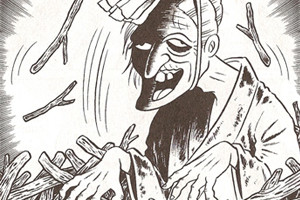
Character-wise, Hino’s designs belong to the same genotype as Kazuo Umezu and Kanako Inuki’s. Hino draws young girls and mothers as beautiful, glassy-eyed dolls and old women, fathers, and boys as grotesques. The narrator, for example, wears his worry like a shirt; he has enormous eyes rimmed in circles and is almost bald, even though his behavior and height peg him as a child of about ten or twelve. The grandparents, by contrast, resemble animals: the grandfather looks like a toad, with a bumpy hide, wide-set eyes, and a broad, leering mouth filled with rotting teeth, while the grandmother increasingly resembles the object of her delusion:

I feel like chicken tonight?

For all Hino’s ability to provoke and amuse, I’m not sure how I feel about The Red Snake. The story unfolds with the feverish logic of a dream, yielding some suitably creepy and bizarre images; I’ve never pictured the Sanzu River as alive with flesh-eating zombie babies, but it’s an arresting idea. The ending, too, is surprisingly effective. It’s not clear if the narrator realizes that he’s trapped in a cycle of unending horror, or is simply puzzled that all of the house’s nameless inhabitants have reverted to their “normal” state; either way, it’s a nasty punchline that subverts our desire — and the narrator’s — for closure.

At the same time, however, Hino has a juvenile fixation with blood, pus, and bugs, relishing every opportunity to draw a close-up of the grandfather’s boil or fill the page with a squirm of insects. Though some of these images merit an appreciative eewww, they’re too broadly cartoonish to really spook us; the grandfather’s ailments reminded me of an old George Carlin routine about the perverse delight humans take in studying their hangnails and pimples, rather than the disturbing metamorphoses found in Junji Ito and David Croenberg’s work. Maybe that’s Hino’s point: that we’re weirdly — almost comically — obsessed with our own bodily existence, but The Red Snake is so packed with ideas and sight gags and detours into the ludicrous that it’s hard to know what, exactly, Hino is trying to do besides mess with our heads.

THE RED SNAKE • BY HIDESHI HINO • DH PUBLISHING • 200 pp. • NO RATING (APPROPRIATE FOR OLDER TEENS AND MATURE AUDIENCES; SEXUAL CONTENT AND DISTURBING IMAGERY)

Filed Under: Manga, Manga Critic, REVIEWS Tagged With: DH Publishing, Hideshi Hino, Horror/Supernatural

From the stack: The Sky over the Louvre

April 4, 2011 by David Welsh

I adored Nicolas de Crécy’s Glacial Period, the first in NBM’s translations of graphic novels created in conjunction with the Louvre. It was funky and imaginative and had interesting things to say about art and the value of cultural history. I keep hoping the subsequent offerings in the series will offer the same feeling of discovery, but none has reached similar heights for me. I don’t regret buying and reading any of them, but I’m not in a rush to read any of them again.

That state of mind persists with The Sky over the Louvre, co-written by Jean-Claude Carrière and Bernar Yslaire and illustrated by Yslaire. It follows key players in the French Revolution during the earliest days of the Louvre’s tenure as a public institution. There’s fascinating potential to explore the intersection of art and politics and individual express in a time of national turmoil. Carrière and Yslaire take advantage of that intermittently, but the story is structured oddly. It veers from intensely personal to dryly polemic without any predictable rhythm or apparent design.

Carrière is a legendary screenwriter (The Tin Drum, The Unbearable Lightness of Being, The Discreet Charm of the Bourgeoisie), but it seems his skills as a storyteller aren’t portable to the graphic-novel form. The script he’s developed with Yslaire relies heavily on bits of expository text that open and sometimes close individual chapters. They provide context and valuable information, but they seem less like crafted prose than captions. Dialogue leans toward the weighty and stylized, and individual voices tend to get lost. The angelic young muse sounds very much like Robespierre, which doesn’t seem right.

Yslaire’s art is certainly striking, particularly the limited palette of colors he uses to accent the pages. His characters have a strangely cadaverous look, even looking decayed from time to time. It helps articulate the contradiction between revolutionary ideals and the men who execute them for their own purposes. It’s often delightful to see these corpses talk about the corruption of the aristocracy as they pursue their own contradictory, hypocritical agendas. There are some stunning tableaus, and the panels featuring more sinister, shadowy content are wonderfully expressive. I also admire the way reproductions of art from the period, particularly portraits by Jacques-Louis David, a key player in the narrative. They’re beautiful for their own virtues, and they pop, but they fold in to the overall narrative well.

Undeniably awkward as the historical content is, there are some genuinely gripping sequences, perhaps because they’re mostly invention. David, ordered to create masterworks for events celebrating the new Republic, allows himself to be waylaid by a beautiful young man who challenges David’s revolutionary principles. The boy, Jules, is barely a character, speaking almost exclusively in convenient metaphors, but David’s reaction to him offers the most compelling, charged moments in the comic. Sequences where David tries to force Jules into the posture of a young martyr of the revolution – for purely artistic purposes, surely – have an effective creepiness to them.

Maybe the whole book should have been invented rather than trying to adhere to the specifics of history. Those parts of the book are certainly more successful than the speechifying.


Filed Under: REVIEWS

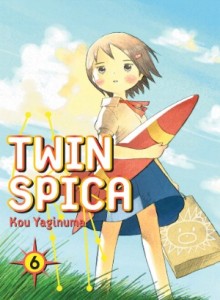
Twin Spica, Vols. 5-6

March 30, 2011 by Katherine Dacey

If you spend any time surfing the mangasphere, you don’t need me to tell you that Twin Spica is about a group of teenagers who are training to become Japan’s first astronauts. You probably know — or have heard from other readers — that it’s poignant. And you may have heard pundits declare it one of the best new series of 2010. (It made my best-of list.) Rather than re-hash plot points or tell you how awesome it is, therefore, I thought I’d share what I like best about Twin Spica: every volume makes me want to look up at the sky.

I’m not talking about the simple act of looking through a telescope or watching clouds drift in the wind — I’m talking about the way the act of looking at the sky makes me feel. Reflecting back on my childhood, that act elicited very specific emotions: the sky represented the future, a large canvas on which I could project my most cherished dreams of traveling to distant places, having adventures, and doing things that, from a six or eight-year-old’s perspective, seemed important. Kou Yaginuma clearly remembers that feeling from his own childhood, because his characters are at their most optimistic and thoughtful when they’re looking up at the sky and thinking about their own experiences.

There’s a lovely moment in volume six, for example, when Fuchuya’s grandfather tells six-year-old Asumi to cherish the memory of gazing up at the sky, as the sky will look different to her as she reaches adulthood. He explains:

You might as well spend your time looking up, at the sky. Me, I’ve spent decades staring up the sky in this town. I only thought the sky was very high when I was your age. When you’re old, it doesn’t seem quite that way. The sky you see as a kid is a lifelong treasure. I mean it. Value what you can see now, and only now.

Reading this passage reminds me of “Feldeinsamkeit” (“In Summerfields”), a beautiful piece of juvenilia from Charles Ives’ 114 Songs. The lyrics, taken from German poet Hermann Allmers, describe the experience of lying in a meadow on a summer’s afternoon and watching the sky. The sight of drifting clouds induces melancholy in his poem’s narrator, who — in typical nineteenth-century fashion — sees the clouds’ gentle, unfettered progress across the sky as a symbol of release from earthly burdens:

I’m resting quietly in tall green grass,
and cast my eyes far upwards;
around me crickets chirp unceasing,
the sky’s blue magically encloses me.

The beautiful white clouds float past
through the deep blue, like lovely silent dreams.
It is as if I had been long dead,
and flew in bliss with them through unending space.

Ives’ setting, by his own standards, is rather tame; there’s a running accompaniment figure that suggests fast-moving clouds, and a fleeting moment of bitonality, but it falls squarely within the nineteenth-century Stimmungslied tradition with its rounded binary form and gentle chromaticism. The song has an undeniably haunting quality, however. Its rapid modulation to harmonically distant key signatures and achingly sad melodic line suggest that the singer isn’t simply describing the act of watching clouds, as the lyrics alone might imply, but remembering what she was thinking and feeling as she did so.

That may sound like a minor distinction, but memory — or, more accurately, the act of remembering — is an important motif in the 114 Songs. “At the River,” for example, initially sounds like a straightforward rendition of “Shall We Gather At the River,” only to deviate from the melody as the singer “forgets” the proper tune, while “Memories” re-enacts a child’s enthusiasm at attending a concert. “In Summerfields” is less self-consciously modernist than either of these songs, but all three rely heavily on the illusion that the performer is reliving one of her own memories.

And that’s exactly the quality I find so compelling about Twin Spica: it’s a manga about living with vivid memories — some haunting, some happy — about reconciling past and present, about recognizing the value in both joy and pain, about negotiating the transition from youthful innocence to adulthood. In that scene with Fuchuya’s grandfather, we’re given a powerful reminder of just how much symbolic importance the sky holds for all of us, even if it doesn’t fill us with the same sense of wonder that it did when we were small.

Review copies provided by Vertical, Inc.

TWIN SPICA, VOLS. 5-6 • BY KOU YAGINUMA • VERTICAL, INC. • RATING: TEEN (13+)

Filed Under: Manga, Manga Critic, REVIEWS Tagged With: Seinen, vertical

Ai Ore!, Vol. 1

March 29, 2011 by Katherine Dacey

Androgyny is as much a part of rock-n-roll as sex, drugs, and three-minute guitar solos, so it seems only natural that a music-obsessed manga-ka would write about a female guitarist who struts like Mick Jagger, or a male singer who can wail like Whitney Houston. Putting two such androgynous rock-n-rollers together in the same manga seems like a stroke of genius — think of what Moto Hagio could do with those characters! — until you realize that Ai Ore! is written by the author of Sensual Phrase, quite possibly the silliest manga ever written about rock musicians.

Ai Ore! begins promisingly enough. Mizuki — a tall, masculine girl — reluctantly allows Akira — a short, feminine boy — to join her band Blaue Rosen. At first, Mizuki seems to be the dominant one; not only is she taller and stronger than Akira, she’s also more charismatic, commanding her friends’ loyalty through the strength of her personality, rather than her sexual allure. (Akira, by contrast, relies on his delicate good looks to get what he wants.) Mizuki claims to hate men, but it doesn’t take long before her cover is blown: she’s besotted with Akira.

So far, so good: Mizuki is a believable character, embracing a masculine persona to camouflage how uncomfortable she feels in her own skin. (As someone who was also tall and broad-shouldered in high school, I can attest to the special misery of being bigger than many of my female peers: I vacillated between striding the halls like General MacArthur and secretly wishing I was four inches shorter.) Even Mizuki’s desire to be softer and prettier for Akira makes sense; she can’t imagine that a boy would be interested in a girl who was unconventionally feminine, despite abundant evidence that both her female and male peers find her attractive.

No, where the story really goes off the rails is in its dogged insistence on including every shojo cliche in the Hana to Yume playbook. A few chapters into the series, for example, we learn that Mizuki’s ambivalence about men stems from a distressing childhood experience in which she became so infatuated with a cute boy that she felt physically ill. (In a line straight out of Guys and Dolls, Mizuki declares, “Men are bad for your health!”) Shinjo doesn’t bother to conceal the mystery prince’s identity from readers, nor does she use that revelation to bring her leads closer together; the whole episode feels completely perfunctory, as if Shinjo were ticking off plot points from a checklist. The same goes for a story line that sends Mizuki, Akira, and a bus full of girls on a retreat. You probably don’t need me to tell you that their destination is a resort with hot springs, or that Akira infiltrates the group by pretending to be girl, or that Mizuki’s virtue is threatened by one of Akira’s classmates who’s tagged along for the express purpose of putting the moves on Mizuki.

It’s too bad that the story settles for such predictable plot twists; there’s a germ of a good idea in here, a chance to challenge the way teenagers define “feminine” and “masculine” by celebrating kids who can’t be neatly pegged as either. Instead, Mizuki and Akira revert to stereotypical female and male roles in the drama, with Mizuki sobbing and trembling and needing rescues, and Akira playing the hero. Now where’s the rock-n-roll in that?

Review copy provided by VIZ Media, LLC. Volume one will be available on May 3, 2011.

AI ORE!, VOL. 1 • BY MAYU SHINJO • VIZ • 300 pp. • RATING: OLDER TEEN (16+)

Filed Under: Manga, Manga Critic, REVIEWS Tagged With: Mayu Shinjo, Musical Manga, shojo beat, VIZ

From the stack: Kingyo Used Books vol. 3

March 28, 2011 by David Welsh

Seimu Yoshizaki’s Kingyo Used Books (Viz) has been rightly (if harshly) criticized for its reliance on formula and simplistic sentimentality, so I thought it was worth noting that the third volume expands the boundaries of the series in some successful and satisfying ways.

For those who haven’t sampled the series online, it’s about a bookstore that specializes in manga. Customers come in and reconnect with an old favorite in ways that resonate with something that’s going on in their lives. It’s very affirming of fandom across the lifespan, and a little of that can go a long way, particularly in a fairly rigidly episodic format.

There’s a nice two-part story in the third volume that steps away from Kingyo and its customer-of-the-month fixation. In it, a salaryman leaves the corporate world to take over a manga rental library. Remembering a youthful transgression, he sets out to collect the books that were never returned to the library. He’s not punitive about it, but he’s willing to go to rather ridiculous extremes to reclaim some of the lost volumes.

It’s a nice change of pace. It also features (or possibly creates) another kind of shared fan touchstone that’s pleasant to see, even if Yoshizaki has manufactured it entirely. (Do Japanese people actually swap manga when they chance to meet each other abroad? I have no idea, but it’s a nice notion.) And the chapters give me fodder for another license request. (Jiro Taniguchi worked on a food manga? The mind reels.)

On the down side, an episodic structure sometimes promises a predictable number of duds. For me, the biggest disappointment in this volume was a piece spun around the manga of the wonderful Kazuo Umezu. It’s about a ladies’ man who sets his sights on a hardcore Umezu fan in spite of his aversion to horror. Given how distinctive Umezu’s work is, you’d think Yoshizaki might have tried to incorporate some of Umezu’s iconic weirdness into the piece. You’d think wrong. Nobody even wears a striped shirt.

But, stumbles and sentiment aside, Kingyo Used Books is never less than gently likable. I’m not sure it benefits from reading in big chunks, but you don’t have to, what with the SigIKKI serialization.


Filed Under: REVIEWS

How to Pen & Ink: The Manga Start-Up Guide

March 25, 2011 by Katherine Dacey

Type the words “how to draw manga” into the Amazon.com search engine, and you’ll net over 575 results. These books run the gamut from Manga-for-Dummies manuals, designed to teach beginners the basics of figure drawing and paneling, to highly specialized texts focusing on a specific skill — say, applying screentone or drawing buxom warriors.

One of the biggest drawbacks to these manuals is the lack of examples culled from actual manga; for licensing reasons, many of these how-to books feature original art that may not be drawn by a professional working in the Japanese publishing industry. And while many of these books possess genuine educational value for the beginning artist, teaching from a copy — however good it might be — isn’t the same thing as learning from the original. That’s where DMP’s How to Pen & Ink: The Manga Start-Up Guide comes in: the book is liberally illustrated with sketches, pin-up art, and finished pages from the work of Oh!Great (Tenjo Tenge, Air Gear), Yasuhiro Nightow (Trigun), and Satoshi Shiki (Kami-Kaze), as well as a half-dozen other established artists.

The book is divided into two sections. In the first, billed as a “close-up of how a manga is born,” each of the three featured manga-ka takes readers step-by-step through the creation of a pen-and-ink drawing, offering insights into their own work process. In the second, readers practice drawing their own manga. This section, which comprises most of the book, contains a list of tools used by professional manga artists, a lengthy Q&A section aimed at novice creators, and a variety of exercises, the most useful of which focus on working with pens. Over a four-week period, readers learn how to draw lines of varying weight, length, and straightness; how to draw effective speedlines; and how to use crosshatching to define space and volume.

What distinguishes Pen & Ink from other how-to manuals is its approach: manga isn’t treated as a style but as a storytelling medium. Almost of the advice focuses on how to draw effective stories, whether readers are learning where to place word balloons or how to use speedlines and panel frames to direct the eye to a key element in the layout. Though some of the tips are too vague to be helpful, the book is chock-full of examples culled from the pages of Air Gear, Kami-Kaze, and Trigun, as well as Hikou x Shonen, Oudo no Kishi Moro, Sgt. Frog, Trigun, and Vampire Princess Yui — a diversity that nicely underscores the manga-as-medium message.

Anyone who’s taken a few life drawing courses should be able to complete most of the exercises, though they may wish to supplement Pen & Ink with a manual on character design. (Tips for drawing eyes, hands, and bodies are too scarce to be very helpful to novice cartoonists.) For readers just learning the basics — anatomy, perspective drawing — most of the information in the book is too advanced to be immediately beneficial; the ideal audience is someone who already owns a few pens and drawing tools but needs guidance on how to work more effectively with them.

Review copy provided by Digital Manga Publishing, Inc.

HOW TO PEN & INK: THE MANGA START-UP GUIDE • VARIOUS AUTHORS • DMP • 114 pp. • NO RATING (BEST SUITED FOR TEENS, AS THE SECTION ON OH!GREAT INCLUDES SOME NUDITY)

Filed Under: Books, Classic Manga Critic, Manga Critic, REVIEWS Tagged With: DMP, How-To, Oh!Great, Satoshi Shiki, Yasuhiro Nightow

From the stack: Blue Exorcist vol. 1

March 21, 2011 by David Welsh

I would have loved to be a fly on the wall in the editorial meetings following the publication of the first chapter of Kazue Kato’s Blue Exorcist (Viz), because they must have been intense. That first chapter is terrible – bland, boring, and baffling, a triple threat in the realm of bad shônen. Aside from being ably drawn, it didn’t have a single aspect that would make me want to read the second chapter if I was a follower of Jump Square, its original home.

Someone at Shueisha, and possibly Kato herself, must have agreed, because the series rights itself completely in the second chapter and stays on course for the remainder of the first volume. It’s downright weird to see all of your complaints and criticisms answered in the space of a month. Even Viz must admit to this, since the free preview of the series is from the second chapter, not the first.

Blue Exorcist is about the son of Satan, Rin Okumura, but this fact has been kept from him by his foster parent, Father Fujimoto. Things go very badly when Rin learns this fact, but the experience leaves him with a goal – he wants to fight demons as an exorcist, even though his chosen profession views him as a likely threat and thinks everyone would be better off if he just died. It’s an awkward situation, compounded by the fact that Rin’s teacher at exorcist school is his fraternal twin, Yukio.

It’s nice to see another fraternal relationship as the crux of an action manga, what with the days of Hiromu Arakawa’s Fullmetal Alchemist (Viz) sadly numbered. Rin is rough around the edges, and Yukio is polished and restrained (and obviously much more studious than his elder twin). Beyond that, there are some dark undertones to their relationship. Yukio doesn’t have the burden of their demonic legacy, and he’s grateful for Rin’s protection throughout their sickly childhood. But Yukio is an exorcist, and his brother is half demon with very poor impulse control. It adds nice tension to the series.

It’s also nice to see Kato’s storytelling become sprightly and thoughtful after the first chapter’s muddle. There’s some solid resonance in the second and third chapters, and the supporting characters show a lot of promise. I’m particularly smitten with Mephisto Pheles, headmaster of the school for exorcists, the True Cross Academy. Mephisto looks ridiculous, both in human form and in those moments when he transforms into a dog (a West Highland White, if I’m not mistaken). He’s one of those grown-ups who seem more intent on amusing themselves than behaving in a strictly responsible fashion, and Mephisto certainly amused me, so I’d love to see more of him.

It seems like the fictional world of Blue Exorcist is moving towards some interesting coherence. The funny, quirky bits aren’t so ludicrous that they throw you out of the story, and Kato shows real flair in the more ostentatiously supernatural visuals. I wasn’t even bothered by the quasi-Catholicism of the whole affair, even though that’s almost always an indicator of a series I’ll despise. (For the record, that’s not due to any protectiveness for the Catholic church on my part. It’s just that manga Catholics are often the presented in exactly same kind of confusing cosplay fashion as manga vampires.) I didn’t find the demons very persuasive or interesting, but Kato seems to be building up a taxonomy.

Blue Exorcist really seems to have a lot of potential, which I never would have believed halfway through that first chapter. In fact, I’d suggest you skip that first chapter entirely, as its events are explained and reframed later (and better), and there’s really no reason to subject yourself to it. If you’re looking for an attractive shônen fantasy-adventure with a decent amount of wit and heart, it’s a likely candidate.

(These comments are based on a review copy provided by the publisher. You may remember that Blue Exorcist was a candidate in my first “readers’ choice” Previews experiment. Believe me, if it hadn’t shown up at random, I wouldn’t have bothered. It still sounds like a formulaic drag on paper.)

Filed Under: REVIEWS

Manga Artifacts: Memories

March 18, 2011 by Katherine Dacey

Given the speed with which DC Comics shuttered CMX Manga last year, it’s easy to forget that both DC and Marvel actually wanted to publish manga back in the day. Marvel’s manga output paled in comparison with DC’s, but is notable nonetheless, as Marvel helped introduce American readers to one the most influential manga-ka of the last thirty years: Katsuhiro Otomo. Like Dark Horse, Eclipse Comics, and other companies who dabbled in manga publishing in the 1980s and 1990s, Marvel licensed work that it believed would appeal to the direct market. Marvel’s first acquisition was Katsuhiro Otomo’s dystopian epic AKIRA. Between 1988 and 1995, Marvel published the story in thirty-eight issues, each colorized and flipped in a calculated bid to woo American sci-fi fans. Though Marvel never finished collecting the original issues into bound editions, AKIRA proved important nonetheless, offering many American readers their first exposure to Japanese comics.

Marvel licensed work from other countries as well — including Airtight Garage and Blueberry, both by French artist Moebius — but never developed a substantial manga catalog; aside from AKIRA, the only manga it published were two short, stand-alone stories from early in Otomo’s career: “Memories” and “Farewell to Weapons.” “Memories” was issued in two forms: the first, in 1992, was a standard, thirty-two-page pamphlet with flipped, colorized artwork. The second, in 1995, was only released in the UK; Mandarin Books re-printed “Memories” and “Farewell to Weapons” as part of a longer anthology of Otomo’s short stories. (That anthology is called Memories and is out-of print; the ISBN is 0749396873.)

Plot-wise, “Memories” is simple but effective: a three-man salvage crew accepts a job clearing the “Sargasso Sea,” a debris field in deep space. They begin receiving a mysterious transmission from a large, rose-shaped ship inside the field, and decide to investigate. Once aboard, the crew makes an astonishing discovery: the interior resembles an English manor house with a formal dining room, an immense library, and a mysterious hallway guarded by robot sentries. As the men begin searching the ship for clues to the owner’s identity, a constellation of forces — including a fierce magnetic storm — threaten to compromise their mission.

It’s a tried-and-true sci-fi plot that’s enlivened by the efficiency of the set-up and the specificity of the art. Otomo wastes few pages establishing the crew members’ personalities and reasons for accepting the assignment. Though he teases the reader with hints about what awaits the men aboard the ghost ship, Otomo doesn’t belabor the introduction, swiftly transferring the action from the salvage vessel to the “magnetic rose.” The contrast between the ships is arresting; the Disposer is cramped, with plain steel walls and banks of computers, while the ghost ship is opulent and cavernous, festooned in elk heads, gilt-framed oil paintings, mirrors, and the kind of expensive bric-a-brac one might expect to find at Thornfield or Chesney Wold.

Normally, I’m a purist about black-and-white imagery, but Steve Oliff’s expert coloring brings clarity and emotion to the work that might otherwise be absent. Many of Otomo’s finer details — the pattern in an elaborate rug, for example, or the grain in a wood panel — pop with the judicious use of color, giving the ghost ship’s interior a more palpable feel. The use of rich reds, purples, and golds colors further reinforces strangeness of the environment; we, too, want to know why this lavish ship is adrift inside a cloud of metal, glass, and machine parts. Most importantly, however, Oliff uses color to underscore the characters’ emotional state, using an intense, disturbing green backdrop in the final pages of the story to suggest their growing state of panic as they discover the ship’s true purpose.

Readers curious about “Memories” won’t have any difficulty scaring up inexpensive copies on eBay; I paid less than a dollar for a bagged and boarded one in great condition. Anime fans may prefer to seek out the big-screen adaptation, which is longer and more detailed than the source material. (More information about the anime can be found here.) In either format, this short story is surprisingly eerie and graceful, proof that even the most familiar plot lines can acquire new power in the hands of an expert storyteller.

Manga Artifacts is a monthly feature exploring older, out-of-print manga published in the 1980s and 1990s. For a fuller description of the series’ purpose, see the inaugural column.

MEMORIES • BY KATSUHIRO OTOMO • EPIC COMICS (MARVEL) • 32 pp. • NO RATING

Filed Under: Manga, Manga Critic, Recommended Reading, REVIEWS Tagged With: Classic, Katsuhiro Otomo, Marvel Comics

From the stack: Dengeki Daisy vol. 1

March 17, 2011 by David Welsh

When running through the winners of this year’s About.Com Manga Readers’ Choice Awards, I realized I hadn’t actually reviewed the first volume of Kyousuke Motomi’s Dengeki Daisy (Viz). Since I expressed puzzlement over its win in the shôjo category over two very superior titles, I thought I should go into more detail. To be honest, I can’t muster much. It’s solid enough, but I find it lacking in some essential ways.

It’s about an orphan named Teru whose older brother has died. She finds solace in communication with a mysterious person named “Daisy” who texts her via a cell phone Teru’s brother left her. Teru gets grief from her well-to-do classmates, but she holds her own. She does wind up in service to the school’s weird handyman when she breaks a window, but the handyman, Kurosaki, is concealing a protective streak towards his indentured minion. Could this jerky loner be the mysterious Daisy?

I was surprised at how little mileage Motomi got out of that question, to be honest. She seems more interested in moving into a narrative groove where Teru acts impulsively, gets into trouble, is saved by Daisy, and doesn’t realize that her taskmaster is also her text-message angel. It’s sad that Teru’s spunk only goes so far and that she’s so prone to requiring rescue. It’s also one of my pet peeves when a character withholds knowledge that could empower another and enable them to make better choices but doesn’t.

It’s conceivable that Kurosaki could have a persuasive reason to keep Teru in the dark, but it feels very by-the-numbers by volume’s end. I admit I would find it a tough sell under any circumstances. It’s hard to invest much in the series when the driving relationship is unsatisfying and, in my opinion, badly constructed.

But I’d love to hear from Dengeki Daisy partisans, especially if they feel the problems I have with the series are mitigated in later volumes. What say you?

Filed Under: REVIEWS

From the stack: The Zabîme Sisters

March 14, 2011 by David Welsh

I’m working my way through the top ten books on the 2011 Great Graphic Novels for Teens, one of which is the late Aristophane’s The Zabîme Sisters (First Second). It follows three girls from Guadeloupe through their first day of summer vacation, and it does so with a degree of clarity, honesty, and restraint that’s quite surprising and very refreshing.

Bossy M’Rose wants to watch a fight between the school bully and one of his targets. Attention-hungry Célina wants to hang out with some girlfriends. Timid Ella just seems to want as pleasant and peaceful a day as she can manage. They cross paths with classmates who have their own agendas and concerns. Manuel is trying to figure out what to do about his father’s broken pipe. Euzhan has smuggled some rum out of the house to share with her girlfriends. Some things go well, some go badly, and some just go.

Aristophane’s approach to slice of life is meticulously subdued. His narrative never overpromises, maintaining a steady pace of event but never inflating those moments into more than just moments. It’s a day, not an epic, and there’s comfort and familiarity in the string of anticlimaxes. The pleasure of The Zabîme Sisters is in its simplicity and candor.

Part of that candor comes in the form of sharp little bits of exposition that Aristophane sprinkled throughout the narrative. When Célina joins her family for breakfast, Aristophane offered this narration:

“Célina got up after making them beg her. She took particular pleasure in being pleaded with and in feeling indispensible. When she got this attention first thing in the morning, she felt especially content.”

These bits of omniscience are frank and illuminating, but they’re never intrusive. They add wonderful layers to the events, and they rarely flatter their subjects. Aristophane isn’t mocking his characters, per se, but his assessments are unsparing. But they reveal the emotional complexity of the characters, too, and they add weight and clarity to their actions. It’s a terrifically successful technique, and it lifts the book to a higher level.

The art has the same kind of chunky, inky beauty that I find so appealing in the work of Iou (Sexy Voice and Robo) Kuroda. Just about every panel is absorbing in its own way, with shifting perspectives and an eye-catching haziness. There’s a blend of precision and abstraction that adds interest; you’re always sure of what you’re seeing, but the rendering has enough oddity and expressionism to keep refreshing the way you see it. (Publishers Weekly ran several preview pages from the book.)

I’m actually kind of embarrassed that this book largely escaped my attention before making it onto the top ten list. It’s the kind of thoughtfully inventive work that always excites me, and its unique elements and techniques cohere in really admirable ways.

Other reviews in this intermittent series:

  • Set to Sea, written and illustrated by Drew Weing, Fantagraphics

You can nominate titles for the next Great Graphic Novel for Teen List, and you can take a look at the current batch of contenders.


Filed Under: REVIEWS

Wandering Son 1 by Shimura Takako: A

March 10, 2011 by Michelle Smith

Book description:
The fifth grade. The threshold to puberty, and the beginning of the end of childhood innocence. Shuichi Nitori and his new friend Yoshino Takatsuki have happy homes, loving families, and are well-liked by their classmates. But they share a secret that further complicates a time of life that is awkward for anyone: Shuichi is a boy who wants to be a girl, and Yoshino is a girl who wants to be a boy. Written and drawn by one of today’s most critically acclaimed creators of manga, Shimura portrays Shuishi and Yoshino’s very private journey with affection, sensitivity, gentle humor, and unmistakable flair and grace. Volume one introduces our two protagonists and the friends and family whose lives intersect with their own. Yoshino is rudely reminded of her sex by immature boys whose budding interest in girls takes clumsily cruel forms. Shuichi’s secret is discovered by Saori, a perceptive and eccentric classmate. And it is Saori who suggests that the fifth graders put on a production of The Rose of Versailles for the farewell ceremony for the sixth graders—with boys playing the roles of women, and girls playing the roles of men.

Wandering Son is a sophisticated work of literary manga translated with rare skill and sensitivity by veteran translator and comics scholar Matt Thorn.

Review:
The main thing I kept thinking about while reading Wandering Son—beyond the continuous undercurrent of general squee—is how things that seem insignificant to one person can be secretly, intensely significant to someone else.

Wandering Son begins simply. Nitori Shuichi (the translation retains Japanese name order) is an extremely shy fifth-grade boy, and as the volume opens, he and his sixth-grade sister, Maho, are preparing for their first day at a new school. Upon arrival, Shuichi is instructed to sit next to Takatsuki Yoshino, a girl so tall and handsome that she’s called Takatsuki-kun by her classmates. They become friends.

One day, when Shuichi goes to Takatsuki’s house to work on some homework, he spies a frilly dress hanging in her room. Perhaps Takatsuki didn’t mean much of anything when she suggested that Shuichi should wear it, but it’s an idea that refuses to leave his head, despite his protests that he isn’t interested. He ends up taking the dress home and giving it to Maho, but its presence in their shared bedroom taunts him.

At this point, Shuichi isn’t thinking about things like gender identity. He’s ten! Instead, he’s dealing with processing the new idea that he could wear a dress and that he might even want to. Slowly, and bolstered by interactions with another encouraging classmate, he begins experimenting. First, he buys a headband. Then he tries dressing as a girl while no one else is home. Finally, when Takatsuki reveals her own treasured possession—her elder brother’s cast-off junior high uniform—he tries going out as a girl in public, with Takatsuki (as a boy) at his side.

One wonders what would’ve happened to Shuichi without Takatsuki to set the example. Would he have become aware of these feelings within himself eventually or been somehow unfulfilled forever? Her comments and her acceptance mean more to him than she knows, as he has a habit of internalizing things that are said to him. After an adorable turn in a female role in a drag version of The Rose of Versailles at school, for example, Maho conversationally notes, “You should have been born a girl.” Again, this is a concept that’s new to Shuichi, but one he gradually comes to believe is true. When his grandmother promises to buy him a present, he visualizes his female form and realizes it’s what he most wants. “Even grandma can’t buy me this.”

I had no problem seeing Takatsuki as a boy throughout, because of her inner certainty and obviously boyish appearance, but Shuichi was more problematic. The moment he confronts the mental vision of what he feels he should be, however, and realizes that he truly wants to be a girl, he starts to become one for the reader. By contrast, it’s shocking when the onset of her first period reminds readers that Takatsuki is biologically female. Though she mostly projects a confident air, her anguish at the undeniable truth that she is not really a boy is intense.

The story is subtle, simple, poignant, and innocent. The tone is matched by Shimura’s uncluttered artwork, which features big panels, little screentone, and extremely minimal backgrounds. These factors combine to make the volume go by quickly, and all too soon it’s over. While waiting for volume two, in which Shuichi and Takatsuki will progress to the sixth grade, I suspect I will have to console myself with the anime adaptation, currently available on Crunchyroll.

The first volume of Wandering Son—published in English by Fantagraphics—will be available in June 2011. The series is still ongoing in Japan, where it is currently up to eleven volumes.

Review copy provided by the publisher.

Filed Under: REVIEWS Tagged With: fantagraphics, Takako Shimura

From the stack: House of Five Leaves vol. 2

March 10, 2011 by David Welsh

Of all of the series in Viz’s SigIKKI initiative, I think Natsume Ono’s House of Five Leaves is probably my favorite. It’s intriguing in a very delicate, oblique way, and it’s rare to be able to say that about… well… just about any kind of entertainment.

It’s about an out-of-work samurai called Masa who falls in with a gang of kidnappers. Masa isn’t a bad person, but he lacks confidence, and he doesn’t inspire it. He looks physically frail, and whatever good intentions he may have are outweighed by the harsh realities of his jobless existence.

Beyond necessity, the gang, the Five Leaves, have a kind of lazy allure. They aren’t violent, and they plan carefully to make sure they profit from their illegal activities. There’s Matsukichi, the spy who prefers to keep his own counsel. In the rest of his life, Ume owns a bar and looks after his daughter who’s just entering adulthood. Sexy, mature Otake views life with a wry curiosity. And Yaichi, their ringleader, has a shady glamour and a strange kind of affection for, or at least profound interest in, Masa.

They’re appealing individually and as a quintet. Ono has assembled the kind of cast I could happily read about if they just sat around and drank and gossiped (which they do a lot). But she finds surprising depths in all of them, and she shifts their relationships around in measured but heartfelt ways.

The second volume digs into Umezo’s criminal past as it encroaches on his present. Masa is recuperating with Ume’s former boss, Goinkyo. Two of Goinkyo’s former underlings are stirring up trouble, one reluctantly and one maliciously. There’s blackmail involved, and violence, but they’re secondary to the dynamics that fuel them. Fatherly Goinkyo seems to have a sense for people who aren’t cut out for a life of crime, and his observations resonate through the events and revelations of the volume. And, of course, there’s Yaichi, guarding his secrets and managing the state of his colleagues at the same time, while wanting to not seem like he’s trying very hard.

In that, he’s representative of the series itself. It kind of glides along, casting sideways glances at its characters that mask the sharpness of its observations. It’s sly, but it’s also very sincere. With an apparent absence of effort, Ono has crafted a cast and a set of circumstances that are deeply involving, even at a very low volume. Ono leaves you wanting to know everything there is to know about these intensely private people, even as you understand she probably won’t spill everything. As low-key as House of Five Leaves is, it’s also cumulatively stunning. I can’t get enough of its hidden depths.


Filed Under: REVIEWS

  • « Go to Previous Page
  • Page 1
  • Interim pages omitted …
  • Page 300
  • Page 301
  • Page 302
  • Page 303
  • Page 304
  • Interim pages omitted …
  • Page 346
  • Go to Next Page »
 | Log in
Copyright © 2010 Manga Bookshelf | Powered by WordPress & the Genesis Framework