• Skip to primary navigation
  • Skip to main content
  • Skip to primary sidebar
  • Home
  • About Us
    • Privacy Policy
    • Comment Policy
    • Disclosures & Disclaimers
  • Resources
    • Links, Essays & Articles
    • Fandomology!
    • CLAMP Directory
    • BlogRoll
  • Features & Columns
    • 3 Things Thursday
    • Adventures in the Key of Shoujo
    • Bit & Blips (game reviews)
    • BL BOOKRACK
    • Bookshelf Briefs
    • Bringing the Drama
    • Comic Conversion
    • Fanservice Friday
    • Going Digital
    • It Came From the Sinosphere
    • License This!
    • Magazine no Mori
    • My Week in Manga
    • OFF THE SHELF
    • Not By Manga Alone
    • PICK OF THE WEEK
    • Subtitles & Sensibility
    • Weekly Shonen Jump Recaps
  • Manga Moveable Feast
    • MMF Full Archive
    • Yun Kouga
    • CLAMP
    • Shojo Beat
    • Osamu Tezuka
    • Sailor Moon
    • Fruits Basket
    • Takehiko Inoue
    • Wild Adapter
    • One Piece
    • After School Nightmare
    • Karakuri Odette
    • Paradise Kiss
    • The Color Trilogy
    • To Terra…
    • Sexy Voice & Robo
  • Browse by Author
    • Sean Gaffney
    • Anna Neatrour
    • Michelle Smith
    • Katherine Dacey
    • MJ
    • Brigid Alverson
    • Travis Anderson
    • Phillip Anthony
    • Derek Bown
    • Jaci Dahlvang
    • Angela Eastman
    • Erica Friedman
    • Sara K.
    • Megan Purdy
    • Emily Snodgrass
    • Nancy Thistlethwaite
    • Eva Volin
    • David Welsh
  • MB Blogs
    • A Case Suitable For Treatment
    • Experiments in Manga
    • MangaBlog
    • The Manga Critic
    • Manga Report
    • Soliloquy in Blue
    • Manga Curmudgeon (archive)

Manga Bookshelf

Discussion, Resources, Roundtables, & Reviews

Reviews

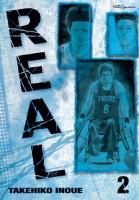
Real, Vol. 2

March 9, 2014 by Ash Brown

Real, Volume 2Creator: Takehiko Inoue
U.S. publisher: Viz Media
ISBN: 9781421519906
Released: October 2008
Original release: 2002
Awards: Japan Media Arts Award

Although I wouldn’t necessarily consider myself to be a sports fan, I have come to the realization that I really enjoy sports manga. Out of all of the sports manga that I’ve so far read, Takehiko Inoue’s wheelchair basketball series Real is the one that stands out for me the most. (Actually, Real happens to be one of my favorite manga series in general.) But it’s really more than just a sports manga. Yes, basketball is an important part of the series, but to an even greater extent Real is about challenges faced in life and how people deal with them. It’s a mix of human drama, tragedy, and hope that earned Inoue a Japan Media Arts Award Excellence Prize in 2001. The second volume of Real was first published in Japan in 2002 while the English edition was released in 2008 by Viz Media under its Signature imprint. Real, Volume 1 did a fantastic job of introducing the series’ main characters and establishing some of the themes that the manga begins to explore more deeply in the second volume and those that follow.

After his accident, Takahashi no longer has the use of his legs. Confined to a hospital bed and with very few visitors he has had to come to terms with his condition largely on his own. He had good grades and excelled at whatever he applied himself to, becoming the captain of his high school’s basketball team with ease. No longer having the ability to walk is a devastating blow to Takahashi and how he is viewed by others and by himself. It won’t be an easy process to compensate for what he has lost. It’s been five years since Togawa lost one of his legs to bone cancer and that’s something he continues to struggle with. He still has most of his mobility, but having a leg amputated brought his dream of becoming the fastest sprinter in Japan, if not the world, to an abrupt end. An extremely competitive athlete he has redirected his ambitions towards wheelchair basketball, now one of the few things in his life for which he has any enthusiasm. Nomiya has a strong love for basketball as well, but as a high school dropout he currently has no outlet for that passion.

A large portion of Real, Volume 2 is devoted to Togawa and part of his backstory. The series turns to his middle school days as he is discovering his love of running, struggling with his relationship with his father, and developing strong, lasting friendships. Immensely talented, it is crushing to know that Togawa will never achieve his dream even as everything seems to be going his way. Just as Takahashi is now being forced to admit his limitations, Togawa also had to deal with events in his life that were beyond his control. The interplay between their two stories in Real is handled extraordinarily well. The two young men have never met, their only direct connection at this point is that they both know Nomiya, but Inoue draws on the parallels between their experiences to great effect. Takahashi is at the beginning of his recovery while Togawa has made years of progress, but the challenges that they face are very similar. Their personalities and how they handle things are very different, though.

Parallels also exist between Togawa and Nomiya. They are both very focused and intense, taking any and all opportunities that they can to practice and improve their game. Even when Togawa, Nomiya, and Takahashi’s stories don’t directly intersect, they are all still very closely tied together. The second volume of Real is very much about beginnings and endings. After originally leaving his basketball team, Togawa has found new drive and inspiration that brings him back. Nomiya doesn’t have the option of returning to his old team and can only watch from the sidelines as his former teammates play their last game. As for Takahashi, he can’t even do that. His denial is slowly turning into agonizing despair as he comes closer to admitting to himself that his life will never be the same. Inoue captures all three of their struggles in a very realistic way. The story is emotionally intense without being melodramatic and the artwork is fantastic, making Real and incredibly effective series.
Filed Under: REVIEWS Tagged With: Japan Media Arts Award, manga, real, Takehiko Inoue, viz media, VIZ Signature

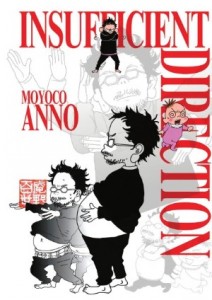
Insufficient Direction

March 9, 2014 by Sean Gaffney

By Moyoco Anno. Released in Japan as “Kantoku Fuyuki Todoki” by Shodensha, serialized in the magazine Feel Young. Released in North America by Vertical.

The North American market has been enjoying Moyoco Anno’s manga for years now, be it Happy Mania, Sugar Sugar Rune, or Sakuran. Hideaki Anno has also been a favorite over here, mostly for Evangelion but also for cult classics like Gunbuster and Nadia: The Secret of Blue Water. (And also infamous for the Kare Kano anime… and, well, Evangelion.) As a result, a volume such as this one, which is a biographical look at their married life with an otaku slant, is one that can actually be released over here and gather some interest. The book itself is a lot of fun, though it did go in a direction I wasn’t quite expecting…

direction

Of course, this is deliberate. Moyoco Anno frames the story to set up my expectations of a normal Japanese woman overwhelmed by her insane otaku husband. The first chapter shows her avatar, Rompers (so called as she draws herself as a baby in a sleeper outfit), stepping on Gigantor toys left around the house like they were a child’s Lego toys. And yet throughout this book, the message we get is somewhat different: Moyoco is a lot like him. It’s very easy for her to get drawn into the otaku lifestyle, and she’s a lot less ‘normal’ than she may pretend to be. As for Director-kun, his sense of self and peace with being a giant weirdo is so great that he ends up being the calm and collected one a lot of the time. It really reads like a great relationship.

A word of warning: there are a LOT of translator notes for this volume. The Anno life is cluttered with 60s Japanese TV series, be it familiar ones such as Ultraman and Star Blazers or untranslated works like A Karate-Crazy Life. And, like many obsessed fans (including myself), the couple tend to speak to each other in terms of the media consumed. Even an argument about proper use of Japanese is referencing Dragon Ball and Galaxy Express 999. This is not something that a casual reader should pick up, though if they do they can at least be reassured that there are lots of notes telling them the importance super sentai shows and George Akiyama.

I note that this series ran in the josei magazine Feel Young, and its presence there was not all that unusual. Most josei magazines (and many seinen ones as well) have these slice-of-life biographical “and here’s what my husband/child/cat did the other day” comics running through them, usually in short 5-6 page bursts in between the larger serialized stories. (And indeed, the chapters in Insufficient Direction are all about that length.) It’s a type of story we’ll almost never see over here, partly due to cultural translation issues but mostly because there’s not really a market for it – North American anime and manga fans tend to prefer their slice-of-life looking more like K-On!. As such, this title is not only an amusing look at the otaku lifestyle of the author and her husband, but also a glimpse into a genre that we are rarely privileged to witness. It’s a lot of fun.

Filed Under: REVIEWS

Toradora, Vol. 6

March 8, 2014 by Sean Gaffney

By Yuyuko Takemiya and Zekkyo. Released in Japan by ASCII Media Works, serialization ongoing in the magazine Dengeki Daioh. Released in North America by Seven Seas.

Given how impossible it is for most mass media to avoid cliches and tropes, the question often becomes “how well does this work manage the cliche”? This volume of Toradora! handles this in both a comedic and serious fashion. The Culture Festival rears its ugly head, and though thoughts of a maid cafe drift through our male classmates’ heads, what we end up with is far sillier, particularly after it’s subverted midway through. It’s the more serious plotline that folks will take with them, however – Taiga’s father is back in her life again, and wants her to come live with him. Something which a projecting Ryuuji can’t help but assist with.

toradora6

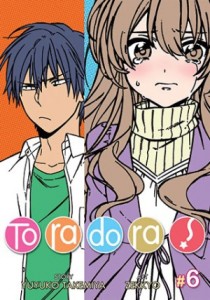
Ryuuji is not helped by the cover art for the volume, showing a tear-filled Taiga and Ryuuji looking askance. This clues the reader in that we are meant to be in her side in the matter. Things are not helped by the appearance of her father himself, who seems far too contrite and meek to be true. Of course he’s playing right into Ryuuji’s hands, though I don’t think that it’s deliberate on his part – her father isn’t genuinely evil, he’s just monumentally selfish. What he doesn’t know, but we do, is that Ryuuji’s lack of a father figure looms incredibly large in his life. And so naturally Ryuuji is going to move heaven and earth to see Taiga and her father reunite, just as he can never do.

On the other side we have Taiga and Minori, who have experience with her father doing all this before and know the truth. Crucially, however, neither of them tell Ryuuji that full truth. In meta terms, this is because the plot has to happen. In the story itself, though, Taiga is more understandable. She gets the reasons why Ryuuji wants this to happen, she’s in love with Ryuuji and doesn’t want to disappoint him, and she really does love her father despite everything, so she opens herself up to him one more time. Minori, though, I’m rather disappointed in, as you’d think she’d be the one to sit Ryuuji down and say ‘Hey, let me give you a timeline of the times this guy has tried this with Taiga before.’ Instead, she just gets angry, saying it’s obvious he’s being a selfish ass. And so they fight, which, Ryuuji still having lingering feelings for Minori, devastates him.

Luckily, Ami is there to be the voice of reason and get Ryuuji out of his funk. Unluckily, Taiga’s dad *is* everything they say he is, and therefore things come to a head at the culture festival with a devastating text sent to Ryuuji. And, once Ryuuji sees for himself what’s going on, he gets it all IMMEDIATELY – a sign of his maturity, even as he backslides here. Sadly, resolution will have to wait – this is the end of the volume, and so we get the horrible cliffhanger with Taiga’s appearance on stage waiting for parental acknowledgement that will never come. How is this going to be resolved? Well, Toradora! comes out about every year and a half in Japan, so we’ll likely have to wait till summer 2015 to find out. See, and folks wonder why publishers don’t want to catch up to Japan…

Filed Under: REVIEWS

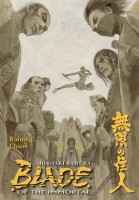
Blade of the Immortal, Vol. 28: Raining Chaos

March 7, 2014 by Ash Brown

Blade of the Immortal, Volume 28: Raining ChaosCreator: Hiroaki Samura
U.S. publisher: Dark Horse
ISBN: 9781616553210
Released: January 2014
Original release: 2011
Awards: Eisner Award, Japan Media Arts Award

Raining Chaos is the twenty-eighth volume in the English-language edition of Hiroaki Samura’s manga series Blade of the Immortal. Because of slight differences between the Japanese and English publications of the series, Raining Chaos is actually equivalent to the twenty-seventh volume of Blade of the Immortal released in Japan in 2011. The English edition was released by Dark Horse in 2014. Blade of the Immortal is a multi-award-winning series, having earned Samura honors both in Japan and in other countries. The series was one of the first manga that I made a point of following, so I am glad that Dark Horse is seeing Blade of the Immortal through to its end. Raining Chaos is part of the fifth and last major story arc in Blade of the Immortal. With only a few volumes left in the series, Blade of the Immortal is quickly approaching its final climax and Raining Chaos is part of that approach.

The majority of the remaining Ittō-ryū members have steadily been making their way to Hitachi, but it was only a matter of time before those in pursuit would catch up with them. After encountering the Rokki-dan en route, the Ittō-ryū has once again split its members into smaller groups so that some of them may have a better chance of survival. Most stay behind to face the Rokki-dan warriors, hoping to at least delay them if not destroy them, while a smaller force forges ahead attempting to keep the Ittō-ryū’s current second-in-command, Abayama Sōsuke, alive and safe. What they hadn’t counted on was the involvement of the Mugai-ryū, the predecessor of the Rokki-dan. Only two members of that group are still alive, and neither of them are the fighters that they once were, but they are both still extremely skilled and dangerous. With the Ittō-ryū occupied with both the Rokki-dan warriors and the Mugai-ryū assassins, the continued existence of the radical sword school looks increasingly grim.

The Ittō-ryū isn’t so much a specific style of fighting as it is a philosophy. The only agreed upon “rule” is that battles are nominally to be fought one-on-one. Other than that, almost anything goes. In part because of this, the school has attracted a diverse group of fighters with different backgrounds, martial abilities, and motivations. Some, like the Ittō-ryū’s leader Anotsu Kagehisa and several of the other high-ranking members, have very honorable intentions; they fight against what they see as corruption, though their methods may be questionable. Abayama, for example, is very concerned about the welfare of the men who train and serve under him. Others, however, are more interested in their own personal vendettas and selfish desires. They don’t care about others as long as they get what they want. The differences between these two types of people–those with noble and lofty ideals and those who are completely without morals–can be clearly seen in Raining Chaos. Even so, they are all still Ittō-ryū.

In addition to having different goals and reasons for joining the Ittō-ryū, the individual members also have different styles of fighting, which is put to good use in Raining Chaos. There isn’t much plot development in this particular volume of Blade of the Immortal, but there is plenty of action as the confrontation between the remnants of the Ittō-ryū and the Rokki-dan and the Mugai-ryū is largely brought to a conclusion. Happily, the battles in Raining Chaos are quite good; they’re well-choreographed and interesting to watch play out. Samura has a tendency to introduce unusual weapons and techniques in Blade of the Immortal, but even the most fantastic and strange have some basis in reality; legitimate tactics and fighting techniques are still applied to the battles in the series. In Raining Chaos, the importance of range and distancing is particularly emphasized. With excellent fights and compelling characters, Blade of the Immortal continues to be a series that I enjoy. I’m looking forward to the next volume, Beyond Good and Evil, a great deal.

Filed Under: REVIEWS Tagged With: Blade of the Immortal, Dark Horse, Eisner Award, Hiroaki Samura, Japan Media Arts Award, manga

Phantom Thief Jeanne, Vol 1

March 4, 2014 by Anna N

Phantom Thief Jeanne Volume 1 by Arina Tanemura

Phantom Thief Jeanne is by far my favorite Arina Tanemura series. It is also one of her earlier ones, since it came out in 1998. It might be less polished than her more recent series, but I have always found it amusing because it has a certain magical girl “throw the spaghetti on the wall and see what sticks” approach to plotting that I find amusing. It also has one of the most bonkers ending volumes I’ve experienced in shoujo manga. I already own the full set of this series from the CMX edition that came out in 2005, but this reissue from viz is based on what I assume are the Bunkoban volumes in Japan, so instead of a seven volume set, this edition will be 5 longer length volumes. There’s a new translation, a color page, and a couple extra sketches in the back.


The Jeanne in the title is in real life the ordinary high school student Maron Kusakabe, who is in the rhythmic gymnastics club at her school. At night, she magically transforms into Phantom Thief Jeanne, who fights for the forces of good in the universe by detecting demons hidden inside masterworks of art and exorcising them. The demonic possession will also extend to the owner of the piece of art, leading Maron to have plenty of encounters with oddly acting art collectors. Maron is aided in her holy quest by her helper, the tiny angel Finn. Maron’s phantom thief name is due to the fact that she’s the reincarnation of Joan of Arc, so she is extra skilled at being a art thief warrior for God. As the volume begins, Maron attempts to deflect her friend Miyako’s interest in her secret alter ego and she’s made a bit nervous by Chiaki, the flirty new boy who just moved in next door in her apartment building.

Maron has a frustrating day and heads out for her typical night out phantom thieving. Her best friend Miyako, who’s father is a police detective, is on the scene determined to capture Jeanne. Like any good phantom thief, Jeanne tends to leave warning notes with clues about where she intends to strike. Jeanne has one of the best magical girl introductions, as she proclaims “I am the Phantom Thief Jeanne…sent down before you by God!” It is hard to argue with the power of the Almighty. When she seals the demon inside the painting, she yells “Checkmate!” and a white chess piece appears. The painting changes into a depiction of an angel, and usually the owner of the painting is so happy at the quality of the new work of art and the lack of danger to their immortal soul that they don’t tend to mind Jeanne’s intervention.

Jeanne is bounding along in the night, trailing ribbons when an enemy appears! It is Phantom Thief Sinbad and he announces his intention to challenge her! Maron goes through her regular school activities, fending off Chiaki by day and dealing with Sinbad’s sudden appearance near all the works of art that she’s targeting at night. It is amazing how Sinbad basically looks just like Chiaki but with a headband and a cloth covering the lower half of his face. Sinbad has similar powers as Jeanne, but he can turn captured demons into black chess pieces and has a dark angel helper as a counterpart to Jeanne’s angel Finn. As a shoujo manga heroine, Maron is both exuberant and kind. Chiaki clearly starts developing feelings for her as he spends more time with her. Maron is also desperately lonely, because her parents went away and haven’t been in touch with her. Maron has a great deal of difficulty trusting people, but she starts opening up to Chiaki a little bit. As Jeanne’s missions continue, Sinbad acts as more of a helper than a rival, but he seems very conflicted about it.

The art in Phantom Thief Jeanne is exactly what you would expect from a Tanemura title, but maybe a tiny bit less detailed than her later works. I enjoyed having a chance to read the manga again in a new edition. I thought that the new Shojo Beat translation was a bit more subtle and smooth than the CMX editions. I also preferred the lettering in the Shojo Beat edition. The CMX version tended to use a great deal of variation in font size and font weight to convey emotional aspects of the dialog, and while that can be an interesting approach, when I was reading a few pages from each edition side by side, I thought that the CMX edition was a bit more choppy in terms of reading experience. Since this is a reissue, I almost wish that the edition had been a bit more deluxe, with a few more color pages or some other extras. I did like the new edition very much, I’m not sure I’d recommend that everyone who already has the CMX version rush out and buy it right away but it has been so long since the first edition of Phantom Thief Jeanne came out there’s a whole new group of readers that can experience this title for the first time!

Filed Under: REVIEWS Tagged With: Arina Tanemura, phantom thief jeanne, shojo beat, shoujo

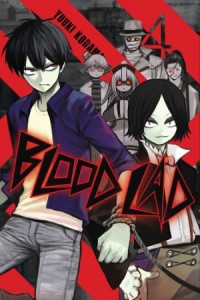
Blood Lad, Vol. 4

March 4, 2014 by Sean Gaffney

By Yuuki Kodama. Released in Japan by Kadokawa Shoten, serialization ongoing in the magazine Young Ace. Released in North America by Yen Press.

In the new Blood Lad omnibus, a lot of big things happen. We finally see what’s going on with Braz and what he’s planning; Wolf meets up with his human mother (an ex-Yanki, to boot!) and is told he may have to be the hero that saves the demon world; Staz is captured by the authorities and later reunited with Braz, who gives himself up; and a major confrontation seems to be what Vol. 5 will be all about. Despite all this, it’s the small character moments of Blood Lad that are the best, the funniest, the most heartwarming, and keep me coming back for more.

bloodlad4

Let’s take a look at Fuyumi. If nothing else, she continues to be the most problematic character in the series. Staz is trying to get her to be more of her own person, but this seems to have devolved into a basic shonen “I will protect you” stance that isn’t really helping. (Also, putting a rope around her and dragging her around is probably his low point. Naturally, Fuyumi points out how humiliating it is but doesn’t really object.) She does get a nice moment later on, where the cowboy outfit and accessories Staz bought her prove useful to getting her out of a perilous situation. But probably the most striking scene is seeing her addiction to Staz’s blood, and how this is shown to be VERY BAD for her and yet at the same time the most erotic scene in the entire volume. I suspect I’m reading too much into her each time, but what else am I supposed to do? Ogle the boobies? Let’s keep overanalyzing.

We meet up with a superhero team in this volume as well, who are shown on the cover. As with most superhero teams, they’re a collection of eccentric weirdos with bizarre powers that seem to bond together as a unit when the chips are down. And, as with Wolf and a number of other people, they’re pitted against Staz, who remains the “bad guy” even as he’s the hero. Can you be a good guy when the entire world views you differently? Later on, when Staz and Fuyumi are captured by the police, we see something similar. Staz is a vampire overlord with massive amounts of untapped power (so much it can apparently be used to resurrect the dead), and now is the best time to stop him, before he discovers that potential.

And then there’s the climax of the volume, which I will walk around and try not to spoil. It should be a very emotional, heartwarming moment, but it seems filled with a sort of impermanence, a sense that this isn’t going to last long. Braz seems to get this too – his open affection for Liz reads very much as a “I’m about to die and will never see you again” gesture (poor Liz, by the way – there’s some great in-text analysis of her character and how she’s starved for affection from her brother). In the end, I have a suspicion that the confrontation that is the cliffhanger to this volume will be dealt with swiftly and anticlimactically before long when we get to Volume 5.

Overall, this remains a great read. You breeze right through it, it’s filled with good humor, some creepy horror, and occasional character development. Plus the obligatory fanservice. It’s everything you could want in a shonen manga (well, except it’s seinen, running in Young Ace… shh, don’t talk to me about demographics).

Filed Under: REVIEWS

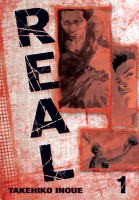
Real, Vol. 1

March 2, 2014 by Ash Brown

Real, Volume 1Creator: Takehiko Inoue
U.S. publisher: Viz Media
ISBN: 9781421519890
Released: July 2008
Original release: 2001
Awards: Japan Media Arts Award

When I first began reading Takehiko Inoue’s manga series Real it was simply because it was the only work of his that my local library had at the time. I was already familiar with and loved Inoue’s fantastic artwork but I hadn’t actually yet read any of his manga. The series that I really wanted to read was Vagabond, but it happened to be Real that was more readily available. Little did I know that Real would not only end up being my favorite series by Inoue, it would become one of my favorite manga period. I honestly believe that Real is one of the best comics currently being released in English. The first volume of Real was published in Japan in 2001, the same year that Inoue won a Japan Media Arts Award for the series. Viz Media released the English-language edition of Real, Volume 1 in 2008 under its Signature imprint.

Ever since he quit the Nishi High School basketball team, nothing seems to be going right for Tomomi Nomiya. His life is changed forever when he is involved in a motorcycle accident. Nomiya comes through it relatively unharmed, at least physically, but Natsumi Yamashita, the young woman who was riding with him, is no longer able to walk. While visiting her at the hospital Nomiya meets Kiyoharu Togawa, another young man who, like him, has a passion for basketball. He’s incredibly talented, but with only one leg it’s wheelchair basketball that has become his outlet. Thus begins a somewhat antagonistic friendship between Togawa and Nomiya. And then there is Hisanobu Takahashi, one of Nomiya’s former classmates and the current captain of Nishi High’s basketball team. He may have the skills on the court, but he has an extremely arrogant attitude and delights in making Nomiya and his friends miserable. But soon he’ll have some serious challenges to face in his own life as well.

In general, Inoue’s artwork in tends to be very realistic, with a particular focus on characters and their designs. This is certainly true for Real, and his style suits a story that emphasizes real-life issues as the source of its drama incredibly well. The characters’ personalities and attitudes can easily be determined by their actions and how they are drawn. When Nomiya is first introduced, he seems to be nothing more than a delinquent. And to some extent he is a delinquent, frequently getting into fights and finding ways to scam rich kids out of their money. But he is also exceptionally kindhearted and accepting of others. Nomiya’s facial expressions and body language range from pure anger to utter delight. Togawa, on the other hand, more often than not has a smirk or sneer on his face and barely manages to suppress his extreme irritation. He has absolutely no patience for people who can’t take themselves or what they are doing seriously and it shows. At times Nomiya and Togawa’s respective intensity can be both frightening and exhilarating.

At its heart Real is very much a manga about its characters and how they deal with the challenges and setbacks in their lives. Basketball is simply a part of that because the game is important to the characters as individuals. The first volume of Real does an excellent job of introducing the main players of the series–Nomiya, Togawa, and Takahashi. In one way or another, each one of them is searching for some direction in their lives. It is their passion for basketball that provides some of that needed purpose. Nomiya struggles a great deal with the guilt he feels over the incident that cost Natsumi the use of her legs; his love of basketball is the only thing that really remains from before the accident. Togawa holds onto a tremendous amount of anger that playing basketball helps to keep under control. As for Takahashi, his talent for basketball was one of the few things that secured his popularity. But even considering the important role that basketball plays in Real, it is not at all necessary to be a fan of the game to be able to appreciate the manga.

Filed Under: REVIEWS Tagged With: Japan Media Arts Award, manga, real, Takehiko Inoue, viz media, VIZ Signature

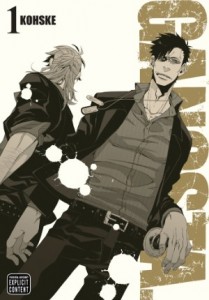
Gangsta, Vol. 1

March 2, 2014 by Sean Gaffney

By Kohske. Released in Japan by Shinchosha, serialization ongoing in the magazine Comic @ Bunch. Released in North America by Viz Media.

One of the things that most manga fans who follow publishing closely have found is that manga readers tend to be loyal to genres rather than authors. Sure, Natsuki Takaya may have written Fruits Basket, one of the best-selling shoujo manga of the last ten years, but other similar titles have proven less stellar, and there’s no rush on anyone’s side to license Hoshi wa Utau or Liselotte to Majo no Mori, her post-Furuba work. On the other hand, when you see a title with vampires that sells, manga publishers go and find other vampire titles. (Oddly, this doesn’t work with other non-Naruto ninja titles, which tend to bomb. I wonder why.) In any case, Dogs and Black Lagoon have done quite well for Viz, but both have ‘caught up’ to Japan. Dogs is now a yearly title, and Black Lagoon is at the mercy of its author’s ‘whenever’ schedule. Clearly another similar title is needed. And so we have Gangsta.

gangsta

Gangsta apparently takes place in “Ergastulum”, which judging by the decor seems to be somewhere in Southern Europe – my guess is “fantasy-world Italy”. Our heroes are mercenaries for hire, who do bad things but have good hearts deep down. Which does not stop them, however, from doing bad things. Each has a tragic past – Worick seems to have been from a rich family at one point, till he was kidnapped and lost one eye. Nick, meanwhile, has it worse – he’s a Twilight, which gives him superior strength and agility, but at the cost of lifespan and getting close to anyone – he’s a pariah. Oh, and he’s also deaf, which doesn’t seem to have anything to do with his Twilightness. The manga starts when they’re hired to wipe out a gang in town, and end up sparing one of the prostitutes in it – Alex, who becomes their new secretary. She’s the naive newcomer in this manga, needing Worick to explain things to her. Indeed, her lack of knowledge about ANYTHING in the town is suspicious in itself.

Gangsta has a very solid first volume. Its art is decent, its plot is better than its art, its characters are better than its plot, and its aesthetic is best of all. The series tends to hit all the right beats. As I noted before, its weakness may be Alex’s need to have the plot exposited to her, which can come across as blunt exposition at times, but it’s so odd I’m prepared to reserve judgment till I see more volumes. Of the two mercenaries, I’m possibly more sympathetic to Nick, but that could just be because he doesn’t speak much – while Worick’s constant chatter always seems to hide darker undertones, as we see towards the end when he brutalizes another prostitute with his harsh words. I also liked Nina, the teenage nurse at a local clinic, who shows that this isn’t just an ‘everything is awful’ world, but is allowed to have happy, innocent kids – even if they are under constant danger of being threatened and kidnapped.

This seems to be the first major work of its author, Kohske, who is female, by the way. I always like to note female creators, especially on titles like this and Dorohedoro where it may not be immediately obvious. In any case, Gangsta is definitely an M-rated title, but if you enjoy titles of this ilk, it’s definitely worth a try, and I will happily get the second volume.

Filed Under: REVIEWS

No. 6, Vol. 5

February 28, 2014 by Ash Brown

No. 6, Volume 5Creator: Hinoki Kino
Original story: Atsuko Asano

U.S. publisher: Kodansha
ISBN: 9781612623597
Released: February 2014
Original release: 2012

As much as I would like to read them, it is highly unlikely that Atsuko Asano’s series of science fiction novels No. 6 will ever be licensed in English. Happily, two adaptations are available: the 2011 anime series directed by Kenji Nagasaki (which was my introduction to the story) and the manga series by Hinoki Kino. Despite the anime’s bungled ending, I actually quite enjoyed the series, so I was glad to have a chance to experience another interpretation of the original story. The fifth volume in Kino’s manga adaptation was initially published in Japan in 2012. Kodansha Comics’ English-language edition of No. 6, Volume 5, published in 2014, also collects bonus stories not included in the regular Japanese edition. Though it had its high points, overall I found the first volume of the No. 6 manga to be a bit weak. However, each volume has gotten progressively stronger as Kino has had time to more fully develop the series’ characters and world.

With the increase in the number of refugees and the rise in violent crime, the population of West Block has been deemed too large and dangerous. It’s all the excuse the holy city of No. 6 needs to mount a massive cleanup operation, known to the residents of West Block as the Manhunt, in which parts of the area outside the city walls are completely destroyed and the population conveniently “removed.” The Manhunt is a way for No. 6 to keep control and prevent riots, but this time the operation serves another purpose–to gather enough undesirables to serve as human guinea pigs for a top-secret experiment being conducted and authorized by the city’s upper echelons. The Manhunt will also provide Shion and Rat with the opportunity that they need to infiltrate the Correctional Facility in order to search for and hopefully rescue Shion’s close friend Safu. Rat is one of the few people to have made it out of the Correctional Facility alive and doesn’t particular want to go back, but he isn’t about to allow Shion to attempt it on his own.

This is the volume of No. 6 in which Shion is brought dangerously close to his breaking point, and it is heart-wrenching to witness it happen. Living in West Block has been slowly changing him; it’s an environment that is drastically different from the seemingly perfect city of No. 6 where he spent almost his entire life. But the violence and suffering that Shion has been exposed to in West Block is nothing compared to the extent of the very deliberate cruelty of the Manhunt. Any faith that he still had in No. 6 is shattered when confronted with this horrifying atrocity, absolute proof that the city is not at all what it claims to be. Shion by nature has a very positive and optimistic outlook on life, but he has begun to lose that. Both he and Rat regret that change and even fear how much Shion might continue to change, especially in light of the most recent turn of events. Shion will never be able to return to the person who he once was no matter how much either of them would want it.

The characters and their growth continue to be some of the strongest elements of Kino’s No. 6 manga. This is especially true of Shion, as can particularly be seen in this volume, but Rat has also been changing in significant ways. The supporting cast, too, has almost all seen at least some minor development. The only major exception to this is the research scientist in charge of No. 6’s experiment. In fact, even though the series is more than halfway over, he doesn’t even have a name yet and is only referred to as “the man in white” in the character profiles. Since he seems to be one of the series’ main antagonists, this is a little disappointing. It’s also rather unsatisfying that the experiment, its purpose, and the motives behind it haven’t yet been made clear to the readers. This persistent vagueness and lack of clarity, instead of being mysterious or creating ominous tension, is mostly just frustrating this far along in the series. Even so, Rat and Shion’s excellent development in the manga largely makes up for this. In the end, I’m still really enjoying No. 6.

Filed Under: REVIEWS Tagged With: Atsuko Asano, Hinoki Kino, kodansha, Kodansha Comics, manga, no. 6

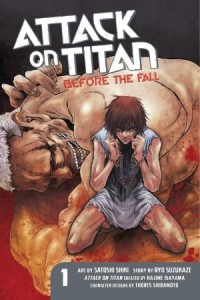
Attack on Titan: Before the Fall, Vol. 1

February 27, 2014 by Sean Gaffney

By Ryo Suzukaze and Satoshi Shiki. Released in Japan by Kodansha, serialization ongoing in the magazine Shonen Sirius. Released in North America by Kodansha Comics.

(This review is based off an advance copy provided by the publisher.)

If Attack on Titan: Junior High as the inevitable lighter, fluffier gag manga spinoff of the main Titan series, then this one is even more inevitable. A prequel set far back enough so that it features no one we know, yet providing some much needed context and perhaps even a few explanations that might carry over into the new series, while still remaining its own title. That said, it remains to be seen how successful it will be, as this is very much Vol. 1 of a longer work, and we’ve just barely gotten started before things are all over.

beforethefall1

Just like its spinoff partner, Isayama did not write or draw this. The author seems to be known for writing tie-in novels (and indeed, this manga is based on a spinoff novel that Vertical will be releasing later in the year). The artist is likely more familiar to old-school manga fans. Satoshi Shiki did a Daphne in the Brilliant Blue manga that Tokyopop released, as well as Kami-Kaze and the really old Viz title Riot, which came out back in the ‘flipped, 32-page comics’ days. The art here is pretty and serviceable, with its leads being attractive and likeable. This puts it miles ahead of Isayama, who has gotten better as he’s gone along, but whose art is still his weakest point. Of course, just because the leads are pretty doesn’t mean bad things don’t happen – some of the grotesque shots of people getting eaten by Titans (and the aftermath) are just as bad as the original.

The basic premise is that, about 70 years before the AoT series proper, a child is found in the puked-up remains of people who had been eaten by Titans, one of whom was a pregnant woman. The baby in her womb miraculously survived, right in the center of the undigested pile. Found by the Survey Corps, he is immediately described as “the child of a Titan”. And promptly locked away for the next 13 years, feeding on bugs and tiny scraps and living a horrible prisoner’s life. It should be noted that Kuklo is not large or monstrous or anything – Child Of A Titan is a metaphor that has carelessly been allowed to become real.

Most of this volume is setup, showing us what life is like inside Wall Sheena, the innermost wall that the cast of the main series haven’t really had to deal with. The answer is that it’s filled with rich smug jerks, including a spoiled brat son who will grow up to lead the military one day, and takes delight in beating the shit out of his prisoner who doesn’t even know enough to fight back. The only other likeable person in the entire series is Sharle, the smug jerk’s younger sister, whose seems to be the innocent, human face of this series and who will no doubt die horribly at some point down the line.

Most of this first volume is setup, showing us the world Kuklo and Sharle live in, and setting up their journey to escape and find answers. It runs based on its mood, which is dark and grimy (the one place that Isayama’s art might have helped… at times this world feels a bit too clean compared to his own.) Certainly a title worth getting for Titan fans, and we’ll see how many volumes it can make it through before inevitable tragedy has to happen.

Filed Under: REVIEWS

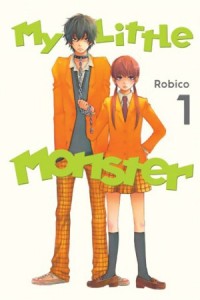
My Little Monster, Vol. 1

February 25, 2014 by Sean Gaffney

By Robico. Released in Japan by Kodansha, serialized in the magazine Dessert. Released in North America by Kodansha Comics.

(This review is based on an advance copy provided by the publisher.)

After an extended period where it seemed that only Nakayoshi titles could get licensed in North America, Kodansha Comics is slowly edging its way back into the more mature shoujo market, starting with this title from the older teen magazine Dessert. (Brief nerd aside: Dessert arose from the ashes of Shoujo Friend, Kodansha’s main ‘older teen’ magazine, which also spawned ‘Bessatsu Shoujo Friend’, aka Betsufure, home of The Wallflower et al. In case you wondered where the Fure came from.) As you can see by the cover, our two lead characters are just absolutely delighted with life and each other, and this is their sweet, fluffy love-love comedy.

mylittle1

Oooooookay, maybe that’s not quite accurate after all. Haru, the male lead, is the monster of the title, a freakishly strong, freakishly weird loner who doesn’t have any real friends, mostly as his reactions to any social situation are so far off the map from any reasonable human interaction he drives everyone away. As for Shizuku, she just wants to get perfect grades so that she can grow up to be rich, and has absolutely no time for nonsense or friendship. Which is a shame as she’s starring in a shoujo manga, so you know that she’s going to be dragged into shenanigans, if unwillingly.

I want to note that, though he’s nowhere near WataMote levels of social maladjustment (this is still a normal shoujo manga), Haru can be very hard to take for the average reader. I could have done without his forcefully dragging Shizuku into an alley at one point, and later forcefully kissing her without her consent. It stems from his ignorance of the basic norms of society, but that doesn’t make it any easier to see. We’ve also just barely begun the series, so there’s no real explanation as to why he’s like this beyond “well, he’s wacky like that”. I hope as the series goes on he gains some depth, as he seems a bit like a Manic Pixie Dream Boy at the moment.

I was far more interested in Shizuku. As the volume goes on and you see the way she interacts with people, you begin to notice that she’s not really the normal, slightly snarky girl she initially comes across as. Indeed, for all that Haru goes on about the need to have friends, Shizuku is equally solitary, and has closed herself off from emotions so much that she has difficulty dealing with then when they need to emerge… which can result in sudden explosions, such as when she realizes Haru is the #1 student in the school (if only he weren’t suspended at the start of the year). I suspect as this title goes on we’ll find she needs this interaction even more than Haru does.

We also get a couple of other characters set up to be regulars… Natsume is the slightly overwrought, ditzy type who contrasts well with Shizuku, and Sasayan is a sports-oriented boy who knew Haru from his previous school and I suspect will turn out to have a dark past or somesuch. This manga doesn’t really break any new shoujo ground. But it’s put together well, the characters are intriguing, and it can be funny (if a bit unnerving) much of the time. It’s 12 volumes total, so we’ll see how long it can keep this up. Definitely a solid first volume, though.

Filed Under: REVIEWS

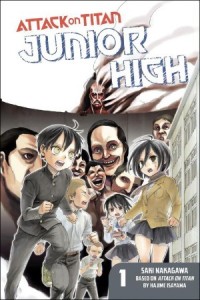
Attack on Titan: Junior High, Vol. 1

February 23, 2014 by Sean Gaffney

By Saki Nakagawa. Released in Japan in two separate volumes by Kodansha, serialization ongoing in the magazine Bessatsu Shonen Magazine. Released in North America by Kodansha Comics.

(This review is based on a copy provided by the publisher.)

Attack on Titan has been such a breakout success both here and in Japan that spinoffs were inevitable, and indeed there are now at least four distinct spinoffs, all available (or coming soon) in English. Two of these are dramatic prequels covering life before the fall of the Wall and Levi’s past. One, out via the online Mangabox site, is a straight-up 4-koma gag comic. I had assumed that Junior High would also be that sort of title, but no, it’s got actual plot and sequential art. It is, however, aimed squarely at comedy, and some of the comedy is very funny indeed.

titanhigh

If you’ve ever read one of the several thousand High School AU fics on Fanfiction.Net, you know where this series is going. Eren and company all go to a junior high that’s quite unusual… it’s divided into human and titan sections. This appalls Eren, who has a hideous grudge against the titans for destroying his life five years earlier. (This being a gag manga, how his life is destroyed will be a punchline.) With the help of his exasperated yet overprotective childhood friend Mikasa, nerdy shut-in Armin, walking appetite Sasha, and “rival” Jean, will he be able to get through school life without making a fool of himself?

Of course not. Seeing Eren make a fool of himself is part of the point of this series. In fact, no one in the entire cast is spared ritual humiliation. Everyone’s personality traits are exaggerated and deconstructed. Eren’s constant anger is combined with a sort of shonen hero effect. Mikasa is still sort of crushing on Eren, but thankfully this isn’t made too explicit. Annie is definitely crushing on Eren, but seeing her interaction with Mikasa is funnier. Sasha is sadly two-dimensional, but at least it’s a funny dimension (her family’s poverty makes for some of the best side-comments). Some cast get very little screen time (Bertolt, Ymir), but this is likely due to this running at the same time as the main series was, so they hadn’t had their big reveals yet.

Indeed, this spinoff actually gives some folks a bit more development than the regular series. Hitch, Annie’s snarky co-worker in the Military Police, is here a snarky princess type, working with Annie on the Student Council, and her personality works well with everyone, but especially Jean. Levi’s squad are back from the dead as 2nd year students, and each get some of the amusing quirks we saw in the original. Nothing here is really deep or meaningful, but I’d hardly expect that from a manga of this sort. If you take Attack on Titan very seriously, you likely rejected this when you heard the title.

Lastly, I want to mention the translation. For some odd reason, this title has not been scanlated online like all the other Titan titles. This proved to be a godsend to translator William Flanagan, who is thus allowed to adapt loosely in order to make things even funnier without fear of fans pointing at an over-literal translation online and crying foul. So expect some Western Culture references mixed in. Best of all, the subject of Hange’s gender is made into a running gag (which I imagine must be Western-only, as in Japan it’s much easier to be gender-ambiguous) which mocks everyone who takes offense to Hange being anything other than ‘uncertain’. Not since Excel Saga have I read a book where it looks like the translator is having as much fun as the reader.

Don’t expect more than a light-hearted comedy AU here. But it’s very good comedy, with lots of quotable bits. In fact, let me leave with one of my favorite lines, from Mikasa as she tries to get hikkikomori Armin to come to school for the athletic festival:

“It’s true that you’re clumsy, talentless, and constantly weirding everyone out. And we know that in the match you’ll just flail around like a terrified toddler fleeing a birthday clown. You don’t have to worry about that. Everyone’s ready to accept you as the freak show weakling that you are.”

Filed Under: REVIEWS

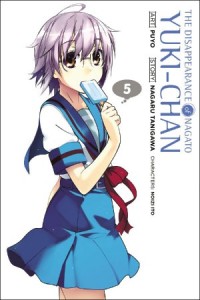
The Disappearance of Nagato Yuki-chan, Vol. 5

February 22, 2014 by Sean Gaffney

By Nagaru Tanigawa and Puyo. Released in Japan as “Nagato Yuki-chan no Shoushitsu” by Kadokawa Shoten, serialization ongoing in the magazine Young Ace. Released in North America by Yen Press.

So when does one choose to end a cash cow? Particularly if the cash cow is a spinoff of an even bigger cash cow whose author seems to have dwindled down to 2 books a decade? Well, the answer is that you don’t – you need to keep the audience interested in these characters for as long as you possibly can, and if the main Suzumiya Haruhi series is on hiatus while its author deals with trying to wrap yup the monster he’s created, and the manga has to end as it can’t make up new Main Storyline stuff – well then, you keep the spinoffs going for as long as they are able.

nagato5

(For the record, I have generally assumed that when dealing with spinoff titles like these, the main plot is being created by the artist, with the writer only signing off on suggestions and censoring plots he wants to handle himself. Thus I assume that Puyo is in charge of both this and the Haruhi-chan manga, but I could be wrong.)

This volume really reads like the author was intending to wrap it up here. Yuki and her AU counterpart have a talk in her mind, after which she’s back to normal with no memories of what happened before… which is a bit of a pain to Kyon and Ryouko. Luckily it’s summer vacation and Haruhi returns to drag everyone through a series of fun activities. You can see Puyo starting to wrap things up. Haruhi reveals how things changed for her 3 years prior, and shows how she developed in a different, slightly more sedate direction due to Kyon’s unthinking response. There’s a sense she’;s moving on from him here. Likewise, Kyon manages to resolve the awkwardness he feels around Nagato, and we finally get to the big confession…

…except there are fireworks, so she doesn’t hear him. And he immediately pulls back, noting that it’s OK if he said it, and now they can go back to their happy carefree days. We then move on to a slight homework arc, and return to the school for the 2nd half of the year, which features Haruhi trying to figure out how to inveigle herself into the culture festival despite not going to that school, and the return of a very familiar face.

Yes, if you write a spinoff featuring the most popular Haruhi character in a starring role, it makes sense to bring in the big breakout character of the last few years as well. So Sasaki’s back. What will her return mean for the relationship between Yuki and Kyon? Probably not a lot, to be honest. But it will at least keep it dragged out for another couple of volumes, which is all Kadokawa asks, really.

I really do enjoy this title. I wish the art rose above mediocre, but given the popularity of Attack on Titan, mediocre art is not a big setback anymore. Puyo specializes in quiet, introspective emotional moments, and the humor here is gentle and mild – it’s probably to contrast with the Haruhi-chan 4-koma he also writes. But I simply can never get out of my head the fact that this is a cash grab for a large anime franchise, and the addition of Sasaki and pullback from an obvious ending do nothing to assuage my worries in that regard. As always, recommended for Haruhi fans.

Filed Under: REVIEWS

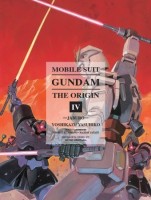
Mobile Suit Gundam: The Origin, Vol. 4: Jaburo

February 21, 2014 by Ash Brown

 Mobile Suit Gundam: The Origin, Volume 4: JaburoCreator: Yoshikazu Yasuhiko
Original story: Yoshiyuki Tomino and Hajime Yatate

U.S. publisher: Vertical
ISBN: 9781935654988
Released: December 2013
Original release: 2008

Yoshikazu Yasuhiko’s manga series Mobile Suit Gundam: The Origin was my first real introduction to the massively popular Gundam franchise. I was somewhat hesitant to enter into the fray; Gundam can appear rather daunting to a newcomer considering the sheer number of series and alternate timelines involved. However, I was already a fan of Yasuhiko’s other manga. If I was going to start anywhere with Gundam it made sense for me to start with The Origin. So far, in my admittedly limited experience with the Gundam franchise, The Origin has been my favorite rendition of the story. The manga is a retelling of the original 1979 anime series with which Yasuhiko was also involved. Jaburo is the fourth volume in the collector’s edition of The Origin, initially published in Japan in 2008 and released in English by Vertical in 2013. The guest contributor for Jaburo was Yokusaru Shibata, which I believe makes it his manga debut in English.

After a far too brief stalemate in which fighting had all but ceased, the war between the self-proclaimed Principality of Zeon and the Earth Federation has quickly begun to escalate once more. Escaping from the destruction of the Federation’s Side 7 space colony, the ship White Base is carrying with it the Federation’s best hope to regain technological superiority over Zeon–the newly developed Gundam mobile suit. Crewed by a mix of civilians and inexperienced military personnel and doggedly pursued by some of Zeon’s finest commanders, White Base has surprisingly been able to persevere. The ship is drawing closer to Jaburo, the Federation’s headquarters on Earth, but the journey will still require passing through Zeon-occupied territory. The mission’s success and the crew’s survival will not only depend on their own inherent skills and talents but the support received from what remains of the Federation military and its dwindling resources.

While the war between Zeon and the Federation continues on a grand scale, Jaburo reveals some of the very personal reasons why the individual soldiers have chosen to fight that war and why some of the civilians have joined in the battle as well. Over the last couple of volumes in The Origin, Zeon has suffered several deaths of particular significance. Garma Zabi’s death has served as a rallying point for Zeon’s forces as a whole, but Ramba Ral’s death has triggered a much more aggressive vendetta from those who knew him best. They are less concerned with Zeon’s cause than they are with their own personal revenge. But neither side of the conflict is immune to the effects of war. In Jaburo, it’s the Federation and the crew of White Base who must face some severe losses of their own. Death and destruction has not been lacking in The Origin, but growing to know the characters, what they hold important, and what they are willing to die for make their demise even more potent.

In addition to the excellent character development found in Jaburo, I was also particularly impressed by Yasuhiko’s artwork in this volume. The color work is especially effective. In general, I have largely favored Yasuhiko’s black and white illustrations in The Origin, but the color artwork in Jaburo is simply gorgeous. The lush greens and blues of the Amazon and South America are beautiful, contrasting with the reds and oranges of fires and explosions as humankind continues to destroy itself. Yasuhiko’s black and white art in the series remains very strong as well and has a fantastic “old school” feel to it. The battles are fierce and dramatic, but Yasuhiko handles the chaos in a controlled manner that still retains a sense of pandemonium. The story has moved from space to Earth and so the technology, mobile suits, and strategies have to be adjusted for the new environment. Both the characters and Yasuhiko are aware of this, and it shows in Jaburo. I’m continuing to enjoy The Origin and look forward to reading more.

Filed Under: REVIEWS Tagged With: Gundam, Hajime Yatate, manga, vertical, Yoshikazu Yasuhiko, Yoshiyuki Tomino

Writing the Love of Boys: Origins of Bishōnen Culture in Modernist Japanese Literature

February 19, 2014 by Ash Brown

Writing the Love of BoysAuthor: Jeffrey Angles
Publisher: University of Minnesota Press
ISBN: 9780816669707
Released: February 2011

I’ve recently become rather enamoured with Edogawa Rampo and his writings which is how I happened to come across Jeffrey Angles’ Writing the Love of Boys: Origins of Bishōnen Culture in Modernist Japanese Literature. Published by the University of Minnesota Press in 2011, the volume is an extension of Angles’ 2004 PhD dissertation “Writing the Love of Boys: Representations of Male-Male Desire in the Literature of Murayama Kaita and Edogawa Rampo.” Angles is currently an associate professor of Japanese literature, language, and translation at Western Michigan University. His primary research interests include translation, modern Japanese poetry, and romance and sexuality in Japanese literature, and especially the portrayal of same-sex desire. All of these subjects are at least touched upon if not thoroughly explored in Writing the Love of Boys. They are all topics that I am particularly interested in as well, so I was rather pleased to discover Writing the Love of Boys while searching for more information on Rampo and his works.

In Writing the Love of Boys, Angles examines the expression of same-sex desire, and specifically male-male desire, in Japanese literature during the late Taishō era (1912-1926) and early Shōwa period (1926-1989). In doing so he focuses on the work of three authors in particular: Murayama Kaita (1896-1919), who was also a poet and a painter; Edogawa Rampo (1894-1965), an incredibly influential writer of detective and mystery fiction among other things; and Inagaki Taruho (1900-1977), whose avant-garde work is noted as being particularly innovative. All three of these authors produced work that either incorporated or directly addressed male-male desire of both homosocial and homoerotic nature. Writing during a time in which attitudes towards sexuality in Japan were changing due to the influence of new medical and psychological approaches, Kaita, Rampo, and Taruho portrayed male-male desire in a way that was different from their immediate predecessors. Placing them within this historical and literary context, Angles also shows how their work would influence creators who followed them as well.

Another subject that is particularly important in Writing the Love of Boys is the erotic grotesque nonsense movement and fad of the 1920s and 1930s. Ero guro literature allowed its authors to explore the bizarre and the strange, including sexual desire that was considered by society to be perverse. However, although Kaita, Rampo, and Taruho were all involved in the rise of ero guro literature, Angles argues that their portrayal of male-male desire was frequently sympathetic and even subversive within the context of the genre which generally used sexuality for the purpose of titillation. Of the three authors that Angles focuses on in Writing the Love of Boys, it is Rampo who is the most well-known in English and who has had more of his work translated. Reading Angles’ analyses and translated excerpts of these three authors’ work, I can’t help but lament the fact that more of their writing isn’t currently available in English. But even though most of the works discussed in Writing the Love of Boys have yet to be released in translation, it is still interesting and valuable to learn about their place and importance within the literary and queer history of Japan.

For me, one of the most intriguing parts of Writing the Love of Boys was the literary lineage that Angles outlines, beginning with Kaita, who influenced Rampo, who in turn collaborated with Taruho, who was a direct inspiration to Takemiya Keiko, one of the creators whose work in the 1970s would lay the foundation for the entire boys’ love genre. In fact, much of the conclusion of Writing the Love of Boys is devoted to the lasting influence and legacies of Kaita, Rampo, and Taruho that can be seen in boys’ love manga. Angles credits Taruho as one of the authors who began developing an aesthetic of male-male desire for a female audience; several of his stories, including his debut, were published in magazines for women. This is one of the links that Angles uses to tie these three authors to the more recently developed genre of stories featuring male-male love primarily written for women by women. To some extent it does feel a little tangential to the work as a whole, and it was somewhat jarring to jump from the 1930s to the 1970s and beyond, but there is a legitimate connection. I found Writing the Love of Boys to be incredibly fascinating; it ended up addressing more of my interests than I initially realized it would–queer theory, ero guro, and even manga, in addition to many other topics.

Filed Under: REVIEWS Tagged With: Edogawa Rampo, Jeffrey Angles, Kaita Murayama, Nonfiction, Taruho Inagaki

  • « Go to Previous Page
  • Page 1
  • Interim pages omitted …
  • Page 257
  • Page 258
  • Page 259
  • Page 260
  • Page 261
  • Interim pages omitted …
  • Page 346
  • Go to Next Page »
 | Log in
Copyright © 2010 Manga Bookshelf | Powered by WordPress & the Genesis Framework