• Skip to primary navigation
  • Skip to main content
  • Skip to primary sidebar
  • Home
  • About Us
    • Privacy Policy
    • Comment Policy
    • Disclosures & Disclaimers
  • Resources
    • Links, Essays & Articles
    • Fandomology!
    • CLAMP Directory
    • BlogRoll
  • Features & Columns
    • 3 Things Thursday
    • Adventures in the Key of Shoujo
    • Bit & Blips (game reviews)
    • BL BOOKRACK
    • Bookshelf Briefs
    • Bringing the Drama
    • Comic Conversion
    • Fanservice Friday
    • Going Digital
    • It Came From the Sinosphere
    • License This!
    • Magazine no Mori
    • My Week in Manga
    • OFF THE SHELF
    • Not By Manga Alone
    • PICK OF THE WEEK
    • Subtitles & Sensibility
    • Weekly Shonen Jump Recaps
  • Manga Moveable Feast
    • MMF Full Archive
    • Yun Kouga
    • CLAMP
    • Shojo Beat
    • Osamu Tezuka
    • Sailor Moon
    • Fruits Basket
    • Takehiko Inoue
    • Wild Adapter
    • One Piece
    • After School Nightmare
    • Karakuri Odette
    • Paradise Kiss
    • The Color Trilogy
    • To Terra…
    • Sexy Voice & Robo
  • Browse by Author
    • Sean Gaffney
    • Anna Neatrour
    • Michelle Smith
    • Katherine Dacey
    • MJ
    • Brigid Alverson
    • Travis Anderson
    • Phillip Anthony
    • Derek Bown
    • Jaci Dahlvang
    • Angela Eastman
    • Erica Friedman
    • Sara K.
    • Megan Purdy
    • Emily Snodgrass
    • Nancy Thistlethwaite
    • Eva Volin
    • David Welsh
  • MB Blogs
    • A Case Suitable For Treatment
    • Experiments in Manga
    • MangaBlog
    • The Manga Critic
    • Manga Report
    • Soliloquy in Blue
    • Manga Curmudgeon (archive)

Manga Bookshelf

Discussion, Resources, Roundtables, & Reviews

Reviews

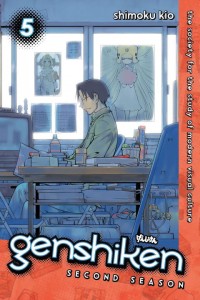
Genshiken: Second Season, Vol. 5

September 21, 2014 by Sean Gaffney

By Shimoku Kio. Released in Japan by Kodansha, serialization ongoing in the magazine Afternoon. Released in North America by Kodansha Comics.

I’ve reviewed the last couple of volumes of this sequel to Genshiken in Bookshelf Briefs, and have remarked several times that it almost feels like they’re trying to aim for a new demographic with all of the new cast being of a more BL tilt, and the graduation of most of the previous players. That said, there are still characters dropping in and out throughout, and Madarame has been a constant, if smaller presence. Well, that changes here. The new volume starts with a definitive ending to the most talked about plotline of the old series, and helps to set up a new one that will also star Madarame, who has never been the viewpoint character but has always been the face of Genshiken, so to speak.
genshiken2-5

The old plotline is, of course, Madarame’s crush on Saki, and the fact that she’s been sort of aware but ignoring it. Last volume she admitted this, and the rest of the club set things up so that they could be alone and he could confess. No one – not even Madarame – seriously expects anything but a rejection. After all, Saki has been dating Kousaka since the series began, and while the majority of fans aren’t really thrilled with that, their love for each other has never been in question. (In fact, the scenes with Kousaka here are some of his best, as I finally begin to understand a character I’ve always had trouble with. As for the “confession” itself, it was very Genshiken, being both hilarious and heartwarming, and the aftermath slips to purely being the latter.

It feels like an ending, as Kio himself lampshades, but there’s still a lot of things to resolve. For one, as Saki notes, Madarame is busy obliviously gathering a harem of his own. Keiko gets a lot more face time here, and we see more of why she’s interested in someone with all the baggage that Madarame has – baggage that gets worse when he decides to quit his job, saying himself he wants to see how far he can fall. As for Hato, his crush on Madarame, if it is one, is still wrapped up in his own identity, which is in flux. This is painful for him, and it’s almost reminiscent of Wandering Son at times, except Hato is far less accepting of his own desires. Having Hato and Madarame intersect like this is a perfect plot – they’re the two most interesting characters of all of Genshiken.

Other than that, it seemed appropriate to devote a chapter to Ohno and Tanaka, who are almost the forgotten couple of the manga (partly die to Tanaka mostly being together about thin gs – even here he’s the adult.) This is also quite cute, and has a nice heartwarming scene that could be construed as a proposal – that’s certainly how the club takes it. And while there isn’t much Sue, the cliffhanger makes me think we may get more of her next time. Genshiken hasn’t forgotten about its old fans, but still has plenty for new readers. If you enjoyed the series before, this volume will not disappoint you.
Filed Under: REVIEWS

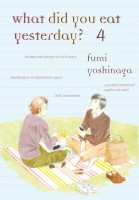
What Did You Eat Yesterday?, Vol. 4

September 19, 2014 by Ash Brown

What Did You Eat Yesterday?, Volume 4Creator: Fumi Yoshinaga
U.S. publisher: Vertical
ISBN: 9781939130792
Released: September 2014
Original release: 2010

With each new volume of Fumi Yoshinaga’s series What Did You Eat Yesterday? that is released in English, I seem to fall in love with the manga just a little more. What Did You Eat Yesterday? probably isn’t my favorite series by Yoshinaga, but I still enjoy the series immensely. Granted, What Did You Eat Yesterday? has a few things going for it that particularly appeal to me. First of all, I’m already a well-established fan of Yoshinaga’s work in general. I also happen to be a fan of food and food manga which What Did You Eat Yesterday? most definitely is. But perhaps most importantly, I appreciate the series’ realistic portrayal of a devoted gay couple and some of the issues that queer people face in contemporary Japan. Food and gay men are frequently found in Yoshinaga’s manga–often together for that matter–so it’s not a terribly surprising combination to see in What Did You Eat Yesterday?. I’m certainly not going to complain about it, though. The fourth volume of the What Did You Eat Yesterday? was published in Japan in 2010 before being released by Vertical in English in 2014.

Although he is a successful and respected lawyer, Shiro much prefers his time spent in the kitchen over his time spent at the office. Cooking has its challenges too though, like when Shiro’s boyfriend Kenji decides that they should have friends over for a dinner party rather than eating out. This solves the problem of Shiro’s constant worrying over being outed as gay while in public, but now he is left to fret over what to serve two men with very discerning palates. (Fortunately, Kenji is more than happy to eat whatever it is Shiro cooks up.) Every once in a while it’s actually Kenji who is set loose in the kitchen. Shiro is more particular when it comes to cooking and preparing meals so he’d much rather be the one in charge, but occasionally that’s just not possible. Kenji might not have the same confidence or natural flair that Shiro has for food, but he can still make a pretty good dish when he needs or wants to. From time to time even Shiro is faced with a technique that he hasn’t quite mastered yet. And so while cooking is often a way for Shiro to unwind, it can sometimes cause a bit of stress, too.

As always, food, it’s preparation, and the resulting recipes are all a major part of What Did You Eat Yesterday?. Some readers will find the minute details tedious, especially if they have no inclination or ability to actually try making any of the dishes, but those sections can easily be skimmed over or simply appreciated for Yoshinaga’s artwork. Her illustrations of food and cooking techniques are beautifully drawn and nearly photorealistic in many instances. Yoshinaga is able to convey a wide variety of textures which is especially important, and impressive, as she is working in black and white without the aid of color. But what particularly struck me about the cooking scenes in the fourth volume of What Did You Eat Yesterday? is how Yoshinaga skillfully captures the different moods pervading the kitchen through Shiro and Kenji’s body language and facial expressions: Shiro’s intense preoccupation when trying to put together the perfect meal, his gloom and frustration when something doesn’t turn out quite right, Kenji’s frenetic happiness when he gets a chance to take care of Shiro for a change, and so on.

Even though a fair amount of What Did You Eat Yesterday? is spent in the kitchen, Yoshinaga’s focus on the characters is a particularly important component of the manga. The series tends to be episodic from chapter to chapter, but growth and change can still be seen as Kenji and especially Shiro are further developed. The fourth volume of What Did You Eat Yesterday? shows Shiro struggling with his anxieties about still being partially in the closet, admiring and perhaps even envying how open, easygoing, and carefree Kenji is able to be about his sexuality. Kenji and their friends are exceptionally considerate and accommodating of Shiro’s fears, but those fears still understandably cause some tension in his relationships. Another interesting developement in this volume of the series is that both Shiro and Kenji at least temporarily become the confidants of their respective bosses who have a few family issues of their own to work out. While the food in What Did You Eat Yesterday? is appealing, it’s really these sorts of connections and moments between characters that make the series so engaging.

Filed Under: REVIEWS Tagged With: fumi yoshinaga, manga, vertical, what did you eat yesterday?

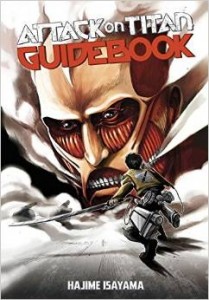
Attack on Titan Guidebook

September 18, 2014 by Sean Gaffney

By Hajime Isayama and the editors at Kodansha. Released in Japan by Kodansha in two separate volumes, “Inside” and “Outside”. Released in North America by Kodansha Comics.

Shonen manga in Japan get quite popular, and as you’d expect, fans want to know absolutely everything about their favorite characters, things that wouldn’t necessarily come up in the manga proper. For those people, there are guidebooks like these – they consists of bios, recaps, examinations of all the little fiddly bits, character popularity polls, favorite quotes, etc. They allow the creator to reveal some information that would likely fit awkwardly if it had to be inserted into the story proper, and let fans understand the characters and story better – OMG, Jean is an Aries! Just like me!

tit

For those familiar with these sorts of guides, the style is unsurprising, but if you aren’t, be prepared for lots of superlatives. At times it reads like a gossip magazine, with lots of punchy headlines and exclamation marks as it tells the story of the 104th training squad. These are two books released separately in Japan joined together, and sometimes you’re able to see that – the book has spoilers through Vol. 11 of the series, but much of the first half seems to have spoilers only through Vol. 9. It can also be somewhat inconsistent – the book takes pains not to discuss Reiner and Bertholt’s secrets in their bio, but has no issues revealing Ymir’s.

There’s a long interview with Isayama where he discusses the major influences on the series – many may be surprised to here one of the biggest was Muv Luv Alternative, though those who have read the visual novel itself may be less surprised – it’s darker than Higurashi. I was less surprised to hear about the influence of Saving Private Ryan in regards to the emotional reactions of the soldiers. The workings of the manga industry are briefly shown, as Isayama discusses how he was asked to move to a more expensive apartment so that he could fit his assistants in it – but then had to make the series a success or he couldn’t afford the apartment!

Where the guidebook excels is in giving a name and backstory to the minor characters like “girl who dies in Volume 2” or “that one guy whose name I can never remember”. Isayama’s art is terrible, especially at the start, and this guide is a boon for those who can’t really tell apart the 5-6 different soldiers with short blond hair. There’s also a lot of discussion of the mechanics of titans and how the vertical gear works, and to show it’s not all grim darkness there’s also some cute fake interviews with the cast, and Isayama drew some AU art based on reader suggestions, such as Sasha, Connie and Reiner forming a band.

Obviously this is not something that you want to pick up if you’re new to the series and wish to see what it’s about. Read the actual manga instead. For those who are fans of the manga, though, this gives you lots of facts and figures, reminds you of your favorite moments, and is a good go-to reference guide. Also, I think the original must call Sasha a boke about 80,000 times. “Airhead” is the translation here.

Filed Under: REVIEWS

Wandering Son, Vol. 7

September 17, 2014 by Ash Brown

Wandering Son, Volume 7Creator: Takako Shimura
U.S. publisher: Fantagraphics Books
ISBN: 9781606997505
Released: August 2014
Original release: 2007

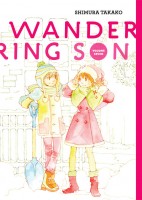
The wait between the release of each new volume of the English-language edition of Takako Shimura’s manga series Wandering Son can seem torturous, but without fail I’m exceptionally glad when the next installment is finally available. Wandering Son is a manga that is personally very meaningful to me, so I’m always a little worried that Fantagraphics won’t be able to complete the series, which would be a shame. Fantagraphics’ edition of Wandering Son is beautiful, complete with color pages and hardcover binding. Wandering Son, Volume 7 was originally published in Japan in 2007 while Fantagraphics’ English translation by Matt Thorn was released in 2014. The series concluded in Japan with the fifteenth volume, which means that the English-language release has just about reached the midway point of Wandering Son. I sincerely hope the rest of the series will be able to be published, too.

The seventh graders’ production of a gender-swapped Romeo & Juliet for their school’s cultural festival is over, but there doesn’t seem to be any end in sight for the drama unfolding in the classroom. Although a few of the students were dissatisfied with their own parts and performances, the play was generally well received, resulting in the theater club attempting to scout some of the best talent. This does cause some tension as the members of the various school clubs shift around to follow their personal interests, leaving friends behind in the process. Some friendships are being severely tested while other, more antagonistic, relationships appear to be on the mend. As Shuichi, Takatsuki, and the others grow and mature, their connections to one another change and evolve, too. Puberty continues to progress as well, bringing with it unwanted changes, anxieties over developing bodies, and concerns over physical appearances. What to wear, what not to wear, acne, and skin problems are all legitimate worries, providing opportunities for both teasing and bonding.

Wandering Son is told in a somewhat non-linear, almost fragmented sort of way. Shimura takes individual moments and memories, often from different points in the characters’ lives, and then layers them together, drawing connections between the separate pieces that would not necessarily have been obvious otherwise. This makes it easier for readers to see that the characters, though they all have their own unique perspectives and individual experiences, are dealing with some very similar issues. Their approaches to those issues and how they deal them are often quite different, though. This layering and revealing of parallels, as well as the other narrative and storytelling techniques that Shimura uses, are very effective in building on some of the themes that Wandering Son explores–namely personal identity–by exhibiting the depth and nuance of the series’ sensitive portrayal of the characters as individuals. The realism and authenticity of the characterization in Wandering Son is one of the manga’s greatest strengths.

Another related aspect of the manga that is handled particularly well is the natural changes in the characters’ relationships with one another. Wandering Son has a large cast of both primary and important secondary characters and it’s a close-knit group. When something happens between two of the members, the social dynamics of the entire circle is influenced. Major developments occur when Shuichi and Anna begin dating, helping to trigger some unexpected changes in Chiba and Takatsuki’s relationship which were particularly interesting to see. Chiba is incredibly self-centered and at times exceptionally unlikeable, but she’s also perceptive and seems to be very sure of herself and who she is. Takatsuki, on the other hand, is still working all of that out but is fiercely determined in other ways. It’s because of Takatsuki’s persistence, despite Chiba’s prickliness, that their friendship has a chance of improving–something that everyone would be happy about. It won’t be an easy process, though, and will take some time. Wandering Son excels in capturing the real-life messiness of relationships.

Filed Under: REVIEWS Tagged With: Fantagraphics Books, manga, Takako Shimura, Wandering Son

Ranma 1/2, Vols. 7 & 8

September 16, 2014 by Sean Gaffney

By Rumiko Takahashi. Released in Japan by Shogakukan, serialized in the magazine Shonen Sunday. Released in North America by Viz.

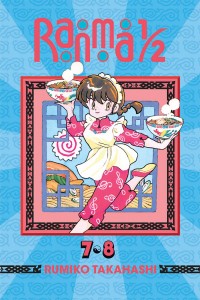
I’ve joked several times in the last few weeks about warning people that this volume features the debut of Happosai, but there’s a kernel of truth to that warning: Happosai is repugnant, and a polarizing figure both within Ranma fandom and within the series itself. Not because anyone really likes him – even his fans think he adds some fun comedy but don’t like him personally – but whether the comedy he adds to the series is really needed. Because Happi is defined by being a pervert – yes, an incredibly strong martial arts master pervert, but a pervert just the same. He feels up women, he steals their underwear, he literally gains strength through contact with females. He is a walking trigger warning. He’s meant to be the male version of Cologne, but Cologne’s actions all serve a greater purpose – at least so far – and Ranma learns a great deal from her. For all that Happi is supposed to be training Ranma as his successor, there’s no lessons, no training, and no point. He is a pox on Ranma 1/2, and will be here till the end of the series. He doesn’t even make horrible puns, like Cherry, his spiritual predecessor from UY, did.

ranma7-8

(breaths out) I feel better. Now let’s talk about what was fun this volume. Ranma has settled into doing what it does best, which is ‘almost anything goes in the name of comedy’. (It’s not *quite* as over the top as UY, so I added the ‘almost’.) There’s lots of martial arts battles, as we see Ranma, Akane and Shampoo compete in martial arts takeout delivery, as well as Akane and Ranma fighting to defend the name of their supposed school when a Dojo Destroyer comes to town (the Destroyer himself looks like a ridiculous over the top stereotype, and barely speaks, but I’ll gloss over that for now. And there’s plenty of comedy, as Ranma’s class puts on a production of Romeo and Juliet, which means a lot to Akane (who was Romeo as a kid, but now finally gets to be Juliet), but little to any of the various competing Romeos, including Ranma. (I was highly amused to see her yelling at Ranma for not reading the play, as in the end all Takahashi takes from the original is ‘balcony scene’ and ‘kiss’.)

There’s quite a lot of time devoted to Ranma (and sometimes Genma) trying to find a cure for the curse, and there are a few temporary cures but nothing really permanent. While this will still play out across the series, as we get further in Ranma simply gets more accepting of his dual nature, and seeing the desperation shown here is interesting. As for Ranma and Akane themselves, they’re both quite attracted to each other and sympathetic to each other’s pain once they pause to think – but they hardly ever do that anymore, so when we do see such moments (Akane bringing Ranma warm food and drink in the backlot), it’s nice and heartwarming. (The box Happi hides under in that scene, by the way, has a reference to Nura: Rise of the Yokai Clan. Wrong company! Shogakukan should be turning in its grave! Don’t tell me they aren’t dead, I’ve seen what Sunday sales in Japan are like lately.)

Miscellaneous thoughts: At one point, when Genma is at his absolute sketchiest, Kasumi calls him annoying. For Kasumi, this is a devastating comment, particularly this late in the series. Both Genma and Soun come off particularly badly in this volume, both as former disciples of Happi who want to be free of him but can’t do anything about it, and as parents who try to trick their children into marrying each other. Nabiki still exists mostly as the “normal” character – we see her deny she’s related to her family more than once in this volume – and Takahashi’s habit of showing her constantly eating is in full force here. Kuno and Gosunkugi are also as loopy as ever – Gosunkugi in particular suffers so much and is loathed by so many you can’t help but laugh at his pathetic awfulness.

Another solid volume of Ranma, though those who found the series beginning to grate at this point and hoping for more plot resolution are only going to get more annoyed as it goes on. Next time around we’ll introduce our final main cast member, and one who’s even more polarizing in her own way. Not because of her own characteristics, but because of how she gave fans who hate Akane a real alternative, and the ship wars truly began in earnest. Next time, we’ll talk Ukyou Kuonji.

Filed Under: REVIEWS

Hayate the Combat Butler, Vol. 24

September 14, 2014 by Sean Gaffney

By Kenjiro Hata. Released in Japan as “Hayate no Gotoku!” by Shogakukan, serialization ongoing in the magazine Shonen Sunday. Released in North America by Viz.

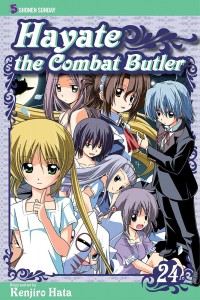
This is probably my favorite volume of Hayate the Combat Butler to date. It manages to resolve the Athena storyline with a lot of fighting spirit, emotional turmoil, and one big “call my name” rescue by Hayate. But is also has a great deal of heart, as we see Hayate’s reunion with Athena, Hina’s heart-to-heart with Ayumu, and some strikingly normal and non-insane life advice from Yukiji. And don’t worry, there’s a good amount of humor here as well, mostly featuring the minor cast back at the hotel having to fight off a pack of mythological beasts. This volume packs a lot of stuff into it, and it’s no surprise that the emotional resolution of Athena’s storyline will carry over into Volume 25.

hayate24

We also see Nagi at perhaps her most mature, even as she insists that Hayate can protect her from anything. Nagi has been a bit of a polarizing character, being both underage *and* tsundere, but even her detractors seemed to like this scene, where she crushes the stone that represents Hayate’s moral dilemma, and announces that she will deal with the consequences no matter what. Of course, I doubt she really realizes what it’s like for a girl like her to live without money, but it’s still great to see.

Likewise, it’s always nice to see Yukiji as the big sister that she usually tries to avoid being. She senses Hina’s abject depression even over the phone, and so flies over there to set things right. (Hina lampshades that this is possible, as she notes Yukiji would have to fly all the way from Italy… which isn’t that far away from Greece, in fact.) Yukiji’s advice is blunt but necessary, as Hina (and Ayumu) both need to be reminded that even in a manga, you sometimes can’t get the happy ending you want, and that this is what life is – a series of struggles. The friendship forged by Hina and Ayumu is important right now, as they can console each other – and also note that it’s nice to be in love with a man who’s loved the same woman for 10 years now, rather than an indecisive player (which Hayate is often accused of being.)

Hina also gets to be at the final battle, as Ayumu and Aika coerce her into dressing as Red, the super sentai hero. Then a magical sword drags her to the battle (literally) that Hayate is having with a possessed Athena and King Midas. There’s little to no humor here, as we see Athena’s struggles and Hayate’s anguish in raw, unfiltered scenes. Yet even here, Hata can’t resist making cultural references – the entire finale is an homage to the end of Shoujo Kakumei Utena, with Athena trapped in a dark place surrounded by swords, and Hayate breaking through in order to rescue her from her despair. It’s hard not to cry with happiness as they embrace, Midas vanquished at last – even as Hina, making a quick exit, is trying not to cry in emotional pain.

The last chapter is pure romantic shipping fluff, as Athena gives into to her grumpy tsundere side (that 3/4 of this cast seems to possess) and tries fishing for compliments while at the same time being upset by them – witness her attack on Hayate after he notes how he was surprised how large her breasts had gotten. As the volume ends, Athena starts to tell Hayate how she escaped from the castle ten years ago, but I have a feeling that we’re also due for a parting soon – after all, Hayate is up to Vol. 41+ in Japan, and did not end with Hayate and Athena ending up together. So expect the next volume to nudge back towards the comedic status quo. For now, however, this was an amazing volume of shonen manga, and well worth the temporary departure from comedy.

Filed Under: REVIEWS

Otome Game Review: Love! Sushi Rangers

September 12, 2014 by Anna N

I think I’ve figured out why I originally burnt out on Otome Games when I started playing them a year ago for just a few months. I generally tend towards games of the “freemium” variety, but they are so slow to progress that I end up playing a bunch of them at once, which then results in me deciding that I’ve been playing far too many otome games, so I just stop and go back to more productive pursuits like knitting, watching k-dramas, and not putting away the laundry. So this time around I’m going to give up on games I find a bit boring a bit earlier in the process, and just go ahead and write a review. I figure playing one storyline all the way to the end is enough, if the game isn’t that great, right?

All that being said, this game Love! Sushi Rangers is bonkers, because it features the typical reverse harem scenario of any otome game but with sushi ingredients. Sushi ingredients given human form and personalities. Japan, everybody!!!!!!

Love! Sushi Rangers is available on android and iPhone

Screenshot_2014-09-08-22-08-44

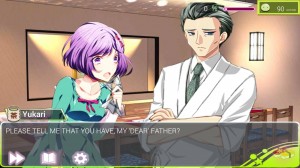
This game starts out with a premise familiar to any manga fan – someone’s parent is going crazy and abandoning them for no logical reason. It is almost as good as the plot device where a sudden marriage where the heroine gets an annoyingly attractive new sibling. In this particular case the heroine’s father, a world class sushi chef, announces that he is going to walk the earth to bring the gospel of sushi to foreign lands, leaving the family restaurant in the hands of his daughter, who is absolutely inept at making sushi. Yukari, who is a sensible girl except for her habit of falling in love with sushi ingredients, is angry and upset about this turn of events. She finds some unlikely helpers, as the sushi ingredients her father left behind turn into handsome young men, prepared to help her keep the restaurant running.

Other than the nutty aspect of dating sushi ingredients, this game is pretty boring. There isn’t really much of a plot to speak of in either of the routes I tried. Salmon and Tuna are engaged in a petulant rivalry with each other.

Screenshot_2014-09-09-12-35-08

This rivalry sometimes becomes violent. Sushi fight!!!!!

Screenshot_2014-09-09-12-35-40

While there is no plot to speak of, this game did at least have a sense of humor, as when the sushi ingredients ponder the morality of sushi ingredients eating sushi.

Screenshot_2014-09-08-22-07-05

I did appreciate the heroine’s tendencies to yell in all caps when she’s upset.

Screenshot_2014-08-22-18-15-19

As a free game, I think you can play up to three character’s story lines for free. I only played through all of Tuna and part of Salmon. It is very very unfortunate that Shrimp and Avocado don’t have routes. The power expended to get through the game for free is about the slowest to regenerate that I’ve ever encountered in a freemium otome game. You basically get only 2 chapters a day, which is a very slow pace. I didn’t think that the character designs were very attractive. Often the game presents you with empty rooms and subtitles, I’m assuming to save on the costs of doing additional illustrations. Lackluster art combined with almost no plot to speak of doesn’t really add up to a game that I’d be interested in playing much further, even though there are flashes of humor due to the wacky premise.

Filed Under: REVIEWS Tagged With: Love! Sushi Rangers, otome games

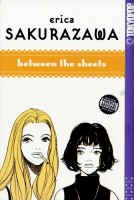
Between the Sheets

September 12, 2014 by Ash Brown

Between the SheetsCreator: Erica Sakurazawa
U.S. publisher: Tokyopop
ISBN: 9781591823230
Released: May 2003
Original release: 1996

Between 2003 and 2004, Tokyopop published six manga by Erica Sakurazawa, some of the very first josei manga to be released in English. More than a decade later josei has still yet to establish a firm foothold in North America, though things seem to be improving and publishers continue to make an effort. Most of the josei that I have read I have thoroughly enjoyed. I wish that there was more available in English, but in the meantime I make the point to support what is currently available and to track down those titles, like Sakurazawa’s, that have gone out of print. The first of Sakurazawa’s manga to be translated was Between the Sheets, which was originally published in Japan in 1996. The volume was not my introduction to her work but out of all of Sakurazawa’s manga that I have so far read, I feel that it is one of the strongest in terms of storytelling. Between the Sheets was initially brought to my attention due to the elements of same-sex desire that play a critical role in the manga’s story.

Minako and Saki are extraordinarily close friends. They frequently hang out together, enjoying the bars and party scene where Saki, despite having a boyfriend, is constantly on the lookout for men. But when Saki and Minako share a drunken kiss in order to convince an undesirable suitor that they’re a couple and to leave them alone, Minako finds her feelings for her best friend beginning to change. Minako had always admired and cared deeply for Saki, but now her love has turned obsessive. She wants to be with Saki. In some ways she wants to be Saki. Saki views Minako as an extremely important person in her life but nothing more than a friend while Minako wants to be everything for Saki: her lover, her protector, her one and only. Convinced she knows what’s best for Saki, Minako will do anything to get closer to her and to drive others away, including sleeping with Saki’s boyfriends.

Frankly, Between the Sheets is an exceptionally disturbing and even horrifying work. Minako’s obsession with Saki creates an ominous and foreboding atmosphere. Each turn of the page seems as though it could reveal some sort of horrible tragedy worse than what has already occurred. Minako’s feelings become self-destructive and her way of dealing with them hurt not only herself but Saki and the men in their lives as well. Often in fiction and romance one person’s utter devotion to another is held as an ideal. However, Between the Sheets takes a much more realistic approach to this sort of extreme, obsessive desire. Minako’s fixation on Saki becomes all-consuming. It’s not flattering and it’s not romantic. In fact, it can hardly even be called love anymore. Her friendship with Saki has evolved into something much darker and much more dangerous. The damage done may be irreparable.

Because of its subject matter Between the Sheets can be a tough and uncomfortable read; it is not at all a feel-good story and there is very little happiness to be found. The characters are entangled in a web of lies, cheating, and betrayal. Unpleasant emotions like hatred, anger, and jealously overshadow those of adoration, love, and affection. However, Sakurazawa handles the intensity of those feelings in a believable way. That realism is probably one of the reasons that Between the Sheets is so troubling. Minako appears to be normal and innocent, her twisted way of thinking hidden safely from view. Sakurazawa’s artwork reflects this–on the surface nothing seems amiss. If readers weren’t privy to Minako’s inner thoughts, they might never suspect the unhealthiness of her state of mind. But eventually her actions and their tragic consequences cannot be ignored and make it quite clear to everyone involved how unbalanced she has become.

Filed Under: REVIEWS Tagged With: Erica Sakurazawa, manga, Tokyopop, Year of Yuri

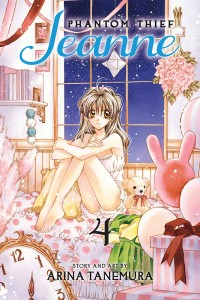
Phantom Thief Jeanne, Vol. 4

September 11, 2014 by Sean Gaffney

By Arina Tanemura. Released in Japan as “Kamikaze Kaitou Jeanne” by Shueisha, serialized in the magazine Ribon. Released in North America by Viz.

Before I get started, I want to note that I remain immensely pleased with this series. It has a lot of what magical girl series should have, a nice sense of humor even in its darkest moments, a good deal of cuteness, and the ongoing plot is fascinating. Everyone should be picking this up. With that said, let me spend this review dwelling a bit on things that felt problematic to me in this volume.

jeanne4

To be fair, one of these things is sort of unavoidable. In her massive villain rant at the start of the series, Finn Fish reveals that Maron has been manipulated, not just since she met Finn, but since birth, as it was the influence of Satan that led to her parents breaking up. I dislike the agency that this removes, and feel that it makes her parents less interesting people – their almost shallow horribleness was a large part of what made Maron so strong and interesting. But then that’s Finn’s point, and certainly if you’re in a series where God and Satan are real, you have to expect temptation to have more concrete forms.

Less excusable is Maron’s forgiveness of Noin’s actions once they go back in time to meet Jeanne D’Arc. She immediately rationalizes the attempted rape by noting that if he’d meant to go through with it, he would have done it while she slept, and also points out that it was due to both being possessed by a demon and his love for Jeanne. Which, yes, is true, but the whole “It’s OK, you were just overcome in the heat of the moment” forgiveness rankles in many shoujo titles. We also have several moments in the second half where Chiaki is attracted to Maron so much that he forces himself on her multiple times. This is meant to be half-amusing, and he beats himself up over it, but that doesn’t actually stop the attempts, even when he knows she’s in a fragile state.

And then there’s Miyako. She gets less of a role to play in this volume until the end, clearly upset that the “phantom thief” isn’t appearing anymore. The problem is that her plotline is mostly resolved – she’s realized that Chiaki loves Maron, and that she can’t really do anything to change that. So, as she herself notes, all that’s left to do is confess to him, get rejected and move on. She is, therefore, too nice to be an antagonist anymore. And that has to be fixed, so at the end of the volume we see her abducted by Finn, and she later pops up, I suspect, clearly possessed by evil. I wish there were a more natural way to do this.

That said, there’s still so much to love about this volume, don’t get me wrong. Everything about Finn’s past and her relationship with Access is beautifully tragic, and (typical for Japan) paints God as being not all that much better when it comes to forgiveness. Yamato’s confession to Maron, and subsequent rejection, plays out beautifully, and is likely why Tanemura wanted to avoid repeating it with Miyako. And the time travel arc is handled surprisingly well and logically, and among its questionable forgiveness does have Maron assuring Jeanne that being raped does not make you less good of a person.

To sum up, see the start of this review. Even with my issues, it’s still far and away by favorite Tanemura series.

Filed Under: REVIEWS

Boogiepop and Others

September 10, 2014 by Ash Brown

Boogiepop and OthersAuthor: Kouhei Kadono
Illustrator: Kouji Ogata

Translator: Andrew Cunningham
U.S. publisher: Seven Seas
ISBN: 9781933164168
Released: January 2006
Original release: 1998
Awards: Dengeki Novel Prize

Boogiepop and Others is the first volume in a series of light novels written by Kouhei Kadono and illustrated by Kouji Ogata. The novel was originally released in Japan in 1998 after winning the Dengeki Game Novel Prize (now known simply as the Dengeki Novel Prize). Boogiepop and Others has been credited with igniting the light novel trend in Japan. Whether that is true or not, the novel has inspired more than a dozen other volumes in the Boogiepop novel series as well as other books, short stories, manga, music, a live-action film adaptation, an anime, and more. Out of the fairly large franchise, four of the light novels–including Boogiepop and Others–two short manga series, the anime, and the film have been released in English. The English-language edition of Boogiepop and Others, translated by Andrew Cunningham, was published by Seven Seas in 2006. Although I had been aware of the Boogiepop Phantom anime series for quite some time, Boogiepop and Others was actually my introduction to the franchise and is set before the events of the anime.

No one is entirely sure who or what Boogiepop is, but there are several rumors and theories among the students of Shinyo Academy. Stories are told about a spirit of death, an assassin who can kill instantly and painlessly. When a number of female students at Shinyo Academy go missing, many naturally assume that Boogiepop must have had something to do with their disappearances. Others believe Boogiepop to be nothing more than a myth or urban legend, but they can’t deny that something very strange and very wrong is going on at their school. Most of the missing girls are written off as runaways by the police and their cases are quickly dropped. And so a few of their classmates take it upon themselves to investigate since they can’t rely on the adults to pursue the matter. But it’s already too late. Some of the girls who have disappeared have lost their lives and there will be even more deaths before those who are responsible can be stopped. If they can be stopped. Any survivors will be left struggling to comprehend everything that occurred at Shinyo Academy.

Boogiepop and Others isn’t told from a single point of view, within a single time frame, or even through a single narrative. Instead, each chapter is seen from the perspective of a different student. Some of the characters are directly involved with the events unfolding at Shinyo Academy while others are only tangentially related. However, none of them know everything about what is going on, though they may have their suspicions. There’s Takeda Keiji, who becomes one of the people closest to Boogiepop, Suema Kazuko, who once was almost the victim of a serial killer herself, Saotome Masami, a deceptively unassuming underclassman, Kimura Akio, one of several boyfriends of one of the missing students, and Niitoki Kei, the president of the discipline committee. They each have their own story to tell, and each version of the events is accurate, but the complete truth can only be understood when all of the individual accounts have been completely disclosed and are then considered and taken together as a whole.

The narrative structure of Boogiepop and Others is actually quite effective in creating and sustaining the mystery and mood of the novel. It’s a slow build as little by little information is revealed and connections are made between characters and their stories. Piecing together everything is an incredibly engaging part of the novel. At times, Boogiepop and Others can be legitimately creepy and disconcerting. The elements of horror in the novel are just as strong as those of science fiction and mystery. Several of the characters are dealing with extreme mental and psychological disturbances and unfortunate family circumstances in addition to the apparent supernatural occurrences. Personally, I preferred Kadono’s exploration of the more reality-based issues over the more outrageous ideas, but in combination even those could be oddly compelling in their strangeness. I thoroughly enjoyed Boogiepop and Others, perhaps even more than I initially anticipated. I definitely plan on reading more of the series.

Filed Under: REVIEWS Tagged With: Boogiepop, Dengeki Novel Prize, Kouhei Kadono, Kouji Ogata, Light Novels, Novels, Seven Seas

Gangsta, Vol. 3

September 9, 2014 by Anna N

Gangsta Volume 3 by Kohske

I continue to thoroughly enjoy this seinen title set in a world where two men with a brotherly bond make money doing odd jobs for the mafia, in a world where genetically enhanced humans are both fearsome soldiers and a disrespected underclass. I thought after reading volume 2 and getting a peak at the cover for this volume that the reader would be getting a bit more backstory on how Nic and Worick first met, and I wasn’t disappointed.

We get a glimpse of Worick’s life before he became a handyman at large and sometime gigolo. He was brought up by a wealthy family with an abusive father who never hesitated to remind him of his illegitimacy. He’s all alone until he gets assigned an unconventional bodyguard Nic, who is working through his own problems as a deaf Twilighter with few communication skills. The two young men gradually grow closer together, with Worick acting as a bit of a tutor. They pour over a sign language book together. This isn’t an idyll by any means, as Worick is beaten by his father, and Nic is abused by the mercenary troop that just wants to take advantage of his skills and dump him when he’s useless.

In the present day Alex finds herself more drawn in to the daily lives of the two handymen and their friends at the nearby medical clinic. There are some mafia conspiracies going on that I’m sure will be drawing in everybody into a violent confrontation. More Twilighters are popping up, and I think things are going to get even more bloody in the volumes ahead The violence in this manga contrasts with some of the slice of life pacing and the strong relationships that develop as the characters intersect. The art manages to be both stylish and dynamic, and the action scenes are effective in showing the enhances powers of the Twilights, and the aftereffects of their actions. Kohske is building an interesting world. If you enjoy seinen with an edge, you can’t go wrong with this manga.

Filed Under: REVIEWS

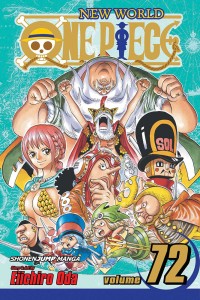
One Piece, Vol. 72

September 9, 2014 by Sean Gaffney

By Eiichiro Oda. Released in Japan by Shueisha, serialization ongoing in the magazine Weekly Shonen Jump. Released in North America by Viz.

When I reviewed the last volume, I said that there was a bit too much going on for me to get a handle on all of it, and that goes double for this volume, which rarely stays on one character for longer than a few pages. As such, I think it’s time to bring out the bullet point review style, which I haven’t done in some time.

onepiece72

— So we get to see Sanji’s reputation as a loser who is easily manipulated by women, but this is undercut a great deal by having him actually be right about her needing help, of course. Sigh. One day I’d like to see a pretty girl who isn’t swayed by Sanji’s annoying chivalry. (Well, one can argue Nami and Robin perform this function…)
— I like the reveal that Donflamingo had the press send a retraction on this quitting the Warlords 12 hours later, right after all his enemies would have taken the bait. It’s quite clever. I also like that Law, given an easy chance, still respects Luffy enough to not take it, and proclaims that they are equal allies.
— Naturally, Usopp playing the hero is getting him into all sorts of trouble, as now he has to lead a Tontatta army to rescue their missing princess (who is apparently a horrible person, but is one of them, so must be rescued). Meanwhile, Robin is resting after using up her one big surprised face last volume, so she’s mostly stoic here.
— Nami, Chopper, and Brook get very little to do, but I have to admit that Oda still knows how to use fruit powers to his advantage. The Picasso fruit allows him to try styles for the characters that are both horrifying and hilarious.
— As I suspected last volume, the big reveal about the toys is that they were once people – and, tragically, they remember this, but the people who they were connected to (wives, children) do not. This is incredibly sad if you think about it, especially as it’s been going on for years. I wonder how this will fall out once the Straw Hat Pirates save the day?
— Much of Luffy’s fight in the ring is taken up by a bunch of seemingly awesome fighters who get taken out by a slew of other even more awesome fighters, as in most tournament arcs. I did like the Ideon ref. The one to note here is Chin Jao, who, as per One Piece tradition, has a backstory both extraordinarily sad and extraordinarily stupid at the same time. (Seriously, without his head being pointy, nothing can happen? He’s that much of a can opener?) That said, in the end it’s Luffy punching the grudge out of him.
–And then there’s Rebecca, who has an even more tragic backstory, which resembles Nami and Robin’s a bit too much for my liking. She’s going out their to kick ass, but I have a sinking feeling that she’s going to need saving. There was much discussion when she appeared that she might join the crew, but her tragic past flashback is only a few pages, so chances aren’t good. We shall see.

Oda is still doing what he does best, and tehre are some very clever twists in this volume. One Piece fans should be quite satisfied.

Filed Under: REVIEWS

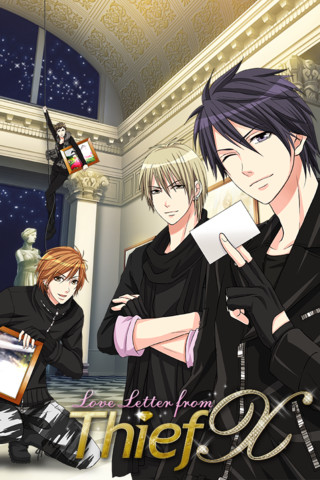
Otome Game Review: Love Letter from Thief X

September 7, 2014 by Anna N

Love Letter from Thief x is availabe on Android and iPhone.

love_letter_from_thief_x

I played a few Otome games a year ago, and I’m playing a couple again. Perhaps there is something about fall that makes me want to play Otome games. Before I move on to the games I am currently playing (spoiler alert! there might be sushi and ninjas involved), I thought I would go back and write about my favorite game to date, Love Letter from Thief X.

There’s something about the premise that really appeals to me, even more than games involving pirates and ninjas, as hard as it may seem. In this game, the heroine works in a museum and finds herself caught up in a ring of Robin Hood-like thieves. It is vaguely like that great Audrey Hepburn and Peter O’Toole move “How to Steal a Million”, except there’s no Givenchy costumes and instead of Peter O’Toole, you get six Japanese dudes.

The heroine of this game works in a museum. Her great-grandfather was the Japanese equivalent of Leonardo da Vinci. One day when she’s at work after hours, she runs into two thieves. She bumps into a display case as she chases after them, almost toppling a statute on top of her. One of the thieves saves her from being brained by the bronze. They notice that she’s wearing an heirloom ring from her great-grandfather, then quickly run away as the police approach. There are rumors floating around about a ring of thieves known as the Black Foxes, and the heroine wonders if the strange men she encountered are part of the group.

thiefx1

The next day the heroine finds herself meeting two other strange men who are also part of the secret band of thieves. She finds herself at a bar where they all hang out, told that she’s the key to unlocking the secret of her great-grandfather’s legacy, and has to pick a thief to accompany her at all times in her new role as a member of the Black Foxes.

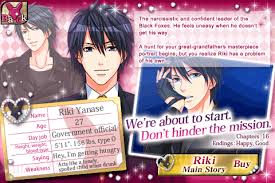
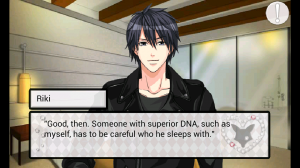
There’s Riki, the arrogant leader:

riki

Screenshot_2013-09-25-00-48-33

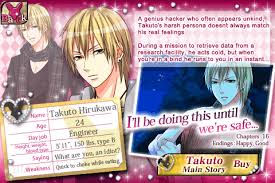
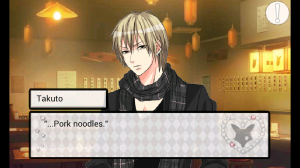
Takuto, a socially inept computer genius.

takuto

Screenshot_2013-09-27-00-47-57

Takuto and the heroine often get into fights over who ate the last serving of pork noodles.

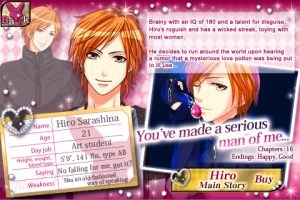
Hiro, an androgynous art student and master of disguise:

hiro

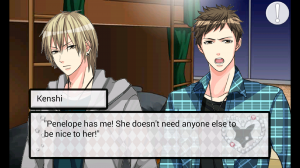
and Kenshi, the boy next door:

kenshi

Screenshot_2014-09-07-16-37-00

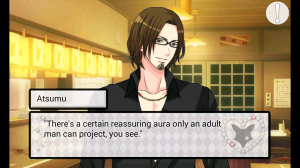
You can also play storylines with Atsumu, the oddly superstitious older boss of the gang, and Tatsuro, an old childhood friend of the heroine’s who happens to be a police detective tracking down the Black Foxes.

Screenshot_2014-09-07-18-38-50

Depending on the route you pick, you get a different scenario for the mystery the Black Foxes need the heroine to solve. Sometimes they are chasing paintings, an advanced scientific invention, an Indiana Jones style lost city, or a precious artifact. I played through all the routes on this game, although I haven’t invested the time and money to play the many sequels, epilogues, and special stories.

There are a lot of similarities in the personalities of the characters to Pirates in Love. In particular, Riki and Eduardo and Atsumu and Morgan were a bit similar. This was the first Otome game where I’ve been interested in playing every route, and it was interesting to see the variations on the story with each character. Riki’s story is good if you enjoy the whole clumsy maiden with a chaebol dynamic that pops up so often in k-dramas, and there’s even a bit of second lead syndrome as Riki and Takuto struggle a bit over the heroine’s affections. Takuto’s story was probably the most emotionally intense. Kenshi’s storyline was simple but sweet. Atsumu’s storyline delves into issues that unfold when you have a leading man who is superficial on the service because he’s dealing with a tragic past. I was happy to play through all the stories, but Hiro and Tatsuro were a bit less entertaining for me.

There’s plenty of humor throughout. I know that many otome game aficionados aren’t necessarily the biggest fans of Voltage Games, but if you aren’t able to play games in Japanese, at least the translation quality is good, you do get plenty of chapters for the $4.99 per game route you’re playing, and the storylines are generally entertaining. This has been my favorite otome game so far, and I would rank Pirates in Love second. I always meant for these reviews to turn into a regular feature! We’ll see what I can manage with the few games I just started playing recently. If you have suggestions for games for me to check out, please let me know. I know that Alice in the Country of Hearts was just released in English, but the translation quality seems so bad, I’m not sure if I can stomach paying for any chapters.

Filed Under: REVIEWS Tagged With: love letter from thief x, otome game, voltage

Noragami: Stray God, Vol. 1

September 7, 2014 by Sean Gaffney

By Adachitoka. Released in Japan by Kodansha, serialization ongoing in the magazine Monthly Shonen Magazine. Released in North America by Kodansha Comics.

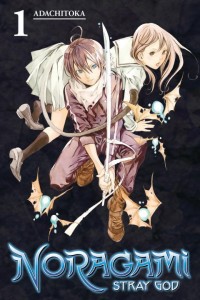
It’s rare to see the word ‘Monthly’ next to Shonen Magazine in North American licenses. Between the licenses from the regular Weekly publication (Fairy Tail, UQ Holder, etc.) and the ‘cool’ alternative of Bessatsu (Attack on Titan, Sankarea, Flowers of Evil), Monthly doesn’t really get much of a look. It tends towards longer series, which may be a primary reason, and there’s also a lot of sports titles, including long-runner Dear Boys. Del Rey tried out Pumpkin Scissors, but it fell victim to The Great Del Rey Cull of 2010 (as seen in all good history books). But now we have Noragami: Stray God, a fantasy featuring a god who’s somewhat full of himself and a young girl who struggles to deal with her new-found brush with death.

noragami1

As I read Noragami, I was struck by its similarity to another title I follow, Rin-Ne. Another spiritual odd jobs man who helps out people in need, even if they may turn out to not really deserve the help they get, and does so despite being on the edge of poverty. Takahashui’s series, though, has fairly mild characters in the lead roles. That’s not the cast with Noragami. I was struck after finishing the first chapter how hard it was to latch onto anything, which makes it a relief that it was a sort of prologue. A victim of class bullying, Mutsumi comes across as somewhat passive and shallow, and even though I am not fond of ‘it’s the victim’s fault for not standing up for herself’ plotlines, you can see Yato’s point.

As for Yato, he’s a very quirky sort of hero, coming across as a bit of a jerk, to the extent that his old Shinki, the only one in the first chapter who seemed like a decent person, abandons him. Of course, this is not the end. Yato is a decent person at heart, it’s just he keeps up a shell of over-the-top dramatics and uncaring dialogue. Things perk up when we meet Hiyori, who does end up taking the role of the audience identification character. She’s a little weird herself (her obsession with pro wrestling is her character introduction), but comes across as nice and sympathetic, and attempts to figure out what to do after an impulsive attempt to save Yato from a care crash leaves her in the realm between life and death (complete with tail for added service).

At the end of the series we meet Yato’s supposed new ShinkiYukine… who seems very ungrateful to be in this position, and whose discussion of Yato’s faults reminds me a lot of the original Shinki we met. Will he stick around long enough to see Volume 3? More to the point, will I? This is an intriguing new series, but it’s hard to really bond with anyone in it, and its plot is being done elsewhere as well. Those who enjoy fantasy comedies should like Noragami, but it can be as hard to take as its hero most of the time.

Filed Under: REVIEWS

Checking out Sparkler Monthly

September 6, 2014 by Anna N

Sparkler Monthly has a membership drive currently happening, and I was given access as a reviewer to poke around and check out what this unique magazine has to offer. I browsed around the site a bit, and while I realize the flagship title is Jen Lee Quick’s Off*Beat, my attention was first captured by the currently running series Dire Hearts and the selection of short stories.

Dire Hearts

Dire Hearts is by Christy Lijewski, and currently has 2 chapters available. Rose attends a special school for Casters, girls with magical abilities who are paired up with Knights. Rose has a severe case of amnesia, a slightly obnoxious roommate, and angsty problems because Sir Shur has chosen her as his caster, even though her abilities aren’t up to speed. Rose is an entertaining, somewhat caustic heroine, who is struggling to regain her memories and not fitting in well to the overly mannered society at her school. Something about all the school uniforms and undercurrents of psychological trauma reminded me a tiny bit of Revolutionary Girl Utena. The standout aspect of this title is Lijewski’s art, which combines the pretty and the grotesque in stylized lines and good panel composition. This was my favorite of the titles that I sampled, but unfortunately this series is now on hiatus.

Windrose

Windrose is by Studio Konsen, it has a more conventional pretty shoujo art style, and I found myself intrigued by the first two chapters, which launch heroine Daniela into an adventure filled with pirates, as she searches for the truth about her father. She falls in with with brother and sister mercenaries Angeline and Leon. Angeline is predatory and sneaky and Leon seems to be silently sympathetic but without much personality yet, so it will be interesting to see if this somewhat random group is able to fulfill Daniela’s quest. I enjoyed the art and the story for this comic, but it is a bit tricky to judge a comic based on only two chapters.

Gatesmith

Gatesmith is by Jen Lee Quick, who is I suppose the flagship creator for Chromatic Press, since her title Off*Beat is available in all three volumes, including the first two previously published by Tokyopop, and the final third volume published by Chromatic Press. This series is a western with supernatural and horror elements. The first chapter shows a wagon journey gone awry, as the travelers are robbed and killed, and the only surviving robber ends up dying in the desert, only to have his corpse be reanimated by a skinwalker. The following chapter shows a mysterious stranger sharing a meal with some ranchers, only to head out alone to track down a supernatural manifestation. I think I’ll be able to get a better feel for the series after reading a couple more chapters, but so far this title does seem very intriguing. Quick’s art is expressive, clear, and easy to follow.

There are short stories available too. Of the three short story series available, Ring of Saturn was the standout for me. I enjoyed the story about a struggling pianist. The historical setting and aspects of the art reminded me a bit of the manga Emma. Before You Go was a meet cute story about two girls who strike up a relationship after sharing the same commute for several weeks.

Sparkler Monthly has put together an impressive amount of content for such a new venture. I was just checking out the comics and didn’t even start reading the prose or audio dramas. I wish that there had been a few more chapters available for the non-Off*Beat series, but I appreciate that it takes a lot of work to issue a chapter of a comic, and many of these comics have just been recently launched.

If you’re interested in Sparkler Monthly, you can download a Sampler Issue and contribute to their membership drive!

Filed Under: REVIEWS Tagged With: Chromatic Press, sparkler monthly

  • « Go to Previous Page
  • Page 1
  • Interim pages omitted …
  • Page 248
  • Page 249
  • Page 250
  • Page 251
  • Page 252
  • Interim pages omitted …
  • Page 346
  • Go to Next Page »
 | Log in
Copyright © 2010 Manga Bookshelf | Powered by WordPress & the Genesis Framework