• Skip to primary navigation
  • Skip to main content
  • Skip to primary sidebar
  • Home
  • About Us
    • Privacy Policy
    • Comment Policy
    • Disclosures & Disclaimers
  • Resources
    • Links, Essays & Articles
    • Fandomology!
    • CLAMP Directory
    • BlogRoll
  • Features & Columns
    • 3 Things Thursday
    • Adventures in the Key of Shoujo
    • Bit & Blips (game reviews)
    • BL BOOKRACK
    • Bookshelf Briefs
    • Bringing the Drama
    • Comic Conversion
    • Fanservice Friday
    • Going Digital
    • It Came From the Sinosphere
    • License This!
    • Magazine no Mori
    • My Week in Manga
    • OFF THE SHELF
    • Not By Manga Alone
    • PICK OF THE WEEK
    • Subtitles & Sensibility
    • Weekly Shonen Jump Recaps
  • Manga Moveable Feast
    • MMF Full Archive
    • Yun Kouga
    • CLAMP
    • Shojo Beat
    • Osamu Tezuka
    • Sailor Moon
    • Fruits Basket
    • Takehiko Inoue
    • Wild Adapter
    • One Piece
    • After School Nightmare
    • Karakuri Odette
    • Paradise Kiss
    • The Color Trilogy
    • To Terra…
    • Sexy Voice & Robo
  • Browse by Author
    • Sean Gaffney
    • Anna Neatrour
    • Michelle Smith
    • Katherine Dacey
    • MJ
    • Brigid Alverson
    • Travis Anderson
    • Phillip Anthony
    • Derek Bown
    • Jaci Dahlvang
    • Angela Eastman
    • Erica Friedman
    • Sara K.
    • Megan Purdy
    • Emily Snodgrass
    • Nancy Thistlethwaite
    • Eva Volin
    • David Welsh
  • MB Blogs
    • A Case Suitable For Treatment
    • Experiments in Manga
    • MangaBlog
    • The Manga Critic
    • Manga Report
    • Soliloquy in Blue
    • Manga Curmudgeon (archive)

Manga Bookshelf

Discussion, Resources, Roundtables, & Reviews

Reviews

Can Someone Please Explain What’s Going On?! ~A Sign-on-the-Line Wedding Story~, Vol. 2

June 17, 2020 by Sean Gaffney

By Tsuredurebana and Rin Hagiwara. Released in Japan as “Dareka Kono Joukyou wo Setsumei Shite Kudasai! ~Keiyaku Kara Hajimaru Wedding~” by ArianRose. Released in North America by J-Novel Club. Translated by Mattias Hirsch.

Despite everything seemingly being resolved at the end of the last book in terms of their marriage, the title of this series still fits, as Viola continues to not really believe it. A combination of her own low self-worth and the guy who’s now trying to win her love being astonishingly bad at it means that any romantic progression we see here is minimal at best. To Viola’s credit, she does actually blush near the end of the book when Cercis gets in her face and says he wants them to be a real couple. But even then, there’s no real sign that she’s fallen for him, more that she’s taken aback by his actions. In order to win the girl, Cercis is not only going to have to get a lot better at not being a rich playboy type, he’s also going to have to hammer into her again and again that he loves her. Fortunately, he has several more volumes to do this.

We begin where the last book left off, with Cercis’ Mistress moving out after dumping his sorry ass. I appreciated the fact that, although she was clearly the “other woman”, the story treated her with respect anyway, and I wonder if we’ll see her again. After that, there’s various events that Cercis uses to try to get closer to his wife who just wants to hang around the mansion and pretend to be a maid. There’s balls (where Viola completely trashes a stereotypical “princess curl” rich girl by simply using her low self-image as a weapon), there’s dates (where Viola continues to be appalled at how much rich people spend, and Cercis begins to vaguely catch a clue), there’s visits back home (where we see a lot of what made Viola who she is today… her mother certainly didn’t go out of her way to praise her), and in the end there’s yet ANOTHER rumor that Cercis has taken a mistress, showing that it’s hard to reform when everyone already thinks the worst of you. Through all this, Viola blithely glides along, with her inner narration providing the snark and her outer face being mostly the perfect duchess.

I praised the translation on Twitter, as Viola’s narrative voice is the main reason to buy this. There is a caveat, though: if you’re bothered by the use of ‘modern’ language in a series with horse and carriages, you may find some of Viola’s remarks jar – at one point she uses the term “helicopter parent”, for example. But honestly it didn’t really bother me, and I found it gave Viola a snap to her lines that was perfectly in character. I do hope that future books work a bit more on her self-loathing… there’s a point where she (having slept poorly the night before) accidentally breaks a vase and she immediately loses it. She’s sent back to her earldom to recuperate for the day, but is convinced in her sleepiness that Cercis will divorce her now. The fact that this isn’t really panicked or upset but just as matter of fact as her other thoughts makes it hurt all the more. Someone needs to teach this girl confidence.

That said, right now it’s Cercis who needs to be learning lessons more, as he starts to figure out that expensive food and presents is not going to win him jack shit, and he slowly begins to see what Viola actually likes. If he continues to be a better person, and someone kick start’s Viola’s self-image, we could see this couple on paper become a real couple soon. In the meantime, I enjoy Viola’s snark a whole lot.

Oh yes, and the entire book is made even better by Cercis’ trio of drunken lady knights, who are a stitch.

Filed Under: can someone please explain what's going on?!, REVIEWS

Kobold King, Vol. 2

June 15, 2020 by Sean Gaffney

By Syousa. and sime. Released in Japan by Legend Novels (Kodansha). Released in North America by J-Novel Club. Translated by Amy Osteraas.

First things first: aside from the very start of this book, it is entirely devoted to warfare, with a large group of adventurers, mercenaries and soldiers marching to wipe out the Kobolds and their allies, and our heroes essentially turning into a jungle-based terrorist group to stop them. If this doesn’t interest you, you are not going to get much out of this book, as the brief characterization we had in Book 1 is left behind for the most part in favor of battle scenes. The good news is that the battle scenes are quite well written, and there’s a definite sense of tension to the whole book. Having killed off one of the main characters in the first volume, the reader is under the assumption that no one is safe. Indeed, while I wasn’t expecting the bad guys to win, I did start to suspect it would be a pyrrhic victory where most of the main cast sacrifice themselves. It comes close. That said, this is marked the end of the first “arc”, so presumably more books are coming.

On one side we have the evil obsessed Wyatt and his suit of magical armor, determined to destroy absolutely everyone on the Kobold side, especially Gaius. He’s attracted most of his force by offer of a large reward, but some others (the ones who were there the first time) he has to blackmail. The force itself is quite well divided between men and women, actually, which surprised and pleased me. Of course, this means that both men and women get their skulls caved in, hearts torn out and heads chopped off, because the mercenary force runs into Gaius and Sashalia’s Kobold guerrilla fighters. They have a force far, far smaller than the army’s, but are fighting for both survival and to make the other side give up and say it’s not worth the trouble. To that end, the Kobolds put out endless dangerous traps, use dirty and underhanded fighting tactics, and also have Gaius, who can kill dozens on his own. All this coordinated by Sashalia, who can no longer fight but can still be a tactician.

While I enjoyed this book, there’s not really much to say about it because it’s almost all action. I was thankful that the whole “I want to be the one to take Gaius’ virginity!” plotline was given barely a passing mention, and indeed there’s no love triangle here as was hinted in the last book, mostly as everyone is too busy fighting. Most of the cast ends up coming pretty close to dying – indeed, I was fairly certain that when Darke was hurled against a tree at full speed that she was dead. I was also certain that Emon was dead when Wyatt basically started hacking him to bits. And I certainly expected Gaius and Wyatt to kill each other in the final battle. Instead, the day is saved by a spirit from the dead returning and giving Gaius one final weapon. It’s unrealistic, but hey, we’ve had realism the whole battle, so I was fine with it.

As with other series from this label, we’re not sure when there will be more of it – it’s only two volumes in Japan for now. Still, if you want to know what Vietnam would have been like with kobolds, elves, dwarves and giant lizard creatures, this is a strong read.

Filed Under: kobold king, REVIEWS

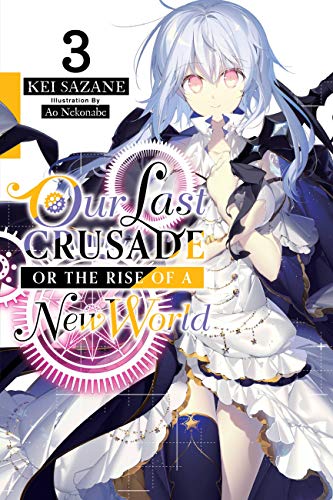
Our Last Crusade or the Rise of a New World, Vol. 3

June 14, 2020 by Sean Gaffney

By Kei Sazane and Ao Nekonabe. Released in Japan as “Kimi to Boku no Saigo no Senjou, Aruiwa Sekai ga Hajimaru Seisen” by Fujimi Fantasia Bunko. Released in North America by Yen On. Translated by Jan Cash.

Some authors are really good at plotting and worldbuilding. Some succeed at depth of characterization. Some write amazing dialogue. And then there’s Kei Sazane, who does none of those things, but that’s OK, as they have one thing that they do better than most anyone else: crafting cliffhangers that make a reader want to get the next book. I spent most of the second volume of this series thinking I would drop it after I finished, only for a last-minute plot twist that made me want to read more. Unfortunately, little is made of the plot twist here, mostly as the characters are two-dimensional. And once again I got to the end thinking, “yeah, OK, interesting did not happen, dropping this” only to get an epilogue which made me say, “Hrngh, now I want to know what happens next.” It’s a praiseworthy skill, and very well done. Of course, I wish that the skills had been used on a better light novel series.

Last volume ended with the revelation that Iska’s captain and designated dojikko Mismis now had an astral crest after basically falling in a pit of magic. So they have to figure out a way to keep it hidden so that she’s not imprisoned for life at best and executed at worst. I suspect skin-colored bandages, tried here, are not going to work well. It doesn’t help that, aside from one or two flashes of actually being a commander, Mismis is a fluffhead of the first order. (The author loves to write those types – more on this later.) Fortunately, they have a reason for her to be away from the Empire and using an Astral Crest – they have to infiltrate the enemy territory. Unfortunately, everything goes south when, for once, it’s Iska who gets to be the designated idiot, sipping a drugged drink provided by Alice’s maid and now taken prisoner in the hideous… honeymoon suite of a first-class hotel.

Last time Alice and Iska never met up, this time they’re together most of the book. It’s not really a great thing for Alice, as, like Mismis, the author loves to write her as a fluffhead, in this case a girl in love who doesn’t actually realize it. The ‘kidnapping’ wasn’t her idea, and she prefers to settle things on the battlefield in a one-on-one fight, of course. Unfortunately, the Empire is also trying to break out a top security prisoner (who is basically Gilgamesh from Fate/Stay Night only with magic instead of swords), and so everyone needs to rush off and stop everything ending in fire. Including Iska, who is, of course, also slowly falling for Alice in his own stoic lunkhead sort of way. Both Iska and Alice excel at combat scenes, where they’re both allowed to be ridiculously overpowered and cool, rather than enacting A Child’s Garden of Romeo and Juliet Scenes.

There’s no actual bad scenes or writing here – everything is very competent but empty, and reminds me a lot of Strike the Blood or Asterisk War in that it feels like it was written as a novelization of an anime. The main cast are all pretty likeable, and as I said, there’s a great cliffhanger that will probably make me read the 4th book in the series. I’ll be grumbling as I do, though.

Filed Under: our last crusade or the rise of a new world, REVIEWS

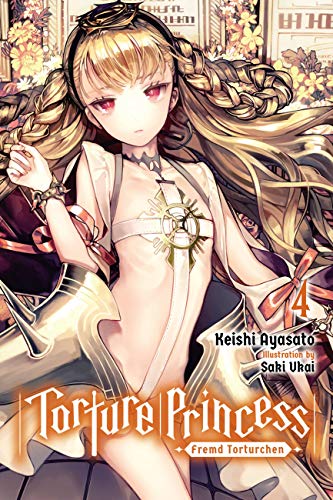
Torture Princess: Fremd Torturchen, Vol. 4

June 12, 2020 by Sean Gaffney

By Keishi Ayasato and Saki Ukai. Released in Japan as “Isekai Goumon Hime” by MF Bunko J. Released in North America Yen On. Translated by Nathaniel Hiroshi Thrasher.

I had mentioned that I was reading this new volume on Twitter, and someone replied to me “isn’t that just torture porn?”. It’s a reasonable question, given the title of the series and a good deal of the content. This fourth volume has slightly less grotesquery than previous ones, but that’s only by degree: there’s still many scenes here meant to disgust you. That said, I would argue it isn’t torture porn for the good reason that anyone reading this series ONLY for the gore is bound to be disappointed. The start of this book delves into mystery briefly, as Kaito and Hime try to discover what or who is slaughtering villages of beastmen. The end of the book, meanwhile, opens the Pandora’s Box of its lore and mythology, showing us that there’s far more disturbing creation myths than we really expected. The gore is there to drive the plot like all the other elements. And, once again, we have a book that is well-written if a bit off-putting because, well, intestines.

There’s also, surprise!, another Torture Princess, who we see on the cover here. Fate/Zero fans may have a head start on this one, though fortunately she doesn’t (so far) share her historical namesake’s fetishes. Jeanne de Rais was created much as Elisabeth Le Fanu was, only her sacrifices were 100% consensual. She’s thought to be the one behind the village massacres, but it turns out to be far more complex than that. She actually ends up being more of a guide/mentor figure, gathering everyone to a place the Church does not want to be seen and then showing them all what’s inside. She’s a fun new villain, though her method of speech takes some getting used to; half the time she sounds emotionless, the other half she talks like a foul-mouthed cowboy.

As for the others, well, fans of Subaru and Rem who want them to get it on will want to read this one, which may be as close as you’re going to get. (it does cut away before coitus ensues, so those reading for THAT will also be disappointed.) Kaito and Elisabeth continue to get very angry with each other for trying to sacrifice themselves so the other can live on, in a way that is half heartwarming and half hilarious. Izabella continues to be a trope that Japan loves, which is the one true believer in an increasingly corrupt Church. Sadly, she’s having a very bad last few weeks. And then there’s the Butcher, who has sort of been a comedy relief figure so far in the series, but here is shown to have a FAR larger role in everything that’s occurring, being a sort of combination of Judas and Mary Magdalene. I wonder what he’ll be doing going forward.

The book ends with a series of revelations about the world’s past religious history, and I suspect that the next book will involve the Church condemning absolutely everyone who found out about it to, well, torture. that said, with Elisabeth AND Jeanne on the same side, I doubt they’ll get far. Torture Princess can be grotesque, and is not for the faint of heart, but it’s far more than mere torture porn.

Filed Under: REVIEWS, torture princess

The Promised Neverland, Vol. 15

June 11, 2020 by Sean Gaffney

By Kaiu Shirai and Posuka Demizu. Released in Japan as “Yakusoku no Neverland” by Shueisha, serialization ongoing in the magazine Weekly Shonen Jump. Released in North America by Viz Media. Translated by Satsuki Yamashita.

This is the last time I’ll be able to write ‘serialization ongoing’ in the header, as the main manga ends this Sunday as I type this. Of course, that still means another 5-6 volumes to go here. More importantly, though, this volume is around the time when we start to see The Promised Neverland lose some of its initial audience. This series started out as pure horror/suspense, and grew quite popular based on that. Even as Emma and company escaped and tried to find out the secrets of this world, those two genres were never far from everyone’s mind. But here, in this 15th volume, when Ray and Emma meet up against some hallucinatory rooms and dream skeletons, it’s frankly a bit of a relief. Most of this volume is made up of political intrigue (albeit among demons) and moral/ethical arguments. It’s well written, and I think this is a very good volume. But is it what people are really reading this series for?

If Emma is the ‘idealistic’ hero of this series, then Norman falls into the ‘realistic’ side. This is amusing if you recall the start of the series, where it was definitely Ray who fell into that category, with Norman being the balance between them. But Norman’s had two years on his own, whereas Ray’s been with Emma the whole time. As a result, there’s been nothing stopping Norman from getting very dedicated to killing some demons. As I said in my last review, this is perfectly valid. The demons have done horrible things, and murdered many of their friends. That said, when the reveal becomes less “they need to do this or they die, so there’s no good answer’ and more ‘there is a good answer, but politics won’t let them use it’, there’s less of a moral leg to stand on. Emma gets this right away, and innocently asks why everyone can’t simply use the solution Mujika has. Norman (and Ray, who is now the middle ground) understand the real reason: power.

Norman, who has been planning everything for SO LONG, is not inclined to stop it just because Emma wants everyone to live happily ever after in peace and harmony, so she and Ray try to find a way to get him to compromise. There’s also the problem that even if they win, they don’t know if anything beyond the Seven Walls is an escape. So they’re going to go beyond the Seven Walls and find out, giving everyone a reason to move forward – and possibly one that might not involve genocide. Of course, it’s not that simple – they end up seemingly back at a deserted Grace Field House, only to find that it’s an amalgam of nightmares and bad memories. This section of the book is where the art really shines, and as I said before adds a nice bit of surrealistic horror to the proceedings. The question is, can they find the real entrance from here?

This is not the Promised Neverland we started off with, and that’s a good thing, even though I do get nostalgic for the old suspense novel feeling. It’s still well worth a read.

Filed Under: promised neverland, REVIEWS

The Devil Is a Part-Timer!, Vol. 16

June 10, 2020 by Sean Gaffney

By Satoshi Wagahara and 029. Released in Japan by Dengeki Bunko. Released in North America by Yen Press. Translated by Kevin Gifford.

This series is finally ending in Japan this august, so we know that after this book there’s only five more to go. As such, it does appear that this “defeat God so that Alas Ramus can have an awesome birthday” plotline is going to be the final one, assuming that it’s not “oh hey, guess I am in love with Emi/Maou after all”. As for this particular book, we’re faced with another “power through a weak first half, because the second half is spectacular” volume. Maou was barely in the last book, so he gets a lot of time at the start of this one. Sadly, everyone ELSE isn’t around, so most of the first chapter is him admitting that he now has bonds with other people and feels very lonely when they aren’t constantly around. (Acieth is around, but sadly he takes no comfort from her very annoying antics.) It doesn’t help that Valentine’s day is coming up, and Chiho is, well, avoiding him as he’s still waffling about her, to EVERYONE’S irritation.

As I said, the first half of this book is not that hot, mostly as the reader is well aware of what character development Maou and Emi need to have happen to them, but the writer wants to drag it out until the main non-romance plot is done. As such, Maou is again too nice for his own good – this time accepting some seeming “obligation” chocolate that is too expensive to really quality as that. Chiho has decided that, having made her feelings clear – again – she’s not going to add to the pressure by getting him chocolates, and was thinking maybe something like miso for his stressed-out stomach. And Emi, of course, is freaking out at the very thought of possibly giving chocolate to the guy she supposedly can’t forgive, and ends up justifying things by figuring out that Alas Ramus can give her daddy candy. None of this is all that interesting.

Where the book takes off is when we go to Enta Isla, where, owing to various plot explanations that I’m not going to get into (don’t worry, the other cast will), Chiho has to participate in an archery competition as part of a contest to be the next chief of the Northern tribes. She’s not aiming to be a chief, but winning the archery part will allow the team to steal a powerful weapon that is also an iconic monument. The reason that it’s so good is that it features Chiho wanting to come out from the shadow of the more powerful characters… both because of her accuracy with the bow (which isn’t super duper – she’s helped by the fact that archery in this world is not nearly as advanced) and because she’s sick of being “the girl defined by her liking Maou”, which honestly is how a lot of fans tend to see her. We know she isn’t winning the Maou sweepstakes, so this is an important step to allow her to become her own person. Also, she’s badass.

There’s other things to enjoy in the second half too, such as a badass granny and Bell getting an unfortunate nickname. That said, it does remind me that I tend to like this series better when Maou is not par-timing. Or angsting.

Filed Under: devil is a part-timer!, REVIEWS

Beatless, Vol. 2

June 8, 2020 by Sean Gaffney

By Satoshi Hase and redjuice. Released in Japan by Kadokawa Bunko. Released in North America digitally by J-Novel Club. Translated by Ben Gessel.

Another long, long book – the longest light novel I have digitally, in fact – and again, I feel it would have been fine if Beatless had been four lengthy books rather than two huge ones. That said, the author clearly thinks of it as one story, as the second volume just picks up where the first one left off and moves forward. There’s lots of cool action set pieces, lots of dead extras, lots of dead hIEs (who then come back to life quite a lot), and a whole lot of philosophizing on the nature of artificial intelligence and the way that it interacts with humanity. If this sounds like I’m parroting my last review, it’s no surprise, this really doesn’t introduce new themes or concepts into the book, it’s just more of the same. This is not to say the book gets dull – there’s always something happening – and the characters are quite interesting. But the book is making a point, and spends several hundred pages making that point.

I’d mentioned that the hIEs tend to die but not really be dead, most of that due to the very nature of how they live – it’s not like hitting their “heart” will kill them. Kouka spends much of the first quarter of the book having a Last Stand before she’s finally taken down, only to be rebuilt into twelve Kouka clones for the finale. Snowdrop is killed, then returns, and then is killed again, and returns again, to the point where she starts to resemble Jason Voorhees more than anything else. She’s easily the creepiest of the five main hIE cast. Methode spends her time being absolutely furious at anything and everything, and unfortunately is the least interesting because of it, though she doesn’t deserve her fate. (OK, I will admit, Mariage is the least interesting, but that’s mostly as her owner doesn’t let her do much of anything – it’s hard to be a major player when you aren’t in the battle.). And then there’s Lacia.

I admit that the nature of how Lacia attacks is quite clever, the best idea in the book, and the seeds were planted earlier with her work as a model. She and Arato make a great couple, to the point where we hate it when he loses his nerve and distrusts her, even though everyone and their brother points out why she’s incredibly dangerous. It all comes down to the question of how do you want humanity to move forward? Standing on the backs of the machines they created, or holding the hands of said machines? Honestly, I think humanity made this decision when they decided to make hIEs look like people. Their role is strangely sexless – Lacia again mentions functions she can’t use with Arato till he’s 18, but honestly there’s never any sense that anyone uses hIEs for sex – and also quite undefined, by design. Even the computer that runs everything, Higgins, is frustrated, to the point where he engineered all this just to be able to move forward.

I haven’t seen the anime, but I understand that the novel and anime end slightly differently, so you may want to check both out. I enjoyed Beatless, but, much like the hIEs themselves, I enjoyed it in a strangely emotionless way. There’s little humor – in fact, the only really good joke in the book comes right at the end – and little passion aside from the slow burn of Arato and Lacia. If you like futuristic SF, I’d give it a whirl.

Filed Under: beatless, REVIEWS

A Certain Scientific Railgun, Vol. 15

June 6, 2020 by Sean Gaffney

By Kazuma Kamachi and Motoi Fuyukawa. Released in Japan as “Toaru Kagaku no Railgun” by ASCII Media Works, serialization ongoing in the magazine Dengeki Daioh. Released in North America by Seven Seas. Translated by Nan Rymer.

In my last review I extolled the praises of Uiharu, whose mad hacker skills were impressive enough to break someone out of an unbreakable prison. Sadly, it turns out that she got noticed by the Dark Side of Academy City, as she’s kidnapped here. Unfortunately, she’s pure peril monkey for the rest of the volume, so it’s up to the other three members of the cast to step up. Do they rescue her? Not yet. Are they badass? Aw yiss. We get to see Mikoto, Kuroko and Saten all show off their best sides as they fight to rescue their friend. Which is not so impressive for Mikoto – it is her series, after all. And we’ve seen Kuroko be badass before, both here and in Index. The more Railgun manga we see, though, the more I remain convinced that it’s an excuse to show off Saten rather than any other Biri-biris who might be lying around. She doesn’t even have a baseball bat this time, but is amazing.

The first two thirds of the book are well done and yet will feel familiar to the Railgun reader. The bad guys here are all teenagers, for the most part, and Index/Railgun has hammered home over and over again that their lives are basically experiments for various bad adults. As a result, Mikoto gets a chance to try to talk the enemy down, which… well, doesn’t work, but hey, she tried. I like the fact that the enemies by now are expecting Mikoto to be, well, a goody-goody, and while she insists that this is Touma’s job and not hers, it’s more or less accurate anyway. Also, salt-based attacks allows for more Biblical imagery in this Bible-heavy series. As for Kuroko’s battle, well, she’s cool and clever, but the “my yuri fantasies can beat up your yuri fantasies” bit was as ridiculous as ever.

And then there’s Saten, who discovers that Uiharu has been kidnapped and begs her friends to have her come along and help. This proves sensible, as while Mikoto and Kuroko both pursue leads that turn out to be false, Saten does what she does best – play detective. She’s questioned for the fallout of the battle between powered folks that happened around her, and, due to various plot-related reasons, this is done in the very prison we’d seen before… where, as it turns out, our enemy is really based. Sadly, they have the world’s dumbest prison guards there, and as a result Saten is able to break out pretty easily. Of course, getting to where Uiharu might be requires jumping between two buildings that are not that close together, and Saten is, as she reminds us, a Level 0. Does she make it? Of course. She’s fighting for her girlfr— erm, best friend!

Again, I suspect Saten is in this story, along with Hamazura in the main Index series, to remind us that Academy City’s “Level” system is complete and total bullshit. That said, I’m fairly sure she’s not gonna rescue Uiharu all on her own. This is shaping up to be another big arc, so we’ll have to wait a month or two… or ten… to find out what happens next. (And with the Index novels now seemingly over in North America, we’re not even getting to tide ourselves over with the main series.) Still, this was an excellent volume. If you take away anything from it, think of Saten, leaping between those buildings and making it – bear-ly – due to the power of conviction and borrowing other people’s technology.

Filed Under: a certain scientific railgun, REVIEWS

How a Realist Hero Rebuilt the Kingdom, Vol. 11

June 5, 2020 by Sean Gaffney

By Dojyomaru and Fuyuyuki. Released in Japan by Overlap, Inc. Released in North America digitally by J-Novel Club. Translated by Sean McCann.

After spending the last volume having all the weddings, it’s no surprise that we’re starting to see the fruits of that labor, so to speak. No, not Souma, although he does bed three more of his wives in this book (it cuts away before the sex, sorry). Instead we have Poncho, whose two wives are already pregnant, possibly as they are banging so much he is literally getting thin because of it, and Hal, whose childhood friend Kaede is also pregnant. Fortunately, the sex and babies is only a tiny part of this book, which is otherwise devoted to integrating its new problem children into the kingdom. Sometimes this is easy – everyone loves Ichiha, the milder climate means he’s healthier, and he’s written the most important book in years. Sometimes it’s a bit more difficult, as with Yuriga, who is not only a budding tsundere in training, but is also writing her brother every week telling him what King Souma is doing. What is Souma doing? Oh, y’know, starting bicycle message services, doing a Day of the Dead costume parade, staging mock battles to cool anime music. The usual.

As you can see from the cover, the other big plot twist is that Roroa has de-aged, and is now attending school. OK, no. In fact that is Lucy, a merchant’s daughter who adores Roroa and models herself after her, to the point where she’s nicknamed “mini-Roroa” in story. The other addition to the schoolchildren ranks is Velza, the dark elf that Hal rescued who has fallen madly in love with him. It’s a bit too soon for her to be going after anyone, though, so in the meantime she join’s Tomoe’s posse to get some learning. As always with this series, part of the fun is seeing not only how Souma introduces things like sewers and the like to Friedonia, nut also normal Japanese things – in this case the idea of school clubs, who recruit just as violently here as they do in Japan. The kids are cute, and we’re seeing them start to grow up – Tomoe has a bit of a crush on Ichiha, and is also trying to be more mature in general.

Arguably the more interesting part of the book is Souma giving a symposium on monsters and what they’ve learned due to Ichiha’s drawings and analysis. Publicly, it discusses classifying monsters more easily and studying them to try to help prevent things like stampedes and the like. Privately, things are more disturbing – evidence points to the monsters being ‘created” rather than born, and if that’s the case, then what about say, the beastmen, or the sea serpents, or any of the sentient races currently living reasonably peacefully with humans. The last thing Souma needs is adding racism to a world that’s trying to get rid of it. And this doesn’t even get into the potential war with the demons they have coming up. The back half of the book is, therefore, lots of talk, but it’s interesting talk.

This book takes place back in Friedonia, but apparently in the next one we go off to another country and meet some more new characters – because honestly the cast is too small, don’t you think? Till then, this gives the readers what they want, and I enjoyed it. Though for God’s sake, stop citing Machiavelli.

Filed Under: how a realist hero rebuilt the kingdom, REVIEWS

Spy x Family, Vol. 1

June 4, 2020 by Sean Gaffney

By Tatsuya Endo. Released in Japan by Shueisha, serialization ongoing in the magazine Shonen Jump+. Released in North America by Viz Media. Translated by Casey Loe.

I have technically reviewed this before. Back when Spy x Family was a brand new manga on the Mangaplus app, I was so taken with it that I did a review of the first four chapters even though it hadn’t even been collected into volumes in Japan. Since then it’s gotten up to four volumes there, been picked up by the Shonen Jump app, gotten ludicrously popular (though rumors of an anime coming soon are likely merely rumors), and now we have the first volume from Viz. Is it worth a reread if you’ve already seen it on the app? Of course. This is a manga that rewards rereads. It’s also the perfect combination of funny and heartwarming, and the Spy and the Family in its title are in almost perfect balance. It also features three leads who can each play the clueless one when the plot allows (yes, even Loid). And of course it’s a found family manga, showing off that when you have people you care about, it can be hard to see them as just pawns for your mission.

Spy x Family takes place in not-Cold War Germany, with tensions brewing between thinly renamed versions of East and West Berlin. Agent Twilight is a master spy, good at almost everything, who is now forced to have a wife and child so that he can infiltrate an exclusive private academy. Going by the name Loid Forger (why not Lloyd? I dunno. Why not Gerald instead of Jellal/Geord?), he goes to an orphanage to adopt Anya, a girl who seems brilliant to him, but it turns out she’s a telepath who just reads his mind to get the right answers. She really wants out of the orphanage, and things Loid is cool. As for a wife, he meets Yor, an office lady who is over 25 yet has no husband, suspicious in this cold war environment. She and Loid both agree to have a sham marriage to prop each other up. Oh yes, she’s also an assassin for the other side. Neither Loid nor Yor know each other’s secrets. Anya knows both, but she thinks it’s really cool, so it’s fine.

This manga is funny. It’s filled with great lines from everyone. Loid’s over-seriousness is mined for comedy. Anya’s childishness and ability to read minds is mined for comedy. Yor is perhaps the best at it, as despite being a lethal assassin, she’s also an airhead of the finest kind. I’d happily read this if it were just broad comedy. But the other reason everyone loves it is the gradual love and affection the family develops for each other, particularly on Loid’s end. The entire reason for him doing this was to infiltrate the school (which they do, in a ludicrous chapter that involves a child stuck in mud, a stampede of wild animals through the campus, and THREE different outfits for everyone “just in case”), and yet when they get there and one of the interviewers starts to humiliate Anya and Yor, Loid snaps and almost hits him, then walks out. His family became (even briefly) more important than the mission. It’s fantastic.

There’s a joke that says that the author came up with the idea of this manga by reading the most popular AO3 tags and mushing them together. It does feel like that at times. But like the best found family/enemies to lovers fanfics, it also has a strong plot, and it’s a lot of fun. I can’t wait for the next volume, even if I have read it before on the Shonen Jump app. It’s just that good.

Filed Under: REVIEWS, spy x family

Der Werwolf: The Annals of Veight, Vol. 7

June 3, 2020 by Sean Gaffney

By Hyougetsu and Nishi(E)da. Released in Japan by Earth Star Novels. Released in North America by J-Novel Club. Translated by Ningen.

For the most part, Der Werwolf has been one of those reincarnation isekai series that tends to ignore the reincarnation most of the time. Veight’s old life in Japan is still mostly a blank to us, and aside from bringing in a few modern ideas to medieval fantasy land, it hasn’t really impacted this story either. That may be changing soon, however, as the cliffhanger at the end of this book seems to show us another Japanese reincarnation, someone who’s looking for Veight specifically. Before that, though, Veight has to finally wrap up this long story arc, helping Eleora to ascend to the throne, fighting off even more plots to try to usurp it from various lords and family members, march through sewers and jump out of windows like a boss, deal with a rival group of werewolves and also a few vampires, and, most importantly, get back home in time like he promised before Airia kicks his ass. He accomplishes… most of these things.

After a number of books that have slowly been killing off the royal family one by one, the theme of this book is trying to solve problems with the least amount of bloodshed. Veight is called “soft” a few times for this, and it’s not inaccurate, but it’s also very politically savvy. The book starts with Ashley on the throne, but he’s a bad emperor for these warlike times. There’s a lord who is clearly plotting… something, and the great joke about him is that every single thing he says is so suspicious that it’s impossible to know how many plans he’s got in his pocket. (Answer: a lot of plans.) There’s also the eldest princess, Dillier, who has grown tired of waiting for a perfect political marriage to be arranged for her and has allied herself with Lord Shallier, thus making one of the most awkward pairing names in some time. (ShallDill?) She’s not evil so much as fed up, so is a lot less difficult to stop.

This book is rather light on its usual tropes. Veight only mentions being a humble vie-commander once or twice, and may even be getting used to people thinking well of him. It helps that he runs into a bishop who is essentially his religious equivalent. Speaking of religion, these books have not been kind to the devout, and that doesn’t really change here, even though the church are not the bad guys this time around. Editing scripture to guide people into doing what you want is a total villain move, but here it’s being used for good. the book is light on Veight being oblivious to everyone being in love with him, too. Eleora clearly is but duty comes before love, so she lets him go. Airia clearly is and I suspect is wondering if she can ask for a kiss or something given Veight promised he’d do a favor for her (as punishment for being late in returning).

And there’s also the shrine maiden we meet in the cliffhanger. Is she going to fall for Veight’s charms? And we we finally get more details about why Japanese folks keep popping up in this world? Not sure, but Der Werwolf remains very well-written and confident. It’s one of the best under-the-radar J-Novel Club series.

Filed Under: der werwolf, REVIEWS

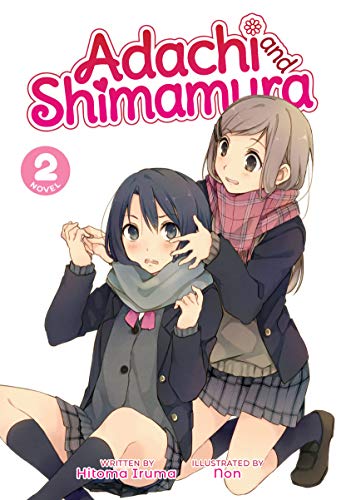
Adachi and Shimamura, Vol. 2

June 1, 2020 by Sean Gaffney

By Hitoma Iruma and Non. Released in Japan by Dengeki Bunko. Released in North America by Seven Seas. Translated by Molly Lee.

When I started this book, I had a very low bar I wanted it to clear, and to its credit, it did. I said on Twitter I was looking for Shimamura to be slightly more interesting and for Adachi to be slightly more gay. On one of those points, the book sails over the bar easily – Adachi’s freaking out about her love for Shimamura, what that says about her, what that says about Shimamura, trying to confess while also desperately hoping she is never found out, and (towards the end) realizing that yes, there is a physical desire in this love as well is probably the highlight of the book. As for Shimamura, sadly, she still narrates a large chunk of the book. She works best when around people more interesting than herself (i.e. the rest of the cast) and especially when she is dragged in an odd direction, which she just goes along with because she’s that sort of person. We saw this last time with the alien girl, and we see it here with her friend Nagafuji.

The book revolves around Christmas in Japan, meaning it’s a lover’s holiday, and also you eat fried chicken. Adachi, trying to convey her feelings without actually doing so, wants to invite Shimamura out to spend the day with her. The first third of the book or so has her working up the courage to do this. The second third splits our heroines into odd pairings – as I noted above, Shimamura and Nagafuji go to get a nice present for… well, for Adachi, but Shimamura, who is not completely clueless about what’s going on here, says it’s for her little sister. Meanwhile, Hino, the other half of “those two girls”, goes to the same mall with Adachi to help her get a present for Shimamura. In the final third, the two go on their not-date, have a relatively nice time, exchange presents, and Adachi tries to confess but doesn’t quite make it.

As with the last book, I think the strengths here lie in the unexpected making an appearance. In this book it’s the boomerang, a ridiculous present to give but also one that appeals highly to Shimamura, who falls in love with the image of Adachi throwing it. (Adachi isn’t wild about it, but it’s a present from the girl she likes, so it’s fantastic. She frames it on her wall. No, really.) I was also somewhat surprised that the book may be trying to pair the spares already, which given its tiny cast makes sense, I suppose. There are a few tiny scenes where you get the sense Hino and Nagafuji are also edging closer to each other, but again, they aren’t quite there. The entire book contrasts comfort (the same old thing every day) with danger (a risk of losing it all, but a big reward if successful. In the end, Adachi chooses to try to fall between the two poles, asking if Shimamura is not just her friend, but her BEST friend. Which, well, she is. For now, I guess Adachi will make do with that.

The flaws of this book are obvious: it still tends towards the dull and ordinary, and even the space alien girl is proving to be just another one of the cast now, hanging out with Shimamura’s younger sister. Oh yes, and there’s a jarring scene at the start when Shimamura, swimming at a fitness center, spots a creeper watching the little kids getting swimming lessons and saying “ew”. It’s meant to be slice of life, and I’m sure this does happen in Japan, but it felt out of place, and I wanted Shimamura to do something about him. Overall, though, if you liked the first book you should like the second. I do wonder how long it can string this out till Adachi finally confesses, though.

Filed Under: adachi and shimamura, REVIEWS

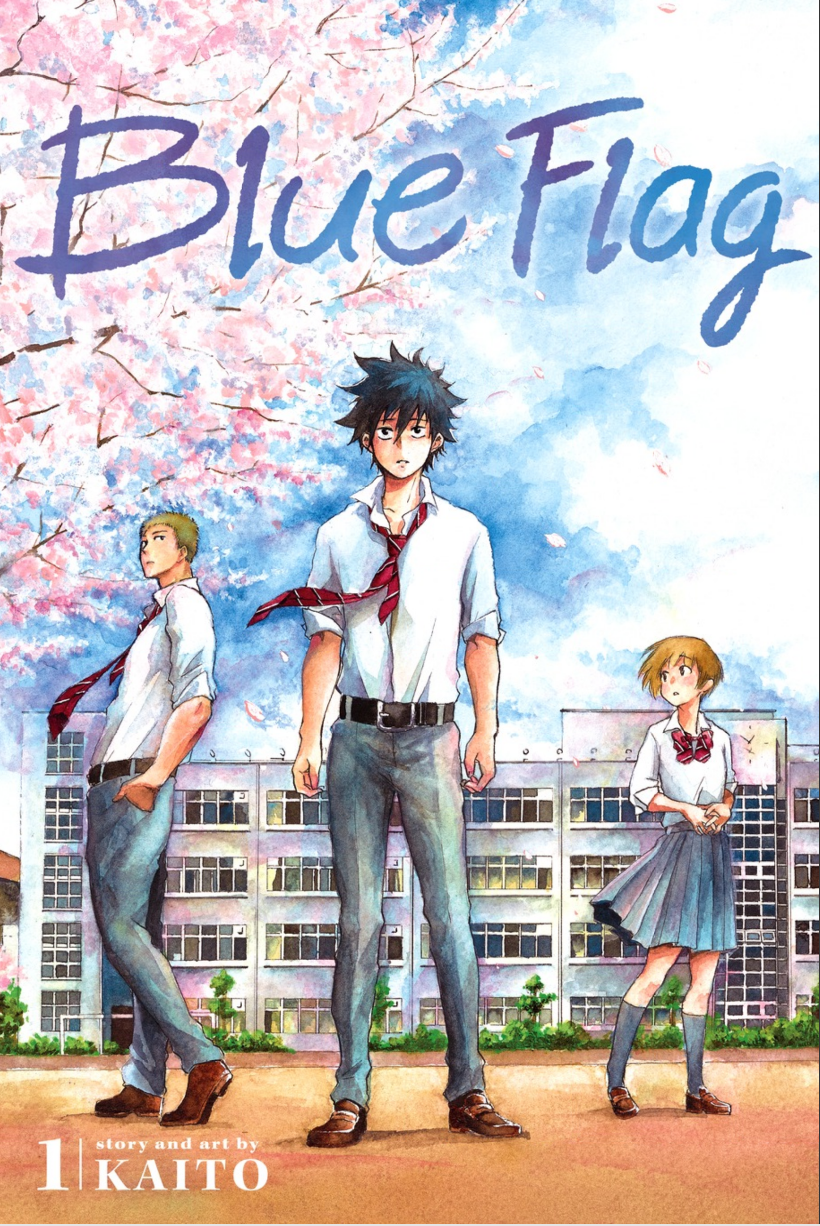
Blue Flag, Vol 1

May 31, 2020 by Anna N

Blue Flag Volume 1 by KAITO

It is fair to say that I read plenty of manga, but now and then I read a series that is just so well executed that it feels incredibly refreshing. I knew Blue Flag had plenty of fans, and I was excited to read it when I heard that it was licensed, but my high expectations were surpassed by the first volume.

The volume opens with some character introductions that remind most readers of standard characters, but the insightful look into Taichi’s inner thoughts as he starts a new school year plays against readers expecting something more stereotypical. Taichi has a small friend group, who all look like they came out of a shonen playbook of nerd 101. He’s fairly content with remaining under the radar at school, but something quickly breaks him out of his usual routine. Taichi’s elementary school friend Toma is going to be in Taichi’s class for the first time in several years. Taichi and Toma are opposites in many ways. Taichi is short and has hair that seems to defy any grooming attempt. Toma is tall, athletic, and extremely popular, but his effortless way of making friends is the result of him being genuinely nice rather than anything overly calculated. Taichi’s friends consider Toma to be a different species than them, and are mystified that Toma keeps popping up to keep randomly talk to Taichi even though Taichi claims that they aren’t close anymore.

Taichi seems to have a special kind of antipathy to Futuba Kuze, a girl in his class who is painfully shy and clumsy. He starts to realize that he’s reminded of his own failings when he looks at her, because she’s similar to him. After an incredibly awkward chance encounter in the library, Futuba asks Taichi for advice because she has a crush on Toma. He thinks that any help he would provide would be useless, but she’s incredibly determined, following up with any random reference that Taichi tosses out. Eventually Taichi agrees to serve as Futuba’s spectacularly uninformed tutor in the ways of teen romance. Taichi is brutally realistic with Futuba about her chances of attracting Toma, but she’s not fazed by the idea that she isn’t his type. Eventually Taichi and Futuba strike up an odd friendship as he keeps trying to draw her in to his usual interactions with Toma. Blue Flag is invested with a ton of emotional resonance as the characters investigate childhood games, deal with homework, and share memories. Futuba explains to Taichi that one of the reasons she’s been nursing a crush towards Toma is that when he accidentally knocked down her plant in the school garden with a stray baseball, he returned every day until it was healthy again.

Towards the end of the volume, the reader gets a sense of what is actually happening in Toma’s head and the realization that the love story that’s unfolding is going to be much more complex and surprising than one would think. Blue Flag rewards the re-reader, who will be able to go back and detect hints in the body language and attitudes of the characters. This is by far one of the most promising shonen series I’ve read in a long time, and the focus on the emotional complexity of teenage live reminded me a bit of Cross Game. I highly recommend Blue Flag, and I’m impatiently waiting for the next volume.

Filed Under: Manga Reviews, REVIEWS Tagged With: Blue Flag, Shonen, viz media

There’s No Way a Side Character Like Me Could Be Popular, Right?, Vol. 1

May 31, 2020 by Sean Gaffney

By Sekaiichi and Tomari. Released in Japan as “Yujinchara no Ore ga Motemakuru Wakenaidaro?” by Overlap. Released in North America by Tentai Books. Translated by Alejandro de Vicente Suárez.

One thing that needs to be made clear about this book’s basic premise is that it only works if our protagonist is using anime/manga terms to talk about real life. Tomoki goes on about the fact that he is a ‘side character’, the best friend to the real protagonist Ike (two syllables, I believe). Ike is handsome, popular, does well in school, etc. Tomoki, on the other hand, has the classic “resting bitch face” that makes everyone terrified of him, rumors of a violent past, and has trouble making friends. Um… Tomoki, I hate to break it to you, but Ike’s type is never, EVER the main character. You are. I therefore assume that he means the ‘main character’ of real life, sort of what the Japanese term ‘reajuu’ – someone who has it together. I will admit that between this, the artist ignoring all Tomoki’s descriptions in the text and drawing him as darkly handsome, and Tomoki’s obliviousness, this didn’t start well for me. That said, it was intriguing, so I read on, and it ended up being pretty decent.

The plot starts when Ike’s younger sister, Touka, a first-year, comes up to Tomoki and asks him to be her boyfriend. She has similar issues to her brother – popular, pretty, good in school – and has a desire to get rid of potential suitors, so needs Tomoki to fake date her. Or at least, so she says. In reality, she’s a lot brattier (and more interesting) than she lets on, and is doing this to try to divide Ike and Tomoki’s friendship. She runs into the brick wall that is Tomoki’s ability to read the room, however, so it doesn’t work, and his essential decency and ability to see her as a real person rather than as “Ike’s sister” lead her to gradually develop real feelings for him. This is upsetting to others, notably Kana, a girl who Tomoki sees as “constantly terrified of him” who, to the reader, clearly has a massive crush on him instead; Kai, Touka’s classmate who has a crush on HER and sees Tomoki as a thug; and Chiaki, their teacher, who… well, we dunno.

As I said, there are some things wrong with this book. It doesn’t start strongly, so bored readers might drop it. More importantly, it can’t decide if it’s a stand-alone or an ongoing series. We get little hints of backstory in regards to Tomoki, particularly from his teacher, who seems sad about something, and Kai, who at some point saw Tomoki beating up a bunch of folks (we see that as well on one of his dates with Touka – the guys are assholes trying to pick her up who go after him first). In other words, Tomoki clearly has a backstory desperately trying to be told. What is it? We don’t really find out here, sadly. On the bright side, Touka is great, striking just the right amount of “I am a brat but also cute” and showing greater depth than I anticipated. And, while initially aggravated at Tomoki’s cluelessness, I really liked that it’s explicitly supposed to be a function of his lack of social skills from ostracization, rather than a comedy “the girls are in love with me and I don’t get it because I am a protagonist” bullet – though it’s partly that as well, of course.

This is a debut from Tentai Books, and the translation seemed decent enough – if a bit over-colloquial at times. (That could simply be me disliking the phrase “smell you later”. On the other hand, “we live in a society, bro”? *chef’s kiss*) I’ll be interested in their other title as well, now. As for the book itself, good and bad, but in the end I did enjoy it, and want to read more, if only to find out what’s been going on before this story began. (That said, the 2nd volume has Kana on the cover, making me worry this will be a “save one heroine per book” series.)

Filed Under: REVIEWS, there's no way a side character like me could be popular right?

Bottom-Tier Character Tomozaki, Vol. 3

May 30, 2020 by Sean Gaffney

By Yuki Yaku and Fly. Released in Japan as “Jaku Chara Tomozaki-kun” by Shogakukan. Released in North America by Yen On. Translated by Winifred Bird.

I’m not sure this series has ‘arcs’ like some other light novels, but there’s no denying that this third volume feels like the end of part one and the start of part two, and it would not surprise me if the upcoming anime decides this is a good place to wrap things up. Here we see Tomozaki finally go on the movie date with Kikuchi that he didn’t do in the last volume, and also invite her out to fireworks, This is part of Hinami’s life plan of getting him dating a girl by the end of summer break. Along the same sort of lines, he goes on a group barbecue/camping trip with the main group, tries to help the others get two of their friends together, and even gets a part-time job. He’s come a long way. The question is, how much of this is him being genuine and how much of this is him doing what Hinami says? And is Hinami really all that successful at life anyway?

The first 3/4 of this volume is merely very good, showing off the characters and situations we like. Tomozaki’s date with Kikuchi is indeed as adorable as expected, as is the fireworks viewing, and it’s her pure and basic honesty that helps him decide how to move forward (and, also, that dating her because of a gaming strategy is not a thing he wants to do). Crucially, she finds it easier to talk to him when he’s not trying to be a “normie”… but doesn’t reject the fact that he’s trying harder. The bulk of the middle of the book is the campout, and it’s fun, and also reminds you that these are, at heart, immature teenagers: a discussion of which girl in the group is hottest revolves around breast size, and Tomozaki may be the first character I’ve seen to canonically get a large penis (it comes up in guy talk), as opposed to in fanfics written about a character.

The last quarter of the book is where things really take off. Misuzawa has seen what Tomozaki has been doing, and finds his odd combination of “trying to be normal” and brutal honesty refreshing. So he tries to open up to Hinami… which goes disastrously. The afterward with her and Tomozaki also goes disastrously, leading to a break in their “teacher/student” relationship and for Tomozaki to backslide into old habits. The best part of this is that it doesn’t reject either premise: Tomozaki’s honest niceness and desire to not do something if he doesn’t want to is a good and sensible thing… and at the same time he dislikes the old, don’t care about appearances or posture self that he gained by learning with Hinami. He likes the fact that he grew as a person… he just wants to do it without moving into uncomfortable directions, like “date the library girl because I told you to.” Best of all, he manages to get Hinami to acknowledge this and start coaching him again, which is a big get given she was ready to completely shut him out of her life.

So another excellent volume, and it also shows that moving forward it will likely be Hinami who has the much harder road ahead. That said, Izumi is the cover girl for the next volume. This has rapidly become a must-read series.

Filed Under: bottom-tier character tomozaki, REVIEWS

  • « Go to Previous Page
  • Page 1
  • Interim pages omitted …
  • Page 120
  • Page 121
  • Page 122
  • Page 123
  • Page 124
  • Interim pages omitted …
  • Page 346
  • Go to Next Page »
 | Log in
Copyright © 2010 Manga Bookshelf | Powered by WordPress & the Genesis Framework