• Skip to primary navigation
  • Skip to main content
  • Skip to primary sidebar
  • Home
  • About Us
    • Privacy Policy
    • Comment Policy
    • Disclosures & Disclaimers
  • Resources
    • Links, Essays & Articles
    • Fandomology!
    • CLAMP Directory
    • BlogRoll
  • Features & Columns
    • 3 Things Thursday
    • Adventures in the Key of Shoujo
    • Bit & Blips (game reviews)
    • BL BOOKRACK
    • Bookshelf Briefs
    • Bringing the Drama
    • Comic Conversion
    • Fanservice Friday
    • Going Digital
    • It Came From the Sinosphere
    • License This!
    • Magazine no Mori
    • My Week in Manga
    • OFF THE SHELF
    • Not By Manga Alone
    • PICK OF THE WEEK
    • Subtitles & Sensibility
    • Weekly Shonen Jump Recaps
  • Manga Moveable Feast
    • MMF Full Archive
    • Yun Kouga
    • CLAMP
    • Shojo Beat
    • Osamu Tezuka
    • Sailor Moon
    • Fruits Basket
    • Takehiko Inoue
    • Wild Adapter
    • One Piece
    • After School Nightmare
    • Karakuri Odette
    • Paradise Kiss
    • The Color Trilogy
    • To Terra…
    • Sexy Voice & Robo
  • Browse by Author
    • Sean Gaffney
    • Anna Neatrour
    • Michelle Smith
    • Katherine Dacey
    • MJ
    • Brigid Alverson
    • Travis Anderson
    • Phillip Anthony
    • Derek Bown
    • Jaci Dahlvang
    • Angela Eastman
    • Erica Friedman
    • Sara K.
    • Megan Purdy
    • Emily Snodgrass
    • Nancy Thistlethwaite
    • Eva Volin
    • David Welsh
  • MB Blogs
    • A Case Suitable For Treatment
    • Experiments in Manga
    • MangaBlog
    • The Manga Critic
    • Manga Report
    • Soliloquy in Blue
    • Manga Curmudgeon (archive)

Manga Bookshelf

Discussion, Resources, Roundtables, & Reviews

Manga Critic

Summit of the Gods, Vol. 1

October 12, 2009 by Katherine Dacey

On a brilliant summer day in 1924, British explorer George Mallory began what would be his third and final attempt to climb Mt. Everest. Armed with oxygen tanks and masks, he and fellow mountaineer Andrew Irvine began their approach to the summit on the morning of June 8th, reaching the Northeast Ridge around one o’clock in the afternoon — a potentially fatal mistake, as they had barely enough time to reach the peak and return safely to camp before nightfall. Noel Odell, another member of Mallory’s expedition, spotted the pair ascending the so-called “steps,” three rock formations located 2,000 vertical feet below the top. As he would recall in the 1924 book The Fight for Everest, Odell caught a brief glimpse of his mates through a break in the cloud cover:

I saw the whole summit ridge and final peak of Everest unveiled. I noticed far away on a snow slope leading up to what seemed to me to be the last step but one from the base of the final pyramid, a tiny object moving and approaching the rock step. A second object followed, and then the first climbed to the top of the step. As I stood intently watching this dramatic appearance, the scene became enveloped in cloud once more, and I could not actually be certain that I saw the second figure join the first. (p. 130)

Odell was the last to see either man alive; for the next 75 years, Mallory and Irvine’s fate remained a mystery, though a few tantalizing clues — Irvine’s ice axe, Mallory’s discarded oxygen canister — suggested that neither had reached the top. In 1999, a joint American-British expedition recovered Mallory’s body not far from where Irvine’s axe was discovered, spurring new questions about their climb: had Odell, in fact, watched the men descending the Steps after a successful trip to the summit? Had Irvine and Mallory become separated on the mountain face, or did they fall together to their deaths? And where was Irvine’s body?

The mystery surrounding Mallory’s disappearance forms the core of Yumemakura Baku and Jiro Taniguchi’s award-winning series The Summit of the Gods. Based on a 1998 novel by Baku, Summit focuses on Makoto Fukamachi, a photographer who picks up Mallory’s trail in Kathmandu, where a 1924 Vestpocket Autographic Kodak Special — the camera Mallory supposedly carried up Everest — turns up in a second-hand store frequented by climbers and sherpas. As Fukamachi tracks the camera’s descent from Everest to Kathmandu, he crosses paths with Jouji Habu, a taciturn Japanese climber who knows more about the camera than he’s willing to reveal. Fukamachi begins trailing Habu, interrogating Habu’s acquaintances and climbing partners in hopes of learning what Habu is doing in Kathmandu. Though Fukamachi expects his questions will lead him to the camera’s source, he discovers instead that he and Habu have similarly haunting pasts: Fukamachi watched — and documented — two climbers fall to their deaths on an Everest glacier, while Habu tried — and failed — to rescue a climbing partner who lost his footing and plunged one hundred feet over a cliff in the Japanese Alps.
summit3

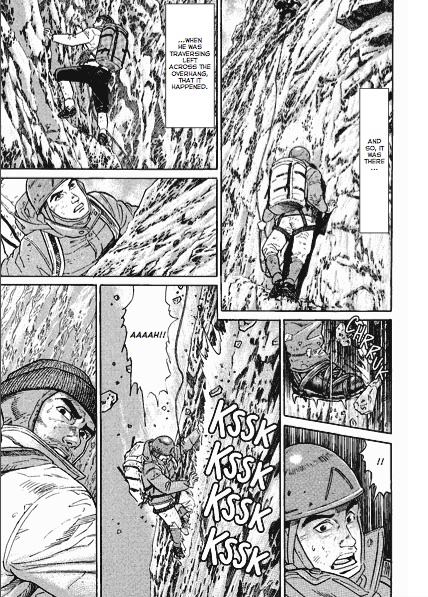
Both characters’ backstories are as harrowing as any passage from Jon Krakauer’s Into Thin Air, thanks to Taniguchi’s impeccable illustrations. Taniguchi captures the mountains’ desolation and danger with his meticulous renderings of rock formations, glaciers, and quick-changing weather patterns; one could be forgiven for wanting to clip into a securely anchored harness before reading volume one. Taniguchi’s talent for evoking the mood and energy of a landscape is also evident in his depiction of Kathmandu, a maze-like city filled with dead ends, bazaars, billboards, temples, and con artists eager to hustle European tourists. Through intricately detailed backgrounds juxtaposing squalid, overcrowded  neighborhoods with sleek, modern buildings, Taniguchi suggests the city’s almost uncontainable energy.

The sheer beauty and power of these scenes distracts from the series’ biggest flaw: the omniscient narrator. In the afterward to volume one, Baku explains that he felt that Taniguchi was “the only artist” who could do justice to “the overwhelming massiveness of the mountains, the details of the climbing, the depictions of the characters.” In adapting his novel for a graphic medium, however, Baku never fully entrusts the artwork with the responsibility of telling the story; too often, Baku inserts unnecessary explanations into gracefully composed panels. In one scene, for example, Fukamachi dreams that he’s trailing a silent, mysterious figure up the summit of Everest, his calls going unheeded. To the reader, it’s obvious that Fukamachi is dreaming about Mallory, as Fukamachi has spent three days locked in his hotel room reading accounts of Mallory’s final climb. Yet the sequence is heavily scripted, with Baku decoding all of Taniguchi’s images rather baldly; it’s as if Baku is narrating the scene for someone who can’t see the pictures.

That Summit of the Gods remains compelling in spite of such editorial interventions is testament both to Taniguchi’s skill as a visual storyteller and to the story’s alluring location; as anyone who’s read Into Thin Air will tell you, the extreme conditions on Everest — the weather, the terrain, the frigid temperatures, the remoteness of the mountaintop — all but guarantee drama, even when the climbers are experienced and the weather cooperative. How Makafuchi and Habu will cope with these challenges remains to be seen, but it’s a sure bet that there will be plenty of nail-biting moments on the way to unraveling the mystery of what happened to George Mallory on that bright June day in 1924.

THE SUMMIT OF THE GODS, VOL. 1 • SCRIPT BY YUMEMAKURA BAKU, ART BY JIRO TANIGUCHI • FANFARE/PONENT MON • 328 pp. • NO RATING

Filed Under: Manga, Manga Critic, REVIEWS Tagged With: Action/Adventure, Fanfare/Ponent Mon, Jiro Taniguchi, Mt. Everest

Moyasimon: Tales of Agriculture, Vol. 1

September 27, 2009 by Katherine Dacey

Moyasimon1_CoverWarning: the Surgeon General has determined that reading Moyasimon: Tales of Agriculture may be hazardous to your health. Individuals who routinely consume large quantities of yogurt, miso, or natto; keep stashes of Purell in their purses and desk drawers; or have an irrational fear of germs or dirt are cautioned against reading Moyasimon. Side effects include disgust, nausea, and a strong desire to wash one’s hands repeatedly. Those with stronger constitutions, however, may find this odd little comedy fun, if a little too dependent on gross-out humor for laughs.
Moyasimon tells the story of Tadayasu, a country boy with an unusual gift: he can see and talk to bacteria. (In other words, he’s the Doctor Doolittle of the microbial world.) At the urging of his grandfather, Tadayasu leaves his small rural village to attend an agricultural college in Tokyo, his best friend Kei in tow. Tadayasu’s abilities bring him to the attention of the eccentric Professor Itsuki, a terraforming expert, and his foul-tempered research assistant Haruka Hasegawa, a graduate student who dresses like a dominatrix. Though they wax poetic about the scientific applications of Tadayasu’s gift, the pair seem more intent on making fermented delicacies — the smellier, the better — than actually conducting experiments. Also vying for Tadayasu’s attention are Misato and Kawahama, two sad-sack sophomores who reach out to him after bacteria compromise one of their numerous get-rich-quick schemes: bootleg sake.

…

Read More

Filed Under: Manga Critic Tagged With: del rey, Seinen

Moyasimon: Tales of Agriculture, Vol. 1

September 27, 2009 by Katherine Dacey

Warning: the Surgeon General has determined that reading Moyasimon: Tales of Agriculture may be hazardous to your health. Individuals who routinely consume large quantities of yogurt, miso, or natto; keep stashes of Purell in their purses and desk drawers; or have an irrational fear of germs or dirt are cautioned against reading Moyasimon. Side effects include disgust, nausea, and a strong desire to wash one’s hands repeatedly. Those with stronger constitutions, however, may find this odd little comedy fun, if a little too dependent on gross-out humor for laughs.

Moyasimon tells the story of Tadayasu, a country boy with an unusual gift: he can see and talk to bacteria. (In other words, he’s the Doctor Doolittle of the microbial world.) At the urging of his grandfather, Tadayasu leaves his small rural village to attend an agricultural college in Tokyo, his best friend Kei in tow. Tadayasu’s abilities bring him to the attention of the eccentric Professor Itsuki, a terraforming expert, and his foul-tempered research assistant Haruka Hasegawa, a graduate student who dresses like a dominatrix. Though they wax poetic about the scientific applications of Tadayasu’s gift, the pair seem more intent on making fermented delicacies — the smellier, the better — than actually conducting experiments. Also vying for Tadayasu’s attention are Misato and Kawahama, two sad-sack sophomores who reach out to him after bacteria compromise one of their numerous get-rich-quick schemes: bootleg sake.

Tadayasu, for his part, finds the attention unsettling. His dearest wish is to have a normal college experience, a desire frustrated by his family’s refusal to send him anywhere but an agricultural school. He also feels ambivalent about his gift. On the one hand, he understands its life-saving potential after thwarting an e-coli outbreak (he overhears the microorganisms rallying around the cry of “Brew ‘n’ kill!”); on the other hand, his microscopic “Spidey sense” makes many everyday activities — shaking hands, eating yogurt, visiting a messy dormitory room — agonizing, as he’s keenly aware of the bacteria’s presence. (In one of the story’s running gags, Tadayasu swoons whenever he visits Misato and Kawahama’s foul bachelor pad, a veritable bacteria playground of half-consumed beverages, dirty dishes, and fetid mattresses.)

hasegawaThe humor is good-natured, though Masayuki Ishikawa indulges his inner ten-year-old’s penchant for gross-out jokes every chance he gets.He repeatedly subjects Tadayasu and Kei to Itsuki’s food fetishes, forcing them to watch Itsuki exhume and eat kiviak (a fermented seal whose belly has been stuffed with birds), or try a piece of hongohoe, a form of stingray sashimi so pungent it makes their eyes water. Ishikawa’s decision to render the bacteria as cute, roly-poly creatures with cheerful faces prevents the story from shading into horror, though it’s awfully hard to shake the image of bacteria frolicking in a bed of natto or around the slovenly Misato’s nostril.

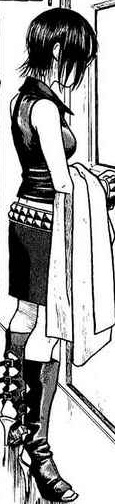
Where Moyasimon really shines is the artwork. Ishikawa’s layouts are detailed yet clear and easy to follow, giving the reader a strong sense of the college and its shabby environs. Ishikawa’s character designs are similarly effective, whether he’s drawing an L. yogurti bacterium or an unscrupulous professor. Take Misato and Kawahama. The two are a classic Mutt-and-Jeff duo: Misato is tall with a scruffy beard, a greasy ponytail, and weasel eyes, while Kawahama is short and round with a dirty face. When we first meet them, we immediately recognize them as a pair of sweating, scheming losers whose big dreams yield little returns. Hasegawa provides another instructive example of how design can play a critical role in establishing character. She’s prickly and aggressive, personality traits amplified by her unusual choice of labwear — knee-high boots with dozens of buckles and sky-high heels, studded belts, and a leather miniskirt — her sharp facial features, and her preferred accessory: a scowl.

Though the art is solid and the characters firmly established, Moyasimon hasn’t quite found its groove yet. Ishikawa can’t make up his mind if he wants us to admire the diversity and tenacity of bacterial life or squirm at the thought of its ubiquity; every educational speech about bacteria’s numerous benefits is punctuated by an icky rim shot. Still, it’s hard to deny the odd appeal of Moyasimon, as Ishikawa takes an all-too-familiar trope — the teen who sees things that other people can’t — and gives it a fresh, idiosyncratic spin.

MOYASIMON: TALES OF AGRICULTURE, VOL. 1 • BY MASAYUKI ISHIKAWA • DEL REY • 224 pp. • RATING: OLDER TEEN (16+)

Filed Under: Manga, Manga Critic, REVIEWS Tagged With: Comedy, del rey

The Manga Hall of Shame

September 20, 2009 by Katherine Dacey 66 Comments

Though my taste in manga is very particular, I’m much less discriminating in my reading habits. My willingness to try anything has yielded some wonderful surprises: Ai Morinaga’s Duck Prince, Taiyo Matsumoto’s No. 5, Shioko Mizuki’s Crossroad, Kazuo Umezu’s Scary Book, Motofumi Kobayashi’s Apocalypse Meow. The flipside of being a gourmand is that I’ve encountered my share of truly dreadful stuff, too — the kind of manga with such incoherent plots, unappealing characters, clumsy artwork, and tin-eared dialogue that they beg the question, Who thought this was a good idea?

Now that I’d donned my flame-proof pants, here are my candidates for the Manga Hall of Shame:

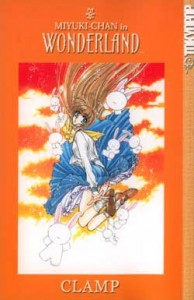
10. MIYUKI-CHAN IN WONDERLAND

CLAMP • Tokyopop • 1 volume

I’ve read my way through the highs and lows of the CLAMP canon, from the Gothic angst of Tokyo Babylon to the cutesy antics of Kobato, and can say with confidence that this odd one-shot represents the nadir of this talented quartet’s work. Miyuki-chan probably sounded like a great idea on paper: a young girl falls down a hole and finds herself in a sexed-up version of Lewis Carroll’s famous story. What better vehicle for Mokona and friends to demonstrate their talent for drawing fabulous costumes, Baroque hairdos, and trippy landscapes? Unfortunately, the story bears almost no resemblance to Alice in Wonderland; Miyuki-chan is just a pretext for CLAMP to draw scantily-clad beauties engaging in vaguely naughty behavior (usually making a pass at the vaguely horrified Miyuki or inviting her to play strip poker). The stories are short and repetitive, barely spanning 100 pages in total, and are so inane that they don’t work as pornography or parody. Strictly for the CLAMP completist.

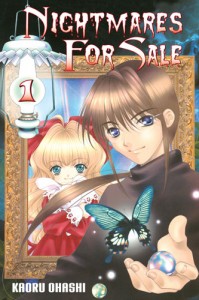
nightmares9. NIGHTMARES FOR SALE

KAORU OHASHI • AURORA PUBLISHING • 2 VOLUMES

The premise of Nightmares for Sale is pure comeuppance theater: in exchange for having their dearest wishes granted – in this case, by the proprietors of Shadow’s Pawn Shop – bad people receive their just desserts. For this old-as-the-hills premise to succeed, three basic conditions need to be met. First, the audience needs to understand the subject is unrepentantly bad and not merely flawed or misguided. Second, the audience needs to see the chain of decisions that lead to the subject’s downfall. And third, the punishment needs to fit the crime. Alas, manga-ka Kaoru Ohashi doesn’t satisfy these basic criteria in Nightmares for Sale. A few characters get what they deserve: an overly ambitious model grows uglier and uglier, a bully is reincarnated as her victim. Many of the stories are sloppily executed, however; we don’t learn how or why the subject is being punished until Shadow appears at the end of the story to tell us. By far the worst chapter is “Children of Darkness,” in which a woman is tormented by the spirit of her unborn child. No matter what your personal convictions on abortion, the story is both macabre and misogynist, and shows an astonishing lack of compassion for the subject’s situation. Not even the artwork can redeem this clunker: it’s both busy and generic, a hot mess of awkwardly posed bodies and poorly applied screentones. (Review originally posted at PopCultureShock, 11/28/07)

armkannon

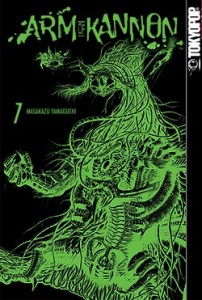
8. ARM OF KANNON

MASAKAZU YAMAHUCHI • TOKYOPOP • 9 VOLUMES

After a nearly three-year absence, archaeologist Tozo Mikami returns to his family with a mysterious object in tow: the Arm of Kannon, an ancient Buddhist relic that, unbeknownst to Mikami’s son Maso, is actually a parasitic weapon that feeds off its host’s life force while transforming him or her into a grotesque killing machine, complete with tentacles. Before we’re too far into volume one, the Arm of Kannon destroys Tozo, choosing Maso as its next host. What follows is an unholy marriage of gore, mystical mumbo-jumbo, and military conspiracy theories, as Maso rapes and dismembers people, gets captured by an army contractor (they want the Arm for their own dastardly purposes, natch), then kills some more. A third-act detour into the distant past adds unnecessary complications to the plot; it’s as if Yamaguchi got bored with his characters but realized that he hadn’t quite resolved things enough to simply end the story. The art is incredibly detailed, which is a mixed blessing; if you like your entrails rendered with anatomical specificity, Arm of Kannon might be your cup of tea. Anyone in search of a coherent plot or sympathetic characters, however, is advised to look elsewhere.

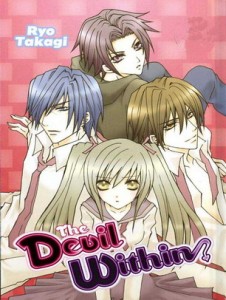
devilwithin7. THE DEVIL WITHIN

RYO TAKAGI • GO! COMI • 2 VOLUMES

Go! Comi has licensed some terrific shojo — think Afterschool Nightmare, Crossroad, Tenshi Ja Nai!! — but the perennially popular The Devil Within is not among them. The main problem is its singularly unappealing heroine, Rion, a teenager who was traumatized by a scary movie involving demonic possession. Since the characters in the film attack women, Rion logically concludes that all adult men are evil and develops a full-on shota complex, gushing about the purity and hairlessness of young boys to such a degree I worried that federal authorities might arrest her. The plot is just as awful as its heroine: forced into choosing among three prospective fiances — all adults — Rion instead pins her hope on a young neighbor who happens to be a fifteen-year-old trapped in a five-year-old’s body. Perhaps as punishment for her predilections, Rion endures some truly grotesque forms of abuse from her suitors, making The Devil Within easily one of the most repellent and ridiculous stories I’ve read.

dragonsister6. DRAGON SISTER!

NINI • TOKYOPOP • 2 VOLUMES, SUSPENDED

Buried beneath the slapstick, speedlines, and extreme mammary close-ups is an intriguing premise: what if ancient China’s greatest warriors were, in fact, women? Dragon Sister! begins around 184 AD, when three brothers—Zhang Jiao, Zhang Bao, and Zhang Liang—acquire a set of magical scrolls capable of granting any wish. In their desire to overthrow the Han Dynasty, the brothers pray that no more heroes will be born, only beautiful women. Their scheme backfires, however, transforming them into a cabal of power-hungry girls. As the country descends further into chaos, young nobleman Liu Bei forms a volunteer army to oppose the Zhang sisters (formerly brothers), recruiting two busty babes, Zhang Fei and Guan Yu, to aid his cause. None of this is explained very clearly—we never have a sense of who the various factions are, or why Liu Bei remains faithful to a corrupt emperor. Instead, Nini treats us to a seemingly endless parade of costume failures, crude jokes, and scenes of predatory lesbianism, all delivered in speech that vacillates between present-day dudespeak and wuxia film formality. For the fanservice crowd. (Review originally posted at PopCultureShock, 11/2/08)

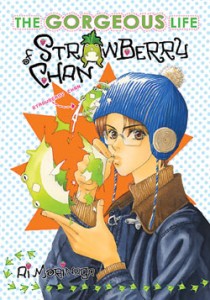
gorgeouslife5. THE GORGEOUS LIFE OF STRAWBERRY-CHAN

AI MORINAGA • MEDIA BLASTERS • 2 VOLUMES

I didn’t think it was possible to dislike anything by Ai Morinaga, but this sadistic boarding-school comedy proved me wrong. There’s no real story here; most of the “action” revolves around Akiyoshi, a fatuous pretty boy, and Strawberry-Chan, his talking frog. Akiyoshi delights in torturing his pet, squashing Strawberry-Chan, burying him alive, and even inflating him like a balloon via a well-placed straw. (If Morinaga is trying to make a greater point with her hero’s perverse antics, I can’t imagine what it is.) Adding insult to injury is the art, which is a riot of misapplied screentones, clashing patterns, and extreme facial close-ups—it’s the best representation of a migraine I’ve ever seen committed to paper, but some of the worst sequential art I’ve seen, period. (Review originally posted at PopCultureShock, 5/31/08)

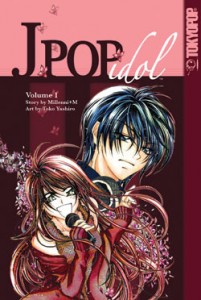
jpopidol14. J-POP IDOL

STORY BY MILLENNI+ M, ART BY TOKO YASHIRO • TOKYOPOP • 2 VOLUMES, SUSPENDED

Until Tokyopop releases a Glitter Cinemanga, otaku eager for overripe musical drama will have to content themselves with J-Pop Idol. But unlike Glitter, which is bad in a jaw-dropping, can’t-take-my-eyes-off-it way (read: awesomely bad), J-Pop Idol is just plain bad. A big part of the problem is the story, which has been hastily cobbled together from dozens of similar, Star Is Born narratives–so hastily, in fact, that many scenes feel like complete non-sequitors. One of the most egregious examples can be found in the very first pages, when the members of an up-and-coming girl group face a test of their friendship: after winning a major talent competition, only one of them is singled out for a recording contract. From the context, however, it’s impossible to see why producers chose Maki over band mates Kay and Naomi, as Maki lacks the charisma, talent, and sex appeal that distinguished Diana Ross from her fellow Supremes (or Beyonce from Destiny’s other Children, for that matter). The rest of volume one charts Maki’s attempt to build a recording career under the tutelage of handsome idol Ken, who motivates his protege with tough talk and hard lessons learned on his way to the top. There’s also a subplot involving tuberculosis that might not seem out of place in a Joan Crawford weepie, but seems downright ludicrous in a manga aimed at a teenage audience. The bottom line: J-Pop Idol may have been a “#1 hit mobile manga in Japan,” but that endorsement carries about as much weight as Paula Abdul’s enthusiastic cheerleading on American Idol. (Review originally posted at PopCultureShock, 3/10/08)

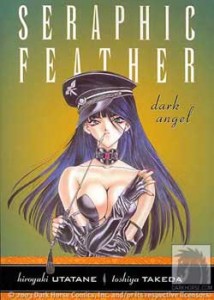
seraphicfeather3. SERAPHIC FEATHER

ART BY HIROYUKI UTATANE, STORY BY YO MORIMOTO AND TOSHIYA TAKEDA • DARK HORSE • 6 VOLUMES, SUSPENDED

I love me a good sci-fi tale as much as the next person, but Hiroyuki Utatane’s Seraphic Feather left me cold. How cold, you ask? Colder than the vacuum of space, I tell you.

The plot revolves around the discovery of an alien spaceship on the far side of the Moon. Various factions compete for the downed ship, hoping to unlock its powers using something called the Emblem Seeds. Running in tandem with the main plot are a love story between a young man named Sunao and his childhood friend Kei, who mysteriously re-appears after dying in an explosion on the Moon, and subplot involving Kei’s brother Apep, who mysteriously sprouts a pair of wings. The dialogue is pure Mystery Science Theater fodder, with characters frequently explaining things to one another that, presumably, they already know. Utatane seems more interested in drawing buxom girls and explosions than actually moving the plot along; though characters yell and grab each other by the arm on almost every page, the story is dead in the water long before the end of volume one. Anyone who finds the cover art sexy will find the actual story an even bigger let-down, as it’s much tamer than all those leather bustiers and riding crops might suggest.

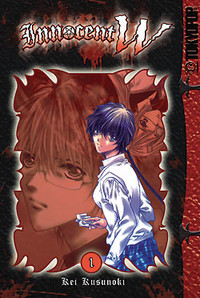
innocentw2. INNOCENT W

KEI KUSONOKE • TOKYOPOP • 4 VOLUMES

I can’t decide if Kei Kusonoke is exceptionally efficient or just plain disgusting. To wit: on the very first pages of this three-volume series, she treats us to a panty shot of a girl with a gruesome injury. (Talk about two-fers.) Things don’t improve much from there, as the story quickly devolves into a Wiccan Battle Royale, pitting a group of young witches against an assortment of sadistic weirdos in a remote, wooded area. The hunters rape, torture, and mutilate the young women for sport, leaving a trail of dismembered corpses in the forest before the survivors gain the upper hand. Perhaps more disturbing than the actual story is the artwork: Kusonoke lavishes considerable attention on the characters’ costumes and hairstyles, but can’t be bothered to endow their faces with any expression; it’s as if the entire cast consumed large amounts of valium right before the mayhem began. They look bored. Funny, I was too…

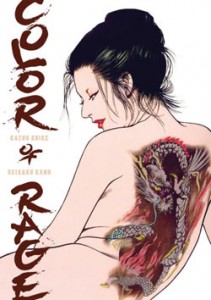
colorofrage11. COLOR OF RAGE

STORY BY KAZUO KOIKE, ART BY SEISAKE KANO • DARK HORSE • 1 VOLUME

First published in 1973, this historical drama plays like a mash-up of The Last Samurai, Rush Hour, and Mandingo. The story begins in 1783, when a whaling ship goes down off the coast of Japan. Two men — George, who’s Japanese, and King, who’s African-American — wash ashore, cut off their shackles, and head inland, only to discover a landscape populated by unscrupulous samurai and feudal lords who hold the peasants in thrall. For such a far-fetched premise to work, its principal characters’ thoughts, words, and actions need to make sense in historical context. Yet George and King behave like two modern action heroes deposited in feudal Japan, not two products of the eighteenth century; it wouldn’t be much of a stretch to imagine John Cho and Will Smith slashing and wise-cracking their way through a big-screen adaptation. Making things worse are several scenes of brutal misogyny — what the editors euphemistically call “pulpy sexiness” — that are made all the more cringe-worthy by the unexamined racial stereotypes on parade. Kazuo Koike is always pushing the boundaries of good taste — that’s part of what makes Crying Freeman and Lady Snowblood so much fun — but Color of Rage sails way over the line and keeps on going.  (Review originally posted at PopCultureShock, 5/18/08)

* * * * *

I’ll be the first to admit that this list reflects my own biases. I don’t have much patience for fanservice, sadism, or gore for gore’s sake; if I’m going to be treated to dismembered bodies and panty shots, there needs to be a story and some memorable characters for me to be on board with it. I realize that some folks don’t feel the same way as I do, and that’s OK. There’s plenty of room for all of us under the manga-loving tent, even if we can’t agree on whether Arm of Kannon is awesome or awful. (In other words: hate the manga, not the critic.)

So what manga belong on your all-time worst list and why? Inquiring minds want to know!

POSTSCRIPT, 9/28/09: Over at Okazu, Erica Friedman posts her Yuri Manga Hall of Shame, five blisteringly funny critiques of books like Suzunari and Alice on Deadlines. Go, read, and be glad you dodged a 4-koma manga about cat clone twincest.

Filed Under: Manga Critic Tagged With: Bad Manga

The Manga Hall of Shame

September 20, 2009 by Katherine Dacey

Though my taste in manga is very particular, I’m much less discriminating in my reading habits. My willingness to try anything has yielded some wonderful surprises: Ai Morinaga’s Duck Prince, Taiyo Matsumoto’s No. 5, Shioko Mizuki’s Crossroad, Kazuo Umezu’s Scary Book, Motofumi Kobayashi’s Apocalypse Meow. The flipside of being a gourmand is that I’ve encountered my share of truly dreadful stuff, too — the kind of manga with such incoherent plots, unappealing characters, clumsy artwork, and tin-eared dialogue that they beg the question, Who thought this was a good idea?

Now that I’d donned my flame-proof pants, here are my candidates for the Manga Hall of Shame:

miyuki10. Miyuki-chan in Wonderland
By CLAMP • Tokyopop • 1 volume
I’ve read my way through the highs and lows of the CLAMP canon, from the Gothic angst of Tokyo Babylon to the cutesy antics of Kobato, and can say with great confidence that this odd one-shot represents the nadir of this talented quartet’s work. Miyuki-chan probably sounded like a great idea on paper: a young girl falls down a hole and finds herself in a sexed-up version of Lewis Carroll’s famous story. Unfortunately, the story bears almost no resemblance to Carroll’s original; Miyuki-chan is really just a pretext for CLAMP to draw scantily-clad beauties engaging in vaguely naughty behavior, usually by making a pass at Miyuki or inviting her to play strip poker. The stories are short and repetitive, barely spanning 100 pages in total, and are so inane that they don’t work as pornography or parody.

nightmares9. Nightmares for Sale
By Kaoru Ohashi • Aurora Publishing • 2 volumes
The premise of Nightmares for Sale is pure comeuppance theater: in exchange for having their dearest wishes granted – in this case, by the proprietors of Shadow’s Pawn Shop – bad people receive their just desserts. For this old-as-the-hills premise to succeed, three basic conditions need to be met. First, the audience needs to understand the subject is unrepentantly bad and not merely flawed or misguided. Second, the audience needs to see the chain of decisions that lead to the subject’s downfall. And third, the punishment needs to fit the crime. Alas, manga-ka Kaoru Ohashi doesn’t satisfy these basic criteria in Nightmares for Sale. A few characters get what they deserve, but many of the stories are sloppily executed; we don’t learn how or why the subject is being punished until Shadow appears at the end of the story to tell us. By far the worst chapter is “Children of Darkness,” in which a woman is tormented by the spirit of her unborn child. No matter what your personal convictions on abortion, the story is both macabre and misogynist, and shows an astonishing lack of compassion for the subject’s situation. Not even the artwork can redeem this clunker: it’s both busy and generic, a hot mess of awkwardly posed bodies and poorly applied screentones. (Review originally posted at PopCultureShock, 11/28/07)

armkannon8. Arm of Kannon
By Masakazu Yamaguchi • Tokyopop • 9 volumes
After a nearly three-year absence, archaeologist Tozo Mikami returns to his family with a mysterious object in tow: the Arm of Kannon, an ancient Buddhist relic that, unbeknownst to Mikami’s son Maso, is a parasitic weapon that feeds off its host’s life force while transforming him into a tentacled killing machine. Before we’re too far into volume one, the Arm of Kannon destroys Tozo, choosing Maso as its next host. What follows is an unholy marriage of gore, mystical mumbo-jumbo, and military conspiracy theories, as Maso rapes and dismembers people, gets captured by an army contractor, then kills some more. A third-act detour into the distant past adds unnecessary complications to the plot; it’s as if Yamaguchi got bored with his characters but realized that he hadn’t quite resolved things enough to simply end the story. The art is incredibly detailed, which is a mixed blessing: if you like your entrails rendered with anatomical specificity, Arm of Kannon might be your cup of tea. Anyone in search of a coherent plot or sympathetic characters, however, is advised to look elsewhere.

devilwithin7. The Devil Within
By Ryo Takagi • Go! Comi • 2 volumes
If 98.7% of shojo heroines are kind, smart, enthusiastic, and/or sincere—read likeable—Rion, the sixteen-year-old heroine of The Devil Within is a rare outlier: she suffers from a full-on shota complex that makes her seem mentally unbalanced. Forced into choosing among three prospective fiances (all adults), Rion instead pins her hope on a young neighbor who happens to be a fifteen-year-old trapped in a five-year-old’s body. Making this whole distasteful concept even more unpalatable is the way in which manga-ka Ryo Takago treats the principle character; Rion endures truly grotesque forms of abuse from her suitors that results in her abject humiliation. Hats off to anyone who made it through the first volume without squirming — I couldn’t.

dragonsister6. Dragon Sister!
By Nini • Tokyopop • 2 volumes
Buried beneath the slapstick, speedlines, and extreme mammary close-ups is an intriguing premise: what if ancient China’s greatest warriors were, in fact, women? Dragon Sister! begins around 184 AD, when three brothers—Zhang Jiao, Zhang Bao, and Zhang Liang—acquire a set of magical scrolls capable of granting any wish. In their desire to overthrow the Han Dynasty, the brothers pray that no more heroes will be born. Their scheme backfires, however, transforming them into a cabal of power-hungry girls. As the country descends further into chaos, young nobleman Liu Bei forms a volunteer army to oppose the Zhangs, recruiting two busty babes, Zhang Fei and Guan Yu, to aid his cause. None of this is explained very clearly—we never have a sense of who the various factions are, or why Liu Bei remains faithful to a corrupt emperor. Instead, Nini treats us to a seemingly endless parade of costume failures, crude jokes, and scenes of predatory lesbianism, all delivered in speech that vacillates between present-day dudespeak and wuxia film formality. Strictly for the fanservice crowd. (Review originally posted at PopCultureShock, 11/2/08)

gorgeouslife5. The Gorgeous Life of Strawberry-chan
By Ai Morinaga • Media Blasters • 2 volumes
I didn’t think it was possible to dislike anything by Ai Morinaga, but this sadistic boarding-school comedy proved me wrong. There’s no real story here; most of the “action” revolves around Akiyoshi, a fatuous pretty boy, and Strawberry-Chan, his talking frog. Akiyoshi delights in torturing his pet, squashing Strawberry-Chan, burying him alive, and even inflating him like a balloon via a well-placed straw. (If Morinaga is trying to make a greater point with her hero’s perverse antics, I can’t imagine what it is.) Adding insult to injury is the art, which is a riot of misapplied screentones, clashing patterns, and extreme facial close-ups—it’s the best representation of a migraine I’ve ever seen committed to paper, but some of the worst sequential art I’ve seen, period. (Review originally posted at PopCultureShock, 5/31/08)

jpopidol14. J-Pop Idol
Story by MILLENNI+ M, Art by Toko Tashiro • Tokyopop • 2 volumes
Until Tokyopop releases a Glitter Cinemanga, otaku eager for overripe musical drama will have to content themselves with J-Pop Idol. But unlike Glitter, which is bad in a jaw-dropping, can’t-take-my-eyes-off-it way, J-Pop Idol is just plain bad. A big part of the problem is the story, which has been hastily cobbled together from dozens of similar, Star Is Born narratives–so hastily, in fact, that many scenes feel like complete non-sequitors. One of the most egregious examples can be found in the very first pages, when the members of an up-and-coming girl group face a test of their friendship: after winning a major talent competition, only one of them is singled out for a recording contract. From the context, however, it’s impossible to see why producers chose Maki over band mates Kay and Naomi, as Maki lacks the charisma, talent, and sex appeal that distinguished Diana Ross from her fellow Supremes.

The rest of volume one charts Maki’s attempt to build a recording career under the tutelage of handsome idol Ken, who motivates his protege with tough talk and hard lessons. There’s also a subplot involving tuberculosis that might not seem out of place in a Joan Crawford weepie, but seems downright ludicrous in a manga aimed at a teenage audience. The bottom line: J-Pop Idol may have been a “#1 hit mobile manga in Japan,” but that endorsement carries about as much weight as Paula Abdul’s enthusiastic cheerleading on American Idol. (Review originally posted at PopCultureShock, 3/10/08)

seraphicfeather3. Seraphic Feather
Art by Hiroyuki Utatane • Story by Yo Morimoto and Toshiya Takeda • Dark Horse • 6 volumes
Seraphic Feather has three strikes against it: an overly fussy plot, tin-eared dialogue, and lousy artwork. The story revolves around the discovery of an alien spaceship on the far side of the Moon. Various Earthly factions compete for the downed ship, hoping to unlock its powers using the Emblem Seeds, a high-protein energy bar a mysterious power source. Running in tandem with the main plot are a love story between a young man named Sunao and his childhood friend Kei — who mysteriously re-appears after dying in an explosion on the Moon — and a subplot involving Kei’s brother Apep, who mysteriously sprouts a pair of wings. Making these baroque plot twists harder to take is the dialogue, all of which sounds like it was pilfered from an episode of Mystery Science Theater 3000. The frosting on the cake, however, is the art: Hiroyuki Utatane seems more interested in drawing buxom girls and explosions than advancing the plot. Though characters yell and grab each other by the arm on almost every page, the story is dead in the water long before the end of volume one. Anyone who finds the cover art sexy will find the actual story an even bigger let-down, as it’s much tamer than the bustier and riding crop might suggest.

innocentw2. Innocent W
By Kei Kusonoke • Tokyopop • 4 volumes
I can’t decide if Kei Kusonoke is exceptionally efficient or just plain disgusting. To wit: on the very first pages of this three-volume series, she treats us to a panty shot of a girl with a gruesome injury. Things don’t improve much from there, as the story quickly devolves into a Wiccan Battle Royale, pitting a group of young witches against an assortment of sadistic weirdos in a remote, wooded area. The hunters rape, torture, and mutilate the young women for sport, leaving a trail of dismembered corpses in the forest before the survivors gain the upper hand. Perhaps more disturbing than the actual story is the artwork. Kusonoke lavishes considerable attention on the characters’ costumes and hairstyles, but can’t be bothered to endow their faces with any expression; it’s as if the entire cast consumed large amounts of valium right before the mayhem began. They look bored. Funny, I was too…

colorofrage11. Color of Rage
Story by Kazuo Koike • Art by Seisake Kano • Dark Horse • 1 volume
First published in 1973, this historical drama plays like a mash-up of The Last Samurai, Rush Hour, and Mandingo. The story begins in 1783, when a whaling ship goes down off the coast of Japan. Two men — George, who’s Japanese, and King, who’s African-American — wash ashore, cut off their shackles, and head inland, only to discover a landscape populated by unscrupulous samurai and feudal lords who hold the peasants in thrall. For such a far-fetched premise to work, its principal characters’ thoughts, words, and actions need to make sense in historical context. Yet George and King behave like two modern action heroes deposited in feudal Japan, not two products of the eighteenth century; it wouldn’t be much of a stretch to imagine John Cho and Will Smith slashing and wise-cracking their way through a big-screen adaptation. Making things worse are several scenes of brutal misogyny — what the editors euphemistically call “pulpy sexiness” — that are made all the more cringe-worthy by the unexamined racial stereotypes on parade. Kazuo Koike is always pushing the boundaries of good taste — that’s part of what makes Crying Freeman and Lady Snowblood so much fun — but Color of Rage sails way over the line and keeps on going.  (Review originally posted at PopCultureShock, 5/18/08)

* * * * *

I’ll be the first to admit that this list reflects my own biases. I don’t have much patience for fanservice, sadism, or gore for gore’s sake; if I’m going to be treated to dismembered bodies and panty shots, there needs to be a story and some memorable characters for me to be on board with it. I realize that some folks don’t feel the same way as I do, and that’s OK. There’s plenty of room for all of us under the manga-loving tent, even if we can’t agree on whether Arm of Kannon is awesome or awful. (In other words: hate the manga, not the critic.)

So what manga belong on your all-time worst list and why? Inquiring minds want to know!

POSTSCRIPT, 9/28/09: Over at Okazu, Erica Friedman posts her Yuri Manga Hall of Shame, five blisteringly funny critiques of books like Suzunari and Alice on Deadlines. Go, read, and be glad you dodged a 4-koma manga about cat clone twincest.

Filed Under: Manga, Manga Critic Tagged With: Bad Manga

Missin’ and Missin’ 2: Kasako

September 16, 2009 by Katherine Dacey

missinAfter reading Missin’ and Missin’ 2, I’m convinced that novelist Novala Takemoto was a teenage girl in a previous life. But not the kind of girl who was on the cheerleading squad, the volleyball team, or the school council — no, Takemoto was the too-cool-for-school girl, the one whose unique fashion sense, sullen demeanor, and indifference to high school mores made her seem more adult than her peers, even if her behavior and emotions were, in fact, just as juvenile as everyone else’s. Though this kind of angry female rebel is a stock character in young adult novels, Takemoto has a special gift for making them sound like real girls, not an adult’s idea of what a disaffected teenager sounds like.

Consider Kasako, the heroine of Missin’ and Missin’ 2. Kasako feels estranged from her peers’ pop-culture interests, finding refuge in “the antique, the outmoded, indeed, the passe.” Though she has a special affinity for Schubert lieder and Rococo artwork, she finds a kindred spirit in Nobuko Yoshiya, a popular romance novelist whose career spanned the Taisho and Showa periods. Like an earlier generation of schoolgirls, Kasako is enthralled with Yoshiya’s Hana monogatari (Tales of the Flower, 1916 – 1924), a pioneering work of Class S fiction, or stories about romantic friendships between teenage girls.

…

Read More

Filed Under: Manga Critic Tagged With: Drama, VIZ

Ooku: The Inner Chambers, Vol. 1

September 15, 2009 by Katherine Dacey

ookuBuilt in 1607, the Ooku, or “great interior,” housed the women of the Tokugawa clan, from the shogun’s mother to his wife and concubines. Strict rules prevented residents from fraternizing with outsiders, or leaving the grounds of Edo Castle without permission. Within the Ooku, an elaborate hierarchy governed day-to-day life; at the very top were the joro otoshiyori, or senior elders, who supervised the shogun’s attendants and served as court liaisons; beneath them were a web of concubines, priests, pages, cooks, and char women who hailed from politically connected families. This elaborate social system was mirrored in the physical structure of the Ooku, which was divided into three distinct areas — the Rear Quarters, the Middle Interior, and the Front Quarters — each intended solely ladies of a particular rank. The only male permitted into the Ooku (unescorted, that is), was the shogun himself, who accessed the “great interior” by means of the Osuzu Roka, a long corridor that connected the shogun’s living quarters with the imperial harem.

…

Read More

Filed Under: Manga Critic Tagged With: Alternative History, fumi yoshinaga, Josei, VIZ

Ooku: The Inner Chambers, Vol. 1

September 15, 2009 by Katherine Dacey

Built in 1607, the Ooku, or “great interior,” housed the women of the Tokugawa clan, from the shogun’s mother to his wife and concubines. Strict rules prevented residents from fraternizing with outsiders, or leaving the grounds of Edo Castle without permission. Within the Ooku, an elaborate hierarchy governed day-to-day life; at the very top were the joro otoshiyori, or senior elders, who supervised the shogun’s attendants and served as court liaisons; beneath them were a web of concubines, priests, pages, cooks, and char women who hailed from politically connected families. This elaborate social system was mirrored in the physical structure of the Ooku, which was divided into three distinct areas — the Rear Quarters, the Middle Interior, and the Front Quarters — each intended solely ladies of a particular rank. The only male permitted into the Ooku (unescorted, that is), was the shogun himself, who accessed the “great interior” by means of the Osuzu Roka, a long corridor that connected the shogun’s living quarters with the imperial harem.

The “great interior” plays a prominent role in Fumi Yoshinaga’s latest series, Ooku: The Inner Chamber. In Yoshinaga’s alternate history of eighteenth-century Japan, however, women run the show, thanks to a devastating plague that killed most of the country’s men. The shogun’s duties remain unchanged by this unexpected gender reversal, and she, too, enjoys the same perks that her male predecessors did. The twist: the Ooku is now home to hundreds of handsome men from important families, all of whom live according to the code established in Hideata Tokugawa’s reign.

Perhaps the most astonishing thing about Yoshinaga’s conceit is that so much remains the same, despite the sudden challenge to established gender norms. Marriage practices remain firmly rooted in money, social status, and fertility (men’s fertility, that is); palace residents continue observing the established pecking order and its attendant rituals; the shogun questions the cost, but not the necessity, of the Ooku itself. The men, in fact, embrace their subordinate roles without hesitation; their petty squabbles, hazing rituals, and political jockeying suggest their inability to imagine anything more important than competing for the shogun’s attention.

Where Yoshinaga takes the most risks is in her portrayal of Yoshimune, the newly appointed shogun. Yoshimune is a rare type in popular entertainment: a strong, intelligent, brusque, and frankly carnal woman with uncanny leadership instincts. She’s dismayed by excess and ritual, which she views as a drain on the shogunate’s dwindling resources; in her personal and political decision-making, she strives for simplicity and efficiency, even going so far as to restrict herself to two meals a day. In true Tokugawa fashion, Yoshimune is wary of the outside world; in one of the volume’s best scenes, she receives Dutch ambassador dressed in male attire, then uses her throne as a bully pulpit to inquire about the all-male crew of his ship. “‘Tis reported that  there is not one woman in your entire company. Wherefore is that?” she demands of the bewildered captain. “Are all the women of Holland weak and sickly?”

Like Yoshinaga’s other costume dramas — especially Gerard and Jacques — Ooku is very talky. Too talky, in fact; the first three chapters unfold at what might charitably be described as a glacial pace, as we watch a young samurai enter the Ooku to avoid a financially beneficial but emotionally sterile marriage. Normally, Yoshinaga excels at conversation-driven storytelling, but the dialogue in Ooku falls flat, thanks to a stilted script that’s liberally peppered with “thees,” “wherefores,” and “forsooths.” (One character angrily addresses another as “thou vile cur!”, an insult that last carried weight in Elizabethan England, while another makes reference to a “man’s nether hole.”) Without an intimate knowledge of Japanese, it’s impossible to know if the problem originates with Yoshinaga’s script or Akemi Wegmuller’s translation; either way, the dialogue’s awkward marriage of contemporary and archaic language proves distracting, keeping the reader at arm’s length from the characters’ feelings.

The other problem with the script is that Yoshinaga uses conversation to explain everything, from the mysterious origins of the redface pox (the fictional disease that kills off the male population) to the elaborate rituals observed within the Ooku. Too often, the script reads like a history textbook; characters don’t have a discussion but lecture one another, revealing little about themselves in the process. Yoshinaga pauses from time to time to stage a dramatic moment — an attempted rape, a sword fight, a lovers’ parting — but she never quite brings the Ooku to life; the first few chapters feel more like a pageant or a historical re-enactment than a drama.

Yoshinaga’s artwork, on the other hand, is elegant and effective, capturing the opulence of Tokugawa-era fashions as well as the austere beauty of Edo Castle. As with all her manga, Yoshinaga’s limited repertoire of character designs seems less a flaw than a charming idiosyncrasy, as if she’s employing the same troupe of actors again and again. Yoshimune, for example, strongly resembles Flower of Life’s Majima, yet Majima’s sharp profile suits Yoshimune perfectly, as do the determined gait and fierce stare that distinguish Yoshimune from the softer, more stereotypically feminine women in her orbit. In service of Flower, those physical characteristics made Majima seem like a shifty operator, but when re-purposed for Ooku, these traits endow Yoshimune with an almost god-like aura, suggesting both her discipline and her strong sense of purpose.

I’ll be honest: I’m not quite sold on Ooku yet. For all its dramatic and socio-political ambitions, volume one isn’t nearly as daring or weird or pointed as it might have been. If anything, it reminds me of a BBC miniseries: it’s tasteful, meticulously researched, and a little too high-minded to be truly compelling. The introduction of the complex Yoshimune, however, bodes well for future volumes, as she brings a sense of urgency and purpose to a script that sometimes meanders.

Review copy provided by VIZ Media, LLC.

OOKU: THE INNER CHAMBERS, VOL. 1 • BY FUMI YOSHINAGA • VIZ • 216 pp. • RATING: MATURE

Filed Under: Manga, Manga Critic, REVIEWS Tagged With: Alternative History, fumi yoshinaga, Josei, VIZ

What Belongs in the Manga Canon?

September 11, 2009 by Katherine Dacey

Back in 2006, I stumbled across this entry at Otaku Champloo, reflecting on the need for a manga “canon.” The author noted that books in the Western literary canon (e.g. Aeschylus, Dante, Shakespeare) were not the “most popular” titles, but titles that “reflect[ed] the progress of humanity” from classical antiquity to the machine age. She then posed several intriguing questions:

[W]hat really struck my head was the idea of a canon for manga. Could we come up a list of mangas that would best represent humanity and the manga genre? Another interesting question would be… what good would a manga canon bring? Does the world of manga need one?

When I first responded to her essay back in 2006, I hadn’t read very much manga — just enough to be dangerously opinionated and scornful of shojo* — and my knowledge of “classic” titles was limited to a few works by Osamu Tezuka and Kazuo Koike. I thought it would be an interesting challenge to revisit and revise that initial response to reflect where I am now, three years and hundreds of series later.

…

Read More

Filed Under: Manga Critic

What Belongs in the Manga Canon?

September 11, 2009 by Katherine Dacey

Back in 2006, I stumbled across this entry at Otaku Champloo, reflecting on the need for a manga “canon.” The author noted that books in the Western literary canon (e.g. Aeschylus, Dante, Shakespeare) were not the “most popular” titles, but titles that “reflect[ed] the progress of humanity” from classical antiquity to the machine age. She then posed several intriguing questions:

[W]hat really struck my head was the idea of a canon for manga. Could we come up a list of mangas that would best represent humanity and the manga genre? Another interesting question would be… what good would a manga canon bring? Does the world of manga need one?

When I first responded to her essay back in 2006, I hadn’t read very much manga — just enough to be dangerously opinionated and scornful of shojo* — and my knowledge of “classic” titles was limited to a few works by Osamu Tezuka and Kazuo Koike. I thought it would be an interesting challenge to revisit and revise that initial response to reflect where I am now, three years and hundreds of series later.

TO INCLUDE OR NOT TO INCLUDE, THAT IS THE QUESTION

As I noted in my initial response, I used to teach at a university that organizes its undergraduate curriculum around the idea that certain works of art, literature, music, and philosophy represent the acme of Western civilization. You might think that the list of canonic works would be fixed, but in fact, the canon is constantly evolving. When the university first mandated its “great works” curriculum in the 1920s, for example, Mary Wollenstonecraft didn’t make the cut; only with the rise of feminist scholarship in the 1970s was her groundbreaking Vindication of the Rights of Woman added to the canon. The 1980s prompted a similar round of revisions to the curriculum: realizing that its emphasis on Western culture excluded some of the oldest and most influential literature in the world, the university developed courses about the canonic work of Eastern civilizations: The Art of War, The Tale of Genji, The Shahnameh.

I cite these curriculum changes because they remind us that defining a canon is a tricky business. There’s a veritable cottage industry of think-tanks and self-appointed cultural guardians who view the inclusion of new voices as a threat to the integrity of the literary canon, as if the recognition that women and blacks have written important books might undermine the point of the whole exercise. (They generally fuss less about Great Art and Great Music, though more conservative scholars in those fields police these canons with a similar zeal: Clara Schumann, hit the road!) In their eyes, the canon is a super-exclusive night club open only to a few “universally” recognized authors; they reject the notion that scholars might have valid historical reasons for admitting a few more folks past the velvet rope.

Then there’s that pesky issue of relevance. My students were always shocked that our music survey didn’t include familiar composers like Tchaikovsky: if we were still performing The Nutcracker and Swan Lake, why wasn’t he taking his rightful place alongside Hildegaard of Bingen and Anton Webern, two composers that 98% of them had never heard of before taking my class? As a music historian, I could rebut their arguments, but my students had a point: sometimes we become so obsessed with the idea that a canon represents the best, most timeless products of a culture that we forget the extent to which taste and connoisseurship play a role in deciding what to include — and what to exclude. (Poor old Tchaikovsky is just too tacky for some scholars, I guess.) We ignore that distinction at our own peril, however, as a canon can become a self-perpetuating list impervious to criticism or revision. Anyone intent on making a list of manga masterpieces, therefore, should bear in mind these observations about how and why we create canons — observations drawn from own experiences studying one of the most canon-centric fields, music.

First, historians play a major role in deciding what works make the cut. This is what I call the “Bach” rule: by the time J. S. Bach was writing his best-known works, his style was seen as old-fashioned, even a little stodgy, and not something an up-and-coming composer would want to emulate. Yet 250 years later, Bach is a household name. Why? Because Bach was “discovered” in the nineteenth century by prominent historians and composers who admired the rigor of his counterpoint and the beauty of his compositions. As a result, he became one of the most studied and posthumously influential composers in Western history. I say this not to slight Bach, or to perpetuate Romantic notions of genius (“they only appreciate you after you’re dead!”), but to remind any would-be canon-builders that an artist’s role in advancing the medium is often the most important rationalization for including his work in a canon.

Second, scholars tend to be suspicious of artists whose work is genuinely popular. This is what I call the “Rachmaninoff” rule: audiences may flock to performances of the Second Piano Concerto, but the canon’s gate-keepers treat Rachmaninoff as “just” a tunesmith whose crowd-pleasing melodies lack the harmonic or structural sophistication of Stravinsky and Wagner’s best work. Rachmaninoff’s tenuous membership in the canon reflects our lingering skepticism about popularity: if everyone likes Rachmaninoff’s music, could it really as worthy of study and emulation as music that aspires to greater levels of compositional complexity (e.g. The Rite of Spring, Parsifal)? It’s the same impulse that might lead a manga scholar to include Tezuka’s Buddha in the canon while excluding Kishimoto’s Naruto or Takahashi’s Ranma 1/2 — we wouldn’t want the “merely” popular taking its place alongside bonafide masterpieces, would we?

Third, there is no such thing as a “universal” canon. This is what I call the “Gershwin” rule. From the perspective of an American historian, George Gershwin is a canonic composer, profoundly influencing the development of American music with his distinctive marriage of black vernacular styles to European art forms. But from a Russian or Italian perspective, Gershwin is a local anomaly, a decent American composer who enjoys a far greater reputation among his fellow countrymen than in the international community. (Translation: he ain’t no Stravinsky or Verdi.) As such, Gershwin is less likely to be mentioned by an Italian musicologist in the same breath as Rossini, Verdi, or Beethoven. Undoubtedly, there will be artists whose importance to Americans may make them obvious candidates for inclusion in a manga canon, but who may not be viewed as favorably on the other side of the Pacific (and vice versa, I might add).

Finally, there is no such thing as an opera or a novel or a manga that is timeless. This is what I call the “Don Giovanni” rule: we still perform Mozart’s opera 200+ years after its initial premiere, but our experience of Don Giovanni is utterly different than that of audiences who heard it 1787. Most of the opera’s musical “in jokes,” for example, are lost on us—how many of us would recognize Mozart’s shout-out to fellow composer Martin y Soler? And how many of us would grasp the subtle musical gestures that Mozart uses to indicate his characters’ social status—gestures that were old hat to his audience? It’s a safe bet that Osamu Tezuka’s current audience experiences his work differently than its original readers, even though we may admire some of the same qualities in his work as the first generation of Princess Knight and Astro Boy fans.

Is there a need for a similar “canon” of manga masterpieces? The growing body of literature on influential artists such as Osamu Tezuka suggests that scholars already entertain some notion of a manga canon. As we begin labeling works “masterpieces,” however, we need to be mindful of the way in which these labels can trap us, preventing us from critiquing or questioning, say, Tatsumi or Tezuka’s greatness. We also need to remember that whatever canon we devise will be flawed from the outset, revised many times, and say as much about our own tastes and values as it will about the inherent quality or relevance of the manga it includes.

POSTSCRIPT

Having identified several potential pitfalls of canonization (if I might re-purpose that term for non-Vatican usage), I’m curious to know (a) whether it makes sense to talk about a manga “canon” and (b) what titles and authors you think belong in the canon. I’m particularly interested in the issue of gender: what female manga-ka belong in a canon and why? Do we have an innate bias towards seinen works, to the exclusion of shojo and josei titles? Inquiring minds want to know!

UPDATE, 9/15/09: Over at Extremely Graphic, librarian-blogger Sadie Maddox offers a thoughtful response to the question of whether or not Americans even have any business talking about a “manga canon.” She notes:

By being translated the integrity of the original work is compromised.  Of course, I’m all for translating because it means I get to read manga and I know that most translators do an excellent job.  But still, that’s one layer removed from the original intent. Are Americans really the ones who should be making a canon out of completely foreign material?

I didn’t get into the issue of translation (obviously one that would need to be addressed, if we were going to take this exercise to its logical conclusion), so go, read, and join the discussion at Extremely Graphic.

UPDATE, 10/6/09: Scholars John E. Ingulsrud and Kate Allen, authors of Reading Japan Cool: Patterns of Manga Literacy and Discourse, posted an interesting response to the question, “What belongs in the manga canon?” Their argument hinges on pedagogy: they note the original purpose of a canon was “to teach and test,” citing the New Testament as a body of literature compiled, in part, to answer the question, “Who was Jesus?” They suggest that any manga canon will arise from a similar need to teach and test. I think that’s a valid argument for the Japanese academy, but is more problematic in a Western context; it’s simply too early to know whether manga will be a permanent part of the American cultural landscape or just a passing fad. I also think they’re too quick to dismiss the question of artistry, as one of the most important contemporary functions of the so-called Western canon — by which I mean literature, art, and music — is to teach aesthetics. Whatever my philosophical differences with Ingulrud and Allen, I found their historical arguments compelling, and encourage you to read their essay for a different perspective on the issue of canonicity.

* I got over it, so don’t paint me as a shojo-hater. Anytime someone wants to license The Windows of Orpheus or The Poe Family, I’ll be a very happy camper.

Filed Under: Manga, Manga Critic Tagged With: criticism

Where to Buy Manga: Comicopia (Boston, MA)

September 1, 2009 by Katherine Dacey

IMG_0080Highbrow, lowbrow… and everything in between. That’s the slogan of Comicopia, a Mecca (mecha?) for Beantown manga lovers. For twenty years, this modest Kenmore Square storefront has been catering to discerning comic fans of all persuasions, stocking everything from Introducing Derrida to Mr. Arashi’s Amazing Freak Show, as well as crowd-pleasers like Peanuts, Bone, Y: The Last Man, Justice Society of America, and, of course, Bleach, Naruto and Fruits Basket. Comicopia’s low-key, friendly vibe is more bookstore than comic store, making it a great place for former Barnes & Noble junkies to ween themselves off the chain store habit.

Owner Matt Lehman claims to have “New England’s largest selection of manga,” a claim substantiated by both the quantity and variety of titles on Comicopia’s shelves. On my most recent visit, for example, I found all nineteen volumes of Full Metal Alchemist alongside full runs of Dragon Head, Eden: It’s An Endless World, and Swan, as well as a generous assortment of older and more obscure titles: Junko Mizuno’s Cinderalla, Shirow Masamune’s Black Magic, Junjo Ito’s Museum of Terror, numerous volumes of Basara, and the first volume of The Monkey King. “We’re committed to carrying every manga in print,” Lehman explains. “We make an effort to stock the first two or three volumes of each new series as it comes out, and continue carrying what sells.”

…

Read More

Filed Under: Manga Critic Tagged With: Boston, Comicopia, Where to Buy Manga

Jyu-Oh-Sei, Vols. 1-3

August 14, 2009 by Katherine Dacey

9781427810151In the year 2346 A.D., humans have colonized the Vulcan solar system, a region so inhospitable that the average life span is a mere thirty years. Rai and Thor, whose parents belong to Vulcan’s ruling elite, enjoy a life of rare privilege — that is, until a political rival executes their parents and exiles the boys to Kimaera, a penal colony reserved for violent criminals. To say Kimaera’s climate is harsh understates the case: daylight lasts for 181 days, producing extreme desert conditions and water shortages, while nighttime plunges Kimaera into arctic darkness for an equal length of time. Making the place even more treacherous is the flora, as Kimaera’s jungles team with carnivorous plants capable of eating humans whole.
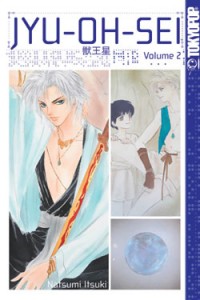
On the planet’s surface, Rai and Thor discover a tribal society based on physical strength and skin color. Four tribes, or “rings,” as they’re known, provide their members food and protection from the extreme climate, but there’s a catch: each person must prove himself strong enough to defend the ring from encroachment by rival factions. The strife within rings is mirrored in the uneasy relationship among the tribal leaders, a motley assortment of criminals, ex-military men, and native Kimaeran women. The ring leaders compete to become the Beast King, Kimaera’s official representative in the Vulcan government and the only person allowed to leave the planet’s surface.

…

Read More

Filed Under: Manga Critic Tagged With: shojo, Tokyopop

Jyu-Oh-Sei, Vols. 1-3

August 14, 2009 by Katherine Dacey

In the year 2346 A.D., humans have colonized the Vulcan solar system, a region so inhospitable that the average life span is a mere thirty years. Rai and Thor, whose parents belong to Vulcan’s ruling elite, enjoy a life of rare privilege — that is, until a political rival executes their parents and exiles the boys to Kimaera, a penal colony reserved for violent criminals. To say Kimaera’s climate is harsh understates the case: daylight lasts for 181 days, producing extreme desert conditions and water shortages, while nighttime plunges Kimaera into arctic darkness for an equal length of time. Making the place even more treacherous is the flora, as Kimaera’s jungles team with carnivorous plants capable of eating men whole.

On the planet’s surface, Rai and Thor discover a tribal society based on physical strength and skin color. Four tribes, or “rings,” as they’re known, provide their members food and protection from the extreme climate, but there’s a catch: each person must prove himself strong enough to defend the ring from encroachment by rival factions. The strife within rings is mirrored in the uneasy relationship among the tribal leaders, a motley assortment of criminals, ex-military men, and native Kimaeran women. The ring leaders compete to become the Beast King, Kimaera’s official representative in the Vulcan government and the only person allowed to leave the planet’s surface.

Sensing an opportunity to upset the uneasy truce that exists among the Blanc, Noir, Ochre, and Sun Rings, several unscrupulous figures encourage Thor to fight his way up the ranks to become the Beast King — his best (and perhaps only) opportunity for escaping Kimaera and finding out why his parents were murdered. Aiding him is Tiz, a tough, resourceful Kimaeran girl who wants Thor for a mate. (In a nice change of pace, women choose their partners, a request men can’t decline.)

Natsumi Itsuki does a superb job of world-building in volume one, striking the right balance between exposition and action. The plot twists come fast and furious, but they feel like a natural outgrowth of the situations the characters find themselves in, rather than an arbitrary decision to move the story in a particular direction. Only in the third and final volume do things begin to fall apart; the first hundred pages are filled with talking heads explaining Kimaera’s true purpose (hint: it involves evil scientists), revealing Thor’s identity, and waxing philosophic about whether mankind should be allowed to become extinct. Perhaps sensing that the story was beginning to sag under the weight of its own pretentiousness, Itsuki then stages a lengthy, exciting battle that pits Thor against those infamous, man-eating plants and a super-computer of HAL-like malevolence.

9781427810168-1Though the story is well-executed, the artwork is something of a disappointment. Itsuki goes to great pains to create a diverse cast — a task at which she’s generally successful — but her character designs are generic and dated; I’d be hard-pressed to distinguish the Kimaerans from, say, the cast of RG Veda or Basara. Itsuki also struggles with skin color; her dark-skinned women bear an unfortunate resemblance to kogals, thanks to Itsuki’s clumsy application of screentone.

More disappointing are Itsuki’s fight scenes: they register as scratchy messes, thanks to her over-reliance on speedlines and trapezoidal panels. The third volume, for example, consists of several lengthy scenes of hand-to-hand combat in which all of the action is suggested by superimposing horizontal lines on close-ups of contorted faces; we never get a clear sense of where the characters are standing in relation to one another, nor do we always have a clear sense of where the action is unfolding.

Tokyopop has done a good job of presenting Jyu-Oh-Sei. The manga was originally released in five volumes; Tokyopop wisely repackaged the story in omnibus format to allow Jyu-Oh-Sei‘s lengthy and complicated story arcs to unfold without significant interruption. The translation is clear and idiomatic, even when the characters are called upon to speak in unadulterated Science Fiction. The only downside to Tokyopop’s presentation is the paperstock: as many readers have observed, it’s thin and greyish, like newsprint, and allows images to bleed through the page.

Aside from a third-act detour into sci-fi pomposity, Jyu-Oh-Sei is a solid, entertaining read: think B-movie in manga form. Like Invasion of the Body Snatchers and District 9, Jyu-Oh-Sei addresses social taboos — race, gender roles — and scientific issues — genetic engineering, environmental devastation — while serving up generous portions of what audiences crave: action, romance, monsters, explosions. Best of all, Jyu-Oh-Sei comes in a neat, three-volume package that’s long enough to allow for world-building and character development but short enough to stay fresh and surprising until the end. It’s the perfect summer escape, minus the sticky floors, endless previews, and seven dollar buckets of popcorn.

This review is an expanded version of an earlier review posted at PopCultureShock. My original review of volume one can be found here.

Review copy of volume one provided by Tokyopop.

JYU-OH-SEI, VOLS. 1-3 • BY NATSUMI ITSUKI • TOKYOPOP • RATING: TEEN

Filed Under: Manga, Manga Critic, REVIEWS Tagged With: Natsumi Itsuki, Sci-Fi, Tokyopop

Tegami Bachi: Letter Bee, Vol. 1

August 7, 2009 by Katherine Dacey

tegami_coverTegami Bachi has all the right ingredients to be a great shonen series: a dark, futuristic setting; rad monsters; cool weapons powered by mysterious energy sources; characters with goofy names (how’s “Gauche Suede” grab you?); and smart, stylish artwork. Unfortunately, volume one seems a little underdone, like a piping-hot shepherd’s pie filled with rock-hard carrots.

The problem lies with the story: manga-ka Hiroyuki Asada takes a simple premise and gussies it up with fussy, poorly explained details. The story itself may remind readers of Banya the Explosive Delivery Man or The Postman, as Tegami Bachi‘s principal characters are also mail carriers — or, in the series’ parlance, Letter Bees — who traverse dark wastelands to deliver letters and packages to the far-flung residents of their homeworld. In the case of Tegami Bachi, that homeworld is Amberground, a planet illuminated by a single, man-made star that hovers above its capital city, Akatsuki, where the wealthiest, most powerful citizens live. Amberground’s cities are separated by country inhabited only by Gaichuu, giant insects whose metal exoskeletons are impervious to most weapons, save the shindanjuu, or heart gun, the preferred sidearm of Letter Bees.

…

Read More

Filed Under: Manga Critic Tagged With: Shonen, VIZ

Tegami Bachi: Letter Bee, Vol. 1

August 7, 2009 by Katherine Dacey

Tegami Bachi has all the right ingredients to be a great shonen series: a dark, futuristic setting; rad monsters; cool weapons powered by mysterious energy sources; characters with goofy names (how’s “Gauche Suede” grab you?); and smart, stylish artwork. Unfortunately, volume one seems a little underdone, like a piping-hot shepherd’s pie filled with rock-hard carrots.

The problem lies with the story: manga-ka Hiroyuki Asada takes a simple premise and gussies it up with fussy, poorly explained details. The story itself may remind readers of Banya the Explosive Delivery Man or The Postman, as Tegami Bachi‘s principal characters are also mail carriers — or, in the series’ parlance, Letter Bees — who traverse dark wastelands to deliver letters and packages to the far-flung residents of their homeworld. In the case of Tegami Bachi, that homeworld is Amberground, a planet illuminated by a single, man-made star that hovers above its capital city, Akatsuki, where the wealthiest, most powerful citizens live. Amberground’s cities are separated by country inhabited only by Gaichuu, giant insects whose metal exoskeletons are impervious to most weapons, save the shindanjuu, or heart gun, the preferred sidearm of Letter Bees.

How, exactly, the shindanjuu works is never satisfactorily explained, despite its prominent role in the story. I had to consult the appendix, which defines “heart” as a magical, omnipresent energy that penetrates and surrounds most living beings, not unlike The Force. (The Gaichuu, lacking heart, are vulnerable to its awesome power, especially when it takes the form of hollow bullets). The shindanjuu also enables Letter Bees to experience other people’s memories in a vivid, almost hallucinatory fashion. As with the magic bullets, the gun’s dream-sharing capacity gets only a cursory explanation; the dream sequences are hella confusing, requiring several readings to figure out whose memories we’re seeing.

Tegami Bachi‘s other shortcoming is its two principal characters. Gauche Suede, the older, more experienced Letter Bee, is a stock shonen hero: a confident, tough-talking loner who turns out to be a softie under his cool, competent exterior. Lag Seeing, the younger one, begins his journey as a package — he’s one of Gauche’s deliveries — and decides to become a Letter Bee after Gauche safely guides them through Gaichuu-infested territory. Lag, too, is a familiar type, the slightly dim but very sincere Kid on a Mission who views mail delivery as his true calling. Both characters have sad back stories involving female relatives — again, a standard shonen trope that does little to enrich the story.

The artwork, on the other hand, is genuinely striking; Tegami Bachi is one of the best-looking titles in the Shonen Jump catalog. Hiroyuki Asada’s landscapes are beautifully rendered, giving a clear sense of Amberground’s geography, technology (they’re in the nineteenth-century Bavarian phase of development, to judge from the architecture), fauna, and flora. And man, what flora! In one amusing sequence, Lag fights Gaichuu in a forest of giant broccoli. Does make you wonder, though: how do those florets get so big without sunlight?

Asada makes effective use of screentone to capture Amberground’s perpetual night, reserving true black for the sky and for a few important details: Gauche’s jacket, the Gaichuu’s carapaces. He incorporates star imagery into almost every scene without it ever seeming cheesy or heavy-handed; the stars have symbolic importance, to be sure, but they also serve an artistic purpose, bringing light and contrast to a layout that might otherwise be a murky mess.

If I seem unduly harsh in my assessment of Tegami Bachi, it’s only because it has the potential to be good — really good, if Asada focuses more on character development and less on mystical hoo-ha. The premise lends itself to both a Delivery of the Week format, in which each chapter functions as a stand-alone story, and to a more traditional Boy on a Quest narrative, in which Gauche, Lag, or both set out to rescue the people they love. Either way, I’ll be picking up volume two to see if the storytelling rises to the level of the artwork.

Review copy provided by VIZ Media, LLC. Volume one will be available on September 1, 2009.

TEGAMI BACHI, VOL. 1 • BY HIROYUKI ASADA • VIZ • 200 pp. • RATING: TEEN

Filed Under: Manga, Manga Critic, REVIEWS Tagged With: Shonen, VIZ

  • « Go to Previous Page
  • Page 1
  • Interim pages omitted …
  • Page 34
  • Page 35
  • Page 36
  • Page 37
  • Page 38
  • Page 39
  • Go to Next Page »
 | Log in
Copyright © 2010 Manga Bookshelf | Powered by WordPress & the Genesis Framework