• Skip to primary navigation
  • Skip to main content
  • Skip to primary sidebar
  • Home
  • About Us
    • Privacy Policy
    • Comment Policy
    • Disclosures & Disclaimers
  • Resources
    • Links, Essays & Articles
    • Fandomology!
    • CLAMP Directory
    • BlogRoll
  • Features & Columns
    • 3 Things Thursday
    • Adventures in the Key of Shoujo
    • Bit & Blips (game reviews)
    • BL BOOKRACK
    • Bookshelf Briefs
    • Bringing the Drama
    • Comic Conversion
    • Fanservice Friday
    • Going Digital
    • It Came From the Sinosphere
    • License This!
    • Magazine no Mori
    • My Week in Manga
    • OFF THE SHELF
    • Not By Manga Alone
    • PICK OF THE WEEK
    • Subtitles & Sensibility
    • Weekly Shonen Jump Recaps
  • Manga Moveable Feast
    • MMF Full Archive
    • Yun Kouga
    • CLAMP
    • Shojo Beat
    • Osamu Tezuka
    • Sailor Moon
    • Fruits Basket
    • Takehiko Inoue
    • Wild Adapter
    • One Piece
    • After School Nightmare
    • Karakuri Odette
    • Paradise Kiss
    • The Color Trilogy
    • To Terra…
    • Sexy Voice & Robo
  • Browse by Author
    • Sean Gaffney
    • Anna Neatrour
    • Michelle Smith
    • Katherine Dacey
    • MJ
    • Brigid Alverson
    • Travis Anderson
    • Phillip Anthony
    • Derek Bown
    • Jaci Dahlvang
    • Angela Eastman
    • Erica Friedman
    • Sara K.
    • Megan Purdy
    • Emily Snodgrass
    • Nancy Thistlethwaite
    • Eva Volin
    • David Welsh
  • MB Blogs
    • A Case Suitable For Treatment
    • Experiments in Manga
    • MangaBlog
    • The Manga Critic
    • Manga Report
    • Soliloquy in Blue
    • Manga Curmudgeon (archive)

Manga Bookshelf

Discussion, Resources, Roundtables, & Reviews

Manga Critic

The Drops of God, Vols. 1-2

December 16, 2011 by Katherine Dacey

Reading The Drops of God is like drinking a good table wine: the flavor may not be as complex as a finely aged varietal, but it goes down easily, leaving a pleasant aftertaste of melodrama, intrigue, and romance.

Like Oishinbo, the manga it most closely resembles, The Drops of God revolves around a slightly preposterous contest between a father and son. Kanazaki Yutaka, a revered wine critic, dies unexpectedly, leaving behind a will that’s a much a gauntlet as it is a set of instructions for his son: Shizuku will inherit Yutaka’s wine collection, but only if Shizuku can identify the thirteen different wines mentioned in his father’s will.

To complete his task, Shizuku must overcome several serious handicaps, not the least of which is his own lack of experience buying and drinking wine. (At the start of the series, Shizuku is a junior sales executive at a beer distributor, proudly eschewing wine for ale.) Adding special urgency to his quest is a rival, Tomine Issei, a handsome young wine critic who was adopted by Shizuku’s father. If Issei successfully names the “Twelve Apostles” and the “Drops of God” before Shizuku, Issei will inherit the entire collection.

No manga cliche goes unturned in the opening chapters. The brash Shizuku has never so much as drunk a glass of wine, but resolves to do his best to defeat Issei. Shizuku’s ability to win that contest is never really in doubt, however: from the very first pages of the story, Shizuku demonstrates a discerning palate, wowing oenophiles and greenhorns alike with his ability to recognize great wines. In his first showdown with Issei, for example, Shizuku correctly identifies the age, varietal, and origin of a wine even though his only exposure to that particular grape came from eating a handful of them as a child. (Top that, Robert Parker!)

Also disappointing is the portrayal of Shizuku’s partner-in-wine-tasting, Miyabi Shinohara, an aspiring sommelier. Though other characters praise Miyabi for her book knowledge of wine, she rarely has an opportunity to shine in her role as the expert on viniculture; Miyabi’s primary function is to recite each wine’s provenance in detail, allowing Shizuku the more entertaining role of waxing poetic about the wine’s flavor. Throughout volumes one and two, Shizuku frequently upstages Miyabi, even when Miyabi’s professional experience ought to afford her greater insight into an appropriate wine-food pairing, or lead her towards an inexpensive but sophisticated French import.

Yet for all the creaky plot mechanics and broad-brush characterizations, The Drops of God proves surprisingly fun, thanks to the author’s imaginative attempts to describe the flavor of particular wines. Early in volume one, for example, one character likens a a 2001 Chateau Mont-Perac to Freddie Mercury’s singing—an odd but inspired choice, as Mercury’s voice is one of the most distinctive rock-n-roll sounds of the last forty years, a piercing, operatic instrument that’s immediately recognizable, even to the untrained ear. The fact that the artist’s rendering of Mercury looks nothing like him is beside the point; the comparison alone is enough to instill in the reader a sense of how visceral and distinctive the Mont-Perac’s flavor is.

The other thing that prevents The Drops of God from sinking under the weight of hackneyed story elements are the supporting characters. Tadashi Agi (actually a pseudonym for the brother-sister writing team of Shin and Yuko Kibayashi) populates the story with mustache-twirling villains, oddball oenophiles, and opinionated co-workers, each of whom leaves a vivid impression. One of the most appealing is Chosuke Honma, a member of the Wine Division at Taiyo Beer. Though drawn in bold strokes, Chosuke seems like a real person — a wine enthusiast who firmly believes that Italy, not France, produces the world’s best wines, and who frequently bursts into song. (His tune of choice: “O sole mio,” of course!) Chosuke’s passion, temper, and obsession with Italian culture — not to mention his receding hairline — make him a great foil for the ridiculously perfect Shizuku, whose movie-star looks, charming personality, and superior ability to identify great wines make him more a fantasy figure than a real character.

Artistically, The Drops of God is a feast for the eyes. Shu Okimoto’s characters are beautifully rendered, making the numerous scenes of characters discussing wine something to savor, rather than something to be endured. Okimoto also does a terrific job of translating terroir into imagery, transporting the reader from Japan to Europe with crisp, evocative drawings of French vineyards; the reader can practically smell the soil and the ripening fruit. Most importantly, Okimoto finds creative ways to suggest the complexity of a good wine, using vivid imagery —  a field of sunflowers, a masquerade party — to suggest how the “nose” of a wine sparks strong associations with events, places, and people.

Long-time manga readers won’t be surprised to learn that The Drops of God is an entertaining way to learn about wine; as titles such as Oishinbo and Not Love But Delicious Foods Make Me So Happy! demonstrate, a skilled writer can fold a considerable amount of educational detail into a story without reducing it to a textbook. Manga newbies or readers looking for a good introduction to wine terminology will find Drops a revelation, however, as it imparts highly specialized information with the same natural ease that Law & Order illustrates the inner workings of a crime investigation, while at the same time functioning as a fun soap opera; even if the reader isn’t the least bit interested in wine, Shizuku’s quest for the “Drops of God” is an irresistible hook. Highly recommended.

THE DROPS OF GOD, VOLS. 1-2 • WRITTEN BY TADASHI AGI, ILLUSTRATED BY SHU OKIMOTO • VERTICAL, INC.

Filed Under: Manga, Manga Critic, REVIEWS Tagged With: Seinen, The Drops of God, vertical, wine

No Longer Human, Vol. 1

November 24, 2011 by Katherine Dacey 4 Comments

First published in 1948, Osamu Dazai’s No Longer Human became one of the most widely read books in post-war Japan. The story, modeled on Dazai’s own life, chronicles a dissolute young man’s profound estrangement from his family and peers. The protagonist’s life follows a trajectory similar to Dazai’s: convinced that his life is an empty charade, Yozo drops out of school; joins the Communist Party; enters into a suicide pact with a virtual stranger; and woos lonely women, using them for shelter, emotional comfort, and financial support after his father, a prominent politician, disowns him.

The novel is divided into three sections, or “notebooks,” each corresponding to a period in the protagonist’s life. In the first, Yozo describes his childhood: his uneasy relationship with his father, his clownish behavior at school, and his abuse at the hands of a female servant. In the second and third sections, Yozo documents his troubled adulthood, as he abandons school for a life of drinking and illicit relationships, bouncing from one woman to the next with little regard for the harm he causes them — or himself. Framing Yozo’s story is a second narrative delivered by an unnamed author who has found three photographs of Yozo: as a child of ten, “a small boy surrounded by a great many women”; as a college student, handsome but “strangely unpleasant”; and as man in his later twenties, his hair “streaked with gray,” and his face “devoid of expression.”*

Given the novel’s enduring popularity, it’s no surprise that several manga artists have adapted Dazai’s text as a graphic novel. Their approaches have ranged from reverential — the East Press edition (2007) hews closely to the original novel — to provocative — Yasunori Ninose’s version (2010) uses tentacle-porn imagery to represent the character’s extreme emotional distress. Usamaru Furuya’s 2009 adaptation falls somewhere in between, taking liberties with the setting and structure of Dazai’s work, while preserving the original tone and events of the novel.

As these myriad approaches suggest, one of the biggest challenges of translating No Longer Human into a pictorial form is its interiority: though eventful, Yozo’s story is as much about his state of mind as his behavior. Early in the novel, for example, Yozo describes his inability to understand how other people feel and think. “I have not the remotest clue what the nature or extent of my neighbor’s woes can be,” he tells the reader. “It is almost impossible for me to converse with other people.” In a desperate attempt to camouflage his bewilderment, Yozo constructs a jovial mask, winning approval from his family members and classmates with impish behavior and remarks. “I kept my melancholy and my agitation hidden, careful lest any trace should be left exposed,” he explains. “I feigned an innocent optimism; I gradually perfected myself in the role of the farcical eccentric.”

Furuya makes a game effort to find visual analogues for Yozo’s interior states. Whenever Yozo feels emotionally disoriented, for example, Furuya obscures the other characters’ expressions, rendering their faces as blurs. Furuya extends this symbolic approach to Yozo’s social paralysis as well. “I was congenitally unable to refuse anything offered to me by another person, no matter how little it might suit my tastes,” Yozo confesses. “In other words, I hadn’t the strength even to choose between two alternatives.” In these passages, Furuya draws Yozo as a marionette, violently manipulated by an unseen puppeteer; as a drowning victim, disappearing under the water’s surface; and as a man engulfed in flames, so consumed by his fear of disappointing others that he surrenders his own agency.

Though Furuya follows the basic outline of Dazai’s novel, he makes two significant changes to the text. First, he moves the story from pre-war Japan to the present day, replacing the unnamed narrator with a character named Usamaru Furuya, a manga artist who discovers Yozo’s pictures on the internet. Second, Furuya streamlines the script, all but eliminating the first notebook; instead, he depicts Yozo’s childhood through a few brief, suggestive flashbacks.

The first decision makes good sense. By moving the setting from Taisho-era Japan to the present, Furuya sheds the novel’s period trappings in favor of a milieu that readers can intuitively appreciate — a world of blogs, cell-phones, high-rise apartment buildings, and other technologies that promote social isolation.

Less successful is Furuya’s decision to focus on Yozo’s adult life to the exclusion of his childhood. In the original novel, ten-year-old Yozo crosses paths with another outsider, a young boy who immediately detects the effort and strain behind Yozo’s clowning.  Fearful that Takeichi will expose his deceit to the other students, Yozo dons “the gentle beguiling smile of the false Christian,” befriending the odd, unlikeable Takeichi in an effort to buy his silence. The episode is among the most potent and revealing in the book, an early example of Yozo’s ability to manipulate others, and a rare example of him acknowledging his own agency — something he never does in the manga.

Furuya also trims another brief but important scene from the early pages of No Longer Human, in which Yozo implies that he was molested by his wealthy family’s servants. “Already by that time I had been taught a lamentable thing by the maids and menservants; I was being corrupted,” Yozo declares. “I now think that that to perpetrate such a thing on a small child is the ugliest, vilest, cruelest crime a human being can commit.” Yozo’s indifference to others’ suffering, inability to experience romantic love, and passive-aggressive behavior, suggest a pathology rooted in this formative experience. Perhaps Furuya found this passage too neatly Freudian for his purposes, but in choosing to omit it, he makes Yozo seem like just another cad who beds and discards women, rather than a wounded soul incapable of sexual intimacy.

Yet for all its shortcomings — the omissions, the obvious symbolism — Furuya’s adaptation still captures the raw power of Dazai’s original novel. In its best passages, Furuya makes us feel as dazed and lonely as Yozo himself; we appreciate how helpless he feels, though we can see how seductive — and dangerous — he can be. Furuya also manages to document the full extent of Yozo’s debauchery without eroticizing it; we are keenly aware of the emotional distance between Yozo and his sexual conquests, making these scenes feel joyless and awkward, rather than titillating in their explicitness.

In short, Furuya has found a way to transform Dazai’s sharp critique of pre-war Japanese society into a more universal text, one that raises the question, What does it mean to be human right now?

* All quotations taken from Donald Keene’s translation (New York: Penguin Books, 1958).

Review copy provided by Vertical, Inc.

NO LONGER HUMAN, VOL. 1 • NOVEL BY OSAMU DAZAI, ADAPTATION BY USAMARU FURUYA • VERTICAL, INC. • RATING: OLDER TEEN (16+)

Filed Under: Manga Critic Tagged With: Osamu Dazai, Seinen, Usamaru Furuya, vertical

No Longer Human, Vol. 1

November 24, 2011 by Katherine Dacey

First published in 1948, Osamu Dazai’s No Longer Human became one of the most widely read books in post-war Japan. The story, modeled on Dazai’s own life, chronicles a dissolute young man’s profound estrangement from his family and peers. The protagonist’s life follows a trajectory similar to Dazai’s: convinced that his life is an empty charade, Yozo drops out of school; joins the Communist Party; enters into a suicide pact with a virtual stranger; and woos lonely women, using them for shelter, emotional comfort, and financial support after his father, a prominent politician, disowns him.

The novel is divided into three sections, or “notebooks,” each corresponding to a period in the protagonist’s life. In the first, Yozo describes his childhood: his uneasy relationship with his father, his clownish behavior at school, and his abuse at the hands of a female servant. In the second and third sections, Yozo documents his troubled adulthood, as he abandons school for a life of drinking and illicit relationships, bouncing from one woman to the next with little regard for the harm he causes them — or himself. Framing Yozo’s story is a second narrative delivered by an unnamed author who has found three photographs of Yozo: as a child of ten, “a small boy surrounded by a great many women”; as a college student, handsome but “strangely unpleasant”; and as man in his later twenties, his hair “streaked with gray,” and his face “devoid of expression.”*

Given the novel’s enduring popularity, it’s no surprise that several manga artists have adapted Dazai’s text as a graphic novel. Their approaches have ranged from reverential — the East Press edition (2007) hews closely to the original novel — to provocative — Yasunori Ninose’s version (2010) uses tentacle-porn imagery to represent the character’s extreme emotional distress. Usamaru Furuya’s 2009 adaptation falls somewhere in between, taking liberties with the setting and structure of Dazai’s work, while preserving the original tone and events of the novel.

As these myriad approaches suggest, one of the biggest challenges of translating No Longer Human into a pictorial form is its interiority: though eventful, Yozo’s story is as much about his state of mind as his behavior. Early in the novel, for example, Yozo describes his inability to understand how other people feel and think. “I have not the remotest clue what the nature or extent of my neighbor’s woes can be,” he tells the reader. “It is almost impossible for me to converse with other people.” In a desperate attempt to camouflage his bewilderment, Yozo constructs a jovial mask, winning approval from his family members and classmates with impish behavior and remarks. “I kept my melancholy and my agitation hidden, careful lest any trace should be left exposed,” he explains. “I feigned an innocent optimism; I gradually perfected myself in the role of the farcical eccentric.”

Furuya makes a game effort to find visual analogues for Yozo’s interior states. Whenever Yozo feels emotionally disoriented, for example, Furuya obscures the other characters’ expressions, rendering their faces as blurs. Furuya extends this symbolic approach to Yozo’s social paralysis as well. “I was congenitally unable to refuse anything offered to me by another person, no matter how little it might suit my tastes,” Yozo confesses. “In other words, I hadn’t the strength even to choose between two alternatives.” In these passages, Furuya draws Yozo as a marionette, violently manipulated by an unseen puppeteer; as a drowning victim, disappearing under the water’s surface; and as a man engulfed in flames, so consumed by his fear of disappointing others that he surrenders his own agency.

Though Furuya follows the basic outline of Dazai’s novel, he makes two significant changes to the text. First, he moves the story from pre-war Japan to the present day, replacing the unnamed narrator with a character named Usamaru Furuya, a manga artist who discovers Yozo’s pictures on the internet. Second, Furuya streamlines the script, all but eliminating the first notebook; instead, he depicts Yozo’s childhood through a few brief, suggestive flashbacks.

The first decision makes good sense. By moving the setting from Taisho-era Japan to the present, Furuya sheds the novel’s period trappings in favor of a milieu that readers can intuitively appreciate — a world of blogs, cell-phones, high-rise apartment buildings, and other technologies that promote social isolation.

Less successful is Furuya’s decision to focus on Yozo’s adult life to the exclusion of his childhood. In the original novel, ten-year-old Yozo crosses paths with another outsider, a young boy who immediately detects the effort and strain behind Yozo’s clowning.  Fearful that Takeichi will expose his deceit to the other students, Yozo dons “the gentle beguiling smile of the false Christian,” befriending the odd, unlikeable Takeichi in an effort to buy his silence. The episode is among the most potent and revealing in the book, an early example of Yozo’s ability to manipulate others, and a rare example of him acknowledging his own agency — something he never does in the manga.

Furuya also trims another brief but important scene from the early pages of No Longer Human, in which Yozo implies that he was molested by his wealthy family’s servants. “Already by that time I had been taught a lamentable thing by the maids and menservants; I was being corrupted,” Yozo declares. “I now think that that to perpetrate such a thing on a small child is the ugliest, vilest, cruelest crime a human being can commit.” Yozo’s indifference to others’ suffering, inability to experience romantic love, and passive-aggressive behavior, suggest a pathology rooted in this formative experience. Perhaps Furuya found this passage too neatly Freudian for his purposes, but in choosing to omit it, he makes Yozo seem like just another cad who beds and discards women, rather than a wounded soul incapable of sexual intimacy.

Yet for all its shortcomings — the omissions, the obvious symbolism — Furuya’s adaptation still captures the raw power of Dazai’s original novel. In its best passages, Furuya makes us feel as dazed and lonely as Yozo himself; we appreciate how helpless he feels, though we can see how seductive — and dangerous — he can be. Furuya also manages to document the full extent of Yozo’s debauchery without eroticizing it; we are keenly aware of the emotional distance between Yozo and his sexual conquests, making these scenes feel joyless and awkward, rather than titillating in their explicitness.

In short, Furuya has found a way to transform Dazai’s sharp critique of pre-war Japanese society into a more universal text, one that raises the question, What does it mean to be human right now?

* All quotations taken from Donald Keene’s translation (New York: Penguin Books, 1958).

Review copy provided by Vertical, Inc.

NO LONGER HUMAN, VOL. 1 • NOVEL BY OSAMU DAZAI, ADAPTATION BY USAMARU FURUYA • VERTICAL, INC. • RATING: OLDER TEEN (16+)

Filed Under: Manga, Manga Critic, REVIEWS Tagged With: no longer human, Osamu Dazai, Usamaru Furuya, Vertical Comics

Dawn of the Arcana, Vol. 1

November 19, 2011 by Katherine Dacey 15 Comments

“Today, I belong to the enemy” — so begins Dawn of the Arcana, a medieval fantasy in which a feisty princess marries into a neighboring country’s royal family. Nakaba characterizes herself as “a lamb,” sacrificed by her people to help two warring kingdoms maintain a fragile peace. Her husband, the handsome but insolent Prince Caesar, initially snubs his new wife; not only does she have red hair — a commoner’s color — but she also flouts palace conventions, wearing the traditional dress of her homeland, employing a male Ajin (humanoid) as her valet, and excoriating Caesar in front of his servants.

Adding fuel to this combustible situation are Caesar’s mother, a Lady Macbeth figure who urges her son to seek the throne; King Guran, her husband; Cain, Caesar’s half-brother; and Louise, Cain’s flirty fiancee. Nakaba is keenly aware of their contempt for her, and struggles to maintain her composure as they openly mock her and threaten her faithful servant Loki. Though Loki is devoted to his mistress, he, too, poses a danger to Nakaba, as he quickly antagonizes Caesar and Guran with his impulsive behavior….

Read More

Filed Under: Manga Critic Tagged With: Rei Toma, shojo, shojo beat, VIZ

Dawn of the Arcana, Vol. 1

November 19, 2011 by Katherine Dacey

“Today, I belong to the enemy” — so begins Dawn of the Arcana, a medieval fantasy in which a feisty princess marries into a neighboring country’s royal family. Nakaba characterizes herself as “a lamb,” sacrificed by her people to help two warring kingdoms maintain a fragile peace. Her husband, the handsome but insolent Prince Caesar, initially snubs his new wife; not only does she have red hair — a commoner’s color — but she also flouts palace conventions, wearing the traditional dress of her homeland, employing a male Ajin (humanoid) as her valet, and excoriating Caesar in front of his servants.

Adding fuel to this combustible situation are Caesar’s mother, a Lady Macbeth figure who urges her son to seek the throne; King Guran, her husband; Cain, Caesar’s half-brother; and Louise, Cain’s flirty fiancee. Nakaba is keenly aware of their contempt for her, and struggles to maintain her composure as they openly mock her and threaten her faithful servant Loki. Though Loki is devoted to his mistress, he, too, poses a danger to Nakaba, as he quickly antagonizes Caesar and Guran with his impulsive behavior.

As predictable as the plot may be — would you be surprised to learn that Caesar soon becomes smitten with his ginger-haired bride? — Dawn of the Arcana proves engaging nonetheless, a heady mixture of palace intrigue and romance. Nakaba, in particular, is a winning heroine: she’s tough and principled, but savvy enough to appease Caesar and his family when it suits her own agenda. (Early in volume one, for example, Nakaba slaps Loki after a tense stand-off between the prince and the valet, telling Loki, “Disciplining my husband is my duty!”) Nakaba’s enemies are two-dimensional at best, but each displays a Joan Collinesque flair for making Nakaba’s life miserable, spitting out their lines with gusto. (“You look wretched!” the queen exclaims upon seeing Nakaba in her people’s native costume. “Typical red-hair!”)

What gives Dawn of the Arcana its real dramatic juice, however, is the way in which Rei Toma draws parallels between Nakaba’s situation and everyday teenage experience. Anyone who’s ever transferred to a new school, run the gauntlet of a junior high school cafeteria, or been hassled for wearing the “wrong” clothes will immediately recognize herself in Nakaba’s shoes. Sitting at a royal banquet, for example, Nakaba squirms under the withering stares of her new subjects. “I can feel it,” she thinks. “The hatred. The curiosity. The sneers.” In an added note of realism, Toma depicts Caesar as two-faced, the sort of fair-weather friend who openly mocks Nakaba in public — where nasty comments score points with his family —while privately acknowledging her sincerity and courage.

If I had any criticism of Arcana, it’s that the artwork is unimaginative. The character designs are attractive, with careful attention to costumes and hairstyles, but lack personality; I’d have difficulty distinguishing Rei Toma’s work from other popular shojo manga artists’. The minimalist backgrounds are likewise disappointing, doing little to situate the story in a particular time or place. Perhaps that’s a deliberate decision on Toma’s part, an attempt to make Nakaba’s story seem more universal. Given the sloppiness with which the establishing shots are rendered, however, it seems more likely that architectural details and landscapes aren’t her forte.

Still, that’s a minor criticism of an engaging story — one that benefits from a terrific premise, an intelligent heroine, and a supporting cast that wouldn’t be out of place in a juicy historical soap opera like Rome or The Tudors. Recommended.

Review copy provided by VIZ Media, LLC.

DAWN OF THE ARCANA, VOL. 1 • BY REI TOMA • VIZ • 192 pp. • RATED: TEEN (13+)

Filed Under: Manga, Manga Critic, REVIEWS Tagged With: Rei Toma, shojo, shojo beat, VIZ

Show Us Your Stuff: Jade’s Eclectic Manga Collection

November 10, 2011 by Katherine Dacey 12 Comments

Welcome to the latest installment of Show Us Your Stuff, in which manga lovers share pictures of their libraries and discuss their comic-collecting habits. Today’s featured otaku is Jade, a manga buff who describes himself as an “auteur of geeky media.” He’s also one of my toughest critics — and I mean that affectionately, as Jade has often challenged my reviews with thoughtful comments that forced me to re-examine what I’d said. Take it away, Jade!

Hi, I’m Jade. I consider myself an otaku in the sense of an auteur of geeky media: comics, genre movies and books, video games, table-top RPGs, etc. If it’s dorky, I probably have some over-bearing critical opinion about it. I feel that all these stories are a pretty earnest window into the soul of a culture, so I like to give them a deeper look than the entertainment value and find a lot of value even in some stuff that’s pretty terrible. As a result, I have a ridiculously large and eclectic manga collection.

What was the first manga you bought? How long have you been collecting manga?
The first manga I ever bought were some Battle Angel Alita floppies way back when I was about fifteen and Ranma and Alita were the only manga you were likely to find anywhere….

Read More

Filed Under: Manga Critic Tagged With: Awesome Manga Collections

MMF: GeGeGe no Kitaro

November 7, 2011 by Katherine Dacey 5 Comments

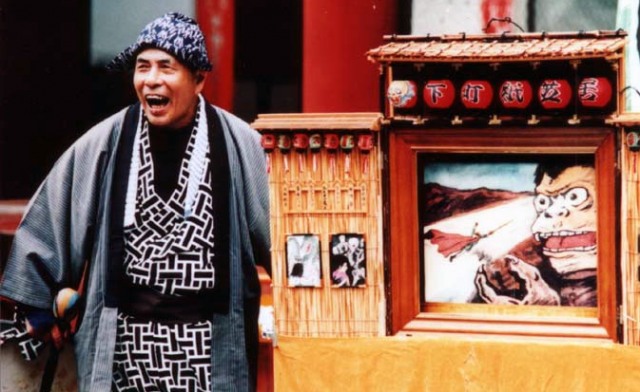
From the early 1920s through the late 1950s, before television became a fixture in Japanese homes, audiences flocked to kamishibai performances on street corners and parks around the country. A kamishibaiya (storyteller) would pedal from village to village with a butai (small wooden stage) perched on the back of his bicycle. When he arrived in a new community, he would click two sticks together to announce his presence, selling candy to the growing assembly of children. He would then show the audience a series of colorfully painted panels that told a story in much the same fashion as a comic book, narrating as he removed them one at a time from the butai.

At the height of its popularity in the 1930s, nearly five million people attended kamishibai performances every day. There were kamishibai for every demographic: sentimental tales about kittens and orphans for girls, adventure stories about masked heroes and mountaineers for boys, and pulpy mysteries and historical dramas for adults. A small army of artists and writers cranked out new installments of popular stories such as Golden Bat, Tiger Boy, Prince Gamma, and Cry of the Andes, providing an important training ground for such postwar manga-ka as Kazuo Koike, Sanpei Shirato, and Shigeru Mizuki.

A contemporary kamishibaiya performs in front of a butai.

Mizuki’s best-known comic, GeGeGe no Kitaro, traces its roots to the 1930s, when kamishibaiya around Japan performed Hakaba no Kitaro, a supernatural tale about a yokai boy who lived in a graveyard. Though Mizuki didn’t create Kitaro, he was responsible for adapting Hakaba no Kitaro into manga form, publishing his first Kitaro stories for the akabon (rental comics) market in 1959. Kitaro eventually found a home at Weekly Shonen Magazine in 1966, where the editors renamed it GeGeGe no Kitaro. Kitaro proved immensely popular, spawning animated television shows, feature-length movies, and video games, not to mention numerous manga sequels in Shonen Sunday, Shonen Action, and Shukan Jitsuwa.

Despite its immense popularity in Japan, none of the GeGeGe no Kitaro manga have been licensed for the North American market. In 2002, Kodansha International hired Ralph McCarthy to translate a handful of the Weekly Shonen Magazine stories, collecting them in three bilingual editions. Those volumes are scarce — at least on this side of the Pacific — although I was able to snag the first on eBay for less than $20. (Caveat emptor: Some Amazon retailers are asking as much as $345.00 for a single volume of the Kodansha Bilingual Comics edition.)

Looking through the pages of volume one, the story’s roots in kamishibai are apparent. The first chapter, “Ghost Train,” is a classic example of comeuppance theater: after two Tokyo businessmen abuse Kitaro and his sidekick Ratman, the men find themselves aboard a mysterious train whose final destination is Tama-reien (Tama Cemetery). The pacing suggests a story told at a campfire, allowing the audience to savor the word play (all the stops on the Tama-reien line have eerie names), the description of the passengers, and the two businessmen’s growing sense of terror. Though the pictures carry the weight of the storytelling, Mizuki uses an omniscient narrator to heighten the reader’s awareness of sound. “The skeleton-thin attendant blew his flute, and a tram came screeching into the station like a rickety hearse,” the narrator informs us. “The door rattled open like the door to a crematorium.”

The narrator serves another important purpose as well, filling in the gap between images, just as a kamishibayai would have done in the 1930s. Towards the end of the story, for example, the two men decide to leap from the train, rather than ride it to its final destination. Mizuki draws their awkward jump, then cuts to an image of the ghost train speeding along a dark track, barely distinguishable from the night sky and grassy wasteland it traverses. “Their heads cracked against something hard — rocks, perhaps,” the narrator explains. “A wail of agony splits the air, then all was silence once again.” This statement proves essential to setting up the story’s punchline, bringing the men’s ordeal to a dramatically suggestive end that is deftly clarified in the last four panels.

The second chapter, “The Leviathing,” owes a debt to such kamishibai mainstays as Golden Bat and Prince Gamma, serial adventures that freely mixed elements of science fiction, mystery, and fantasy. In “Leviathing,” Kitaro joins a scientific expedition to New Guinea, where an unscrupulous scientist injects Kitaro with a prehistoric animal’s blood, transforming Kitaro into a hairy, seven-story beast with the head of a whale and the body of a yeti.

As in “Ghost Train,” an omniscent narrator plays an important role in advancing the story, describing the changes in setting, and revealing the limitations of Kitaro’s new form. “Kitaro tried to yell, ‘Father!’, but all that came out was the Leviathing’s roar,” the narrator intones. “He put down his frightened father and walked away.”

Vital as the narration may be, it’s the artwork that underscores the poignancy of Kitaro’s situation. Mizuki draws the Leviathing in a dramatically different fashion when viewed from below than when viewed close-up: from the perspective of a human bystander, the Leviathing is monstrous, with an enormous, gaping mouth and short, grasping arms. Up close, however, he’s a gentle creature, capable of frowning, sighing, and shedding tears. These close-ups help remind us that it’s Kitaro trapped inside this destructive body, unable to communicate with humans or yokai; there’s simply no place for a giant prehistoric creature in such a thoroughly urbanized landscape, a point underscored by the military’s brutal efforts to eradicate Kitaro by driving him out to sea.

Although “The Leviathing” may strike readers as a sci-fi romp and not a ghost story, it illustrates one of the series’ most important themes: displacement. In many of the Kitaro stories, he struggles to find a place for himself — and his yokai friends — in an increasingly modernized world. As Jonathan Clements observes,

Mizuki was one of the first manga creators to deal with the rush of modernity, depicting Japanese ghosts largely as peaceful, gentle creatures forced into action by the encroachment of human civilisation on their remote, secluded places of haunting. In particular, he cited electric light as the main nemesis of spirits from the otherworld, giving his stories an elegiac quality that celebrates Japanese folktale traditions, even as he laments their passing.

Readers familiar with GeGeGe no Kitaro from its numerous film and television adaptations may find the bilingual edition a frustrating introduction to the manga, as many of the series’ colorful supporting players — Daddy Eyeball, Catchick, and The Sand Witch — play minor-to-nonexistent roles in the first volume. Readers interested in manga’s history, however, will find the first volume of the bilingual edition a fascinating window into the pre-war Japanese entertainment industry, offering English-speakers a hint of the stories and storytelling practices that once enchanted Japanese audiences on street corners around the country. Below, you’ll find a short bibliography of articles and books about Kitaro and kamishibai, should you wish to learn more about this famous character’s roots.

For Further Reading

Clements, Jonathan. “Spooky Ooky.” Schoolgirl Milky Crisis. 13 September 2010. <http://schoolgirlmilkycrisis.com/blog/?p=1710>. Accessed 11/6/11.

Kobayashi, Kenji and Kelly Yamamoto. “Kamishibai Theater.” Japanese American National Museum. <http://www.janm.org/janmkids/kamishibai.php>. Accessed 11/7/11.

Kyogoku, Natsuhiko. “Afterword.” GeGeGe no Kitaro, Vol. 1. Trans. Ralph F. McCarthy. New York: Kodansha International, 2002. 123-25.

McCarthy, Helen. “Spooky Kitaro’s Sixth Generation.” Suite 101. 6 May 2008. <http://helen-mccarthy.suite101.com/spooky-kitaros-sixth-generation-a52997>. Accessed 11/6/11.

Nash, Eric. Manga Kamishibai: The Art of Japanese Paper Theater. New York: Harry N. Abrams, 2009.

Filed Under: Manga Critic Tagged With: GeGeGe no Kitaro, Manga Movable Feast, Shigeru Mizuki, Shonen, Yokai

Manga Artifacts: GeGeGe no Kitaro

November 7, 2011 by Katherine Dacey

From the early 1920s through the late 1950s, before television became a fixture in Japanese homes, audiences flocked to kamishibai performances on street corners and parks around the country. A kamishibaiya (storyteller) would pedal from village to village with a butai (small wooden stage) perched on the back of his bicycle. When he arrived in a new community, he would click two sticks together to announce his presence, selling candy to the growing assembly of children. He would then show the audience a series of colorfully painted panels that told a story in much the same fashion as a comic book, narrating as he removed them one at a time from the butai.

At the height of its popularity in the 1930s, nearly five million people attended kamishibai performances every day. There were kamishibai for every demographic: sentimental tales about kittens and orphans for girls, adventure stories about masked heroes and mountaineers for boys, and pulpy mysteries and historical dramas for adults. A small army of artists and writers cranked out new installments of popular stories such as Golden Bat, Tiger Boy, Prince Gamma, and Cry of the Andes, providing an important training ground for such postwar manga-ka as Kazuo Koike, Sanpei Shirato, and Shigeru Mizuki.

A contemporary kamishibaiya performs in front of a butai.

Mizuki’s best-known comic, GeGeGe no Kitaro, traces its roots to the 1930s, when kamishibaiya around Japan performed Hakaba no Kitaro, a supernatural tale about a yokai boy who lived in a graveyard. Though Mizuki didn’t create Kitaro, he was responsible for adapting Hakaba no Kitaro into manga form, publishing his first Kitaro stories for the akabon (rental comics) market in 1959. Kitaro eventually found a home at Weekly Shonen Magazine in 1966, where the editors renamed it GeGeGe no Kitaro. Kitaro proved immensely popular, spawning animated television shows, feature-length movies, and video games, not to mention numerous manga sequels in Shonen Sunday, Shonen Action, and Shukan Jitsuwa.

Despite its immense popularity in Japan, none of the GeGeGe no Kitaro manga have been licensed for the North American market. In 2002, Kodansha International hired Ralph McCarthy to translate a handful of the Weekly Shonen Magazine stories, collecting them in three bilingual editions. Those volumes are scarce — at least on this side of the Pacific — although I was able to snag the first on eBay for less than $20. (Caveat emptor: Some Amazon retailers are asking as much as $345.00 for a single volume of the Kodansha Bilingual Comics edition.)

Looking through the pages of volume one, the story’s roots in kamishibai are apparent. The first chapter, “Ghost Train,” is a classic example of comeuppance theater: after two Tokyo businessmen abuse Kitaro and his sidekick Ratman, the men find themselves aboard a mysterious train whose final destination is Tama-reien (Tama Cemetery). The pacing suggests a story told at a campfire, allowing the audience to savor the word play (all the stops on the Tama-reien line have eerie names), the description of the passengers, and the two businessmen’s growing sense of terror. Though the pictures carry the weight of the storytelling, Mizuki uses an omniscient narrator to heighten the reader’s awareness of sound. “The skeleton-thin attendant blew his flute, and a tram came screeching into the station like a rickety hearse,” the narrator informs us. “The door rattled open like the door to a crematorium.”

The narrator serves another important purpose as well, filling in the gap between images, just as a kamishibayai would have done in the 1930s. Towards the end of the story, for example, the two men decide to leap from the train, rather than ride it to its final destination. Mizuki draws their awkward jump, then cuts to an image of the ghost train speeding along a dark track, barely distinguishable from the night sky and grassy wasteland it traverses. “Their heads cracked against something hard — rocks, perhaps,” the narrator explains. “A wail of agony splits the air, then all was silence once again.” This statement proves essential to setting up the story’s punchline, bringing the men’s ordeal to a dramatically suggestive end that is deftly clarified in the last four panels.

The second chapter, “The Leviathing,” owes a debt to such kamishibai mainstays as Golden Bat and Prince Gamma, serial adventures that freely mixed elements of science fiction, mystery, and fantasy. In “Leviathing,” Kitaro joins a scientific expedition to New Guinea, where an unscrupulous scientist injects Kitaro with a prehistoric animal’s blood, transforming Kitaro into a hairy, seven-story beast with the head of a whale and the body of a yeti.

As in “Ghost Train,” an omniscent narrator plays an important role in advancing the story, describing the changes in setting, and revealing the limitations of Kitaro’s new form. “Kitaro tried to yell, ‘Father!’, but all that came out was the Leviathing’s roar,” the narrator intones. “He put down his frightened father and walked away.”

Vital as the narration may be, it’s the artwork that underscores the poignancy of Kitaro’s situation. Mizuki draws the Leviathing in a dramatically different fashion when viewed from below than when viewed close-up: from the perspective of a human bystander, the Leviathing is monstrous, with an enormous, gaping mouth and short, grasping arms. Up close, however, he’s a gentle creature, capable of frowning, sighing, and shedding tears. These close-ups help remind us that it’s Kitaro trapped inside this destructive body, unable to communicate with humans or yokai; there’s simply no place for a giant prehistoric creature in such a thoroughly urbanized landscape, a point underscored by the military’s brutal efforts to eradicate Kitaro by driving him out to sea.

Although “The Leviathing” may strike readers as a sci-fi romp and not a ghost story, it illustrates one of the series’ most important themes: displacement. In many of the Kitaro stories, he struggles to find a place for himself — and his yokai friends — in an increasingly modernized world. As Jonathan Clements observes,

Mizuki was one of the first manga creators to deal with the rush of modernity, depicting Japanese ghosts largely as peaceful, gentle creatures forced into action by the encroachment of human civilisation on their remote, secluded places of haunting. In particular, he cited electric light as the main nemesis of spirits from the otherworld, giving his stories an elegiac quality that celebrates Japanese folktale traditions, even as he laments their passing.

Readers familiar with GeGeGe no Kitaro from its numerous film and television adaptations may find the bilingual edition a frustrating introduction to the manga, as many of the series’ colorful supporting players — Daddy Eyeball, Catchick, and The Sand Witch — play minor-to-nonexistent roles in the first volume. Readers interested in manga’s history, however, will find the first volume of the bilingual edition a fascinating window into the pre-war Japanese entertainment industry, offering English-speakers a hint of the stories and storytelling practices that once enchanted Japanese audiences on street corners around the country. Below, you’ll find a short bibliography of articles and books about Kitaro and kamishibai, should you wish to learn more about this famous character’s roots.

For Further Reading

Clements, Jonathan. “Spooky Ooky.” Schoolgirl Milky Crisis. 13 September 2010. <http://schoolgirlmilkycrisis.com/blog/?p=1710>. Accessed 11/6/11.

Kobayashi, Kenji and Kelly Yamamoto. “Kamishibai Theater.” Japanese American National Museum. <http://www.janm.org/janmkids/kamishibai.php>. Accessed 11/7/11.

Kyogoku, Natsuhiko. “Afterword.” GeGeGe no Kitaro, Vol. 1. Trans. Ralph F. McCarthy. New York: Kodansha International, 2002. 123-25.

McCarthy, Helen. “Spooky Kitaro’s Sixth Generation.” Suite 101. 6 May 2008. <http://helen-mccarthy.suite101.com/spooky-kitaros-sixth-generation-a52997>. Accessed 11/6/11.

Nash, Eric. Manga Kamishibai: The Art of Japanese Paper Theater. New York: Harry N. Abrams, 2009.

Filed Under: Manga Critic, REVIEWS Tagged With: GeGeGe no Kitaro, Shigeru Mizuki, Shonen, Yokai

Show Us Your Stuff: Myrah’s Tower of CLAMP

October 25, 2011 by Katherine Dacey 25 Comments

Welcome to the latest installment of Show Us Your Stuff! Today’s contributor is Myrah, an educator-in-training who’s passionate about books, baking, and CLAMP. Her collection is modest but catholic, and includes some rare Antique Bakery doujinshi. Here’s what this very busy woman had to say about her growing manga library.

Hello! I’m an undergraduate working on a major in English and minors in Education and Asian Studies. I’ve always enjoyed reading and writing and I’ve wanted to be a teacher for as long as I can remember. My decision to pursue Asian Studies is a more recent thing, partly influenced by my love for manga, and partly by my general interest in World History. I’m working on my Chinese and will hopefully study abroad in China for a semester in the near future.

I don’t have much free time between class and working as a teacher’s aide, but when I do I like to bake yummy things, ride my bike, and pet my cats. Besides my manga collection, I also have a rather large library of novels, anthologies, plays, non-fiction, and other graphic novels. Simply put, I love books!

What was your first manga?
That would be Sailor Moon, which is kind of strange because I never saw the anime. My sister (who doesn’t like books, let alone manga) borrowed the first few volumes from a girl on her school bus, and since I read everything I came across back then, I gobbled them up. I wound up buying most of the series, but sadly sold it years ago. I was very happy to hear Kodansha would be re-releasing it. (But I still haven’t seen the anime…)…

Read More

Filed Under: Manga Critic Tagged With: Awesome Manga Collections, clamp, fullmetal alchemist, fumi yoshinaga

Gate 7, Vol. 1

October 21, 2011 by Katherine Dacey 23 Comments

I have good news and bad news for CLAMP fans. The good news is that Gate 7 is one of the best-looking manga the quartet has produced, on par with Tsubasa: Reservoir Chronicles and xxxHolic. The bad news is that Gate 7‘s first volume is very bumpy, with long passages of expository dialogue and several false starts. Whether you’ll want to ride out the first three chapters will depend largely on your reaction to the artwork: if you love it, you may find enough visual stimulation to sustain to your interest while the plot and characters take shape; if you don’t, you may find the harried pacing and repetitive jokes a high hurdle to clear.

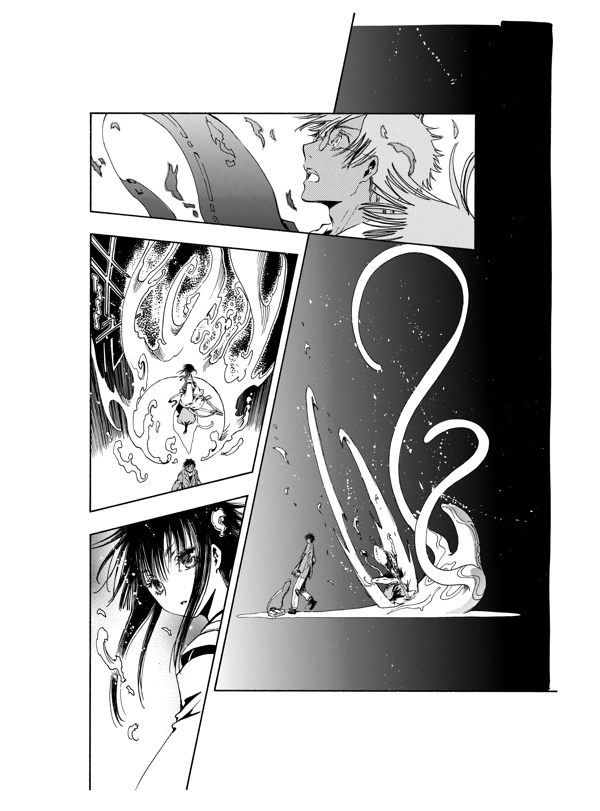
Art-wise, Gate 7 most closely resembles Tsubasa. The character designs are elegantly stylized, rendered in delicate lines; though their proportions have been gently elongated, their physiques are less giraffe-like than the principle characters in Legal Drug and xxxHolic. The same sensibility informs the action scenes as well, where CLAMP uses thin, sensual linework to suggest the energy unleashed during magical combat. (Readers familiar with Magic Knight Rayearth will see affinities between the two series, especially in the fight sequences.) Perhaps the most striking thing about the artwork is its imaginative use of water and light to evoke the supernatural. As Zack Davisson observes in his review of Gate 7, CLAMP uses a subtle but lovely image to shift the action from present-day Kyoto to the spirit realm, depicting the characters as stones in the water, with soft ripples radiating outward from each figure….

Read More

Filed Under: Manga Critic Tagged With: clamp, Dark Horse, Gate 7, Kyoto

Gate 7, Vol. 1

October 21, 2011 by Katherine Dacey

I have good news and bad news for CLAMP fans. The good news is that Gate 7 is one of the best-looking manga the quartet has produced, on par with Tsubasa: Reservoir Chronicles and xxxHolic. The bad news is that Gate 7‘s first volume is very bumpy, with long passages of expository dialogue and several false starts. Whether you’ll want to ride out the first three chapters will depend largely on your reaction to the artwork: if you love it, you may find enough visual stimulation to sustain to your interest while the plot and characters take shape; if you don’t, you may find the harried pacing and repetitive jokes a high hurdle to clear.

Art-wise, Gate 7 most closely resembles Tsubasa. The character designs are elegantly stylized, rendered in delicate lines; though their proportions have been gently elongated, their physiques are less giraffe-like than the principle characters in Legal Drug and xxxHolic. The same sensibility informs the action scenes as well, where CLAMP uses thin, sensual linework to suggest the energy unleashed during magical combat. (Readers familiar with Magic Knight Rayearth will see affinities between the two series, especially in the fight sequences.) Perhaps the most striking thing about the artwork is its imaginative use of water and light to evoke the supernatural. As Zack Davisson observes in his review of Gate 7, CLAMP uses a subtle but lovely image to shift the action from present-day Kyoto to the spirit realm, depicting the characters as stones in the water, with soft ripples radiating outward from each figure.

The story, however, is less satisfying. The plot revolves around high school student Chikahito Takamoto, a timid dreamer who’s obsessed with Kyoto as a place of “history, ancient arts, temples, and shrines.” While exploring the Kitano Tenmangu Shrine, Chikahito is transported to an alternate dimension, where he encounters three warriors: Sakura, Tachibana, and Hana, an androgynously beautiful, child-like figure who possesses even greater spiritual power than the other two. Chikahito watches the trio dismantle a ribbon-like serpent, but before he can question what he’s seen, poof! he finds himself eating noodles with them in a Kyoto apartment as Sakura and Tachibana debate the ethics of erasing Chikahito’s memory.

Hana astonishes Chikahito with an awesome display of power.

The biggest problem with this introductory section is that the subsequent chapter traces a nearly identical trajectory: Chikahito returns to Kyoto, encounters Hana in the streets, then is whisked onto the spirit-plane for another round of magical combat. As soon as the monster is defeated, Chikahito once again finds himself eating a meal with Hana, Sakura, and Tachibana. (This time around, however, they gang-press him into cooking and cleaning for them.) CLAMP even recycles the same gags from the prelude: Hana’s fragile appearance belies a monstrous appetite for noodles, an incongruity CLAMP mines for humor long past the point of being funny.

Other problems prevent Gate 7 from taking flight in its early pages. As we begin to learn more about the Kitano Tenmagu Shrine, for example, various characters take turns explaining its history. These narratives are clearly intended to set the table for a more complex plotline, but have the unintended consequence of stopping the story dead in its tracks. The script also makes some maddening detours into mystical clap-trap; in trying to understand how the seemingly ordinary Chikahito can enter the supernatural realm, characters lapse into Yoda-speak. “We’re alike,” Hana informs Chikahito. When asked, “In what areas?” Hana cheerfully replies, “In areas that are… ‘not.’ Where he’s the same is… ‘not.'”

The most disappointing aspect of Gate 7 is the flimsiness of the characterizations. CLAMP seems to be relying on readers’ familiarity with other titles — Cardcaptor Sakura, Chobits, Tsuaba, xxxHolic — in establishing each character’s personality and role in the drama. Hana, for example, slots into the Mokona role: Hana refers to himself (herself?) in the third person, repeats pet phrases, and behaves like a glutton, yet proves surprisingly powerful. Chikahito, on the other hand, is a carbon copy of xxxHolic‘s Watanuki, a nervous, bespectacled everyman who unwittingly becomes the housekeeper and magical errand-boy for more supernaturally gifted beings. The frantic pace and abrupt transitions between the mundane and supernatural world further complicate the process of establishing Hana and Chikahito as individuals; with so much material stuffed into the first two hundred pages, CLAMP leans too heavily on tics and mannerisms to carry the burden of the characterization. (Cute finger-wagging does not a character make.)

The dramatic introduction of a new character in the volume’s final pages suggests that CLAMP may finally be hitting its stride in chapter four. As promising as this development may be, I can’t quite shake the feeling that I’m reading a Potemkin manga, all surface detail and no depth. Let’s hope volume two proves me wrong.

GATE 7, VOL. 1 • BY CLAMP • DARK HORSE • 192 pp. • NO RATING

Filed Under: Manga, Manga Critic, REVIEWS Tagged With: clamp, Dark Horse, Gate 7, Kyoto

X, Vol. 1

October 16, 2011 by Katherine Dacey 19 Comments

As a child of the 1970s, I appreciate a good disaster flick, whether the devastation is local or global, natural or man-made. There’s something immensely satisfying about watching the world go up in flames, only to walk outside the theater and be reassured by the presence of stop lights, busses, coffee shops, and pedestrians going about their business. Small wonder, then, that I adored CLAMP’s X back in 2003. Not only did it have an impossibly large cast of attractive characters, it also boasted awesome scenes of destruction — scenes worthy of a Hollywood blockbuster.

When VIZ announced that it would be reissuing X in a deluxe edition, however, I had misgivings about the project: would the apocalypse be as good the second time around?

In 2003, I’d swooned over the illustrations, re-read favorite scenes, and marveled at the fact that all the characters dressed like refugees from a 1980s music video. Though my inner snob normally disdained anything so purple, I secretly loved the all-caps dialogue, the swirling lines and wind-swept hairdos, and the melodramatic death scenes, not to mention the eerie, post-apocalyptic dream sequences that were sprinkled throughout the series. X read like a hybrid of The Seventh Sign (not to be confused with The Seventh Seal, a much classier flick), Götterdämmerung, and Captain EO, and I couldn’t get enough of it.

At the time I was collecting X, I hadn’t read much else, save a handful of manga by CLAMP and Rumiko Takahashi. The very qualities that drew me to X — angstful conversations, tortured characters — soon had the opposite effect on me: I started to avoid comics in which the emotional volume was cranked up to eleven on every page, as I found them exhausting, the manga equivalent of Tristan and Isolde. Re-reading Tokyo Babylon, for example, I was mortified by my initial enthusiasm for the story, which now seemed hopelessly overripe to me; not since I’d re-read The Lion, The Witch, and The Wardrobe had I been so disappointed by a favorite text.

Revisiting X proved a more rewarding experience, though the series’ structural flaws were more readily apparent on a second reading. The dialogue, for example, is often unintentionally hilarious: bystanders comment on the main characters, helpfully telling us how wonderful they are (“Last week, he saved my son from drowning in the river,” one anonymous mother says of Fuma), while the main characters introduce themselves to one another as if they’re networking, not preparing to kill each other. (Sample: “The name’s Sorata Arisugawa! A cute ‘n’ fun-lovin’ high school senior!” “Allow me to return the favor. I am Yuto Kigai. A humble public servant in the local ward office.”) Kotori, the first major female character to be introduced, embodies the Mary Sue concept to a tee; not only is she beautiful, kind, and long of hair, but she’s also very delicate, beset with a heart so weak that she collapses whenever someone frowns. More amusing still are the characters who materialize at the very moment they’re needed: witness the introduction of Tokiko Magami, a school nurse who just so happens to be Kamui’s sole surviving relative, and a fount of information about Kamui’s mother.

Yet these moments of narrative clumsiness are overpowered by the sheer force of the imagery. The battle scenes are kinetic and violent, as characters leap across rooftops, level buildings, and plunge their swords into one another; few licensed shojo or shonen titles can match the gory zest with which CLAMP executes these moments of hand-to-hand combat. The dream sequences, too, are shockingly graphic: characters are dismembered, crucified, impaled, and engulfed in flames, often right before their loved ones’ eyes. Though these images teeter on the brink of kitsch — in one dream, Kamui cradles Kotori’s severed head in his arms — they underscore one of the series’ most important points: sacrifice and loss are a fundamental part of becoming an adult, whether that sacrifice means leaving one’s family (as Sorata and Lady Arashi have done) or losing them (as Kamui, Fuma, and Kotori do in the early chapters of the manga).

The series’ other major theme — that humans are poor stewards of Mother Earth — is less successfully illustrated; three volumes in, it still isn’t clear what, exactly, the Seven Seals are charged with doing: preventing nuclear war? staving off pollution? protecting spotted owls? What will happen if the Seals fail, however, is evocatively rendered; CLAMP draws a post-apocalyptic Tokyo worthy of Katsuhiro Otomo, a landscape of twisted skyscrapers and rotting corpses slowly engulfed by sand dunes.

The fact that these images appeared in Monthly Asuka and not Young Magazine is what makes X so remarkable: it may not be the best shojo fantasy ever written, but it certainly is one of the bloodiest, a fierce, angry blast of emotion that scorches everything in its path. I hesitate to suggest that X‘s body count is an achievement, but it is sharp and welcome rebuke to the idea that female readers strongly prefer conversation and character development to butt-kicking and carnage. Count me in for volume two.

Review copy provided by VIZ Media, LLC.

X, VOL. 1 • BY CLAMP • VIZ MEDIA • 580 pp. • RATING: OLDER TEEN (16+)

Filed Under: Manga Critic Tagged With: clamp, shojo, VIZ, X/1999

X, Vol. 1

October 16, 2011 by Katherine Dacey

As a child of the 1970s, I appreciate a good disaster flick, whether the devastation is local or global, natural or man-made. There’s something immensely satisfying about watching the world go up in flames, only to walk outside the theater and be reassured by the presence of stop lights, busses, coffee shops, and pedestrians going about their business. Small wonder, then, that I adored CLAMP’s X back in 2003. Not only did it have an impossibly large cast of attractive characters, it also boasted awesome scenes of destruction — scenes worthy of a Hollywood blockbuster.

When VIZ announced that it would be reissuing X in a deluxe edition, however, I had misgivings about the project: would the apocalypse be as good the second time around?

In 2003, I’d swooned over the illustrations, re-read favorite scenes, and marveled at the fact that all the characters dressed like refugees from a 1980s music video. Though my inner snob normally disdained anything so purple, I secretly loved the all-caps dialogue, the swirling lines and wind-swept hairdos, and the melodramatic death scenes, not to mention the eerie, post-apocalyptic dream sequences that were sprinkled throughout the series. X read like a hybrid of The Seventh Sign (not to be confused with The Seventh Seal, a much classier flick), Götterdämmerung, and Captain EO, and I couldn’t get enough of it.

At the time I was collecting X, I hadn’t read much else, save a handful of manga by CLAMP and Rumiko Takahashi. The very qualities that drew me to X — angstful conversations, tortured characters — soon had the opposite effect on me: I started to avoid comics in which the emotional volume was cranked up to eleven on every page, as I found them exhausting, the manga equivalent of Tristan and Isolde. Re-reading Tokyo Babylon, for example, I was mortified by my initial enthusiasm for the story, which now seemed hopelessly overripe to me; not since I’d re-read The Lion, The Witch, and The Wardrobe had I been so disappointed by a favorite text.

Revisiting X proved a more rewarding experience, though the series’ structural flaws were more readily apparent on a second reading. The dialogue, for example, is often unintentionally hilarious: bystanders comment on the main characters, helpfully telling us how wonderful they are (“Last week, he saved my son from drowning in the river,” one anonymous mother says of Fuma), while the main characters introduce themselves to one another as if they’re networking, not preparing to kill each other. (Sample: “The name’s Sorata Arisugawa! A cute ‘n’ fun-lovin’ high school senior!” “Allow me to return the favor. I am Yuto Kigai. A humble public servant in the local ward office.”) Kotori, the first major female character to be introduced, embodies the Mary Sue concept to a tee; not only is she beautiful, kind, and long of hair, but she’s also very delicate, beset with a heart so weak that she collapses whenever someone frowns. More amusing still are the characters who materialize at the very moment they’re needed: witness the introduction of Tokiko Magami, a school nurse who just so happens to be Kamui’s sole surviving relative, and a fount of information about Kamui’s mother.

Yet these moments of narrative clumsiness are overpowered by the sheer force of the imagery. The battle scenes are kinetic and violent, as characters leap across rooftops, level buildings, and plunge their swords into one another; few licensed shojo or shonen titles can match the gory zest with which CLAMP executes these moments of hand-to-hand combat. The dream sequences, too, are shockingly graphic: characters are dismembered, crucified, impaled, and engulfed in flames, often right before their loved ones’ eyes. Though these images teeter on the brink of kitsch — in one dream, Kamui cradles Kotori’s severed head in his arms — they underscore one of the series’ most important points: sacrifice and loss are a fundamental part of becoming an adult, whether that sacrifice means leaving one’s family (as Sorata and Lady Arashi have done) or losing them (as Kamui, Fuma, and Kotori do in the early chapters of the manga).

The series’ other major theme — that humans are poor stewards of Mother Earth — is less successfully illustrated; three volumes in, it still isn’t clear what, exactly, the Seven Seals are charged with doing: preventing nuclear war? staving off pollution? protecting spotted owls? What will happen if the Seals fail, however, is evocatively rendered; CLAMP draws a post-apocalyptic Tokyo worthy of Katsuhiro Otomo, a landscape of twisted skyscrapers and rotting corpses slowly engulfed by sand dunes.

The fact that these images appeared in Monthly Asuka and not Young Magazine is what makes X so remarkable: it may not be the best shojo fantasy ever written, but it certainly is one of the bloodiest, a fierce, angry blast of emotion that scorches everything in its path. I hesitate to suggest that X‘s body count is an achievement, but it is sharp and welcome rebuke to the idea that female readers strongly prefer conversation and character development to butt-kicking and carnage. Count me in for volume two.

Review copy provided by VIZ Media, LLC.

X, VOL. 1 • BY CLAMP • VIZ MEDIA • 580 pp. • RATING: OLDER TEEN (16+)

Filed Under: Manga, Manga Critic, REVIEWS Tagged With: clamp, shojo, VIZ, X/1999

Codename: Sailor V, Vol. 1

October 13, 2011 by Katherine Dacey 4 Comments

Do you remember Wonder Woman? From an adult perspective, the show was dreadful, marred by ham-fisted scripts, low-budget special effects, campy plotlines, and wooden performances. From a child’s perspective, however, Wonder Woman was magical: the heroine had a secret identity, wore a cool crime-fighting outfit complete with nifty, crime-fighting accessories, and fought bad buys. Better still, she could transform from civilian to superhero by extending her arms and twirling a few times, a transformation made even more dramatic by a blinding flash of light and a musical flourish on the soundtrack.

Codename: Sailor V irresistibly reminded me of the old Wonder Woman show. Judged by adult standards, it’s repetitive, hokey, and poorly drawn; judged by a child’s standards, however, it’s an appealing fantasy in which an ordinary girl can assume a new, powerful identity in order to defeat bullies, robbers, and aliens who like to impersonate idols. (More on that in a minute.)

Sailor V follows a well-established shojo template in which a seemingly ordinary girl discovers her true identity as a soldier, priestess, or princess. For perky tomboy Minako Aino, her alter ego is Sailor Venus, a glamorous, sailor-suited warrior tasked with protecting the Earth from the Dark Agency, a nefarious band of aliens using the entertainment industry to enslave humanity. With the aid of Artemis, a talking cat, Minako begins mastering her two secret weapons: a magical pen and a crescent-shaped compact, both of which enable her to overwhelm opponents with the light of truth….

Read More

Filed Under: Manga Critic Tagged With: kodansha, Magical Girl, Naoko Takeuchi, sailor moon, shojo

Codename: Sailor V, Vol. 1

October 13, 2011 by Katherine Dacey

Do you remember Wonder Woman? From an adult perspective, the show was dreadful, marred by ham-fisted scripts, low-budget special effects, campy plotlines, and wooden performances. From a child’s perspective, however, Wonder Woman was magical: the heroine had a secret identity, wore a cool crime-fighting outfit complete with nifty, crime-fighting accessories, and fought bad buys. Better still, she could transform from civilian to superhero by extending her arms and twirling a few times, a transformation made even more dramatic by a blinding flash of light and a musical flourish on the soundtrack.

Codename: Sailor V irresistibly reminded me of the old Wonder Woman show. Judged by adult standards, it’s repetitive, hokey, and poorly drawn; judged by a child’s standards, however, it’s an appealing fantasy in which an ordinary girl can assume a new, powerful identity in order to defeat bullies, robbers, and aliens who like to impersonate idols. (More on that in a minute.)

Sailor V follows a well-established shojo template in which a seemingly ordinary girl discovers her true identity as a soldier, priestess, or princess. For perky tomboy Minako Aino, her alter ego is Sailor Venus, a glamorous, sailor-suited warrior tasked with protecting the Earth from the Dark Agency, a nefarious band of aliens using the entertainment industry to enslave humanity. With the aid of Artemis, a talking cat, Minako begins mastering her two secret weapons: a magical pen and a crescent-shaped compact, both of which enable her to overwhelm opponents with the light of truth.

What distinguishes Sailor V from other magical girl manga is Minako’s can-do spirit. Minako may flunk math quizzes and miss homeroom, but when the fate of the Earth hangs in the balance, she embraces her responsibility with cheerful resolve. “I feel liberated! I’m overflowing with power!” she declares after her first successful mission. Even when the missions fall into a predictable pattern, Minako’s enthusiasm and competence prove irresistible: she delivers high-flying kicks with graceful precision, discovers new powers in the heat of battle, scolds evil-doers for evading the tax code (no, really), and experiments with different personae. (In one story, she transforms into a handsome male idol; in another, she poses as a military commando.)

Put simply, Minako kicks butt and has fun doing it.

I’m less enthusiastic about the artwork, which is a riot of busy screentones, arm-flapping chibis, and noseless characters. The visual flow is often choppy, with abrupt shifts in perspective and setting that can disorient the reader. The character designs, too, leave something to be desired, as the villains all have blank, doll-like faces and enormous foreheads, while Minako and her friends have saucer-shaped eyes. Only the fight scenes are well executed; using undulating lines and balletic poses, Takeuchi does a fine job of distinguishing Minako from Sailor V, showing us how a plucky teen transforms into a strong young woman.

And therein lies the key Codename: Sailor V‘s appeal: the series allows young girls to try on a grown-up persona, to imagine what it might be to like to be a strong, smart, and capable woman who’s free to realize her full potential. At the same time, however, Sailor V honors a young girl’s ideas of femininity, recognizing that it’s perfectly possible to save the day while wearing a cute outfit. Small wonder, then, that the Sailor Moon franchise proved so popular among young girls on both sides of the Pacific: who wouldn’t want to be a princess and a warrior?

CODENAME: SAILOR V, VOL. 1 • BY NAOKO TAKEUCHI • KODANSHA COMICS USA • 272 pp. • RATING: TEEN (13+)

Filed Under: Manga, Manga Critic, REVIEWS Tagged With: kodansha, Magical Girl, Naoko Takeuchi, sailor moon, shojo

  • « Go to Previous Page
  • Page 1
  • Interim pages omitted …
  • Page 15
  • Page 16
  • Page 17
  • Page 18
  • Page 19
  • Interim pages omitted …
  • Page 39
  • Go to Next Page »
 | Log in
Copyright © 2010 Manga Bookshelf | Powered by WordPress & the Genesis Framework