• Skip to primary navigation
  • Skip to main content
  • Skip to primary sidebar
  • Home
  • About Us
    • Privacy Policy
    • Comment Policy
    • Disclosures & Disclaimers
  • Resources
    • Links, Essays & Articles
    • Fandomology!
    • CLAMP Directory
    • BlogRoll
  • Features & Columns
    • 3 Things Thursday
    • Adventures in the Key of Shoujo
    • Bit & Blips (game reviews)
    • BL BOOKRACK
    • Bookshelf Briefs
    • Bringing the Drama
    • Comic Conversion
    • Fanservice Friday
    • Going Digital
    • It Came From the Sinosphere
    • License This!
    • Magazine no Mori
    • My Week in Manga
    • OFF THE SHELF
    • Not By Manga Alone
    • PICK OF THE WEEK
    • Subtitles & Sensibility
    • Weekly Shonen Jump Recaps
  • Manga Moveable Feast
    • MMF Full Archive
    • Yun Kouga
    • CLAMP
    • Shojo Beat
    • Osamu Tezuka
    • Sailor Moon
    • Fruits Basket
    • Takehiko Inoue
    • Wild Adapter
    • One Piece
    • After School Nightmare
    • Karakuri Odette
    • Paradise Kiss
    • The Color Trilogy
    • To Terra…
    • Sexy Voice & Robo
  • Browse by Author
    • Sean Gaffney
    • Anna Neatrour
    • Michelle Smith
    • Katherine Dacey
    • MJ
    • Brigid Alverson
    • Travis Anderson
    • Phillip Anthony
    • Derek Bown
    • Jaci Dahlvang
    • Angela Eastman
    • Erica Friedman
    • Sara K.
    • Megan Purdy
    • Emily Snodgrass
    • Nancy Thistlethwaite
    • Eva Volin
    • David Welsh
  • MB Blogs
    • A Case Suitable For Treatment
    • Experiments in Manga
    • MangaBlog
    • The Manga Critic
    • Manga Report
    • Soliloquy in Blue
    • Manga Curmudgeon (archive)

Manga Bookshelf

Discussion, Resources, Roundtables, & Reviews

Manga Critic

A Devil and Her Love Song, Vol. 4

September 19, 2012 by Katherine Dacey 7 Comments

A Devil and Her Love Song has been one of 2012’s best surprises. Though the series uneven — and sometimes a little silly — its heroine is one of the most memorable in the Shojo Beat canon. Maria Kawai looks like a mean girl on the surface: she’s pretty and unsparingly blunt, pointing out her classmates’ insecurities with all the delicacy of Dr. Phil. Yet Maria’s bull-in-a-china-shop demeanor reflects her own uncertainty about how to be the kind of person who’s liked for who she is, not the kind of person who’s admired for telling unpleasant truths. And that makes her interesting.

Early in volume four, for example, Maria confronts queen bee Ayu in the bathroom, where she finds Ayu primping for the television cameras. When Maria questions Ayu’s behavior — “But you look the same,” she tells Ayu — Ayu is furious. Maria, however, persists — not because she wants the embarrass a rival, but because she wants to share a hard-won piece of advice. “If someone likes you, or wants to get to know you, it’s not because of how you look,” she tells Ayu. “It’s because you show them how you feel.”

Ayu’s subsequent behavior, however, points to one of the series’ weaknesses: characters have epiphanies with whiplash-inducing frequency. (Saul would never have made it to Damascus if he fell off his donkey as many times as Maria’s classmates do.) Though some of these epiphanies feel genuine, many are contrived: would an alpha girl suddenly confess her feelings to a cute boy in front of all her friends, risking public rejection? Or the class darling admit that she’s actually a nasty manipulator, risking her popularity? Those are nice fantasies, but not very plausible ones; Tomori is working too hard to convince us that Maria’s classmates secretly wish they could be more like her, and not giving group-think and fear enough due.

The series also relies heavily on shopworn gimmicks to advance the plot. The arrival of a television crew in volume three, for example, serves no useful purpose; they disappear for long stretches at a home, only to materialize when the plot demands that someone bear witness to the class’ antics. Maria’s long-running feud with her teacher, too, feels more like an editor’s suggestion than an original idea. To be sure, a student as outspoken as Maria might infuriate a certain kind of adult, but her teacher’s cartoonish behavior renders him ineffective; his actions seem too obvious, too ripe for exposure, for him to pose a real threat to Maria.

Where A Devil and Her Love Song shines is in Maria’s one-on-one interactions with other students. These scenes remind us that everyone is wearing a mask in high school — even Maria, whose sharp comments are as much a pose as Hana’s forced cheerfulness. Though Tomori nails the mean-girl dynamic in all its exquisite awfulness, the best of these exchanges belong to Maria and Shin. Their will-they-won’t-they tension is certainly an effective narrative hook, but what makes these scenes compelling is their honesty. Tomori captures her characters’ body language and fitful conversations, which unfold in fragments, silences, and sudden bursts of feeling, rather than eloquent declarations.

I don’t know about you, but that’s how I remember high school, as a time when I had flashes of insight and bravery, but a lot more moments of cringe-inducing stupidity, cowardice, or tongue-tied helplessness. That Tomori captures adolescence in all its discomfort while still writing a romance that’s fun, readable, and sometimes endearingly silly, is proof of her skill. Now if she could just ditch the television crew and the evil teacher…

Review copy provided by VIZ Media.

A DEVIL AND HER LONG SONG • BY MIYOSHI TOMORI • VIZ MEDIA • 200 pp. • RATING: TEEN (13+)

Filed Under: Manga Critic Tagged With: Miyoshi Tomori, shojo, shojo beat, VIZ

A Devil and Her Love Song, Vol. 4

September 19, 2012 by Katherine Dacey

A Devil and Her Love Song has been one of 2012’s best surprises. Though the series uneven — and sometimes a little silly — its heroine is one of the most memorable in the Shojo Beat canon. Maria Kawai looks like a mean girl on the surface: she’s pretty and unsparingly blunt, pointing out her classmates’ insecurities with all the delicacy of Dr. Phil. Yet Maria’s bull-in-a-china-shop demeanor reflects her own uncertainty about how to be the kind of person who’s liked for who she is, not the kind of person who’s admired for telling unpleasant truths. And that makes her interesting.

Early in volume four, for example, Maria confronts queen bee Ayu in the bathroom, where she finds Ayu primping for the television cameras. When Maria questions Ayu’s behavior — “But you look the same,” she tells Ayu — Ayu is furious. Maria, however, persists — not because she wants the embarrass a rival, but because she wants to share a hard-won piece of advice. “If someone likes you, or wants to get to know you, it’s not because of how you look,” she tells Ayu. “It’s because you show them how you feel.”

Ayu’s subsequent behavior, however, points to one of the series’ weaknesses: characters have epiphanies with whiplash-inducing frequency. (Saul would never have made it to Damascus if he fell off his donkey as many times as Maria’s classmates do.) Though some of these epiphanies feel genuine, many are contrived: would an alpha girl suddenly confess her feelings to a cute boy in front of all her friends, risking public rejection? Or the class darling admit that she’s actually a nasty manipulator, risking her popularity? Those are nice fantasies, but not very plausible ones; Tomori is working too hard to convince us that Maria’s classmates secretly wish they could be more like her, and not giving group-think and fear enough due.

The series also relies heavily on shopworn gimmicks to advance the plot. The arrival of a television crew in volume three, for example, serves no useful purpose; they disappear for long stretches at a home, only to materialize when the plot demands that someone bear witness to the class’ antics. Maria’s long-running feud with her teacher, too, feels more like an editor’s suggestion than an original idea. To be sure, a student as outspoken as Maria might infuriate a certain kind of adult, but her teacher’s cartoonish behavior renders him ineffective; his actions seem too obvious, too ripe for exposure, for him to pose a real threat to Maria.

Where A Devil and Her Love Song shines is in Maria’s one-on-one interactions with other students. These scenes remind us that everyone is wearing a mask in high school — even Maria, whose sharp comments are as much a pose as Hana’s forced cheerfulness. Though Tomori nails the mean-girl dynamic in all its exquisite awfulness, the best of these exchanges belong to Maria and Shin. Their will-they-won’t-they tension is certainly an effective narrative hook, but what makes these scenes compelling is their honesty. Tomori captures her characters’ body language and fitful conversations, which unfold in fragments, silences, and sudden bursts of feeling, rather than eloquent declarations.

I don’t know about you, but that’s how I remember high school, as a time when I had flashes of insight and bravery, but a lot more moments of cringe-inducing stupidity, cowardice, or tongue-tied helplessness. That Tomori captures adolescence in all its discomfort while still writing a romance that’s fun, readable, and sometimes endearingly silly, is proof of her skill. Now if she could just ditch the television crew and the evil teacher…

Review copy provided by VIZ Media.

A DEVIL AND HER LONG SONG • BY MIYOSHI TOMORI • VIZ MEDIA • 200 pp. • RATING: TEEN (13+)

Filed Under: Manga, Manga Critic, REVIEWS Tagged With: Miyoshi Tomori, shojo, shojo beat, VIZ

Manga Artifacts: The Unauthorized Astro Boy Comic

September 7, 2012 by Katherine Dacey 6 Comments

In 1963, NBC acquired the rights to broadcast Tetsuwan Atomu, or Mighty Atom, an animated children’s show that had been a hit on Japanese television earlier that year. NBC executives renamed it Astro Boy and began airing it in September on WNEW, NBC’s New York City affiliate. Astro Boy proved a success with young viewers, prompting NBC to order fifty-two more episodes from Mushi Studios and syndicate the show nationally (Schodt 88).

Two years later, NBC licensed the Astro Boy character rights to Gold Key Comics . Gold Key was a brand-new subsidiary of Western Publishers, best known to consumers for titles like The Poky Little Puppy and The Saggy Baggy Elephant. The company had considerable experience selling its Little Golden Books through non-traditional outlets — supermarkets, drug stores — and wanted to apply that knowledge to the newsstand comics market, then dominated by companies such as Dell Comics.

Without the knowledge or approval of Mushi Studios or Osamu Tezuka, Gold Key hired an artist to adapt the Astro Boy show into a comic. (No artist is credited for Astro Boy #1.) The result was a four-color, two-story issue that used Osamu Tezuka’s characters but bore little to no resemblance to the comic that had been running in Shonen magazine since 1952.

“Gangor the Monster,” the first of the two stories, is based on an episode of the Astro Boy show. The plot is simple: Gangor, a centipede-like robot, terrorizes the passengers aboard an ocean liner on which Astro and Professor Ochanomizu (called Dr. Packadermus J. Elefun in the English version) are traveling. Astro Boy soon discovers Gangor’s secret — Gangor is actually comprised of forty-seven identical robots — and quickly defeats it in a battle that unfolds underwater and in the air. As in many Silver Age comics, word balloons carry the burden of the storytelling; though we see several panels of Gangor in action, most of what we learn about Gangor is revealed in conversations between the main characters:

The second story, “Attack of the Mud People” is original, with no obvious precedent in the the show. In terms of tone and plot, it reads like a rejected DC Comics script: a pair of evil scientists unleash a horde of mud monsters on an unsuspecting city, demanding five million dollars in ransom. (Better still: the scientists have mustaches. They also happen to be identical twins. It’s a trifecta of villainy!) Astro Boy is nearly defeated by the monsters, as their dirt clogs his joints, preventing him from flying. In a flash of inspiration, he realizes the best way to stop the monsters is to make it rain — a feat he accomplishes with the aid of a little dry ice. As in “Gangor,” very little actually happens; most of the story consists of characters’ reaction shots as they flee in terror, or watch Astro Boy go mano-a-mano with the monsters.

As the page above demonstrates, both stories look more like generic Silver Age products than shonen manga; small wonder Tezuka deplored it as a cheap knock-off of his work. Yet for all their flaws, both stories offer a fascinating window into the American comics industry in the 1960s.

For one thing, they attest to the the growing importance of television as source material for comics publishers. A quick glance at Gold Key’s catalog turns up comics based on The Addams Family, Dark Shadows, Lost in Space, My Favorite Martian, Star Trek, and The Twilight Zone. Animated shows were an important part of the Gold Key catalog as well. In the 1960s and early 1970s, Gold Key had a partnership with Hanna-Barbera Studios, cranking out comic book versions of The Amazing Chan and the Chan Clan, The Flintstones, The Pink Panther, and Scooby Doo. As former Gold Key writer Mark Evanier explains, there was a standard procedure for taking a new show and turning it into a comic. The first few stories would faithfully reproduce early episodes; after that, the artist was given greater creative freedom to do as he saw fit with the characters:

Chase [Craig, the editor] handed me a pile of storyboards and told me to read them all to get a feel for the property but to write an adaptation of one in particular… Anyway, I was assigned to adapt it and later on if the comic continued, there would be original stories conceived fresh for the comics. As Chase explained to me, he preferred to launch a new H-B book in this manner. The studio had approval rights and the people there could get pointlessly picky about the material…but they rarely bothered looking at any issue after the first few. Therefore, it simplified the procedure to do the first issue as an adaptation and maybe the second. They couldn’t very well complain that a plot taken from the show was inappropriate.

We can see this process at work in the Astro Boy comic as well, with one story based on the show and one story drawn from the artist’s imagination. Of course, no one from Mushi Studios was reviewing the work, as in the model that Evanier describes above; the primary reason for re-telling “Gigantor,” presumably, was to cement the connection between the show and the comic.

These stories also attest to a powerful Western arrogance about the source material; every effort was made to conceal its Japanese origins, from renaming the characters to adding color. More telling still was that Tezuka himself was never identified as Astro Boy‘s creator; NBC was listed as the copyright holder (Schodt 88-89). It never occurred to anyone at either NBC or Gold Key that the very foreignness of the original material — the action-driven storytelling, the frank presentation of difficult issues — might appeal more to kids than a bowdlerized version in which every conflict was neatly resolved in sixteen pages, and no one ever died. For that version of Astro Boy, American readers would have to wait another thirty-seven years.

Works Cited

Evanier, Mark. “Goodbye, Charlie!” News From Me. N.p., 25 Apr. 2006. Web. 07 Sept. 2012. <http://www.newsfromme.com/archives/2006_04_25.html>.

“Gold Key Astro Boy #1 – Attack of the Mud People.” Magic Carpet Burn. N.p., 23 Mar. 2009. Web. 07 Sept. 2012. <http://magiccarpetburn.blogspot.com/2009/03/gold-key-astro-boy-1-attack-of-mud.html>.

“Gold Key Astro Boy #1 – Attack of the Mud People (Conclusion).” Magic Carpet Burn. N.p., 24 Mar. 2009. Web. 07 Sept. 2012. <http://magiccarpetburn.blogspot.com/2009/03/gold-key-astro-boy-1-attack-of-mud_24.html>.

“Gold Key Astro Boy #1 – Gangor the Monster Pt One.” Magic Carpet Burn. N.p., 21 Mar. 2009. Web. 07 Sept. 2012. <http://magiccarpetburn.blogspot.com/2009/03/gold-key-astro-boy-1-gangor-monster-pt.html>.

“Gold Key Astro Boy #1 – Gangor the Monster Pt Two.” Magic Carpet Burn. N.p., 22 Mar. 2009. Web. 07 Sept. 2012. <http://magiccarpetburn.blogspot.com/2009/03/gold-key-astro-boy-1-gangor-monster-pt_22.html>.

Schodt, Frederik L. The Astro Boy Essays: Osamu Tezuka, Mighty Atom, and the Manga/Anime Revolution. Berkeley: Stone Bridge Press, 2007. Print.

Filed Under: Manga Critic Tagged With: Astro Boy, Gold Key Comics, NBC, Osamu Tezuka

Dawn of the Arcana, Vols. 3-5

August 1, 2012 by Katherine Dacey 4 Comments

On the surface, Dawn of the Arcana looks like a Harlequin romance. Its flame-haired heroine is feisty and impetuous, torn between her feelings for the man who raised her and the man she was forced to marry. Both men are keen to “own” her — their word, not mine — and are willing to go to ridiculous extremes to prove their devotion, even setting aside their differences to honor her requests. And true to Harlequin form, the heroine frequently struggles to reconcile the circumstances of her marriage and her growing feelings for her jailer-husband.

Peer beneath its romance-novel trappings, however, and it quickly becomes clear that manga-ka Rei Toma is actually writing a pretty nifty fantasy-adventure as well, one with interesting moral dilemmas, parallels with contemporary geopolitics, and multi-layered characters whose behavior frequently deviates from the Harlequin playbook.

In volume three, for example, Nakaba’s mother-in-law attempts to dye her hair black, lest visiting dignitaries realize that the new Belquat princess hails from Senan. Toma might have used this scene to provide Caesar an opportunity to publicly declare his feelings for Nakaba, or demonstrate Nakaba’s ability to endure hazing with noble forbearance. Instead, Toma transforms this act of fairy-tale cruelty into a moment of self-actualization: Nakaba seizes a sword and defiantly gives herself a fabulous pixie cut — er, short, boyish locks — denying the queen the satisfaction of humiliating her in front of the royal family.

That act resonates throughout the next three volumes, as Nakaba sheds her girlish braid and girlish indignation in favor of a stronger, more active role in defeating Belquat’s royal family. Though Nakaba’s new ‘do leads to some predictable exchanges about “looking like a boy,” both Loki and Caesar admire her determination: red hair symbolizes more than just her country of origin, but also the struggles that helped define her as a person.

As appealing as such scenes may be, they highlight the series’ main drawback: the artwork is too plain and spare for a story with such vivid characters. Though the principal characters’ costumes are rendered in considerable detail, the supporting cast resemble Renfair extras, with faintly old-timey clothing and long tresses. Worse still are the backgrounds: with their perfect right angles and unvaried lines, they look like stills from an ancient Nintendo game, rather than a representation of a specific time and place. That sterility isn’t a deal-breaker, but it does reinforce the impression that Toma hasn’t quite developed the artistic chops to fully realize her vision.

Despite its artistic shortcomings, Dawn of the Arcana remains an appealing mixture of fantasy and romance, offering just enough sword fights, scenes of female empowerment, and emotional entanglements to appeal to fans of both genres.

Review copies provided by VIZ Media, LLC.

DAWN OF THE ARCANA, VOLS. 3-5 | BY REI TOMA | VIZ MEDIA | RATING: TEEN (13+)

Filed Under: Manga Critic Tagged With: Rei Toma, shojo, shojo beat, VIZ

Dawn of the Arcana, Vols. 3-5

August 1, 2012 by Katherine Dacey

On the surface, Dawn of the Arcana looks like a Harlequin romance. Its flame-haired heroine is feisty and impetuous, torn between her feelings for the man who raised her and the man she was forced to marry. Both men are keen to “own” her — their word, not mine — and are willing to go to ridiculous extremes to prove their devotion, even setting aside their differences to honor her requests. And true to Harlequin form, the heroine frequently struggles to reconcile the circumstances of her marriage and her growing feelings for her jailer-husband.

Peer beneath its romance-novel trappings, however, and it quickly becomes clear that manga-ka Rei Toma is actually writing a pretty nifty fantasy-adventure as well, one with interesting moral dilemmas, parallels with contemporary geopolitics, and multi-layered characters whose behavior frequently deviates from the Harlequin playbook.

In volume three, for example, Nakaba’s mother-in-law attempts to dye her hair black, lest visiting dignitaries realize that the new Belquat princess hails from Senan. Toma might have used this scene to provide Caesar an opportunity to publicly declare his feelings for Nakaba, or demonstrate Nakaba’s ability to endure hazing with noble forbearance. Instead, Toma transforms this act of fairy-tale cruelty into a moment of self-actualization: Nakaba seizes a sword and defiantly gives herself a fabulous pixie cut — er, short, boyish locks — denying the queen the satisfaction of humiliating her in front of the royal family.

That act resonates throughout the next three volumes, as Nakaba sheds her girlish braid and girlish indignation in favor of a stronger, more active role in defeating Belquat’s royal family. Though Nakaba’s new ‘do leads to some predictable exchanges about “looking like a boy,” both Loki and Caesar admire her determination: red hair symbolizes more than just her country of origin, but also the struggles that helped define her as a person.

As appealing as such scenes may be, they highlight the series’ main drawback: the artwork is too plain and spare for a story with such vivid characters. Though the principal characters’ costumes are rendered in considerable detail, the supporting cast resemble Renfair extras, with faintly old-timey clothing and long tresses. Worse still are the backgrounds: with their perfect right angles and unvaried lines, they look like stills from an ancient Nintendo game, rather than a representation of a specific time and place. That sterility isn’t a deal-breaker, but it does reinforce the impression that Toma hasn’t quite developed the artistic chops to fully realize her vision.

Despite its artistic shortcomings, Dawn of the Arcana remains an appealing mixture of fantasy and romance, offering just enough sword fights, scenes of female empowerment, and emotional entanglements to appeal to fans of both genres.

Review copies provided by VIZ Media, LLC.

DAWN OF THE ARCANA, VOLS. 3-5 | BY REI TOMA | VIZ MEDIA | RATING: TEEN (13+)

Filed Under: Manga, Manga Critic, REVIEWS Tagged With: Rei Toma, shojo, shojo beat, VIZ

The Best Manga You’re Not Reading: Suki

July 26, 2012 by Katherine Dacey 8 Comments

The brilliant sociopath, the hooker with the heart of gold, and the naïf are my three least favorite character types, the first two for their tiresome ubiquity in popular culture, and the third for being tiresome: when was the last time you read a story about a sweet, innocent person that didn’t make you feel horribly manipulated or horribly jaded? Imagine my surprise, then, at discovering CLAMP’s delightfully odd series Suki: A Like Story, which revolves around a brilliant but impossibly naive teenager who trusts everyone, reads picture books, and talks to teddy bears. I thought I’d be tearing my breast in agony by the end of the first chapter; instead, I quickly succumbed to Suki‘s charms and even suppressed a sniffle or two in the final pages.

Suki succeeds, in large part, because the supporting cast has the same reaction to sixteen-year-old Hinata Asashi as the reader. Hina’s boundless enthusiasm endears her to best friends, Touko and Emi, though both roll their eyes at her inability to read social cues or grasp ulterior motives. Touko, in particular, is keen to protect her pal; as we learn in the second volume of the series, Hina has been kidnapped nine — count ’em — times over the course of her short life. (Hina’s dad is rich and willing to pay ransom for the safe return of his daughter.) Though an ordinary person might be deeply scarred by such experiences — or least more suspicious of strangers — Hina remains cheerful and oblivious to signs that a tenth abduction might be in the works.

Those signs include a string of odd coincidences: the long-vacant house next to Hina’s is suddenly occupied by a handsome young man who just happens to be Hina’s new homeroom teacher, Shiro Asou. Shiro just happens to be around whenever Hina is in need of an escort, or rescuing. And Shiro just happens to conduct clandestine meetings when the class goes on field trips. The ever-vigilant Touko quickly suspects the worst, but Hina interprets Shiro’s gruff yet solicitous behavior as concern, and develops a chaste crush on her sensei.

Watching Hina come to terms with her feelings is a painful but believable process. At first, she revels in any opportunity to spend time with Shiro, whether they’re raking leaves or walking home from school. Later, she begins to see parallels between their relationship and the relationship between two characters in a favorite picture-book series. (More on the series-within-a-series gambit in a minute.) In the final chapters of the book, Hina develops a more realistic idea of who Shiro is, eventually telling him how her feelings have evolved from youthful naivete to adult maturity. “At first, I fell in love with you because you did so many things I loved,” she confesses. “But from now on, Asou-san… whatever you do for yourself… I’ll love you for that.”

That Hina’s epiphany is facilitated, in part, by reading a children’s book may strike some readers as hopelessly twee. Suki — the name of the story-within-a-story — isn’t subtle; using bears as surrogates for Hina and Shiro, Suki charts the budding friendship between a small, chatty bear and her large, bespectacled neighbor. The parallels between the main plot and the story-within-the-story are obvious, but they serve an important purpose, reminding us that Hina is struggling to reconcile new, adult feelings with her decidedly child-like worldview.

Art-wise, Suki: A Like Story is one of CLAMP’s simplest — one might even say plainest — series. Tsubaki Nekoi’s style is much less Baroque than her cohorts’; she favors ordinary street clothes over epaulets and garter belts, and more realistic physiques over exaggerated shoulders and sharp chins. By shedding the fanciful trappings, Nekoi focuses the reader’s attention on faces, allowing us to fully register how each character is feeling. Nowhere is that more evident in the way Nekoi draws Touko. Touko is by far the most mature girl at Hina’s school, and the one most attuned to signs of adult malfeasance. Though Touko voices her concerns, the sadness in her face reveals a level of understanding that might be rooted in her own experiences, not just Hina’s:

Though Hina has a much more innocent personality than Touko, Nekoi resists the temptation to draw Hina as a child; Hina is clearly meant to be a teenager, given her size and athleticism. Hina’s transparent facial expressions, wide-eyed enthusiasm, and sudden, darting movements, however, hint at the discrepancy between her chronological and emotional ages; she bounces and skips and claps her way through the story, reacting with intense glee at even the briefest exchange with Shiro:

The art isn’t perfect by any means. Shiro’s proportions, for example, often look wrong: he has a tiny head and an enormous frame, and is so much taller than the other characters that he’d be NBA draft material in real life. Suki, the book-within-a-book, is also problematic. It’s quite possibly the dullest picture book I’ve read, a series of simple drawings accompanied by large, undifferentiated blocks of text. I certainly wasn’t expecting Sylvester and the Magic Pebble (or A Kiss for Little Bear), but the flat, unimaginative illustrations make it harder for the reader to imagine why someone Hina’s age would find the story so compelling:

Perhaps the most interesting thing about Suki is that Hina’s realistic coming-of-age story is embedded within a thriller. The suspenseful elements of Suki are handled with skill and restraint, even if they are a wee bit ridiculous. (OK, a lot ridiculous: who allows their frequently kidnapped sixteen-year-old daughter to live alone with her teddy bears?!) The few action scenes are brief but crisply executed, adding some much-needed variety in tone and pacing to the story. If the ending is a little too tidy, CLAMP avoids the trap of pandering to the reader’s expectations of what should happen; there’s a note of melancholy in that final scene, joyous though Hina may be.

Readers curious about Suki: A Like Story won’t have too much difficulty tracking down used copies on eBay or Amazon; the complete series will set you back about $20-30.

SUKI: A LIKE STORY, VOLS. 1-3 • BY CLAMP • TOKYOPOP • RATING: TEEN (13+)

Filed Under: Manga Critic Tagged With: clamp, Suki, Tokyopop

The Best Manga You’re Not Reading: Suki

July 26, 2012 by Katherine Dacey

The brilliant sociopath, the hooker with the heart of gold, and the naïf are my three least favorite character types, the first two for their tiresome ubiquity in popular culture, and the third for being tiresome: when was the last time you read a story about a sweet, innocent person that didn’t make you feel horribly manipulated or horribly jaded? Imagine my surprise, then, at discovering CLAMP’s delightfully odd series Suki: A Like Story, which revolves around a brilliant but impossibly naive teenager who trusts everyone, reads picture books, and talks to teddy bears. I thought I’d be tearing my breast in agony by the end of the first chapter; instead, I quickly succumbed to Suki‘s charms and even suppressed a sniffle or two in the final pages.

Suki succeeds, in large part, because the supporting cast has the same reaction to sixteen-year-old Hinata Asashi as the reader. Hina’s boundless enthusiasm endears her to best friends, Touko and Emi, though both roll their eyes at her inability to read social cues or grasp ulterior motives. Touko, in particular, is keen to protect her pal; as we learn in the second volume of the series, Hina has been kidnapped nine — count ’em — times over the course of her short life. (Hina’s dad is rich and willing to pay ransom for the safe return of his daughter.) Though an ordinary person might be deeply scarred by such experiences — or least more suspicious of strangers — Hina remains cheerful and oblivious to signs that a tenth abduction might be in the works.

Those signs include a string of odd coincidences: the long-vacant house next to Hina’s is suddenly occupied by a handsome young man who just happens to be Hina’s new homeroom teacher, Shiro Asou. Shiro just happens to be around whenever Hina is in need of an escort, or rescuing. And Shiro just happens to conduct clandestine meetings when the class goes on field trips. The ever-vigilant Touko quickly suspects the worst, but Hina interprets Shiro’s gruff yet solicitous behavior as concern, and develops a chaste crush on her sensei.

Watching Hina come to terms with her feelings is a painful but believable process. At first, she revels in any opportunity to spend time with Shiro, whether they’re raking leaves or walking home from school. Later, she begins to see parallels between their relationship and the relationship between two characters in a favorite picture-book series. (More on the series-within-a-series gambit in a minute.) In the final chapters of the book, Hina develops a more realistic idea of who Shiro is, eventually telling him how her feelings have evolved from youthful naivete to adult maturity. “At first, I fell in love with you because you did so many things I loved,” she confesses. “But from now on, Asou-san… whatever you do for yourself… I’ll love you for that.”

That Hina’s epiphany is facilitated, in part, by reading a children’s book may strike some readers as hopelessly twee. Suki — the name of the story-within-a-story — isn’t subtle; using bears as surrogates for Hina and Shiro, Suki charts the budding friendship between a small, chatty bear and her large, bespectacled neighbor. The parallels between the main plot and the story-within-the-story are obvious, but they serve an important purpose, reminding us that Hina is struggling to reconcile new, adult feelings with her decidedly child-like worldview.

Art-wise, Suki: A Like Story is one of CLAMP’s simplest — one might even say plainest — series. Tsubaki Nekoi’s style is much less Baroque than her cohorts’; she favors ordinary street clothes over epaulets and garter belts, and more realistic physiques over exaggerated shoulders and sharp chins. By shedding the fanciful trappings, Nekoi focuses the reader’s attention on faces, allowing us to fully register how each character is feeling. Nowhere is that more evident in the way Nekoi draws Touko. Touko is by far the most mature girl at Hina’s school, and the one most attuned to signs of adult malfeasance. Though Touko voices her concerns, the sadness in her face reveals a level of understanding that might be rooted in her own experiences, not just Hina’s:

Though Hina has a much more innocent personality than Touko, Nekoi resists the temptation to draw Hina as a child; Hina is clearly meant to be a teenager, given her size and athleticism. Hina’s transparent facial expressions, wide-eyed enthusiasm, and sudden, darting movements, however, hint at the discrepancy between her chronological and emotional ages; she bounces and skips and claps her way through the story, reacting with intense glee at even the briefest exchange with Shiro:

The art isn’t perfect by any means. Shiro’s proportions, for example, often look wrong: he has a tiny head and an enormous frame, and is so much taller than the other characters that he’d be NBA draft material in real life. Suki, the book-within-a-book, is also problematic. It’s quite possibly the dullest picture book I’ve read, a series of simple drawings accompanied by large, undifferentiated blocks of text. I certainly wasn’t expecting Sylvester and the Magic Pebble (or A Kiss for Little Bear), but the flat, unimaginative illustrations make it harder for the reader to imagine why someone Hina’s age would find the story so compelling:

Perhaps the most interesting thing about Suki is that Hina’s realistic coming-of-age story is embedded within a thriller. The suspenseful elements of Suki are handled with skill and restraint, even if they are a wee bit ridiculous. (OK, a lot ridiculous: who allows their frequently kidnapped sixteen-year-old daughter to live alone with her teddy bears?!) The few action scenes are brief but crisply executed, adding some much-needed variety in tone and pacing to the story. If the ending is a little too tidy, CLAMP avoids the trap of pandering to the reader’s expectations of what should happen; there’s a note of melancholy in that final scene, joyous though Hina may be.

Readers curious about Suki: A Like Story won’t have too much difficulty tracking down used copies on eBay or Amazon; the complete series will set you back about $20-30.

SUKI: A LIKE STORY, VOLS. 1-3 • BY CLAMP • TOKYOPOP • RATING: TEEN (13+)

Filed Under: Manga, Manga Critic, Recommended Reading, REVIEWS Tagged With: clamp, Suki, Tokyopop

My 5 Favorite CLAMP Manga

July 24, 2012 by Katherine Dacey 19 Comments

I’ve read almost every CLAMP title available in English, from X (or X/1999, as we called it in back in the day) to Gate 7, and while I can’t claim to love them all, there is a core group of manga that I’ve read, re-read, and recommended to other fans. I make no special claims of excellence for these series, though I will say that these manga impressed me with their technical brilliance, genre-bending narratives, and beautiful artwork, if not their stellar endings.

MAGIC KNIGHT RAYEARTH (Dark Horse; 2 volumes)

It’s easy to forget that Magic Knight Rayearth ran in the pages of Nakayoshi, as it adheres so closely to the friendship-effort-victory template that it almost passes for a Shonen Jump title. A careful reading of MKR, however, reveals it to be a unique fusion of shojo and shonen storytelling practices. On a moment to moment basis, MKR reads like shojo: the heroines denigrate their academic prowess, swoon over the only cute boy to cross their path, and extol the value of “heart” in defeating their enemies. The intense and protracted battle scenes, however, scream Naruto — or maybe Gundam — as the girls are pushed to their physical and emotional limits while casting spells, swinging swords, and piloting giant robots. That CLAMP reconciles such tonally different genres into a coherent whole is an impressive narrative feat; no matter how many times the heroines utter dippy or painfully sincere sentiments, their tenacity in combat makes them every bit as bad-ass as Naruto, InuYasha, or Ichigo Kurasaki. -Reviewed at The Manga Critic on July 22, 2011.

LEGAL DRUG (Tokyopop; 3 volumes)

I hesitate to use the word “intertextual” to describe Legal Drug, as that term is so heavily freighted with academic associations. But intertextual it is, as Legal Drug takes place in a universe that’s been carefully mapped out in prior works such as Angelic Layer, Cardcaptor Sakura, and Suki. Major and minor characters from Chobits and Suki wander in and out of the story, providing comic relief and commentary on the budding relationship between Rikuo and Kazahaya, two handsome young errand boys for the Green Drugstore. As in xxxHolic — a series in which Rikuo and Kazahaya make guest appearances — the supernatural frequently intrudes on mundane existence, giving rise to scenes of sublime comedy and surreal grace. An odd mixture of melancholy and whimsy, with a soupçon of shonen-ai.

CLOVER (Dark Horse; 1 volume)

Clover is a gorgeous train wreck, an unholy marriage of shojo, steampunk, and science fiction that almost — almost — gels into a coherent story. The plot revolves around a class of psychically gifted individuals known as Clovers, who have been rounded up, tested, and sorted into categories based on their abilities. The most powerful — Three- and Four-Leaf Clovers — have been imprisoned, as they pose a threat to humanity.

In the small fragment of story that CLAMP completed, the Clovers’ abilities are hastily sketched; the few demonstrations of their powers are less-than-awe-inspiring, and the government’s reasons for fearing them poorly explained. But oh, the atmosphere! Anyone who remembers what it felt like to be fourteen will recognize the Clovers’ magnificent isolation, as they struggle with feelings of loneliness, rejection, and desire; that they’ve been singled out for being different (and special!) only heightens the emotional intensity of their dilemma. The artwork, too, is a feast for the eyes, with inventive layouts and sensual character designs that rank among CLAMP’s finest. Even CLAMP’s use of soggy, overwrought song lyrics as a narrative device contributes to the story’s moody beauty, if not the pantheon of great love songs.

SHIRAHIME-SYO: SNOW GODDESS TALES (Tokyopop; 1 volume)

Shirahime-Syo: Snow Goddess Tales is testament to CLAMP’s Borg-like ability assimilate any genre or artistic style and make it into their own. The three stories that comprise this slim volume are folkloric in tone and subject-matter, but expressed in a visual language that’s a beautiful synthesis of shojo manga and ukiyo print-making; the characters — with their pointy chins and artfully tousled hair — inhabit stark landscapes reminiscent of the Kishi and Shijo schools. If the overall mood is more subdued than xxxHolic or Tokyo Babylon, the stories are nonetheless moving in their directness and simplicity. The first, “On Wolf Mountain,” is the strongest of the three, exploring how one girl’s quest for revenge is transformed by the discovery that her enemy is, in fact, more courageous and generous than she ever imagined. The other stories — “The Ice Flower” and “Hiyoku no Tori” — read more like entries in Lafcadio Hearn’s Kwaidan and Other Strange Stories, but are nonetheless effective parables about sacrifice. An out-of-print gem.

X (VIZ; 6 volumes)

On many levels, X is a bad manga: the characters are underwritten, the storytelling is lazy, and the dialogue is comically awful. (Don’t believe me? Check out Party Like It’s 1999, a Tumblr blog dedicated to exploring X on a page-by-page basis.) If you can look past the 90s hair and the tin-eared dialogue, however, what you’ll discover is a fierce apocalyptic drama that boasts some of the best end-of-the-world imagery in any manga not written by Katsuhiro Otomo. Oh, and blood. Buckets of blood.

The battle scenes are kinetic and violent, executed with a gory zest that’s difficult to resist. The dream sequences, too, are suitably shocking: characters are dismembered, crucified, impaled, and engulfed in flames, often right before their loved ones’ eyes. I hesitate to suggest that X‘s body count is a victory for women, but it is a sharp and welcome rebuke to the idea that female readers strongly prefer conversation and character development to butt-kicking and carnage. – Reviewed at The Manga Critic on 10/16/11.

So, readers, I turn the floor over to you: what are your favorite CLAMP titles? Which manga do you recommend to friends and new fans? Inquiring minds want to know!

Filed Under: Manga Critic Tagged With: clamp, Clover, Dark Horse, legal drug, Magic Knight Rayearth, Shirahime-Syo, shojo, Tokyopop, VIZ, X/1999

Polterguys, Vol. 1

July 20, 2012 by Katherine Dacey 9 Comments

If you’ve ever watched Iron Chef, you know that some competitors prevail by transforming the day’s theme ingredient into dishes of astonishing originality and complexity, while others win by making everyday dishes—say, mac and cheese or fish sticks—with such consummate skill that they elevate comfort food into cuisine. I don’t know what kind of cook Laurianne Uy is, but if I had to hazard a guess based on her writing, I’d say she fell into the second category of culinary magicians. Polterguys, her print debut, isn’t astonishing for its novelty, but for its masterful presentation of a familiar story.

That story goes something like this: nerdy high school girl Bree seeks a fresh start in college. Bree soon discovers, however, that college isn’t the haven she imagined it would be. Her roommate is loud and messy, and her classmates are more interested in partying than studying. When presented with the opportunity to live on her own, off-campus, Bree jumps at the chance. The house she rents, however, is already occupied… by five male ghosts. And cute ones, at that.

What prevents Polterguys from reading like a supernatural retread of Ouran High School Host Club is Uy’s ability to adapt the reverse-harem concept to an American setting. The college town in which the story takes place bears a strong resemblance to Berkeley, CA (or perhaps Palo Alto), and the characters who inhabit the town look and sound like American college students. Her ghosts are pleasingly diverse, running the gamut from all-American jock to dread-locked scientist. Best of all, Uy’s protagonist has a depth and complexity that many shojo heroines lack; Bree is smart and capable, but her prickly behavior, fierce work ethic, and inability to relate to her peers make her seem like a real person, rather than a wallflower who’s just waiting for a hot guy to fall in love with her. (She’s also appealingly quirky, hanging a picture of Dr. Sanjay Gupta on her dorm wall for hunkspiration.)

Polterguys also benefits from a tightly scripted story. Uy handles the exposition crisply, using an emotionally charged scene to frame the action: we meet Bree, watch her move into her college dorm, then see her collapsed, sobbing, in the rain several weeks later. The story then jumps back to the beginning of her first semester, showing us the sequence of events that led to that tearful moment. Though Uy covers considerable territory in her first volume, completing one character’s story arc and establishing another (presumably to be addressed in the second volume), the narrative never feels rushed; Uy steadily increases the dramatic tension, building to third-act climax that’s both sad and satisfying.

Art-wise, Polterguys may remind readers of Dramacon and Nightschool — not because Uy’s style resembles Svetlana Chmakova’s, but because Uy, like Chmakova, employs an artistic vocabulary that’s a distillation of shojo manga conventions, rather than a slavish imitation. Uy’s character designs are a great example: though they’re heavily stylized and simplified, they owe as much a debt to Archie as they do to Ouran; the only obvious nod to shojo manga is embodied in a pair of twins who have a bad case of Manga Hair. (Both sport spiky, skunk-striped fetlocks.) In another departure from standard shojo operating procedure, Uy draws Bree as a slightly awkward, geeky figure — bespectacled and freckled, favoring Carhart pants over cute outfits — rather than a blandly pretty teen.

The Polterguys with Bree (front right). Image copyright Laurianne Uy.

Perhaps the best compliment I can pay Polterguys is that it’s an old story told well. Uy’s witty script and appealing characters leave a fresh impression, even when the plot itself does not; Polterguys is one of the most unabashedly fun new comics I’ve read this summer. Recommended.

Where to Read and Buy: Readers curious about Polterguys can read the entire first volume at Laurianne Uy’s website. Thanks to a successful Kickstarter campaign and a 2012 Xeric Grant, readers who would like to own a copy can purchase PDF and paper copies through her website. Polterguys is also available through Amazon, Barnes & Noble, and the Apple Bookstore.

Review copy provided by the artist.

Filed Under: Manga Critic Tagged With: Laurianne Uy, OEL/Global Manga, Reverse Harem, Supernatural Romance

Sakuran

July 13, 2012 by Katherine Dacey 11 Comments

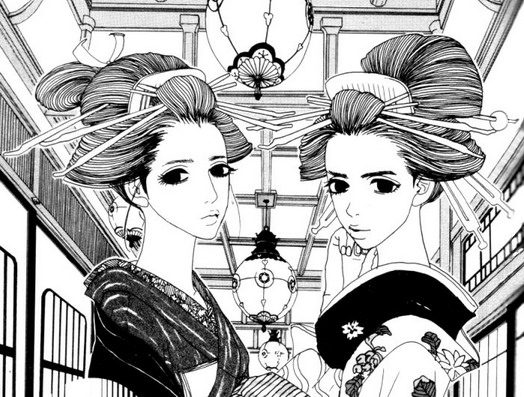
The oiran, or Japanese courtesan, is a product of seventeenth century Japan. Like the geisha who eclipsed them in popularity, the oiran were not simply prostitutes; they were companions and performers, trained in a variety of arts — calligraphy, music, flower arranging — and prized for their ability to converse with powerful men. Though confined to the official pleasure districts of Edo, Kyoto, and Osaka, they were highly visible, formally parading through the streets in elaborate costumes, attended by a retinue of maids.

As a potent symbol of the new, hedonistic culture of urban Japan, the oiran were frequent subjects of ukiyo-e, or “floating world” prints. Artists such as Suzuki Harunobou emphasized the oiran’s refinement, the rarefied world in which they operated, and, in their more explicit shunga prints, the bodily pleasures they offered.

Moyocco Anno’s Sakuran presents a less romanticized image of the oiran, documenting one girl’s rise from maid to tayuu, or head courtesan. We first meet Kiyoha as an eight-year-old child: orphaned and undisciplined, she chafes against the strict rules inside Edo’s Tamagiku House, making several unsuccessful attempts to escape. Shohi, Kiyoha’s mistress, is one of the few people to recognize Kiyoha’s potential: not only is Kiyoha quick-witted, she also boasts a porcelain complexion and delicate facial features, both highly prized assets in a courtesan. Shohi’s method for grooming Kiyoha for her new role is less tutoring than hazing, however, a mixture of slaps, insults, and mind games designed to teach Kiyoha to behave in a more dignified fashion.

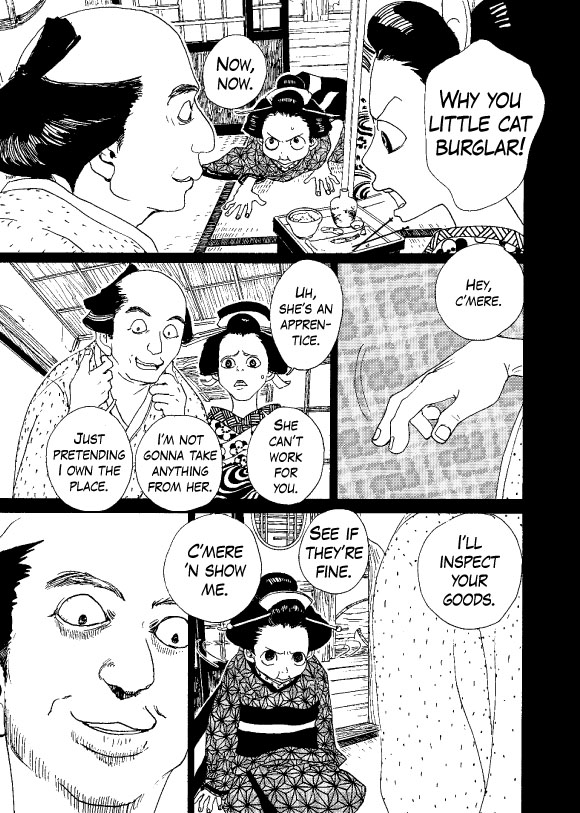
Anno’s artwork is uniquely suited to the subject matter: it’s both starkly ugly and exquisitely beautiful, capable of conveying the anger and suffering beneath Kiyoha’s carefully manicured appearance. When we first meet Kiyoha, for example, Anno draws her as a “dirty little turnip” with a snot-stained face, unkempt hair, and an ill-fitting yukata. Though Kiyoha undergoes a remarkable transformation over the course of the manga, we are frequently reminded of what she looked like when she first arrived at Tamagiku. Kiyoha’s face contorts into a grotesque, child-like mask whenever she feels wronged or vulnerable, and she frequently reverts to a feral posture when eating, as if her bowl might be snatched from her hands.

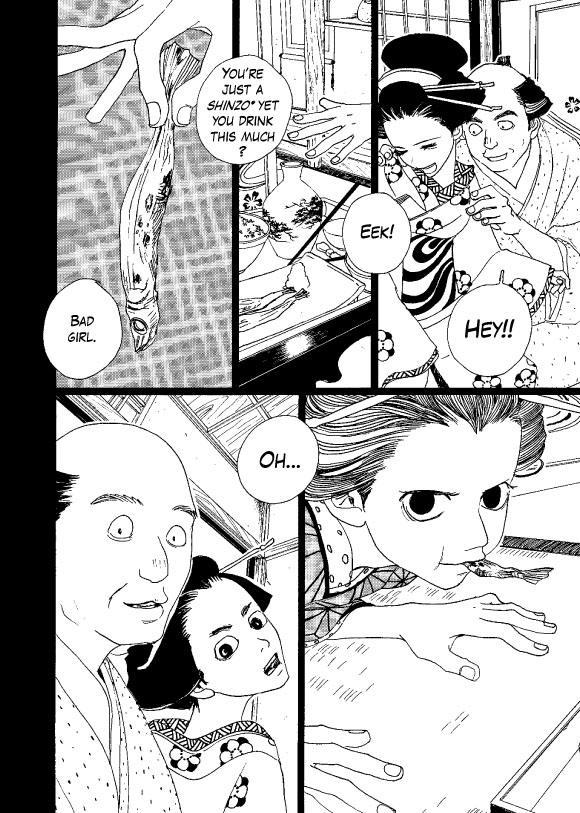
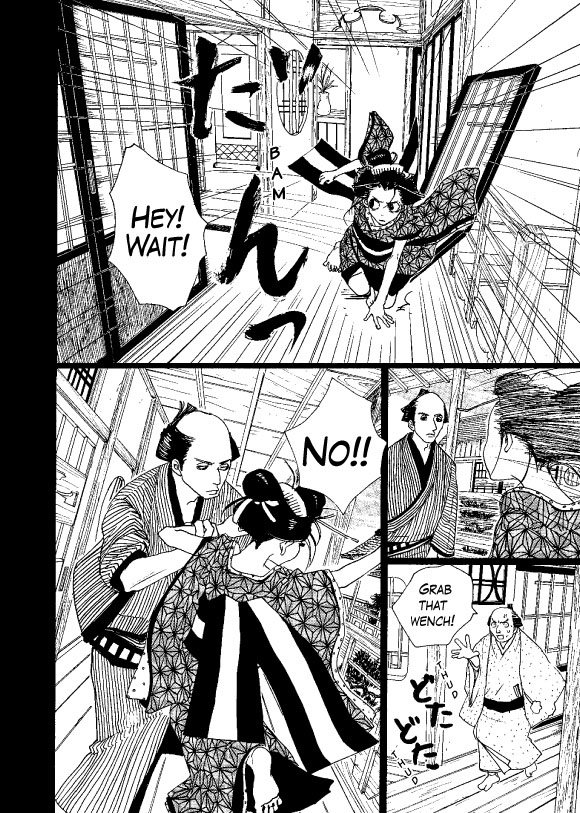
In this sequence, for example, twelve-year-old Kiyoha interrupts a transaction between a shinzu (the lowest ranking courtesan of the house) and a lecherous customer. Kiyoha’s motives for intervening are unclear, since her relationship with the shinzu in question is never carefully delineated. As she tussles with the customer, however, we see Kiyoha’s childhood survival instinct emerge in full force, overriding Shohi’s etiquette lessons:

One of the things this sequence also emphasizes is the discrepancy in power between the low-ranking courtesans and the house clientele; any violation of established protocol could result in severe reprisal. Anno infuses this scene with special urgency by using blunt, contemporary speech in lieu of the archaic language that verisimilitude might demand. It’s a welcome departure from the tortured, Fakespearian dialogue that plagues the otherwise brilliant Ooku: The Inner Chambers, focusing the reader’s attention on visual signifiers of class and gender — eye contact, body language, clothing — rather than honorifics and awkward syntax.

Perhaps Anno’s greatest achievement is her ability to capture her characters’ physical beauty and sensuality without reducing them to objects. Even the most erotic images are carefully framed as business transactions: the dialogue reminds us that the oiran are performing for their customers, creating an illusion of sexual and emotional intimacy for the sake of money, while their customers’ grim expressions and sweaty bodies remind us of their determination to get the most bang for the buck (so to speak).

If Sakuran sounds like a hectoring treatise on prostitution, rest assured it’s not. Anno creates a vibrant, fascinating world, teeming with people from every walk of life. Though her female characters have limited agency, they nonetheless find opportunities to exert influence over their customers, improve their social standing, and choose their own lovers.

Kiyoha embodies all the contradictions and complexities of her environment: she’s impetuous, competitive, and unmoved by her peers’ hardships, yet she has a great capacity for feeling — and transcending — pain. That Kiyoha is, at times, a repellant figure, does not diminish her appeal as a character; we appreciate the mental toughness that her job demands, and admire her efforts to push back against its limits. It seems only fitting that the story ends not with the outcome that a modern reader might choose for this fierce woman, but with one that reflects the heroine’s own clear-eyed understanding of what she is. Highly recommended.

Review copy provided by Vertical, Inc.

SAKURAN • BY MOYOCCO ANNO • VERTICAL, INC. • 308 pp. • RATING: MATURE (VIOLENCE, LANGUAGE, AND SEXUAL NUDITY)

Filed Under: Manga Critic Tagged With: Moyocco Anno, Oiran, Sakuran, vertical

Sakuran

July 13, 2012 by Katherine Dacey

The oiran, or Japanese courtesan, is a product of seventeenth century Japan. Like the geisha who eclipsed them in popularity, the oiran were not simply prostitutes; they were companions and performers, trained in a variety of arts — calligraphy, music, flower arranging — and prized for their ability to converse with powerful men. Though confined to the official pleasure districts of Edo, Kyoto, and Osaka, they were highly visible, formally parading through the streets in elaborate costumes, attended by a retinue of maids. As a potent symbol of the new, hedonistic culture of urban Japan, the oiran were frequent subjects of ukiyo-e, or “floating world” prints. Artists such as Suzuki Harunobou emphasized the oiran’s refinement, the rarefied world in which they operated, and, in their more explicit shunga prints, the bodily pleasures they offered.

Moyocco Anno’s Sakuran presents a less romanticized image of the oiran, documenting one girl’s rise from maid to tayuu, or head courtesan. We first meet Kiyoha as an eight-year-old child: orphaned and undisciplined, she chafes against the strict rules inside Edo’s Tamagiku House, making several unsuccessful attempts to escape. Shohi, Kiyoha’s mistress, is one of the few people to recognize Kiyoha’s potential: not only is Kiyoha quick-witted, she also boasts a porcelain complexion and delicate facial features, both highly prized assets in a courtesan. Shohi’s method for grooming Kiyoha for her new role is less tutoring than hazing, however, a mixture of slaps, insults, and mind games designed to teach Kiyoha to behave in a more dignified fashion.

Anno’s artwork is uniquely suited to the subject matter: it’s both starkly ugly and exquisitely beautiful, capable of conveying the anger and suffering beneath Kiyoha’s carefully manicured appearance. When we first meet Kiyoha, for example, Anno draws her as a “dirty little turnip” with a snot-stained face, unkempt hair, and an ill-fitting yukata. Though Kiyoha undergoes a remarkable transformation over the course of the manga, we are frequently reminded of what she looked like when she first arrived at Tamagiku. Kiyoha’s face contorts into a grotesque, child-like mask whenever she feels wronged or vulnerable, and she frequently reverts to a feral posture when eating, as if her bowl might be snatched from her hands.

In this sequence, for example, twelve-year-old Kiyoha interrupts a transaction between a shinzu (the lowest ranking courtesan of the house) and a lecherous customer. Kiyoha’s motives for intervening are unclear, since her relationship with the shinzu in question is never carefully delineated. As she tussles with the customer, however, we see Kiyoha’s childhood survival instinct emerge in full force, overriding Shohi’s etiquette lessons:

One of the things this sequence also emphasizes is the discrepancy in power between the low-ranking courtesans and the house clientele; any violation of established protocol could result in severe reprisal. Anno infuses this scene with special urgency by using blunt, contemporary speech in lieu of the archaic language that verisimilitude might demand. It’s a welcome departure from the tortured, Fakespearian dialogue that plagues the otherwise brilliant Ooku: The Inner Chambers, focusing the reader’s attention on visual signifiers of class and gender — eye contact, body language, clothing — rather than honorifics and awkward syntax.

Perhaps Anno’s greatest achievement is her ability to capture her characters’ physical beauty and sensuality without reducing them to objects. Even the most erotic images are carefully framed as business transactions: the dialogue reminds us that the oiran are performing for their customers, creating an illusion of sexual and emotional intimacy for the sake of money, while their customers’ grim expressions and sweaty bodies remind us of their determination to get the most bang for the buck (so to speak).

If Sakuran sounds like a hectoring treatise on prostitution, rest assured it’s not. Anno creates a vibrant, fascinating world, teeming with people from every walk of life. Though her female characters have limited agency, they nonetheless find opportunities to exert influence over their customers, improve their social standing, and choose their own lovers.

Kiyoha embodies all the contradictions and complexities of her environment: she’s impetuous, competitive, and unmoved by her peers’ hardships, yet she has a great capacity for feeling — and transcending — pain. That Kiyoha is, at times, a repellant figure, does not diminish her appeal as a character; we appreciate the mental toughness that her job demands, and admire her efforts to push back against its limits. It seems only fitting that the story ends not with the outcome that a modern reader might choose for this fierce woman, but with one that reflects the heroine’s own clear-eyed understanding of what she is. Highly recommended.

Review copy provided by Vertical, Inc.

SAKURAN • BY MOYOCCO ANNO • VERTICAL, INC. • 308 pp. • RATING: MATURE (VIOLENCE, LANGUAGE, AND SEXUAL NUDITY)

Filed Under: Manga, Manga Critic, REVIEWS Tagged With: Moyocco Anno, Oiran, Sakuran, vertical

The Flowers of Evil, Vol. 2

July 10, 2012 by Katherine Dacey 12 Comments

Do you remember the first time you tried to impress someone on a date? I do: I was fifteen, and thrilled that an older boy had invited me to dinner. (He drove a Mazda two-seater and quoted lines from Wim Wenders’ Wings of Desire, which, in 1988, made him a god.) My strategy for wooing him was to describe, in excruciating detail, the nuances of Igor Stravinsky’s Petrushka, from the opening tableau to the final notes. I was convinced that if he could see my passion for something as dark and powerful as that ballet, he’d understand who I really was, and fall in love with that person. (Needless to say, we didn’t go on a second date.)

Kasuga, the earnest hero of The Flowers of Evil, finds himself in a similar situation at the beginning of volume two: Saeki, the classmate whom he’s loved from afar, has finally consented to go on a date with him. As they wander the aisles of his favorite bookstore, Kasuga confesses to Saeki that Baudelaire’s Fleurs du Mal “changed how I see the world. I felt as though I’d been an ignorant fool my whole life.”  It’s a cringe-inducing moment — not because Saeki mocks Kasuga, or recoils from him, but because Kasuga has exposed himself in such a clumsy, sincere, and godawful manner.

That sincerity is nearly his undoing. Throughout the volume, Nakamura goads Kasuga about Saeki, reacting with fury when Kasuga asks Saeki to enter into a “pure, platonic relationship” with him: how dare he pretend to be normal? Nakamura then redoubles her efforts to reveal Kasuga’s “perversion,” currying favor with Saeki while pouring poison in Kasuga’s ear. But to what end? The final scene of the manga offers some interesting, and surprising, hints at Nakamura’s true agenda while suggesting that Kasuga might, in fact, have more in common with her than he’d care to admit. I won’t reveal what happens, but will venture to say that “orgiastic” is an apt description of those last glorious, frenzied pages.

Review copy provided by Vertical, Inc.

THE FLOWERS OF EVIL, VOL. 2 | BY SHUZO OSHIMI | VERTICAL, INC. | 168 pp.

Filed Under: Manga Critic Tagged With: Flowers of Evil, Shonen, Shuzo Oshimi, vertical

The Flowers of Evil, Vol. 2

July 10, 2012 by Katherine Dacey

Do you remember the first time you tried to impress someone on a date? I do: I was fifteen, and thrilled that an older boy had invited me to dinner. (He drove a Mazda two-seater and quoted lines from Wim Wenders’ Wings of Desire, which, in 1988, made him a god.) My strategy for wooing him was to describe, in excruciating detail, the nuances of Igor Stravinsky’s Petrushka, from the opening tableau to the final notes. I was convinced that if he could see my passion for something as dark and powerful as that ballet, he’d understand who I really was, and fall in love with that person. (Needless to say, we didn’t go on a second date.)

Kasuga, the earnest hero of The Flowers of Evil, finds himself in a similar situation at the beginning of volume two: Saeki, the classmate whom he’s loved from afar, has finally consented to go on a date with him. As they wander the aisles of his favorite bookstore, Kasuga confesses to Saeki that Baudelaire’s Fleurs du Mal “changed how I see the world. I felt as though I’d been an ignorant fool my whole life.”  It’s a cringe-inducing moment — not because Saeki mocks Kasuga, or recoils from him, but because Kasuga has exposed himself in such a clumsy, sincere, and godawful manner.

That sincerity is nearly his undoing. Throughout the volume, Nakamura goads Kasuga about Saeki, reacting with fury when Kasuga asks Saeki to enter into a “pure, platonic relationship” with him: how dare he pretend to be normal? Nakamura then redoubles her efforts to reveal Kasuga’s “perversion,” currying favor with Saeki while pouring poison in Kasuga’s ear. But to what end? The final scene of the manga offers some interesting, and surprising, hints at Nakamura’s true agenda while suggesting that Kasuga might, in fact, have more in common with her than he’d care to admit. I won’t reveal what happens, but will venture to say that “orgiastic” is an apt description of those last glorious, frenzied pages.

Review copy provided by Vertical, Inc.

THE FLOWERS OF EVIL, VOL. 2 | BY SHUZO OSHIMI | VERTICAL, INC. | 168 pp.

Filed Under: Manga, Manga Critic, REVIEWS Tagged With: Flowers of Evil, Shonen, Shuzo Oshimi, vertical

Jiu Jiu, Vol. 1

July 4, 2012 by Katherine Dacey 11 Comments

My childhood bookshelves were filled with stories about wolves and the girls who loved them, so Jiu Jiu sounded like pure Kate Bait. Not only did Jiu Jiu feature wolves — two, to be exact — it also featured the kind of angry, conflicted heroine familiar to me from years of reading books like Sasha, My Friend. As an added bonus, Takamichi, the heroine, wasn’t just a frustrated teen adjusting to a new school and new classmates; she was a demon hunter who dispatched ghouls with the chilly efficiency of a robot, aided by Snow and Night.

But oh, the execution! Jiu Jiu is a riotously busy manga, with layouts that look more like a junior high school student’s scrapbook than a conscious ordering of panels. Author Touya Tobina draws cute wolf pups, but her command of human anatomy is poor; her characters’ rubbery limbs barely seem anchored to their torsos, resulting in odd pretzel configurations whenever they embrace or fight. Her use of screentone and pattern is similarly problematic: though the dark palette helps dramatize Takamichi’s inner turmoil, it also obscures many nicely observed moments, seldom allowing those images to stand alone, unadorned, for the reader to contemplate.

The other problem is the ever-present threat of romance. Snow and Night aren’t ordinary wolves; they’re shape-shifters who transform into handsome teenage boys. As much as they view Takamichi as their mother and mistress, there’s a strong whiff of eroticism in their interactions with her. Takamichi, of course, doesn’t yet perceive her pups’ romantic designs on her, though it doesn’t take a great leap of imagination to see that living with two attractive wolf-men might  invite emotional and physical entanglements beyond the occasional game of fetch. By placing so much emphasis on Snow and Night’s hotness, however, author Tobina seems to be laying the foundation for a much less interesting story, one in which the heroine must chose between two cute guys, rather than forge her own destiny.

Where Jiu Jiu redeems itself is in the individual characterizations. Takamichi, for example, reminded me a lot of how I was at sixteen: moody, isolated, and eager to mask my insecurities with belligerence and swagger. Her hot-and-cold relationship with Snow and Night also rings with truth, as she vacillates between nurturing them and sternly rejecting them, re-enacting her fraught relationship with her father in the process. Snow and Night, too, are a marked improvement on the standard-issue shojo prince. Yes, one is blonde and outgoing while the other is bespectacled and introspective, but both characters’ personalities betray their canine DNA; who but a dog would think a frisbee was the ideal birthday present for a human?

For all the skill with which these characters are realized, however, Jiu Jiu still frustrates more than it entertains. The author’s visually frenzied layouts and frequent recourse to emotional manipulation make volume one a bumpy ride, with too many unwarranted shifts between comedy and heart-tugging drama. (Does anything say “emotional manipulation” quite like the sight of a whimpering puppy?) I’m still clinging to the hope that Jiu Jiu will improve in future chapters, if for no other reason that I haven’t outgrown my love of stories about tough girls who run with wolves.

Review copy provided by VIZ Media LLC.

JIU JIU, VOL. 1 • BY TOUYA TOBINA • VIZ MEDIA • 200 pp. • RATING: OLDER TEEN (16+)

Filed Under: Manga Critic Tagged With: shojo, shojo beat, Touya Tobina, VIZ

Short Takes: Olympos and Utahime: The Songstress

June 22, 2012 by Katherine Dacey 8 Comments

When I first spotted the cover for Olympos, I had a nagging feeling I’d read something else by Aki, but couldn’t remember the title. A quick surf of the internet and presto! I had my answer: Aki also wrote Utahime: The Songstress, which DMP released in 2009 to strong reviews. In preparation for reading Olympos, I tracked down a new copy of Utahime. I had a vague notion of reviewing both books, then decided that the two-books-one-author concept would make a swell basis for a Short Takes column.

Which title did I like better? The answer might surprise you.

OLYMPOS

BY AKI • YEN PRESS • RATING: OLDER TEEN (16+)

Have you ever spotted a stunningly attractive person at a party, only to discover that he or she was a crashing bore? (Or worse, a boor?) If so, you may experience a few pangs of deja-vu while reading Olympos, a beautiful manga with a shapeless script.

Early in the story, the Sun God Apollo kidnaps Heinz, a human whose dearest wish is to marry his childhood sweetheart. Apollo offers Heinz a chance to perform a task in exchange for Maria’s hand — a task far more difficult than it initially seems. That sounds like a decent starting point for a cat-and-mouse game between Apollo and a plucky mortal, but Heinz soon disappears from the narrative altogether, creating a vacuum that’s never satisfactorily filled. Other figures from Greek mythology wander in and out of the story — Zeus, Poseidon, Artemis, and Hades all pop by for a cup of coffee and a little prophecy — but the endless stream of chatter grows tiresome.

That’s a pity, because Aki’s sensual linework is ideally suited to the material. Olympos is one of the few graphic novels in which the gods are so physically perfect, so pansexual in their appeal, that one can imagine why the gods bristled at the suggestion that any mortal might surpass them in beauty. Consider Hades, god of the underworld: Aki renders him as lithe man with goat horns, cloven feet, and a long mane of hair. For all his animal parts, however, Hades is undeniably attractive, moving with the grace of a Bolshoi dancer and meeting the other characters’ gazes with eyes that are both terrifying and alluring. The other gods are executed with similar care; even Poseidon, who’s portrayed as a bearded buffoon, has a handsome, agreeable face.

Some readers may find these drawings so appealing that the aimless script won’t spoil their enjoyment of Olympos. Others may find — as I did — that no amount of sensual imagery can hold their interest while the gods hold forth on the meaninglessness of their existence.

Review copy provided by Yen Press.

UTAHIME: THE SONGSTRESS

BY AKI • DIGITAL MANGA PUBLISHING • RATING: OLDER TEEN (16+)

Is gender destiny? That’s the question at the heart of Utahime: The Songstress, which takes place in a kingdom in which utahime, or “song princesses,” preserve the fragile peace through the power of their singing.

The story focuses on a trio of characters: fraternal twins Kain and Maria, whose mother is an utahime, and Thomas, whose father is the head of the nearby village. Kain, Maria, and Thomas’ relationship is shown at several stages, beginning with Kain’s return from a self-imposed exile of ten years. We then jump back in time to explore the characters’ childhoods, watching them come to terms with the ugly truth about Kain and Maria’s mother: she’s a virtual prisoner, jealously guarded by the local townspeople to ensure that their village remains safe and prosperous.

If you can soldier through the first few pages — which, I grant, are a mess — you’ll find an intimate story that focuses as much on the characters’ interior states as their actions. Aki allows her characters room for growth and reflection; though Kain and Thomas have a predictably antagonistic relationship as children, their shared concern for Maria overrides that hostility in adulthood. Aki also makes good use of her setting to explore the relationship between gender and destiny; if only women are allowed to be songstresses, what happens when a young man is born with the requisite voice?

If the artwork isn’t as lush as Olympos‘, it nonetheless makes a strong impression. Aki devotes the most attention to character designs, giving each cast member a distinctive appearance and an elastic, expressive face capable of registering subtle shifts in mood and energy. Her backgrounds, by contrast, are very sparse, making use of an occasional prop to establish the setting: a table and a few rickety chairs for a saloon, a high window and a iron frame bed for the utahime’s home.

That artistic restraint serves her story well, firmly establishing the characters’ emotional states without excessive reliance on dialogue and thought balloons. As a result, Utahime‘s script is leaner and more focused than Olympos‘, gently but insistently leading the reader through a series of effective (and affecting) scenes that help us appreciate the utahime’s plight. Recommended.

Filed Under: Manga Critic Tagged With: Aki, DMP, Greek mythology, Josei, yen press

  • « Go to Previous Page
  • Page 1
  • Interim pages omitted …
  • Page 9
  • Page 10
  • Page 11
  • Page 12
  • Page 13
  • Interim pages omitted …
  • Page 39
  • Go to Next Page »
 | Log in
Copyright © 2010 Manga Bookshelf | Powered by WordPress & the Genesis Framework