• Skip to primary navigation
  • Skip to main content
  • Skip to primary sidebar
  • Home
  • About Us
    • Privacy Policy
    • Comment Policy
    • Disclosures & Disclaimers
  • Resources
    • Links, Essays & Articles
    • Fandomology!
    • CLAMP Directory
    • BlogRoll
  • Features & Columns
    • 3 Things Thursday
    • Adventures in the Key of Shoujo
    • Bit & Blips (game reviews)
    • BL BOOKRACK
    • Bookshelf Briefs
    • Bringing the Drama
    • Comic Conversion
    • Fanservice Friday
    • Going Digital
    • It Came From the Sinosphere
    • License This!
    • Magazine no Mori
    • My Week in Manga
    • OFF THE SHELF
    • Not By Manga Alone
    • PICK OF THE WEEK
    • Subtitles & Sensibility
    • Weekly Shonen Jump Recaps
  • Manga Moveable Feast
    • MMF Full Archive
    • Yun Kouga
    • CLAMP
    • Shojo Beat
    • Osamu Tezuka
    • Sailor Moon
    • Fruits Basket
    • Takehiko Inoue
    • Wild Adapter
    • One Piece
    • After School Nightmare
    • Karakuri Odette
    • Paradise Kiss
    • The Color Trilogy
    • To Terra…
    • Sexy Voice & Robo
  • Browse by Author
    • Sean Gaffney
    • Anna Neatrour
    • Michelle Smith
    • Katherine Dacey
    • MJ
    • Brigid Alverson
    • Travis Anderson
    • Phillip Anthony
    • Derek Bown
    • Jaci Dahlvang
    • Angela Eastman
    • Erica Friedman
    • Sara K.
    • Megan Purdy
    • Emily Snodgrass
    • Nancy Thistlethwaite
    • Eva Volin
    • David Welsh
  • MB Blogs
    • A Case Suitable For Treatment
    • Experiments in Manga
    • MangaBlog
    • The Manga Critic
    • Manga Report
    • Soliloquy in Blue
    • Manga Curmudgeon (archive)

Manga Bookshelf

Discussion, Resources, Roundtables, & Reviews

Reviews

Tiger & Bunny, Vol. 1

April 28, 2013 by Anna N

I watched the first episode or so of the Tiger & Bunny anime when it seemed like Tiger & Bunny fever was gripping the nation (or at least the percentage of the nation that I follow on twitter). I thought the premise of the series was clever and it was well-executed, but while I found the show entertaining I didn’t follow up and watch the series. I was curious to see if I would enjoy the manga as well.

Tiger & Bunny has an interesting take on modern-day superheroes. Superheroes of various kinds do good – but only for the sake of ratings on a reality tv show. The superheroes all have corporate sponsorships, focus-group tested costumes, and scripted catchphrases. The lone superhero with some integrity is the hopelessly old-fashioned Wild Tiger, whose power is to increase his physical abilities 100x for only five minutes. The manga opens with an action sequence intercut with reality tv production, as the producer of the show offers commentary and scoring on the real-life mayhem. The heroes all jockey for screen time, but Tiger’s attempt to help ends in humiliation as he falls out of the sky only to be saved by the pedigreed rookie Barnaby Jones Jr. Jones’ armored suit gives him the appearance of bunny ears and he is not happy that his first job onscreen is “rescuing an old man.”

Barnaby is ordered to team up with Tiger, and a super-powered Odd Couple is created. Tiger is full of idealistic advice and war stories, and Barnaby is focused on screen time. There’s a supporting cast of heroes which features gay stereotype Fire Emblem, silent and sturdy Rock Bison, tiny kung-fu girl Dragon Kid, the disgustingly heroic Sky High, and the icy Blue Rose. The look and feel of the manga mirrors the visual style of the anime, as the mangaka was also one of the animators of the tv show. Overall, I found this manga entertaining, both due to the bickering nature of the developing relationship between Tiger and Bunny, and the conflict between the commercial nature of the super hero world and Tiger’s unshakeable code of ethics. I can certainly see why the anime was so popular, and it is nice that the manga gives fans the option of experiencing the story in a different way.

Filed Under: REVIEWS Tagged With: tiger & bunny, viz media

Negima! Magister Negi Magi, Vol. 38

April 28, 2013 by Sean Gaffney

(This review shamelessly spoils the entire volume.)

And so Negima ends, at least for now. This volume gives me very complicated feelings. It starts off with some of the most teeth-grindingly annoying chapters we’ve had in ages. We then get possibly some of the best chapters in the entire series. And it all ends with a flashforward that answers everything we didn’t really want answered, avoids answering things we did, and undercuts the moral that it had just given several pages earlier. In short, while there’s a ton to adore here, this volume is… a bit of a mess.

negima38

Let’s start off with the end of the Battle Royale to beat Negi up for toying with girl’s hearts. Which only gets worse when the cheerleaders manage to force out of him that he does have romantic feelings for someone. The fact that Negi is way underage (as are all the girls, really, but 15 isn’t really all that underage in terms of fandom shipping, whereas ten is) has been a point of contention throughout the entire series, with many fans finding the fact that people are making jokes about seducing Negi vaguely discomfiting. As such, laying it all out in the open makes it even worse, since it’s clear from the writing (good on Akamatsu showing this) that Negi simply isn’t mature enough to handle something like this. It really makes the reader dislike characters like Yuna (who I quite like apart from this) and Haruna (who I don’t really like much at all, to be fair) who keep pressing things, especially as it’s all done just so they can have another melee chase sequence and a gratuitous last-minute pactio.

We then get the sequence with Asuna. This is the polar opposite of what I talked about above. It’s subtle, well-handled, and almost perfect. Asuna says that she’s come to terms with being a magic ‘battery’ for 100 years (which everyone thinks will erase her personality, by the way), but coming out of it in the future and discovering that yes, indeed, everyone is dead by now is absolutely devastating for her. The emotions in the scene where she reads the time capsule are amazing, and it makes the climax (and sudden appearance of the two obvious characters to suddenly appear) even more awesome.

There was some controversy about the ‘easy’ resolution to Asuna’s fate when this first came out, mostly as Western shonen manga fans are always desperate for a ‘dark, unhappy’ ending for some reason I can’t quite figure out except they’re all teenagers or something. I was very happy with it, mostly as it made perfect sense given everything we’ve seen before. Negima has abused time travel shamelessly ever since Chao was introduced, why shouldn’t it resolve the entire thing by using time travel? It makes everyone happy, solves the ‘how do we get enough magical power for 100 years’ question, and is a giant emotional pile of tears. Win all around, this part of the manga was fantastic.

Right after Asuna’s return, when Negi and everyone else are asking future-Eva and Chao about what happens from now on, Eva points out that the future is a blank page, and that they don’t have to rely on knowing what will happen. And I really wish Akamatsu had taken his own advice. He says that this is ‘one possible ending’ and that ‘this world is possibly the happiest’ – though given only 7 years or so have gone by, it still has a ways to go. And, well, it ‘ship sinks’ the four main fan pairings. Now, to be fair, harem manga, especially lately, are well-known for having inconclusive endings. Authors and editors don’t want to upset fans who are invested in one particular girl, so they like to leave things vague. That said, we still don’t know who Negi ends up with when he grows up… but we know it’s not the girls he had the most character development with. Which… suck, really. I suppose it’s my fault for getting emotionally involved in the ship tease despite everything.

More annoying, however, is laying out the fates of every single main girl. The future is a blank page… now let’s write in it. If you’re going to do an open ending, leave it open! Special mention must be made of Chisame’s future, by the way. It’s absolutely, 100% in character… and all the more depressing because of it. Why would you do that? She had possibly the most character development, along with Nodoka, of the entire cast! And now, in the future, she’s a hikikomiri shut-in who helps Negi behind the scenes. We see her staring grumpily at her computer… just as we did at the start. She’s not even cosplaying anymore. Having seen the possibilities, she has chosen to stay the hell away from them. Bleah.

Oh yes, and we still have no idea what happened to Negi’s mother. Akamatsu hints that it may be left to the anime (which, given the anime’s final movie was FAR WORSE than this manga’s ending, is not something I look forward to.) We do, at least, hear that Setsuna and Konoka get married… though in typical ‘must be as vague as possible’ tradition, it’s left uncertain (but obvious) if it was to each other. The reason for this car-crash ending, by the way, is rumored to be that Akamatsu and Kodansha got into a fight about materials and he cut the manga short. They presumably patched things up, as he’s preparing a new series for them, but that doesn’t really help Negima. Maybe he’ll come back to it, but then I’m still waiting for Shirow to return to Dominion too.

So in the end I remain dissatisfied, but I will try to remember all the great fun I had reading this series. Given Ken’s goal was to avoid doing just another Love Hina-style harem comedy the way Kodansha wanted him to, I think he succeeded admirably. We grew enamored and invested enough in this world, its hero, and its many, many heroines that we are allowed to get up in arms when it all falls apart. Love it or hate it, few were indifferent to this volume of Negima.

Filed Under: REVIEWS

Crimson Empire, Vol 1: Circumstances to Serve a Noble

April 25, 2013 by Anna N

Crimson Empire, Vol 1: Circumstances to Serve a Noble by QuinRose and Hazuki Futaba

I have a weakness for romance titles with ridiculously long titles in either manga or prose format. There’s something about the inherent ridiculousness of a title like “The Sicilian’s Ruthless Marriage Revenge” that makes me want to read it! If a romance title has five words or more, I’m usually entertained if I’m in the mood for some light reading. My decision to pick up Crimson Empire was largely due to the title, combined with the fact that it is another Quinrose title. I enjoyed the first Alice in the Country of Hearts manga adaptation well enough, so I was curious to see if I’d also like a different manga title from the brand without the literary connection.

Crimson Empire has a potentially amusing protagonist in Sheila the former assassin turned royal bodyguard and head maid, but the story in the first volume isn’t all that compelling as it mostly involves Sheila meeting an endless progression of handsome men. This is only what one could expect in a manga based on an otome game, but there were enough interesting elements that I would probably check out the second volume. This manga opens in a very dark way as one of the turning points of Sheila’s childhood is portrayed when her assassin trainers tell her to kill a random man. She does fulfill her duty, but not without a lot of trepidation. Years later Sheila is ready to accept her first official assignment, and she ends up as a bodyguard to the royal Prince, instead of joining the assassin league that has served as her foster family.

Prince Edvard is blond, charming, and the target of frequent assassination attempts which Sheila foils. He also might be a bit of a sociopath, as his outward personality masks an inner emptiness and pathological self-regard. Edvard’s older brother Justin is the tall, dark, handsome, and tsundere hero of many a female protagonist’s dreams. His outward hostility towards Sheila leads her to wonder if he’s behind all the attacks on his brother, but Justin always seems to be in the right place at the right time if Sheila needs a bit of help. There’s an almost too-large cast of supporting characters that Sheila meets as she goes about her duties. While the art is capably executed, it doesn’t have much of a distinct style. Fortunately the character designs are all very good, which helps the reader distinguish a little bit between the Brainy One, the Mischievous One, the Sorcerers One, the Demonic One, the Well-Dressed One, and the always essential Guy Wearing Glasses.I’m being a bit snarky, but overall I did like reading this manga, and I would follow the series if the next volume shows signs of a more interesting plot. If any more characters are introduced I might give up on the series because I can barely remember everybody! Fans of reverse harem manga would likely enjoy Crimson Empire, Vol 1: Circumstances to Serve a Noble, and at least Sheila’s bodyguarding duties give her a more interesting background than many of the heroines of the genre.

Filed Under: REVIEWS Tagged With: crimson empire, Seven Seas, shoujo

Dorohedoro, Vol. 9

April 25, 2013 by Sean Gaffney

By Q Hayashida. Released in Japan by Shogakukan, serialization ongoing in the magazine Ikki. Released in North America by Viz.

This bright pink volume of Dorohedoro feels very much like the calm before the storm, or the sort of thing that ends with the tag ‘End of Part One’. There’s not as much pulse-pounding action here, and the revelations are still mostly hinted rather than stated outright. But we’ve almost got Caiman’s past, and we’re starting to learn Nikaido’s, and it’s going to turn out SO BADLY for both of them, isn’t it?

dorohedoro9

I especially feel as if I may have seem the last of Caiman, at least as Caiman, and that’s a shame, as he’s such a big, lovable doof. With a lizard head. But he’s always wanted to retrieve his memories, and is now starting to see the downside to all of that. Unfortunately, it’s not really something he can stop doing, either. Hayashida, by the way, does a terrific job of showing just how agonizing Caiman’s ongoing headaches are – including giving us an x-ray of his brain to drive it home!

Meanwhile, Shin and Noi are also hot on the trail of the cross-eyes’ boss, despite him possibly being dead. This leads us to the funniest moment of the series, where we meet the boss’ grandfather, and react to his appearance. Even in the most horrible moments, Dorohedoro still finds a way to be completely ridiculous, and it’s a big reason why I love it as much as I do. If this series didn’t have a high level of comedy and weirdness, it would simply be too bleak to function.

Meanwhile, I can’t really feel bad for Chota – who brought it all on himself, and makes things even worse towards the end. What we do get via his character, however, is the start of Nikaido’s backstory, as she began to keep a diary while at En’s so that she didn’t lose herself. (I’ll be honest, at first I thought the diary would be a giant fakeout, but the flashbacks do seem to make it genuine.) Little Nikaido is absolutely adorable, and you know her backstory is going to be amazingly wretched, so I’m just enjoying the tiny kid messing around with time magic while I can.

And of course I would be remiss if I didn’t discuss the omake chapter at the end. Shin and Noi are my favorite characters in the series, and I also tend to ship them. So far, though, any in-series romance has been just tease. It’s clear that Noi has a crush on Shin, but his feelings for her have been more ambiguous. Now we get a flashback to Shin from ten years ago, forced to attend a masquerade ball by En where he has to dance or get poked by devils with a pitchfork. (This sounds like most of the junior high dances I attended, only everyone usually chose the pitchfork over dancing with girls.) Shin looks adorably cute here, and his dance partner even more so. I love seeing side stories like this.

All in all, another solid volume of Dorohedoro. I see in addition to Scott Pilgrim’s creator giving a blurb, the man behind King City is also praising the series. Viz should be happy. It may not generate Naruto sales, but Dorohedoro has become one of their prestige series, and needs more love. And gyoza. It always needs more gyoza.

Filed Under: REVIEWS

Angel Sanctuary, Vol. 1

April 23, 2013 by Sean Gaffney

By Kaori Yuki. Released in Japan as “Tenshi Kinryouku” by Hakusensha, serialized in the magazine Hana to Yume. Released in North America by Viz Media.

It’s worth noting that this came out in the mid-to-late 90s in Hana to Yume, which these days is better known as the home of series like Oresama Teacher and Skip Beat!. It evolved rapidly in the early years of the 21st century, because back in the late 80s-early 90s there was a lot more darkness and a lot more androgyny in the magazine. And one of the best examples of this is Kaori Yuki’s Angel Sanctuary, a 20-volume series about angels, demons, impossible relationships, and above all strange things happening so fast the cast cannot get proper time to angst (but they manage to work it in anyway).

angelsanctuary1

First of all, yes, as my Manga Bookshelf colleagues have noted, this first volume is a bit tedious at times. There’s a lot of setup, a lot of putting pieces in place, and a lot of backstory that really doesn’t make much sense. We also don’t get enough time to like Sara’s friend as herself before she’s immediately possessed/killed/whatever. That said, I think that the volume manages to succeed anyway, almost entirely on mood. Everything is tense here as we wait for horrible things to happen to our lead, Setsuna, who is a typical troubled teenager with an atypical love for his sister, Sara. He’s having enough trouble trying to shut out his own lustful desires, he really does not need folks coming down and saying he’s the reincarnation of an angel. In fact, his hotheaded and impulsive personality is very reminiscent of a shonen protagonist. But boy, is he in the wrong series.

I mentioned the incest elements, and it’s worth noting how they’re handled. Given that here in 2013 there is an overabundance of incest in almost every manga or anime designed for the otaku, you’d think it would lose its thrill. But this is not here to titillate. Setsuna’s feelings are powerful and deep, and they horrify him. I loved that the first thing he did was check the family register to make sure that one of them wasn’t secretly adopted – he’s read other shoujo manga, I see! But no, he doesn’t get an out that way. And of course Sara feels the same way, though I don’t think either of them is quite aware of the depths of their love just yet. It helps that, familial relationship aside, they make the cutest couple in the book – which, to be fair, is not about romance. Well, not shoujo schoolgirl romance anyway.

The art is another strong point here – at times, it’s the only humor in the series, and I love some of Setsuna’s facial expressions and asides. Given that the series is about angels and demons, there’s also a lot of androgyny on display here, and I guessed wrong about the gender of two of the characters TWICE before nailing it down. (Kurai and Arachne also provide much needed humor here, I should note.) But overall, if I was to use a word to describe this series, it would be overdramatic. And I don’t necessarily mean that just in a bad way. It’s a great series for teenagers – particularly, I think teenage girls would eat this up – as everyone is pretty and your forbidden love is, literally, the end of the world.

Filed Under: REVIEWS

Kanokon, Vols. 1-2

April 21, 2013 by Sean Gaffney

By Katsumi Nishino and Rin Yamaki. Released in Japan as by Media Factory, serialized in the magazine Comic Alive. Released in North America by Seven Seas.

As I’ve noted before, in general these days I try to give every new Vol. 1 a chance and a review. Sometimes, though, I suspect on seeing the advance solicit that I know I’m just hurting myself. Kanokon was that sort of title. Moe foxgirl on the cover. Runs in Comic Alive. Harem title. Lots of overt fanservice and sexuality with little actual sex. Male lead whose sole good quality is his endearing niceness. That said, I was hoping at least for a chance to write a scathing review with lots of amusing vitriol, a la Sasameke or Qwazer of Stigmata. But the manga doesn’t even hit those levels of bad. It’s simply a mediocre-to-fair yokai harem manga.

kanokon_vol1-2_full

The title is another of those abbreviations that are becoming increasingly needed in a world where every book coming out has a title like “My Light Novel Can’t Possibly Be This Awkwardly Phrased” (AwkPhr for short). In this case, Kanokon stands for “Kanojo wa Kon to, Kowaiku Seki wo Shite”, or “She Coughed With a Cute Little “Yip”. (eeeeurgh…) Seven Seas does helpfully have a couple notes at the back explaining this, as well as a few other culture notes. As for the plot, if you were asked to write a harem manga for comic alive and given the premise of yokai, this is probably what you’d come up with. New transfer student Kouta is from the country, and thus attracts the attention of the popular girl Chizuru. She turns out to be a fox yokai, and has not only fallen for Kouta but can also merge and take over his body to a degree, though it depends on their feelings for each other. Cue angry brother, angry classmate, angry fellow yokai, and teachers, all of whom would like to see Chizuru be a bit more reticent and a lot less horny.

From what I understand, the anime got a lot more blatant, or perhaps this just feels worse when you see it as moving images. In any case, I was not nearly as horrified as my friends who saw the anime said I would be. Instead, it was more of a malaise. There does appear to be an ongoing plot that has potential to get interesting (and thank God this was in omnibus format, as if it had just been the first half it might have been unbearable). That said, the story has some very dumb stuff in it in order to allow the plot to function, particularly how, in creating a juvenile delinquent school for troubled yokai, they then allow totally normal humans to attend, for reasons I cannot fathom. (Yes, yes, learn how to blend in, etc. Still, highly dangerous.)

With all that said, I went into this knowing it was not a series for me. It does, however, have a fanbase of people who love this sort of thing. Cute fox girls, titillation, some fights, and a lead non-entity they can project themselves on who has a girl falling all over herself to sleep with him (and I’ve no doubt there will be more girls added later on). It does its job well for those readers, and thus is not actively radioactive. It’s simply not my thing.

Filed Under: REVIEWS

Unico

April 18, 2013 by Sean Gaffney

By Osamu Tezuka. Released in Japan by Sanrio, serialized in the magazine Lyrica. Released in North America by Digital Manga Publishing.

Here’s an unusual one: a Tezuka title that read left-to-right originally. Unico was apparently written for a magazine that was going to come out in the West, so was drawn in the Western way. It’s also full-color, and (given it’s Sanrio) features an adorable, thoroughly marketable creature on the cover and throughout the story. But it’s also Tezuka, so you know there’s going to be some darkness in there, even if it’s for kids. The question is, how does the story hold up?

unico

The main plot is basically a MacGuffin to let Tezuka tell whatever story he wants, as the goddess Venus, pissed off as usual that she isn’t the fairest in the land, banishes Unico for basically being too adorable and awesome. He’s whisked all over space and time, and whenever he shows signs of being happy or achieving something, the West Wind whisks him away again. He’s also mindwiped so he never remembers anything. It’s really pretty horrible if you swell on it. Luckily, Unico is nothing if not earnest, and knows enough about himself to help others with his unicorn magic… though occasionally that help goes sour.

The stories themselves are basic children’s fairy tales, with talking animals and mythical beasts, a place where Unico will not have much trouble at all fitting in. The saddest is the first one, a tale of a forbidden love between a young Native American boy and a white settler girl, who become older via Unico’s magic so they can experience adult passion. The concepts behind that are staggeringly fascinating (and creepy), and it’s no surprise that everything goes wrong. Honestly, I was pleased that the rest of the volume didn’t get quite that morally ambiguous… or political.

The rest of the stories are slightly less ambiguous. The longest one is about a cat who yearns to belong to a witch, and I believe it was adapted into a movie. It features a man who is so over the top evil that I had to laugh. All he lacked was a mustache to twirl. That said, the shots of him massacring the animals of the forest are quite dramatic, and small children might find them quite scary. Other highlights include a young girl being kidnapped by a sentient factory that has fallen in love with her (didn’t Demon Seed come out around the time Tezuka wrote this?) and a young Russian thief who secretly wants to be a shy princess, but can’t quite pull it off as she’s simply too awesome.

As you’d expect, the translation is quite good, being simple without sounding childish. There are footnotes for the few culture references in here, most of which have to do with the band Pink Lady, who were becoming superstars at the time Tezuka was writing this. And a few of Tezuka’s ‘star system’ characters can be glimpsed in here, in different roles. But even if you aren’t a Tezuka fan, Unico is worth checking out. it’s family friendly, straightforward, and cute. It doesn’t have much of an ending, but that’s what you get when your lead character drives the plot but isn’t really the plot himself.

Filed Under: REVIEWS

The Story of Saiunkoku, Vol 9.

April 16, 2013 by Anna N

The Story of Saiunkoku, Vol. 9 by Sai Yukino and Kairi Yura

It is rare for a manga series to end leaving me wishing that it was twice as long, but that is exactly what happened as I was reading the final ninth volume of Story of Saiunkoku. The eighth volume was a natural stopping point, and this volume has some side stories that help shed some light on the histories of selected members of the supporting cast. This volume might not be totally necessary to round out Shurei’s main story, but fans of the series will enjoy visiting with the extended Hong clan and the amazingly eccentric Ryuren.

The first story, “So Began the Fairy Tale” focuses on Shurei’s father, giving greater background into the more ruthless personality behind his smiling exterior. While he’s an amazingly gentle and wonderful father, his past as an assassin gives a bit of an edge to all of his actions in the manga. Here we see the beginnings of his ability to plot as he takes action to make sure that the Hong clan isn’t endangered. “Hurricane Ryuren Strikes the Capital” flashes back to the examination period, where we see Shurei and Eigetsu start to cement their friendship with the eccentric Ryuren despite his crazy clothes, horrible flute playing, and tendency to make odd pronouncements. This story ends up serving as a meditation on the nature of friendship, even as Shurei and Egitsu’s overtures to Ryuren wind up taking them on a detour through the gambling underworld. The final story focuses on the Hong family again, with “Someday I Will Come to You (Though I Love You, How Far You Are From Me)” focusing on Shurei’s uncle Reishin Hong’s bizarre psychological hang-ups. This volume featured plenty of humor, as a series of masks duplicating the expressions of Shurei’s father are put to an unorthodox use, and the reactions Ryuren accidentally provokes from the people surrounding him are always funny.

It does make me a little sad knowing that there’s a very long light novel series containing more adventures of The Story of Saiunkoku that we’ll never see translated here, but the manga adaptation of the story was certainly fun to read. This is going to be a “keeper” series for me, as I can see myself wanting to reread this every few years. It is so unusual to find a shoujo ending where the happy ending for the heroine is a life of civil service as opposed to everything wrapping up nicely with a romantic interest. Many things combined to make this an entertaining manga – the clear art, fun supporting cast, and the blend of humor and drama made this manga very enjoyable.

Filed Under: REVIEWS Tagged With: shojo beat, shoujo, story of saiunkoku, viz media

A Certain Scientific Railgun, Vol. 7

April 16, 2013 by Sean Gaffney

By Kazuma Kamachi and Motoi Fuyukawa. Released in Japan as “Toaru Kagaku no Railgun” by ASCII Media Works, serialization ongoing in the magazine Dengeki Daioh. Released in North America by Seven Seas.

First off, in case I forget to actually review the book, this was a fun volume of Railgun. The Sisters arc was wrapped up, we started a new one about the city-wide athletic festival, and there’s lots of awesome, heartwarming, and funny.

Now, let’s talk continuity, aka “Wait, when the hell did Kuroko get put in a wheelchair?!?!”

railgun7

First, a brief timeline:
1) A Certain Magical Index Light Novels: April 2004-present. The “Sisters” book came out in September 2004, and the “athletic festival” books (which didn’t focus on Misaka entirely) in April-May 2006.
2) A Certain Scientific Railgun (manga): April 2007-present. It runs in a monthly magazine.
3) A Certain Magical Index (manga): May 2007-present. Also in a monthly magazine.
4) A Certain Magical Index (anime): October 2008-March 2009. This includes the “Sisters” arc, from Touma’s perspective.
5) A Certain Scientific Railgun (anime): October 2009-March 2010. Note that the manga had only just barely started the Sisters arc (from Misaka’s perspective) when the anime began. Which is why you didn’t see it.
6) A Certain Magical Index II (anime): October 2010-April 2011. This has the athletic festival from Touma’s POV, but likely won’t crossover with the Railgun storyline much.
7) A Certain Magical Index (film): February 2013.
8) A Certain Scientific Railgun S (anime): April 2013-present. Judging by the OP credits, this *will* have the Sisters arc, including the battle with ITEM.

For the most part, the Railgun manga has been pretty good about letting casual readers follow along, and explaining things as they go. The only time the storyline ever really connects with index is during the Sisters arc, and other than that, Railgun has its own plots and its own problems. There are, of course, little bonuses for those who follow the books. ITEM are given a major role in the Sisters arc as the child soldiers Misaka battles, right around the time they were becoming very important in the Index books proper. (This is why Rikou, who really wasn’t all that active in the battles, gets a larger picture on the cover than Frenda, who was. She’s more important later.)

Around Vol. 7 is where the continuity starts to snarl, though. First of all, the anime, needing to fill up episodes since they couldn’t animate the Sisters arc (as the manga hadn’t finished it yet) introduces Mitsuko Kongo much earlier, and gives her different plotlines to play around with. Not that the manga is ready to introduce her, it doesn’t really have the time to. So Mitsuko’s introduction takes about 2 chapters, where she sets herself up as the rich rival character and is very quickly humbled. (This actually has the added benefit of making her more likeable, and I thought she was pretty cute.)

And sometimes the manga simply has to abandon even explanations, and just trust the reader will go “OK, something happened.” The athletic festival takes place about a month after the Sisters arc ends, and somehow Kuroko is now in a wheelchair (and Uiharu is blaming herself for the injuries.) What happened? Well, the 8th Index novel, in which Kuroko, as a member of Judgement, goes after a fellow teleportation expert who is trying to steal valuable plot macguffins. In the midst of this, she nearly gets killed, and thus is now in said wheelchair for the duration of the festival. Unfortunately, the series is not called “A Certain Perverse Teleporter”, so Kuroko’s story is just elided away.

There’s also lots of other little things: Accelerator appears again, and seems to be crippled (from Touma’s beating? Actually, no.) and also not, apparently, in any trouble for the experiments. Actually, the manga does a nice little flashback showing how Accelerator was manipulated by scientists just as much as Misaka was, and makes you ponder if “I was only following orders” might be a valid excuse for someone so young. It gets to the point where when we see characters who actually ARE appearing for the first time (such as the “Queen”, or the Aztec girl at the end of the volume), we wonder if they’ve been in the main source and we missed it.

More accurately, I wonder this. Most casual readers likely are fine with reading this typically exciting and fun Railgun volume. But Kuroko’s injury and its out-of-nowhere appearance has been mentioned as confusing, so I thought I’d talk about it a bit.

Oh yes, and Saten is still awesome. But you knew that.

Filed Under: REVIEWS

Tiger & Bunny, Vol. 1

April 14, 2013 by Sean Gaffney

By Mizuki Sasakibara, based on the franchise created by Sunrise, Masafumi Nishida, and Masakazu Katsura. Released in Japan by Kadokawa Shoten, serialized in the magazine Newtype Ace. Released in North America by Viz.

I will admit up front that I haven’t seen the anime series this is based on, which Viz is obviously selling hard. I am familiar with Katsura’s work via Video Girl Ai, DNA^2, etc., but aside from Blue Rose looking a bit like Karin Aoi (naming her Karina doesn’t help), there’s not really much influence here. As a result, for once I can ignore all the other variations and alternate continuities I’m familiar with and enjoy this for what it is – a goofy Japanese take on superheroes and mass media, with a very compelling lead duo.

tigerbunny1

The artist for this manga seems to have worked for Marvel Comics before, and it shows – this is a Japanese take on American superheroes that knows what it’s doing, and can get behind the ridiculousness of people in spandex running around as well as the awesomeness. But as much as it’s a take on superheroes, it’s also examining the state of mass media and marketing in the modern age, with the superheroes being sent out at precisely the right time to grab ratings, and having to work together in pre-scripted ways… while still actually trying to capture the bad guys, who aren’t (so far) pre-scripted. The fact that they’re actually trying to do good helps this title avoid the cynicism of, say, a Max Headroom, but it’s still all a bit false.

Naturally, Tiger, aka Kotetsu Kaburagi, is an old-school hero who doesn’t hold with all this televised ratings crap. Not that he doesn’t actually go along with it… after all, a hero’s gotta work. His working-class superhero attitude not only contrasts with the rest of the superheroes we see, but also with his new partner, Barnaby Brooks, Jr. Barnaby looks to be the classic insufferable genius, who regards ‘teamwork’ as a dirty word and fights crime with a sneer on his face. Actually, this doesn’t seem to be the case, as when he’s in action he seems to be quite friendly and smiling to those he rescues. He just dislikes Tiger. I have no doubt he will have a horribly tragic past.

I was rather surprised that both Tiger and Bunny have the same power – an unusual thing for a superhero team-up, but one that helps to show why they don’t get along at first. As for the other superheroes, we don’t see much of them here, but they have moments where it seems they’re chafing against the script as well. The sooner we get away from heroes-as-wrestling and into serious character drama, the better. As for the fights, they looked fine. The action was easy to follow and exciting, and definitely showed some Marvel influence.

This is a very good first volume, leaving you wanting to go hunt down the anime to find out more. Even the character bios intrigue me – Tiger having a daughter means his tragic past can war with Bunny’s. (How sad is it that my first thought on seeing “guy with daughter” is “how did his wife die in the backstory”? Heck, maybe he’s just divorced. But I doubt it.) I’ll admit I was expecting this to be just another tie-in, but it’s quite worthy on its own. Recommend it to friends who want to try manga but have never ventured beyond the X-Men.

Filed Under: REVIEWS

Excel Saga, Vol. 25

April 11, 2013 by Sean Gaffney

By Rikdo Koshi. Released in Japan by Shonen Gahosha, serialized in the magazine Young King OURS. Released in North America by Viz.

I have to remind myself at times, when Miwa or Kabapu are making master plan after master plan and putting different personas in different robot bodies of other characters, that Excel Saga is still predominately a satire. Yes, the plot and characterization are a cut above the anime (and again, I remind readers that when the anime was licensed, Shonen Gahosha’s caveat was that the show would NOT use Rikdo’s plots), but it’s still making fun of everything, be it the fall of Japan’s bubble economy, the everyday 3-jobs-a-day week of the Japanese working girl, sentai shows like Power Rangers, or power-mad villains stockpiling schemes like Aizen. To a degree, the inability to truly understand what’s going on may be hard-wired into the format – that’s the joke.

excelsaga25

That’s not to say there aren’t points of interest here. Il Palazzo has always been the hardest character to get a grip on in this series, even more so than Hyatt, and even Miwa is having difficulty figuring out what he’s doing. Indeed, he may not know himself – we’ve seen he is having a war with some other personality in his head. And for that matter, how many people are possessing Iwata at any one time, and re any of them Iwata himself? It gets bad enough that even Misaki is taking to making guesses – she picks Shiouji’s father, and is informed that she’s incorrect (if fan theories prove to be correct, she’s more wrong than she knows). For that matter, how much of ACROSS’s base runs on ancient technology?

This being Excel Saga, there are many moments of hilarity here. Elgala’s crucifixion, The meta commentary on Iwata and Excel being the sort who would “be the hero of a manga” (notably, Hyatt is absolutely correct, but for the wrong reasons – I’m afraid we’re at the point where Excel is simply never going to climb that pedestal Hyatt puts her on), and almost everything with the Department of City Security folks imprisoned in ACROSS’s base with, theoretically, minimal food and water. Even Misaki, who is usually out Only Sane Woman, finds herself losing it a bit here. One of the more serious parts of the book is her self-awareness of how close she’s coming to a total nervous breakdown, and trying to calm herself and stop it from happening – or at least put it to good use for things like blowing up walls.

Then there’s Umi, the one remaining innocent in this series, who’s been sent/lured down to ACROSS’s base by Miwa in order to see if Excel will break. It works, to a degree – Excel’s berserker rage is distracted for a moment – but I think as long as Excel still thinks that Robot Body allows her to be more useful than Human Body she’ll continue to make the same decisions, whether Teriha’s memories are still talking in her head or no. Of course, this may all be moot now that she has a giant hole blown into her. The thoughts in her head about “not wanting to be alone” are odd – are they Teriha’s, or is she picking up Umi in some odd way? Honestly, we’ve never seen Excel have much of a problem with solitude, and I think as long as Il Palazzo was with her, she’d be absolutely fine being alone.

(Great seeing Shiouji SUPER PISSED, too – for all that he finds Umi annoying, he doesn’t want to see her hurt in any way – indeed, a large part of his actions in the series are to avoid Umi getting emotionally damaged.)

And of course there’s the endnotes by Carl Horn, which are marvelous as always. They contain actual info about obscure references, meta-commentary on the series itself, they have their own in jokes (Carl is right – that line absolutely should be read by George Takei), and there’s a long endnote afterword discussing Rikdo’s current series, which he is drawing and Masamune Shirow is writing. Yes, Ghost in the Shell Shirow. As for Excel Saga 25? It was great, though the plot was not advanced a whole lot, and there may not be as much to advance as I think – see point #1. And it’s good to see all the Ropponmatsu vs. Ropponmatsu battles, after so long apart. Can’t wait till August, for the penultimate volume!

Filed Under: REVIEWS

We, the Children of Cats

April 10, 2013 by Ash Brown

Author: Tomoyuki Hoshino
Translator: Brian Bergstrom and Lucy Fraser
U.S. publisher: PM Press
ISBN: 9781604865912
Released: August 2012
Original release:1998-2006

We, the Children of Cats is a collection of Tomoyuki Hoshino’s early short works. Published in 2012 by PM Press under its Found in Translation imprint, the volume gathers together five short stories and three novellas which were originally released in Japan between 1998 and 2006. (PM Press is also the publisher of the only novel by Hoshino that is currently available in English, Lonely Hearts Killer.) Three of the stories in We, the Children of Cats were previously translated and released in English, but the others are appearing for the first time. Although one story, “Chino,” was translated by Lucy Fraser, Brian Bergstrom was primarily responsible for editing and translating the collection as a whole. Bergstrom also contributes a substantial afterword to the volume, “The Politics of Impossible Transformation.” We, the Children of Cats was my introduction to Hoshino’s work.

After a newly written preface by Hoshino for the collection, “To All of You Reading This in English,” We, the Children of Cats begins with the short story “Paper Woman.” This story ended up being my favorite piece included in the volume and made me want to read everything that Hoshino has ever written. This set my expectations pretty high for the rest of We, the Children of Cats; for the most part, I wasn’t disappointed. I did tend to prefer Hoshino’s short stories (“Paper Woman, “The No Fathers Club,” “Chino,” “We, the Children of Cats,” and “Air”) over his longer novellas (Sand Planet, Treason Diary, and A Milonga for the Melted Moon.) For me, reading Hoshino’s works was often a heady and even dizzying experience; his shorter pieces are still mystifying but more grounded, immediately accessible, and easily grasped as a whole.

The stories collected in We, the Children of Cats are not directly related to one another although many share common elements and themes. Faint echoes of Hoshino’s earlier stories can often be seen in his later works. Latin America is a frequent touchstone in We, the Children of Cats. Which, considering Hoshino’s personal interest and time spent in the area, shouldn’t be too surprising. The influence of magical realism, which has strong ties to Latin American literature, is also readily apparent in Hoshino’s stories. Perhaps my favorite recurring theme to be found in We, the Children of Cats is that of the power granted to words and language and their ability to change, process, create, restore, and transform truth and reality.

As Bergstrom’s illuminating afterword asserts, transformation is the key to We, the Children of Cats. Some of the stories are more realistic (some are even based on or inspired by actual events) while others are more fantastic, but they all deal with transitions, growth, and changing identity in some way. Hoshino’s writing style tends to be discursive and his stories aren’t always particularly straightforward, but his imagery is powerful and poetic. Every once in a while there would be a thought, idea, or phrase that would momentarily floor me. After reading We, the Children of Cats, even I felt changed or transformed in some nearly indescribable way. We, the Children of Cats isn’t an easy collection, at times it can be difficult and even troubling, but I am glad that I put in the effort needed to truly appreciate it.

Filed Under: REVIEWS Tagged With: Found in Translation, PM Press, Tomoyuki Hoshino

Mobile Suit Gundam: The Origin, Vol. 1

April 9, 2013 by Anna N

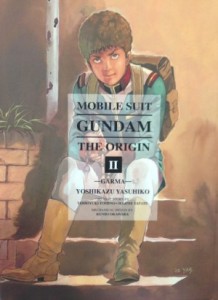
Mobile Suit Gundam: The Origin Volume 1 by Yoshikazu Yasuhiko

It has been a long long time since I’ve encountered the Gundam franchise. I’m familiar with the basic story, but the Gundam that made a big impression on me wasn’t the first series but Zeta Gundam, which I watched back in the day when people’s only access to anime was attending random university-affiliated clubs that showed fansubbed VHS tapes. I don’t even remember very much about Zeta Gundam other than the fact that young teenage me thought it was awesome. Most anime mecha featuring protagonists with daddy issues owe a lot to the original Gundam series, so it was fun to experience it again through this manga interpretation.

Mobile Suit Gundam: The Origin opens with a glimpse of a future where the human race has a tenuous hold on life in outer space. Humans have migrated to space colonies, which are now gripped in a civil war as the colony Zeon has decided to become independent. Amuro Ray is the young teenage protagonist, and while he does fit in generally with the type of character the reader would expect to see, he’s still interesting and sympathetic. He’s a moody teenage boy who spends his spare time neglecting to clean his room and hacking into his father’s work computer. His father is a scientist who has invented a new type of Zaku (mechanized battle suit). Amuro is out with his friend Fraw when their colony is attacked by Zeon fighters. Amuro stumbles across the unmanned Gundam prototype that he recognizes from his father’s plans and he throws himself into the defense of his colony. Amuro changes from frightened to angry when he sees the civilians under attack, and he stumbles through his first battle aided more by the Gundam’s advanced capabilities than his own skill.

One of the interesting things about Mobile Suit Gundam is the way the story doesn’t only focus on giant battle robots with light sabers fighting each other. The military ship protecting the colony has to take on a large influx of civilian refugees. Amuro is installed as the pilot of the Gundam, and Fraw starts helping out with the civilians. Char Aznable, the masked commander who is the Zeon ace pilot is the Red Baron to Amuro’s Snoopy, but Char is dealing with his own troubles related to the way he keeps losing Zaku that go up against the Gundam prototype. Char’s skills as a pilot outmatch Amuro, but he seems to enjoy the challenge provided by the advanced weaponry of the Gundam. As Char and Amuro clash, Char is toying with the young pilot in a gleeful way that makes him a very entertaining villain. In addition to the growing rivalry between Char and Amuro, there’s a well-developed supporting cast. I was particularly fond of Sayla, whose imperious attitude and willingness to brandish a gun were a good contrast to Fraw’s more gentle personality. Seeing Bright struggle with his new command responsibilities as well as Amuro’s issues with dealing with military protocol helped enhance the general sense of the story taking place in a larger society, where the civilian and military points of view were often at odds even in the middle of a war.

I had a pleasant jolt of nostalgia as I was reading when I encountered dialog like “Release the Minovsky particles at battle density!” and to and was able to experience again what an intriguing antagonist Char Aznable is. This is without a doubt one of the nicest manga volumes I’ve owned, since Vertical chose to print this in an oversized hardcover format with glossy paper. This is a must buy for any past and present Gundam fans, and if you haven’t encountered the franchise before, I’m betting this manga will win you over. I’m actually happy that I don’t remember the exact details of this story so I can be pleasantly surprised as the story unfolds in the next three volumes.

Filed Under: REVIEWS Tagged With: mobile suit gundam, vertical

Crimson Empire: Circumstances to Serve a Noble, Vol. 1

April 9, 2013 by Sean Gaffney

By Quin Rose and Hazuki Futaba, based on the game by Quin Rose. Released in Japan by Ichijinsha, serialized in the magazine Zero-Sum Ward. Released in North America by Seven Seas.

Seven Seas has very helpfully noted this is from the creator of the Alice in the Country of series on the cover, and indeed fans of that series will find a lot to like here. There’s a greater depth to the heroines, lots of hot guys with major personality defects, and a feeling that the entire world is just slightly broken. That said, it sure was helpful having Lewis Carroll’s template for the Alice books, because without that, things in Crimson Empire get awfully muddled awfully fast.

crimsonempire

That said, the volume opens awfully well. Our heroine is a street rat somewhere in Anime Arabia, who sells her soul to a demon (who notes she has quite a future ahead of her – though good or bad, he can’t say)and becomes an assassin-cum-bodyguard, defending Prince Edvard from the many and varied people trying to kill him – including Justin, his own half-brother. Oh, and of COURSE, she has to dress up as Head Maid. After all, this is the aristocracy, and we can’t just have women walking around in suits.

I made this sound a bit more fetishy than it actually is, to be honest. The fanservice is nil, and this is definitely a josei title. Sheila is quite similar to Alice, though a bit stronger and more broken (she’s been through a bit more), and as with Alice, the various men around her are Otome Game types, where the player can choose to interact with their favorite. In terms of manga plot (vs. game plot), the first volume is quite simple. Sheila prevents people from murdering Edvard, Edvard snarks and acts nice on the outside but evil on the inside, Justin is the opposite, etc.

The difficulty here is, even with a ‘Cast of Characters’ page at the start, there’s simply too many people introduced too fast. Things aren’t helped by the fact that this is a semi-sequel to another Otome Game, Arabians Lost, which introduces a few characters from that series and mentions the Queen, who was the player character. Moreover, Sheila seems to have past relationships with several of them, which don’t come off as “Well, the manga will catch me up on their shared history” as much as “I feel I missed something, I should go buy the previous game this is clearly meant to be pimping out.”

From a manga perspective, the plot simply meanders. Given there’s less of a desire to see who Sheila will end up with (she’s sold her soul, so it’s sort of irrelevant, as she’ll end up with the demon one way or another), the need to read this likely hinges on how much you enjoy seeing Sheila interact with the characters around her. This isn’t helped by Sheila being, so far, the most interesting character. I also can’t help but compare the guys to the Alice series – Meissen, for one, is clearly Ace with the serial numbers filed off.

This is only three volumes, so I do recommend it if you like the Alice series in general and are a fan of this sort of josei “girl surrounded by pretty boys” series. But plotwise, it really needs to sort itself out. More scenes like the bleak opening, which was excellent.

Filed Under: REVIEWS

The Summit of the Gods, Volume 2

April 7, 2013 by Ash Brown

Author: Baku Yumemakura
Illustrator: Jiro Taniguchi

U.S. publisher: Fanfare/Ponent Mon
ISBN: 9788492444328
Released: January 2010
Original release: 2001
Awards: Angoulême Prize, Japan Media Arts Award

The second volume of The Summit of the Gods, a five volume manga series written by Baku Yumemakura and illustrated by Jiro Taniguchi, was originally released in Japan in 2001. The English-language release of The Summit of the Gods, Volume 2 was published by Fanfare/Ponent Mon in early 2010. The series is based on Yumemakura’s 1997 award-winning novel The Summit of the Gods and has won several awards itself, including a Japan Media Arts Excellence Award in 2001 and an Angoulême Prize for Artwork in 2005. I will admit right now that I love Yumemakura and Taniguchi’s The Summit of the Gods. The manga is easily my favorite work that Taniguchi has collaborated on. The series has gorgeous artwork, characters that are larger than life but who remain human in their imperfections, and an engaging story.

After returning to Japan from Nepal, journalist Makoto Fukamachi has been doggedly pursuing the enigma of the man he believes he met there–a legendary Japanese mountain climber named Jouji Habu. Initially, Fukamachi was interested in a camera he is convinced is in Habu’s possession. It may very well be the same camera that George Mallory brought with him on his assault on Everest in 1924. If true, Habu has his hands on an important piece of mountaineering history. But as Fukamachi’s investigation proceeds he becomes more and more interested in Habu himself and what drives the man as a climber. While Fukamachi’s personal life is unraveling he throws himself into his research, tracking down anyone who might know anything about Habu and his current whereabouts.

While I personally find Fukamachi’s persistent research to be interesting as he slowly pieces together disparate clues and leads, what I really love about The Summit of the Gods, Volume 2 are the stories that he uncovers. As unlikeable as Habu can be, and with as many enemies as he has made, his accomplishments as a mountain climber are unquestionably phenomenal. Fukamachi delves into many of Habu’s feats: his disastrous and yet astonishing foray climbing the Grandes Jorasses as well as his notorious participation in a group summit assault on Everest and several unfortunate incidents relating to it. But as amazing as Habu’s achievements are as a climber, it’s Taniguchi’s stunning artwork that makes them a reality for the reader. From the largest mountain vistas to the smallest crack in ice or rock, Taniguchi’s attention to detail is superb. The pacing and timing of his panels make the climbs both exhilarating and terrifying.

Nature and the mountains can be glorious, but they can also be extraordinarily dangerous. Taniguchi’s artwork expertly conveys this. Both the figurative and literal gravity of the situations that the climbers face can almost be felt reading The Summit of the Gods. When something goes wrong, even the smallest something, the repercussions can be devastating. And at times the events that unfold are entirely outside of human control. Saying that a climber fell–such a small and simple word–is easy enough. But the enormity of the human drama and the story surrounding that fall, what happened to cause it, and what happens as a result of it, is intensely engrossing. It is clear that the characters in The Summit of the Gods are effected deeply; the impacts can be seen in their changing relationships to each other, to climbing, and to the mountains themselves. The Summit of the Gods is an incredible work.

Filed Under: REVIEWS Tagged With: Angoulême Prize, Baku Yumemakura, Fanfare/Ponent Mon, Japan Media Arts Award, Jiro Taniguchi, manga, summit of the gods

  • « Go to Previous Page
  • Page 1
  • Interim pages omitted …
  • Page 267
  • Page 268
  • Page 269
  • Page 270
  • Page 271
  • Interim pages omitted …
  • Page 342
  • Go to Next Page »
 | Log in
Copyright © 2010 Manga Bookshelf | Powered by WordPress & the Genesis Framework