• Skip to primary navigation
  • Skip to main content
  • Skip to primary sidebar
  • Home
  • About Us
    • Privacy Policy
    • Comment Policy
    • Disclosures & Disclaimers
  • Resources
    • Links, Essays & Articles
    • Fandomology!
    • CLAMP Directory
    • BlogRoll
  • Features & Columns
    • 3 Things Thursday
    • Adventures in the Key of Shoujo
    • Bit & Blips (game reviews)
    • BL BOOKRACK
    • Bookshelf Briefs
    • Bringing the Drama
    • Comic Conversion
    • Fanservice Friday
    • Going Digital
    • It Came From the Sinosphere
    • License This!
    • Magazine no Mori
    • My Week in Manga
    • OFF THE SHELF
    • Not By Manga Alone
    • PICK OF THE WEEK
    • Subtitles & Sensibility
    • Weekly Shonen Jump Recaps
  • Manga Moveable Feast
    • MMF Full Archive
    • Yun Kouga
    • CLAMP
    • Shojo Beat
    • Osamu Tezuka
    • Sailor Moon
    • Fruits Basket
    • Takehiko Inoue
    • Wild Adapter
    • One Piece
    • After School Nightmare
    • Karakuri Odette
    • Paradise Kiss
    • The Color Trilogy
    • To Terra…
    • Sexy Voice & Robo
  • Browse by Author
    • Sean Gaffney
    • Anna Neatrour
    • Michelle Smith
    • Katherine Dacey
    • MJ
    • Brigid Alverson
    • Travis Anderson
    • Phillip Anthony
    • Derek Bown
    • Jaci Dahlvang
    • Angela Eastman
    • Erica Friedman
    • Sara K.
    • Megan Purdy
    • Emily Snodgrass
    • Nancy Thistlethwaite
    • Eva Volin
    • David Welsh
  • MB Blogs
    • A Case Suitable For Treatment
    • Experiments in Manga
    • MangaBlog
    • The Manga Critic
    • Manga Report
    • Soliloquy in Blue
    • Manga Curmudgeon (archive)

Manga Bookshelf

Discussion, Resources, Roundtables, & Reviews

Reviews

The Manga Revue: Fragments of Horror

July 17, 2015 by Katherine Dacey

I’m too squeamish for horror movies–the blood alone is enough to send me screaming for the exits. But horror manga? That’s in my wheelhouse, as manga allows me to engage with the material as much–or as little–as I wish. Junji Ito’s work is largely responsible for showing me the possibilities of comic book horror; I don’t think I’ll ever forget the image of an enormous great white shark climbing a flight of stairs in pursuit of his next meal, or an entire village consumed by a voracious plague of… spirals. (It’s scarier than it sounds.) So when VIZ announced that they would be publishing a new collection of Ito stories, I knew I would buy it. But does Fragments of Horror deliver? Read on for the full scoop.

fragments_horror_vizFragments of Horror
By Junji Ito
Rated T+, for older teens
VIZ Media, $17.99

Uncanny–that’s the first word that comes to mind after reading Junji Ito’s Fragments of Horror, an anthology of nine stories that run the gamut from deeply unsettling to just plain gross. Ito is one of the few manga-ka who can transform something as ordinary as a mattress or a house into an instrument of terror, as the opening stories in Fragments of Horror demonstrate. Both “Futon” and “Wood Spirit” abound in vivid imagery: apartments infested with demons, floors covered in eyes, walls turned to flesh, rooves thatched in human hair. Watching these seemingly benign objects pulse with life is both funny and terrifying, a potent reminder of how thin the dividing line between animate and inanimate really is.

Taut–that’s another word I’d use to describe Fragments of Horror. Each story is a model of economy, packing 60 or 70 pages of narrative into just 20 or 30. “Dissection Chan,” for example, explores the forty-year relationship between Tatsuro, a surgeon, and Ruriko, a woman who’s obsessed with vivisection. In a brief flashback to Tatsuro’s childhood, Ito documents the unraveling of their friendship, capturing both Ruriko’s escalating desire to cut things open and Tatsuro’s profound shame for helping her procure the tools (and animals) necessary for her experiments. Three or four years have been packed into this seven-page vignette, but Ito never resorts to voice-overs or thought balloons to explain how Tatsuro feels; stark lighting, lifelike facial expressions, and evocative body language convey Tatsuro’s emotional journey from curious participant to disgusted critic.

Not all stories land with the same cat-like tread of “Dissection Chan.” “Magami Nanakuse,” a cautionary tale about the literary world, aims for satire but misses the mark. The central punchline–that authors mine other people’s suffering for their art–isn’t executed with enough oomph or ick to make much of an impression. “Tomio • Red Turtleneck”  is another misfire. Though it yields some of the most squirm-inducing images of the collection, it reads like a sixteen-year-old boy’s idea of what happens if your girlfriend discovers that you’ve been stepping out on her: first she’s angry at you, then she’s angry at the Other Woman, and finally she forgives you after you grovel and suffer. (In Tomio’s case, suffering involves grotesque humiliation with a cockroach–the less said about it, the better.)

Taken as a whole, however, Fragments of Horror is testament to the fecundity of Ito’s imagination, and to his skill in translating those visions into sharp, unforgettable illustrations like this one:

ito_horror_interior

PS: I recommend pairing this week’s review with 13 Extremely Disturbing Junji Ito Panels, a listicle compiled by Steve Fox. (The title is a little misleading: the images are unsettling, but are generally SFW.)

Reviews: Sean Gaffney reads Pandora in the Crimson Shell and Magika: Swordsman and Summoner so that you don’t have to. At Women Write About Comics, Amanda Vail compares the light novel and manga versions of The Devil is a Part-Timer!

Connie on vol. 3 of Alice in the Country of Clover: Knight’s Knowledge (Slightly Biased Manga)
Jennifer Wharton on vols. 1-6 of The Betrayal Knows My Name (No Flying No Tights)
Lesley Aeschliman on vol. 55 of Case Closed (WatchPlayRead)
Kristin on vol. 1 of The Demon Prince of Momochi House (Comic Attack)
Sean Gaffney on vol. 1 of First Love Monster (A Case Suitable for Treatment)
Frank Inglese on vols. 3-4 of Food Wars! Shokugeki no Soma (Snap 30)
Megan R. on Fushigi Yugi: Genbu Kaiden (The Manga Test Drive)
Connie on vol. 6 of Gravitation (Slightly Biased Manga)
Dave Ferraro on The Legend of Zelda: A Link to the Past (Comics and More)
Wolfen Moondaughter on vol. 13 of Library Wars: Love and War (Sequential Tart)
Connie on vol. 6 of Love Pistols (Slightly Biased Manga)
Ash Brown on vol. 4 of Mushishi (Experiments in Manga)
Lesley Aeschliman on vol. 5 of My Love Story!! (WatchPlayRead)
Leroy Douresseaux on vol. 10 of Nisekoi: False Love (Comic Book Bin)
Joe McCulloch on Pandora in the Crimson Shell (The Comics Journal)
Sheena McNeil on vol. 28 of Pokemon Adventures: Emerald (Sequential Tart)
Wolfen Moondaughter on vol. 1 of Requiem of the Rose King (Sequential Tart)
Leroy Douresseaux on vol. 18 of Rin-ne (Comic Book Bin)
Matthew Alexander on vol. 10 of Sankarea: Undying Love (The Fandom Post)
confusedmuse on Skip Beat! (Organization Anti-Social Geniuses)
Kate O’Neil on vol. 4 of Soul Eater Not! (The Fandom Post)
Sheena McNeil on vol. 4 of Spell of Desire (Sequential Tart)
Courtney Sanders on vol. 1 of Twin Star Exorcists (Three If By Space)
Ken H. on vol. 5 of Witchcraft Works (Sequential Ink)
Matthew Alexander on vol. 6 of Wolfsmund (The Fandom Post)
Matthew Alexander on vol. 5 of World Trigger (The Fandom Post)
Lesley Aeschliman on vol. 3 of Yukarism (WatchPlayRead)


Filed Under: MANGABLOG, REVIEWS Tagged With: Fragments of Horror, Junji Ito, Manga Review, viz media

A Sky Longing for Memories: The Art of Makoto Shinkai

July 17, 2015 by Ash Brown

A Sky Longing for MemoriesCreator: Makoto Shinkai
Translator: Maya Rosewood
U.S. publisher: Vertical
ISBN: 9781941220436
Released: June 2015
Original release: 2008

I was introduced to the work of Makoto Shinkai through his animated film 5 Centimeters per Second, which left a huge impression on me. The beautifully melancholic story about lost and unrequited love was simple enough, but the visuals were stunningly gorgeous. A Sky Longing for Memories: The Art of Makoto Shinkai is an artbook that was originally released in Japan in 2008, the year after 5 Centimeters per Second debuted. I was very pleased when Vertical Comics announced its intention to publish an English-language edition. That volume was ultimately released in 2015 with a translation by Maya Rosewood. Vertical hasn’t released very many artbooks, but A Sky Longing for Memories is a good fit for the publisher. Not only has Vertical published other nonfiction works about Japanese film, it has also released two Shinkai manga: 5 Centimeters per Second and The Garden of Words.

A Sky Longing for Memories primarily consists of stills and background artwork from four of Shinkai’s projects initially released between 2002 and 2007. Prominently featured are three of his animated films—5 Centimeters Per Second, The Place Promised in Our Early Days, and Voices of a Distant Star—as is the television commercial he created for Shinano Mainichi Shimbun, “Say Something Important.” More than half of A Sky Longing for Memories is devoted to 5 Centimeters Per Second, the volume opening with some of Shinkai’s most visually refined and impressive work. The three sections that follow are dedicated to each of the earlier films and “Say Something Important.” Also included in the volume is a glossary—useful for readers who are unfamiliar with some of the technical terms used in the animation industry—as well as “Makoto Shikai’s Colors,” a section exploring the methods and techniques used by Shinkai, and “Testimonials of Makoto Shinkai’s World,” a collection of brief interviews with Shinkai and ten other members of Shinkai Works.

Although A Sky Longing for Memories can simply be appreciated and enjoyed as a collection of stunning artwork, the volume also provides insight into the creative processes and artistic direction required to achieve such impressive images. Many of the individual pieces are accompanied by brief descriptions of the decisions that were made in their overall design in addition to the specific considerations and techniques used in their creation. It’s unclear who actually wrote much of the text in A Sky Longing for Memories, but from the context it would seem to either be one (or several) of Shikai’s staff members or someone else who was close to the work being done. Either way, I was glad for the inclusion of the various descriptions and explanations; I don’t have a strong background in visual art or design and so found A Sky Longing for Memories to be illuminating and intellectually stimulating as well as beautiful to look at.

One of the key components of Shinkai’s style is his use of color. With this in mind, Vertical has taken great care to faithfully reproduce Shinkai’s artwork in A Sky Longing for Memories; the volume uses thick, glossy paper on which the colors in particular are beautifully presented. Simply put, it’s a gorgeous book of gorgeous illustrations. A Sky Longing for Memories reveals Shinkai not only as a talented artist but also as a skilled director. While he solely handled almost every aspect of Voices of a Distant Star except for the film’s music, by the time 5 Centimeters per Second was produced Shinkai was guiding and coordinating the work of an entire staff. Interestingly, most of the team members were traditionally trained artists from outside of the animation industry who had to learn digital techniques and illustration methods on the job. As can be seen from A Sky Longing for Memories, the result of their combined efforts is spectacular.

Filed Under: REVIEWS Tagged With: 5 centimeters per second, anime, Artbooks, makoto shinkai, Nonfiction, vertical, Vertical Comics

First Love Monster, Vol. 1

July 17, 2015 by Sean Gaffney

By Akira Hiyoshimaru. Released in Japan as “Hatsukoi Monster” by Kodansha, serialization ongoing in the magazine Aria. Released in North America by Yen Press.

First off, this is another one of those titles where, no matter how good the execution is, recommending it to friends is just going to be problematic. “See, the twist is that the male lead is really 11 years old… STOP CALLING THE COPS, DAMMIT!” Manga and anime romance has skewed young pretty much since inception, but 13-14 used to be the low end, with most of it taking place in high school. Lately, though, we’re seeing more and more series with younger and younger characters, and even if they aren’t getting in relationships they’re sexualized in some way (hi, No Game No Life). And of course this is written for Aria, which has increasingly become Kodansha’s ‘eccentric’ shoujo magazine. Come into this knowing that the premise is questionable.

hatsukoi1

The good news is that the author and the cast also know the premise is questionable, and call it out throughout the entire volume. Our heroine is caught up in the flush of first love based both on looks and the fact that he saved her life in a cool manner, but is aware this is deeply wrong. Everything Kanade does emphasizes that he’s not ‘mature for his age’ in anything but appearance – he’s still playing in sandboxes. If this were a case where she were in college and he was in high school, it would be like any other shoujo romance out there, but the fact that he’s 11 adds a frisson of wrongness that just doesn’t go away. It drives the entire title.

Honestly, I kept expecting this to be creepy and make me stop reading, but it never did. It has so many elements that could have gone badly. If the 11-year-old hero had also been mentally/emotionally mature… if the heroine had not been sheltered and naive herself, as well as starved for affection… even the appearance of the characters, which the author says in a note her editor had her change, as the original was a normal-sized girl with a short guy (she liked the huge difference between then, so when told to make the girl tiny, made him huge to contrast), ends up massively improving the product.

There’s also lots of humor – this doesn’t take itself seriously, and I laughed out loud at the introduction of Kanade’s equally huge classmates, as well as their Detective Conan-eaque leader. The one thing I really disliked was Taga, the college age guy who attempts to sexually assault Kaho because… well, because that’s what happens in these sorts of titles to provide conflict, and I wish it didn’t. Naturally, he gets away with a busted lip and nothing else, and is free to emotionally abuse the heroine later. Luckily, the rest of her roommates are more supporting, but that guy needs to go away.

As with so many titles I’ve reviewed lately, if the premise squicks you, don’t get First Love Monster. But the author actually respects and treats the leads sympathetically, without setting up the heroine for comedic humiliation faces. That means I’m intrigued, and will get the next volume to see where it goes.

Filed Under: REVIEWS

Mushishi, Vol. 4

July 15, 2015 by Ash Brown

Mushishi, Volume 4Creator: Yuki Urushibara
U.S. publisher: Del Rey
ISBN: 9780345499233
Released: May 2008
Original release: 2003
Awards: Japan Media Arts Award, Kodansha Manga Award

Although the ten-volumes series Mushishi was Yuki Urushibara’s professional debut as a mangaka, it has been very well-received by both critics and fans. The manga began its serialization in 1999 and would go on to win a Japan Media Arts Award in 2003 and a Kodansha Manga Award in 2006 among other honors and recognitions. Mushishi, Volume 4 was originally published in Japan in 2003. In 2008, Del Rey Manga released the first English-language edition which is now sadly out-of-print. However, as of 2014, the volume has been made available digitally by Kodansha Comics. Mushishi was a series that I stumbled upon when it was initially being released in English. The manga quickly became and continues to be one of my favorite series; Mushishi was one of the first manga that I made a point to collect in its entirety. I love the series’ quiet, creepy atmosphere, its emphasis on life and nature, and the influence of traditional Japanese culture and folklore on the stories being told.

Mushishi, Volume 4 collects five stories. The volume opens with “Picking the Empty Cocoon,” telling the tale of a family with close connections to both mushi and mushishi. They are the caretakers of uro, a particularly useful but dangerous type of mushi. In “One-Night Bridge,” Ginko is invited to a remote village in a deep valley to investigate the case of a young woman who fell to the bottom of the gorge but somehow survived. Except that she’s never been the same since her accident. Plants growing out of season allow a brother and sister to weather harsh winters in “Spring and Falsehoods,” but the mushi that cause the phenomenon aren’t as benign as they first appear. In the fourth story, while traveling through the mountains, Ginko stumbles upon a small family living in a vast bamboo grove. They seem to be trapped there, unable to leave no matter how hard they try; they always end up circling back to their home. The volume concludes with “The Sound of Trodden Grass,” which provides a little more insight into Ginko’s past.

Mushishi, Volume 4, page 112For the most part, Mushishi tends to be fairly episodic. Except for the presence of Ginko, out of all of the stories included in the fourth volume only “The Sound of Trodden Grass” has an explicit connection to any of the other chapters in the series, and it’s only a tangential one. Although none of the stories in Mushishi, Volume 4 are directly related to one another plot-wise, there was one similarity shared between them all that particularly struck me: the prominent role played by families. Looking back, this actually isn’t at all an uncommon theme in Mushishi—families, as well as other tightly knit communities and groups, are frequently featured in the manga. However, through the illness and other problems that follow them, mushi are shown to cause great strife in those relationships. Circumstances caused by mushi’s existence can drive people apart, but in some cases they may actually draw them together. Familial ties are strong and not easily broken, but mushi’s close connection to nature and life and death (including those of humans) is sometimes in conflict with them and they are just as enduring.

The stories in Mushishi are often reminiscent of folktales and legends originating from Japan; Urushibara clearly draws some inspiration directly from that lore. For example, “In the Cage” with its children born of bamboo recalls the story of Kaguya-hime. The fourth volume of Mushishi is influenced by Japanese history, as well. “The Sound of Trodden Grass” features a group of wanderers displaced by mushi known as the Watari who are based on the Sanka people of Japan. (This is even more meaningful to me now after having read Kazuki Sakuraba’s novel Red Girls: The Legend of the Akakuchibas in which the Sanka also play a part.) Some of Mushishi‘s stories can be rather spectacular, with mushi causing phenomena verging on the paranormal, while others are more subdued. Mushi are said to be very close to the original form of life and are therefore inseparable from nature, but they remain mysterious. Mushishi is a collection of tales that delve into that terrifying unknown. Urushibara combines elements of folklore and history along with her own imagination to successfully create a series that feels familiar while still being new.

Filed Under: REVIEWS Tagged With: del rey, Japan Media Arts Award, Kodansha Manga Award, manga, mushishi, Yuki Urushibara

Double Dose of Seven Seas: Pandora in the Crimson Shell: Ghost Urn vs. Magika: Swordsman and Summoner

July 15, 2015 by Sean Gaffney

Pandora in the Crimson Shell: Ghost Urn by Shirow Masamune and Rikudou Koushi. Released in Japan as “Koukaku no Pandora – Ghost Urn” by Kadokawa Shoten, serialization ongoing in the magazine Newtype A. Magika: Swordsman and Summoner by Mitsuki Mihara and MonRin. Released in Japan as “Magika no Kenshi to Shoukan Maou” by Media Factory, serialization ongoing in the magazine Comic Alive. Released in North America by Seven Seas.

As I’ve said before, my tendency to give all Volume 1’s a shot even if I suspect they won’t be my thing at all gets me into a lot of difficulties, particularly with Seven Seas, which is very much an all or nothing company with me. They debuted two new titles this month, one of which not only has the amazing writer-artist team of Shirow Masamune and Rikudou Koushi (leaving Viz means he gets his u’s back), but managed to be on SDCC’s worst manga of the year list despite having been out a total of 5 days when the panel ran. The other one is a harem fantasy from my old nemesis, Comic Alive. Two otaku-pandering titles enter, only one can leave – which one did I like more?

ghosturn1

Pandora gets off to a poor start with that cover, featuring our heroine bursting, semi-mude, from some sort of mosaiced plastic casing. We then get color pages of another heroine dressing up in tiny lingerie. This title definitely does not skimp on the fanservice, as we’ll see throughout the volume. The basic premise involves Nene, our heroine, getting involved with a confident young woman who may actually be a supervillain and her cyborg companion. Nene is also a cyborg and highly idealistic, saying that she wants to see world peace. Sadly, she arrives at her island destination to find a robot gone amok, and only she and Clarion (the other cyborg) can hope to stop it.

On pure skeeze factor, Pandora in the Crimson Shell wins hands down. The sequences where Nene has to finger Clarion in her vaginal ‘port’ are risible, though admittedly I wouldn’t put it past Shirow based on past titles. Speaking of which, the credits show quite a committee working on this title. Rikudou is the main artist in charge, but I had felt that I could only see his art style occasionally, and that may be why. His sense of humor, thankfully, is sometimes more apparent, particularly in the Excel-ish intrepid reporter and the dry tones of Uzal Delilah. The action sequences, which make up much of the second half, are… decent. Basically, if it weren’t for the horrible service and constant sexual assault hints, I may actually have enjoyed this. Sadly, the service and assault is all over the book.

msas1

Magika Swordsman and Summoner is our second title, and reads like a modern-day light novel checklist (appropriate, it’s based on a light novel). Our hero is the lowest of his class at magic school, not good for much yet but stirring water around. He’s also the only male in a class of females. He has an adopted sister (older than him, but acts younger as they only found that out recently), who harbors incestuous feelings for him. At the school, he meets a busty airheaded woman who turns out to be student council president, as well as an angry young blonde who seems very upset that he doesn’t recognize her, for some reason. Oh yes, you can also add in a quiet, stoic elf-girl and a shy girl who can’t deal with men. When he summons an amnesiac diva with no powers (which gets him in trouble, as she may be evil), he discovers he has to form a harem of 72 women in order to become the Harem King.

If you started throwing up halfway through that, you may get the feeling I had while reading this title. Everything about it is from Tropes 101, be it the Magic Academy stuff or the Harem stuff, though I admit 72 is aiming high – even Negima didn’t quite go for that many women. (Yes, it’s from reports of the houris that accompany Muslim martyrs after they die.) Seven Seas’ back cover notes that fans of Dragonar Academy and Zero’s Familiar will enjoy it, and I can’t argue with that – it’s certainly more of the same. The one redeeming feature is the hero, who seems a decent sort and is very uncomfortable with the whole harem concept. We’ll see how long that lasts. Or rather, other readers will.

In general, if you’re going to be a bad manga and keep me interested, it’s best to do it with style. Neither of these titles are things I’d recommend to anyone except SS’s core otaku audience. But honestly, Ghost Urn made me wonder how the cliffhanger might be resolved, whereas with S&S I just didn’t care. On balance, I have to give the edge to Shirow, Rikudou and company here.

Filed Under: REVIEWS

The Legend of Kamui, Vol. 1

July 10, 2015 by Ash Brown

The Legend of Kamui, Volume 1Creator: Sanpei Shirato
U.S. publisher: Viz Media
ISBN: 9781569313183
Released: August 1998
Original release: 1990

Sanpei Shirato’s The Legend of Kamui had its beginnings in 1964 as one of the first series to be published in the influential alternative manga magazine Garo. In the 1980s, Sanpei would continue the manga with a second series, Kamui Gaiden. It was Kamui Gaiden that became one of the earliest manga series to be translated into English and widely published in North America. Between 1987 and 1988, Viz and Eclipse Comics released thirty-seven issues of Kamui Gaiden under the title of The Legend of Kamui, serializing edited versions of two stories: “The Island of Sugaru” and “The Sword Wind.” “The Island of Sugaru,” which was later compiled by Viz into two volumes in 1998, is probably one of the most well-known Kamui stories, and not just because of the Kamui Gaiden live-action film adaptation from 2009. The Legend of Kamui, Volume 1 collects the first half of “The Island of Sugaru,” material from a volume of Kamui Gaiden that was originally published in Japan in 1990.

Kamui is an apostate ninja during Japan’s Edo period, on the run from the members of his clan who consider him to be a traitor when he tries to leave. While traveling through Yumigahama he encounters a woman who, like him, once belonged to a clan of ninja. Sugaru has been able to avoid capture and death long enough to establish a new life with a husband and three children who love her, but she is still being hunted and must be constantly vigilant. Sugaru has managed to survive because she doesn’t trust anyone, and that includes Kamui. Although he helped to save her life when she was attacked by Iga ninja, Sugaru can’t take a chance that Kamui might be trying to kill her as well. After an intense battle in which they are both injured, they part ways. But in a strange twist of fate, Kamui is later shipwrecked on the very island where Sugaru and her family reside. Kamui lives peacefully for a time in the small, remote fishing village and Sugaru’s family becomes very fond of him, but Sugaru would rather see him dead.

The Legend of Kamui, Volume 1, page 255From reading The Legend of Kamui, Volume 1 alone, not much is known about either Sugaru or Kamui’s past lives beyond the fact that they are trying to escape them. The hunted versus the hunter, whether the prey chooses to flee or to fight, is a theme that recurs throughout the manga, mirrored in both nature and human society. Kamui and Sugaru do have the advantage of being exceptionally adept fighters. Although Sugaru does strain under the burden of keeping both herself and her family safe, she is actually one of the strongest characters in The Legend of Kamui, Volume 1, exhibiting both great determination and martial prowess. Her skills rival and in some cases surpass those held by Kamui. Tragically, and understandably, due to her circumstances Sugaru has lost her ability to trust others; it’s simply no longer an option for her. Kamui, on the other hand, has so far managed to retain that part of his humanity, even though it has put his life in danger on multiple occasions.

I really wish more of The Legend of Kamui had been released in English because the series is excellent. The characters are complex, as are their personal struggles and their searches for freedom in an era that could be unforgiving, harsh, and violent. The action sequences are exciting and dynamic. Although a few ninja tricks are employed during the life-or-death battles—secret techniques, impressive acrobatics, illusions and transformations—there is a sense of realism that pervades The Legend of Kamui. In between the dramatic conflicts are the quieter moments of everyday life in a fishing village. Initially it appears as though Kamui, like Sugaru, will be able to outrun his fate and have a chance at a peaceful, happy existence. He learns to fish and becomes friendly with the villagers who are more than happy to welcome a strong young man into their midst. The Legend of Kamui, Volume 1 offers hope that such changes are possible, but ultimately taking charge of one’s own destiny is a difficult path to follow.

Filed Under: REVIEWS Tagged With: Legend of Kamui, manga, Sanpei Shirato, viz media

Gyo: The Death-Stench Creeps

July 8, 2015 by Ash Brown

Gyo: The Death-Stench CreepsCreator: Junji Ito
U.S. publisher: Viz Media
ISBN: 9781421579153
Released: April 2015
Original run: 2002

Gyo: The Death-Stench Creeps is a short, two-volume horror manga series created by Junji Ito. Originally published in Japan in 2002, Gyo has had several English-language releases by Viz Media. It was first translated between 2003 and 2004, a slightly updated second edition was released between 2007 and 2008, and most recently, published in 2015, was the deluxe hardcover omnibus. In addition to Gyo, the omnibus also collects two of Ito’s short horror manga: “The Sad Tale of the Principal Post” and “The Enigma of Amigara Fault.” The deluxe edition of Gyo is very similar in design to the recent omnibus of Ito’s manga Uzumaki; the two volumes look great on the shelf together. Uzumaki was actually my introduction to Ito’s work, and I consider it to be one of the best horror manga that I’ve read. Despite Gyo having been released in English three times, and despite the fact that I’ve been meaning to read more of Ito’s manga, the series’ deluxe omnibus is actually the first that I’ve read since Uzumaki.

While vacationing in Okinawa, Tadashi and his girlfriend Kaori witness the harbinger of what will eventually become a plague overrunning the entirety of Japan—a small, rotting fish walking on land with what appear to be mechanical legs. Accompanying it is an overwhelming and nauseating stench. Soon, countless fish and other sea creatures begin streaming out of the ocean. The only things that they have in common are the bizarre appendages and the sickening smell. Kaori and Tadashi cut their vacation short and return to Tokyo, but Kaori in particular is traumatized by the events in Okinawa and soon the creatures begin to be found in the city as well. No one knows where the walking fish originated or how they evolved; of much greater concern is the death and disease caused by their presence on land. And things are only getting worse with the passage of time.

Gyo: The Death-Stench Creeps, page 66The back cover of the omnibus describes Gyo as Ito’s “creepiest masterpiece of horror manga ever.” Admittedly, some of the artwork in Gyo is fantastically creepy, not to mention gruesome and grotesque. Ito is an extremely skilled illustrator, creating images that are horrifying and nightmare-inducing. And as a whole, Gyo can be exceptionally gross. However, the manga’s story ends up being so utterly ridiculous that I would be hard pressed to call it a masterpiece, especially when compared to his earlier work Uzumaki. Whereas Uzumaki is surreal and bizarre, Gyo is so absurd as to be ludicrous, and only increasingly so as the manga progresses. I simply can’t take Gyo seriously; I can only read the series as a comedy, whether or not it is actually intended as such. The manga is perhaps closer to being a cult classic, which I suppose might make it a masterpiece of a different sort, but that’s something that could be argued either way. If nothing else, though, Gyo is a brilliantly outrageous spectacle.

Gyo is certainly not a manga that will appeal to every reader, even those who are already fans of horror manga. Though disconcerting and disgusting, especially the illustrations, the plot of Gyo is too silly to be truly terrifying. Taken alone, the art is superb, but the ridiculous nature of the story creates a weird disconnect. However, I can’t deny that I was entertained by the progressively over-the-top, illogical, and random developments in the manga: sentient gas, a circus out of the middle of nowhere, characters who are oddly oblivious or overly accepting of what is going on around them, and so on. (Though, it is rather sweet how Tadashi sticks beside Kaori through to the very end.) Assuming that one can find it palatable to begin with, Gyo is a very strange manga that is difficult to look away from as Ito presses further and further into territory that is beyond believing. I kept turning the pages to see just how far he would be able to take things. Gyo may very well be one of those manga that’s so good simply because it’s so bad; whether that’s deliberate or not, I’m not sure.

Filed Under: REVIEWS Tagged With: Gyo, Junji Ito, manga, viz media

Alice in Murderland, Vol. 1

July 8, 2015 by Sean Gaffney

By Kaori Yuki. Released in Japan as “Kakei no Alice” by Kodansha, serialization ongoing in the magazine Aria. Released in North America by Yen Press.

I’ll admit that I’ve always found Kaori Yuki titles hard to get into, and even harder to review. There is a certain amount of ‘aesthetics preferred over plot and character’ to her work, which makes it highly entertaining and visceral but leaves a person frustrated when they have to talk about it. There’s also giant piles of corpses in most everything she’s done, usually of the most sympathetic women in the book, and that applies here 100%. And of course the grand guignol horror of it all. Oh, and this is yet another of what has become my least favorite genre, the survival game. Despite all that, this is still a compelling read, and I had no trouble getting to the end of Volume 1, though I’m not exactly sure where it’s going beyond ‘chaos’.

alice1

Our heroine is the Alice seen on the cover – except not really. She’s actually Stella, a normal dark-haired high school student who is part of a very eccentric family of orphans who were adopted after a tea party filled with mass child slaughter. Every month the family goes to a tea party that’s held by their amazingly insane mother, who this month tells them that the time has come for them to fight each other to the death to see who gets to be the next family head and have access to a medicine that makes a person young and beautiful even in their old age. Some of them are, of course, reluctant to do this, so each of them has a hostage who will be killed if they don’t comply. To make matters worse, none of them are exactly stable to begin with – certainly not Stella, who snaps in traumatic situations and transforms into the blood-spattered Alice seen on the cover.

If this sounds a bit over the top, welcome to the world of Kaori Yuki. I also forgot to mention Alice’s stalker-cum-protector, Tsukito, who carries around voodoo dolls to curse people and is obsessed with Stella, yet halfway through shows up to become her new bodyguard and who we’re now supposed to feel sympathy for, despite the fact that he was a real creep earlier. As for the rest of the family, the other one who merits mention is Zeno, Stella’s ‘big brother’, who is killed early in the volume but then revived, only for Stella to find his personality is quite a bit different. She should be used to this, though, given how she does a 180 degree turn into murderous grinning killer when faced with horrible situations.

I’m not sure I actually enjoyed this – the horror is really grotesque in places, and there’s a sequence with a toy bunny getting restuffed that should come with a trigger warning. But it’s certainly compelling and gives a visceral thrill. I wouldn’t read it if you want to see what happens next with the plot and characters. But if you enjoy Kaori Yuki’s terrifying manga titles, and want to see lots of action and corpses, Alice in Murderland is right up your alley.

Filed Under: REVIEWS

Sword Art Online: Progressive, Vol. 2

July 5, 2015 by Sean Gaffney

By Reki Kawahara and abec. Released in Japan by ASCII Mediaworks. Released in North America by Yen On.

One of the problems with a series that’s narrated in first person, which Sword Art Online is (yes, sorry, Asuna fans, this is again all Kirito), is that it can be harder to see the flaws inherent in the protagonist, since you have to remove yourself from the narrative voice to see what’s really going on. Last time we saw Asuna starting out in Aincrad trying to find a noble way to die, and Kirito had to show her that there are better things to try for than that. But he has issues of his own – he’s bad at dealing with people, as he both admits himself and we see time and time again, making bad jokes in order to try to get past the fact that he finds it hard to gauge what others are thinking. And while I think he’s right that Asuna could grow to be a great inspiration to others trapped in the game, I worry he may be putting her on a bit of a pedestal, particularly as he tries to ensure the other players don’t see her as a villain.

saop2

Kirito is also having to have genuine interaction more than he expected, as the elf that they meet up with, Kizmel, not only doesn’t die – as she did in the beta Kirito played – but proves to be far more well-rounded and realistic than any NPCs he’s come across before. Both he and Asuna over the course of the book are amazed at how Kizmel grieves for the sister she lost, has mysterious, prophetic dreams, and seems to be having flashbacks to the beta test that Kirito participated in. This helps to show how SAO is not just another game, but it also lends a bit of intrigue to the series going forward, as this isn’t really explained much beyond “wow, Kayaba was a better programmer than we thought”. Luckily, without spoiling much, I will note that Kizmel survives, and I expect we’ll see her again in Book 3.

The other big focus of the book is the reveal of Morte, and what kind of player he is. Fans of the SAO anime and Japanese fans who read the books in order may be a bit ahead of those coming at the novels in NA-publishing order, as they are aware of the guild called ‘Laughing Coffin’. I’m pretty sure that’s what we’re seeing the genesis of here, as Kirito chillingly runs into a player who simply has the desire to kill, because he realizes that he can do it here and get away with it. The duel itself is the high point of the novel, menacing, action packed, and a bit terrifying. After that, we get a fight that doesn’t arise, as Kirito (and Asuna, who thankfully tails after him when he’s being a loner idiot) talks down two nascent guilds from fighting against each other and helps them realize the goal is for everyone to work to escape the game.

As for my review, those who read me regularly know the less I talk about the actual qualities of the book and the more I theorize, the better I like it. Sword Art Online Progressive’s prose is more mature than the original works, its steady pace (we only get one floor this time around) allows it to grow more naturally, and Kirito and Asuna are clearly destined for each other but are both in denial, which is cute. (For a killer drinking game, try drinking every time Asuna elbows Kirito in the gut. Actually, don’t do this.) Honestly, I’d recommend this series to an SAO newbie first, even if it does have a lot of callbacks. Probably my favorite SAO novel to date.

Filed Under: REVIEWS

The Manga Revue: A Silent Voice and Your Lie in April

July 3, 2015 by Katherine Dacey

It’s been a while since I checked in with Kodansha, so this week I reviewed two recent additions to the KC catalog: A Silent Voice, which explores the complex relationship between a bully and his victim, and Your Lie in April, which focuses on a piano prodigy who flamed out at an early age.

A Silent VoiceA Silent Voice, Vol. 1
By Yoshitoki Oima
Rated T, for Teens
Kodansha Comics, $10.99

Thirteen-year-old Shouya Ishida is at loose ends: he’s a mediocre student, a latch-key kid, and a thrill-seeker who goads his friends into dangerous stunts. When deaf girl Shoko Nishimiya joins Ishida’s class, however, Ishida’s recklessness shades into cruelty. He orchestrates a systematic campaign of harassment against her, mocking her speech, stealing her hearing aides, and blaming her for “ruining” the class.

As manga-ka Yoshitoki Oima capably shows, Ishida’s inability to control his worst impulses stems from a toxic mixture of loneliness, frustration, and immaturity. Oima resists the urge to blame Ishida’s mother for her son’s behavior, portraying her as a hard-working, decent woman who’s struggling to run a business and raise two children on her own. Instead, Oima zeroes in the complex dynamic between Ishida and his classmates, acknowledging the degree to which their own hostility towards Nishimiya validates–and encourages–Ishida’s cruelty.

In one scene, for example, the teacher calls on Nishimiya to read a passage out loud. Her words are labored and difficult to understand, prompting uncomfortable stares from the class. When Ishida is asked to do the same, he’s emboldened by his peers’ response. “Uwah! Uwoh! Argle! Bargle!” he declares, feasting on the giggles and snickers his impression elicits. Though the teacher issues Ishida a stern warning, Mr. Takeuchi’s own contempt for Nishimiya seeps into their conversation, granting Ishida further license to harass his classmate.

I’d be the first to admit that A Silent Voice is a difficult read, not least for the scenes in which Ishida torments Nishimiya; Nishimiya’s crestfallen expressions will rip your heart out. It’s a worthwhile series, however, for its truthful exploration of adolescent cruelty, and for its steadfast refusal to paint its troubled protagonist as a monster–or a victim.

your_lie_april_EnglishYour Lie in April, Vol. 1
By Naoshi Arakawa
Rated T, for Teens
Kodansha Comics, $10.99

Your Lie in April follows the budding relationship between Kosei Arima, a piano prodigy, and Kaori Miyazono, a violinist who plays by her own rules. When Arima first meets Miyazono, he’s so crippled by his own perfectionism that he can’t play in public. Miyazono, on the other hand, is fearless, giving messy but emotionally authentic performances that irk judges and wow audiences. Miyazono has an equally messy personality–she’s impetuous, petulant, and bossy–but captivates Arima with the sheer force of her enthusiasm.

I’ll be honest: I’d like Your Lie in April a lot more if it focused on a drama troupe or a sports team. That may seem like an odd admission from a musicologist, but Miyazono’s character embodies what I dislike most about popular depictions of classical music. Her eclectic performances are offered as evidence of her “true” musical ability, while the judges’ disapproval is portrayed as a failure of imagination–it’s like Shine in manga form, and boy howdy, did I hate Shine. Why? Because a score isn’t a loose set of guidelines to be followed at the musician’s whim; it’s an explicit representation of the composer’s intentions. Willfully ignoring tempo markings, dynamics, and phrasing misses the entire point of musical notation. Miyazono may make Beethoven’s Kreutzer sonata “unequivocally her own,” but is she really capturing the spirit of the piece by taking so many liberties with it?

Given my own bias, I don’t know if I can give Your Lie in April a fair shake. I found the artwork clean and expressive, and the dynamic between Arima and his non-musical friend Tsubaki Sawabe true to life. (In contrast to Miyazono, Sawabe is not simply a vehicle for the hero’s self-actualization, but a character in her own right.) I also enjoyed the program notes at the end of every chapter–a nice touch for readers who recognize Saint-Saens’ name, but can’t quite tie him to a specific composition or stylistic period. I’m not sure these small pleasures are enough inducement for me to pick up volume two, but a less fussy music lover might well enjoy this coming-of-age drama.

Reviews: Bust out your handkerchief–the final installment of House of 1000 Manga has been posted! Jason Thompson takes a few minutes to reflect on the column, list his ten favorite manga, and discuss what he’ll be doing next. Like many of ANN’s regular readers, I will miss House of 1000 Manga dearly; Shaenon and Jason did a terrific job of sharing their knowledge of and enthusiasm for manga with readers in a consummately effortless style.

Courtney Sanders on vol. 16 of 07-Ghost (Three If By Space)
Connie on vol. 2 of Alice in the Country of Clover: Knight’s Knowledge (Slightly Biased Manga)
Connie on vol. 3 of Alice in the Country of Clover: Cheshire Cat Waltz (Slightly Biased Manga)
Al Sparrow on vol. 1 of The Ancient Magus’ Bride (ComicSpectrum)
Ken H. on vol. 4 of Attack on Titan: Before the Fall (Sequential Ink)
Erica Friedman on Awajime Hyakkei (Okazu)
Connie on vol. 18 of Black Bird (Slightly Biased Manga)
Kate O’Neil on vol. 10 of Black Lagoon (The Fandom Post)
Connie on vol. 28 of Blade of the Immortal (Slightly Biased Manga)
Helen on Cardcaptor Sakura (Organization Anti-Social Geniuses)
Connie on vol. 1 of Citrus (Slightly Biased Manga)
TSOTE on vol. 29 of C.M.B. (Three Steps Over Japan)
Connie on vol. 2 of Demon Love Spell (Slightly Biased Manga)
Rebecca Silverman on Dream Fossil (ANN)
Holly Saiki on Fragments of Horror (Examiner)
Courtney Sanders on Fragments of Horror (Three If By Space)
Ken H. on In Clothes Called Fat (Sequential Ink)
Luke Halliday on vol. 2 of JoJo’s Bizarre Adventure: Phantom Blood (Snap 30)
Rebecca Silverman on vol. 18 on Kamisama Kiss (ANN)
Sakura Eries on vol. 4 of Kiss of the Rose Princess (The Fandom Post)
Johanna Draper Carlson on vol. 14 of The Kurosagi Corpse Delivery System (Comics Worth Reading)
Connie on vol. 5 of Love Pistols (Slightly Biased Manga)
Kristin on vol. 3 of Master Keaton (Comic Attack)
Lesley Aeschliman on vol. 3 of Master Keaton (WatchPlayRead)
Anna N. on vol. 2 of Meteor Prince (The Manga Report)
Sean Gaffney on vol. 1 of Non Non Biyori (A Case Suitable for Treatment)
Al Sparrow on Panty & Stocking with Garterbelt (ComicSpectrum)
TSOTE on vol. 1 of Q.E.D. iff (Three Steps Over Japan)
Matthew Alexander on vol. 9 of Sankarea (The Fandom Post)
Megan R. on Seraph of the End (The Manga Test Drive)
Al Sparrow on vol. 1 of A Silent Voice (ComicSpectrum)
Connie on vol. 34 of Skip Beat! (Slightly Biased Manga)
L.B. Bryant on vol. 1 of So Cute It Hurts! (ICv2)
Matthew Alexander on vol. 9 of Triage X (The Fandom Post)
Connie on vol. 16 of We Were There (Slightly Biased Manga)
Ash Brown on vol. 7 of What Did You Eat Yesterday? (Experiments in Manga)

Filed Under: MANGABLOG, REVIEWS Tagged With: A Silent Voice, Kodansha Comics, Manga Review, Your Lie in April

What Did You Eat Yesterday?, Vol. 7

July 3, 2015 by Ash Brown

What Did You Eat Yesterday?, Volume 7Creator: Fumi Yoshinaga
U.S. publisher: Vertical
ISBN: 9781941220221
Released: March 2015
Original release: 2012

What Did You Eat Yesterday? incorporates so many things that I love—the work of Fumi Yoshinaga, food, queer life, and so on—that it’s really not too much of a surprise that I enjoy the manga series. Yoshinaga has had many of her manga released in English. I have always been particularly impressed by the subtle complexities of her characterizations. Her skill at writing people is especially important for a series like What Did You Eat Yesterday? in which a tremendous amount of focus is given to the characters themselves rather than to an intricate, overarching plot, at least when the manga’s not focusing on food. The characters in What Did You Eat Yesterday?, likeable or not, are all very realistically portrayed, which is one of the things that I appreciate most about the series. What Did You Eat Yesterday?, Volume 7 was originally published in Japan in 2012. The English-language edition, released by Vertical, was published in 2015.

Shiro and Kenji have been living together for years, but it’s only recently that Shiro has managed to get up the courage to actually introduce his long-term boyfriend to his parents. It’s a momentous albeit awkward occasion, but Kenji at least is thrilled by the prospect. Shiro’s family has known he was gay for quite some time, however they are still coming to terms with exactly what that means. Happily, sharing a good meal can go a long way to help acceptance and understanding grow. Food has helped to improve and stabilize Kenji and Shiro’s relationship as well—Shiro enjoys cooking and Kenji is usually more than happy to accommodate his boyfriend, not to mention eat the fruits of his efforts—which is why when work interferes with their dinner dates at home it’s particularly vexing. The salon that Kenji works at is undergoing renovations and staffing changes while the law office where Shiro is employed is inundated with bankruptcy cases. Both men have been very busy of late, but they are still ready to support each other both inside the kitchen and outside of it.

What Did You Eat Yesterday, Volume 7, page 24Food, and the preparation and consumption of said food, is a major component of What Did You Eat Yesterday?. A majority of the seventh volume, if not the entire series, is spent either cooking in a kitchen or eating around a table. While other aspects of Yoshinaga’s artwork are rather simple, she puts a tremendous amount of detail into the various dishes that are featured in the manga—the food in What Did You Eat Yesterday? is beautifully illustrated. The recipes in the series tend to be fairly detailed as well. It is entirely possible for an experienced cook to successfully recreate many of the courses. I’ve even been tempted to try a few myself. (The tea sorbet from the seventh volume sounds especially appealing to me.) Occasionally, the focus on food in What Did You Eat Yesterday? can get in the way of the stories being told, but sometimes it’s expertly integrated.

As much as I enjoy all of the food and eating What Did You Eat Yesterday? (and I certainly do), what really makes the series work for me are its characters and the realistic portrayal of their lives. I have come to love and care for the characters in the series a great deal in spite of, or maybe because of, their very human flaws. They all come across as real people with both good traits and bad. I enjoy seeing their relationships evolve and change, and I enjoy seeing them continue to grow as people well into their adulthood. The individual chapters of What Did You Eat Yesterday? provide small snapshots of the characters’ everyday lives. Sometimes the events shown are fairly ordinary or mundane, such as grocery shopping followed by a quick stop at a cafe, while others are more momentous, like meeting the parents of an established partner for the first time. But even the seemingly small and quiet moments in What Did You Eat Yesterday? are important, carrying signficant meaning and impact, and showing just how skilled a writer Yoshinaga can be.

Filed Under: REVIEWS Tagged With: fumi yoshinaga, manga, vertical, what did you eat yesterday?

Non Non Biyori, Vol. 1

July 2, 2015 by Sean Gaffney

By Atto. Released in Japan by Media Factory, serialization ongoing in the magazine Comic Alive. Released in North America by Seven Seas.

There is, as most fans know by now, a large market in Japan, and a smaller one in the West, for manga for grown men that involve groups of young girl students doing cute things in a comedic and laid-back way. K-On! is perhaps the most obvious example, but there’s also Sunshine Sketch, GA Art Design Class, etc. Most of them tend to involve ‘girls in school doing activity X’. Non Non Biyori (Biyori is ‘weather’, but I think the title is meant to sound nonsensical) doesn’t even get to that point – the series features a group of four girls, and occasionally their teacher, in a country school far removed from anywhere in particular, doing adorable things. That’s the plot.

nnb1

The girls are all eccentric, to varying degrees. Hotaru is the ‘normal’ one, being the transfer student just moved from the city, but she’s got quirks too; she’s 11 years old but looks about 17, and she has a big crush on another girl, Komari, though as is standard in these sorts of titles the yuri is one-sided and is there for humor and not much else. Komari is Hotaru’s opposite, as shes 14 but short and childlike. She tries to act the older sister, but her personality keeps failing her. Her younger sister, Natsumi, is 13. She’s the troublemaker, bad at school and tends to try to get a rise out of everyone else, particularly her sister. And Renge, who is 6, is precocious but strange, with that triangle mouth that Lucky Star readers will recognize (and that’s another series that this manga is like.)

You won’t find much originality here (even the teacher, Renge’s older sister, is the usual ‘laid back, one of the girls’ types we’ve seen in Azumanga, etc.), but it succeeds in its one goal, which is being cute as a button. Each short chapter involves an amusing situations, and the laughs come naturally from it. The class rabbit has escaped its hutch and must be captured. The teacher tricks the class into working on her family’s rice field for a day. Komari watches a horror movie and gets scared, so Natsumi trolls her. It fulfills its demographic target amiably. There’s also a minimum of fanservice, with no bath scenes or underwear shots that I could spot. Given this runs in Comic Alive, I’ll consider that a big victory.

There’s a short, unrelated manga at the end that involves a girl who dreams of being in a dream, which is even weirder than the main manga but also probably the weakest part of the volume. Best to stick with the main series. Honestly, this is the sort of series that, based on its premise, you’d automatically assume was a 4-koma – just like every other series above that I compared it to. But no, it’s fashioned like a regular manga, which means you don’t get the gag at the end of every page feel. It allows the humor to be more laid-back and relaxed. Which is a good description for the entire volume.

Filed Under: REVIEWS

Meteor Prince Vol. 2

June 30, 2015 by Anna N

Meteor Prince Volume 2 by Meca Tanaka

I enjoyed the first volume of Meteor Prince very much, and after reading the second, I’ve found it to be a great, self-contained two volume series. Sometimes shorter series suffer a bit from having an unfinished feeling, with an abrupt final chapter, but Meteor Prince pulls off the trick of telling a short, self-contained story with a satisfying conclusion. After the perpetually enthusiastic alien prince Io and earth girl with bad luck Hako got together in the first volume, it is time for some additional obstacles to be thrown in their path.

Io’s intended alien fiancee abruptly appears on earth to claim her man, and she is not happy that Io has pledged himself to a human. Tania’s flowing hair and imperious attitude, combined with her tendencies to transform into a giant ape-like creature makes her a formidable opponent. Tania’s relentless approach to winning Io back doesn’t fare well when faced with the strength of the couple’s bond, and she ends up reduced to lurking in the background and plotting slightly more quietly.

The next trial for Io and Hako is when he meets her parents and her extremely protective younger brother. There’s plenty of cuteness and comedy when Io makes some over the top attempts to be extremely polite to his future wife’s parents. The family issues don’t stop there, as Io’s younger brother Yuro decides that the best way of getting his older brother back is to come to earth and disintegrate everything.

Tanaka’s facility with art portraying both wacky alien landscapes and blushing high school students in the first stages of romance ensures that Meteor Prince is whimsical without being overly wacky or too sweet. She balances heartwarming moments with humor, making this a great feel-good short series. I would have been happy to read several more volumes of Io and Hako’s adventures, but the last volume wrap up the storyline nicely. Highly recommended for people who enjoy their shoujo with a bit of humor.

Filed Under: REVIEWS Tagged With: meteor prince, shojo beat, shoujo, viz media

The Isolator, Vol. 1

June 30, 2015 by Sean Gaffney

By Reki Kawahara and Shimeji. Released in Japan by ASCII Mediaworks. Released in North America by Yen On.

You have to figure that Reki Kawahara is definitely listening to his critics. Sword Art Online features Kirito, who does have deeper issues than people give him credit for, but in the end is pretty much defined by how cool he is. Accel World has Haruyuki, designed to be different, a short, pudgy guy who’s spent much of his life being bullied and has low self-esteem. And now with The Isolator, we have Minoru, whose entire family was massacred while he was hidden in the pantry, tries to live his life in a constant state of the present by never thinking about any past memories, and is, as we see towards the end of the book, actively suicidal much of the time. When Yen talks about angst on the back cover, it’s not kidding.

isolator1

The girl that you see on the cover is not, of course, the star. Indeed, posing demurely on a chair in the middle of what seems to be a garden of some sort does not actually happen in this book. Instead, Yumiko seems to serve as a sort of inspiration and mentor for Minoru, showing up to save him and being a member of a shadowy organization dedicated to fighting evil. You get the sense that most of her backstory and depth is being held for future volumes. Alas, she’s probably the best developed female character here. The other two, Minoru’s new friend Tomomi and adopted big sister Norie, are there to serve as bait in order to spur our hero onward and nothing more. A pity, we’re seen Kawahara can write better women if he tries.

The villain fares better – a lot better. One of my biggest criticisms of Fairy Dance was the two-dimensional patheticness of its antagonist. The Biter may in fact remind a few people of Sugou, but he’s a lot scarier, a lot more dangerous, and his backstory lets you know where he’s coming from. Indeed, his memories of his stressful childhood and the damage it did to his teeth are harrowing, some of the best writing in the book. That said, he’s also a terrifying psychopath, particularly when combined with the red gem possessing him, and seeing how much he Just Won’t Die forms much of the climax of the book.

As with most Kawahara books, the action may be the biggest reason to read. There are two main fight scenes, and each are told crisply and with care to detail, thrilling the reader into continuously turning the page. In between, we mostly get Minoru’s POV, which can be… disheartening. He’s a messed-up young man, clearly suffering from bad PTSD that is not particularly being treated. It’s realistic yet horribly sad that his goal is to have the chief of the organization he joins at the end (who can erase memories with consent) erase the memory of his existence from everyone who knew him. And his life goals seem to have progressed from ‘I will throw myself in the river and rejoin my dead family’ to ‘I will die nobly in battle and rejoin my dead family.’ It’s scary. Even his superpower is related to cutting himself off from everything.

The second volume only just came out in Japan this February, so don’t expect it till at least next spring. Still, fans of Kawahara’s other works, particularly those who like to see young men shouting at each other and fighting with supernatural powers, will enjoy this.

Filed Under: REVIEWS

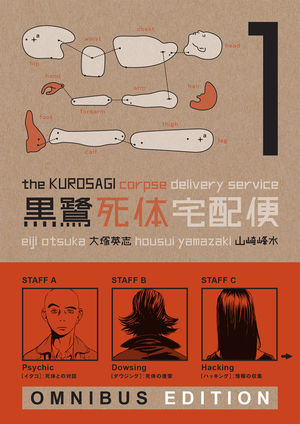
The Kurosagi Corpse Delivery Service, Vol. 14

June 28, 2015 by Sean Gaffney

By Eiji Otsuka and Housui Yamazaki. Released in Japan as “Kurosagi Shitai Takuhaibin” by Kadokawa Shoten, serialization ongoing in the magazine Young Ace. Released in North America by Dark Horse.

It’s been a long time since the last volume – two and a half years, in fact – even though the manga is still clipping along at a reasonable pace in Japan. Sadly, the reasons for this are the same reasons that we aren’t seeing Eden: It’s an Endless World or Translucent. Kurosagi Corpse Delivery Service doesn’t sell well enough to justify its continuing expense. That said, Dark Horse are certainly giving it more chances than the other two (the potential movie rights help a lot), and Carl Horn talks about the Omnibus Editions coming out in the fall – specifically, that we should get folks to buy them if we want to see Vol. 15. Like corpse delivery, manga can be a cutthroat business.

kcds14

What we get from this volume are 3 solid stories, all of varying types, which show us why this series is such a hit. The first is one that cries out to my Higurashi loving soul, as the premise is a corrupt politician who is trying to get a dam put in that will destroy a backwater town, and the dam protests that happen as a result. Of course, this politician is taking care of the problem in a more murderous way, the better to involve our heroes. What’s more important here is the introduction of a new sort-of antagonist, who has created an app that lets him find corpses and see their thoughts, and thus creates his own fake Corpse Delivery Service to lure out the real one. This series is fond of picking up plot arcs and dropping them, so I suspect he may not show up for a bit. He certainly makes himself known, though, casually solving the murder of Numata’s family just to show off.

The second story explains the title portraits, drawn in a simplified “western” style. We get a couple of chapters of what the series would look like transplanted to America, with a bit more snark and grotesqueries, but the same old horrible murders, this one of a couple with a fancy tattoo cut off of their bodies. It was cute, but honestly made the least impression on me, and I felt the comedy ending was a bit forced.

The last part gets back into the dangerous political waters this series is also known for – it’s courted controversy several times, bringing up stuff the government would rather the Japanese people forget. There’s no real-life comparison here, but certainly it’s a great example of bureaucracy taken to fatal extremes, particularly when up against a politician trying to cut down on wasteful practices. Ranou’s death is sudden and horrific, made all the more tragic by the fact that we actually meet and sympathize with her first – she’s someone Sasaki can intern for, so we know she’s respectable. She gets the last word, but sadly only in the way all the dead people in this series do.

This was a good, solid volume of the series that will make fans happy it came out. As for those who haven’t read the series – please, I beg you, get the first omnibus when it comes out this September.

Filed Under: REVIEWS

  • « Go to Previous Page
  • Page 1
  • Interim pages omitted …
  • Page 230
  • Page 231
  • Page 232
  • Page 233
  • Page 234
  • Interim pages omitted …
  • Page 342
  • Go to Next Page »
 | Log in
Copyright © 2010 Manga Bookshelf | Powered by WordPress & the Genesis Framework