• Skip to primary navigation
  • Skip to main content
  • Skip to primary sidebar
  • Home
  • About Us
    • Privacy Policy
    • Comment Policy
    • Disclosures & Disclaimers
  • Resources
    • Links, Essays & Articles
    • Fandomology!
    • CLAMP Directory
    • BlogRoll
  • Features & Columns
    • 3 Things Thursday
    • Adventures in the Key of Shoujo
    • Bit & Blips (game reviews)
    • BL BOOKRACK
    • Bookshelf Briefs
    • Bringing the Drama
    • Comic Conversion
    • Fanservice Friday
    • Going Digital
    • It Came From the Sinosphere
    • License This!
    • Magazine no Mori
    • My Week in Manga
    • OFF THE SHELF
    • Not By Manga Alone
    • PICK OF THE WEEK
    • Subtitles & Sensibility
    • Weekly Shonen Jump Recaps
  • Manga Moveable Feast
    • MMF Full Archive
    • Yun Kouga
    • CLAMP
    • Shojo Beat
    • Osamu Tezuka
    • Sailor Moon
    • Fruits Basket
    • Takehiko Inoue
    • Wild Adapter
    • One Piece
    • After School Nightmare
    • Karakuri Odette
    • Paradise Kiss
    • The Color Trilogy
    • To Terra…
    • Sexy Voice & Robo
  • Browse by Author
    • Sean Gaffney
    • Anna Neatrour
    • Michelle Smith
    • Katherine Dacey
    • MJ
    • Brigid Alverson
    • Travis Anderson
    • Phillip Anthony
    • Derek Bown
    • Jaci Dahlvang
    • Angela Eastman
    • Erica Friedman
    • Sara K.
    • Megan Purdy
    • Emily Snodgrass
    • Nancy Thistlethwaite
    • Eva Volin
    • David Welsh
  • MB Blogs
    • A Case Suitable For Treatment
    • Experiments in Manga
    • MangaBlog
    • The Manga Critic
    • Manga Report
    • Soliloquy in Blue
    • Manga Curmudgeon (archive)

Manga Bookshelf

Discussion, Resources, Roundtables, & Reviews

Reviews

JoJo’s Bizarre Adventure: Battle Tendency, Vol. 3

May 22, 2016 by Sean Gaffney

By Hirohiko Araki. Released in Japan as “Jojo no Kimyou na Bouken” by Shueisha, serialized in the magazine Weekly Shonen Jump. Released in North America by Viz Media.

In modern days, it has become a somewhat amusing joke to say that “no one dies in (insert Jump title here)”, be it Bleach, One Piece (until recently), or other such series. There are lots of apparent deaths, but it is a very popular cliche to have the supposedly dead person reappear to much rejoicing, and Jump in particular loves to do it. That said, this is a good 25 years earlier, and so JoJo’s is not afraid to brutally murder major cast members in order to advance the plot and provide much character development and tears of rage from our titular hero. Indeed, the villains are so arrogant that being killed by one of them personally is deemed to be a blessing given to a worthy opponent – attention has been paid.

jojobattle3

Last arc it was Speedwagon who survived, with Jonathan being killed off right at the very end. Joseph is a different, less tragic sort of hero, and so it falls to Caesar to be the one who loses his life so that the others may pursue their goal of defeating the evil whositses – honestly, a lot of the plot details of JoJo still tend to whiz by me as people scream battle poses at each other. Not that this is a bad thing – that is why we read this series, as Araki is very good at keeping a reader’s interest with reaction shots and amazed exclamations. Take, for example, the return of Stroheim, who has returned as something of a cyborg, and manages for a while to go toe to toe with Kars (named after the band, or the Gary Numan song? Or both). This despite the fact that the entire “he’s a Nazi, but I don’t hate him as a person” plotline is deeply uncomfortable, and I won’t cry when we leave World War II behind.

As for Joseph himself, he is, as ever, more of a trickster than his grandfather was, which allows him more success in battle against enemies who are prone to being faked out. Of course, this comes with cocksure arrogance and sometimes a petulant anger as well. He’s at his best here dealing with Suzie Q, who he flirts with for about two pages before she’s possessed by another one of the bad guys. This is why seeing him and Lisa Lisa devastated at the climax of this volume is so heartbreaking. We don’t like seeing Joseph like this. I have no doubt that he will get an epic revenge in the fourth and final volume of this arc, but will he be able to bounce back and show us some cocksurity? Who knows.

By now anyone reading this series knows what they’re getting into. I wish there was less “Nazis may be evil but they sure are cool” here, to be frank, but other than that this is wall to wall excellent shonen at 100% volume.

Filed Under: REVIEWS

The Manga Revue: Guardians of the Louvre

May 20, 2016 by Katherine Dacey

Whew–it’s been a while! Life got in the way of blogging for a few months, but the summer forecast looks good for manga reviewing. On the docket this week: Jiro Taniguchi’s Guardians of the Louvre, part of an ongoing graphic novel series published by NBM/Comics Lit that also includes Glacial Period, On the Odd Hours, and Rohan at the Louvre.

COVERLAYOUT.inddGuardians of the Louvre
By Jiro Taniguchi
No rating
NBM Graphic Novels, $24.99

One part Times of Botchan, one part Night at the Museum, Jiro Taniguchi’s Guardians of the Louvre is a stately, handsomely illustrated manga that never quite rises to the level of greatness.

The premise is simple: a Japanese artist lies ill in his Parisian hotel room, feverishly dreaming about the museum’s galleries. In each chapter, the hero is temporarily transported to a particular place and time in the Louvre’s history, rubbing shoulders with famous artists, witnessing famous events, and chatting with one of the museum’s most famous works–the Nike of Samothrace, who takes the form of a stone-faced tour guide. If the set-up sounds like The Times of Botchan, it is, though Guardians of the Louvre is less ambitious; Taniguchi’s primary objective is to celebrate the museum’s collection by highlighting a few of its most beloved works, rather than immersing the reader in a specific milieu.

The artist-as-time-traveler schtick is a little hackneyed, but provides Taniguchi with a nifty excuse to showcase the breadth of his artistry, offering the reader a visual feast of rural landscapes, gracious country manors, war-ravaged cities, and busy galleries. Using watercolor and ink, Taniguchi convincingly recreates iconic paintings by Van Gogh and Corot, effortlessly slipping into each artist’s style without slavishly reproducing every detail of the originals. Taniguchi’s characters are rendered with a similar degree of meticulousness, though their waxen facial expressions sometimes mar scenes calling for a meaningful display of emotion.

What prevents Guardians of the Louvre from taking flight is its relentlessly middlebrow sensibility. In one scene, for example, the Nike of Samothrace leads our unnamed hero through an empty Salle des États, home of the Mona Lisa. The artist examines the painting closely, musing about the tourist hordes that normally throng the gallery. “It’s not about art appreciation anymore. It’s wholly a popular tourist destination” he says wistfully. If his character was anything more than an audience surrogate, his comment might have registered as a thoughtful meditation on the commercialization of fine art, or the outsized fame of Da Vinci’s canvas. Absent any knowledge of who he is or what kind of art he creates, however, his remarks sounds more like a moment of bourgeois snobbery: don’t these peasants realize the Louvre is filled with other remarkable paintings?

A similarly pedestrian spirit animates the chapters documenting the 1939 evacuation of the Louvre. To be sure, the mechanics of packing and transporting the art are fascinating; Taniguchi’s expert draftsmanship conveys the complexity and physical demands of the task in vivid detail, inviting us to ride along with Delacroix’s monumental Raft of the Medusa on its perilous journey from Paris to Versailles. The dialogue that frames these passages, however, is rife with cliches. “They were ready to risk everything to evacuate the paintings,” the Nike solemnly informs our hero before implying that this operation was a little-known episode in French history–a strange claim, given the story’s romantic treatment in popular culture: surely the Nike has read All the Light We Cannot See or watched The Monuments Men?

The manga’s most effective passages, by contrast, are wordless. We see our hero wander through a forest where Corot silently paints the undulating boughs, and a medieval town where Van Gogh sets up his easel in a sun-drenched hay field. In these fleeting moments, Taniguchi’s sensual imagery allows us to step into the artist’s shoes and relive the creative process that yielded Recollection of Mortefontaine and Daubigny’s Garden for ourselves. If only the rest of the manga wasn’t so insistent on telling us how to appreciate these paintings.

Reviews: Sean Gaffney gives Rokudenashiko’s autobiographical manga What Is Obscenity? the thumbs-up. Over at The Fandom Post, Matthew Alexander jumps in the WABAC Machine for a look at Shaman Warrior, one of the first manhwa published by Dark Horse.

  • Julie on Abby and the Playboy Prince (Manga Maniac Cafe)
  • Helen on A Centaur’s Life (The OASG)
  • Megan R. on Earthian (The Manga Test Drive)
  • Frank Inglese on vol. 10 of Food Wars!! Shokugeki no Soma (Snap 30)
  • Richard Prenice on vol. 11 of Food Wars!! Shokugeki no Soma (Three if By Space)
  • Matt on vol. 2 of Forget Me Not (Ani-TAY)
  • Seth Hahne on A Girl on the Shore (Good OK Bad)
  • Michael Burns on vol. 2 of Handa-kun (Ani-TAY)
  • Matthew Alexander on vol. 1 of He Is My Master (The Fandom Post)
  • Infinitespeech on vol. 1 of I Am a Hero (The Fandom Post)
  • Kory Cerjak on vol. 3 of JoJo’s Bizarre Adventure, Part 2: Battle Tendency (The Fandom Post)
  • Nick Creamer on vol. 4 of My Hero Academia (Anime News Network)
  • Nick Creamer on vol. 1 of Mysterious Girlfriend X (Anime News Network)
  • Chris Beveridge on vol. 2 of Nichijou (The Fandom Post)
  • Dustin Cabeal on vols. 13-15 of Nisekoi: False Love (Comic Bastards)
  • Dustin Cabeal on vol. 1 of Prison School (Comic Bastards)
  • Kristin on vol. 1 of Shuriken and Pleats (Comic Attack)
  • Frank Inglese on vol. 5 of Tokyo Ghoul (Snap 30)
  • Robert Prentice on vol. 6 of Tokyo Ghoul (Three If By Space)
  • Julie on Wife by Contract, Mistress on Demand (Manga Maniac Cafe)
  • Frank Inglese on vol. 9 of World Trigger (Snap 30)
  • ebookgirl on vol. 11 of Yotsuba&! (Geek Lit Etc.)

Filed Under: MANGABLOG, REVIEWS

What Is Obscenity? The Story of a Good-For-Nothing Artist and Her Pussy

May 19, 2016 by Sean Gaffney

By Rokudenashiko. Released in Japan by Kinyobi, Inc., partially serialized in the magazine Shuukan Kinyobi. Released in North America by Koyama Press.

Like many people, I first heard about Rokudenashiko via news reports retweeted and reblogged around the internet. In fact, it may have been watching The Daily Show, which covered her arrest (she makes reference to it here). But when I saw that she had a panel at TCAF and was promoting a manga discussing what happened, I decided to seek it out. and I’m delighted that I did, as this manga is fascinating, managing to make the reader angry and outraged at her mistreatment while at the same time laughing hysterically. It actually comes in two parts. The first, written for the weekly magazine, is a light-hearted (but the events are serious) look at her arrest and imprisonment for distributing 3D copies of her vagina via crowdsourcing. The second half retells some of the same events, but as part of her life story, and it’s more serious and personal.

obscenity

The amazing double-standards of Japanese culture, which has no issues with the word ‘chinko’ (which means dick), but can’t abide the word ‘manko’ (which means pussy) is on display throughout, from the initial sneering and TV-cop stereotype of her arrest to the hilarious points where the officers try to take her statement and she humiliates them by insisting on saying ‘manko’ as many times as possible. We get a lovely tour of Japanese women’s prison, which is as unpleasant as you’d imagine, and she has a variety of cellmates, ranging from the normal to the intensely strange. Interspersed through the manga are various textual articles discussing the nature of obscenity, Japanese law (yes, it really is far more like Phoenix Wright than you’d expect), and the campaign on the outside to petition for her freedom (which we barely see as we’re following her POV).

As I said earlier, the second part of the manga is a short biography of her life, and how she ended up becoming an artist who used her ‘manko’ as an inspiration for various art projects and showcases. The most amusing part for me was that her initial reasoning was seeing that you can have “vaginal surgery” and thinking “whoah, cool!”. She was later told by her editors to change it and make her more ashamed of her body in order to sell to readers better. I am reminded of many other editorially demanding manga series. That said, we also see that using ‘manko’ in her art also led to her divorce, to her friends abandoning her, and to suicidal thoughts. None of that was in the more commercial first part of the book, but it adds a sense of depth and realism that touches the heart.

So rest assured, this is a highly entertaining and moving memoir. But it’s also a wonderful look at the standards that go into defining what is obscene, and the struggles that an artist has to go through in order to be able to express themselves properly. The behavior of the police and courts in this book is jaw-dropping, and if nothing else, I’m hoping that more awareness of the these issues might lead to international pressure for change. In the meantime, the story of Rokudenashiko and her artistic triumphs and struggles is a must-read for anyone who loves freedom of expression.

Filed Under: REVIEWS

The Birth of Kitaro

May 17, 2016 by Sean Gaffney

By Shigeru Mizuki. Released in Japan as “Gegege no Kitaro” by (among others) Kodansha, serialized in various magazines. Released in North America by Drawn & Quarterly.

There was already a sampler of Kitaro a few years back, also by Drawn & Quarterly, but this new collection appears to be the equivalent of a multi-volume best-of, apparently signed off on by Mizuki himself, who gave the editor a test to see if he could choose the stories that Mizuki himself would have chosen (he got all but one). And so we see some earlier Kitaro manga from the late 60s, including a lengthy chapter from the magazine Garo that shows off how Kitaro came to be, and helps you understand that the otherwise generic zombie on the cover really is one of the main characters. It’s a grim little tale, more serious than the rest of the stories in this volume, possibly as it lacks the series’ main drawing point.

birthofkitaro

See, Kitaro is a nice kid, mostly (his ethics can be rather questionable from a human perspective), but he is essentially Mickey Mouse. He’s the title character and appears in every story, but what the readers really want is someone a bit more fallible and funny. And you can’t get much funnier or more fallible than Nezumi Otoko, which translates to Rat Man. He is the Donald Duck of this series, only Donald was never quite so evil. Nezumi Otoko will do absolutely anything for money, including tricking old rich men out of their life savings, luring respectable young manga editors to their yokai-influenced deaths, and take advantage of the dead – multiple times. Even when he’s not being an ass, he’s usually a coward, always the first to run away. This, of course, makes him a marvelous character, the best reason to read this series. He’s beloved in Japan (for a certain definition of beloved), and was used as narrator for Mizuki’s Showa history.

The other big reason to read the series is the yokai, who veer from the silly to the terrifying, but they’re all dangerous. Neko Musume shows up here, and those who recall her cute moe appearance in some of the more recent Kitaro animes will be startled by this bowl-cut girl who tries to literally eat Nezumi Otoko when she first sees him (to be fair, he deserved it – he always does). The Gyuki and Hideri Gami are more typical straight-up monsters, in the former case even managing to possess Kitaro, who gets to enjoy a rare turn attacking people. Kuckily, Kitaro is made of stern stuff, able to survive even being dropped in a volcano. Also luckily, this is very much not a serialized story. Tales need to end in a certain number of pages, so the yokai rarely get to do much before Kitaro has won and they’re off on their next adventure. (The anime was airing as these manga chapters were running, and you can see references to the insanely catchy theme song in these final ‘the adventure continues’ panels.)

Even if you aren’t a fan of manga history or yokai stories, this is still a must purchase. It’s also fairly child-friendly, despite a few scares. I am eagerly awaiting more.

Filed Under: REVIEWS

The Man in the High Castle

May 13, 2016 by Ash Brown

The Man in the High CastleAuthor: Philip K. Dick
Publisher: Houghton Mifflin Harcourt
ISBN: 9780544916081
Released: October 2016
Original release: 1962
Awards: Hugo Award

Philip K. Dick’s The Man in the High Castle is one of those classic science fiction novels that I’ve been meaning to read for ages but for one reason or another never quite got around to. Recently, though, the novel seems to be popping up wherever I turn: Viz Media’s speculative fiction imprint Haikasoru takes its name from the title; it was mentioned multiple times in the tenth volume of Mechademia which I read not too long ago; and in 2015 it was adapted as a live-action television series. Originally published in 1962, The Man in the High Castle can be counted as among the first major works of fiction written in English to examine an alternate history in which Germany and Japan emerged victorious from the Second World War, a historical turning point which has since become one of the most popular for the subgenre to explore. Winning the Hugo Award for best novel in 1963, The Man in the High Castle is also regarded as one of Dick’s most well-known and highly-acclaimed works. The novel has been re-published around the world numerous times with the most recent US edition scheduled to be released in 2016 by Houghton Mifflin Harcourt.

After being defeated, the United States of America was divided into three political entities at the end of World War II. The Pacific States of America is overseen by Japan and the Eastern United States is occupied by Germany while the central third of the country, the Rocky Mountain States, remains an independent buffer zone. Less than two decades have passed since the end of the war. Nazi Germany, having become a major power, continues to dominate and conquer the rest of the world and has even extended its reach to space. However, internal power struggles threaten to throw the precariously-balanced international political landscape into war and turmoil once again. In the meantime, Americans have had to either learn to adapt to their occupiers’ whims or to flee their homeland. The Japanese rule is fairly benign, especially when compared to that of the Germans, but it is still grating and demeaning for the Americans who are slowly losing their national identity along with the freedoms and respect that they once enjoyed in the past.

The alternate history that Dick envisions in The Man in the High Castle is honestly terrifying and horrifying. Under the global influence of a fascist, totalitarian regime, extreme racism and prejudice is rampant and genocide isn’t a thing of the past but of the present and future. People live in a world in which insidious fear, hatred, anger, and uncertainty have come to dominate. The Man in the High Castle follows several different and fairly ordinary characters from a variety of backgrounds who are all ultimately connected to one another, either directly or tangentially: an antiques dealer making his living selling Americana to Japanese clients, an American craftsman and jewelry maker who must hide his Jewish identity and heritage, a Japanese trade official stationed in what was once California, an American woman who teaches judo in the Rocky Mountain States, and a Nazi defector trying to prevent impending atrocities from becoming a reality. By the end of the novel, both together and separately, they have all taken a stand against the status quo and have made a difference, however small, in the world around them.

In addition to being a work of alternate history itself, there is a novel within The Man in the High Castle—The Grasshopper Lies Heavy—which explores yet another potential reality. That novel plays a pivotal role as does the Chinese classic the I Ching which many of the characters consult as an oracle or use to make major decisions and which Dick himself used to guide the story and plot of The Man in the High Castle. The writing style of The Man in the High Castle did take some time for me to get used to. Much of the novel consists of the characters’ internal monologues and thought processes, resulting in a work that frequently feels like fragmented stream-of-consciousness. Parts of the novel are also written in deliberately stilted English which, while clever and effective (and while I can understand and appreciate Dick’s intentions), doesn’t necessarily always make for the most pleasant reading experience. However, the underlying ideas and themes behind The Man in the High Castle are tremendous. Ultimately, The Man in the High Castle is a fascinating and chilling read, and a novel that is remarkably relevant and thought-provoking even today.

Filed Under: REVIEWS Tagged With: Hugo Award, Novels, Philip K. Dick

One Piece, Vol. 78

May 10, 2016 by Sean Gaffney

By Eiichiro Oda. Released in Japan by Shueisha, serialization ongoing in the magazine Weekly Shonen Jump. Released in North America by Viz.

My last review of One Piece was, for me, quite negative, as I was getting very weary of Dressrosa. That hasn’t changed one bit with this new volume, unfortunately, and we’re still here. I am going to make a concerted effort not to bring up Rebecca, despite my teeth grinding so much during the “you are a pretty princess who must not fight” scenes I may need to see the dentist. Instead, let’s be positive and focus on the fun things going on in this arc. And there are fun things, because even when Oda is getting more sexist by the volume and rehashing things we’ve seen before, he can still introduce crazy stuff that makes you grin, or even show us a kid wearing a Bartholomew Kuma T-shirt.

onepiece78

The cover, showing off the Straw Hats (+ Law), reminds us that the main cast may have gotten a bit too unwieldy, given that Oda now has to write out half the Straw Hats in order to not overburden an already overburdened arc. That said, it does allow those who are remaining to have moments to shine. Zoro has done “beyond the impossible” so many times that you’d think it would be old hat by now, but no, it’s always fun, mostly as every time you’re reminded what a complete lunatic he can be when he’s in battle mode. If the enemy needs to be stopped but is much too far away, just have yourself hurled at the enemy. If he shapeshifts too fast to kill his real body, just cut everything so fast he doesn’t have time to get away. And oh yes, use haki to make sure your swords won’t even get scratched. When Zoro isn’t sleeping or getting lost, he’s there to be super cool, and he achieves that here.

Then there’s Luffy, who gets to battle the real Doflamingo at long last, in what is hopefully the climax of this arc. The timeskip has helped to mature Luffy, even if (like the rest of the cast) he can backslide at any time for comedy reasons. True, his reasoning for going all out against Doflamingo is still somewhat simplistic – you made my friends cry, you made my friends mad. But honestly, that’s a good enough reason to begin with, and if anyone deserves to be punched into next week, it’s Doflamingo, who sets up one last deathtrap to kill everyone on the island for the lulz. Flashbacks show that if you tell a young boy filled with rage and fury that he is better than everyone else and give him whatever he wants, bad things will ensue. Luffy is the opposite of this, even though he is also filled with rage and fury here. Abuse of power is the main enemy in One Piece, be it pirates, marines, World Government, or what have you. If you do it, Luffy is here to kick your ass.

So there are many things to like here, but again, I will be very, very glad to see the back of this arc. I believe that in the next volume I finally achieve this.

Filed Under: REVIEWS

Yowamushi Pedal, Vol. 2

May 8, 2016 by Sean Gaffney

By Wataru Watanabe. Released in Japan in two separate volumes by Akita Shoten, serialization ongoing in the magazine Weekly Shonen Champion. Released in North America by Yen Press.

The last volume promised we’d see a race, but I don’t know if readers were prepared for the race to take up the entire omnibus, which is to say two volumes of the original Japanese release. Given that it’s meant to be an endurance test to weed out those who aren’t ready for the big time, it makes sense. And, of course, it ends up showing off the character development of our three leads – Onoda discovers the joy of competition, particularly when he gets a real bike; Naruko realizes that he is not in fact top dog here; and Imaizumi finds a desire to win that had been absent in him for some time. In other words, this still manages to embody all the archetypes of sports manga in one handy volume.

yowamushi2

Onoda is still the star, and we see him coming to terms with the fact that he can’t make it on pure guts alone – though god knows he tries, particularly when he gets his racing bike. There’s a lovely bit where he sees the car of team captains behind him (they’re there to pick up those too far behind and say they’ve lost) and despairs, but no, they’re here to give him his racing bike, which got stuck in traffic before the event. The team captains (and Kanzaki, who continues to boggle at Onoda’s raw potential, though this being a sports title, and an Akita Shoten one at that, I expect boggling is all she will do) also get to play Greek chorus along the way, explaining why *this* is the exact point that Onoda will finally run out of steam, only to be proven wrong time and time again.

Of course, he eventually does collapse – your male sports lead does not end up winning against the veterans in the early volumes. The course is designed to kill anyone who doesn’t plan on being a “cycling uber alles” sort, which means most of it is a giant hill. Onoda wins the race to the top of the hill, but that’s all he has in him. As for Imaizumi, there’s some lovely characterization here as he unconsciously finds himself riding as he did when he was a child (something noticed by Kanzaki, who was a childhood friend of his), and also overexerting himself despite knowing it’s not the right thing to do in order to efficiently win the race. Stoic types in manga are always at their most interesting when they go up against something that threatens their facade. It doesn’t necessarily have to make them emotional, but it’s good to see.

So now that Onoda has made a name for himself, to the point where even Kanzaki’s non-cycling BFF says that he seems to have more presence than before, what’s next? My guess is more cycling, and probably an intense training regimen. Are we too early for an inter-high meet? What does the author plan to do with the eccentric yet clearly intelligent and wily coach we’re introduced to? I definitely plan on finding out next time.

Filed Under: REVIEWS

What Is Obscenity?: The Story of a Good for Nothing Artist and Her Pussy

May 6, 2016 by Ash Brown

What Is Obscenity?Creator: Rokudenashiko
U.S. publisher: Koyama Press
ISBN: 9781927668313
Released: May 2016
Original release: 2015

Like many other people both inside and outside of Japan, the work of artist and activist Rokudenashiko (the pseudonym of Megumi Igarashi) was brought to my attention following her arrests in 2014 on charges of obscenity. Rokudenashiko is a self-described manko (pussy) artist, challenging preconceived notions and taboos surrounding female genitalia by creating clever, fun, and silly sculptures incorporating realistic molds of vulvas as well as designing Manko-chan, a cute anthropomorphized pussy. One of Rokudenashiko’s responses to being arrested was to create the manga What Is Obscenity? about her experience. It was originally serialized in the Japanese political magazine Weekly Friday in 2014 before being collected in a single volume along with other material in 2015. The English-language edition of Rokudenashiko’s comic memoir, subtitled The Story of a Good for Nothing Artist and Her Pussy, was published by Koyama Press in 2016 thanks in part to the editing, translation, and production efforts of the fine folks behind Massive Goods.

In 2013, Rokudenashiko successfully crowdfunded a project to create a kayak molded from a 3D scan of her genitals. One of the rewards given to some contributors of the campaign was a downloadable vector file of the scan which she encouraged others to use to make their own artwork. In July 2014, this file along with her artwork and other personal belongings were used as evidence to support the obscenity charges that were brought against her. Rokudenashiko was arrested and jailed for a week before being released only to be arrested and indicted again in December of that year. She continues to fight the charges in court and her trial process is currently ongoing, although a judgement on her case is scheduled to be pronounced on May 9, 2016.

What Is Obscenity? collects two short series of autobiographical manga—”What Is Obscenity? How I Became a So-Called Artist” about Rokudenashiko’s first arrest, her time spent in jail, and the immediate aftermath and “Why I Became a Manko Artist” which relates the story of how she almost unintentionally became an activist and started creating pussy-related artwork. Adorable illustrations of Manko-chan are found throughout the volume and “This Is My Story,” a short full-color manga about Manko-chan, is featured as well. The English-language edition of What Is Obscenity also includes additional material such as an introduction by Rokudenashiko, examples of her sculptures and artwork, color photography, cultural notes, and an excerpt of a discussion between Rokudenashiko and the controversial film direction Sion Sono.

What Is Obscenity?, page 11Freedom of expression, and especially freedom from governmental censorship, is something that I am very passionate about. One of my particular focuses in the various copyright and intellectual property law courses I took in graduate school actually happened to be obscenity law which, as in the case of Rokudenashiko, can be used to attempt to silence and punish artists and other creatives as criminals and which are notoriously inconsistent in their application. But Rokudenashiko isn’t allowing herself to be silenced. Her arrest and trial, as well as her willingness to publicly fight the obscenity charges, made not only national but international news. This has given her a larger platform that has allowed her to bring even greater attention to the absurdity of the systemic injustice of a society that objectifies the bodies of women while at the same time treating them as something shameful and obscene. I greatly and sincerely admire her work and efforts; what Rokudenashiko is doing is incredibly important both artistically and socially.

One of the things that makes Rokudenashiko so remarkable is that even in the face of infuriating and intimidating circumstances she is able to retain an outwardly upbeat, bright, and strikingly personable attitude which is then reflected in her work. Even while dealing with some fairly serious issues, What Is Obscenity? is sweet and charming with a wonderful sense of humor and art to match. As with much of Rokudenashiko’s work, What Is Obscenity? can be silly and fun, though many of the events portrayed were probably not nearly as funny while she was actually living through them. Her experiences, everything from the utter lows of personal and family troubles and the jail time caused by her artwork to the immense joy sparked by the unflagging support of her friends and fans, are recounted with a cheeky candidness that makes her story and the subject matter approachable and entertaining while still getting her message across. With its gentle humor and creative cuteness, What Is Obscenity? and the rest of Rokudenashiko’s work is subversively powerful, inspiring, and empowering.

Filed Under: REVIEWS Tagged With: Koyama Press, manga, Rokudenashiko

Planetes, Vol. 2

May 5, 2016 by Sean Gaffney

By Makoto Yukimura. Released in Japan by Kodansha, serialized in the magazine Weekly Morning. Released in North America by Dark Horse Comics.

The 2nd omnibus volume of Planetes has as many powerful moments as the first, including possibly the most iconic marriage proposal in all of manga. But, just like its subject, one gets the feeling that the series has proven a bit too big for its author. The 2nd half of the series has a series of story arcs that feel like endings, but it keeps going on for a bit, and reminds me somewhat of a series that has been extended by its editors rather than its author. Of course, this offers us the opportunity for a magnificent arc focusing on fee, so I shouldn’t complain too much. But space has no ending, and neither does Planetes, which simply keeps rolling along till the very last page.

planetes2

Of course, Hachimaki is still the star, and after his vision quest he’s almost a different person, though it’s touch and go as to whether he’ll survive at all – not that he did himself any damage, but he seems to have lost the will do live his life, something that Sally has to bully out of him with a combination of yelling and nudity. Moreover, he needs someone like Tanabe, even if marrying means they immediately won’t see each other again for seven years. The aforementioned marriage proposal, done as a game of shiritori, is justifiably famous, but I think may be surpassed by two other scenes – Hachimaki comforting a sobbing Tanabe as she reveals she has no idea what she can possibly write in her will should she be killed in space, and Tanabe’s complete inability to explain why she loves Hachimaki or why she married him – except that she loves him a lot. Tanabe is still the heart of this series.

And then there’s Fee. (Sorry, Yuri, you are forever “the other one”.) Fee has always tried to avoid making the personal political, probably as it’d be so easy for her to do, as we find out here. But with the world superpowers waving their dicks around and blowing up so much stuff in space that an entire orbit is now forever lost, even one person finds it hard to make a difference. We contrast adult Fee’s attempts to balance a job, a family life, and a newfound, unwanted fake with Fee’s childhood, which she liked to spend with her uncle out in his shack in the woods. This allows Planetes to take on the quiet racism of the countryside, adding in a handful of prejudice against the mentally disabled as well. It’s handled with a surprisingly gentle touch, and also allows Fee to realize that she and her son are far more alike than she’d like, but also that she belongs in space.

There’s more I haven’t touched on – Locksmith continues to be a very ambiguous villain, and Hachi’s father gets a nice flashback chapter. But as I said, the manga does not end, but keeps flowing onward till the last page. Hachi’s message to the Earth from Jupiter reflects that, talking about the need to explore space, and how it needs to be done while not losing sight of humanity. It’s a subtle rebuke to Locksmith, and also a great, down-to-earth speech. Planetes remains one of the best space-oriented titles out there, and I’d recommend it to any reader.

Filed Under: REVIEWS

Emma, Vol. 4

May 3, 2016 by Sean Gaffney

By Kaoru Mori. Released in Japan in two separate volumes by Enterbrain, serialized in the magazine Comic Beam. Released in North America by Yen Press.

After the last omnibus proved to be quite depressing at times, it’s a relief to see that this new one contains a happy ending, of sorts. Given this is still an interclass relationship in Victorian England, of course, the definition of happy is a lot more repressed than you’d expect, but it works. I was somewhat relieved to see that Emma’s arranged abduction by Big Daddy Campbell was less ‘let’s have her murdered’ and more ‘let’s dump her far away from London and remind her she is merely a working-class girl’, something which Emma sadly takes to heart. Luckily, after a thorough search of all of England (the coincidences fly thick and fast in this volume, but I suspect Mori is well aware of how ridiculous it is – it feels Dickensian), William and Emma are reunited, he managed to break off his engagement to Eleanor (and also his family’s upward mobility, though hopefully that’s temporary), and Emma prepares to enter high society.

emma4

While things are mostly dramatic, there are moments of humor that serve to lighten the mood. Eleanor has been treated horribly by the narrative, and her emotional breakdown would be incredibly depressing were it not for the presence of Hakim’s identical triplet concubines doing their best “staaaaaaaaaaaaaaaaaaaare” at her. And the scene of Mrs. Jones, Mrs. Molders, and Emma trying to sort out the many and varied rules of etiquette, some of which contradict each other, is pure gold. That said, William and Emma’s romance is played with the utmost seriousness, and seeing her decked out in fine fashion at the end of the main story is breathtaking. Mori can draw, and it’s still one of the best reasons to get her works.

Emma proper ends here, but there were three volumes of side stories which were collected as well, and the first of these is the second half of this omnibus. We get to see a young Kelly Stownar and her long-dead husband when they were young just-barely-getting-by newlyweds, trying to save up to see the Great Exhibition, in a very sweet and touching chapter. Eleanor, having been exiled to Brighton as a disgrace by her evil father (presumably she is a disgrace for now being good enough to keep William Jones’ attention despite his being – ugh – a merchant), gets to meet a young student who turns out to have been William’s underclassman at school, and they bond, although I am pleased to see it doesn’t seem to be a rebound relationship – indeed, Eleanor seems to want to emulate him more than romance him. I also liked the chapter devoted to Tasha, the clumsy maid who befriended Emma, and her huge family that she goes home to visit.

Emma is always best when it evokes mood and shows us gorgeous things, and there’s a lot of that in this omnibus. And, of course, if you like William and Emma’s romance, you will be pleased as well. More side-stories follow in the final omnibus, including, I understand, an actual wedding, though it does take place several years after the main plot.

Filed Under: REVIEWS

The Heiress and the Chauffeur, Vol 1

May 1, 2016 by Anna N

The Heiress and the Chauffeur, Volume 1 by Keiko Ishihara

It is interesting that there are a couple new two volume series (Shuriken and Pleats being the first) coming out from Shojo Beat now. I feel like publishes backed off super-short shoujo for a little bit in favor of mid-range 5 or 6 volume series. Heiress and the Chauffeur is a conventional shoujo series with attractive art that is livened up by a historical setting.

The heiress in question is Sayaka Yoshimura, who is the daughter of a wealthy family. Her chauffeur is Shinobu Narataki, and they were raised closely together as children, resulting in a friendship that is entirely unconventional for a mistress and her servant. Sayaka has to deal with the behavioral rules and rumors swirling at her all-girls school, while running a gauntlet of all her admiring classmates who enjoy staring at Shinobu while he patiently waits to pick her up. Sayaka has a bright, spunky personality and she isn’t afraid to stick up for Shinobu when his habit of barging in to rescue her gets them both in trouble with the school authorities.

heiresschauffeur1

I enjoyed the historical aspect of the manga, and seeing the life of an heiress in the Taisho era portrayed, because that’s a type of setting that I don’t usually see in shoujo manga. I was a bit worried that each chapter would be a replay of the dynamic where Sayaka gets in trouble, Shinobu rescues her, and they have to find their way out of the aftermath, but towards the end of the volume it is made clear that their odd friendship has given Sayaka the tools to stand up for herself independently. That being said, overall the manga was a little bit dull. The art is pretty, but not terribly distinctive, and while the premise and setting is interesting, there isn’t much to distinguish the main characters from any other shoujo series. This is Isihara’s first series though, and it certainly is well executed enough that I’m curious to see what she could do given a bit more space to develop a manga. I think younger teens would enjoy The Heiress and the Chauffeur in particular.

Filed Under: REVIEWS Tagged With: heiress and the chauffeur, shojo beat, shoujo, viz media

Is It Wrong To Try To Pick Up Girls In A Dungeon?, Vol. 5

May 1, 2016 by Sean Gaffney

By Fujino Omori and Suzuhito Yasuda. Released in Japan as “Dungeon ni Deai o Motomeru no wa Machigatte Iru Darou ka?” by Softbank Creative. Released in North America by Yen On.

Well, I suppose I asked for it. In the last few reviews of this series I kept mentioning how the mechanics of the series meant that Hestia, the supposed female lead, kept getting less screen time than everyone else. Now we have a book where she actually comes along on a dungeon crawl in order to rescue Bell, and it’s sadly fairly cliched. She can’t use godly powers in there, so she’s useless in the fighting. She spends much of the time post-rescue jealous of the fact that every girl in the entire series has fallen in love with Bell (though honestly, I think what Aiz is feeling is deep jealousy of Bell’s progress, but that doesn’t matter to Hestia), *and* she gets kidnapped and has to be rescued.

danmachi5

The others fare better. Bell too needs to be rescued, but that’s not really his fault, and he, Welf and Lilly show off their excellent teamwork here. (Lilly also shows a lot of jealousy, but she’s more cynical and sarcastic about it, and thus appeals more to Western readers.) Bell’s reputation is starting to precede him, and much of this volume is devoted to the fact that if you are an overpowered character in what is for all intents and purposes an RPG, you’re going to have players assuming you’re cheating, or getting help, or just plain old “who does he think he is?”. And so we see the return of some old bullies from Book 2, who decide to teach Bell a lesson – and by that I mean beat the crap out of him. The trouble is, Bell is just too good for that to work.

The big debut this volume is Hermes, who’s the standard trickster god type, also out to teach Bell a lesson: stop being so naive and realize that some humans are bad people. This lesson does not work, because Bell is Bell, and this isn’t Black Bullet. Hermes is amusing, and I love the fact that everyone just accepts that he’s something of an asshole – indeed, when we get the standard “whoops, Bell is peeking on the girls at the hot spring, lol” scene, literally everyone there knows this isn’t something Bell would do, and blame Hermes instead. I was ecstatic to see that. He also lets the cat out of the bag about Bell’s ancestry, but honestly I think everyone had guessed that by now anyway.

For those who enjoy battles, the one in the last third of the book is very epic, with a huge cast of characters all teaming up to take out a nightmarish monster. Lyu, one of the waitresses from our favorite pub, gets a tragic backstory and a serious chance to show off. In fact, I’d argue the series has more women kicking ass than men by a large margin – which is partly for the service, but it’s also simply nice to see. In the ‘odd’ department, we meet one of the Japanese gods and his all-Japanese human team, who do well but feel out of place in this land of Greek fantasy archetypes. On the whole, though, it’s another strong volume, though I hope Hestia can get over her jealousy soon. (Yes, I know.) Also, we’ve now caught up with the anime, so the next book should be new to viewers.

Filed Under: REVIEWS

After School Nightmare, Vol. 9

April 30, 2016 by Ash Brown

After School Nightmare, Volume 9Creator: Setona Mizushiro
U.S. publisher: Go! Comi
ISBN: 9781933617701
Released: November 2008
Original release: 2007

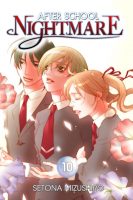
After School Nightmare is a ten-volume manga series by Setona Mizushiro. Darkly psychological with elements of horror as well as social commentary, After School Nightmare can at times be a deeply troubling and challenging read while still being engrossing and oddly compelling. I first started reading the series several years ago, but have only recently been able to bring myself to read beyond the first few volumes of the manga, largely because I did find it so disconcerting and hard-hitting. Granted, the dark, anxiety-ridden atmosphere which makes the After School Nightmare so intimidating to approach is also what makes the story particularly effective and is an aspect to the manga that I can appreciate. After School Nightmare, Volume 9 was first published in Japan in 2007. The English-language edition of the volume was released in 2008 by Go! Comi. Sadly, the entire series has now gone out of print and is becoming more difficult to find.

One by one the students participating in the special after school class which forces them to share their literal nightmares with one another are graduating and disappearing, leaving only a vague memory of their existence behind. Though at times vicious and cruel, the dreams are intended to allow the students to work through their personal traumas, crises, and fears so that they can let go and move on from their troubled pasts. However, the violence and turmoil they experience within the dreams frequently spills over into their waking lives and graduating doesn’t necessarily guarantee a peaceful resolution. Koichiro in particular has reached his breaking point. He is ruthless in his determination to graduate and leave his overbearing and abusive father behind along with his carefully crafted public persona. Triggered by outside events, the nightmare Koichiro brings down upon the other students as he tries to free himself turns into a shockingly brutal and bloody rampage, signalling the beginning of the end for himself and for those who still remain.

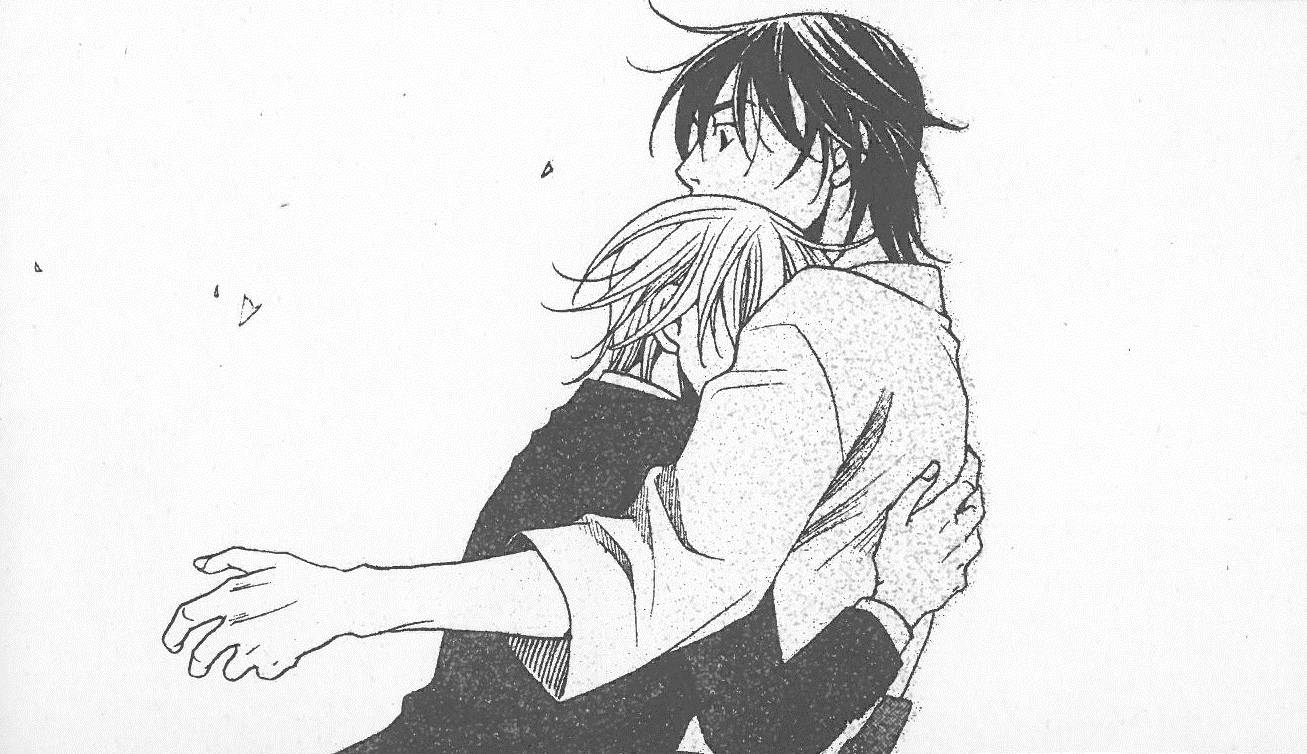
After School Nightmare, Volume 9, page 29A few questions still remain, but for the most part Koichiro’s character arc is resolved in After School Nightmare, Volume 9. Like so many of the other characters’ stories, Koichiro’s is a tragic one and it is heartwrenching to see it play out. The culmination of his anger, pain, and suffering has a direct and devastating impact on the others, ending with a violent attack on Mashiro, the portrayal of which has blatant parallels to a sexual assault. Koichiro was at one point the most stable and seemingly well-adjusted character in the series, so to see such a drastic shift in his outward attitude and behavior is especially startling. He isn’t the only character to have significantly changed over the course of After School Nightmare, though. However, for some the process, while still being extraordinarily difficult, has ultimately been more positive. Just as the dreams have led Koichiro to abandon his self-restraint, they have also allowed Mashiro the freedom to begin to come to terms with his fluid gender identity and the fact that he may feel more comfortable as a girl. Compared to the beginning of the series, Mashiro has greatly matured.

After School Nightmare, Volume 9 has a fair number of major plot twists, surprising reveals, and crucial story developments, many of which call into question everything that has come before in the manga. Some of these things have been foreshadowed and are not entirely surprising but there is still some disorientation as they are revealed to be not quite what they initially seemed. Koichiro dominates the first few chapters of the ninth volume but from there the focus of the manga turns toward Sou as more of his backstory is explored. An explanation of a past that he has not entirely dealt with yet and that has been incredibly damaging both emotionally and psychologically is finally given. After School Nightmare was never a light series, but the ninth volume is a particularly heavy and dramatic one. Considering the very final scene which challenges many of the assumptions that I had made regarding the series, I am very curious to see where Mizushiro takes the story in the final volume. After School Nightmare has been a dark and twisting journey and I have no idea how it will end; I’m almost a little frightened to find out.

Filed Under: REVIEWS Tagged With: after school nightmare, Go! Comi, manga, Setona Mizushiro

The Gods Lie.

April 29, 2016 by Michelle Smith

By Kaori Ozaki | Published by Vertical, Inc.

gods-lieThe Gods Lie is a seinen one-shot by Kaori Ozaki, who also brought us Immortal Rain, which I liked very much. Even though it was released recently, Ozaki’s clean and clear artwork somehow conveys a more vintage feeling, a bit like a Miyazaki movie.

Natsuru Nanao is in sixth grade and dreams of becoming a soccer star. The girls in his class have ignored him ever since he rejected the princess of the group, so he’s surprised when Rio Suzumura actually acknowledges his presence. After his beloved soccer coach is hospitalized, the negative and demanding replacement causes Nanao to bail on soccer camp and he ends up spending a lot of time over summer vacation with Suzumura and her little brother, Yuuto (and Tofu, the kitten they have rescued). Nanao lives with his mother, since his father died when he was little, but soon discovers that Suzumura and Yuuto are living on their own after their father took off to earn money fishing in Alaska.

Over the course of the volume, Nanao makes some bittersweet discoveries about life. The new coach causes him to doubt his dreams of soccer stardom. He learns that one of his teammates already has a different career path plotted out. He falls in love with Suzumura and stands by her when her dad fails to return by the summer festival like he promised. He discovers her terrible secret. And, lastly, he begins to understand why “the gods lie.”

I think in this case, the gods of the title are taking the form of parents, and how they might appear to a young kid. Suzumura’s dad has lied to his children, but Nanao reflects that his dad had lied to him, too, promising that he’d surely get better if Nanao was a good boy. People who love you can lie to you, sometimes because they don’t want you to be sad, sometimes because they are assholes who are unworthy of your love. That’s life.

What I like best is that Ozaki lets Nanao take in these revelations without destroying his capacity to dream, or ending the book on a thoroughly depressing note. Indeed, the conclusion is downright hopeful. In the end, I enjoyed The Gods Lie very much, and particularly recommend reading it somewhat slowly, to really evoke that leisurely summer vacation feel.

Review copy provided by the publisher.

Filed Under: REVIEWS Tagged With: Kaori Ozaki, vertical

The Irregular at Magic High School: Enrollment Arc, Part 1

April 28, 2016 by Sean Gaffney

By Tsutomu Sato and Kana Ishida. Released in Japan as “Mahouka Koukou no Rettousei” by ASCII Mediaworks. Released in North America by Yen On.

Sometimes, when I review a new series, I come into it relatively unspoiled beyond a basic premise. And then there are times where the series is somewhat infamous, and so I’m spoiled no matter what I do. The Irregular at Magic High School, aka Mahouka, is one of the latter. It’s become somewhat infamous on the internet for its immense volume of technobabble, for its bizarre and skewed views of world politics, but most of all for its hero, who tends to get even more flak than Kirito for being perfect in every way. The term “Mary Sue” has been used to incorrectly in recent times that it’s become meaningless, and “Gary Stu” was never really anything more than a desperate attempt to try to not look sexist. That said, one has to admit: Tatsuya’s pretty cool.

irregular1

The basic premise is that our hero and his adoring sister (more on that later) go to a school for magic users. Miyuki is a magic prodigy. Tatsuya, while brilliant in every other way, does not have much in the way of actual magic power in him. As a result, which she’s handpicked for the student council and the freshman representative, he’s placed in Course 2 with the other students who have skills but not actual power behind them. And, this being a typical high school with typical teenagers, that means there’s a lot of bullying and prejudice against Course 2 students. Tatsuya, though, is not going to let a little thing like magic power stop him from using his analytic abilities and natural-born intelligence to be the best. Oh, and his martial arts. So he’s scouted by the discipline committee in order to help keep peace on the campus.

Tatsuya, thank goodness, is not your typical schlub light novel narrator. He’s somewhat stoic and emotionally stunted, and frequently has difficulty grasping the basic concept of people actually wanting to be friends with him – I suspect his past is filled with bad things. We already know he’s estranged from his parents. Luckily, he has a close relationship with his sister – too close, possibly, for many readers. There is a whole load of incestuous subtext in this first book, and it’s not all on Miyuki’s end, though she’s the largest supplier. This plot point, plus the fact that Tatsuya sometimes bends the narrative his way like he’s the star of a Dark!Grey!Independent Harry Potter fic, means the book can be hard to take. Oh, and the technobabble is just as bad as people said it would be.

There are some bright spots. Tatsuya’s narration can be quite amusing, and helps to define his character in much the same way that Kyon’s defines his – I wonder how much of his inner monologue was left in the anime. Mayumi, meanwhile, is a delight – my favorite character so far, a classic student council president type who knows she’s that type and plays it to the hilt. Tatsuya’s frank description of her as “evil” is hilarious but not inaccurate. In general, though, I think this series is one for those with a high tolerance for heroes who can do everything without breaking a sweat, and who don’t mind that the younger sister has an obvious crush on her brother. Yes, that does sound a bit like Sword Art Online as well, but multiply both of those factors by two in this case.

Filed Under: REVIEWS

  • « Go to Previous Page
  • Page 1
  • Interim pages omitted …
  • Page 215
  • Page 216
  • Page 217
  • Page 218
  • Page 219
  • Interim pages omitted …
  • Page 342
  • Go to Next Page »
 | Log in
Copyright © 2010 Manga Bookshelf | Powered by WordPress & the Genesis Framework