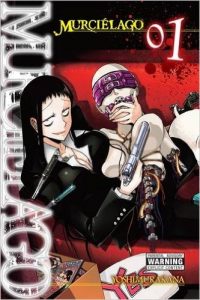
Story by Ryukishi07; Art by Hinase Momoyama. Released in Japan in two separate volumes as “Umineko no Naku Koro ni: Dawn of the Golden Witch” by Square Enix, serialized in the magazine GFantasy. Released in North America by Yen Press. Translated by Stephen Paul.
Warning: this reviews mentions the biggest spoiler in Umineko, which I have been dancing around until now. I won’t mention it in this first paragraph, but it’s hard not to review this final omnibus of the arc and discuss it, as it ends up being a major part of the climax. Before we get to that, though: I’ve talked before about how Ryukishi07 loves a good old fashioned shonen battle at heart, and a great deal of this book is just that. Various characters try to attack Beatrice and get blown away by various other characters, as you realize how ridiculously huge the cast has become by now. Erika finally loses, and judging by the “roll call” at the end of the book, seemingly abandoned to a watery grave by Bernkastel. And Ryukishi still can’t resist connecting Umineko and Higurashi, even though Featherine and Hanyuu are as alike as two very unalike things.

(I am very irritated with that front cover image, by the way. I know it’s not Yen’s fault, and that the Japanese licensor chose which cover to use and which to hide. But it makes me sad that the best cover in the series is relegated to the color page inside.)
For those trying to figure out what’s going on in Umineko, the manga has been a bit more obvious in its hints than the visual novel, even back in earlier arcs. For this particular arc, we’ve spent a long time debating why it is that Shannon, Kanon, and Beatrice need magic in order to have their love fulfilled, and this volume explicitly says it’s because they are not a whole person. Meanwhile, as predicted in the last volume, Battler is trapped in a logic error of his own making, trapped inside the guest room till he can figure out how to get out without disturbing the chain lock, duct tape seals, or anything else. The answer ends up being that Kanon, being dead (Shannon won the big duel), can now come free Battler and take his place. And then “erase himself” by magic. There’s only one way for this all to work, and that’s by realizing that we’re talking about IDENTITIES when we discuss people on the island, not BODIES. Shannon and Kanon cannot both love without magic help as they’re the same person. And both are also a third person – Beatrice.
This works a lot better than you’d imagine if you think about what is “real” in the books and what takes place in an imaginary fantasy world. We’ve gone on and on about “magic” being a conceit, and that’s in full force here. It’s also what allows Fledgling Beato to take up the place of her old self and become the “real”, haughty Beatrice – though that mask slips much of the time, and there’s still some creepy incestual vibes between her and Battler that is the big downside of this arc and I kind of hate. In any case, we may have figured out the gimmick behind one of the biggest mysteries of Umineko, but we’re still completely in the dark as to the motive? What led to this? Was it Battler’s sin (remember that)? Was it because everyone needed a lot of money right now? What drove Beatrice, whoever she may identify as, to the events of 1986?
We will hopefully find out soon (though Yen hasn’t scheduled it yet) with the 7th arc of Umineko: Requiem of the Golden Witch. I’m sure it will be happy and filled with good times – after all, Bernkastel will be in charge of this arc. What could possibly go wrong?





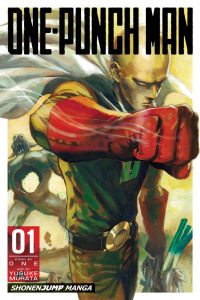 My name is Saitama. I am a hero. My hobby is heroic exploits. I got too strong. And that makes me sad. I can defeat any enemy with one blow. I lost my hair. And I lost all feeling. I want to feel the rush of battle. I would like to meet an incredibly strong enemy. And I would like to defeat it with one blow. That’s because I am One-Punch Man.
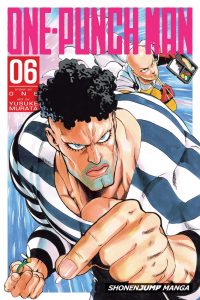 The balancing act ONE and Murata achieve here is impressive. On the one hand, One-Punch Man is gloriously silly. Heroes and foes alike are apt to be ludicrous, and some of the former have terrific names like Tank Top Vegetarian or Spring Mustachio (although I actually think he’s pretty cool). On the other hand, there is a lot of excellent shounen manga storytelling going on. The way Saitama lives his life without criticism for others makes me think he’d get along well with One Piece‘s Luffy, and the devotion his pupil Genos shows for him means they can always rely on each other. Too, after Saitama joins the Hero Association, we get regular updates on how his rank is improving, and this puts him in contact with even more heroes, some of whom are inept, some of whom are capable, and one of whom might actually be an enemy. He doesn’t seek glory, so many are unaware of his true strength, but I assume that eventually he will attain the rank he deserves (currently, due to poor performance on the written test, he’s far below Genos).
 As of volume eleven, there are several plotlines in play. Monsters are appearing everywhere, and appear to be organizing. Is this tied in with the prediction of an extinction-level event within the next six months? What about that hint of a possible traitor that was dropped a few volumes back? While a rogue martial artist named Garo is hunting heroes, Saitama is off at a martial arts tournament to learn more how to defeat Garo (not knowing that he totally already did) and seems destined to face off against another strong fighter who is desperate for a challenge. I admire how this story has widened in scope in a natural way, without compromising the balance of narrative and humor. It could conceivably go on for a very long time, and I deeply hope it does.