• Skip to primary navigation
  • Skip to main content
  • Skip to primary sidebar
  • Home
  • About Us
    • Privacy Policy
    • Comment Policy
    • Disclosures & Disclaimers
  • Resources
    • Links, Essays & Articles
    • Fandomology!
    • CLAMP Directory
    • BlogRoll
  • Features & Columns
    • 3 Things Thursday
    • Adventures in the Key of Shoujo
    • Bit & Blips (game reviews)
    • BL BOOKRACK
    • Bookshelf Briefs
    • Bringing the Drama
    • Comic Conversion
    • Fanservice Friday
    • Going Digital
    • It Came From the Sinosphere
    • License This!
    • Magazine no Mori
    • My Week in Manga
    • OFF THE SHELF
    • Not By Manga Alone
    • PICK OF THE WEEK
    • Subtitles & Sensibility
    • Weekly Shonen Jump Recaps
  • Manga Moveable Feast
    • MMF Full Archive
    • Yun Kouga
    • CLAMP
    • Shojo Beat
    • Osamu Tezuka
    • Sailor Moon
    • Fruits Basket
    • Takehiko Inoue
    • Wild Adapter
    • One Piece
    • After School Nightmare
    • Karakuri Odette
    • Paradise Kiss
    • The Color Trilogy
    • To Terra…
    • Sexy Voice & Robo
  • Browse by Author
    • Sean Gaffney
    • Anna Neatrour
    • Michelle Smith
    • Katherine Dacey
    • MJ
    • Brigid Alverson
    • Travis Anderson
    • Phillip Anthony
    • Derek Bown
    • Jaci Dahlvang
    • Angela Eastman
    • Erica Friedman
    • Sara K.
    • Megan Purdy
    • Emily Snodgrass
    • Nancy Thistlethwaite
    • Eva Volin
    • David Welsh
  • MB Blogs
    • A Case Suitable For Treatment
    • Experiments in Manga
    • MangaBlog
    • The Manga Critic
    • Manga Report
    • Soliloquy in Blue
    • Manga Curmudgeon (archive)

Manga Bookshelf

Discussion, Resources, Roundtables, & Reviews

Reviews

Hayate the Combat Butler, Vol. 34

October 2, 2019 by Sean Gaffney

By Kenjiro Hata. Released in Japan as “Hayate no Gotoku!” by Shogakukan, serialized in the magazine Shonen Sunday. Released in North America by Viz. Translated by John Werry.

The history of Hayate the Combat Butler is an interesting one. Very much a funny gag sort of story for the first 16 or so volumes, it attracted that sort of audience, and the first couple of anime were of that nature as well. Then came the Athena arc, which was really good, and set up a far more serious backstory for the manga, which attracted fans who really wanted to know about that story. And so the last ten to fifteen volumes have made an attempt to still be light-hearted gag comedy while throwing out the occasional plot bone to keep readers here for the plot satisfied. It… hasn’t really worked. This will reach its apex about two volumes from now, in the series’ most infamous chapter, but for the moment readers who want more about castles and coffins will be delighted to find there’s an extended section here where Hayate discovers a hidden room in the boarding house, with something very familiar inside.

It is notable that everyone involved in the discovery of the hidden room is not one of the “normal” cast members, if such a word can be used to describe people like Hinagiku or Nagi. It’s Hayate, Tama the tiger, the ghost priest, Alice, who still doesn’t remember her past but is there because of who she is, and Isumi, who reminds us that this is still a comedy even in the dramatic plot sections by making an absolutely ridiculous entrance through the wall of the building, knowing full well how awesome she will look. Sadly, she looks less awesome when up against the series’ new minor villain, whose name I’m not sure of yet but she does enjoy wearing her Gurren Lagann cosplay shades. This doesn’t answer many questions… well, OK, any questions, except who shade-wearing woman is working for… but it does remind you that this plot exists, and it weighs on Hayate’s mind.

Elsewhere,the boardinghouse continues to fill up, first by adding Ruka, who has “run away from home” because they’re trying to make her stop being a doujinshi artist and stick to pop idoling, as well as Ayumu, who literally has a mom and dad to live with but scrapes up the money to live in the boarding house for a month because she senses how big a threat Ruka is in the Hayate sweepstakes. (This leads to the best gag in the volume, where Hinagiku is stunned to find that she isn’t a threat – after all, if she can’t confess, what good is she?) We also get more of Ruka’s backstory, which matches Hayate and Hinagiku’s on the “bad parents” front (the bad parents are always in silhouette). And Nagi’s manga continues to be the series’ achilles’ heel, as her attempts to get better at it are bad and she still remains pretty annoying.

Still, overall this was a very good volume for the 5-6 people still buying this series, and if anything else we got to see Isumi performing feats even an olympic gymnast might have trouble with.

Filed Under: hayate the combat butler, REVIEWS

Suspension: Kubitsuri High School – The Nonsense User’s Disciple

October 1, 2019 by Sean Gaffney

By NISIOISIN, illustrations by take. Released in Japan as “Kubitsuri Hai Sukūru: Zaregoto Tsukai no Deshi” by Kodansha. Released in North America by Vertical, Inc. Translated by Daniel Joseph.

(This review was based on a copy provided by the publisher.)

It’s been a long time coming, my friends. We got the first two books of Zaregoto back in the Del Rey days, and they did not sell well at all. But Nisio’s reputation grew, and the Monogatari novels did better, and then Zaregoto got an anime, not to mention the constant fan begging on Twitter, and here we are: the third in the Zaregoto series, a mere nine years later. Was it worth the wait? I think so. It’s not as good as the second book, but that’s a very high bar to clear. More to the point, while it’s still invested in lampooning the mystery genre, Nisioisin is not as concerned with the intricacies of the Whodunnit anymore. Which is good, as it’s pretty obvious early on who the killer is. Instead we get what the Zaregoto series does best, which is a book that looks at what it means to be a normal human told through the story of people who aren’t remotely normal.

Ii-chan is abducted… erm, invited by Jun Aikawa to help her with an escape. There’s a certain girls’ academy that has a student that would like to leave it. And so Ii-chan dons a girls’ school uniform and goes to meet this girl, Ichihime Yukariki. Of course, things do not go quite as easy as that, as Ii-chan quickly finds that the school seems to be training up assassins. Needing to get rescued from the rescue by Jun, the three of them try holing up in the office of the Director, only to find that there’s no escaping a pile of corpses that keeps getting larger. In the meantime, Ii-chan continues to entertain the reader by being his usual self, deflecting, prevaricating, omitting, and outright lying most of the time. The question is, how is he going to deal with it when he runs into someone who’s a little bit like him? No, not Zerozaki, someone else.

This is a slim book, the shortest in the series (there was apparently a contest, which Nisio used as an excuse to add an extra book to his contracted amount), and it’s also far more action-filled than the previous two. Which is to be expected given that Jun plays a much larger role here. It’s also got a lot more corpses than the previous two, though to be fair most of those are offscreen. The reason to get the book, though, is the dialogue and conversations between Ii-chan and the cast. He still avoids saying his name, but does give a few hints to one of the students which might help narrow it down for those who might know Japanese and also be good at math. And Ichihime is also a fascinating new addition to the cast. I’m not sure if she’ll show up again, but I suspect that Ii-chan inviting her to live in the apartment complex he currently does is some fairly unsubtle foreshadowing. I also really liked the other two students we met here, but sadly this is the last we’re going to see of them, unless Nisioisin does something weird like write them into a prequel in his Zerozaki side series. Lastly, Jun calls Ii-chan out on being a mystery protagonist – like Jessica Fletcher, wherever he goes, murders follow.

This does not have the psychological fascination of the second book, as I said earlier. It’s a quick hit-and-run. But it’s still a really good read, and I certainly hope that it does well enough that we get the 4th and 5th books (a 2-parter) before 2029.

Filed Under: REVIEWS, zaregoto

Invaders of the Rokujouma!?, Vol. 23

September 30, 2019 by Sean Gaffney

By Takehaya and Poco. Released in Japan as “Rokujouma no Shinryakusha!?” by Hobby Japan. Released in North America digitally by J-Novel Club. Translated by Warnis.

As we are at a particularly dramatic point in the main storyline, clearly it is time for another short story collection that takes place before everyone went off into space. These stories all seem to take place at some vague point between Vols. 14-20, and once again three of them were serialized online and one is original for this book. You can probably guess that the best of the four is the exclusive one, and you’d be correct, but they’re all pretty decent, showing off these characters we’ve come to enjoy. The first story continues a theme of Harumi being rather annoyed at Koutarou treating her like the sweet, fragile girl, so she asks Kiriha for advice on how to be a “bad girl”. This goes about as well as you’d expect, as Harumi is as sweet as pie. Likewise, Clan is noted for her awkward tsundere attitude around Koutarou, and that’s not going to change either, even if she does start working out with him and Shizuka.

Elfaria gets the cover art for once, as well as the third story, where she explains why she looks so young (genetics, she’s an alien) and allows Yurika, Maki and Sanae to give her a makeover to make her look even younger, at least for a time. This also allows Koutarou to see Elfaria as she was when he first met her, which throws him for a loop – no doubt her intention. This all leads to the final story, where the class goes on a trip to… well, the text if careful not to say where they go, except they have to fly, but it’s not Kyoto. A rather lonely Harumi and Clan end up tagging along, but the big plot point of this story is another girl in the class, Shiori, who has known Koutarou since he was little, has made up her mind to confess to him. (His basic standoffishness is why she put it off for so long.) Suddenly the girls are all worried – sure, they’re all close to Koutarou, but will this girl pass them all?

The answer isn’t surprising (no), but the key point comes when Kiriha realizes what’s been bugging her about this whole situation: the girls are feeling jealous of Shiori, but not of each other. No one in the group resents anyone else for being in love with Koutarou. It’s important setup given that this ISN’T one of those fantasy isekai worlds where polygamy is legal to solve everything. Kenji also helps underline this point by telling Koutarou he has to buckle down and pick one of the girls to date formally, and Koutarou absolutely cannot so it as he can’t imagine living without any of them. The feeling of family has to come first – they all love each other, but “romantic love” is still down the road. The story also helps to remind everyone how much the girls – and Koutarou – have grown sine the start of the series.

So overall a good short-story collection. That said, I’ll be glad to be back in the main action with Vol. 24. Good thing it’s already out.

Filed Under: invaders of the rokujouma!?, REVIEWS

Accel World: Pull of the Dark Nebula

September 29, 2019 by Sean Gaffney

By Reki Kawahara and Hima. Released in Japan by ASCII Mediaworks. Released in North America by Yen On. Translated by Jocelyne Allen.

It goes without saying that Sword Art Online is just SLIGHTLY more popular than Accel World, by a factor of about 100. This despite the fact that I think that in general Accel World is the better written title, mostly as Kawahara learned form the mistakes he made in SAO. It serves him well in this 19th volume, which is, once again, almost entirely setup for the next big series of battles. The subtitle sounds ominous, but is actually suggestive of the larger plot: Kuroyukihime’s group is going to storm the White Legion territory, but there just aren’t that many of them. What’s more, Kuroyukihime herself needs to stay behind. What’s the answer? More allies. We already have the new snack-based trio that joined last time. And we have Niko and Pard. Perhaps Ash Roller. But is that enough? Can we get some former enemies on our side? What’s more, perhaps we can even… merge two legions? The author makes this sound pretty dramatic and exciting, which is good, because more than any other AW book to date, this is all conversations.

The former enemy is Magenta Scissor, which is not too much of a surprise. The surprise is who comes to fight/debate her into switching sides. It’s not Haruyuki, and I like that the cast has grown large enough that we can have scenes like this not need to feature him. Instead it’s Chocolat Puppeter, who engages in a water-based battle with her partner Avoacdo Avoider before getting to the core of Magenta’s cynical philosophy, much of which stems from her real life watching Avocado (who, it is hinted, has a learning disability in real life) get bullied by the other kids in the hospital they were both in. She also has a condition I’d never heard of, but (like everyone in Accel World) helps to explain her avatar in general. Again, a reminder that a good core of Brain Burst is based on childhood traumas.

The start of the book finishes up the conversation in the Castle, with Graphite Edge (who is feeling less like a Kirito gag and more like a takeoff on the typical blockhead shonen hero, though he’s smarter than that) divvying out information as slowly and obliquely as he can, but we do get an awful lot of plot and background details here that feel important. Accel World is, as far as I know, not ending anytime soon, but the pieces of what needs to be done before the ending are still in place. And, much like its parent series, we are also dealing with “NPC” characters who nevertheless pass every test of sentience out there. I’m not sure if Metatron’s fate will mirror Alice’s, but it’s plain to see what sort of things Kawahara was interested in and researching as he wrote this.

So this is a solid volume in the series. The 20th book sounds like it will begin the next “books of mostly fighting” arc, but I’ve been fooled by that before. Till hen, enjoy this book of mostly talking.

Filed Under: accel world, REVIEWS

Dorohedoro, Vol. 23

September 28, 2019 by Sean Gaffney

By Q Hayashida. Released in Japan by Shogakukan, serialized in the magazines Ikki, Hibana, and Monthly Shonen Sunday. Released in North America by Viz. Translated by AltJapan Co., Ltd. (Hiroko Yoda + Matt Alt).

I knew it had been a while since the last volume of Dorohedoro, but I did not realize that it had been a year and a half. It’s been a long journey – the manga started here in 2010, so almost ten years ago. And in Japan it’s been since 2002. This volume is packed – it’s 350 pages long, so essentially a double volume – trying to get everything resolved before the end of the series. As a climax, I think it’s very fitting. It is not without some last minute deaths (the Cross-Eyes, who have been the designated butt monkeys of this series, continue to fare badly) and is filled with lots of blood, gore and zombies, as you’d expect from Dorohedoro. But for the most part, this is as close to “and they all lived happy ever after” as you’re going to get from this story, and I was quite pleased. (It also stayed firmly on the side of “this is not about romance” – the three “couples” are together, but there’s nothing suggesting they aren’t just friends.)

I really can’t discuss this volume without discussing its major brilliant move. Caiman, for the most part, has been defined by his search for who is the head in his mouth – we now know – but also by his love of gyoza. This love has been far more than just a light coedy personality thing for some time now, but it’s in the final volume where it reaches its zenith. To stop the sorcerer-destroying monster, Caiman is made into a sorcerer, which gives him a magic rod that he can use how he sees fit. This ends up essentially turning him into Magical Gyoza Caiman, complete with a magical familiar gyoza, which we have, of course seen before. Together Caiman essentially functions in this final volume like Sailor Moon, going up against tthe big bad and the big bad’s final monster, and trying to rescue his friend, who has died. It’s Episodes 44-45. Except that Caiman actually survives.

Once this is taken care of and Nikaido is resurrected (she does not get much to do here, but her arc resolved before Caiman’s), it’s time for the epilogue. Well, actually, we do see Shin and Caiman join forces to defeat the monster right at the end, despite still having an understandable antipathy between each other. The epilogue shows Shin and Noi are still partners, Fujita is the only one who seems to think of honoring the dead, and that more than being a devil or being a sorcerer, Nikaido wants to run the Hungry Bug. Oh yes, and there’s Turkey, who offhandedly remarks that they apparently transitioned to a female for the past few years – something that En’s family notably doesn’t care about in the least, instead being more surprised that Turkey’s mask IS a turkey you can eat. I thought this was a terrific offhand character moment that fit right in.

And so we end Dorohedoro. Easily the most popular of the series that Viz debuted under the SigIkki imprint, I believe that its end means the end of that imprint as well, though I could be wrong. It was worth it. This was a badass, dark but hilarious journey from a woman manga creator filled with violence, nudity, friendships, tragedy, magic, and gyoza. I loved it.

Filed Under: dorohedoro, REVIEWS

Shojo & Tell: Moto Hagio Edition

September 28, 2019 by Katherine Dacey

To celebrate the release of Moto Hagio’s The Poe Clan, Shojo & Tell host Ashley MacDonald invited me to join her for an in-depth conversation about three of my all-time favorite manga: A, A’, They Were Eleven, and A Drunken Dream and Other Stories. We mulled over plot developments, discussed problematic passages, and agreed that “Iguana Girl” may be the biggest tear-jerker in the Hagio canon. (Seriously–I can’t read it without getting the sniffles.) Ashley just posted the episode, which you can check out here:

For more insight into the manga that we discussed, I recommend the following essays and reviews from The Manga Critic vault:

  • The Poe Clan, Vol. 1
  • A Drunken Dream and Other Stories
  • Manga Artifacts: A, A’ and They Were Eleven
  • An Introduction to Keiko Takemiya’s To Terra (essay explores Takemiya’s work in the context of the shojo manga revolution of the 1960s and 1970s)

I want to thank Ashley for the opportunity to chat about Hagio, and for doing such a terrific job of editing our conversation! If you’re not regularly following Shojo & Tell, I encourage you to check out the archive, as Ashley is a thoughtful host with a knack for choosing great manga and great guests. Recent contributors include Aisha Soleil and Rose Bridges discussing Bisco Hatori’s Ouran High School Host Club, Asher Sofman discussing CLAMP’s Tokyo Bablyon, and Manga Bookshelf’s own Anna Neatrour discussing Meca Tanaka’s The Young Master’s Revenge. Go, listen!


Filed Under: Manga, Manga Critic, REVIEWS Tagged With: Classic Manga, Magnificent 49ers, moto hagio, Sci-Fi, Shojo & Tell

Our Last Crusade or the Rise of a New World, Vol. 1

September 27, 2019 by Sean Gaffney

By Kei Sazane and Ao Nekonabe. Released in Japan as “Kimi to Boku no Saigo no Senjou, Aruiwa Sekai ga Hajimaru Seisen” by Fujimi Fantasia Bunko. Released in North America by Yen On. Translated by Jan Cash.

Let’s get this out of the way first: that is one awkward title, and it’s actually the much better choice, as when this was first announced by Yen the title was the even worse “The War Ends the World / Raises the World”. It’s trying to convey a certain apocalyptic mood, asking whether this book will feature the end of everything or the rebirth of something. This world has two power blocs fighting each other to the death. The Empire is a nation of science, with a mysterious council behind the scenes and battle-hardened swordsmen and engineers. The Sovereignty is a magic-dominated world, run by a royal family descended from their progenitor, and controls the very elements. They hate each other a whole lot. The Empire has just released its best swordsman, currently serving life in prison, to defeat the Sovereignty’s most powerful astral mage. He was a boy. She was a girl. Could I make it any more obvious?

If I was to be even more glib than I was in that last sentence (something I’m not sure is humanly possible), I’d say that this book is something like “Romeo and Juliet meets A Certain Magical Index”. Certainly Index fans will have a feeling of similarity with the magic and science sides of this particular world, especially given each have mysterious and possibly evil heads of state. Iska doesn’t quite have Touma’s bad luck, but the whole reason for his imprisonment seems to be that he saved an enemy mage (she didn’t have much power, and therefore he didn’t feel she deserved the treatment she got), which is very Touma. As for Aliceliese, there’s a good deal of Mikoto in her, particularly her tendency to get overemotional and upset when she keeps running into Iska coincidentally despite their being (supposedly) bitter enemies. Of course, they’re actually falling in love at first sight. Which, to be fair, is not much like Index, which will never given Touma romantic feelings.

This book is pretty solid, with some nice fight scenes, very amusing comedic romantic moments, and a reasonably-sized (for now) supporting cast. I will admit I did not immediately warm to Mismis, Iska’s commanding officer and “big sister”, mostly due to a very unfortunate interior illustration which can be described as “lol, huge boobs”, and I felt that her “empathic” skills that are apparently why everyone respects her should have been used a bit more often than the “ditzy klutz”. Speaking of the illustrator, they may be familiar to North American readers from Battle Divas, as well as the 2nd (of 3!) artists for The Magic in This Other World Is Too Far Behind!. Not a fan. Despite these flaws, though, I was intrigued enough to try more. It’s not as serious and dramatic as I’d have liked (for those who want that, give 86 a try), but if you want an “anime-style” action romance that for once does not seem to involve magic academies, this is a decent start.

Filed Under: our last crusade or the rise of a new world, REVIEWS

Ms. Koizumi Loves Ramen Noodles, Vol. 1

September 26, 2019 by Sean Gaffney

By Naru Narumi. Released in Japan as “Ramen Daisuki Koizumi-san” by Takeshobo, serialization ongoing in the magazine Manga Life Storia. Released in North America by Dark Horse Comics. Translated by Ayumi Kato Blystone.

We have had so many food-related manga coming out over the past few years that it’s become somewhat hard to break away from the pack, especially given that there’s dungeon crawl foodie manga, isekai foodie manga, Fate/Stay Foodie, etc. When I picked up the first volume of this, I was uncertain what we would get besides a lot of loving descriptions of ramen. And we certainly do get those. The title is no lie, and Koizumi will happily ramble on and on about broth, sauces, ingredients, soft or hard noodles, etc. But the series actually does a good job balancing out the ramen with a real cast of characters. Koizumi is a recent transfer student, and another student, the hyperactive, overly affectionate Yu, wants to be friends with Koizumi. (And possibly more, yes, but if there’s yuri in this it’s really tiny.) The difficulty is that Koizumi loves ramen noodles but not much else. And also Yu pushes way too hard.

The plot, such as it is, involves various ramen places and Koizumi eating in them, while Yu attempts to get to be her friend and mostly fails miserably. There are two other girls in the cast, the popular but fragile Misa and the “class president”-esque Jun, both of whom amusingly seem to bond with Koizumi much better than Yu, who is simply trying too hard. The series is light-hearted so this isn’t too much of an issue, with Koizumi mostly being very cold about it. And it does throw Yu a bone towards the end, when Koizumi collapses due to a personal tragedy (the ramen shop is closed today), and Yu makes her special (and weird) homemade ramen. The chapter with Misa, where she eats spicy ramen with Koizumi to get over a breakup, is excellent (I was expecting her to fold when she first tasted the ramen, but no…) and Jun’s chapter will resonate with anyone who has terrible eyesight.

The other star of the manga is, of course, the ramen. I’m not a ramen student, so mostly just smiled and nodded when Koizumi went off on her long tangents explaining ramen’s styles and variations, but they do seem very informative. I was especially amused by the chapter where she managed to find ramen in a McDonald’s (it was in Hawaii), and by contrast once ate a burger and fries in a ramen shop. She’s not Chie-sensei, she can eat other things. The ramen and eating of such are also drawn nicely, giving the reader a healthy appetite, which is the goal. Given that the series is seven-plus volumes in Japan, I’m sure we haven’t even begun to get into all the ramen discussion we could be having, though I hope that it continues to balance things out with stories of the four lead girls.

Food manga enthusiasts, or those who like manga starring a bunch of cute high-school girls, should like this. Just… take it down a notch, Yu.

Filed Under: ms. koizumi loves ramen noodles, REVIEWS

The Way of the Househusband, Vol. 1

September 25, 2019 by Katherine Dacey

If you’ve seen Lillehammer or My Blue Heaven, you’ll immediately recognize the foundation on which The Way of the Househusband is built: a mafia don or hit man renounces his old life and joins the ranks of ordinary civilians working nine-to-five jobs, mowing lawns, and attending school plays. Predictably, the transition from whacking rivals to whacking weeds is a bumpy one, as the former criminal discovers that the skills he acquired in his old line of work haven’t fully equipped him for a more prosaic existence; seemingly benign interactions at the principal’s office or the post office are fraught with peril, as they’re guided by unfamiliar social codes. Then, too, there’s the specter of his old life—the possibility that a former associate might recognize him or seek him out for one last job.

The Way of the Househusband covers all of this well-spaded ground, earning its laughs by putting fresh twists on familiar scenarios. Its protagonist, the stone-faced Tatsu, is a former yakuza boss-cum-househusband who spends his days making elaborate bento boxes for his wife and scouring the grocery store for bargains. As is standard for this particular fish-out-of-water genre, Tatsu’s sangfroid is sorely tested by the minor annoyances of civilian life: a visit from the neighborhood association president, a trip to the mall.

When a knife salesman knocks on Tatsu’s door, for example, author Kousuke Oono teases the idea that his characters’ interactions might end in violence or a harrowing demonstration of Tatsu’s knife-wielding skills. Instead, Tatsu has an opportunity to show off his culinary prowess, winning over the understandably nervous salesman with his “patented hamburger steak plate.” The salesman’s rhapsodic expression and interior monologue put the gag over the top, as the salesman identifies the dish’s secret ingredient—“minced fish paste”—and muses that its flavor “takes me back to my hometown.”

Strong artwork is essential to selling a slapstick premise like Househusband’s, and for the most part, Oono succeeds. Oono’s characters have distinctive appearances that makes it easy to “read” their comic function–the suspicious neighbor, the former crime associate–but Oono never relies on this technique alone, often giving bit players an unexpected moment of steeliness or resourcefulness that nudges the joke in an unexpected direction. The salesman, for example, looks like a soft, middle-aged man, but turns out to be stronger, pushier, and more determined than his initial reaction to Tatsu might suggest, quickly recovering his composure after Tatsu answers the door wearing a bloody apron. (“I was just, uh, doin’ a little butcherin’,” Tatsu explains sheepishly.)

Appearance-wise, Oono does a great job of making Tatsu look utterly incongruous with his surroundings. With his pencil-thin mustache, scarred face, and aviator sunglasses–not to mention his black suit and tattoos–Tatsu cuts a striking figure in the supermarket and on the street. Oono invigorates this obvious sight gag by swathing Tatsu in housewife “drag,” outfitting him in a kerchief and apron emblazoned with a shiba inu to further emphasize just what a fish out of water Tatsu is. That same attention to detail extends to the way that Tatsu moves; Oono draws him like a human cobra whose sinewy, explosive movements strike terror into his enemies’–and his neighbors’–hearts.

Sheldon Drzka and Jennifer LeBlanc’s skillful adaptation of the script is the icing on the cake, giving every character a distinctive voice, and every exchange the pleasant zing of a good Saturday Night Live or Key & Peele sketch–no mean feat, given the cultural specificity of the jokes.

As good as the script and art are, however, I have a sneaking suspicion that Way of the Househusband might run out of gas after three or four volumes unless Oono pivots the storyline in a new direction–say, by introducing a baby into the picture, or revealing that Tatsu’s hard-charging wife has a secret past of her own. But for now, I’m happy to continue reading any series that pits a former yakuza boss against a Roomba and a frisky cat, or depicts a manly man going to extreme lengths to ensure that his wife has a tasty lunch. In the immortal words of Paris Hilton, that’s hawt. Recommended.

VIZ Media provided a review copy. Read a free preview here.

THE WAY OF THE HOUSEHUSBAND, VOL. 1 • STORY AND ART BY KOUSUKE OONO • TRANSLATION BY SHELDON DRZKA, ADAPTATION BY JENNIFER LEBLANC • VIZ MEDIA, LLC • 166 pp. • RATED T+, FOR OLDER TEENS (SUGGESTED VIOLENCE, YAKUZA JOKES)

Filed Under: Manga, Manga Critic, REVIEWS Tagged With: Comedy, VIZ, VIZ Signature, Way of the Househusband, Yakuza

Otherside Picnic, Vol. 1

September 25, 2019 by Sean Gaffney

By Iori Miyazawa and shirakaba. Released in Japan by Hayakawa Publishing. Released in North America by J-Novel Club. Translated by Sean McCann.

This is the third in J-Novel Club’s line of “sci-fi yuri”, and it’s arguably the least sci-fi of the lot. In fact, I’d argue it’s more straight up horror with elements of folklore, though there are lots of explanations for what’s going on in scientific terms, and even a “works cited” at the end. As with the author’s previous book, Side-by-Side Dreamers, I think this book would be more for the horror fan than the yuri fan. That said, the relationship between the two leads is one of the main reasons to get the book. It’s told in first-person POV, and does a good job of sublimating its “I am attracted to this woman” vibe beneath a general “she is pretty while I am so plain” mindset. But it’s the plot that brings them together, as they’re relying on each other while exploring – and later, trapped – in another world which has very lethal dangers to both of them. The dangers are the reason I called the book horror – this book is TERRIFYING at times.

Sorawo is our main heroine and narrator. She presents herself as being your typical introvert with a normal past, which turns out to be mind-bogglingly far from reality, but we don’t find out about that till the end. She likes to explore abandoned areas, and one day found an entrance to another world. After a couple of brief minute-long explorations, she decides to investigate for real – and ends up about to drown in a marshland. She’s saved by Toriko, who appears to be Sorawo’s opposite, but again, appearances can be deceiving. She’s in this other world looking for her friend/mentor/crush, who disappeared a while back. They decide to team up and try to find her, and also learn more about this world and its monsters, which are seemingly based on Japanese urban legends… something Sorawo is very familiar with.

I will state here that there was one aspect of the book I wasn’t too fond of. The concept of the brilliant scientist/doctor/genius who looks like an elementary schoolgirl has been done to death in Japanese media, and I don’t think we needed it here. Honestly, Kozakura would have worked exactly the same without that aspect of her character, functioning as “mission control” and later brought in, much to her dismay, to the actual otherside world. It was hard not to think of her as Hakase from Nichijou. Other than that, though, this ended up being a ball to read, though I will state those who dislike horror imagery may want to give it a pass. There’s lots of images and phrasing designed to scare, and it works. Sorawo also grows greatly throughout the book, forced to examine her own personality and realize her shortcomings. Toriko doesn’t fare as well, as we get no POV of her, but the good news is that for once this is not the first and only book in the series, and there are two more to date. Which is good, as the book ends with everyone still trapped, and I’d like to see how/if they get out.

If you enjoyed Last and First Idol and Side-by-Side Dreamers, there’s no reason not to immediately get this book. For those new to the “genre”, I’d recommend it for thrills and great dialogue and imagery.

Filed Under: otherside picnic, REVIEWS

Restaurant to Another World, Vol. 3

September 23, 2019 by Sean Gaffney

By Junpei Inuzuka and Katsumi Enami. Released in Japan as “Isekai Shokudou” by Shufunotomosha. Released in North America by Seven Seas. Translated by Elliot Ryouga. Adapted by Jude Wetherell.

We’re introduced to the third main cast member from the anime here. Kuro (who calls herself Black in her inner monologue, but they mean the same thing anyway) is an ancient legend now living, literally, on the moon because in her true form she causes people to drop dead around her. Fortunately, she can suppress it when she turns into an elf girl and can enter the restaurant, where she falls in love with the chicken curry and stays to become the restaurant’s second waitress. That said, much like the first two books, the staff don’t get much focus at all. The emphasis is on the diners – some old friends, some new – and the food they’re eating. We jump around a lot more here, sometimes confusingly (one chapter ends with an ancient warrior going to see his late lover, who seems to have the same name as our sweets-loving princess), but if you love reading about food, this remains the light novel for you.

Indeed, sometimes the novel seems to actively avoid any conflict at all. The first and second volumes had a few arguments (usually about food), but there’s none of that here, as they’ve learned to simply avoid the people they know would cause friction. It’s especially obvious with Kuro, who once has an ancient Elven priestess come for food and completely not notice her, despite mentioning her fearsome and terrifying past earlier in the book. It was a bit frustrating to me till the end, when it became apparent that – much like her power of “death” – Kuro seems to be making it so that she’s unnoticed by all but the strongest folks – and they’re not saying anything. She was asked by “Red” – the dragon we’ve seen earlier – to essentially be security for the restaurant in case someone tries to kidnap the owner and take him back to the other world. So far she’s done her job very well, but it can lead to a certain… I want something exciting to happen, dammit!

Till then, there’s just getting excited about the food. We get a few interesting variants here. Birthday Cake comes up to celebrate a child’s not-quite-coming-of-age-but-close-enough, and we see the Master preparing BBQ for a Japanese festival he’s participating in (we do not actually see the festival). The sake-steamed clams sounded amazing. And oh yes, right near the end as the legendary warrior is experiencing the wonder of croquettes, we find that the Master and his father (who we also see, as several of these chapters take place “in the past”) may not be as completely unrelated to the fantasy world as previously expected. I liked the idea, very appropriate for a book like this, that since the master was not able to use, say, magic or swordfighting in modern-day Japan, that he was taught how to be a marvelous chef instead. You pass down what you can to teach your children.

We’ve seen a plethora of food-related manga and novels recently, but this one remains in the top tier for both descriptions of delicious food and also giving you enough characterization and plot to keep coming back for more even though it’s still a bit thin. A yummy read.

Filed Under: restaurant to another world, REVIEWS

Witch Hat Atelier, Vols 1-3

September 22, 2019 by Anna N

Witch Hat Atelier Volumes 1-3 by Kamome Shirahama

It is rare to find a series that is so fully realized in terms of both art and story that there is absolutely nothing to nitpick, but Witch Hat Atelier is one of those manga. Coco is a young girl who helps her mother who is a seamstress. Coco lives in a world where magic is practiced only by a select few, but she’s extremely curious about how it all works. Her life is changed when she sees a flying carriage land near her mother’s shop and she runs into a mysterious gentleman who wears glasses with one tinted lens. Coco ends up cutting a length of cloth for the man, and she recounts a story that ties in with her fascination for magic. When she was younger, she encountered an enchanter who wore a hat decorated with a single eye, fringed with fabric that obscured his face. He offered to sell Coco a book of magic spells and even gave her a wand. Coco soon found out that people need to be born to magic, and gave up on her dream. When the flying carriage is damaged, the mysterious man identifies himself as Qifrey the Witch, and he decides to fix it. Coco spies on him and discovers that magic isn’t something one is born with, it relies on careful drawing with a pen. She promptly decides to experiment.

witch hat atelier

Like most books that feature a child adventurer and inconvenient parents, Coco’s mother is quickly dispatched when Coco’s first spell goes awry, turning her into a statue. The only solution is for Coco to dedicate herself to learning magic in order to reverse the spell. She becomes Qifrey’s newest apprentice, and travels with him to his school where he is already teaching several other girls her age. Coco has an enthusiasm for knowledge and a unique way of looking at magic but her fellow apprentices are suspicious of her. Coco’s roommate Agott in particular has a cranky attitude which backed up with unusual expertise in magic. The world of magic can be dangerous, for example when Agott goads Coco into taking a test that she’s unprepared for. The girls later get whisked away to a labyrinth guarded by a dragon due to some machinations of the witch with the eyeball hat, and later help with a rescue. The world is filled with odd magical contraptions that take the place of technology, like a water bubble for transporting water, bricks that light up under people’s feet, and shoes that are enchanted to give the power of flight.

Shirahama has a detailed style that is reminiscent of illustrations that might be in a classic childrens’ book. Panels are occasionally decorated with botanical motifs, with a nod to art nouveau. The various costumes of the witches have elaborate decoration, and spells look intricate, causing effects that look both elegant and unnatural. The worldbuilding and illustrations are lovely, but there’s an undercurrent of menace, as the one-eyed hat magical practitioner is intervening in Coco’s life for an unknown reason. The secretiveness of the witches also causes Coco to be threatened with a memory wipe spell multiple times. Her status as an outsider gives her an innovative and instinctive feel for magic, and she often manages to improvise spells due to her unique mindset. Coco’s new found family keeps expanding as the series develops, and it seems like she’s meeting other magic practitioners that ultimately will help her if there’s a confrontation with the dark witches who seem to be far too interested in her. There’s certainly some Harry Potter parallels, but not enough to make it seem like Witch Hat Atelier isn’t original. I’m equally entertained by both the art and the story in Witch Hat Atelier, and highly recommend it if you are looking for a fantasy series that lets the reader disappear into another world for a little while.

Filed Under: Manga Reviews, REVIEWS Tagged With: kodansha, witch hat atelier

Cats of the Louvre

September 22, 2019 by Sean Gaffney

By Taiyo Matsumoto. Released in Japan as “Louvre no Neko” by Shogakukan, serialized in the magazine Big Comic Original. Released in North America by Viz Media. Translated by Michael Arias.

In the beginning there was Rohan at the Louvre, a one-volume collection published by Musée du Louvre Editions in an effort to publicize the famous museum. It was written by Hirohiko Araki, the author of JoJo’s Bizarre Adventure, and I believe also serialized in Ultra Jump. Then we get Guardians of the Louvre, by the late Jiro Taniguchi, author of The Walking Man (he gets a cameo signing said manga at the end of this volume, which made me tear up.) Both of these were published here by NBM Publishing. And now we have Cats of the Louvre, by Taiuyo Matsumoto, author of Tekkon Kinkreet and Sunny. Each of these volumes, despite all being about the Louvre Museum, have also been books you can pick up and immediately know who drew it. They are all very distinctive artists. And this applies whether we are seeing cats, humans, or the odd cat-human hybrids that Matsumoto decides to use through the story, a choice I was not a big fan of at first but grew to like. Best of all, the plot is terrific.

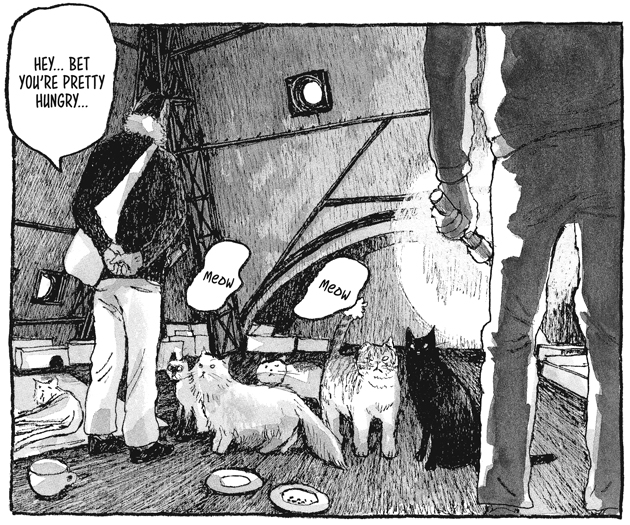
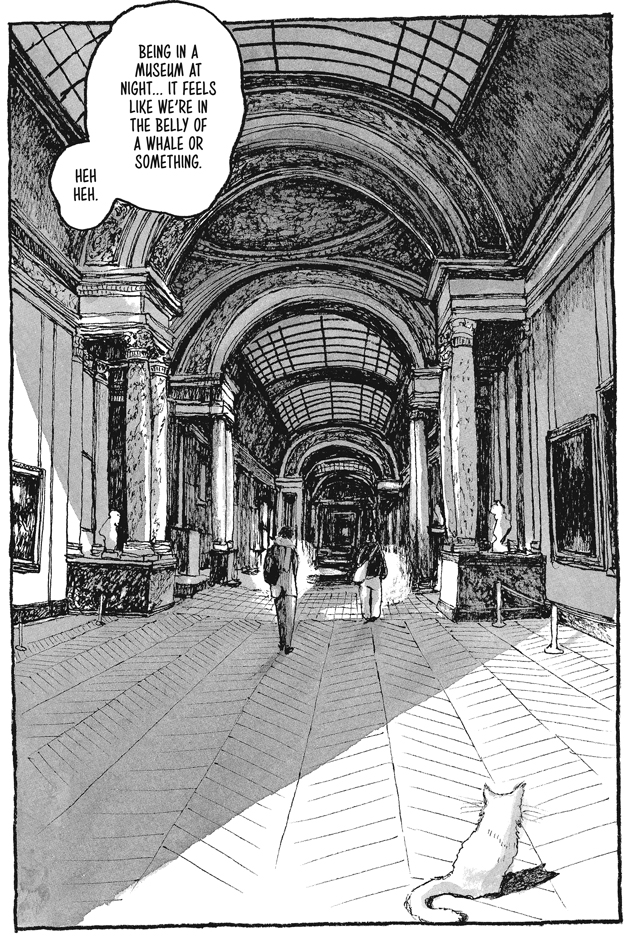
The cat on the cover is the main protagonist, Snowbebe, a small white kitten who has remained small and a kitten for about six years now. He’s one of many cats that live secretly in the museum, helped out by the night watchmen who know they’re there but don’t say anything. There’s also Cecile, a middle-aged Louvre tour guide who dislikes large crowds and is therefore not at peace with her job. She sees Snowbebe during one of her guided tours, but then he vanishes. Talking about it with the night watchmen, Patrick and Marcel, she is asked – as Marcel has asked everyone for the decades he’s worked there – if she can hear the voices of the paintings. Turns out there’s a very good reason for this question, which ties in with his sister, who also disappeared looking at a painting – but unlike Snowbebe, she did not return. Can the cat really walk through paintings, and if so, which painting is the one Marcel’s sister went into?

This is the basic plot, but I’ve left out all the other cats who also inhabit the Louvre, many of whom have personalities of their own and one of whom is very unhappy with Snowbebe wandering through the museum and paintings when he pleases and getting them in trouble. Usually with a book like this you’d expect to empathize with Snowbebe’s innocent sense of wonder, but after a while you start to see the other cat’s point – it’s looking less like innocence and more like a refusal to grow up (you never age in paintings, which is why Snowbebe is still a kitten). I also liked the minor plotline with Cecile trying to find the correct painting Marcel remembered, and then trying to meet with her old teacher, who is restoring it – we hear that she was on the fast track to be a restorer as well, till her father died and she had to leave school. I do wonder if she might be enticed back to that side of the business, which seems far more her speed.

The plot and characters are very good, but I’d argue the art and mood of the book is the main reason to get it. Matsumoto’s quirky, “indie” art style fits the Louvre well, and there’s many times when I found myself having to go back and read the dialogue as I’d been concentrating too much on the images. This deluxe hardcover edition should be read by anyone who loves manga.

Also, the art opposite the title page has Snowbebe looking just like Kitten Kong from the Goodies, which I loved. Whole lotta cat…

Filed Under: cats of the louvre, REVIEWS

Full Metal Panic!: Trembling Into the Blue

September 21, 2019 by Sean Gaffney

By Shouji Gatou and Shikidouji. Released in Japan by Fujimi Shobo. Released in North America by J-Novel Club. Translated by Elizabeth Ellis.

This third book in the series serves as the climax of the first season of the anime, and thus is quite well-remembered. It takes place mostly on the Tuatha de Danaan, as unfortunately Sousuke inviting Kaname to spend time on a south sea island is thwarted by the plot: terrorists are attacking US Special Forces, supposedly for ecology reasons, but in reality it’s all related (as indeed everything in this series is) to Tessa’s brother, still unseen but controlling things from afar (apparently giving orders while having sex too, in case we didn’t dislike him already) and Gauron, who it turns out- surprise! – is not as dead as first thought. Combine this with some evil moles within Tessa’s own people, and you have the basis for another action movie, which is what FMP does best. Unfortunately, Kaname is upset thinking that Sousuke is only with her out of a sense of duty, and Sousuke is still having trouble dealing with his Very Special AS, so they need to get past mental burdens before the day can be saved.

After briefly appearing to be more of a femme fatale in the second book, Tessa slides into the girl we know and love here, who loves Sousuke but has a sneaking suspicion that ship has sailed, and more importantly is more devoted to her ship and crew. She gets to be extra badass here, helped by Kaname, who finally gets to learn more about what she is and how it’s both valuable and incredibly dangerous. The rest of the crew are mostly just names, with the exception of our designated traitors and designated victims of said traitors. Their identities are fairly obvious as they’re the ones who are constantly moaning and bitching about being in MITHRIL while on this mission, and (unlike Kurz) are easily swayed by money and/or racism. And then there’s Gauron, far more competent than any of them but again seemingly just in this for the lulz rather than any sort of agenda. Fortunately, he’s blown up AND drowned at the end of the book, and I’m sure we’ll never see him again.

There are some funny parts of this book, rest assured. The first fifth or so is hilarious, going from Sousuke’s festival fortress to the way that they have to board the Tuatha de Danaan, which seems designed solely to be animated. And I won’t even get into Kaname and Tessa both singing Get Up (I Feel Like Being a) Sex Machine. Which I’m fairly certain was NOT in the anime. But once the terrorists arrive, the mood quickly turns serious. You’re especially reminded that neither Kaname nor Sousuke are quite what the other one thinks of them: Kaname is beset with self-doubt and hesitation, belying the idea that she’s always the confident “hits him all the time” tsundere. And Sousuke screws up a LOT in this book, to the point where Kurz punches him in the face for making Kaname cry. He’s certainly not the stoic superman Kaname thinks he is. They’re made for each other, honestly.

All in all, an excellent addition to the series, and fans of the anime will want to read this to see what else was left out besides James Brown. Next time we get the series’ first two-parter. Oh yes, and thank you, Elizabeth Ellis, for keeping the iconic “everything is gonna happy” from Kaname’s “I’m good at English but not great” message to the crew.

Filed Under: full metal panic!, REVIEWS

The Way of the Househusband

September 20, 2019 by Anna N

The Way of the Househusband Volume 1 by Kousuke Oono

I was looking forward to The Way of the Househusband very much, because the title, premise, and subtly menacing cover art made it seem like just the type of action and humor manga I would enjoy. The househusband in question is a former yakuza member whose nickname was “The Immortal Dragon.” I think it is easy for a reader to tell if they will like this series from the first few pages, which show the househusband waking up, clothing himself grimly in all black, putting on an apron, and then making an adorable bento box for his wife. The househusband loves coupons, sales, and going to grocery stores while wearing his shibainu apron. Unfortunately his past has a tendency to catch up with him. While the Immortal Dragon still has the skills to administer a severe beatdown, often he disarms situations with his househusband hobbies by breaking through people’s emotional barriers with homemade cookies or a pair of deeply discounted gloves.

househusband

I particularly enjoyed the marriage scenes in this manga. The househusband’s wife is a designer who loves anime, and the lengths to which he will go to make her happy display the same relentless attitude that I’m sure helped helped him ruthlessly dispatch his enemies. It would be hard to pull off this title without solid art, and Oono excels at showing the househusband with epic resting bitch face that basically means that regular people find him terrifying. He seems to always be surrounded by film noir shadow effect lighting that throws his features in stark contrast. The larger format of the Viz Signature line makes it easier to appreciate the fight scenes taking place in mundane locations. I had high expectations for this title and I wasn’t disappointed.

Filed Under: Manga Reviews, REVIEWS Tagged With: the way of the househusband, viz media

  • « Go to Previous Page
  • Page 1
  • Interim pages omitted …
  • Page 133
  • Page 134
  • Page 135
  • Page 136
  • Page 137
  • Interim pages omitted …
  • Page 342
  • Go to Next Page »
 | Log in
Copyright © 2010 Manga Bookshelf | Powered by WordPress & the Genesis Framework