• Skip to primary navigation
  • Skip to main content
  • Skip to primary sidebar
  • Home
  • About Us
    • Privacy Policy
    • Comment Policy
    • Disclosures & Disclaimers
  • Resources
    • Links, Essays & Articles
    • Fandomology!
    • CLAMP Directory
    • BlogRoll
  • Features & Columns
    • 3 Things Thursday
    • Adventures in the Key of Shoujo
    • Bit & Blips (game reviews)
    • BL BOOKRACK
    • Bookshelf Briefs
    • Bringing the Drama
    • Comic Conversion
    • Fanservice Friday
    • Going Digital
    • It Came From the Sinosphere
    • License This!
    • Magazine no Mori
    • My Week in Manga
    • OFF THE SHELF
    • Not By Manga Alone
    • PICK OF THE WEEK
    • Subtitles & Sensibility
    • Weekly Shonen Jump Recaps
  • Manga Moveable Feast
    • MMF Full Archive
    • Yun Kouga
    • CLAMP
    • Shojo Beat
    • Osamu Tezuka
    • Sailor Moon
    • Fruits Basket
    • Takehiko Inoue
    • Wild Adapter
    • One Piece
    • After School Nightmare
    • Karakuri Odette
    • Paradise Kiss
    • The Color Trilogy
    • To Terra…
    • Sexy Voice & Robo
  • Browse by Author
    • Sean Gaffney
    • Anna Neatrour
    • Michelle Smith
    • Katherine Dacey
    • MJ
    • Brigid Alverson
    • Travis Anderson
    • Phillip Anthony
    • Derek Bown
    • Jaci Dahlvang
    • Angela Eastman
    • Erica Friedman
    • Sara K.
    • Megan Purdy
    • Emily Snodgrass
    • Nancy Thistlethwaite
    • Eva Volin
    • David Welsh
  • MB Blogs
    • A Case Suitable For Treatment
    • Experiments in Manga
    • MangaBlog
    • The Manga Critic
    • Manga Report
    • Soliloquy in Blue
    • Manga Curmudgeon (archive)

Manga Bookshelf

Discussion, Resources, Roundtables, & Reviews

Features & Reviews

Henshin

February 18, 2015 by Ash Brown

HenshinCreator: J. M. Ken Niimura
U.S. publisher: Image Comics
ISBN: 9781632152428
Released: January 2015
Original release: 2014

J. M. Ken Niimura is probably best known for his collaboration as an illustrator with writer Joe Kelly on I Kill Giants, an award-winning American comic that was completed in 2008. Among many other honors, the work earned Niimura and Kelly the top International Manga Award in 2012. A Spanish artist of Japanese descent, Niimura currently lives and works in Tokyo. Henshin is his first major Japanese publication. The collection includes thirteen short manga that were originally released online between 2013 and 2014 on the website for Ikki, a magazine that has been the home to some of my favorite mangaka, before finally being collected into a single volume. (An interesting sidenote: I Kill Giants was also published in Japan by Ikki Comix.) Henshin was subsequently released in Spanish in 2014 by Norma Editorial and in English by Image Comics in 2015. Out of the three print releases of Henshin, the English-language edition has the largest trim size.

The manga collected in Henshin are short, anywhere from twelve to twenty-eight pages in length. Although there are a variety of genres and styles, the stories generally fall into one of two broad categories: those that are semi-autobiographical, focusing on either Niimura’s creative processes or his love of cats, and those that are fictional narratives largely set in or near Tokyo or otherwise featuring Tokyoites. For the most part, the individual manga are unrelated and stand perfectly well on their own, but the first and last stories do share the same lead characters and there is a running episodic story about Niimura and a cat that lives near his apartment. Henshin includes slice-of-life manga, as well as manga with science fiction and fantasy elements, pieces infused with nostalgia, family and friends, pieces where loneliness and missed connections predominate, stories with a bit of humor, and stories with a bit of sadness.

MerciAlthough the manga in Henshin are all different, they do share some thematic and narrative similarities. The first story, “No Good,” perfectly captures the tone of the volume as a whole. It starts out as a seemingly innocent tale but it suddenly shifts into something completely unexpected and outlandish. Most of the stories in Henshin have some sort of twist to them that require the reader to reconsider and reevaluate everything that has come before. Those surprising plot developments may be humorous, touching, absurd, disconcerting, or even morbid, in any combination. In Japanese, “henshin” means transformation, metamorphosis, or change, which is exactly what the stories collected in the volume have to offer—pivotal moments in which all of a sudden things are no longer the same, demanding a new and different understanding of reality.

Niimura exhibits a range of art styles in Henshin, drawing influence from Asian, European, and American comics traditions. Some of the illustrations are simple caricatures while others are more detailed or involved, some even reminiscent of classic ink wash paintings. The artwork in each of the short manga is tailored to fit the specific story and its mood, but in every case Niimura’s illustrations show impressive narrative strength. In general, Henshin uses minimal text and dialogue—one manga is even completely wordless—relying on the artwork (which performs magnificently) to actively aid in the telling of the stories. Henshin is an excellent and rather delightful collection of charming and quirky short manga that, in all of its strangeness and occasional absurdity, remains emotionally relevant and carries an impact. I enjoyed Henshin immensely and hope to have the opportunity to read more of Niimura’s comics and manga in the future.

Filed Under: REVIEWS Tagged With: Image Comics, J. M. Ken Niimura, manga

Bookshelf Briefs 2/16/15

February 16, 2015 by Sean Gaffney, Anna N and Michelle Smith Leave a Comment

This week, Sean, Anna, & Michelle look at recent releases from Seven Seas, Yen Press, and Viz Media.

centaur5A Centaur’s Life, Vol. 5 | By Kei Murayama | Seven Seas – This volume does a god job of balancing out the slice-of-life and the worldbuilding. ON the one hand we have chapters like the one with Kyoko and her brother, which reassures us that despite both being goat/human hybrids they’re still a typical family with rivalries and brattiness. On the other you have the last chapter, showing the history of how the centaurs gained rights, with this world’s Napoleon promising them freedom if they fight under his command. And in the middle we see Suu and her childhood friend appear to talk about manga romances not being the same as real life (she seems a bit creeped out). This series is decidedly odd, and that’s what keeps it so readable. – Sean Gaffney

foodwars4Food Wars!, Vol. 4 | By Yuto Tsukuda and Shun Saeki | Viz Media – With a minimum of fanservice, and a good heaping help of classic Shonen Jump tropes, this is the best volume of Food Wars! to date. Soma’s battle with Shinomiya is really Megumi’s battle, and she shows off once again why she’s an amazing chef if she can just learn to stop panicking. But for Soma, who knows they won on a technicality, the frustration of losing leads to self-harm (don’t worry, it’s just punching a wall). And while the last volume saw Megumi on the verge of expulsion as the cliffhanger, here we see Soma in the same situation, as his breakfast menu has not gained any support. There’s also the usual bevy of eccentric characters and amusing one-shot gags, and it may just be the lack of ‘this food is making me having an orgasm’ pages, but I’ve come to love this. – Sean Gaffney

happymarriage10Happy Marriage?!, Vol. 10 | By Maki Enjoji | Viz Media – In our final volume, most everything gets resolved. What I appreciated most was the implicit realization that both Hokuto and Chiwa married too soon, and how to fix that without simply breaking up, as they do love each other dearly. That said, they just can’t stop getting on each other’s nerves, and it’s fitting that the final chapters show off how they’re always going to be fighting each other, and have simply come to accept it. The series has existed on that sort of tension, so doesn’t just want to get rid of it with an overly soppy ending. But they’re married – again – and Chiwa may be pregnant, so all is well. The marriage parts of this were, in the end, the victor over all the ‘Hokuto’s backstory’ parts. – Sean Gaffney

honeyblood0Honey Blood: Tale Zero | By Miko Mitsuki | Viz Media – This volume collects the first chapters of Honey Blood, where we get a previous version of the story that is a bit more humorous and improbable, and the heroine has a slightly less strong personality. I think the changes in the version for the two volume manga were for the better, but it was interesting to get a peek into the creative process involved in reworking a story for longer serialization. The volume is rounded out with some additional short stories, one featuring a tomboyish girl with a crush on an aspiring male makeup artist, and a story between a boy and girl next door that doesn’t end well. This volume is probably best for completists only, the other two volumes of Honey Blood stand on their own. While I think this series didn’t completely come together, I’d like to check out other works by Mitsuki, because I did enjoy the art and aspects of the plot. – Anna N

roseprincess2Kiss of the Rose Princess, Vol. 2 | By Aya Shouoto | Viz Media – I was hoping the second volume of Kiss of the Rose Princess would help me decide what to make of this series, but it’s so different from the first—introducing a villain who attacks two knights and kidnaps a third, as well as a weakening seal on the demon lord that can only be repaired with a terrible sacrifice—that I remain kind of baffled. I appreciate the more serious moments, though there is still plenty of unfunny comedy, and it’s really jarring when what could’ve been an important moment is undermined by a stupid gag. Too, I suspect either Shouoto or her editor was a fan of Buffy the Vampire Slayer, because there are a couple of plot elements that are so similar they’ve got me wondering. Still, it’s an improvement overall, and I find myself willing to stick around a bit and see where this goes. – Michelle Smith

souleater24Soul Eater, Vol. 24 | By Atsushi Ohkubo | Yen Press – I appreciated the reminder midway through this volume of how terrifying the series can get, as Crona’s attack on the infiltrators is something that I will likely have nightmares about. That said, even Crona can’t stop Asura from being the final big bad, and it’s up to Maka, Black*Star and Death the Kid (who has a brief comedic detour back to Earth, the best joke in the volume) and their respective weapons to stop him. We’ve only got one more volume to go, and that sounds about right, as there’s time for one last battle, Shinigami-sama’s death (which is clearly lampshaded here), and a big celebration to end it all. Soul Eater has given us a bizarre skewed shonen manga, right to the end. – Sean Gaffney

toriko26Toriko, Vol. 26 | By Mitsutoshi Shimabukuro | Viz Media – It’s all battles again in this new Toriko, so I have less to talk about. It was interesting to see an actual death of a named character, as Tommyrod is finished off by Sunny in a battle of the disturbing. Meanwhile, Brunch’s battle against a supposed immortal invincible character shows off how little those attributes actually mean in a manga like this. The most troubling battle goes t Toriko, who is almost killed off before revived by the sound of Komatsu crying for him (in case you hadn’t figured out he’s the heroine by now). Is he actually ready to take on Starjun? And is this the real enemy, or is there now a 3rd party gumming up the works? Man, remember when this was all about food? More food, please. – Sean Gaffney

Filed Under: Bookshelf Briefs

My Week in Manga: February 9-February 15, 2015

February 16, 2015 by Ash Brown

My News and Reviews

Last week was a two-review week here at Experiments in Manga. I read and loved Ellery Prime’s Gauntlet, the first novel to have both started and finished in Sparkler Monthly. I’m not sure the review really does the book justice–the story is difficult to write about without spoiling it–but Gauntlet is really good stuff. Ever since reading the novel, I haven’t been able to get it out of my head. (Coincidentally, both Gauntlet and Jen Lee Quick’s marvelous comic Off*Beat are currently on sale!) The second review posted last week was of Setona Mizushiro’s After School Nightmare, Volume 2. So far, the series remains a disconcerting but compelling work. The manga has a lot of dark, psychological drama, which I tend to enjoy, although that can also make it a difficult read from time to time. Many of the characters simply aren’t very nice people. The review is a part of my monthly horror manga review project; next month it will be Mushishi‘s turn again.

On to other interesting reading and news from elsewhere online! The Young Adult Library Services Association has released its 2015 Great Graphic Novels for Teens. The annual list is always worth a look. The manga for 2015 include All You Need is Kill, My Little Monster, My Love Story, Seraph of the End, Summer Wars, Voice Over! Seiyu Academy, Wolf Children: Ame & Yuki (the only manga included on the top ten list), and World Trigger. Over at Organization Anti-Social Geniuses, Laura from Heart of Manga provides The 2015 Shoujo Manga Forecast, a comprehensive overview of the shoujo manga that has so far been announced for this year, listed by publisher and expected release date. And on the Vertical Tumblr there is a post Reviewing the “Best Manga of 2011” from a licensing angle which I found to be particularly fascinating. Speaking of Vertical, three new licenses!–Seraph of the End light novels, Ninja Slayer manga, and KizuMonogatari.

Quick Takes

Air Gear, Volume 32Air Gear, Volume 32 by Oh!Great. This is actually the first volume of Air Gear that I’ve ever read, and the only other manga by Oh!Great that I’ve been exposed to is the very beginning of Tenjo Tenge. From that limited experience, I expected there to be violence and a fair amount of fanservice in Air Gear, and there certainly is. Since I’m not particularly familiar with Air Gear, its plot, or its characters, unsurprisingly I was a bit lost reading the thirty-second volume. It didn’t help that Oh!Great’s use of flashbacks and flashforwards seems haphazard, making it difficult to maintain a firm grasp on the manga’s chronology, and therefore was not as effective as intended. There are only five more volumes in the series and even though I’m unaware of all of the details, it is quite obvious that there has been a tremendous buildup to reach the thirty-second. The volume concludes at least one major battle and leaves several important characters dead. Even though I wasn’t able to follow everything that was going on story-wise, I could still appreciate Oh!Great’s dynamic artwork (beginning with the stunning cover illustration) and the series’ over-the-top action. If nothing else, Oh!Great can draw.

Assassination Classroom, Volume 1Assassination Classroom, Volumes 1-2 by Yusei Matsui. The junior high students of class 3-E are the academic underachievers and juvenile delinquents whom no one else in the school wants to deal with, but they’re apparently also the only ones who have any chance of saving the world from being destroyed. The teens have less than a year to assassinate their teacher, a superpowered tentacle creature who plans on disintegrating the planet after their graduation. Although he has a few weaknesses, Koro Sensei is extremely powerful, impervious to most weapons, and able to move at Mach 20. A successful assassination will require a significant amount of creativity and teamwork. Surprisingly, even though he intends to destroy Earth, Koro Sensei is actually a great teacher who seems to genuinely care about his students, challenging them to better themselves and encouraging them not only in their studies but in their assassination attempts as well. Assassination Classroom is a strange but enjoyable series. 3-E is a class of losers and outcasts who, when given the opportunity and shown that someone actually believes in them, are able to overcome challenges even if they haven’t figured out a way to kill Koro Sensei yet.

From the New World, Volume 6From the New World, Volumes 6-7 written by Yusuke Kishi and illustrated by Toru Oikawa. The manga adaptation of From the New World frustrates me immensely. The story is fantastic, the setting intriguing, and the atmosphere incredibly dark. But overall the manga just isn’t very satisfying, suffering from tonal imbalance and uneven worldbuilding and plot development. Although there’s still some ridiculous fanservice–Saki’s breasts in particular are constantly being emphasized to the point of distraction–these volumes fortunately are mostly lacking in the explicit sex scenes found throughout the rest of the series that seem completely out-of-place and interrupt the narrative flow of the story. The final volume with its dramatic conclusion of the war between the morph rats and the humans, would have been one of the strongest in the series except for the fact that the last chapter, which serves as a lengthy epilogue, slightly fumbles what is perhaps the series’ biggest twist. Quite a few of the reveals in the final volumes likely would have been more powerful if they had been encountered earlier in the story. In the end, I still think what I really want is to read Kishi’s original novel.

Stones of PowerStones of Power by Isora Azumi. A few years ago I read and enjoyed the first quarter or so of Stones of Power when it was initially being serialized in the Gen anthology. The manga has since been collected into a single volume, including material that I believe hadn’t previously been released. Stones of Power is admittedly unpolished and its artwork fairly generic, but there are things I really like about the manga. It mixes the mundane with the supernatural in rather curious ways, especially in the beginning. Fujita is a young man with a passion for fish who ends up being hired to maintain the aquarium at a small cafe. That might not be a particularly strong hook for most readers, but I happen to really like fish and used to keep a tank of my own. It just so happens that the fish Fujita’s been put in charge of are actually dragon gods and the two siblings he works for are fox spirits. From there Stones of Power spins off into an increasingly strange and dangerous situation in which Fujita, who apparently has an unexpected affinity for the occult (or at least the dragons), is unwittingly dragged into a battle between the foxes and an ancient power that threatens the life of an innocent young girl.

Filed Under: FEATURES, My Week in Manga Tagged With: air gear, assassination classroom, From the New World, Isora Azumi, manga, Oh Great, Toru Oikawa, Yusei Matsui, Yusuke Kishi

Nura: Rise of the Yokai Clan, Vol. 25

February 15, 2015 by Sean Gaffney

By Hiroshi Shiibashi. Released in Japan as “Nurarihyon No Mago” by Shueisha, serialized in the magazine Weekly Shonen Jump. Released in North America by Viz.

We’ve come to the final volume of this Shonen Jump series, and as it turns out I had not done a full review of it since the very first. That first review is sort of retroactively hilarious, talking about what was mostly a high school comedy about Rikuo trying to hide his yokai heritage from his friends while dealing with a minor love triangle. Now here we are at the end, and I don’t think we’ve had a volume that wasn’t basically either a giant battle or preparations for a giant battle since around the early teens. When you have a hero that can transform into a handsome badass, and a large cast filled with eccentric but fascinating supernatural creatures, no one cares about your human childhood friend. Sorry, Kana.

nura25

But of course the tradeoff is that, while I’ve basically enjoyed myself throughout the series, there’s been very little to talk about with each individual volume, hence why I’ve kept my comments to the Bookshelf Briefs. Even here, the first half of the book is basically the climax of the final battle, which is as you’d expect – the villain is convinced he’s won, but with the help of all his yokai companion, as well as a reformed villain or two, our hero pulls it out despite risking death (as does his grandfather, who actually meets his wife in “heaven” before returning as his time is not yet over). With everything won, we return to the (somewhat beat up) clan house, where a giant party proceeds to end the volume. Well, except for several side-stories to pad it out to a proper length – by the end of the series, Nura was running in ‘Jump Next’, a side-magazine, which allowed it to have its 80-page finales but also hinted it was being put out to pasture.

And it’s for the best, really, as I’m not sure how much more Nura had to give. It’s always been one of those series that was good but not great, and you can’t see the ‘Final Volume!’ at the back cover without thinking “Oh good”. As ever with Jump series, we’d had an escalating scale of villains, but with the last one basically being a creation of absolute evil, there’s nowhere else to go after that. As for the romance, it was the typical non-romance you get in Jump titles like these. There’s enough tease to keep Tsurara fans happy, and it’s implied Rikuo returns her feelings, but nothing really happens. In a world where we recently saw Naruto trying to pair people up and fail so miserably (I actually do like Naruto/Hinata, but there’s no denying that rushed ‘epilogue’ was pretty miserable), and where Bleach fans await the end of their series with dread and prepared outrage, this seems quite satisfying.

The cover shows us three generations of Nuras, which is good as honestly in black and white I can’t tell them apart, and they’re all smiling and showing off their badass poses. It’s a good cover for a series that has never been amazing or addictive, but more solid and dependable. I enjoyed reading you, Nura. Now… GET OUT!

Filed Under: REVIEWS

Alice in the Country of Joker: Circus and Liar’s Game, Vol. 7

February 13, 2015 by Sean Gaffney

By Quin Rose and Mamenosuke Fujimaru, based on the game by Quin Rose. Released in Japan as “Joker no Kuni no Alice – Circus to Usotsuki Game” by Ichijinsha, serialized in the magazine Comic Zero-Sum. Released in North America by Seven Seas.

This review contains spoilers for the “Bad End” of the visual novels.

Of all the Alice spinoffs, this one is clearly my favorite, and I’ve said why in previous reviews I did for Bookshelf Briefs. The romance between Alice and Blood doesn’t overwhelm the story. There isn’t as much painful filler the way some of the lower-tier Alice spinoffs have, where you can find yourself in Crimson Empire at the drop of a Hatter subplot. But mostly I think I like it as the main plot is very much dedicated to psychological trauma, Alice’s in particular but also everyone else. Time after time in Circus and Liar’s Game we see her back in the prison, with her sister Lorina sitting in a cell that only Alice can open. Joker is taunting her, trying to get her to face up to the memories of her past that she avoids. And the entire rest of the cast tries to stop her, and get her to stay there and not remember.

alice7

We’re never going to get a ‘bad end’ in these spinoffs, and I think it’s a shame, because the more I read of this series the more I think I really want to see it. Alice remembers that her sister is dead, and wakes up back in the real world, clearly older than the franchise has been portraying her, and having apparently been completely devastated by the loss. Thus staying in Wonderland – kept in that “Sunday Afternoon” that Peter White represents – is denial of reality, and the inability to grieve and move on with her life. And it’s clear that the series, in almost all its endings, really wants you to pick ‘denial’. Throughout Circus and Liar’s Game, Alice is tempted by Joker, and we do cheer when Blood confronts Joker and even takes a wound in order to stop her giving in. In the end, she even marries Blood. But is it really a “happy ending”?

There are two reasons I ask this. The first is the epilogue of this volume, where Alice ends up in the Country of Diamonds after a fight with Blood, and is horrified to find that every relationship she’s had is lost. Blood in particular is not the one she knows, even though he’s still willing to protect her if need be. The best part of this is that it’s not Joker tempting Alice to return to reality in this world, but Ace. Ace has always functioned as the most dangerous protagonist, the one who only loves Alice when she’s upset, fretting or struggling. Here she’s his ideal (and it’s worth noting that we see “adult” Ace here, not the teenage one from the Diamonds VN). That said, the epilogue can’t bring itself to destroy its happy ending, and she chooses to return to her Blood, who she wakes up with.

The other interesting thing is what Alice chooses to become, and how it ties into Blood and Vivaldi. As with the main Alice series, their relationship is a key aspect of the plot here. We get flashback hints (which I suspect I’d understand more if I played the game, but that machine translation drives me up the wall) that they aren’t just brother and sister, but were once like Alice herself. And that’s what makes the ending extra disturbing, as Alice’s ‘Outsider’ status is now considered a Role, one she willingly takes on. Does this mean that she has a clock in her chest now? It’s possible I’m reading too much into this, but I think in the end I’m like Ace. I like the Alice series best when it’s troubled, disturbing, and has nasty implications. Even if Alice is getting great sex with Blood and happy endings. This Circus and Liar’s Game has been a terrific look at the psychology of the series.

(Also, Alice looks fantastic in that Negotiator outfit. She should wear it more often.)

Filed Under: REVIEWS

After School Nightmare, Vol. 2

February 13, 2015 by Ash Brown

After School Nightmare, Volume 2Creator: Setona Mizushiro
U.S. publisher: Go! Comi
ISBN: 9781933617176
Released: December 2006
Original release: 2005

The second volume of Setona Mizushiro’s After School Nightmare, a disconcerting shoujo manga series with dark psychological elements, was originally released in Japan in 2005. The English-language translation was published by Go! Comi in 2007. The entire ten-volume series is now out-of-print in English, but happily the individual manga can still be found relatively easily. I had initially read the first few volumes of After School Nightmare by borrowing them from a library before deciding to track down a set of my own. However, I never got around to reading the entire manga until now because, although the beginning of the series immediately captured my attention, the manga was honestly discomforting. The first volume introduces a surreal setting in which dreams can be just as terrifying and damaging as the realities from which the characters would like to escape. After School Nightmare is a manga that is both fantastically strange and oddly compelling.

Conflicted and confused over his gender due to having a body that is neither entirely male nor female, Mashiro has tried to keep his physical condition hidden from others by living his life as a boy, but now that closely kept secret is out. Every Thursday after school, he and a handful of other students participate in a special class required for their graduation. During the class they literally share a dream, or rather a nightmare, together. In the process their true selves are revealed to the other students, and so a few of Mashiro’s classmates have found out about his body. Within the dreams, Mashiro has fallen victim to the cruel Black Knight, another student whose identity he is unsure of but who he suspects may be Sou. In waking reality, Sou has forcibly kissed Mashiro, insisting that he is a girl and even going so far as to declare his love for him. It is not a situation that Mashiro is comfortable with and if he can get up the courage he intends to confront Sou, whether it be in the nightmare or outside of it.

After School Nightmare, Volume 2, page 56Frankly, Sou is a jerk. He may be earnest in his feelings for Mashiro, and he’s at least started to try to reign in his aggressiveness, but he has yet to show Mashiro any sort of respect. I can’t like the guy because of the way he treats Mashiro, however I do still have some sympathy for him. Sou, like all of the other students in the special class, suffers greatly from emotional abuse and trauma. Still, that does not excuse his behavior towards Mashiro. Even so, he is positioned as one of Mashiro’s two potential romantic interests in After School Nightmare, the other being Kureha. Although she has made an exception and is currently dating Mashiro, she hates and despises men. Mashiro and Kureha generally get along, but their relationship isn’t as healthy as it could be, mostly but not entirely due to Mashiro’s continued insecurities over his gender. He seems to believe that his identity is defined and determined by the person he is intimate with. Because he’s desperate to be seen as a man, this calls into question whether or not he’s actually in love with Kureha, or if he’s simply dating her as a way to prove his masculinity.

The shared dreams in After School Nightmare are a way of forcing the students to face and work through the darkness that exists within their hearts and psyches. In theory, those nightmares are supposedly intended to be kept separate from reality, but the two worlds do have an effect on each other. The distorted forms the students take within the dreams can be terrifying, but what really makes them so disturbing are the troubling truths and dark pasts that they reveal. The pain, suffering, and hatred that is readily visible in the nightmares still exists and is present in their waking lives. Usually hidden, suppressed, or otherwise concealed, the prejudices that the students carry within them occasionally erupt violently. The skills and maturity needed to deal with these emotional, psychological, and physical disturbances are at least in part being developed within the dreams. In After School Nightmare, Volume 2, Mashiro begins to learn the importance and power of mental strength and fortitude, but both he and his classmates all still have room to learn and grow.

Filed Under: REVIEWS Tagged With: after school nightmare, Go! Comi, manga, Setona Mizushiro

Manga the Week of 2/18

February 12, 2015 by Sean Gaffney, Ash Brown, Anna N, Michelle Smith and MJ 1 Comment

SEAN: A fairly subdued third week, with a lot of recurring series and one decidedly odd debut.

On the Kodansha side, Cage of Eden has another fanservice-tastic cover for its 17th volume, but hopefully will work in some more giant extinct animals and brushes with death as well.

And we get the final volume of over-the-top manga comedy Manga Dogs with Vol. 3.

Seven Seas has a fourth volume of Black Butl—sorry, of Devils & Realist. (Their plots aren’t all that alike, but they seem to share the same aesthetic.)

And we get a 2nd volume of superhero manga Lucifer & The Biscuit Hammer, with vols. 3 & 4. The end of the first omnibus got dark pretty fast – will we get new heroes?

ASH: I had no idea what to expect from the first omnibus, and I’m not sure where the second one will be going, but I’m rather enjoying the series’ quirkiness.

hitomi1

SEAN: Nurse Hitomi’s Monster Infirmary is a new Seven Seas series that looks to combine monsters from mythology and slapstick comedy. And given it runs in Comic Ryu, I expect a lot of fanservice as well.

Vertical has a 5th volume of shonen card-battle manga Cardfight!! Vanguard (the exclamation point placement is very important).

And a 3rd Witchcraft Works, with more witches and badass heroines.

ASH: Another delightfully quirky series that I’m enjoying. The artwork is quite nice, too.

SEAN: Lastly, Viz has a 5th volume of dystopian action series Gangsta.

ASH: I’m actually behind in reading Gangsta, but I’ll definitely be picking up the new volume.

ANNA: I think I missed the fourth volume! I do really enjoy this series and am looking forward to catching up.

SEAN: Are you watching out for something this week?

MICHELLE: I am sad to say that literally nothing on this list particularly appeals to me. But! All hope is not lost, for there is more Boys Over Flowers on the horizon and that makes me cautiously happy!

MJ: I am sad to say the same. And I’m probably more skeptical about the Boys Over Flowers than Michelle is, so even that fills me with “meh.”

SEAN: Boys Over Flowers… so much influence, so many volumes, so much “WHY?!?!”

MICHELLE: I admit it has many flaws, but I love it anyway. I’m afraid season two will really suck, but that won’t keep me from checking it out anyway.

ANNA: I am super excited for this!

Filed Under: FEATURES, manga the week of

Gauntlet

February 11, 2015 by Ash Brown

GauntletAuthor: Ellery Prime
Illustrator: T2A

Publisher: Chromatic Press
ISBN: 9780993861123
Released: December 2014

Although Ellery Prime has been writing for years, Gauntlet, illustrated by the talented T2A, is her first original novel to have been published. Gauntlet is also the first novel to have both started and finished in Chromatic Press’ multi-media online magazine Sparkler Monthly before being released in print. Gauntlet began serialization in the very first issue of Sparkler Monthly in 2013 and was completed in 2014, after which it was revised and complied into a single volume. The finalized version of Gauntlet also includes additional material not found elsewhere: “Square One,” a short prequel to the main story, as well as a few amusing yonkoma-style bonus comics. Gauntlet has been very accurately described as a “survival horror romance novel” by the publisher. I’m actually kind of glad that I waited to read Gauntlet until it had been finished; the number of twists and cliffhangers would have made the wait between chapters torturous.

Twenty-two-year-old Clio has recently moved to the big city. Embarking on her new life as a responsible, independent adult, Clio is largely enjoying living on her own. After three months she has grown more and more comfortable as a resident of the city and with finding her way around its streets and alleyways, but that all changes when she makes a wrong turn and puts her trust into the wrong people. Suddenly Clio finds herself a reluctant participant in a game of survival, trapped inside the Gauntlet–an incredible and expansive system of interconnected buildings at the heart of the city. Clio doesn’t even know the rules she should be following, nor does she know who is responsible for the game or why she was chosen as a participant. Each person she encounters in the Gauntlet has their own reasons for being there, and many are playing by their own rules. Clio may be in even more danger than she realizes. The other players she meets are just as likely to manipulate or betray her as they are to help her.

Gauntlet -T2AOne of the things that makes Gauntlet particularly engaging and enthralling is its setting–the Gauntlet itself. The complex is logic-defying, a constantly changing labyrinth that presents very real survival concerns: finding food, clean water, and safe places to hide and rest, not to mention avoiding capture and falling into the hands or under the influence of people who, intentionally or not, mean harm. But the Gauntlet is also insidiously seductive. At first Clio desperately wants to find a way out and to escape, but there’s an underlying fear that she will lose her will to do so. Some people, perhaps most, never leave the Gauntlet after entering it even if they survive. Clio discovers many who are mindlessly shuffling through its halls and corridors as well as participants who have simply give up, content to be controlled by others. But most dangerous and terrifying are those people who have made deliberate, conscious decisions to remain within the Gauntlet’s depths.

The characters in Gauntlet are just as intriguing and complex as the novel’s setting. In the beginning Clio isn’t nearly as independent as she believes herself to be. Very early on she attaches herself to Britt, another young woman in the Gauntlet, which will have significant ramifications later on. Again and again Clio comes to rely on others and again and again she is taken advantage of by those very same people, all of whom have their own motivations and desires. But she grows and becomes stronger, impressively so. In some ways, Gauntlet feels like a dark homage to Lewis Carroll’s Wonderland–the Gauntlet and the people within it operate by their own logic with surprising, unexpected, and sometimes curious and peculiar results–and there are frequent nods to other stories and fairy tales as well. After finishing the novel, not only did I want more of Gauntlet, I also wanted to immediately read it again to see how all of its individual pieces fit together from the beginning. That, to me, is a sign of a great piece of fiction.

Filed Under: REVIEWS Tagged With: Chromatic Press, Ellery Prime, Light Novels, Novels, T2A

Haganai: I Don’t Have Many Friends, Vol. 10

February 10, 2015 by Sean Gaffney

By Yomi Hirasaka and Itachi. Released in Japan as “Boku wa Tomodachi ga Sukunai” by Media Factory, serialization ongoing in the magazine Comic Alive. Released in North America by Seven Seas.

There is always a certain level of frustration in a harem comedy, which its audience tends to want resolved immediately and its parent company tends to want to have it go on indefinitely. The author is usually caught in the middle somewhere. Harem fans love the romance to a point, but after around 6 or 7 volumes the voices start creeping in, wondering why the hero doesn’t understand that all these girls are all over him, why isn’t he going after (girl who is not the lead girl), why isn’t he manning up and showing all these girls who’s boss? (I will get into the inherent sexism of much of the harem manga fans at a later date.) Haganai has always been a bit meta about such things, and here the face of that fan becomes Rika, as she has finally had enough of Kodaka’s act.

haganai10

There’s actually a nice buildup to this the entire volume. Sena’s attraction to Kodaka has been obvious, as has her frustration, but Kodaka has been very good about hiding his desires for anything to go further with anyone. Now we see that he’s starting to become more obvious – ending up shopping with Sena on what is clearly a date, at least until she presses the issue of whether he wants a girlfriend or not. Later on, when Kate and Maria (look, if I say ‘Zoro’ and ‘Ryouga’ I’m allowed to say ‘Kate’ as well) show up at his house, and we get the inevitable full frontal nudity fanservice that seems to be this titles way of driving away any readers I might lead to it, Kate observes that she’s like to go after him, but it’s no real use – after all, he has Sena. His ‘huh?’ is used as the cliffhanger here, but when it’s followed in the next chapter by ‘I knew what she was trying to say’ we know that he’s started to stop lying to himself, at least.

The Friends Club is, to a degree, inhabited by people who are socially inept and have difficulty communicating in ways that society considers ‘normal’. This manifests itself on Kodaka’s end both by his desire to have the club stay together no matter what, but also his denial that he has any friends, the purpose of the club. Staying in a comfortable place where you can quietly hate yourself and hang out with friends without risking anything. If you admit you’re friends, then why have a club? If you admit you’re falling for Sena, then won’t everything fall apart? And is this club more important to someone like Yozora than it is anyone else?

This culminates in the maid cafe scene, where the girls all do their best to show why a maid cafe is a disastrous idea. For Rika this involves acting like a stereotypical ‘tsundere’ maid, but in reality it’s a way to work off some stress about Kodaka’s dumb act. Earlier in the volume, we heard her say out loud that no one can be that oblivious, and his response was, naturally, “What’s that?’. Readers of this series should know that’s almost a catchphrase by now, and it’s not because he’s hard of hearing. So when Rika ‘serves’ Kodaka as a maid, her service turns into 15 minutes of abuse and torture, which the others observe is a way to get her frustration out of her system. Kodaka admits to himself he knows what she was trying to do. But he still doesn’t say anything.

Can a harem comedy, especially these days, go on forever without making a choice? If Kodaka admits his feelings for Sena, will the readers abandon ship the way Yozora might? It’s a high-wire act that’s really hard to achieve, but a little meta makes it enjoyable.

Filed Under: REVIEWS

My Week in Manga: February 2-February 8, 2015

February 9, 2015 by Ash Brown

My News and Reviews

A small variety of posts went up at Experiments in Manga last week. First up, the Cinderalla manga giveaway winner was announced. The contest was a tie-in to the Female Goth Mangaka Carnival, so the post also includes a list of the featured creators’ manga available in English. The first in-depth manga review for February was Saki Nakagawa’s Attack on Titan: Junior High, a parody spinoff of the immensely popular Attack on Titan franchise. The series’ funniness can be somewhat uneven, but it can be absolutely hilarious at times. And posted over the weekend was January’s Bookshelf Overload, revealing the absurd amount of manga that came into my household last month.

Elsewhere online, Viz Media’s Shojo Beat announced two new licenses: QQ Sweeper by Kyousuke Motomi (the creator of Dengeki Daisy, which I rather enjoy) and Idol Dreams by Arina Tanemura. Organization Anti-Social Geniuses posted The Very Unofficial Guide to Discovering Manga in 2015, which is a nice overview of demographics, publishers, where to read and buy manga, and so on. Den of Geek has an interview with comics historian Graham Kolbeins, one of the editors behind Massive: Gay Erotic Manga and the Men Who Make It and The Passion of Gengoroh Tagame: The Master of Gay Erotic Manga. Finally, Otaku USA interviews Patrick Macias about Hypersonic Music Club, his collaboration with artist Hiroyuki Takahashi and the first of Crunchyroll Manga’s original series.

Quick Takes

Sky LinkSky Link by Shiro Yamada. Like many boys’ love mangaka, before making her professional debut Yamada started by creating doujinshi (she seems to have been particularly fond of pairing Gintoki and Hijikata from Gin Tama together). Sky Link is Yamada’s first original manga and is currently the only work of hers available in English. The volume collects two unrelated boys’ love stories, the titular “Sky Link” and “You through a Kaleidoscope.” Unfortunately, neither of the short manga are particularly satisfying; while her artwork can at times be quite lovely (occasionally her characters’ eyes are unintentionally creepy), Yamada definitely has room to grow as a storyteller. “Sky Link” had too many disparate elements to it. It could have worked quite well as a longer series, but as a short story Yamada didn’t have enough time to effectively develop the plot or characters and everything is left frustratingly vague. Ritsuki is a first year college student with some sort of troubled past who has caught the attention and affections of one of his new professors who, it is later revealed, has a troubled past of his own. “You through a Kaleidoscope,” a fairly standard high school boys’ love romance, isn’t as ambitious but is more successful as a result.

Tsubasa: Reservoir Chronicle, Omnibus 1Tsubasa: Reservoir Chronicle, Omnibuses 1-2 (equivalent to Volumes 1-6) by CLAMP. I originally read the first few volumes of Tsubasa back when it was being released by Del Rey. Because I was borrowing it from the library and people had a tendency to steal volumes Tsubasa and its sort-of crossover series xxxHolic, I never got very far with the series. I’m glad that Kodansha is bringing Tsubasa back into print, because it really is an immensely enjoyable adventure tale. And because the setting is constantly moving from one dimension to the next, CLAMP is able to have a lot of fun with the clothing designs and worldbuilding from one short story arc to the next. The drive of the series is the search for Princess Sakura’s memory, pieces of which have been scattered throughout space and time, but the remembrances of her and the other characters form an important part of the story as well. I do think I’m enjoying Tsubasa a little more my second time trying to read it. I’ve now been exposed to more of CLAMP’s work, so I can better appreciate the references being made and the alternate-dimension versions of characters from the group’s other manga. (Seeing couples originally from X actually have a chance at happiness is both touching and heart-wrenching.)

UQHolder3UQ Holder!, Volume 3 by Ken Akamatsu. I enjoyed the third volume of UQ Holder more than I did the first two, but the series has yet to win me over. It seems as though the manga is starting to focus a bit more, which it desperately needed to do, but that may simply be because Akamatsu spends very little time on trying to develop a coherent plot and primarily sticks with the action sequences. The third volume is almost entirely devoted to a sequence of fight scenes. Right now the battles in UQ Holder are probably my favorite thing about the series. They are entertaining, exciting, and extremely energetic. And because immortals are involved, they can be pretty epic, too. The damage inflicted on both persons and property is impressive. Many of the characters, even the non-immortals, have superhuman powers of some sort. Incredible strength, quick regeneration, shape-shifting, and magic—either alone or in combination—are only a few examples of the over-the-top abilities found in UQ Holder. But as entertaining as the battles can be, from time to time the action is unclear. Something will happen and it will be extremely difficult to understand exactly what or how. I’m not even going to try to attempt to explain why Yukihime suddenly loses her skirt for seemingly no reason.

Filed Under: FEATURES, My Week in Manga Tagged With: clamp, Ken Akamatsu, manga, Shiro Yamada, tsubasa, UQ Holder

Attack on Titan: Junior High, Vol. 2

February 6, 2015 by Ash Brown

Attack on Titan: Junior High, Omnibus 2Creator: Saki Nakagawa
U.S. publisher: Kodansha
ISBN: 9781612629186
Released: November 2014
Original release: 2013-2014

I was actually a little surprised by how much I ended up liking the first omnibus of Attack on Titan: Junior High. Created by Saki Nakagawa with input from Hajime Isayama (both of whom actually attended the same design school, though that fact is more of a coincidence than anything else), Attack on Titan: Junior High is specifically a parody spinoff of Isayama’s immensely popular manga series Attack on Titan. More generally, the series is also a parody of just about any manga with a school setting. Attack on Titan: Junior High is an odd mix of Attack on Titan and contemporary school life that actually manages to work much of the time. The second Attack on Titan: Junior High omnibus, released by Kodansha Comics in 2014, collects the third and fourth volumes of the series’ original Japanese edition, published in 2013 and 2014 respectively. Kodansha was kind enough to send me a review copy of Attack on Titan: Junior high, Omnibus 2 which, because I enjoyed the first omnibus, I was particularly happy to see.

Life isn’t easy for the human students of Attack Junior High. Not only do they have to worry about the normal sorts of challenges encountered at school–getting a passing grade in class, surviving the ire of upperclassmen, daring to ask another student on a date, ensuring their clubs aren’t suspended, and so on–they also have to worry about the rest of the student body, the Titans. It doesn’t help that Attack Junior High’s principal just so happens to be a Titan as well, meaning most of the administration looks the other way as the Titans terrorize the much smaller students, the victims of bullying and stolen lunches. But then there’s the beloved teacher Mr. Erwin Smith who on the surface seems to favor the Titans when in actuality he harbors a deep-seated hatred so intense that it rivals Eren’s. Considering Eren’s single-minded commitment to taking on and taking out all of the Titans, this is rather impressive.

There is no denying that Attack on Titan: Junior High is an utterly ridiculous manga series. In general, I think that overall I probably enjoyed the first omnibus slightly more. The novelty of the spinoff has worn off some, but the second omnibus still managed to make me laugh on multiple occasions. I do find that the series works best for me when it is directly riffing on the original Attack on Titan manga and its fandom rather than playing around with more generic story tropes. Granted, from time to time those parodies can be entertaining, as well. But ultimately Attack on Titan: Junior High tends to be rather uneven with its humor. Sometimes the manga can be absolutely hilarious, but just as often the attempts at comedy just aren’t very funny. Unsurprisingly, many of the jokes in the series require readers to already be very familiar with Attack on Titan to really appreciate them, but it’s those readers for whom the series is intended to begin with.

Attack on Titan: Junior High and its style of humor certainly will not appeal to everyone. It’s not particularly clever and much of the manga can only be enjoyed by readers who are already predisposed towards random, absurd, and frequently nonsensical comedy. The English translation and localization of Attack on Titan: Junior High is fairly loose in sections, adding a few jokes here and there and freely changing pop culture references to ones that will likely be more recognizable to Western audiences. I’m not sure how funny or effective some of the changes will be in a few years’ time since they often refer to recent events, but for now they are amusing. The best gags are those where Nakagawa takes the characters of Attack on Titan and emphasizes and distorts their personality quirks to extremes. One of the most appealing things about the original Attack on Titan is its ensemble cast, and that is true of Attack on Titan: Junior High as well. Fortunately, that’s something that doesn’t rely on timeliness.

Thank you to Kodansha for providing a copy of Attack on Titan: Junior High, Omnibus 1 for review.

Filed Under: REVIEWS Tagged With: attack on titan, kodansha, Kodansha Comics, manga, Saki Nakagawa

Manga the Week of 2/11

February 5, 2015 by Sean Gaffney, Michelle Smith, Ash Brown, Anna N and MJ 2 Comments

SEAN: It’s Velentine’s Day week at Manga the Week of, and I wonder how romantic these titles are?

Ze from 801 Media has hit double digits, and is still the most popular manga among titles with two letters in them. (Sorry, ES).

MICHELLE: Tezuka’s MW: *kicks a rock*.

SEAN: I feel ashamed for forgetting about MW. All right, sorry, Ze. I have no jokes to make about you at all. Hang your head.

ASH: I was actually just thinking about Eternal Sabbath the other day…

SEAN: Dark Horse gives us more manly manga with a 4th Samurai Executioner omnibus.

A 6th volume of Say “I Love You” from Kodansha gives us more shoujo angst.

MICHELLE: Woot!

ANNA: Yay!

SEAN: And there’s a 3rd Tsubasa Reservoir Chronicle omnibus as well.

MJ: I think there’s a general feeling of “ho hum” regarding this omnibus release, but I’m really happy to see it. I read this series by way of library copies and volumes borrowed from friends, and I’ve been eyeing it as a way to finally collect it for myself. So, yay!

alice7

SEAN: Alice in the Country of Joker: Circus & Liar’s Game has been my favorite Alice spinoff, and I am sad to see it come to an end with this 7th volume.

ASH: I recently finished reading Alice in the Country of Hearts and really enjoyed it; this might actually be the spinoff I tackle next.

ANNA: I liked the main series but have never been able to get more than a couple volumes into a spinoff.

MICHELLE: Same here.

SEAN: Dragonar Academy has a 5th volume.

And we get the final volume of I Am Alice: Bodyswap in Wonderland, making this a double-Alice week.

Vertical has the 3rd volume of Ajin, which has demi-humans (are there panhumans?).

ASH: Demi-humans, pan-humans, omni-humans, in-humans, etc., etc.

SEAN: And another gritty title from Vertical, the 2nd volume of Prophecy, which continues to not feature a giant mutated bear. I suppose that’s not technically a flaw.

ASH: No, no bears, but still one of the best manga series that I’ve read lately.

SEAN: Viz has a quartet of titles, beginning with the 7th volume of Deadman Wonderland.

I reviewed Hayate the Combat Butler 25 here. Can it follow up from its recent dramatic turn?

And Magi has Vol. 10 arrive, which I anticipate will be awesome. Just a guess.

MICHELLE: And woot again!

SEAN: Lastly, there’s a 6th volume of the Tiger & Bunny manga, which likely has far more BL fans than actual BL titles like Ze.

ASH: And you didn’t think you had any jokes about Ze to make!

MJ: Ha!

SEAN: That’s actually not that much romance. What looks good to you?

Filed Under: FEATURES, manga the week of

Assassination Classroom, Vol. 2

February 5, 2015 by Sean Gaffney

By Yusei Matsui. Released in Japan by Shueisha, serialization ongoing in the magazine Weekly Shonen Jump. Released in North America by Viz.

In this second volume, there’s a bit less focus on the actual assassination attempts as Matsui starts to try to expand the cast and show us more of the horrible world they live in. We meet the principal of the school, who exudes pure cynicism and hatred from every pore, and it’s quite apparent that he will not allow Class 3-E to succeed. Scapegoats who learn to better themselves have no value to him, and so he changes the rules to ensure that they are hated and despised. What it’s doing to the kids themselves doesn’t seem to matter to him – I think if they all killed themselves the day after graduation he wouldn’t spare it a second thought – but in my mind, it’s the values he’s placing in the A-D classes that’s far more chilling.

ac2

Of course, this is meant to contrast with Koro-sensei, who may be an alien out to kill us all but is also determined to give these kids self-confidence to be the best they can be, and takes it personally when all his hard work goes wasted during the midterms. This is nicely contrasted with all the moments where Koro-sensei is simply an eccentric idiot – the reasn that we don’t get to bored or irritated with him is that he has so many flaws and bad habits in among his invulnerability – flaws that are dutifully being written down by our narrative voice Nagisa (calling him the protagonist of this series seems oddly wrong), and flaws that are abused, seemingly, by the new teacher and assassin introduced here, Irina Jelavich.

A brief aside. For those who hoped that with the forced addition of ‘Koro-sensei’ we’d see honorifics in this series, sorry, Jump editorial practice will only allow it if it leads to an untranslatable pun. Thus ‘Bitch-neesan’ becoming ‘Bitch-sensei’ is not going to happen, and instead we see ‘Ms. Bitch’ becoming ‘Ms. Vitch’, which also neatly allows Viz to soften things up a bit. Bitch or Vitch, though, Irina certainly makes a horrible first impression, on both the cast and the readers. She’s an omniglot and talented assassin, but it’s clear that she only knows how to assassinate through seduction, and when it comes to actually keeping her cover as a teacher she’s useless. That said, she does seem to be easing up a bit, particularly when she sees how Class 3-E are treated by the rest of the school. I could have done without the tentacle rape joke, though given what Koro-sensei looks like I suppose it was inevitable.

We see the students here as well, but so far they seem to be more of a cast herd rather than having deeply drawn personalities. Nagisa is the strongest, being the keen observer (though he’s weak for busty women, like most teens – and indeed like Koro-sensei). Kaede hasn’t really said much at all (though I did love the ‘my brain is up here’ sign she held up, a wonderful translation choice, as I think the original just had her complaining about Irina’s large breasts). And Karma may be the smartest in the class, but he made far less of an impression here. The end of the volume promises that may change soon, though, and I’m hoping that this is the sort f series where everyone gets some attention paid to them. Though ‘a lot of them are only bit players so I try not to make them too unique’ doesn’t bode well.

Overall, this is still an addictive series, even if I feel it has some issues with character. Irina is an amusing addition to the cast, and I hope we will eventually get jokes about her that don’t involve her being a femme fatale who’s really just a ditz. More to the point, the stakes are raised with the introduction of the principal, as now we really see what Koro-sensei and the class are up against. Go get this.

Filed Under: REVIEWS

JoJo’s Bizarre Adventure: Part 1 Phantom Blood Vol 1

February 4, 2015 by Anna N

JoJo’s Bizarre Adventure: Part 1 Phantom Blood, Volume 1 by Hirohiko Araki

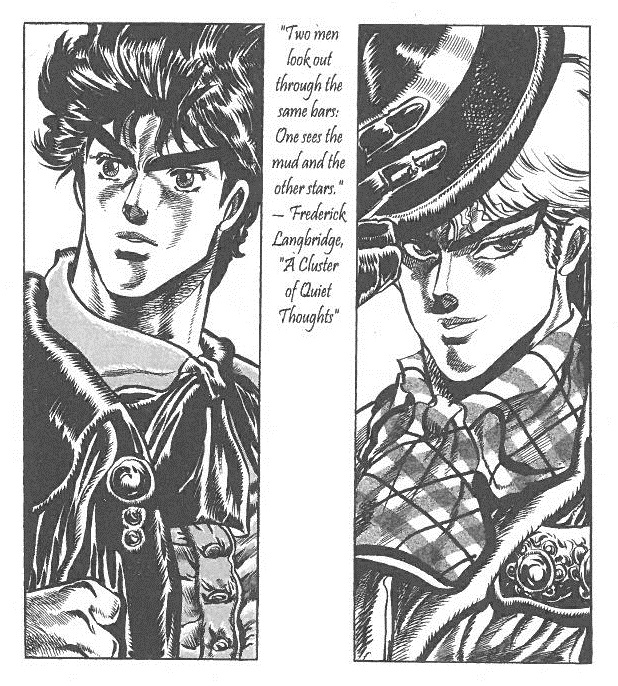
I read this volume without much background in this series other than knowing that it was a huge and long-running series in Japan, has a bit of a cult following in Japan, and the books that Viz had been releasing under the shonen jump line started midway through the series. This volume goes back to the earliest story arc in the series, kicking things off with the English nobility, bloodthirsty Aztec masks, and people beating the crap out of each other.

The story kicks off in old school shonen fashion, where a scantily clad woman is sacrificed to the wearer of a mysterious stone mask who proclaims that his accessory drinks the blood of the living. Bones from the mask pierce his skull, but he’s still alive and taking on even more blood sacrifices, not worried about staining his stylish leopard skin pelt cape because he has found the secret to eternal life!

The story then skips over to England, where an evil red-haired young man offers his dying father some medicine. Dio’s father tells him a story about how he accidentally saved the life of a nobleman named Joestar when he came across the wreckage of carriage he was intending to scavenge. Brando tells Dio to go to the Joestars when he becomes orphaned, and Dio does, thus starting the torture of poor young Jonathan Joestar. Dio is immediately adopted as a second son by the Joestar family, but since he is basically the spawn of Satan and Jonathan Joestar is like a friendly naive puppy, things do not go well with the new brothers.

Dio is basically a human form of a cancer, undermining the heir to the Joestar family whenever he gets a chance. It has been a long time since I’ve read a shonen manga this manly! There are speed lines and yelling on almost every page. Jonathan and Dio engage in fistfights and boxing matches, where one blow will end up knocking a half dozen teeth into the air. Towards the end of the book the legacy of the blood drinking Aztec mask is further explored, and Jonathan finally begins to get proof of Dio’s nefarious deeds. The art is really dynamic although the proportions are often a bit off. Often one of the muscular bodies of the main characters will look like it is supporting a shrunken head. If Rob Liebefeld and Tetsuo Hara of Fist of the North Star mashed up their styles you might end up with something like JoJo’s Bizarre Adventure, except Araki can actually draw feet. I’m sure the art gets much better in subsequent volumes, and even though it wasn’t always to my taste I couldn’t deny the effectiveness of the energy of the many battle scenes in the manga.

As a main character, Jonathan Joestar lets himself be taken advantage of for far too long, but he does manage to battle back as shonen heroes always do. The hardcover edition is really nicely designed, with color pages shifting to further tonal pages where the black and white art is enlivened by shades of orange. This volume ends on a cliffhanger, and I do want to know what happens next, as I assume it will involve more stone mask blood drinking and face punching. I can certainly see why this is such a long-running and popular series in Japan. Recommended for those who want a major dose of testosterone in their manly manga.

Filed Under: REVIEWS Tagged With: JoJo's Bizarre Adventure, Shonen, viz media

Umineko: When They Cry, Vol. 9

February 3, 2015 by Sean Gaffney

Story by Ryukishi07; Art by Soichiro. Released in Japan in two separate volumes as “Umineko no Naku Koro ni: Alliance of the Golden Witch” by Square Enix, serialized in the magazine Gangan Online. Released in North America by Yen Press.

With this volume we are halfway through Umineko proper, at least in terms of arcs. Most of the major issues involved have become fairly clear to the reader. Battler’s incompetence as a detective is not because he’s stupid per se, but because he can’t see past the who and how to figure out the why. I think he finally manages to grasp this by the end of the book, but by then it’s a bit too late for Beatrice, who is a character whose ‘who’ and ‘why’ define her, to the extent that her dying wish to Battler is to uncover who she is. As for Ange, she figures out what’s going on, and learns how magic works, but her lack of empathy for Beatrice means that she fails here as well, and gets a highly grotesque death. The only real winners in this arc are Bern and Lambda.

umineko9

There’s also the small matter of what’s happening on the “game board”, of course, in which the rest of the cast bar Battler are quickly polished off in an almost perfunctory way. You know things are ridiculous where Krauss fights a goat butler and wins. Actually, I’d argue that the manga didn’t go far enough here – the VN framed this as a long scene, showing off the goat butler’s ‘motivation’ and framing it as a video game with cliches piling up one on top of another. It was highly amusing, yes, but more to the point it shows off how overegged this pudding is. When first Jessica and then Kyrie take pains to tell Battler “you must believe in the witch god we were so wrong being all logical and stuff”, you’re meant to raise an eyebrow. Of course, with all the special effects death, magic is hard to deny. Assuming you can trust what you see.

The most important scene in the volume, which I also think the manga gives some short shrift to, is game-Beatrice asking game-Battler to remember his sin, and her complete devastation when he doesn’t. For Battler, 6 years ago is when he walked out on Rudolf, and all his theorizing about why that was wrong has to do with his place in the Ushiromiya family. Beatrice is clearly looking for something very different and more personal, and the fact that it meant so little to Battler that he’s forgotten it is what breaks Beatrice, both in the game and in meta. It’s telling that, since the whole Ushiromiya family thing is what he remembered, she takes that away from him by removing that identity. (This is where Battler truly is stupid – he knows his dad is a philandering ass, he should never have been taken in by her word games.)

So where are we now, with half the series gone? Beatrice is seemingly killed off. Battler can’t really escape the game. Everyone on the island is still dead. And even Ange is stated to have “died in 1998”, which is quite interesting given that the last we saw of her she was having the Seven Stakes of Purgatory brutally slaughter Kasumi and her yakuza goons. (Speaking of Ange, she starts to understand Eva a little better, though I worry she goes a bit too far. It’s a very hard line to walk between explaining and excusing child abuse, and I think Umineko sometimes walks across that line a bit too much.) And to no one’s surprise, Lambda and Bern turn out to be working together, or at least having mutually useful goals.

So Battler is an awful detective. Ange tried her best, but was too caught up in revenge and suicidal tendencies. Is there not a Great Detective who could possibly tell us what happened in Rokkenjima? Is there someone for whom this level of reasoning is possible? And can they actually be unbiased? Well, now I may be asking too much. In any case, May will bring us ‘End of the Golden Witch’, in which Beatrice’s tragedy reaches its inevitable conclusion. (No, it’s not the last arc.)

Filed Under: REVIEWS

  • « Go to Previous Page
  • Page 1
  • Interim pages omitted …
  • Page 320
  • Page 321
  • Page 322
  • Page 323
  • Page 324
  • Interim pages omitted …
  • Page 538
  • Go to Next Page »
 | Log in
Copyright © 2010 Manga Bookshelf | Powered by WordPress & the Genesis Framework