• Skip to primary navigation
  • Skip to main content
  • Skip to primary sidebar
  • Home
  • About Us
    • Privacy Policy
    • Comment Policy
    • Disclosures & Disclaimers
  • Resources
    • Links, Essays & Articles
    • Fandomology!
    • CLAMP Directory
    • BlogRoll
  • Features & Columns
    • 3 Things Thursday
    • Adventures in the Key of Shoujo
    • Bit & Blips (game reviews)
    • BL BOOKRACK
    • Bookshelf Briefs
    • Bringing the Drama
    • Comic Conversion
    • Fanservice Friday
    • Going Digital
    • It Came From the Sinosphere
    • License This!
    • Magazine no Mori
    • My Week in Manga
    • OFF THE SHELF
    • Not By Manga Alone
    • PICK OF THE WEEK
    • Subtitles & Sensibility
    • Weekly Shonen Jump Recaps
  • Manga Moveable Feast
    • MMF Full Archive
    • Yun Kouga
    • CLAMP
    • Shojo Beat
    • Osamu Tezuka
    • Sailor Moon
    • Fruits Basket
    • Takehiko Inoue
    • Wild Adapter
    • One Piece
    • After School Nightmare
    • Karakuri Odette
    • Paradise Kiss
    • The Color Trilogy
    • To Terra…
    • Sexy Voice & Robo
  • Browse by Author
    • Sean Gaffney
    • Anna Neatrour
    • Michelle Smith
    • Katherine Dacey
    • MJ
    • Brigid Alverson
    • Travis Anderson
    • Phillip Anthony
    • Derek Bown
    • Jaci Dahlvang
    • Angela Eastman
    • Erica Friedman
    • Sara K.
    • Megan Purdy
    • Emily Snodgrass
    • Nancy Thistlethwaite
    • Eva Volin
    • David Welsh
  • MB Blogs
    • A Case Suitable For Treatment
    • Experiments in Manga
    • MangaBlog
    • The Manga Critic
    • Manga Report
    • Soliloquy in Blue
    • Manga Curmudgeon (archive)

Manga Bookshelf

Discussion, Resources, Roundtables, & Reviews

Features & Reviews

Black Rose Alice, Vol 6

December 13, 2015 by Anna N

Black Rose Alice Volume 6 by Setona Mizushiro

I was disappointed when I realized a couple volumes in to this series that it was on hiatus in Japan. But by that time I was thoroughly won over by Mizushiro’s surreal and unique take on vampires and the tragic tone of the manga in general. It turns out that I shouldn’t have been worried too much, because while this volume doesn’t wrap up all the possible loose ends in the series, it does provide a satisfying conclusion.

Dimitri is away, and Alice and the twins are living in the house, dealing with the aftermath of Leo’s death. The twins’ backstory is told through flashbacks, and it is just as dark as one might expect from this series. Neither twin seemed like particularly great humans, but Kai’s actions are particularly despicable, making his current more winning personalty stand out in contrast to his past actions. There’s a moment of levity injected into the household when Dimitri returns home with a human woman who he once saved from a horrible assault, promising to make her his vampire bride. Now Akari is all grown up, and determined to experience the most cliched date possible with Dimitri by her side. This prompts feelings of jealousy in Alice, and an emotional confrontation.

As far as endings go, this volume concludes with one that is about as happy as it is possible to get, considering that everyone is doomed. Black Rose Alice is such a delightfully odd series, one that doesn’t turn aside from the darkness in human (or vampire) nature. It is a more mature, and quirky addition to the Shojo Beat family. I highly recommend it. This is one of those series that I’ll take down from the bookshelf and reread every few years.

br6

Filed Under: REVIEWS Tagged With: Black Rose Alice, shojo beat, viz media

Planetes, Vol. 1

December 13, 2015 by Sean Gaffney

By Makoto Yukimura. Released in Japan by Kodansha, serialized in the magazine Weekly Morning. Released in North America by Dark Horse Comics.

This title has been a fan favorite ever since Tokyopop first released it back in 2003. Now it’s rescued, with a new translation, color artwork throughout, and a larger trim size as two omnibuses. This first one covers the first 12 chapters, ending with Hachimaki’s vision quest, which is an excellent cliffhanger. Rereading it, I was reminded why I found the series so enthralling – it combines interesting and flawed characters, a political thriller plot, and of course the beauty of space exploration, and why people want to go to space, though it makes sure to note that sometimes what people do to get to space can be morally questionable.

planetes1

Like many titles, the series starts off feeling like a series of one-shots, possibly as it was – many titles are given a chapter or two before they get picked up, which also explains such glitches as Hachimaki’s hair. From the start, though, we have the basical – Hachimaki, Yuri and Fee command a debris collecting ship, making sure that the worst of the objects that litter space are removed so that there’s less risk of an accident. We open on one such accident, which weights heavily on Yuri, the first of our cast we really meet. Ironically, his character arc pretty much finishes in this volume, as he is able to let go of his wife’s death and move on. Likewise, Fee is a wife and mother whose biggest issues are trying to find a place to have a smoke in peace – she’s more of a mentor figure, as well as providing comedy through physical and verbal violence and in her spare time saving all of Earth from cosmic disasters.

No, it’s clearly Hachimaki, and later Tanabe, who are going to be the stars of our show. Hachi is really irritating in that “I am 23 and therefore know better than anyone else” sort of way, and spends much of his time angry at the world, his colleagues, and himself, not in that order. He wants to control his own destiny, but his idea of doing whatever it takes to achieve it feels wrong, especially since we get to contrast it with the creepy villain Locksmith, who is able to write off the death of hundreds in an explosion as good data for his next attempt. In contrast, Tanabe is all heart, and while she’s just as angry and headstrong as Hachi the narrative seems to be on her side most of the time. The two of them are also falling for each other hard, though Hachi finds this idea irritating more than anything else.

This is an expansive series that is not afraid to shift its focus and open up its cast. We meet Hachi’s eccentric father, down-to-earth mother and determined brother; a young girl who’s lived her whole life on the moon due to health issues; and of course various terrorists, who pepper the entire book trying to destroy everything Locksmith and Hachi are working on. No one is presented as totally right or wrong here, though certainly violence is shown to be the wrong answer in general. Towards the end of the book Hachi finally gets onto the crew headed to Jupiter, but a combination of three near-death experiences over the course of the first volume have him questioning everything about himself and what he’s doing. This reaches a point of ridiculousness at the end, when he’s able to somehow stay alive for a week in his spacesuit while having a vision quest.

Planetes is simply a great manga. It has an interesting plot, character growth and depth (Hachi is far less hotheaded by the end), and some gorgeous art. It also rewards us by showing the joys and sorrows of space travel, and why we should still strive to achieve it, despite everything. Even if you’ve already got the Tokyopop volumes, I recommended getting this spiffed up new edition. You can fall in love with it all over again.

Filed Under: REVIEWS

The Manga Revue: Junji Ito’s Cat Diary

December 12, 2015 by Katherine Dacey

2015 has been a banner year for Junji Ito. In April, VIZ re-issued Gyo, Ito’s ick-tastic classic. Two months later, VIZ introduced readers to Fragments of Horror, the first new Ito title to arrive in the US in a decade. That was soon followed by the stateside debut of Junji Ito’s Cat Diary: Yon & Mu, a humorous anthology published by Kodansha Comics. I first heard about Cat Diary back in 2011, when Ryan Sands posted a few images at Same Hat! It sounded like something I’d like–I’m on record as being an animal sap–so I was delighted when Kodansha announced plans to release it this year. Here are my somewhat biased thoughts on Yon & Mu.

Cat_DiaryJunji Ito’s Cat Diary: Yon & Mu
By Junji Ito
Rated T, for readers 13+
Kodansha Comics, $10.99

On the surface, Junji Ito’s Cat Diary is a gag manga. J-Kun–a lightly fictionalized version of the author–reluctantly agrees to let his fiancee bring two cats into their home: Yon, a black-and-white cat with sinister markings on his back, and Mu, a Norwegian forest cat with a cute face and a wicked bite. Each story depicts Yon and Mu doing normal cat things, from coughing up hairballs to resisting unsolicited human affection. Readers familiar with Ito’s previous manga will get a chuckle at J-Kun’s over-the-top reactions to cat poop, scratched floors, and feather wands, as his grotesque facial expressions have been swiped from the pages of Gyo and Uzumaki. Surprisingly, these grimaces work just as well in the context of a domestic comedy, capturing the mixture of revulsion and love that cat behavior elicits. The uninitiated reader may also find these scenes amusing, if a bit excessive; surely a grown man realizes that cats can be jerks?

On a deeper level, however, Cat Diary is a meditation on human relationships. Though the ostensible plot focuses on J-Kun’s struggle to overcome his dislike of cats, the real story is Yon and Mu’s role in bringing J-Kun closer to his fiancee. J-Kun comes to love the cats–spoiler alert!–but the way in which he expresses those feelings demonstrates his journey from “me” to “we,” as his selfish concerns about the house give way to a shared sense of responsibility for the cats’ welfare. This human dimension of Cat Diary infuses it with a warmth that’s frequently missing from Ito’s work, and prevents the stories from reading like a collection of cat GIFs. (I can haz laffs now!)

On a totally shallow note, reading Cat Diary made me want to get my own Norwegian forest cat. I’m not sure if that’s an endorsement of Ito’s comedy chops, but it’s proof that he can draw the hell out of cute, furry things.

The verdict: You don’t need to be a cat person–crazy or otherwise–to enjoy this idiosyncratic manga, though a healthy respect for cats definitely helps.

Reviews: In the mood for shojo? Megan R. of The Manga Test Drive has you covered with in-depth reviews of The Demon Prince of Momochi House, First Love Monster, L♥DK, and Requiem of the Rose-King. Comics Alliance contributor Tom Speelman reflects on the legacy of Naruto, one of the world’s most popular manga.

Michael Burns on vol. 4 of Akame ga Kill! (Ani-TAY)
Megan R. on The Angel of Elhamburg (The Manga Test Drive)
Jordan Richards on vols. 5-7 of Assassination Classroom (AiPT!)
Sean Gaffney on vol. 7 of A Bride’s Story (A Case Suitable for Treatment)
Sheena McNeil on vol. 56 of Case Closed (Sequential Tart)
Lindsey Tomsu on vols. 1-3 of Dictatorial Grimoire (No Flying, No Tights)
Nick Smith on vol. 1 of Dragons Rioting (ICv2)
Michael Burns on vol. 8 of Food Wars! Shokugeki no Soma (Ani-TAY)
Justin Stroman on vol. 1 of Horimiya (Organization Anti-Social Geniuses)
Lindsey Tomsu on vols. 1-9 of Kanokon (No Flying, No Tights)
Jordan Richards on vol. 2 of Komomo Confiserie (AiPT!)
Karen Maeda on vol. 4 of Master Keaton (Sequential Tart)
Sarah on vol. 1 of Merman in My Tub (Anime UK News)
L.B. Bryant on vol. 1 of Monthly Girls’ Nozaki-Kun (ICv2)
Sarah on vol. 1 of Monthly Girls’ Nozaki-Kun (Anime UK News)
Austin Lanari on vol. 7 of New Lone Wolf & Cub (Comic Bastards)
Chris Beveridge on vol. 1 of Planetes (The Fandom Post)
Matt on vol. 2 of Prison School (Ani-TAY)
Matt on vol. 1 of School-Live! (Ani-TAY)
Josh Begley on vol. 6 of Vinland Saga (The Fandom Post)

Filed Under: MANGABLOG, REVIEWS Tagged With: Cat Diary, Junji Ito, Kodansha Comics, Manga Review

Manga the Week of 12/16

December 10, 2015 by Sean Gaffney, Ash Brown, Michelle Smith, Anna N and MJ 2 Comments

SEAN: There are 39 titles due out next week. Thirty-nine. Let’s take a look. Try not to get lost in the deluge.

Attack on Titan’s 17th volume has a Special Edition with a DVD of Ilse’s Notebook, the side story from the 5th volume.

ASH: It’s really interesting to see special editions like this starting to come out!

SEAN: Fairy Tail has a 51st volume.

Kiss Him, Not Me! and L♥DK both have their second volumes which may interest shoujo fans.

MICHELLE: I suppose I will check out the second volume of L♥DK just to see whether it improves, but I don’t have high hopes.

SEAN: And Say “I Love You” has an 11th volume that is a must for shoujo fans.

MICHELLE: A definite must.

ANNA: I am way behind on this series! Maybe I will binge read during an upcoming vacation.

twc1

SEAN: Tsubasa has finally climbed out of its Reservoir and is ready to take on the world with the debut of Tsubasa World Chronicle 1. I am trying to contain my enthusiasm. See? :|

MICHELLE: I didn’t even know this existed!

ANNA: You know, I used to be a major CLAMP fan, and now I have CLAMP fatigue.

MICHELLE: Yeah, I think that has afflicted me, too. I never finished xxxHOLiC or the first Tsubasa series, despite owning them all, and now they both have sequels I haven’t touched. And then there’s that Gate 7 series, which utterly failed to make an impression with me.

ANNA: Most of my remaining feelings of affection for CLAMP are tied up in nostalgia for X/1999. So much angst and feathers!

MICHELLE: I have an enduring fondness for CLAMP Campus Detectives, but more so the anime than the manga. Oh, and Cardcaptor Sakura!

SEAN: It is rather sad that Man of Many Faces is still in my top 5 CLAMP works, given it was their first. (It’s out digitally next week as well, by the way! Rescued by Viz.)

ANNA: Cardcaptor Sakura is also great! Actually, I’m interested in reading Man of Many Faces, and I didn’t realize that it was out digitally.

MJ: I’m probably the only person here unlikely to succumb to CLAMP fatigue, I suppose, and while a Tsubasa sequel is not high on the list of what I’d really like to see most from them, I’ll surely check it out. Their artwork will always be a draw for me, and they have a knack for creating characters I can’t get enough of. Even when they write themselves into a hole (as they’ve occasionally done), I’ll stick around to the end.

SEAN: One Peace has a 5th (final?) volume of Aquarion Evol.

ANNA: I have some volumes of Aquarion I need to read.

SEAN: If you’ve somehow not read the brilliant and evocative A Distant Neighborhood books from Ponent Mon, they’ve got a Complete Edition out next week to correct that.

MICHELLE: I really liked A Distant Neighborhood.

ASH: Very glad to see this coming back into print!

ANNA: I haven’t read this, but I know it is wonderful, and I am also glad it is coming back into print.

MJ: It really *is* wonderful, and I’m so glad to see it coming back!

SEAN: And Seven Seas also has an omnibus of Mayo Chiki starting next week, whose audience is possibly a bit different from that of A Distant Neighborhood.

kizu

Vertical debuts a novel that will be of great interest to anime fans: Kizumonogatari: Wound Tale, the first (chronologically) of the popular Monogatari series from Nisioisin (author of Medaka Box and Zaregoto). I am VERY excited for its release, even though it has vampires – possibly that only adds to the excitement!

ANNA: Vampires are always exciting!

MEILNDA: I’m always willing to try something from Vertical, even if vampires are involved.

SEAN: Vertical also has the 12th and final volume of Mobile Suit Gundam the Origin. It’s a labor of love, and I’m sure that the Manga Bookshelf team, particularly Ash, are ready to congratulate them on its completion.

ASH: It’s true! This has been a fantastic release. Congrats, Vertical!

ANNA: Vertical deserves some sort of award for this lovely edition.

SEAN: And if Gundam is too realistic for you, try the second Ninja Slayer, also from Vertical.

Afterschool Charisma is a series I keep forgetting is still running, but here’s the 11th volume.

ANNA: I’m way behind on this, but I like it!

SEAN: And here is the 17th Dorohedoro, which I could never forget. Are these two the last remnants of SigIKKI?

MICHELLE: I believe so.

ASH: I love Dorohedoro so much.

SEAN: Master Keaton has a 5th volume already. I’ve fallen behind on this series.

MICHELLE: Me, too. I did start, but got bogged down somewhere in volume two.

ANNA: I am happy to report that this is one series I am not behind on! I enjoy Master Keaton.

SEAN: And a 4th volume of the insanely popular Tokyo Ghoul, which will war with Attack on Titan 17 for the top of the bestseller charts.

Yen On has five light novels out for the holidays. The 2nd Black Bullet will, I suspect, be as grim as the debut was.

The Devil Is A Part-Timer! has proven to be very likeable, and I hope the third volume continues the trend.

I remain surprised at how addictive Is It Wrong To Try To Pick Up Girls In a Dungeon? has become, particularly with that title. The 4th volume is also highly anticipated.

We’ve nearly come to the end of the long running Spice & Wolf novel series, with Vol. 16 being the 2nd to last.

And Sword Art Online’s 6th novel wraps up another arc, as Kirito and Sinon try to figure out the secret behind the Gun Gale Online game and those using it to kill players in real life.

MJ: I think I’m one of the few folks here who is pretty into SAO… how did that happen? In any case, I’m always ready for more!

aldnoah1

SEAN: Yen Press has a number of debuts next week, beginning with Aldnoah Zero, which (like Rose Guns Days) gets a Season One appended to it. It runs in Manga Time Kirara Forward, but don’t expect it to be a 4-koma: this is a serious sci-fi title based on an anime created at the same time.

ASH: I haven’t seen the anime yet, but I am rather curious about the Aldnoah Zero manga.

MJ: I’m interested as well.

SEAN: There’s an 8th Barakamon, which I do recommend if you’re missing Yotsuba&!, even though the two titles have a somewhat different feel.

MICHELLE: I have a big stack of Barakamon that I really need to get around to reading.

MJ: I haven’t given this title its due, but I really should pay more attention to it!

SEAN: For those who don’t like prose, there’s the 2nd volume of the Black Bullet manga.

A ninth volume of Bloody Cross no doubt sees the series headed towards its endgame.

And there’s a third volume of eccentric fantasy Chaika the Coffin Princess.

Demon from Afar is up to Vol. 5, and no doubt continues to look very pretty and destroy all our hopes and dreams.

The third Emma omnibus also will look very pretty, but likely has 100% fewer corpses.

MICHELLE: *snerk*

MJ: I’m still excited every time one of these shows up, since I missed this series the first time around!

SEAN: And we get a 5th volume of He’s My Only Vampire. One of a large number of vampire manga out there, it’s trying to be our steady and doing a pretty good job.

MICHELLE: Definitely my favorite of the vampire gang.

ANNA: Is it odd that I haven’t read this yet? Probably.

MJ: I think that’s very odd indeed!

SEAN: Maximum Ride is not technically a manga, but it certainly sells well enough, so let’s mention the 9th volume here.

The Melancholy of Suzumiya Haruhi-chan is now at double digits, and I suspect will run till the author (Puyo, not the author of the original source) decides it is over.

ayakashi1

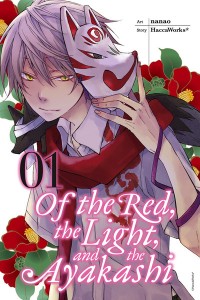
Of the Red, the Light and the Ayakashi is based on a visual novel, and runs in Media Factory’s sorta-kinda-shoujo magazine Comic Gene. Expect prettiness.

MICHELLE: I’ve started reading this and it’s giving me some Natsume’s Book of Friends vibes, which is definitely a compliment.

ASH: Oooh, that’s good to hear! And the cover art is pretty, too!

ANNA: I’m always up for pretty sorta-kinda-shoujo.

MJ: I’m up for this, definitely, especially after reading Michelle’s comment above.

SEAN: Pandora Hearts has a 23rd volume, and it’s the first to come out in over a year, so I’ll let Michelle and MJtake over from here.

MICHELLE: I’ve fallen somewhat behind, so I am going to have a nice big marathon and it’ll be awesome. And then I’ll wait in desperation for the 24th and final volume to come out.

MJ: I have *not* fallen behind, as you might imagine, and have been anticipating this rather anxiously! My love for this series has not waned!

SEAN: Puella Magi Madoka Magica: The Movie has a first volume, and is sure to appeal to fans of Homura who couldn’t get enough of the movie—ow, I think I cut myself on my sarcasm there.

MJ: I haven’t been able to maintain any interest in this series beyond the original anime. So many books. So little interest.

SEAN: There’s also a 2nd volume of Puella Magi Suzune Magica.

Rose Guns Days Season One gets a 2nd volume, as we learn more about this strange occupied Japan and the eccentrics populating it.

The Secret Sakura Shares is a done-in-1 omnibus that ran in Hakusensha’s LaLa and LaLa DX magazines, and I love that we’re seeing Hakusensha titles get additional publisher availability. That said, I suspect many readers will have trouble getting past the premise.

MICHELLE: Yeah, I don’t know about this one, but I’m gonna read it anyway.

ANNA: Hmmmmmm.

MJ: I just read the premise, and I agree I may have trouble getting past it. I guess we’ll see.

yowapeda1

SEAN: Sunshine Sketch 8 finally bids farewell to its two gayest… sorry, oldest characters, as Sae and Hiro are graduating. But the series continues, and we gain some new students in the process.

Lastly, we have the first Yowamushi Pedal omnibus, as an incredibly popular shonen cycling series finally gets a chance in the West, despite a huge number of volumes extant. There are, I hear, one or two male fans. Somewhere. But for the most part, YowaPeda is known for its BL fandom, though the manga itself is not BL.

MICHELLE: I’m looking forward to this one a lot. Not for the BL but for its presumed sports manga-y aspects.

ASH: I’m certainly excited to see publishers giving sports manga another chance!

ANNA: I am always wishing for more sports manga, so I’m glad this is coming out.

MJ: Yay sports manga! Yay BL fandom! I’m ready for it all!

SEAN: That’s it. Finally. What are you getting?

Filed Under: FEATURES, manga the week of

The Tokyo Zodiac Murders

December 10, 2015 by Ash Brown

The Tokyo Zodiac MurdersAuthor: Soji Shimada
Translator: Ross and Shika Mackenzie
U.K. publisher: Pushkin Press
ISBN: 9781782271383
Released: September 2015
Original release: 1981

The British-based publisher Pushkin Press launched Vertigo, a new imprint devoted to classic crime and mystery fiction from around the world, in 2015. One of the six works selected for Vertigo’s debut was Soji Shimada’s first novel The Tokyo Zodiac Murders. Originally published in Japan in 1981, the novel would become the first book in a series of mysteries featuring Kiyoshi Mitarai. Shimada is an extremely prolific author particularly known for fostering the revitalization of honkaku fiction, a subgenre of Japanese mysteries that I was introduced to through The Decagon House Murders by Yukito Ayatsuji, who Shimada mentored. Currently, The Tokyo Zodiac Murders is the only major work by Shimada available in English although a few of his short stories have been translated as well. The Tokyo Zodiac Murders, translated by Ross and Shika Mackenzie, was first released in English in 2004 by IBC Publishing, but that edition has since gone out-of-print. I was very glad to see Vertigo bring the novel back.

In 1936, a set of grisly murders took place in Japan which came to be known as the Tokyo Zodiac Murders. Seven women, sisters and cousins, were found dead, their bodies cut into pieces and buried in remote locations across the country. A letter describing exactly how the women would be killed and dismembered would have made Heikichi Umezawa, their father and uncle, the primary suspect except that he himself had already met an untimely demise behind locked doors. Although over time many popular theories were proposed, the murders of Umezawa and the seven women remained unsolved for more than forty years. In 1979, new evidence came to light which inspired amateur detectives Kazumi Ishioka, a mystery enthusiast, and his close friend Kiyoshi Mitarai, a professional astrologer, to take up the case. Their investigation led them in many different directions as they searched for additional clues, but finally, more than four decades later, the murders are solved.

While there are some wonderful character moments in The Tokyo Zodiac Murders, especially between Mitarai and Ishioka—who is the one actually narrating the tale—the novel is much more focused on the details of the crimes and the related investigations than it is on nuanced characterization. Over the course of The Tokyo Zodiac Murders, Shimada outlines all of the clues needed for the novel’s readers to solve the mystery themselves—they are given the same information that Mitarai and Ishioka have available to work with. In fact, Shimada briefly interrupts the narrative not once but twice, directly addressing and challenging readers to solve the case before Ishioka reveals the solution in the final few chapters. Granted, in addition to crucial hints, Shimada has also included plenty of red herrings to lead readers astray if they are not careful. The Tokyo Zodiac Murders presents a devious intellectual challenge, but it is solvable.

Although the cleverness of The Tokyo Zodiac Murders can be appreciated in its own right, much of my enjoyment of the novel came from directly engaging with the mystery. Readers can simply follow along as Ishioka and Mitarai conduct their investigations, waiting for everything to be disclosed, or they can take up Shimada’s challenge to try to uncover the solution on their own. First, the known facts about the murders are recounted by Ishioka in a fairly straightforward if enthusiastic manner. He then reveals how he and more specifically Mitarai became personally involved with the case, showing how their efforts ultimately led to the closing of a decades-old crime. The Tokyo Zodiac Murders is gruesome and shocking, but it’s also engrossing and introduces a likeable and somewhat eccentric investigator in Mitarai. Although The Tokyo Zodiac Murders was Shimada’s debut work, it is still considered by him and by others to be one of his best and I can understand why.

Filed Under: REVIEWS Tagged With: Detective Mitarai, Novels, Soji Shimada

A Bride’s Story, Vol. 7

December 8, 2015 by Sean Gaffney

By Kaoru Mori. Released in Japan as “Otoyomegatari” by Enterbrain, serialization ongoing in the magazine fellows!. Released in North America by Yen Press.

I have reached the point in this series where I genuinely do enjoy the adventures of Amir, Karluk, and their family, and I’m pleased to see we’ll be headed back there for Vol. 8. But I will admit that my top 3 volumes of this series have all been the ones that venture away from the ‘main’ characters and focus on English researcher Mr. Smith… or rather, focus on where he ends up in his travels, as he also barely figures in this volume. Instead, we get a different kind of wedding, as two already married wives with young children find each other and we are introduced to a marriage ceremony between two women who vow to be Avowed Sisters, a concept that reminds me of Anne Shirley’s bosom friends.

bride7

Our heroine this volume is Anis, a young merchant’s wife who is married to a caring husband and has a young child, but still feels there’s something lacking in her life – she *is* happy, but knows she could be happier. After talking with her maidservant, she decides to start going to the public baths, and there meets up with the shy Sherine, who is also married, and bonds with her immediate.y And by ‘bonds’, I mean ‘falls in love with’, as we see immediately that Anis is physically and emotionally attracted to the reserved Sherine. They bond really fast – something remarked on by everyone – and eventually agree to become Avowed Sisters, with a ceremony led by one of the female elders. Of course, this being a dramatic story rather than a history, the moment the ceremony is over, Sherine’s husband drops dead.

I’ve talked before about how most of Kaoru Mori’s titles deal with repressed emotions, and that’s true here as well, even though by comparison Anis is open and obvious. Sherine’s husband was poor, and with him now gone it’s clear that she may be reduced to begging. This leads to Anis asking her husband to take Sherine as a second wife – something acceptable in these times and places – and his stunned reaction. Her husband’s been presented as a good guy throughout, who has trouble reading his wife but clearly loves her. He never took another wife as he was worried Anis wouldn’t like it, and Anis agrees that is absolutely true – except for Sherine. And so the volume ends with the two Avowed Sisters living together as co-wives, planning a trip, and feeding the birds by an ornamental pond.

The mood throughout is beautiful – after the last volume’s battles and deaths, Mori wanted to have a more peaceful story, though she jokes this just led to a lot of nudity. Indeed, the bath scenes take up a large part of the book, and there’s a fold-out color illustration with even more. For all that fashion is her first drawing love, Mori adores drawing the naked female form. But overall this is about Anis and Sherine, and another example of nontraditional brides in what is thought to be a very traditional period in time. It’s well worth your time.

Filed Under: REVIEWS

Bookshelf Briefs 12/7/15

December 7, 2015 by Sean Gaffney, Michelle Smith and Anna N Leave a Comment

Anna, Sean, and Michelle review a smattering of new releases.

magus3The Ancient Magus’ Bride, Vol. 3 | By Kore Yamazaki | Seven Seas – I love it when I find a Seven Seas title I can wholeheartedly support, and this is one of the best. We continue to develop the questionable relationship between Elias and Chise, and the supporting characters notice how codependent it’s starting to be. Chise, of course, is not in a headspace where she can accept this now, but she is growing by leaps and bounds, to the point where I worry she will seriously overextend herself in a volume or two. The rest of the book allows us to wander around British fantasy settings, complete with the Wandering Jew as one of the more terrifying pretty-boy villains I’ve seen in some time. Anyone who enjoys fantasy with a strong plot and characterization should be following this series. – Sean Gaffney

assassination7Assassination Classroom, Vol. 7 | By Yusei Matsui | Viz Media – Koro-sensei may be a barrel of laughs (and I am very fond of the fact that even in the most serious situations the author still finds time for a panel or two of hilarity), but as a teacher, he’s first rate, be it assassinations or civics. Class 3-E may still be in the doghouse, but their performance in the exams this semester makes you want to punch your fist in the air. Even the headmaster’s “just as planned” seems rather hollow. The class is also getting more skilled at planning assassinations, and their attempt towards the end of the volume was the closest they’ve been yet. Of course, now we get a new crisis and cliffhanger. Sounds like it’s Nagisa and Kayano to the rescue. Always grateful to Viz for licensing this. – Sean Gaffney

foodwars9Food Wars!: Shokugeki no Soma, Vol. 9 | By Yuto Tsukuda and Shun Saeki | VIZ Media – The Fall Classic has reached the quarter-final stage! After Soma pulls off a bento victory against amazingly talented Alicie Nakiri, it’s Megumi’s turn to shine in a ramen battle. It’s great to see her holding her own, exhibiting confidence, determination, and talent, and I appreciate that female chefs are treated as worthy adversaries in this series. There’s not too much fanservice in this volume, either, as it’s mostly the (older, male) judges reacting in silly ways to the foods they are tasting. Actually, the only icky moment comes in the form of live-turtle butchery, but even that is somewhat redeemed when it leads to an Ultraman versus Gamera sort of homage. Food Wars! is great fun and always leaves me wishing I had more volumes to devour. – Michelle Smith

inuboku9Inu x Boku SS, Vol. 9 | By Cocoa Fujiwara | Yen Press – A timeskip, even one involving reincarnation, has been seen in manga before, but I don’t recall too many that have then returned again, as we start the climax of Inu x Boku SS by returning to the characters as we knew them at the start of the series. This allows for a few attempts at humor, (mostly in the first half, as there are three side-stories before the continuation proper), but for the most part it’s down to business as our heroes read the letters from their future selves and decide what to do. We also get some insight into Zange’s past, and he seems a lot less goofy and annoying than he was before. Now, however, everyone’s about to be split up. How are things going to go from here? Still a good supernatural thriller. – Sean Gaffney

ooku11Ōoku: The Inner Chambers, Vol. 11 | By Fumi Yoshinaga | VIZ Media – We’ve seen quite a few power-hungry schemers throughout this series, but none has been as odious as Tokugawa Harusada, who holds the reins of government while her son, good-hearted but timid Ienari, serves as an ornamental shogun whose only responsibility is to beget heirs. In comparison to someone like Hisamichi, who did bad things out of love of Yoshimune, Harusada comes off as just plain evil. It’s a bit hard to take, honestly, but balancing out her reign of terror is a hopeful storyline in which Aonuma’s former disciples not only find happiness outside the palace, but work towards fulfilling the dream of creating a vaccine to stop the redface pox once and for all. I absolutely love that Yoshinaga shows how strongly Aonuma and Gennai live on in the memories of those who worked alongside them; it gets me right in the feels. – Michelle Smith

socute4So Cute it Hurts!!, Vol. 4 | By Go Ikeyamada | Viz Media – This series continues to be relentlessly adorable, as twins Megumu and Mitsuru go on some unconventional datas. Megumu and Aoi go out, even though he can’t be any closer to her than two feet. This complication doesn’t hinder the blushing couple. Mitsuru gets into his kendo gear to answer a challenge from Azusa. He assumes that they are going to fight, but they take their combat to the closest video arcade. This volume was extremely light and fluffy, but there are hints of complications ahead. This is fun to read, even though it is a bit superficial. – Anna N

Filed Under: Bookshelf Briefs

My Week in Manga: November 30-December 6, 2015

December 7, 2015 by Ash Brown

My News and Reviews

So, one of the many reasons that I’ve been incredibly busy lately (which led to me temporarily reducing the number of posts that I’ve been writing each week) is that I’m in the process of applying for a promotion at work. I’m currently putting the final touches on my dossier which is due later this week. At this point it’s already well over two hundred pages and has taken up a significant amount of my time; I’m really looking forward to being done and over with the whole thing so I can get back to reading and writing about things that I actually enjoy.

That being said, last week I announced the winner of the Kodansha Shoujo Smorgasbord manga giveaway. The post also includes a list of some of Kodansha Comics’ shoujo and josei manga, of which there’s a nice variety. The honor of the first in-depth review of the month went to Studio Kôsen’s Windrose, Volume 1 from Chromatic Press/Sparkler Monthly. Kôsen has had a few other releases in English, but I think that Windrose is probably my favorite so far. Finally, over the weekend I posted November’s Bookshelf Overload which will likely be the last list of its utterly ridiculous size for a while.

Elsewhere online in manga publishing announcements: Kodansha Comics manga are now available digitally on Overdrive, which is great news for libraries in Canada and the United States. Seven Seas is in the midst of celebrating ten days of licenses with some interesting as well as not-so-surprising choices. (At the moment, the new license tag on Seven Seas’ Tumblr may be the easiest place to see all of the new titles at once.) Yen Press probably made the biggest license announcement last week, though–Natsuki Takaya’s Fruits Basket is being re-released in English! Yen plans to release Takaya’s Liselotte & Witch’s Forest and Twinkle Stars as well.

Quick Takes

Alley of First LoveAlley of First Love by Ellie Mamahara. I picked up Alley of First Love without knowing much about the manga except that it was a boys’ love one-shot. Sometimes that can a risky proposition ripe with potential for disappointment, but Alley of First Love ended up being a pleasant surprise. After graduating high school, Shusuke’s best friend (and crush) Atsushi left to study abroad in England with no intention of returning to Japan. But six years later he unexpectedly comes back and Shusuke must once more face the fact that his feelings for Atsushi go far beyond friendship. There were quite a few things that appealed to me about the Alley of First Love: the leads are adult men, the prominence of their tightly-knit families and community (and the realistic rumor mills that accompany those), the touches of humor and overall heartwarming nature of the story, and so on. Readers looking forward to steamy love scenes will be left wanting as they are mostly implied rather than shown (Mamahara jokes in her notes that she’s terrible at drawing them), but the emotional connection between Shusuke and Atsushi is definitely there.

Love at Fourteen, Volume 3Love at Fourteen, Volumes 3-4 by Fuka Mizutani. I didn’t anticipate that I would enjoy the first couple of volumes of Love at Fourteen nearly as much as I actually did. However, although I also enjoyed the third and fourth volumes, my compulsion to read more of the series has somewhat diminished. Tanaka and Yoshikawa may be the leads, but I think they may actually be some of the least interesting characters in the series. But even though their personalities aren’t particularly strong, I do like them. And I like their relationship and the portrayal of the slow development of young love. But in the end, I find that I’m more intrigued by the supporting characters and their stories. Perhaps I’m not the only one who felt this way—Mizutani adds even more of them to the series in these two volumes. My favorite character has turned out to be Nagai, a delinquent with a talent for singing. However, the way that the music teacher manipulates and leads him on is troubling. She’s supposedly fallen in love with her fourteen-year-old student. I’m not sure if Mizutani intends for it to be tragically romantic, humorous, or what, but the way it plays out and is shown in the manga comes across as creepy more than anything else.

My Love Story!!, Volume 3My Love Story!!, Volume 3-6 written by Kazune Kawahara and illustrated by Aruko. I absolutely loved the first two volumes of My Love Story!! and so have made a point to collect the manga even though I’ve fallen behind in actually reading it. At first, I wasn’t really sure how long the series would be able to last before the gimmick was completely played out and became tiresome. After all, the manga was initially intended to be a one shot. Happily, My Love Story!! has yet to lose its charm for me. It continues to be funny and sweet, earnest and endearing. The story is beginning to expand more, as well. While Takeo and Yamato’s incredibly adorable and wholesome romance is at the heart of it all, the manga is now exploring the lives and relationships of their friends and family members as well. At one point it seemed as though My Love Story!! was going to be somewhat episodic, but some longer, continuing storylines are being introduced as are new, recurring characters. My Love Story!! always manages to make me happier just by reading it, so I’ll definitely continue following it.

Filed Under: FEATURES, My Week in Manga Tagged With: Aruko, Ellie Mamahara, Fuka Mizutani, Kazune Kawahara, Love at Fourteen, manga, My Love Story

Bloody Mary, Vol 1

December 6, 2015 by Anna N

Bloody Mary Volume 1 by Akaza Samamiya

Vampires! There have been plenty of options available for the manga fan who enjoys vampires, and these series are obviously popular, because it seems like most publishers have at least one or two current series featuring those who walk the night. How is Bloody Mary different from all the other shoujo vampire series out there?

Bloody Mary is a bit different because there are no clumsy high school girls who unwittingly find themselves the target of a vampire’s affections. Instead in this series the reader gets a cranky and mysterious priest and a vampire with a death wish. Mary is a vampire who has been on a quest to find a priest who can actually kill him. Maria is a priest who is the target of vampires due to his family’s position as prominent exorcists. Maria knows how to brandish a mystical cross, but he doesn’t yet have the ability to combat vampires the same way his ancestors did.

Mary rescues Maria from a vampire attack and brings him home to the church. Maria promptly kicks him out, because he’s tired of vampires constantly showing up and demanding his delicious blood. Mary explains that he only wants Maria to kill him. Eventually the duo strike up an uneasy truce – Maria will give Mary blood, in return for protection against vampire attacks. When Maria is able to gain his true powers as an exorcist, he promises to put Mary out of his misery. While Mary is over 400 years old, he’s drawn as a mischievous teenager, skulking around in a cat-head hoodie. Maria is tall, blond, imposing, and has attitude issues. There are plenty of opportunities for odd couple shenanigans ahead.

There’s also plenty of mystery to explore. Mary has amnesia issues. He’s probably the vampire boogieman known as Bloody Mary, but he seems to have patchy memories of his past. He doesn’t have the same vulnerabilities that other vampires do. On Maria’s side, his lack of access to his family’s traditional power, and the knowledge that his hidden from him hint that he has the potential to become a destructive force in his own right as well.

bloodymary1

This first volume packs a bunch of story elements in to just a few chapters, as Mary and Maria’s relationship is established, hints of everyone’s secret past are alluded to, and Maria also has to deal with a handsome student council president who knows more about exorcism than he initially lets on. The character designs are attractive, and the fatalistic humor combined with plenty of vampire angst makes Bloody Mary a solid addition to the Shojo Beat lineup.

Filed Under: REVIEWS

Accel World: The Floating Starlight Bridge

December 6, 2015 by Sean Gaffney

By Reki Kawahara and Hima. Released in Japan by ASCII Mediaworks. Released in North America by Yen Press.

My last review mentioned that I was more interested in the worldbuilding than the characters with this series, and it’s possible the author heard me, as this fifth novel, the first to not yet be animated, is filled with character development. Haruyuki’s personal issues still exist, but we are reminded that he’s not the only one having a bad time, and Kuroyukihime and Fuko are both dealing with devastating traumas, both involving Brain Burst and the real world, though we get minimal information on the latter. Luckily, this book isn’t simply piling up the angst – there’s a lot of fights going on here, and a race to the top of a brand new level which has a lot to offer everyone.

aw5

And there’s also that cover, as you are reminded yet again that this is a series filled with very young teens. That said, it fits well with the plot, as the overly dramatic ‘everything is terrible’ mood swings that kids get when they’re between 11 and 15 allows for dramatic speeches and loud screaming without feeling like you’ve stepped onto the cover of Shonen Jump too much. We get more development of the ‘Incarnate’ powerups, and they’re public now, so that’s a new worry. But the biggest worry is with our hero, who (as was becoming obvious) is not quite free of the killer possessive armor from Book 2, and one way that you can tell this is going to be a long-running series is that the volume is content to leave most everything up in the air.

It also resolves issues left over from the previous book about Fuko, who is at last doing something with the team, but really isn’t using her full potential due to her latent trauma over what she did to her legs in the game. I’d wanted more with her and Kuroyukihime, and I got it here, as it’s clear that both of them take the blame for the pain that each one suffered, and it’s up to Haruyuki to demonstrate that they are not a horrible person (Kuroyukihime) or to show off what her powers and avatar really is used for (Fuko). Haruyuki is very empathic, and (except of course for the increasing number of girls crushing on him, which he doesn’t get mostly for plot reasons) understands almost unconsciously what needs to be done to help people achieve their potential.

Brian Burst, for all its drama, twisted revenge antics, and continued suggestions of a dark evil villain side using it for bad things, is a game, and a fun one at that. The battles featured here are probably the best writing in the book, as they’re fast, exciting, dramatic, and uncertain. Yes, you could predict that our heroes would win, but how they won was certainly not expected, and I loved that it also required an assist from Blood Leopard and Ash Roller – breaking apart the boundaries of the ‘teams’. Given what happens near the end of this book, Haruyuki and company are going to need all the allies they can get. I’m eagerly looking forward to the next volume.

Filed Under: REVIEWS

Windrose, Vol. 1

December 4, 2015 by Ash Brown

Windrose, Volume 1Creator: Studio Kôsen
Publisher: Chromatic Press
ISBN: 9781987988055
Released: November 2015
Original run: 2014-2015

Windrose is an ongoing series by Studio Kôsen, a Spanish creative team made up of two comics artists: Aurora García and Diana Fernández. Kôsen has had several comics as well as an artbook released in English in the past, including Saihôshi: The Guardian (my introduction to the team’s work), Stallion, and Daemonium. Currently, both Windrose and Kôsen’s previous work Lêttera are being serialized online through Chromatic Press’ multimedia magazine Sparkler Monthly. I was very excited when Windrose was first announced–I love Kôsen artwork and am a huge fan of Chromatic Press and Sparkler Monthly–and even more so when it came time for the first volume to be released in print. Windrose, Volume 1, completed in 2015, collects the first six chapters of the comic originally serialized between July 2014 and May 2015, as well as some additional notes from the creators about the comic and its historical setting.

On the day of her seventeenth birthday, Danielle received a strange gift from her father, a French merchant who has been away from their Barcelona home for months. Inside the secret compartment of a cleverly designed puzzle box is a miniature astrolabe and a letter asking her to keep it safely hidden away as his own life is in grave danger. Instead passively waiting for more information, Danielle decides to leave her Spanish mother behind in order to search for her father in France. Danielle’s mother never approved of Danielle’s more adventurous nature, trying with little success to raise her daughter to act like a proper lady. And Danielle’s journey to Marseille is not without incident–it’s dangerous for a young woman of the upper class to travel alone in the seventeenth century. After pirates attack the ship she is sailing on, Danielle is rescued by two fellow travelers, Angeline and Leon, whose reasons for helping are less than virtuous. Danielle may be in well over her head in more ways than one.

Windrose, Volume 1, page 17After only a single volume of Windrose I’m already absolutely loving the series. In fact, Windrose may very well be my favorite work by Kôsen to date. The art in the comic is gorgeous, and the inkwork in particular is especially striking. Kôsen has also made the effort to research the time period, including its clothing. The resulting character designs are wonderful in their details, whether the attire called for is intricate formal wear or simpler, more practical dress. Already the story of Windrose has moved through a wide variety of settings which Kôsen has expertly conveyed without visually overwhelming the scenes. There are countryside estates and lavish manors, docks and seafaring vessels, shady bars, dark alleyways, and even an abbey complete with secret passages. And of course there are the exceedingly attractive protagonists and antagonists of the series, too, each with their own distinct personality and ways of expressing themselves.

In addition to being beautifully drawn, the characters themselves are a large part of why I’m enjoying Windrose so much. At first Danielle seems to be sheltered and naive to the ways of the world, but she’s intelligent and learns quickly. She also has a particular talent for solving puzzles and riddles, encouraged and instilled in her by her father. Not much has been revealed yet about Angeline and Leon’s pasts, but they make a strong impression from the start. Angeline is a brash young woman with an aggressive streak which, when combined with her sword skills, allows her to pose as a man if it happens to be convenient or serve her purposes. Leon, while just as beautifully handsome as Angeline, has a more reserved and cautions nature which helps to balance her hotheadedness. The three of them together make a somewhat peculiar trio, but already Danielle is starting to rely on the other two even if she can’t quite trust them. With spectacular artwork, engaging characters, and exciting adventure, Windrose is off to a magnificent start.

Filed Under: REVIEWS Tagged With: Chromatic Press, comics, Kôsen, Windrose

Manga the Week of 12/9

December 3, 2015 by Sean Gaffney, Michelle Smith, Ash Brown, Anna N and MJ Leave a Comment

SEAN: A relatively quiet week, possibly as everyone’s saving up for the week after this, which may be the biggest week I’ve seen in manga ever. But for now, things are peaceful.

planetes1

Dark Horse has the first Planetes Omnibus, and if you have not read this series before (Tokyopop released it a while back), get it. Even if you have, get it. It’s supposed to be spiffed up. Planetes is one of the really good ones that every manga owner should have.

MICHELLE: Ooh, I forgot this was being rereleased. I never actually finished the TOKYOPOP volumes. Bad me.

ASH: I love this series! (The anime was well done, as well.) I’m very happy to see the manga coming back bigger and better than ever.

ANNA: I also love this series, and have saved the old Tokyopop volumes. I’m glad that more people will get a chance to read this manga, it really is something special.

MJ: I’m so excited about this. I missed out on the original release, and this is something I’ve wanted to read for a long, long time.

SEAN: I do note that I use Diamond Comics release dates for Dark Horse titles in this list, as that’s their primary distributor. Same with Udon. Other retailers may get in in a week or two later.

Seven Seas has a 3rd omnibus for Freezing, a very Seven Seas-ey title.

And a 4th volume of Servamp, which is not quite as Seven Seas-ey, but it does try hard.

Vertical has a 2nd omnibus for Tokyo ESP, whose first volume I enjoyed more than I expected to.

MICHELLE: Same here. I’m looking forward to volume two.

ANNA: I haven’t tried this yet but it sounds like I should look into it!

MJ: I’m in!

SEAN: And an 8th volume of Witchcraft Works, which I think is almost caught up with Japan?

ASH: If so, that’ll give me time to get caught up, too; I’m behind.

thorns1

SEAN: Viz has a digital-only debut released next week, Crown of Thorns. This is a Betsuma series by Youko Kamio, creator of Boys Over Flowers. That alone should be enough to make people check it out.

MICHELLE: !!!!!!!! I had no idea! I am so there.

ANNA: EEEEEEEEE! I am excited!!!!!!!!!!!!!

MJ: Mostly I’m just excited because they are. Who can resist such squee?

SEAN: We’re almost at the end of Deadman Wonderland, with Vol. 12. Are they still in prison?

Whereas even at volume 16, Itsuwaribito still has a ways to go.

Lastly, there’s a 15th volume of Magi, which, being a Shonen Sunday title, no doubt needs more love. Certainly I love it.

MICHELLE: Me, too!

ASH: One of these days I’ll actually follow through and give the series a try. And probably my love.

MICHELLE: Do eet.

ANNA: I just ordered some volumes to fill in my collection, and am going to start getting caught up. I enjoyed the first few volumes of the series very much. It also has my love!

SEAN: Are you picking any of these up next week?

Filed Under: FEATURES, manga the week of

Lucifer and the Biscuit Hammer, Vols. 9-10

December 3, 2015 by Sean Gaffney

By Satoshi Mizukami. Released in Japan by Shonen Gahosha, serialized in the magazine Young King Ours. Released in North America by Seven Seas.

This final volume has a lot of fighting and backstory in it – in fact, a good 4/5 of the book could be described as fighting and backstory, even the epilogue with Akane. But it’s a credit to the author that the backstory always feels natural and not like an infodump, and the fights never wear out their welcome, even when they’re supposed to. We get the villain’s main motivation (delusions of godhood), the relationship between him and Anima, and why Samidare is so desperate to smash the world. And, spoiler, the world is not smashed, which means that we also find out what happens afterwards – we hear in an afterword that Mizukammi always wanted to find out what happened to characters after the final battle ends, and that’s what we see here. It’s heartwarming as heck.

lbh9-10

With the exception of Nagumo, our cast have for the most part been from middle-school to early college age, and their mindset and problems have stemmed from that – immaturity, frustration, pent-up emotions, and budding sexuality. We now see that Animus and Anima’s battle has remained what it is again due to a very childish reason – Animus has psychic powers, as does his sister, and when a doctor calls him a god, Animus gets one of the most creepy ‘insane grin’ faces I’ve seen in manga, and proceeds to prove his godhood by destroying first the space station they’re on, then the Earth. Anima, who was trying to convince him that powers or no he’s still a human, is desperate to stop him.

If this sounds vaguely familiar it’s because it’s mirrored in the relationship between Samidare and Yuuhi, who as I predicted is not really going to let her smash the world with her giant projected fist after all. That said, he does pretend he is for some time, which leads to a number of battles where he shows off how much he’s been holding back until now, and basically curbstomps all the other knights bar Mikazuki, who’s still down from the battle against Animus. Samidare goes on like a lovestruck girl (which she is) about how cool Yuuhi has become, and it’s true – his emotional growth in this series has been nothing short of stunning. And now with Samidare, who has discovered that she has something to live for after all, the emotional growth is a catharsis.

The 10 years in the future epilogue is a bit Harry Potter-esque, particularly the part where we find out that Shimaki and Yayoi got married despite very little interaction in the main series at all – Anima’s “Hmm?’ and blank stare reminds me of my own when I heard Luna was marrying some offscreen guy I’d never heard of. But as Yuuhi points out, that’s how life works, and is the nature of ‘where are they now?’ epilogues. More importantly, Samidare is healthy again, and everyone has been moving forward. Even Akane, in many respects the most emotionally broken of the group, gets a separate section to show off how much he’s changed – though the Hawaiian shirt is perhaps a bit much. (He also gets the best “love confession”.) The fighting is dine, our heroes are content, and so am I. This was a great ending to a terrific series, one of the more realistic takes on superhero battles out there. Get someone all of it for Christmas.

Filed Under: REVIEWS

Mushoku Tensei: Jobless Reincarnation, Vol. 1

December 1, 2015 by Sean Gaffney

By Fujikawa Yuka and Rifuin Na Maganote. Released in Japan as “Mushoku Tensei – Isekai Ittara Honki Dasu” by Media factory, serialization ongoing in the magazine Comic Flapper. Released in North America by Seven Seas.

Never let it be said that companies don’t know their core audience. Someone like Viz might have simply called this ‘Jobless Reincarnation’ and be done with it, but Seven Seas knows that the folks most interested in it also wouldn’t recognize it unless it had its original Japanese title. Hence the hyphenated name. And Media factory knows their audience as well, which is why the front cover stars the cute teenage girl who’s a mere mentor for our hero, with our hero himself in the back. That said, some of the editorial decisions, while I can sort of guess why they happened, baffle me a little bit, the first one being why we have this story’s framing device at all.

mushoku1

Our story starts off with a chubby goateed guy at his computer eating instant ramen. He’s quickly kicked out on the streets by his family, as it turns out he’s a NEET with no job or desire to get one. As he bemoans his useless life, he sees a truck barreling towards an arguing young couple and decides to rescue them, even as it means the truck kills him. He dies with a desire to do his life over properly. We next cut to a standard ‘fantasy’ world, where Rudy, our hero, is a 3-year-old precocious brat learning swordfighting, but he can also do magic. He’s that guy reincarnated, but he still has all his prior memories. Now he buckles down and learns as fast as possible, so that he can live a life he’s proud of.

This is all very well and good, but aside from creepy moments when we see a little kid perving on a young teenage girl, or the odd traumatic reference to his death from the start of the book, there’s no real reason why this had to happen at all. Why not just have it be a story of a bright and precocious young kid in a fantasy universe? I fear the answer may be that ‘ordinary guy gets trapped in a fantasy universe’ is the in thing right now, and the author knew it. It’s based on a series of light novels, so that wouldn’t surprise me. It could also be a way to ward off criticism of his hero, who’s doing things at 3 years old that most folks can’t pull off till their teens.

That niggle aside, this was better than I expected, and shows off Rudy’s boyish young charms (when he’s not being a 34-year-old otaku) very well. His conflict resolution is also based off his prior memories, and while this does give him a vocabulary no little kid should have yet, it does actually resolve the conflicts to some degree. There’s also a suggestion that this might get into some darker areas, not least of which is the cliffhanger. I’ll check out the second volume, but I wish the series had simply dumped the wraparound and been a straight up fantasy.

Filed Under: REVIEWS

Bookshelf Briefs 11/30/15

November 30, 2015 by Sean Gaffney and Anna N Leave a Comment

Shake off the food coma and partake of some briefs!

sakamoto2Haven’t You Heard? I’m Sakamoto, Vol. 2 | By Nami Sano | Seven Seas – It’s always a battle each chapter to see who’s more interesting, Sakamoto or the people reacting to him. Because, while Sakamoto is the star and the catalyst, the plot is driven by those other people, those who find themselves changed by Sakamoto’s eccentric yet ultra-cool behavior. A teacher frustrated and determined to catch Sakamoto doing something against the rules ends up two chapters later yelling “don’t make me worry, dammit” in the best tsundere way. A gang leader finally finds a way to make Sakamoto angry, but the battle which follows still is nothing like he expects. For all that everyone wants to be near, love, or impress Sakamoto, at the end of the day they’re all marching to his beat. – Sean Gaffney

seki5My Neighbor Seki, Vol. 5 | By Takuma Morishige | Vertical Comics – Unlike Sakamoto-kun in the above review, Seki still struggles with controlling the narrative of his own title, mostly as he has to deal with the main heroine, Yokoi, who’s long since given up pretending she doesn’t want to be entertained and get involved, even if she keeps telling herself it’s to punish him and make him pay attention. Sometimes this still backfires on her, such as during parents’ day (when we meet Seki’s non-speaking but frustrated mother), but more often than not, Yokoi is starting to gain the upper hand. Even if this means that other people view their relationship as something more than it is. Seki-kun will never be deep, or even pretend to, but it’s a lot of fun. – Sean Gaffney

skipbeat35Skip Beat!, Vol. 35 | By Yoshiki Nakamura | Viz Media – As this series progresses, Nakamura is able to dial up the emotional stakes for her characters more and more. At first I thought that the enforced closeness of the Heel Siblings storyline was about as intense as it was going to get, but when Kyoko encounters Ren as Corn, her long-lost childhood fairy, the reader sees some vulnerability and uncertainty from Ren/Kuon/Corn that is absolutely disarming. The mental gymnastics that Kyoto goes through to justify her friendship with Corn while she’s thinking of Ren are quite amazing, and Ren dealing with jealousy towards his own alter ego is hilarious. Yet another great volume of Skip Beat!, one of my shoujo favorites. – Anna N

uqholder6UQ Holder, Vol. 6 | By Ken Akamatsu | Kodansha Comics – This volume seems packed with things that are designed to make any Shonen Magazine reader happy. A genuine zombie invasion, with many, many people killed off—luckily we have a supporting character who can reverse time. An onsen scene that allows readers to get their fill of Akamatsi’s nude bodies, still popular after all these years, and also lets him further develop Kuromaru’s anxiety about gender identity—not helped by everyone else saying “you’re acting like a girl, so be one.” And the presence of Mana at the end, which reminds us that this is still a sequel to Negima, whose cast was filled with students who were half-demon, supernatural, or just robots, so are still around 100 years later. We’ll see what happens with her in the next volume. – Sean Gaffney

yamadakun5Yamada-kun and the Seven Witches, Vol. 5 | By Miki Yoshikawa | Kodansha Comics – For the most part this volume is content to spin its wheels a bit—the fire subplot with Sarushima is stopped with a minimum of fuss and a lot of comedy (including some panty flashing and boob showing, as this is a Magazine title). We also get a new club member, who sadly seems totally uninteresting. Luckily Yamada and Shiraishi are still the best part of this title, and their kind of sort of love story is heartwarming when used properly. The next arc combines witch-hunting with that old shonen favorite, “your club will be used to do the Student Council’s dirty work,” and it will be interesting to see how this develops, though I suspect it will again involve a lot of comedy and panty flashing. – Sean Gaffney

Filed Under: Bookshelf Briefs

  • « Go to Previous Page
  • Page 1
  • Interim pages omitted …
  • Page 296
  • Page 297
  • Page 298
  • Page 299
  • Page 300
  • Interim pages omitted …
  • Page 538
  • Go to Next Page »
 | Log in
Copyright © 2010 Manga Bookshelf | Powered by WordPress & the Genesis Framework