• Skip to primary navigation
  • Skip to main content
  • Skip to primary sidebar
  • Home
  • About Us
    • Privacy Policy
    • Comment Policy
    • Disclosures & Disclaimers
  • Resources
    • Links, Essays & Articles
    • Fandomology!
    • CLAMP Directory
    • BlogRoll
  • Features & Columns
    • 3 Things Thursday
    • Adventures in the Key of Shoujo
    • Bit & Blips (game reviews)
    • BL BOOKRACK
    • Bookshelf Briefs
    • Bringing the Drama
    • Comic Conversion
    • Fanservice Friday
    • Going Digital
    • It Came From the Sinosphere
    • License This!
    • Magazine no Mori
    • My Week in Manga
    • OFF THE SHELF
    • Not By Manga Alone
    • PICK OF THE WEEK
    • Subtitles & Sensibility
    • Weekly Shonen Jump Recaps
  • Manga Moveable Feast
    • MMF Full Archive
    • Yun Kouga
    • CLAMP
    • Shojo Beat
    • Osamu Tezuka
    • Sailor Moon
    • Fruits Basket
    • Takehiko Inoue
    • Wild Adapter
    • One Piece
    • After School Nightmare
    • Karakuri Odette
    • Paradise Kiss
    • The Color Trilogy
    • To Terra…
    • Sexy Voice & Robo
  • Browse by Author
    • Sean Gaffney
    • Anna Neatrour
    • Michelle Smith
    • Katherine Dacey
    • MJ
    • Brigid Alverson
    • Travis Anderson
    • Phillip Anthony
    • Derek Bown
    • Jaci Dahlvang
    • Angela Eastman
    • Erica Friedman
    • Sara K.
    • Megan Purdy
    • Emily Snodgrass
    • Nancy Thistlethwaite
    • Eva Volin
    • David Welsh
  • MB Blogs
    • A Case Suitable For Treatment
    • Experiments in Manga
    • MangaBlog
    • The Manga Critic
    • Manga Report
    • Soliloquy in Blue
    • Manga Curmudgeon (archive)

Manga Bookshelf

Discussion, Resources, Roundtables, & Reviews

Features & Reviews

Princess Jellyfish, Vol. 3

November 14, 2016 by Sean Gaffney

By Akiko Higashimura. Released in Japan in two separate volumes as “Kuragehime” by Kodansha, serialization ongoing in the magazine Kiss. Released in North America by Kodansha Comics. Translated by Sarah Alys Lindholm.

After waffling a bit about the first two omnibuses of this series, the third settles in more comfortably into something I’m really enjoying. The characters develop a bit more, though that’s not always a good thing. The humor can be first rate much of the time. And the overwhelming sense of impending doom is done with a light but necessary touch, as we never forget even from the start that Amars’ home is about to be taken away from them – indeed, the owner (Chieko’s mother, who amusingly also seems to be a giant otaku, this time for Korean actors) signs off on selling it, so we’re left wondering what can possibly be left to save it? Ah, but in the best Mickey Rooney/Judy Garland tradition, Kuranosuke has the answer – we’re gonna put on a show!

jellyfish3

Actually, the show was my favorite part of this whole volume – not the fashion show that serves as the cliffhanger ending, but the college drama that they all go to see in order to fill up seats, that fires up Karanosuke’s arrogant fashion heart and leads to all this. College productions can be hilarious at times, and the idea of a huge number of Ophelia clones fighting it out over Hamlet is exactly the sort of play you’d likely see in a hardcore drama department. Likewise, the shoestring budget and slapdash costumes also fit in, even if they upset the aesthetic sense. It’s nice to see Tsukimi manage to overcome her introversion and get everyone sewing so we can get the jellyfish dresses, even if I did groan as Kuranosuke once again forced her into a big social situation without telling her.

And then there’s Inari. I still don’t like her – by design, she’s the villain – but I also wasn’t fond of the plotline in this volume. Her faked suicide looked and felt offhand, as if she threw it together uncaringly, though I was fine with Shu being upset about her doing it. The fact that she started to fall for him for real after he hit her upset me a bit, though I know it wasn’t meant to be taken that way. In reality, it’s that he actually cares about her well-being and isn’t just another male body on the sexual corporate ladder. Still, I wish we could have had that without the violence. That said, I was amused at how she seemingly falls apart a bit after that, to the point where she can’t even blackmail him properly.

The rest of Amars also fare well, getting things to do to flesh them out. Mayaya gets the most, of course, as she’s the one with the body of a model and the personality of a fruitcake. We get into the background of the cast in greater depth here – Mayaya hides her eyes as they’re evil-looking, similar to the hero in Toradora!. But everyone in Amars is quick to remind her that they all went through that sort of thing – they were all bullied in school for being different. I’m not sure how long Mayaya’s actual modeling career may last – and I note that if she ends up with the Benz freak it would be hilarious – but it’s amusing and inspiring at the same time.

To sum up, while I still have a few issues with Princess Jellyfish, I enjoyed this omnibus a lot more, and it’s a solid josei title for young women or anyone.

Filed Under: REVIEWS

JoJo’s Bizarre Adventure: Stardust Crusaders, Vol. 1

November 13, 2016 by Sean Gaffney

By Hirohiko Araki. Released in Japan as “Jojo no Kimyou na Bouken” by Shueisha, serialized in the magazine Weekly Shonen Jump. Released in North America by Viz Media. Translated by Evan Galloway, original translation and adaptation by Alexis Kirsch and Fred Burke.

Though this is the third arc in the JoJo’s series, it was actually the first released in North America, as Viz released it on its own in 2005. I never read it, mostly as it was the 3rd part of a series, and from what I hear its sales were no great shakes. But now JoJo’s is becoming more of a phenomenon, and the hardcovers seem to be doing OK, and so thankfully we get to read this somewhat in context, as we are introduced to Joseph Joestar’s grandson, Jotaro Kujo, his somewhat airheaded mother, Holly (she must get it from her own mother), and another epic quest, as Dio has returned from the dead to stir up trouble, kill off a few helpless victims, and make life miserable for the Joestars. And so the stage is set for an epic battle. Sadly, the first volume of said epic battle mostly falls flat for me.

jojo3-1

Jotaro is Japanese, unlike his English great-great grandfather or American grandfather, and shows it off by taking on the staple of 80s manga destined never to be licensed here, the delinquent uniform, complete with peaked cap that is worn slightly off-kilter. Unlike his overearnest/cocky (delete where applicable) ancestors, Jotaro is mostly stoic and cool, which is nice but makes him a lot more of a flat character than his predecessors. Thankfully, Joseph is here, albeit mellowed, and we get a few of the classic JoJo’s types – the mentor and friend, the villain turned good guy, the smug asshole minor villains, and the piles of cannon fodder that lead to many sort-of deaths. (The deaths are not as numerous as you’d expect – the school nurse who is possessed by evil literally has her head ripped off, but should be fine if she’s treated soon. What the hell?)

Of course, the main driving force of this arc is that Dio is back, and clearly up to his old tricks, using Jonathan’s body with his head stapled into it to possess people with parasitic brain worms and casually rape and murder random women in his castle of doom. What’s more, people are now exhibiting new Superpowers, called “Stands” for a reason so stupid I’d rather forget about it. Sometimes these can be cool, like JoJo’s, but they can also be deadly, like his mothers, which is causing her to slowly die by mutating into a plant, as far as I can tell. Thus our heroes must fly to Cairo to take on Dio, provided of course their plane is not hijacked, which it is. This arc is apparently a road movie, so expect lots of foreign settings in amongst the cool poses and piles of gore.

If you read JoJo’s for such things, you should enjoy this volume. There’s cool fights, there’s grotesque violence (the insect pulling the tongues out of an entire aisle of innocents on the plane wins), and there’s occasional stabs at humor, including a bad pun as the cliffhanger. But unfortunately, this was the first JoJo’s that I came away from thinking it was rather dull compared to its predecessors. Given it’s longer than both its predecessors combined, I’m hoping it fixes that soon.

Filed Under: REVIEWS

Aoharu x Machinegun, Vol. 1

November 12, 2016 by Sean Gaffney

By Naoe. Released in Japan by Square Enix, serialization ongoing in the magazine GFantasy. Released in North America by Yen Press. Translated by Leighann Harvey.

I have to admit, I wasn’t looking forward to this one. It’s clearly popular, given it’s a Yen Press digital-only title that escaped into print (6 volumes are currently out digitally). But I saw the words ‘survival game’ and groaned, having grown incredibly weary of Battle Royale wannabes, ever decreasing casts, and heartwarming character development followed by murder. Fortunately, Aoharu x Machinegun isn’t any of these things, instead being about a survival game we have here in reality – paintball wars. Only no paint here, instead we have bb pellets, and the party that is shot has to announce it. You can imagine how often that works out. Luckily, the two guys who make up our viewpoint team have found a new, good and earnest young man to be their third. Except what they don’t know is… she’s a woman!

aoharu1

This title runs in GFantasy, so probably deserves to be called shoujo, as that’s as close as Square Enix really gets to the genre. Our heroine, who sadly isn’t badass enough to get the cover art, is Hotaru, who goes to school dressed in a male uniform, is fairly flat-chested, and has a strong sense of justice that leads her to be hot-blooded and violent. Ergo, no one really assumes she’s a girl at all – only her best friend seems to know. The sense of justice is what leads to our plot, as in order to get revenge for said friend, she ends up invading a host club to take on the guy who was responsible. Naturally, he challenges her to a gun duel, and naturally, she loses. But she does have mad skills, so (not knowing she’s female – he literally tells the others he refuses to have girls on his team) he gets her to join him in outdoor survival gun battles.

So yeah, less Battle Royale and more Ouran High School Host Club. Unlike Ouran, though, the artist seems content to have Hotaru’s secret be a secret for now, which is fine, as neither Masamune (the aforementioned guy) or Tooru (the somewhat creepy next door neighbor who has an unhealthy obsession with Masamune) seem to be falling for her despite themselves. I was actually rather surprised that this trope didn’t pop up immediately, given its appearance in almost all shoujo featuring cross-dressing female leads. But romance is not the point of this first volume. This first volume is driven by Hotaru stressing out, bonding with her new friends, and being so overearnest that it drives everyone to distraction. It’s a good contrast for the guys, who are far more devious, though that sometimes doesn’t work out for them, particularly Tooru.

Nothing in this volume blew me away, but it’s quietly competent, with good action scenes and a likeable hero. And of course it hits on a current trend, while also managing to keep itself light and fluffy. And Hotaru’s very likeable. “Decent” is not really much of a recommendation, but that’s how I come away from Aoharu x Machinegun. Tell you what, I’ll add to it. “Mostly decent.”

Filed Under: REVIEWS

A Clutch of Monster Manga

November 11, 2016 by Sean Gaffney

Readers of this blog may know that I am not wild about the new Monster Girl genre, with one or two exceptions, such as My Monster Secret. That said, I do try to read Vol. 1 of most everything these days, and then try to have something to say about it. But sometimes it’s not a lot. So here we have four books mostly involving monsters, which are mostly monster girls. None of them are horrible, so I wanted to talk about them, but none of them are great either.

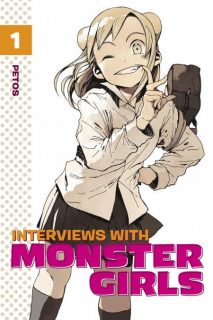
interview1

Interviews with Monster Girls. By Petos. Released in Japan as “Demi-chan wa Kataritai” by Kodansha, serialization ongoing in the magazine Young Magazine the 3rd. Released in North America by Kodansha Comics. Translated by Kevin Steinbach.

At its heart, this is essentially a less ecchi version of Nurse Hitomi’s Monster Informary. The difference is that the teacher and counselor here is a normal human, and he’s in a school that is also normal, but with a few “demihumans”, which is the term preferred here for Monster Girls. There’s a vampire, a snow woman, a dullahan who carries her head around, etc. Oh, and one of the teachers is a succubus. While this may sound like the start of a harem, it doesn’t read that way, really. The girls deal with the difficulties of who they are, and the teacher supports and helps them. Its main issue is that originality is really off the table – the dullahan in particular has a lot of Durarara!! in her. As long as it avoids everyone falling for the teacher, it should be OK for monster girl fans.

dragonmaid1

Miss Kobayashi’s Dragon Maid. By Coolkyousinnjya. Released in Japan as “Kobayashi-san Chi no Maid Dragon” by Futabasha, serialization ongoing in the magazine Monthly Action. Released in North America by Seven Seas. Translated by Jenny McKeon. Adapted by Shanti Whitesides.

Here we have a yuri take on the genre, though how yuri it actually is depends on your rose-colored glasses. Miss Kobayashi is a introverted young office worker who has, through various circumstances, a dragon living in her apartment. Luckily, said dragon can also turn into a cute girl. Things proceed from there, as we see coworkers, and of course other supernatural girls showing up. It’s played very much for comedy – I was amused at Kobayashi’s behavior when drunk, as she releases her inner otaku – though there are moments of sweetness when you realize that things might progress if the author was interested in any romantic progression. I doubt they are, though, so it’s mostly just OK. the author has also done I Can’t Understand What My Husband Is Saying and Miss Komori Can’t Decline!, whose anime has come out here but whose manga are unlicensed.

t-rex1

My Girlfriend Is a T-Rex. By Sanzo. Released in Japan as “T-REX na Kanojo” by Media Factory, serialization ongoing in the magazine Gene Pixiv. Released in North America by Seven Seas. Translated by Wesley Bridges. Adapted by David Lumsdon.

The title is basically the plot – dinosaurs evolved rather than dying off, and now we have a girl who’s top half is human, whose bottom half is a dinosaur, but whose personality is basically ‘well-meaning clumsy strong girl’. She’s probably the least interesting part of this title, which gets far more mileage out of its hero and side characters. Despite the title, however, Churio (the dino girl) and Yuuma aren’t officially dating. Yuuma is the reason I enjoyed this – he starts off looking like a bland romance manga hero, and then we discover that’s by design – he’s an ex-gang leader and troublemaker who’s trying to straighten up after graduation. This turns out to be more difficult than you’d think. We also get Churio’s best friend, Torika, also a dinosaur girl, but also a vamp who loves using men to get presents. She’s hilarious. I enjoyed this probably more than it deserved.

remonster

Re:Monster. By Kogitsune Kanekiru and Haruyoshi Kobayakawa. Released in Japan by Alpha Polis, serialization ongoing in the magazine Alpha Polis. Released in North America by Seven Seas. Translated by Lu Huan. Adapted by Rebecca Schneidereit.

I’m cheating a bit here – this is not a Monster Girl manga, but another in a long line of “I was transported to a fantasy world” titles. That said, all the main characters, including the girls, are goblins of some sort or other, so let’s let it slide. This has the most intriguing premise of the four – the surprise being that the guy who’s now a goblin had superpowers in his previous world, which was filled with espers who could do cool things. After getting killed by a jealous childhood friend, he’s now a lowly goblin, in a world where stats, levels and powerups are real. Sadly, the premise is the best thing about this manga, which means well but is incredibly tedious. There’s not much dialogue – it’s almost all narrative voice, which makes sense given this was adapted from a novel, but the narrator is so dry and boring that everything drags. The other issue is that we have a standard male power fantasy here. Gob-Rou never loses a fight, wins the respect of the goblins, becomes their leader, and by the end of the first book has started to amass a harem. Some self-doubt or failure would help.

Filed Under: REVIEWS

Manga the Week of 11/16

November 10, 2016 by Sean Gaffney, Michelle Smith, Ash Brown, Anna N and MJ Leave a Comment

SEAN: Life goes on. Somehow. And so does manga. Let’s see what’s coming out next week.

MICHELLE: *heavy sigh*

logh3

SEAN: Haikasoru has the 3rd volume of Legend of the Galactic Heroes, as a corrupt democracy battles a fascist dictatorship, with a third party making money off of both of them. Insert dark joke here.

MICHELLE: Heh.

ASH: Eyup.

ANNA: Sounds like a good time for me to finally pick this up.

SEAN: Kodansha gives us the 4th and final volume of Livingstone.

ASH: Intriguing premise with a somewhat uneven execution, but I’m still interested in seeing how it ends.

SEAN: And the 11th Yamada-kun and the Seven Witches, which many thought would be the final volume, but… it isn’t.

ASH: Already the series has had some good stopping points. I do enjoy the manga, but I also wonder how long it can be stretched.

SEAN: Vertical has the second to last Tokyo ESP.

gundam1

Do you like Gundam? Do you like serious, hardboiled, probably depressing Gundam? By the creator of the tragically unlicensed Moonlight Mile? You will love Viz’s debut of Mobile Suit Gundam Thunderbolt, then. Plus it ran in Big Comic Superior. Do you know how often that magazine gets a license? Never, that’s how often.

ANNA: I do like Gundam in general, but am not sure I am in the mood for depressing Gundam.

SEAN: Viz also has our yearly release of Ooku, with its 12th volume. If you like digital manga, Ooku 1-12 are also available digitally for the first time next week!

MICHELLE: Commence Kermit flail.

ASH: Always glad to see more of this series!

ANNA: EEEEEE!

MJ: Yes!

SEAN: And there’s a 6th and final volume of Sunny, probably my favorite Taiyo Matsumoto manga to date, even though I’ve fallen way behind on it.

MICHELLE: As have I.

ASH: It is a very good series.

tfm15

SEAN: Terra Formars continues to be a resounding success despite all my best efforts. Here’s the 15th volume.

And Ultraman’s 6th volume is ultra good. (Sorry, witty comments are thin on the ground today.)

And Yen On has most of its November releases ship next week (one was moved to the week after), starting with the 9th volume of A Certain Magical Index. What happens when you combine science, magic, a citywide athletics festival, and a terrorist attack? If you guessed “shenanigans”, you win.

Durarara!! has a 5th volume that starts up a new story arc, as Izaya gets revenge for the lack of hotpot invites, and Mikado learns that running a “colorless” gang is not as easy as he thinks.

Log Horizon’s 6th volume is focused on Akatsuki, who finds her skills hitting a wall and her relationship with Shiroe doing much the same.

And lastly, another volume of Re: Zero, where we see if our hero can survive the next day, or if he keeps getting horribly murdered.

Take your mind off things. Read manga!

Filed Under: FEATURES, manga the week of

One Piece, Vol. 80

November 10, 2016 by Sean Gaffney

By Eiichiro Oda. Released in Japan by Shueisha, serialization ongoing in the magazine Weekly Shonen Jump. Released in North America by Viz. Translated by Stephen Paul.

The Dressrosa arc drags to a conclusion here, featuring many of what we’ve come to accept as typical One Piece cliches. Townspeople pretend to start an angry riot in order to help Luffy and company get away. A noble Marine takes them on only to change his mind and let them go at the last minute because he knows they aren’t really evil. Luffy once again rejects the basic ideas that make up what most of the world thinks of piracy, preferring to create his own definition. And before starting a new arc, we once again get a roundup from around the world of how various people are doing, seeing Rob Lucci of CP9, Buggy and company, Dragon and his revolutionaries, and the marines and Blackbeard pirates. All are there to make us recall that the world is complex and not easy to fit into a bio, and Luffy’s job is to fit it into that box anyway.

op80

Given this is the final time I’ll be talking about Dressrosa, let me once again take the opportunity to talk about what a wasted character Rebecca was. It was always going to be difficult to see her arc because, well, we already had her arc with Vivi, and we love Vivi. So many of the same beats of this arc had also been hit in Alabasta. But Vivi, while she was a stated pacifist, and occasionally would cry, was not set up to be the ‘pretty princess’ quite like Rebecca was. I think the arc may have been helped by showing us Rebecca as a shy, sheltered girl before we saw her as a gladiator, which would at least show us that she was meant to be painfully out of place. The trouble is that Oda can’t help but make her fights look really cool, and thus we react viscerally when the narrative keeps hammering us with “you don’t have to fight anymore, step back and be pretty”. In any case, Rebecca can now be reunited with her father, and I can move on.

The other thing to talk about here is the Straw Hat Pirate Alliance, suggested by many of the pirates who have helped Luffy in Dressrosa, among them Bartolomeo and Cavendish. It’s the next logical step on Luffy’s quest to be the Pirate King, the most important pirate in the world – a fleet of allies. But Luffy is not interested in the logical way to anything, and doesn’t want the responsibility of commanding a fleet of pirates. Honestly, he’s barely interested in commanding his own nakama. It is somewhat awkwardly spelled out in the narration – to Luffy, this is about freedom, not power. That said, he gains his alliance anyway, and they swear to come to his aid if he ever needs it, which will no doubt crop up in the future. Again, we hit a core truth of One Piece – Luffy’s piracy is not everyone else’s, and that’s why his crew love him so much.

And now we prepare to start a new arc, which begins in a truly weird way as only Oda can do, with a floating island that’s actually an elephant, anthropomorphic minks who no doubt will bond quickly with our heroes (heck, Nami is already loaning out her clothes to them), and a cliffhanger as Nami has something horrible to tell us about Sanji. If this leads to a Sanji arc, I’ll be quite happy – I’ve disliked comedy Sanji at times, but serious Sanji can be excellent. One Piece’s flaws are now openly visible every book, but it’s still well worth reading.

Filed Under: REVIEWS

Bookshelf Briefs 11/7/16

November 7, 2016 by Sean Gaffney and Michelle Smith Leave a Comment

haikyu5Haikyu!, Vol. 5 | By Haruichi Furudate | Viz Media – Well, I was wrong about training harder. They do, but we don’t see it much. Instead, we head right into the big tournament proper, and get the first two matches. The first one is against an old classmate of Sawamura’s, and we see how far along our heroes have come compared to the other teams. There’s a great shot halfway through showing all the losing teams—including the Karasuno Girls’ team, whose captain clearly has a crush on Sawamura, always a danger in a manga with a 99% female fandom. The rest of the book shows their match against the team that beat them last year, though, and they’re still tough as nails. But now we have our short but valiant secret weapon! Very shoneny, in the best way. – Sean Gaffney

liselotte2Liselotte & Witch’s Forest, Vol. 2 | By Natsuki Takaya | Yen Press – Well, I did ask for more on Liselotte’s past, and I certainly got it. We also get a lot of her channeling her inner Tohru, trying to meet the witches in the forest to assure them that she means them no harm but merely wants to live here in peace and harmony. Of course, that’s easier said than done, especially when an assassin is sent after her, complete with an eyepatch so that you know he’s a true rogue. And we learn a bit more about Engetsu, who is sort of Liselotte’s old dead love Enrich, but also sort of not. How this plays out is anyone’s guess, but it certainly looks pretty, and has some nice cool fighting. I still find it a bit underwhelming, but honestly that’s been true of any non-Furuba Takaya title. – Sean Gaffney

magi20Magi: The Labyrinth of Magic, Vol. 20 | By Shinobu Ohtaka | Viz Media – The most important thing in this volume for me is that Morgiana returns, and she does what we love to see her do best: rescue Alibaba and princess carry him. She seems to be a lot less stoic after her trip of awesome training. The rest of this volume consists of a) lots of battling against the big evil thing of evil, which proves quite difficult to defeat as it is literally made of evil; b) a lot of backstory that shows that Aladdin has a lot more going on than everyone expected, which honestly most readers had guessed; and c) theoretically killing off some characters (I’ll believe it while I see it), while bringing the most obvious one back from the dead right after he’s passed. Fun, but I really want a new arc. – Sean Gaffney

maidsama11-12Maid-sama!, Vols. 11-12 | By Hiro Fujiwara | VIZ Media – This is a fairly uneven installment of Maid-sama!, though the one constant throughout is Misaki attempting to come to grips with and then successfully express how she feels about Takumi. First, they go on a double date to the hot springs, and then Takumi’s family drama suddenly ramps up. Next, it abruptly turns back into a comedy as his half-brother has a penchant for making his valet dress up like a ninja as he spies on Takumi. Throughout, there are various assertions that Misaki isn’t good enough for Takumi, with Takumi dissenting, et cetera. And then, at the end, Aoi designs some costumes and briefly stops being a jerk. I don’t know why I kind of expected a volume of Maid-sama! to be uniformly good, but I did. In any case, it’s decent enough and the story is moving along. Sort of. – Michelle Smith

missions13Missions of Love, Vol. 13 | By Ema Toyama | Kodansha Comics – You know how most people were about Black Bird? Or Hot Gimmick? That’s how I’ve come to feel about Missions of Love. Don’t get me wrong, I absolutely love it. I love seeing these damaged, deeply manipulative teens walk all over each other. I love the fact that Yukina is amazed that she might still be ignorant of what love is, despite the entire series being based around that premise. (“Apparently I’m frigid.” made me laugh out loud.) And then there’s Mami and Akira, whose plotline keeps happening just off camera, all the better to keep Yukina guessing. And of course there’s Shigure, who is understandably frustrated at being away from all of this. Good thing she’s dragged to him for the cliffhanger. Read this amazing trash. – Sean Gaffney

onepunch9One-Punch Man, Vol. 9 | By ONE and Yusuke Marata | Viz Media – The deeper stuff I mentioned last time is continuing, as the villain we met last time decides to go around beating up literally everyone he comes across, and most of the heroes seem to be able to do little to stop him. I’m sure Saitama and Genos will end up in his path eventually, but in the meantime we have Blizzard, a stereotypical yakuza boss who’s also a hero, and decides that Saitama is good enough that she wants him to be part of her hero gang. Naturally, Saitama is unimpressed, and has some nice lectures on what it means to be a hero. Also naturally, most of her bluster is just that—she’s the Tornado of Terror’s little sister, and it weights on her. I love how this series views superheroes. Highly recommended. – Sean Gaffney

oresama21Oresama Teacher, Vol. 21 | By Izumi Tsubaki | VIZ Media – For a while there, it looked like we weren’t going to get any follow-up to the “Hayasaka finds Super Bun’s scarf in Mafuyu’s closet” cliffhanger, and so I was doubly disappointed by the boring hometown interlude set during winter break. Happily, once school reconvenes, we learn that Hayasaka has been waiting for the opportunity to ask Mafuyu about it, but just then, a Super Bun impostor is sighted, and the rest of the volume primarily consists of chase scenes. That probably sounds boring, but it’s actually something fun and different. I can’t remember if we’re supposed to recognize the dude who’s behind it all, and I’m sure it’ll end with Hayasaka still not learning the truth, but for now it’s quite enjoyable. – Michelle Smith

shuriken2Shuriken and Pleats, Vol. 2 | By Matsuri Hino | VIZ Media – Mikage Kirio is attempting to leave her past as a ninja behind and fulfill her late master’s wish for her to lead the life of a normal high school girl. There are a couple of nice moments when she achieves this, reflecting on the warm welcome she receives from her new group of friends, and marveling at their skill in finding the most delicious meat buns in town, but most of the volume is in a hurry to wrap up the not-very-interesting seeds-as-bioweapon plot. It’s not exactly unsuccessful—it all makes sense, at least, which is more than I can say for some series—but it’s terribly rushed. Still, it’s nice to see serious Mikage smiling for once, and overall the series has left a pleasant impression. – Michelle Smith

toriko36Toriko, Vol. 36 | By Mitsutoshi Shimabukuro | Viz Media – We wrap up one arc and start another here, so there’s not really a lot of fighting. What there is is backstory and explanations, so many of them in what is almost one big infodump. Some of it is truly interesting—I love the idea of the Earth as a meal that’s almost finished cooking, and it’s nice to see that the chefs are all going to have their own little adventure (led, no doubt, by Komatsu, who apparently awoke his own gourmet cells—he’s come a long way.) But yeah, much of this is setup for the volumes to come, with Sunny griping as always, Coco being the sensible one, and Toriko and Starjun having to work together—something which comes surprisingly easy to them. Solid, but unexceptional. – Sean Gaffney

Filed Under: Bookshelf Briefs

My Week in Manga: October 31-November 6, 2016

November 7, 2016 by Ash Brown

My News and Reviews

Last week at Experiments in Manga the winner of the Sweetness & Lightning manga giveaway was announced. The post also includes a list of some of the manga available in English that feature notable fathers or father figures. As for more in-depth features, I’m (still) currently working on some random, but rather personal, musings about Ichigo Takano’s manga series Orange. Progress on that post is a little slower than I would like it to be, but hopefully I’ll have something to share in the relatively near future.

As for interesting things that I’ve recently found online: The Honolulu Museum of Art recently hosted a series of lectures and discussions called Manga in Japan, Hawai‘i, and Throughout the World; many of the recordings can now be watched online. The proceedings of the Manga at a Crossroads symposia are available to read or download from The Ohio State University. Anna Madill has also posted the slides from her 2016 Comics Forum keynote address–Genre, genealogy, and gender: Reflecting on Boys’ Love manga–which includes some interesting results from her BL Fandom Survey. And speaking of boys’ love, Digital Manga’s Juné imprint is seeking the print rights for Asumiko Nakamura’s Classmates (Doukyusei).

Quick Takes

Haikyu!!, Volume 3Haikyu!!, Volumes 3-5 by Haruichi Furudate. The new Karasuno team has made it through its first game, but the members still have some practicing to do before they can completely shed the nickname of the fallen champions. But considering their tremendous talent and potential, that might not take them too long. With these volumes, a few more Karasuno veterans are introduced, as are their rivals, before the series quickly moves from training to tournaments. Although there are some very exciting moments, I actually find the games to be the least interesting part of Haikyu!!, which may (but not necessarily) present a problem in the long run for what is primarily a sports manga.  Some of the action was a little difficult for me to follow until I got used to Furudate’s visual language, probably because I’m not actually all that familiar with volleyball gameplay. Growing up, my family’s anything-goes backyard games followed vastly different rules; Haikyu!! is actually teaching me how volleyball as a sport is really played. However, I am still enjoying Haikyu!! immensely. I particularly love the series’ focus on teamwork and even more so its unflagging positivity. Haikyu!! manages to be competitive without being mean. I also really like the distinctive personalities of the characters, and Furudate’s sense of humor and comedic timing is great. The manga continues to be great fun.

Neo-Parasyte fNeo-Parasyte F by Various. Hitoshi Iwaaki’s series Parasyte happens to be not only one of my favorite horror manga, but one of my favorite manga in general. That’s probably the main reason I was so excited that the Parasyte shoujo tribute anthology Neo-Parasyte F was licensed, but the list of contributors is exciting in and of itself, too. I was especially happy to have the chance to read more of Asumiko Nakamura’s work, but there are other creators that English-reading fans will likely recognize as well, such as Ema Toyama, Kaori Yuki, and  Yuri Narushima among others. Neo-Parasyte F collects fifteen short manga that in one way or another pay tribute to Parasyte. Some of the stories take place within the same world as Parasyte–Shinichi and Migi, the main characters of the original series, even make a few appearances–while others are set completely apart. Many of the manga are still horror-themed, but there are a surprising number that actually take a more humorous approach. Ever wonder what Parasyte would be like as an otome game? Neo-Parasyte F presents one possible interpretation of just that. Overall, the volume is a great anthology containing an excellent variety of genres and styles. Neo-Parasyte F will likely appeal most to readers who are fans of or at least familiar with Parasyte, although a few of the contributions can stand completely on their own.

The Prince in His Dark Days, Volume 1The Prince in His Dark Days, Volume 1 by Hico Yamanaka. In Japan, Yamanaka is probably better known for her boys’ love manga, but that’s not all that she’s done. For example, The Prince in His Dark Days, Yamanaka’s English-language debut, does not fall into that particular genre. However, it is poised to explore gender and sexuality in interesting ways, which is what first brought the series to my attention. The story follows Atsuko, a high school student from a broken and abusive family who is struggling to make ends meet. She is more or less coerced into becoming the stand-in for Itaru, the wealthy heir to a major corporation who has gone missing. Very possibly he ran away due to some of his own unfortunate circumstances. Until Itaru is found, Atsuko will be taking them on in his place. Although she’s not exactly leading a life of luxury–parts of Itaru’s own life are less than ideal–at least she’s no longer quite as miserable as she once was. The initial setup of The Prince in His Dark Days is a little rough and feels a somewhat forced, but it does establish understandable reasons for everything that follows. Admittedly, the whole situation is rather strange, but once Atsuko has adopted her new role she devotes herself completely to it. In the process, she begins to create meaningful if somewhat peculiar relationships with the people around her. I’m not entirely sure where The Prince in His Dark Days is heading, but I do know that I want to find out.

Princess Jellyfish, Omnibus 3Princess Jellyfish, Omnibus 3 (equivalent to Volumes 5-6) by Akiko Higashimura. I am still incredibly pleased that Princess Jellyfish manga series is being released in print. I thoroughly enjoyed the anime adaptation and was left wanting more after it ended, so I’m thrilled to finally have the chance to read the original manga. The anime began around the same time that the sixth volume was originally being released in Japan, so from this point on more and more of what is seen in the manga will either be new or significantly different. It has been a while since I’ve watched the anime so I may be misremembering parts of it, but already I can identify where notably different choices were made as to plot and characters. However, the heart of both the manga and the anime are definitely the same. Despite the various romantic and relationship dramas, Princess Jellyfish is largely a comedy. Serious matters like familial and social expectations are addressed and explored in the series, but Higashimura primarily does so through humor, sometimes more successfully and sometimes less so. Princess Jellyfish is an energetic manga that can be over-the-top and ridiculous, but it can also be very touching. As the women of Amamizukan search for a way to save their beloved home they are finding new ways to express themselves through skills and talents that they never realized they had, slowly coming out of their shells in ways they never expected.

Filed Under: FEATURES, My Week in Manga Tagged With: Akiko Higashimura, Haikyu!!, Haruichi Furudate, Hico Yamanaka, manga, Parasyte, Prince in His Dark Days, Princess Jellyfish

Scum’s Wish, Vol. 1

November 6, 2016 by Sean Gaffney

By Mengo Yokoyari. Released in Japan as “Kuzu no Honkai” by Square Enix, serialization ongoing in the magazine Big Gangan. Released in North America by Yen Press. Translated by David Rowe-Caplan and Megan Denton.

This story begins in a very cute, heartwarming way, but I suspect the reader is not going to fall for it. The ‘scum’ in the title is the clue, and there’s also the cover art, showing our heroine, Hanabi, with her shirt mostly off, winking and sticking her tongue out at the reader. So when you discover almost right away that they’re actually both in love with their teachers (hers at least is her childhood “big brother” figure that she grew up with, but as always teacher/student romance is accepted far more by Japanese readers than Western ones), you aren’t particularly surprised. Mugi, the guy, and Hanabi are pretending to date while they pine away from someone else. And, because they’re both giant pots full of teenage hormones, they also take care of each other’s physical needs – there’s explicitly no going all the way, but there’s lots of making out and physical contact to a disturbing degree. It’s fascinating yet sordid.

scum1

I mentioned on Twitter while reading this volume that it’s like an evil mirror image of another Yen Press title, Love at Fourteen. That one also deals with a first time student romance, and also features an awkward teacher student relationship. But while equally realistic, and occasionally has the odd crisis, it is for the most part cute and heartwarming. You like these kids and want them to be together. Scum’s Wish shows us a relationship of convenience that isn’t good for either one of the couple, but you still end up rooting for them, as while they’re not all that sympathetic, they’re both very likeable. Hanabi especially grew on me, especially when it became clear that she was not going to be a meek and passive victim here. She’s actually somewhat cynical and snarky, something she tries to hide from her teacher whenever possible, and can be quite possessive, not just of her real love, but even of her fake one.

Towards the end we also meet a new girl who seems completely out of place to the somber, bittersweet anti-love story going on here. I loved her to bits. Moka first appears in a flashback where we’re getting an otherwise depressing but well told backstory for Hanabi, and we see her as a spoiled brat princess sort. Come high school, that hasn’t changed. If anything, she’s got a bad case of Eighth Grader Syndrome, demanding to be called Moka instead of Noriko and describing Mugi as her Prince Charming come to take her away from all this. You’d think she would be horribly wrong for a series like this one, but she actually releases the tension that’s built up from the start, and I find her nuttiness soothing. I also loved Hanabi’s casual threat to her, not letting her even get a toehold in between the fake relationship he’s built up.

I’m not sure that I’m going to love where this goes, and I fear it will be one of those sorts of series I call ‘potboiler’. But some potboilers are fascinating for all the right reasons, and Scum’s Wish caught my eye from the start and didn’t let it go. Good art, too, capturing the sensuality and furtiveness that most teen romance writers tend to forget is the majority of what’s going on there. Definitely recommended, provided you don’t mind feeling you need to wash up afterwards.

Filed Under: REVIEWS

Welcome to the Ballroom, Vol. 1

November 5, 2016 by Michelle Smith

By Tomo Takeuchi | Published by Kodansha Comics

ballroom1In the immortal words of Sir Paul McCartney:

Ballroom dancing made a man of me
One, two, three, four
I just plain adore your
Ballroom dancing, seen it on TV
I got what I got from ballroom dancing
Big B.D.

Feckless Tatara Fujita isn’t especially good at anything, and doesn’t know what he wants to do after middle school. One day, as bullies are hitting him up for cash, he is saved by Kaname Sengoku, who mistakes Fujita’s perusal of a poster advertising a part-time job for interest in an adjacent dance studio ad. Fujita is summarily whisked away to the studio, where he learns that one of his classmates, seemingly studious Shizuku Hanaoka, is not only a student there but one of the top amateurs in the sport.

For, indeed, this is a sports manga. Once Fujita sees a recording of Sengoku in action, he vows to change. To him, dancing is (not yet anyway) about personal expression but about self-improvement. He wants to gain poise and self-confidence, and once he decides that’s what he’s going to do, he works very hard. This isn’t one of those manga where the protagonist has some great talent, for even after weeks of lessons, he’s still not great, but there’s a glimmer of something about him that intrigues Sengoku. When he and Fujita later attent a tournament that Hanaoka is competing in, Sengoku taps Fujita to fill in when her long-time partner mysteriously disappears.

Although I don’t often comment on the art in manga, I found Welcome to the Ballroom to be quite interesting in that department. It almost seems a bit shoujo at times, with the lovely way the dancing is depicted, but then it must remind you that it’s shounen by throwing in a panty shot. I also found it refreshing that the cute love interest doesn’t stay on the sidelines or manage the team—she’s very talented and focused, with dreams of her own. (Lamentably, her ambitious plans to study abroad are later revealed to be for the benefit of her partner.)

I’m excited by the prospect of the world championship qualifying tournament that’s coming soon, though I hope we see it in more detail than the introductory glimpses we’ve had thus far. Alas, there are not thirty-plus volumes of this to look forward to either, since the series is on hiatus after eight volumes in Japan. Nevertheless, I do recommend it and look forward to more!

Welcome to the Ballroom is up to eight volumes in Japan, where it is presently on hiatus. Kodansha will release the second volume later this month.

Filed Under: REVIEWS

Is It Wrong To Try To Pick Up Girls In A Dungeon? On The Side: Sword Oratoria, Vol. 1

November 5, 2016 by Sean Gaffney

By Fujino Omori and Suzuhito Yasuda. Released in Japan as “Dungeon ni Deai o Motomeru no wa Machigatte Iru Darou ka? Gaiden – Sword Oratoria” by Softbank Creative. Released in North America by Yen On. Translated by Andrew Gaippe.

First of all, boy is that title unwieldy. It’s certainly an accurate translation of the Japanese, though ‘Side Story’ might be more accurate. It’s a way to let the reader know this is not part of the main series dealing with adventurer Bell Cranel and his goddess Hestia. Instead, this series will focus on Bell’s idol and inspiration, Aiz Wallenstein, and the adventures of her Familia under Loki. Aiz has been something of a cipher throughout the series, so it’s great to see her get more focus, even if she gets a bit less development than I expected.

danmachiss1

Most of that is simply due to the function of her personality – Aiz is not stoic, as she’s seemed in some of the main series novels, but she is very emotionally repressed. We get a bit of her backstory here, though it’s seen in a dream, so is very vague, and she admits to herself that one reason she takes such an interest in Bell (this novel takes place at the same time as the events in Book 1 of the main series) is that he reminds her of the way she was as a little girl. We also get some good examples of how she fights alongside her team in a much lower level than Bell has ever been to, and to no one’s surprise, she is miles above everyone else – even her own badass partners.

The other girl on the cover is Lefiya, a Level 3 elf who fills the role of the newbie in this book. Admittedly, being Level 3, she’s miles above where Bell and his companions are in the main series. However, when you’re a Level 3 surrounded by Level 5s, you tend to feel useless, especially when you only do magic and are easily distracted. As you’d expect, she gets a few failures at the start of the book, and a big success right at the end – she has a bit of a rulebreaking power, and isn’t afraid to use it to save her friends. She’s also possibly gay, though as ever in Japanese media, the line between lesbian and just akogare is deliberately obfuscated – honestly, I suspect it’s the latter.

As I noted earlier, the book takes place at the same time as the first in the main series, and gives us some extra insights – Bete, the drunken lout who insulted Bell in the first volume, showed that he was VERY drunk when he did this, and feels horrible about it. He is a jerk, but not THAT much of a jerk. And Loki and Freya have some very interesting conversations which read better now that we’ve seen future volumes, and show off just how capricious these gods are. And just as Freya is sort of kind of the main antagonist in the series to date, the side story gets Dionysus, who I’m pretty sure we’ll be seeing more machinations from in the future, as he sets a dangerous monster on the Loki team and almost kills everyone there.

This is not quite as good as the main series, as you can sort of hear the author working a bit too hard to connect the dots to fit this book in seamlessly with the main series. But it’s still a lot of fun, and Danmachi fans will absolutely enjoy it. I’m hoping we continue to learn more about Aiz and Loki Familia as we go along.

Filed Under: REVIEWS

Manga the Week of 11/9

November 3, 2016 by Sean Gaffney 1 Comment

SEAN: November continues to give us lots of manga, with something for everyone next week.

Dark Horse has Psycho Pass: Inspector Shinya Kogami, a prequel to the popular anime series detailing the main character’s days as an Inspector.

fireforec1

Kodansha gives us Fire Force, from the creator of Soul Eater. It’s about demons causing people to catch fire, and a boy with special powers who joins the fire brigade to help. I look forward to the art if nothing else.

ASH: Looks like it could be fun.

SEAN: Did you enjoy Parasyte? Did you want more from this world, possibly from different creators? Then get ready for Neo Parasyte f, an anthology that collects all sorts of Parasyte-related stories from creators like Kaori Yuki (Godchild), Ema Toyama (Missions of Love), and Yuri Narushima (Planet Ladder).

ASH: I am incredibly excited for this anthology! Asumiko Nakamura (Utsubora, Doukyusei) is a contributor, too.

SEAN: There’s a 3rd omnibus of Princess Jellyfish, as they continue to try to save the apartment complex.

MICHELLE: This is already in my Amazon cart!

ASH: Still incredibly happy this series is getting a print release!

ANNA: I need to put it in my Amazon cart!

SEAN: And a 9th UQ Holder, which finally gave up and subtitled itself Negima 2 in Japan.

I find it hard to believe A Centaur’s Life has reached double digits, but there we are. Seven Seas releases Vol. 10 next week.

And there’s an 11th Devils And Realist, which is less hard to believe.

There’s a new series debuting called Re: Monster, with a fantasy world and reincarnation and a male hero who amasses a harem of zzzzzzzzzzzzzzzzzzz…

And a third volume of Shomin Sample, which has only its snarky hero to save it from oblivion.

tencount2

SuBLime has a 2nd volume of Ten Count, which is still not about boxing, but it does have guys pulling off their shirts. Or possibly eating their shirts.

ASH: Nope, not about boxing. But I did find the first volume compelling.

ANNA: I think I have the first volume stashed somewhere, I need to read it!

SEAN: Vertical gives us the 3rd Seraph of the End novel, a prequel to the Viz manga.

Ranma 1/2 is starting to wrap up, but isn’t quite there yet. Here’s the 17th omnibus.

And a new Requiem of the Rose King, in which I expect Richard to be absolutely terrible, but in a very shoujo way.

MJ: Finally, something for me to get excited about. This is a series I still love.

MICHELLE: Me, too. And I like the cover very much, too.

ASH: I also love this Shakespearean reimagining. All of the covers have been excellent, and Kanno’s interior artwork is wonderfully moody, too!

ANNA: Add me to the list of people who love this series.

SEAN: There’s a new volume of Rin-Ne (the 22nd), though honestly you could swap it with any of the last 15 volumes and the content would be about the same.

MICHELLE: I missed some of the middle teens, but I have a few of the more recent volumes that I plan to read in the near future. Sometimes I appreciate a series where it isn’t necessary to read every volume in order to follow what’s going on in the present.

SEAN: And it’s been a while, but here’s the 9th volume of Tiger & Bunny.

Lastly, Yen released a numbered edition of this last month, but this month comes the mainstream release of Spice & Wolf: The Anniversary Collector’s Edition. This almost-1000 page hardcover collects all 17 Spice & Wolf novels to date, and looks like a Complete Works of Shakespeare. A must for S&W fans, though I myself will be waiting for the digital release that is apparently coming soon.

ASH: That does sound impressive!

SEAN: As I said, something for everyone. But is there something for you?

Filed Under: FEATURES, manga the week of

The Black Museum: The Ghost and the Lady, Vol. 1

November 3, 2016 by Sean Gaffney

By Kazuhiro Fujita. Released in Japan as “Kuro Hakubutsukan” by Kodansha, serialized in the magazine Weekly Morning. Released in North America by Kodansha Comics. Translated by Zack Davisson.

Kazuhiro Fujita is one of the more famous Japanese manga artists that have never been published in North America till now. Part of the reason is that his two main series, Ushio and Tora and Karukiri Circus, both suffer from being over 30 volumes long and, even worse, being a Shonen Sunday series, a notoriously difficult sell over here for anyone not named Rumiko Takahashi. Fujita’s titles tend to have a supernatural bent, and this one is no different, an anthology series he wrote for the seinen magazine Morning about a museum of oddities and its beautiful but very eccentric curator. One night a ghost arrives to tell his story, which involves a young woman named Florence Nightingale who can see spirits, and is begging for death…

ghostandlady1

While there are a few creepy moments, at heart this is not really a horror series. This is about a young woman who is tormented by the strictures of society who is able to move past it and find new determination with the help of her new bodyguard, who just happens to be a ghost. the ghost, The Man in Grey (referred to as ‘Grey” by Florence), is a former duellist with a love of the theatre. Florence comes to him because she can see Eilodons, invisible creatures that lurk over everyone and seem to take in all their anger, hatred, fear, etc. Florence not only sees them but knows she has one of her own, which is tormenting her. She makes a deal with Grey to kill her – but he doesn’t want to do it yet, preferring to wait till she’s at her deepest moment of despair. Which will surely come along. Really soon. Any day now.

Those familiar with the story of Florence Nightingale may be laughing up their sleeve a bit by now, and indeed most of the humor in this series involves the ghost getting increasingly frustrated at Florence’s sheer spunk and determination – there are several moments when he could easily kill her, but she’d just die happily and at peace, and what’s the point of that? So instead he assists her to occasionally attack other eilodons that are in opposition to her (her parents, etc.), but mostly to act as a sounding board and snarky narrator of asides. Meanwhile, Florence manages to succeed at her true calling, nursing, and ends up in the middle of the Crimean War… where she runs into Le Chevalier D’Eon, who is not only also a ghost, but is surely delighted to be featuring in yet another Kodansha series released in North America. (No, it’s not a crossover, D’Eon is a real historical figure.)

I don’t have much to analyze here except that this is a solid, well-written book that had me turning the pages rapidly. The art is at its best with the expressions, be they Grey’s increasing frustration, Florence’s shift from hollow-eyed and suicidal to determined and powerful, or even the increasingly loopy and amusing reactions of the curator of the Black Museum, who I hope we see more of. (There is also a fair bit of nudity, be warned – it is a seinen series.) It’s also a handsome hardcover of about 300 pages long, and the translation is of course excellent. It’s just a great example of why this artist is so popular in Japan, and I am greatly looking forward to the second (and final?) volume.

Filed Under: REVIEWS

Fruits Basket Collector’s Edition, Vol. 6

November 1, 2016 by Sean Gaffney

By Natsuki Takaya. Released in Japan by Hakusensha, serialized in the magazine Hana to Yume. Released in North America by Yen Press. Translated by Sheldon Drzka.

The end of this omnibus is the halfway point in the Fruits Basket re-release, and you definitely get the sense that we have turned a corner. While I’m not sure that Takaya-san had worked out exactly how long she was going to make the series, I think here is where the ending she wanted firmed up in her mind and she began to take steps towards achieving it. And that means that Tohru, who had been suffering a bit from drifting through life after the death of her mother, acquires a new purpose, and becomes surprisingly driven to achieve it. Or perhaps it’s not so surprising, given that Akito is the one who sets her in motion with a violent rejection of her very self.

furuba6

The first half of the book is still set in the summer vacation beachhouse, as Akito works hard to ruin everyone’s vacation. But we find that success is not as easy as it once was. Kazuma explains to Tohru later on that Akito has an effect on the other zodiac, that words that could be brushed off if someone else said them affect them to their very core. But we actually begin to see a bit of that unraveling here. Haru seems to be so worried about Rin that he doesn’t react as much to Akito’s jibes about being stupid. Momiji is willing to defy Akito to avoid getting Tohru hurt. Even Kyo, whose self-loathing reaches another peak here, finds that a rare meeting with Akito doesn’t have the pull that it once did. The curse is explained in mroe detail than it’s ever been here, but we’re starting to see the start of it breaking.

And Tohru wants to be the one to do it. Akito’s little speech, which is long and violent (her cheek is scratched hard enough to draw blood) basically amounts to “Fuck off”, actually does the opposite of what it intends – mostly because it reveals what Kyo’s eventual fate will be. The Furuba fandom had been somewhat equally divided between Tohru/Yuki and Tohru/Kyo, but I think this book is where people began to realize that the triangle was already being broken up. Partly due to Yuki continuing his own separate, non-Sohma subplot (which still hasn’t quite gotten off the ground, though we did meet the always wonderful Kimi, who I will be praising more as the serious goes on, because she’s hilarious), but also due to the fact that it’s clearly Kyo’s fate that makes Tohru want to push to find out about how to break the curse more than anything. Seeds are being sown.

Speaking of seeds, we also meet Rin here for the first time properly, though she’s still something of an enigma, and notably does not receive the same treatment as the other Sohmas to date – meet, reveal their emotional trauma, get bathed in Tohru’s healing waves. Rin is a massive ball of rage, and will not be the sort to simply wilt under Tohru’s good cheer. I suspect a collision in the next book, particularly as Rin has discovered what Tohru is looking for. And some seeds have ended up not flowering after all, as Kagura discovers when she admits to herself that Kyo is never going to accept her affection, and manages to pour her heart out to him in an actual, real date free from her usual over the top violence. Her broken confession that she felt better being around Kyo because of the cat’s scapegoat nature is heartwrenching, but Kyo’s sympathetic, lukewarm response may be even more so.

As always with an omnibus, I feel I’m leaving more out. I never did talk about the mysterious Ren, who is mentioned here and seems to be the one that finally sets Akito off to go attack Tohru. And then there’s the school counseling sessions, when the parents arrive to discuss their children’s futures. Tohru’s grandfather is laid up with a bad back, so Shigure goes in his place, which leads to as much hilarity as you’d expect when he clashes with Mayu. (Also note his fantastic expression when she tells him he’s not even nice to the people he loves.) But overall, an excellent omnibus, possibly the high point of the entire series, and certainly a sign that we are going to start tying up our loose ends soon, even if some of them are going to resist that for a long time to come.

Oh yes, Tohru and Uo’s faces when Hanajima mentions that Kazuma is hot. Those are also a big highlight. See? I can go on and on.

Filed Under: REVIEWS

My Week in Manga: October 24-October 30, 2016

October 31, 2016 by Ash Brown

My News and Reviews

Although I was finally around for most of last week (as opposed to traveling and being busy with family stuff and such like I was for previous two weeks), all that was posted in addition to the usual My Week in Manga feature was the monthly manga giveaway for October. Experiments in Manga is currently following a more relaxed posting schedule which, while it does still frustrate me that I’m not currently able to post more, is better than not posting anything at all. Anyway! There’s still time to enter for a chance to win the first two volumes of Gido Amagakure’s Sweetness & Lightning. All you have to do is tell me a little about your favorite dad or father figure from manga.

Seven Seas was celebrating its twelfth anniversary last week and announced a slew of new licenses including Yurino Tsukigase’s Otome Mania!!, Aikawa Shou’s Concrete Revolutio, Isaki Uta’s Generation Witch, Aoki Spica’s Beasts of Abigaile!, Nozomu Tamaki’s Don’t Meddle With My Daughter, Hachijou Shin’s Red Riding Hood and the Big Sad Wolf, Aosa Tsunemi’s Akashic Records of the Bastard Magical Instructor, Shiramine’s Tales of Zestiria, and Kabi Nagata’s My Lesbian Experience With Loneliness (which is probably the manga that I’m most curious about). Also of note, it looks as though Seven Seas might be getting back into the light novel game and the first print run of Kore Yamazaki’s The Ancient Magus’ Bride, Volume 6 will be accompanied by a booklet with a bonus chapter.

Not to be outdone, Yen Press announced three new acquisitions: Delicious in Dungeon by Ryoko Kui, the original novel, manga adaptations, and spinoff novel of Makoto Shinkai’s Your Name, and No Game No Life, Desu! by Yuu Kamiya and Kazuya Yuizaki. Also, Bento Books is preparing to release some more manga, including second volume of the Math Girls adaptation and the first two volumes of Female Math Major. After a bit of a mishap the first time around, the relaunch of Digital Manga’s most recent Kickstarter is well on its way to raise funds to release several of Osamu Tezuka’s short manga collections: Under the Air, Melody of Iron, and The Crater (which has its own history of mishaps separate from Digital Manga’s). Other Kickstarters that have recently caught my eye include the queer, supernatural, erotic comic Letters for Lucardo and the supernatural horror-comedy comic Not Drunk Enough.

Quick Takes

Fairy Tail: Blue Mistral, Volume 3Fairy Tail: Blue Mistral, Volume 3 by Rui Watanabe. Out of all of the various Fairy Tail spinoffs (and to some extent even Fairy Tail itself), Blue Mistral is the manga that I’m most enjoying so far. I find this particularly interesting because out of all the series, Blue Mistral is the one aimed at a demographic farthest from the one that technically I belong to. I believe Blue Mistral is currently the only shoujo version of Fairy Tail (or at least is the only one to have been published in  English at this point) and the magazine in which it was originally released is generally geared toward middle school girls. However, this audience is fitting for a series which follows Wendy Marvell, Fairy Tail’s twelve-year-old dragon slayer magic user. Although other characters from Fairy Tail do make appearances in the series, Blue Mistral is absolutely about Wendy and her adventures apart from the rest of the guild. In this particular volume, she spends much of her time posing as a boy for her own safety as she investigates the disappearances of a group of young women in the town of Aiya. After joining the town guard, she comes to discover that the circumstances are much more complicated than they first appeared. Romantic feelings play an important role in the story, but generally the romance occurs between characters who are not Wendy. Her heart does beat a little faster from time to time, though. Blue Mistral, even with all of the danger that Wendy must face, continues to be a generally upbeat, fun, and charming series.

Forget Me Not, Volume 4Forget Me Not, Volume 4 written by Mag Hsu and illustrated by Nao Emoto. Although by and large I have been enjoying Forget Me Not, the third volume managed to frustrate me immensely. However, the fourth volume worked much better for me. Serizawa’s romantic relationships and attempts at romantic relationships continue to be utter utter wrecks (which considering the premise of the series is entirely expected), but at least he’s finally gained some more maturity and is able to begin to understand his own feelings. The fourth volume also delves into Serizawa’s family history which reveals some of the likely reasons that he has so much trouble forming relationships to begin with–raised by his mother after his father abandons them for another woman, he hasn’t really had a good model to follow. That’s actually something that I really appreciate about Forget Me Not. Many series which focus on romance and love tend to idealize them when in fact relationships of any sort take a tremendous amount of work. Serizawa is in the process of learning this, and it can be painful to watch as he not always successfully navigates his romances, but he is making some progress, slowly recognizing what he needs is not necessarily what the other person needs. What is missing from the fourth volume of Forget Me Not is its connection to the series’ hook, the reason why Serizawa is currently looking back on his disappointing love life; I’m hoping that the series will explore this again soon.

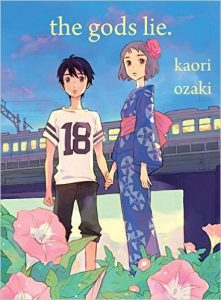
The Gods LieThe Gods Lie by Kaori Ozaki. Even though it was never fully released in English, I loved Ozaki’s Immortal Rain (or Meteor Methuselah as it was originally titled). And so when The Gods Lie was licensed, I was understandably thrilled that I would have the opportunity to read more of Ozaki’s work. Other than the fact that I recognized the creator, I didn’t actually know anything about The Gods Lie. However, I was very happy to discover that it was just as beautifully drawn and emotionally resonant as Immortal Rain. Ozaki’s storytelling in The Gods Lie is just as strong if not stronger, too. It’s also a more mature work aimed at a more mature audience, seinen rather than shoujo. The Gods Lie is a heartwrenching and devastating manga. The themes that Ozaki explores with the work are pretty heavy and hard-hitting–death, abandonment, and desperation being some of the most prominent. But there’s also love and righteousness to be found. Interpersonal relationships and families, both good and bad, provide the manga’s center. The story takes place during a very limited span of time, primarily over the course of Natsuru Nanao’s sixth-grade summer vacation, but the events that occur will have a tremendous impact on the young man. Natsuru’s characterization is incredibly well done. In part The Gods Lie is a cutting coming-of-age story. Natsuru changes and matures in very believable ways, losing some of his innocence while gaining a better understanding of and dealing with some of the world’s more unfortunate realities.

Otherworld Barbara, Omnibus 1Otherworld Barbara, Omnibus 1 (equivalent to Volumes 1-2) by Moto Hagio. Fantagraphics doesn’t currently have a huge line of manga (and sadly we may never see the rest of Takako Shimura’s Wandering Son translated), but the works it does publish are quality ones. I was very excited for the release of the first half of Otherworld Barbara; the manga was one of my most-anticipated titles for 2016. Although Hagio is a very influential creator in Japan, not much of her work has been published in English. I’ve loved everything that has been translated but have a particular fondness for Hagio’s science fiction. Otherworld Barbara is very much a part of that genre–it’s even one of the few manga to have won the Nihon SF Taisho Award–but it also includes strong elements of fantasy and the supernatural in addition to some significant family drama. Dreams, reality, past, present, and future all overlap with one another in Otherworld Barbara. Tokio is a dream pilot with the ability to enter other people’s dreams, gaining insight into their psyches in the process. Often he’s called upon to use his ability to help with criminal investigations, but more recently a group of researchers has asked him explore the dreams of a young woman who has been asleep for seven years. Surprisingly, his estranged son seems to somehow be tied to her case. The deeper Tokio probes, the more strange coincidences he uncovers, and the more dangerous the situation becomes for him and everyone else involved. I’m immensely curious to see how the story plays out.

Filed Under: FEATURES, My Week in Manga Tagged With: Fairy Tail, Forget Me Not, Kaori Ozaki, Mag Hsu, manga, moto hagio, Nao Emoto, Otherworld Barbara, Rui Watanabe

  • « Go to Previous Page
  • Page 1
  • Interim pages omitted …
  • Page 271
  • Page 272
  • Page 273
  • Page 274
  • Page 275
  • Interim pages omitted …
  • Page 538
  • Go to Next Page »
 | Log in
Copyright © 2010 Manga Bookshelf | Powered by WordPress & the Genesis Framework