By Yuuki Kodama. Released in Japan by Kadokawa Shoten, serialized in the magazine Young Ace. Released in North America by Yen Press. Translated by Melissa Tanaka.
It’s been over a year since we last looked at the world of Blood Lad. Such is life when you’ve caught up to a series’ Japanese releases, even more so when Yen puts this out as an omnibus. But the manga has now finished in Japan, so we shouldn’t have quite as long to wait for the final volume. In the meantime, we get this new omnibus, which does exactly what I suspected it would, which is get taken up by a huge fight between the villain and everyone else, showing off all the minor and secondary characters to a decent degree, but putting the emphasis squarely where it’s been (more or less) since Day One: on the odd relationship between vampire leader Staz and busty newly dead ghost Fuyumi. It even gives Fuyumi something to do!… though that’s somewhat problematic as well.
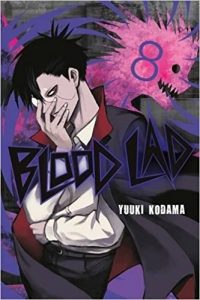
If you look at my past reviews of Blood Lad, you’ll see that Fuyumi’s lack of character development has been a bit of a bugaboo for me. She’s improved, but still tends to be reactive rather than proactive. That doesn’t change here, much as I’d like it to. The solution to how to defeat the bad guy involves Staz fusing with Fuyumi’s body, effectively making her the action heroine, but since it’s really Staz in the driver’s seat, the effect is lost, no matter how often we hear ‘Super Fuyumi Kick!’. Her best moment in this volume may come in a ‘dreamscape’, as she yells at him for being tactless and not understanding her feelings while literally dressed up as a giant 50-foot bride. Fuyumi is ‘the love interest’, and sadly Blood Lad’s biggest lost opportunity.
Thankfully, we’ve got something that makes up for that: humor. A good deal of this volume is hilarious, especially towards the end. Much as I disliked the Staz/Fuyumi fusion as character development, as an homage to giant robots it’s wonderful, especially as more and more people end up getting added and Staz’s Fuyumi Gundam rapidly turns into a Fuyumi Yamato. And, let’s be honest, the sight of Fuyumi with Staz’s teeth and attitude is also highly amusing. It helps to distract a bit from the brutality of the villain, who I think we abandon all hope of ever turning back to the other villain he used to be here. He’s a good villain, but also a bit one-note. Still, he provides tension.
Blood Lad in the end works best if you view it as one of those summer action blockbusters you see in the theater. While you’re watching it you’re captivated by the cool fight scenes and great quips, but it tends to fall apart when you go home and think about the plot afterwards. So don’t think about it too hard. Just sit back and enjoy a manga written by an artist who is clearly enjoying the hell out of himself, and grin along with Staz as you pilot a giant robot version of the girl you like in order to defeat a madman.


 A Banquet of Consequences by Elizabeth George
 The End of Everything by Megan Abbott
 The Ex by Alafair Burke
 Girl in the Dark by Marion Pauw
 Mr. Kiss and Tell by Rob Thomas and Jennifer Graham
 The Mysterious Affair at Styles by Agatha Christie
 The Outpost by Mike Resnick
 These Vicious Masks by Tarun Shanker and Kelly Zekas