• Skip to primary navigation
  • Skip to main content
  • Skip to primary sidebar
  • Home
  • About Us
    • Privacy Policy
    • Comment Policy
    • Disclosures & Disclaimers
  • Resources
    • Links, Essays & Articles
    • Fandomology!
    • CLAMP Directory
    • BlogRoll
  • Features & Columns
    • 3 Things Thursday
    • Adventures in the Key of Shoujo
    • Bit & Blips (game reviews)
    • BL BOOKRACK
    • Bookshelf Briefs
    • Bringing the Drama
    • Comic Conversion
    • Fanservice Friday
    • Going Digital
    • It Came From the Sinosphere
    • License This!
    • Magazine no Mori
    • My Week in Manga
    • OFF THE SHELF
    • Not By Manga Alone
    • PICK OF THE WEEK
    • Subtitles & Sensibility
    • Weekly Shonen Jump Recaps
  • Manga Moveable Feast
    • MMF Full Archive
    • Yun Kouga
    • CLAMP
    • Shojo Beat
    • Osamu Tezuka
    • Sailor Moon
    • Fruits Basket
    • Takehiko Inoue
    • Wild Adapter
    • One Piece
    • After School Nightmare
    • Karakuri Odette
    • Paradise Kiss
    • The Color Trilogy
    • To Terra…
    • Sexy Voice & Robo
  • Browse by Author
    • Sean Gaffney
    • Anna Neatrour
    • Michelle Smith
    • Katherine Dacey
    • MJ
    • Brigid Alverson
    • Travis Anderson
    • Phillip Anthony
    • Derek Bown
    • Jaci Dahlvang
    • Angela Eastman
    • Erica Friedman
    • Sara K.
    • Megan Purdy
    • Emily Snodgrass
    • Nancy Thistlethwaite
    • Eva Volin
    • David Welsh
  • MB Blogs
    • A Case Suitable For Treatment
    • Experiments in Manga
    • MangaBlog
    • The Manga Critic
    • Manga Report
    • Soliloquy in Blue
    • Manga Curmudgeon (archive)

Manga Bookshelf

Discussion, Resources, Roundtables, & Reviews

Features & Reviews

Invaders of the Rokujouma!?, Vol. 10

March 17, 2018 by Sean Gaffney

By Takehaya and Poco. Released in Japan as “Rokujouma no Shinryakusha!?” by Hobby Japan. Released in North America digitally by J-Novel Club. Translated by Warnis.

As the author says in the afterword, technically this could have been Volume 9.5. That said, I am happy that it kept itself in the main series, as for the most part it had a larger scope than the chapters with Koutarou and Clan back in ancient history did. This particular volume shows that, even as Koutarou adn the reader thinks that his troubles began when all the girls tried to move into his apartment on the same day, they actually have a bond that extends back a lot longer. We already know about Koutarou’s relationship with Theia and Ruth’s planet, and of course Harumi seemingly being the reincarnation of Alaia. Now we see how he was Kiriha’s knight in shining armor all along, and he also had a major role to play in the past of both Yurika and Sanae, though neither of them technically show up here. It all ties together, and not in a teeth-grinding way either.

Adult Kiriha is on the cover, but child Kii-chan is who we get for 4/5 of the book, having run away from home due to latent grief over the death of her mother. She runs into Koutarou and Clan, who are time-traveling back but have to recalibrate. Naturally, Koutarou doesn’t recognize her till halfway through the book… and even then he promptly forgets about it because of an even bigger revelation – the day they’ve arrived is the day his own mother was killed in a car accident. Now he has to choose between saving his mother or protecting the future he’s fought for with everyone. There are, of course, a few problems. Kii-chan is a target for assassination. The assassin is actually a dark magical girl. Which means that Nana, Yurika’s predecessor and mentor, is also trying to stop her… as in a young woman who is an archer, desperately trying to save her daughter, whose spiritual energy is being bled out to power EVIL RITUALS. There’s a lot going on.

I’ll be honest, I was expecting the “save mom or save the timeline” decision to be less of an issue than it ended up being, but I probably shouldn’t have been. Each of the characters has shown themselves to be deeply lonely in a way they can only fix by being around each other, and therefore it should be no surprise that Koutarou’s first reaction is “forget about the timeline, I have to do this”. You can likely guess what the outcome is, but on the bright side, we get another cool battle that shows off Koutarou’s ridiculous endurance even as it shows us that he’s getting less pwoerful the longer he’s away from the others. Probably the best scene in the book is the final one, back in the present, as Kiriha has realized who her “oniichan” really is and is, unsurprisingly, ecstatic. The author really excels at drawing deeply emotional, sappy scenes without making the reader roll their eyes or feel uncomfortable.

Shizuka may have gotten the last cover, but she wasn’t in this one (though her ridiculous strength was mentioned). It seems unlikely she’ll be in the next one either, as we get another cliffhanger that tells us that next time around is Sanae-focused. If you’ve been reading Rokujouma from J-Novel Club, and you enjoy supporting the author by actually buying it (please support the author!), you’ll definitely enjoy this new volume.

Filed Under: invaders of the rokujouma!?, REVIEWS

Genshiken: Second Season, Vol. 12

March 16, 2018 by Sean Gaffney

By Shimoku Kio. Released in Japan by Kodansha, serialized in the magazine Afternoon. Released in North America by Kodansha Comics. Translated by Stephen Paul.

The last time I gave Genshiken a full review, I noted that the author seemed to be aiming for a new demographic with the new cast being mostly women, and their own interests tending towards BL. Well, we’ve had several volumes since then, and I’d say in the end the demographic didn’t QUITE change. Genshiken is still, at heart, a series for male otaku by a male otaku. But I think the Second Season may have helped broaden their horizons a bit, showing the readers what life is like outside their comfort zone, particularly with the awkward, touching but ultimately “just friends” relationship between Madarame and Hato. That said, I suspect that readers over here in North America may have wished that he’d pushed the envelope a bit more – the final half of this sequel was all about Madarame in a harem situation, something that aggravated as many people as it entertained. Still, at least it avoided the dreaded “nothing changes” stasis, mostly thanks to Saki, who makes one last appearance to kick Madarame’s ass into gear.

The cover art may give you an idea of who the Final Girl is, but honestly it was easy to figure out with Madarame’s rejection of all four, which had three sensible, well-thought out replies and one lame dodge, something Saki immediately points out. (Amusingly, everyone else there noticed it as well, but weren’t saying anything – Madarame can be appallingly stubborn, and only Saki can kick back against that.) And despite confessing to each other in otaku terms – or perhaps because of it – Madarame and Sue do actually make a very good couple, though actual coupling may still be a long way off. It’s also nice to see Madarame distancing himself from the Genshiken, moving away and trying once again to find a real job. The Genshiken has always been filled with weirdos, but Madarame vs. Saki had been the plot for so long that it was nice to see it return for one final appearance.

And then there’s graduation. I could talk about Kuchiki here, but don’t want to, despite the fact that the end of the book is mostly about him. Instead, let’s talk about Hato, who Madarame rejects here with a very well-thought out reason – he doesn’t think Hato is comfortable enough in his own skin to date a guy, and thinks that he should concentrate on being a “fudanshi” who likes to cross dress. The series has been dancing back and forth on Hato’s gender identity and sexual preferences, and again, I don’t think that the author goes as far as the audience wanted him to take it. That said, the journey we’ve seen in the last 12 volumes has been fantastic in many places, and Hato is absolutely the most interesting character in the sequel, with Yajima a close second. (Fans of Hato may be interested in checking out Spotted Flower, an unlicensed “alternate universe” Genshiken manga, though I warn fans of Genshiken proper that they may not like it.)

Like a lot of otaku-driven anime and manga, Genshiken went on too long, added some unnecessary subplots, and features far too much of characters that everyone hates – both in universe and out. But the journey had some wonderful moments, and in the end I think was worth it, even if it ended up more breaking down than reaching its goal. I wish the cast well.

Filed Under: genshiken, REVIEWS

Manga the Week of 3/21/18

March 15, 2018 by Sean Gaffney, Michelle Smith, Ash Brown and Anna N 2 Comments

SEAN: More manga, more problems. Shall we add to the stack?

Dark Horse has a 4th volume of the Vocaloid spinoff Hatsune Miku: Rin-chan Now!!.

J-Novel Club has a 2nd Ao Oni volume, this one subtitled Vengeance.

Kodansha Digital has a new release, and I’m definitely looking forward to it. Perfect World is about a young woman who reunites with her first love as an adult, only to find he’s now in a wheelchair. It’s a josei title, running in Kiss.

MICHELLE: I’m looking forward to this very much!

ANNA: I’m always up for more josei.

ASH: Josei!

SEAN: There are also ongoing volumes. Fuuka 17, Giant Killing 11, Kasane 11, and Love’s Reach 7. Also, I’m in Love and It’s the End of the World has its 5th and final volume.

MICHELLE: It’s over already?! I didn’t even have the chance to get started.

SEAN: Print-wise, we get a 4th Kiss Me at the Stroke of Midnight and a 3rd Wake Up, Sleeping Beauty.

MICHELLE: I’m looking forward to more Wake Up, Sleeping Beauty.

ASH: I found the beginning of the series to be rather intriguing, so I’m looking forward to more, too.

SEAN: One Peace has a 10th Rise of the Shield Hero light novel.

Seven Seas has three debuts next week. DNA Doesn’t Tell Us runs in Shonen Sirius, and seems to be a cutesy animal girls series.

Dragon Half is a legendarily silly anime from the dawn of time (aka the 1990s), and its manga ran in Dragon Magazine. Seven Seas is putting it out in omnibus format. I absolutely can’t wait. Expect laughs and old-style art.

ASH: I know so many people who were absolutely thrilled when this was licensed. I’m personally not familiar with the Dragon Half anime, but I definitely plan on checking out the manga!

SEAN: And Mononoke Sharing is a perverse comedy that runs in Young Magazine the 3rd and is by the author of Miss Kobayashi’s Dragon Maid. I can wait on this one.

Also from Seven Seas is a 2nd Nirvana and an 8th Testament of Sister New Devil.

Vertical gives us a 5th Flying Witch.

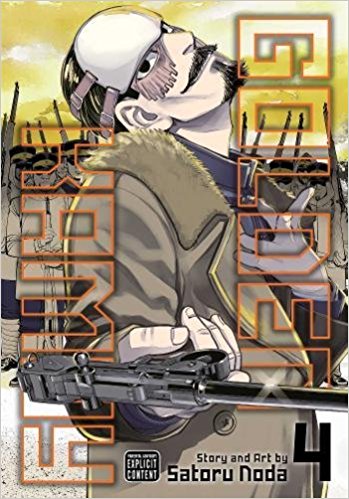
Viz has Children of the Whales 3 (grim), Golden Kamuy 4 (grim but also amusing and filled with delicious food) and Sweet Blue Flowers Omnibus 3 (grim in a yuri angst sort of way).

MICHELLE: Woot for Sweet Blue Flowers, despite the grim.

ANNA: I finally read the first volume, it is so well done.

ASH: Sweet Blue Flowers is wonderful. I’m really enjoying Golden Kamuy, too.

SEAN: And Yen has a few titles as well. ACCA 13-Territory Inspection Department has a 2nd volume. Kiss and White Lily for My Dearest Girl has a 5th.

ASH: I’m always happy to have more of Natsume Ono’s work translated! ACCA has a terrific atmosphere to the storytelling.

SEAN: Twinkle Stars comes to an end with its 5th and final omnibus. Being it was 11 volumes total, this omnibus is larger than the others. I enjoyed it more than I expected.

MICHELLE: I don’t know why it didn’t occur to me that the fifth omnibus would be the final one!

ANNA: Another series I need to get caught up on!

ASH: I need to catch up, too, but I really liked the first few omnibuses.

SEAN: And Is It Wrong to Try to Pick Up Girls in a Dungeon? finally gets in on the 4-koma parody comics schtick, as Days of Goddess is just that. Danmachi fans should love it.

Dare you add to your unread piles? What are you getting?

Filed Under: FEATURES, manga the week of

Walking My Second Path in Life, Vol. 2

March 15, 2018 by Sean Gaffney

By Otaku de Neet and Kurodeko. Released in Japan as “Watashi wa Futatsume no Jinsei wo Aruku!” by Earth Star Entertainment. Released in North America digitally by J-Novel Club. Translated by Shirley Yeung.

Towards the end of the second volume of this series, there’s a scene where Fie, our heroine, realizes that she’s sort of been coasting along from day to day as a squire without giving much thought to her future or what her goals are. I’m not entirely sure that the author meant it to apply to the series as a whole as well, but it’s a somewhat apt comparison. This second volume of Second Path feels at times like a short story anthology based around the main story, and is content to meander along as such. We still have never met Fie’s sister, and while Fie reveals who she really is to someone else in this book, it doesn’t really change much for her on the larger scale. Don’t get me wrong, this is still a fun series to read, and I enjoy the antics of Fie/Heath. I just get the sense that the author had a great idea for a series but has absolutely no endgame in mind.

There are two major events in this second volume, the larger of which is a competition between Fie’s dorm and the students of the Eastern dorm, their biggest rivals. There are a few characters introduced who seem to be something of a stock type – the arrogant jerk who belittles everyone, the stoic analytic guy, etc. This does serve to give us a bit more character development for a few of Fie’s fellow knights – in fact, Fie’s own battle is the odd anticlimax to the whole thing, mostly as she can’t win through normal means, so resorts to “the letter of the law, not the spirit” to achieve a sort of Pyrrhic victory. It’s thoroughly in character, but reminds you that whether she’s a princess or a knight, Fie is a giant brat.

The other major part of this book is inserting a romance into it. There’s the king, of course, who flits in and out of the book disguised as the Knight Commander, and who will no doubt become an issue once he and Fie realize who the other one is. But sensibly, the author writes the romance using the most developed character besides Fie; Queen, the socially awkward young man who went from “pet” to “friend” over the course of time. Queen’s always had something of a crush on Fie, and in this second book that expands greatly to full-blown attraction. This leads to the funniest scene in the book, which I really don’t want to spoil but is both hilarious and painfully embarrassing, especially if you’re a guy. That said, Fie is not entirely sure if she feels that way about Queen, and after taking advice that dating will be good “life experience” for her, she and Queen hooking up seems a bit less impactful than it could be.

Walking My Second Path in Life feels like walking along a long, meandering path with great scenery. You enjoy the view. Then you look up after 45 minutes and realize you have no idea where the heck you are. Fortunately, we’ve caught up with Japan now, so we’ll let the author try to figure it out while Fie flits along from day to day.

Filed Under: REVIEWS, walking my second path in life

Toppu GP, Vol. 2

March 13, 2018 by Katherine Dacey

For two decades, Kosuke Fujishima’s Oh! My Goddess was a veritable institution in the US. It arrived in comic book stores in 1994 and finished its run in 2015, along the way introducing several generations of manga fans to the fraught relationship between the nebbishy Keiichi Morisato and his otherworldly companion Belldandy. Fujishima’s current project Toppu GP debuted last year with little attention from critics, but this sports manga might just be the better of the two series; as I noted in my review of volume one, the characters are types and the drama predictable, but the motorcycle races are thrilling, funny, and surprisingly educational, helping the novice appreciate the skill necessary to ride at an elite level.

The latest installment of Toppu GP does all the things you’d expect the second volume of a sports manga to do: it introduces new rivals for the principal characters, expands the supporting cast, and features several lengthier, riskier races. Not all of these gambits work. Toppu’s new fanclub — which includes Billy Izumo, a tow-headed bike enthusiast, and Itsuki Nagoya, a nerdy girl with a crush on Toppu — provides the weakest sort of comic relief by making Nagoya and Myne compete for Toppu’s attention. (“Who is this old lady?” Nagoya sniffs when introduced to Myne.) When the action shifts to the race track, however, the story roars to life, offering Fujishima a unique opportunity to explain the physics and strategy of moto GP through imaginative visual metaphors. In one sequence, for example, Toppu compares the components of his bike to instruments in a rock band — a neat way to suggest the sound and function of each — while in another, Fujishima represents Toppu’s anxiety as a giant, coiled rattlesnake. These metaphors are corny, to be sure, but they enliven the racing sequences, breaking the relentless stream of speedlines, facial close-ups, and banked turns.

Though Toppu gets top billing, Myne also gets a turn in the spotlight in a fiercely competitive race against Daiya Ishibashi, the reigning champ at the Course 2000. Their race is a genuine nail-biter, with Ishibashi and Myne aggressively vying for the lead. By the end of the volume, it’s not clear if Myne will prevail over Ishibashi, but her tenacity and cunning have made that outcome a real possibility. Readers who want to know whether Myne wins have two choices: wait until August for volume three, or purchase chapters 15 and 16 right now. (The digital serialization is up to chapter 23.) Me? I’m going to tough it out until August, since Toppu GP is one of the few series I’m actively collecting. Recommended.

Toppu GP, Vol. 2
By Kosuke Fujishima
Translated by Stephen Paul
Kodansha Comics, 192 pp.
Rated T, for Teen (13+)

Filed Under: Manga, Manga Critic, REVIEWS Tagged With: Kodansha Comics, Kosuke Fujishima, Moto GP, Sports Manga, Toppu GP

Re: ZERO ~Starting Life in Another World~, Vol. 6

March 13, 2018 by Sean Gaffney

By Tappei Nagatsuki and Shinichirou Otsuka. Released iJapan by Media Factory. Released in North America by Yen On. Translated by Jeremiah Borque.

Last time I said that I finally realized why so many fans love Rem. After this volume, I can say that I now know why those Rem fans dislike Emilia, though to be fair it’s not really her fault. In fact, Emilia’s barely in this book once more. But yes, Subaru and Rem’s scene in the last quarter of the book is astonishing, some of the best and most emotional writing we’ve seen in the entire series, and Subaru’s response to Rem is simply stomping on the face of shippers. I suspect a lot of people would have preferred Rem and Subaru’s fantasy where they live a normal life in the fantasy equivalent of Japan (indeed, I think the author wrote that as a side story). But Subaru remains true – eventually, after much teeth-grinding – to Emilia, who he wants to save and support. And so Rem will support him. It’s extremely heartwarming and heartbreaking at the same time. It also makes the first 3/4 of the book pale in comparison.

Each of the “arcs” in Re: Zero has been longer than the previous one. The first was one book, the second was two. This one is SIX, meaning we’re only halfway through it. As a result, the time we’ve had to spend watching Subaru be frustrating has increased, which does not make me happy. In the previous “loop”, he spent most of the time being broken, in the loop in this book, he spends most of it being furious, burning with the desire to get revenge on Petelgeuse, to the point where at times he completely forgets about Emilia. Furious Subaru does not inspire confidence, and when he tries to ally himself with Crusch, with Priscilla, or with Anastasia, he is rebuffed one by one. Only Rem is in his corner, but then she’s also willing to sacrifice her own life so that he might live on. Hell, even when in the deepest despair, he’s still misjudging people horribly, almost bringing Beatrice to tears when he begs her to kill him because he thinks that she’s a stoic girl who doesn’t like him.

Fortunately, we may have finally, FINALLY turned the corner, as Subaru restarts again, and after that fantastic scene with Rem, actually bothers to try thinking this time. And when Subaru actually does this, he’s quite clever, using the knowledge from his prior arcs to bargain with Crusch, as he knows something that actually is useful: the habits of the White Whale. I suspect that battle will take up much of the 7th book. There’s also a 2nd EX side story out next month dealing with Wilhelm, so I would not be surprised if he played a major role in what’s to come. In the meantime, the best part of this volume of Re: Zero is that it turns the corner, and I will greatly be looking forward to not seeing Subaru be quite as Subaru going forward. (Feel free to laugh at me if I am wrong.) Also, yeah, Rem is indeed pretty awesome, I freely admit it, though I worry her devotion to Subaru is going to get her in even more trouble as we go forward.

Filed Under: re: zero, REVIEWS

Bookshelf Briefs 3/12/18

March 12, 2018 by Michelle Smith, Sean Gaffney and Ash Brown Leave a Comment

The Ancient Magus’ Bride, Vol. 8 | By Kore Yamazaki | Seven Seas – I have to say, if the artist is trying to get Chise and Elias to be a romantic couple, as the title might imply, she’s doing a horrible job of it. That said, I’m pretty sure that’s not what she’s doing, and the second half of this volume certainly shows that in terms of understanding humanity and Chise’s own wishes, Elias fails dismally. Chise spends most of this volume dealing with the aftermath of the previous one, including her new arm. But it’s hard not to have the story overwhelmed by the final couple of chapters, as Chise decides it’s for the best to break with Elias—at least for now. This remains intensely addicting, though I’m not entirely certain it will have a happy ending. – Sean Gaffney

Beasts of Abigaile, Vol. 3 | By Spica Aoki | Seven Seas – Captured by Eva and with the threat of having her odiferous humanity revealed to the whole school, Nina insists she’s not like other humans. Roy intervenes, challenging her to prove it and claiming he’ll kill her himself if he’s not convinced. Initially, what follows is one of those “this is so stupidly impulsive” moments in which Nina climbs a cliff in the rain to get roses for Poe to paint with, but it turns into a pretty terrific scene with Eva in which Nina sacrifices herself for Eva’s sake and leaves the latter with no target for her anger. Plus, Roy now admits she’s not their enemy. In fact, the enemy seems to be the creepy student council president, who drugs Nina for this volume’s cliffhanger. Still way better than you’d expect. – Michelle Smith

Bloom Into You, Vol. 4 | By Nakatani Nio | Seven Seas – It’s summer vacation and the student council has a training camp to rehearse for their upcoming play. Before the camp, though, Yuu has time to really miss Nanami (who is trying to keep her distance lest Yuu get tired of her) and is a little jealous at the closeness Nanami and Sayaka share at the camp. As ever, though, Nanami and her sister complex is the most interesting thing about the series. Here, she learns from her sister’s former classmate that the idealized version she held of her sister was far from the truth. In fact, she’s probably surpassed her already in so far as being a good president is concerned. But who is she supposed to be now? Clearly not herself, because her self-loathing is very strong. I look forward to seeing whether Yuu can succeed in helping Nanami to change. – Michelle Smith

Cardcaptor Sakura: Clear Card, Vol. 2 | By CLAMP | Kodansha Comics – The main plot of Cardcaptor Sakura, besides the usual acquiring of new cards, is that Eriol and Syaoran are keeping a secret from Sakura, presumably either for her own good or so that she isn’t sad. This is intensely frustrating for the reader, who knows it will backfire in the worst way. Thankfully, the rest of the volume is exactly what you want from this series: light cute fluffyness, lots of card-capturing action, cute costumes and Tomoyo’s reactions to said costumes, and the occasional bout of silly humor. Still, the “secret” being kept from Sakura not only makes the reader edgy but makes it harder to enjoy this manga to its fullest. I hope she finds out what it is soon. (Also, please don’t let it be a crossover with Tsubasa.) – Sean Gaffney

Fukushima Devil Fish | By Katsumata Susumu | Breakdown Press – It’s been almost a decade since the award-winning Red Snow, Susumu’s first volume of manga to be translated into English, was released. Now there is a second–Fukushima Devil Fish, a terrific collection of nine of Susumu’s short manga accompanied by four essays written by Susumu himself, Abe Yukihiro, and the volume’s editor Asakawa Mitsuhiro, which provide additional context. The manga were all originally released between 1969 and 1989, most of them in the influential alternative manga magazine Garo. The stories generally fall into three categories. The first two are anti-nuclear manga using the now infamous Fukushima nuclear power plant as a setting. (They are very interesting to compare to Kazuto Tatsuta’s Ichi-F.) Kappa and tanuki feature prominently in the next four folklore-inspired tales while the final three incorporate semi-autobiographical elements. It’s a bit of a variety, but there’s a beautifully expressed sense of loneliness and melancholy that is frequently found throughout. – Ash Brown

Haikyu!!, Vol. 21 | By Haruichi Furudate | Viz Media – The game finally ends in this volume, in suitably dramatic fashion. Hate to spoil it, but our heroes win. The win takes up the majority of the volume, though, and is filled with back-and-forth, showing off the exhaustion and stubbornness of both teams, as well as giving a lesson in “short people can too be good at volleyball.” Actually, the exhaustion leapt out at me—this volume does a great job of showing how physically grueling this match was, and how deeply, deeply tired everyone is at the end of it. And so now we wait to see who Karasuno will be playing—Nekoma are their “rival” team, but there’s ominous foreshadowing showing that it’s not going to be them. I suspect the team with the smuggest bastards wins. – Sean Gaffney

Kiss Him, Not Me!, Vol. 13 | By Junko | Kodansha Comics – When a series is about a heroine’s love of 2-D anime heroes over actual guys, and she ends up paired up with a guy, there’s going to be conflict. And given this is primarily a comedy, it takes a LOT to get it through Kae’s head that Mutsumi is her REAL boyfriend and Shion is a fictional character. (The resolution to this dilemma, I note, is so perfectly in character it hurts.) Naturally, there’s a bitter mastermind behind this. Unlike a lot of “you think I’m gay but I’m not” male shoujo rivals, Yashiro actually *is* gay, and the manga does its best not to make that a stereotype. He’s certainly a jerk, though. The series ends in the next volume, and I think it’s the right place to end it. Keep reading this if you’ve already been doing so. – Sean Gaffney

Queen’s Quality, Vol. 3 | By Kyousuke Motomi | Viz Media – There’s a bit less silly humor in this volume, mostly as we’re still trying to figure out what kind of Queen Fumi is going to turn out to be. The ideal is apparently the White Queen, but frankly, all options seem to involve a certain sacrifice of self that I suspect Kyutaro is not going to appreciate—though Fumi already has a big swathe of amnesia to deal with. Fumi is a cute, hyperactive and likeable heroine, but she only really seems to come alive when the “Black Queen” in her comes out. The Black Queen needs to be killed, but is that really the best answer? As with Dengeki Daisy, the author’s previous series, each volume of Queen’s Quality makes me want to learn more about the world it inhabits. – Sean Gaffney

Scum’s Wish, Vol. 6 | By Mengo Yokoyari | Yen Press – First of all, my reaction to the male option that will prevent Ecchan from having to be a genuine lesbian is basically “BLEAH.” (I may be wrong, but I suspect I’m not—also he’s an asshole, which isn’t helping.) The core of this book involves Mugi and Hanabi both promising to break things off with their crushes so that they can finally move on. This proves far more successful in one case than it does in the other, but it does remind you that if you have a situation in Scum’s Wish and you don’t know which way it will go, the seediest route is always the correct option. I’m still reading this, but I admit it’s feeling less like a guilty pleasure and more like an endurance contest. How much more screwed up will this get? – Sean Gaffney

Skip Beat!, Vol. 40 By Yoshiki Nakamura | VIZ Media – After such a long wait, it’s kind of a bummer to get only a transitional volume of Skip Beat!. By no means is it bad, as it includes Kyoko realizing that, for some reason, Ren left her off his list of White Day gift recipients (I hope this leads to some kind of confession soon!), and also acquiring Yashiro as her manager. She’s devoting herself to securing the part of a ninja in a period drama where she can work alongside Moko, but just as the auditions are about to begin, she’s culled, seemingly for failing to prepare for the role by dyeing her hair black. I can only assume that she’ll knock ’em dead in the next volume, but having to wait until September to see that makes me pout. Oh, well. #firstworldproblems – Michelle Smith

Filed Under: Bookshelf Briefs

Tales of Wedding Rings, Vol. 1

March 12, 2018 by Sean Gaffney

By Maybe. Released in Japan as “Kekkon Yubiwa Monogatari” by Square Enix, serialization ongoing in the magazine Big Gangan. Released in North America by Yen Press. Translated by Andrew Cunningham.

I can’t say I wasn’t warned. Read the title, Sean, I should have said to myself. Note the plural. And yet I still felt a little sucker-punched when we got to the plot “twist” in question, mostly as I was quite enjoying the first volume of this action romance. The lead is likeable and not a perv, the heroine really seems to have fallen for him (and thus wants to avoid getting him in danger), there’s cool monster fights. Heck, even the prince that she’s “supposed” to marry, who all previous fantasy series would tell you would be an obnoxious SOB, turns out to be quite nice and helpful to our heroes, glad to see that they have a passionate and true love. So yes, when it comes out at the end that he’s got to marry four other princesses, I was a bit grumpy. Polyamory has become a common trope in the last couple of years, particularly in isekai novels, but I’d like it to have a better setup than this, and usually it works best when all the heroines are OK with it.

But before the ending of the volume, we get a pretty good story. Satou is introduced to Hime as a child when she and her guardian arrive from a portal of light. That said, he’s mostly forgotten about this, and she’s become his cheerful, buxom childhood friend that he has a crush on but is too afraid of ruining their friendship to do anything about. Unfortunately, after spending a lovely festival day with him, she’s giving off “I am never going to see you again” vibes that he picks up on just in time. He rushes after her into a fantasy world where she’s a princess (the name may have given it away), about to be wed to a handsome prince. But the wedding is promptly crashes by a monster, as apparently the princess hanging out in our world was to prevent her being killed. Only a hero using her wedding ring power can help them… and she finally admits Satou is that hero, as she’s in love with him. What follows is a lot of monster battles combined with blushey romantic tropes.

The author is known for ecchi stuff, so I was surprised that this first volume kept it relatively tame. Oh sure, Hime’s got a voluptuous body, as the cover art clearly indicates. But the fanservice is mostly confined to one or two scenes and the ‘chapter art’ pages. Satou and Hime are also both nice kids who clearly are in love with each other but don’t quite now how to handle it now that they’ve admitted it. A scene near the end where they try to have a wedding night – then admit they aren’t ready to go that far yet – is really well done. My only objection is that I worry as we add more princesses that the serviced will increase… especially as Hime has admitted she doesn’t really want the multiple wives. She wants Satou and he wants her. I want that too. That said, there was wenough here I enjoyed to make me want to pick up a second volume to see what happens next.

Filed Under: REVIEWS, tales of wedding rings

Lovesick Ellie, Vols. 1-3

March 11, 2018 by Michelle Smith

By Fujimomo | Published digitally by Kodansha Comics

I admit that I was initially attracted to Lovesick Ellie because of the covers, which are adorable. My favorite is the third, because it perfectly captures Ohmi-kun’s personality.

So, imagine you’re an awkward boy who doesn’t express himself well, only you’ve been born exceedingly handsome. You’re placed on a pedestal, and instead of getting to play a tree in the school play, the role of the prince is thrust upon you. At kindergarten graduation you’re completely confused when the girls ambush you for souvenirs and end up in tears. In middle school, you end up alienating your best friend who grows envious of your good fortune and disappointing people when you let your true personality show. That’s the plight facing Akira Ohmi, and when he gets to high school he decides to adopt a princely facade to go along with his looks so that he can keep his distance and avoid hurting anyone else.

Eriko Ichimura is a plain girl whom nobody notices. (Yes, this is one of those Dessert manga where the friendless girl attracts the notice of the most popular boy in school.) In lieu of real relationships, Eriko entertains herself by writing fantasies about Ohmi-kun on an anonymous Twitter account under the name Lovesick Ellie. One day, she accidentally catches a glimpse of the real Ohmi-kun. Shocked, she leaves her cellphone behind, enabling Ohmi to read her tweets about him. Rather than be mad, he thinks they’re hilarious. In exchange for her keeping his secret, he offers to fulfill her fantasies, then laughs when she’s, like, “Okay!” In the end, he decides to trust her.

After this encounter, they gradually come to know each other. Ohmi is derisive toward the other girls who’ve fallen for the false persona he’s created, but Eriko is different. Not only is she not disappointed by his true personality, she continues to lust after him openly. Ultimately, this is a story about really being seen and loved for your true self. Nobody noticed Eriko until Ohmi did, and while everyone noticed him, they never saw the real him.

As they navigate their new relationship, there are various firsts, and a lot of blushing, and some misunderstandings, and some mean girls who disapprove of Ohmi dating someone (though they mistakenly think he’s dating Sara, the friend Eriko eventually acquires). None of this is new shoujo manga territory, but the characters are refreshing. Ohmi is seriously endearing, especially once his bratty attitude subsides and he allows himself to be sweet and vulnerable. He’s apologetic for the things he gets wrong, and encourages Eriko not to give up on him. For her part, Eriko is kind of a spaz, but shoujo heroines are not typically this horny, so that’s a unique aspect, for sure. It certainly makes for some snerkworthy declarations, like when she proclaims, “I like you sexually!”

So far, I really like this series a lot, and I look forward to continuing it.

Lovesick Ellie is ongoing in Japan. Its sixth volume comes out there on March 13th, which is the same day the fourth will be available in English.

Review copies provided by the publisher.

Filed Under: Manga, REVIEWS, Shoujo Tagged With: Fujimomo

In Another World with My Smartphone, Vol. 7

March 11, 2018 by Sean Gaffney

By Patora Fuyuhara and Eiji Usatsuka. Released in Japan as “Isekai wa Smartphone to Tomo ni” by Hobby Japan. Released in North America digitally by J-Novel Club. Translated by Andrew Hodgson.

This s another volume of Isekai Smartphone, with all that that entails; the work is almost review-proof, as no one would be reading Vol. 7 of this series without knowing exactly what it’s like. The main cast continues to have the depth of tissue, but I think depth might actually hurt the series more than it helps. No one wants to see Touya angst and brood about what he is becoming. Is he god? Is he man? Who cares? He can build the Great Wall of China, or its fantasy equivalent, in six days. (One presumes that on the seventh day, he rested.) He can also tell us about his little known piano lesson backstory, which allows him to build a piano (grand, of course) so that he can bring out Sakura’s hidden singing talent. No one reads Smartphone to see Touya be dull. Well, I mean, he is fundamentally dull, but you know what I mean. He doesn’t do dull things. Smartphone is rarely boring in that respect.

There’s one new character, but for the most part what we get in this book are characters we briefly saw previously returning for a more expanded role, starting with Hilde, the knight that Touya saved in the previous book. She’s since fallen head over heels for him, and upon hearing of his more recent exploits (more on that later) goes to see if she can be his knight… and his bride. Of course, then she meets Yae, who is also a fantastic swordswoman and already married to Touya, and realizes that there’s no way she can be anything but a carbon copy. (She gets her “shy tomboy” personality more from Elze.) Fortunately, who Touya loves is not really his own decision, mostly as he’s so kind and easygoing to everyone. And so his “Bride Council” decide that she’s acceptable. And so she’s bride #7. Two more slots! That said, Pam, the Amazon woman also from a previous book, will not be getting into the harem. She doesn’t love Touya, the one big requirement. She just wants his babies.

We also get the Goddess of Love, who has come down from heaven supposedly to look for an errant God, but mostly to mess with Touya’s love life. She declares that she’s his older sister Karen, and the rest of the cast, who Touya still hasn’t told anything about his past, accept it relatively easily. She’s the classic “slightly immature big sister” type, happily dishing out advice (some of which is actually good!) and also dishing dirt, as she’s fully aware of Touya’s life on Earth before he was killed. We also get his *other* older sister, the Goddess of Swords, who we hadn’t met before but who seems to fit in quite well. She’s great at tactics and combat analysis, but less so at other socialization. As for Touya himself, it’s brought up that he’s becoming a God himself, something he tries not to think about too much. Given the occasional flashes of rage he gets whenever someone hurts one of his fiancees, I’d be worried if I weren’t sure the author was absolutely not going to go there.

As for the plot, the book is essentially divided into three. The first part deals with a massive invasion by the Phrase, far bigger than anything we’d seen before. Fortunately, Touya now has a bunch of Gundams that he can use in the battles, and a large quantity of people trained to use them. He also has Ende, who leaps into his own Gundam clone faster than you can say Kaworu Nagisa. Ende may not do much other than exposit and run, but I’m still amused by him. That said, the Phrase are essentially just bugs, as Touya himself says. We need a more obvious villain, because what’s Smartphone without the bad guys being OVER THE TOP EEEEEEEVIL! And so we get the Nation of Yulong, which is a stand-in for a Nation here on Earth that should be obvious. The word “bashing” applies liberally here, as the Yulong Nation prove to be scummy in every possible way. The rest of the book is more sedate, as the second part is Hilde’s Bride Introduction, and the third has a tournament arc, as Touya won’t sire Pam’s children but will help her tribe win a competition.

The plot may be getting away from the author a bit – we met no new Gynoids and got no new parts of Babylon in this book, and Leen was totally absent as well. Still, it’s enough Smartphone to tide us over for now. The series is ridiculously plastic and shallow, but I honestly love it just for those very qualities. It’s the light novel equivalent of eating a bag of Skittles.

Filed Under: in another world with my smartphone, REVIEWS

Again!!, Vol. 1

March 10, 2018 by Katherine Dacey

There are no second chances in life, but there are in manga — think A Distant Neighborhood, Erased, and orange. The latest entry in the second-chance sweepstakes is Again!!, a dramedy about Imamura Kinichirou, a loner who tumbles down a flight on stairs at his high school graduation and wakes up on the first day of freshman year. Doomed to repeat the worst three years of his life, Imamura impulsively signs up for the school’s ouendan, but quickly runs afoul of prickly captain Yoshiko Usami, whose dedication to the struggling club proves more deterrent than draw for would-be members.

Imamura isn’t the only time-traveler; joining him on his temporal odyssey is Akira Fujieda, a perky classmate who also tumbles down a flight of stairs at graduation. Unlike Imamura, Akira greets this development with enthusiasm, but her fond memories of high school make her too quick to assume that everything will unfold the same way twice: she propositions her not-yet-boyfriend too boldly (he turns her down) and dismisses a would-be friend’s taste in music. (“It’s too bad Cara Mana broke up so soon,” Akira declares. “It didn’t take me long to get sick of them, though, since all their songs sort of sound the same.”) Crushed by the double rejection, Akira becomes Imamura’s reluctant ally in the quest to restore the ouendan to its former glory.

Whether you cotton to Again!! depends on how you react to the principal characters. I found Usami’s fierce commitment to tradition exhausting; she bellows, belittles, complains, accuses, and sobs, but seems fundamentally unable to have a normal conversation. Her bluster is meant to suggest her sincerity and vulnerability, I think, but has the opposite effect, reducing her to a one-note character. More convincing is Imamura, who decides that a do-over isn’t as terrible as he’d imagined. (I particularly enjoyed his nonchalant turn at the board in his math class; his classmates’ reaction to his display of mathematical acumen is priceless.) Imamura even flirts with the possibility of a social life: when the girls’ cheer squad mobilizes against Usami, for example, Imamura conspires with Akira and Reo, a pretty classmate, to undermine the cheerleaders’ plan.

Akira, too, is a pleasant surprise, a busybody who’s suddenly relegated to the margins of freshman life. Though her sense of the school’s pecking order remains unchanged, she can’t resist the opportunity to advise the once-lowly Imamura on how best to manipulate the cheerleading squad — it’s her chance to demonstrate her expertise, and perhaps to reclaim her former Queen Bee status by engineering a major social coup. As one might expect, Akira gets the sauciest lines, but she also learns the hardest lesson of the three principal characters: serendipity plays as big a role in popularity as personality and looks.

Mitsurou Kubo’s art plays a vital role in helping us understand Imamura and Akira’s predicament. In the first two chapters, Kubo does an excellent job of distinguishing past from present with subtle details: Imamura’s mom, for example, is a little plumper, while Akira is shorter and less physically developed. (Akira realizes something is amiss when she realizes that her breasts are smaller.) Equally impressive is the care with which Kubo reconstructs the same sequence of events that precede the time jump, showing us Imamura’s memories of the day and then Akira’s. Here again, it’s the little details — a snippet of conversation, a minor change in hairstyle — that convey whose perspective is represented, and how that character’s personality influences what we’re seeing and hearing.

Kubo’s facial drawings show the same degree of meticulousness as her handling of the time travel sequences. Her reaction shots do more than just capture a character’s immediate response to a new development; they convey the emotions and experiences that underlie that reaction. Consider this split-screen image of Imamura:

This panel appears at the end of chapter one, as Imamura stands at a temporal and figurative crossroads: he can change his future by joining the ouendan, or recede into the background and be a loner once again. Imamura’s furrowed, sweaty brow and crestfallen expression capture his sense of helplessness; he has the look of someone who’s actively reliving a terrible experience moment by moment, contemplating the real possibility that nothing will change the second time around.

It’s this level of nuance that makes Again!! worth reading, even when the plot mechanics are creaky and the characters too strident. Watching Imamura forge new connections on his own terms is both funny and poignant, a reminder that we always have the potential to change our destiny, even when it seems preordained. I’m curious to see how Imamura and Akira grow and change, and how their behavior influences the future. Count me in for volume two.

AGAIN!!, VOL. 1 • STORY AND ART BY MITSUROU KUBO • TRANSLATED BY ROSE PADGETT • KODANSHA COMICS • 208 pp. • RATED TEEN (13+)

Filed Under: Manga, Manga Critic, REVIEWS Tagged With: Again!!, Comedy, Kodansha Comics, Mitsurou Kubo, Ouendan, Sports Manga

Kaguya-sama: Love Is War, Vol. 1

March 10, 2018 by Sean Gaffney

By Aka Akasaka. Released in Japan as “Kaguya-sama wa Kokurasetai〜Tensei-tachi no Renai Zunō-sen〜” by Shueisha, serialization ongoing in the magazine Weekly Young Jump. Released in North America by Viz Media. Translated by Emi Louie-Nishikawa. Adapted by Annette Roman.

If you have ever stared at a couple on stage, screen, or the page and screamed “Oh my God, just kiss already!”, then this is the manga for you. In fact, one could argue that’s the entire premise. The literal title of the series is “Kaguya-sama Wants to Be Confessed To: The Geniuses’ War between Love and Brains”. That’s quite a mouthful, you can see why it got condensed. It runs in Weekly Young Jump, a magazine usually known (at least over here) for more “upscale” series such as Real, Golden Kamuy, and Tokyo Ghoul. This got branded with the Shonen Jump titles, though, and it’s a good decision, as at heart this is a high school comedy, and would not be out of place among the Nisekois and Sket Dances of the world. As for why you should read it? Well, it’s really entertaining and funny. Reason enough for anyone.

Our heroine is Kaguya Shinomiya, a rich heiress who is also vice president of the student council at Shuchiin Academy. Our hero is Miyuki Shirogane, who’s not rich but who’s at the academy due to his intelligence. He’s the President. Together, they are both seemingly perfect… and you know what that means in a comedy manga. Yup, they’re both perfect messes. The entire school already thinks they’re a couple. They aren’t, but that’s entirely due to pride – we find in the first chapter that both consider “whoever confesses first is the loser” to be the order of the day. As a result, the manga, at least in this early volume, amounts to a series of pranks, as both Kaguya and Miyuki attempt to be the one to force the other to confess their love… at which point, of course, they will accept with a smirk on their face. (Indeed, Miyuki imagining Kaguya’s sneering victory smirk as she towers over him gives us some of the funniest images of the book.)

It helps that, even though they’re both prideful as hell, these are both nice kids at heart. Kaguya is the very definition of a sheltered princess, and even things like going to the movies baffle her. Miyuki is seemingly a bit more together, but his paranoid imaginings about what Kaguya’s real plan is trip him up constantly (it doesn’t help that half the time his paranoia is justified.) The only other regular in this first book is Chika, who is nice and seemingly completely oblivious to the affection war between Kaguya and Miyuki. I like her, particularly as I suspect even if she knew about it she’d act exactly the same. She’s Kaguya’s childhood friend, though Kaguya is so poker-faced and bad at socialization that you’d never know it, as the author admits.

The author states that it’s not guaranteed that the two of them will get together in the end, which I think is ridiculous, but it’s certainly guaranteed they won’t be getting together anytime soon, as this series is eight volumes and counting in Japan. Still, I’m certainly happy to keep reading about these two perfect dorks and their battle to one-up each other, and I’m hoping that we get a few heartwarming moments along the way. For now, though, the comedy is the reason to get this.

Filed Under: kaguya-sama: love is war, REVIEWS

Nekomonogatari: Cat Tale (White)

March 9, 2018 by Sean Gaffney

By NISIOISIN. Released in Japan by Kodansha. Released in North America by Vertical, Inc. Translated by Ko Ransom.

This is the first volume of the Monogatari Series not to be narrated from the POV of Koyomi Araragi, and it makes a difference, although not as much as you might expect. Tsubasa Hanekawa is our narrator, and therefore the narrative is every bit as analytical and over-verbose as ever (given the actual author of the works, this is likely unavoidable). But there’s a certain sleaziness we’ve gotten used to with Araragi that is mostly absent here, despite Senjogahara’s best efforts to keep it around. We also get to see Hanekawa come to some critical realizations about herself. If Tsubasa Cat was about the reader seeing how messed up Hanekawa is, and Nekomonogatari Black was about Araragi seeing it, then this book is the finale, as Hanekawa has to finally realize what she’s really like and take steps to change it. And given that there’s a part of Hanekawa that wants to just sit back and let the world burn – quite literally – this is a tall order.

Despite the absence of Araragi’s narrative from the volume (indeed, Araragi himself doesn’t even show up until the climax), there are many familiar things going on here. There is a certain metatextual fourth wall breaking throughout, from Hachikuji cheerfully telling the reader that the next book will be about her (true, though also false – see the Kabukimonogatari review in 2 months) to Hanekawa noticing that there are missing chapters as the book goes on. There’s also a large amount of funny banter, mainly due to the burgeoning friendship of Hanekawa and Senjogahara. Senjogahara has become far more open since the series began, something Hanekawa herself observes, and almost takes on Araragi’s role here, flirting with Hanekawa constantly and at one point showering together with her. (One senses Nisioisin is now writing this knowing there will be an anime.) There’s also some unintentionally dark humor, such as Hanekawa blithely deciding to sleep in the abandoned cram school with cardboard boxes for bedding – her matter-of-fact narration of this is painful and hysterical.

The main thrust of the book is a new aberration, a large Tiger that is seemingly burning to the ground places Hanekawa has just slept – first the house she lives in with her “parents”, then the cram school itself. In reality, things are a bit more complicated, and it should not surprise any regular readers of the series to know that this aberration is more about Hanekawa’s repressed emotions – in this case, her envy of what it means to have a happy family. Deciding to stop pushing all of her negative emotions onto aberrations and simply deal with them instead is admirable, but it has to come at a cost, and in this case it’s finally confessing to, and getting rejected by, Araragi, which allows her to cry for possibly the first time in her entire life. This is the final volume of Hanekawa’s main story arc, and it’s a very good ending, even if she’s not leaving the main story just yet.

For anime fans, there are a lot of reasons to get this book. The uncut version of longer monologues provides greater depth of feeling – Hanekawa is allowed to outright state that her parents are abusive, and she also admits to herself that she’s fallen for Senjogahara too, but of course simply cannot get in the way of her relationship with Araragi. (OT3 fans will be both happy and sad, I expect.) And of course there is the usual good reason to get the books, which is to wallow in Nisioisin’s idiosyncratic prose, which may come from Hanekawa’s POV but is still present and correct. If you like Monogatari in general and Tsubasa Hanekawa in particular, this volume is essential.

Filed Under: monogatari series, REVIEWS

Manga the Week of 3/14/18

March 8, 2018 by Sean Gaffney, Michelle Smith, Ash Brown and Anna N 2 Comments

SEAN: Remember when the 2nd and 3rd weeks of the month were smaller? (lol)

ASH: Ha!

SEAN: Bookwalker has a 3rd volume of post-war baking adventures with The Combat Baker and Automaton Waitress.

Cross Infinite World’s webnovel licenses are not normally on my radar, but I will admit to curiosity about their latest shoujo novel, Obsessions of an Otome Gamer.

Dark Horse gives us a 5th omnibus of Blade of the Immortal.

ASH: Some of the individual volumes have gone out of print and can be difficult to find, so the omnibus edition is a great way to collect the series now.

SEAN: J-Novel Club has a debut next week. The Master of Ragnarok and Blesser of Einherjar. When the cover shows a smug Japanese teen sitting on a throne surrounded by women at his feet, you know what you’re in for.

MICHELLE: Pass.

SEAN: Kodansha Digital also has a debut next week. Starving Anonymous (Shokuryou Jinrui) is a post-apocalypse survival sort of series that runs in various Young Magazine spinoffs. It’s by the author of My Wife is Wakamatsu-san and Fort of Apocalypse. Expect it to be more like the latter.

There’s also new digital volumes for Aoba-kun’s Confessions (5), Grand Blue Dreaming (7), GTO Paradise Lost (6) (where has this been?), Kokkoku: Moment by Moment (6), Lovesick Ellie (4) and Tsuredure Children (8).

MICHELLE: I finally started Lovesick Ellie. It’s kind of refreshing to have a heroine so openly lustful.

SEAN: Print-wise, Genshiken 2nd Season finally comes to a close with its 12th volume. As a sequel it wasn’t as good as the original, but I’ll still stick around to the end.

ASH: I need to catch up with it, but there are elements in the series that I really appreciate.

SEAN: There’s also, in print, Land of the Lustrous 5, The Seven Deadly Sins 25, To Your Eternity 3, and UQ Holder 13.

ASH: Both Land of the Lustrous and To Your Eternity are beautiful and devastating works, though each in their own way.

SEAN: One Peace has a 7th volume of Kuma Miko.

Seven Seas debuts the Arifureta manga, which from what I understand is not quiet as well received as the novel, but should please those of you who prefer that format.

They also have Devilman vs. Hades 1, which seems like it might be workplace violence judging from the title.

ASH: I’m certainly curious about this Devilman and Mazinger Z spinoff!

SEAN: Lastly, there’s Sorry for My Familiar (Uchi no Tsukaima ga Sumimasen), a good! Afternoon series (so yes, Seven Seas can license Kodansha too) about a demon girl and her middle-aged man. The man is the familiar.

Seven Seas also has a 4th Girl from the Other Side (yay!) and a 13th Monster Musume (whee).

MICHELLE: Yay for Girl from the Other Side.

ASH: Girl from the Other Side remains one of my favorite series currently being released; it’s tremendous.

ANNA: I haven’t read the 3rd volume of this yet, but I am excited for another!

SEAN: SuBLime has a 7th volume of Blue Morning.

MICHELLE: Ooh, I didn’t know this was coming out. I enjoy Blue Morning.

ASH: The series is so good!

SEAN: Vertical gives us more Gundam Wing with a 5th volume.

Viz has a 3rd volume of The Legend of Zelda: Twilight Princess, a 26th Rin-Ne, and a 2nd Splatoon.

And Yen Press gives us a 15th Barakamon and a 9th Prison School omnibus. Don’t get them mixed up.

MICHELLE: I probably say every time that I will eventually read Barakamon, but it’s still true. I even moved volume one to a different stack recently!

SEAN: So what will you be picking up?

Filed Under: FEATURES, manga the week of

Voices of a Distant Star

March 7, 2018 by Sean Gaffney

By Makoto Shinkai and Mizu Sahara. Released in Japan by Kodansha, serialized in the magazine Afternoon. Released in North America by Vertical Comics. Translated by Melissa Tanaka.

Of the various horrifying secrets I have, “has never seen a Makoto Shinkai anime” surely must rank among the largest. But it’s true. I’ve gradually stopped watching a lot of anime anyway, and what I do watch does not tend to fall into the introspective mode that Shinkai does so well. So, just like your name and The Garden of Words, I am coming into reading Voices of a Distant Star as someone unfamiliar with the original anime. Indeed, I never read the manga when it came out from Tokyopop back in 2006. But now I have read it and, as with most things Shinkai has been in charge of, I’m glad I did. The plot is slight, and the characters fairly easy to understand. but that’s because it’s going for a feeling that most of us know only too well, even if it’s couching it in the language of science fiction and time dilation.

We open on two middle school friends who clearly want to be more than friends. There’s just one problem. One of them has been chosen to go into space to help fight aliens, meaning they’ll be separated. But that’s OK – they have email! Unfortunately, this is a more realistic version of space travel, meaning that as time passes and the interstellar distances get longer, the communication gets leagues more difficult. Can their budding love stand the test of both time and space? Now, of course, what makes this even more interesting is that the pilot who’s been recruited is the girl, Mikako, and it’s her friend Noboru who’s staying behind on Earth, trying to live the live that she wanted to live and figure out what he wants to do next. Mikako gets a lot more to do, meeting fellow pilots, then losing them just as quickly, and also discovering the crushing loneliness that comes from a mission like this. Is this another Shinkai title with a bittersweet ending?

Well, no, it gets to be more sweet than bitter, though as you might expect the emphasis is on the ambiguity. In fact, from what I understand the manga actually made things clearer and more explicit (the manga seems to have expanded things a lot from the original anime, which was quite short). This is a one-volume manga, and it’s just the right length to let readers feel the ache of the story it’s telling without wallowing too much in it. The emotions are what we’re here for, adn they’re excellent. Noboru’s most stoic endurance cracking near the end, and Mikako’s love seemingly growing stronger the farther away from him she gets. I will admit that I wasn’t thrilled with the alien invasion subplot, which felt more like an excuse to put some action – any action – in a story that could just as easily have been about Mikako on a space exploration flight.

This is a quiet, emotionally devastating but ultimately uplifting story, and you really like the two kids even when they’re questioning themselves and their own feelings. It’s well worth the read.

Filed Under: REVIEWS, voices of a distant star

  • « Go to Previous Page
  • Page 1
  • Interim pages omitted …
  • Page 221
  • Page 222
  • Page 223
  • Page 224
  • Page 225
  • Interim pages omitted …
  • Page 538
  • Go to Next Page »
 | Log in
Copyright © 2010 Manga Bookshelf | Powered by WordPress & the Genesis Framework