• Skip to primary navigation
  • Skip to main content
  • Skip to primary sidebar
  • Home
  • About Us
    • Privacy Policy
    • Comment Policy
    • Disclosures & Disclaimers
  • Resources
    • Links, Essays & Articles
    • Fandomology!
    • CLAMP Directory
    • BlogRoll
  • Features & Columns
    • 3 Things Thursday
    • Adventures in the Key of Shoujo
    • Bit & Blips (game reviews)
    • BL BOOKRACK
    • Bookshelf Briefs
    • Bringing the Drama
    • Comic Conversion
    • Fanservice Friday
    • Going Digital
    • It Came From the Sinosphere
    • License This!
    • Magazine no Mori
    • My Week in Manga
    • OFF THE SHELF
    • Not By Manga Alone
    • PICK OF THE WEEK
    • Subtitles & Sensibility
    • Weekly Shonen Jump Recaps
  • Manga Moveable Feast
    • MMF Full Archive
    • Yun Kouga
    • CLAMP
    • Shojo Beat
    • Osamu Tezuka
    • Sailor Moon
    • Fruits Basket
    • Takehiko Inoue
    • Wild Adapter
    • One Piece
    • After School Nightmare
    • Karakuri Odette
    • Paradise Kiss
    • The Color Trilogy
    • To Terra…
    • Sexy Voice & Robo
  • Browse by Author
    • Sean Gaffney
    • Anna Neatrour
    • Michelle Smith
    • Katherine Dacey
    • MJ
    • Brigid Alverson
    • Travis Anderson
    • Phillip Anthony
    • Derek Bown
    • Jaci Dahlvang
    • Angela Eastman
    • Erica Friedman
    • Sara K.
    • Megan Purdy
    • Emily Snodgrass
    • Nancy Thistlethwaite
    • Eva Volin
    • David Welsh
  • MB Blogs
    • A Case Suitable For Treatment
    • Experiments in Manga
    • MangaBlog
    • The Manga Critic
    • Manga Report
    • Soliloquy in Blue
    • Manga Curmudgeon (archive)

Manga Bookshelf

Discussion, Resources, Roundtables, & Reviews

Blog

Manga Artifacts: Magical Mates

September 23, 2010 by Katherine Dacey

It’s hard to remember a time when the only translated manga featured explosions, monsters, and naked women, but for most of the 1980s and 1990s, manly-man manga was the norm; American publishers barely acknowledged that female comic fans existed in or outside Japan. There were licensed manga with female protagonists, to be sure, but The Legend of Mother Sarah and Mai The Psychic Girl were clearly written for male audiences, as the reductive tagline on Mai‘s front cover attests: “She is pretty. She is psychic. She is Japanese.” (Read: “She might go out with you.”) That began to change in the mid-1990s, when a few publishers made the then-radical decision to introduce manga for girls. VIZ released Moto Hagio’s They Were Eleven (1995) and A, A’ (1997); Mixx made a hit out of Naoko Takeuchi’s Sailor Moon (1997); and Antarctic Press, home of Ninja High School and Hurricane Girls, dabbled in shojo with Mio Odagi’s Magical Mates (1996).

If VIZ took the high road, introducing readers to one of Japan’s most influential and beloved creators, and Mixx took the middle road, courting female fans of Mighty Morphin’ Power Rangers and the Sailor Moon anime, Antarctic took the cheap road, licensing a self-published work by an obscure artist. The fact that Magical Mates reached American shores at all had more to do with who Odagi knew than the quality of her work. As Jason Thompson explains in a recent House of 1000 Manga column, Odagi was a member of Studio Do-Do, a small group of artists that had an inside connection at Antarctic Press: Ippongi Bang, whose friendship with Antarctic staffers helped open the door for her fellow Studio Do-Do artists.

Flipping through the six issues that comprise Magical Mates, Mio Odagi’s lack of skill is painfully obvious. The stories — which focus on a trio of tarot-reading, spell-casting teens — abound in the kind of poorly drawn panels and non-sequitors that would make a Hana to Yume editor pull out her hair. Odagi lavishes considerable attention on her characters’ eyes, rendering their irises and lashes with a meticulous precision that’s fundamentally at odds with the slapdash way she draws the rest of their bodies. She also struggles with backgrounds; her characters often appear to be floating above the picture plane, unencumbered by gravity.

Each story revolves around a romantic entanglement of one sort or another: in “Love on a Friendship Bracelet,” for example, Rinko, Kana, and Noemi help the manager of the boys’ soccer team express her feelings to the arrogant star player, while in “The Priestesses’ Love Letter,” the girls play matchmaker for the class brain and the rock guitarist she secretly adores. Not much connects the episodes, save for running gags about Rinko’s vanity — she vies with Kana and Noemi to be the “star” of the series — and about Rinko’s long-suffering suitor Eiji, a short, bespectacled nerd with an alter ego: The Student President of Darkness, a malicious teen who carries out Eiji’s darker wishes.

The Student President of Darkness gag embodies what’s good and bad about Magical Mates. Eiji’s frequent transformations are the kind of problem that could easily be fixed by logic or a lanyard; the fact that he’s always absent when the President is sabotaging a soccer match or flooding a water park doesn’t seem to register with Rinko or her friends. Yet for all the suspension of disbelief that Eiji’s Jekyll-and-Hyde persona demands, these transformations serve an important function, adding a badly needed element of emotional authenticity to Magical Mates; Eiji’s jealousy feels more real than anything else in the series, providing a reliable source of comic relief and dramatic conflict.

More striking than the stories themselves is Antarctic Press’ attempt to position Magical Mates as a comedy that older male readers would enjoy. Each issue featured advertisements for comics such as Warrior Nun Areala, Codename: Scorpio, and the NC-17 vampire comic Tabou, which had a tie-in with an adult film. Though the covers seem less deliberately calculated to appeal to male readers than the advertising, issue four is a notable exception: all three girls have been given a sexy makeover with super-long legs, savage tans, and skimpy bathing suits that are completely out of character. The one fan letter that Antarctic published — which appears on the back page of issue four — comes from a male reader who complains that he doesn’t like Magical Mates‘ cover art or title. “It’s got that Sailor Moon stigma,” he notes. “I hope readership picks up, and that people don’t get the wrong idea and think this is some sort of bland children’s comic.”

With the benefit of hindsight, it’s easy to fault Antarctic for treating Magical Mates as something other than a “children’s comic,” as its tone and episodic structure seem best suited for young readers. Yet at the time Mates debuted, there was no obvious market for girls’ manga. The Sailor Moon anime was just beginning to reach female audiences here in the US — it was still two years away from becoming a big hit — and American publishers had been neglecting the female comics market for decades. Antarctic made a logical gamble, presenting Mates as a wacky comedy starring three cute girls rather than a wacky comedy written for girls, never acknowledging that Odagi’s artwork, plotlines, and sensibility owed a significant debt to the magical girl genre.

Had it been marketed differently, Magical Mates still might not have found an audience — Moto Hagio, after all, bombed with readers, despite her impeccable pedigree and formidable talent. Yet Mates is significant because it anticipated the kind of shojo that caught on with American girls in the following decade, with its focus on romance, wacky hijinks, and unabashedly teen pursuits, from telling fortunes and swapping love charms to visiting amusement parks.

Readers curious about Magical Mates can find inexpensive copies of all six issues on eBay; note that Antarctic initially planned a nine-issue series, but canceled the last three.

Manga Artifacts is a monthly feature exploring older, out-of-print manga published in the 1980s and 1990s. For a fuller description of the series’ purpose, see the inaugural column.

Filed Under: Manga, Manga Critic, REVIEWS Tagged With: Antarctic Press, Mio Odagi, Studio Do-Do

Manga Artifacts: Magical Mates

September 23, 2010 by Katherine Dacey

It’s hard to remember a time when the only translated manga featured explosions, monsters, and naked women, but for most of the 1980s and 1990s, manly-man manga was the norm; American publishers barely acknowledged that female comic fans existed in or outside Japan. There were licensed manga with female protagonists, to be sure, but The Legend of Mother Sarah and Mai The Psychic Girl were clearly written for male audiences, as the reductive tagline on Mai‘s front cover attests: “She is pretty. She is psychic. She is Japanese.” (Read: “She might go out with you.”) That began to change in the mid-1990s, when a few publishers made the then-radical decision to introduce manga for girls. VIZ released Moto Hagio’s They Were Eleven (1995) and A, A’ (1997); Mixx made a hit out of Naoko Takeuchi’s Sailor Moon (1997); and Antarctic Press, home of Ninja High School and Hurricane Girls, dabbled in shojo with Mio Odagi’s Magical Mates (1996).

If VIZ took the high road, introducing readers to one of Japan’s most influential and beloved creators, and Mixx took the middle road, courting female fans of Mighty Morphin’ Power Rangers and the Sailor Moon anime, Antarctic took the cheap road, licensing a self-published work by an obscure artist. The fact that Magical Mates reached American shores at all had more to do with who Odagi knew than the quality of her work. As Jason Thompson explains in a recent House of 1000 Manga column, Odagi was a member of Studio Do-Do, a small group of artists that had an inside connection at Antarctic Press: Ippongi Bang, whose friendship with Antarctic staffers helped open the door for her fellow Studio Do-Do artists.

Flipping through the six issues that comprise Magical Mates, Mio Odagi’s lack of skill is painfully obvious. The stories — which focus on a trio of tarot-reading, spell-casting teens — abound in the kind of poorly drawn panels and non-sequitors that would make a Hana to Yume editor pull out her hair. Odagi lavishes considerable attention on her characters’ eyes, rendering their irises and lashes with a meticulous precision that’s fundamentally at odds with the slapdash way she draws the rest of their bodies. She also struggles with backgrounds; her characters often appear to be floating above the picture plane, unencumbered by gravity.

Each story revolves around a romantic entanglement of one sort or another: in “Love on a Friendship Bracelet,” for example, Rinko, Kana, and Noemi help the manager of the boys’ soccer team express her feelings to the arrogant star player, while in “The Priestesses’ Love Letter,” the girls play matchmaker for the class brain and the rock guitarist she secretly adores. Not much connects the episodes, save for running gags about Rinko’s vanity — she vies with Kana and Noemi to be the “star” of the series — and about Rinko’s long-suffering suitor Eiji, a short, bespectacled nerd with an alter ego: The Student President of Darkness, a malicious teen who carries out Eiji’s darker wishes.

The Student President of Darkness gag embodies what’s good and bad about Magical Mates. Eiji’s frequent transformations are the kind of problem that could easily be fixed by logic or a lanyard; the fact that he’s always absent when the President is sabotaging a soccer match or flooding a water park doesn’t seem to register with Rinko or her friends. Yet for all the suspension of disbelief that Eiji’s Jekyll-and-Hyde persona demands, these transformations serve an important function, adding a badly needed element of emotional authenticity to Magical Mates; Eiji’s jealousy feels more real than anything else in the series, providing a reliable source of comic relief and dramatic conflict.

More striking than the stories themselves is Antarctic Press’ attempt to position Magical Mates as a comedy that older male readers would enjoy. Each issue featured advertisements for comics such as Warrior Nun Areala, Codename: Scorpio, and the NC-17 vampire comic Tabou, which had a tie-in with an adult film. Though the covers seem less deliberately calculated to appeal to male readers than the advertising, issue four is a notable exception: all three girls have been given a sexy makeover with super-long legs, savage tans, and skimpy bathing suits that are completely out of character. The one fan letter that Antarctic published — which appears on the back page of issue four — comes from a male reader who complains that he doesn’t like Magical Mates‘ cover art or title. “It’s got that Sailor Moon stigma,” he notes. “I hope readership picks up, and that people don’t get the wrong idea and think this is some sort of bland children’s comic.”

With the benefit of hindsight, it’s easy to fault Antarctic for treating Magical Mates as something other than a “children’s comic,” as its tone and episodic structure seem best suited for young readers. Yet at the time Mates debuted, there was no obvious market for girls’ manga. The Sailor Moon anime was just beginning to reach female audiences here in the US — it was still two years away from becoming a big hit — and American publishers had been neglecting the female comics market for decades. Antarctic made a logical gamble, presenting Mates as a wacky comedy starring three cute girls rather than a wacky comedy written for girls, never acknowledging that Odagi’s artwork, plotlines, and sensibility owed a significant debt to the magical girl genre.

Had it been marketed differently, Magical Mates still might not have found an audience — Moto Hagio, after all, bombed with readers, despite her impeccable pedigree and formidable talent. Yet Mates is significant because it anticipated the kind of shojo that caught on with American girls in the following decade, with its focus on romance, wacky hijinks, and unabashedly teen pursuits, from telling fortunes and swapping love charms to visiting amusement parks.

Readers curious about Magical Mates can find inexpensive copies of all six issues on eBay; note that Antarctic initially planned a nine-issue series, but canceled the last three.

Manga Artifacts is a monthly feature exploring older, out-of-print manga published in the 1980s and 1990s. For a fuller description of the series’ purpose, see the inaugural column.

Filed Under: Manga Critic

Café Latte Rhapsody by Toko Kawai: A-

September 22, 2010 by Michelle Smith

I reviewed this cute yet complicated love story for this month’s BL Bookrack column at Manga Bookshelf. I really, really enjoyed the romance between a somewhat relationship-scarred bookstore employee and his huge younger lover, and it made me realize I haven’t read anything by Toko Kawai that I didn’t like!

You can find that review here.

Review copy provided by the publisher.

Filed Under: Uncategorized Tagged With: digital manga publishing, Juné, Toko Kawai

BL Bookrack: Four from DMP

September 22, 2010 by MJ and Michelle Smith 10 Comments

Welcome to the September installment of BL Bookrack, a new, monthly feature co-written with Soliloquy in Blue‘s Michelle Smith.

This month we take a look at four manga from Digital Manga Publishing, Cafe Latte Rhapsody, Garden Sky, and The Tyrant Falls in Love from their Juné imprint, and Double Cast from DokiDoki.


Cafe Latte Rhapsody | By Toko Kawai | Published by Juné | Rated 16+ – Freckled and good-natured Hajime Serizawa works at a book store. One day, while attempting to fill an order, he comes across a huge customer with a piercing glare. Serizawa’s scared of him at first, but when the customer kindly fetches a book that the diminutive Serizawa can’t reach, he wonders if his first impression was mistaken. Further observations reveal that the huge customer is the kind of guy who tidies up books misshelved by other customers and saves abandoned kittens in the rain. In other words, not scary at all!

Serizawa learns that the customer’s name is Keito, and they strike up a friendship initially based upon finding the kittens a home. Keito discovers that Serizawa is gay when the latter’s no-good former lover comes by to hit Serizawa up for money, but it doesn’t seem to bother him. Little by little, they fall in love and it’s just about the sweetest, cutest thing on the planet.

Rather than the story fizzling at this point, it actually gets even better. Serizawa, at 23, has been in relationships before but none ever worked out. Even now, when it seems he’s finally found a fairy-tale love, he’s thinking of the day when it’ll all have to end. As readers, we also get to know him better when it’s slowly revealed that he’s not actually as cheerful as he appears—he has some deep-seated insecurity, especially about his looks, which prevents him from expressing annoyance when the girls at work start to show an interest in Keito. He feels like he’s so unattractive, it wouldn’t be fair to ask Keito not to notice them, and instead he goes in the opposite direction and almost seems to encourage their hopes.

Sweet, cute, complicated in a very human way… these are the ingredients of some of the best BL! Toko Kawai also has a gift for staging some very natural-feeling conversations between her characters. They’re not always talking about their feelings—sometimes they talk about coffee or food they dislike, and even seem to be a pair of science nerds, though that’s not dwelt upon too much. The one complaint I could really make is that the art is a little rough, but it’s not in any way detrimental to a truly charming love story.

I’ve read a few things by Toko Kawai now and there was not a one among them that I didn’t like. In fact, I think Café Latte Rhapsody has solidified my status as an honest-to-goodness fan.

-Review by Michelle Smith


Double Cast | By Ellie Mamahara & Takana Mizuhashi | Published by DokiDoki | Rated 16+ – Yuki Yamamuro is a charismatic idol whose stage work in a modern adaptation of Goethe’s Faust is just a way of killing time while he waits for his stalled television career to revive. When he fears that the young actor double-cast in his role may be making moves on his producer (and occasional lover), Otaki, he tries to manipulate his rival into falling for him instead. Unfortunately for Yuki, the other actor, Sawaki spots his efforts a mile away, setting up a level of rivalry between them that Yuki is neither emotionally nor artistically prepared to face.

The promotional copy for this manga is filled with phrases like “seemingly innocent” and “game of love.” With words like these in mind, one imagines a cast of sexy idols sharing arch glances and little substance–at best a sly, humorous romp. What Double Cast actually offers, however, is a surprisingly insightful and even touching exploration of insecurity, confidence, ambition, and art.

Initially portrayed as an arrogant player (both for the story’s audience and in the character’s own mind), Yuki’s emotional deterioration is swift and true, betraying the inherent vulnerability of anyone whose self-worth and livelihood are both reliant on the approval of strangers. Both the challenges he receives from his better-trained rival and the truths revealed by his nurturing producer are perfectly calculated to either ruin him or save him, depending on your point of view. Meanwhile, Sawaki’s bitterness over the natural charisma of his less-educated (and arguably less-talented) co-star is palpable, manifesting itself as both resentment and desire, neither of which conforms to his high ideals or his careful career plans.

That the story’s theatrical setting is one of a handful in which a cast of characters made up almost entirely of gay men seems genuinely plausible surely adds to its realistic feel, but there is really very little fantasy involved here at all. Aside from whatever liberties may be taken with the workings of the Japanese entertainment business, the characters’ emotional journeys feel very authentic to their necessarily self-centered careers.

Mamahara’s artwork is attractive, if uneven. Though the visual storytelling flows well, her male characters in particular feel stiff and awkward, with expressionless faces outside of their occasionally haunted eyes. She has better luck with her few female characters. Yuki’s ambiguous girl friend, Kaho, is downright luminous (as is her adorable pet cat) offering a refreshing contrast to the stony-faced leads and perhaps deliberately creating sympathy for a girl who is ultimately destined for heartbreak.

And “refreshing” is really a key word here. Emotionally complex and surprisingly thoughtful, Double Cast falls into the all-too-rare category of single-volume yaoi I’ve truly enjoyed reading. Recommended.

-Review by MJ


Garden Sky | By Yuko Kuwabara | Published by Juné | Rated 13+ – Garden Sky is technically a short story collection, but the stories within focus on just two sets of characters. In the first, the child-like Kami-sama (God) is lonely. While watching the pond of human lives one day, he spots an idiotic fellow who has just been shot by a jealous lover and is about to die. Figuring that bringing a dead person back as a companion does not violate the laws barring him from interfering in the lives of humans, he rescues the man, dresses him in white clothing, and dubs him Shiro (white).

Shiro’s crazy for chicks and when there aren’t any in Heaven, he convinces Kami-sama to let him pick a woman friend and, together, the three of them will become a family. As luck would have it, the woman Shiro picks turns out to be a ninja with the magical ability to change genders and she is really he, whom Kami-sama dresses in black clothes and names Kuro (black). While spazzy Shiro initially pesters reserved Kuro to adopt his feminine form, he somehow realizes that Kuro still does it for him even though he’s a guy. They seem to be growing closer and then… the story’s over.

The next set of stories, “Go East,” is more of a typical fantasy. Raiho and Yukito are students at a training school for taimashi, or fighters who combat the bevy of monsters roaming the countryside. In looks and personality, they are nearly identical to the protagonists of the earlier stories, but while Raiho is exuberant and rather clueless and Yukito is more serious, both are driven to achieve their goal of being sent to vanquish a dangerous dragon god. A decade before, a group of taimashi were dispatched to the dragon god’s lair, including Yukito’s father, thus providing Yukito’s motivation. Raiho just likes fighting monsters. They complete the task assigned by their boss to test whether they’re worthy to undertake the journey and then… the story’s over.

See a pattern here? Both tales are very light on substance, feature the same types of characters, and go absolutely nowhere in the end. They’re pretty boring while they’re underway, for that matter. The one aspect I did like is the art—it’s not groundbreaking or anything, but it’s clean and easy to read and there’s just something about the way she draws profiles that I find appealing.

Garden Sky is a disappointment. Even if you’re in the mood for a bit of fluff, surely there exists some in which stories actually conclude in a satisfying manner!

-Review by Michelle Smith


The Tyrant Falls in Love, Vol. 1 | By Hinako Takanaga | Published by Juné | Rated 18+ – Tetsuhiro Morinaga is a university student with long-held feelings for his vocally homophobic sempai, Souichi Tatsumi. Though he’s grateful that Tatsumi is willing to remain friends with him even after discovering his feelings, their close relationship actually makes the situation more difficult for Morinaga, until finally he loses control and takes Tatsumi by force.

It’s no secret how little I enjoy rape as a catalyst in BL manga, and in most cases, a premise like this would turn me off of a series completely. The frequency with which rape is used as a precursor to romance in this genre is enough to make my head spin. What makes The Tyrant Falls in Love stand out in the din, however, is how expertly the relationship between its characters is developed from the beginning, and how that changes the tone of the whole story–even the dreaded rape. To be clear, this scenario is no less disturbing to me than in any other BL rape fantasy, but far more interesting in its development and execution.

Takanaga’s skill as a writer is evident from the beginning. With sure, broad strokes she paints her main characters, letting us know exactly who they are in the very first pages, and cementing their relationship with little more than body language and a few pieces of dialogue. Her drawing is expressive and the humor is spot on. The rape itself happens less than two chapters into the volume, but even by then, and even with the use of a device so ridiculous it basically boils down to a love potion, these characters have been so firmly established, it’s not at all difficult to believe the scene as played.

It’s all sickeningly believable–Morinaga’s careful manipulation of his own thoughts to justify actions he knows are deeply wrong, the sheer horror on Tatsumi’s face as he realizes that he’s not safe with the person he trusts most–every piece of this scene rings true. And even afterwards, as Morinaga withdraws from the school in shame, the relationship between the two of them has been so well-drawn, it’s not at all unbelievable that Tatsumi might feel devastated at the loss, to the point of offering forgiveness to the person who has betrayed him in the worst way he can imagine.

Unfortunately, it’s after this that Takanaga gives in to cheap fantasy, satisfying her readers’ immediate romantic desires but sacrificing her characters in the process. Given the deep relationship between her main characters, there may indeed be a way to believably move them towards actual romance, but pushing them into a never-ending predator/prey cycle as she does here (one that is played for humor, no less) is definitely not it.

Though Takanaga’s expressive artwork and deft characterization are a significant draw, this volume ultimately disappoints. For hard-core fans only.

-Review by MJ


Review copies provided by the publishers.

Filed Under: BL BOOKRACK Tagged With: bl bookrack, yaoi/boys' love

TOKYOPOP & comiXology launch digital Hetalia

September 22, 2010 by MJ 1 Comment

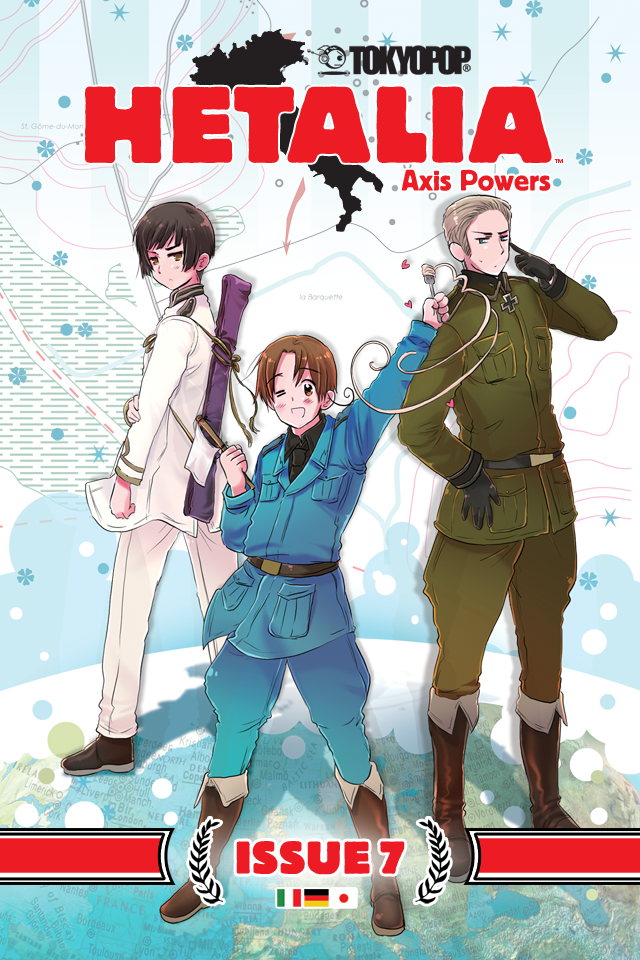
Announced today, manga publisher TOKYOPOP and digital comics publisher comiXology have teamed up to present the first simultaneous print/digital release the industry has yet seen (check out Comics Worth Reading for a little clarification on that claim). The title chosen for this collaboration is Hetalia Axis Powers, a popular Japanese webcomic by Hidekaz Himaruya that has since been adapted to print (as well as anime) in Japan.

This will be the first manga to join comiXology’s catalogue of over 3,000 comics. The series’ first six chapters are already available from comiXology for the web, iPad, iPhone and iPod. The first chapter is free, with subsequent chapters selling for $0.99 each.

Also coming soon, according to a recent press release, is a deluxe teaser app that fans can download from the iTunes App Store, which includes a preview of the first chapter, manga trailer, and photos of elaborately dressed fans in Hetalia cosplay.

Quotes from TOKYOPOP’s Stu Levy and comiXology’s David Steinberger suggest that this is the first in an effort to bring all of TP’s manga titles to comiXology’s digital platform. Other manga publishers who currently provide both print and digital releases of many titles include Digital Manga Publishing and NETCOMICS, and of course Yen Press, whose Yen Plus magazine recently launched its first digital issue. Who will be next?

Filed Under: NEWS Tagged With: comixology, Tokyopop

Eyeshield 21 1-3 by Riichiro Inagaki and Yusuke Murata: B

September 21, 2010 by Michelle Smith

Though I’ve long professed an ardent love for sports manga, I did secretly wonder if my enthusiasm would wane when the featured sport is one in which I have zero interest, like, say, football. Would the inherent charms of sports manga be able to compensate for my real-world disinterest? Eyeshield 21 has proven to me that the answer to this question is “yes.”

Sena Kobayakawa has justed started his first year at Deimon High School, where he’s looking forward to reinventing himself after years of serving as gopher for bullies (when not fleeing from them). Picked as an easy recruitment target by the demonic Himura, captain of football team, Sena finds himself volunteering to be the team’s manager. Once Himura witnesses Sena’s speed and natural running back moves, though, he is suited up and disguised (so that other teams won’t try to steal him) and given the moniker Eyeshield 21.

Although he’s initially not too thrilled about this, the passion and skill of Himura and the completely adorable (and completely enormous) lineman, Kurita, kindles his interest in the game. His running abilities lead the Deimon Devil Bats to their first victory ever. Their next opponents, the Ojo White Knights, prove much tougher, and it’s then Sena meets his rival—Shin, a player who’s nearly as fast as he is, but much, much stronger. Although there’s really no chance for the Devil Bats to prevail, they still manage to score two touchdowns against the superior team and Sena achieves a sense of personal victory when he’s finally able to evade one of Shin’s tackles.

As volume three comes to a close, the Devil Bats have been eliminated from the spring tournament but have turned their eyes and hopes towards fall, with the eventual goal of playing in the Christmas Bowl. Things are looking up a little—they’ve finally found their fourth member, a monkey-like boy named Raimon with some mad catching skills and the presence of Sena’s childhood friend, Mamori, as team manager seems destined to attract even more recruits. Aside from Himura and Kurita, no one knows that Sena is Eyeshield 21 (since his green eyeshield is magically sufficient to obscure his identity), and he can only watch in some consternation as the mysterious player’s legend begins to grow. When he happens to encounter Shin on the street, he realizes he can admit his real identity to him, but there’s no time to bond because the two of them have to unite to take down some thieves on a motorcycle. It’s actually kind of awesome.

So yes, Eyeshield 21 manages to entertain me even though it’s about football, a sport I find excruciatingly dull. There are loads of visual aids to help explain the game, the tone is optimistic and silly, and the characters are all memorable, too. Himura’s brand of crazy is responsible for most of the gags in the series: he looks like a demon, seems to have sufficient dirt to blackmail everyone into doing his bidding, keeps a ferocious dog chained up at school, and casually totes around all manner of weaponry. There’s a lot of attention devoted to Haruto, a teen idol whose fans persist in calling him the ace of the White Knights, even though he knows he isn’t. Shin’s a cool character, and Sena is okay, too, but really, my heart belongs to Ryokan Kurita.

Kurita is very big and round, very strong, very sweet, and prone to get weepy when he’s emotional. I think a visual aid is necessary here to truly convey his cuteness.

Aww!

Ultimately, Eyeshield 21 is lots of fun. I’m chuffed my library has recently acquired the full run of the series; expect to see more here in months to come!

Filed Under: Manga, Shounen Tagged With: Riichiro Inagaki and Yusuke Murata

Complete Fairy Tales of Oscar Wilde: A

September 21, 2010 by Michelle Smith

From the back cover:
A celebrated playwright and poet, Oscar Wilde also penned incomparable nonfiction and fiction—and lovely gem-like fairy tales. Filled with princes and nightingales, mermaids, giants, and kings, his tales carry the mark of his signature irony and subtle eroticism. This volume brings together all the stories found in Wilde’s two collections, The Happy Prince and Other Tales and A House of Pomegranates. Published here alongside their evocative original illustrations, these fairy tales, as Wilde himself explained, were written “partly for children, and partly for those who have kept the childlike faculties of wonder and joy.”

Review:
I was first made aware of the fairy tales of Oscar Wilde by Stephen Fry, whose recording of six of the stories is nothing short of delightful. This print edition has its charms, too, including three additional tales as well as illustrations and a great introduction that acquaints readers with not only the tragedies of Wilde’s life but with the fond recollections of his friends. I’d say it’s worthwhile to invest in both.

Wilde published two collections of children’s stories and both, obviously, are included here. On one level, the stories are amusing and imaginative, featuring a bevy of talking animals—whom Wilde often uses for satirical purposes, as with the mother duck in “The Devoted Friend” who frets that her children will never be in “the best society” unless they can stand on their heads—and even a sentient firework with delusions of grandeur. Often, though, a surprising degree of darkness is also present, as various characters die, realize the suffering they have caused others, commit valiant acts of self-sacrifice for ultimately no purpose whatsoever, and persist in their misguided ways despite the best attempts of others to show them the light.

In these stories, Wilde mingles the fantastic with the quotidian and the heartwarming with the bittersweet in a way that really appeals to me. Here are my three favorite examples (spoilers ahead):

In “The Nightingale and the Rose,” a nightingale overhears a student bewailing his plight: the woman he loves has agreed to dance with him at an upcoming event if he brings her a red rose. Alas, there are no red roses in his garden. The bird, believing him to be the very embodiment of true love, which she is always singing about, tries everything in her power to procure such a flower for him, ultimately deciding that it’s worth sacrificing her own life for the sake of love. And what is the recipient’s reaction to the rose when it is presented to her? “I’m afraid it will not go with my dress.” It ends up in the street and is promptly run over by a cart. The end.

A similarly awesome ending can be found in “The Star-Child.” One winter, a pair of poor woodcutters are returning to their homes when they see what appears to be a falling star land nearby. When they get there, they find a baby, and one of the men takes it home. The boy grows up fair and comely and becomes vain and cruel because he is convinced of his own lofty origins. One day, a beggar woman shows up to claim him as her son, but he rejects her. This action renders him ugly, and he spends the next three years in search of the woman to beg her forgiveness, learning mercy and pity along the way and sincerely repenting of his former actions. A happy ending seems imminent when he not only gets his looks back but is revealed to be a prince, but Wilde concludes the story (and A House of Pomegranates as a whole) with the following paragraph:

Yet ruled he not long, so great had been his suffering, and so bitter the fire of his testing, for after the space of three years he died. And he who came after him ruled evilly.

The end. Is that not amazing?

My very, very favorite story, though, is “The Happy Prince.” Once upon a time there was a prince, and he was happy while he lived in his isolated palace and remained ignorant of the world outside. After his death, the townspeople erected a beautiful, gilded statue in his honor and set it on a tall column, from where he can see (with his sapphire eyes) all the misery in the city that he could not see before. One day, a swallow—delayed in departing for warmer climes because of his devotion to a fickle reed (“It is a ridiculous attachment,” twittered the other swallows. “She has no money and far too many relations.”)—lands near his feet and becomes the messenger for the Happy Prince, plucking out his jewels and stripping off his gold and delivering them to the poor and needy.

The swallow eventually succumbs to the cold, but not before sharing a kiss with the statue he loves. The mayor, once he notices how shabby the statue has become, decides that one of himself would do much better and pulls it down. Here, instead of a wholly sad ending, Wilde offers up a sweeter alternative that sees both the statue and the bird rewarded for their benevolence. It’s an immensely satisfying tale that also portrays pure love between two males, though they be not human; I like it immensely.

The one author of whom I was reminded while reading these stories is Neil Gaiman. I’m now convinced he was at least partly inspired by Wilde, so, if you’re a fan of his short stories, you might like these as well!

Filed Under: Books, Children's Fiction, Classic, Fantasy, Short Stories Tagged With: Oscar Wilde

Pick of the Week: House of Five Leaves

September 21, 2010 by MJ 3 Comments

Taking a quick break from my recent Vertical kick (though you can expect to see them back in this slot next week), and eschewing my usual PotW source, Comicopia, I hereby name Natsume Ono’s House of Five Leaves as my latest Pick of the Week!

Unlike many others, I haven’t fully jumped on the Natsume Ono bandwagon (though I do like Ristorante Paradiso quite a bit), but this series… oh this series. It hits me in all the right ways, with its passive, conflicted protagonist and shaky moral center.

Here are a couple of quick quotes from my recent review on Off the Shelf, where I discussed both my love for the story’s “hero,” Akitsu, as well as the volume as a whole:

“He’s just about as lost as a person could be, and yet there’s a survivor’s instinct somewhere in there that keeps him living and makes him weirdly compelling, despite his limp personality. I can’t help liking him and it’s definitely not out of pity. Ono’s unique art style is especially poignant here, too, and I think that really helps develop the character … The story moves quite slowly, but that’s really not the point. It’s all about this strange, vulnerable man, and whether he can truly discover family in a bunch of morally ambiguous outlaws. I had a lot of difficulty stopping after the first volume. It grabbed me that strongly.”

For more info, check out Viz’s latest press release on the series. Or just go buy it.

Filed Under: PICK OF THE WEEK Tagged With: house of five leaves

New Tumblr: Mini Bookshelf

September 20, 2010 by MJ Leave a Comment

Because the thing we all most need is yet another social network, Manga Bookshelf has joined Tumblr!

Behold: Mini Bookshelf

My intent for the Tumblr is to chronicle my daily manga/manhwa reads & to collect those of others (should others wish to play). To share what you’re reading today, simply go to my Tumblr and click “What are you reading?” Then just write a little note or upload a photo of whatever you’ve pulled off the shelf today. Judging from the submissions I’ve received so far, you don’t have to have a Tumblr account to participate!

I’ve been on a Vertical kick this week, with both Chi’s Sweet Home and 7 Billion Needles so far occupying my time.

So, what are you reading?

Filed Under: DAILY CHATTER Tagged With: tumblr

Manhwa Monday: Drama Dreams

September 20, 2010 by MJ 1 Comment

Welcome to another Manhwa Monday!

With so little manhwa currently available in English, fans have long realized that one of the best ways to preview some of what we’re missing is by checking out the plethora of Korean dramas available for streaming at sites like Crunchyroll and DramaFever, many of which are based on popular manhwa.

While the vast majority of manhwa currently published in English fall into just one or two primary genres, the range of K-dramas available to English-speakers is much, much broader, offering us a more balanced representation of what’s actually available in Korea.

For this reason, many manhwa fans not only keep up on currently running K-dramas, but also those in production. One example is the upcoming series, Daemul (대물), based on the manhwa by In-Kwon Park, about a woman who becomes South Korea’s first female president and her relationship with a male escort.

K-drama blog Dramabeans has been reporting on the series’ progress from the start, and though excitement was high early on, new promo photos have begun to indicate that the drama may not quite maintain the reportedly dark tone of the manhwa series.

When Daemul was first announced, I was pretty excited about it, particularly the more I read up on its source material. It seems the manhwa is pretty dark and flirts with racy topics … It seemed like a mature, adult story that could be quite interesting … Add political intrigue, conspiracy plots, and a thriller vibe, and we’ve got some interesting dynamics in play.

Before the drama airs, I can’t say for sure what the tone will be like, but the fact that it evokes none of that abovementioned stuff leads me to wonder just how whitewashed the story has become.

Even if the drama does prove to be a watered-down adaptation, as a manhwa fan, I just find myself wishing that someone would license a manhwa like this over here. I guess we’ll wait and see.

In other news, ANN reports that the South Korean government has released a piece of manhwa propaganda in an attempt to quell distrust among the nation’s youth. For more, check out the Bloomberg report.

Aspiring webtoon publisher iSeeToon has reported in their blog that they are delaying their launch until October.

At ComicBitsOnline, Terry Hooper laments the increasingly stunted efforts to bring manhwa and manhua to the UK.

This week in reviews, Michelle Smith takes a look at recent volumes of Sarasah (Yen Press) in last week’s Off the Shelf column at Manga Bookshelf. And at Manga Xanadu, Lori Henderson checks out the final two volumes of You’re So Cool (Yen Press).

That’s all for this week!

Is there something I’ve missed? Leave your manhwa-related links in comments!

Filed Under: Manhwa Bookshelf, Manhwa Monday

  • « Go to Previous Page
  • Page 1
  • Interim pages omitted …
  • Page 913
  • Page 914
  • Page 915
  • Page 916
  • Page 917
  • Interim pages omitted …
  • Page 1047
  • Go to Next Page »
 | Log in
Copyright © 2010 Manga Bookshelf | Powered by WordPress & the Genesis Framework