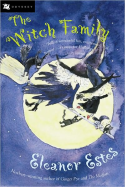
 From the back cover:
Banished!
Old Witch likes nothing better than to fly about on her broomstick crying “Heh-heh!” and casting abracadabras, but now she has been sent away… by two young girls.
Amy and Clarissa love to tell stories about Old Witch… until one day they decide she is just too mean and wicked. Drawing a rickety old house upon a barren glass hill, the girls exile Old Witch there with the warning that she’d better be good—or else no Halloween! For company they draw her a Little Witch Girl and a Weeny Witch Baby.
Old Witch tries to be good, but anyone would get up to no good in a place as lonely as the glass hill… as Amy and Clarissa find out when Old Witch magics them into her world, a world of make-believe made real.
Review:
If you’ve got a clever and charming child and are looking for a clever and charming Halloween book that they might enjoy, The Witch Family just might fit the bill.
Amy and her best friend Clarissa, both “ordinary real girls,” are almost seven. Amy’s vivid imagination has been captured by the tales her mother tells about the wicked Old Witch, and she enlists Clarissa—who, with her faulty memory but pleasant disposition, is content with the sidekick role—in drawing a series of pictures that continue Old Witch’s adventures.
The story is presented in a really neat way. For example, it’s immediately clear through vocabulary that Amy is concocting Old Witch’s story herself. (She’s fond of big words, but doesn’t always know how to spell or pronounce them, so when she sentences Old Witch to live alone on a glass hill as punishment for her evil ways, she declares, “I banquished her!”) But a lot of the book is told from Old Witch’s point of view, so kids would probably enjoy the “is she really real?” mystery.
It’s certainly a fun Halloween tale, but I think Amy is the most fascinating character of all. What a bright little girl! Seriously, I found myself wishing for an epilogue that read, “And then Amy became a super-famous novelist” or something. There’s a real whimsy in the language used, and I love that she does typical little girl things like write the bumblebee who’d been in her yard into the story and give him a noble and heroic part to play. She’s also inserting herself into the story in a way, by giving Old Witch a little witch girl named Hannah to keep her company who looks so much like Amy that no one can tell them apart when Hannah comes to visit Amy on Halloween and goes trick-or-treating with her friends.
I find I haven’t a lot more to say about the book than this. It’s very cute. There are kitties and weeny witch babies and things to make adults giggle and the most adorable bee on the planet. Thanks for the recommendation, K!




 One thing I checked out was the debut of a new manhwa from Seven Seas (their first, I think) called
  MJ: I have indeed, or at least partly so. My first read this week was volume seven of Yuki Midorikawa’s
  MICHELLE: The first volume of the Yen Press adaptation of James Patterson’s
  MJ: Well, you know, “horror” can have various meanings, and in my ongoing experiment to see just how much “horror” I can take, I decided to delve into volume eleven of Kanoko Sakurakouji’s demon-centric romance,