• Skip to primary navigation
  • Skip to main content
  • Skip to primary sidebar
  • Home
  • About Us
    • Privacy Policy
    • Comment Policy
    • Disclosures & Disclaimers
  • Resources
    • Links, Essays & Articles
    • Fandomology!
    • CLAMP Directory
    • BlogRoll
  • Features & Columns
    • 3 Things Thursday
    • Adventures in the Key of Shoujo
    • Bit & Blips (game reviews)
    • BL BOOKRACK
    • Bookshelf Briefs
    • Bringing the Drama
    • Comic Conversion
    • Fanservice Friday
    • Going Digital
    • It Came From the Sinosphere
    • License This!
    • Magazine no Mori
    • My Week in Manga
    • OFF THE SHELF
    • Not By Manga Alone
    • PICK OF THE WEEK
    • Subtitles & Sensibility
    • Weekly Shonen Jump Recaps
  • Manga Moveable Feast
    • MMF Full Archive
    • Yun Kouga
    • CLAMP
    • Shojo Beat
    • Osamu Tezuka
    • Sailor Moon
    • Fruits Basket
    • Takehiko Inoue
    • Wild Adapter
    • One Piece
    • After School Nightmare
    • Karakuri Odette
    • Paradise Kiss
    • The Color Trilogy
    • To Terra…
    • Sexy Voice & Robo
  • Browse by Author
    • Sean Gaffney
    • Anna Neatrour
    • Michelle Smith
    • Katherine Dacey
    • MJ
    • Brigid Alverson
    • Travis Anderson
    • Phillip Anthony
    • Derek Bown
    • Jaci Dahlvang
    • Angela Eastman
    • Erica Friedman
    • Sara K.
    • Megan Purdy
    • Emily Snodgrass
    • Nancy Thistlethwaite
    • Eva Volin
    • David Welsh
  • MB Blogs
    • A Case Suitable For Treatment
    • Experiments in Manga
    • MangaBlog
    • The Manga Critic
    • Manga Report
    • Soliloquy in Blue
    • Manga Curmudgeon (archive)

Manga Bookshelf

Discussion, Resources, Roundtables, & Reviews

Blog

Demon Love Spell, Vol. 3

May 28, 2013 by Anna N

Demon Love Spell Volume 3 by Mayu Shinjo

It is nice being able to read a Mayu Shinjo series that I can wholeheartedly enjoy. There are so many overly serious paranormal romance stories out there, it is still refreshing to visit Demon Love Spell for a bit of a comedic spin on the genre. Bumbling shrine maiden Miko and overly alpha male incubus Kagura are just goofy enough to be funny but not ridiculous, and their relationship has enough character-based humor that it is easy to root for them as a couple.

This volume opens with the overly theatrical banishing of a demon by Sou Yamabuki, a former pupil of Miko’s father. Kagura in chibi-form gets jealous that Miko is crushing on Yamabuki on TV, but she assures him that she thinks he’s the coolest. At school the next day Miko gets a bunch of attention from other guys and excitedly assumes that she’s now popular with boys. Miko and Kagura go on an actual date with some great moments where Miko blackmails Kagura into ignominious activities like eating hamburgers by threatening to shrink him again. The ending of the date is interrupted by Sou, who promptly banishes the source of Miko’s new found charms – a weak succubus demon. With Sou, Shinjo explores the old standby “sudden fiance” as he decides that he needs to marry Miko in order to take her away from Kaguya. Sou also reveals that while Miko’s ability to apply her power might not be the best yet, she’s actually extremely gifted. Sou’s desires seem to center more on gaining demon fighting power than truly caring for Miko. Kaguya decides upon an extremely unorthodox method to fend off his rival, but it does show how much he actually cares for the priestess. The next main story in the volume focuses on the sudden appearance of a handsome snow demon who spends some time protecting Miko when Kaguya storms off in a huff.

I still sort of wish that some of Shinjo’s other, earlier series would be translated over here. Sensual Phrase has most other English-translated shoujo beat for unadulterated melodrama. But Demon Love Spell is a nice substitute. It has the humor of Ai Ore without going too far out into left field, and the relationship between Miko and Kaguya is nicely balanced due to the power imbalance inherit in him spending a good portion of each day as mini-figure clipped to her handbag. This was a satisfying volume of this series, and I’m looking forward to seeing what happens with Miko’s newly revealed power in future volumes.

Filed Under: REVIEWS Tagged With: demon love spell, shojo beat, viz media

The Disappearance of Nagato Yuki-chan, Vol. 4

May 28, 2013 by Sean Gaffney

By Nagaru Tanigawa and Puyo. Released in Japan as “Nagato Yuki-chan no Shoushitsu” by Kadokawa Shoten, serialization ongoing in the magazine Young Ace. Released in North America by Yen Press.

This volume of Nagato Yuki-chan is pretty much impossible to review without spoiling the major plot twist that happens in the first chapter, be warned.

So, when we last left Yuki, she was about to be hit by a car, ending our cute little AU spinoff before it really began. Luckily, it doesn’t do major physical damage. That said, there’s something… odd about Yuki after the accident, which Ryouko, being the perfect best friend and oneesama, figures out right off the bat. Yuki seems more serious, speaks more precisely, isn’t a giant goofball, and acts more like another Nagato Yuki that readers may be far more familiar with. Yes, that’s right, this series that is an AU spinoff of a movie where Kyon crossed over into a world where Yuki was a shy adorable human is now crossing back over with the canon and dealing with a very different Nagato.

Tanigawa_YukiChanV4_TP

Please note that nowhere in the actual text does it say this. Indeed, there’s very little ‘explanation’ given at all. Yuki has an alternate personality due to the accident, which acts much like Nagato from the main Haruhi series, and everything resolves at the end of the volume with a similar lack of explanation – her mind re-orients itself and Nagato essentially says goodbye. Indeed, some may argue it’s not the canon Nagato due to the amount of emotions shown by this version – ranging from embarrassment at her stomach growling to a full-on body blush when Ryouko suggests that she may be in love with Kyon. But then again, Nagato in canon is an alien whose emotional growth is deliberately stunted by her masters. Here, she’s in a real human body and has no such tethers. So dealing with these feelings makes sense.

More to the point, Ryouko and Kyon’s reactions to this new Nagato are pitch perfect (Haruhi and Koizumi are conveniently absent for tests, so this book is pretty much just Kyon, Nagato and Ryouko). They’re both worried about what’s happened to Yuki, but both instinctively realize – even if Kyon’s much better at expressing it – that this Nagato is also her own person and shouldn’t just be treated as a clone or as if she’s “taken over” Yuki’s body. (Ryouko worries even more than usual here – also, great meta-joke about her saying she’ll just stab Kyon to relieve her stress.) There is a lack of conflict here that in most series would serve to make things rather boring – but this is the light and fluffy Suzumiya Haruhi spinoff, so it makes sense that there’s no accusations or attempts to return Yuki to her head – just calm acceptance, patience, and watching Nagato grow as a character of her own – to the point that she also falls head over heels for Kyon.

I’m not sure what the fallout from all this will be – whether Yuki will have memories of the time she spent as Nagato (it seems unlikely from what little we see) or whether Kyon will be able to deal with a love confession that wasn’t really – but I will admit that this volume really is a major step forward by Puyo, and the best in the series. Which is still light and frothy, but now deals with its characters on a level equal to its source.

Filed Under: REVIEWS

It Came from the Sinosphere: The Duke of Mount Deer (Part 1)

May 28, 2013 by Sara K. 1 Comment

The_Deer_and_the_Cauldron_(鹿鼎記)

I’m going with the title “The Duke of Mount Deer” because a) it seems to be the most common title for this story in English and b) I like it more than the other titles for this in English. It’s also known as The Deer and the Cauldron and Royal Tramp. If I had to come up with a title for this story, I would pick What the **** Are You Doing, Wei Xiaobao?, which I think better conveys the spirit of the story than any other title.

The Story

Wei Xiaobao is a teenage brat from Yangzhou who goes on an adventure to Beijing. There, he gets captured, taken in to the Forbidden City, and has to pretend to be a eunuch called “Xiaojiazi” to keep his head attached to his shoulders. He’s instructed to go looking for the “Sutra of Forty-Two Chapters,” and becomes friends with another boy in the palace called Xiaoxuanzi. Why are they friends? Because Xiaoxuanzi likes to beat Wei Xiaobao up.

I’m going to stop there, because I really don’t want to spoil the next twist in the plot. Let’s just say that Wei Xiaobao has an interesting life.

Background

This is Jin Yong’s final novel. If you don’t know or don’t remember who Jin Yong is, you may consult the archives.

The Jin Yong Anti-Hero

The Jin Yong TV Tropes page puts this very succinctly:

Wouldn’t Hit a Girl: Most of his protagonists except for Wei Xiaobao.

The typical Jin Yong protagonist is:

– hardworking / dedicated to improving his martial arts techniques
– is chaste (or at least wants to be chaste)
– feel a sense of Han Chinese nationalism (though some feel it more strongly than others, and their feelings about this are often complicated)
– is willing to die for the people he loves and/or his principles
– actully want to make the world a better place, or at least do the just thing

By contrast, Wei Xiaobao

– is too lazy to become a real martial artist (he won’t practice because it’s boring)
– is way less sexually inhibited than other Jin Yong protagonists
– does not give a shit about Han Chinese national (he doesn’t care whether or not somebody is Han Chinese, nor does he care whether or not the Han Chinese control China)
– is not willing to die for anything, though he is willing to fake his own death
– does not care about making the world a better place

Wei Xiaobao is not just an anti-hero. He’s an anti-Jin-Yong-hero. You really have to read several Jin Yong stories and then read this one really appreciate it.

And quite frankly, it’s refreshing to read about a protagonist who does not have the typical Jin-Yong-protagonist hangups.

That said, Wei Xiaobao is not a complete opposite of other Jin Yong protagonists. Most Jin Yong protagonists are child-like/immature/naive (pretty much the only exception to this is Qiao Feng, though Chen Jialuo is arguably neither child-like nor immature), and Wei Xiaobao is … child-like, immature, and naive. I think that the child-like quality is actually more essential to Jin Yong protagonists than, say, their sexual philosophies. What is at the heart of the stories is a sense of wonder while exploring the world, which is a child-like approach (though mature adults can do it too). To me, this is a key signature of Jin Yong’s style which sets apart his stories from most other wuxia.

Qing Dynasty Curio Box

Much of the imperial collections of the Qing Dynasty court are in Taipei, and a fraction is on display at the National Palace Museum.

A photograph of a Qing dynasty sandalwood curio box full of various little trinkets.

This image comes from Qing Dynasty Treasures on Pineterest

The Qing Dynasty court loved curio boxes. First of all, the boxes had creative designs, often to show off the contents in unusual ways, or with secret compartments. The contents could be artifacts from thousands of years ago, weird baubbles imported from Europe, or the fine work of the imperial artisans (and many other things beside – it could be anything that would fit into a box and delight the viewer).

To me, this novel feels like a Qing Dynasty court curio box, which is appropriate, since most of the novel does take place in the Qing dynasty court. There are lots of secrets to be uncovered, and lots of plot twists to delight the reader.

I want to give examples, but every single example would be a spoiler, so instead I am going to make something up – Wei Xiaobao notices that a middle-aged man always appears at a gambling house in Beijing on the 7th day of the month, that this mysterious man is an excellent martial artist, and that this man wants to hide, not find, the “Sutra of 42 Chapters.” Wei Xiaobao eventully finds out that this “man” is actually a woman – specficially Qingqing from The Sword Stained with Royal Blood. After Wei Xiaobao discovers her true identity, Qingqing captures him and takes him all the way to Brunei, where she has a beautiful daughter who decides that Wei Xiaobao is an excellent punching bag.

This doesn’t actually happen in the novel, but it’s like the things which do happen in the novel.

Language

This novel is very playful with it’s language, which I’m sure gives the translators painful headaches a wonderful challenge.

Wei Xiaobao himself is illiterate, and is too lazy to even learn the Cyrillic alphabet (Wei Xiaobao knows some Russian), let alone the Chinese writing sytem.

However, because he needs to pick up imperial etiquette mighty quickly to keep his head attached to his shoulders, he ends up learning this formal imperial language quite well.

What he does not learn, however, is how to speak as an educated person. Or rather, he learns it, but incorrectly. For example, there is a phrase – ‘it’s hard to chase four horses’. Wei Xiaobao always says it as ‘it’s hard to chase a dead horse’ (the Chinese word for ‘four’ sounds like the word for ‘death’), and furthermore often uses the phrase for totally inappropriate situations.

Of course, while Wei Xiaobao cannot use proper formal Chinese, he is a poet of gutter Chinese. This novel is full of foul language, and some of the humor comes from Wei Xiaobao using foul laguange inside the Forbidden City. At one point, Wei Xiaobao says something like ‘[character] is wearing a hat of fine emerald’. People who are familiar with the Chinese language can figure out that this is a very salacious comment. And then, some members of the imperial family pick up some foul language from Wei Xiaobao…

The contrast of the stiff, formal imperial Chinese with gutter Chinese is yet another level of fun in the novel. The prose in this novel may not be as beautiful as in some of Jin Yong’s other novels but, well, beautiful prose would miss the point.

I read this edition.

I read this edition.

Sexual Abuse

At one point in the story, Wei Xiaobao overhears some people forcing a girl (probably around 10 years old) to drink something. Wei Xiaobao assumes that the drink is drugged, or at least is alcholic, and that they plan to rape her. He is totally indifferent to this.

We then learn that, where Wei Xiaobao grew up, this happened all of the time, and that all of the adults around him went along with this. In other words, he was taught that raping 10-year-old girls is OK.

This explains at LOT.

The parts of the novel which I enjoyed least were the sections where Wei Xiaobao was persistently sexually harassing people. On the one hand, yes, Wei Xiaobao is a very clever prankster. If he were, say, finding clever ways to pee all over his enemies’ beds (like a certain other Jin Yong protagonist), I would have had a blast.

But while I think pranking is fun, sexual harassment is not fun. I’m not saying this to be politically correct, I mean that, in my guts, sexual harassment feels bad.

So here I was, with long sections of this novel which would have been a lot of fun if Wei Xiaobao’s pranks had not been a form of sexual harassment. It was a drag.

(the rest of this section has spoilers)

Of course, Wei Xiaobao wouldn’t actually rape anybody, would he? He’s so cute and adorable, and most of the beautiful female characters could easily beat him to a pulp.

One of the most common defences of rapists is “but he’s such a charming guy – he can’t be a rapist” (or variations of this defence). Also, when people mention that they are being sexually harassed (for example, female bloggers receiving rape threats from anonymous commenters), they’re often told that there’s no danger, and that they should just ignore it. There’s also this myth that most rapes could be prevented by potential victims being armed, or learning self-defence, when in fact this would only prevent a minority of rapes.

Well, I have to give Jin Yong points for realism. Wei Xiaobao was raised to think that rape is OK, and nobody expelled this notion out of his head. When one of his victims complain about the sexual harassment, other chracters explain it away by saying that Wei Xiaobao doesn’t have any bad intentions, and that she shouldn’t take him too seriously. And the physical capabilities of his targets is irrelevant if he drugs their drinks.

The one thing which I cannot buy is that two of his victims start liking him after Wei Xiaobao rapes them. I’m not going to say this is absolutely impossible, but as a reader, I need a damn good explanation in order to believe this (even in a work of fiction). I do not get any explanation. Therefore, I had to edit my headcanon to keep the story functioning inside my headspace. It is simply not in human nature to start liking your rapist (unless there are a hell of lot of interfering factors at work).

Wei Xiaobao himself is also a victim.

At the very minimum, he’s the victim of non-consensual BDSM. It is also possible that he is a rape victim himself. The novel does not state whether or not he consented to sex with that specific character, but given a) his previous experience of non-consensual BDSM b) the fact that she often uses threats to make Wei Xiaobao do what she wants and c) Wei Xiaobao tries to avoid her precisely because he’s scared that she will cause him physical harm, I have my doubts.

Just because Wei Xiaobao himself is a perpertrator does not mean it is okay to sexually abuse him. Two wrongs do not make a right, especially when it comes to sexual abuse. I admit there were times when I wished someone would kick Wei Xiaobao in the nuts, but even that would only be okay in certain circumstances (such as self-defence).

Does Wei Xiaobao take his feelings of being on the receiving end of sexual abuse, and connect it to the way that he is making his victims feel? Of course not – Wei Xiaobao is terrible at empathy.

I’m Not Done!

Next week, I will continue to discuss this novel. If you can’t wait for the conclusion, it’s “READ THIS NOVEL!”

***

Sara K. is dealing with major technical difficulties right now. If you liked this post, you should thank Sara K.’s father, for if he hadn’t impressed on her that she should always be prepared to run a computer without using a hard drive, there is no way this post would have been finished on time. Right now, she is running the computer off a Class 10 SDHC card, which is thanks to her uncle’s suggestion.

Filed Under: It Came From the Sinosphere Tagged With: jin yong, Novel, The Deer and the Cauldron, The Duke of Mount Deer, wuxia

Bookshelf Briefs 5/27/13

May 27, 2013 by MJ, Michelle Smith and Sean Gaffney Leave a Comment

This week, MJ, Michelle, and Sean look at recent releases from Yen Press, Vertical, Inc., and Viz Media.


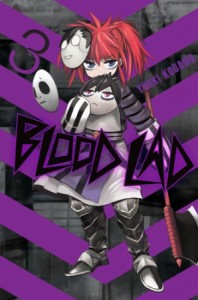
bloodlad3Blood Lad, Vol. 3 | By Yuuki Kodama | Yen Press -I’ve liked Blood Lad from the start, but what’s most impressive about it is that it’s constantly surprising me with the ways in which it increases my affection. Though its fun, well-developed characters and humorous meta have been the series’ biggest draws so far, it goes further with both in this latest omnibus by making the meta about its character development. As Fuyumi’s true connections to the demon world are revealed, Staz agrees to a “curse” that forces him to respect her will by only allowing him to do anything with her for which she explicitly grants her permission. So now, after mulling over the difference between being the hero and the anti-hero, Staz must actively work to ensure that the objectified female love interest is granted full agency by the story itself, or (as far as he knows) risk his own death. I *heart* you, Blood Lad. – MJ

btooom2BTOOOM!, Vol. 2 | By Junya Inoue | Yen Press – I’m rather torn on how I feel about BTOOOM!. On the one hand, it’s a quick, action-packed read about people on a deserted island being forced to participate in a deadly real-life version of a blow-’em-up video game, and the implication that the protagonist’s mother sent him into this environment on purpose is at least moderately intriguing. On the other, it’s completely lacking in any sort of depth, has mediocre art, and seems to revel in its gross and/or explicit content. A new player, a homicidal fourteen-year-old, is introduced in this volume, and of course we have to see him in the act of committing his particularly disturbing crime in the past. And the preview for volume three is entirely about whether a female player is going to be sexually assaulted, complete with extreme crotch closeup. While I don’t hate this series, this volume left me feeling unclean. I think I may be done. – Michelle Smith

limit5Limit, Vol. 5 | By Keiko Suenobu | Vertical, Inc. – This volume begins as harrowingly as the last ended, but its trajectory after that I found truly surprising. As the original group is finally confronted with the truth of Usui’s death, they’re left with a problem that may truly be too much for them to handle. Amidst all the horror and chaos, one thing that has remained neatly black-and-white for the group up to this volume has been the subject of murder; guilty or not guilty? These were the only choices. So what to do now that things have become suddenly muddy, even on this point? What began as a tense survival tale has grown increasingly more complicated over the course of the series, finally forcing its characters into a position where they’ll have to make judgements they clearly aren’t prepared for. And I’m truly on the edge of my seat. Highly recommended. – MJ

psyren10Psyren, Vol. 10 | By Toshiaki Iwashiro | Viz Media – I like how Psyren keeps its characterization grounded in the plot. After last volume, I was expecting “Research Subject 7” to be a sort of smiling mommy mentor type. Imagine my delight that she has nasty mood swings, is completely broken after all the trauma she faced, and removes herself from the battlefield as the best way to help our heroes. As for our heroes, they’re back in the present now (with some nice acknowledgement that if they win, the “future” Elmore Wood gang are stuck), and it’s back to trying to work out how to stop all this. Which may be even more difficult given that Sakurako seems to be losing her memories… and sense of self. At times Psyren feels like a sprawling mess, but when it’s on, it’s as exciting as any Jump series. I look forward to seeing how they march toward the ending.– Sean Gaffney

strobeedge4Strobe Edge, Vol. 4 | By Io Sakisaka | Viz Media – My favorite part of this volume was the attention paid to “beta couple” Daiki and Sayuri. I was afraid that after the first volume they’d be making only token appearances, but given that this is a manga about how difficult high school love affairs can be, it’s great to see everyone having to deal with it. Long-distance relationships can be especially rough, as they both learn. As for the rest of the cast, they all compete to see who can be the best at suffering stoically. Ren wins, of course, because he’s trying to be everything for everybody. I am rather impressed that Ninako has managed to keep her shiny happiness through these four volumes without really inching into depression for too long. I hope the same can be said for Mayuka, who the cliffhanger seems to indicate will be headed for a breakup soon.– Sean Gaffney

Filed Under: Bookshelf Briefs

Manga Bookshelf & Yumi Tamura

May 27, 2013 by MJ Leave a Comment

Here at Manga Bookshelf, we love the Manga Moveable Feast. Sometimes, though, we really love it, and this month has been one of those times.

scan0003Though only a handful of works by Yumi Tamura have been published in English, our collective love for Tamura-sensei’s work was enough to inspire a host of articles here this week, including a rather lengthy roundtable discussion. Since these articles are likely to scroll off the front page long before we’re finished visiting and revisiting them in our minds, here’s a handy index of our contributions to this month’s Feast.

Yumi Tamura at Manga Bookshelf

  • Fanservice Friday: Draco Malfoy & the Blue King (MJ)
  • License This! 7 Seeds by Tamura Yumi (Travis Anderson)
  • Yumi Tamura: Two Artbooks (Karen Peck)
  • Off the Shelf: Basara, MMF Edition (MJ, Michelle Smith, Anna N., & Karen Peck)
  • Basara, Vols 13-16 (Anna N.)
  • Personalizing Feminism in Basara (MJ)

Since we really have no desire to stop talking about Yumi Tamura, we hope you’ll join us in comments!


Full roundups of this month’s MMF entries can be found at Tokyo Jupiter.

Filed Under: UNSHELVED Tagged With: Manga Moveable Feast, MMF, Yumi Tamura

Pick of the Week: Onizuka FTW!

May 27, 2013 by MJ, Sean Gaffney and Michelle Smith Leave a Comment

shonan9MJ: I’m sure this will come as no surprise, but pretty much regardless of whatever else is on the list this week, I’ve gotta go with the final volume of GTO: 14 Days in Shonan. I have loved this series more than I thought I could love a thing about a surprisingly badass sort-of-loser like Onizuka. He’s got my number, and as much as I’m mourning that this is the final volume, I really can’t wait to see how it ends. This little series has been my first exposure to the GTO universe, and I’m grateful to Vertical for picking it up. It’s absolutely this week’s must-buy!

SEAN: MJspeaks for me. Onizuka has my sword. And my bow, come to think of it.

MICHELLE: I feel sort of bad picking GTO: 14 Days in Shonan, seeing as how I’m so far behind on it, but the truth of the matter is that I have no interest in Air Gear or an erotic bookstore, have never read Mardock Scramble, and am even farther behind on Fairy Tail, so GTO it is! That may not sound like a ringing endorsement, but I really do enjoy the series. I’m just perhaps not the most qualified person to champion it at the moment.

What looks good to you this week?

Filed Under: PICK OF THE WEEK

Personalizing Feminism in Basara

May 26, 2013 by MJ 29 Comments

(Warning: This article contains major spoilers for Yumi Tamura’s Basara.)


basara13When you’re discussing a 27-volume series like Yumi Tamura’s Basara, there’s inevitably a lot to be said that can’t be said in a single roundtable discussion—even when that discussion is nearly 10,000 words long! I was able to get some of the more fannish overflow out of my system by way of last week’s Fanservice Friday, but one topic I’m still obsessing over, even after our roundtable discussion, is feminism in Basara, and how it relates to both the story’s politics as a whole and to me personally as a reader.

Despite the fact that I openly identify as a feminist, it’s something that I don’t talk about often, at least not in specifics. And the primary reason for this is that I’m not a student of feminist theory—or really any theory at all (unless you count music theory, and I think you’ll find that most people don’t). I’ve never read any books about feminism, or taken a class, or attended a talk on the subject. I can’t speak as an expert or scholar, or even as a well-informed layperson. I don’t even have the academic background or vocabulary with which to fake it. I rarely talk about feminism, because I don’t want to talk ignorantly about feminism, and that’s pretty much where things stand.

My identity as “feminist” comes largely out of ideas that have been part of who I am ever since the moment I realized, as a child, that there were people in the world who inexplicably made assumptions about me based solely on my gender. It simply didn’t make sense. Though, as I became old enough to comprehend it, I realized that there were ways in which the household I grew up in conformed to traditional ideas about gender (both certified teachers, my mother balanced part-time work with most of the childcare, housekeeping, and cooking, while my father worked full-time), neither of my parents seemed remotely concerned that I followed more naturally in my dad’s footsteps and showed no interest at all in domestic pursuits.

I liked pretty dresses, ballerinas, heated political debates, science fiction, kickball, and digging up worms in the back yard, and nobody ever suggested that there might be anything contradictory about my tastes. I was allowed and encouraged to just be “me,” to pursue my natural interests wherever that led me, and the idea that there might be limits on that, for any reason, seemed patently absurd. I knew instinctively that I was a capable, complete person, and that my individual potential was just that—individual. Nothing else made sense. My parents taught us about things like “women’s lib” and “male chauvinist pigs” (somewhere in the late 70s my sister and I acquired t-shirts with the slogan, “A woman needs a man like a fish needs a bicycle”) but the whole thing seemed kind of ludicrously obvious. Nobody really thought otherwise, did they? It was all right there. The whole world was right in front of me, in all its glorious mystery, and I was a free agent. What did my gender have to do with anything?

As I got older, and my world became more obviously gendered, things made even less sense. Though certain girl-tagged items were, to me, obvious draws (YA fiction and prettyboy teen idols dominated much of my free time in my pre-teens) popular concepts of what it meant to “be a girl” in midwestern ’80s teen society—the hairspray, the conversation, those quizzes in Cosmopolitan—just felt wholly alien, as did most other girls I knew. I struggled to look and act like them, but I simply didn’t fit the mold, no matter how painfully I squeezed and prodded. Having finally hit upon something apparently beyond my capabilities, I wondered if I even was a real girl, given the growing evidence against it. It was my 8th grade English teacher, though, who finally, inadvertently showed me the way. When, as we studied Nathaniel Hawthorne’s The Scarlet Letter, she admitted that she thought that Hester deserved to wear that big, red “A,” I knew suddenly that whatever that teacher was, I decidedly was not. And that’s when I began to really think about and identify with the word “feminist.”

basara-dreams-smOut of all that, whatever it is that my personal “feminism” is and grew out of, that’s the feminism of Basara. It’s the feminism of a girl who just is what she is, whether she’s falling in love or leading a rebellion against an oppressive regime. Whether she’s using her own name, her brother’s, or no name at all, she’s all herself, all the time, and she couldn’t possibly be anything else. And though she’s not consciously fighting a feminist cause, she’s forwarding one with her politics in general, as well as by simply existing as herself and exercising her own undeniable agency.

Basara‘s feminism, however, is not just about its formidable lead. Shoujo manga as a whole is heavily populated with spunky heroines, many of whom lead overtly heroic lives, especially in fantasy series like Basara. Often, however, these heroines exist largely alone in a world of men. They are exceptional girls and women, of this there’s no doubt, but that’s just the thing—they’re exceptions. Even in current shoujo fantasy series, like Dawn of the Arcana or Fushigi Yugi: Genbu Kaiden, heroic women are supernaturally-endowed or pre-destined beings to be protected and fought over, anomalies in their worlds, often despised and opposed by other female characters (who may or may not be evil love rivals).

Basara begins with some fantasy tropes firmly in place. Sarasa is the “child of destiny,” and she initially disguises her gender in order to lead her revolution. But as her journey brings her in touch with numerous other women whose individual dreams and circumstances have caused them to cross her path (and, in most cases, join her cause), the matter of hiding her gender becomes more of a lie she doesn’t know how to get out of rather than anything of genuine importance. And when she’s finally forced into revealing the truth, it’s a relief to everyone.

Which isn’t to say that being a powerful woman in Sarasa’s post-apocalyptic Japan is easy. Chacha, the pirate captain who joins Sarasa’s (Tatara’s) army after their initial confrontation, spent her young life constantly having to prove herself in order to take on her natural role as a leader. Renko, the outspoken publisher of a newspaper in Suo, is persecuted and (literally) crucified for criticizing Momonoi’s regime. And Kiku—the one female among the White King’s “four nobles” acknowledges more than once her frustration and sense of powerlessness in her role. But, like Chacha and Sarasa, Kiku eventually learns to love who she is and to take control of her own destiny.

basara-morekiku

I think it’s notable that the White King, who is eventually revealed as the series’ primary antagonist (I don’t say “villain,” because ultimately this story doesn’t so much have villains as is does just people who have been badly damaged by their circumstances), is a woman whose sense of self was utterly destroyed by the role she was forced into as a young woman in the royal family. She’s a tragic figure—one that Tamura refuses to soften with any kind of last-minute redemption, or anything approaching a happy ending. The damage done by the patriarchy is real and irreversible, says Basara, and there’s no way out but to dismantle it completely.

And dismantle it Tamura does. I talked a bit in our roundtable about what I see as social anarchist principles at work in Basara, and these are inextricable from the series’ feminism. Women lead the story’s rebellion because it is women, forced to view the corrupt power structure from the outside, who are able to see clearly the damage that’s been done and what’s required to forge a completely new path. Men are valuable allies in Tatara’s revolution, but it’s the women who are teaching them (and each other) how to live better lives. When Sarasa finds herself shattered by the realization that the man she’s fallen in love with and the man she’s vowed to destroy are one and the same, though it’s Ageha who shelters her through her subsequent mental breakdown, it’s her mother‘s words that finally help Sarasa to shed the hate that she’s been subsisting on all through her career as “Tatara.”

One particularly moving scene in volume thirteen takes place in Suo city, at the site of Renko’s crucifixion. Though in the next volume, Sarasa and her army will arrive to remove Renko from her cross, Renko’s artist lover, Hozumi, (who is also Momonoi’s son) arrives to show her that she’s made a difference. Having lost use of his arms as punishment for aiding Renko, Hozumi kneels before her to paint as a demonstration of his support and understanding.

basara-art

“I was born into a rich family,” he thinks as he works,” I had nice clothes to wear. I ate good food. Until I came to Suo and met Renko, I knew nothing about the world. If I try to make a speech now, it can only sound naive. I just don’t want anyone to shed blood.”

“I love you,” he thinks as he paints a field of green around her, but the subtext is, “Thank you,” and “You saved me.” And as he demonstrates, silently, what he’s learned from Renko, Sarasa is learning it too. In the wake of Renko’s sacrifice, Sarasa glimpses a world in which individual creativity and expression is more powerful than the sword, and where fully-realized individuals can come together peacefully to work for the common good.

I mentioned in the roundtable that I thought it was notable that though Tamura clearly views some forms of government more favorably than others, Sarasa never attempts to establish any government at all, and a later side story reveals that the government that does spring up after the rebellion has already fallen into corruption less than a full generation later. Ultimately, Basara rejects not only the violent, decadent patriarchy that Sarasa and her comrades fight to bring down, but any system at all that threatens the compassionate autonomy Sarasa and her allies represent.

basara27Perhaps the greatest demonstration of Tamura’s rejection of patriarchal norms, however, is in her publishers’ apparent need to reinforce them, at least on the surface.

When I got to the series’ final volume, I was surprised at its cover, featuring what would appear to be the wedding of Sarasa and Shuri, with a sort of weird, plastic, pod-people feel to it.

“Do they actually get married?” I asked myself, flipping quickly through the volume for some sign of matrimonial activity.

“Hmmm… Shuri proves to Sarasa that he’s no longer the “Red King,” Tamon gets the Genbu sword, Asagi adopts an orphaned child (what?), no… not here… cute owls… no.”

And the answer is… no. Though Sarasa and Shuri do apparently stay together and definitely produce offspring, there’s no indication whatsoever that they bothered to walk down the aisle—nor does that even seem likely given the way they’ve decided to live. In fact, it’s explicitly stated at one point that they’re not married. They are lovers, for sure, and partners, absolutely. But husband and wife? If it happens, it’s offscreen.

There is one couple who gets married during the course of the volume—with very little page time, and the ceremony is not shown—but even that short story is focused on the couple’s determination not to change as individuals despite their arranged marriage. “Just because we’re gettin’ married doesn’t mean it changes anything. You don’t have to change. And I won’t either.” At best, it reads as the reluctant acceptance of a generally objectionable institution.

So what’s up with that cover? Was it so important that the series appear to wrap up with a traditionally “happy” shoujo ending that they had to retcon one in? I can’t know the answer for sure, of course, but wow does it create some real cognitive dissonance.

Fortunately the contents of the book itself are consistent with the raw, heartfelt feminism that drives the series overall, and the volume ends with the image of the child, Sarasa, facing that glorious, mysterious world with the same sense of power and free agency I felt as I gazed at the fields and woods beyond my childhood backyard.

basara-world3


All images © Yumi Tamura/Shogakukan, Inc. New and adapted artwork and text © Viz Media. This article was written for the Yumi Tamura Manga Moveable Feast. Check out Tokyo Jupiter for more!

Filed Under: FEATURES & REVIEWS Tagged With: basara, Manga Moveable Feast, MMF, Yumi Tamura

Basara, Vols 13-16

May 25, 2013 by Anna N

Whenever I pick up and read a few volumes of Basara, I’m always struck by how much story and emotion Yumi Tamura is able to pack into a few pages. I’d started rereading Basara last year, but got distracted by having too many volumes of shiny new manga. The Manga Moveable Feast seemed like a great excuse to dig up these volumes again. These volumes cover Sarasa’s journey as she escapes from prison and wages war on the desert city of Suo, only to encounter the Red King. The battle doesn’t go the way either of them planned.

Sarasa is able to escape Abashiri prison with her comrades, but she doesn’t have time to settle back and appreciate freedom again. It is time to head south and take up the struggle to determine the fate of Japan. Ageha leaves Sarasa, saying that he can’t become a crutch to make things easier for her. She has to execute her plans on her own, based on her convictions. Shuri heads to his precious desert city of Suo, but things have changed there for the worse as the administrator there Momonoi attempts to remake it in the image of Kyoto by displacing the poor and blowing up buildings. Asagi prevents a reunion between Sarasa and Shuri in a southern market, because he thinks if they each find out the truth about each other now, it would be “too dull.” Sarasa and Shuri both head to Suo with drastically different purposes.

The struggle in Suo is portrayed in mental as well as physical terms. Sarasa meets up with Hozumi, Momonoi’s son who his a non-violent artist. His girlfriend Renko runs an underground newspaper in the city. Sarasa starts unsettling the city by plastering notices that “Tatara was here” on the walls, and even flying the message from a kite. Sarasa starts to reflect a bit about what it means to be both a strong and feminine woman after spending some time with Renko. Hozumi stages his own form of protest by painting elaborate pictures on the walls of buildings slated for destruction, so people hesitate to blow them apart.

When Shuri sees the wreckage of Suo, he’s angry at what it has become. Momonoi brutalizes both Hozumi and Renko. Sarasa and Shuri both go after Momonoi for different reasons. Sarasa is nervous about being in close proximity to the Red King, the man who destroyed her village. Shuri sees that he’s not welcomed as a savior in his treasured city, and begins to reflect that his previous philosophy about a good leader inspiring fear was mistaken. Sarasa’s reinforcements come, but her plan to use Momonoi’s own explosives to cut off the palace kills the water supply for the city. The Red King’s army executes a tricky sneak attack, and the star-crossed lovers seem like they are headed towards mutual destruction. Sarasa is devastated when she realizes that she’s bring more destruction to the people of Suo. A horrible sandstorm prevents the battle from progressing further, but rather than regroup with her comrades, Sarasa runs off and finds Shuri in the chaos.

It is a little unbelievable that Sarasa and Shuri have managed to keep their identities from each other for so long, especially considering the way they both tend to show up and meet each other right around the time that Tatara and the Red King have a skirmish. It is clear now that part of reason is that they honestly don’t care, and they are both blinded by love for each other so much that they aren’t going to stop and ask inconvenient questions when they could just enjoy each other’s company. This idyll is very short, and the Red King and Tatara’s army clash the next day and Shuri and Sarasa finally get a glimpse of each other from across the battlefield.

What follows is one of the most emotionally devastating scenes in the series, as Sarasa and Shuri react to this newfound knowledge in different ways. Sarasa slips into a fugue state, forcing out commands to kill the Red King, while Shuri mechanically tries to kill himself at the suggestion of his followers because his group is so clearly outnumbered by the rebel forces. Both armies flee the battle as King Ukon’s army approaches and Ageha takes Sarasa away in an attempt to bring back Tatara. Ageha thinks “Was he…that good? Why not just take me instead?” Ageha concludes that Sarasa isn’t his “woman worth dying for” and decides to leave. Sarasa ends up finding shelter with a local priest and his family, but her destiny isn’t going to let her sit back and do nothing.

Sarasa strikes up an odd friendship with Kikune, one of the White King’s spies. Sarasa and Kikune end up befriending Lady Purple, the Black King’s estranged wife. Lady Purple ends up being another type of mentor to Sarasa, but Sarasa’s emotional healing really begins when she’s reunited with her mother. In a very nurturing way, Sarasa’s mother asks her some pointed questions about the reasons why she was fighting and what she wants the future of Japan to be.

There’s some funny yet poignant exchanges happening as Asagi has rescued Shuri, who is undergoing his own emotional rehabilitation. Asagi is all but twirling his non-existent evil mustache in an attempt to get Shuri to have some sort of emotional reaction to him, but Shuri calmly accepts the prospect of being sold into slavery by his half-brother.

Overall, these volumes server as a great emotional climax to the first half of the series. The central mystery about what would happen if Sarasa and Shuri would find out about each other has been answered, and now they have to pick up the pieces of their lives yet again. While Ageha might have given up on Sarasa, it is clear that her destiny as Tatara will not allow her to just retire into the countryside and life out the rest of her life peacefully. Shuri has his own set of trials ahead, and it will be interesting to see how both of these powerful leaders manage to build a new Japan with such strong and well-connected enemies lining up against them. One of the strengths of Basara is the way Tamura will intersperse shorter, more personal adventures into the larger struggle with the extended cast. Having Sarasa and Shuri both on their own a little bit, without their customary support systems allows them to grow more as individuals, making the battles much more human. I’m glad I set aside the time to get back with my Basara rereading program, and I’ll likely finish up rereading the rest of the series outside of this week’s manga moveable feast.

Filed Under: REVIEWS Tagged With: basara, Manga Moveable Feast, shoujo

Off the Shelf: Basara, MMF Edition

May 25, 2013 by Anna N, MJ, Michelle Smith and Karen Peck 17 Comments


MJ: It’s time once again for the Manga Moveable Feast, this month featuring the works of Yumi Tamura and hosted at Tokyo Jupiter. Though three of her manga have been published in English by Viz Media, Tamura-sensei is best known to English-speaking fans for her 27-volume fantasy series Basara, published by Viz in its entirety between 2003 and 2008. The story—about a fifteen-year-old girl in post-apocalyptic Japan who assumes the identity of her murdered twin brother in order to free her people from the tyrannical grip of a corrupt monarchy— offers up a familiar mix of sword-fighting, military strategy, political intrigue, drama, humor, and romance along with themes less common in high fantasy, like feminism and (I’d argue) social anarchism.

Since Michelle has been a vocal fan of Basara for a long, long time, it seemed only natural that we’d dedicate this week’s Off the Shelf to a discussion of the series. We’ve also invited Anna to join in on the festivities, along with Karen Peck, Michelle’s collaborator on The CMX Project. Welcome, Anna and Karen!

Though Basara was one of the very first series recommended to me when I first began reading manga in 2007, I missed the opportunity to buy most of Viz’s editions when they were actually in print, and it took me years to acquire some of the rarer middle volumes. As a result, though I eventually did find them all, I’d only read through the first ten volumes before planning this roundtable. I suspect I’m the only one coming to the discussion as a (mostly) new reader of the series. Can you each tell me a bit about how you were first introduced to Basara?

ANNA: I think I actually stumbled across Basara fairly close to when it was first coming out. I think I picked up the first half-dozen volumes and then started buying each volume as it was released. One thing I remember was that the manga looked a bit different from the other Viz releases at the time, which definitely piqued my interest.

MICHELLE: Honestly, I’m not sure how I first encountered Basara. In my early days of manga enthusiasm, one of my goals was Buy All the Shoujo, so it’s possible I just snagged it because of its imprint. I also, however, have a distinct memory of reading about the Basara anime, thinking it sounded awesome, and acquiring some fansubs of that. I just can’t remember which came first. What I do have documented is that I read the first volume of the Basara manga in September 2004 and the last in 2008. Although merciless upon my wallet, the Buy All the Shoujo approach did save me some anguish, as I bought each volume as it came out and didn’t have to track anything down.

KAREN: I am a latecomer to Basara, having just finished reading it this weekend. I don’t know why I skipped out on it when it first came out, as I was in a similar BUY ALL THE SHOUJO mode as Michelle was. Years later, I kept hearing how awesome it was—but the idea of collecting it was daunting, as some of the volumes were out of print and fetching crazy prices online.

ouch3

What really prodded me was reading 7SEEDS, Tamura’s current work, in French, which was one of the best things I’ve ever read. So I decided to go ahead and start buying up all the Basara I could, and import the French-language editions as placeholders, with the hope that prices would one day came down to something reasonable. I was lucky that a generous friend found volumes 19 through 21 for me at a used bookstore and passed them along – thanks Michelle!

MJ: So I’m not the only newcomer! That makes me happy, I admit—mainly because I found the series so exciting that I was worried my n00b squee would be so loud and obnoxious as to drown out all reasonable discussion. I mean, this thing pings pretty much everything I’ve ever loved in manga, beginning with its truly awesome heroine all the way to the simple fact of its length. Which is not to say that I love all long-running series, but I absolutely love a long-running series that is so obviously well-planned as this one was. There isn’t a single extraneous scene in Basara—absolutely everything that happens is essential to its plot line and the growth of its characters. That’s my take on it, at least. Is it just me?

scan0003MICHELLE: It isn’t just you. (But first let me express my gladness that you love this series. Maybe this is what you felt like when I was the newcomer to your beloved Fullmetal Alchemist!) Basara is incredibly well planned—though upon this reread I picked up on one subtle, possible mid-story change that I missed the first time, more on this later—and Tamura-sensei juggles the various elements with consummate skill. That’s not to say that there isn’t time for levity, for there surely is, but she’s able to combine some lighter moments with action in a way I really like. Too, there are scenes between supporting characters that are absolutely fascinating. I definitely have more to say about this later, too, but I don’t want to rush ahead before we’ve actually talked about our main characters!

KAREN: I just want to throw in my appreciation of a well-plotted series – she’s juggling a lot of balls, but she keeps the focus primarily on Sarasa and Shuri. There’s room for secondary and tertiary character development, but it never sidetracks the story. Wisely, she leaves longer stories of those characters to the extra chapters – and avoids any of those other characters from taking over in the main story. What is important is how they serve the story and relate to either Sarasa and/or Shuri – they still have their importance but they have their place, too.

I’m glad someone else will be a oh-so-excited newbie over this with me! There’s something about reading these epic series in a compressed amount of time, the drama of the story is more intense because there is no wait – having to go to sleep/work made me downright resentful, I wanted to be back in that world and see what happened.

MJ: Yes, yes, exactly, Karen! I’m a big fan of total immersion when it comes to fiction (or anything, really) and my experience with Basara was a perfect illustration of why. I read it all through in just a few days, and during that time, I really lived there. It was an awesome place to live, that’s for sure.

And that is exactly how I felt when you were the newcomer, Michelle, so I figured it would be a point of personal gratification for you! And speaking of our main characters, why don’t we jump right in? I have a lot of highfalutin thoughts regarding the series’ feminism and so on, but to get to that, we have to begin with Sarasa. Michelle, would you like to start us off?

MICHELLE: Sure!

When Sarasa and her twin brother Tatara were born, Nagi, the prophet of Byakko village, proclaimed, “This is the child of destiny.” ** The assumption was made that the prophecy would obviously pertain to the male child, and so Tatara was celebrated and fêted while Sarasa saw herself as unwanted scraps. After the Red Army attacks her village and Tatara is beheaded by General Kazan, the most loyal of the Red King’s soldiers, the people of the village are confusedly milling about. Knowing that something needs to be done to give them hope so that they might make it to safety, Sarasa transforms herself into Tatara.

(Click images to enlarge. Read right-to-left.)

basara-childofdestiny1
basara-childofdestiny2

She continues to live in that guise most of the time, intent on personal vengeance at first but gradually developing a desire to transform the entire country. She’s only able to be Sarasa in stolen moments with Shuri, a handsome but arrogant fellow whom she believes is a dumpling merchant but who is actually the Red King. (Hello, textbook example of dramatic irony!) Eventually, however, she does come clean about her gender to her followers, who all do not care. “You’re the leader we believe in,” they tell her.

And why believe in her? Because she’s not just idealistic about how the world should be, she acts. It’s this that earns her Shuri’s respect, too. She doesn’t just speak up about injustice, she does something about it. And not something histrionic, but typically something downright clever (though her plans are not immune to failure). One of her followers, Hijiri, puts it this way: “I think I’m starting to understand, Tatara. People don’t come worshipping you as the savior. They don’t come together under you looking for guidance… They can’t bear just to stand back and watch as you run ahead on unsteady feet, bawling your eyes out.”

** Originally, Tamura-sensei depicted Nagi as unaware of which of the children was actually the subject of the prophecy. “Now… I see what I could not,” he says. “Tatara was the sacrifice. Sarasa. You are the one…” Later, though, there’s a very small bit in volume eight where Chigusa, Sarasa’s mother, suggests that Sarasa was specifically the subject and that her parents treated her the way they did for her protection. Which basically means Tatara’s parents were setting him up to be a decoy from the start. I never caught that change the first time around.

basara-destiny

KAREN: What I enjoyed about Sarasa is her growth – and she does make mistakes, as Michelle points out. She’s not some Child of Destiny savant, she has a lot to learn and the reader gets to see this happening. And she has to learn it while secretly coming of age as a young woman – no wonder she opens her heart to the one person who only knows Sarasa.

And as she grows, so does the revolution. Avenge her family. Rescue the sword. Each step leads to another, more challenges, more allies. Which all leads to… making a new Japan. And it turns out, as Michelle noted, the revolution was able to go on, even if it was lead by a woman – maybe it could only happen because it was led by a woman.

ANNA: I think the “Child of Destiny” aspect of Sarasa’s life is handled in a very realistic and nuanced manner. Too often, a protagonist with this type of fate ends up serving as a bit of a narrative crutch for the author. In Sarasa’s case while she is clearly destined for great things, she ends up struggling so much and sometimes being aided by random chance so that her destiny feels like it is earned through time, rather than something that was just handed to her.

Shuri, the other star-crossed lover in this equation, ends up being a great foil for Sarasa simply because he is so very different from her. He starts off as extremely arrogant and entitled, but he still cares for his people. His brutality in battle contrasts with his gentleness with Sarasa, as he doesn’t realize that she’s the leader of the rebellion.

MJ: I agree with what all of you have said, and I think what I also really appreciate about the way Sarasa is written is that regardless of whether she’s using her brother’s name or her own, she’s all Sarasa all the time. Though she clearly recognizes that as “Tatara” she has enormous responsibility on her shoulders, it’s not like the Tatara persona gives her anything she doesn’t already possess. When she eventually longs for the opportunity to just be “Sarasa,” it’s not that she isn’t able to be herself or isn’t able to be a woman when she’s calling herself Tatara. It’s that she, like any leader, occasionally longs for the chance to be selfish. She longs to be able to make decisions for her own sake only—just now and then—without having to be responsible for the lives and happiness of everyone else in Japan at the same time. She’s the girl “Sarasa” all the time, but sometimes she wishes to be only that.

Her feelings ring very true to me, and stand in stark contrast to something like Princess Knight, in which the heroine is reduced to a delicate flower anytime her “boy’s heart” is taken away from her. Sarasa couldn’t be anyone else if she tried.

basara-sarasa

MICHELLE: Very well put! This puts me in mind of a scene from the Okinawa arc in which Sarasa is dressed like Tatara, carrying his sword, and doing something heroic—trying to keep a presidential candidate from attacking a ship carrying his own brother—but all Shuri sees when he looks her way is Sarasa.

Speaking of Sarasa and her growth, one thing I really liked was that her flaws don’t go away automatically. She has a tendency to keep things from her followers, not because she doesn’t trust them but because she doesn’t want to burden them. This happens several times until Asagi (I assume we’ll have a great deal to say about him!) exploits the situation and creates the first serious discord the group experiences. Later, though, Sarasa becomes more assured when issuing commands and is able to put her comrades to use because she finally understands that contributing is important to them.

MJ: I know that Sarasa’s stubborn autonomy is one of her flaws, but I admit that it’s one I find particularly endearing—not so much when it comes to her comrades, who really need her to be willing to share her burdens, but in general as just part of her personality. People’s best and worst traits are usually flip-sides of the same thing, and Sarasa’s instinct to take care of difficult things on her own is, I think, the flip-side of her ability to take care of others when it most counts.

There’s a scene in volume five, when Sarasa and Shuri have been forced into participating in a sick “race” (actually a hunt, where humans—mostly slaves—are the hunted) for the entertainment of the Blue King, in which Shuri offers Sarasa his comfort and protection. “It’s all right. I’m here,” he says, and for a moment Sarasa thinks about how nice it must be to feel protected. “But…” she thinks, “I’m Tatara. If I were alone, I’d have to do something on my own.” At which point, she takes charge of the situation and organizes the group in building what they need to make it to the next part of the race. And y’know, she says, “I’m Tatara,” but that’s the way she is all the time. She puts herself on the front line in any situation, and that includes those that (she thinks) only affect her.

basara1

ANNA: One of the things I like about the series is how leadership is explored throughout the story. As Sarasa travels she encounters a variety of leaders in different locations as she seeks to find allies to aid her rebellion. I’m thinking of the brash style of the Pirate Queen Chacha in particular, as she provides an example of what it is like for a female to lead without disguising her gender.

MJ: Oh, I absolutely love Chacha—so much so that I wouldn’t mind at all skipping over Shuri right now and coming back to him later.

MICHELLE: That would be okay with me!

MJ: Chacha is one of those characters who grabbed me in about two seconds. I loved that fact that she was respected and revered by her crew and that there was no fuss made whatsoever about the fact that she was a woman. It was just a matter of fact.

MICHELLE: We glimpse some of her and Zaki’s shared backstory in volume seven, and even from childhood she’s challenging the notion that she won’t be able to take over leadership of the pirate crew because of her gender. She simply proceeded to get stronger than everyone, defeat them publicly, and then she was accepted. And she is definitely womanly, and passionate about her pleasures, etc.

KAREN: Chacha is indeed awesome – but there’s a number of the women of Basara I could say that about. Tamura is one of those writers who shows that women have ways to develop and display their power, in a variety of ways. Kikune, one of the Four Nobles, is the only girl in that group and feels like she has to work harder to measure up – even when she has skills beyond the others and her gender helps her with one of her assignments (such as being a lady-in-waiting to the Purple Queen). Despite her ties to the White King, she seems to be able to be helpful wherever needed – and provides Sarasa a friend her own age.

basara-kiku

Then there’s women such as Princess Senju, Shido’s (briefly) wife and later widow, who represents the letting go of the cycle of vengeance that could undermine everything that Tatara is fighting for. Another woman who breaks that cycle is Sarasa’s mother, who devotes herself to tending the wounded of either side of the battlefield, which seems to lead to a larger “Nightingale” movement, which is significant to the healing of a united Japan as well.

MICHELLE: Definitely an impressive list! I’m also fond of Yuna, Dr. Basho’s apprentice, who becomes Shuri’s friend yet doesn’t take any of his crap and talks plainly to him, which is what he needs.

basara-yuna

MJ: Since we’re talking about female characters, I can’t help but bring up Tara, a character who appears in one of the many side stories that populate the series’ last couple of volumes. She’s someone we eventually find out is sort of an ancestor to Sarasa, philosophically speaking—and in more ways than one! She’s living a nomadic warrior lifestyle with three men, one of whom she’s very close to (and probably in love with, but that’s a whole other thing). At one point, she’s confronted by the girlfriend of that guy who tries to appeal to her as a woman, “Please… give him back. You’re a woman, too. You must understand. A woman is happiest with the one she loves, having his children, having a family. I hope you can find that life, too.” Tara answers, absolutely befuddled, “I don’t understand. Even an animal can do that. I want to do something only I can do.”

Tamura spends a lot of time rejecting traditional ideas about what it means to be a woman, but I think even more than that, what it means to be a person. She treasures the individuality and autonomy of her characters more than anything else, but not in a self-obsessed Ayn Rand kind of way. Rather, she seems to place the greatest value on an individual’s capacity for unbridled compassion—an ability to do great things in the service of others.

ANNA: I agree, Sarasa starts out as a decent human being and manages to grow in both her capabilities and her compassion as she’s exposed to more people during her travels through post-apocalyptic Japan.

MJ: To bring this back to your discussion of leadership, Anna, one way in which Sarasa grows especially is in her ability as a leader, and it’s this that really caused me to identify Basara as a social anarchist narrative. Sarasa becomes more skilled as a warrior and as a military strategist as the story goes on, and she certainly learns the importance of trusting her comrades. But the place that trust eventually comes from—and what Tamura characterizes as her greatest strength as a leader—is in her ability to take her own ego entirely out of the equation. It’s stated several times throughout the story that the rebellion wouldn’t end if Tatara were to die, because each of Tatara’s followers is personally driven and capable of continuing the fight on his or her own. Sarasa’s a natural leader, and she’s used those skills along with the legend of “the child of destiny” to empower people to rise up against their oppressors, but the secret to her success is in knowing when not to lead—or perhaps in the fact that she leads by example rather than by rule. “Tatara’s army is a marvel,” someone observes late in the series. “Each man moves at his own discretion, but they don’t fragment into chaos.”

And while there is certainly a sense throughout the series that Tamura believes this kind of vision could only have been realized because “Tatara” is a woman, I think the message goes beyond feminism. It’s significant to me that though Tamura portrays certain forms of government in a more positive light than others, Sarasa never tries to establish any government at all. And when, in a later side story, we hear more about the government that did spring up after the rebellion, it’s already begun to sink into corruption.

MICHELLE: I actually have some geekbumps now, thinking of the first time “Tatara” specifically addresses the masses about the type of world she wants to create. It comes during volume thirteen when Renko (another strong woman!) is being persecuted for operating a newspaper critical of Momonoi, the governor of Suo City who’s been appointed by King Ukon in the Red King’s absence. In a very stirring scene, Tatara cinematically stands upon a rooftop and, for the first time, specifically orates about her vision for the future. Killing Momonoi is not the way, she insists, because a new leader will only be appointed in his place and nothing will change.

(Click images to enlarge. Read right-to-left.)

basara-speech1
basara-speech2

MJ: And perhaps this is the time to finally come back to Shuri, the Red King, because though Sarasa grows immensely throughout the series, it’s Shuri whose entire worldview must be torn down and rebuilt from scratch.

Our first glimpse of the Red King is as the worst kind of tyrant. When a young Sarasa accidentally runs out in front of his marching army, he—just a child himself—orders her to be killed. Thanks to intervention from Ageha (oh, so much to say about him here at some point), Sarasa’s life is spared, but the king returns just a few years later to remove the potential threat of “the child of destiny,” killing Tatara and pretty much wiping out Sarasa’s entire village.

Sarasa’s next encounter with him is at a remote hot spring, where she’s gone to soothe herself after suffering a wound in her escape as “Tatara.” There, Shuri’s just a guy, a bit too sure of himself, but still just a guy. Sarasa is put off by his arrogance, but after a second encounter, the two start to open up to each other—Sarasa about her plans to avenge her loved ones and Shuri about his plans to take control of his screwed-up family. On one hand, it’s set up as a classic tale of star-crossed lovers, but what Tamura really uses this for is to allow Sarasa to reach Shuri and introduce him to a new way of thinking without her blind hatred for the Red King getting in the way. And while this ultimately forces Sarasa to confront her own hatred, it’s Shuri whose ideas must be completely transformed, not only to be worthy of Sarasa, but also to become worthy of the people of Japan.

(Click images to enlarge. Read right-to-left.)

basara-starcrossed1
basara-starcrossed2
basara-starcrossed3

I’ll be the first to admit that I really disliked Shuri in those early scenes in the hot springs, and I worried initially that he was going to be just another controlling shoujo love interest I’d be expected to adore. Fortunately, that wasn’t Tamura’s agenda in the slightest.

ANNA: Shuri really changes and evolves. It is a tricky thing to pull off, showing someone so unsympathetic at the beginning only to be completely transformed through their experiences, but Tamura pulls it off. And just as Sarasa manages to surround herself with loyal followers Shuri gradually puts together his own supporters as well.

MICHELLE: Like Sarasa’s, Shuri’s evolution is so well done because it’s hard-earned and gradual. His first chance to spend some significant time with Sarasa occurs when they travel to Seiran (home of the Blue King) together, each secretly thinking to use the other as cover. They end up participating in the sick race MJ mentioned earlier, and during it, they have their first clash about how to treat people. Though Shuri dismissed her views at the time, Sarasa’s words come back to him later, even though he is still unable to admit he’s made any mistakes.

And even after he’s seen Okinawa and been inspired, Shuri really only sees the flaws in Japan and how it could be different, but still nothing wrong about himself or anything he’s done. There’s a telling scene in volume nine where he’s talking about being reborn and one starts to expect some kind of big turning point… except on the next page he reveals that instead of being a king, he’s decided to become an absolute dictator.

(Click images to enlarge. Read right-to-left.)

basara-king1
basara-king2

It’s clear that while some new thoughts are beginning to percolate in his brain, he still doesn’t truly get it. And really, his overall goals—a united Japan that is peaceful, prosperous, and green—aren’t so very different from Tatara’s. It’s just that his own ego is FULLY in the equation. Dominating the equation, in fact.

ANNA: Shuri’s arrogance is a defining characteristic. I’ve often thought that if he were transplanted into the current times, he’d be an effective CEO of a company. While he has more than enough ego to spare, he also has an uncanny ability to find people who will be loyal to him, and he uses their abilities to further his goals. In addition, Shuri’s confidence may contribute to him being a bit reckless, but his recklessness often leads to success as he often exhibits a certain kind of calculated ruthlessness when making his decisions. It is easy to see how other people would be drawn to him, because his potential for greatness is obvious.

scan0002KAREN: Shuri’s growth was exciting to watch because despite its harshness, it really, really took a long time for him to really and truly change. Where Sarasa was The Child of Destiny who was meant to change the world, Shuri really had to overcome his birthright and his destiny to become a better person, and worthy of Sarasa. But wow, how he was broken – his best friend dead, his capital burnt, deposed, forced into death race, sold into slavery – he’s hard to break and even harder to change. The reader roots for him to be a better person because there are glimpses and glimmers of a better person underneath, and what all of that intelligence and charisma could do, if used for good. The relationship between simply Shuri and simply Sarasa was important not just for the sake of romance, but to show a different side to the rebel leader and the Red King.

Sarasa and Shuri really have to learn to trust others – Sarasa’s worry is that she’s burdening others, a trait probably having to do with feeling like the left-behind sister of the Child of Destiny – while Shuri’s is a matter of pride. He is the son of the king, he is the Red King – as Michelle, said, ego – he clings to that to a point where it could have destroyed him. When he’s deposed and the common folk try to offer their help, he angrily brushes it aside. For this reason I enjoyed seeing his friendships with Nakijin and Yuna develop, although the Shuri/Nakijin bromance wasn’t the most intense one in the series (I would give the Cipher award for Best Bromance to Nachi and Hijiri, although I’m open to other nominations).

Now that we’re into Shuri, how about the other two major players from the royal family – the mercurial Asagi/Blue King and the scheming, deeply damaged Ginko/White King?

MJ: Oh, Asagi… Asagi. I e-mailed Michelle partway through the series to express my surprise that Tamura had made me half-fall for a character like Asagi. Then later, I fell the rest of the way. Kinda pathetic, really, but wow did I find him relatable later on. You could boil his entire character down to the one simple desire: to have someone—anyone—just one person love him best. And seriously, who can’t relate to that?

scan0004MICHELLE: I love the notion of Asagi as parasite—that’s the name of the chapter in which he first comes aboard Tatara’s ship, even—because he’s so cold and calculating yet really depends on others more than anyone. At first, his presence among Tatara’s followers really stressed me out because I just hated watching everyone being controlled by him so easily, but once Sarasa gains confidence as a leader she’s able to shut down some of his schemes and manages him more effectively. Of course, by this time he’s begun to be changed by proximity to her, as was the White King’s concern.

ANNA: Asagi is a fully realized character, but he’s also a bit of a plot contrivance, just because he actively prevents Sarasa and Shuri from finding out the truth about each other.

MJ: It’s interesting that you say that, Anna, because that idea hadn’t really crossed my mind at all. I mean, yes, he deliberately withholds the truth from both of them after he’s figured it out, but his motivations make so much sense, it hadn’t occurred to me to think of him as a contrivance. He’s so jealous of Shuri, and has been for so long (for very relatable reasons, if not good ones) that it seems perfectly natural to me that he’d cling to any power he had (or could imagine he had) over Shuri’s life. And in the end, he really has none at all. Meanwhile, the meaningful friendship he develops with Sarasa (despite his protestations) is one of my favorite relationships in the series.

KAREN: There were certain points with Asagi where I wish he’d grow a mustache so he’d have something to twirl as he plots away. Okay, he wasn’t ever that cartoonish, but he seemed very impressed with his own scheming – he did learn from a master, after all. But he never could quite have the White King’s detachment – and this proves to be his undoing to furthering her plots. Despite all his plans, he liked Sarasa and her group – those friendships humanized him more than he ever intended. He may be selfish, but he’s very salvageable – he thankfully never got as twisted as his mentor/mother/sister. Parasites can sometimes be beneficial, after all.

One character I did love right away was Ageha. I think he has other fans here as well?

MJ: It’s difficult for me to imagine any reader not loving Ageha. He makes an immediate impression by standing up to the Red King on Sarasa’s behalf, and things only go uphill from there. He’s a rare kind of heroic shoujo figure who can spend a major portion of his time crossdressing for a living, and still strike fear into the heart of… well, really anyone. There’s a scene at one point late in the series, when Ageha has become a source of terror for those in King Ukon’s circles, and he passes Shuri on the street, dressed as a woman, strumming lightly on a small stringed instrument. And it’s one of the most menacing things in the world. Only Ageha could pull that off—both the grace of it and the foreboding.

basara-ape

He’s also one of the series’ most sympathetic characters, and the most tragic from my point of view. I couldn’t help half-shipping him with Sarasa, just because he was so entirely worthy of her, unlike any other man in the series, really. And I honestly cried when he sat to have a smoke with the severed head of his dear friend, Taro, who had been executed for being a journalist.

ANNA: Ageha is so larger than life and fascinating! He’s one of my favorite supporting characters in manga of all time. In addition to Basara, I would have happily read a 20+ volume series just about him. I think with Ageha as an example, Sarasa starts to get a sense of how important Tatara is as a symbol, and her use of theatricality in addition to military tactics helps her win confrontations. Ageha is in many ways the perfect mentor, showing up just when Sarasa needs him, and disappearing when it seems like she might rely on him too much.

MICHELLE: I love Ageha very, very much. One thing I was particularly struck by this reread is how he initially keeps some distance in his relationship with Tatara and still acts friendly with some of the people she opposes. It’s not emblazoned brightly, but Tamura does show this how this came to be in a conversation Ageha has with Senju in volume nine. Senju asks, “So now whose side are you on?” Ageha replies, “Now? I can’t say.” His thoughts continue with, “I haven’t heard from Tatara yet. What kind of country do you want to build? How will you change things? I still haven’t heard…”

When Sarasa returns from Okinawa, inspired, she addresses her followers with specific goals for the country’s future for the first time. Ageha looks on, impressed, and from then on suddenly becomes a much more committed ally. Has he chosen his side at last? He’s there for her in a huge way all throughout the Abashiri Prison arc—we must talk about this, which boasts several very painful scenes—and one eventually comes to realize that he’s been hoping this whole time. Hoping she was the one who’d change things, and helping her in any way he could, but maintaining some distance just in case she ended up a disappointment.

MJ: He also manages to be respected by pretty much everyone, including those who oppose Tatara the most. Besides his complicated history with Shuri’s most trusted ally, Shido, one scene that also springs to mind is in the Blue King’s castle, where he’s able to speak plainly, insulting the Blue King (the fake one, not Asagi—that’s a whole thing) who is begging Ageha to become his personal entertainer and somehow getting away with it—in part thanks to Asagi’s intervention, but also just because that’s who Ageha is. He’s not someone who can be dismissed, even in anger.

basara-taroMICHELLE: I did wonder how he got to be so influential. Perhaps it’s due to his career as Kicho, which allowed him access to people in positions of power, who he was then able to charm with his beguiling dance.

MJ: I think that’s got to be a major factor—much is made of the fact that he is beguiling to everyone—and I also think it’s his presence. As a former slave, Ageha went through a lot to recover himself as a person (with the help of the troupe that took him in), and as a result, I think he’s more certain of who he is and who other people really are than anyone else in the story. That alone is a real source of power.

MICHELLE: I can see that. Hence the lack of kowtowing to authority figures.

KAREN: Michelle, I wondered that too! He must be a great dancer.

I loved him most when he took a despondent Sarasa, who was heartbroken over finding out that Shuri was the Red King, away from her supportive cocoon (which also has some less-than-supportive elements) to try to make her deal with everything. I think only Ageha could have done that; she knows that he’s been through much, much worse and I think he’s the one who loves her enough to essentially abandon her when she needs it.

And then he cuts his hair. That devastated me, because his support seemed to be the most important – he seemed to be the only one that got Sarasa and the rebel leader Tarata.

I wondered at that point if he had really given up on her being “the one”. His destiny – that he would one day meet a woman worth dying for – is even heavier than Sarasa’s. Did he know when he sacrificed his eye for her when she was a child? Then he’s in Kyoto, and is it Taro’s death that drives him to his endgame? Or is he realizing, like Sarasa, that he can’t outrun his destiny?

MJ: I love that you brought all this up, Karen, and especially the cutting of his hair, because it seemed so… final. I’m grateful that it wasn’t, and that he came back to Sarasa in the end, but his story is the most painful for me, ultimately, because I have the same questions as you do, and I wonder if he was really sure, even in the end, that she was that “woman worth dying for.”

ANNA: Ageha’s status as a person apart also serves as a contrast to the familial bonds that develop between Sarasa and her companions. It is easy to see that Ageha has plenty of friends, but something about him always remains solitary.

MJ: You know, Anna, I think maybe that’s why the scene where he brings a smoke for Taro’s severed head affected me so strongly. It’s such an intimate moment, really, even though Taro’s gone. We don’t see Ageha showing that kind of personal vulnerability that often.

ANNA: He isn’t often shown that vulnerable, although he does seem to have an immense capacity to endure suffering in addition to his almost super-human personal magnetism. I think it all contributes to his mystique and the way everyone around Ageha responds to him as a larger than life character.

MICHELLE: This reminds me of something he thinks while incarcerated at Abashiri Prison. In order to protect Sarasa, he gives his body to the leader of the cell in which they’re placed. Sarasa is absolutely anguished about this. Ageha tells her to close her eyes and cover her ears, and then narrates, “From birth.. my tarot has been the “hanged man.” It is the card of sacrifice, ordeals, and unrequited love. Yeah, it’s dull. But you know what? You are worth it.”

(Click images to enlarge. Read right-to-left.)

basara-worth1
basara-worth2

MJ: Even with all that tremendous mystique, I’ll admit that Ageha’s strong presence in Sarasa’s life actually came as a bit of a surprise to me. It’s Nagi who is the most influential early on, and it’s not that he’s exactly replaced by Ageha, but somehow Ageha comes to understand Sarasa the most thoroughly. In fact, the only person who I think comes close to the same level of understanding is Sarasa’s mother, who isn’t even with her for the bulk of the series.

I have a favorite scene between Sarasa’s mother and Shuri, in which she’s clearly figured out who Shuri is and tells him about her daughter. And it’s amazing how well she knows Sarasa, even though they’ve been separated for so long and though it seemed that Tatara was the focus of their parents’ attention before that. Her honest assessment of Sarasa in that scene reminds me of Ageha somehow, as though Ageha is in some way fulfilling her role in Sarasa’s life in her absence.

Well, her role, but with more killing. And maiming. Much more maiming.

(Click images to enlarge. Read right-to-left.)

basara-2children1
basara-2children2
basara-2children3

MICHELLE: Sarasa does liken him to a parent at one point!

ANNA: I feel like the discussion of maiming is a good jumping off point to discuss the great action scenes and set pieces in Basara. One of the reasons why I enjoy this series so much is because it invests a ton of emotion in action scenes.

MICHELLE: You’re so right, Anna. What springs to mind immediately is the incredibly intense battle in volume three between Chacha’s crew and the Red King’s forces, who appear to have them surrounded. A desperate yet determined Sarasa stealthily swims through the king’s fleet (using a shark for camouflage at one point), boards a third party’s ship, and then uses their cannon to blow the fleet to smithereens. This is all very exciting, and a huge victory for Tatara, but amidst the carnage, Sarasa spots the silhouettes of soldiers suffering and dying in flames. “Those are red demons,” she tries telling herself. “The red demons that destroyed my village.” But that doesn’t stop her tears from flowing, and from this point on, she’s always cognizant that even her enemies have loved ones that will mourn their passing.

basara-demons

MJ: That’s one of my favorite battle scenes as well, Michelle. Another pretty spectacular sea battle is later in volume nineteen, in which Tatara’s army has reached such a desperate point that they have no choice but to blow up their own ship—one which has become home to so many of their people. It’s an incredibly tense battle, involving enemy armies and a group of assassins who have been sent to kill Tatara. I’m not always big on manga battles, because I often find them difficult to follow, but even with so much going on, Tamura leads us through so expertly. As a result, it’s both exciting and extremely moving on a number of levels. The sinking of the Suzaku flagship feels both tragic and somehow freeing—like it was one last comfort necessary to cast off in order for Tatara’s comrades to be free.

ANNA: I think Tamura always does a great job at making the battles emotionally meaningful and a demonstration of character development. Sarasa learns with each confrontation, and how people fight tells the reader something essential about their personalities.

MJ: At first when you brought up the action scenes in particular, Anna, I thought I would have trouble coming up with favorites, because I’m such an emotionally-driven reader. But as you say, the battles in Basara are so emotionally meaningful, they are really completely essential to my experience with the series and so many of the things about it I hold dear.

Do you have a favorite scene of your own? Or a favorite set piece?

ANNA: There are so many great action scenes that the favorites that come to mind are likely to just be centered around whatever volumes I’ve read recently. That being said, I think the scenes when Sarasa is trapped in prison in volumes 11-12 are particularly harrowing and claustrophobic. I’ve just finished rereading volumes 13-16, and the battle in volume 14 where Sarasa and Shuri confront each other as Tatara and the Red King is particularly devastating emotionally. You can see them work through the psychological blocks they inadvertantly inacted about each other’s identity, and they are both just utterly destroyed by their new knowledge finding out that the person they love is their hated enemy. Seeing Sarasa slip into a fugue state as she forces out the commands to kill the Red King made me wonder if this was a blow she’d be able to recover from.

Also, my favorite action scenes would also be anything featuring Ageha, since he is so fabulous.

KAREN: Tamura has the sort of art that works so well for action scenes – its very fluid and lively, but she still manages to make it all personal. These are the characters we’ve grown to care about, after all. The action scene in particular that stands out to me is the battle where Sarasa and Shuri realize who the other is – the battle is rising and then there’s this stunning, shattering confrontation in the middle of it. So much action, but there’s an amazing, emotional heart to it all.

(Click images to enlarge. Read right-to-left.)

basara-prepare1
basara-prepare2

MJ: Anna and Karen, I’m so glad you brought that particular scene up, because I thought of it as well, and I just wasn’t sure how to talk about it. Because what’s so stunning about it is that confrontation you mention—the sudden inaction in the middle of all this action. Everything comes to a complete halt, with the on-screen action matching perfectly the emotional state of the two leads. There, in the midst of their passionate rage, they see each other and their worlds just… stop.

(Click images to enlarge. Read right-to-left.)

basara-shatter1
basara-shatter2

This is something we encounter often in romantic fiction, where two lovers (or soon-to-be lovers) spot each other across a crowded room and their hearts stop and everything else suddenly falls away. Except that convention is nearly always used to illustrate something wonderful—that heart-stopping recognition of true love, the spontaneous creation of a slow-motion universe of two. But in this case, Tamura does something very similar to illustrate two hearts shattering to pieces over that recognition. Everything else falls away, but the universe they’re left with—that universe of two—is the worst thing they can imagine.

basara-shatter4

MICHELLE: One thing I especially love about the way Tamura has structured her story is that we are privy to how painful this is for both of them. It’s not just the heroine realizing that the one she loves is her enemy, who has dealt her many personal blows. She has also dealt him many personal blows, killing Shido and putting the final nail in the coffin for Suo, the city he and Shido planned together and loved so much.

MJ: Well said, Michelle! I was thinking in particular about that scene that I really appreciated that they were *both* completely ruined by the realization of who they really were. I half expected one of them to attack anyway—to be enraged by the revelation rather than ruined. That they both broke down so completely not only felt entirely refreshing, but it also added depth to the love scene earlier in the volume. It made it clear that their love was real to both of them, and not something that even hate could overcome.

ANNA: I also loved the aftermath of the scene where Asagi is saving Shuri for further torment and he becomes more and more frustrated with Shuri’s utter indifference to him. It was a small moment of comedy after some very emotional events.

basara-pineappleMICHELLE: Tamura is positively wonderful at including small moments of levity amidst serious goings-on! I adore the little background reunions between Kagero (Ageha’s owl) and his son, Shinbashi, every time their two humans meet up, for example.

And there’s another memorable gag in volume fourteen right in the middle of Nachi’s tense espionage mission. Not only is he attempting to recover someone’s body so that he may be buried alongside the woman he loved, but he’s also been tasked with sabotaging the palace’s well. While skulking about he comes across Nakijin, Shuri’s Okinawan ally, and they both immediately are stricken by the resemblance of the other’s hair to a pineapple. This is funny enough on its own, but it happens again in a few pages and still elicits giggles.

I also love the sidebar profile for King Ukon where someone off-panel is hurling a rock at him. I think Tamura-sensei and I must be on the same wavelength, humor-wise.

king-ukon

ANNA: I think the little flashes of humor is one thing that keeps the series from seeming long or tedious, even though it stretches across many volumes.

KAREN: I really like Shinbashi – and sometimes his bits are taking place in the background, as if Shinbashi is having his own epic adventure as well. Tamura also does some great side-panels and her “Tam-Tam Time” is really wacky stuff. The extra gag stories are also worth reading – she clearly loves her characters but also loves to mess with them – the high-school and singing contest re-imaginations were a lot of fun.

The other running gag I liked was Shuri’s “bird mouth” moments, which his daughter seems to have inherited.

MJ: I’ll admit that I often skip gag strips in series like these, because I’m usually anxious to get to the next volume and I hardly ever find them funny anyway. But like Hiromu Arakawa (again? I really didn’t expect Fullmetal Alchemist to come up at all in this roundtable, let alone twice—heh) Yumi Tamura is actually funny.

KAREN: MJ, I got a very Hiromu Arakawa vibe in her off-story panels/pages as well. I tended not to skip because unlike other extra stories, I needed the palate-cleanser of offbeat humor some of the dramatic and heart-breaking places where each volume left off.

MICHELLE: I think this may be my cue to unleash the torrent of squee I’ve been holding in: I freaking love Shinbashi SO MUCH. Even though there’s been plenty of horrible things happening since the beginning of the series, the first scene to truly make me bawl happens in volume eleven. Sarasa, Ageha, and Asagi are on their way to Abashiri Prison and when Shinbashi objects to the treatment they receive, he gets thrown out of the cart just as it’s beginning to snow. He can’t fly yet, and we get several just awful pages of Sarasa’s anguish as she pleads for the driver to stop.

(Click images to enlarge. Read right-to-left.)

basara-shinbashi2-2
basara-shinbashi2-1

Ageha attempts to bolster her spirits, but we don’t see Shinbashi again for a couple of volumes.

basara-shinbashi3

When we do, he can fly and has a new home. Sarasa acknowledges that it would probably be better for him to stay there, but he rejoins her and her reaction of pure unadulterated joy at his return is quite literally making me tear up right now just thinking about it.

basara-shinbashi4

MJ: Oh, Michelle, YES. I kind of lost my mind with grief when Shinbashi was lost in that volume, even though I felt that it was very likely we’d see him again. And his eventual reunion with Sarasa… GAH. I think you and I had very similar reactions to all of this. In general, I love that fact that Shinbashi is so much a part of everything—even in the love scene I mentioned earlier, he’s around, barely avoiding getting smushed in all the excitement. It means a lot to me that he’s so important.

MICHELLE: Me, too. I mean, in a way, it’s like he didn’t just return to/for Sarasa but chose to be part of the rebellion rather than seize his chance at a cushy life. Like Karen says, he’s having his own epic adventure, too! There’s a great page in volume fourteen too, where he’s just returned from his first solo messenger assignment, then flies back to Sarasa’s side wearing the most adorably determined expression.

basara-mission

ANNA: I think that Shinbashi is the most fully realized animal sidekick that I’ve seen in manga, in terms of him having a distinct personality and adding an essential layer to the story.

KAREN: Anna, I agree with you about how nice it is to have a useful animal sidekick. For communication purposes alone that’s a great contribution – like all of Sarasa’s other allies he’s very useful and, as Michelle pointed out, chose to be there.

MJ: This may sound a bit random, but you know I’ve had Harry Potter on the brain lately, and in some way having Shinbashi around, being so wonderfully written, has helped me get over my seemingly never-ending grief over the death of Hedwig. I never knew I had such a thing for owls, but there it is.

MICHELLE: You are not alone. I thought of Hedwig, too. Of course, now you’re making me ponder which characters in Basara match to which characters in Harry Potter, but while some fit, I think most probably don’t.

MJ: Ha! Well, I’ve already talked at length about Asagi and Draco Malfoy, but I hadn’t really thought further about anyone else. Well, maybe the White King as Voldemort? Though she’s a lot more sympathetic than Voldemort ever is.

MICHELLE: Hayato as Ron? Ageha as Lupin? These are just off the top of my head, but maybe. I guess Nagi and Kaku could be Dumbledore and Hagrid? Hee.

MJ: Ageha’s such a badass, maybe he’s Remus and Sirius all rolled up into one.

KAREN: off-topic, but when mentioning other fantasy franchises, every time Masunaga popped up I totally got a Lee Pace-as-Thranduil-in-The Hobbit image going on, and now I can’t shake it – I think it’s the eyebrows combined with an odd headdress that did that to me.

MJ: I love that imagery, Karen! I don’t know that I had many major fantasy references spring to mind while reading (other than what I mentioned already) though I did at one point mentally compare the fake Blue King to Joffrey Baratheon.

MICHELLE: I guess we ought to try to wrest ourselves back on to Basara itself. One question I wanted to put to the group is pretty broad… do you personally have any favorite scenes that have not been mentioned so far?

MJ: There are a thousand moments in the series proper that I love with my whole heart—too many to even sift through, really. But for some reason, my mind keeps bringing me back to one of the side stories in the final volume called “Black Story: Cherry.” It’s a bit of backstory involving Masunaga and Tamon, two of the characters we first met in the Abashiri Prison arc. Both were among four boys chosen as potential wielders of the Genbu sword—one of the four swords passed down through generations that become central to Sarasa’s quest for allies to join her rebellion.

The four are sent into ceremonial test to see which of them is worthy to inherit the sword. Masunaga is frustrated that Tamon—by far the best sword fighter among them—lacks the aggression required for a warrior, but when the get into the test, it’s only Tamon who is able to see that “foes” they are fighting are actually each other. In the end, he is given the Genbu sword, which as it turns out, is made of bamboo.

(Click images to enlarge. Read right-to-left.)

basara-tamon1
basara-tamon2

Partly, I like this story because I like gentle Tamon, who wants nothing more than to spend his days fishing. But I also like the Genbu sword as a symbol—as a warning against the thirst for blood that consumed the original sword and its wielder.

ANNA: For me really most of the scenes in volume 25 that concluded the story were incredibly effective. The last time we see Ageha, Sarasa’s final choice, all of it added up to a tremendously satisfying ending.

MICHELLE: I mentioned before about scenes between supporting characters being fascinating, and one relationship that I just could not get enough of was the one that developed between General Kazan and Chigusa, Sarasa’s mother. Shortly after Chigusa was captured (and subsequently abused by the Red King’s men), she comes under Kazan’s protection. He’s clearly in awe of her beauty and dignity, and she lives for a time as his guest, unbeknownst to the Red King. Asagi sees to it that this secret eventually comes out, and though Shuri gives Kazan several chances to claim that this apparent treachery was all a clever ruse, loyal Kazan refuses to take the offered way out, because doing so would sully his feelings for Chigusa. Chigusa is stunned. Despite what Kazan did to her son, he’s still clearly an honorable man. I just love that so much.

basara-chigusa-kazan

I’m also haunted by a particularly indelible sequence of pages at the end of volume 22, but I’m not going to spoil them!

KAREN: It’s hard to pick just one! But if I must… it would be from volume 16, where Sarasa finally meets with her mother again after so long. I’m glad that Michelle mentioned Chigusa and Kazan, I think that experience gave her some of the wisdom that she was able to use to counsel her daughter. “I can’t do it… I can’t hate anyone anymore.”

basara-hate

It took other people to bring Sarasa back from the shock of finding out that Shuri was the Red King – as I mentioned before, Ageha, but her mother is able to bring her some peace yet gives her permission to feel the pain she’s been carrying. Only after she lets go of the pain and guilt that she bears, Sarasa is not just functional again – she is able to articulate her vision of the Japan she’s fighting for – and she’s also able to want to see Shuri again, to see what his dreams are for Japan. It’s the first step in reconciling Shuri as the Red King, her lover and her enemy, which will all lead up to the final battle and its outcome, as we will see in volume 25. That ending couldn’t have been as satisfying and justified without the groundwork being laid – in this case, with simple acts of compassion to dying men on a frozen mountain.

MJ: Another scene that springs to mind comes near the end of the series. Tatara has brought her army into a final battle with the Red King, who appears to be fighting on behalf of the royal family. She’s been confused the entire time, though, because Shuri’s been fighting in an oddly extravagant manner—with showy effects, expensive equipment—even a freaking elephant. Finally, as the battle reaches its climax, Shuri reveals that he’s deliberately collected all the wealth and old relics of the royal regime to be destroyed in battle.

What’s spectacular to me about this scene, is that it simultaneously demonstrates Shuri’s new commitment to a different way of life for the people of Japan, while also showcasing his still-enormous pride. Shuri’s so proud of himself for pulling this off right under the noses of the aristocracy, he practically radiates it. I just love the fact that Tamura was careful not to change his personality regardless of his shift in political philosophy.

(Click images to enlarge. Read right-to-left.)

basara-royalfamily1
basara-royalfamily2
basara-royalfamily3

Thank you so much, Anna and Karen, for joining us in this discussion! And thank you, Michelle, for inspiring me to working to collect all these volumes. I expected to love Basara, but I’m not sure I was prepared for just how much I’d love it. I finished the last volume just a couple of weeks ago, and I’ve wanted nothing more than to start from the beginning and read it all again.

I dearly hope that Viz will be able to offer this series digitally someday soon, but I simply have to say that if you’re a manga fan, a fantasy fan, a or even just a fan of extraordinary storytelling, it’s worth trying to hunt down all 27 print volumes. It’s that good.


All images © Yumi Tamura/Shogakukan, Inc. New and adapted artwork and text © Viz Media. Color images from the Basara Postcard Calendar Book. This article was written for the Yumi Tamura Manga Moveable Feast. Check out Tokyo Jupiter for more!


More full-series discussions with MJ & Michelle:

Moon Child | Fullmetal Alchemist | Paradise Kiss
The “Color of…” Trilogy | One Thousand and One Nights | Please Save My Earth
Princess Knight | Fruits Basket | Chocolat
Wild Adapter (with guest David Welsh) | Tokyo Babylon (with guest Danielle Leigh)

Full-series multi-guest roundtables: Hikaru no Go | Banana Fish | Gerard & Jacques | Flower of Life

Filed Under: OFF THE SHELF Tagged With: basara, Manga Moveable Feast, MMF, Yumi Tamura

Yumi Tamura: Two Artbooks

May 24, 2013 by Karen Peck

For this month’s MMF, I wanted to review something a little different—two new artbooks by Yumi Tamura. While they’re not available in English, they are fairly easy to find, and Tamura’s beautiful art doesn’t need to be read to be enjoyed.

Edge of Emotions front cover

Edge of Emotions front cover

Natsu, a high school girl who is so shy that her only friend is her cat, sits down to a meal with her family and, oddly enough, it’s every one of her favorite foods. When she wakes up, she’s on a small boat, in the middle of the sea with six other teenagers and an adult. The adult later reveals to the group that they weren’t kidnapped or the victims of some accident—they are some of the few survivors from a catastrophe that has devastated the world and Japan. The leaders of Japan, knowing this was coming, devised a project where five groups of specially chosen young people would be cryogenically frozen, only to awake when the world was stable enough again for human life. 7SEEDS is the story of Natsu and Team Summer B, but also the others that have awoken in a terrible world. There are also glimpses of humanity’s last days in a survival shelter, and the brutal, stark story of how Team Summer A came to be. While there’s only a handful of people left, the story still has an epic scope as they try to build their lives among the ruins.

7SEEDS is one of the best series being published in Japan right now, running in Shogakukan’s FLOWERS magazine, which runs other older-skewing shojo series like Kaze Hikaru. While it would fit in with current trends in YA publishing (dystopias ahoy!), the fact that it is currently in volume 24 goes against the current realities of the manga market.

Edge of Emotions dustjacket reverse - there are more people on the flaps!

Edge of Emotions dustjacket reverse – there are more people on the flaps!

This is a problem for the manga reader who doesn’t read Japanese. 7SEEDS had ten volumes published in France, which is somewhat readable if you still have a decent memory of high school French. Sadly, though, for unknown reasons the publisher no longer has the license (cancellations are rare in the French market) and the volumes are out of print, which makes them difficult and expensive to import.

One way to enjoy titles that you can’t read is to enjoy the art. Artbooks have long been available in the US market through various importers, and the books for the bigger titles can be had (for an inflated price, of course) at your favorite local anime convention. So, having a bit of an artbook addiction, when I saw two new releases from Yumi Tamura, one for 7SEEDS and the other focusing on her whole body of work, I had to have them!

Edge of Emotions - Natsu and Hana

Edge of Emotions – Natsu and Hana

7SEEDS: Edge of Emotions was released in 2012 and is more of a guide/character book than a straight-up artbook, so there is a significant amount of text. However, this is a very attractive presentation—the back of the dustjacket is a poster with many of the main characters, and the book opens with a poster in the front—one side is Natsu, the other side is a rundown of all of the “seeds” and their adult guides, included the deceased ones. Then there’s multiple pages of beautiful color artwork from the series—mostly from cover/splash pages—and also from furoku items. The paper is good quality but not glossy, like you’d see in regular artbooks.

Edge of Emotions - Aramaki <3

Edge of Emotions – Aramaki <3

Being a character guide, the focus is on providing profiles of the 35 “seeds” and the guides, along with the handful of other pre-disaster characters. For a handful of characters who didn’t make it long, there’s more about them here than was ever in the series itself. There is also an extensive interview with Tamura-sensei at the end. One of the most interesting parts is an extra manga at the end, which is a short story of how many of the characters’ paths were crossing before the disaster, but they didn’t even know it.

Edge of Emotions - Profile page for Hana

Edge of Emotions – Profile page for Hana

The other book is one of a series of special releases for Shogakukan’s 90th anniversary, titled Flowers Comics Masterpieces, featuring “five comics legends”: Taeko Watanabe (Kaze Hikaru), Chie Shinoara (Red River), Moto Hagio (Heart of Thomas, They Were 11), Akimi Yoshida (Banana Fish) and Yumi Tamura.

Heat of Life - slipcase box and book presentation

Heat of Life – slipcase box and book presentation

生命の熱量 , or roughly, Heat of Life, is firstly a beautiful presentation. The hardcover and bonus book (more on that later!) are in a very nice, heavy-duty carboard slipcase. The slipcase is embossed with gold foil and it’s really well made. The hardcover book runs over 400 pages, consisting primarily of one-shots. Perhaps some of these are the titles she kept mentioning in her Basara notes! Most stories open with a color page as well. There’s also a selection of colored work from titles that -aren’t- 7SEEDS or Basara—but there is stuff that a Western fan would recognize, like Chicago. It’s all on high-quality paper so the illustrations are reproduced beautifully.

Heat of Life - poster from the reverse side of the Basara/7SEEDS book dustjacket

Heat of Life – poster from the reverse side of the Basara/7SEEDS book dustjacket

What will be of most interest to fans would be the second book—a smaller, thin paperback. It has the same nice paper, and the dustjacket reverses and folds out into a Basara poster. Not having those artbooks I can’t immediately tell if it is new art or not. Half of the book is about Basara, and it’s basically an illustrated summary of the story. The second half is for 7SEEDS, and provides some information on post-disaster Japan, since a lot of the character information was already covered in Edge of Emotion. Both halves have fantastic artwork, and there is some overlap on the 7SEEDS artwork.

Heat of Life - Beautiful art from the Basara book

Heat of Life – Beautiful art from the Basara book

If you have to get just one, Heat of Life is a much more comprehensive take on Tamura’s 30-year career, but it is a special edition, and priced like one. Edge of Emotions is a third of the price but entirely focused on 7SEEDS. Although, if you want to know more about it while you pen letters/prepare bribes for the folks at VIZ, it’s a great resource. Either way, you’re supporting Yumi Tamura!

Heat of Life - Interior art from the main book for one of the one-shot stories

Heat of Life – Interior art from the main book for one of the one-shot stories

So now that I have you wanting these, yes? :) Here are my sources:

-Kinokuniya online, or, if you’re lucky and live near one, at one of their stores. To order online, it’s best to use ISBNs unless you can input Japanese text. Reasonable shipping costs.

-YesAsia online – again, having the ISBNs is a plus. They convert the titles into English text but the romanization leaves a lot to be desired. On YesAsia, also always be careful that you’re buying the Japanese editions—they also sell Chinese-language editions as well. They offer free shipping if you order over a certain amount but it’s rather slow.

Heat of Life - Interior art from Chicago

Heat of Life – Interior art from Chicago

-Amazon Japan – the biggest and best source, but you’ll be paying for overseas shipping. Still, investigate and compare—YesAsia and Kinokuniya’s pricing may still reflect when the dollar was stronger against the yen, so even with shipping it may not be a terrible deal since through Amazon you will get current rates. Amazon will also convert your payment themselves, so you don’t get hit with a foreign currency charge if you pay by credit card.

-eBay – There’s usually a significant markup by the majority of the “anime” sellers, so I prefer to use eBay for out-of-print titles that I can’t find elsewhere; Amazon Japan does have a marketplace comparable to the US site but few if any sellers will ship internationally. You can get lucky, sometimes, when someone is downsizing a collection and find a fair deal.

Heat of Life - Last page!  A little Tam-Tam Time and a little Shinbashi

Heat of Life – Last page! A little Tam-Tam Time and a little Shinbashi

7SEEDS: Edge of Emotions (7SEEDS 公式ファンブック) ISBN 978-4091342577, 980 JPY

Yumi Tamura: Heat of Life (田村由美-生命の熱量) ISBN 978-4091791436 2,730 JPY

Filed Under: FEATURES Tagged With: Yumi Tamura

  • « Go to Previous Page
  • Page 1
  • Interim pages omitted …
  • Page 670
  • Page 671
  • Page 672
  • Page 673
  • Page 674
  • Interim pages omitted …
  • Page 1048
  • Go to Next Page »
 | Log in
Copyright © 2010 Manga Bookshelf | Powered by WordPress & the Genesis Framework