• Skip to primary navigation
  • Skip to main content
  • Skip to primary sidebar
  • Home
  • About Us
    • Privacy Policy
    • Comment Policy
    • Disclosures & Disclaimers
  • Resources
    • Links, Essays & Articles
    • Fandomology!
    • CLAMP Directory
    • BlogRoll
  • Features & Columns
    • 3 Things Thursday
    • Adventures in the Key of Shoujo
    • Bit & Blips (game reviews)
    • BL BOOKRACK
    • Bookshelf Briefs
    • Bringing the Drama
    • Comic Conversion
    • Fanservice Friday
    • Going Digital
    • It Came From the Sinosphere
    • License This!
    • Magazine no Mori
    • My Week in Manga
    • OFF THE SHELF
    • Not By Manga Alone
    • PICK OF THE WEEK
    • Subtitles & Sensibility
    • Weekly Shonen Jump Recaps
  • Manga Moveable Feast
    • MMF Full Archive
    • Yun Kouga
    • CLAMP
    • Shojo Beat
    • Osamu Tezuka
    • Sailor Moon
    • Fruits Basket
    • Takehiko Inoue
    • Wild Adapter
    • One Piece
    • After School Nightmare
    • Karakuri Odette
    • Paradise Kiss
    • The Color Trilogy
    • To Terra…
    • Sexy Voice & Robo
  • Browse by Author
    • Sean Gaffney
    • Anna Neatrour
    • Michelle Smith
    • Katherine Dacey
    • MJ
    • Brigid Alverson
    • Travis Anderson
    • Phillip Anthony
    • Derek Bown
    • Jaci Dahlvang
    • Angela Eastman
    • Erica Friedman
    • Sara K.
    • Megan Purdy
    • Emily Snodgrass
    • Nancy Thistlethwaite
    • Eva Volin
    • David Welsh
  • MB Blogs
    • A Case Suitable For Treatment
    • Experiments in Manga
    • MangaBlog
    • The Manga Critic
    • Manga Report
    • Soliloquy in Blue
    • Manga Curmudgeon (archive)

Manga Bookshelf

Discussion, Resources, Roundtables, & Reviews

Blog

Bookmarked: Setting the Table

November 26, 2014 by Brigid Alverson

On the eve of Thanksgiving, we decided to whet our appetite for tomorrow’s dinner with a conversation about our favorite food manga. Our guests around the table today are the Manga Bookshelf bloggers: MJ, who runs Manga Bookshelf and blogs there as well, Ash Brown of Experiments in Manga, Michelle Smith of Soliloquy in Blue, Anna N of Manga Report, and Sean Gaffney of A Case Suitable for Treatment. Bon appetit!

Michelle: I’ve thoroughly been enjoying What Did You Eat Yesterday?, especially the idea that this is everyday fare that a person on a budget might be able to make, were they so ambitious. Somehow it’s so refreshing to see someone using powder mixes! I love Shiro’s shopping trips and his sense of triumph upon scoring a good deal. My one regret is that I really can’t imagine how the vast majority of what he makes actually tastes.

Another food manga I enjoy, somewhat despite myself, is Food Wars!: Shokugeki no Soma. I kind of feel like I should be more bothered by the fan service than I am, but to me it seems purposefully ridiculous and not meant to titillate, but I suppose it could be doing both things at once. Anyway, this manga is basically Prince of Tennis with food. You’ve got the cocky protagonist, whose father possibly is a famous cooking ninja or something, who immediately takes on and bests his classmates at an elite culinary school. And being that it’s kind of sports manga with food, it is completely up my alley.
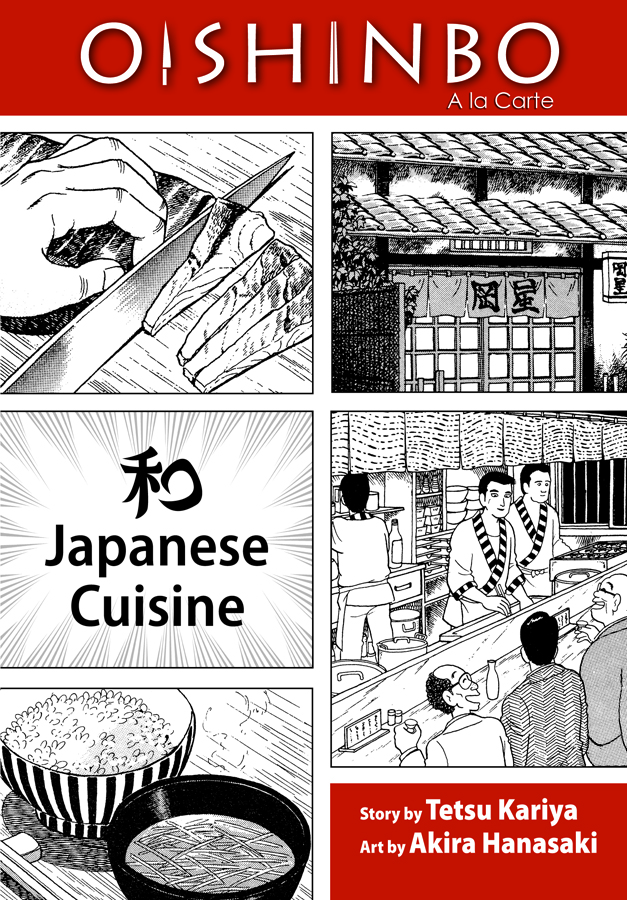
oishinbo1_coverAsh: I love food and I love manga, and so when the two come together in the same work I’m always going to check it out. More often than not, I end up enjoying it, too. My first food manga was Oishinbo: A la Carte, and it remains one of my favorite food series. With its food and family drama, Oishinbo is both informational and highly entertaining. Occasionally it can be controversial as well. Despite being a best-selling food manga in Japan, back in May publication of the series was suspended after its depiction of health issues in the Fukushima area. The series can be very opinionated, and at times those opinions aren’t widely held or popular. Another example is the support shown in favor of whaling. But I appreciate a work that can take a strong stance; even if I don’t necessarily agree with it I usually learn something by reading it.

Currently my go-to food manga is What Did You Eat Yesterday? Granted, it’s not just the food that particularly appeals to me about the series; I also welcome its realistic portrayal of gay life in contemporary Japan. Food frequently has an important role to play in Fumi Yoshinaga’s manga, as can be seen in Antique Bakery and Not Love But Delicious Foods among others, but What Did You Eat Yesterday? takes it to a whole new level. I know plenty of readers who don’t really enjoy the detailed food preparation and recipes found in the manga, but I’m one of those people who can happily watch cooking and food shows for hours at a time (if I actually had the time, that is) so it doesn’t bother me at all. And I especially like how the creation of a dish is shown to be a method of personal expression and communication.

What Did You Eat Yesterday 5MJ: I’ll pipe up here to add myself to the list of folks who are rabidly consuming What Did You Eat Yesterday? There’s pretty much nothing I love more than the combination of Fumi Yoshinaga and food. As a food-lover who does not cook, I suppose I especially appreciate the fact that even food-preparation serves to move the story along in a Yoshinaga manga, so I’m never left to face my inadequacies in the kitchen alone; there’s always a little bit of human drama to keep me company. Actually, I think that’s a significant part of what always drew me to CLAMP’s xxxHolic as well. It’s not a food manga by any means, but there’s an enormous amount of food and food-preparation involved in the story. These things are inextricable from the character’s lives.

Brigid: Michelle, I’m right there with you on Food Wars. It’s so over the top that it’s hard to take seriously, and it must be said that the delicious food has the same effect on guys as on girls, although somehow it’s funnier with the guys. Anyway, it’s one of those manga I enjoy in spite of my better judgment. And the food is interesting.

I’m going to toss out a few more titles to get your reactions: Back when it first came out, I read the first couple of volumes of Yakitate!! Japan, a shonen manga about a guy who wants to create the national bread of Japan—it’s funny because Japan is a rice culture, not a bread culture—and it was sort of interesting how he had these bread-baking beatdowns with other would-be bakers. Then there’s Kitchen Princess, a super-shoujo drama about a good-hearted orphan girl, Najika, who has perfect taste, the way some people have perfect pitch, and can make really delicious, classic dishes out of cheap ingredients. This story is very much about the emotional side of food, as it’s basically a soap opera in which all problems are solved by Najika’s cooking. I also really like Toriko, the story of gourmet hunters in search of the world’s rarest and most elusive foods, just because the plants and animals the author comes up with are so imaginative. And finally, an oldie but a goodie, Iron Wok Jan, sort of a manga version of Iron Chef that’s set in a Chinese restaurant. Does anyone have any thoughts on these, or am I the only one who read them?

Michelle: I have the complete runs of Kitchen Princess and Yakitate!! Japan, but haven’t read them. I did, however, watch a few episodes of the latter’s anime and what I remember also kind of reminds me of Food Wars, in that it’s a big sports manga-ish (maybe what I really mean here is simply that it’s thoroughly shounen) and there are over-the-top reactions to food, though not so much fanservicey as wacky. Like Drops of God or something. :) I definitely intend to read both series one of these days.
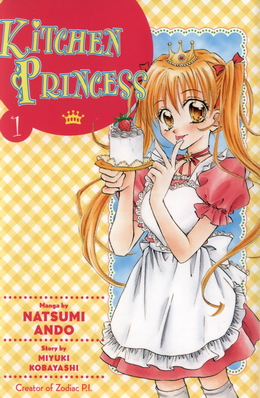
Kitchen_Princess_vol01Ash: Yakitate!! Japan is a series I’ve been meaning to read, but haven’t quite got around to yet. Kitchen Princess, on the other hand, I have read. It’s deliciously melodramatic, and the food is tasty, too! I’ve actually seen more of the Toriko anime than I’ve read of the manga, but I do enjoy the series. It’s a lot of fun. As you mentioned, Brigid, the flora and fauna are incredibly imaginative. The gourmet hunters and their prey are both fantastically over-the-top. And I really like Toriko himself—he’s a powerful and skilled fighter, but he also has a respect for life and a childlike delight in food. It’s been a while since I’ve read Iron Wok Jan (it was one of my very first food manga), but I do remember some pretty epic and intense battles in that series, too!

Anna: I enjoyed the first few volumes of Yakitate!! Japan, mostly due to the horrible puns and the baking competitions. Iron Wok Jan I read several volumes of many years ago, and it had a bit of a fiercer edge to the cooking competitions, just because the main character was so intense. There was a little less humor and more over the top cooking aggression from what I remember from that series. I read most of Kitchen Princess, and I enjoyed being able to read a foodie manga in a shoujo setting, because it seems like more often when food manga comes out here, it comes with an Iron Chef-like series of shonen competitions.

I have to say that for food manga now I do prefer the works of Fumi Yoshinaga, just because her enthusiasm for food is so genuine it ends up getting reflected so well in the way her characters react to their meals. I’m a little less than enthused about Food Wars due to the fanservice, but there still is something entertaining about the combination of cooking mastery and an elite school for young chefs.

I do also enjoy food manga that are a bit more didactic or instructive in addition to the variations of battle manga. I was really glad to have the chance to read some translations of Ekiben Hitoritabi when JManga was up and running. I’ve also enjoyed a few volumes of Drops of God and Oishinbo.

Sean: I enjoy a lot of food manga, but not necessarily for the food—I’m honestly a McNuggets kind of guy. I like how it shows that anything can be adapted to fit the manga style. The titles like Food Wars and Yakitate Japan all are very much shonen fighting/training/making friends series, just about food.

Most of the seinen food manga we’ve seen consist of “talk about food preparation/eat food/exult about how delicious food is”, with close ups of amazed faces. Though Yoshinaga’s What Did You Eat Yesterday? at least does have characters, much as I don’t care for Shiro. With Oishinbo, characterization was so irrelevant that Viz could simply release seven omnibuses from all over the spectrum, with Kurita going from vaguely attracted to Yamaoka to already having kids and back depending on the food “theme.” (Also, lots of Shiros in food manga.)

As for series like Mixed Vegetables and Kitchen Princess, the food is a vital ingredient, but it isn’t the plot, like with Food Wars or What Did You Eat Yesterday? The standard shoujo romance and high school traumas take the front seat, though food may be used to advance those plots.

And josei, well, that’s Yoshinaga as well, right? Not Love But Delicious Foods?

Michelle: Oh, Ekiben Hitoritabi! I forgot about that one, but I also really liked it. Too, JManga had Gokudou Meshi, in which a bunch of prisoners had a yearly tradition of telling each other about delicious food they had eaten. I’m sad I won’t get to read more of either of those.

Kate: I’m glad to see that I’m not the only one mourning the demise of JManga–that was my go-to source for off-beat food manga! I was a big fan of both Ekiben Hitoritabi and Gokudou Meshi, in part because neither had fanservice, over-the-top battle sequences, or idiot savants whose one great gift was making awesome cakes. Of the two, I had a slight preference for Gokudou, as the script was a deft blend of slapstick comedy and culinary shop-talk, with characters waxing poetic about their last meal “on the outside,” or favorite comfort food. Ekiben unfolded at a more leisurely pace that, at times, bordered on snoozy; how much is there to say about the food at train stations? Still, Ekiben captured the feeling of train travel, and made me sad that the food options at Penn Station are so abysmal.
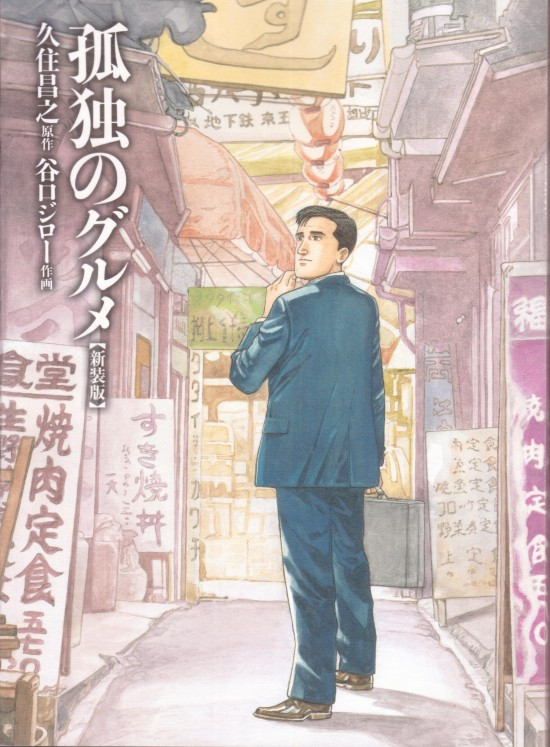
gourmetAnother JManga title that I loved was Kodoko no Gourmet, quite possibly the least manly-man title ever illustrated by Jiro Taniguchi. Its hero, Goro Inoshigara, is a traveling salesman who spends most of his time checking out new restaurants in each city he visits. (If he actually transacts any business during the course of the series, I missed it.) Each chapter is just a few pages long, but gives us a window into a variety of different types of restaurants, from mom-and-pop noodle joints to upscale bistros. Taniguchi does a terrific job of conveying the atmosphere of each place that Goro visits–something that frequently gets overlooked in competition-oriented food manga, where the tastiness of the food trumps all other considerations.

I’d also like to join the chorus of folks praising Fumi Yoshinaga. Though I share Sean’s opinion of What Did You Eat Yesterday?, I adored Not Love But Delicious Foods. The story consists of fifteen vignettes, each centered around a particular eatery: a Korean restaurant, a French bistro, a bagel bakery. (Call me a recovering New Yorker, but I hate to think of what passes for a decent bagel in Tokyo.) The meals are an important ingredient in every story, but it’s the conversation that really pops; Yoshinaga does a great job of demonstrating the power of wine and food in bringing people together, smoothing over disagreements, and giving people license to break taboos.

Still hungry? Back in 2012, Khursten Santos hosted a Manga Moveable Feast devoted to food manga; click here to view the entire archive.


Filed Under: MANGABLOG

Manga Giveaway: Seven Seas Sampler

November 26, 2014 by Ash Brown

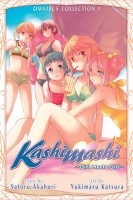
The end of the month draws near, so it’s once again time for another manga giveaway at Experiments in Manga! As is tradition, November’s giveaway features multiple volumes. This month you will all have a chance to win a sampling of some of Seven Sea’s manga releases, both old and new: A Centaur’s Life, Volume 1 by Kei Murayama; Dictatorial Grimoire, Volume 1: Cinderella by Ayumi Kanou; Gakuen Polizi, Volume 1 by Milk Morinaga; and Kashimashi: Girl Meets Girl, Omnibus 1 written by Satoru Akahori and illustrated by Yukimaru Katsura. And as always, the giveaway is open worldwide!

A Centaur's Life, Volume 1Dictatorial Grimoire, Volume 1: CinderellaGakuen Polizi, Volume 1Kashimashi: Girl Meets Girl, Omnibus 1

It used to be that I didn’t pay much attention to Seven Seas. It had a smallish catalog and I wasn’t particularly interested in most of the series it was publishing at the time. But with the success of Monster Musume and the various Alice series, Seven Seas has really taken off in recent years. And increased sales mean even more manga licenses. Seven Seas has been making a particular point to diversify its offerings lately. It has helped revive interest in yuri manga in English. A range of genres are being released, including slice-of-life, comedy, fantasy, horror, mystery, and science fiction among others. There are otome manga as well as quirky shounen series.  Ecchi and fanservice manga features heavily, but there are more wholesome titles, too. Seven Seas really is trying to have a little something of everything and a little something for everyone. I might not personally be interested in every license the publisher picks up, but I do like seeing the variety of works. You’ve caught my attention, Seven Seas. Now show me what you can do.

So, you may be wondering, how can you win a Seven Seas Sampler?

1) In the comments below, tell me a little about your favorite manga released or licensed by Seven Seas if you have one. (If you don’t have a favorite or haven’t read any of Seven Seas manga, just mention that.)
2) If you’re on Twitter, you can earn a bonus entry by tweeting, or retweeting, about the contest. Make sure to include a link to this post and @PhoenixTerran (that’s me).

It’s as easy as that. Each person can earn up to two entries for this giveaway. As usual, participants will have one week to submit comments. Entries can also be sent via e-mail to phoenixterran(at)gmail(dot)com which I will then post in your name. The giveaway winner will be randomly selected and announced on December 3, 2014. Happy feasting!

VERY IMPORTANT: Include some way that I can contact you. This can be an e-mail address in the comment form, a link to your website, Twitter username, or whatever. If I can’t figure out how to get a hold of you and you win, I’ll just draw another name.

Contest winner announced–Manga Giveaway: Seven Seas Sampler Winner

Filed Under: FEATURES Tagged With: Ayumi Kanou, Centaur's Life, Dictatorial Grimoire, Gakuen Polizi, Kashimashi, Kei Murayama, manga, milk morinaga, Satoru Akahori, Yukimaru Katsura

Gou-dere Sora Nagihara, Vol. 1

November 25, 2014 by Sean Gaffney

By Suu Minazuki. Released in Japan as “Gou-dere Bishoujo Sora Nagihara” by Hakusensha, serialized in various Young Animal spinoffs. Released in North America by Yen Press.

I tend to try to read a lot of Volume 1s that are released by manga companies, even if the premise makes me sort of rear back a bit. Sometimes I find I’m pleasantly surprised, such as, say, Haganai. Sometimes I can’t quite make it through the volume, as happened with Monster Musume. And then there’s this title, where I made it through the volume out of sheer morbid fascination at how appalling it was going to get, and whether it could keep up its pace of sexual assault jokes with no breathing space. Unfortunately, the answer is “not really”, but it made a valiant effort, at least.

gou-dere1

The creator is better known over here for a series called Sora no Otoshimono, and I’ve no doubt fans would rather be seeing that series, but it’s 20 volumes, while this is four. This particular series revolves around a young nebbish man who spends most of his life being sexually attracted to the girls in his bishoujo magazines, particularly the star of Tama x Kiss (a thinly veiled parody of Kimi x Kiss and all those other ecchi visual novels), Sora Nagihara. Then suddenly, for reasons that are still not particularly clear, Sora comes out of the magazine and appears in his lap. Only this is not the cute, shy, soon to die heroine he’s familiar with. She’s a Gou-dere, which I think is a tsundere-esque word that means she’s crude and appalling (with a hidden depressive side, which we see towards the end of this volume). She desires to have her new “master” rule the world by sleeping with every girl around him.

And here’s where the part of this book that’s an over the top parody and satire comes in, as she proceeds to kidnap, strip, and sexually assault young women for her so-called master (who then gets the blame, arrested, and beaten half to death by the police officers in town). The assault *is* the point of the manga – the heroine is constantly carrying around little packages of milk in order to allow her to create “facial’ shots as she finds a new victim. There is a childhood friend of the hero’s, naturally, who is appalled at what’s happening but mostly just yells and screams at the hero to stop Sora. The other girl on the cover is the president of the boxing club, who is assigned to destroy our hero (he has a name, but makes so little an impression I feel reluctant to use it), and who Sora ends up magically giving huge breasts, because of course she does.

As I said, the key here is over the top. This is not particularly meant to be titillating, it’s meant to make your jaw drop. When it’s at its most appalling, I admit I had to admire its sheer effort. Unfortunately, it also tries to have a typical harem plot while also parodying it, and that’s a high wire act it can’t quite achieve. I don’t buy that all these girls are in love with this guy for any reason other than “the plot says so.” There’s also a hint towards the end that even Sora herself may have a more serious storyline in her, and I don’t really want serious stories in this series. It makes the service harder to take.

If you’re a young man, and want to see what a parody of the typical “ecchi Japanese harem” series is like (and most North American examples we’ve seen over here are far less explicit than this), then you may want to pick this up. For people who really like fanservice no matter what, definitely pick this up. For everyone else… I don’t think the parody is good enough to justify buying it.

Filed Under: REVIEWS

DMP Kickstarter Fails, Yen Confirms New Licenses

November 24, 2014 by Brigid Alverson

Johanna Draper Carlson has some commentary on Digital Manga’s Tezuka World Kickstarter, which failed to reach its goal last week. Lori Henderson shares her thoughts as well at Manga Xanadu.

Some sharp-eyed folks spotted a couple of unannounced manga on Amazon, and Yen Press confirmed it: They will publish Sword Art Online: Girls Ops in May and Puella Magi Madoka Magica: The Rebellion Story in June. They also announced that they will publish Tomoco Kanemaki’s Kingdom Hearts light novel series in a single volume.

What’s good this week? The Manga Bookshelf bloggers have some recommendations.

Lori Henderson rounds up the Viz and New York Times best-sellers in one handy post.

Erica Friedman looks at the latest issue of Eureka Magazine, which focuses on “The Current State of Yuri Culture,” and she updates us on just that with the latest edition of Yuri Network News.

Help Ash Brown decide what series to write about next at Experiments in Manga.

Neon Genesis Evangelion: The Shinji Ikari Raising Project will end this summer.

News from Japan: Matsuri Hino wrapped up Vampire Knight a little while ago, but now she’s back with a new chapter that will run in the March issue of LaLaDX. Shueisha’s Miracle Jump magazine announced that there are now 4.5 million volumes of One Punch Man out there. Crunchyroll has a preview of Peach-Pit’s first shonen manga, Wandering Wonder World, which will debut in the January issue of Shonen Ace. Kaiji Kawaguchi (Zipang, Eagle) will launch a new series, Kūbo Ibuki (Aircraft Carrier Ibuki), in Big Comic Magazine in December.

Reviews: Streamline your reading by checking out this week’s Bookshelf Briefs at Manga Bookshelf. Ash Brown has more short takes and a roundup of a week’s worth of manga reading.

Lori Henderson on Another (Manga Xanadu)
Sarah on vol. 18 of Black Butler (nagareboshi reviews)
Anna N on vol. 2 of Black Rose Alice (Manga Report)
Erica Friedman on vol. 2 of Bousou Girlsteki Mousou Renaiteki Suteki Project (Okazu)
Kory Cerjak on vol. 5 of Deadman Wonderland (The Fandom Post)
Damion Julien-Rohman on Gangsta (The State Press)
Sean Gaffney on vol. 26 of Higurashi: When They Cry (A Case Suitable for Treatment)
Matthew Warner on vol. 5 of Inu x Boku (The Fandom Post)
Matthew Warner on vol. 4 of Kingdom Hearts 358/2 Days (The Fandom Post)
Steve Bennett on vol. 1 of LBX: New Dawn Raisers (ICv2)
Kate O’Neil on vol. 17 of Natsume’s Book of Friends (The Fandom Post)
Lesley Aeschliman on vol. 25 of Pokemon Adventures (Lesley’s Musings on Manga)
Leroy Douresseaux on vol. 1 of Resident Evil: The Marhawa Desire (I Reads You)
Leroy Douresseaux on vol. 17 of Tegami Bachi: Letter Bee (The Comic Book Bin)
Ash Brown on vol. 5 of Vinland Saga (Experiments in Manga)
Leroy Douresseaux on vol. 7 of Voice Over (The Comic Book Bin)

Filed Under: MANGABLOG

Black Rose Alice Vol 2

November 24, 2014 by Anna N

Black Rose Alice Volume 2 by Setona Mizushiro

If you had asked me where Black Rose Alice was headed after reading the first volume, I would not have replied “slice of life reverse harem story about vampires running a cafe” and yet that was what ended up happening in the second volume. I thought that after establishing Dimitri’s past and the troubled present lives of the teacher Azusa and her doomed relationship with her student Koya, I was expecting a bit more fallout after Azusa agreed to trade her soul to Dimitri in exchange for Koya’s life. There are a few hints of Azusa’s past feelings in the second volume, but the bulk of the story is spent establishing her new existence inhabiting Agnieszka’s body and what exactly happens when she wakes up as the object of affection for four vampires that all want to continue their species. Azusa takes on the name Alice in her new incarnation.

Dimitri has surrounded himself with vampire companions. There’s the twins Reiji and Kai, who are a bit young (for vampires) and naive. Leo, who is more sophisticated dedicates himself to waging a calculated campaign for Alice’s affections. In an interesting twist on the reverse harem scenario, Alice is going to be the only way for the young vampires to extend the life of their line, but it is up to her to make a choice about who she wants to end up with. Dimitri is determined to hold himself aloof from the new soul inhabiting Agnieeszka’s body, but he finds himself drawn to Alice despite himself.

While the first volume had more of a tumult of emotions, this second volume was much more even in tone and had some vampire-centric slice of life moments as Alice slowly gets used to her new identity. Alice has an imperious streak that comes out from her former habits of managing a classroom. There are still a few moments of the surreal body horror that made the first volume more distinctive, but not nearly as many random tarantulas spewing from a given vampire’s mouth. It isn’t often that I put down the second volume of manga feeling genuinely surprised about the direction and tone, but I finished up this volume feeling more intrigued than I did after reading the first. This series seems to be shaping up to be quite quirky and unique, which is just the type of thing that I’m currently most interested in reading.

Filed Under: REVIEWS Tagged With: Black Rose Alice, shojo beat, shoujo, VIZ

Bookshelf Briefs 11/24/14

November 24, 2014 by Sean Gaffney and Michelle Smith Leave a Comment

This week, Sean and Michelle look at recent releases from Viz Media and Kodansha Comics.

blexorcist12Blue Exorcist, Vol. 12 | By Kazue Kato | Viz Media – This volume essentially has two functions, both of which it performs very well. It gives some backstory and depth to Izumo, who has had a lot to do but whose past has been unclear to us. We get a big flashback here, and no surprises: her past was horrible. Now she’s been captured by the latest big villains, which include a surprising member. This betrayal comes as something of a surprise, and there’s no real sense yet that it’s for show and said person will really turn good later, so you can sympathize with everyone’s frustration. We also briefly see Lucifer, who makes a big impression by being able to terrify even Mephisto. Blue Exorcist continues to be one of the jewels in Viz’s shonen crown.-Sean Gaffney

cageofeden16Cage of Eden, Vol. 16 | By Yoshinobu Yamada | Kodansha Comics – I’ve always sort of sighed and shook my head at this series’ fanservice, but the cover of this volume actually caused me to let out an annoyed grunt. Women tied up and in peril while our heroes stand shocked and the villain sneers. Must we? Luckily, the content continues to be better once you get past this, as we continue to fight the evil doctor and discover more about the island – it’s seemingly near Japan, and the prehistoric animals we’ve seen (remember them?) all may have actually been part of a giant experiment. That said, we haven’t had a main cast death in a while, and it’s worrying. Is Kurusu-sensei the next one to go? Or will they be able to defeat their tormentor once more? Soap opera fun with much service.-Sean Gaffney

nisekoi6Nisekoi: False Love, Vol. 6 | By Naoshi Komi | Viz Media – Harem manga that are as balanced as this one are something of a rarity. While you get the vague sense that Chitoge will wind up the winner simply due to narrative structure and Japan’s love of tsunderes, it’s not obvious every single chapter like it is in many other series such as Love Hina. Chitoge may get to play Juliet in the end, but it’s Onodera who gets the bit rooftop romantic scene at the end. Speaking of Chitoge, her realization that she loves Raku leads to their biggest fight, as he hasn’t realized much of anything, so can’t understand why his words are hurting her. There’s nothing new and unique here, but it’s well-written and makes you like everyone, which is always nice to see in a romantic comedy like this. – Sean Gaffney

oresama17Oresama Teacher, Vol. 17 | By Izumi Tsubaki | Viz Media – The last few volumes of Oresama Teacher have been consistently good—maybe it’s time to officially come down in favor of the series. In volume seventeen, Yui has been blackmailing members of the Public Morals Club in order to get them to quit, and eventually realizes he’s been using Miyabi’s orders as an excuse not to have to think for himself. Honestly, it was predictable that Yui would repent and seek to rejoin his friends in the club, but that didn’t make it any less satisfying. Plus, there was pigeon symbolism! Too, I like that Miyabi seems to actively be trying to help the members of the student council change. Could he actually be a decent person? His cryptic warning about Hayasaka is pretty durn intriguing, too. Translation: bring on volume eighteen! – Michelle Smith

rin-ne16Rin-Ne, Vol. 16 | By Rumiko Takahashi | Viz Media – As Rin-Ne heads towards its anime, which is finally happening sometime next year, the plot seems to be moving slower than ever. Is there even a plot? Most of the volumes have included something that advances plot and characterization even if it’s only in a token way, but this one consists entirely of unconnected one-shots. They’re well-written – Takahashi may be trying to be a hack here, but she can’t quite pull it off – and I enjoyed the humor, but it’s telling that this review sounds exactly the same as the last 10 reviews of Rin-Ne I’ve written. At least the anime won’t have to worry too much about ending differently than the canon – judging by this volume, any resolution is a long way away. – Sean Gaffney

spell2Spell of Desire, Vol. 2 | By Tomu Ohmi | Viz Media – I ended up liking the first volume of Spell of Desire more than I expected, and it’s probably because of that that I ended up being disappointed by volume two. There’s just not a lot of plot here, until the very end when Kaoruko and Kaname are summoned before the black witches coven. Before that, it’s pages upon pages of Kaoruko reflecting rhapsodically—usually with teary, heavy-lidded eyes—upon Kaname’s kisses and trying to convince herself that what she feels for him is due to the magic power compelling her to reciprocate. When she finally admits to herself that she loves him, it’s a relief rather than any sort of revelation. I suppose something more interesting could happen in the next volume, but now I really wouldn’t bet on it. At least this series is only five volumes long. – Michelle Smith

uq3UQ Holder, Vol. 3 | By Ken Akamatsu | Kodansha Comics -Akamatsu may begun this sequel to Negima by telling fans most of the girls they loved were dead, but that doesn’t mean he’s totally moving on. His grandson here shows off his new use of Magia Erebea, Negi’s signature powers, and though he has no idea what they are he can use them instinctively. Meanwhile, one of the villains turns out to be a frustrated idealist who found he couldn’t compete with the ungodly powers of Negi’s generation – watch for silhouettes, fans of Zazie, Mana and Chachamaru. That said, this is still Tota’s story, and he gets to show off, while Kuromaru continues to wrestle with gender issues and Karin faces a villain who can be very clever about getting rid of her. Good action shonen. – Sean Gaffney

Filed Under: Bookshelf Briefs

Pick of the Week: Opus & More

November 24, 2014 by MJ, Ash Brown and Sean Gaffney 1 Comment

potwMJ: My pick this week is probably pretty obvious, but I’ll put it out there anyway. Not only was I a well-documented fan of CLAMP’s xxxHolic, but I was also one of the few people who did not hate the end of the series. That xxxHolic: Rei seems to be starting off as though much of that ending didn’t happen, I admit I’m kind of hoping it’s got a lot more up its sleeve, and I’m willing to wait to find out. Meanwhile, I’m enjoying the continuing adventures of the series’ original cast. So, yeah. I’ll be buying up the second volume with no hesitation whatsoever. Bring it on.

ASH: Even though it’s a smaller shipping list this week, there are still quite a few manga in which I’m interested. But, there’s only one that stands out for me as an immediate must-buy and that’s Satoshi Kon’s Opus. I’m very happy that his works are being released in English. I enjoyed Tropic of the Sea and am looking forward to reading more of his manga a great deal.

SEAN: The obvious choice would be Opus, but Ash already got that, so instead I will go with the final Neon Genesis Evangelion volume (available 11/25). I’ve been reading this series since Viz was putting it out in flipped 32-page comic books, and am ready to see if the ending will keep the main themes but avoid some of the depressing nihilism of the TV series.

What looks good to you this week?

Filed Under: PICK OF THE WEEK

My Week in Manga: November 17-November 23, 2014

November 23, 2014 by Ash Brown

My News and Reviews

Two reviews were posted last week at Experiments in Manga, and a little something else as well! The first review was for the second part of Boogiepop Returns: VS Imaginator, the third volume in Kouhei Kadono’s Boogiepop light novel series. Boogiepop is a rather peculiar series, but I’ve really been enjoying it. And speaking of series that I enjoy, I also reviewed the fifth omnibus of Vinland Saga by Makoto Yukimura. Vinland Saga is an epic work of historical fiction, and one of my favorite manga series currently being released in English. And, as promised, last week I also posted a poll so that readers of Experiments in Manga can help pick my next monthly manga review project. I’ve narrowed the choices down to five horror manga options, and now it’s up to you to vote. The poll will be open through the end of November.

A few things of note that I encountered online last week: It was brought to my attention that Akino Kondoh’s collection Nothing Whatsoever All Out in the Open is now available to order. Publishers Weekly has a great list of 12 Awesome Comics about Outer Space compiled by Matt White which includes Makoto Yukimura’s Planetes, Chūya Koyama’s Space Brothers, and Yukinobu Hoshino’s 2001 Nights, which are all excellent choices. Finally, Johanna Draper Carlson has a nice recap of the recent Digtial Manga Tezuka Kickstarter debacle/failure over at Manga Worth Reading.

Quick Takes

Angel Sanctuary, Volume 6Angel Sanctuary, Volumes 6-10 by Kaori Yuki. Halfway through the series, and I still find Angel Sanctuary a bit frustrating and confusing. It’s difficult to follow because there is so much going and and there are so many characters, with even more being introduced in these volumes Angel Sanctuary is incredibly ambitious, but I’m afraid that Yuki has bitten off too much to chew; the series would be stronger with a little more focus. Even though it seems like Yuki is making things up as she goes along, her author’s notes would seem to indicate that she actually does have a plan and even the major plot twists were developed well in advance. To the reader, though, it feels like they come out of nowhere. If anything, it should be very clear by this point in the series that you really can’t trust any of the characters. They all have their own ambitions and motivations, so it’s almost impossible for any of them to be considered allies for a long period of time. I can’t deny that Angel Sanctuary is extraordinarily dramatic, and a string of betrayals continues to up the stakes. And even though the story is all over the place, I do still really enjoy Yuki’s gothic artwork.

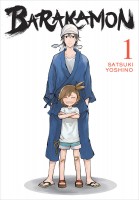
Barakamon, Volume 1Barakamon, Volume 1 by Satsuki Yoshino. Seishuu Handa is a young, award-winning calligrapher who, after handling a critique of his work quite poorly, has been encouraged by his father to at least temporarily retire to the remote Gotō Island. Thus begins Barakamon, a fairly low-key comedy that’s part slice of life and part gag manga. Much of the humor either revolves around Seishuu, a city boy, being so out-of-place in the countryside, or Naru, a young, energetic troublemaker who’s grown rather attached to “Sensei.” Though generally amusing, Barakamon is never quite as funny as I actually want it to be. I’ll admit though, since I grew up in a rural village myself, I couldn’t help but feel a little bit satisfied when Seishuu gets shown up by the island’s residents, especially because he thinks so little of them to begin with. I can appreciate Seishuu’s struggles as an artist, too, though I can’t say that I like him very much as a person, yet. But, I suspect that’s what Barakamon is in part about–Seishuu becoming a better person after some much-needed self-reflection. While no means exceptional in art or story, I did largely enjoy the first volume of Barakamon and plan on continuing the series for a least another few volumes.

Smut Peddler 2014Smut Peddler 2014 by Various. After being revived in 2012, Smut Peddler is back again in 2014 with a second collection of short, erotic comics. Some of the contributors are new to Smut Peddler while others are returning to the series. Smut Peddler 2014 includes twenty-five comics from thirty-two artists and writers. Although some of the individual comics are phenomenal, overall I think the first collection is the stronger of the two. Even so, Smut Peddler remains one of the best series for diverse, sex-positive, lady-friendly, queer-friendly, kink-friendly erotic comics. There’s straight sex, and queer sex. There’s modest sex and flamboyant sex. Sweet sex and spicy sex. Sex with humor and sex with solemnity. And there’s everything in between, too. With the inclusion of a few science fiction and fantasy tales, there’s also alien and inter-species sex, which is always fun. I was particularly pleased to see how many transgender and/or nonbinary narratives were included in the 2014 edition of Smut Peddler. The sheer variety of genres, styles, characters, and stories found in Smut Peddler is one of the highlights of the series. The fact that the creators are just as diverse as their comics makes it even better.

Filed Under: FEATURES, My Week in Manga Tagged With: angel sanctuary, Barakamon, comics, Kaori Yuki, manga, Satsuki Yoshino, Smut Peddler

Higurashi: When They Cry, Vol. 26

November 23, 2014 by Sean Gaffney

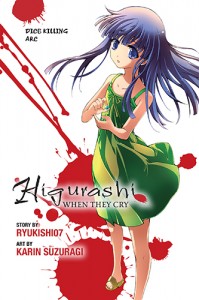
Story by Ryukishi07; Art by Karin Suzuragi. Released in Japan as “Higurashi no Naku Koro ni: Saikoroshi-hen” by Square Enix, serialized in the magazine Gangan Joker. Released in North America by Yen Press.

As the readers of Higurashi plowed their way through the series, they gradually began to notice that the protagonist was changing before their eyes. At the start, this looked like a typical datesim variant, albeit a dark one, and therefore Keiichi Maebara was clearly the hero. After all, in the visual novels he didn’t even have a sprite. But as we got deeper into the plot, we realized who was really the driving forced behind this: Rika Furude, the young shrine maiden who was the only person who could remember all the past worlds. Indeed, she seemed at times to be much older than her unstated tween age, having lived her life till getting killed June 1983 over and over again. The main series, being more concerned with figuring out why this was happening and how to stop it, rarely stopped to consider the psychological implications of this. This epilogue, the “Dice-Killing Arc”, is here to do that.

higurashi26

The basic premise is simple enough: Rika, who is no longer threatened by impending death, becomes too careless when biking down a seldom-used hill and is struck by a truck. She wakes up in a world unlike all the others she’d been reliving over and over again. Keiichi isn’t here, Satoshi is alive, and so are her parents. In this new world, all the horrible things that happened in everyone’s pasts seem to have been avoided. It’s a “sinless world”… but is there a place for Rika in it? Can she return to the Higurashi world we know and love? And who is Rika Furude anyway?

As Ryukishi07 wrote this, he was also writing and planning his next series, Umineko: When They Cry, so it’s unsurprising that elements of that are seen in this. Most obvious is Rika feeling disassociated with her child self – she’s lived so many lives by now that she doesn’t feel like Rika Furude anymore, and when she makes the transition into this world she feels like she’s possessed the real Rika Furude. In a drunken stupor (we’ve seen Rika dilute wine and get drunk on it before, and she does here as well – be warned) she stares at the label on her father’s wine bottle and declares that her alternate self is actually Frederica Bernkastel.

As if this wasn’t disturbing enough, Rika’s mental state really takes a nosedive in this world. Satoko supposedly hates her and the others are mostly indifferent to her. Her parents are alive, but this doesn’t cheer her up – she simply regards them as nuisances. It all comes to a head when she’s sitting in class trying to work out how to return to her own world and Satoko decides to bully her a little too much – she snaps and punched Satoko, then starts to beat her over and over with a chair. “Fans” of Higurashi who saw this in the anime tended to be a little too happy over this scene, feeling Satoko “got what she deserved”. First of all, if you feel anyone in Higurashi gets what they deserved, stop following the series. Secondly, this scene is meant to be HORRIBLE. It’s preceded by a scene where Hanyuu (communicating with Rika via a relic) states that she may have to kill someone to get back to her world, and Rika hopes it’s her parents, as she has no attachment to them. It’s truly chilling.

What ends up happening, thankfully, is that Rika slowly understands this isn’t just her correct world and a “wrong” world, but two unique worlds with their own virtues. She starts to rebuild a relationship with her mother, who had always been upset at Rika seemingly knowing how to do things (due to the loops) and showing little affection; Rika also tries to remember what being a child who loves her parents was like in the first place. Likewise, Satoshi, Reina and the others help her to realize she can forge new bonds here, and maybe try to be friends with Satoko again. In the end, Rika makes the decision to stay in this world and not kill her mother…

A decision that turns out to perhaps be irrelevant, as she wakes up (after being in a coma for a month) back in the Higurashi world we know and love, with everything seemingly having been a “dream”. This ending is somewhat debated in Higurashi fandom, mostly as it’s implied it was a dream Hanyuu deliberately forced on Rika in order to get her to properly remember and grieve for her parents (and also possibly remind her not to bike into traffic). This would probably read better if Hanyuu had been better characterized throughout the series – we’re not even sure why she’s incorporeal again.

So not without its faults – there’s also a long expodump between Reina (who kept the i in this world) and Rika explaining the differences that’s almost painful – but it’s a story I’m happy we got, as it reminds us that even if there is a happy ending for everyone, lives still go on, and Rika has to make the decision to go forward at last, and not let herself be bound by her repeated loops and assumptions. I’m not sure if we’ll see more Higurashi manga after this (Daybreak and Bus Stop are still out there if Yen is interested), but as epilogues go, this is a fitting ending for the series.

Filed Under: REVIEWS

Vinland Saga, Vol. 5

November 22, 2014 by Ash Brown

Vinland Saga, Omnibus 5Creator: Makoto Yukimura
U.S. publisher: Kodansha
ISBN: 9781612624242
Released: October 2014
Original release: 2010-2011
Awards: Japan Media Arts Award, Kodansha Manga Award

Makoto Yukimura’s award-winning manga Vinland Saga, an epic and thoroughly researched work of historical fiction, has quickly become one of my favorite series currently being released in English. I was very happy when Kodansha Comics initially licensed Vinland Saga, but with each new volume that is published my excitement increases. The English-language edition of Vinland Saga is being printed as a series of hardcover omnibuses, each containing two volumes of the manga as originally released in Japan. The fifth omnibus, published by Kodansha in 2014, collects the ninth and tenth volumes of the Japanese edition of the series which were published in 2010 and 2011 respectively. It also includes a section of questions and answers exclusive to the English-language edition in which Yukimura discusses some of the inspirations for and creative processes behind Vinland Saga. I already enjoy Vinland Saga immensely, but greatly appreciate of this sort of bonus material.

Ever since his father was killed in front of his eyes, Thorfinn has devoted his life to one thing–seeking revenge against Askeladd, the man he holds responsible for his father’s death. But when Askeladd takes King Sweyn’s head and doesn’t survive the resulting skirmish, suddenly Thorfinn is left directionless and without purpose. Despondent and empty, he ends up a slave on an expansive wheat farm in Denmark. There he really only goes through the motions of living, suffering silently under the humiliation, discrimination, and torment inflicted by the farm hands and hired guards. It’s not until Einar arrives at the farm that Thorfinn is slowly drawn out of his despondency. Of the two, Einar is much more lively and still chafes at his enslavement. And, unlike Thorfinn, he actually knows a thing or two about farming. As difficult as it will be to achieve, those are skills that could conceivably help them earn back their freedom.

The amount of research and historic detail that Yukimura has put into both the artwork and the narrative of Vinland Saga has always been impressive, and that hasn’t changed with the fifth omnibus. Vinland Saga incorporates the politics and social structures of the time period directly into the story in a very engaging way, making them critical issues that the characters must deal with and which greatly impact their lives. At this point in the series, the manga has largely moved from the battlefield to the wheat field, but it still retains its intensity. Farming, like war, is also a life and death struggle which requires men and women to submit themselves to arduous and unforgiving tasks for the smallest chance of survival. The main difference is that raising crops is a creative act while battle is a destructive one. It seem appropriate then that Thorfinn’s labouring in the fields might actually help to bring him some healing, especially since in his past he was part of a force that would raze farms and villages when needed or convenient.

Much of the fifth omnibus of Vinland Saga is devoted to Thorfinn and Einar and the system of slavery that they are now a part of. A great deal of focus is given to Thorfinn and his psychological development in particular. In addition to historical accuracy, Yukimura also excels at creating realistically complex and well-defined characters in Vinland Saga who change and are affected by the events around them. And in some cases, they are the ones to bring great change to the world in which they exist. One of the characters that has transformed the most is Canute, the younger son of King Sweyn. Out of the entire omnibus, only two chapters show what has become of him, but they leave a tremendous impact. Once a seemingly weak and timid young man he has shown incredible fortitude and strength. Where Thorfinn has lost his purpose, Canute has found his. Canute’s ambitions and his willingness to do anything it takes to forge his kingdom will have far-reaching implications.

Filed Under: REVIEWS Tagged With: Japan Media Arts Award, kodansha, Kodansha Comics, Kodansha Manga Award, Makoto Yukimura, manga, Vinland Saga

  • « Go to Previous Page
  • Page 1
  • Interim pages omitted …
  • Page 574
  • Page 575
  • Page 576
  • Page 577
  • Page 578
  • Interim pages omitted …
  • Page 1048
  • Go to Next Page »
 | Log in
Copyright © 2010 Manga Bookshelf | Powered by WordPress & the Genesis Framework