• Skip to primary navigation
  • Skip to main content
  • Skip to primary sidebar
  • Home
  • About Us
    • Privacy Policy
    • Comment Policy
    • Disclosures & Disclaimers
  • Resources
    • Links, Essays & Articles
    • Fandomology!
    • CLAMP Directory
    • BlogRoll
  • Features & Columns
    • 3 Things Thursday
    • Adventures in the Key of Shoujo
    • Bit & Blips (game reviews)
    • BL BOOKRACK
    • Bookshelf Briefs
    • Bringing the Drama
    • Comic Conversion
    • Fanservice Friday
    • Going Digital
    • It Came From the Sinosphere
    • License This!
    • Magazine no Mori
    • My Week in Manga
    • OFF THE SHELF
    • Not By Manga Alone
    • PICK OF THE WEEK
    • Subtitles & Sensibility
    • Weekly Shonen Jump Recaps
  • Manga Moveable Feast
    • MMF Full Archive
    • Yun Kouga
    • CLAMP
    • Shojo Beat
    • Osamu Tezuka
    • Sailor Moon
    • Fruits Basket
    • Takehiko Inoue
    • Wild Adapter
    • One Piece
    • After School Nightmare
    • Karakuri Odette
    • Paradise Kiss
    • The Color Trilogy
    • To Terra…
    • Sexy Voice & Robo
  • Browse by Author
    • Sean Gaffney
    • Anna Neatrour
    • Michelle Smith
    • Katherine Dacey
    • MJ
    • Brigid Alverson
    • Travis Anderson
    • Phillip Anthony
    • Derek Bown
    • Jaci Dahlvang
    • Angela Eastman
    • Erica Friedman
    • Sara K.
    • Megan Purdy
    • Emily Snodgrass
    • Nancy Thistlethwaite
    • Eva Volin
    • David Welsh
  • MB Blogs
    • A Case Suitable For Treatment
    • Experiments in Manga
    • MangaBlog
    • The Manga Critic
    • Manga Report
    • Soliloquy in Blue
    • Manga Curmudgeon (archive)

Manga Bookshelf

Discussion, Resources, Roundtables, & Reviews

Blog

Short Takes: Food Wars, Manga Dogs, and Yukarism

January 6, 2017 by Katherine Dacey

Did you receive an Amazon or RightStuf gift certificate this holiday? If so, this post is for you! Below, I’ve reviewed the first volumes of three series that debuted in 2014, offering a quick-and-dirty assessment of each. Already read Food Wars? Fear not—I’ve also tackled Manga Dogs, a comedy about a teen manga artist, and Yukarism, a time-traveling, gender-bendering manga from Chika Shiomi (Canon, Yurara).
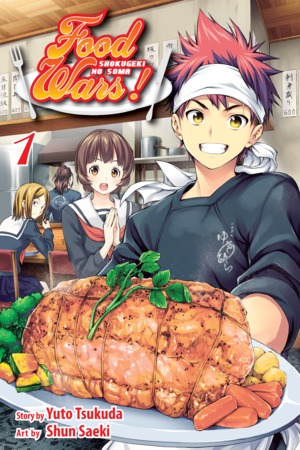
thumb-10857-FDW_01_webFood Wars, Vol. 1
Story by Yuto Tsukada, Art by Shun Saeki
Rated T+, for Older Teens
VIZ Manga, $9.99

Food Wars begins with an only-in-manga scenario: Soma Yukihira’s dad shutters the family’s greasy spoon restaurant and lights out for America, leaving his son behind. With no place to go, Soma enrolls at Totsuki Culinary Academy, a hoity-toity cooking school that prides itself on its wealthy alumnae, rigorous curriculum, and high attrition rate. Soma’s working-class background is a major handicap in this environment, but his can-do attitude and culinary instincts allow him to triumph in difficult situations, whether he’s salvaging an over-salted pot roast or wowing an unscrupulous developer with a simple potato dish.

In theory, I ought to hate Food Wars for its cartoonish characters and abundant cheesecake, two qualities I generally despise in a manga. But here’s the thing: it’s fun. Soma repeatedly shows up bullies and snobs with his ability to transform everyday dishes into haute cuisine, proving that good food doesn’t need to be fancy. Though Soma’s foes are stock types—the Busty Bitch, the Rich Mean Boy, the Teacher With Impossibly High Standards—Shun Sakei’s crisp caricatures make them seem like fresh creations. I wish I could say the same for Sakei’s abundant fanservice, which quickly wears out its welcome with porny images of women enjoying Soma’s cooking. These pin-up moments are supposed to be funny, I guess, but the heavy emphasis on heaving cleavage and bare skin seems more like a concession to teenage male taste than an organic part of the story.

The verdict: I can’t decide if Food Wars is a guilty pleasure or a hate read, but I’ve just purchased volumes 2-4.
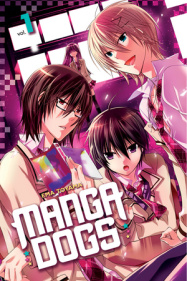
Manga Dogs 1Manga Dogs, Vol. 1
By Ema Toyama
Rated T, for Teens
Kodansha Comics, $10.99

Manga Dogs has a terrific premise: a teenage artist decides to enroll in her school’s manga program, only to discover that her teacher is inept, and her classmates are pretty-boy otakus with no skill or work ethic. When Kanna’s classmates discover that she’s actually a published artist, Fumio, Fujio, and Shota glom onto her in hopes of breaking into the business—even though her debut series is on the verge of being cancelled.

With such a ripe set-up, it’s a pity that Manga Dogs is DOA. Part of the problem is that the script panders to the reader at every turn, whether it’s poking fun at reverse-harem tropes or saddling the characters with pun-tastic names inspired by famous manga creators. The author spends too much time patting the reader on the back for “getting” the jokes and not enough time writing genuinely funny scenarios or imbuing her characters with more than one personality trait each. The other issue is pacing: the story and artwork are both frenetic, with characters screaming, jumping, and flapping their arms on almost every page. By the end of the third chapter, I felt as if someone had beaten me up for my lunch money while asking me, “Do you think I’m funny? No? Now do you think I’m funny?”

The verdict: Just say no.
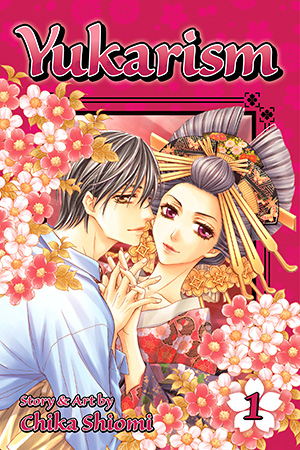
1421575906Yukarism, Vol. 1
By Chika Shiomi
Rated T, for Teen
VIZ Media, $9.99

Yukarism combines the supernatural elements of Rasetsu with the historical drama of Sakuran, then adds a dash of gender-bending weirdness for good measure. The story revolves around Yukari, a best-selling author whose novels explore the history of Edo’s red-light district. Though fans attribute the abundant details in his writing to research, Yukari has an even better strategy for learning about the past: he visits it! When he returns to the 1800s, however, Yukari becomes Yumurasaki, a top-earning oiran (or courtesan) enmeshed in a web of political intrigue, lust, and violence.

Given the complexity of the plot, it’s not surprising that the first volume of Yukarism is a bumpy ride. The tone see-saws between broad physical comedy and brooding melodrama, making it difficult to know if Yukari’s plight is being played for laughs or sniffles. The script, on the other hand, is too pointed; manga-ka Chika Shiomi is so intent on telling us what Yukari is thinking and seeing that she forgets the old dictum about showing, not telling. The same kind of editorial interventions result in at least one character waxing profusely about how handsome and cool Yukari is, just in case we haven’t realized that he’s supposed to be handsome and cool. Now that the basic parameters of the story have been established, however, Shiomi can dispense with the heavy-handed dialogue and do what she does best: write sudsy supernatural romances with beautiful characters in beautiful costumes.

The verdict: Volume two should be a pure guilty pleasure.

These reviews originally appeared at MangaBlog on January 2, 2015.

Filed Under: Classic Manga Critic, Manga, Manga Critic, REVIEWS Tagged With: Cooking and Food, kodansha, shojo, Shonen, VIZ

Assassination Classroom, Vol. 1

January 6, 2017 by Katherine Dacey

Americans steadfastly believe that all students need to succeed are a few good teachers—think of how many movies you’ve seen about an unorthodox educator who helps a group of misfits, losers, or underachievers realize their full potential against all odds. Perhaps that’s why American publishers hesitated before licensing Assassination Classroom, a comedy that outwardly conforms to the tenets of the genre while poking fun at its hoariest cliches.

Assassination Classroom‘s star teacher is Koro-sensei, a super-powered alien who can wipe out an army with a swish of a tentacle. His students are class 3-E, the troublemakers and flunkies of Kunugigaoka Junior High School. Instead of studying calculus or Shakespeare, however, Koro-sensei’s charges are learning how to kill him and save Earth in the process—in other words, it’s To Sir With Lethal Force.

If the script isn’t quite as edgy as my summary suggests, Assassination Classroom scores points for the sheer ridiculousness of the premise. Koro-sensei’s relentless enthusiasm and high standards match those of other fictional educators—Michelle Pfeiffer in Dangerous Minds, Robin Williams in Dead Poets Society—but are applied to such activities as shooting and stabbing. He gives the same kind of inspirational speeches that you’d find in those movies, too, reminding his charges that he specifically requested the job because he knows the students’ true potential.

In one scene, for example, timid student Okuda presents Koro-sensei with three deadly potions, imploring him to sample them. “I’m not good at surprise attacks!” she tells him. “But I love chemistry! And I really put my heart and soul into this!” Koro-sensei cheerfully obliges, offering to help Okuda “research a poison that can kill me.” When Okuda proves more skillful at mixing chemicals than persuading her target to drink them, Koro-sensei reminds her that “in order to kill someone, you need to understand how they feel,” skills that she can cultivate through—what else?—reading and writing.

The exchange between Okuda and Koro-sensei is complemented by some of the best visual gags in volume one. One of the poisons, for example, neutralizes Koro-sensei’s Cheshire grin into a flat line, prompting a student to exclaim, “You look like an emoticon!” Although Koro-sensei’s face is the essence of simplicity—a circle with pin-dot eyes and a toothy smile—this subtle tweak of his appearance yields a big pay-off laugh-wise.

At the same time, however, the poison episode illustrates Assassination Classroom‘s biggest flaw: Yusei Matsui wants to have his cake and eat it, too, soft-pedaling the humor with an uplifting, awwww-worthy moment in almost every chapter. Students unironically vow to do their best after Koro-sensei points out the flaws in their technique, saves them from harm, or gives them a pep talk. None of the students harbor a grudge against him—at least not for very long—or question the value of Koro-sensei’s lessons. (Makes you wonder: is Koro-sensei guilty of grade inflation?)

Still, I enjoyed volume one enough to continue with the series, even if Matsui’s efforts to express the Shonen Jump dictum of “friendship, effort, victory” sometimes blunt the edge of his satire.

ASSASSINATION CLASSROOM, VOL. 1 • BY YUSEI MATSUI • RATED T+, FOR OLDER TEENS • VIZ MEDIA

This review originally appeared at MangaBlog on December 18, 2014.

Filed Under: Manga, Manga Critic, REVIEWS Tagged With: Comedy, Shonen Jump Advanced, VIZ, Yusei Matsui

Barakamon, Vol. 1

January 6, 2017 by Katherine Dacey

Barakamon is a textbook fish-out-of-water story: an impatient city slicker finds himself in the country where life is slower, folks are simpler, and meaningful lessons abound. Its hero, Seishuu Handa, is a calligrapher whose fiery temper and skillful but unimaginative work have made him a pariah in Tokyo. His foils are the farmers and fishermen of Gotou, a small island on the southwestern tip of Japan that’s inhabited by an assortment of eccentrics, codgers, and naifs.

If this all sounds a little too familiar, it is; you’ve seen variations on this story at the multiplex, on television, and yes, in manga. (I think I liked it better when it was called Cold Comfort Farm, and starred Kate Beckinsale and Rufus Sewell.) Satsuki Yoshino does her best to infuse the story with enough humor and warmth to camouflage its shopworn elements, throwing in jokes about internet pornography, dead frogs, and bad report cards whenever the story teeters on the brink of sentimentality. The mandates of the genre, however, demand that Handa endure humiliations and have epiphanies with astonishing regularity—1.5 times per chapter, by my calculations.

From time to time, however, Yoshino finds fresh ways to show us Handa’s slow and fitful progress towards redemption. The first chapter provides an instructive example: Handa angrily dismisses his six-year-old neighbor Naru when she declares his calligraphy “just like teachers write.” After seeing Naru’s wounded expression, Handa chastises himself for lashing out at a kid. Handa never musters an apology to Naru, but makes restitution by joining her for a series of small adventures. The experience of swimming in the ocean, scrambling over a wall, and watching a sunset prove liberating, leading Handa to an explosive outburst of creativity punctuated by a few high-flying kicks. (Now that’s what I call action painting.) The results are messy, but the message is clear: Handa has the potential to be a genuine artist if he can connect with his playful side.

Like the story, the artwork is serviceable if not particularly distinctive. Yoshino creates enough variety in her character designs that the reader can easily distinguish one islander from another—an important asset in a story with many supporting players. Yoshino’s grasp of anatomy, however, is less assured. When viewed from the side, for example, Handa’s Tokyo nemesis has a cranium like a gorilla’s and a chest to match; when viewed from above, however, the Director appears small and wizened. Other characters suffer from similar bodily distortions that exaggerate their necks, arms, and torsos, especially when Yoshino attempts to draw them from an unusual vantage point.

Yoshino is more successful at creating a sense of place. Through a few simple but evocative images of the harbor and coastline, she firmly establishes the seaside location. She also uses architectural details to suggest how old the village is; though locals enjoy such modern conveniences as television, their homes look otherwise untouched by modernity. Yoshino is less successful in creating a sense of space, however. It’s unclear, for example, if Naru lives a stone’s throw from Handa’s house—hence her frequent intrusions—or if she lives a mile down the road.

The dialogue, too, plays an important role in establishing the setting. Faced with the difficult task of rendering the Gotou dialect, translators Krista and Karie Shipley chose a broad Southern accent for the local population. That decision neatly illustrates the cultural divide between Handa and his neighbors, but at the cost of nuance; a few jokes that hinge on vocabulary simply can’t be conveyed by this particular adaptation strategy. (The Shipleys’ translation notes are helpful in demystifying these exchanges.) Most of the punchlines, however, need no such editorial interventions to enjoy; certain elements of city slicker/country bumpkin humor transcend culture.

My verdict: Barakamon has enough charm and energy to engage the reader, even if the story isn’t executed with enough precision or subtlety to transcend the basic requirements of the fish-out-of-water genre.

BARAKAMON, VOL. 1 • BY SATSUKI YOSHINO • RATED T, FOR TEENS • YEN PRESS

This review originally appeared at MangaBlog on November 19, 2014.

Filed Under: Manga, Manga Critic, REVIEWS Tagged With: Comedy, Satsuki Yoshino, yen press

Franken Fran, Vols. 7-8

January 6, 2017 by Sean Gaffney

By Katsuhisa Kigitsu. Released in Japan by Akita Shoten, serialized in the magazine Champion Red. Released in North America by Seven Seas. Translated by Jocelyne Allen, Adapted by Shanti Whitesides.

More of everything. More outrageous humor, more appalling horror, more of the few sympathetic members of the cast having their lives destroyed in the worst way possible, more of the deeply horrible darkness that is humanity, and so many goddamn Sentinels that you’ll never want to watch sentai shows again. All of this is in the final omnibus of Franken Fran, where the author clearly knows things are wrapping up, and has therefore decided to make this Franken Fran’s Greatest hits. Which is fine, as that’s exactly what we read Franken Fran for. It’s over the top, it goes to far, it’s offensive but hilarious. And in the end you aren’t even sure if Fran is alive or dead.

Of course, sometimes things are moving a bit too fast. The author has a lot of stories to tell, and a limited number of pages in which to do so (he said in one afterword that he was forced to make one into a two-parter). The first story in the volume ends SO abruptly that I actually had to check to verify that we weren’t missing pages (and also gives us a bad end to another likable woman whose only crime is hanging around Fran too much, though like most of this ensemble cast she shows up right as rain again later). The art also seems a little messier than usual, as if it’s simply being drawn to too tight of a deadline. And sometimes the stories don’t really land – I admit that I’m sort of sick of the Sentinels, and didn’t need to see this much of their antics again.

The one story in here that stands out above all others – indeed, I suspect it to be the main reason fans clamored for this to be licensed in the first place – has Gavril hired to come to Fran and Veronica’s school and be a substitute teacher. We’ve seen teachers before who don’t act the part and dispense “real life” advice rather than platitudes, but Gavril takes this beyond eleven, telling guys the proper way to threaten rape on their fellow classmates, giving girls advice on how to get ahead in this world, and basically being the worst Great Teacher ever. Naturally, the kids all love her, mostly as, given that they’re in Franken Fran, the entire school is sort of deeply twisted to begin with. Other excellent chapters involve horror (Fran’s octopus specimen gets stolen, with amazingly dreadful results), humor (the continuing awfulness of every moment of Kuho’s life as a policewoman), or simply tragedy (the other best story in this volume, in which Veronica’s new friend at school takes agency against the adults who are gang-raping her in a particularly vengeful way).

The volume caps off with a dream sequence, after Fran is trapped on an ocean liner that sinks to the bottom of the sea. She dreams of the entire cast coming out to thank her for everything she’s done to them – sorry, I mean for them – over the years. Okita is in a human body, Kuho (and her clones) are happy, hell, even Veronica is briefly happy (so you can tell it’s a dream). And, like the first story in the volume, the ending is sort of ambiguous. Did Fran actually wake up and get rescued? Or is she just dreaming she’s back at the operating table? Franken Fran was a grand horror/comedy mess, and while I think it may have offended more people than it impressed, I always admired its moxie. I’ll miss it.

Filed Under: REVIEWS

Manga the Week of 1/11

January 5, 2017 by Sean Gaffney, Anna N, Ash Brown, MJ and Michelle Smith Leave a Comment

SEAN: The holidays are over and it’s back to the grind, but we have some manga here to help you along.

Dark Horse is not only putting out Shinji Ikari Raising Project omnibuses, but also the actual series. Vol. 17 is the 2nd to last. Love those Evangelion AUs.

Kodansha has a few books. I was very pleased with the first volume of In/Spectre, whose female lead basically ticks many marks I look for in female leads. I am very excited for Vol. 2.

ASH: I’m very curious to see how this series unfolds!

SEAN: And we also get a 3rd volume of That Wolf-Boy Is Mine!, though the wolf boy himself may say otherwise.

MICHELLE: I really enjoyed the first two volumes and am looking forward to the third!

SEAN: Meanwhile, the 12th Yamada-kun and the Seven Witches starts to show us how it intends to move on after for all intents and purposes ending last volume.

ASH: The series seems to have done this a few times now.

SEAN: The big publisher this week is Seven Seas, with five titles. First we have a 9th volume of techno thriller Arpeggio of Blue Steel.

And a 3rd volume of Zero Sum-tastic action series Battle Rabbits.

The debut this week is The Girl From the Other Side: Siúil, A Rún, which is a mouthful but I have high hopes. Also known as Totsukuni no Shoujo, it’s a Mag Garden title from Comic Blade. We haven’t seen much of them since the old Tokyopop days. It seems to be along the lines of Ancient Magus’ Bride and similar titles.

ASH: I am looking forward to this one immensely; possibly one of my most anticipated debuts of the year.

ANNA: This sounds interesting to me.

MJ: Oh, this. I’m definitely interested in this!

SEAN: Golden Time’s 6th volume continues to show us that law school students can have just as many angsty romantic triangles as high school students.

And the always gloriously silly My Monster Secret has a 5th volume.

Speaking of silly, or at least just plain weird, there’s a 6th volume of Nichijou from Vertical Comics.

Viz closes things out. First we have a 61st volume of Case Closed, which continues to feature lots of mysteries and lots of pointing.

The Legend of Zelda: Legendary Edition’s first volume was a huge bestseller, and I suspect the second, which will have Oracle of Seasons and Oracle of Ages, should do equally well.

Lastly, Ranma 1/2 has its second to last omnibus, which means that at least one of its many hanging subplots will get wrapped up. No, really, it will. But not any of the romantic ones, fear not.

ASH: Still glad Ranma is getting a re-release!

SEAN: There’s some really good titles here. What interests you?

MICHELLE: Apparently only wolf boys!

Filed Under: FEATURES, manga the week of

The Irregular at Magic High School: Nine School Competition Arc, Part 1

January 5, 2017 by Sean Gaffney

By Tsutomu Sato and Kana Ishida. Released in Japan as “Mahouka Koukou no Rettousei” by ASCII Mediaworks. Released in North America by Yen On. Translated by Andrew Prowse.

I had mentioned in my Manga the Week of post that I was very amused at the coincidence that this third volume released only one month after the 9th volume of A Certain Magical Index, which is *also* the first of a two-book arc featuring a sports competition between various schools disrupted by a terrorist attack. (As it happens, they even have the same translator, who must have wondered what god he offended to get these assignments right in a row.) That said, thankfully the books take slightly different tacks. Index is fully concerned with the terrorist attack, and the competition games take something of a back seat. This first volume of Mahouka’s new arc is almost all about the games themselves, with the terrorist attacks only starting to come up near the end. And while Touma may be Index’s star, he rarely completely overpowers the storylines. The same can’t be said for Tatsuya, who is, as ever, the most awesome man to ever awesome.

I say this with affection, of course. I enjoy this series, and frankly if you’re still reading this series and don’t enjoy what they’re doing with Tatsuya after the first two volumes, what the heck is wrong with you? It’s actually helped by how ridiculous it gets – you can’t help but laugh at his discomfort as Azusa gushes about her love of the mysterious student engineer Taurus Silver, and Tatsuya does everything but rub the back of his head and laugh uncomfortably. Not that he would ever do that, as we do get a bit more backstory as to exactly what’s wrong with his basic personality. It’s apparently by family design, and he literally can’t feel emotional extremes. Which is handy if you want to keep your lead male from the standard harem series ‘whoops I walked in on the girls changing’ stuff, but can be a bit off-putting as well, because it’s hard to get a read on Tatsuya even when we are getting his inner thoughts.

We get a new member of his inner circle this volume as well. Mikihiko is a magician whose abilities are sort of being suppressed by a magic accident right now, and so he’s lumped in Course 2 with the rest of the “bad magic students”. Of course, like every other Course 2 student in Tatsuya’s inner circle, Mikihiko actually has brilliant magical control of spirits and will no doubt shine when the story call for it; his issue seems to be more self-doubt and angst. It’s not just him, either; many of the upperclassmen competing in the games feel a bit underpowered compared to our amazing lead, and those feelings don’t just go away. (The women, of course, have no such issues, and clean up in every event – or would, if not given a game-breaking injury by said terrorists.) Magic School is tough, and everyone is having difficulties working under the pressure.

This being the first of a two-book arc (though like the last arc, it seems to stop rather than come to a cliffhanger – did the author write one huge book that had to be cut in half AGAIN?), there’s lots of plot threads introduced that I’m sure will pay off in the second book, including Chinese mafia and a student from a rival school who seems to have fallen for Tatsuya’s sister Miyuki at first sight (boy, is he in for crushing disappointment) .So in the end, there are only two big flaws to this otherwise highly entertaining series. The first is the magical discussion, which goes on and on as if it’s trying to be a textbook as much as a novel. And the second is Tatsuya, who the reader needs to accept really is just that awesome, or they will hate this. I’ve accepted it. Viva Tatsuya!

Filed Under: REVIEWS

Manga Giveaway: Kuroko’s Basketball Giveaway Winner

January 4, 2017 by Ash Brown

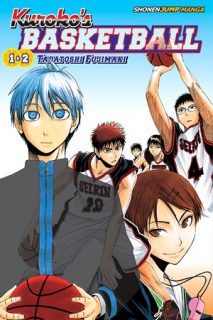
Kuroko's Basketball, Omnibus 1And the winner of the Kuroko’s Basketball manga giveaway is… Coco!

As the winner, Coco will be receiving a copy of the first Kuroko’s Basketball omnibus, created by Tadatoshi Fujimaki and published in English by Viz Media. Tournaments often play a large part in sports manga like Kuroko’s Basketball but they can also be incorporated into other genres in interesting ways, too. For this giveaway, I asked that participants tell me a little about their favorite tournament manga. I’ve collected some of the responses in the list below (combined with some additional titles), but be sure to check out the giveaway comments for all of the detailed replies.

Some of the tournament and competition manga licensed in English:
Air Gear by Oh!Great
Angelic Layer by CLAMP
Battle Angel Alita: Last Order by Yukito Kishiro
Crimson Hero by Mitsuba Takanashi
Cross Game by Mitsuru Adachi
Dragon Ball by Akira Toriyama
Eyeshield 21 written by Riichiro Inagaki, illustrated by Yusuke Murata
Fairy Tail by Hiro Mashima
Food Wars!: Shokugeki no Soma written by Yuto Tsukuda, illustrated by Shun Saeki
Haikyu!! by Haruichi Furudate
Hikaru no Go written by Yumi Hotta, illustrated by Takeshi Obata
Hunter x Hunter by Yoshihiro Togashi
King of Cards by Makoto Tateno
Kuroko’s Basketball by Tadatoshi Fujimaki
Let’s Dance a Waltz by Natsumi Ando
My Hero Academia by Kohei Horikoshi
The Prince of Tennis by Takeshi Konomi
Real by Takehiko Inoue
Reborn! by Akira Amano
Revolutionary Girl Utena by Chiho Saito
Shaman King by Hiroyuki Takei
Slam Dunk by Takehiko Inoue
Toriko by Mitsutoshi Shimabukuro
Welcome to the Ballroom by Tomo Takeuchi
Yakitate!! Japan by Takashi Hashiguchi
Your Lie in April by Naoshi Arakawa
Yowamushi Pedal by Wataru Watanabe
YuYu Hakusho by Yoshihiro Togashi
Yu-Gi-Oh! by Kazuki Takahashi

The above list is not by any means comprehensive, but it’s not a bad place to start looking for some tournament manga to read. Perhaps unsurprisingly, sports manga seems to predominate but there are a few other interesting titles in there as well. As always, thank you to everyone who took the time to participate in the giveaway and share your favorite manga tournaments with me! I hope to see you again for the next giveaway. (Oh, and happy new year!)

Filed Under: Giveaways, UNSHELVED Tagged With: Kuroko's Basketball, manga, Tadatoshi Fujimaki

The Case Study of Vanitas, Vol. 1

January 4, 2017 by Sean Gaffney

By Jun Mochizuki. Released in Japan as “Vanitas no Shuki” by Square Enix, serialization ongoing in the magazine Gangan Joker. Released in North America by Yen Press. Translated by Taylor Engel.

Steampunk as a genre is usually a sign that fun is about to ensue, and it’s no different in Japanese manga. From Soul Eater to Sakura Taisen, the idea of Victorian fashion and technological advances has always intrigued the promising new creator. And here we have The Case Study of Vanitas, a new series from the creator of Pandora Hearts. (A very new series, in fact – We’re already caught up with Japan, so don’t expect this one to be every other month.) And the story begins with a giant dirigible, looking as ridiculous as you could possibly imagine. Yet all of this is perhaps distracting myself from the simple fact that at its core, The Case Study of Vanitas is a series about various types of vampires and how to deal with them. Yup. More vampires.

My weariness of the glut of licensed vampire titles is well known, but I will quash it when it’s in the service of a good title. And, for the most part, The Case Study of Vanitas is a good title. It’s light and frothy, despite the presence of dark creatures of the night and the occasional horrific death. There’s lots of action scenes in midair, and confrontations on well-lit backroads. Our hero really isn’t the guy on the cover but Noe, a vampire who has come to Paris searching for the mysterious Book of Vanitas, which is said to be able to interfere with the true name of a vampire. Imagine our surprise when he finds the owner of the book after only about 30 pages. This *is* the guy on the cover, who calls himself Vanitas and is seemingly going around trying to be a “doctor” for vampires by using the book.

To be honest, there is one big weakness with the first volume, and that’s Vanitas himself. Normally I’m quite find of the obnoxious guy who rubs everyone the wrong way, but this time he was starting to rub me the wrong way too. Vanitas is simply too unlikable for a series that’s designed to revolve around him. I suspect the author knows this – that’s why Noe fulfills the hero role a bit better – but something just sours me, especially when he forces himself on the Witch Jeanne who’s come to wipe them out at the behest of her young master. I just suspect that I’m supposed to find him funny and amusing in a horrible way, but the horrible is what sticks.

That said, other than its title character, this was a great deal of fun. Lots of vampire lore and blood for those who do love the genre, a few officious bureaucrats and stoic servants, and in the middle of it is Noe, who spends much of the volume staring at Vanitas with a “the fuck?” look on his face. There’s hints of a tragic past with him, which I suspect we’ll get in the second volume. In the meantime, steampunk vampires!

Filed Under: REVIEWS

The Devil Is a Part-Timer!, Vol. 6

January 3, 2017 by Sean Gaffney

By Satoshi Wagahara and 029. Released in Japan by ASCII Mediaworks. Released in North America by Yen Press. Translated by Kevin Gifford.

The Devil Is a Part-Timer! is one of the few light-novel series currently being released in North America that has not had a multi-volume arc of some kind. By the end of each volume, things are somehow resolved enough that everyone can go back to the apartment complex. And yet each successive volume builds on the last, layering on more backstory revelations, character dilemmas, and (for this particular series) religious imagery until we realize that really, it’s been one big arc all along. Which is just what you want for a series like this. Each new volume makes you want to read the next one immediately. This one in particular, as Maou finally starts to give some answers as to what he was doing back in Enta Isla. Not many, but a few.

Of course, part of the reason that Maou is able to reveal to readers that yes, he was actually trying to conquer the world through war (something he regrets now) is because we now know that he did not in fact horribly murder Emi’s father. She’s still trying to deal with everything she found out in the last book, particularly the identity and status of her mother, and it’s left her a mixture of angry and devastated. Most of these books have been Emi discovering that literally everything she lived her entire life for has been a giant lie, and that a lot of people see her as a giant tool to point and shoot. We’re still nowhere near them being friends, but Emi is finally starting to get to the point where she’s not screaming at Maou every time she sees him, and can work with him against a common enemy, which is happening more and more frequently these days.

And then there’s Chiho’s development, as it turns out that when you fill a girl with divine mystical energies and use her body as a conduit, it can actually have lasting effects. Luckily, this is a still a relatively light-hearted series, and Chiho is so big-hearted, that it mostly means teaching her ways to psychically communicate with the others in case she’s ever kidnapped again – which turns out to be of great use when she is, in fact, kidnapped again. I like the fact that Chiho turns out to be surprisingly adept at magic, to the point where even Suzuno is startled at how fast she’s picking things up, and what she’s doing with it. I also really liked that psychic thought projection is likened to cell phone usage to make things easier to understand, and that imagery may be one reason she’s so good at it.

I’d mentioned in my last review that I loved the pointless daily life segments more than anything else, and while there aren’t as many of them this time, we do get some lovely discussion of how to be a barista. The McRonald’s has now become a McCafe, which means Maou and Chiho will now be serving coffee. This also serves to give us some much-longed for depth in regards to their manager Mayumi, and her discussion of her life’s dream (to be a bartender) leads neatly to Maou discussing his own goals and dreams. Much to his frustration, everyone seems to assume that he’s hiding out in Japan to give up. No, he’s hiding out in Japan to learn how to take over the world… ECONOMICALLY! Because that’s a much less blood-filled way of conquering than the old one. It was nice seeing Maou’s drive to rule the world pop up again, and I suspect the cast will be back in Enta Isla before long – though I assume not permanently.

This series continues to be top-tier. Great plot, the backstory hangs together, the characterization flows smoothly, and the narration can sometimes be quite witty even though it’s third person. I would say I can’t wait till the next volume, but Vol. 7 appears to be a short-story collection, so I’ll likely have to wait till Vol. 8. That’s OK. Like Maou, I’m patient.

Filed Under: REVIEWS

Bungo Stray Dogs, Vol. 1

January 2, 2017 by Sean Gaffney

By Kafka Asagiri and Sango Harukawa. Released in Japan by Kadokawa Shoten, serialization ongoing in the magazine Young Ace. Released in North America by Yen Press. Translated by Kevin Gifford.

I often regret that I haven’t read as much classical Japanese literature as I should. To be fair, a great deal of it is not translated into English, but there’s a ton that is as well, and for all that I’ve wanted to read No Longer Human, it sits on my phone with about 80 million other books I tried to read and then got distracted by. But I suppose I’m going in with the wrong mindset, as I don’t really want to read these works for their literary value, but in order to understand what the hell is going on in all the manga that make references to them. And honestly, do I know any other Dazai than No Longer Human? Did I even know the classic film Rashomon was based on a short story? And if I knew the literary references that flit throughout the first volume of Bungo Stray Dogs, would I find it more interesting than I did?

Without the literary references, what we have here is a somewhat standard superhero team-up story. Our young hero is an abandoned orphan fleeing a monstrous tiger creature that’s been following him around and wreaking havoc; he sees a very eccentric young man supposedly trying to kill himself in the nearby river and rescues him, and their two lives become intertwined. It turns out that a) the supposedly suicidal young man (like Zetsubou-sensei, it’s played for laughs throughout) is part of a group with powers who form a detective agency, and b) our hero IS the tiger that follows him around – that’s his power, though he’s been sort of suppressing it. After a brief test to see if he has the skill and compassion to make it in their agency, he joins up with them and they battle a mafia kingpin who uses his powers not for niceness, but for evil.

The literary references come in because they’re all named after famous Japanese authors and poets, and their powers are based on their most famous work. Dazai is the eccentric man, and his power is No Longer Human. The villain, Akutagawa, has a power called Rashomon, from the short story of the same name. And so forth. Without this, unfortunately, you’re mostly left with something that we’ve seen a lot of before, and I’m not sure the gimmick is enough to keep me interested. It doesn’t help that we get brother/sister incest used for humor value, something that can be done with a light touch, but rarely is a light touch used. There’s no doubt this is popular – it spawned an anime, and the cast are attractive bishies who snark at each other much of the time. The action scenes are also pretty well done. But I’m not sure that’s enough to make me come back. It’s good, but lacks that certain something.

Filed Under: REVIEWS

  • « Go to Previous Page
  • Page 1
  • Interim pages omitted …
  • Page 455
  • Page 456
  • Page 457
  • Page 458
  • Page 459
  • Interim pages omitted …
  • Page 1048
  • Go to Next Page »
 | Log in
Copyright © 2010 Manga Bookshelf | Powered by WordPress & the Genesis Framework