• Skip to primary navigation
  • Skip to main content
  • Skip to primary sidebar
  • Home
  • About Us
    • Privacy Policy
    • Comment Policy
    • Disclosures & Disclaimers
  • Resources
    • Links, Essays & Articles
    • Fandomology!
    • CLAMP Directory
    • BlogRoll
  • Features & Columns
    • 3 Things Thursday
    • Adventures in the Key of Shoujo
    • Bit & Blips (game reviews)
    • BL BOOKRACK
    • Bookshelf Briefs
    • Bringing the Drama
    • Comic Conversion
    • Fanservice Friday
    • Going Digital
    • It Came From the Sinosphere
    • License This!
    • Magazine no Mori
    • My Week in Manga
    • OFF THE SHELF
    • Not By Manga Alone
    • PICK OF THE WEEK
    • Subtitles & Sensibility
    • Weekly Shonen Jump Recaps
  • Manga Moveable Feast
    • MMF Full Archive
    • Yun Kouga
    • CLAMP
    • Shojo Beat
    • Osamu Tezuka
    • Sailor Moon
    • Fruits Basket
    • Takehiko Inoue
    • Wild Adapter
    • One Piece
    • After School Nightmare
    • Karakuri Odette
    • Paradise Kiss
    • The Color Trilogy
    • To Terra…
    • Sexy Voice & Robo
  • Browse by Author
    • Sean Gaffney
    • Anna Neatrour
    • Michelle Smith
    • Katherine Dacey
    • MJ
    • Brigid Alverson
    • Travis Anderson
    • Phillip Anthony
    • Derek Bown
    • Jaci Dahlvang
    • Angela Eastman
    • Erica Friedman
    • Sara K.
    • Megan Purdy
    • Emily Snodgrass
    • Nancy Thistlethwaite
    • Eva Volin
    • David Welsh
  • MB Blogs
    • A Case Suitable For Treatment
    • Experiments in Manga
    • MangaBlog
    • The Manga Critic
    • Manga Report
    • Soliloquy in Blue
    • Manga Curmudgeon (archive)

Manga Bookshelf

Discussion, Resources, Roundtables, & Reviews

Blog

Is It Wrong To Try To Pick Up Girls In A Dungeon? On The Side: Sword Oratoria, Vol. 2

February 26, 2017 by Sean Gaffney

By Fujino Omori and Suzuhito Yasuda. Released in Japan as “Dungeon ni Deai o Motomeru no wa Machigatte Iru Darou ka? Gaiden – Sword Oratoria” by Softbank Creative. Released in North America by Yen On. Translated by Andrew Gaippe.

After a first volume that was good but a bit too much side story by the numbers, the second volume of Aiz’s book series ups the ante, and really shows us how similar and yet totally different Aiz and Bell both are. This is less tied into the main series than the first book was – we can tell it’s at the same time as Book 2 due to Aiz giving Bell a lap pillow (at the suggestion of her companion) when they find him collapsed. And that’s all for the best, as we begin to develop the rest of Loki’s badass crew, including Loki herself, who is allowed to become a bit of a detective as she tries to track down who’s responsible for the plant monsters we saw in the prior book. That said, the core of this book is all Aiz, as she finally finds someone she can’t defeat, and it nearly breaks her.

Frustratingly, at last for the reader, we never get a name for this mystery assailant, who is clearly set up to be an ongoing antagonist. She’s definitely in charge of the plant monsters, though, and is strong enough to take out Aiz, though to be fair she’s already injured when they fight. Their main battle happens barely halfway through the book, though, so it’s not the point. The point is not just that Aiz lost but that Aiz lost to someone who knows the name of her mother, Aria. Aiz’s past is a mystery to the reader, though we know she’s been dungeon crawling since she was seven. Here we see a flashback to happy family times before that, and can sense there’s a tragedy here we haven’t quite heard about. More to the point, that trauma combined with the loss drives Aiz to make a suicidal charge on one of the lower floor bosses, which she insists on taking out all by herself. It’s an absolutely brutal sequence, and it’s also fascinating to see Aiz actually struggle given how perfect she’s seen to be in the main series.

As for the rest of the cast, they all get their cool moments. Lefiya still has a tendency to need rescuing, but is less self-deprecating here, and helps out Aiz more than once. (She’s also still very gay for Aiz, something I doubt will ever go anywhere but I also suspect will continue as the books go on.) They have their own murder mystery to solve, but unlike Loki’s the murder is not that mysterious, just gruesome, and the culprit shows herself almost immediately. There’s also some nice little world building and ties to prior books – Hermes’ follower who pops up here as an incidental part of the murder investigation reveals that Hermes is having her hide her higher status, something that doesn’t surprise me at all knowing him, and we meet Ouranos, the God who rules the city, and he’s one mysterious character.

Honestly, not much else to say beyond this is a really good, enjoyable book from one of my favorite light novel authors. Also, lots and lots of cool fights. Fans of the series have to pick it up. It does have a typo in regards to Lefiya’s level at the very end (she’s a 3, not a 5), but I’m ignoring that because the book was so much fun.

Filed Under: is it wrong to try to pick up girls in a dungeon?, REVIEWS

Fruits Basket Collector’s Edition, Vol. 10

February 25, 2017 by Sean Gaffney

By Natsuki Takaya. Released in Japan by Hakusensha, serialized in the magazine Hana to Yume. Released in North America by Yen Press. Translated by Sheldon Drzka.

Yen Press’ rush release of these omnibuses has been a bit disorienting at times, and because I’m giving each of them full reviews it sometimes feels like I was only just talking about the last book and here’s another one. (It’s been about 3 1/2 weeks since I reviewed Vol. 9). That said, one can never, ever run out of things to talk about when discussing Fruits Basket, so no worries on that end. As Takaya herself says, we’re beginning the home stretch here, and many mysteries are being cleared up now that the biggest of them all has been revealed. We see why Kakeru has been so on edge around Tohru, and finally meat his semi-mythical girlfriend Komaki (who for a moment looks as if she may stay with a ‘hidden face’ before getting revealed a bit later), and we get Kyo starting to explain exactly why he feels tremendous guilt and pain when he thinks about Tohru’s mother.

Speaking of Tohru, this volume is probably her low ebb. Her inability to reveal the fact that she loves Kyo is shown to have explicit ties to her idolization of her mother and the trauma of her passing, as well as a somewhat understandable complete misunderstanding of how loving someone actually works. Shigure, who in the past gave her nice, calm, friendly advice, is perhaps getting a bit too attached to her, as he now proceeds to slam at all of her buttons at once, trying to break past her traumas and get her to admit what she doesn’t want to. It hasn’t worked on Akito, and there’s no reason it’d work on Tohru, but it does show how he may feels about her now, and winds up with Shigure wondering, to the reader’s horror, what might have happened if he’d dreamt of Tohru rather than Akito.

As for Akito, well, much of the book is spent with her holed up and avoiding everyone, having a massive sulk after recent events. We finally get some backstory regarding his father (who reminds me of Yuki quite a bit, something I think Akito herself is also aware of), as well as, unfortunately, more insight into Ren, who we see Akito seems to get her selfishness and tendency towards insane tantrums from. Akito at least is seeing the cursed Sohmas gradually break away from her – more on that later – but Ren is given no real reason for her abusive nature beyond being a petty, selfish and violent person. Her attack on Akito is unfortunately, not so much for her as because it gives Akito a knife, which leads to bad things later on.

I’d mentioned two more curses break here, one right after the other – Momiji and Hiro’s. Hiro, possessing an actual warm and loving home life and with his angst over Kisa and Rin mostly being resolved, is not much of a surprise, and the revelation is quite heartwarming. Momiji is more startling, particularly in the somewhat unrealistic way he’s grown up and, frankly, become almost unrecognizable – I’ve talked before about when Takaya’s art morphed from its early Furuba faces to late ones, and despite her hurting her hand after Vol. 8, I think it’s more around here that we see it. Momiji is no longer cursed, but of course he can’t return to his family, and he already knows he’s not going to win Tohru’s love, despite his words to Kyo. So what’s left is a deep loneliness, but also a yearning to make a brilliant future for himself.

More to discuss, as always! Ayame angering an already angry BL fandom by admitting that Mine is his girlfriend, and showing off some casual cruelty towards a love confession when he was in high school that will make your jaw drop (Hatori is appalled, Shigure just amused). Kagura may barely appear in the series anymore, but she makes her appearance count, getting upset at Tohru waffling about her love for Kyo to the point where she belts Tohru in the head – which a) should give Tohru a concussion and possibly hospitalize her, given this is Kagura, and b) leads to a wonderful bit where Rin witnesses this and loses her shit, screaming that Kagura has no right to hit anyone. (Kagura, very pointedly, apologizes to Rin but not Tohru.)

And now everything is terrible, basically. (I didn’t even talk about Shigure’s scenes with Ren, in which acid meets… well, even more corrosive acid.) Kureno is stabbed (and hey, that maid wasn’t fired after all!), Akito is walking around town with a knife and not in the best frame of mind, and Kyo is telling Tohru that he a) thinks he killed his mother, and b) thinks he killed HER mother. Can things possibly get worse? Hell yes. In any case, Fruits Basket: still wonderful.

Filed Under: fruits basket, REVIEWS

Psycome: Murder Maiden and the Fatal Final

February 24, 2017 by Sean Gaffney

By Mizuki Mizushiro and Namanie. Released in Japan by Enterbrain. Released in North America by Yen On. Translated by Nicole Wilder.

The good news is that this is a much more tonally consistent book than the first two, and has a better idea – most of the time – as to when to be over the top funny and when to have the reader genuinely disturbed. Renko remains the best character, getting in so many hilarious lines I can’t even bother to count them but also getting a really surprising amount of character depth (though I could have done without the epilogue telling rather than showing us all that character depth). Eiri continues to be the girl that Kyousuke SHOULD end up with, and I am very happy to hear that she’s the focus of the next book. Maina was less annoying as well this time around, and though Shamaya is back she seems to have lost the unpleasant implications of the end of the last book and just become another garden variety psycho. What I’m trying to say here is that I enjoyed everything about this except for the two lead characters and the main plot.

I knew going in that I wasn’t going to warm up to Ayaka. The “little sister obsessed with her big brother to an unnerving degree” is something already greatly exaggerated and overused by anime in general, and so turning the dial to 11 is not as successful as I think the author wants it to be. We’re meant to be amused at first and then gradually horrified as we realize that Ayaka is far more mentally unbalanced than she really should be for a “comedy” light novel, but since she enters the book hitting the high note and then only gets higher after that, we’re merely exhausted. That said, the larger issue here is Kyousuke.

There are hints, particularly at the end of the book, that Kyousuke’s entire family is, shall we say, a bit unusual, but even so, his reactions to Ayaka’s behavior beggar belief. I could be wrong here by dint of being an only child, but I’m fairly certain even the most doting brother would have noticed what was going on with Ayaka long before he did. It’s one of those cases where the revelation can’t come until the climax of the book, and so the hero ends up being unnecessarily stupid. The plot – when it arrived – was actually quite interesting, involving Ayaka deliberately being recruited into the school by their teacher, who can see a future assassin in her no doubt, but the fact that we didn’t find out about that until 90% of the way through the book is frustrating. And the subplot – involving everyone studying for finals, which have awful punishments for the bad students and setups for the next volume for the good students – was simply dropped at the end, making the “Fatal Final” a giant anticlimax.

And so, having spent much of this review being annoyed, let’s return to my original paragraph. This is a better book than the first two. The writing is more consistent, and there were some nice heartfelt scenes almost despite itself. But I don’t think Psycome will ever stop teetering on the edge of being a flaming ball of disaster, as seen in the Kamiya Family this time around. As long as it teeters and doesn’t fall off, I’ll keep reading.

Filed Under: psycome, REVIEWS

Manga the Week of 3/1/17

February 23, 2017 by Sean Gaffney, Ash Brown, Anna N, Michelle Smith and MJ 1 Comment

SEAN: Next week is the biggest “5th week of the month” I’ve seen in quite some time. There’s another huge pile here, be warned.

Dark Horse gives us a 25th volume of Vampire Hunter D, the great-granddaddy of the vampire craze.

ASH: I’ve been meaning to read the Vampire Hunter D novels for a loooooong time now, but I don’t see me tackling all twenty-five any time soon.

SEAN: J-Novel Club has a 2nd volume of My Little Sister Can Read Kanji. Further, deponent sayeth not.

Kodansha has a lot of stuff. First, we get the 2nd and final volume of the Attack on Titan: Lost Girls manga adaptation.

ASH: I was surprised by how much I enjoyed the first volume! Lost Girls may very well be my favorite Attack on Titan spinoff right now.

SEAN: There’s also a 58th volume of Fairy Tail, which we’ve just heard is in its final arc.

There are three new “digital only” series debuting next week. The first is another josei title from Kiss, The Full-Time Wife Escapist, aka Nigeru wa Haji da ga Yaku ni Tatsu. It’s technically another “fake marriage” title, but this looks like it has lots of depth, and inspired a live-action drama.

From Dessert, we have House of the Sun, aka Taiyou no Ie. This looks like a cute and fluffy romance series, and is 13 volumes. I think it’s also won awards.

MICHELLE: I’m really interested in both of these!

ANNA: As am I, surprising no one!

MJ: I might be? These are sometimes a wild card for me.

SEAN: Back briefly to print, we have the 9th volume of Kiss Him, Not Me!, which can be cute and fluffy romance, but honestly should be read for the laughs.

ASH: Definitely not a series to be taken too seriously, but it can be a lot of fun.

SEAN: Our final digital debut is Peach Heaven!, also a 13-volume romance from Dessert, but this one seems more in the “how much do I like jerks?” L♥DK mode. I hope I’m wrong.

MICHELLE: Here’s one Kodansha digital title I’m going to pass on.

MJ: Ugh.

SEAN: And back to print again, with the third volume of Ouran’s dark mirror, The Prince in His Dark Days.

And there’s a 4th Sweetness and Lightning as well.

ASH: Yay! Still loving the series’ combination of family and food.

SEAN: Seven Seas has another Freezing omnibus, collecting volumes 13 and 14.

And the second volume of Holy Corpse Rising.

MICHELLE: Is that what they do the morning after a Corpse Party?

ASH: Hahaha!

SEAN: Their first debut is the last of the “month of yuri” titles, this one from Hirari magazine. Kase-san and Morning Glory looks sweet and adorable, and I look forward to it.

MICHELLE: It does look cute!

ASH: It certainly does.

SEAN: The second debut is There’s a Demon Lord on the Floor, which is an ecchi comedy, and for once involves a demon being summoned to OUR world rather than an “average school student” being summoned there.

Vertical gives us the 2nd Bakemonogatari novel from Nisioisin, which introduces us to enthusiastic Suruga Kanbaru and shy and moe Nadeko Sengoku. (No spoilers, please.)

And also the 7th Cardfight Vanguard, which I think will now resume regular releases after a long hiatus over here.

Viz gives us a gorgeous-looking deluxe boxset of the entire Revolutionary Girl Utena manga, including the movie volume. I am conflicted, to say the least, about the content of said manga, but as a hardcore Utena anime fan, I will be getting it anyway, and seeing if the years have been kinder.

ASH: Surprisingly, I actually haven’t read the Utena manga series, but I did love The Adolescence of Utena (the movie volume) which is also included in this set. From the pictures Shojo Beat has been posting online, this should be a stunning release.

MJ: I’m probably putting this on my list.

SEAN: Yen Press says “Hey, we have digital-only releases too!”, and they do indeed, with the 8th Aoharu x Machinegun, 9th Corpse Princess, and 8th Saki.

ASH: Saki!

There are also two print stragglers. Anne Happy has a 4th volume of “how miserable can we make everyone for comedy?” antics.

And Monthly Girl’s Nozaki-kun never has to worry about that, it’s always funny. Here’s the 6th volume.

MICHELLE: Yay!

ASH: I love this series so much. Reading it makes me so happy.

ANNA: I’m behind already. One day I will catch up!

MJ: Woot!

SEAN: That’s a lot of stuff. Are you prepared? Can you handle so many manga volumes?

Filed Under: FEATURES, manga the week of

JoJo’s Bizarre Adventure: Stardust Crusaders, Vol. 2

February 23, 2017 by Sean Gaffney

By Hirohiko Araki. Released in Japan as “Jojo no Kimyou na Bouken” by Shueisha, serialized in the magazine Weekly Shonen Jump. Released in North America by Viz. Translated by Evan Galloway, original translation and adaptation by Alexis Kirsch and Fred Burke.

I had worried with the last volume if I wasn’t going to like Jotaro as much as his predecessors, and indeed that still seems to be the case, though I’ve somewhat come to terms with it. Things are still “we must do as many cool things as possible”, but there’s a notable element of humanity missing from this new series, instead relying on set piece after set piece and slowly moving the story around the globe, presumably ending up confronting Dio, though he barely shows up here. I also noticed the first major “we have to change this or the band will sue us” adaptation fix, as Soul Survivor (a Santana reference, so clearly the translators did an excellent job there) replacing the Japanese Devo. (Couldn’t they just say Deevo or Divo or something? They did with Kars, after all.)

It’s always worrying when I’m discussing translation choices in the first paragraph of a review. JoJo’s is one of those series I decided to write full reviews for every volume, but that was much easier in the days of Jonathan’s histrionics and Joseph’s amusing banter. The trouble with Stardust Crusaders is that while it’s not exactly bad, there’s nothing to really grasp and think deeply about. It’s all surface. Now, to be fair, Araki does surface very well. There are some striking fights here, and some of the gory deaths are both horrifying and somewhat amusing, in the best JoJo’s tradition. But even when a major plot point does appear, such as Kakyoin supposedly still being under the influence of Dio, it ends up being a bit too confusing for its own good, as it turns out that the Kakyoin that’s betraying them is actually a spy. (Also, is he named Rubber Soul or Yellow Temperance? Was the name adapted out as well?)

We also pick up a bratty little kid along the way, which I don’t really have too much of an objection to – bratty kids hanging out with heroes is very much a shonen manga trope. I was rather annoyed when she randomly decided to take a shower in the face of ever-present danger, which seems to have been solely to have her be named when faced with such danger. She looks to be about 11 years old, so this was especially annoying. We don’t need that kind of fanservice. I’m not sure how long into the series she’ll last – she doesn’t even have a name to date – but she certainly seems to have taken a shine to Jotaro. As for everyone else, they pose, they shout, and I can’t even remember most of their names.

After spending its first two volumes influencing the majority of modern Jump manga, Stardust Crusaders seems to be coasting, confident that it’s popular enough not to worry about getting cancelled, and relying on violence, set pieces, and attempting to look cool. I miss the earlier style.

Filed Under: jojo's bizarre adventure, REVIEWS

A Springtime With Ninjas Vol. 1

February 22, 2017 by Anna N

A Springtime with Ninjas Volume 1 by Narumi Hasegaki

I had high hopes for this title because I greatly enjoy both ninjas and shoujo manga, but I was underwhelmed by A Springtime With Ninjas. I think part of my disappointment was because I was hoping that the heroine and hero of the manga were both ninjas, but it turned out to be a decently executed manga that had some funny moments with a very conventional clueless rich girl heroine who was unfortunately not a ninja at all.

Benio is a sheltered rich girl who lives with the a horrible curse – she has to marry the first man who kisses her. She’s trapped in her home, at the mercy of a procession of tutors and she longs to go to school and experience normal life as a high schooler. Her uncle announces that he’s found a friend for her, and produces Tamaki, a flirtatious ninja bodyguard. Benio immediately finds him offputting, cherishing the memory of a friendship she had as a child when a boy who came over to play with her. Surprising no one who has read a shoujo manga before, it is pretty clear that Tamaki is her long lost friend.

Benio and Tamaki eventually get clearance to go to school, and he fends off Benio’s would-be suitors with his elite ninja skills. There were some amusing lines of dialogue like “The sanctity of this princess’s lips bears more weight to me than your lives.” Also, it was fun to see random high school club presidents suddenly manifest ninja abilities. The art is attractive, and the action scenes are clear and easy to follow. But there isn’t really any distinct quality or style to the art that would help offset storylines that kept giving me a sense of deja vu. I ended up putting down this manga being reminded of all the other shoujo manga that I’ve read that cover some of the same story tropes but end up being a little bit more funny, or have a more interesting take on ninjas or sheltered heiresses.

Filed Under: Manga Reviews, REVIEWS Tagged With: a springtime with ninjas, Kodansha Comics

A First Look at We Never Learn

February 22, 2017 by Katherine Dacey

We Never Learn follows a tried-and-true shonen formula: an ordinary joe finds himself at the apex of a love triangle with two pretty girls. The points of this particular triangle are Yuiga, a bright, hard-working student from a poor family; Ogata, a math whiz whose classmates call her “Thumbelina Calculator”; and Furahashi, a budding literary talent whose classmates call her “Sleeping Beauty of the Literary Forest.” (Something tells me those nicknames were funnier in the original Japanese.) In keeping with the dictates of the genre, Ogata and Furahashi are physical and temperamental opposites: Ogata is petite, cold, and disdainful, while Furahashi is lanky, spazzy, and cheerful. Both girls initially appear to be out of Yuiga’s league, as they outperform him in the classroom and outclass him in looks.

The story takes an interesting turn midway through chapter one: Yuiga’s school hires him to tutor Ogata and Furahashi, both of whom are blissfully unaware of their natural strengths. Ogata dreams of enrolling in a prestigious liberal arts school, while Furahashi hopes to attend an engineering college. In trying to help Ogata and Furahashi achieve their goals, Yuiga discovers that his high EQ is a better asset than his book smarts. Yuiga knows how to cope with failure: as we learn in a flashback, he was once a mediocre student who gradually improved through trial and error. Ogata and Furahashi, by contrast, are portrayed as naturally brilliant in their respective fields but lacking the experience or maturity to master their weaker subjects.

Of course, there are plenty of elements you’d expect to see in a shonen rom-com: gratuitous shower and bath scenes, melodramatic proclamations, and a supporting cast of interchangeable classmates, none of whom make much of an impression. The manga’s generous portrayal of its principle characters and its genuine sincerity, however, suggest that We Never Learn has the potential to be sweetly funny without making Yuiga into an insufferable know-it-all or a dweeby doormat.

The bottom line: Try before you buy! The first chapter is available free on the VIZ website; readers wishing to continue the story can do so through the digital version of Shonen Jump. 

WE NEVER LEARN • BY TAISHI TSUTUI • VIZ MEDIA • RATED T, for teen (13+)

Filed Under: Manga, Manga Critic, REVIEWS Tagged With: Shonen, Shonen Jump, VIZ

Manga Giveaway: Tokyo ESP Giveaway

February 22, 2017 by Ash Brown

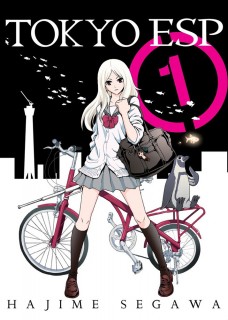
The end of February is almost here which means it’s yet again time for another giveaway at Experiments in Manga. This month everyone will have the opportunity to win the first omnibus of Hajime Segawa’s manga series Tokyo ESP. (Published in English by Vertical Comics, the omnibus collects the first two volumes of the original Japanese edition.) As always, the giveaway is open worldwide!

Tokyo ESP, Omnibus 1

Growing up I absolutely loved stories about psychic powers. (Did anyone else read The Girl with the Silver Eyes Willo Davis Roberts? That was a favorite of mine and I frequently reread it.) I no longer deliberately seek out that particular subgenre in the same way that I used to, but I do continue to enjoy stories with ESP as a prominent feature. At one point in time, it actually seemed like it was impossible to get away from manga series revolving around characters with psychic powers. While they don’t seem to be nearly as common as they once were, manga with psychics and espers are still regularly released in English, Tokyo ESP being just one example

So, you may be wondering, how can you a copy of the first Tokyo ESP omnibus?

1) In the comments below, tell me a little about one of your favorite psychics or espers from a manga. (If you don’t have a favorite or don’t know of any, simply mention that.)
2) If you’re on Twitter, you can earn a bonus entry by tweeting, or retweeting, about the contest. Make sure to include a link to this post and @PhoenixTerran (that’s me).

That’s pretty straightforward, right? Everyone participating has one week to submit comments and can earn up to two entries for the giveaway. Comments can also be sent directly to phoenixterran(at)gmail(dot)com if needed or preferred. Those entries will then be posted here in your name. The giveaway winner will be randomly selected and announced on March 1, 2017. Good luck, everyone!

VERY IMPORTANT: Include some way that I can contact you. This can be an e-mail address in the comment form, a link to your website, Twitter username, or whatever. If I can’t figure out how to get a hold of you and you win, I’ll just draw another name.

Contest winner announced–Manga Giveaway: Tokyo ESP Giveaway Winner

Filed Under: FEATURES, Giveaways Tagged With: Hajime Segawa, manga, Tokyo ESP

Konosuba: God’s Blessing on This Wonderful World!: Oh My Useless Goddess!

February 22, 2017 by Sean Gaffney

By Natsume Akatsuki and Kurone Mishima. Released in Japan as “Kono Subarashii Sekai ni Shukufuku o!: Aa, Damegami-sama” by Kadokawa Sneaker Bunko. Released in North America by Yen On. Translated by Kevin Steinbach.

In the current light novel boom that North America has been experiencing, there have been many novels that fall under the broad category of ‘funny’. They either take a relatively serious plot and give it a funny touch (The Devil Is a Part-timer!), expand on a completely ludicrous situation (Psycome), or are an outright parody (I Saved Too Many Girls And Caused the Apocalypse). KonoSuba’s first volume is most like the latter of these options, but I have to say as I was reading it that I can’t think of a single series, even Little Apocalypse, that was as dedicated to wringing as many laughs out of everything as KonoSuba is. Never mind plot complications or depth of characterization. This series is damned funny, and that’s why you should read it.

The archetype being parodied will be most familiar to readers of the manga Mushoku Tensei. A young man who is something of a loser dies performing one noble act, and is given an option to reincarnate in a fantasy world so he can be a hero. Except here, Kazuma’s death turns out to be so pathetic that even the doctors who tried to save him and his own parents laughed when they heard about it, and the young goddess who wants to send him to a fantasy world seems to be doing it so that she can fill her quota more than anything else. She’s so annoying, in fact, that Kazuma, rather than wishing for a fantastic sword or unbeatable magic powers to go along with him into this world, wishes for… the goddess herself. Fans of Oh My Goddess will be especially amused, showing that the subtitle of the first volume isn’t just for show. Kazuma and Aqua could not be more different than Keiichi and Belldandy, though, and when they both arrive in Generic Fantasy world X, he finds this goddess to be a lot less help than he’d hoped.

Everything that follows amps up the comedy, as it should be. Kazuma, because he didn’t pick an insane superweapon but a useless goddess, as average stats and minimal weapons to defeat a giant demon king. He has luck… but that merely seems to allow him to use thief abilities to steal girl’s panties. (Yeah, sorry about that, it’s still written for guys.) We meet Megumin, a teenage overdramatic girl who likes explosions and not much else. We meet Darkness, a knight with elite defensive powers who can’t hit the side of a barn door with her sword, and who seems to get off on just about anything. Together, these four take on giant frogs (which I won’t spoil), supposedly evil lichs (another great scene), and in the end a demon general who is a dullahan (were these always in anime even before Celty, or is their resurgence all Ryohgo Narita’s fault?). And what’s more, they win!

It’s tricky to review this, because I don’t want to give away the best gags. I will note that, while I’m sure this will change, I was pleasantly surprised at the utter lack of romance in this first book. Kazuma and Aqua act like bratty siblings, Megumin is too young for him, and while Darkness is basically what he finds attractive, her masochism creeps him out. That plus his tendency to yell at everyone and everything makes this party dynamic more family than harem, and I appreciated that. But when all is said and done, you read this book because it will make you laugh. Even if you aren’t familiar with the tropes of isekai and reincarnation novels, you’ll still like this.

Filed Under: konosuba, REVIEWS

Bookshelf Briefs 2/20/17

February 20, 2017 by Michelle Smith and Sean Gaffney Leave a Comment

Kamisama Kiss, Vol. 23 | By Julietta Suzuki | Viz Media – As we get ever closer to the ending, everything is getting ramped up a notch, and we’re seeing the true villain of the series is not Akura-Oh. Indeed, the humanity that Akura-Oh has inherited by Kirihito leads to some of the best scenes in the book, as the young girl lost in the Underworld turns out to be someone far more important than we thought. And then there’s Nanami, who continues to be told what to do and then just does what she wants to anyway, and usually ends up turning out all right. Best of all, though, is Yatori, who’s always been awful but really goes above and beyond to become a truly hateful villain, the sort you really want to see Tomoe and Nanami destroy. Which will have to wait for next time. – Sean Gaffney

Magi: The Labyrinth of Magic, Vol. 22 | By Shinobu Ohtaka | VIZ Media – It continues to impress me how complex Magi has become. In this volume, Alibaba learns about the Kou Empire’s plan to achieve peace through domination and homogenization, and is pressured into an alliance for the sake of Balbadd. When the world’s leaders gather at a conference, Aladdin finally reveals what happened on the world of Alma Tran, with direct parallels to what Kou is trying to achieve. It’s an affecting tale, with an adorable kitty beast, but what I liked best about the volume was Alibaba learning about and reacting to the terrible things Kou and Sinbad have done to others in pursuit of their goals. Both use essentially the same line about having to get their hands dirty in order to protect their countries, and one wonders how far Alibaba’s own ideals will be compromised for the same reason, especially given his new allegiance. Fascinating stuff! – Michelle Smith

Maid-sama!, Vols. 13-14 | By Hiro Fujiwara | Viz Media – Continuing from my last brief, it’s not just me—Misaki’s sister is definitely sweet on Hinata, which I suspect will pay off nicely next time in a “Pair the Spares” way. And you can tell the next omnibus will wrap things up, as we’re definitely headed towards an endgame, defined in part by Usui deciding to stop fighting against everything and transfer schools. The big reason that you can tell things might be ending, though, is that we finally get the confession from Misaki, and it’s as awesome as you’d expect. Misaki may still struggle with maturity and the fact that everything seems to embarrass her, but she’s come a long way. Maid-sama! has had issues, but I’m pleased we are getting the chance to read it to its finish. – Sean Gaffney

My Hero Academia, Vol. 7 | By Kohei Horikoshi | Viz Media – We wrap up one arc and begin another here, so there’s a bit of shifting gears and some cute school scenes in between. The kids learn the value of secrecy and propaganda, especially when it applies to schoolchildren who have technically broken the law. They also move on to midterm exams, which involve a practical portion that involves battling their teachers in sets of two. Naturally, Midoriya and Bakugo are paired up, because everyone has noticed Bakugo seemingly can’t stand Midoriya. Expect lessons to be learned, as this fight is definitely going to carry over into the next book. But most importantly, the chief of police in the city appears to be McGruff the Crime Dog. I approve. – Sean Gaffney

My Love Story!!, Vol. 11 | By Kazune Kawahara and Aruko | Viz Media – This volume continues the development from the last one, as Yamato spends a lot of time trying to gently get through to Takeo that she is, in fact, OK with it if he tries to go further physically in their relationship. He gets it in the end, but we don’t really have them go any further—this continues to be one of the purest shoujo series ever, so I’m not surprised. Instead we introduce a new rival, but it’s not another love rival this time around. It’s a new transfer student who immediately seems to bond with Suna… in fact, it looks like he’s doing it on purpose. Could the new guy be using Suna? I’m definitely looking forward to the next book to find out, as Suna’s motivations fascinate me. – Sean Gaffney

Please Tell Me! Galko-chan, Vol. 2 | By Kenya Suzuki| Seven Seas – This is not quite as much fun as the first volume, and when it attempts to add new characters you can sort of hear the gears turning loudly in the author’s head. It’s at its best when it focuses on our core trio and their adorable if somewhat overly awkward interrelations. My favorite part was probably Ojou’s concert recital, where she really shines, and also manages to show off that she actually has friends from school. It’s also adorable when we see her get pissed off for never arguing with Galko or Otako, if only as it means she actually changes expression. And there’s still a bit of sex talk but not nearly as much as the first volume. It’s a fun gag series, and the colors are fantastic. – Sean Gaffney

Re:Monster, Vol. 2 | By Kogitsune Kanekiru and Haruyoshi Kobayakawa| Seven Seas – I’m not entirely sure why I kept reading this after the first volume, and if I want to be honest I’m still not sure after getting through volume two. Its flaws are many and obvious—it is a massive overblown male power fantasy, the narrative is unemotional and stoic (though to be fair this sometimes works, usually when Gob-Rou is required to be clueless about women), and the idea of “it’s not rape if they’re drugged into horniness” is appalling in every way. But I dunno, there’s still a compulsive readability to this, and given the large numbers of what amount to orgies in the series it could have been even less tasteful. If you’re going to read a screwed-up male power fantasy, this isn’t a bad choice. Also, T for Teen, Seven Seas? Really? – Sean Gaffney

A Springtime with Ninjas, Vol. 1 | By Narumi Hasegaki | Kodansha Comics (digital only) – Sometimes, a shoujo series asks its readers to swallow a ludicrous premise but rewards them with solid characters and emotional arcs. Not so, here. Benio Kasugami is the sheltered daughter of the richest family in Japan, which has the tradition that she will have to marry the first guy who can get past her ninja bodyguards and steal a kiss from her. She rails against her confinement, but naturally, the moment she steps outside she is insta-kidnapped and nearly kissed before her protector (and childhood first love, naturally), Tamaki Kageshita, swoops in for the rescue. Rinse, repeat. There are quite a few clichés here, but the real issue impacting my enjoyment was Benio herself, who is equal parts clueless and reckless, which gives me no reason to root for her. I’ll be passing on the rest of this series. – Michelle Smith

Ten Count, Vol. 3 | By Rihito Takarai | SuBLime – Volume three was to be the deciding factor in whether I’d continue reading Ten Count. I had hoped that more subtle and insightful characterization would be forthcoming, but alas, it was not to be. In her author’s note, Takarai makes it clear that she sees what Kurose and Shirotani are doing as a “dom” training his “sub,” and the result walks a line between run-of-the-mill smutty BL and an icky erosion of the notion of consent. What does it say when in one panel Shirotani is declaring “no means no” and a few panels later, is shown to be willing after all? Kurose continues to be baffling, too, showing concern for Shirotani and pride in his efforts to conquer his OCD one moment, and telling him that if they were lovers, he’d “do even more things to you that would make you cry” in the next. I’m done. – Michelle Smith

Filed Under: Bookshelf Briefs

  • « Go to Previous Page
  • Page 1
  • Interim pages omitted …
  • Page 445
  • Page 446
  • Page 447
  • Page 448
  • Page 449
  • Interim pages omitted …
  • Page 1048
  • Go to Next Page »
 | Log in
Copyright © 2010 Manga Bookshelf | Powered by WordPress & the Genesis Framework