• Skip to primary navigation
  • Skip to main content
  • Skip to primary sidebar
  • Home
  • About Us
    • Privacy Policy
    • Comment Policy
    • Disclosures & Disclaimers
  • Resources
    • Links, Essays & Articles
    • Fandomology!
    • CLAMP Directory
    • BlogRoll
  • Features & Columns
    • 3 Things Thursday
    • Adventures in the Key of Shoujo
    • Bit & Blips (game reviews)
    • BL BOOKRACK
    • Bookshelf Briefs
    • Bringing the Drama
    • Comic Conversion
    • Fanservice Friday
    • Going Digital
    • It Came From the Sinosphere
    • License This!
    • Magazine no Mori
    • My Week in Manga
    • OFF THE SHELF
    • Not By Manga Alone
    • PICK OF THE WEEK
    • Subtitles & Sensibility
    • Weekly Shonen Jump Recaps
  • Manga Moveable Feast
    • MMF Full Archive
    • Yun Kouga
    • CLAMP
    • Shojo Beat
    • Osamu Tezuka
    • Sailor Moon
    • Fruits Basket
    • Takehiko Inoue
    • Wild Adapter
    • One Piece
    • After School Nightmare
    • Karakuri Odette
    • Paradise Kiss
    • The Color Trilogy
    • To Terra…
    • Sexy Voice & Robo
  • Browse by Author
    • Sean Gaffney
    • Anna Neatrour
    • Michelle Smith
    • Katherine Dacey
    • MJ
    • Brigid Alverson
    • Travis Anderson
    • Phillip Anthony
    • Derek Bown
    • Jaci Dahlvang
    • Angela Eastman
    • Erica Friedman
    • Sara K.
    • Megan Purdy
    • Emily Snodgrass
    • Nancy Thistlethwaite
    • Eva Volin
    • David Welsh
  • MB Blogs
    • A Case Suitable For Treatment
    • Experiments in Manga
    • MangaBlog
    • The Manga Critic
    • Manga Report
    • Soliloquy in Blue
    • Manga Curmudgeon (archive)

Manga Bookshelf

Discussion, Resources, Roundtables, & Reviews

Blog

Konosuba: God’s Blessing on This Wonderful World!: Love, Witches & Other Delusions

April 24, 2017 by Sean Gaffney

By Natsume Akatsuki and Kurone Mishima. Released in Japan as “Kono Subarashii Sekai ni Shukufuku o!: Chūnibyō demo Majo ga Shitai!” by Kadokawa Sneaker Bunko. Released in North America by Yen On. Translated by Kevin Steinbach.

First of all, I would like to state, for the record, that it was Yen On’s decision not to use an oxford comma in the subtitle. I am merely replicating their choice. And if you think that’s a somewhat silly way to start a review, then you’re clearly not the right audience for KonoSuba, whose second light novel is content to replicate the choices of its first, showing that it is quite happy to have its dysfunctional cast behave badly in hilarious ways. Kazuma whines and moans (and tries to get laid with a succubus, which works about how you’d expect); Aqua is the brattiest goddess you’ll ever see (indeed, the book begins with a much nicer example); Megumin cares about explosions and nothing else, and Darkness’ masochism is in full force. There’s a hint the next book will advance what passes for a plot, but in the meantime, enjoy the antics.

The book starts off on the right foot – indeed, it may be my favorite part – with a story about a foolish young man, seeing Kazuma surrounded by hot girls and not much else, offering to switch parties with him for the day. Kazuma, who is no fool, accepts, and you’d think we’d stick with other guy and watch the fallout. But no, instead we follow Kazuma and see his normal day with a normal party. He uses his adventuring powers wisely, helps save the day, gains the respect of his teammates – it’s peaceful, heartwarming, and would no doubt be incredibly dull it it lasted any longer than it does. We then return and see the aftermath of Dust’s day with Aqua, Megumin, and Darkness… and yup, he’s begging to switch back. Predictable, but still hilarious.

Even when the book takes a turn for the slightly serious, there’s still gags lurking in the background. That’s a good thing, to be honest – this really isn’t a series you want to see depth and feeling in. Taking it too seriously would ruin the point. So when we get the climax with everyone fighting against the giant spider mecha with the bomb inside it, it’s undercut by the creator’s hilariously mopey diary about the building of the thing. There’s even some mild romance in this, though as ever I see the group as more of a family than anything else. When Kazuma requests a “dream visit” from a succubus, he’s clearly expecting Darkness based on his reactions – we’ve heard before that were it not for her masochism, she’s exactly his type – and Darkness’ atypical reactions seem to suggest she’s far more open to this than you’d expect a comedic harem girl to be. Of course, nothing comes of it…

The book ends on a cliffhanger, and the afterword is already announcing side-stories to be released (which have not, as of yet, been licensed here, I add for clarification). Clearly it was a runaway success in Japan. You can see why. It’s mocking a very popular Japanese light novel genre, and doing it well.

Filed Under: konosuba, REVIEWS

Toppu GP, Vol. 1

April 23, 2017 by Sean Gaffney

By Kosuke Fujishima. Released in Japan by Kodansha, serialization ongoing in the magazine Afternoon. Released in North America by Kodansha Comics.

It is somewhat mindboggling that we did not arrive at this point a good 35 years ago. No one has put more effort into writing motorbikes into series that did not necessarily need a lot of motorbike attention as Kosuke Fujishima has. You’re Under Arrest was a buddy cop manga, but right from the start it was clear that both girls were about driving fast, and making their cars and bikes as fast as possible. Oh My Goddess! had goddesses, demons, heaven, hell, and so many motocross races it wasn’t even funny, to the point where entire volumes barely focused on anything but racing. Even minor series such as Paradise Residence or EX-Driver have found a way to show off bikes and souped-up engines. Yet somehow, Fujishima has never written a pure, modern-day racing manga until now. Can we blame Initial D?

For the most part, it’s been worth the wait. You can argue all you want that Fujishima sometimes skimps on characterization, but there’s no doubt the man knows how to write a race. The racing here is sort of like the dancing in Welcome to the Ballroom – exciting, understandable, fast, and it makes you want to find out more about it yourself. The hero, as you might guess from the title, is Toppu, a young kid who was just interested in building Gundam models and not much else. But he has two big things going for him to get him into the world of Grand Prix racing: a) an ability to analyze how to best race by merely watching others, and b) a massive crush on the girl next door, Myne, who’s a very talented GP rider and is convinced that Toppu could be even better. And, after finally getting on a bike to try it, he discovers a love of racing himself.

As you might guess from Toppu’s grumpy mug on the cover of this volume, he’s not exactly filled with the joy of everyday living. Myne makes up for that, being such a force of pure cuteness and verve that I had to check to make sure this wasn’t being written by Mitsuru Adachi. (Actually, like Adachi, I wonder if Myne might end up being a posthumous character as this goes on – Toppu’s “I hope you’re watching this” to the skies in the starting flashforward is ambiguous – but I suspect Fujishima is not the sort to kill off his cast quite like that.) She gets some development as well – when two brothers bend the rules in their favor to try to topple Toppu (say that three times fast), she goes after them in the next race out of pure vengeance – which she realizes, thankfully, pulling back and reminding herself of the joy of racing.

And really, that’s why you want to read this, more than the plot or characters. It is a giant love letter to motorbikes, their care and maintenance, and the way that they move around a track. I’m not sure when the next volume will be out – we’re already caught up with Japan – but I can’t wait for more.

Filed Under: REVIEWS, toppu GP

The Asterisk War: The Phoenix War Dance

April 22, 2017 by Sean Gaffney

By Yuu Miyazaki and okiura. Released in Japan by Media Factory. Released in North America by Yen On. Translated by Melissa Tanaka.

The Asterisk War, quality of writing or no, has a tendency to be overly cliched. Sometimes, in fact, it’s so cliched it actually throws me off my game and surprises me. We’re introduced to a pair of sisters here, who end up fighting Ayato and Julis towards the end of the book. Given that we first meet the older sister literally chained up in a subbasement, I expected her to be the barely controllable psycho one gets chained up in subbasements. As it turns out, she loves to fight, but is far nicer than it would seem (though she was right to ditch the weapon trying to overpower her mind). As for the younger sister, I naturally expected her to show that the sweet girl act was a facade, and that she was really the evil one and the brains of the outfit. Hope. She’s just as sweet as she seems, and is there to cook and be rescued. You can second guess yourself on how cliched this book can be.

This is not to say I did not enjoy the book – I did. It’s as deep as a puddle, but that’s not what I’m looking for. Actually, the one time I think that the book really succeeded in creeping me out was when Claudia (who gets the cover art this time) explains the price she pays for the ability to use her weapons, and what it does to almost everyone who isn’t her. One wonders just how much of the flirty yet manipulative student council president is an act – though probably not much, I’ve already learned my lesson on second guessing myself. As for the rest of the harem, Julis is tsundere, though as always it’s a mild case; Saya is cool and seemingly stoic, and Kirin is shy, and they all still like Ayato a lot. I suspect we can also add Priscilla by the end of this book. Ayato is, of course, completely unnoticing, not getting at all why the girls want him to rub their head.

As you may have gathered, we’ve entered the tournament arc part of the story, and it appears it’s going to last more than one book. This allows us to see Ayato and Julis curbstomp a few opponents into the ground, as we know that they’re going to make it close to the finals as, well, they’re the heroes. In fact, given Julis’ wish, I suspect they pretty much have to win. Not so for Saya and Kirin, and I was pleased to see that they also live to fight another novel. Of the new characters, easily the most memorable – even more than the sisters who are the focus of the book – are the two AI robots, who seem deliberately written to be cartoon cliches. In fact, their interaction reminded me a lot of The Poet and Sickle from the later Baccano books, though thankfully Ardy does not speak nearly as floridly as the Poet. They to pummel their way through the contest, and I suspect we’ll get a confrontation between them and our heroes soon.

To sum up, this book is much like the last two books – hilariously unoriginal and yet fun to read in spite of that. It’s the perfect book to take on a vacation – just be aware the books are short, you’ll likely need to take something else as well.

Filed Under: asterisk war, REVIEWS

Duncan Kincaid and Gemma James, Books 5-8 by Deborah Crombie

April 22, 2017 by Michelle Smith

dreaming_of_bonesDreaming of the Bones
After making my way through the first four books in this series with reasonable alacrity, I really stalled out on Dreaming of the Bones at first. A large part of the problem for me was that it had to do with the death of a poet five years prior, and was thus strewn with quotations of both poetry and flowery letters.

Once I summoned the fortitude to continue, however, I ended up enjoying the book well enough. We are introduced to Victoria, Duncan’s ex-wife, and I appreciated that both of them are painted sympathetically. Their relationship falling apart was no one’s fault in particular, and both have the wisdom now to recognize that. Victoria is on the English faculty at Cambridge and is working on a book about poet Lydia Brooke, whose death was presumed to be suicide. Victoria suspects otherwise and Duncan (as usual) keeps an open mind about her instincts and agrees to look into things even though the local police are not exactly enthusiastic about him poking around.

Although I generally prefer stories where Duncan is assigned to the case of a stranger, Vic’s involvement did offer many emotional consequences for Duncan. Too bad there really weren’t any consequences for the rule-breaking and jurisdiction-trampling he engaged in throughout. Also, I really disliked that Gemma works out the big reveal through a spate of poetic interpretation. Ugh. At the same time, there’s a scene at the end that made me verklempt, so… not my favorite, but still definitely worth reading!

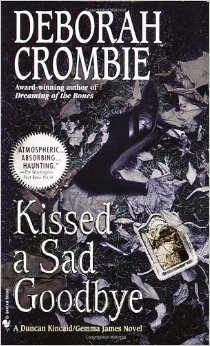
kissed_goodbyeKissed a Sad Goodbye
Duncan and Gemma are assigned to the case of a body found lovingly laid out in a park on the Isle of Dogs. They soon learn her identity—Annabelle Hammond, the beautiful and determined director of Hammond’s Fine Teas who has several lovers on the go. But is what happened to her the result of romantic jealousy, or could it be tied to something else entirely?

Two months have passed since the events of Dreaming of the Bones, and Duncan is still struggling with (spoiler alert!) his newfound fatherhood. The perspective, however, is mostly on Gemma, who is having some trouble figuring out what she wants and who she wants to be. Initially this manifests in a decision to take piano lessons, but soon involves another man.

Honestly, I failed to be convinced by Gemma’s little side romance with Gordon the clarinet-playing busker, who showed up in some earlier book in a greatly diminished capacity. I recall in his earlier appearance that he was brusque and uninterested, but here we get a retcon about how he was secretly intrigued by Gemma all along. It’s played up to be this mutual attraction that she must decide whether to pursue, but he’s just not accessible enough as a character to really make this convincing.

That said, I liked the mystery itself. There were flashbacks throughout to the ’40s, when some of the characters were evacuated to the countryside as children, and they not only elucidate the present but reveal one particular character to be more sympathetic than one might ordinarily assume. On the whole, definitely worth reading, even if there were parts of it I didn’t especially like.

finer_endA Finer End
A Finer End is somewhat tough to review, because I did genuinely like some of the characters that Duncan and Gemma encounter in Glastonbury, where they’ve traveled as a favor to Duncan’s cousin, Jack, whose vicar girlfriend has been injured in a hit-and-run accident. The problem is that Jack has supposedly been receiving messages from a long-dead monk in the form of automatic writing, a claim that Duncan and Gemma accept without question. On top of this, there’s a painter who receives visions not only of one particular little girl but also the whereabouts of the thing that the monk is trying to lead Jack to find. And because the narrative confirms the verity of these paranormal happenings, other elements of the story are thrown into question. Did the “old gods” and the tribute they’re due actually play a part in what happened, for example?

It’s not that I dislike stories about the supernatural; it’s that it’s really bizarre when the supernatural suddenly shows up in the seventh book of a series about Scotland Yard detectives. It also bothered me that the one character who’s a skeptic about all of this is a flagrant asshole who eventually comes unhinged. In addition, I dearly hope that the paternity of a particular child was supposed to be glaringly obvious to the reader, because it sure was. Too, the conclusion is muddled, and the final line was so incredibly cheesy that I actually said, “Barf!” out loud.

All in all, this was profoundly disappointing and I hope it doesn’t signify a new trend for the series.

justice_noneAnd Justice There Is None
It is with profound relief that I proclaim that I really, really liked this one! There are absolutely no supernatural elements whatsoever, thankfully, and the investigation itself is a change of pace, too. Instead of being dispatched to some bucolic locale on Scotland Yard business, a murder is committed in Notting Hill, where Gemma is now assigned as a Detective Inspector. Moreover, she and Duncan and their respective sons move into a house nearby, which puts her family in proximity to the crime and, ultimately, the culprit.

The case involves the wife of a well-off antiques dealer who recently discovered she was pregnant by her lover. Duncan recalls a similar killing that took place a month prior, so he and Gemma work together on the case. Interspersed throughout is the story of “Angel,” a young woman who is orphaned in the mid-sixties and finds herself swept up in the London drug scene. All of the pieces eventually come together, and even though there’s one clue that lets readers know who the murderer is before Gemma has figured it out, she doesn’t end up seeming slow on the uptake. Rather, it adds an extra layer of menace when the perpetrator just happens to be strolling past their new house and has a chat with Kit (Duncan’s son).

And oh, what a house. I love that Gemma and Duncan are establishing their own family, especially given the new addition on the way. I love, too, that the pets are 100% accounted for, and that Gemma adopts a sweet new dog. Best of all, though, is that it’s Christmas. Duncan’s present to Gemma makes both her and me verklempt. I also liked seeing Gemma and Duncan working with other people, and hope that some of the nice people she encountered in the neighborhood make appearances in future books.

Filed Under: Books, Mystery, REVIEWS Tagged With: Deborah Crombie

Ghost Diary, Vol. 1

April 21, 2017 by Sean Gaffney

By Seiju Natsumegu. Released in Japan as “Kaidan Nikki” by ASCII Media Works, serialized in the magazine Dengeki Daioh. Released in North America by Seven Seas. Translated by Krista Shipley, Adapted by Shannon Fay.

For a while now, there has been a war going on in manga, though some may not have noticed it. Here at Manga Bookshelf, though, we pride ourselves on observational skills, and have watched the fallout with much interest. I am referring, of course, to the battle between manga being licensed about yokai and manga being licensed about monster girls. Both seemingly involving the same thing, but in reality these are very different beasts. Monster Girl series, with one or two exceptions, show us various types of creatures living alongside humans in society, while yokai series tend to involve humans investigating said creatures as dangerous and mysterious phenomena. Ghost Diary ran in Dengeki Daioh, so honestly I was expecting the former, but make no mistake about it, this is a relatively serious work, and its dark turns surprised me.

The plot involves a group of high-school occultists who go around searching for mysterious things. That said, most of the club are there to fill out the cast, and the real stars are Kyouichi, a teen exorcists who is haunted by a tragic past, and Mayumi, the standard cardboard cutout tsundere who likes him. Kyouichi’s older sister disappeared after a battle with a yokai that was coming after Kyouichi himself, and he’s vowed to find her. Luckily, he has help. Unluckily, it’s the worst kind of help. Chloe is a grim reaper who seemingly wants to find Kyouichi’s sister as well so she can get her memories back, and offers to help him out when he needs it, to the point of moving into his house. Unfortunately for Kyouichi, Chloe is not going to be one of those quirky mentors you see so often in these sorts of series.

As you may have guessed by my brief snarkiness in the prior paragraph, I wasn’t all that impressed with the love interest in this series, and the rest of the club is also a bit underwhelming (even the shy girl who speaks through her doll has been done better elsewhere, though I admit the overweight yakuza is new). But make no mistake about it, you want to read this manga for the relationship between Kyouichi and Chloe, as she kills his friends (then resurrects them, to be fair), destroys what might otherwise have been a heartwarming chapter about a dead baker who was moved by Kyouichi’s sister, and otherwise behaves like she may be the villain of the series. But she may not be – certainly at times she does behave very much like the mentor she wants to be, and it’s unclear if she’s the antagonist of the whole series or just a horrible creature. I want to see more of her.

This series is not for everyone – the last chapter has some disturbing rape threats from a man trapped in the body of a prepubescent boy – but overall I was pleasantly surprised. This is a dark take on a genre that already gets pretty dark. And it’s only three volumes, so I’m definitely interested in finishing it. Let’s hope that Kyouichi can survive it.

Filed Under: ghost diary, REVIEWS

Manga the Week of 4/26/17

April 20, 2017 by Sean Gaffney, Ash Brown, Anna N and Michelle Smith 1 Comment

SEAN: For a non-Yen final week of the month, this is pretty ridiculously busy.

J-Novel Club has the 2nd volume of The Faraway Paladin, whose first volume I greatly enjoyed. Looking forward to this more serious take on the ‘reincarnated in another world’ genre.

Kodansha has piles of new volumes for fans of their old Del Rey series out digitally. Gakuen Prince 12, Nodame Cantabile 18, Princess Resurrection 12, Pumpkin Scissors 11, and School Rumble 19.

ASH: Oh! Nodame Cantabile! I actually still have the volumes that Del Rey released; glad I’ll be able to finish the series. (Though, as always, I will continue to hope for a print edition, as unlikely as it is.)

SEAN: There’s also new digital volumes of their newer series. The Full-Time Wife Escapist 2, House of the Sun 4, and Peach Heaven 2. Definitely interested in more Wife Escapist, which I really enjoyed.

MICHELLE: Yay for Nodame and House of the Sun and escapee wives!

ANNA: I can’t believe I’m so far behind in digital releases, wait, it it is totally believable. Sounds like I need to check out the Full-Time Wife Escapist for sure.

SEAN: In new digital releases, though you can’t seem to preorder them yet, we have DAYS, another soccer manga from the creator of Over Drive that runs in Weekly Shonen Magazine.

MICHELLE: Being sports manga, I am of course duly excited for DAYS. In fact, I think I’ve now officially lost count of how many sports manga series are being released here.

ASH: I’m enjoying this surprising sports manga renaissance, too!

SEAN: And there’s also Tsurezure Children, a 4-koma romance series from Bessatsu Shonen that deals with a varied cast. It looks cute.

In print Kodansha, we have the 21st volume of Attack on Titan. Will we finally get to that pesky basement of Eren’s dad?

ASH: One of these days, maybe!

SEAN: The 4th and final volume of the Fairy Girls spinoff is out.

And a 4th volume of Happiness.

ASH: I already need to get caught up with Happiness. I’m not especially interested in vampires, but I really liked the first volume.

SEAN: Seven Seas has an 11th volume of D-Frag!. Get your tsukkomi ready!

And also a 12th Devils and Realist.

Magical Girl Apocalypse has somehow made it to 11 volumes, despite all the hate rays coming from my eyes.

And Monster Musume has a Vol. 11 as well.

Mushoku Tensei: Jobless Reincarnation’s 5th volume will satisfy fans of (again) reincarnated in another world series.

And My Monster Secret has a 6th volume. I always look forward to this series.

Vertical has the 3rd and final volume of the Bakemonogatari novels, this one focused on Tsubasa Hanekawa, the bespectacled class president. Fear not, though, Nisemonogatari begins in June.

Vertical Comics has the 8th and I believe final omnibus of Tokyo ESP.

Viz has a digital only debut this week: ēlDLIVE, a shonen sci-fi series from the creator of Reborn! and will likely appeal to fans of same, though I’m not sure if it has as much BL tease as Reborn! did. It’s definitely harder to type, though.

Yen Digital has a 9th Aoharu x Machinegun, and a 10th Corpse Princess.

Lastly, Yen On shuffles out four more volumes of the Spice & Wolf novel series digitally – Books 11-14.

April brought a shower of manga and light novels. What are you getting?

Filed Under: FEATURES, manga the week of

Baccano!: 1932 Drug & The Dominoes

April 20, 2017 by Sean Gaffney

By Ryohgo Narita and Katsumi Enami. Released in Japan by ASCII Mediaworks. Released in North America by Yen On. Translated by Taylor Engel.

This was the final Baccano! light novel that was used in the 2007 anime adaptation, but even if you’ve seen the anime you should read this anyway, as it’s startling how much was left out and how much was changed. The anime needed a little bit more plot to add to its “let’s move back and forth between various time periods” style, and Eve’s subplot seemed to fit the bill. They had little to no use for Roy Maddock and his drug addiction, though, and so he was completely eliminated. Which is a shame, as while I have little use for Roy himself, who is not as interesting as virtually everyone else in this book, his girlfriend Edith is awesome, and having Roy also means we meet Kate Gandor, Keith’s wife – and actually hear Keith speak more than a few lines of dialogue!

Eve Genoard, younger sister to ne’er-do-well Dallas, is front and center on the cover, and I’d wager that she gets to have the hero’s journey here – as I said before, Roy is a bit too flat for me to really grant that to him. You could argue that Luck Gandor may also qualify – he’s worrying that he’s lost an essential humanity since becoming immortal, and it’s through dealing with Eve and the Runoratas that he comes to accept who he is now and realize that he hasn’t changed as much as he thought. He’s certainly unrepentant about what he did to Dallas – who, let’s remember, killed several men in the Gandor mafia clan – but he allows Eve a chance to possibly rescue Dallas from his watery grave. (Luck wonders why he was so soft-hearted, which is hilarious given that earlier in the book, all three Gandors were terrified about the idea of having to punish a woman, mafia-style, for betrayal – they end up giving her a haircut.)

This happens right after the last two books – in fact, the first third of it actually happens before the last two books, as it begins in late December 1931 and ends in early January 1932. And we do see characters from the previous books. Isaac and Miria have a smaller role than usual, but it’s their theft of the Gandor Family Fortune which sets most of this in motion, and their obsession with dominoes that gives us some more comedy, though I think it’s REALLY OBVIOUS that Narita only added that plot so he could use the title, which comes from Eric Clapton’s band Derek and the Dominoes. Firo spends most of the book grumbling and whining, which seems a bit out of character for him. And we also see a few people who look like they’re being introduced for future books, such as Tick, the Gandor family’s smiling torture specialist, and Maria, a walking Mexican stereotype who can’t stop saying “amigo” but who is a lot of fun anyway. The Daily Days also get a lot more here to do than usual, and the one morally dubious guy of their bunch gets his after a ride on the Rail Tracer express (not lethal, for once).

That said, the book ends with a sort of tragedy, and it involves another immortal who appears throughout the book – Begg, who seems to have been one of Maiza’s group who became immortal back in 1711. He’s now the Runorata family drug expert, and spends his years trying to perfect a drug that will make everyone live in their own happy world, with no problems or worries. Given the halting, jittery way he speaks, you get the feeling he’s tested a lot of drugs on himself. And, despite an attempt at a heartwarming scene with Czeslaw (which is also rife with foreshadowing), in the end we see him at the start of the 21st century, burned out in an institution, barely able to respond to Maiza. Immortals may live forever, but they can still damage their mind, and it’s sad to see, even if you question the entire premise of what Begg wanted to achieve.

All in all, a good addition to the series, with lots of fun stuff happening, though I don’t think it hits the heights of Book 2. Next time we’ll move forward a bit – quite a bit – and see what the cast is up to in 2001.

Filed Under: baccano!, REVIEWS

Yona of the Dawn, Vol. 5

April 18, 2017 by Sean Gaffney

By Mizuho Kusanagi. Released in Japan as “Akatsuki no Yona” by Hakusensha, serialization ongoing in the magazine Hana to Yume. Released in North America by Viz. Translated by JN Productions, Adapted by Ysabet Reinhardt MacFarlane.

In general, I’m always a bit wary of ‘chosen one’ narratives, which Yona of the Dawn is shaping up into being. The difficulty is striking a balance between following the chosen one because you know they will be a good person who can change the world, and following the chosen one out of a literal compulsion you can’t control that draws you to them. Yona of the Dawn tries to have this both ways, and I like that the new Dragon, Jaeha, is reluctant to follow his supposed destiny, being very happy being what he is, which is a showboating, girl-loving pirate with the classic Hana to Yume “sleepy eyes”. Of course, this is still a shoujo manga, and thus the cliffhanger has him running into Yona and immediately his heart skips a beat, because of course it does – if you’re going to write romance cliches, do them properly.

Meanwhile, as predicted, the Blue Dragon decides to come with them, and even gets named by Yona, who is, of course, still the Chosen One but balances this out by being caring and loving and sweet and nice, etc. Names turn out to be pretty important in this book, as the male cast who aren’t Hak gradually start to call Yona by her first name. Hak is an exception, though, and this is the best scene in the volume, as Yona tells him the reasons that she wants him to still call her “your highness” and treat her as royalty. It’s so that they don’t forget her father or what he did. This is immediately followed up with the heartbreaking revelation that most people in the country seem to regard the late King with contempt as a terrible King, much to Yona’s distress. (In reality, putting the distance between her and Hak may be authorial fiat – let’s face it, this is a reverse harem manga with an obvious endgame, and it’s best to delay it as much as possible.)

Most of this volume is, of course, the standard quest, as Yona and company continue wandering the land hunting for Dragon Warriors. This means that they have to stop and fight injustice whenever they can, of course, even if they’re supposed to keep a low profile (Yona’s red hair really does not help with stealth missions). The humor in this book is fairly predictable, mostly revolving around Hak’s inability to practice what he preaches, and everyone (including Yona) seeming to think that he spent time in a brothel, much to his frustration. Jaeha looks like an excellent addition to the cast, balancing nicely with the other guys’ personalities. This of course assumes that he does join the main cast, and I suspect the next volume will show us Yona trying to convince him of the righteousness of her cause.

In the end, this is another top-notch volume of Yona of the Dawn, which continues to be one of Shojo Beat’s best series.

Filed Under: REVIEWS, yona of the dawn

Bookshelf Briefs 4/17/17

April 17, 2017 by Michelle Smith and Sean Gaffney Leave a Comment

The Demon Prince of Momochi House, Vol. 8 | By Aya Shouoto | VIZ Media – Even though they both involve a girl with modest spiritual powers and a sexy, white-haired, fox-eared ayakashi guy, The Demon Prince of Momochi House is quite a distinct entity from Kamisama Kiss. That said, this volume’s plotline is somewhat reminiscent, as Himari goes in search of Aoi’s past in order to help him with a present predicament. What she finds out is quite sad, as readers likely expected, but the part I liked the best was when she was presented with the choice to either delve into Aoi’s past or her own. After indulging in a single pang for the things she was passing up, she chooses Aoi without hesitation. I always seem to say that this is Shouto’s best series by far, but it continues to be true. – Michelle Smith

Domestic Girlfriend, Vol. 1 | By Kei Sasuga | Kodansha Comics (digital only) – This manga begins with the hero losing his virginity to a girl he just met, a somewhat unusual start for a romantic drama. Said hero, Natsuo, has a crush on his young teacher, and hopes this might get it out of his system. He then finds out that his father is remarrying, and the new wife is bringing along her two daughters. If you guessed the girl he slept with, one point, but you get ten points if you guessed that the teacher is ALSO now part of his family. And so begins a torrid soap opera of a manga. I found it worked best when not focused on the romance—Natsuo’s attempts to help stoic Rui make friends was hilarious, as was his dramatization of two people having an affair. A decent start, recommended for those who like more mature titles. – Sean Gaffney

Kuroko’s Basketball, Vols. 9-10 | By Tadatoshi Fujimaki | Viz Media – There’s a lot of character development in this omnibus—everyone’s trying to improve, even Kuroko, who’s practicing a secret move. We also get even more new characters, one of whom thankfully has long hair so I can easily pick him out from all of the crew-cut guys in this series. The sports manga cliches are all present and correct, but they’re well done—one of the best ways to tell a sports manga is exceptional is that you care equally whether they’re in a game or not. The game provides the cliffhanger, though, as Seirin gets a rematch with Shutoku and we find out that Midorima has been working on improving as well. Each volume seems to coincide with a desperate cliffhanger—bring on the next one. – Sean Gaffney

Magi: The Labyrinth of Magic, Vol. 23 | By Shinobu Ohtaka | Viz Media – I knew we’d get more flashback here, but I wasn’t aware it would take up all of this volume (and presumably some of the next). In addition to hooking up Solomon and Sheba (who no doubt have Aladdin as their child), a romance that is honestly a bit rushed and underdeveloped, we also get discussion of the difference between a strong leader who rules with the will of the people and a king who rules by fiat. Solomon wants to avoid becoming power mad, a good lesson to learn, and is not being helped by everyone asking him to essentially be their chosen one. Meanwhile, David is still around, and not quite dead. A lot of good stuff, and even a bit of humor, but I’m wanting to get back to our main cast. – Sean Gaffney

Magi: The Labyrinth of Magic, Vol. 23 | By Shinobu Ohtaka | VIZ Media – Aladdin’s tale of the fate of Alma Tran continues. Solomon was the son of King David, an arrogant and authoritarian ruler, and desperately did not want to become like him. He strove to unite all species, aided by several faithful companions, including powerful magician girl named Sheba who falls in love with him. In time, he ends up reluctantly accepting the mantle of kinghood, and fathers a child with Sheba who I am assuming will turn out to be Aladdin. It’s not that it isn’t a compelling story, but it drags in spots when delving into deep discussions of rukh, and it still isn’t over, as the volume ends on a cliffhanger. I continue to be impressed with how complex Magi is for a shounen manga, but this might be a better volume to read when you’ve got the next one handy. – Michelle Smith

Pandora in the Crimson Shell: Ghost Urn, Vol. 7 | By Shirow Masamune and Rikudou Koushi | Seven Seas – Lots of action this time round means less wacky fanservice comedy, though there is an “activation” sequence, and the villain finds that opening what he thinks is the final firewall to what he wants merely uploads Buer’s upskirt pics to the entire world. Fortunately, most of it really is the cool action sequences, which are reasonably well done and clever, and show strong heroes and easy-to-hate villains. Lots of amusing cameos as well—in addition to Kabapu and his secretary as always, I saw “Sader” at one point, as well as Tatsuya and Miyuki from Mahouka. Pandora will always be a combination of mecha (Shirow), fanservice (both authors), and whatever the heck Rikdou wants to do. Pandora is Pandora. – Sean Gaffney

Filed Under: Bookshelf Briefs

Toppu GP, Vol. 1

April 17, 2017 by Katherine Dacey

In a week when The Fate of the Furious is roaring into theaters, it seems only fitting that Kodansha is releasing the first volume of Toppu GP, a manga that extols the virtues of “family values and hot rides” almost as doggedly as Vin Diesel and the rest of his car-boosting gang. The similarities don’t end there, either: both series boast cartoonish villains, pretty girls in skimpy outfits, and dialogue so ham-fisted you could serve it for Easter dinner.

I love them both.

The “family” unit in Toppu GP consists of Toppu, the eleven-year-old hero; Myne, the local motorcycle racing champion; and Teppei, Toppu’s father. Toppu is a classic shonen type: he’s sullen, brilliant, and reluctant to try anything outside of his nerdy comfort zone. (He likes to build elaborate Gundam models.) There are hints, however, that Toppu is destined for the track: he accurately gauges Myne’s qualifying times without benefit of a stopwatch, for example, and instinctually rides to victory in his second race by copying Myne’s technique.

Myne, too, is a familiar type, the sexy “big sister” who squeals and fusses over a smart, promising boy a few years her junior. (Toppu even calls her “Big Sis,” emphasizing the degree to which she’s part of his “family.”) She strides around in a tight-fitting tracksuit dispensing advice and hugs to her protege, goading him to victory with bribes. And just in case we find her more competent than adorable, she suffers from one of those only-in-manga ailments: pathological clumsiness so acute it strains credulity.

The third family member is Teppei, a single parent who’s raising Toppu while writing a novel. Though Teppei professes to be working hard on his book, his actions suggest he’d rather hang out at the track than sit at a typewriter; he spends most of volume one playing coach and mechanic to his kids, dispensing wisdom about the art of motorcycle racing. Dad’s editor must be a forgiving guy.

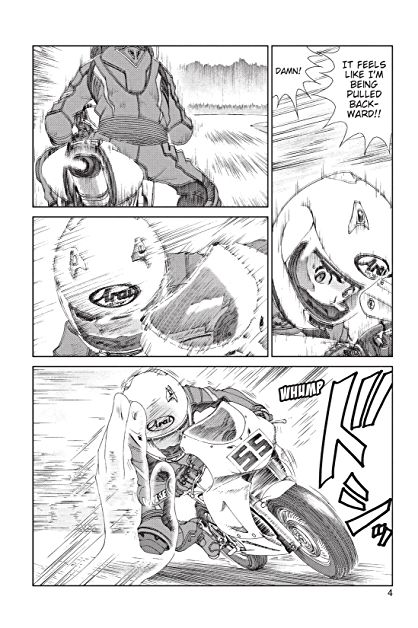
In contrast to the characters, who are painted in broad strokes, the layouts are executed with thrilling precision. Veteran artist Kosuke Fujishima drops us into the action through deft use of perspective and speedlines, capturing the bikes’ velocity and the riders’ positions, as well as the sheer danger of high-speed maneuvers in close proximity. Fujishima complements these images with a handy primer on G-forces, using an invisible hand to show us what Toppu and Myne feel when they accelerate down a straightaway or bank a sharp turn at high speed:

Perhaps the most astonishing aspect of Fujishima’s layouts are their economy. While many shonen artists might be tempted to stretch Toppu’s racing debut over several chapters, Fujishima uses just a handful of panels to show us how Toppu succumbs to the pleasures of competition. This transformation is bookended by two closeups, the first of Toppu’s terrified face as he pulls back on the throttle for the first time, and the second of Toppu’s gleaming eyes as he completes his final lap of the track. We see just enough action between these two panels to grasp the disparity between how quickly the race is unfolding and how slowly time passes for Toppu as he struggles to gain control of the bike, snapping back to “real” time only when Toppu realizes just how much he’s enjoying himself.

In a nod toward gender parity, Fujishima dedicates an entire chapter to showcasing Myne’s tenacity on the track as well. Though Fujishima employs many of the same strategies for immersing us in Myne’s race as he does Toppu’s, Fujishima periodically interrupts the competition with goofy, arresting images of Myne as a tracksuit wearing, sword-wielding avenger and a fiery, Medusa-haired biker. These fleeting visions are a nice bit of comic relief, echoing iconic scenes from Kill Bill and Ghost Rider, but they serve an equally important purpose: showing us how Myne’s rivals see her in competition.

As dazzling as these racing sequences are, I’d be the first to admit that the familial banter between Myne, Toppu, and Teppei feels as perfunctory as the dastardly scheming of the the Niimi brothers, the series’ first villains. (They resent Toppu’s meteoric rise in the standings and want to put him in his place.) The dialogue, too, often veers into the faintly pompous, with characters declaring how much they love “the roar of the exhaust pipe,” “the smell of burning gas and oil,” and “the gaze of the crowd” when they’re at “home.” But when Toppu or Myne jump on their bikes, the series shifts into high gear, offering the same kind of thrills as The Fate of the Furious: fast rides, fierce competition, and the ever-present threat of crashing. Recommended.

A word about buying Toppu GP: Kodansha is simultaneously publishing Toppu GP with the Japanese edition; readers can purchase new installments through Amazon and ComiXology on a weekly basis. Folks who prefer print will find the first volume available in stores now, with volume two to follow in September.

TOPPU GP, VOL. 1 • BY KOSUKE FUJISHIMA • KODANSHA COMICS • RATED T, FOR TEENS (13+)


Filed Under: Manga, Manga Critic, REVIEWS Tagged With: Kodansha Comics, Kosuke Fujishima, Moto GP, Shonen

  • « Go to Previous Page
  • Page 1
  • Interim pages omitted …
  • Page 435
  • Page 436
  • Page 437
  • Page 438
  • Page 439
  • Interim pages omitted …
  • Page 1048
  • Go to Next Page »
 | Log in
Copyright © 2010 Manga Bookshelf | Powered by WordPress & the Genesis Framework