• Skip to primary navigation
  • Skip to main content
  • Skip to primary sidebar
  • Home
  • About Us
    • Privacy Policy
    • Comment Policy
    • Disclosures & Disclaimers
  • Resources
    • Links, Essays & Articles
    • Fandomology!
    • CLAMP Directory
    • BlogRoll
  • Features & Columns
    • 3 Things Thursday
    • Adventures in the Key of Shoujo
    • Bit & Blips (game reviews)
    • BL BOOKRACK
    • Bookshelf Briefs
    • Bringing the Drama
    • Comic Conversion
    • Fanservice Friday
    • Going Digital
    • It Came From the Sinosphere
    • License This!
    • Magazine no Mori
    • My Week in Manga
    • OFF THE SHELF
    • Not By Manga Alone
    • PICK OF THE WEEK
    • Subtitles & Sensibility
    • Weekly Shonen Jump Recaps
  • Manga Moveable Feast
    • MMF Full Archive
    • Yun Kouga
    • CLAMP
    • Shojo Beat
    • Osamu Tezuka
    • Sailor Moon
    • Fruits Basket
    • Takehiko Inoue
    • Wild Adapter
    • One Piece
    • After School Nightmare
    • Karakuri Odette
    • Paradise Kiss
    • The Color Trilogy
    • To Terra…
    • Sexy Voice & Robo
  • Browse by Author
    • Sean Gaffney
    • Anna Neatrour
    • Michelle Smith
    • Katherine Dacey
    • MJ
    • Brigid Alverson
    • Travis Anderson
    • Phillip Anthony
    • Derek Bown
    • Jaci Dahlvang
    • Angela Eastman
    • Erica Friedman
    • Sara K.
    • Megan Purdy
    • Emily Snodgrass
    • Nancy Thistlethwaite
    • Eva Volin
    • David Welsh
  • MB Blogs
    • A Case Suitable For Treatment
    • Experiments in Manga
    • MangaBlog
    • The Manga Critic
    • Manga Report
    • Soliloquy in Blue
    • Manga Curmudgeon (archive)

Manga Bookshelf

Discussion, Resources, Roundtables, & Reviews

Blog

The Faraway Paladin: The Archer of Beast Woods

May 6, 2017 by Sean Gaffney

By Kanata Yanagino and Kususaga Rin. Released in Japan as “Saihate no Paladin” by Overlap. Released in North America digitally by J-Novel Club. Translated by James Rushton.

I’d mentioned in my review of this first volume of this series that it had more of a high fantasy feel to it than a light novel feel, and that continues in the second volume, which sees William making his way back to civilization and discovering what said civilization actually is. (Also as I said in the first volume review, the fact that he’s a reincarnated Japanese guy is completely irrelevant to the story. I suspect it was added in order to draw in fans of that genre.) He immediately runs into the character we see on the cover page (and in the title), a half-elf who is both bemused and amazed at Will’s combination of superpowers and stunning naivete. In fact, mentioning superpowers, I am reminded of what Will feels like in this second book. He feels like Superman.
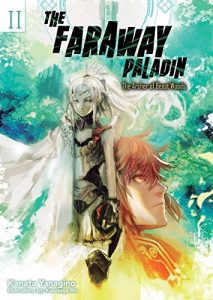
There are, obviously, a lot more characters in this book than the last one, as Will and Menel are going around saving villages, battling monsters, and meeting up with Antonio from Shakespeare’s Twelfth Night, who I was rather surprised to find in the middle of a light novel. (It gets even worse later in the book when Bishop Beesley from Michael Moorcock’s Cornelius series arrives, though thankfully this is a less evil version.) It helpfully shows off how bad Will can be at not only actual human interaction, but understanding consequences in this new world – he needs to be bailed out several times by his companions. Fortunately he’s aware of this, as he keeps worrying about social ostracism, but that doesn’t make him any less bad at it. His pureheartedness may also remind the reader of Dudley Do-Right at times.

The writing on this book continues to be excellent, with the better scenes towards the back half of the book. William has a bit of a breakdown near the end as he realizes the distance between himself and his colleagues, and the way that we get to see this happen from his narrative point of view and scream “no, stop, you’re being an idiot!” is really well done. Luckily, he is stopped for being an idiot, and other characters get to show off that just because he’s super pure and strong does not always mean he saves the day – cunning and experience still has its place. There’s also a bit more humor this time around as well, mostly due to a) Will’s po-faced reaction to things, b) Menel being a massive tsundere; and c) the presence of Bee, a hobbit (in all but name) who regales everyone with song and stories. This also leads to the most touching moment in the book, where she narrates an epic song that turns out to be about Blood, Mary, and Gus – Will is so happy they weren’t forgotten he starts to cry.

In the end, this remains a very good fantasy novel, with a distinct lack of harems, little sisters, or other light novel cliches, and the main character’s overpowered nature is balanced out enough in the text that I don’t think it matters. To me, this remains the J-Novel Club release to read for those who don’t like J-Novel Club releases. That said, we’re almost caught up with Japan, so I’m not sure when the next release will be.

Filed Under: faraway paladin, REVIEWS

Manga the Week of 5/10/17

May 6, 2017 by Sean Gaffney, Ash Brown, Anna N, Michelle Smith and MJ Leave a Comment

SEAN: 2nd week, and things are popping. What’s coming down the pike?

Dark Horse has the debut of another comedic gag Evangelion manga, this one called Legend of the Piko Piko Middle School Students.

It also has the 3rd omnibus of its slice-of-life dumb-it-down Evangelion manga, The Shinji Ikari Raising Project.

ASH: Though I’ve seen the original anime series, I’ve never actually read any of the Evangelion manga.

ANNA: Me too.

SEAN: J-Novel Club has another debut, Bluesteel Blasphemer. Yes, it’s another “transported to a fantasy world” series, but this one has guns, and it’s by the author of Chaika the Coffin Princess.

And a 2nd volume of the popular title How a Realist Hero Rebuilt the Kingdom. Will they go to war?

Del Rey catchups are mostly taking the week off, but we do get a 13th Princess Resurrection.

There is still plenty of new Kodansha Digital, though, as we have Ace of the Diamond 3, Domestic Girlfriend 2, House of the Sun 5, *and* Tokyo Tarareba Girls 3!

MICHELLE: Yay for 75% of those!

ANNA: I am glad these are all out and sad I am so far behind in my reading!!!

SEAN: In print, we have the 10th volume of Genshiken 2nd Season. Will we finally resolve Madarame’s endless harem issues?

And a 4th In/Spectre, which promises to take a turn back towards the grim.

Interviews with Monster Girls 4 will hopefully be less grim, despite also featuring yokai.

One last Kodansha Digital title, which I mention only as it’s a series I never noticed began sometime last year. Unlimited Fafnir ran in good! Afternoon, and this is the 4th and final volume. It’s a light novel adaptation.

Seven Seas has a 3rd volume of Miss Kobayashi’s Dragon Maid, which has quite a following now that the anime’s done.

ASH: I enjoyed the first volume much more than I thought I would.

SEAN: And a 2nd There’s a Demon Lord on the Floor.

SuBLime has a 4th volume of not-boxing manga Ten Count.

ASH: Nope, definitely not boxing. The series actually comes across to me as dark, psychological horror more than anything else right now.

ANNA: The first couple volumes that I read were pretty grim.

MJ: Oh, Ten Count… I never really made it past volume two.

MICHELLE: I made it to volume three, but I’m really done now.

SEAN: People, people, it’s supposed to be a TEN count.

Vertical Comics gives us a 9th volume of My Neighbor Seki, which always makes me smile.

ASH: Me, too! :)

SEAN: A fourth Legendary Edition for The Legend of Zelda, this one has The Minish Cap and Phantom Hourglass.

Lastly, there’s a 6th volume of Requiem of the Rose King, and I can hear everyone in Manga Bookshelf breathe a sigh of relief. Also, shouldn’t Henry be dead soon?

ASH: I love this series so much!

ANNA: Yay!!!

MJ: This! Always! THIS!!!!

SEAN: It’s Mother’s Day next week! Which of these titles would you buy for your mother?

Filed Under: FEATURES, manga the week of

My Brother’s Husband, Vol. 1

May 5, 2017 by Sean Gaffney

By Gengoroh Tagame. Released in Japan in two separate volumes by Futabasha, serialized in the magazine Gekkan Action. Released in North America by Pantheon Books. Translated by Anne Ishii.

This has been a book I’ve been waiting to see for a long time. I was at last year’s TCAF panel with the author, where he discussed his works and the challenges of a serialization like this one. It has since finished (at four volumes, meaning there will be one more omnibus), and this first omnibus is a handsome hardvoer with great reproduction and quality translation. But most importantly, the story and art are top notch. Fans of Gengoroh Tagame who know him for his Bara work (n.b. – Bara is gay manga, as opposed to yaoi/BL, whose primary audience is women) will love this, and those who aren’t into the gay bondage thing but want a good story about sexuality, grief, loss, and the intermingling of the three will also be delighted with this story.

The story deals with Yaichi, a single man raising his young daughter Kana. He’s a twin, and his twin brother has recently passed away. His twin brother was also gay, and his husband, a Canadian man named Mike, has come to visit Yaichi. What follows is partly slice-of-life – they go to visit places in the town, they make breakfast, they go to a gym – but there’s a lot more to it. Yaichi has inbuilt “ew, gay” prejudices that can’t simply be shrugged off, even if he is basically a nice guy at heart. Moreover, having a gay man living openly in their household is starting to make the neighbors talk, and the talk isn’t good. That said, Yaichi knows how he should be behaving despite his prejudices, and Kana simply adores Mike. As for Mike, he’s seemingly a happy-go-lucky guy, but is still dealing with grief over the loss of his husband, which is not helped by Yaichi being his identical twin.

My favorite thing about this release is how well the art and story complement each other. Tagame’s characters have amazing expressions, sometimes written all over their face (Yaichi), and sometimes seemingly poker-faced, but always drawn in a way that you know just what they’re thinking. The start of the story has an artistic conceit where the top half of a page has Yaichi acting out his (homophobic) thoughts, while the bottom half has the reality of his reserved Japanese response. I wasn’t expecting Yaichi to be as likeable as he is – yes, he’s a bit creeped out by the idea of Mike being gay at first, mostly due to how it ties into his brother, but he’s also prioritized being a good dad to his kid. (Taichi’s ex-wife shows up at one point – leading to a very funny reaction from Mike, who assumed she was dead by the photos in the house – and they get on quite well despite being divorced – it’s implied they broke up as she’s devoted to her work more than anything else.)

Mike can sometimes be a cipher, but that goes away as the book progresses, and we realize just how much he’s dealing with (and repressing, to a certain extent) his loss. His relationship with Kana is fantastic, as she’s constantly curious and trying to figure out things that adults haven’t really explained properly. And while some in the neighborhood call him a “negative influence”, that goes the other way as well, as he’s able to advise a young teen who comes to him and reveals that he’s gay. (This is right at the end of the volume, and I worry it may lead to bad things next time – I hope not, but the drama has been very low key so far.) And, as I said before, Tagame’s art is just terrific, giving added depth to characters just from a knowing look or a stressed out sigh.

To sum up, this book is simply compulsively readable, with its sole flaw being that we don’t know the date for the next volume yet. I was expecting to enjoy the series, but I was amazed at how much I enjoyed it, and how great all the characters were. And “being a gay foreigner in Japan” is treated just right. An absolute must-read.

Filed Under: my brother's husband, REVIEWS

Everyone’s Getting Married, Vol. 5

May 4, 2017 by Anna N

I still very much enjoy Everyone’s Getting Married, but this volume was a little bit of a letdown, mostly because I’m not terribly fond of the way the “suddenly a rival appears!” storyline is being executed.

At the end of the last volume Kamiya, a work colleague of Asuka’s decided that she would be his ideal wife. He was not put off by the fact that she’s dating Ryu, and Kamiya’s persistence was one of the most annoying things about this volume, even though he did bring up some good and rational points about Asuka and Ryu’s counterproductive relationship. Asuka is mostly reduced to a bargaining chip between the men, and her actions are a little bit too passive, although I suppose it is an accurate portrayal of where a woman might end up when she has been thoroughly socialized to be nice all the time. The volume opens with Ryu and Kamiya getting a drink together, and even though Ryu warns Kamiya to stop his pursuit of Asuka, Kamiya is undeterred, pointing out the futility of a relationship where one person wants to get married and the other is set against it. Kamiya is convinced that the couple will eventually break up, and when that happens he will be there, ready to scoop up Asuka and take advantage of her innate intelligence and competence to have the supportive live partner of his dreams.

Kamiya proceeds to both threaten and manipulate Asuka into spending time with him, and I started feeling very annoyed that Asuka was so passive that she got thrown into situations with Kamiya when she didn’t really want to spend time with him. Ryu and Asuka always do reaffirm their relationship, and a brief trip away with a break from work serves to smooth things over. One of the reasons why this manga is so interesting to read is the fact that either one of the main characters is going to have to fundamentally change, or they will have to break up, and that dramatic tension is intriguing. This volume felt like a bit more of a placeholder, and I hope there’s a more satisfying story in the next volume.

Filed Under: Manga Reviews, REVIEWS Tagged With: everyone's getting married, Josei, shojo beat, viz media

Several from Seven Seas

May 4, 2017 by Michelle Smith

In the past couple of months, Seven Seas has published several new releases of interest to me!

Bloom Into You, Vol. 1 by Nakatani Nio
Koito Yuu has just begun her first year of high school. Pressured by her friends to participate in club activities, she ends up assisting the student council, where she meets elegant second-year student Nanami Touko. Yuu has been trying to figure out how to reply to the male friend who confessed his love for her at their middle school graduation, and when she overhears Touko rejecting a confession with the words “I don’t intend to go out with anyone, no matter who asks me,” she thinks she’s found someone who’ll understand how she feels.

Or, rather, doesn’t feel. Yuu wants to experience a soaring, sparkly love like she reads about in manga. She tried, but she couldn’t, and with Touko’s support, she’s finally able to let the guy down. What she isn’t prepared for is for Touko to reveal that they’re not alike after all because “I think I might be falling in love with you.”

At first, I was annoyed by Touko’s declaration. It was too soon; it felt unearned. However, the more we get to know her, as Yuu spends more time with her while working as her campaign manager for student elections, it becomes clear that Touko has devoted a lot of time and effort into projecting an image that isn’t really her. She wanted to be special, and now she must maintain that perfect facade. Around everyone, that is, except Yuu, who is seemingly incapable of finding anyone special. For you see, Yuu doesn’t feel anything when Touko confesses either, nor when the other girl steals her first kiss. She’s not excited, and she’s not upset. She feels nothing. I actually began to wonder… has she suffered some kind of deep, psychological trauma?

I like both Yuu and Touko, I like the Maria-sama ga Miteru sort of atmosphere, I like Yuu’s continued detachment, and I have high hopes for how this story might unfold going forward.

Bloom Into You is ongoing in Japan, where three volumes have been released so far. Volume two comes out in English on May 16th.

The Girl from the Other Side: Siúil, a Rún, Vol. 1 by Nagabe
It doesn’t happen all that often that I read something and conclude, “This is a five-star manga that everyone should read.” So, please keep that in mind when I say… This is a five-star manga that everyone should read.

The back cover blurb sets up the tone of the series marvelously, so I’m going to quote it. “In a land far away, there were two kingdoms: the Outside, where twisted beasts roamed that could curse with a touch, and the Inside, where humans lived in safety and peace. The girl and the beast should never have met, but when they do, a quiet fairytale begins.”

I knew I’d adore this series the moment a black-as-pitch creature approaches a little girl who’s snoozing unaware and instead of menacing her, he scolds her for wandering off. Indeed, the creature—whom Shiva, the little girl, refers to as “Teacher”—is gentle, gentlemanly, and valiant, protecting Shiva both physically (when paranoid human soldiers think she must be cursed and try to kill her) and mentally (by shielding her from the truth that she has been abandoned). He also possesses medical knowledge but forgot that he told Shiva he’d been a doctor. Was he once human himself? His concern for Shiva radiates from him—I was particularly struck by a panel depicting his fists clenched in worry—and I love him deeply.

While humans and their fear are one threat, we’re introduced to another at the end of the volume, making for a chilling cliffhanger. I can’t wait for volume two of this lovely and captivating series!

The Girl from the Other Side is ongoing in Japan, where three volumes have been released so far. Volume two comes out in English on May 16th.

Kase-san and Morning Glories by Hiromi Takashima
Kase-san and… is a series that is technically comprised of a succession of one-shot stories. This first volume, entitled Kase-san and Morning Glories, includes the title story as well as interludes like “Kase-san and the Bicycle,” “Kase-san and Sneakers,” and “Kase-san and the Spring Breeze.”

Yamada doesn’t fit in with her classmates well. Though she has noticed popular Kase-san, the boyish star of the track team, she never thought she was on the other girl’s radar. But it turns out that Kase-san admired Yamada’s dedication to the thankless task of weeding the school grounds. The girls eventually start hanging out together and it isn’t long before Yamada is having Feelings with a capital “F.” There ensues the typical angst about “but she’s a girl.”

There are a couple of other moments that I’ve seen elsewhere, too—an indirect kiss via a shared thermos, the first real kiss in the nurse’s office—and it’s certainly fluffy and insubstantial, but it’s still really cute. The art style is pleasant, and I wonder whether Yamada’s friend—who warns her about Kase dating girls—might provide some drama down the road. In any case, I’m on board for the next volume.

Kase-san and… is ongoing in Japan, where three volumes have been released so far. The second, Kase-san and Bento, comes out in English on May 23rd.

Kindred Spirits on the Roof: The Complete Collection by Hachi Ito, Aya Fumio, Toitentsu, and Liar-Soft

I was initially under the mistaken impression that the manga version of Kindred Spirits on the Roof was a retelling of the storyline from the yuri visual novel. Instead, it focuses on new girls attending Kokono-Tsuboshi Girls’ Academy of Commerce with some of the original couples returning as side characters or cameos.

In side A, written and illustrated by Hachi Ito, we are introduced to shy Shiina Shiori, who is in the art club. She comes out of her shell a bit while helping to create scenery for the play her class is putting on for the school festival, and by the end of the volume—after much dithering and conversations about “what does it feel like to love someone?”—has decided to stop running away from the feelings of her childhood friend, Kanda Mako. The moment where they become a couple is the only time the original kindred spirits are glimpsed, buy they don’t do or say anything.

Side B, written by Toitensu and illustrated by Aya Fumio, has a little more meat on its bones, but only just. Hase Chiharu and Ichiyama Tokino are fans of “friendly girls,” and decide to join the quiz club so that they can squee over the relationship between their sempai, Tomoe Natsuki and Sasaki Rika. They endeavor to help cool Sasaki admit to her feelings, and there is, of course, the implication that they themselves will form a couple someday. There were very brief glimpses of the girls at their quiz tournaments, but it was very far from being the focus of the story.

Ultimately, I didn’t hate Kindred Spirits on the Roof. It’s sweet and not lecherous. But it’s also a very frothy concoction without much depth. I can’t see myself ever desiring to reread it.

Kindred Spirits on the Roof is complete in two volumes.

Review copies for Kase-san and Morning Glories and Kindred Spirits on the Roof provided by the publisher.

Filed Under: Girls' Love, Manga, REVIEWS, Shounen, Supernatural

Rokka: Braves of the Six Flowers, Vol. 1

May 4, 2017 by Sean Gaffney

By Ishio Yamagata and Miyagi. Released in Japan by Shueisha. Released in North America by Yen Press. Translated by Jennifer Ward.

(contains mild spoilers for the end of the novel, meaning I don’t use the guilty party’s name but still make it obvious who they are)

For a book that is supposed to be about the gathering of six warriors to traverse the country and defeat the evil demon lord, there’s surprisingly little fighting of demonic creatures in this first volume of Rokka (which is the one that was adapted into an anime). The reason for that is fairly simple; there’s actually seven brave warriors who show up, and thus one of them is a fake. What follows is pure mystery, as we spend time gathering clues, suspecting other people, and watching our hero get the ever-loving crap beaten out of him by the rest of the cast. Fortunately, as he tells us constantly, he’s the Strongest Man In The world, so he can take it. All of this, plus the series’ rather abstract art, makes it a nice change of pace in the ‘swords and dragons’ novels we’ve seen so much of in light novels lately.

Adlet is the aforementioned Strongest Man, and is very much your prototypical shonen manga protagonist, being filled with confidence, pluck and a burgeoning optimism. He is joined by an eccentric princess and her sullen bodyguard; a cheerful yet immoral child who can control Earth (think Toph but slightly evil); a serious-minded priestess; a big, seemingly goofy cat-eared assassin; and the girl on the cover, Fremy, who is stoic and suffering and also half-fiend, which makes her everyone’s natural suspect as the seventh evil Brave. She isn’t, of course, but she is a bundle of complexes, and seeing her and the eternally perky Adlet banter and flirt is one of the high points of this book. The action is also well-told, showing off everyone’s abilities and superhuman strength and endurance, though honestly Adlet’s endurance stretches disbelief a bit by the end.

If there’s a flaw in the book it’s the actual mystery itself. It wasn’t too obvious, at least not for me, but I don’t think we had enough development of the character for it to really make an impact, especially given that the character is supposed to be somewhat schizophrenic to begin with. (Actually, the ‘I am a gadfly with no real sense of how to actually behave’ made them my favorite character for a bit, though it goes away when everyone has to act seriously and track down the mole.) It’s unclear whether we’ll see them again, and the cliffhanger is very much a “The End… OR IS IT?” situation, as we get ANOTHER Brave showing up late meaning there’s ANOTHER mole among them. That promises to be the main plot of book 2.

But overall I enjoyed myself reading it, though at times the back and forth betrayal accusations can get to be a bit much. It’s a serious book, but not as dour as some other light novels in this genre; you don’t get the sense that their lives will be terrible forever, even though they’re going to battle the Evil God. If you enjoy light novel fantasies, especially ones that aren’t ‘sent from another world’ sorts, this should meet your expectations.

Filed Under: REVIEWS, rokka: braves of the six flowers

Manga Giveaway: Queen Emeraldas Giveaway Winner

May 3, 2017 by Ash Brown

Queen Emeraldas, Volume 1And the winner of the Queen Emeraldas manga giveaway is… Sofia!

As the winner, Sofia will be receiving a copy of the first volume of Leiji Matsumoto’s Queen Emeraldas as published in English (and in hardcover!) by Kodansha Comics. Queen Emeraldas is a relatively recent example of a manga released in translation that is set in space. I happen to be rather fond of stories with space settings and so for this giveaway I asked that participants tell me a little about their favorite space manga. Check out below for a list of manga, but everyone’s detailed responses can be found in the giveaway comments.

Some of the manga with space settings released in print in English:
2001 Nights by Yukinobu Hoshino
A, A′ by Moto Hagio
Astra Lost in Space by Kenta Shinohara
Andromeda Stories written by Ryu Mitsuse, illustrated by Keiko Takemiya
Battle Angel Alita: Last Order by Yukito Kishiro
Bodacious Space Pirates: Abyss of Hyperspace by Chibimaru
Captain Harlock: Dimensional Voyage written by Leiji Matsumoto, illustrated by Kouichi Shimahoshi
Chronowar by Kazumasa Takayama
Earthian by Yun Kouga
Gankutsuou: The Count of Monte Cristo by Mahiro Maeda
Gin Tama by Hideaki Sorachi
Jyu-Oh-Sei by Natsumi Itsuki
Knights of Sidonia by Tsutomu Nihei
Mobile Suit Gundam: The Origin by Yoshikazu Yasuhiko
Mobile Suit Gundam: Thunderbolt by Yasuo Ohtagaki
Moon Child by Reiko Shimizu
Phoenix by Osamu Tezuka
Planetes by Makoto Yukimura
Please Save My Earth by Saki Hiwatari
Queen Emeraldas by Leiji Matsumoto
Stellvia by Ryo Akitzuki
Saber Tiger by Yukinobu Hoshino
Saturn Apartments by Hisae Iwaoka
Terra Formars written by Yu Sasuga, illustrated by Ken-ichi Tachibana
They Were Eleven by Moto Hagio
To Terra… by Keiko Takemiya
Trigun by Yasuhiro Nightow
Twin Spica by Kou Yaginuma
The Two Faces of Tomorrow by Yukinobu Hoshino
The Voices of a Distant Star written by Makoto Shinkai, illustrated by Mizu Sahara

As usual, the above list is not at all comprehensive (and there’s even more available digitally), but it should hopefully provide a good launching point. I’ve personally read and am quite fond of many of the titles listed, but there are some that I have yet to try, too. Thank you to everyone who took time to share your favorite space manga with me! I hope to see you all again for the next monthly giveaway.

Filed Under: Giveaways, Lists, UNSHELVED Tagged With: Leiji Matsumoto, manga, Queen Emeraldas

Dreamin’ Sun, Vol. 1

May 3, 2017 by Sean Gaffney

By Ichigo Takano. Released in Japan originally by Shueisha, serialized in the magazine Bessatsu Margaret. New edition released by Futabasha. Released in North America by Seven Seas. Translated by Amber Tamosaitis, Adapted by Shannon Fay.

The manga orange was one of the big hits of the last couple years, and even spawned an anime. Therefore it’s no surprise that the company that put it out is dipping their toes into the author’s other works. Dreamin’ Sun is her other significant series, and so far, while it doesn’t have the immediate emotional heft that orange had, it makes up for it with quirky characters who are fun to read about. The basic premise may strain my suspension of disbelief a bit, but I’ll put that down to it being more acceptable in Japan and just roll with it. And of course there are love triangles galore, which are the main reason to read these sorts of shoujo titles. It’s a cute series.

When we first meet Shimana, she’s not entirely sympathetic, being wrapped up in the frustrations of youth. She hates her weird name. She hates that her father has remarried and had another child, seemingly moving on from her mother faster than she’d like. And the family doesn’t seem to pay attention to her anymore. But everything changes when she skips school and runs into a drunk guy passed out in the street, which (this being shoujo manga) immediately leads to him offering to put her up at his boarding house – provided that a) she tell him why she’s ACTUALLY upset, b) find his key, and c) get permission from her father. Through the course of the manga, she actually manages to do all three things, and we also meet the other students in the boarding house – hot guy Asahi, who Shimana falls for immediately, and goofball Zen, who presumably will get more depth later but for now is here entirely for comic relief.

If you’re thinking there’s something a bit Fruits Basket-ey about the setup, you’re not alone – in particular, Taiga’s vacillating between responsible adult (she’s a prosecutor, something Shimana is as yet unaware of) and goofy silliness is very Shigure, though he seems to lack Shigure’s more evil qualities. Asahi is less Yuki and more the stock Shueisha shoujo guy, clearly nice and thoughtful but a bit distant, and himself in love with someone who isn’t returning his feelings. As for Shimana, she can be frustratingly self-absorbed at times, but of course that’s the point, and it feels very realistic and teenage. It’s unclear who will be the winning guy in this reverse harem – she has the most chemistry with Taiga, as well as the “we’re not dating!” running gag, but I think he’s too old for her. On the other hand, Asahi is clearly trouble.

As with orange, this actually got licensed via Futabasha rather than Shueisha – when the author jumped publishers, she took this series with her as well, and the version we’re reading is a new release with an added afterword that mentions orange, as well as introducing the new characters who will pop up in future volumes. It’s very silly (silly afterwords in a shoujo manga? Inconceivable!), but also tells us that this title is going to play out across ten volumes. In other words, we’ve barely started, and I think that Dreamin’ Sun is one of those books I will feel more confident in liking once I’ve read more of it. For now, though, this is a cute start and shoujo fans should definitely check it out.

Filed Under: dreamin' sun, REVIEWS

My Love Story!! Vol. 12

May 2, 2017 by Anna N

My Love Story!! Volume 12 by Kazune Karahawa and Aruko

I enjoy the volumes of My Love Story!! that focus on the central relationship between Takeo and Yamato, but manga chapters that focus more on Suna are a little bit more rare in this series, so I look on them as a pleasant refresher. Here, a new transfer student named Tanaka has fixated on Suna as a new friend, and while Suna goes along with it to some degree as soon as Tanaka starts badmouthing Takeo, the friendship is over as far as Suna is concerned.

While Takeo is initially very worried about Tanaka using Suna’s photogenic qualities for more Instagram likes, he begins to realize that the transfer student is genuinely lonely and trying to keep up the appearances of having friends. Suna is fiercely protective of Takeo, when Tanaka starts talking about how odd the giant highschooler is, Tanaka is dead to Suna. It takes Takeo’s unusual emotional intelligence to bring everyone together, as he pronounces that dudes just need to hang out and get snacks together to repair friendships. This is true, although hanging out then tends to involve massive feats of strength and physical exertion. Takeo’s simplistic but genuine approach ends up smoothing over the situation with Tanaka, and things seem to be evened out for a little bit.

Since this series is nearing the end, there’s a late breaking complication for Takeo and Yamato’s relationship that I’m sure will be resolved wonderfully in the last volume. It says a lot about the quality of My Love Story!! that I’m genuinely looking forward to some very conventional shoujo plot twists, because everything is just so well-executed and heartwarming.

Filed Under: Manga Reviews, REVIEWS Tagged With: My Love Story, shojo beat, shoujo, viz media

Bakemonogatari: Monster Tale, Part 3

May 2, 2017 by Sean Gaffney

By NISIOISIN. Released in Japan by Kodansha. Released in North America by Vertical, Inc. Translated by Ko Ransom.

The final volume in the Balemonogatari trilogy (as it now is) is Tsubasa Cat, and finally gives us a closer look at out favorites glasses-wearing class president. Of course, I say ‘finally’ but due to Nisio’s agent suggesting that North America start with Kizumonogatari we’re already quite familiar with Hanekawa as she’s the heroine of that book as well. Indeed, even if you split Bakemonogatari into three rather than two, of the first eight books in the series, four of them have Hanekawa as the heroine, more than any of the others by, well, a factor of four-to-one – the other girls get one book each to that point, but Hanekawa keeps getting more and more attention. If you read Tsubasa Cat, you’ll get a glimpse as to why, but this first book is far more concerned with Araragi than Hanekawa, so the glimpse into her horrible life is at an oblique angle.

Araragi’s introduction leads us to expect that we’re finally going to hear what happened during Golden Week, where (we’ve been told several times already) Hanekawa somehow got mixed up with a cat monster, but although we do get a flashback to that point, the answer is still no. Golden Week was about Hanekawa taking out her stress on her parents, who are no relation to her through a series of deaths, marriages, and more deaths. This book, though, is about Hanekawa’s repressed love for Araragi, and the fact that she got beaten to the punch – Senjogahara confessed almost immediately, and was also helped by Araragi not putting her on a giant pedestal. And so Hanekawa is left with this burgeoning passion that can’t go anywhere, and thus we see the return of her cat side, Black Hanekawa – a side the reader is seeing for the first time.

Speaking of Senjogahara, she’s really only in one chapter of the book, but she almost steals it right out from under Hanekawa. (Highly appropriate, really.) The chapter was adapted into Episode 12 of the anime, which may be the most beloved episode of the entire franchise, and involves Senjogahara taking Araragi on a date to her favorite stargazing spot deep in the mountains. This whole chapter serves to hammer home the differences between Senjogahara and Hanekawa – I hesitate to use the word passive-aggressive to describe Senjogahara, who’s really more aggressive-aggressive, but the joy of this chapter is seeing the way that her nervousness and uncertainty shine through in her actions – note she tries to do her hair up like Hanekawa’s for their date, thinking that’s what he’s most attracted to – and then seeing how she powers through it anyway in order to show Araragi what a difference he’s made in her life and how much she loves him for it. It’s almost a perfect chapter.

The rest of the book can’t quite measure up, but is still excellent. Shinobu’s still not speaking, but we get a bit more insight into the nature of her sulk, and Araragi trying to balance out his codependent relationship with her and the relationship with the other girls in his “harem” will continue to be a subplot. And Black Hanekawa herself shows off not only her violent side, but also her smarts – for all that Araragi keeps belittling her for being stupid, she’s anything but, and Hanekawa’s kind nature keeps bleeding through. For those who are concerned, the translation does an excellent job of keeping her “cat-speak”, showing off her true nature. Due to being split into thirds, Tsubasa Cat may be the shortest of the three Monogatari volumes, but it’s also the best of the three, with great dialogue and a lot of character moments that will continue to be important as the series goes on. And fortunately there is more of the series – next time, in Nisemonogatari, we’ll take a look at Araragi’s younger sisters, and discover just how far a prose novel can take ‘fanservice’.

Filed Under: monogatari series, REVIEWS

  • « Go to Previous Page
  • Page 1
  • Interim pages omitted …
  • Page 432
  • Page 433
  • Page 434
  • Page 435
  • Page 436
  • Interim pages omitted …
  • Page 1048
  • Go to Next Page »
 | Log in
Copyright © 2010 Manga Bookshelf | Powered by WordPress & the Genesis Framework