• Skip to primary navigation
  • Skip to main content
  • Skip to primary sidebar
  • Home
  • About Us
    • Privacy Policy
    • Comment Policy
    • Disclosures & Disclaimers
  • Resources
    • Links, Essays & Articles
    • Fandomology!
    • CLAMP Directory
    • BlogRoll
  • Features & Columns
    • 3 Things Thursday
    • Adventures in the Key of Shoujo
    • Bit & Blips (game reviews)
    • BL BOOKRACK
    • Bookshelf Briefs
    • Bringing the Drama
    • Comic Conversion
    • Fanservice Friday
    • Going Digital
    • It Came From the Sinosphere
    • License This!
    • Magazine no Mori
    • My Week in Manga
    • OFF THE SHELF
    • Not By Manga Alone
    • PICK OF THE WEEK
    • Subtitles & Sensibility
    • Weekly Shonen Jump Recaps
  • Manga Moveable Feast
    • MMF Full Archive
    • Yun Kouga
    • CLAMP
    • Shojo Beat
    • Osamu Tezuka
    • Sailor Moon
    • Fruits Basket
    • Takehiko Inoue
    • Wild Adapter
    • One Piece
    • After School Nightmare
    • Karakuri Odette
    • Paradise Kiss
    • The Color Trilogy
    • To Terra…
    • Sexy Voice & Robo
  • Browse by Author
    • Sean Gaffney
    • Anna Neatrour
    • Michelle Smith
    • Katherine Dacey
    • MJ
    • Brigid Alverson
    • Travis Anderson
    • Phillip Anthony
    • Derek Bown
    • Jaci Dahlvang
    • Angela Eastman
    • Erica Friedman
    • Sara K.
    • Megan Purdy
    • Emily Snodgrass
    • Nancy Thistlethwaite
    • Eva Volin
    • David Welsh
  • MB Blogs
    • A Case Suitable For Treatment
    • Experiments in Manga
    • MangaBlog
    • The Manga Critic
    • Manga Report
    • Soliloquy in Blue
    • Manga Curmudgeon (archive)

Manga Bookshelf

Discussion, Resources, Roundtables, & Reviews

Blog

Manga Giveaway: Summer Spookiness (Ghost Diary and In/Spectre)

June 28, 2017 by Ash Brown

It’s that time again! The end of June is quickly approaching, which means the monthly giveaway at Experiments in Manga is now commencing. Summer has most definitely arrived in the Northern Hemisphere and it has been ridiculously hot in some places. One Japanese tradition is to tell ghost stories in the summer hoping that the chilling tales will help beat the heat. And so with that in mind, this giveaway will provide an opportunity to win the first volume of Seiju Natsumegu’s Ghost Diary and Chasiba Katase’s In/Spectre, published in English by Seven Seas and Kodansha Comics respectively. As usual, the giveaway is open worldwide!
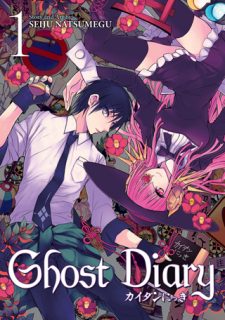
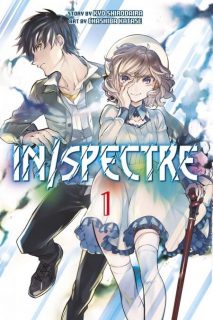
Ghost Diary, Volume 1In/Spectre, Volume 1

Considering my well-established love of Japanese folklore and yokai it might just be wishful thinking, but recently there seems to have been a wave of manga in translation that incorporate traditional Japanese legends, ghosts, spirits, monsters, and so on. (I’m not at all complaining.) Whether they appear as main or supporting elements in a story, even just the promise that they’ll be included is usually enough for me to give a manga a try. Ghost Diary and In/Spectre, two of the more recent manga releases dealing with Japanese supernatural traditions, provide distinctly modern takes on Japanese folklore and mythologies. But while they do share some similarities, Natsumegu and Katase’s approaches are vastly different and the contrasts between the two series can be quite interesting.

So, you may be wondering, how can you a copy of the first volumes of Ghost Diary and In/Spectre?

1) In the comments below, tell me a little about one of your favorite manga about Japanese folklore, ghosts, or urban legends. (Don’t have a favorite? Simply mention that instead.)
2) If you’re on Twitter, you can earn a bonus entry by tweeting, or retweeting, about the contest. Make sure to include a link to this post and @PhoenixTerran (that’s me).

And there you have it! Everyone participating can earn up to two entries and has one week to submit comments. If needed or preferred, those comments can also be sent to me directly at phoenixterran(at)gmail(dot)com. They will then be publicly posted here in your name. The giveaway winner will be randomly selected and announced on July 5, 2017. Good fortune to you all!

VERY IMPORTANT: Include some way that I can contact you. This can be an e-mail address in the comment form, a link to your website, Twitter username, or whatever. If I can’t figure out how to get a hold of you and you win, I’ll just draw another name.

Contest winner announced–Manga Giveaway: Summer Spookiness Winner

Filed Under: FEATURES, Giveaways Tagged With: Chasiba Katase, Ghost Diary, In/Spectre, manga, Seiju Natsumegu

Sound! Euphonium: Welcome to the Kitauji High School Concert Band

June 28, 2017 by Sean Gaffney

By Ayano Takeda. Released in Japan by Takarajimasha, Inc. Released in North America by Yen On. Translated by Paul Starr.

One of the biggest surprise licenses from last year was this book, originally released as a stand-alone novel about the struggles of a high school concert band, which got made into a hugely successful anime. Note that I said ‘novel’ and not ‘light novel’ – there are no interstitial pictures in this book, which is the usual way to tell the difference about these sorts of things. But even beyond that, the fact that Sound! Euphonium does not take place in a fantasy world, at a magical academy, or even have Satan working at McDonald’s was a big point against it. But Yen took a chance on licensing the book, and I’m glad they did, as this is really well-written and dramatic, manages to show off in textual form the difficulties of playing music and the difference between ‘really good’ and ‘outstanding’, and most of all, it has in Kumiko one of the most fascinating protagonists I’ve met all year.

Kumiko is not a first person narrator per se, but the POV of the narration never leaves her, so in effect she functions as our eyes and ears for this book. She’s trying to “start anew” at a new high school, but can’t quite escape her concert band past, especially when her new friends also express an interest. Her childhood friend and not-boyfriend Shuuichi is also in the same band, as is her middle-school bandmate Reina. More on Reina later. Kumiko did not have a pleasant middle-school band experience, as most concert bands, where some instruments are more popular than others and some people get to solo while others don;t, is filled with politics and infighting, and the confrontations just wore her down. To a large degree the book is about helping Kumiko rediscover her love of the euphonium and band in general, and showing her how important it is to not simply glide along and have fun.

I had first heard of the anime as a “yuri anime”, and therefore was rather amused to note that the first half of the book featured precisely none of that. Indeed, Reina appears far less than you’d expect – she may as well be a minor character – until the festival, when Kumiko desperately tries to avoid Shuuichi asking her out (as it might actually force her to confront her feelings for him) and grabs Reina, saying they’re going together. Reina is fine with this, and takes Kumiko on a very romantic festival date. Despite Kumiko clearly being set up with Shuuichi, and Reina admitting that she’s in love with their teacher (what is it with Japan and teacher-student romances?!), it’s Kumiko and Reina who have the most chemistry together, as their body language and conversation reads like a couple rapidly falling for one another. I’d also like to mention Asuka here, the most fascinating character after Kumiko. She and Kumiko seem to be contrasted, if not as rivals, then as mirrors of each other, and their few scenes together are also charged – not with romantic tension, but with just tension. They ended up being my favorite scenes in the book, actually.

The book ends with the Kyoto Competition, and indeed ends somewhat suddenly with the reveal of the results. It was meant to be a stand-alone book, but the author ended up writing two more novels and some short stories afterwards, which were adapted into another anime season. So far Yen has only licensed this book, but I’d like to see it do well so we can see more of this cast – especially Kumiko and Asuka. Highly recommended.

Filed Under: REVIEWS, sound euphomium

Dorohedoro, Vol. 21

June 27, 2017 by Sean Gaffney

By Q Hayashida. Released in Japan by Shogakukan, serialization ongoing in the magazine Hibana. Released in North America by Viz. Translated by AltJapan Co., Ltd. (Hiroko Yoda + Matt Alt).

I’ve often talked about the fact that I find Dorohedoro very satisfying to read while at the same time immensely confusing. It’s a series with a lot going on, and there’s a lot of characters and locations (and many of the characters also wear masks!). But we’re getting near to the end of the series now, and the author is finally starting to dish out some answers. And it works: this volume felt very strong plot-wise, and I was able to follow Ai’s explanations of what happened to him for the most part. It’s quite a tragic fate, like many of the other fates in Dorohedoro, but looking back on everything with Caiman, Ai, Kai and Aikawa you can nod your head and say “yeah, that makes sense”. Well, except maybe for Caiman, which is openly lampshaded when Nikaido admits she has no idea who he is now.

Speaki9ng of Nikaido, there’s an explanation of that “cliffhanger” ending from last time – she’s turning into a devil more and more, and is now much taller and getting cloven feet. Unfortunately for her, En is back in business, and he’s still obsessed with having her as his partner, but we’ll see how that goes. In fact, most of the band is back together, as Shin is sane again and reunited with Noi, and the rest of the decapitated heads are getting bodies again (though almost immediately they’re mushroomed by En, who’s trying to save them). And yes, poor Ebisu is still roundly humiliated, though as always it’s in the most hilarious ways – En remotely creates a mushroom body from one that’s on Ebisu’s head, which causes her head to end up as the remote body’s crotch – something she finds hilarious, as you’d expect. What follows is a long, protracted mushroom war, as En shows off how powerful and clever he really is – though even he may be no match for the devil Chidaruma, who is gloating triumphantly on the cover for a reason.

I know I’ve said this in seemingly every Dorohedoro review to date, but my God there is a lot of truly graphic violence in this book. Decapitations, eviscerations, blood and gore on almost every page. There’s casual deaths, casual eye gouging torture, and Ai’s entire flashback, which is filled with flesh-melting horror. This all culminates in Chidaruma slaughtering everyone in Haru’s flying house, so that the house itself begins to bleed. Never let it be said that Hayashida doesn’t know how to do grotesque imagery. The art is a plus as always, and even though I still sometimes get a few of the characters confused (particular when they have masks on), it doesn’t matter because there’s always something on the page to marvel at. Dorohedoro is speeding towards a climax (I think – it’s still running in Japan), and now that the books are a good 80-90 pages longer each time, there’s even more reason to run out and buy it.

Filed Under: dorohedoro, REVIEWS

Bookshelf Briefs 6/26/17

June 26, 2017 by Michelle Smith and Sean Gaffney Leave a Comment

Assassination Classroom, Vol. 16 | By Yusei Matsui | Viz Media – Most of this volume is taken up by the flashback showing us how Koro-sensei became what he is today. As you’d expect, it’s pretty tragic, but there’s also a bit of cognitive dissonance, as it’s hard to see the Koro-sensei we know today in that apathetic killer who appears at the start. But it’s the power of love that helps turn him, if not away from the dark side, at least into someone who cares about the right way to teach. Also, in case you didn’t hate Yanigasawa enough already, his portrayal as an arrogant abuser will help speed things along. Back in the present, our class is now divided—can they really kill Koro-sensei, or should they try to save him? Each volume of this series gets more and more gripping. -Sean Gaffney

Complex Age, Vol. 5 | By Yui Sakuma | Kodansha Comics – Phew. After a gut-wrenching fourth volume, I was seriously wary about reading this volume. Thankfully, however, it is far more encouraging than the last. True, Kimiko is still planning to give up on cosplay, and though she tries to sell it as wanting to devote herself to photography, it’s clear that what Rui (boo! hiss!) said to her had a role to play in her decision. But Nagisa meets her fiancé and can’t help but be happy for her best friend. Meanwhile, Hayama continues to cosplay and is having fun in her new job as an event coordinator. The bottom line is—the future needn’t be bleak, and Nagisa is left to wonder where her own limits are. With people at work and home seemingly inclined to respect her choices, could we possibly have a happy ending next time? I hope so! – Michelle Smith

Everyone’s Getting Married, Vol. 5 | By Izumi Miyazono | Viz Media – I’d mentioned Kamiya’s ‘aggressive courting’ in the last volume, and here it walks way over the line into blackmail and emotional abuse. Kamiya has become a creep, and Asuka is rightly trying to do her best to pull away from him without it damaging either her career or Ryu’s. Ryu, meanwhile, is having his own battles with Kamiya, as each says that they don’t care about what Asuka is really thinking about. Frankly, I think Ryu’s doing a better job of it, and he’s also able to break things off with Sakura in a more permanent way. Still, Kamiya isn’t going away, and the volume’s end shows him trying to be the Sun rather than the North Wind. Frustrating at times, especially when Kamiya’s being a creep, but still good. – Sean Gaffney

Food Wars!: Shokugeki no Soma, Vol. 18 | By Yuto Tsukuda and Shun Saeki | Viz Media – Yes, Soma wins his battle, showing that the power of fantastic food is better than the power of bribery. This also means that the administration’s goons temporarily back off attacking Polaris Dorm, and we get a highly amusing celebration scene (with more horror from newbies at Isshiki stripping). The big impact comes in the middle of the book, as we learn that Erina’s father is attacking Polaris in particular due to a past with Soma’s father. In fact, he was unaware that Saiba was Soma’s father (the danger of taking the wife’s last name, a far more Japanese thing)… and moreover, Erina was unaware of it as well. In any case, more bad things are happening as the book wraps up, and I expect things will get worse soon. – Sean Gaffney

Kiss Him, Not Me!, Vol. 11 | By Junko | Kodansha Comics – Well, new rival turned out to be absolutely terrible, didn’t he? This volume consists of a lot of running around trying to stop Kae from getting forcibly married. Kae spends the entire main storyline in her “overweight” form, which surprised me, but it doesn’t stop her making an awkward but impressive escape attempt. Unfortunately, after that she mostly acts as a passive prize, only snapping and letting Mitsuboshi have it right at the end. And even that seems to be a case where she can only “win” by literally pounding him into unconsciousness with her bulk. There’s also a side story which is terminally ridiculous—which is good, as this manga needs to be over the top silly in order not to drown in problematic shoujo and fat stereotypes. Variable as always. – Sean Gaffney

Kuroko’s Basketball, Vol. 11-12 | By Tadatoshi Fujimaki | Viz Media – It’s rare you see a tie in a sports manga, but given this is only the qualifiers, a tie is what we end up with. Of course, this just means that Kuroko and company have to win their next match, and it ends up being against a bunch of goons who fight dirty. The leader of this team is fantastic in an awful way, showing off a couple of tragic backstories before taking them back with a smirk. Teppei and Junpei also get a lot of focus here, with a flashback that shows how they both joined the team and how Teppei got injured (and also how obvious an OT3 with them and Riko is). But they pass, and the Winter Cup is up next, with all of Kuroko’s old teammates. An extremely compelling basketball manga. – Sean Gaffney

Magi: The Labyrinth of Magic, Vol. 24 | By Shinobu Ohtaka | Viz Media – Did I say the flashback would take up ‘some’ of this next volume? Sorry, I meant 90% of it, as everything turns horribly tragic and awful in the best backstory way, as Aladdin finishes trying to explain why metal users fighting each other leads only to destruction. There is some truly heartrending imagery here, with children burned to death and lots and lots of dead bodies. Couples we loved and found cute are beaten down by events, and of course Sheba dies, but not before giving birth to Aladdin. That said, I suspect we haven’t seen the last of Arba. It is really nice to see the main cast again, and I loved the “Alibaba is undercut” gag’s exquisite timing. In any case, the flashback is finally done—will we get more Morgiana now, please? – Sean Gaffney

Of the Red, the Light, and the Ayakashi, Vol. 7 | By HaccaWorks* and nanao | Yen Press – A rather interesting thing happens in this volume: quite a few things are revealed and yet the overall story doesn’t get appreciably clearer! Yue and his friend Akitoshi are trying to rescue Tsubaki from the shrine, but before they can manage to do so, he’s whisked away to be tossed into a pond to give strength to Mikoto, who is fighting off Akashi, whose body now belongs to Yue because Shin stole it hundreds of years ago and oh, also, Shin is the progenitor of the Tsubaki family line and by the way, here’s the deal about Mikoto’s missing tail. So many things to try to keep track of and make sense of! Thankfully, Yue’s personal dilemma is a very compelling one. I’m invested in his outcome, even if I don’t fully grasp what happened in the past. – Michelle Smith

Sweetness & Lightning, Vol. 6 | By Gido Amagakure | Kodansha Comics – This is a particularly good volume of Sweetness & Lightning—there’s a bit more conflict than usual and it doesn’t always get solved through yummy food. Tsumugi gets attached to the lost kitty she and her dad have taken in, only for its real owners to come to claim it. Then, the gang goes camping and a couple of her friends get in a disagreement. Something similar ensues on Kotori’s school trip. And Inuzuka’s bossy brother shows up and offers unsolicited advice on various things. The best part, though, is when Tsumugi stays a while with her grandparents while her dad is chaperoning a school trip. Not the part where they eat locusts, but the time she spends with her great-grandmother, looking at pictures of her dad as a kid, and contemplating complex topics like getting old. Delicious food and some bittersweet feels? I am so on board with that! – Michelle Smith

Filed Under: Bookshelf Briefs

Pick of the Week: Gems, Witches, Emperors and Vikings

June 26, 2017 by Sean Gaffney, Michelle Smith, Katherine Dacey, Ash Brown and Anna N Leave a Comment

SEAN: I’ll be honest, most of my attention this week is focused on novels, what with Combat Baker and Nisemonogatari. But I picked a novel last week, so this week my pick is Land of the Lustrous, a new Kodansha series with gem wars but sadly not Steven.

MICHELLE: I’m looking forward to the second volumes of series whose debut volumes I liked a lot. Ordinarily, I’d pick Giant Killing, what with it being sports manga and all, but Flying Witch has an amusing kitty, and that gives it the edge this time.

KATE: I share Michelle’s enthusiasm for manga featuring cute animal sidekicks., but my vote goes to the digital-only release The Emperor and I, a comedy about a family living with an Emperor penguin. The story unfolds in short chapters of three to nine pages, so the formula isn’t as rigid as a 4-koma title; it feels a little bit like reading a collection of Sunday comic strips. Not sold? Here’s what I had to say about it back in May.

ASH: For me, my pick could be nothing other than Vinland Saga this week. The series has been consistently compelling from the very beginning. It’s also had great female characters from the start, but the most recent story arc allows the women in the series to shine like they haven’t before.

ANNA: I agree with Ash, I am very happy that new volumes of Vinland Saga are coming out after the series was paused for some time. It is rare for a series to combine great historical background with a truly compelling story and evocative art. Vinland Saga is my pick!

Filed Under: PICK OF THE WEEK

My Week in Manga: June 19-June 25, 2017

June 26, 2017 by Ash Brown

My News and Reviews

Last week I posted the Bookshelf Overload for May, a rather lengthy list of manga, comics, and other books that have recently made their way into my home. One reason it was such a long was due to the fact that the Toronto Comic Arts Festival was also held in May and I’m always inspired to pick up a bunch of things while I’m there. Normally I post the Bookshelf Overload feature during the second week of the month rather than the third, but I switched things up this time in order to post my review of Yeon-sik Hong’s manhwa Uncomfortabily Happily closer to its release date.

Elsewhere online, Deb Aoki recently took a look at some of the major trends impacting the North American manga industry for Publishers Weekly–“Nine Reasons Manga Publishers Can Smile in 2017.” Otherwise, I didn’t really come across much in the way of manga news and announcements last week. While it may have in fact been a relatively quiet week, I suspect that I might have just missed things due to the fact that I wasn’t online much. (I’m in the midst of preparing lesson plans for an introduction to taiko course that I’ll be instructing over the summer.) Do let me know if there was anything in particular that you’ve found interesting lately, though!

Quick Takes

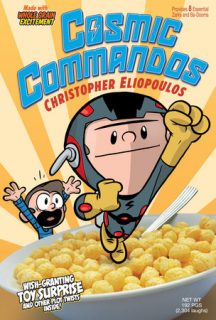
Cosmic CommandosCosmic Commandos by Chris Eliopoulos. Every once in a while a comic is directly sent my way that I otherwise would probably have never encountered. Cosmic Commandos, the debut graphic novel of American comics creator and illustrator Eliopoulos, is one such work. In part inspired by his own identical twin sons, Cosmic Commandos follows an unexpected adventure that a pair of twin brothers find themselves caught up in. Jeremy and  his (slightly) younger brother Justin have vastly different personalities, much to Jeremy’s dismay and embarrassment. In fact, Jeremy seems pretty annoyed and bored with a lot in his life, but that soon changes when a cereal box prize turns him into the hero from his favorite video game. Not only that, the monsters and villains from the game are now invading the town, too. However, they are proving to be much more difficult to beat in real life and, like it or not, Jeremy will need to rely on Justin’s help to save the day. Cosmic Commandos is aimed towards younger readers but some of the more subtle jokes and humor will probably be appreciated even more by the adults in their lives. It’s not a comic that I would normally find myself reading, but it was a fun and energetic story. There’s even a sequel in the works, Monster Mayhem, which sounds delightful.

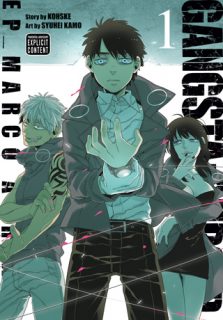
Gangsta: Cursed, Volume 1Gangsta: Cursed, Volumes 1-2 written by Kohske and illustrated by Syuhei Kamo. I was surprised and impressed by how close Kamo’s artwork in Gangsta: Cursed aligns with Kohske’s artwork in Gangsta. This can probably be largely explained by the fact that Kamo is actually one of Kohske’s assistants for the original series, of which I wasn’t previously aware. Gangsta: Cursed primarily takes place before the events of the main series and is set during another time in Ergastulum’s history in which violence against the Twilight population was at a peak. Although there hasn’t been much story yet per se–for the most part the first two volumes of Gangsta: Cursed consist of one brutal action sequence after another–functionally the series serves as the backstory for Marco Adriano, who at that point was known as Spas. Unsurprisingly, considering that this is still Gangsta, his past is a tragic one filled blood and death. Indoctrinated as a young man to hate Twilights above all else, he is part of a group of particularly vicious Hunters known as the Destroyers. They have been instructed to kill all of the Twilights that they can find along with any normal human sympathizers, and they do. However, Spas is beginning to have doubts and seems to be quickly approaching a psychological breakdown.

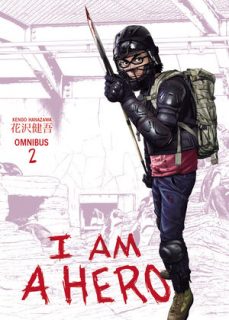
I Am a Hero, Omnibus 2I Am a Hero, Omnibuses 2-3 (equivalent to Volumes 3-6) by Kengo Hanazawa. I’ll have to admit, although in general I’ve grown somewhat weary of the zombie subgenre, I’m finding I Am a Hero to be a gripping series. It can also be fairly gruesome and outright disturbing at times. Hanazawa has at this point established a good narrative rhythm, allowing both the characters and readers to have moments of respite (even if those moments are still frequently anxiety-inducing) in between intense, action-oriented, near-death experiences. Hideo, the lead of I Am a Hero, continues to be one of the most interesting characters that I’ve recently encountered in a manga, mostly due to the non-sensationalistic portrayal of the numerous mental health issues he deals with on top of simply trying to survive a zombie outbreak. Most everyone he knows has already died or has otherwise succumbed to the devastating infection, but as the series progresses further he does at least temporarily find some allies who can confirm that something terrible is going on in the world and that it’s not just all in his head. How long any of them will last is an entirely different matter though; the death count in I Am a Hero continues to be incredibly high and any survivors aren’t having an easy time of it, either.

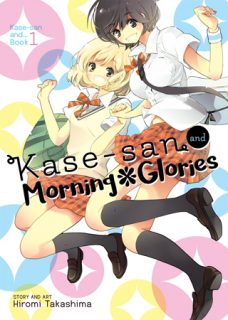
Kase-san and Morning GloriesKase-san and Morning Glories by Hiromi Takashima. I haven’t quite been able to put my finger on exactly why, but I find the cover art of the first volume in the Kase-san series to be both cute and slightly off-putting. Fortunately, later volumes don’t seem to have the same issue. It’s also somewhat misleading as the interior illustrations are drawn in a completely different style, but one that I greatly prefer even though the anatomy can occasionally be a bit off. Like many manga, Kase-san and Morning Glories originally started as a one-shot story which is probably why the early part of the series feels very episodic. I’m not sure if the episodic nature of the manga will continue or if the series will develop a larger overarching narrative (which by the end of the first volume it seems that it might), but what I am certain of is that Kase-san and Morning Glories is adorable, light, and fluffy. There’s not much depth to the characters or stories at this point, but they are likeable and charming. The manga is largely seen from the perspective of Yamada, a young woman who loves to garden and who has recently found herself attracted to the titular Kase, one of the tomboyish stars of their school’s track team. Kase likes Yamada, too, but it takes some time for them to realize that their feelings are mutual.

Filed Under: FEATURES, My Week in Manga Tagged With: Chris Eliopoulos, comics, Gangsta, Hiromi Takashima, I Am a Hero, Kase-san, Kengo Hanazawa, Kohske, manga, Syuhei Kamo

Psycome: Murder Anniversary and the Reverse Memorial

June 26, 2017 by Sean Gaffney

By Mizuki Mizushiro and Namanie. Released in Japan by Enterbrain. Released in North America by Yen On. Translated by Nicole Wilder.

It is somewhat odd that I feel reassured at Psycome’s lack of ambition. At heart, this is meant to be a broad comedy, and as such it can’t give in too much to its premise. Despite having an innocent man in a prison devoted to making teen murderers into assassins, despite befriending a truly insane timebomb of a gas-mask wearing girl, despite finding out that your little sister seems to be genuinely disturbed… despite all that, the tone of this series has been light. Everything skews towards the cliche, towards the trope, towards the predictable. And yet you don’t really mind, because despite its flaws it’s sort of fun. That especially holds true for the 4th book, where we meet Eiri’s family and find they are a machine-gun nest of cliches.

Eiri herself is already quite the cliche, ticking off all the tsundere boxes very neatly. In case you think that she earned marks good enough to be able to leave the school, save your breath: she came in second to last, beaten only by the mohawk guy who spent the midterms in the nurse’s office. But her family have called for her, and so she must go. They’ve also asked for Kyousuke, which she finds disturbing. As for Ayaka and Renko, their grades WERE good enough to let them go outside for the reward, so they come along as well, because leaving Kyousuke and Eiri alone together is unthinkable. (Sorry, Maina, you’re just not important enough, though you do get the cover of the next book.) So everyone’s off to visit Eiri’s palatial home, which has the inscrutable mother, the little sister whose love for her sibling has turned to hatred, and the big brother who is creepy and a bit of a pervert. Oh yes, and murderous twin 9-year-olds, one male, one female, who are at least not named Hansel and Gretel. Eiri’s been called back home to try to solve the big problem: her inability to kill.

The climax of this volume is actually a giant anticlimax – by design, to be fair – and so most of the meat is devoted to the relationship between Eiri and her younger sister, Kagura. The moment you see Kagura and she attacks Eiri, you can see the entirety of her plotline laid out from end to end, and sure enough it’s all there – the hero worship, the frustration at being second best, the anger at being second best to an assassin who can’t kill. And of course the buried love she still has for her sister, which ends up coming out even after Eiri refuses to kill an innocent child to prove herself. The point of this book is to get Eiri – and by extension her family – to admit that it’s not that she can’t kill but that she doesn’t want to – that she finds it wrong. This is tied into the murder of her father as a child – Eiri felt the agony of her father’s death and her subsequent grieving, and even though she wants revenge, every time she made the attempt she though of others going through that and stopped. It’s good character development. Honestly, it’s more earned than the “I guess I do love you” tacked on at the end, which seems designed to keep things on a more even keel romance-wise – Kyousuke having spent much of the volume wondering if he really does love Renko.

Psycome is never going to be “really good”, but it’s still reasonably funny, and I like many of the characters. And we keep getting hints of the endgame plot, which I suspect will happen in the final volume. Recommended if you don’t mind cliches.

Filed Under: psycome, REVIEWS

Beasts of Abigaile, Vol. 1

June 25, 2017 by Sean Gaffney

By Spica Aoki. Released in Japan as “Bara Kangoku no Kemono-tachi” by Akita Shoten, serialization ongoing in the magazine Princess. Released in North America digitally by Seven Seas. Translated by Alethea and Athena Nibley, Adapted by Marykate Jasper.

Once again, a manga I had very few expectations for manages to please me greatly. I always enjoy it when this happens, particularly when it’s shoujo. The premise of this seemed to be ‘Werewolf reverse harem’, which did not inspire confidence, and I admit that when I first read the words ‘Alpha, Beta and Omega’ midway through, my heart sank. But it won me over anyway, partly due to the art (the artist is really good at facial expressions, particularly in the case of Nina, the heroine) and partly due to Nina herself, who is a great combination of spunky, stubborn, and sort of goofy in the best way. We haven’t seen a title from the ‘Princess’ magazine in quite some time – Tokyopop used to do a lot of their stuff before they shuttered their manga line – and I like that it feels different from the Big Three’s shoujo titles.

The premise is that Nina and her uncle have arrived at the vaguely Mediterranean country of Ruberia, apparently to get a fresh start after getting bullied so bad in Japan she had to flee the country. Unfortunately, no sooner has she gone exploring then an escaped convict runs past her, and when she tries to stop him using her martial arts fighting skills (because yes, she’s that sort of heroine), he tackles her and bites her neck, causing her to pass out. After some brief suspicious guards catch the convict, they shove her into the paddy wagon as well. When she comes to, she finds herself on the prison island off the coast of the country, which turns out to be populated by werewolves, all of whom are prisoners of sadistic human guards, trained and tortured to be servants to the country’s human population. Which is troubling enough, except… Nina now has wolf ears and a tail too! Did the bite turn her into a werewolf? And how will she survive?

As you may have guessed by the description above, this title is gloriously silly and over the top. If you take it seriously, I’m not sure it would actually work. The characters are not blazingly original – we get the seemingly nice guy who’s actually in thrall to the Queen Bee, we get the incredibly jealous girl who hates Nina getting the attention of her love (no doubt she will attack Nina viciously in Volume 2), and of course we get Roy, who’s the sort of smug but sexy and mysterious jerk that every shoujo manga needs. Luckily, Nina fights back – in fact, the final moment in this volume made me laugh out loud at a shoujo cliche getting subverted, and I daren’t spoil it. Nina also ends up in a pack of trans werewolves, and while they tend towards the stereotypes and sometimes a punchline, they don’t seem to be there to be made fun of, which is nice.

Basically, as long as you don’t mind werewolf cliches (I did mention the alpha thing), this is a hell of a lot of fun, especially Nina. I look forward to the next volume.

Filed Under: beasts of abigaile, REVIEWS

If It’s For My Daughter, I’d Even Defeat a Demon Lord, Vol. 1

June 24, 2017 by Sean Gaffney

By CHIROLU and Truffle. Released in Japan as “Uchi no Musume no Tame Naraba, Ore Moshikashitara Maou mo Taoserukamo Shirenai” by Hobby Japan. Released in North America digitally by J-Novel Club. Translated by Matthew Warner.

The most popular light novel genre at the moment, both here and in Japan, is “generic RPG fantasy world”. In this genre, however, you can do all sorts of things. There are isekai variations, and novels where it really is a game. There are harem romances, and dark gritty tragedies. These days it seems like a popular editorial request is “do fantasy but with __________”. And with this particular title, we’re getting another type of popular Japanese genre, the “single dad raises his daughter/adopted daughter (it’s always a daughter) and she’s really really goddamn cute” genre. The dad can be bumbling or competent, but the adorableness of the girl is never in question. (The light novel genre being male-oriented, the single mom raising her adorable son has not to my knowledge had any series, but hope springs eternal.) And now we have this series, where the adopted girl is a devil abandoned by her people for mystery reasons, and she’s just cute as the dickens.

The first 2/3 of this book is basically running on that premise. Our hero is a seasoned young adventurer who looks like the standard ‘generic guy’ you see in these sorts of fantasy book (Smartphone guy looks exactly the same). He runs into Latina in the woods, starving and unable to speak human languages, and decides to bring her home on the basis of being unable to let her starve to death or be eaten by monsters. Then he and the couple who run the inn he lives in slowly watch her grow up, learn to speak and read human, show she can use magic, wait tables, and wrap absolutely everyone around her finger. Part of the fun in this book is seeing Dale (the dad) turning into a complete over the top loon about his new daughter. Actually, one drawback is that I wish we’d had a bit more of Dale as he was before he met Latina – we see flashes of it, but it loses a bit of impact as we barely know him before he’s a doting dad.

The last third is far more serious, and at first I thought it might be dealing with Latina being bullied by her peers, but no, she’s being emotionally and mentally abused by her new teacher, who lost her family to devils and has gone half-insane to rage and prejudice as a result. Latina’s attempts to hide what’s being done to her with “everything is fine” even as she looks more and more worn and exhausted will ring a bell with anyone who ever dealt with a bullied child “staying strong”. The whole section is brutal, and it wouldn’t have nearly half the impact it does without most of the book being variations on “look at the daily life of this cutie”. It is nice to see the entire town seemingly standing up to protect her, including Dale, whose cold rage is absolutely terrifying to the temple who employed the teacher.

There are 5 volumes in this series, and each one shows Latina slightly older, so I suspect we won’t have cute antics for the whole series. But if you enjoy series like Yotsuba&!, Sweetness and Lightning, or Bunny Drop (the first half – I hope) and wish it had more swords and sorcery, I think you’d greatly enjoy this series.

Filed Under: if it's for my daughter i'd even defeat a demon lord, REVIEWS

Chihayafuru, Vol. 3

June 23, 2017 by Sean Gaffney

By Yuki Suetsugu. Released in Japan by Kodansha, serialization ongoing in the magazine Be Love. Released in North America digitally by Kodansha Comics. Translated by Ko Ransom.

There’s a lot going on in this volume of Chihayafuru, which is starting to find its feet. We gain a new member of the karuta club, which has now hit the required five. Tsutomu, aka “Desk-kun”, is an introverted, small, nerdy guy who seems to be devoted to studies and has few friends. But once Chihaya sets her sights on him (which involves, at one point, kidnapping him), and he realizes that one of the otehr players on the team is in fact the #1 stude3nt in the school, he wonders if karuta can help his focus in other areas as well. I like Tsutomu. He brings a rookie lack of confidence that this sort of series always needs, and his crisis of faith towards the end of the book is both dramatic and understandable. What’s more, his suggestion of playing karuta with the poem-side down leads to a match of pure memorization between Taichi and Chihaya, and gives him his first big triumph.

Chihaya’s learning a lot in this volume, mostly as they now have a full team of five, which means that they have to learn how to play Karuta as a team – not that they play together, but such things as setting the right order for the matches and having trust that your other teammates are going to be fine. She’s also thrown off by one of her first opponents, who even gets her precious Chihaya card, which makes you feel like she’s going to break. (Her inner monologue has everything sounding far away to her, thus ruining her hearing advantage. I like this detail, as it makes it sound like she’s about to pass out – I’ve had that feeling myself.) Oddly, the true heart and leader of the team ends up being Taichi, who always knows the right think to say to Chihaya to snap her out of whatever funk she’s in. I suspect this is meant to be a love triangle with Arata, but given Arata’s ongoing absence it’s easier to fall on the Taichi side.

This volume is almost all karuta, but not entirely – there’s a “training session” at Taichi’s house that is just an excuse to give Chihaya a surprise birthday party. Sadly, it’s ruined when his incredibly strict mother comes home early, and the girls have to take off, but they at least get to meet up later (and we get an Arata text message cameo.) Chihaya continues to be the main reason to read the manga – Taichi may be the heart of the team, but she’s the heart of this series, and her incredible emotional ups and downs make for thrilling reading. Karuta isn’t just ‘let’s have fun and make friends’ anymore – by the end of the volume, the entire team is thinking ‘I want to win’ like it’s a mantra. Playing in a competitive sport means pushing your limits, and not slacking off. There’s a cliffhanger here, and Vol. 4 isn’t on Kodansha’s schedule yet, but I hope it comes soon. Unmissable.

Filed Under: chihayafuru, REVIEWS

  • « Go to Previous Page
  • Page 1
  • Interim pages omitted …
  • Page 423
  • Page 424
  • Page 425
  • Page 426
  • Page 427
  • Interim pages omitted …
  • Page 1048
  • Go to Next Page »
 | Log in
Copyright © 2010 Manga Bookshelf | Powered by WordPress & the Genesis Framework