• Skip to primary navigation
  • Skip to main content
  • Skip to primary sidebar
  • Home
  • About Us
    • Privacy Policy
    • Comment Policy
    • Disclosures & Disclaimers
  • Resources
    • Links, Essays & Articles
    • Fandomology!
    • CLAMP Directory
    • BlogRoll
  • Features & Columns
    • 3 Things Thursday
    • Adventures in the Key of Shoujo
    • Bit & Blips (game reviews)
    • BL BOOKRACK
    • Bookshelf Briefs
    • Bringing the Drama
    • Comic Conversion
    • Fanservice Friday
    • Going Digital
    • It Came From the Sinosphere
    • License This!
    • Magazine no Mori
    • My Week in Manga
    • OFF THE SHELF
    • Not By Manga Alone
    • PICK OF THE WEEK
    • Subtitles & Sensibility
    • Weekly Shonen Jump Recaps
  • Manga Moveable Feast
    • MMF Full Archive
    • Yun Kouga
    • CLAMP
    • Shojo Beat
    • Osamu Tezuka
    • Sailor Moon
    • Fruits Basket
    • Takehiko Inoue
    • Wild Adapter
    • One Piece
    • After School Nightmare
    • Karakuri Odette
    • Paradise Kiss
    • The Color Trilogy
    • To Terra…
    • Sexy Voice & Robo
  • Browse by Author
    • Sean Gaffney
    • Anna Neatrour
    • Michelle Smith
    • Katherine Dacey
    • MJ
    • Brigid Alverson
    • Travis Anderson
    • Phillip Anthony
    • Derek Bown
    • Jaci Dahlvang
    • Angela Eastman
    • Erica Friedman
    • Sara K.
    • Megan Purdy
    • Emily Snodgrass
    • Nancy Thistlethwaite
    • Eva Volin
    • David Welsh
  • MB Blogs
    • A Case Suitable For Treatment
    • Experiments in Manga
    • MangaBlog
    • The Manga Critic
    • Manga Report
    • Soliloquy in Blue
    • Manga Curmudgeon (archive)

Manga Bookshelf

Discussion, Resources, Roundtables, & Reviews

Blog

Appleseed Alpha

July 9, 2017 by Sean Gaffney

By Iou Kuroda, based on the manga create by Masamune Shirow. Released in Japan by Kodansha, serialized in the magazine Morning Two. Released in North America by Kodansha Comics. Translated by Lillian Olsen and Stephen Paul.

It has been an awfully long time since I read Appleseed, even with the recent digital release. And I haven’t seen the 2014 movie that this is apparently a spinoff from, though I understand the manga and anime may only be loosely based off each other anyway. But that’s OK, because Appleseed Alpha is still a perfectly enjoyable, if occasionally too busy for its own good, story. All you really need to know is that the human woman is Deunan Knute, and her lover/companion is Briareos, a former human who is now mostly cyborg. (How far they go as lovers is, as always, left mostly ambiguous.) The main series proper saw them living in, and rebelling against, the utopia of Olympus. The Alpha story is a prequel, so naturally we get to spend it in a dystopia – the remains of New York City, run by a cyborg who is half mayor and half mafia boss.

Shirow is not writing or drawing this, by the way, but the artist is not unknown to North American readers – it’s Iou Kuroda, creator of cult classic Sexy Voice and Robo. That felt like more of an indie comic than a manga, and this feels much the same, which makes sense as it ran in Kodansha’s experimental manga title Morning Two. The art has thick lines and less detailed faces, though trust me, there’s just as much detailed background and cityscapes as you’re used to with this title. The main plot separates our heroes early, as Briareos, by nature of his not only being a cyborg but one of the awesome cyborgs, is lauded by the mayor (whether he likes it or not) and Deunan is left out in the cold. She ends up outside the city, meeting a group of farmers who may have more links to the city than she had expected. Meanwhile, Briareos has, of course, NOT abandoned Deunan, and ends up heading out to see her.

This one-volume omnibus has a few cool battles, though the artist seems more suited to drawing the effects of the fights than the fights themselves. There’s also some amusing humor, the best of which involves several trains filled with cows all heading into the remains of Penn Station with drivers asleep at the wheel. Deunan and Briareos feel in character – both somewhat removed from society, yet still highly involved it it – and Deunan still gets to be a hothead at times. As for the mayor, Two Horns, he is a hoot, a giant parody of all mayors with a sinister side to him as well – and a mysterious past that gets revealed right at the end of the book. I’d definitely recommend this if you’re a fan of Appleseed. For others, even though it’s technically a prequel/alternate universe, I’d recommend starting with the four main Appleseed books themselves.

Filed Under: appleseed, REVIEWS

Full-Time Wife Escapist Vols 1 and 2

July 8, 2017 by Anna N

Full-Time Wife Escapist Volume 1 and 2 by Tsunami Umino

Kodansha seems to be putting out so many digital titles, I’m having a hard time keeping track of them all. I’m always curious to check out josei titles and Full-Time Wife Escapist is a unique title, as it isn’t as overtly focused on romance as some of the other josei titles that have been translated over here.

Mikuri is in a bind after attending graduate school in psychology. She’s having difficulty finding a full-time job, and makes ends meet as a temp. When her temp job ends, she’s caught in a difficult situation because her parents are moving to the country, where there will be even less work for her. She picks up some shifts here and there doing housework and meets a man named Tsuzaki, and she becomes his regular part-time housekeeper. They become closer when she takes care of him during an illness. Mikuri and Tsuzaki come up with the solution where Mikuri will move in as his platonic paid wife, taking over housekeeping duties, making him lunch and dinner, and generally making his bachelor apartment more comfortable.

Tsuzaki is a bit of a loner at work, and somewhat emotionally stunted and has a way of relating to other people that make them assume that he’s cranky, but it seems more like he just hasn’t developed his social skills very well. The transnational nature of the relationship is one of the aspects of this manga that makes it both interesting and refreshing. When Mikuri and Tsuzaki go to visit his parents, they set the terms of Mikuri’s overtime by negotiating back and forth. It is interesting to see tasks that would be unacknowledged emotional labor in a real relationship being assigned a dollar value in this one.

Mikuri’s background in psychology shows her observing other people as opposed to getting real insight on herself. She does have some amusing daydream sequences when her mind wanders and she projects herself into some dream tv interviews that offer some commentary on her life choices. Her aunt Yuri, an unmarried career woman, serves as a counterpoint to Mikuri’s more aimless lifestyle. I enjoy manga when it gets a little didatic, and there are some great asides in Full-Time Wife Escapist where the characters start discussing the economic conditions facing younger adults in Japan, providing some real world background and context to Mikuri’s unconventional lifestyle choice.

The first volume sets up the unique relationship situation in The Full-Time Wife Escapist fairly quickly, and the second volume shows some of the issues that happen when the couple continues to try to portray their relationship as real to friends and colleagues, who sense that something is a bit off in the way the couple relate to each other. At the same time, the close proximity of the fake couple is showing some awareness developing between them. This series has a nice slice-of life pace to the storytelling, as everyday activities like preparing dinner have a new slant due to the unique relationship. At the same time, there are some moments of pathos, as Tsuzaki reflects that if Mikuri ever decides to get married for real, he’s going to be alone for the rest of his life.

Tsuzaki’s friend Kazami starts appearing a bit more and more, and he and Mikuri have a few easy friendly conversations. Kazami starts envying the married lifestyle, but he’s not interested in settling down at all. Intriguing changes are signaled for the next few volumes. I enjoy a good josei romance series, but one of the things I appreciate about The Full-Time Wife Escapist is that it is focused more on transactions and slowly developing friendships than overt romance. It’ll also be interesting to see if Mikuri’s unconventional wife for hire lifestyle is sustainable over the long term.

Filed Under: Manga Reviews, REVIEWS Tagged With: full-time wife escapist, Josei, Kodansha Comics

Demon King Daimaou, Vol. 1

July 8, 2017 by Sean Gaffney

By Shoutaro Mizuki and Souichi Itou. Released in Japan as “Ichiban Ushiro no Daimaou” by Hobby Japan. Released in North America digitally by J-Novel Club. Translated by David Musto.

While I would not go so far as to say that it was terrible, or that I won’t get more (I am curious to see what happens next), there’s no getting around the fact that Demon King Daimaou is a deeply flawed book. It knows what it wants to do, but sometimes skips necessary steps to get there. Its setting is bog standard, and most of its characters hew to the cliched stereotype. In fact, when this fairly old light novel series was made into an anime several years back, fans called the heroines by their hair color rather than their name. That’s harder to do with a textual book, even with illustrations, so I will try to use actual names – I apologize if this makes things confusing. The most interesting part of the book is the hero, but that’s not always to its benefit either.

Our hero is Akuto, seen here on the cover showing more expressiveness than he does in the entirety of this book. He’s a young orphan who arrives at Constant Magical Academy in order to start a path towards changing the world by becoming a high priest. Unfortunately, like the Sorting Hat in Harry Potter only much worse, there’s a machine at the school that lays out your perfect career path for all students. And Akuto’s is Demon King, which disturbs almost everyone since the last Demon King was defeated at that very school years ago. Of course, Akuto doesn’t believe in fate, and a simple explanation to his fellow students should do the trick. Unfortunately, while he may be overly serious, studious, and have seemingly noble intentions, he cannot help but stick his foot in his mouth every time he speaks – partly as he genuinely isn’t paying attention to how his words come across till after he’s said them, and partly because, well, he really would make a pretty nifty demon king.

Akuto is interesting as a hero mostly as he’s not really the hot-headed, fiery type or the “harem protagonist” type – the book runs on his total inability to say the right thing in any given situation, but skewed just enough so it doesn’t seem familiar. The same can’t be said of the heroines. Keena, the girl on the cover, is meant to be the ‘airhead’ sort, but also has a mysterious past, and spends a lot of the book away from events. Junko is our standard Akane Tendo heroine, who likes Akuto at first before he’s chosen by the machine to be demon king, but afterwards alternates between humiliated rage at being played for a fool and growing feelings of love (that frankly grow far too fast given their interaction). The best of the girls so far is Korone, an android bodyguard with a stonefaced expression and a tendency to tease the bejabbers out of Akuto – she was my favorite part of the book.

I should also mention the ending, which features another girl, who is secretly evil, getting her comeuppance at the end in what is meant to be a humorous way. Sadly, this involves her getting gangraped by her other female classmates, who are under the influence of a drug. It’s implied and offscreen, but I don’t care. It’s ugly and awful. It helps to make this first volume something of a hot mess, and while I’m not abandoning it just yet, it’s on thin ice. I’d recommend it to those who enjoyed the anime only.

Filed Under: demon king daimaou, REVIEWS

Land of the Lustrous, Vol. 1

July 7, 2017 by Katherine Dacey

Land of the Lustrous is a gorgeous trainwreck, the kind of manga that doesn’t make sense on a panel-by-panel basis, but ravishes you with artwork so beautiful and strange it’s hard to look away.

I’ll be honest: I read the first volume three times, and found it almost impenetrable. As best I could tell, Land of the Lustrous depicts an interplanetary war between two races: the Gems, whose androgynous, humanoid appearance belies their true, rock-like nature, and the Lunarians, who frequently raid Earth, hoping to capture Gems for decorative purposes. (What kind of decorations remains a mystery; my vote is for bedazzled jeans and hoodies.) Since there are only 28 Gems, they’ve organized themselves into “fighter-medic” pairs to defend Earth from the Lunarians. One Gem — Phosphophyllite, who registers only 3.5 on the Mohs scale — is too weak to perform either task, so the group’s leader pronounces Phos their official naturalist, and tasks Phos with writing a history of Earth.

You’d be forgiven for thinking that Land of the Lustrous was a satire on the dissertation-writing process, given how much time Phos spends procrastinating and grumbling about the book, but these scenes are interspersed with awkward flirtations, violent combat, and a brief episode in which Phos turns into a cute, sentient space slug. These abrupt shifts in tone frustrate the reader’s ability to get a handle on what, if anything, Land of the Lustrous is trying to say — a problem compounded by the dialogue, which is sometimes so windy that it’s a drag on the story, and sometimes so burdened with exposition that it barely passes for conversation.

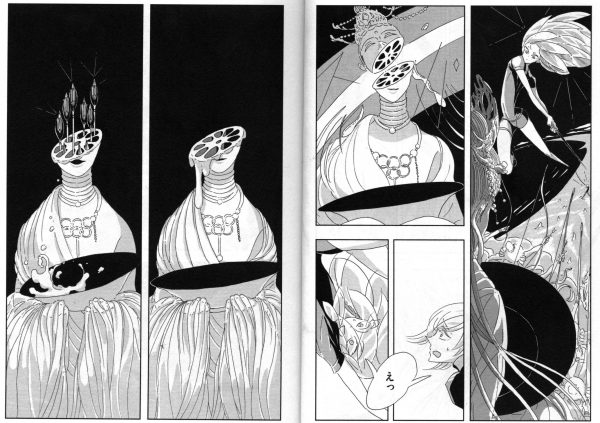
When the characters stop talking and start doing things, however, Land of the Lustrous is a show-stopper, a testament to the richness of Haruko Ichikawa’s imagination. The Lunarians’ first appearance, for example, establishes them as an inscrutable menace. Their soldiers glide silently above the ground, led by an enormous, stone-faced Bodhissattva who’s flanked by undulating lines of archers with bows drawn, their arms and arrows criss-crossing the horizon to form a graceful lattice. (Busby Berkeley would have approved of the Lunarians’ formation.)

What happens next is even more astonishing:

In this sequence, a Gem slices through the general’s head, only to reveal a lotus pod filled with lethal “seeds” — a beautiful but unsettling moment reminiscent of Aubrey Beardsley’s work in its commingling of the sensual and the grotesque; we’re not certain if the Lunarians are animal, vegetable, or mineral. Making this sequence even more disorienting is the dramatic shift in perspective: we see the impending attack from the general’s point of view, then shift to the attackers’ for the moment of contact and its aftermath. The eerie stillness of the final two panels reveals the extent to which the Lunarian general’s transformation has confounded the Gems, who are transfixed by the viscous flow of blood — or is that sap? — from his head.

Looking at these images, I wonder what a more assertive editor might have done to reign in Ichikawa’s worst storytelling tendencies: would the tone and pacing have been more even? The world-building more coherent? The dialogue more revelatory? In the absence of such editorial interventions, however, the most original aspects of Ichikawa’s work sink beneath a torrent of banal conversation and stale comic bits that pass for character development. A few moments of unnerving imagery interrupt the tedium long enough to make an impression on the reader, but are too brief and scattered to yield a truly satisfying experience.

LAND OF THE LUSTROUS, VOL. 1 • BY HARUKO ICHIKAWA • TRANSLATED BY ALETHEA AND ATHENA NIBLEY • KODANSHA COMICS • RATED: TEEN (13+) • 192 pp.

Filed Under: Manga, Manga Critic, REVIEWS Tagged With: Haruko Ichikawa, Kodansha Comics, Sci-Fi

Manga the Week of 7/12/17

July 6, 2017 by Sean Gaffney Leave a Comment

SEAN: There’s a pile. Let’s get down to it, boppers.

MICHELLE: Heh.

SEAN: Dark Horse starts us off with the third Blade of the Immortal omnibus.

J-Novel Club has the 2nd Bluesteel Blasphemer on tap.

They also have a debut, Infinite Dendrogram. It’s got many elements common to recent light novel series – a new VRMMO that may blur the line between reality and game – but I am assured it is quite good, so we shall see.

Kodansha is still rescuing some Del Rey stuff, with the 15th Yozakura Quartet and the 20th School Rumble.

In new digital licenses, they have the 4th Domestic Girlfriend, and the 4th Full-Time Wife Escapist. Excited for the latter.

ANNA: I need to get caught up on Full-Time Wife Escapist! I enjoyed the first couple volumes.

MICHELLE: I’m excited for volume four, as well!

SEAN: They also snuck in some new licenses too late for me to mention them last week, so these are already out. I have failed you again. Sorry. Hotaru’s Way (Hotaru no Hikari) is the most famous of the three licenses, a josei series from Kiss that’s been made into some live-action series. It’s the ever-popular “falling in love with my boss” genre.

ANNA: Yay josei!

MICHELLE: That’s not my favorite josei genre, but I’ll give it a look.

SEAN: Sneaking in a print release here, as the 5th Interview with Monster Girls ships next week.

Back to this week’s digital debuts (damn my penchant for alphabetical order), Kounodori: Dr. Stork is a long-running seinen title from Evening Magazine, involving an obstetrician/pianist. It sounds very seinen.

ASH: Huh. I had missed the pianist angle.

SEAN: Love’s Reach (Kinkyori Renai) is an older shoujo series that ran in Betsufure, and has a teacher/student romance to go along with the earlier boss/employee romance.

ANNA: OK!

SEAN: And now we’re back to next week proper, as there’s a 21st Seven Deadly Sins.

Seven Seas has a 2nd volume of shoujo romance Dreamin’ Sun.

MICHELLE: I enjoyed volume one a lot!

ASH: I actually just got around to reading the first volume. I rather liked the quirky cast of characters.

SEAN: And a 2nd volume of supernatural thriller Ghost Diary.

ASH: It seemed very derivative, but enjoyed the first volume more than I expected. (Except for one character’s super-annoying verbal affectation…)

SEAN: And I suppose we must mention the 3rd volume of yuri sleaze NTR – Netsuzou Trap. Now with anime adaptation.

They also finish a series next week, as The Sacred Blacksmith ends with its 10th volume.

SuBLime has a 7th volume of The World’s Greatest First Love.

And Udon rolls out a 5th volume of Persona 3.

Vertical gives us a 5th volume of Immortal Hounds (lot of Vol. 5s next week).

Viz has Vol. 63 of Case Closed.

They also have a new Legendary Edition of The Legend of Zelda, this one covering the Four Swords story.

ASH: The Legendary Edition of the series is really nice!

SEAN: Lastly, Rumiko Takahashi keeps toddling along with a 24th Rin-Ne.

Beat the heat with manga! What are you reading next week?

Filed Under: FEATURES, manga the week of

The Combat Baker and Automaton Waitress, Vol. 1

July 6, 2017 by Sean Gaffney

By SOW and Zaza. Released in Japan by HJ Bunko. Released in North America by Bookwalker. Translated by David Musto.

I wasn’t quite sure what to expect from this series, the first to be licensed by Bookwalker directly from Japan. I had seen it on HJ’s site a while back, and thought it might make a good license at the time due to one specific reason: it didn’t appear to be an isekai, which light novel licenses were currently drowning in. (Still are, to be fair.) I wondered if it would end up being something of a foodie book, focusing on the making of the bread and daily life of the bakery. In fact, it’s nothing remotely like that. But that’s OK, because I genuinely enjoyed what we get, which is a darker story about a country recovering from a vicious war that spanned the continent, the scars it left behind, and one of its veterans trying to repent for his sins with delicious bread.

The baker is Lud, a former soldier who was responsible for much of the devastation and death, and also happened to be on the winning side. He was never happy with it, though, starting off as a child soldier, and his biggest regret is being unable to save the bakery he had stayed in for a spying mission at one point. After the war, he settles into one of the neighboring countries and decides to open his own bakery. There are a few problems with this. 1) He has a face like a hardened combat veteran, and has trouble making his smile not seem like a threat. 2) The town in question is avoiding him and no one will buy his bread. His only friends are Jacob, a young man who stops by on occasion to buy some bread and snark at him, and Marlene, who is the nun in charge of the orphaned kids. Things are looking pretty bad, that is until he hires a young, highly enthusiastic, and extremely odd waitress named Sven.

Sven’s true identity is not unknown to the reader, as it’s the first scene we see in the book, but it is unknown to Lud, who finds her a good employee and friend, but doesn’t connect the dots to his former life till the very end. Sven herself has a very easily triggered jealous and possessive side, but given who she is and her newfound state, this is actually a bit more acceptable than most clingy jealous girls. The large majority of the book is dedicated to the fact that the war may technically be over, but there are still aftershocks spreading through this continent that is clearly meant to be Europe, only not. Neighboring countries that sound suspiciously like Russia are sending in terrorists as moles, or using old men with a chip on their shoulders to repair tanks, or searching for evidence of the old, world-conquering civilization that used to exist a thousand years ago. The book does a very good job keeping the reader’s interest through this, and it reads more like a thriller than a wacky romantic light novel.

Translation was good, on the whole – there were a few times I saw Lud’s name as Luke, but apparently Bookwalker are already fixing that (the benefits of being a digital publisher). As for the heroine being named Sven, well, that’s the Japanese author’s fault – if you can accept Jacuzzi Splot, you can accept this. I will note that I think the book’s formatting works better on a larger tablet than it does on a phone, so Bookwalker readers may want to try reading it that way. On the whole, though, a very good debut, and I look forward to seeing more of the series, which is 6 volumes in Japan.

Filed Under: combat baker and automaton waitress, REVIEWS

Manga Giveaway: Summer Spookiness Winner

July 5, 2017 by Ash Brown

Ghost Diary, Volume 1
In/Spectre, Volume 1

And the winner of the Summer Spookiness manga giveaway is… Olivia!

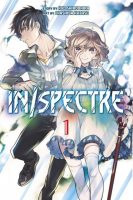
As the winner, Olivia will be receiving copies of Ghost Diary, Volume 1 by Seiju Natsumegu and In/Spectre, Volume 1 by Chasiba Katase as published in English by Seven Seas and Kodansha Comics respectively. For this giveaway, I asked that participants tell me a little about their favorite manga which includes Japanese folklore, ghosts, or urban legends in some way. Yuki Midorikawa’s Natsume’s Book of Friends and Adachitoka’s Noragami: Stray God were the two most frequently mentioned series (and they are great!) but everyone’s detailed responses can be found in the giveaway comments. And, as usual, I’ve created a list of related manga below, as well.

Some of the print manga available in English incorporating Japanese folklore:
Anomal by Nukuharu
Bleach by Tite Kubo
Death Note written by Tsugumi Ohba, illustrated by Takeshi Obata
Durarara!! written by Ryohgo Narita, illustrated by Akiyo Satorigi
The Demon Prince of Momochi House by Aya Shouoto
Forbidden Scrollery by Moe Harukawa
Gate 7 by CLAMP
Ghost Diary by Seiju Natsumegu
Ghost Hunt by Shiho Inada
Ghost Talker’s Daydream by Saki Okuse
Hanako and the Terror of Allegory by Sakae Esuno
In/Spectre by Chasiba Katase
Inu x Boku SS by Cocoa Fujiwara
Inuyasha by Rumiko Takahashi
Kamisama Kiss by Julietta Suzuki
Kekkaishi by Yellow Tanabe
Kitaro by Shigeru Mizuki
Mail by Housui Yamazaki
Mushishi by Yuki Urushibara
Natsume’s Book of Friends by Yuki Midorikawa
NonNonBa by Shigeru Mizuki
Noragami: Stray God by Adachitoka
Nightmare Inspector: Yumekui Kenbun by Shin Mashiba
Nura: Rise of the Yokai Clan by Hiroshi Shiibashi
Nurse Hitomi’s Monster Infirmary by Shake-O
Oninagi by Akira Ishida
Pet Shop of Horrors by Matsuri Akino
Phoenix by Osamu Tezuka
RIN-NE by Rumiko Takahashi
Shirahime-Syo: Snow Goddess Tales by CLAMP
Soul Eater by Atsushi Ohkubo
Tale of a White Night by Tooko Miyagi
That Wolf Boy Is Mine! by Yoko Nogiri
Tokyo Babylon by CLAMP
xxxHolic by CLAMP
Yokai Girls by Kazuki Funatsu
Yokai Rental Shop by Shin Mashiba

Although the above list certainly isn’t comprehensive, I do think it shows a nice variety of titles. It should also hopefully provide a good starting place for someone who might be interested in manga which include elements of Japanese folklore. Thank you to everyone who shared your personal favorites with me by participating in the giveaway! I hope you’ll stop by again for the next one as well.

Filed Under: Giveaways, Lists, UNSHELVED

Land of the Lustrous, Vol. 1

July 5, 2017 by Sean Gaffney

By Haruko Ichikawa. Released in Japan as “Houseki no Kuni” by Kodansha, serialization ongoing in the magazine Afternoon. Released in North America by Kodansha Comics. Translated by Alethea Nibley & Athena Nibley.

This was a trip. I wasn’t sure what to expect going in, as I didn’t know much about it beyond “fighting gems” and that it’s been nominated for awards. Indeed, Kodansha even says it’s for fans of Steven Universe, presumably because, well, gems. I can see some similarities, but really, this manga is its own thing, and calling Phos and Steven similar lead characters seems a bit insulting to Steven. As for the plot, I honestly found it to be somewhat confusing much of the time, not really a surprise when it’s the first volume. But there are a few very good reasons to read this. The first is that the author is very good at depicting tension and frustration between two different characters, as our lead goes around and annoys everyone into submission. Secondly, the art is really nice, and conveys a sense of wonder and a sense of horror depending on where you are in the story.

The basic premise is that gem people are fighting against Moon creatures. They seem to fight based on the hardness of their base gem – the harder the better. Our lead gem is Phosphophyllite, who is most assuredly NOT on of the hardest gems – indeed, they’re known for being rather fragile and brittle. Phos is also a bit of a ditz, whiny, selfish, and lazy, which makes it very diffifuclt to find them a job. Fortunately, the sensei who’s in charge of the gems has come up with something: Phos will compose a natural history of their world. This seems, on the face of it, a idea that is both good and bad. Good because it’s the sort of this that plays right into Phos’ skill sets, and bad because Phos really has no skills sets beyond “people seem to like them”. Really, what it is is an excuse to have Phos wander around and interact with the other gems, such as the reclusive Cinnabar or the beautiful yet secretly self-loathing Dia. In the second half of the book, Phos accidentally gets eaten by a slug creature, and after everyone spends a long time figuring out how to get them back, now has… the ability to communicate with it? Maybe?

As I said earlier, this isn’t really a title I’m reading for the plot. It also has to be said, for those who get easily annoyed at selfish characters who clearly are going to grow and change as the series goes on, Phos starts out REALLY irritating, and you can easily understand some of why they’re treated so poorly. But not entirely all of it – Phos is also bullied in many ways, and the excessive verbal abuse heaped on them seems a bit much. Even those characters who do seem to like Phos, such as Cinnabar, show this affection by being even meaner than the others, though that ties more into Cinnabar’s self-hatred and suicidal tendencies than anything else. (The gems seem to be genderless, and I’ve done my best to avoid gendering them when writing this review.) To sum up, I’m not entirely sure where this is going, but I find the character interaction excellent and the art captivating. Which is all you can ask of a Volume 1, really.

Filed Under: land of the lustrous, REVIEWS

Nisemonogatari: Fake Tale, Vol. 1

July 4, 2017 by Sean Gaffney

By NISIOISIN. Released in Japan by Kodansha. Released in North America by Vertical, Inc. Translated by James Balzer.

The afterword of this volume of the Monogatari series says that Nisioisin never intended for it to be published, but just wrote it for his own amusement. I hate to call an author a liar, but just reading the text of this first volume of Nisemonogatari makes me think he’s full of it. The book is filled with efforts to make this short series into a much longer one, adding onto running gags and deconstructing them, taking existing characterization and flipping it on its head or making it more ominous, setting the stage for new plot points to be carried over to future books, and the endless references to the fact that the books recently had an anime greenlit, right after the first set of books kept joking about the idea of the characters being in an anime. Nisemonogatari’s metatext is thick. Fortunately, its text is also good, showing off Araragi’s sisters, and how they’re far more like him than he’s comfortable with.

Fitting given that he has two sisters, the Nisemonogatari series is split into two books, and this is the first one, Karen Bee. Karen is his “older younger sister”, and is almost the definition of ‘dumb muscle’, a karate black belt devoted to justice and righting wrongs who seems to forget that she’s just in middle school and that actual villains can run rings around her. She’s a nice kid, but you can see why Nisioisin spent so much time re-introducing the rest of Bakemonogatari’s cast; there’s just not enough in her to justify the 300 pages or so that this book consists of. We also get a better glimpse at Tsukihi, the “younger younger sister”, who Nisio is clearly far more fond of writing, mostly as she’s able to go toe-to-toe with her older brother in the only battle that really counts in any works by this author: wordplay. Tsukihi’s mood swings and temper tantrums will be looked at in more depth in the following book.

As for the rest of the cast, again, they’re shifting from “this is a series of short stories, each about a different girl” to “this is a long-running series that will have several books after this. That doesn’t change the fact that Araragi and Senjogahara are still a couple – indeed, some of the best scenes in the book feature the two of them. But we see that Hanekawa and Senjogahara have clearly had “a chat” in between books, and that – despite Sensjogahara’s attempts to exaggerate it in order to make us dismiss it – there is clearly major tension between them. Possibly because, as Kanbaru states midway through the book, Araragi and Hanekawa are the more obvious couple. Hanekawa herself has cut her hair and gotten contacts in order to show she’s moving on from Araragi, but I’m not sure how much I buy it – she’s willing to say she loves him to his face, but it’s not a confession per se.

Oh yes, can’t forget Shinobu, who has finally decided to stop sulking and become the extremely talkative haughty vampire we met in Kizumonogatari, and she’s not going to let looking like an eight-year-old stop her. She gives Araragi a way to discuss oddities now that Oshino has left town – she gives advice on the supernatural, while Mayoi, who is a wandering ghost, ironically gives advice on more down to earth things like love. And Nadeko is here as well, and her fumbling, overly obvious attempts at seducing Araragi (obvious, that is, to everyone except him) show us that she’s not just a shy, blushing girl in love with him. More on that much later. And then there’s Kaiki, one of the most popular characters in the entire series judging by Western fandom. He’s very good at playing the evil villain, and does like to drone on endlessly (as every character in Monogatari does), but there’s a hint that there’s far more to him than that, and I’m sure we haven’t seen the last of him.

You’ll notice that this volume has a new translator (yes, I’ll mention it). Vertical apparently decided, given the aggressive release schedule, to divide the series up into chunks, so James Balzer is doing the Nise series and Ko Ransom will be back with Nekomonogatari Black and White. For the most part, the change is not all that noticeable. The series is well translated (hang on, getting to it), keeping most of the culture references – I was very pleased to see Araragi’s Read or Die comment left in – and adapting the wordplay and Japanese puns so they are mostly not noticeable. And Shinobu sounds like her old-world vampire self – which may come as a surprise to anime watchers, as most subbers decided not to bother translating her into “old school” speech. Two things, though. First, the book keeps the scene where Hanekawa mocks Araragi for using the -chan honorific to refer to his sisters, which seems odd in a series so otherwise aggressively devoted to avoiding honorifics (My Senior, etc.).

The second thing is a bit more egregious. In the original Japanese, Tsukihi says (in English) that she is “Platinum Mad”, which is a take off of puchi and purachina/platinum. She uses the phrase a few times in the series, and the anime turned it into her OP theme song, “Platinum Disco”. It would not be exaggerating to say that when you think of Tsukihi, you think of “Platinum Mad”. The translator, however, decided that since it’s weird Japanese wordplay it had to be changed to weird English wordplay – as he has done throughout the book. So “a bit” becomes “dagnabbit”. There are several issues here. First off, dagnabbit sounds to a Western ear like something Yosemite Sam would say. Secondly, almost no one noticed the wordplay itself, and just saw that “Platinum” had been changed to “Dagnabbit” for no reason (remember, Platinum is IN ENGLISH in the original). Most importantly, though, it seems to show that the people in charge of translating the series for Vertical are translating the books without paying attention to the other media – anime, singles, or the fandom. I get that – these were books first, and you want to make sure that they can also sell to casual readers. But try not to drive the hardcore fans off. Platinum Mad is a meme, fer chrissakes. Dagnabbit Mad just makes Tsukihi sound stupid. Which she very clearly isn’t – intellectually, she’s her brother’s equal.

OK, rant over. Aside from that, I felt the translation was excellent, and I didn’t really notice a major change between Ko and James. More importantly, for anime fans, there’s still a lot of new stuff here – you’d think given that it got adapted into 7 episodes that they didn’t leave much out, but there’s still many extra and lengthened scenes in here that got adapted out. Fans of Araragi and company will want to pick this up, as it’s excellent. Though be prepared to write “platinum” in your copy with ballpoint.

Filed Under: monogatari series, REVIEWS

Bookshelf Briefs 7/3/17

July 3, 2017 by Michelle Smith and Sean Gaffney Leave a Comment

The Demon Prince of Momochi House, Vol. 9 | Aya Shouoto | VIZ Media – The “delving into Aoi’s past” arc resolves here, after a neat reveal about the true nature of his ayakashi sister. With Himari’s help, Aoi was able to both remember and accept his past, and returns to normal. Yukari then reveals that, long ago, Aoi found a diary from Himari’s parents that mentioned their daughter eventually coming to Momochi House, and that he’s been waiting for her and performing omamori duties all that time so that the house wouldn’t consume her. This feels a little like a retcon, but I’ll allow it. Another thing I’ll oh-so-graciously allow is the final scene—it’s rather silly that Himari and Aoi are riding around on a dragon firework, but I sniffled when she was able to show him the lights of the town he’s protecting. And I was sure we’d end on a cruel cliffhanger ’til I turned the final page. A very strong volume! – Michelle Smith

Fate/Zero, Vol. 5 | By Gen Urobuchi, Type-Moon, and Shinjiro | Dark Horse – Fate/Zero continues to do what it does best: show off some excellent fights and magics while being about ten times as dark as Fate/Stay Night. The battle between Kayneth and Kirutsugu is fairly one-sided, though the real horror there is Sola-Ui’s fervent desire to cut off his arm and become Lancer’s new Master (it’s impled so she can sex him up). Iris and Maiya take on Kirei, meanwhile, and Kirei gets to show us that he’s good for a lot more than merely verbally abusing Shirou—he’s a major badass. Throw in a funnier omake than usual (the shirt ripping, I should note, not the tasteless Sakura rape joke), and you have a strong volume of Fate/Zero, a series that remains only for the strong of stomach. – Sean Gaffney

Flying Witch, Vol. 2 | By Chihiro Ishizuka | Vertical Comics – Flying Witch is shaping up to be one of those series where not much happens, but it’s enjoyable to spend time in the company of its characters. In this volume, Makoto and her cousins pick and eat some wild plants, meet a fortune teller who believes she’s been the victim of Akane’s (Makoto’s sister) magical experimentation, and make some uncanny candy that plays with snackers’ emotions. Although there wasn’t enough of Chito the kitty for my taste, there were still some funny non-verbal panels, and Chinatsu deciding that she wants to be a witch too will probably result in more hijinks and witchy worldbuilding. I look forward to it! – Michelle Smith

Giant Killing, Vol. 2 | By Masaya Tsunamoto and Tsujitomo | Kodansha Comics (digital only) – We’ve waited three months for the second volume of Giant Killing and happily, it does not disappoint! The seinen slant to this series feels surprisingly fresh, dealing as it does with adults, their career trajectories, fan loyalty, etc. In this volume, we’re introduced to a showy East Tokyo United player named Prince who might be irresponsible but has the ability to think ahead that prompts Tatsumi to name him captain. Not everyone is pleased with that decision, but Tatsumi’s strategy is proven valid when ETU scores the first goal in their match against much-favored Tokyo Victory, league champions two years running, thanks to Prince and inconsistent newcomer Tsubaki. Manga soccer matches are so much more interesting than real-life soccer matches! Only a month to wait for volume three! – Michelle Smith

The High School Life of a Fudanshi, Vol. 1 | By Atami Michinoku | Seven Seas – Seventeen-year-old Ryo is a closet fudanshi. He has shared his secret with his friend, Nakamura, and throughout a series of 4-koma strips, proceeds to explain his hobby, fanboy over a couple of guys he thinks are gay, make friends with a fujoshi, attend a doujinshi event, recoil when a couple of attendees think he is gay, etc. Exceedingly few punchlines are even slightly amusing, and most are downright lame. Too, the treatment of a flamboyant gay character is problematic. I did smile at Ryo’s reaction to the squishy sound effects on a BL drama CD, and completely sympathize with the geeky logic of refusing to pay $40 for a shirt while eagerly dropping the same amount on fandom items, but I shan’t be continuing this series. – Michelle Smith

The Honor Student at Magic High School, Vol. 7 | By Tsutomu Sato and Yu Mori | Yen Press – Most of this volume is devoted to manga-only characters and battles, with Amy getting a taste of the spotlight and showing that she can be a funny gag character while still having dramatic scenes. More to the point, her victory here reinforces what we know from the novels—people who have Tatsuya help them win, people who don’t do not. As such, what we really need is a battle between two competitors who Tatsuki can help equally, and that’s Shizuku and Miyuki. The confrontation isn’t going to be seen till next time, and thanks to the books we know how it turns out, but there are some nice scenes with Shizuku and Tatsuya to show off her determination and will. A very good side manga. – Sean Gaffney

Of the Red, the Light, and the Ayakashi, Vol. 7 | By nanao and HaccaWorks* | Yen Press – There’s certainly a lot more forward movement than we’d had in the past couple of volumes, though I still spend some time needing to remind myself which pretty boy is which when we start a new book. I was happy to see Hina come to the rescue of her brother, even if it meant the realization that she too is not what she seems and not really his sister, though she cherished their time together. As for Yue, he’s still—for some reason—having trouble connecting the dots between ‘eating’ someone and ‘killing’ them, which unfortunately makes his naivete a bit aggravating right now. Still, his basic decency is all that’s standing between this title and a bloodbath, so I’ll give it to him. – Sean Gaffney

The Water Dragon’s Bride, Vol. 2 | By Rei Toma | VIZ Media – I had hoped for something more substantial from this volume, and I think Toma-sensei delivers. By far, the standout character for me in this series is the water god, so I loved seeing him begin to feel compassion, not only healing Asahi, but spending a lot of time watching over her. (These nonverbal panels are my favorites.) In his annoyance with the humans, he lets loose a flood that shows them that Asahi is under his protection, and it seems she is thereafter left alone, for years swiftly pass and we conclude the volume with she and Subaru looking like teenagers. I’m definitely intrigued to see where the story goes from here, and hope I’m able to get a stronger sense of Asahi herself. (I did like the part where she buried a fish, though.) – Michelle Smith

Filed Under: Bookshelf Briefs

  • « Go to Previous Page
  • Page 1
  • Interim pages omitted …
  • Page 421
  • Page 422
  • Page 423
  • Page 424
  • Page 425
  • Interim pages omitted …
  • Page 1048
  • Go to Next Page »
 | Log in
Copyright © 2010 Manga Bookshelf | Powered by WordPress & the Genesis Framework