• Skip to primary navigation
  • Skip to main content
  • Skip to primary sidebar
  • Home
  • About Us
    • Privacy Policy
    • Comment Policy
    • Disclosures & Disclaimers
  • Resources
    • Links, Essays & Articles
    • Fandomology!
    • CLAMP Directory
    • BlogRoll
  • Features & Columns
    • 3 Things Thursday
    • Adventures in the Key of Shoujo
    • Bit & Blips (game reviews)
    • BL BOOKRACK
    • Bookshelf Briefs
    • Bringing the Drama
    • Comic Conversion
    • Fanservice Friday
    • Going Digital
    • It Came From the Sinosphere
    • License This!
    • Magazine no Mori
    • My Week in Manga
    • OFF THE SHELF
    • Not By Manga Alone
    • PICK OF THE WEEK
    • Subtitles & Sensibility
    • Weekly Shonen Jump Recaps
  • Manga Moveable Feast
    • MMF Full Archive
    • Yun Kouga
    • CLAMP
    • Shojo Beat
    • Osamu Tezuka
    • Sailor Moon
    • Fruits Basket
    • Takehiko Inoue
    • Wild Adapter
    • One Piece
    • After School Nightmare
    • Karakuri Odette
    • Paradise Kiss
    • The Color Trilogy
    • To Terra…
    • Sexy Voice & Robo
  • Browse by Author
    • Sean Gaffney
    • Anna Neatrour
    • Michelle Smith
    • Katherine Dacey
    • MJ
    • Brigid Alverson
    • Travis Anderson
    • Phillip Anthony
    • Derek Bown
    • Jaci Dahlvang
    • Angela Eastman
    • Erica Friedman
    • Sara K.
    • Megan Purdy
    • Emily Snodgrass
    • Nancy Thistlethwaite
    • Eva Volin
    • David Welsh
  • MB Blogs
    • A Case Suitable For Treatment
    • Experiments in Manga
    • MangaBlog
    • The Manga Critic
    • Manga Report
    • Soliloquy in Blue
    • Manga Curmudgeon (archive)

Manga Bookshelf

Discussion, Resources, Roundtables, & Reviews

Blog

The Unwanted Undead Adventurer, Vol. 3

October 28, 2018 by Sean Gaffney

By Yu Okano and Jaian. Released in Japan as “Nozomanu Fushi no Boukensha” by Overlap, Inc. Released in North America digitally by J-Novel Club. Translated by Shirley Yeung.

Last time I complained about the dullness of Rentt’s POV, and though the cast remains as small as ever, it appears the author remains cognizant of it, as we get Rentt thinking about the fact that since he became undead, he’s become relatively flat and emotionless. Fortunately, though Rentt is still undead, he does level up a bit here, so at least we don’t have to read his halting, shambolic speech anymore in the second half of the book. In fact, I found the book very much felt like an inverted U as I read it. The middle two sections are easily the best, and I genuinely enjoyed them. I was not as enamored with the first section, which was essentially wrapping up events from the last book and meandered quite a bit, and the final section, which features far too many magic lessons. There are times when you can tell that the author is still learning the craft.

As I noted earlier, we pick up where we left off, with Rentt getting the flower that will help heal the woman in charge of the orphanage. While there, he meets an adventurer who turns out to be a butler (not named Sebastian, alas) and gets a request to visit the butler’s master… or mistress, as it turns out. This second section sees Rentt navigate a confusing hedge maze and then search through a pile of valuable magic artifacts for his “reward”, as well as making a contract to get more of that healing flower. Due to events in that section, Rentt is able to evolve further, becoming… sort of vampire-ish? He has bat wings, and is very pale. But he’s not QUITE exactly what the textbooks say, and he can still use his divinity, mana, etc. Finally, the young girl at the orphanage who hired Rentt to cure their caretaker is made a magic pupil of Lorraine’s, and she and Rentt attend a magic class which is made up of equal parts amusing pettiness and boring worldbuilding.

The best parts of the book are the ones where Rentt is allowed to wander outside the “boring old undead adventurer” narration. The sequence with the toy airship, and Rentt’s nerd infatuation with it, made me smile, and is absolutely terrific. That whole section was good, as Laura, the head of the family hiring Rentt, is intelligent and fun without being a brat (and knows the value of good tea). I also liked the aftermath of Rentt becoming a vampire-like being, as he and Lorraine take turns going over his body and exactly what he can and cannot do now. (I was disappointed that Lorraine didn’t ask if he was “fully functional”, so to speak, but then she seems just as shy as he is in many ways.) This was one of the sections where the worldbuilding and back and forth conversations worked quite well.

The end of this volume implies things may not go nearly as well for Rentt in the fourth volume, as we’re getting new characters who I suspect won’t take kindly to heroic vampire adventurers. That said, it may be a bit of a wait – the 4th volume is out in Japan in November, so I expect at least 3 or 4 months. Till then, The Unwanted Undead and Uneven Adventurer is still mostly keeping my attention.

Filed Under: REVIEWS, unwanted undead adventurer

Black Torch, Vol 1

October 27, 2018 by Anna N

Black Torch, Vol 1 by Tsuyoshi Takaki

I was surveying my stacks of manga and decided that I needed to make more of an effort to get into the Halloween spirit. I figured that Black Torch was an ideal candidate since it features supernatural beings and a black cat, who is also a supernatural being. Spooky!

Jiro is the plucky protagonist of this manga, who has some unique abilities. He has the ability to talk to animals and is descended from a long line of ninjas. He also has absolutely no tolerance for animal cruelty, as the opening scene in the manga shows him driving of a gang that was bugging a stray cat and raven. Jiro’s Grandfather seems to mainly enjoy yelling at his grandson about ninja traditions. Jiro finds out about a cat in distress and goes to rescue it. He finds Rago, a demon (or mononoke) trapped in the form of a black cat. Jiro learns that Rago was caught up in a demonic struggle, and doesn’t remember all the details of his past. Jiro is determined to help Rago, even though the demon attempts to leave Jiro, he is relentless in his desire to help. This is one of the more endearing aspects of Black Torch, even though Jiro ends up getting trapped in a deadly mononoke battle. Rago and Jiro end up being fused together, as Rago goes to help his reckless ninja friend. There are elements that are somewhat predictable in most shonen manga, like a supernatural protection agency and the hints that Rago and Jiro will soon join a team fighting evil.

Black Torch 1

The art in Black Torch has a slightly scratchy quality that I enjoyed. Rago’s surprised cat faces were hilarious, and when his mystical powers manifest in the form of swirling black tendrils surrounding his cat form, the effect is suitably dramatic and mystical. The action scenes are dynamic. While Black Torch doesn’t stray far from the typical shonen manga formula, Jiro’s devotion to animals, the odd couple relationship between him and Rago, and Rago’s hilarious cat expressions go pretty far in making it an enjoyable supernatural action manga.

Filed Under: Manga Reviews, REVIEWS, Uncategorized Tagged With: Black Torch, Shonen, viz media

Futaribeya: A Room for Two, Vol. 1

October 27, 2018 by Sean Gaffney

By Yukiko. Released in Japan by Gentosha, serialized in the magazine Comic Birz. Released in North America by Tokyopop. Translated by Katie McLendon.

I haven’t reviewed a Tokyopop title in nearly seven years, I believe, ever since its founder decided to rearrange his priorities. But the priorities are rearranging themselves back a bit, it would seem, and so here we are with a new Japanese manga. Futaribeya seems to be a fairly safe choice to leap back on this train (given they’re doing a massive Aria release next year that may, God Willing, actually finish the series, I was always going to board the train eventually) as it’s light, fluffy, slice of life with a few yuri tease bits. There actually are more of the latter than I was expecting – honestly, given the number of series that folks say are yuri that merely feature two girls who stand near each other, my expectations were low. But this series is pleasant and amusing enough, mostly due to the strength of its two leads, who may not be a couple but who bounce off each other perfectly.

Sakurako is a nice, upright, studious young woman who’s starting high school and given the choice of living in a dorm or in an apartment complex nearby. There she meets Kasumi, who is beautiful but pretty much lives in the dictionary under the definition of “my pace”. The two get along much better than you’d expect, and the first volume seems rather Sunshine Sketch-y, reasonably free of major drama and content to have us watch the two girls live their high school life. We get to see everyone struggling to study, except Sakurako, who apparently has a photographic memory and gets straight A’s (except the one time she fills in the answers all over one place by accident). We see Kasumi struggle to… well, stay awake and exert energy, really, but she’s also the one I bonded most with over the course of the volume. We also meet some relatives and fellow classmates, but honestly the series is mostly about these two girls and their growing friendship.

As I said above, the yuri in this one is there, but if you don’t want to see it you won’t. Sakurako and Kasumi have a very close friendship, sleep together in the one bed, and Kasumi rejects guys who ask her out by saying she’s dating someone while describing Sakurako. That said, I certainly wouldn’t mind if the yuri actually went somewhere. It would not take a lot for these two to go from high school to college to just living together as a couple. Both girls admit they’re each other’s “type”, at least to themselves. And there’s a valentine’s day chapter and a subsequent white day chapter, which features Kasumi buying Sakurako… well, not a refrigerator, and they don’t shop for it together, but it’s a microwave oven/toaster oven combo that is a really serious thing to get a girl for White Day. I was impressed.

This is cute, mild yuri that left a smile on my face and I liked everyone. I’ll read more.

Filed Under: futaribeya, REVIEWS

An Archdemon’s Dilemma: How to Love Your Elf Bride, Vol. 2

October 26, 2018 by Sean Gaffney

By Fuminori Teshima and COMTA. Released in Japan by Hobby Japan. Released in North America digitally by J-Novel Club. Translated by Hikoki.

The color illustrations of most light novels tend to spoil, and a lot of readers who hate spoilers know that they should avoid them before reading the book. That said, even if you looked at the color pages for the second volume of Archdemon’s Dilemma, you can’t have been TOO surprised. Having used Vol. 1 to set up the premise of adorable ‘villain’ and his even more adorable ‘slave’, with them essentially being a married couple, the fact that they gain an adopted daughter is not exactly a surprise if you’ve read any sort of manga or light novels. Seeing Chastille dressed up as a maid might be more of a surprise, but given what happened to her in Book 1, and the fact that this volume begins with her execution being discussed, it’s not hard to connect the dots either. Archdemon’s Dilemma is trying to balance out the cute found family stuff with the badass archdemon stuff, and so far… well, so far it’s a bit overbalanced on one side, I will admit.

Speaking of Chastille, I hadn’t mentioned her at all in the last review, probably as she very nicely filled the ‘other girl who likes him but isn’t going to get anywhere’ slot. That said, Zagan was impressed with her power, and I appreciated the fact that although she spends most of this book either at the peril of the Church, an Archangel who has supposedly arrived to kill her, or a dragon girl with a grudge against Archangels who keeps pranking her, she eventually does get over her deep depression and manage to take up her sword again – and once she does, she manages to kick ass. (It was also nice to see that it was Nephy, not Zagan, who was the one to talk her out of her funk.) I’m not sure how well she’s going to do at trying to get the angels and demons to talk to each other, but I’m rooting for her, despite her basically being Emilia from The Devil Is a Part-Timer! with a few serial numbers filed off.

As for Zagan, there are a few moments in the book where we get him and Nephy being adorable together (helped along by the illustrations, which do a much better job than the text of conveying his emotional awkwardness), but I wish there were more of them, as most of the rest of this book is devoted to showing off how super-ungodly powerful Zagan is. He’s still saying the wrong thing most of the time, but the things he says are designed to make him sound cool and brooding, and there’s not enough of his inner self NOT being cool and brooding. In other words, he feels too much like an OP protagonist. Things aren’t helped by the fact that the final battle sees Nephy staying behind at the castle like a dutiful wife, waiting up and preparing his dinner. Nephy helps make Zagan more down to earth.

Still, overall it was a good book, provided you don’t mind the battles being a bit boring because Zagan is always in control. And we even get a butler at the end, who I’ve decided I will call Sebastian. As with most fantasy light novels, recommended for those who like these sorts of books.

Filed Under: archdemon's dilemma, REVIEWS

Manga the Week of 10/31/18

October 25, 2018 by Sean Gaffney, Michelle Smith, Anna N, MJ and Ash Brown 1 Comment

It’s Halloween, and the trick is being able to stand under the weight of all this manga.

Ghost Ship has a 7th volume of “porn or not?” series To-Love-Ru Darkness.

J-Novel Club has a trio of ongoing titles, as we get the 8th Arifureta: From Commonplace to World’s Strongest, the 7th The Magic in This Other World Is Too Far Behind!, and the 2nd Sorcerous Stabber Orphen.

Kodansha’s print debut is Hiro Mashima’s Playground, which as you might guess is a collection of short stories from the creator of Fairy Tail.

Speaking of short story collections, we also get Battle Angel Alita: Holy Night, which collects previously unseen one shots from the Gunnm universe. (What’s Gunnm?, I hear you cry. Well…)

ASH: Oh, I had missed this one being picked up, though I’m not surprised that it was.

SEAN: There’s also the 14th and final volume of Animal Land, a series whose first volume came out in North America sometime in 1643.

MICHELLE: I legitimately forgot this series existed.

MJ: Same.

ASH: It really is a shame that this series hasn’t gotten more attention. It’s a little strange, but quite good.

SEAN: The digital debut is a sequel, as we get the first volume of Princess Resurrection: Nightmare, the sequel to… well, Princess Resurrection. It still runs in Shonen Sirius, and seems to be more of a Tokyo Ghoul-style reboot.

Also out digitally: Beware the Kamiki Brothers! 6 and Heaven’s Design Team 2.

MICHELLE: I read the first volume of the latter and it was.. odd. We’ll see if the author varies the already established formula at all with volume two.

SEAN: Seven Seas is hitting us with lots of stuff. The debut is Versailles of the Dead, which does not feature Oscar but does feature Marie Antoinette and zombies. I think it’s currently running in Hibana, though it’s changed magazines a few times.

ANNA: I have to admit I am intrigued by the title, along with historical zombies.

ASH: As am I! It’s by the creator of Afterschool Charisma, too.

SEAN: There’s also The Ancient Magus’ Bride Supplement, yet another in-depth guidebook to the series.

ASH: I’ll be picking this one up!

SEAN: And we have an 8th Dreamin’ Sun, the 8th Grimgar of Fantasy and Ash novel in print, the 2nd manga adaptation of If It’s For My Daughter Etc., the 3rd Mononoke Sharing, the 13th My Monster Secret, the 8th Nurse Hitomi’s Monster Infirmary, and 2nd True Tenchi Muyo! novel, and the 4th and final Yokai Rental Shop.

ASH: I wasn’t as enamored with the beginning of Yokai Rental Shop as I was hoping I would be, but I have been meaning to read more of the series.

SEAN: Udon has a 3rd volume of Infini-T Force.

Vertical has Onimonogatari, which theoretically is about Shinobu but Mayoi is going to steal the show.

That leaves Yen Press, but that’s still a lot.

ASH: It really is.

SEAN: Starting with Yen’s digital-only manga, we see Corpse Princess 19, Toilet-Bound Hanako-kun 8, and IM: Great Priest Imhotep 9.

JY is Yen’s imprint for younger readers, and we have two titles to point to. The first is Crush, the 3rd in Svetlana Chmakova’s series that began with Awkward and Brave. It is sure to be as awesome as both of those were.

JY also has a Japanese title debuting. Zo-Zo-Zombie is from the kids’ magazine Corocoro, and is the most adorable zombie manga you’ll ever read.

ASH: D’awww.

SEAN: Yen On debuts Mirai, the latest ‘novelization of a popular movie’ title. There’s also Final Fantasy VII: On the Way to a Smile, in which Aerith is, like Francisco Franco, still dead. Though given these are short stories, possibly not in this volume.

Goblin Slayer, now a hit anime, also gets a side story novel, called Year One. I expect goblins.

Yen On also has new volumes of The Empty Box and Zeroth Maria (4), Is It Wrong to Try to Pick Up Girls in a Dungeon? (12), Is It Wrong to Try to Pick Up Girls in a Dungeon? Sword Oratoria (7), Re: ZERO (8), Spice and Wolf (20), and its sequel Wolf and Parchment (3).

Theoretically there is also the long, long, long delayed 7th volume of No Game No Life, but I won’t believe this without actual evidence.

And then the manga. So much. Only one debut, which is High School Prodigies Have It Easy Even in Another World!. Based on an unlicensed light novel, it’s another isekai, as you can see, only the kids finding themselves in another world are all insufferable geniuses. How will they cope? Easily, apparently.

That leaves the ongoing series. Let’s divide it, as I tend to do, in half. First, NOT based on light novels. There’s Anne Happy 8, Aoharu x Machinegun 13, Demonizer Zilch 5, Gabriel Dropout 5, Hakumei & Mikochi 2, Hatsu*Haru 3, Kakegurui: Compulsive Gambler 7, Kiss and White Lily for My Dearest Girl 7, Murcielago 8, Prison School 11, Sacrificial Princes and the King of Beasts 3, the 5th Sekirei omnibus, Shibuya Goldfish 2, Silver Spoon 5, Spirits & Cat Ears 7, Taboo Tattoo 12, Teasing Master Takagi-san 2, Triage X 16, and Val x Love 4. … I’m actually getting a lot of that. Yikes, that’s a lot.

MICHELLE: Hatsu*Haru, Sacrificial Princess, and Silver Spoon for me.

ANNA: You know, if I don’t read any of this, I’m not behind. That’s what I will tell myself. Although somewhere I have first volumes of Sacrificial Princess and Silver Spoon squirreled away.

MJ: Obviously Silver Spoon. Always Silver Spoon.

ASH: Silver Spoon is likewise at the top of my list, but I’m reading (and falling behind with) a few others, too.

SEAN: On the light novel adaptation side, we have A Certain Magical Index 15, Death March to the Parallel World Rhapsody 5, The Devil Is a Part-Timer! 12, Durarara!! re;Dollars 3, the 5th DanMachi: Sword Oratoria manga, Napping Princess 2, The Saga of Tanya the Evil 4, and the 4th So I’m a Spider, So What?.

ANNA: Why are there so many light novels, and no one has released any Library Wars titles, or finished 12 Kingdoms????

MICHELLE: Or Saiunkoku Monogatari???

ANNA: YES! Someone bring out Saiunkoku Monogatari!!!!

ASH: I would love to see those series translated, too! I’d add No. 6 and the rest of Moribito as well, though those might not technically be light novels.

SEAN: Are you gorged on all these treats? What’s in your bag?

ASH: SO MUCH.

Filed Under: FEATURES, manga the week of

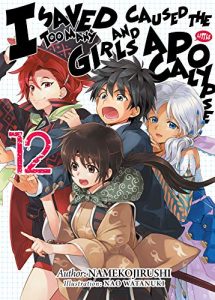
I Saved Too Many Girls and Caused the Apocalypse, Vol. 10

October 24, 2018 by Sean Gaffney

By Namekojirushi and Nao Watanuki. Released in Japan as “Ore ga Heroine o Tasukesugite Sekai ga Little Mokushiroku!?” by Hobby Japan. Released in North America digitally by J-Novel Club. Translated by Mana Z.

More volumes, more girls. And perhaps a sneak peek at the bad future that R keeps talking about. No, we’re not actually seeing said future – since the author is nothing if not predictable, I suspect that we’ll get that in Books 15 or 16, the final ones – but thanks to a ditzy and morally questionable angel, we do get a sneak preview of what the war of Rekka’s fiancees would be like. It’s not a pretty sight. Rekka’s girls have never been as tight-knit a group as, say, Rokujouma, but jealous glaring is all we’ve previously been a party to. Unfortunately, the girls he’s saved who are in love with him also happen to possess insane amounts of power, power which could easily be destructive in nature. And so when the limiters are taken off… well, thank goodness it’s limited to property damage this time. As for Rekka? Still acting clueless, though even he is finding that front hard to keep up with Iris in full throttle mode.

The girls in this book are: the aforementioned Angel, who needs “love energy” to survive, though “jealousy” might be more accurate, and too much of it leads to the plot; an intergalactic producer trying to have another big hit by producing a sentai show, which sounds like a good idea till Rekka falls on her lead actor and puts his back out; and a magical girl dedicated to love and justice, not in that order (at least not at first), who is somewhat started to find herself in the wrong genre when a kaiju starts to wreak havoc. Unlike the last big and dramatic arc, this one is fairly easy to resolve – indeed, the book’s very much on the short side, so one might say it’s a bit too easy to resolve. Since Little Apocalypse runs on cliches, it’s good to see they’re all present and correct here, as the magical girl, now in a sentai/kaiju story, powers up by others believing in her, a la “clap for Tinkerbell”. Unsurprisingly, Rekka believing in her has far greater an effect.

How much you enjoy this book might depend on how much you enjoy harem antics at their most obvious. This takes place on the first day of school, but we don’t even make it there, as Iris (helped along by the love angel) decides to take Rekka on a date to an interstellar amusement park. Iris hasn’t gotten as much to do lately, so this gives her some good face time, and as one of the most “forward” of the heroines she comes very close to actually, if not scoring with him, at least making him acknowledge her love. But it’s Vol. 10, not Vol. 16, so instead we get half a volumes of girls attacking each other (and Rekka). R spends much of the volume frustrated, and you can see why.

We have six books to go till the end, and I think even the author knows he can’t string this along forever. But he’s strung it along enough. This is a decent Little Apocalypse, with two of the three heroines being pretty likeable. I also enjoyed the theater references. Sides!

Filed Under: i saved too many girls and caused the apocalypse, REVIEWS

Bookshelf Briefs 10/23/18

October 23, 2018 by Ash Brown, Sean Gaffney and Michelle Smith Leave a Comment

DAYS, Vol. 10 | By Tsuyoshi Yasuda | Kodansha Comics (digital only) – Seiseki has advanced to the finals of the Tokyo tournament, where they’re up against Toin, the reigning champions. Before the game actually begins, we get a rather neat sequence in which Ubukata, who hasn’t given anything her all in years, works diligently to gain intel on Toin and develop a strategy for Seiseki. Yasuda-sensei does a great job ramping up the tension for the big game, and it’s great to see Tsukamoto’s training beginning to pay off. Now, not only can he steal a ball, he can evade a skilled defender and take a shot. His first attempt fails, and the volume ends just as he gets another, but it’s still very satisfying. I realize the protagonist’s gradual evolution in skill is the point of every sports manga, but I wholeheartedly appreciate it every time just the same. – Michelle Smith

Kuroko’s Basketball, Vols. 27-28 | By Tadatoshi Fujimaki | Viz Media – Another “darkest before the dawn” volume, this second to last omnibus of Kuroko’s Basketball can be rather heavy going, as it involves a lot of finding out things don’t work and then trying new things that also don’t work. As with a lot of sports manga, there is a whole hell of a lot of “that’s it, there’s no way they can come back,” with faces looking like it’s a literal death sentence. (Which it feels like, because sports.) Fortunately, we’re seeing that Seirin are at least keeping it from being a total blowout. And trying to be a Kuroko is harder than it looks, too. Next time’s the finale. Will our heroes win? It’s not always certain in Japanese sports manga. We shall see. – Sean Gaffney

My Hero Academia, Vol. 15 | By Kohei Horikoshi | Viz Media – Midoriya now has his internship, but it’s running him ragged, and he’s in danger of losing it. Before that, though, there’s a young girl that needs to be saved, one who seems to have a mysterious quirk that Overhaul is using. We thus get together several groups of heroes and interns, including Uraraka, Tsuyu and Kirishima, to try to rescue her. Unfortunately, that mostly means this volume is all setup and not much payoff. It is pretty nice if you’re a Kirishima fan, and he does really well here. I think the main issue with this volume is that everyone’s so down— Midoriya’s depressed the whole book, and Nighteye is moaning about his quirk as well. I suspect next volume will be ALL ACTION, which will help. – Sean Gaffney

Precarious Woman Executive Miss Black General, Vol. 2 | By jin | Seven Seas – This continues to give me exactly what I want from a title like this—lots of laughs. Our heroine is settling down a bit, but that’s only compared to the first volume—she’s still thinking up various ways to get closer to Braveman and is not going to let anything stop her. We also meet a few more heroes, who unfortunately find that just because the Black General is a comedy goofball does not mean she’s not dangerous, and they are brought down to size very quickly. The best chapters involve her infiltrating the Hero League to become Braveman’s sidekick—but her idea of “heroism” is as suspect as you’d expect. This has become a fast favorite of mine, as it puts a big grin on my face. – Sean Gaffney

Sleepy Princess in the Demon Castle, Vol. 3 | By Kagiji Kumanomata | Viz Media – Our favorite princess continues to barrel through her problems like a berserker, leaving mayhem and chaos in her wake—and, of course, amusement for the reader. She’s gotten a nice windowpane for her room, as well as a kotatsu and woolen underwear, as the season is changing to winter. In fact, Christmas is here. Fortunately, the manga is self-aware enough to know that the Princess is, if not completely evil, at least utterly amoral, and so she gets the equivalent of coal in her stocking. That’s not changing her ways at all, though, and she even goes outside the castle to try sleeping and tormenting in the fresh air. As long as you don’t care about lack of consequences, this is still hilarious. – Sean Gaffney

Takane & Hana, Vol. 5 | By Yuki Shiwasu | Viz Media – The culture festival concludes this volume, but really it’s all about the latter half of the book, as we’re introduced to Rino, a former underclassman of Takane’s who is harboring feelings for him, and she’s not all that fond of Hana. This culminates in a Christmas party the main cast is going to, where we discover Rino’s secret and her actual relationship with Takane. It’s hard to discuss this without spoiling things, but I was very impressed with the way it was handled, which is shockingly modern and forward thinking for Japan. As for Takane and Hana, Rino’s appearance forces Hana to admit a few things to herself, but honestly what we mostly get is why I read this in the first place—Takane and Hana digging at each other constantly. – Sean Gaffney

Tokyo Tarareba Girls, Vol. 2 | By Akiko Higashimura | Kodansha Comics – Being a fan of Princess Jellyfish, it’s probably not much of a surprise that I would seek out more of Higashimura’s work. And so I happily found myself reading Tokyo Tarareba Girls, a manga series about the lives of three thirty-something women as they struggle to come to terms with the fact that they aren’t getting any younger. All three of them find themselves asking “what if” over and over as they contemplate past decisions and lost opportunities. Their friendship, along with their frequent nights out drinking, tend to see them through the worst of it. While the first volume of Tokyo Tarareba Girls primarily focused on Rinko and the ups and downs of her relationships, romantic and otherwise, the second volume turns to those of her best friends Kaori and Koyuki. Tokyo Tarareba Girls is a lively manga with humor that both highly entertains and cuts to the quick. – Ash Brown

The Water Dragon’s Bride, Vol. 7 | By Rei Toma | Viz Media – Well, Asahi isn’t quite back at the start of this volume, as I said last time, but she does end up returning to the fantasy world and her water god. This causes her a lot of anguish, as she sees how much her family suffered while she was gone, and is slowly bonding with her brother. But in the end she can’t resist returning to him, and just in time too, as there’s a drought in the land due to his depression of Asahi’s departure. Of course, all is not well going forward, as the new mini-villain snatches Asahi away and transports her to the equivalent of the underworld. I’m not sure that we’ll ever return to Asahi’s family, but I’m glad we saw them, even as I’m also pleased she returned to her grumpy tsundere god. – Sean Gaffney

The Water Dragon’s Bride, Vol. 7 | By Rei Toma | VIZ Media – I’ve enjoyed The Water Dragon’s Bride from the beginning, but the series has gotten even better in recent volumes. I think Toma-sensei is getting a little better at expressing everyone’s feelings now that the Water Dragon God is beginning to experience some of his own, so that Subaru ends up with some strong character moments of his own even though the bulk of the story is about Asahi’s time back at home and how much she misses the Water Dragon God. I seriously got verklempt when she impulsively decides to return (leaving her poor, adorable little brother behind) and the Water Dragon God simply cannot contain the strange emotion he finally identifies as joy. She has changed him for the better, and I very much look forward to seeing how the final volumes in this story play out. – Michelle Smith

Filed Under: Bookshelf Briefs

Captain Harlock: The Classic Collection, Vol. 2

October 23, 2018 by Sean Gaffney

By Leiji Matsumoto. Released in Japan as “Uchuu Kaizoku Captain Harlock” by Akita Shoten, serialized in the magazine Play Comic. Released in North America by Seven Seas. Translated by Zack Davisson. Adapted by Snati Whitesides.

This second omnibus of Captain Harlock settles down a bit, with a lot less goofy comedy but also without the tragedy that I was expecting. What we end up getting are a series of scenes/arcs of the Arcadia and its crew going after the Mazon in deep space, and having adventures. It reminds you that manga titles back in the day were far more concerned about any casual reader being able to pick up and follow along even after missing the previous seven months. There’s not a lot of intercontinuity here. That said, it’s certainly not dull; once you get your head around the Harlock pacing and remind yourself that these characters don’t speak, they declaim, you can see why Captain Harlock is still a beloved character today, even as he spends the entire book talking with his computer or getting upset about (seemingly) being saved by his hated enemies.

The cover art has the Mazon Queen, who spends most of this volume standing in her place of power and trying to get more inside information on Harlock and company. At one point a Mazon pilot, who seems to be not quite as fanatical as the others, boards the ship and speaks briefly to the crew, finding them “united in body and heart”, much to the horror of the seemingly heartless Mazon Queen, who in reality is about as cold and ruthless as the Cybermen in Doctor Who’s 80s period, which is to say not at all. A lot of the conflict in Harlock tends to be glossed as “men” (Harlock and his crew) vs. “women” (the all-female Mazon), and we get to see the men be the ones who are stronger because of their emotions and bonds, while the cool, heartless women are doomed to never understand. Harlock’s crew does have two women in it, of course, and possibly my favorite sequence of the book was seeing Kei pretending to be in trouble and letting herself get rescued by Daiba to satisfy his grumpy male ego. This is laid out explicitly so that the reader gets it. That said, I’d feel better about Matsumoto’s handling of women if he didn’t draw most of them looking the same.

At one point the Arcadia is almost destroyed by a gravity planet, and is rescued at the last second. Harlock thinks it was the Mazon who did it, and is suitably angry and humiliated – it’s not just Daiba, Harlock too has an ego that is easily bruised. The Mazon Queen, though, is also wondering who it was that saved Harlock, because it didn’t seem to be them either. As a result, there is a tiny bit of forward plot motion in this volume that is otherwise a series of static paintings. I think there’s one more omnibus of this series, and I’m interested to see if it wraps up nicely and neatly, or if its ending is open. In the meantime, if you like classic manga, you should give this a read.

Added bonus for Doctor Who fans: the Sontaran fighter who makes an appearance. (OK, he’s not meant to be Sontaran, but come on, look at him.)

Filed Under: captain harlock, REVIEWS

Pick of the Week: Psycho vs. Piano

October 22, 2018 by Sean Gaffney, Ash Brown, Michelle Smith, Katherine Dacey and Anna N Leave a Comment

ASH: Were I a reader of digital manga, my pick this week would most likely be the debut of Forest of Piano. Alas, that is not yet to be. Fortunately, I’ve also been greatly looking forward to the release of Mob Psycho 100, so that’s what I’ll be choosing this time.

MICHELLE: Those are definitely my top two pics, too, but I can’t help but feel that by Kodansha releasing so much Forest of Piano at once, I’m already somehow behind on it. Mob Psycho 100 seems a little easier to commit to at the present moment.

SEAN: Actually, given the page counts, it’s 7 omnibuses, so probably 14 volumes. And yeah, I’m gonna be so far behind. Love you, seinen piano manga, but Mob Psycho 100 for me as well.

KATE: What Michelle said!

ANNA: Like everyone else, I’m torn between Forest of Piano and Mob Psycho 100. But due to me feeling extra guilty about being so far behind in other digital titles like Chihayafuru, that just pushes me further in the direction of Mob Psycho 100.

Filed Under: PICK OF THE WEEK

Clockwork Planet, Vol. 4

October 22, 2018 by Sean Gaffney

By Yuu Kamiya, Tsubaki Himana, and Sino. Released in Japan by Kodansha. Released in North America by J-Novel Club. Translated by fofi.

This volume gives a lot of attention to Halter, who has tended to serve as the realist and voice of reason for our little band of terrorists. To be fair, this role seems to be his by default; Naoto and Marie are such shiny idealists it’s a wonder you can look straight at them without going blind, RyuZU would destroy the world if Naoto asked her to, and as for Vermouth… yeah, let’s not. So it’s fallen to Halter to explain that, in fact, the world does not end up being sweet and caring just because you wish really hard. Especially when they’re in the steampunk Thailand, where anything and anyone can be bought and sold. So it’s not a big surprise when he turns out to “betray” Naoto and Marie in order to make sure that they aren’t, well, killed in eighteen different ways. That said, while Halter may be the sensible one of the goup, that’s only by a matter of degrees. Because this group is, to a man, utterly broken. In a gaming sense.

The cover girl is TemP, the newest of RyuZU’s siblings to show up, but she’s arguably the weak point of the book, being something of an airhead and lacking a purpose in life beyond “get revenge on her sister” and “be silly”. No, as ever, it’s the main group that commands the most attention, particularly the way that they react to each other. We’ve seen this before, but it’s spelled out explicitly here: Naoto, Marie, AND Halter all think of themselves as being “normal” people surrounded by insane geniuses who do the impossible every day. Since Naoto thinks of his hearing as something that’s typical, he can’t appreciate that he does what no one else can do. Marie’s own self-deprecation frequently gets in her way whenever she runs into a fresh new obstacle. And, as we really see in this volume, Halter is not merely a bodyguard and mercenary, he is possibly THE bodyguard and mercenary, able to take out whole divisions by himself with ease. Each of the three help each other in this book (indeed, Marie helping Halter is almost framed religiously), and are reminded that they can’t stop chasing in Y’s footsteps, but have to create something new. Be artists, not artisans.

At the end of the book we’re headed further west, and it’s definitely open ended. The afterword talks about the anime that was being made, and does mention the 5th book being written in among its goofiness. That said, it’s now nearly three years on, and there’s still no 5th book in Japan. One of the two authors has been dealing with health issues, and also writing the (more popular) No Game No Life books, which have also had lots of delays. The other author (who you get the sense wrote most of this book, if only as it’s slightly less lewd than the other three) started another series for Kodansha in 2017, but that also seems to have stalled out. And so we may be left with this as the final volume, and it’s not too bad a way to go out. You get the sense that Naoto and Marie will eventually achieve the heights they dream of, and manage to have the whole of RyuZU’s siblings around them. As to how that happens… well, the reader is invited to spin their own tale.

Filed Under: clockwork planet, REVIEWS

  • « Go to Previous Page
  • Page 1
  • Interim pages omitted …
  • Page 351
  • Page 352
  • Page 353
  • Page 354
  • Page 355
  • Interim pages omitted …
  • Page 1055
  • Go to Next Page »
 | Log in
Copyright © 2010 Manga Bookshelf | Powered by WordPress & the Genesis Framework