• Skip to primary navigation
  • Skip to main content
  • Skip to primary sidebar
  • Home
  • About Us
    • Privacy Policy
    • Comment Policy
    • Disclosures & Disclaimers
  • Resources
    • Links, Essays & Articles
    • Fandomology!
    • CLAMP Directory
    • BlogRoll
  • Features & Columns
    • 3 Things Thursday
    • Adventures in the Key of Shoujo
    • Bit & Blips (game reviews)
    • BL BOOKRACK
    • Bookshelf Briefs
    • Bringing the Drama
    • Comic Conversion
    • Fanservice Friday
    • Going Digital
    • It Came From the Sinosphere
    • License This!
    • Magazine no Mori
    • My Week in Manga
    • OFF THE SHELF
    • Not By Manga Alone
    • PICK OF THE WEEK
    • Subtitles & Sensibility
    • Weekly Shonen Jump Recaps
  • Manga Moveable Feast
    • MMF Full Archive
    • Yun Kouga
    • CLAMP
    • Shojo Beat
    • Osamu Tezuka
    • Sailor Moon
    • Fruits Basket
    • Takehiko Inoue
    • Wild Adapter
    • One Piece
    • After School Nightmare
    • Karakuri Odette
    • Paradise Kiss
    • The Color Trilogy
    • To Terra…
    • Sexy Voice & Robo
  • Browse by Author
    • Sean Gaffney
    • Anna Neatrour
    • Michelle Smith
    • Katherine Dacey
    • MJ
    • Brigid Alverson
    • Travis Anderson
    • Phillip Anthony
    • Derek Bown
    • Jaci Dahlvang
    • Angela Eastman
    • Erica Friedman
    • Sara K.
    • Megan Purdy
    • Emily Snodgrass
    • Nancy Thistlethwaite
    • Eva Volin
    • David Welsh
  • MB Blogs
    • A Case Suitable For Treatment
    • Experiments in Manga
    • MangaBlog
    • The Manga Critic
    • Manga Report
    • Soliloquy in Blue
    • Manga Curmudgeon (archive)

Manga Bookshelf

Discussion, Resources, Roundtables, & Reviews

Blog

Side-By-Side Dreamers

July 2, 2019 by Sean Gaffney

By Iori Miyazawa. Released in Japan by Hayakawa Publishing. Released in North America by J-Novel Club. Translated by Sean McCann.

As with another Hayakawa title released last year, Last and First Idol, I’d say that this book might be more rewarding for those who are looking for a really good science fiction book rather than those who are looking for yuri. It’s there – the two leads gradually realize their love, and there are hints of another couple (that never go past that), but I suspect anyone buying this wanting, say, Madoka Magica or the like are going to be disappointed. That said, I greatly enjoyed it as a science fiction story, and would recommend it to anyone looking for something a bit different from the standard light novel. (Being a Hayakawa title, this is a straight novel, with only one illustration of the cast, and no interior pictures.) That said, if you worry about getting too much sleep, or not enough, this book’s themes and imagery are probably not going to quiell any fears – your lack of sleep may secretly be destroying the world. Sweet dreams.

Our main heroine, Saya, has been suffering from abysmal insomnia for the past few months, and it’s destroyed most of her school and social life. One day, while staggering to the nurse’s office to lie down and not sleep, she runs into Hitsuji, another girl in her school who has no trouble sleeping at all – she can drop off anywhere, and in fact the rest of the people around her might sleep too. Saya finds herself lying next to the girl and for once, actually sleeping… which leads to her dreaming of a world where she and Hitsuji are lovers who are fighting creatures called Suiju. As it turns out, Hitsuji and some other girls are Sleepwalkers, who have the power to hunt those creatures in dreams. Which is important, as the creatures seem to be trying to break out into the real world… and if they do that, the real world won’t stay that way. Can Saya, whose insomnia can be weaponized, help? Or will she make things worse? And can she and Hitsuji acknowledge their feelings outside of dreams?

There is some fantastic and imaginative dream imagery in this book, as it shows the way that dreams can drift from one thing to another and often have their own bent sort of logic. It can be hard to even realize that you’re not dreaming – particularly for Saya, who tends to get caught up in her dreams a bit too much. The Suiju at first just seem like standard easy-to-kill monsters, but as the book goes on it becomes clear that they’re pulling the girls into a trap, and the dreams become a lot more like nightmares. The last third of the book or so has the reader (and the characters) trying to figure out whether they’re awake or asleep. I will note, though, that the ending to the book is very abrupt – VERY abrupt. I think it works all right, but it does feel a bit like the author wanted to be a bit arty and mysterious, and this was the best way to do it. Things are resolved? Maybe?

As I said, as a yuri title this is cute but not much else. As a science fiction book, though, it was great fun to read. I hope we can get more Hayakawa titles in the future.

Filed Under: REVIEWS, side by side dreamers

A Variety of VIZ

July 1, 2019 by Michelle Smith

In which I cover several new(er) series and a digital one-shot!

Daytime Shooting Star, Vol. 1 by Mika Yamamori
Fifteen-year-old Suzume Yosano has been going to school with the same kids in her country town for as long as she can remember, but when her dad gets transferred to Bangladesh for work, Suzume ends up transferring to school in Tokyo and living with her uncle. When she faints on the way to his house, one of his customers (he runs a café) helps her find her way. The next day, she learns that her savior is her homeroom teacher, Mr. Shishio.

I don’t generally like student-teacher romances, but Daytime Shooting Star runs in Margaret, a magazine that many of my favorites have come from, so I was willing to give it a chance. And, indeed, I do like it! Suzume is a fun lead character. She’s much more forthright than one normally sees in a shoujo heroine, particularly with how she deals with a mean girl (Yuyuka Nekota), and yet kind of humble at the same time. She’ll state clearly her position and unabashedly apologize when she’s wrong. I like her a lot.

Shishio is fairly likeable, too. Twenty-four years old and handsome, he’s popular with the girls, but rather than coming across as skeevy, so far he seems genuinely interested in helping out kids who might be struggling. It might be a little dodgy that he’s willing to come privately tutor Suzume after she spectacularly fails a quiz, but it’s apparently something he does for all of his students who need extra help.

What makes Daytime Shooting Star acceptable is that, so far, Shishio does not seem to have any romantic interest in Suzume whatsoever. Some promising retrospective narration adds, “At that time, even if I had known he was out of reach like that star, I was still drawn to him.” If this is the story of a girl’s unrequited first love, I am totally here for that. If Shishio starts to reciprocate, it’ll be time to reevaluate.

Daytime Shooting Star is complete in twelve volumes. VIZ will release the second volume in September.

Komi Can’t Communicate, Vol. 1 by Tomohito Oda
Serialized in Shounen Sunday (and possessed of that unique charm that many series from that magazine possess), Komi Can’t Communicate is the story of Shoko Komi, a girl so lovely she’s seen as an unapproachable beauty possessed of cool reserve when actually she has a communication disorder and, though she would love to make friends, can’t manage to talk to anyone. One day, her timid classmate Hitohito Tadano happens to hear her talking to herself and ends up befriending her—over the course of a sprawling chalkboard conversation—and vowing to help her achieve her goal of making 100 friends.

The pacing of the series is very much like a 4-koma manga, but the panel layout is more like standard manga, so even though each page kind of has a punchline, it also feels like a through-composed story. Throughout the course of this first volume Tadano helps Komi make friends with Najimi Osana, his junior high friend of ambiguous gender, and Himiko Agari, a super-nervous girl for whom Komi feels particular affinity. Various hijinks ensue, including Najimi seeming to use Komi as an errand girl by sending her off to fetch a complicated coffee order—though perhaps this really was intended as useful practice for her?—and Tadano and Komi attempting to join in on some classroom games and faring terribly, with Tadano ultimately sacrificing his own reputation in order to spare Komi’s. I only laughed out loud once, but overall, it was pretty cute.

The elite prep school they attend has a reputation for admitting many quirky individuals, so presumably Oda-sensei won’t want for material any time soon. I shouldn’t expect anything deep from this series, or any sort of social renaissance for Tadano, so if I keep that in mind, I foresee this being an enjoyable, easy read for a long time to come.

Komi Can’t Communicate is ongoing in Japan, where the thirteen volume comes out this month. VIZ will release volume two in August.

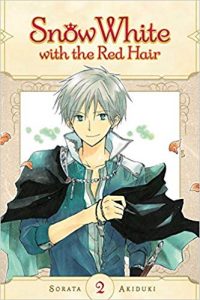
Snow White with the Red Hair, Vol. 1 by Sorata Akiduki
Shirayuki is renowned in the country of Tanbarun for her apple-red hair. When the infamously foolish Prince Raj decides that she’s going to be his next concubine, Shirayuki cuts her hair and flees. She winds up making the acquaintance of a boy named Zen, who turns out to be the younger prince of the neighboring Clarines kingdom. After they defeat Prince Raj’s henchman, they decide to stick together. Zen returns home to the Clarines capital city where Shirayuki starts studying to become a court herbalist.

I really liked the characters in this one. Shirayuki is smart and has a definite goal that she wants to earn for her own merits and not through Zen’s benevolence. She is never once spazzy. Although her unique beauty (and a developing reputation as a “treasure even a prince failed to nab”) makes her a target, which sometimes requires Zen to come to her rescue, she is suitably defiant and resourceful enough on her own that this does not play out like a typical shoujo trope. For his part, Zen is wonderfully supportive of her goals and, furthermore, demonstrates that he understands her when he dismisses someone’s suggestion that he should just appoint her to be court herbalist.

This is kind of a low-key series so far, but it’s exceedingly charming and I very much look forward to continuing with it.

Snow White with the Red Hair is ongoing in Japan, where 20 volumes have been released so far. Volume two comes out in English tomorrow.

That Blue Sky Feeling, Vols. 1-2 by Okura and Coma Hashii
When friendly and outgoing Dai Noshiro transfers to a new school, he can’t help but notice that one student is always alone. Kou Sanada insists that Noshiro doesn’t have to go out of his way to talk to him, but Noshiro is convinced that Sanada is lonely and keeps trying to befriend the boy, even after hearing rumors that Sanada is gay. He chastises others for treating Sanada differently, but must confront his own reaction when, after Sanada backtracks after admitting the rumor is true and instead claims to have been joking, relief is his primary emotion. To his credit, he realizes the impact of his words and swiftly apologizes.

The bulk of these two volumes concerns these very different boys getting to know each other. Noshiro is big and loud but profoundly innocent in the realm of romance. He had notions of protecting Sanada, but soon realizes, “He’s way more grown-up than me!” (Sanada has had at least one boyfriend, Hide, who is 26. Seeing as how Sanada is in high school, this is a little creepy, but Hide actually proves to be a decent guy who gives Noshiro a lot of helpful advice.) Sanada is reserved and prefers to keep out of the spotlight, which is difficult when someone as boisterous as Noshiro is around.

Sanada is also pretty anxious, and I loved that every time he worried that Noshiro wouldn’t accept him or that he should continue to keep parts of his life separate, Noshiro would surprise him. One good example is when Sanada meets up with a guy he met online and Noshiro spots them walking around town together. Sanada expects the worst. “The more he gets to know me the more Noshiro will be weirded out by me. I just know it.” But the truth is… Noshiro is just upset that other people can make Sanada smile more easily than he can, and this bugs him for some reason.

By the end of volume two, it’s clear that Sanada is starting to have feelings for Noshiro, and that he’s jealous when another boy starts crushing on him, too. It’s unclear whether Noshiro is feeling the same—he’s so clueless romantically that he actually thought Sanada might start dating a female classmate simply because she is his friend—though he does at least realize that what he feels for Sanada is special. I do hope they get together in the end, but a more bittersweet ending would be satisfying, too.

That Blue Sky Feeling is complete in three volumes. The final volume will be released in English in October.

Will I Be Single Forever? by Mari Okazaki
As a big fan of Okazaki’s Suppli, I was delighted when VIZ decided to offer one of her titles in a digital-only format. Based on an essay by Mami Amamiya, Will I Be Single Forever? features the interconnected stories of three unmarried and proudly self-reliant women in their thirties.

Mami is 36 and a successful writer, though her mother pities her for her singlehood. “I’m finally capable,” Mami laments, “but she feels sorry for me.” Reuniting with family for a funeral reminds Mami how others have assumed their places as wives and mothers, but it’s her free-spirited single uncle who really seems to be enjoying life. She wants to be like him.

Yukino has broken up with a guy who she didn’t really like that much, but is upset nevertheless. After a brief attempt at rekindling with an old flame—and realizing with horror that she was so scared of being alone that her memories of why they broke up temporarily vanished—she decides to go on the trip she and her ex had planned to take by herself and has a blast.

Shimizu has a lover she forgets about for weeks at a time and turns down a rendez-vous with him in favor of work, which she finds more fulfilling. She ponders if fixating on random projects is just protecting herself from something, but in the end concludes the work is honestly rewarding. “I want to keep going down this path.” (My one complaint here is that the exact nature of these projects is kept vague, something that also bugged me in Suppli.)

In the final chapter, the women convene after Mami almost gets married. Her fiancé was a jerk from a family of jerks, and she emerges from the experience literally and figuratively battered and bruised. The final scene is marvelous, as the trio creates their own definition of happiness: “Eating good food. Reading your favorite books. Telling yourself “Good job!” at work. Eating a whole bag of potato chips in the middle of the night. And getting those things for yourself with your own strength.”

In the interview at the end of the book, the creators assure readers they bear no ill will towards married ladies and stress that it’s the independence, the having of one’s own life that is most important. I think I would’ve preferred a much longer series fleshing out these characters, but it was a good, affirming read nonetheless!

Will I Be Single Forever? is complete in one volume.

Filed Under: Fantasy, Josei, LGBTQIA+, Manga, REVIEWS, Shoujo, Shounen Tagged With: Mari Okazaki, Mika Yamamori, Okura and Coma Hashii, Sorata Akiduki, Tomohito Oda

Pick of the Week: Dreaming of Shoujo

July 1, 2019 by Sean Gaffney, Michelle Smith, Katherine Dacey, Ash Brown and Anna N Leave a Comment

MICHELLE: Despite the Pretty Little Liars vibes of its concept, the mere fact that Daytime Shooting Star ran in Margaret is sufficient for me to award it my pick of the week. I deeply hope I’m not skeeved.

SEAN: I want that too, and will always welcome Oresama Teacher and Kaguya-sama: Love Is War, but my pick this week is Side-by-Side Dreamers, because yuri science fiction novels are something I’d like to see more of.

KATE: I’m still reeling from last week’s enormous bounty, so I’m going to pass on recommending anything new. Ask me when I’m climbed out from underneath the big stack of books next to my bed…

ASH: I’m likewise behind in my manga reading, however many of the shoujo releases from Viz will still be added to my ever-growing stack this week. I’m easily furthest behind with Oresama Teacher, but it’s such a delightful series that I have no qualms with making it my official pick.

ANNA: I’m always excited for shoujo debuts like Daytime Shooting Star, but when looking over the week I’m most interested in reading the second volume of Snow White with the Red Hair, which seemed endearingly quirky based on the first volume. I want to see how the series develops.

Filed Under: PICK OF THE WEEK

Infinite Dendrogram: Blue Blood Blitz

July 1, 2019 by Sean Gaffney

By Sakon Kaidou and Taiki. Released in Japan by Hobby Japan. Released in North America by J-Novel Club. Translated by Andrew Hodgson.

First off, it has to be said: that is a deeply ludicrous and yet amazing hat and cloak combo that the Princess is wearing while she’s out secretly saving the world – though it seems the only one who doesn’t figure out who she is is Ray. I’d mentioned in my last review that the Princess is set up as a sort-of-but-not-really love interest for Ray, and that holds true here: Ray continues to be almost asexual, and it’s made clear that his role in Altimia’s story is to get her to trust Masters again so that Altar might actually be able to defend itself in the upcoming war. That said, she and Ray do make a very good combo team, and I’m sure we’ll see more of her eventually. Also amusing in this volume is Ray and Nemesis taking down an extremely cliched villain from the “This-this cannot be!” school of acting, and the revelation about who he is in real life fits 100%.

The girl on the cover is another of Ray’s new weapons/abilities/allies, but in terms of this story she shows up, demonstrates her FIRE PUNCHING, then goes away again. More interesting are the revelations about Tom Cat, the clone-making adventurer that we met in the previous book. His actual identity is more of a surprise than I expected, but works well in the context of the series/world. It’s still unclear how much of Dendrogram is “this is an unusually complex game with a deep deep backstory” and how much is “this is an actual world that we have somehow made into a game”, but the author is enjoying making us try to figure it out. Hopefully next time we will have fewer doomsday weapons. That said, I did very much enjoy the weapon having slept for 2000 years and no longer able to recognize what humanity is till it sees something that is reminiscent of its former time. It was cheesy but very effective.

There’s an anime coming soon, and I really do wonder how a fandom that’s not familiar with him is going to deal with Ray. His chuuni tendencies aside (and we do get some more making fun of his Evil Overlord Outfit), he really is the ridiculously OP hero that most fans of fantasy works profess to hate. He has an easier time than he’s had in the last few books here – he may be pushed to the brink once or twice, but there’s never any real sense he’s in trouble, and it helps that he’s found out that his magical robot horse is also doing cool (if mysterious) stuff to save his life. Without the usual Altar masters around to show that there are people even better than Ray, he gets more of a big fish in a small pond book here. It works well for this book, but I hope next time we see him either in real life or the game getting shown that he has a ways to go.

Dendrogram is always fun to read, and this volume is no different. At times I can’t follow the worldbuilding (a wiki of some sort is likely needed), but it’s still definitely recommended.

Filed Under: infinite dendrogram, REVIEWS

The Asterisk War: Conquering Dragons and Knights

June 30, 2019 by Sean Gaffney

By Yuu Miyazaki and okiura. Released in Japan by Media Factory. Released in North America by Yen On. Translated by Haydn Trowell.

Even if you hadn’t already figured out what the result of the Gryps competition, the subtitle of the volume may clue you in. Our heroes this time take on Jie Long’s Dragon Warriors, a team seemingly set up to look like they stepped off the screen of a videogame. The winner of that battle goes on to face Saint Gallardsworth’s team of Arthurian types, though I’m honestly not sure if Arthur’s Knights of the Round Table ever had an obvious princess-curled tsundere quite like Laetitia. Things are not helped by the events in the previous volume, which have left most of Team Enfield feeling particularly exhausted. Of course, this is exactly the time when a typical cliched shonen series would have its cast each reach the next level, pull new abilities out of their asses, and go on to crush the competition by virtue of being really, really shonen about it. And never let it be said that Asterisk War does not go for the easy answer, as this is exactly what happens.

Kirin has the cover image this time around, and while the author apologizes in the afterword for sidelining her from the final fight, I have a feeling that was meant to be partly ironic, as the fight against Jie Long is Kirin’s finest hour to date. Honestly, I was expecting Ayato to pull things off again, but to be fair, he was needed for the next fight along, and Kirin had not had a spotlight in some time, so it’s justified. Much as it’s talked about in terms of being able to see the way the fighter’s prana is behaving, her new ability essentially boils down to “can predict moves better”, which is fine. No one cries out for gritty realism in a magical academy fighting manga – at least I hope they don’t. Instead you ask for cool, and that’s what we get here… at the cost of Kirin being bedridden for the rest of the book. And possible getting yelled at by her family, there’s a cliffhanger involved.

We then go up against Team Lancelot, though not before we see Ayato meet a mysterious masked man who professes to be the one who put his sister in her coma. He’s a trickster mentor of the finest water, and his presence (and assistant) seems to hint that Ayato’s story will be tied up with Sylvie’s again pretty soon. That said, the best part of this second half was seeing Ernest finally give in and embrace his inner selfish asshole. His weapon involves being pure, noble and chivalrous, but doing so was clearly pressuring him in ways that were obvious to see. It was one of those things where the reader, who knows his character type, was waiting for the other shoe to drop. He also becomes far more interesting, even though it may be Percival who we follow going forward. (Sorry, Laetitia, you have “always a side character” written all over you.

In addition to Kirin’s family cliffhanger, we also get Ayato getting a call from his father right at the end. Still, despite that, I suspect that the next volume will be a lighter, breezier one to help relax after this arc. If you’re enjoying this beach read of a light novel, this is an excellent pickup.

Filed Under: asterisk war, REVIEWS

I Saved Too Many Girls and Caused the Apocalypse, Vol. 14

June 29, 2019 by Sean Gaffney

By Namekojirushi and Nao Watanuki. Released in Japan as “Ore ga Heroine o Tasukesugite Sekai ga Little Mokushiroku!?” by Hobby Japan. Released in North America digitally by J-Novel Club. Translated by Mana Z.

There is a plot twist about 2/3 of the way through this volume that pretty much manages to make me drop my main complaint about the book, which is that it’s simply too short. Even by the standards of Little Apocalypse, not one for large page counts, this is ridiculously short. It’s also got a cliffhanger, making me wonder if it might originally have been combined with the volume after it. The first third is relatively sedate… for Rekka, not the reader. We know there’s a problem because the huge cast list of heroines we see at the start of each book has almost all of them scribbled out – including R. Only seven heroines make the cut for this book, leading us to wonder what it is about them that makes them important… or rather, unimportant, as it seems they’re what’s left over after most of Rekka’s memories of the last six months have been wiped.

Technically not a new heroine on the cover, nor is she played by Jodie Whitaker, but The Doctor is the creator of both L and R, and is interested in their welfare – as well as that of Rekka. Sadly, events in the future are reaching a turning point, with the extremists deciding now is the time to kill Rekka in the past, even if they have to use giant robots to destroy the town. And that’s what we get, as a baffled Rekka and his remaining heroines try to evacuate and figure out what’s going on. Fortunately, Rekka eventually gets his memory back, and we find out what happened to R, but the other missing heroines remain missing for the entire book, nor do we know where they are. (My guess is the future, where Rekka ends up heading at the end of the book.) Even his parents, who show up in this book for the first time since the start of Chapter 1 or Book 1, aren’t able to do much but slow the enemy down.

As I noted earlier, I really liked the twist we get here, which is that Rekka should NOT be having to deal with all these heroines at once. The gimmick of the series – that he uses one heroine’s problems to solve another’s problem – was never meant to happen. The seven heroines who aren’t mindwiped/kidnapped are there because they’re the heroines he was SUPPOSED to originally save. They’re the “easy mode” heroines. (Notably, this does NOT include his childhood friend, removed even from her parents’ memories.) They’re heroines that Rekka could save using only his own human abilities and those of the heroine herself – I mean, we do still have a shrine priestess and nun with very lethal weapons around. If nothing else this helps us to be impressed with what Rekka’s achieved. The question is, though, what changed everything? Does it have to do with Rekka’s “helper” being R, not L?

Again, readers need to prepare for being able to finish off this book in only an hour. But if you don’t mind the length, this is a suitably fun and interesting volume as we head towards the series’ climax.

Filed Under: i saved too many girls and caused the apocalypse, REVIEWS

Accel World: The Black Dual Swordsman

June 28, 2019 by Sean Gaffney

By Reki Kawahara and Hima. Released in Japan by ASCII Mediaworks. Released in North America by Yen On. Translated by Jocelyne Allen.

First of all, my apologies. I ended the last review by complaining that we had the buildup to “what will a Space Stage be like?” with no follow through. Of course, it’s in THIS book that we get the space stage, as before they can battle Oscillatory Universe they have to go through Great Wall, who took some of their territory back in the day and now need to test their resolve in the best shonen manner. This of course leads to Black Lotus battling Graphite Edge, which leads me to my first complaint: I’m not that fond of Graphite Edge. Usually I enjoy a character with his sort of personality, but I feel it meshes very badly into the Accel World Universe. There’s also the fact that he’s clearly meant to be a take on Kirito – just look at the subtitle for this volume. But he’s nothing like Kirito at all – if anything he’s more similar to Klein. That said, the cliffhanger shows we may get more interesting detail about him in the next book.

We also meet a few other people in the real world and see how they contrast with their burst linker selves./ Sometimes it’s not much of one – the twins from Leondis radiate “we are a cliched parody of twins” to their core, but feel much the same in the Accelerated World. And sometimes there’s a larger contrast, as we find that Chocolat Puppeter is a classic “why would anyone notice me as I’m so ordinary” heroine. This is in fact pointed out by her two companions, who note that she’s the sort that folks call cute, and they’re right. I was a bit put out that we got the buildup for them meeting Nega Nebulus in the real world but the meeting itself took place offscreen – if nothing else I always enjoy people who have fought Silver Crow suddenly realize that it’s Haruyuki. This is especially true for Chocolat Puppeter, who we recall he tried to eat in their last fight. For tactical reasons, of course.

The climax of the book (there’s also a short story epilogue giving backstory to Blood Leopard, which was OK but that’s about it) involves Haruyuki realizing that he may not be able to be with Kuroyukihime much longer – her parents are pressuring her to move to a high school away from Tokyo, or even in America. This would mean no more Accel World. As such, he wants to help her achieve her goals… sort of. He wants her to reach Level 10, but doesn’t want her to kill four Kings to do it. So he and Fuko (and Metatron, who I really hope meets Othinus some day in an Index crossover) go back to the Imperial Palace to talk once more to the young boy who is totally not the son of the Emperor or anything, Trilead Tetraoxide. Unfortunately, the book ends before we can see if they achieve what they went there for: to see if the Fluctuating Light holds the answer to Level 10.

This is, overall, a fairly typical Accel World, still sort of spinning its wheels waiting for the next big arc. That said, 18 volumes in you’ll still want to read it.

Filed Under: accel world, REVIEWS

My Hero Academia, Vols. 1-19

June 27, 2019 by Michelle Smith

By Kohei Horikoshi | Published by VIZ Media

Reviewing nineteen volumes of a manga at once is a pretty daunting task, but here goes!

In a world where 80% of the population possesses superpowers known as “Quirks,” some people turned to villainy while others, officially trained and licensed, embarked upon careers of heroism to thwart them. Izuku Midoriya grew up idolizing heroes, particularly All Might, the Symbol of Peace, who always saved people with a smile. Unfortunately for Izuku, he was one of those unfortunate few without a Quirk and was forced to watch as his classmates and friends manifested abilities while he did not.

When Izuku is fourteen, he meets and impresses All Might when, despite being powerless, he rushes in to help his childhood friend Katsuki Bakugo when he is attacked by a sludge villain. As it turns out, All Might, who possesses a Quirk called One for All that endows him with super strength, was grievously injured several years previously in a battle with his nemesis, All for One. One for All is unique in that it can be passed on to a successor, and All Might has decided that Izuku is worthy of inheriting his power. All along, it’s been Izuku’s dream to attend U.A. High School and, after ten months of intensive training (and after ingesting one of All Might’s hairs), he succeeds in passing the entrance exam for U.A.’s Hero Course, much to Bakugo’s annoyance. (Bakugo believes he has been deceived about Izuku having been Quirkless all this time.)

Like many other shounen manga, part of the plot of My Hero Academia involves Izuku and the other students gradually getting stronger. Izuku goes through various stages of control over his power and eventually injures himself seriously to the point where he must switch to fighting primarily with his legs because his arms are so damaged. By volume nineteen, he can sustain 20% power only briefly, and All Might (who now teaches at U.A.) is training him how to, for the first time, add long-range attacks to his arsenal.

Meanwhile, just as Izuku is the protégé of All Might, All for One had taken a boy under his wing, as well. Tomura Shigaraki is a nihilistic villain with a particular grudge against All Might. He forms the League of Villains and so far has attempted to assassinate All Might at the school, attacked a training camp and kidnapped Bakugo, and ambushed a police caravan in order to steal Quirk-erasing drugs that had been seized from a former ally. While All Might exhausted the remainder of his powers to vanquish All for One, Shigaraki remains an active threat. Because of the power vacuum left by All Might’s retirement, the U.A. first years are able to take their provisional license exams earlier than normal and also go out into the field in work-study capacity.

The TL;DR version is: the plot is very good. Horikoshi-sensei writes with exuberance and mastery. However, the plot is not the reason I love My Hero Academia. I love it for the characters. I was thinking… I have read almost 90 volumes of One Piece by this point. Clearly, I enjoy it a lot and particularly admire the worldbuilding and continuity. However, while I’m fond of a few of the Straw Hats, I wouldn’t say I love any of them. Whereas with My Hero Academia, I love, like, ten of them. Here are some standouts:

• Izuku Midoriya – One of the things I really like about Izuku is that he’s smart. As a Quirkless hero fanboy, he spent a lot of time analyzing how they handled situations, and he’s good at coming up with strategies. Plus, he possesses all the idealistic qualities that a good shounen hero should have. He’s always out to help people, even if they don’t ask for it.

• Katsuki Bakugo – Bakugo has an explosive temper, but gradually reveals he’s a lot more sensitive that he lets on. Because of his volatile performance at the Sports Festival, Shigaraki targeted him, hoping to recruit him for the League of Villains. This ultimately led to All Might’s final confrontation with All for One, and Bakugo feels responsible that the Symbol of Peace (whom he also deeply admires) has been depowered. He’s the only one who knows Izuku’s secret and, after the most moving brawl I’ve ever seen in which he’s able to process some of the feelings he couldn’t express, he’s finally able to talk to Izuku without hostility. The day he actually smiles at Izuku, I will bawl.

• Shoto Todoroki – He became Izuku’s friend after the Sports Festival, in which Izuku encouraged him to finally embrace the half of his powers that came from his odious dad, #2 hero Endeavor. He’s still got a complex about his dad, but he’s working through it. And, for his part, Endeavor is trying to become a better hero, too, though he’s got a long way to go.

• Ochaco Uraraka – She’s a spunky girl who admires Izuku and has other feelings for him that she’s pushing aside for the moment. When she begins the series, she wants to become a hero for financial reasons, hoping to support her parents who’ve worked so hard. After her work study experience requires her to convey a dying hero to the hospital, she realizes in volume eighteen how much she just wants to save people. The monetary side has become less important.

• Eijiro Kirishima – Kirishima is just a supporting character until around volume fifteen, when he suddenly gets more fleshing out than even Ochaco or Ida (another of Izuku’s close friends) has received. He’s got an inferiority complex because his Quirk is purely defensive and castigates himself that he couldn’t help when Bakugo was taken. He presents himself as someone more confident and has a lot of noble ideals about what a hero should be, but I love that underneath that persona he’s a lot more complicated.

• Yuga Aoyama – In most other series, the kid who starts off being puffed up with pride over his own abilities (a naval laser!) would remain comic relief forever. But Horikoshi gives Aoyama several important heroic moments and, recently, he and Izuku have bonded over the fact that both of their Quirks cause them bodily harm, which doesn’t seem to be a problem for the other students. I would really love to see Aoyama star in his own arc.

• Mirio Togata – I was not prepared for the dizzying speed at which I’d come to love Mirio. First introduced in volume fourteen, he’s the one the principal (and All Might’s former sidekick, Sir Nighteye) originally had in mind as the next recipient of One for All. He’s optimistic and works hard and I love that he bears no grudge against Eri, a six-year-old girl that he lost his Quirk protecting. His return to heroism has been foreseen, so that’s something I’m looking forward to. His best friend Tamaki Amajiki is highly lovable, too.

• All Might – He’s not the greatest teacher, but he’s really trying hard. He serves as a father figure to Izuku and says encouraging things to him that make me verklempt, like “You’ve already exceeded my expectations more times than I can count. In my heart of hearts, I believe there’s something special in you and you alone.” He absolutely does not hesitate to give everything he’s got in that final battle with All for One, and has no regrets about the outcome, save that he failed to notice how much pain Bakugo was in about it. “I’m sorry. You too… are only a boy.” Waah.

• Shota Aizawa – I saved the best for last. Aizawa is the homeroom teacher for class 1-A and I love him so, so much. He is a great teacher and puts a lot of thought into how best to encourage development in his students. One of my favorite Aizawa moments occurs at a press conference when he expresses absolute faith that Bakugo will not be tempted to join the League of Villains. “More than anyone, he pursues the title of top hero with all he has.” Later, during a home visit with Bakugo’s parents to discuss the new on-campus dormitories, Bakugo’s mom reveals how much she appreciated this proof that her son has been understood by his educators. “Most everything comes easy to him. His whole life, people’ve made a fuss about him… praising him for every little thing he does.” Aizawa sees Bakugo’s potential but also doesn’t let any of his shortcomings slide. I love, too, how he helps take care of Eri and buys her outfits with kitties on them.

Barring one, the other students in class 1-A are great, too, and I hope they get their own arcs as revelatory as Kirishima’s. And then there’s class 1-B, whom we’ve only glimpsed, as well as Hitoshi Shinso, a boy from the General Studies Course who may have the potential to transfer to the Hero Course.

Alas, there’s one thing and one particular character that I don’t love about My Hero Academia.

• Although the female characters are impressively varied in character design and personality and are always included in various heroic endeavors (and their abilities respected by the male characters), they just don’t get as much of the spotlight as the guys do. True, Ashida and Jiro are more to the fore during the School Festival arc, which is very welcome, but I want to see them out in the field kicking some serious ass.

• Minoru Mineta – Unlike the other students who’ve grown over the course of the series, Mineta starts off as a gross little pervert, remains a gross little pervert, and there’s zero indication that he’ll ever be anything other than a gross little pervert. He doesn’t see girls as people, but as objects, evaluated solely for their attractiveness. In fact, his first words to Eri in volume nineteen—who is, I reiterate, six years old—are, “Look me up in ten years.” I want Shigaraki to use his disintegration Quirk on him. Slowly. And then Shinso can have his spot.

Ultimately, I love this series unabashedly. I love it as much as I love Hikaru no Go, and that’s a lot. And as with Hikaru, I love the anime just as much as the manga and recommend both. It took until volume nineteen to make it to October of Izuku’s first year, so at that pace, we’re looking at around 38 volumes per school year times three years… Sounds good to me! I will plug my ears and go “la la la!” if anyone ever mentions a time jump. This is really too good to rush. Or miss.

My Hero Academia is ongoing in Japan, where volume 24 will be out in August. Volume 20 is due out in English in August. New chapters are also available in English on the Shonen Jump website and app.

Review copies for some volumes provided by the publisher.

Filed Under: Manga, REVIEWS, Sci-Fi, Shounen Tagged With: Kohei Horikoshi

Manga the Week of 7/3/19

June 27, 2019 by Sean Gaffney, Michelle Smith, Anna N and Ash Brown Leave a Comment

SEAN: July begins with, as you may be used to by now, a pile of manga. Let’s take a look.

Cross Infinite World has another novel debut with Labyrinth Angel, a supernatural thriller with a psychic woman and her butler assassin.

ASH: I do have a soft spot for butler assassins…

SEAN: There’s no Seven Seas next week, oddly enough, but we have two Ghost Ship titles. To-Love-Ru Darkness 11 and Yuuna and the Haunted Hot Springs 6 are both out.

J-Novel Club debuts a one-shot yuri novel, Side-by-Side Dreamers. Like JK Haru, this is from Hayakawa, a publisher known more for their science fiction than their light novels. An insomniac and a girl who can influence dreams battle against outside forces trying to destroy everyone’s sleep.

ASH: That’s a great premise. I hope this one is eventually released in print!

SEAN: They’ve also got Cooking with Wild Game 3, Infinite Stratos 8, and Kokoro Connect 6.

Kodansha has only one print title out next week, the 7th Grand Blue Dreaming.

Digitally, they have My Sweet Girl 4, Our Precious Conversations 3, Perfect World 9, and The Tale of Genji: Dreams at Dawn 5.

MICHELLE: I keep meaning to check out Our Precious Conversations, as it’s by Robico, whose My Little Monster I enjoyed.

SEAN: Now we drop all the way from K to V, with Vertical’s 13th Mobile Suit Gundam Wing.

There’s plenty of Viz, though – in fact it’s the bulk of the list. Debuting is Daytime Shooting Star (Hirunaka no Ryuusei), a Margaret title! Yes, regular Margaret, not Betsuma – a rarity for Western licenses. Country girl moves to the city, and finds the hot guy who she met the other day is her homeroom teacher. Student/teacher romance is not normally my thing, but I’m still gonna check it out.

MICHELLE: I unfailingly love Margaret titles, so despite the student/teacher aspect, I will also be reading this one.

ANNA: Me too, psyched for anything Margaret.

ASH: Count me as curious.

SEAN: Other shoujo titles include Anonymous Noise 15, Kakuriyo: Bed & Breakfast for Spirits 4, Oresama Teacher 26 (the ending was just announced in Japan! Noooooo!), Snow White with the Red Hair 2, Vampire Knight: Memories 3, and The Water Dragon’s Bride 10.

MICHELLE: Lots of good stuff in this list! I especially vote for Snow White with the Red Hair, the first volume of which was a lot of fun and had seriously likeable leads.

ANNA: This is a good week for me. Also excited for Snow White with the Red Hair and Water Dragon’s Bride.

ASH: Yup! Hooray for shoujo fantasy!

SEAN: On the Jump end, there is Black Clover 16, Demon Slayer: Kimetsu no Yaiba 7, Dr. STONE 6, Haikyu!! 33, Kaguya-sama: Love Is War 9, the 2nd My Hero Academia School Briefs light novel, as well as the 5th Vigilantes spinoff volume, and Platinum End 9.

ASH: Hooray for Haikyu!!, too!

SEAN: Lastly, a couple of Yen titles got pushed back a bit. Bungo Stray Dogs gets its first novel, a prequel taking place two years before the manga. And we also get the 11th and final Alice in Murderland, which means that we are once again in an odd, Kaori Yuki-less time period in our lives.

There’s plenty in this list to interest everyone. What about you?

Filed Under: FEATURES, manga the week of

Shortcake Cake, Vol 4

June 26, 2019 by Anna N

Shortcake Cake Volume 4 by suu Morishita

I’m growing more and more fond of this series. I enjoy the steady, slice of life way the plot unfolds, the great sense of place that is grounded in the boardinghouse setting, and most of all the silent moments between the characters that are filled with meaning. I swear, a 4 panel layout of characters from Shortcake Cake just glancing at each other would be a long drawn out speech about feelings in a less well-executed manga.

Switching back and forth one’s object of affections isn’t really anything new, but as Ten starts to reassess her feelings for Riku, Chiaki comes down with a severe case of second male lead in a Korean drama syndrome, where he basically speaks to Ten about his feelings for her in incredibly oblique riddles that she is totally unable to pick up on. Oh, the foolishness and frustration of teenage shoujo manga love! Chiaki and Ten’s fake relationship to fake out Rei gives her an excuse to dismiss his declarations of affection, which Chiaki conveniently times for when Rei is around. Ten realizes her emotions are shifting and thinks to herself that if she was reading a story where she was the protagonist, she wouldn’t like it, because the main character contradicts herself and is selfish. She thinks of her current life being “a bad book” but it seems to more like just what anyone would expect from a teenager not very practiced at friendship. Ten’s self awareness goes a long way in making her sympathetic as she attempts to figure out her suddenly very complicated romantic life.

Chiaki and Riku also attempt to negotiate the strange new undercurrents in their friendship. Ten starts a summer job and in a fraught decision, the trio decide to go to a beach together during their vacation. This volume very much felt like summer, and as Ten goes home she starts to get more clarity over her emotions. I enjoyed the way Ten is self-reflective throughout the book, she seems to be making a decision that will carry over to the next volume, but she’s put in a lot of emotional work behind the next step on her journey.

Filed Under: Manga Reviews, REVIEWS Tagged With: shojo beat, shortcake cake, shoujo, viz media

  • « Go to Previous Page
  • Page 1
  • Interim pages omitted …
  • Page 308
  • Page 309
  • Page 310
  • Page 311
  • Page 312
  • Interim pages omitted …
  • Page 1048
  • Go to Next Page »
 | Log in
Copyright © 2010 Manga Bookshelf | Powered by WordPress & the Genesis Framework