SEAN: Believe it or not, under 20 releases is now a quiet week. Welcome to the Manga Boom, here’s your accordion. So what’s out next week?

J-Novel Club has an odd license. Despite being available to them, no one thought the company would license Invaders of the Rokujouma!? for two reasons: 1) It’s 23 volumes and counting in Japan, and 2) it already had a well-regarded fan translation of the first 22 volumes. But J-Novel has licensed that fan translation, is giving it an edit, and doing a fast release of the first three volumes of the series, with more to come monthly, apparently. As for the title itself, it’s a harem comedy, so moving on…
ASH: It’s probably not a series that I’ll ever pick up, but that’s an interesting publication history!
SEAN: Kodansha has more digital Del Rey rescues. Alive 16, Nodame Cantabile 20, and Yozakura Quartet 12.
…and I guess that Kodansha has Battle Angel Alita 1-3 out digitally too. I knew it was coming, but not so soon. This is the original BAA (as opposed to the Last Order reboot), with a new translation.
Their lone print release this week is the 60th volume of Fairy Tail, which should be wrapping up in Japan soon.
Kodansha also has new digital releases. Kasane is an award-winning work, and runs in the magazine Evening. It appears to be a dark thriller with lots of bullying and abuse overtones. But, magic lipstick!

Real Girl (3D Kanojo) is a shoujo/josei title from Dessert, involving a nerdy outcast type who ends up working with a cool beauty, the sort he hates, but gradually comes to realize that cool beauties are people too.
ANNA: I have mixed feelings about these digital releases, I’m so happy that more shoujo/josei is coming out, but having been burned before by the crash and burn of digital manga programs in the past, I’m concerned about some of these titles actually being finished. Also, it would be great to have some more josei print manga! Even with these handy reminders for the Manga Bookshelf team, I’m having a hard time keeping track of all the digital releases that I’m interested in.
MICHELLE: There certainly are a lot of them! That said, I will give these two new ones a try. And yay for more Nodame, as well!
ASH: I’m glad that these titles are being licensed at all, but I’d definitely like to see more of the released in print, too.
MJ: I share Anna’s concerns. I’m glad these are being released, but I’m still reeling from the loss of some JManga series I was really invested in (that have not, to my knowledge, been picked up by anyone else), and I admit I still mistrust digital.
SEAN: If it helps, the JManga title To All Corners of the World was rescued by Seven Seas and will be out in November in one (print) omnibus.
Seven Seas has a few new titles next week, starting with a (gasp!) novel, The Disappearance of Hatsune Miku, based on the seemingly unstoppable Vocaloid idol.

The manga debut is The High School Life of a Fudanshi (Fudanshi Koukou Seikatsu), a comedy title from Zero-Sum Online about a straight guy obsessed with BL, and his drive to find someone else to share his obsession with.
ASH: Knowing a few straight fudanshi myself, I’m rather curious to see how the series handles the topic.
MJ: Cautiously interested.
SEAN: And there’s a 5th volume of Shomin Sample, which must have run out of girls showing us their panties on the cover by now. (checks) Sadly, apparently not.
Vertical has the 8th Ninja Slayer, for all your Ninja needs.
They also have a light novel based on the Seven Deadly Sins manga, subtitled Seven Scars They Left Behind. Judging by that title, I wouldn’t expect a lot of laughs.
Yen Digital has some new volumes for us, as we get the 10th Aphorism, the 10th Crimson Prince, and the 10th Sekirei.
And while it’s not Vol. 10, Yen On does have the first four Sword Art Online novels now available digitally, for those obsessed with reading light novels on their phones (like me).
Are you taking a week off? Or getting something here?
 Fifteen-year-old Tsukushi Tsukamoto doesn’t have any friends. He’s always rushed home after school to be there for his disabled mother, who is raising him on her own after his father passed away. After an eccentric fellow named Jin Kazama saves Tsukushi from bullies, Tsukushi is more than willing to grant Kazama the favor of playing a game of futsal with him. In fact, he runs six miles through the rain in order to fulfill his promise, and though he’s spectacularly awful at the game, he’s also a gutsy idiot and something about his enthusiasm rubs off on his teammates.
 Little by little, Tsukushi manages to not completely suck, albeit only for brief moments at a time. Because of his ability to rekindle the joy of soccer in others, he is surprisingly chosen for the Interhigh team. Though he makes an error that costs them a penalty kick, he also makes a valiant save that rallies everyone’s spirits. I’m a sucker for those moments when the underdog first hears the crowd cheering for them so, predictably, this moment made me verklempt.


 Mikuri Moriyama is a 25-year-old licensed clinical psychologist who hasn’t been able to find a job after grad school. She’s been living with her parents and working for a temp agency, and when she’s laid off her father arranges for her to assume housekeeping duties for a guy he used to work with. Hiramasa Tsuzaki is 36 and single. He seems humorless and particular at first, but Mikuri finds that working for a hard-to-please guy makes it easier to know when she’s been successful. She performs her duties well, even managing to nurse Tsuzaki through an illness in such a business-like way that it’s not awkward for him. Things go well for a few months, then Mikuri’s father prepares to retire and move to the countryside. Rather than lose their mutually beneficial arrangement, Mikuri and Tsuzaki decide that she’ll move in with him and, for the sake of propriety, become his common-law wife. They proceed to perpetuate the ruse that they’re actually a real couple.
 As Tsuzaki’s coworkers learn that he’s gotten married, his social calendar suddenly fills up in a way it never did before, while Mikuri notices that her aunt Yuri, with whom she’s very close, has been hesitant to invite her out as much as she used to before Mikuri got married. Spending time with Numata and Kazami is enjoyable for the couple, but it’s also risky, because nosy Numata snoops and learns there’s only a twin bed in the bedroom, and by volume two, Kazami is convinced that they’re faking it. Kazami is perhaps as equally developed as Tsuzaki himself, as we hear a great deal about his reservations about marriage, which all leads up to the big cliffhanger ending of volume two (which I shan’t spoil). Tsuzaki, meanwhile, is attempting in vain to keep from developing feelings for Mikuri. She persists in being business-like, and he 100% believes there’s no chance she’d ever reciprocate, so he often looks emotionless in front of her, only revealing his feelings when he’s alone. I love that neither one of them is spazzy; they’re in a somewhat trope-y arrangement, but they’re handling it like adults.


 Even without knowing much about Dreamin’ Sun, I was sold by the fact that it’s an earlier series from Ichigo Takano, creator of orange, which I loved dearly. Dreamin’ Sun is more of a straightforward and comedic shoujo story in which characters do not contend with letters from their future selves or how to save a suicidal friend, but it still has a few poignant moments.
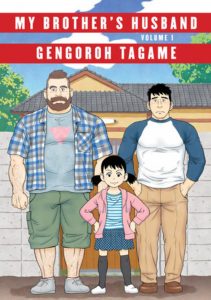 Yaichi is a single dad who works from home managing the rental property his parents left to him and his brother, Ryoji, after being killed in a car accident when the boys were teenagers. He considers his real job to be providing the best home he can to his daughter, Kana. On the day the story begins, Yaichi is expecting a guest—Mike Flanagan, the burly Canadian whom Ryoji married after leaving Japan ten years ago. Ryoji passed away the previous month and Mike has come to Japan to try to connect with Ryoji’s past and see for himself the many things he’d heard stories about from his husband.
 It’s the story of Minare Koda, a waitress with a gift of fluency that catches the attention of a local radio producer, Mato. After secretly recording her drunken rant about her thieving ex and playing it over the air, he eventually takes the chance of giving her her own weekly show in a late-night time spot where she has the freedom to do some really kooky things. The first episode, for example, is a surreal audio drama about murdering said ex, Mitsuo. The next week, it’s time to bury the body on Mt. Fuji!
 Yaichi is a single dad, earnestly raising his young daughter, Kana, whose life is upended by the arrival of Canadian visitor, Mike, husband to Yaichi’s estranged twin brother, Ryoji, who has just passed away. Yaichi greets Mike with awkwardness and not just a little homophobia, but is forced to invite him to stay after Kana, blissfully unaware of her father’s discomfort, insists that he must be welcomed into their home. Mike, stricken with grief, but anxious to connect with Ryoji’s family and childhood, gratefully accepts Yaichi’s grudging hospitality and settles into Ryoji’s old room.
  Asahi is spending a pleasant afternoon with her parents and she’s just about to go in and have some cookies when the backyard pond reaches out and ensares her, transporting her to another world. There, she meets a friendly boy named Subaru who unfortunately has some very ruthless parents, who immediately decide to offer Asahi to the water dragon god to obtain prosperity.
 In elementary school, Shoya Ishida often engaged in foolhardy stunts to stave off boredom. When hearing impaired transfer student Shoko Nishimiya joins his class and causes disruption within the class, she becomes Shoya’s target. Initially, the other kids laugh at Shoya’s antics but when he goes too far and destroys several hearing aids to the tune of $14,000, they swiftly condemn him. Now he’s the one who’s ostracized and this status continues into high school, long after Shoko transferred out again. Full of self-loathing, he’s preparing to commit suicide, but a chance reunion with Shoko inspires him to try to change.
 Back and forth things go, with this group continuing to try to establish themselves as friends without seeming to genuinely like each other much. Eventually, they decide to film a movie together. For one scene, they need to acquire permission to film at their old elementary school. Shoya is the unwilling emissary, and an encounter with his odious former teacher leaves him feeling so awful about himself that he ends up lashing out at all his friends, seemingly trying to drive them away as he feels he deserves. This has the unintended side effect of causing Shoko to feel like she’s the cause of his unhappiness, prompting a desperate act.
 Less clear is what Oima was aiming for with their group of friends. Even though Naoka was far more outwardly nasty to Shoko, at least she was open about it and expressed a great deal of self-loathing because of her behavior. With the help of another friend, Miyoko, she is encouraged to have a bit more optimism, and will probably end up doing okay. Even though she could’ve been fleshed out further, I do like Naoka as a character. But man oh man, do I hate Miki. She makes everything about herself—at one point revising the bullying narrative so that she and Shoko were co-victims—and doesn’t seem to grow at all. Everything she does seems fake, because most of it is, and I was baffled when the boy she fancies declared her to be “kind” after some weepy episode. Miki should get hit by a bus.


 Bloom Into You, Vol. 1 by Nakatani Nio
 The Girl from the Other Side: Siúil, a Rún, Vol. 1 by Nagabe
 Kase-san and Morning Glories by Hiromi Takashima
 Kindred Spirits on the Roof: The Complete Collection by Hachi Ito, Aya Fumio, Toitentsu, and Liar-Soft