• Skip to primary navigation
  • Skip to main content
  • Skip to primary sidebar
  • Home
  • About Us
    • Privacy Policy
    • Comment Policy
    • Disclosures & Disclaimers
  • Resources
    • Links, Essays & Articles
    • Fandomology!
    • CLAMP Directory
    • BlogRoll
  • Features & Columns
    • 3 Things Thursday
    • Adventures in the Key of Shoujo
    • Bit & Blips (game reviews)
    • BL BOOKRACK
    • Bookshelf Briefs
    • Bringing the Drama
    • Comic Conversion
    • Fanservice Friday
    • Going Digital
    • It Came From the Sinosphere
    • License This!
    • Magazine no Mori
    • My Week in Manga
    • OFF THE SHELF
    • Not By Manga Alone
    • PICK OF THE WEEK
    • Subtitles & Sensibility
    • Weekly Shonen Jump Recaps
  • Manga Moveable Feast
    • MMF Full Archive
    • Yun Kouga
    • CLAMP
    • Shojo Beat
    • Osamu Tezuka
    • Sailor Moon
    • Fruits Basket
    • Takehiko Inoue
    • Wild Adapter
    • One Piece
    • After School Nightmare
    • Karakuri Odette
    • Paradise Kiss
    • The Color Trilogy
    • To Terra…
    • Sexy Voice & Robo
  • Browse by Author
    • Sean Gaffney
    • Anna Neatrour
    • Michelle Smith
    • Katherine Dacey
    • MJ
    • Brigid Alverson
    • Travis Anderson
    • Phillip Anthony
    • Derek Bown
    • Jaci Dahlvang
    • Angela Eastman
    • Erica Friedman
    • Sara K.
    • Megan Purdy
    • Emily Snodgrass
    • Nancy Thistlethwaite
    • Eva Volin
    • David Welsh
  • MB Blogs
    • A Case Suitable For Treatment
    • Experiments in Manga
    • MangaBlog
    • The Manga Critic
    • Manga Report
    • Soliloquy in Blue
    • Manga Curmudgeon (archive)

Manga Bookshelf

Discussion, Resources, Roundtables, & Reviews

Michelle Smith

Off the Shelf: Good Reads & Oddities

June 16, 2011 by MJ and Michelle Smith 7 Comments

MICHELLE: I just ate an uncooked tortilla full of cheese.

MJ: I am eating bread stuffed with pepperoni.

MICHELLE: Assuming yours was actually cooked, I deem you the more sophisticated snacker. Shall we stop talking food and start talking manga?

MJ: Sure! I had a great week in manga, actually, with new volumes from two of my favorite creators arriving at my doorstep. It began with volume six of Ooku, Fumi Yoshinaga’s historical manga set in an alternate version of feudal Japan in which the male population has been nearly wiped out, leaving women to step into traditionally male roles.

This series has been fascinating from the start, and I’ve written quite a bit about it, especially in terms of the way it portrays a gender-reversed society that is essentially still patriarchal. This is still fascinating, but what really struck me in particular as I was reading this volume is just how much it reads like true history. Everything about this volume evokes a feeling of authenticity so strong, if I didn’t know anything about the history of Japan, I would absolutely believe it was non-fiction. That might not sound like a compliment, considering the quality of writing in a lot of non-fiction, but I absolutely mean it as such.

Every detail here, even the odd speech and awkward cadence, feels authentic. This is enhanced greatly by the strong sense, in this volume particularly, that everything here is far in the past, imbuing the story with an aura of inevitability I can’t quite describe. These events are fact, immutable and accepted by generations of people before us. That’s how the story feels.

The series gets pretty unsavory in places, and this volume is no exception there, but one experiences it with the same acceptance as one must when reading history. Even the ugliest moments are irrevocably part of the story’s time and place.

This may seem like a pretty simplistic observation, but really, it hadn’t hit me so strongly before this point. It honestly felt like a revelation of a sort.

MICHELLE: I wonder if that viewpoint will help me get past the hurdle of volume two. “Fictional cat, fictional cat,” I’ve been trying to tell myself. Maybe my mantra should be “Fictional cat a long, long time ago” instead.

MJ: Perhaps even “Real cat from a long time ago whose memory stays alive through poignant depiction of its fate.”

MICHELLE: That may be pushing it a bit.

MJ: Well then, moving on, what have you read this week? You know, that doesn’t involve an untimely feline death?

MICHELLE: Some interesting stuff, actually! As you might be aware, I’ve had some difficulty in pinpointing how I feel about Julietta Suzuki’s Kamisama Kiss. Each volume has been more or less enjoyable, yet I’ve remained disappointed.

I’m happy to report that the third volume has hopefully changed that. This has less to do with any alterations on Suzuki’s part, however, and more with one I made myself: I stopped waiting to be impressed. Because I liked Suzuki’s Karakuri Odette so much, I was waiting for her to transcend that series with this new one, and it just wasn’t happening. By volume three, this impulse had largely subsided and I was able to simply enjoy the series for what it is: an episodic supernatural sitcom.

Volumes two and three have established a pattern: Nanami goes to school and encounters some new supernatural hottie from whom Tomoe, her slightly grumpy but actually kind shinshi (familiar), must protect and/or rescue her. Volume three’s interloper is Mizuki, a shinshi whose master has disappeared due to lack of worshippers. He takes the form of a white snake, and when he randomly shows up at Nanami’s school in this guise, she prevents other students from harming him. He repays this favor by leaving a mark on her that means they are now engaged.

It’s gratifying to see Tomoe spurred to action on Nanami’s behalf, even as he tries to tell himself it’s only on account of his shinshi dignity, and they are both awakening to their feelings more swiftly than I’d expected. None of this is really new territory—the description “Black Bird Lite” would not be far off—but as long as one stops expecting some sort of innovation, it’s actually a pretty nice story.

MJ: Now, one of the things I liked about the first volume of this series, is that it didn’t contain any of the blatant misogyny so characteristic of Black Bird. Given that you’ve described it as a “Lite” version of that series, what should I expect? Has this changed?

MICHELLE: Oh, no, it hasn’t. I just meant you’ve got a heroine whom supernatural fellows seem to desire—though this is usually on account of her kami powers or her shrine and not because boffing her will convey some benefit—and who has yet another supernatural bishounen to protect her. Tomoe isn’t condescending towards Nanami, in fact he’s beginning to acknowledge her good qualities, and though she’s grateful for his help, it’s not in a creepy “you validate me” sort of way. I guess it’s more or less the premise that’s similar, but the character dynamics are much more tolerable in Kamisama Kiss.

MJ: Makes me want to pick up volumes two and three so I can catch up!

MICHELLE: You should! So, what else did you read this week?

MJ: Well, I also received a copy of Natsume Ono’s La Quinta Camera , due out next month. As you know, I’m a big fan of the author, so I snatched this up to read just as soon as it arrived.

La Quinta Camera (The Fifth Bedroom) peeks into the world of a five-bedroom apartment in Italy, which is occupied by four middle-aged men and a stream of disparate foreign students who temporarily occupy the apartment’s fifth room. The story begins with Charlotte, a Danish student who comes to Italy to study the language, and whose tumultuous entry into the country takes a turn for the better upon her arrival at the apartment. At first, it seems like this will be her story, but by the beginning of the second chapter, Charlotte is already moving out, and suddenly it’s obvious that the real story revolves around the apartment’s constants, rather than its revolving fifth room.

This is early Ono, and there’s no denying it. After reading later series like Ristorante Paradiso and House of Five Leaves, it’s a bit jarring to return to the simpler, less refined art style that characterized not simple. What really shows off this story’s youth, however, is its narrative shakiness. Even slice-of-life manga like this benefits from a strong thread to hold it together, and there’s not all that much here to do the trick.

That said, what is here is brilliant in its own way. Ono’s talent for quiet characterization truly shines, though perhaps even that is overshadowed by her gift for nuance, especially when it comes to human relationships. Though most of the manga’s few threads of story feel woefully underdeveloped, Ono’s characters really live here, and there’s a sense that their lives continue offscreen even as we read. Particularly compelling is the personal journey of Massimo, the apartment’s owner, whose attachment to his roommates becomes tearfully apparent by the end.

Is this my favorite of Ono’s works? No, it’s not. But it’s still Ono, and that’s worth a lot.

MICHELLE: It almost sounds like a dress rehearsal for Ristorante Paradiso, with the young woman coming to Italy to have her lives enriched by a bunch of older men. And even if it’s not Ono’s best, it’s always interesting to read an early work of such a unique creator and chart how she has grown over the years.

MJ: Yes, it really is wonderful to be given the opportunity to trace the evolution of her work like this. I’m so pleased Viz has been releasing so much of her work!

So, what do you bring to us as our last selection for the evening?

MICHELLE: A bit of an odd duck, I’m afraid. I’m talking about the sixth volume of Raiders, published by Yen Press, which has the distinction of being the only manhwa I’ve read that is distinctly geared for a male audience.
Raiders is set in England, and follows a young man named Irel Clark as he first discovers then drinks from a bottle containing the blood of Jesus, which renders him immortal. Also searching for this magical beverage is Lamia, a zombie hoping for a cure, and they eventually team up, with Irel serving as her food supply. By the sixth volume, Irel and Lamia have parted ways and are independently learning some shocking truths about Christianity.

There is so much that’s wrong with Raiders. The story is convoluted and difficult to follow. The same could be said of the action scenes, and the art in general is just too bright/white. It makes me wish the book came with a knob so I could adjust the picture. The breakneck pace makes each volume a breeze to read, but there’s not enough time for plot developments to sink in, and there are still characters whose names I don’t know.

Even with all of these issues, though, I don’t actually dislike Raiders. Though one is bounced between scenes without always understanding how they relate, the scenes are usually interesting enough in their own right, and gradually a picture is beginning to emerge of what the series actually is: a very cynical take on Christianity and religion as a whole. If more people were aware of Raiders, I could imagine it causing a stir with quotes like “Religious zealots are no different than gambling addicts. They are obsessed lunatics.” In the world of Raiders, Christianity is most decidedly a myth, and one created with megalomaniacal aims in mind. Irel, with his newfound immortality, presents a challenge to the man responsible, which could lead to all manner of intriguing developments.

While I can’t really recommend Raiders, therefore, I intend to keep reading it.

MJ: Actually, the whole religion-is-lunacy theme you’re describing here makes me feel suddenly interested in the series.

MICHELLE: I had a feeling it might. There’s a sci-fi angle to it as well, which really doesn’t make any sense at this point (and might never), but that theme is certainly what made me really sit up and take notice.

MJ: You know, I’d become a little jaded about zombie comics, but I think I have to give this one a look, finally.

MICHELLE: Yeah, it’s less about humans having to fend off zombie hordes than it is about zombies being bummed out about their unlives.

MJ: Something we can all relate to. Heh.

MICHELLE: Yeah, though I thankfully haven’t had the experience of my leg failing to reattach itself on account of being sliced by the special sword wielded by an albino vampire.

MJ: You haven’t? Geez, Michelle, you’re so sheltered.

MICHELLE: I should get out more.

MJ: Indeed.

Filed Under: OFF THE SHELF Tagged With: kamisama kiss, La Quinta Camera, ooku, raiders

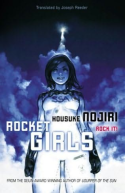
Rocket Girls by Housuke Nojiri

June 13, 2011 by Michelle Smith

From the back cover:
Yukari Morita is a high school girl on a quest to find her missing father. While searching for him in the Solomon Islands, she receives the offer of a lifetime—she’ll get the help she needs to find her father, and all she need do in return is become the world’s youngest, lightest astronaut. Yukari and her half-sister Matsuri, also petite, are the perfect crew for the Solomon Space Association’s launches, or will be once they complete their rigorous and sometimes dangerous training.

Review:
I was really looking forward to reading Rocket Girls. I’ve long been intrigued by VIZ Media’s venture into Japanese sci-fi, Haikasoru, but this is the first title in the lineup that I’ve read (unless you count Brave Story, which I read before it was grandfathered into the imprint). Alas, I ended up disappointed.

The basic plot is that Yukari Morita, a high school student weighing 37 kg. (81 lbs.) has traveled to the Solomon Islands during summer vacation to search for her deadbeat father. She ends up meeting scientists from the Solomon Space Association just when they’ve determined that they need a really light person to pilot their rocket, and when the director promises to help her find her father, she agrees. Later, her similarly petite half-sister Matsuri joins up to serve as backup. The SSA folks have a lot of trouble getting a rocket into orbit, but eventually succeed (sort of) and Yukari becomes a national hero.

I guess I was hoping for the novel equivalent of Twin Spica or something, but Rocket Girls doesn’t even come close to achieving the passion and poignancy on display in that series. In fact, it almost totally lacks any depth whatsoever. The book is about 80% dialogue, with very little insight into Yukari’s thoughts, let alone anyone else’s. As a result, many of the characters’ reactions and decisions are inexplicable. Here are some examples:

  • The director of the space program, Isao Nasuda, calls up Yukari’s mother to obtain her permission for Yukari to become an astronaut. Without asking any questions at all, her mother agrees. I could accept a similarly carefree mom in a manga comedy, but it’s harder to swallow in a sci-fi novel.
  • Very quickly, Yukari finds her father, who had no idea she even existed (having disappeared during his honeymoon). His reaction? “How about that?” What, that’s it?!
  • Yukari decides she doesn’t fancy dying in an unsafe spacecraft, but her father won’t come back to Japan with her if she outright quits, so she decides to gain weight so that Matsuri will have to take her place. And then, suddenly, she’s done with that idea. I think this is because one of the scientists guys waxed poetic about his spacefaring dreams, but I’m not sure.
  • Yukari then decides to become hyper-vigilant about the safety of the craft and goes on a hunger strike protesting some new fuel mixture. And then later, when she’s strapped in and ready to take off, the team finds a problem. Her response? “If we let every little thing scare us, we’ll never launch.” Uh, then what was that whole protest about? She even had a sign.

At first, I was bothered that none of the adults seemed to have any empathy for Yukari. They treated her as a tool and spoke dispassionately of bringing her to her breaking point so they could test the jungle-survival capabilities of the new skintight spacesuit they’d designed for her. But then I realized that I had lost all empathy for Yukari, too! Probably I was supposed to care when she nearly died during the flight, but I did not. I just wanted the book to end. After a kind of cool but very brief visit to Mir, I got my wish.

Is one slightly nifty bit near the end enough to recommend the book? I think not. There is also a sequel, but I’ve no intention of reading it.

Filed Under: Books, Sci-Fi Tagged With: Housuke Nojiri, VIZ

Pick of the Week: Trio

June 13, 2011 by David Welsh, Michelle Smith and MJ 5 Comments

With Kate out of town, we’re a trio this week, perusing the expected arrivals at Midtown Comics. Check out our picks below!


DAVID: I’m not quite sure what the deal is with my pick. Shigeru Mizuki’s Onward Towards Our Noble Deaths (Drawn & Quarterly) came out months ago via Diamond, but it’s apparently just hitting Midtown on Wednesday. As I noted in my review, it strikes me as a little odd to go deep and dark before giving Mizuki’s best-known work a proper English-language release, but it’s certainly better than no Mizuki at all. This autobiographical tale of ill-used soldiers serving in the Pacific at the end of World War II isn’t quite as grim as it sounds, but it’s hardly a beach read. It’s deeply heartfelt, though, and it’s fascinating to see Mizuki apply his distinctive style to this kind of material. For those interested in the full scope of how manga can be used, this is essential reading. And if it succeeds commercially, maybe we’ll get GeGeGe no Kitaro.

MICHELLE: My pick is about as far from David’s as possible. It’s probably going to be exceedingly silly, but I am looking forward to the first volume of Bad Teacher’s Equation. It’s by Kazuma Kodaka, whose Kizuna I’ve really begun to enjoy, and is an older series, originally started in 1993. It’s a longer series, too, with its original ten volumes condensed to five for the bunko edition, which is what DMP has licensed. I admit the plot doesn’t sound thrilling—a high schooler enrolls in a particular school in order to reunite with his crush, the school nurse, but it seems the fellow is no longer as friendly as he once was and is maybe someone else altogether—but I suspect it will be a fun read anyway.

MJ: Probably my real choice would be to agree with David, whose review of Onward Towards Our Noble Deaths has made me quite anxious to pick it up, but I noticed another item on the list that intrigues me at least a little, so I’ll give it a spotlight here. I quite enjoyed Tooko Miyagi’s angsty BL melodrama, Il Gatto sul G when I first took a look at it, and even picked up a couple of its volumes in print. Its sequel, Butterfly Of The Distant Day ships this week, and I admit I’m quite interested in checking it out. After all, how often do you get to read yaoi about a “schizophrenic genius violinist”? Truth be told, I can’t resist!


Readers, what are your picks this week?

Filed Under: PICK OF THE WEEK Tagged With: onward towards our noble deaths, yaoi/boys' love

Bookshelf Briefs, 6/13/11

June 13, 2011 by MJ, Katherine Dacey and Michelle Smith 6 Comments

This week, MJ, Kate, & Michelle take a look at a handful of titles from Viz Media and Digital Manga Publishing.


Border, Vol. 1 | By Kazuma Kodaka | Digital Manga Publishing – If you’re still mourning the cancellation of Crown, you could do a lot worse than Border, a globe-trotting adventure about an ex-commando who runs a detective agency. The story focuses on a quartet of handsome men: Yamato, a former Special Forces officer; Sogo, the team’s go-to guy for explosives and gizmos; Tamaki, a hairdresser who moonlights as a detective; and Kippei, their plucky Guy Friday. Volume one begins with two stories showing the team solving cases, then jumps back in time to explore Yamato’s military past. Aside from a few unfortunate “I’m not gay, you’re special!” conversations between Yamato and his lover, the flashback works surprisingly well, explaining both Yamato’s skills (he can repel down skyscraper walls and overpower men twice his size) and his conflicted attitudes about sex. Sexy character designs, decent action sequences, and an engaging plot complete the attractive package. -Katherine Dacey

Claymore, Vol. 18 | By Norihiro Yagi | Viz Media – I’m a big fan of Claymore, there’s no doubt, but I’ll admit the last two volumes have wearied me some. Aside from a few fascinating revelations at the beginning of volume 16, it’s been all battles, all the time in the Claymore universe lately. But though volume 18 deviates very little from that trend, it also offers at long last the confrontation we’ve been moving toward for nearly the entire series as Clare meets Priscilla on the battlefield once more. While it’s true that battles are hardly my favorite thing, even in battle manga, this kind of emotionally fraught skirmish shows off mangaka Norihiro Yagi at his best. It’s nice to finally find myself at the edge of my seat again. Bring it on, Yagi, bring it on. -MJ

The Desert Prince | By Shushushu Sakurai | Digital Manga Publishing – Superficially, the five stories that comprise The Desert Prince are very different: one focuses on the relationship between a handsome sheik and a Japanese tourist, for example, while another explores the attraction between a yakuza enforcer and his protege. Plot-wise, however, all five stories follow the same trajectory, with characters fussin’ and fightin’ until one breaks down and confesses his true feelings for the other, leading to a brief but steamy sex scene. Shushushu Sakurai’s character designs are generally appealing, though she struggles a bit to make her older men look their age; the hero of the final story, “Mister Y’s Love,” looks more like a shar-pei puppy than a retiree. What prevents The Desert Prince from being a guilty pleasure is the thinness of the writing; there are simply too many plot holes, coincidences, and abrupt reversals for any of the stories to make much of an impression, in or out of the bedroom. -Katherine Dacey

Fullmetal Alchemist, Vol. 25 | By Hiromu Arakawa | Viz Media – Oh, Fullmetal Alchemist, you never cease to thrill me. Just two volumes away from the conclusion to Arakawa’s epic fantasy-adventure, what strikes me most is just how tightly plotted this series has been since the beginning. With everything coming together as the story approaches climax, it’s clear now that there has been nothing in this entire series—not a single side character, perhaps not even a single joke—that wasn’t carefully crafted to serve that climax in one way or another. Also, between volumes 24 and 25, it’s been made clear to me that a feature on “The Women of Fullmetal Alchemist” is not only imminent, but essential. Arakawa’s women simply kick ass. Highly recommended. -MJ

Ouran High School Host Club, Vol. 16 | By Bisco Hatori | Viz Media – The perpetual brakes on the passage of time in Ouran have finally been released and Haruhi becomes a second-year student at long last. Other changes are afoot, too, as Tamaki’s domineering grandmother finally allows him to live in the main house, though this means adhering to her strict rules. Tamaki commits to the challenge admirably—even though it means giving up the host club and possibly Haruhi as well—while everyone else worries about him. Even though this storyline shows most of the characters to their advantage, I would so much rather see Tamaki and Haruhi make real romantic progress that the bulk of this volume is downright dull. I hope we can put Tamaki’s family issues behind us soon and get to the good stuff! -Michelle Smith

Filed Under: Bookshelf Briefs Tagged With: border, claymore, fullmetal alchemist, ouran high school host club, the desert prince

Twinkle Stars 1-2 by Natsuki Takaya

June 12, 2011 by Michelle Smith

I have no idea why Natsuki Takaya’s Twinkle Stars (aka Hoshi wa Utau) has yet to be licensed in the US, but when I learned that English editions were available in Singapore/Australia, I knew I had to acquire them. See the final paragraph of this post for a link where you might do the same.

I thought I might be disappointed by this series. There’s no shortage of complaining Takaya fans online, after all, and it’s not like her other series Tsubasa: Those With Wings or Phantom Dream really knocked my socks off, though I did come to like the latter by the end. After having read these two volumes, however, I am left to conclude that the chief complaint of unhappy fans is that Twinkle Stars is nothing like Fruits Basket. But why should it be? It’s a completely different kind of story, but that doesn’t mean it isn’t good!

Sakuya Shiina is a heroine in the mold of Tohru Honda, in that she has a difficult family situation but tries to keep up a cheerful front and doesn’t talk about her own problems very much. Her father contracted her cousin, Kanade, to be her guardian, though it’s unclear whether Sakuya knows that, since she seems to regard Kanade as a kind of savior (and often defends him against allegations of laziness). We don’t learn too much about Kanade, but it seems that he originally kept his distance from Sakuya, but has lately become very fond of her. As the story begins, he has actually remembered her birthday and offered to cook Sakuya’s favorites for dinner.

When Sakuya gets home from her part-time job that evening, she finds that Kanade is not alone. A young man named Chihiro is with him, and Sakuya simply assumes he’s one of Kanade’s friends. He gives her a present and tells her she’s amazing for always smiling and never giving up. Attracted to his lonely mien, Sakuya wants to meet him again, but discovers the next morning that Kanade didn’t actually know Chihiro at all! He spotted him loitering around outside with a gift box and assumed he was there for the festivities.

Sakuya becomes determined to find Chihiro and enlists the help of her two best friends, Hijiri Honjō and Yūri Murakami, who are also members of the stargazing club Sakuya has started. One of Natsuki Takaya’s strengths is in creating terrific friends for her heroine, and Hijiri and Yūri are both interesting characters in their own right. Yūri is pretty straightforward—a short but athletic fellow who is brave, forthright, and easily flustered—but Hijiri is a lot more complex, one of those refined-looking girls who loves to say things that rile other people but who is fiercely protective of Sakuya, even though she seems to adore her friend largely because of her ineptitude in various areas and doesn’t intervene to spare her embarrassment. I think I could easily read a spin-off all about Hijiri, especially since we’ve already gotten a couple of hints that she’s got secrets.

Eventually, Sakuya runs into Chihiro. She’s convinced he’s not a bad person and just wants to hear his reasons for what he did so as to understand, but he’s not cooperative. “I don’t want to tell you anything,” he says, and seems willing to concoct some fantasy persona for himself but not reveal the reality of his life. He disappears after telling Sakuya he hates her, and only then does she realize that she’s fallen in love with him.

At this point it becomes apparent that this will probably be one of those stories (like We Were There or Kare Kano) where the heroine will help heal the hero’s pain and angst. Because this is a shoujo manga Chihiro soon transfers into Sakuya’s school, and though he is initially cold and remote, he very slowly begins to warm up to Sakuya. Another thing Takaya is good at is leaving little clues about important events, and we get a couple of glimpses of Chihiro’s past that inform his behavior toward Sakuya. Primarily, she’s so vulnerable and pathetic that it moves him to protect her, and this sort of unpredictable impulse scares him.

It’s not that he actually hates her, but that he’s uncomfortable and unsure around her. This point is proven when Sakuya speaks before a group of students in an attempt to recruit new members for the stargazing club. She flounders so badly that Chihiro, spurred by the memory of another girl in a similar situation, rushes to her side to reassure her. Although he initially comes across as an irritating jerk, by the end of the second volume it’s clear that he’s mostly just awkward, and perhaps a little broken, too. Sakuya continues to be confused by his behavior, but the lingering sadness in his eyes convinces her not to give up.

The quality of the Chuang Yi edition is quite good. Physically, the paper quality is lovely, the images are crisp and clean, and the volumes come with dust jackets. The translation has a British flair, tickling me by including words like “wonky” and “vexing.” Takaya’s art looks great, but also makes for a kind of bizarre reading experience. The characters are so obviously drawn by her that they look and feel incredibly familiar, and yet they are not copies of anyone in either design or personality. Take, for example, this panel of Sakuya and Chihiro.

There’s no doubt who drew that. And they look slightly reminiscent of other characters, but one would never get them confused. It’s almost like we’re seeing some denizens of the Fruits Basket world to whom we were simply never introduced before.

Contrary to expectations, I enjoyed Twinkle Stars a lot. True, it’s not epic on the level of Fruits Basket, but again, that’s okay by me. I certainly don’t expect Takaya to keep writing the same sorts of things over and over, and I’m really looking forward to seeing what she achieves with this different kind of tale.

Twinkle Stars is not currently licensed in North America. These English editions were published by Chuang Yi Publishing in Singapore and distributed by Madman Entertainment out of Australia. They are available for purchase here, but shipping is quite expensive. I’ll be switching to the French editions from volume three onwards. The series is complete in Japan with eleven volumes.

Filed Under: REVIEWS Tagged With: Chuang Yi Publishing, natsuki takaya

Off the Shelf: Deliver us from slugs

June 8, 2011 by Michelle Smith and MJ 9 Comments

MJ: Well, hello there, colleague! I’m still really enjoying that.

MICHELLE: Why, hello! Fancy meeting you here.

MJ: What a lovely space we have here. Makes me feel like talking about books. And you?

MICHELLE: Now that you mention it, I am experiencing an odd tingle, so I’m going to take that as an invitation to begin! My reads this week provoked wildly different reactions in me. One was epic and impressive while the other was icky and confusing. Saving the best for last, I shall begin with the latter.

I didn’t have very high hopes for Amnesia Labyrinth, the two-volume (so far) series released this year by Seven Seas, but it is a mystery manga penned by Nagaru Tanigawa, the man behind the Haruhi Suzumiya light novels, so I at least expected to derive a modicum of enjoyment from it. Alas, while the first volume is merely not very good the second is downright craptacular.

The story begins promisingly enough. Readers witness the murder of a high school student who turns out to be the class president of the school our protagonist, Souji Kushiki, is transferring into. Two other students have died over summer break, as well. One of Souji’s classmates, the perky Yukako Sasai, is attempting to investigate and enlists his help because he’s very smart and she thinks his politician dad might be able to get her access to the police department’s information. By this point, I was expecting a Haruhi-esque story, in which stoic Souji goes along with energetic Yukako’s efforts to unravel the mystery. Instead, the story goes in a completely different direction, as we begin to learn more and more unpleasant things about Souji’s deeply creepy family.

The back cover of the first volume tries very hard to depict the “inappropriate” and “clingy” behavior of Souji’s sisters as something new, but it quickly becomes apparent that this is par for the course, given that Souji’s been having sex with his half-sister, Saki, since at least middle school. This doesn’t prevent his full-blooded sister, Youko, from coming on to him nor his innocent step-sister, Harumi, from wanting to be his bride. On top of this, Souji suspects Saki and Youko of committing the murders, and volume two attempts (in as baffling a manner as possible) to flesh out the family history as (I think) supernatural assassins of some sort who also possibly suffer from multiple personality disorder. It’s monumentally unclear and surreal in a bad way.

Natsumi Kohane’s art doesn’t help matters any. Faces are generic and stiff, anatomy can occasionally be very strange, and the action scenes in the Heian-era flashback are utterly incomprehensible. Plus, there’s a lot of squicky images like this one. Seriously, is that supposed to be sexy? It looks like she’s barfing out a slug!

Apparently, this is all that’s been written of this series so far, and the second volume is padded out with an illustration gallery and a preview of Blood Alone. Normally I’d be sorry to see a manga go unfinished, but in this case, I think we should all be grateful.

MJ: Well, wow. After that image, I find that I have nothing to say. Except maybe, “Ew.”

MICHELLE: “Ew” is certainly the prevailing thought I’m left with after that second volume. After that image, we’re both probably in need of a mental palate cleanser. I hope you’ve something that can do the trick!

MJ: You know, I do! I liked both my reads this week, but I’ll start with one I know you’ve read and liked as well to help with that cleansing. I’m talking about Bakuman, by Tsugumi Ohba and Takeshi Obata, the fifth volume of which has been released just this week.

Mashiro and Takagi have gotten their manga serialized, but their success begins with a shock as their editor, Hattori, is being replaced by Miura, a man they’ve never met before. Though they have no choice but to accept the change, things get off to a rocky start as their series takes a while to catch on with Jump readers.

I’ve blown hot and cold with this manga in some ways, but I think I’ll never stop being fascinated by the look it provides into the process at Weekly Shonen Jump, however pro-Jump it might read to someone with more knowledge of the business in Japan. I’m charmed, too, by the way its creators use the Jump formula to comment in Jump itself.

For a long time, these things were the series’ only decisive draw for me, but more and more I’m drawn in by the series’ supporting characters, especially eccentric prodigy Eiji Nizuma and Takagi’s girlfriend, Miyoshi, who are probably my favorite characters in the series.

Volume five warms me to some potential new favorites, including reluctant mangaka Hiramaru who, when asked if he wanted to be a manga artist, replies, “Maybe, for like a fraction of a second.” I’m also becoming increasingly fond of self-possessed writer Aoki, who manages to lower her defenses a bit in this volume.

More astonishingly, the series’ protagonists have started to matter to me. While this should perhaps be a given for most series, this is the first volume in which I’ve found myself really at the edge of my seat, wondering what will happen as they receive each week’s reader survey results. Finally these characters mean something to me, which makes the whole thing that much more worthwhile. It’s a real treat.

MICHELLE: I love Nizuma so much now that I can’t believe I ever found him irritating. My favorite moment in the whole volume occurs when Mashiro and Takagi encounter him at the Jump New Year’s party, dramatically quaffing soda from a champagne glass.

I’m with you, too, on finally caring about Mashiro and Takagi as people. I think it helps that other characters are acknowledging the ridiculousness of Mashiro’s arrangement with Miho, the girl he likes, not to see each other until their dreams come true. Plus, Miyoshi is so awesome that Takagi grows more awesome for liking a girl like her.

It’s really become a series that I actively anticipate.

MJ: You’re absolutely right about Miyoshi’s awesomeifying effect. And I think it helps, too, that Miho is really struggling, so we’re seeing some nuance in that relationship even within its ridiculous construct.

So go on now and hit me with “epic and impressive!”

MICHELLE: I know that you, historically, have not had an easy time getting into Eiichiro Oda’s One Piece, but I have to say, it really is a stunning piece of storytelling. Oda has created not just a cast of likable characters, but a fully realized world for them to inhabit, and in this world, conflict has long been brewing between the pirates and the navy.

In volume 57 of the series, this conflict comes to a head on the island of Marineford where Portgaz D. Ace, brother to series protagonist Monkey D. Luffy, is about to be executed by the navy. Luffy’s on his way to save him, along with a plethora of pirates he helped escape from the impregnable prison Impel Down, but does not actually appear until midway through the volume. Instead, we witness the beginnings of an epic clash between the navy and Whitebeard, a powerful pirate and Ace’s captain.

The battle is huge, sprawling, and fascinating. It’s made doubly more impressive by the fact that, with the exception of the tardy Luffy, it’s entirely being carried out by supporting characters. That is how fleshed out this world is—there’s a whole cast of semi-familiar navy officials (and hired security of sorts in the form of the Warlords of the Sea) to go up against Whitebeard and his allies. Part of the draw is the cool Devil Fruit powers nearly everyone seems to possess, but Oda does a great job conveying the importance of this encounter as well as linking the public revelation of Luffy’s parentage to events that occurred much earlier in the series. Continuity has always been one of the series’ strongest suits.

I must also mention that many of Luffy’s allies are drag queens who rush into the fray whilst wearing fishnets and high heels. No one bats an eye, because in this universe, it’s a given truth that anyone can be brave and awesome, even if they’re a man wearing a tutu.

MJ: Well, if you think about it, is there anyone braver than a man wearing a tutu? I think not.

I know I need to get further into this series, and every time you or David talk about it, I remember why.

MICHELLE: That’s a very good point!

And yes, you do. I wish everyone had a public library as awesome as mine, because it’s ever so much easier to commit to a 62-volumes-so-far series like this one when you have that kind of resource. Even so, I find myself seriously tempted to start compiling my own collection. It’s just that good.

What else did you read this week?

MJ: Well, I’m way behind, but I finally read the third volume of Natsume Ono’s House of Five Leaves, one of my very favorite current series.

It’s difficult to discuss plot when talking about this series, because though things do happen in the world of broken samurai Masa, the story’s actual events are never really the point. There’s a missing member of the Five Leaves gang and the theft of a candle merchant’s seals, but the real story here seems to be about Masa’s acquaintance with a man from the magistrate’s office and the strain that acquaintance is putting on his relationship with Five Leaves leader, Yaichi.

This series is built on deeply private characters and layers and layers of atmosphere. Even when nothing particular is going on, you can feel the weight of Masa’s world on his slouched shoulders. Even in his most contented moments, his world feels heavy, yet he’s quietly grateful for all of it, somehow. He’s the soul of this story in all his passive reticence, and it’s his personal journey that most interests me.

That said, some real tension begins brewing in the plot department during this volume, which should offer a clearer thread of action as the story continues on. And if I’m content to sit with Masa as he quietly waffles through life, I admit that this extra momentum is a bit exciting. One gets the feeling that it wouldn’t take much for the entire world Ono has created to shatter into pieces, should something happen to break the tension she’s built up so slowly.

This series is one I find myself rereading already just to pick up extra nuances as I head into each new volume. It’s that compelling for me.

MICHELLE: I haven’t read beyond volume one yet myself, but even from the beginning the weight of tension is tangible. Now I’m excited by proxy at the idea of actual plot momentum. I wonder if that’s an IKKI thing, because Saturn Apartments is similar—I’m perfectly content to wallow in its slice-of-life charm, but small stirrings of actual plot seem to be cropping up in earnest now, meaning the series might become even more enjoyable.

MJ: Yes, I’m really looking forward to what the next volume has in store.

In other news, every time I look up at that slug-tongue image, it creeps me out more. I had to make it smaller, just to lessen the effect.

MICHELLE: I keep looking at it, too, as if to remind myself of its utter awfulness. Now I feel compelled to apologize to the readers for exposing them to it.

MJ: Hopefully they will forgive us … and possibly save us from it.

MICHELLE: We can only hope.

Filed Under: OFF THE SHELF Tagged With: amnesia labyrinth, bakuman, house of five leaves, One Piece

Pick of the Week: Spring Bounty

June 6, 2011 by Michelle Smith, MJ, David Welsh and Katherine Dacey 10 Comments

The arrivals list at Midtown Comics overflows with manga, making this week’s Pick a tough one for all. Take a look below to see what made the cut!


MICHELLE: It’s a bountiful week at Midtown Comics, with many Shonen Jump and Shojo Beat offerings from VIZ making their way onto the shelves. There’s an awful lot on this list that I am personally planning to buy, and singling out just one is pretty tough. New volumes of One Piece and Slam Dunk are serious contenders, but in the end, the fifth volume of Bakuman。 walks away with the honors. I’ve been catching up on the series this weekend, and it’s just utterly charming. The behind-the-scenes glimpses into manga production at Shueisha are fascinating, Mashiro and Takagi are finally achieving some success, and an interesting crop of friendly rivals has developed, including the endearingly weird Eiji Nizuma, who has been waiting for Mashiro and Takagi to come challenge him. Now, gee, what other Shonen Jump manga illustrated by Takeshi Obata does that remind me of?

MJ: We’re offered a wealth of choices this week, indeed. New volumes of Black Jack, Claymore, and Rasetsu call out to me in particular, but if I could only buy one volume of manga from this list, I’d have to choose the 25th installment of Fullmetal Alchemist. I doubt anybody needs me to go on and on again about why I love this series, but just in case you’ve missed it somehow, feel free to browse this tag. And for those who’ve never gotten around to starting this admittedly long series, now is the perfect time to start, with the first of Viz’s new 3-in-1 editions arriving in stores this week as well. If you’ve only watched the anime series, you don’t know what you’re missing. Time to pick up a volume and find out!

DAVID: Viz really could learn to pace itself. I’m quite eager to read the third volume of Kamisama Kiss and curious to see which way the pendulum will swing on Grand Guignol Orchestra, not to mention the previously mentioned books, but I’m going to have to cast my vote for the 14th volume of Osamu Tezuka’s Black Jack from Vertical. Much as I love Tezuka’s crazed gekiga stories, I have such a weakness for this series and its totally reliable, often absurd servings of genre fiction. I have high hopes that this volume will offer a nice side dish of creepy, creepy Pinoko.

KATE: Tempted as I am by the second volume of Blue Exorcist, I’m also going old-school with my pick and choosing the fourteenth volume of Black Jack as this week’s must-buy manga. I’d be the first to admit that the series can be repetitive, especially when read in large chunks. But if you ration yourself to just one or two stories at a time, it’s easier to appreciate Tezuka’s storytelling gift; he manages to fit a whole volume’s worth of drama into twenty pages without sacrificing clarity or emotional intensity. The hero’s dark, brooding personality is another plus; Black Jack may share Dr. Gregory House’s ability to diagnose a rare illness from looking at a character’s fingernails or smelling his breath, but Jack isn’t nearly as smug and insufferable as his TV counterpart. I’m not sure how Tezuka will ever top the story in which Black Jack operates on himself in the Australian outback while fending off wild dingoes, but I’m happy to keep reading until Tezuka does.


Readers, what looks good to you this week?

Filed Under: PICK OF THE WEEK Tagged With: bakuman, black jack, fullmetal alchemist

Bookshelf Briefs 6/6/11

June 6, 2011 by MJ, Katherine Dacey, David Welsh and Michelle Smith 4 Comments

This week, MJ, Kate, David, & Michelle take a look at a variety of manga from Viz Media, Vertical Inc., Digital Manga Publishing, and Yen Press.


Bakuman, Vol. 5 | By Tsugumi Ohba & Takeshi Obata | Viz Media – The theme for this volume may as well be “Everyone makes progress toward making their dreams come true!” Not that everything is smooth sailing. Mashiro and Takagi finally have a series in Shonen Jump, but along with that comes new editor, Miura, who is rather inexperienced. It takes him some time to gain the confidence to steer the boys in a direction that will keep their series popular with readers. Meanwhile, other friends and rivals aim for the same goal and even Miho experiences a rejuvenation in her dedication to become a voice actress. It’s a thoroughly shounen setup, which is only fitting for a story about making shounen manga. I wish we actually got to see some of this manga they’re creating, though! Maybe in due time… -Michelle Smith

Black Bird, Vol. 8 | By Kanoko Sakurakoji | Viz Media – If there’s one thing that can be said for Kanoko Sakurakoji’s Black Bird, it’s that it stays unflinchingly on message, volume after volume. “Girls, always obey what the menfolk tell you,” it says over and over, in a thousand different ways. “They’re smarter and stronger than you are, so they always know what’s best.” That’s the overwhelming message of this series, though there’s an equally consistent side note attached, “Be grateful and understanding when your man punishes you for your mistakes. After all, it’s for your own good.” Volume eight personifies these messages without fail, as always, with the added bonus of the much-anticipated consummation of Misao and Kyo’s sexual relationship, which is of course preceded by extra gratitude, humility, and expressions of flushed desperation from our heroine. Yay? -MJ

Bleach, Vol. 35 | By Tite Kubo | Viz Media – Despite its status as a hit battle manga, for a reader like me, the best of Bleach exists between battles, when Tite Kubo is able to utilize his (not insignificant) talent for writing quirky, compelling characters. Unfortunately Kubo tends to excess in this area, creating a never-ending stream of brand new characters, leaving less room and page time for those we already love. With that in mind, volume 35 reveals both the best and worst of Kubo’s habits, providing some genuinely satisfying moments with some of our favorite characters while leading us into another series of battles with an array of new foes. If I could deliver one message to Kubo, it would be that when it comes to supporting characters, sometimes less is more. 35 stacks up in the “win” column, but the future looks far less bright. – MJ

Blue Exorcist, Vol. 2 | By Kazue Kato | Viz Media – In discussion of this series’ first volume, I said, ” I’d like to see more … with Rin actually learning the craft under Yukio’s tutelage, because watching the two of them together is the most compelling aspect of the story so far.” The good news here is that we do see more of this, and it indeed remains the series’ greatest strength. The less good news is that the bulk of this volume is spent introducing the class’ other students, including hotheaded Suguro and by-the-book tsundere Izumo. Though there’s obviously a self-formed family of young exorcists being nurtured here, it’s a shame to have so much of the volume’s focus stolen away by it, when we’ve only just begun with the series’ two main characters. Still, this remains the most compelling new shounen series to travel westward this year. I look forward to seeing where it goes from here. – MJ

A Bride’s Story, Vol. 1 | By Kaoru Mori | Yen Press – This is one of those books where I’m convinced I could pass off random page scans as a review, possibly followed up with, “See? See?!” I can’t quite decide if it’s more gorgeous than Mori’s Emma (CMX), but I can say without question that it’s one of the loveliest manga you’re likely to find in current release. It’s also as quietly moving and packed with absorbing details as Emma was, so you really can’t lose. In this tale set in central Asia in the 19th century, a 20-year-old woman enters into an arranged marriage with a 12-year-old boy. We see quietly forceful Amir adapt from her nomadic lifestyle to the more settled state of affairs with her young bridegroom. There’s the whispered promise of an actual plot, but I could read dozens of volumes of nothing but Mori’s meticulously researched, breathtakingly drawn slice of life. Really, what more do you need? -David Welsh

Chi’s Sweet Home, Vol. 6 | By Konami Kanata | Vertical, Inc. – After five volumes of cute kitten antics — including Chi’s first visit to the vet, Chi’s first bath, and Chi’s first excursion beyond the safe confines of home — I thought Kanata Konami would have run out of material. I’m pleased to report that volume six of Chi’s Sweet Home is just as appealing and fresh as the previous installments, offering plenty of awwww-inducing moments as well as some genuinely funny scenes. (Don’t miss the chapter in which Chi stalks a parakeet; Chi’s reaction to the parakeet is priceless.) Konami continues to expand the scope of the story to include more animals, more people, and more settings, neatly mimicking Chi’s growing awareness of her surroundings while preventing the story from becoming too cutely claustrophobic. As in previous volumes, the illustrations are simple but effective, capturing Chi’s surprise and delight in discovering new things: vacuum cleaners, Kleenex, birthday cake. Recommended. -Katherine Dacey

Chi’s Sweet Home, Vol. 6 | By Konami Kanata | Vertical, Inc. – Whenever a new volume of Chi’s Sweet Home comes into my possession it automatically vaults to the top of the to-read pile. The first five volumes all offered colorful, cute, and (mostly) cheerful stores about Chi, an adorable tabby kitten, and the sixth is no exception. Kanata has a knack for depicting scenarios familiar to any cat owner, like massacred houseplants and the species-wide fascination with climbing into boxes, while imagining what the world must look like to a cat. Chi’s nocturnal journey to the local park is a particular standout. My one complaint is that Chi’s owners, the Yamadas, continually do frustrating things like leave cakes unattended and store breakable objects at the top of a flight of stairs, then proceed to freak out when Chi messes with them. You’ve got a cat now, folks. You either put things away or get used to the gnaw marks. -Michelle Smith

Itsuwaribito, Vol. 2 | By Yuuki Iinuma | Viz Media – In this volume, Utsuho proves himself trustworthy to the implausibly youthful Dr. Yakuma by rescuing him from the clutches of a bizarre fellow whom I shall christen “Freaky Dude.” Not only that, he correctly deduces the cause of Freaky Dude’s killing spree and helps him to see the error of his ways. The display convinces Yakuma to invite Utsuho on a journey to Nadeshiko Island, where he suspects a treasure of life-extending medicine awaits. It also happens to be the location of many exiled criminals. I’m still not enraptured by Itsuwaribito, but I found this volume a lot more entertaining than the first. For reasons I cannot quite pinpoint, it reminds me of Black Cat, in a simple shounen adventure kind of way. Plus, there’s an adorable twitchy-eared talking tanuki! I’ll definitely be checking out volume three. -Michelle Smith

Twin Spica, Vol. 7 | By Kou Yaginuma | Vertical, Inc. – In the seventh volume of Twin Spica, Kou Yaginuma explores Marika’s childhood, as well as Marika’s struggle to create her own destiny, rather than the one for which she was created. Though Marika’s story is emotionally compelling, Yaginuma strains too hard to show us that Marika, Asumi, and Fuchuya have a shared history; there’s a tidiness to the connection that feels a little false, as if the characters’ shared memory of the Lion disaster wasn’t grounds enough for bonding. The volume’s final chapters are more dramatically persuasive, giving the three female leads a chance to demonstrate just how smart, resourceful, and tough they can be under duress. N.B. Beginning with volume seven, Vertical will be releasing Twin Spica in a longer omnibus format of 300-400 pages (roughly 1.5 volumes). -Katherine Dacey

Your Story I’ve Known | By Tsuta Suzuki | Juné Manga – It’s rare that I find the sex scenes in a boys’-love title to be the most interesting, but that’s definitely the case in the title story of this book. Suzuki laces the physically intimate moments with intriguing, revealing observations. Unfortunately, those kinds of notes are largely absent in the rest of this tale of a gangster who takes up with the son of one of his ex-girlfriends. It’s drawn well, but the characters and their dynamic aren’t very engaging. The back-up stories compensate for the centerpiece, though. One’s about a young man dealing with his lover’s irritating reticence. Another is a love story between a kid and a goofy, centuries-old ghost. The last describes the awkward early courtship between two salarymen. Each has a distinct, quirky charm, making the book a worthwhile investment overall. -David Welsh

Filed Under: Bookshelf Briefs Tagged With: a bride's story, bakuman, black bird, bleach, blue exorcist, chi's sweet home, itsuwaribito, twin spica, your story I've known

The Science of Doctor Who by Paul Parsons

June 4, 2011 by Michelle Smith

From the front flap:
Almost fifty years after the Doctor first crossed the small screen, he remains a science fiction touchstone. His exploits are thrilling, his world is mind-boggling, and that time travel machine—known as the Tardis—is almost certainly an old-fashioned blue police box, once commonly found in London.

Paul Parsons’s plain-English account of the real science behind the fantastic universe portrayed in the television series answers such burning questions as whether a sonic screwdriver is any use for putting up a shelf, how Cybermen make little Cybermen, where the toilets are in the Tardis, and much more.

(Note: This is the 2010 revision of a book originally published in 2006.)

Review:
I am not a science person. In my years of schooling, I never once came up with a non-lame idea for a science project and was positively abysmal at experiments. I did pretty well on tests and homework, but if someone’s test tube was going to spontaneously erupt in a geyser of brown froth (true story!), it would be mine.

Suffice it to say, then, that while I enjoy science fiction entertainment, it’s not because of the science. Still, The Science of Doctor Who promises “a plain-English account of the real science behind the fantastic universe portrayed in the television series,” so I reckoned on being able to follow it. Alas, Paul Parsons’s definition of plain English is a bit different than mine.

I was okay with the majority of the material. Chapter topics include the Doctor’s recurring foes, regeneration, gadgets, weapons, space stations, force fields, parallel universes, and more. In general, Parsons would start by mentioning something that happened in a particular Doctor Who serial and then interview renowned scientists as to whether this is actually possible. Most of the time the answer is “no” or “only with extreme amounts of energy/effort,” but there are a few things that are not so far off. The chapters on alien worlds (Lots of planets really do have a north!) and mirror planets were particular favorites of mine.

Stupidly, however, I hadn’t counted on there being so much physics! I frequently found my eyes glazing over during these sections, which were unfortunately clustered near the beginning (making it hard to get started) and end (causing a strong urge to set the book down with only forty pages to go) of the book.

Take, for example, this quote from page 35:

M-theory’s main thrust is to generalize the one-dimensional objects of string theory into p-dimensional objects known, amusingly enough, as p-branes (where setting p = 0 gives a particle, p = 1 gives a string, p = 2 a “membrane,” and so on).

My brain’s response: asdlkjasldkfzzt!

Seriously, is that plain English? I note that Parsons did not bother to define “p-dimensional,” though that probably wouldn’t have been much help to me anyway.

In the end, I did learn some interesting things. In the chapter on Cybermen, for example, I learned that a cybernetic brain implant currently exists that can block the signals that cause Parkinson’s disease. That’s pretty awesome! I also now know that Sontarans reproduce by cloning and it takes only ten minutes for their offspring to reach adulthood. That’s less awesome.

I’m glad I didn’t give up on reading The Science of Doctor Who but now I think I’ll give my brain a rest by actually watching some.

Additional reviews of The Science of Doctor Who can be found at Triple Take.

Filed Under: Books, Nonfiction, Science, Television, Triple Take Tagged With: Doctor Who, Paul Parsons

A Spy in the House by Y. S. Lee

June 4, 2011 by Michelle Smith

From the back cover:
Mary Quinn leads a remarkable life. At twelve, an orphan and convicted thief, she was miraculously rescued from the gallows. Now, at seventeen, she has a new and astonishing chance to work undercover for the Agency.

It is May 1858, and a foul-smelling heat wave paralyzed London. Mary enters a rich merchant’s household to solve the mystery of his lost cargo ships. But as she soon learns, the house is full of deceptions, and people are not what they seem—including Mary herself.

Review:
As a convicted thief, twelve-year-old Mary Lang is about to be executed when she is saved by the ladies of Miss Scrimshaw’s Academy for Girls. There, she receives an education and by the age of seventeen is teaching other students the skills they will need to be independent. Trouble is, she’s not satisfied and the few other career options open to her gender don’t interest her much, either. When she mentions this to the two women running the school, they suggest another alternative: the Agency.

The Agency is a covert organization of female spies, operating under the assumption that because women are presumed to be flighty and empty-headed, their agents will be able to retrieve information more easily than a man might, particularly in situations of domestic servitude. Mary quickly agrees, despite the threat of danger, and soon finds herself serving as paid companion to spoiled Miss Angelica Thorold, whose merchant father is suspected of dealing in stolen Hindu goods.

Mary (now using the surname Quinn) isn’t the lead on the investigation and isn’t supposed to actually do much of anything, but she gets antsy, and in the process of snooping meets James Easton. James’s older brother desperately wants to marry Angelica, but James has heard rumors about her father’s business practices, and so is doing some sleuthing of his own to determine whether a family connection would be unwise. He and Mary form a partnership and spend most of the book poking about in warehouses and rest homes for aging Asian sailors and following people on foot or in carriages while maintaining a flirty sort of bickering banter.

Author Y. S. Lee tries to make the mystery interesting, giving us a bit of intrigue between Angelica and her father’s secretary as a distraction, but ultimately it feels very insubstantial to me. Nothing much comes as a surprise and two story elements that could’ve been highlights—Mary’s month-long intensive training and Scotland Yard’s raid on the Thorold house—occur off camera! Too, Mary is harboring a secret about her parentage which is thoroughly obvious: she’s part Asian. Only towards the end did Lee actually make clear that Mary is keeping this a secret from others because of the foreigner bias of the time, and I must wonder whether the intended young adult audience was reading this going, “What’s the big deal?”

Not that it isn’t nifty to have a part-Asian heroine, of course. Mary is competent and level-headed, though I admit I did get irritated by how often she is favorably compared to “ordinary women,” who would scream or faint in situations in which Mary is able to keep her head. When a mystery stars a male sleuth, do we need to hear over and over how much smarter he is than the ordinary fellow? I don’t think so. On the flip side, the overall theme of the book seems to be “don’t understimate women,” and Mary finds time to inspire a scullery maid to seek out Miss Scrimshaw’s and to convince Angelica to pursue a musical career.

In the end, A Spy in the House is a decent read. It’s not perfect, but I still plan to read the second book in the series in the near future.

Additional reviews of A Spy in the House can be found at Triple Take.

Filed Under: Books, Historical Fiction, Mystery, Triple Take, YA Tagged With: Y. S. Lee

Off the Shelf: Anniversary Edition

June 1, 2011 by Michelle Smith, MJ, Katherine Dacey and David Welsh 13 Comments

MICHELLE: Gee, they told me that we’d be holding Off the Shelf here this week, but it’s dark and doesn’t look like anyone’s here yet…

MJ: Surprise!!

Er. Sort of?

MICHELLE: OMG, no way! You guys~!

KATE: It’s OK, Michelle–we figured you might be on to us. But you do an excellent job of feigning surprise, if that’s any consolation.

DAVID: I made punch! It’s vivid pink and thick with booze!

MJ: I’ll take a glass of that punch!

MICHELLE: Well, I did kind of invite all of you here to celebrate not only my official induction into the Manga Bookshelf family, but also the one-year anniversary of Off the Shelf!

DAVID: And we’re thrilled to be here!

MJ: That’s right, we’ve actually been doing this column for a full year as of today. How wonderful that this coincides with Michelle’s official entry into our ranks!

KATE: Call me a skeptic, but that seems planned!

MICHELLE: I can vouch for it being a happy accident! Once we realized the coincidence, we knew we had to have a partay!

MJ: So, we’ve never tried to do this with more than two people before. I guess I should ask someone… So, David, read any good books this week?

DAVID: Ah! I have the perfect tonic for skepticism! And it comes in an omnibus-sized dose!

MICHELLE: Lay it on us!

DAVID: Indeed I did! When not hiking the canyons of southern Utah or trying to figure out how the lights worked in a Las Vegas hotel, I was paying a visit to CLAMP Land.

Now, based on what I’ve read of their work, I’m not a huge CLAMP fan. I think they can be pretty self-indulgent, and coherent narrative is not their highest priority. So I was totally delighted to see how focused Cardcaptor Sakura is. I read Book 1 of Dark Horse’s re-release while I was on vacation, and it was a complete treat. (I also suspect I was the only 40-something gay man in Utah who happened to be reading Book 1 of Cardcaptor Sakura at that point in time, which was gravy in a strange way that I can’t fully explain.)

Everyone probably already knows this, but it’s in the magical girl genre. Our heroine, Sakura, finds a dusty old book that used to contain the powerful Clow Cards, which grant the user various abilities. The guardian of the book, an adorable little whatsit called Kero, informs Sakura that she has magical abilities and can collect the missing cards, thus preventing unspecified disaster. It’s your basic gather-stuff-and-get-stronger structure, but it isn’t bogged down in the details of that ongoing quest. The CLAMP quartet doesn’t neglect Sakura’s card-capturing adventures, but they aren’t encyclopedically obsessed, either.

Their primary interest seems to be to give you reasons to like Sakura and her friends and family, and they knock that out of the park. Sakura is spunky and funny. She knows she’s a novice at the whole magic thing, but she’s not insecure about it. She has good instincts and trusts them, and she has reliable helpers. There’s the previously mentioned Kero, and there’s her rich classmate Tomoyo who, in addition to being unfailingly supportive, provides fabulous costumes for Sakura and chronicles her adventures on video. She’s like Edna Mode with a camcorder.

I like Sakura’s brother, Toya, and his twin impulses to tease and protect Sakura seem entirely credible. I like Sakura’s rival in card collection, Syaoran, mostly for the fact that Sakura seems generally unfazed by his criticisms and finds him a useful indicator that she’s on the right track. And while I don’t have much of an opinion on Yukito, Toya’s best friend, I find the fact that Sakura and Syaoran both have huge crushes on him to be totally adorable and ceaselessly amusing. In fact, the undercurrents of homo-romanticism (I can’t really call it homo-eroticism) in the book give it such an interesting flavor, because they’re such non-issues. They’re just believable side notes that make things livelier.

I’ve already used the word “adorable” twice in this review, and you should gird yourself for me using it again, because this book is adorable in all of the best ways a thing can be adorable. The character designs? Adorable. The jokes and romance? Adorable. The sparkly, easy-to-read art? Adorable. It’s cheerful, heartwarming stuff that still manages to be thoughtful and exciting, and I can’t wait to read more of it, because, beyond being very endearing magical-girl manga, it seems like it might be heading interesting, even daring places. I’m not ready to excuse CLAMP School Detectives or the song lyrics and angel drag in Clover or anything that drastic, but this definitely gives CLAMP one for the win column.

MJ: David, the way you describe this, I feel like I need to rush out and buy the Dark Horse editions RIGHT NOW.

DAVID: You totally do. It is the best kind of cute manga. Of course, you’re the real CLAMP devotee of the group, Kate. What did you pull off the shelf?

KATE: Not CLAMP, I’m afraid! I think I’m beginning to outgrow them, honestly; when I want melodramatic, inter-dimensional craziness, I’m more inclined to reach for Keiko Takemiya or Saki Hiwatari these days. I still plan to buy Magic Knight Rayearth, X/1999, and Gate 7 as they’re released, but I don’t feel that same sense of giddy anticipation about a new CLAMP title that I might have back in the day. (Mind you, by “back in the day,” I mean, “about four years ago, when David interviewed me about my CLAMP habit.”)

No, I just finished the fourth volume of Neko Ramen. As the title suggests, Neko Ramen features a cat who likes noodles — or, to be more precise, a cat who runs a small ramen joint. The joke, of course, is that he’s a cat; the restaurant’s bathroom is a back-room letterbox, the dishes frequently come with cat-hair garnishes, and the food is all but inedible from a human perspective.

What makes Neko Ramen such an unexpected joy is that Kenji Sonishi goes a step further with the jokes; yes, there are scratching post gags in later volumes, but most of the series’ humor is rooted in Taisho’s crazy business schemes. Taisho is always cooking up new strategies for improving business, strategies that, on their face, make good sense: discount cards, buyer reward programs, giveaways. In practice, however, Taisho has a knack for undermining himself, developing ill-advised dishes — boomeramen, anyone? — and promotions that repel more diners than they attract.

At the beginning of volume four, for example, Taisho decides to “go green” and substitute hand-made clay bowls for plastic ones. The problem? His paw prints and fur are embedded in the new serving dishes. (“I feel kind of dirty eating this,” a customer mutters as Taisho serves him his meal.) An attempt to make 3-D noodles similarly goes awry: though the dish looks cool when viewed through 3-D glasses, Taisho used real paint to color the noodles red and blue, making them unsafe to eat.

The series’ best running joke is that Taisho hasn’t grasped his true market value. Taisho has figured out that animals are a potential draw for customers, however, and is endlessly experimenting with mascots and costumes. In volume one, for example, he himself dons a crab suit, while in volume four, he hires someone to greet customers dressed as a polar bear. (In a weird touch, the guy in the suit is actually an anteater.) The irony is that Taisho resists any attempt to make himself the star attraction; he vehemently refuses to act cute and cat-like for one of his animal-loving customers, viewing it as an affront to his dignity.

Better still, Neko Ramen reads like a good newspaper strip. The jokes and stories are self-contained, so readers can jump into Neko Ramen without knowing anything about the characters. But if you do choose to spend time with Taisho and his friends, you’ll find the humor has more layers than meet the eye.

MJ: Kate, I haven’t read any of this series, but you’re making it sound cuter to me than it has in the past.

KATE: I think Neko Ramen succeeds precisely because it isn’t cute. There’s a gleeful, absurd quality to many of Neko Ramen’s jokes. I mean — boomeramen, the dish that comes back to you? That’s both groan-worthy and totally inspired.

DAVID: It sounds great, but I’m confused. I thought all four-panel manga had to feature four to six high-school girls of different but complementary temperaments.

KATE: Me, too–that’s why I’m not usually a 4-koma kinda girl. Neko Ramen is the anti-Sunshine Sketch.

MICHELLE: I think I need another hit of punch after being reminded of Sunshine Sketch.

MJ: Pass some of that punch over here.

MICHELLE: Here you go. I also brought you one of those swirly bits of ham with a toothpick. So, what’d you read this week, MJ?

MJ: This week, I finally caught up with volume seven of Kou Yaginuma’s charming series, Twin Spica. This is a double-sized volume with a lot going on, especially for this type of manga, which I tend to think of as sort of sweetly lazy in terms of pace. It’s a warm, gentle manga, with just enough darkness to make it incredibly compelling, and this volume is a perfect example of that. We find out more about Marika’s unusual origins in this volume, and we get a bit more backstory for Asumi’s father, too.

Something I’ve really enjoyed about this series in its most recent volumes is the hint of teen romance, I think particularly because it is presented much more subtly than what I’m accustomed to in school-based romances, most of which are shoujo. This actually reminds me more of the YA novels I loved most as a teen and pre-teen, which were character-driven, certainly, and always contained some small nugget of romance, but were much less romance-focused than most of the shoujo I (gleefully) read. Yeah, Anne Shirley was *totally* going to get together with Gilbert Blythe someday, but most of the story was about Anne herself, only leaning heavily to romance in later installments of the series.

Despite its seinen roots, Twin Spica, to me, feels like one of these stories. It’s like Lucy Maud Montgomery, Maud Hart Lovelace, and Margaret Sutton all wrapped up together… IN SPACE. Okay, not really in space, but you get my point. It’s got all the best qualities of my favorite old YA novels, along with all the best qualities of my favorite younger-aimed sci-fi novels, with a small helping of whimsy on the side. Mr. Lion is a particular favorite of mine, and I think even Anne would have had difficulty dreaming him up.

I also really love that fact that though all the boys in this story seem vaguely (or not so vaguely) fascinated with Asumi, it’s because she’s genuinely awesome. Their interest in her is not remotely inexplicable. Also, all three of the series’ main female characters are really fantastic and richly written. Late in this volume, when the three of them are teamed up for a seemingly impossible mission, one of the boys observes that their team “has the toughest members.” And it’s wonderfully, actually true.

I know we’ve all praised this series in our blogs at least once, so none of this is news. But I continue to be bowled over by the loveliness of this series.

DAVID: Twin Spica is one of those series that just get better as you consume more of it. Not unlike this punch.

MICHELLE: I don’t know how I ended up so far behind on Twin Spica, but the Anne Shirley comparison makes me regret this terribly. It’s nice to think this series may be as meaningful to some tween girl as Anne of Green Gables was to me.

MJ: You know, I think it could have been that for me, easily. I dreamed so often of flying into space in those days. This really would have been a meaningful series for me. It’s a meaningful series to me now.

So what about you, Michelle? What do you have to share on this super-celebratory occasion?

MICHELLE: I have lately been loving the heck out of SangEun Lee’s manhwa series, 13th Boy, and its seventh volume (due later this month from Yen Press) is no exception.

One of the most endearing quirks about 13th Boy has always been Beatrice, the talking cactus who serves as confidante and advisor to Hee-So Eun, the series’ slightly spazzy protagonist. Beatrice watched over his master as she attempted to land the guy of her dreams, Won-Jun Kang, and now that she’s finally succeeded, he’s feeling lonely and jealous. More to the point, he has realized that he has feelings for her.

It’s these feelings that allow Beatrice to change into his human form (usually only possible on a full moon) and stay that way, but unfortunately, all this does is result in inconvenience for Hee-So. She has to hide him from her family, so they spend several days of her precious summer vacation hiding away in her room, eating noodles on a hot plate. She makes excuses to her friends, and bails on a couple of dates with Won-Jun. Poor Beatrice has gotten what he wished for, but he just feels like a burden, and eventually decides to relieve Hee-So of his presence.

Hee-So, in turn, realizes that the one who was truly dependent was her, and immediately launches out into the rain to search for Beatrice with little regard for her personal safety. One of the best things about this series is the dialogue that you’d never find anywhere else. Like this line, for example:

Once I find you, I’ll punch you in the face first, and then I’ll—I’ll get you some chicken.

Of course, there’s a little bit of romantic strife thrown in for good measure, as Hee-So is jealous of Won-Jun’s relationship with his friend Sae-Bom and Won-Jun is jealous of Hee-So’s interactions with magically inclined hottie, Whie-Young, but for the most part, this volume’s about a girl and her cactus.

MJ: You know I love this series, and I have to admit I totally ‘ship Hee-So with the cactus.

MICHELLE: I don’t think I actually ship Hee-So with anyone in particular, because each contender has his own unique baggage. I do love that she loves Beatrice so much that when he’s in peril or in pain, it drives any thought of dreamy romance right out of her head. And there’s a great panel, too, when she returns to her bedroom after having been unable to find him and realizes that, for the first time in eight years, she is all alone there.

KATE: We may be the only three women in North America who are eagerly anticipating volume 8! I smell a roundtable discussion here…

MJ: Yes, yes, we must convince them all! If a roundtable is what it takes, I’m up for it.

DAVID: Now I have to track down early volumes. If it makes the three of you this giddy, I feel positively foolish for waiting this long.

MJ: I think any series in which a talking cactus is a viable romantic option is a winner no matter how you look at it.

MICHELLE: Forsooth.

DAVID: And on that note, I’m letting the punch run its course. Welcome to the battle robot, Michelle, and thanks for the invitation to this week’s Off the Shelf!

KATE: Thanks for having us — y’all know how to host a great party!

MICHELLE: Thanks for coming! Can I be the green lion?

MJ: Today, Michelle, you can be anything you want. :)

And that’s a wrap!

Filed Under: OFF THE SHELF Tagged With: 13th boy, cardcaptor Sakura, neko ramen, twin spica

13th Boy 3-6 by SangEun Lee

June 1, 2011 by Michelle Smith

After I read the first two volumes of SangEun Lee’s 13th Boy, in which a pertinacious girl named Hee-So Eun does everything in her power to win the love of the handsome Won-Jun Kang, I had high hopes for the quirky series but apparently not high enough because, starting with volume three, the story veers into unexpectedly (and awesomely) dark territory. That’s not to say that the sense of whimsy—best represented by Beatrice, a talking cactus—has disappeared. Indeed, volume six has several silly moments. But both the reader and Hee-So discover that things are more serious than expected, with the result being that she reveals some admirable qualities that she had not previously displayed.

The bulk of the drama revolves around three childhood friends: Won-Jun, Whie-Young, and Sae-Bom. The three of them have been stuck in a love triangle for years, with Won-Jun pining away for Sae-Bom, and Sae-Bom pining for Whie-Young. But so much time has passed, they begin to question what it is they actually feel for each other. Won-Jun, for example, is staying near Sae-Bom partly out of guilt born of an awful secret that in turn led to a serious accident. Sae-Bom is stunted because of these incidents, behaving like her seven-year-old self (though she is now fifteen) in an attempt to return things to how they used to be. And Whie-Young doesn’t want much to do with either of them.

Into their group comes Hee-So, and though she first appears obnoxious (I didn’t like her much in the first two volumes) her bright outlook and unfiltered expression of what she’s feeling make a big difference in their lives. At first, she merely turns the triangle into a square, with Whie-Young drawn to her while she chases after Won-Jun, but soon begins to make an impact on the others as well. Although Hee-So initially befriends Sae-Bom because it hurts to see Won-Jun caring for his damaged friend so solicitously and she figures he’ll have to do less of that if she helps out, she throws herself into the friendship with true commitment and eventually helps Sae-Bom relinquish her tight hold (literal and mental) on Toe-Toe, a stuffed rabbit who at one point had been given life by Whie-Young, who has magical powers.

You might not think that convincing a teenage girl to give up her stuffed animal would be riveting drama, but it really is. There’s a lot of emotional baggage concerning Toe-Toe, like who was responsible for his death and what that has subsequently meant for Sae-Bom’s emotional state. Simultaneously, Hee-So’s ability to rebound after being snubbed by Won-Jun makes him relax, because even if he should hurt her accidentally, it doesn’t affect how she feels about him. In time, he grows to feel a profound peace in her company and once Sae-Bom actually starts to look at him instead of Whie-Young, it may already be too late for her, because Hee-So has gotten her wish at last.

Starting in volume three, each volume is full of major progress in the story, to the point where I began to think “And there are twelve volumes of this series?! We’re not supposed to find this stuff out until the very end!” But SangEun Lee continues to come up with unforeseen avenues for the story to travel, with the most recent development being that Beatrice, the talking cactus, has realized that he is in love with Hee-So. Although this results in some amusingly absurd dialogue, like “Please don’t say that. It’s an unworthy thought. I am a cactus. I don’t have the right to love her…” it’s still treated fairly seriously, and Beatrice’s wish to become human (something he already manages each month on the full moon) has the potential to complicate the story still further.

And yet, while the romantic feelings of each character are definitely important and inform their motivations, this is not a story that can simply be settled by Hee-So and Won-Jun getting together and living happily ever after. There are too many secrets and too many deep bonds for matters to wrap up so neatly. Will Sae-Bom succeed in redirecting Won-Jun’s attention onto herself? Will Won-Jun, now that he has conquered the symbolic hurdle of “crossing the bridge” into Hee-So’s neighborhood, regress back into childhood obligations or continue on his own path, which ultimately might not include Hee-So? Will Whie-Young, who purports to be tough but yet frequently grants magical favors at the cost of his own health, really fail to live to the age of twenty? In many series, I would doubt that the death of a major character would be allowed to occur, but not 13th Boy.

If you read only the beginning of the series and dismissed it as a romantic comedy, I urge you to reconsider, because 13th Boy is surprising, complex, and well worth reading.

Review copies for volumes three, five, and six provided by the publisher.

Filed Under: REVIEWS Tagged With: yen press

June MMF: Call for Participation

June 1, 2011 by MJ and Michelle Smith 18 Comments

MJ: So, Michelle, first of all, welcome to Manga Bookshelf! I must say, it feels like you’ve always been here.

MICHELLE: Probably because I have! I’m like the houseguest that wouldn’t leave.

MJ: No, you’re the houseguest we kidnapped and brainwashed as one of our own!

We’re thrilled to have you here as a permanent resident, and what better way to kick things off than to put out the call for this month’s Manga Moveable Feast featuring Kazuya Minekura’s Wild Adapter, a series beloved by us both!

MICHELLE: Oh, is that what happened? I’m a little fuzzy on the details. Must be the chloroform.

In truth, I am very happy to officially be part of the family, and delighted that this coincides with a celebration of Wild Adapter!

MJ: For those who are unfamiliar, Wild Adapter (from the creator of Saiyuki) is the story of a young yakuza who becomes involved in the investigation of a mysterious drug known as “W.A.” which turns people who take it into beasts. The series runs in a BL magazine, but there is no more overt BL content than you’d find in a series like Banana Fish. In fact, I often recommend it to fans of that series. That said, similar to Banana Fish, one of the series’ greatest draws is the relationship between the main character and another young man—a victim of W.A. whom he finds collapsed in the street. For people who don’t typically read BL, it’s an unusual example of the genre with broad appeal. It’s also told in an unsusual and effective style, with many chapters set from the POV of a side character. You can check out my review of volumes 2-6 for an overview, as well as some sample pages from the series. David described in on Twitter as, “an incredibly sly, sexy book that combines crime noir with BL goofiness,” which is as good a description as any.

So, the details! Michelle and I will be hosting the Feast here at Manga Bookshelf beginning on Sunday, June 19th through Saturday the 25th. We’ll post an introduction to the series to start, with a roundtable to follow later in the week, as well as a special edition of Let’s Get Visual and whatever else we can come up with. But of course, the real feast comes from you!

MICHELLE: It’s kind of like a potluck in that respect! If you’d like to contribute to the feast, all you need to do is… well, do it! Then send an email to either mj@mangabookshelf.com or swanjun@gmail.com and we will make sure your contribution becomes part of the official archive!

MJ: No blog? No problem! Just send one of us an e-mail with your contribution included and we’ll post it on your behalf! You may discuss this title any way that pleases you—reviews, essays, comparisons, character studies—whatever you’d like to share. If you have questions, feel free to ask us. You can also join the Feast’s Google Group to mingle with other participants and find out anything you need to know.

MICHELLE: Personally, I’d love to see someone express their appreciation of Wild Adapter through interpretive dance!

MJ: For that, my friend, I’d pay!

So join us on June 19th for the Manga Moveable Feast and Wild Adapter!

Filed Under: UNSHELVED Tagged With: Manga Moveable Feast, MMF, wild adapter

Soliloquy in Blue Joins Manga Bookshelf!

June 1, 2011 by Michelle Smith

Some might wonder “What took so long?” but personally, I’m sort of pinching myself. To be in the company of such esteemed bloggers as MJ, Kate Dacey, and David Welsh is a big honor, and I’m very flattered they wanted to make me officially part of the family.

You might notice regular Soliloquy in Blue features like Let’s Get Visual are now appearing on Manga Bookshelf’s front page, and there’s also a little corner there now for my reviews of prose works! MJ is responsible for the gorgeous site redesign—seriously, I find it hard to stop looking at it—which I actually find pretty inspiring. So, if there’s to be any change, it will probably be an increased frequency of posts!

Thanks for following me to my new home and if, for some inexplicable reason you’ve not visited the blogs of MJ, David, and Kate, I suggest you click the little ‘Manga Bookshelf’ icon in the top right and remedy that immediately!

Filed Under: NEWS

Kamisama Kiss 2 by Julietta Suzuki

May 31, 2011 by Michelle Smith

From the back cover:
Nanami Momozono is alone and homeless after her dad skips town to evade his gambling debts and the debt collectors kick her out of her apartment. So when a man she’s just saved from a dog offers her his home, she jumps at the opportunity. But it turns out that his place is a shrine, and Nanami has unwittingly taken over his job as a local deity!

Nanami doesn’t want to miss out on the fun when a hot teen idol joins the student body. Tomoe reluctantly agrees to let her go, as long as she conceals her divine mark. After all, what could possibly go wrong at high school…?

Review:
Nanami has been out of school for three months, living in the shrine that is her new home, but the appalling lack of worshippers means her days are very dull indeed. When she sees a TV news story about a famous pop idol transferring to her high school, her school spirit is suddenly reinvigorated and she decides to return, even though Tomoe (her fox-eared familiar) insists she wear a stupid-looking headscarf to cover the mark that identifies her as a tochigami (deity of a specific area of land), lest yokai detect her presence and attack.

The pop idol, Kurama, turns out to be a jerk, but he’s intrigued by Nanami’s ability to resist his charms. The other students aren’t too friendly, either, and tease Nanami about her poverty. Enter Tomoe to save the day, clearing her name when she is accused of theft, delivering a delicious lunch when she’s too poor to afford something from the cafeteria, and generally making it appear as if she’s now under the care of a wealthy family. When Tomoe later finds himself in need, having been shrunk by another deity who has taken over the shrine, Nanami is grateful to be able to give back to him, watching over him as his child’s body struggles to contain his powers. In the end, when the other deity is ousted, Tomoe chooses to reenter into a contract with Nanami.

I’m still unsure exactly what to make of Kamisama Kiss. I definitely like its sense of humor—it’s pleasantly absurd, like when Kurama (who predictably turns out to be a yokai) is chased through the halls of the school by one of Tomoe’s fireballs while in the form of an ostrich—and the supporting cast (like the two onibi-warashi who occupy the shrine along with Nanami and Tomoe), but the main characters have yet to really intrigue me. It’s nice that Tomoe and Nanami are building a more friendly relationship, and that both clearly care about each other, but there’s nothing to really distinguish this development from all the other stories in which two argumentative sorts wind up falling for each other.

I think part of the problem is that I am still mentally comparing it to Suzuki’s other series released in English, the very charming Karakuri Odette. I shouldn’t, because they’re very different types of stories, but every now and then Nanami gets an expression on her face that reminds me so much of Odette that I can’t help myself.

Because Karakuri Odette turned out to be so good, I am reasonably confident that Kamisama Kiss will eventually win me over, but in the meantime I’m left a little bit disappointed.

Review copy provided by the publisher.

Filed Under: Manga, REVIEWS, Shoujo, Supernatural Tagged With: Julietta Suzuki, shojo beat, VIZ

  • « Go to Previous Page
  • Page 1
  • Interim pages omitted …
  • Page 139
  • Page 140
  • Page 141
  • Page 142
  • Page 143
  • Interim pages omitted …
  • Page 182
  • Go to Next Page »
 | Log in
Copyright © 2010 Manga Bookshelf | Powered by WordPress & the Genesis Framework