• Skip to primary navigation
  • Skip to main content
  • Skip to primary sidebar
  • Home
  • About Us
    • Privacy Policy
    • Comment Policy
    • Disclosures & Disclaimers
  • Resources
    • Links, Essays & Articles
    • Fandomology!
    • CLAMP Directory
    • BlogRoll
  • Features & Columns
    • 3 Things Thursday
    • Adventures in the Key of Shoujo
    • Bit & Blips (game reviews)
    • BL BOOKRACK
    • Bookshelf Briefs
    • Bringing the Drama
    • Comic Conversion
    • Fanservice Friday
    • Going Digital
    • It Came From the Sinosphere
    • License This!
    • Magazine no Mori
    • My Week in Manga
    • OFF THE SHELF
    • Not By Manga Alone
    • PICK OF THE WEEK
    • Subtitles & Sensibility
    • Weekly Shonen Jump Recaps
  • Manga Moveable Feast
    • MMF Full Archive
    • Yun Kouga
    • CLAMP
    • Shojo Beat
    • Osamu Tezuka
    • Sailor Moon
    • Fruits Basket
    • Takehiko Inoue
    • Wild Adapter
    • One Piece
    • After School Nightmare
    • Karakuri Odette
    • Paradise Kiss
    • The Color Trilogy
    • To Terra…
    • Sexy Voice & Robo
  • Browse by Author
    • Sean Gaffney
    • Anna Neatrour
    • Michelle Smith
    • Katherine Dacey
    • MJ
    • Brigid Alverson
    • Travis Anderson
    • Phillip Anthony
    • Derek Bown
    • Jaci Dahlvang
    • Angela Eastman
    • Erica Friedman
    • Sara K.
    • Megan Purdy
    • Emily Snodgrass
    • Nancy Thistlethwaite
    • Eva Volin
    • David Welsh
  • MB Blogs
    • A Case Suitable For Treatment
    • Experiments in Manga
    • MangaBlog
    • The Manga Critic
    • Manga Report
    • Soliloquy in Blue
    • Manga Curmudgeon (archive)

Manga Bookshelf

Discussion, Resources, Roundtables, & Reviews

Michelle Smith

The Documents in the Case by Dorothy L. Sayers (with Robert Eustace)

December 7, 2011 by Michelle Smith

From the back cover:
The grotesquely grinning corpse in the Devonshire shack was of a man who had died horribly—with a dish of mushrooms at his side. His body contained enough death-dealing muscarine to kill thirty people. Why would an expert on fungi feast on a large quantity of this particularly poisonous species? A clue to the brilliant murderer, who had baffled the best minds in London, was hidden in a series of letters and documents that no one seemed to care about, except the dead man’s son.

Review:
The Documents in the Case is the one full-length mystery novel penned by Dorothy L. Sayers that doesn’t star Lord Peter Wimsey. Before I’d read it, I knew of it merely as “the one with the mushrooms.” Now I’ll know it as “the really boring one with the mushrooms.”

For the most part, this is an epistolary novel in which letters written by the residents of a particular Bayswater address depict the state of family life before the death of patriarch and mushroom enthusiast, George Harrison (yes, really). Sayers expertly and efficiently depicts the character of each correspondent through their writing, including George himself; the young, flighty, and discontented lady of the house (Margaret); her deluded-to-the-point-of-insanity companion (Miss Milsom); the dashing artist tenant (Harwood Lathom); the deep-thought-having novelist tenant (John Munting); and George’s son from an earlier marriage (Paul), who has gathered the documents together in a bid to prove that his father was too much of an expert on mushrooms to have died from accidentally ingesting a poisonous variety.

Some of this is fairly interesting, some is irritating—seriously, although one can sympathize with Margaret for her repressive husband, she is still frequently too insincere and manipulative to bear—and some is downright tedious. Munting’s letters to his fiancée often lapse into pseudo-philosophizing, but the cake is taken by an extremely long and self-indulgent scene near the end in which Sayers uses a bunch of random professorial types as mouthpieces through which to espouse some theories on the origins of life. If I had a paper copy instead of an audiobook I would quote some of the dialogue from this section, but it will have to suffice it to say that my impatience caused me to hurl profanities at my innocent cassette player.

Eventually, this rambling conversation produces the means of proving the death was no accident, and then there’s a very brief postscript about how the culprit was hanged. The end.

Ultimately, I conclude that this one is only for completists. Completists, I wish I could say this was better, but perhaps it will be some small comfort to know that it is at least quite short.

Filed Under: Books, Mystery Tagged With: Dorothy L. Sayers

Pick of the Week: Balanced Diet

December 5, 2011 by MJ, David Welsh, Katherine Dacey, Sean Gaffney and Michelle Smith 8 Comments

We’ve got a hefty haul at Midtown Comics this week, ranging from classic staples to contemporary 4-koma. Check out the Battle Robot’s picks below!


MJ: Heavy shipping weeks like this are nearly as tough for me as the bleak ones. From such a bounty of manga, I hardly know what to choose. As a bit of a completist, though, I admit I’m drawn to big finishes, and we have a pretty spectacular one this week. I’m speaking, of course, of the final volume of Osamu Tezuka’s Black Jack, arriving at Midtown Comics this week from Vertical. Based on the Akita Deluxe Edition mapped out by Tezuka before his death, along with three additional stories in the hardcover special editions of the first three volumes, Vertical’s collection is one of the most comprehensive in any language to-date. Above all, though, Black Jack is just a really great comic, and it’s pretty thrilling to have so much of it available in English, produced with the kind of loving care that Vertical gives to all its licenses. This final volume also features an appendix at the back, containing the original publication dates of the stories contained in Vertical’s editions, as well as a chronological listing of every story in the series, including those that were “sealed” by the author. For any fan of the series, this volume is a must-buy.

DAVID: I can’t say that this particular arc of Eiichiro Oda’s One Piece has been my very favorite ever, but a middling patch of One Piece is still superior to the vast majority of comics. I suspect that the 59th volume will be one of those heartbreakers that Oda can pull off when one least expects it. And I’m sure there will be some callback to it about six or seven volumes down the road that will break my heart all over again. For those who aren’t up to date, Luffy has been fighting like a demon to save his brother from execution, and, being Luffy, he’s ignited a huge war between the navy and pretty much every pirate in the world without even trying. We’re nearing the conclusion of that and – hopefully – the return of the regular supporting cast. I miss the Straw Hats something awful.

KATE: Though I heartily second MJ’s choice of Black Jack, my pick goes to Dawn of the Arcana, a new Shojo Beat title. Most early reviews were tepid, with critics grousing about the pace, the poor integration of the fantasy elements, or the author’s over-reliance on types (e.g. Brash Jerk with Heart of Gold, Fawning Admirer Who Would Throw Himself in Front of a Bus for You). Those are fair criticisms of Arcana, but I liked it nonetheless, as it features the kind of steely, smart heroine who can think her way out of a tough situation, rather than relying on her fists or her feminine wiles. I also happened to like the story’s brisk tempo; the author allows important information to be revealed through the natural unfolding of the story, rather than assaulting the reader with lengthy monologues about the setting or the characters’ histories.

MICHELLE: My pick this week goes to the seventeenth and penultimate volume of Bisco Hatori’s Ouran High School Host Club. I’m not blind to the flaws of this series—I groan often at the episodic hijinks—but I still nurture very fond feelings for it, and each volume usually contains just enough romantic progress from the two leads to leave me satisfied as I begin the long wait for the next installment. I can only assume that as the series draws nearer to its conclusion we will see less comedy and more romance, which will make me happy indeed. I love Haruhi and I really love Tamaki, so I want to see those kids work it out already!

SEAN: And I will likewise pick a final volume, though this series does not quite have the blogger cred that Black Jack does. But K-On! has been improving volume by volume, and in the 4th and final volume (for now) of the cast’s exploits, we see the cast trying to deal with passing their exams, getting into the right colleges, playing their final school concert, and dealing with the worst horror of all – the school play! There’s still plenty of laughs here (I love the chapter where everyone thinks Ritsu has a secret boyfriend), but the emphasis is on adorable and heartwarming, with a few tears sprinkled throughout. It probably won’t change anyone’s mind if they hadn’t liked what came before, but for those who did, this is the best of the four volumes. See you in University!


Readers, what looks good to you this week?

Filed Under: PICK OF THE WEEK

Bookshelf Briefs 12/5/11

December 5, 2011 by MJ, Michelle Smith and Katherine Dacey 2 Comments

This week, MJ, Michelle, & Kate look at new releases from Viz Media, Digital Manga Publishing, and Vertical, Inc.


About Love | By Narise Konohara and Tomo Ootake | Digital Manga Publishing – The unconventional cover on this one led me to expect a quirky story, but About Love is calm and melancholy as it depicts the friendship and romance between Asaka, a wedding planner, and Sasagawa, one of his first clients. What I found striking about this story was the lack of optimism from its protagonists—Sasagawa is convinced that Asaka only wants to be friends while Asaka is in love but has no intentions of ever revealing the relationship to his friends and family. Misunderstandings and work obligations conspire to keep the two apart and… I don’t know… usually one assumes a BL couple will ride happily off into the sunset, but I honestly am not sure that’ll happen here. Which is probably a good thing, right? Bucking convention and all that. In any case, it was an interesting read and I recommend it if you’re in the mood for something different. – Michelle Smith

Bakuman, Vol. 8 | By Tsugumi Ohba and Takeshi Obata | Viz Media – Bakuman‘s romantic entanglements have never been its strength, and unfortunately this volume is saddled with more than its fair share. Even more unfortunate is the authors’ portrayal of young novelist Aiko Iwase, a brilliant former schoolmate of our heroes, whose ambition is apparently driven entirely by romantic feelings for Takagi, but is presented without any of the genuine insight or sympathy granted to similarly love-obsessed artist Nakai. And while it’s admittedly pretty satisfying to see Nakai finally get smacked in the face (twice!) later in this volume, it’s even more of a relief to see Ohba and Obata turn the plot back to the craft and politics of the manga publishing biz, which is what really makes this series work. I’ll cross my fingers in hopes that we see more of this in the next volume. Still cautiously recommended. – MJ

Black Jack, Vol. 17 | By Osamu Tezuka | Vertical, Inc. – The final installment of Black Jack includes a mixture of good, great, and outstanding stories, the best of which feature Pinoko. I’d be the first to admit that Pinoko is my least favorite character of the series, as she’s always struck me as a nasty caricature of the Japanese housewife. In volume 17, however, Pinoko is forced to confront her liminal status as an adult — first when Black Jack tries to give her to a childless couple, then when her sister enters Black Jack’s life again. Both stories are an appealing mixture of humor, suspense, and pathos that cast this problematic character in a more sympathetic light; we feel Pinoko’s pain as she struggles to reconcile her eternally youthful appearance with her more mature feelings for Black Jack. As an added bonus, Tezuka stuffs these last stories with cameos from Phoenix, Ode to Kirihito, and Swallowing the Earth (to name a few), a lovely reward for his most devoted fans. – Katherine Dacey

I’ll Give It My All… Tomorrow, Vol. 4 | By Shunju Aono | Viz Media – After the crushing resignation of the editor who believed in him, Shizuo’s new editor—the embittered, no-nonsense daughter of a failed novelist—cuts him no slack, describing his work as self-indulgent justification for his own lifestyle. Surprisingly, Shizuo actually seems to listen, at least by the end of the volume, providing hope that the promised “Tomorrow” might actually be at hand. I’ve become frustrated with this series from time-to-time, as it vacillates between latching on to a real narrative and settling into the perpetual sitcom feel so common in comedic manga. But I do have some hope of it finally leaning towards the former, especially after this very strong volume. As usual, the series’ side characters are more interesting than its protagonist, but finally it seems like that protagonist might actually care. It’s fascinating to watch this series evolve in a way not dissimilar to our hero’s own journey, which may simply prove how brilliant it’s been from the start. Recommended. – MJ

The Innocent | By Avi Arad, Junichi Fujisaku, and Yasung Ko | Yen Press – I was initially baffled by the presence of quotes from Stan Lee and Sam Raimi on the back cover of The Innocent until a little research revealed that Arad is actually some kind of Marvel bigwig. Apparently, this is why he has the likes of Nicolas Cage proclaiming that his work “shows like an esoteric haiku by way of anime and Lichtenstein and achieves comic book poetry.” To which I say, “Um, what?” And also, “Were we reading the same book?” I found The Innocent to be uninspired, with unsympathetic characters, incredibly paper-thin villains, and incoherent action scenes. It’s possible that this could have been a cool story—it does feature a wrongly executed guy who comes back to life with a body made of ash, which he can manipulate in various nifty ways—but the flaws listed above prevented me from giving a hoot about any of it. – Michelle Smith

Real, Vol. 10 | By Takehiko Inoue | Viz Media – It’s been a long wait for the tenth volume of Real, but I am happy to report that the wait is well worthwhile! This volume maintains the sort of shounen-esque feel of volume nine, with a mixture of grand declarations, gritty determination, and talk of achieving one’s dreams, but without losing any of the realism that makes this series so compelling. It’s gratifying, really, to see a character like Takahashi discover a glimmer of aspiration at long last, and it’s surprising how possible Noyima’s seemingly unrealistic dream suddenly appears, now that his moment of trial has arrived. Inoue’s craftsmanship is as stunning as ever, and I’m constantly impressed by his ability to shift focus from character to character without ever losing the tension in even one of his delicately-overlapping storylines. Heavy as it can be, this series is always a pleasure to read, which is a true feat for any writer. It seems clear that this series will always be worth waiting for. Highly recommended. – MJ

Filed Under: Bookshelf Briefs

Let’s Get Visual: The Jibblies

December 3, 2011 by Michelle Smith

MICHELLE: So, in our last installment of Let’s Get Visual we celebrated the pretty, so it seems only fitting that this time we devote our attentions to images that make us shudder with a feeling I like to call “the jibblies.” Just like beauty, creepy is a subjective thing, so we’ve each chosen a variety of images that get our personal hackles rising.

MJ, you want to go first this time?

MJ: Sure!

So, as I was perusing my manga collection for things that creep me out, it became increasingly clear to me that I’m very simple when it comes to what scares me. All it takes to really get to me is a single disturbing image–especially one that distorts something human into something sinister. I’m apparently not scared of monsters so much as I am of monsters in human clothing.

My first example comes from Setona Mizushiro’s After School Nightmare. In this series, a group of teenagers is regularly drawn into a shared dreamworld in which they each appear as physical manifestations of their own worst fears. Some of these are visually more disturbing than others. The series’ main character, Ichijo, for instance, most fears his own confusion about gender, so his skirt-wearing dream self is really horrifying only to him. Some of the other students, however, wear their fears in a much more visually distorted manner. This short spread features two of those students.

After School Nightmare, Vol. 1 (Go! Comi)

First, you’ll see a student who appears only as an arm and hand, twisting itself around Ichijo. Second, a girl appears with giant cavities replacing her face and chest. While the second of these has the most stunning, immediate affect on my psyche, the first creeps up on me as I try to move away from the page. Both images stick with me long after I’ve put the book down, and this seems to be the real key to scaring the bejeezus out of me. If I can’t get the image out of my mind, it easily haunts me for days. That’s the power of a single, shocking image.

MICHELLE: My first thought upon hearing of your aversion to “a single disturbing image” is that you shouldn’t read Junji Ito’s Uzumaki, followed by the thought that you should read it.

My reaction to the image above differs from yours, though, in that while these images certainly provoke in me an “ew” reaction, they aren’t the type that haunt me. I definitely think that the slinky arm creature is the more creepy in the image you displayed. For me, it’s because the gaping images of emptiness are immediately recognizable as symbols for what that character is feeling, but what on earth is causing that other student to appear like a grasping, creeping arm?! I feel like their circumstances in life might ultimately be the more disturbing! (This comes from someone who’s read only one volume of After School Nightmare, so I don’t know if this turns out to be the case.)

MJ: I think part of what makes the gaping holes in the second student so horrifying for me, is that (for whatever reason) I’m strongly affected by a lack of face. I have the same reaction to images of people with blank faces. It creeps the hell out of me when I can’t assess a person’s feelings/personality from their expression. It feels very threatening to me.

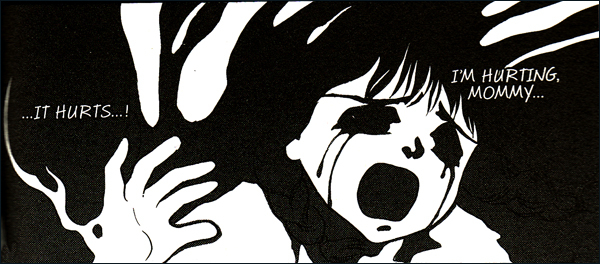
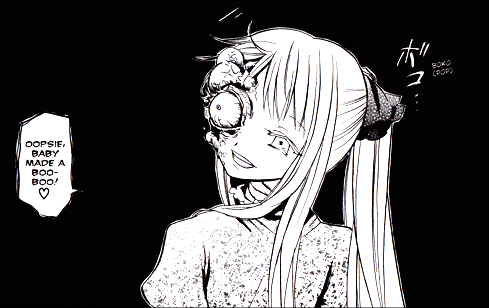
Perhaps it’s further evidence of how much a face means to me, actually, that both of my follow-up images are pretty much face-only. First, from CLAMP’s Tokyo Babylon, we have the face of a dead child who pleads with her mother to avenge her, and secondly, from Jun Mochizuki’s Pandora Hearts, the face of a girl that reveals itself to be a monster underneath.

Tokyo Babylon, Vol. 4 (TOKYOPOP)

Pandora Hearts, Vol. 1 (Yen Press)

I actually find both of these to be creepier than the images from After School Nightmare, though they are much simpler. Something they have in common is that they are presented against a stark, black background, giving the distorted expressions full focus. After that, though, they are nearly opposites of each other. The face of the girl in Tokyo Babylon is all too real, distorted by the power of raw emotion, while the character in Pandora Hearts is revealed to have no emotion at all, or at least none that matched what was on her false human face. Yet in the end, which is more monstrous?

MICHELLE: It’s interesting how much the things that creep us out reveal about us, isn’t it? I’d wager you get the same threatening feeling from the girl who is revealed to be a monster underneath as you do the girl with no face at all. People pretending to be what they’re not, hiding their real selves, etc. That’s definitely something all of us have experienced at one time or another.

Getting back to actual attempts at visual analysis, those deep black backgrounds really do focus the reader’s eye on what the mangaka wants them to see. It’s as if they’re saying, “I don’t want you to be distracted by anything else.”

MJ: Your analysis of me is spot-on, that’s for sure!

And yes, I think the black backgrounds achieve exactly that, while also evoking our natural fear of the dark, or what we can’t see. It’s a powerful tool for both showing us something and not showing us something, if that makes sense.

MICHELLE: It definitely does.

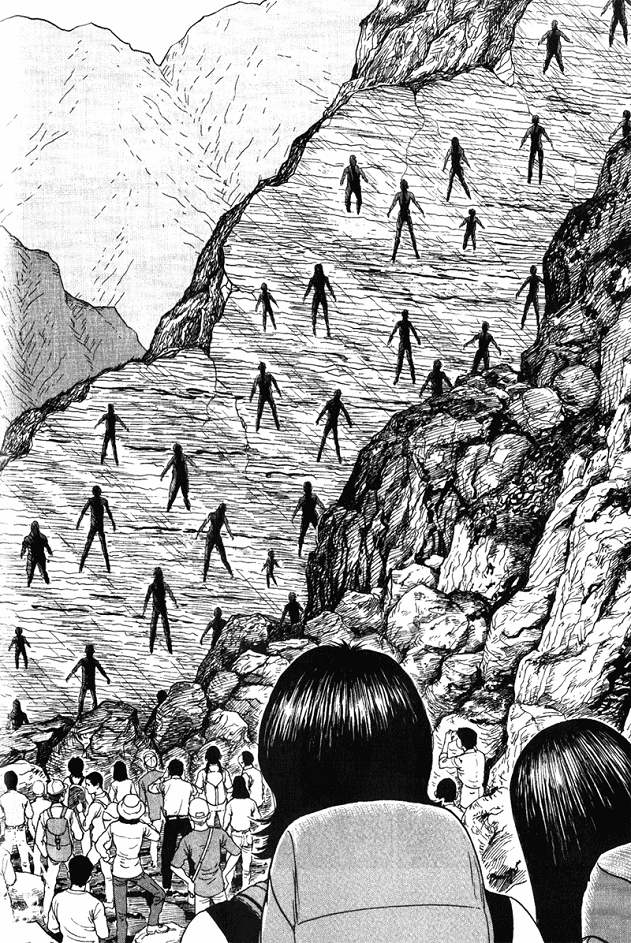
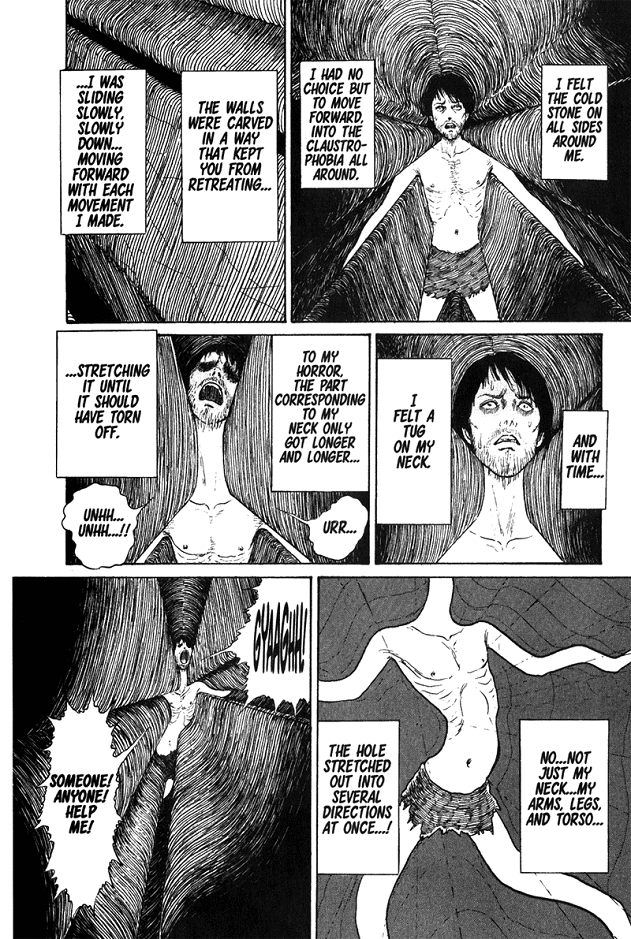
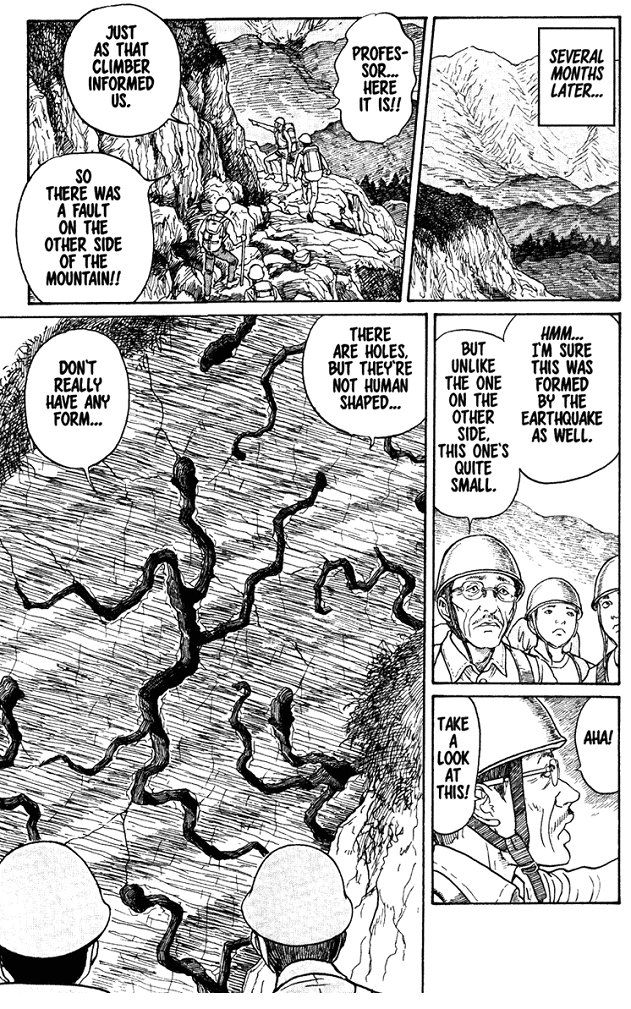
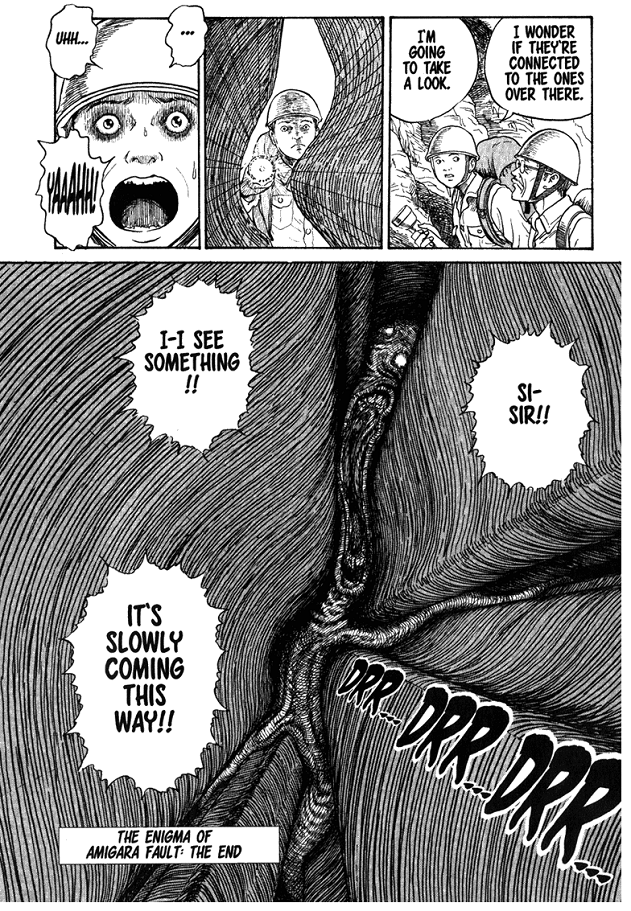
Now I’m reflecting on what the images I’ve chosen say about me. There’s hardly a face among them, for one thing, because I am less creeped out by shocking images than I am by imagining an experience, specifically an experience during which one is forced to endure something horrible for a really, really long period of time with no means of escape. Ugh, just thinking about the short story my images come from—”The Enigma of Amigara Fault” by Junji Ito—has given me the jibblies while typing this paragraph!

Gyo, Volume 2, “The Enigma of Amigara Fault” (VIZ Media)

Page 178

Page 185

Page 198

Page 203

Page 204

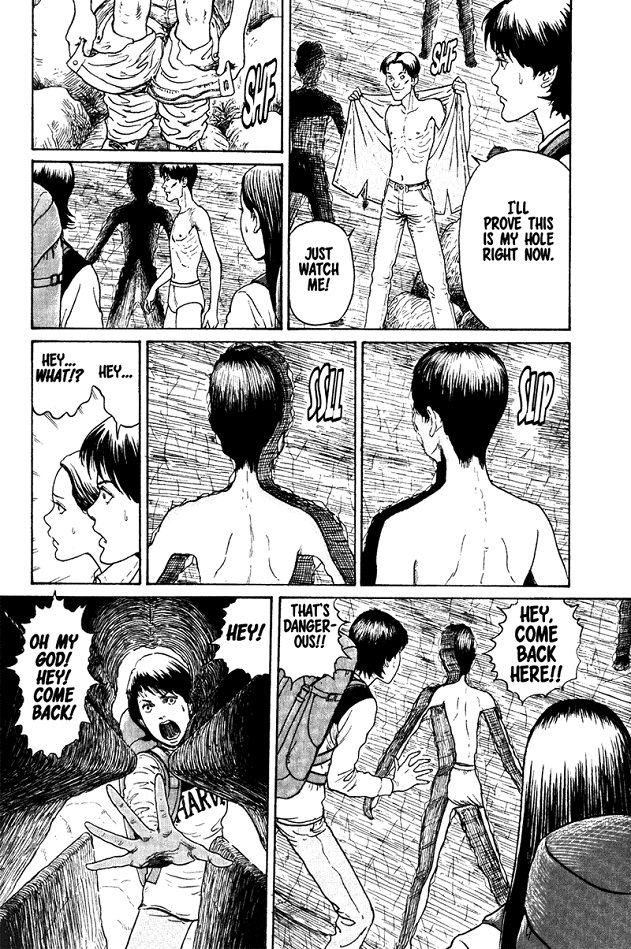
I’ve chosen this particular sequence of images from this short story because they illustrate the entire plot without me needing to introduce it beforehand. By now you probably don’t need me to explain that when the TV news reports on a mountainside full of people-shaped holes revealed by a recent earthquake, people flock to the site and can’t be dissuaded from climbing into their personal holes, where long, icky agony awaits them. At first the site seems innocent enough, if a bit strange, but soon people are walking into holes, having nightmares about what happens to you in a hole, and eventually discovering the exit and…. Holy crap, it’s terrifying. This is the kind of thing that will haunt me for ages.

I’m honestly trying to analyze Ito’s artistic techniques dispassionately here, but I find that the disturbing power of the images is so great that it is affecting my ability to reason even now!

MJ: Hmmm, I’m wondering if what it’s saying is that while I’m terrified of people betraying me, you’re terrified of your environment betraying you. Or something like that.

In any case, these panels are undeniably creepy. Even if they creep me out in a less personal way, I can certainly see what’s giving you the jibblies! Interestingly, we again see the human form distorted, though in this case it’s happening sort of *to* the character we’re relating to rather than in front of him. (Maybe I’m afraid of the people I trust being compromised, and you’re afraid of yourself being compromised?)

This has a Twilight Zone feel to me, where some unexplained supernatural phenomenon is turning the lives of ordinary people into a nightmare. The artist does a great job of evoking the real terror of what’s happening, too. The texture of the stone walls around the man gives the images a three-dimensional look that makes it feel more real than a lot of what we see in manga. It’s the only thing that has that kind of thick texture, too, so it really stands out.

MICHELLE: More like I’m terrified of taking a step that can’t be undone and ending up in eternal torment because of it!

And yes, now that I’ve regained my senses, I agree that it’s the realistic three-dimensional detail that really makes it so disturbing. The details of the setting itself establish it firmly in the here and now, and then we’re shown that within the here and now exists something completely alien and unexplainable! Regarding the texture of the stone walls… it’s that bit of dialogue about how they’re carved to prevent backtracking that really gets to me. It’s mute, immobile stone, and it’s going to be your tormentor for the next several months, slowly inflicting more gruesome horrors upon you than something living could ever do. Uh-oh… jibblies.

MJ: There, there!

MICHELLE: Thanks. I also really love the bottom left panel on page 185, when you see the outside world from inside the tunnel. Interestingly, this is an angle from which the guy who just entered the hole could never have seen the characters. He’s got his back turned to this world, and is resolutely leaving it behind. And, too, I love the “less is more” approach here. We don’t see the distorted figure actually emerge from the mountain and thrash around terrorizing people. One glimpse is enough to confirm what has happened. It’s almost kind of elegant in its structure.

MJ: Yeah, I agree, the threat of what is about to happen is actually scarier by itself than it might be if we actually saw it happen. Or at least it’s creepier that way.

MICHELLE: Well, I fear this column has actually been more about us than the art, but it’s been the art that made us feel that way, and that’s something, isn’t it?

MJ: It is!

MICHELLE: So, that’s it for us this month. What gives you the jibblies?

Filed Under: FEATURES, Let's Get Visual Tagged With: Junji Ito, VIZ, VIZ Signature

A Traitor to Memory by Elizabeth George

November 28, 2011 by Michelle Smith

Book description:
When Eugenie Davies is killed by a driver on a quiet London street, her death is clearly no accident. Someone struck her with a car and then deliberately ran over her body before driving off, leaving nothing behind but questions.

What brought Eugenie Davies to London on a rainy autumn night? Why was she carrying the name of the man who found her body? Who among the many acquaintances in her complicated and tragic life could have wanted her dead? And could her murder have some connection to a twenty-eight-year-old musical wunderkind, a virtuoso violinist who several months earlier suddenly and inexplicably lost the ability to play a single note?

For Detective Inspector Thomas Lynley, whose own domestic life is about to change radically, these questions are only the first in an investigation that leads him to walk a fine line between personal loyalty and professional honor.

Review:
I finished A Traitor to Memory last night and have spent most of today trying to find the words to explain why I didn’t like it very much. The one thing that keeps coming back to me is that it just felt somehow empty, especially in comparison with the previous few books in the series.

It’s November now, a couple of months since Barbara got demoted and she and Lynley spent an entire book at odds with each other. While it’s certainly a relief that they are getting along well again, it is fairly strange that neither ever reflects upon their period of estrangement. In fact, there is exceedingly little from Barbara’s point of view and no appearances by her charming neighbors. Compensating slightly for this omission, however, are some segments from Winston Nkata’s perspective.

Anyway, the case in question involves a series of hit-and-run accidents that are connected to the murder of a child that Superintendent Webberly (Lynley’s boss) investigated twenty years ago. Interspersed with the feats of detection are journal entries by a violin prodigy named Gideon Davies who is in therapy to discover the reason for his abrupt inability to play his instrument. As with many books in this series, one must have patience and wait for the a-ha moment that connects seemingly disparate elements, and there are quite a few of those in this novel. “Ohhhh,” one says, “so that’s who he is!”

Unfortunately, I found the final solution… inelegant. Oh, I can devise arguments in its favor, namely that in the real world, detectives frequently do not learn why a given suspect did something, only that they did. But readers are spoiled and we are accustomed to learning such details. The evidence is sufficient, but without that extra level of confirmation it’s not quite as satisfying. Also, there’s a shock ending that inspires conflicting reactions. On one hand, it’s a neat twist, but on the other, I highly doubt that George will ever get around to revealing what actually happened, especially as the next book in the series (A Place of Hiding) is about Simon and Deborah St. James and not anyone inclined to comment on the details of this case.

Ultimately, this was a long, slightly tedious, and rather disappointing installment in the Lynley-Havers series. Not that this will in any way dissuade me from continuing on, however!

Filed Under: Books Tagged With: Elizabeth George

Pick of the Week: Negima & more

November 28, 2011 by Sean Gaffney, MJ, Katherine Dacey and Michelle Smith 6 Comments

A slow week at Midtown Comics can be painful, but the Battle Robot finds a few books to love, both on and off the list.


SEAN: I’ve become accustomed to the fact that both titles I’d like to talk about this week fall into the category of ‘will never, ever gain new readers no matter how much I review them’. With that in mind, this has been one of the most enjoyable arcs of Negima! to date, and this volume, although technically a breather, advances a lot of plot points. The four sports girls each get some lovely character moments, particularly Yuna and Akira, and we get some nice (if tear-jerking) backstory. We also get a good look at Fate’s group, showing that even thought they may be the villains that doesn’t mean that they’re irredeemable or acting out of evil. (cough) Well, except Tsukuyomi. Who reaches new levels of terrifying. For Negima fans, it’s a must buy. For casual readers, go read the 2nd omnibus instead.

MJ: This week’s meager offering is nearly a bust for me, but fortunately my favorite talking cactus saves the day! Things take a fairly dramatic turn, romance-wise, in volume 9 of SangEun Lee’s 13th Boy, and I have to admit it’s all going my way, at least for now. I can’t think of a girls’ comic I’ve enjoyed more in the past year or so than 13th Boy, and I’m already mourning the fact that it’s only going to last me through July of next year. Beatrice now, Beatrice forever!

KATE: This week’s manga offerings are mighty slim, so my choice is the third issue of Dorothy and The Wizard in Oz (Marvel). As a child, I only read the first Oz novel and, truth be told, found it kind of ponderous. In Skottie Young and Erik Shanower’s capable hands, however, all of Baum’s Oz novels have been a genuine pleasure to read: they’re beautifully and playfully illustrated, bringing Baum’s weirdest creations to vivid life. Dorothy and the Wizard is the fourth novel in the original series, reuniting Dorothy with the balloonist-cum-wizard from the first book. The episodic plot is perfectly suited to a serial medium like comics, offering readers enough variation to keep them interested while allowing each of the supporting characters a memorable turn in the spotlight. A great choice for younger readers.

MICHELLE: Oh dear, there is indeed a paucity of choices from Midtown Comics this week. Since MJhas so ably recommended volume nine of 13th Boy, I shall go off-list and pick something that should be on this list but isn’t, and that’s volume one of Shugo Chara-chan!, due out this week from Kodansha Comics. Honestly, I have no idea whether this will actually be good, but I’ve been looking forward to checking it out for a while. It’s by Peach-Pit, the same team who wrote Shugo Chara! itself, and is essentially a 4-koma comic strip starring the “guardian characters” from the main series. It’s possible that it will be painfully unfunny, or perhaps only suited for young audiences, but I am hoping for the best!


Readers, what looks good to you?

Filed Under: PICK OF THE WEEK

Bookshelf Briefs 11/28/11

November 28, 2011 by MJ, Michelle Smith, David Welsh, Katherine Dacey and Sean Gaffney 8 Comments

This week, MJ, David, Kate, Michelle, and Sean take a look at Yen Press, Viz Media, Kodansha Comics, East Press, and Digital Manga Publishing.


13th Boy, Vol. 9 | By SangEun Lee | Yen Press – I know they say “you can’t always get what you want” and all that, but what I’ve learned from SangEun Lee’s 13th Boy, is that sometimes you really can and it’s freaking fantastic. After eight terrific volumes, 13th Boy is giving me exactly what I’ve most wished for, and even if it’s a temporary situation (which I suspect it is), I can’t deny that I’m walking on air. Fortunately, this bit of wish-fulfillment is written with the same humor and charm as everything else in this series, so it isn’t only what we want, but also just what the narrative needs. Isn’t it nice when these things work out? 13th Boy may not be the flashiest series in Yen’s current lineup, but it’s certainly one of the best. Still recommended. – MJ

Cross Game, Vol. 5 | By Mitsuru Adachi | Viz Media – Adachi introduces a surprisingly contrived plot twist in this generally grounded series, and I’m not quite sure what I think of it. A new character moves into the neighborhood, and she causes a number of ripples in the regular cast, though she has no idea she’s doing it. Her impact is the result of something that’s entirely beyond her control, which is unlike what I’ve come to expect from the very character-driven Cross Game. Adachi’s enormous talent makes the ripples much more moving than they might be otherwise, and he seems to be building up the new character as an individual rather than as just a catalyst. Still, I don’t really know what to make of Adachi’s decision to introduce her in the first place. It seems like a narrative shortcut or a stunt, and, no matter how well executed it might be, I feel like the technique is almost a little bit beneath Adachi. – David Welsh

Dawn of the Arcana, Vol. 1 | By Rei Toma | Viz Media -The notion of a feisty young woman who must choose between two boys – one aloof, one fawning – is possibly one of the least fresh in the wide world of romantic fiction. That’s the main attraction of Dawn of the Arcana, at least as far as the first volume goes, so the reader is left to evaluate it based on execution. Toma has a lot of talent on her side. Her art is stylish, and her storytelling is sincere. But her ability to create characters that engage the reader quickly isn’t really in place. Nakaba, a psychic princess who’s forced into marriage, has some intriguing qualities that don’t have much to do with her effectiveness as the hinge of a love triangle. As a result, I ended up caring least about what Toma spent the largest amount of time examining. If she rounds out the story with more palace intrigue and dark destiny, the series could hold my attention better. – David Welsh

Fairy Tail, , Vol. 16 | By Hiro Mashima | Kodansha Comics – The end of one arc and the start of another here, but there’s much to like in this transitional volume of Fairy Tail. It’s rare that an author actually lets you know that they’ve added and changed material from the weekly magazine version, but Mashima is proud to point out that he was able to expand the celebration in Chapter 128, and rightly so – it really helps to show the sheer joy and happiness that the town is seeing, as well as the somewhat melancholy departure of Laxus. Another villain with basic good intentions, Laxus simply can’t stay in Fairy Tail after what he’s done, and the melodrama is appropriate here. There’s also a brief chapter featuring Lucy and her father, as she discovers he’s lost everything. The scene where he confronts her is incredibly discomfiting (which is what is intended.) Finally, we start on a new quest, and meet a bunch of new people from various other guilds. Betcha two to one it’s the cute loli girl who becomes the new cast member. As ever, if you want more One Piece-esque shonen and don’t mind that it’s not quite as good, Fairy Tail is a lot of fun.-Sean Gaffney

I’ll Give It My All… Tomorrow, Vol. 4 | By Shunju Aono | Viz Media – The fourth volume of I’ll Give It My All… Tomorrow introduces a new character, Aya Unami, a twenty-three-year-old editor who sees parallels between failed manga-ka Shizuo Oguro and her own father, a failed novelist. The relationship between Unami and Oguro supplies most of the dramatic juice in volume four, as Unami tries to discourage Oguro from submitting more work to EKKE. (“I think you need to know when to give up,” she tells him at the end of their first meeting.) Though Oguro never persuades her to publish “Live to 300,” his latest excruciatingly autobiographical manuscript, Oguro does have an epiphany about his tough-talking editor: she might be the only person with the vision and honesty to help him improve. Whether she’s willing to coach him, and whether he can accept her guidance… well, that’s another story. -Katherine Dacey

No Longer Human | Based on the novel by Osamu Dazai; Adapted by Variety Art Works | East Press – Given the commercial and critical success of Osamu Dazai’s final novel, it’s no surprise that so many manga publishers have commissioned adaptations. Vertical, Inc. has just released the first volume of Usamaru Furuya’s 2009 version, which transplants the story from pre-war Japan to the present day, while JManga has dug into the vault for an older, more straightforward version from East Press. The East Press version suffers by comparison with Furuya’s, as the artwork is clumsy and the pacing hurried; the adaptation team tries too hard to include every scene from Dazai’s book, resulting in a string of brief, two-to-three page episodes that never gel into a coherent story. Readers unfamiliar with Dazai’s novel may find this brief comic book treatment a useful place to start, but are encouraged to seek out Donald Keene’s English translation for a more thorough introduction to Dazai’s unflinching style. -Katherine Dacey

Nura: Rise of the Yokai Clan, Vol. 6 | By Hiroshi Shiibashi | Viz Media – If you had any doubts about why VIZ licensed Nura, volume six should dispel them: it’s easily the most exciting installment to date, boasting several lengthy action sequences and a bevy of fierce-looking demons worthy of Tsukioka Yoshitoshi. The downside to all this activity, however, is that only the most committed reader will be able to follow the battles; Hiroshi Shiibashi stages too many separate fights at once, lurching back and forth between storylines with little regard for continuity. The second half of the volume is positively sedate in comparison, as Rikuo joins his human friends in exorcising a ghost with yakuza ties. Though the story follows a well-traveled path, Shiibashi manages a few scares and laughs, thanks to imaginative character designs and a denouement worthy of Scooby Doo himself. Fitfully entertaining. -Katherine Dacey

Only Serious About You, Vol. 1 | By Asou Kai | Digital Manga Publishing – Naoki Oosawa is a single dad balancing caring for his daughter Chizu and his busy work schedule at a restaurant. When Chizu falls ill, Oosawa accepts the help offered by a flirtatious gay customer, Seiichi Yoshioka, and ends up learning that Yoshioka is not quite as cavalier about relationships as it seems. There is much to like about this two-volume series so far. For one, it takes its time depicting the trust and friendship developing between Oosawa and Yoshioka, complete with many cute scenes in which Yoshioka bonds with Chizu. (There is an adorable moment involving hair ties, for example.) For another, I appreciate the way in which Yoshioka’s behavior can be reinterpreted once one begins to really understand him. That’s some sure-handed characterization. Ultimately, this was quite a pleasant surprise and I look forward to the second volume. – Michelle Smith

We Were There, Vol. 13 | By Yuuki Obata | Viz Media – In a romance series as melancholy as We Were There, there’s a point where even the most beloved relationship can become intolerable if it’s creating too much pain, and Nanami and Yano’s has finally reached that point, at least for this reader. This is not actually a criticism. It’s a testament to the realism of this series that I’ve come to regard Nanami as a friend who needs a good talking-to, in hopes that she’ll finally let go of her high school sweetheart and learn to appreciate what’s actually in front of her, “true love” be damned. Obata has a real knack for capturing some of the heart’s least fortunate truths and presenting them with both honesty and compassion, and this volume is a perfect example of that skill in action. Both quiet and complicated, We Were There is still one of the best ongoing series’ in Viz’s Shojo Beat catalogue. Recommended. – MJ

Filed Under: Bookshelf Briefs

Pick of the Week: Sailors Moon & V

November 21, 2011 by Michelle Smith, Sean Gaffney, MJ and David Welsh 5 Comments

It may be a slow week for shipping at Midtown Comics, but the Battle Robot picks out two easy favorites.


MICHELLE: It’s slim-pickings time again at Midtown Comics. Happily, though, two of the three releases (sorry, Ninja Girls!) are on my must-buy list. Forced to choose between them, I’d give my pick to volume two of Codename: Sailor V. Sure, the first volume was an episodic string of encounters between perky Minako and evil singing groups bent on making humanity their slaves, but it took a more serious turn in its final chapter that might bode well for volume two. I’ve read this before, but it was so long ago I don’t remember how things turn out, but I anticipate more glimpses of Usagi and friends as Minako comes closer to her eventual place with the rest of the team. If you’ve read volume one, you absolutely can’t miss volume two!

SEAN: Yes, hard as the decision may be, I’m going to have to pass on Ninja Girls as well. My pick is for the second volume of Pretty Guardian Sailor Moon. This second volume continues to give us reveals fast as lightning – if you watched the anime first, you might think it was rushing. In fact, it’s just cruising through its plot with no filler whatsoever. It’s possible Takeuchi originally planned to have this end in 3-4 volumes, as there’s a lot of revelation and backstory here, almost looking as if it’s setting up an ending. Of course, that could also be Takuechi just messing with our heads – there are some surprises sprinkled throughout, and even one of the bigger hoary old cliches trotted out is still done in a suitably dramatic fashion. Best of all, having wrapped up her plot in Code Name: Sailor V, Minako joins the cast at last, and our senshi team is complete (for now).

MJ: Well, I just read Sean’s pick, and I’m *sold*. It’s Sailor Moon for me, too! Though I do wish Midtown would hurry up and get Princess Knight!

DAVID: And I’ll second Michelle on the Codename front. Kodansha is making it easy this week!


Readers, what looks good to you this week?

Filed Under: PICK OF THE WEEK

Bookshelf Briefs 11/21/11

November 21, 2011 by Sean Gaffney, Katherine Dacey and Michelle Smith Leave a Comment

This week, Sean, Kate, & Michelle take a look at recent releases from Viz Media, NETCOMICS, Vertical, and Seven Seas.


Dengeki Daisy, Vol. 7 | By Kyousuke Motomi | Viz Media – Well, we’d been waiting for a volume like this, and here it is. Mind you, it takes until the very end to finish pulling all its triggers. The start of the book is cute, funny, and has tinges of romance, just as this series has always done when it’s not trying to kill its heroine or dealing with backstory and intrigue. In particular, at first we think Akira is going to screw things up in a mild, typical shoujo way. His forced kiss, and Teru and Kurosaki’s response, are a real highlight. Then we get that 2nd half, where we discover the dangers of having your cell phone stolen. You could argue that Kurosaki is far too gullible, but honestly, he’s been telling himself for the last 6 volumes that he should suffer, so why are we surprised when he believes what he sees? And that cliffhanger? Oof. Volume 8 had better come soon and resolve this, or there will be a reckoning.– Sean Gaffney

Full House, Vol. 6 | By Sooyeon Won | NETCOMICS – Smooching! Rescues! Revelations! Haircuts! This volume has it all. We open with our leads hiding out from Ellie’s kidnapper in a swanky house conveniently located in the middle of nowhere. As they settle into their temporary digs—including the cutest let’s-see-whether-this-expired-food-is-any-good scene ever—they grow closer, with Ryder finally sharing with Ellie the details of his first love, Jasmine. But because he believes he is dying of cancer, he doesn’t follow up on their connection and once the truth is revealed to him, Ellie has already determined to move on with her life. It’s melorama at its finest, but I enjoyed it tremendously. I also appreciate how much Ellie has matured since the start of the series and watching easy-on-the-eyes Ryder moon about over her is great fun. I only wish these volumes were available in print because this is the kind of series that lends itself to weekend marathons. – Michelle Smith

Princess Knight, Part One | By Osamu Tezuka | Vertical, Inc. – Osamu Tezuka’s Princess Knight wasn’t the first shojo manga, but it was one of the most influential girls’ comics in postwar Japan. The story focuses on Sapphire, a princess who’s raised as a prince so that she may inherit her kingdom’s throne. When her parents’ duplicity comes to light, Sapphire goes on the lam, using her expert swordsmanship to defend her subjects from the wicked Duke Duralumin. Though the series’ gender politics are dated — Sapphire wants nothing more than to be able to wear a pretty dress — it’s easy to see why this story has enchanted several generations of Japanese readers: Sapphire has swashbuckling adventures *and* wins the hand of Prince Charming. Long unavailable in English, the new Vertical edition is a marked improvement over Kodansha’s bilingual one from 2002, thanks to Maya Rosewood’s fluid translation. A must for serious manga fans. -Katherine Dacey

RIN-NE, Vol. 7 | By Rumiko Takahashi | Viz Media – Like InuYasha before it, RIN-NE is like a manga sitcom, with a steadily growing cast of recurring characters who convene for different scenarios during which nothing ever changes about their interpersonal relationships. This volume features such stock settings as a summer festival and the beach, and none of the stories is really much of anything to get excited about. In fact, the final one, about a cursed crop of sweet potatoes (yes, really), is downright dumb. And yet, I can’t dislike this series. It just has this innate Takahashi charm that encourages acceptance of its weaker elements and compels me to keep checking in to see whether anything has actually really happened with the characters. I’m not sure whether I can recommend it to other people, but I’ll probably keep reading it. – Michelle Smith

Rin-Ne, Vol. 7 | By Rumiko Takahashi | Viz Media – This volume is a nice breather after the last, and has no real overall plot development. It does have a bit of character development, as Rinne’s feelings, which were always fairly clear to begin with, are becoming very obvious to anyone not named Sakura. Aside from that, it’s a typical Takahashi volume – lots of really goofy ideas (the while sweet potato story is a classic “how did she even come up with that?” idea from Takahashi, some abuse of its heroes (Rinne can’t catch a break, of course, but Tsubasa and Ageha also get their turn being the butt monkey), and the occasional sweet moment as a bone thrown to longtime readers (the festival chapter). If you’re waiting for something to actually develop, you should look elsewhere, but for those Viz readers who can’t imagine not having a Takahashi title they’re collecting, Rin-Ne will serve admirably.– Sean Gaffney

Toradora!, Vol. 3 | By Yuyuko Takemiya and Zekkyo | Seven Seas – After Soul Eater, this may be my second title where I find I’m reading it primarily for the art. To be more precise, I’m reading it for the Kushieda gags. Kushieda is a complete flake, and whenever she gets a scene where she acts especially flakey, the artist decides to draw it in a completely different style. This gives us what appears to be sordid game-show contestant Kushieda and bancho Kushieda, both of whom are worth the price of the manga alone. That said, the plot going on here (seeing Ami’s true self, and getting her to stpo being the devious manipulator) is handled well, and Taiga is still incredibly tsundere without making you want to smack her, i.e. the best kind. One art drawback, though – the introduction of the student council president, who also appears to be Kitamura’s crush, is undercut by her resemblance to Ami – I got the two mixed up almost immediately. Still, can’t have everything, and Toradora! continues to be a fun romantic comedy. And love those poses.– Sean Gaffney

Filed Under: Bookshelf Briefs

Off the Shelf: Natsume Ono

November 17, 2011 by MJ and Michelle Smith 5 Comments

MJ: Well, hello, Michelle! Is it really time for another Manga Moveable Feast?

MICHELLE: It seems like every time I turn around there’s a new one!

MJ: Agreed! But when that Feast revolves around the likes of Natsume Ono, I’m not going to complain. So, we’ve each read some Ono this week in preparation for the Feast. Michelle, would you like to begin?

MICHELLE: Sure! It’s been a pretty busy time for me lately and while my tired brain balked at the daunting prospect of getting into Ono’s longer works, her collections of short stories presented an option that I can only describe as “undemanding,” and I mean that in the nicest way.

First, I read La Quinta Camera, which is a series of linked short stories revolving around an apartment in Italy. Four of its rooms are occupied by middle-aged men of incredibly “singular” personalities—Massimo, the landlord, who is nurturing and kind; Luca, the small hippy busker, who is sweet and child-like; Celestino, the short and mustachioed guy, who is annoying yet much-loved; and Al, the truck driver who is either asleep or at work. Massimo routinely takes in exchange students to let the fifth room and, as the story opens, Danish language student Charlotte arrives.

It’s a bit of a surprise when, in chapter two, Charlotte has moved out and been replaced by Alessandro, but this introduces the central gimmick of the book: in each chapter, there’s a new tenant. In a sort of… gentle and vague way, focus shifts amongst the residents during the course of six chapters, during which time Luca finds and loses love, Charlotte offers to have Al’s babies, and Massimo’s girlfriend announces that she’s pregnant, which means everyone must move out.

Objectively, I realize that works like House of Five Leaves are better than La Quinta Camera, but I have to say that I liked it a lot. I just simply like stories where people are nice to each other… where they remember to leave Christmas messages for the lonely Japanese kid left alone in their apartment over the holiday. With its light touch and pleasant feeling, his is the kind of brain balm I sometimes require.

MJ: There’s a real warmth to Ono’s short stories that indeed serve as kind of a healing balm, in my view. I don’t see this as being a lesser type of storytelling (even if I tend to prefer something a bit more epic), and it’s especially lovely in Ono’s hands. Sure, love something powerful, but a light touch can often be just what’s needed.

MICHELLE: I think I’m probably just not in the mood for something powerful as often as you are, hence my fondness for less-than-awesome media tie-in fiction. There’s some pressure to be profound when responding to Great Works that one just doesn’t feel when reading a book about Buffy. And so La Quinta Camera performed a similar function for me.

Anyhow, I suspect you have read something a bit more epic this week.

MJ: Well, I’m not sure if “epic” is an appropriate word for House of Five Leaves, though it’s long-form storytelling of course. But it’s rather leisurely, really, much like Ono’s shorter works but with expanded opportunity for exploration.

I tried to read volume four a while back, and somehow couldn’t latch on to it. I know now that it must have been me, because there’s a whole lot going on in this volume, and it clicked immediately with me on my second try.

Much of the volume revolves around Ginta, a new sort-of-member taken on reluctantly by the Five Leaves. He’s the cast-off son of a wealthy family who tricks his way into the Leaves, but not without revealing a whole lot more of himself than he intended. We also learn new things about the Leaves’ leader, Yaichi, in this volume, and it’s definitely not pretty.

What makes House of Five Leaves so consistently intriguing, though, is the failed samurai that provides the series’ heart. With Masa at its core, there’s always an odd mingling of warmth and unease running through the story. These feelings are where Masa lives, and one has the sense that this has always been the case. There’s a heartbreaking flashback in this volume, in which we see Masa being basically thrown out of his home for being so ill-suited as a samurai. Yet it’s hard to imagine exactly what he should be. He’s all ambiguity (and a little self-loathing), and certainly not a hero, yet it’s impossible not to care for him, and it’s obvious that Ono does.

I’ve loved this series from the beginning, and it’s only become more dear to me over time. It’s probably my favorite of Ono’s work, and that’s saying quite a lot. I look forward to the next volume.

MICHELLE: I read and loved the first volume, but when I recently attempted to read volume two (with a goal of catching up on the series) I had a similar experience in which it just failed to engage me somehow. With Ono’s short stories I found that having a dedicated amount of time to just sit and consume them in one sitting was ideal, so perhaps that’s where I went wrong with Five Leaves. I’ve definitely not given up on the series.

MJ: I’m glad you haven’t given up. It really is one of my favorite currently-running series.

So, speaking of Ono’s short stories, we both read Tesoro this week, just released from Viz. Want to talk about that a bit?

MICHELLE: Sure!

Tesoro (the Italian word for “treasure”) is a collection of fourteen stories by Natsume Ono. The earliest works were published as doujinshi, while more recent stories appeared in IKKI. Unlike La Quinta Camera, the stories here are not overtly serialized, though there are some recurring characters and common themes (like curmudgeonly guys who really love their wives).

For the most part, though, the stories seem to be short expressions of ideas that don’t go very far in developing the characters. Some stories are whimsical—the introductory piece, for example, consists entirely of a bear taking the bus to get some donuts then going home again—while some are more serious, like the story of an orphaned girl who sees a potential father in every famous man of whom she becomes aware. It’s an intriguing concept, and one can definitely see seeds of Ono’s eventual storytelling abilities, but it’s lacking the warmth that imbued even the loose-limbed La Quinta Camera with touching moments.

I definitely enjoyed it, don’t get me wrong. But I think it would be more enjoyable to those already familiar with Ono rather than for those who are wondering who she is and what the fuss is all about.

MJ: I agree, though, like you, I certainly enjoyed Tesoro. One of my favorite stories in the volume was “senzo titolo #3,” about a father taking his young son to see his estranged father for the first time. There’s a lot packed into this little story–apprehension, excitement, some lingering resentment–all without ever actually seeing the grandfather ourselves. It’s a little glimpse of Ono at her best. There are a lot of moments like that here.

I think you’re absolutely right, though. This is a collection for fans to linger over, rather than an effective introduction to the author.

Did you have a favorite story?

MICHELLE: Oh, I loved “senzo titolo #3” because I loved how the dad started singing the Coke jingle in public and the kid was embarrassed. :) I thought that was a nice little true-to-life moment.

I think my favorite is “Moyashi Couple” (or “bean sprout” couple), because the husband is seen as a grouch by the neighbors but once he learns the neighbors think he and his wife don’t get along, he makes sure that they go out and about in public to disprove that notion. There’s a really nice line in it about the neighbors being able to tell that he’s actually kind because, though he usually walks in an impatient swagger, when he’s with his wife he automatically assumes a more leisurely pace so as to be able to walk beside her. Maybe I’m just a sucker for crusty guys with hearts of gold, but I think that’s the story I won’t forget from this collection.

MJ: I liked that too, and probably for similar reasons. I was also fond of “The Frooms,” about a boy with two domineering older sisters, whose dad tries (and fails miserably) to equalize things. It’s funny and poignant all at once. Poor dad!

MICHELLE: Oh yes, I love how that poor dad is just flabbergasted that his big plan to give his son a dazzling gift is derailed.

It occurs to me that these are like drabbles. Little ideas that suggest what a longer extrapolation on the theme could be like without actually, y’know, extrapolating.

MJ: That’s an excellent point, Michelle! They do indeed have the same, wispy quality. This is what a real “slice of life” looks like.

MICHELLE: Exactly! Perhaps the term has never been more literally applied!

MJ: So while I’d be more likely to hand a new reader something like Ristorante Paradiso, Tesoro really is a treat for Ono’s existing fans.


Read more about the work of Natsume Ono at this month’s Manga Moveable Feast, hosted by Manga Widget’s Alex Hoffman.

Filed Under: OFF THE SHELF Tagged With: Manga Moveable Feast, MMF, Natsume Ono

Pick of the Week: Variety

November 14, 2011 by Katherine Dacey, Michelle Smith, Sean Gaffney, MJ and David Welsh 1 Comment

This week’s bounty at Midtown Comics is especially diverse, though even that can’t quite satisfy the broad tastes of the Battle Robot. Check out our picks below!


KATE: Though VIZ is releasing several must-read manga this week — including Natsume Ono’s Tesoro and the tenth volume of Takehiko Inoue’s Real — my vote goes to the fourth volume of Hisae Iwaoka’s Saturn Apartments. This beautifully illustrated drama focuses on a handful of window washers aboard an enormous space station. The characters’ job grants them access to every nook and cranny of the joint, offering them a window (no pun intended) into the lives of their wealthy and eccentric clientele. At the same time, however, their job is incredibly dangerous: as Iwaoka amply demonstrates throughout the series, the characters face UV exposure, strong solar winds, and a variety of other hazards, all of which can send them plunging to their deaths. Lest I make Saturn Apartments sound like an Upton Sinclair novel set in space, rest assured that the story isn’t unrelentingly grim, thanks to Iwaoka’s playful, imaginative artwork and her lively cast of supporting characters. My only complaint about the series: VIZ doesn’t release it frequently enough!

MICHELLE: I considered picking volume two of Pretty Guardian Sailor Moon this week—for, despite the fact that Midtown Comics is not receiving it, other retailers are—but figured that enough people would buy it or had already pre-ordered it that it didn’t need my help! So, instead, I will cast my vote for volume three of Tsuta Suzuki’s A Strange and Mystifying Story, which I reviewed in the October BL Bookrack column. The series’ first two volumes depict a relationship between a sickly guy and the guardian beast that heals him, but volume three signifies a welcome new direction for the series. Here’s what I had to say about it:

“Mangaka Tsuta Suzuki is wise enough to know when a story is played out and brave enough to risk angering her fans by taking things in an entirely new direction. Akio and Setsu appear but briefly, therefore, as Suzuki devotes the first half of this volume to the absolutely adorable love story between two of Akio’s coworkers and the second half to a teenager named Tsumugi who has just encountered a guardian beast of his own.”

Even if you’re not into guardian beasts per se, the first half alone is worth the price of admission.

SEAN: Honestly, there is some manga I’m getting this week, but nothing that really makes me jump up and say Pick Of The Week. So I’m going to talk about Pogo again. There’s just so much nostalgia wrapped up in this release, even if it is only of the first two years (the comic ran 24 years before Kelly passed away). The odd passive love triangle between Pogo, Porkypine and Mam’selle Hepzibah; Howland Owl and Churchy LaFemme’s continued ability to get sucked into any incredibly stupid scheme they come across; Albert Alligator, despite being a loudmouth jerk most of the time, being an alligator you can truly believe is not eating most of the native populace; and Deacon Mushrat, who in these early strips is the closest the comic has to a villain, though in later volumes – it’ll be Vol. 3, I believe – he is easily supplanted by far more sinister characters. Much as fans of literature always point you towards the classics, fans of comics – both Japanese and American – should know their Pogo.

DAVID: I could easily pick the 10th volume of Takehiko Inoue’s splendid Real, but I’m going to favor Natsume Ono’s Tesoro for a couple of reasons. The first is that Alexander (Manga Widget) Hoffman is hosting a Manga Moveable Feast dedicated to Ono’s work. The second is that Tesoro is really charming. It contains some of Ono’s earliest professionally published works, but you could never tell if you haven’t read some of her more recent comics. And, even if you’ve read her more polished titles, there’s still plenty here to enjoy. I’m going to post a review of the book today, so I won’t go into too much detail here, but if you like charming, character-driven comics, then you should do yourself a favor and pick this up. The stories here are uniformly sweet and sometimes satisfyingly sad.

MJ: Anyone who knows me well will know that I’m probably the least likely person on earth to stand up as a champion of sports… anything, but I find myself unable to resist the opportunity to be the one to stand up for Takehiko Inoue’s Real. Here’s what I said about volume 9: “Though I’m not a big fan of sports manga … this is really my kind of sports manga. It’s dark, gritty, and mature in the very best sense of the word … though the games are definitely dramatic, they are really not the focus of the series at all. Much more time is spent off the court than on, especially in recent volumes, and most of the drama revolves around the characters’ struggles that bring them to the game, rather than the game itself.” It’s been a year since the last volume was released, so seeing more of this series in the US really is a treat.


Readers, what looks good to you this week?

Filed Under: PICK OF THE WEEK

Bookshelf Briefs 11/14/11

November 14, 2011 by Michelle Smith, David Welsh, Katherine Dacey and Sean Gaffney 3 Comments

This week, Michelle, David, Kate, & Sean take a look at new releases from Viz Media, Seven Seas, Digital Manga Publishing, and the Digital Manga Guild.


Arata: The Legend, Vol. 8 | By Yuu Watase | Viz Media – Although the back cover blurb mentions nothing aside from the fact that Arata Hinohara and friends engage in a bit of crossdressing, that’s far from being the most significant development in this installment. One of Hinohara’s companions, a boy named Kanate, has been looking for the gang of thieves that wronged him, but when he finally finds them he’s so desperate for strength enough to exact revenge that he makes a choice that will pit him against Hinohara in the future. I did not see this coming at all, but look forward to the eventual drama this will create—and really, many of Watase’s plot developments are like this. On one hand, they feel a little out-of-the-blue, but if you think about it, the groundwork has been laid and the things characters know and do make perfect sense. This is a really solid shounen fantasy and I look forward to more. – Michelle Smith

A Certain Scientific Railgun, Vol. 2 | By Kazuma Kamachi and Motoi Fuyukawa | Seven Seas – This series works much better when it’s being as grim and dramatic as possible. The best moment in the volume for me was probably the phone conversation between Uiharu and Saiten, showing not only a depth of emotion but also giving some very personal reasons for why ‘normal’ people are getting into all this Level Upper in the first place. I also quite liked the eventual explanation for Level Upper, which is quite clever and works well with the context of the series. Unfortunately, there’s also a bit of humor too, which almost always falls flat. Shirai is a good action heroine but a horrible pseudo-lesbian, and Kiyama’s constant stripping was simply tedious. Lastly, I do admit every time we see Toma and he talks about mysterious things that never come up again, I get curious to see if this is stuff I’d know about if A Certain Magical Index was licensed. That can be frustrating. Still, keep getting grittier, Railgun: you’re better off for it.– Sean Gaffney

A Certain Scientific Railgun, Vol. 2 | By Kazuma Kamachi and Motoi Fuyukawa | Seven Seas – I was inclined to write this series off after the first volume, but the second is a significant improvement. The issues posed by the fact that this is some kind of tertiary spin-off of a light-novel franchise that’s never been published in English are largely cast aside here in favor of a proper story. In a school community where psychic powers are commonplace (though not universal), someone has come up with a way for normal people to manifest abilities of their own. Unfortunately, it leaves a lot of them in a coma. The higher-ups aren’t taking the situation seriously, so our cast of super-girl hall monitors decides to investigate. What follows is a proper mystery with some nicely observed adolescent drama and solid action featuring resourceful young women who are strong and smart. The art is still just competent, but the plotting and character development are an order of magnitude better. – David Welsh

Kimi ni Todoke, Vol. 11 | By Karuho Shiina | Viz Media – Sawako and Kazehaya are finally together, and this volume mostly deals with the fallout from that. Kurumi’s defending Sawako, and Sawako’s own refusal to apologize (Kurumi noted she would have hit her if she had) is well played, and I think finally moves Kurumi out of the ‘villain’ area, though of course I may reckon without the long memory of some fans. Meanwhile, Yano is having her own self-image issues, which she keeps from her friends, and wonders if being a ‘pure’ kind person is better than one who is kind in a calculating way because it suits them. Pin points out, in the best part of the volume, that both sorts are kind, in the end. (Also, love that Yano/Kurumi ship tease there. “If I were a man” indeed…) Lastly, we see the start of the manga from Kazehaya’s perspective, and see he and Sawako going on their first date. This is the adorable half of the manga, and while I didn’t find it as gripping, it’s still very cute. Great stuff.– Sean Gaffney

Mr. Tiger and Mr. Wolf, Vol. 1 | By Ahiru Haruno | Digital Manga Publishing – I ordered this pursuant to a careful democratic process, knowing in advance that yaoi featuring characters with animal ears would have to do a very great deal to endear itself to me. It didn’t, but I certainly didn’t hate it, either. The series is basically one good-natured joke repeated over and over with reasonable portions of smut in the mix. An adult wolf adopts what he thinks is a tabby cat, but the tabby cat turns out to be a tiger… and a top! They deal with the disapproval of their respective species and Mr. Wolf’s insecurities about, of all things, his comparatively shorter lifespan. I don’t know how keen I am on inter-species conflict as coming-out metaphor in general, but Haruno uses a fairly light touch, so it ends up being sort of cute. The big problem here is repetition; Haruno seems to find her core premise funnier than I do and doesn’t exert a lot of extra effort. – David Welsh

Real, Vol. 10 | By Takehiko Inoue | Viz Media -The latest installment of Real skillfully juxtaposes two plotlines. In the first, Tomiya decides to pursue a career in basketball, while in the second, Takahashi makes a firm commitment to his physical rehabilitation after watching the Tigers and the Dreams play a scrimmage. Takehiko Inoue demonstrates an uncommon ability to make the characters’ everyday struggles as dramatic and compelling as the game play; watching Takahashi struggle up a long wheelchair ramp proves as nerve-racking as Tomiya’s bold drives to the basket. Better still, Real avoids easy uplift; Inoue resists the temptation to make his characters likable, allowing us to see them as unique individuals, rather than cardboard saints. Crisp artwork and smart dialogue complete the package. -Katherine Dacey

Tired of Waiting for Love | By Saki Aida & Yugi Yamada | Digital Manga Guild/eManga – When Kyousuke Sawaragi meets Shuuya Kasuga in prison he vows to have nothing to do with the younger man, who protects himself by doling out sexual favors. When an injured Shuuya turns up at Sawaragi’s place after his release, however, Sawaragi must examine the reason for his distance and, ultimately, help Shuuya see that there are people in the world whom he can truly trust. I must have a thing for yakuza BL or, more specifically, BL featuring yakuza characters determined to leave their past behind, because I liked this quite a lot. I was especially fond of the metaphor likening Shuuya to the stray cat he finds on the street, and how Sawaragi must choose between showing him a moment’s kindness or a lifetime’s. Plus, Yugi Yamada’s art is gorgeous and the cat is darned cute. Highly recommended. – Michelle Smith

Filed Under: Bookshelf Briefs

Going Digital: November 2011

November 13, 2011 by MJ, David Welsh, Sean Gaffney, Katherine Dacey and Michelle Smith 6 Comments

Welcome to Going Digital, Manga Bookshelf’s monthly feature focusing on manga available for digital viewing or download. Each month, the Manga Bookshelf bloggers review a selection of comics we’ve read on our computers, phones, or tablet devices, to give readers a taste of what’s out there, old and new, and how well it works in digital form.

This month, we’ll take a look at Kodansha Comics’ new iPad app, as well as several manga published for viewing on an iOS device and in your web browser. Device, OS, and browser information is included with each review as appropriate, to let you know exactly how we accessed what we read.


Apps

Kodansha Comics | iPad app – Digital manga was the unofficial theme of this year’s New York Comic Con and one of the major announcements came from Kodansha Comics, who launched their new iPad app during the convention.

For those familiar with Viz Media’s app, Kodansha Comics’ layout will be comfortingly familiar, right down to the “Store,” “My Manga,” and “Settings” buttons at the bottom of each page. The one notable difference in layout unfortunately highlights Kodansha’s biggest weakness—one that’s hopefully temporary. While Viz features a lengthy drop-down list of titles in its app’s upper right corner, Kodansha uses a featured tab to reveal its full catalogue of… four.

Acquiring digital rights for manga is clearly a tricky business, as we’ve seen particularly with companies like Yen Press, who have no official ties to Japanese publishers, but it’s surprising to see such a small selection from a company like Kodansha, whom one might expect to have an advantage. Even now, nearly a month after the app’s launch, no new series have appeared, and it’s not difficult to imagine the bulk of Kodansha’s potential readers wandering away with nothing to read.

What Kodansha lacks in variety they make up for in pricing, as long as you’re a fan of Hiro Mashima’s Fairy Tail. While most volumes on the app sell for $4.99 apiece—comparable to the price of a used print volume in most stores—at least for now, volumes of Fairy Tail can be picked up for just $2.99 a pop. As I’ve stated before, I think $4.99 is a tad high to encourage bulk purchases, but it would be difficult to resist the opportunity to pick up, say, a ten-volume series for just $30… that is, if it’s a series one really wants to read, which brings us back once again to the question of variety.

Kodansha’s only other potentially bothersome quirk is their decision to use what I assume are progressive jpegs for the pages of their digital manga. What this means for the reader is that each time a page is “turned,” there is a moment’s delay before the next image comes into focus. See the video below for a demonstration of what I mean.

While it’s likely that one might get used to this particular idiosyncrasy over the course of a volume, I personally found it very distracting, and it’s not an issue I’ve been required to overcome for any of the other digital comics apps I’ve tried, including those from Viz and Yen Press. While those apps have provided me with an experience comparable (and perhaps even superior) to reading a print volume, this particular aspect of Kodansha’s app interrupts my experience at each page turn, making choosing digital feel like a real step down.

While Kodansha seems to have caught on to bulk pricing ahead of most manga publishers, slim selection and a clunky images may keep them from being truly competitive in a rapidly growing market. – MJ


iOS

Oishinbo A la Carte, Vol. 1, Japanese Cuisine | By Tetsu Kariya and Akira Hanasaki | Viz Manga app | iPad 2, iOS 4.3 – One of the wonderful things about new digital platforms is that they give underappreciated titles (and I must apologize in advance for the following, potentially multilayered pun) a second bite at the Apple. When Viz first released its sample of Oishinbo volumes in print, the publisher was clearly very excited about this project. They pushed it hard, and they didn’t spare any expense on production.

It’s easy to see why. The title is huge in Japan, still running in Shogakukan’s Big Comic Spirits with more than 100 volumes in print. And its subject is fascinating: food, from the humble to the transcendent, with every stop along the way. It held the promise of being a crossover title, interesting to comic fans and foodies alike. Alas, it didn’t turn out that way. But now, readers who might have been reluctant to spend $13 on a book can spend about $6 on a digital version, which gives me hope that a wider audience will discover it. It also suggests that Viz isn’t ready to give up on publishing more Oishinbo in the future, because they’ve seriously barely scratched the surface.

The series is about two newspapers, each trying to craft the be-all and end-all of gourmet menus. A brash, frankly snotty young reporter is in charge of one, and his bullying, know-it-all father is helming the other. Father and son hate each other for good reasons, as they’re both pretty obnoxious, but the passion for food and discovery on display here overcomes the toxic familial dysfunction. Like The Drops of God, Oishinbo is less of a throw-down than a know-down, and you don’t really need to care about the ongoing plot, since the books cherry-pick subject-linked stories to focus on a specific culinary theme.

I bought each volume as it came out, and they’re cherished items on my shelves, so I’m unlikely to buy a redundant digital version, but I did look at it on the app, and it looks terrific. At the very least, read the free sample chapter: it’s a nifty blend of father-son venom and gourmet education, and, if you like it, you’ll like however much of Oishinbo Viz is able to provide. – David Welsh


Web Browser

Joshi Kousei, Vol. 1 | By Towa Oshima | Futabasha, Comic High! | JManga.com | Firefox 8.0 – I’d been interested in this one, as it was a title that I’d bought all nine volumes of when it was first put out by Dr Master several years back. I knew that the translation would be different by past experience with other JManga titles, and also wondered if the scanned art was better (it wouldn’t be hard). For those unfamiliar with the title, Joshi Kousei was brought over here as High School Girls, and was a ‘shoujo comic for guys’ – i.e. a guys’ comic that starred girls talking about girl things. The main cast featured four different types of idiotic girls and their goofy lives in an all-girls’ school. (Later volumes added two more). Whether you enjoy it or not depends greatly on how much you like broad comedy that is not ashamed to revel in sex and bodily function humor. It’s not Ping Pong Club, though, mostly as the girls are still very cute, likeable flawed characters.

As for the translation, it reminded me how two different groups can take the same Japanese and come up with very different things. JManga and Dr Master’s dialogue is clearly based on the same material, but each sentence, each bit of dialogue is different. I can’t read the Japanese for comparison, but at a guess, I’d say JManga’s is the more technically accurate – Dr Master seems to have been very loose about things. That said, Dr Master’s adaptation works best, as the girls’ dialogue actually sounds like something that a high school girl would actually say – JManga’s can get too caught up in precise verbiage. I also noted that JManga’s was far more explicit than Dr Master’s – the girls are more foul mouthed here, and the chapter with the ‘remember the chemical formulas by using filthy words’ plot has words that are far more filthy.

However, the big reason that fans of the old High School Girls volumes might want to rebuy Joshi Kousei online is the art/scans. Dr Master’s scans were terrible, some of the worst I’d seen in modern manga, and looked like 3rd-generation xeroxes (they probably were). JManga’s has access to the original, and shadowing and tone actually look like what they are now. It makes a world of difference – the manga looks modern now, as opposed to twice-removed, and the girls are cuter now that we can see that’s just shadow on their faces, rather than the five-o-clock shadow it appeared to be with Dr Master. Given this, if you are a fan of High School Girls, I’d say this is worth a rebuy, especially at the current sale prices. The translation is a little awkward in places (especially early on), but the art upgrade makes up for it. Also, it’s funny. – Sean Gaffney

Otaku Type Delusional Girl, Vol. 1 | By Natsume Konjoh | Action Comics | JManga.com | Firefox 3.6.24 – “Otaku girls don’t care about reality,” explains one of the characters in Otaku Type Delusional Girl. “Anime or celebrity, they are deep within their world, loving their favorite character.” His description certainly applies to Rumi Asai, a shy, bespectacled fujoshi whose obsession with yaoi manga is all-consuming. Abe, her long-suffering boyfriend, does his best to appease her, donning cat ears to resemble Asai’s favorite character, reading all twenty-five volumes of her favorite series, and agreeing to pose in a compromising position with his pal Chiba. Why Abe agrees to such an unending stream of humiliations is a mystery: Asai is far more interested in seeing Abe kiss Chiba than in being the recipient of Abe’s affections.

Though there are a few genuinely funny moments, most of the humor revolves around the stale trope of mistaken identity. Abe and Chiba’s classmates believe the boys are romantically involved with each other, leading to numerous scenes in which one (or both) vigorously assert their heterosexuality. The literal-minded translation puts an unfortunate, homophobic spin on the jokes, even when the underlying punchlines aren’t mean-spirited. Worse still, each chapter follows the same template, allowing little opportunity for the characters to interact in fresh or surprising ways. Even the introduction of Masai, a fangirl with yuri leanings, does little to enliven the proceedings; her main role is to say and do suggestive things to Asai. (At least the fan service is equal opportunity.)

The bottom line: if you adore My Girlfriend’s a Geek, you might find Otaku Type Delusional Girl appealing, if clumsily translated. Other readers will find the story too repetitive and familiar to be genuinely funny, especially if they’ve read other series starring an obsessed fangirl. – Katherine Dacey

So I Married an Anti-Fan, Vol. 2 | By Wann | NETCOMICS.com | Windows 7, SeaMonkey 2.4.1 – I’ve long been a fan of the NETCOMICS business model, which operates more like a manga rental service than an actual storefront. Instead of selling its customers a complete volume of material that they can read as many times as they like at no extra charge, NETCOMICS provides its content in chapters and charges a mere $0.25 for each one. Readers have two days to read the material, from the time they first access it, and if, after that time elapses, they wish to read it again, they’ll have to pay again. This might be a big turnoff for some, but suffice it to say that I read this entire volume of So I Married an Anti-Fan for a whopping $1.75.

It’s hard to argue with a price like that, especially when So I Married an Anti-Fan continues to be an enjoyable read. Alas, life is not currently so rosy for its scrappy protagonist, Geunyoung Lee, who is now filming a reality series wherein she acts as manager to Joon Hoo, the celebrity who got her fired from her old job. Joon is snooty and disdainful at first and one really grows to sympathize with Geunyoung, especially when she realizes that the producers are editing the show in such a way to play up her mistakes and stir up even more of the negative sentiment she was hoping would be quelled by her genuine desire to do a good job.

Of course, it was inevitable that Joon would begin to see Geunyoung’s good qualities, namely that because she dislikes him and wants nothing from him, he is able to be “a free man” in her company. While I approve of this realization, Joon’s jealousy and actions when Geunyoung gets lost in Tokyo—he rushes off to find her and when he finds her at a friend’s place he drags her out with enough force to leave bruises—leave something to be desired. I sincerely hope the dynamic of their relationship won’t turn out to be similar to the one MJfound so troubling in Wann’s previous series for NETCOMICS. – Michelle Smith


Some reviews based on digital copies provided by the publisher.

Filed Under: Going Digital

Off the Shelf: Destruction, Despair, & Other Stories

November 11, 2011 by MJ and Michelle Smith 5 Comments

MICHELLE: Hey, MJ! Did you hear about the fire at the circus?

MJ: Why, no, Michelle. What about the fire at the circus?

MICHELLE: It was in tents!

MJ: Ba-dum-dum *chick*. Wow. That one was especially painful. And I mean that in the most complimentary way possible.

MICHELLE: I take it as such!

So, read any interesting manga lately?

MJ: Indeed I have! First of all, I was finally able to dig into one of my most eagerly anticipated releases this year, Osamu Tezuka’s The Book of Human Insects, out recently from Vertical.

I chose Human Insects as a Pick of the Week just over a month ago, and at the time my expectation was that it would “be one of those books that blows me away with its artistry while simultaneously killing me with its outlook on humanity.” I’m pleased to say that the latter was actually not the case at all, which made this an even more enthralling experience than I expected.

Just barely into her twenties, Toshiko Tomura is already a revered and accomplished artist in more fields than most of us will even dabble in over the course of our lifetimes, let alone master. She’s won prestigious awards in both writing and design, after already having achieved notoriety as a dazzling stage actress. What Tezuka soon reveals, is that she’s acquired all of these accomplishments by attaching herself to brilliant mentors and absorbing their talent and creativity to the point of effectively making them her own. She’s a gorgeous, seductive monster, consuming the lives of everyone she touches and leaving them (sometimes literally) for dead.

I often have difficulty enjoying a story in which I don’t like the protagonist, so what was particularly astounding about Toshiko for me, is that Tezuka was occasionally able to make me root for her, as horrifying as that seems. There’s no thought of “redemption” here—no romantic transformation or even mercy to be found in Toshiko’s trajectory. She’s more Becky Sharp than Cordelia Chase, and Tezuka is far more brutal to his anti-heroine’s victims than Thackeray ever was. Yet she’s so full of life and the brilliant spark of desire, it’s impossible not to fall for Toshiko just a little bit, even against one’s own will.

The book is every bit as scathing as I expected, but there’s an exuberance to Tezuka’s writing here that keeps it from sinking into real darkness. You get the sense that he’s been seduced by Toshiko too, and in the end, he treats her with more respect and even affection than, say, a character like Ayako, who is (presumably) intended to evoke our sympathy. It’s complicated, and certainly not as morally straightforward, but much more compelling overall.

Coming at Tezuka’s work from a modern, feminist point of view can sometimes be difficult, but The Book of Human Insects was a true pleasure for me, from start to finish. I highly recommend it.

MICHELLE: Wow, that Becky Sharp comparison really sums up her character in a nutshell. I am immensely pleased that you enjoyed this so much because I’ve been eying it with some trepidation since Ayako proved to be so misanthropic. Maybe I’ve no need to be wary after all!

MJ: I think you’ll enjoy this, Michelle, I really do. And I find myself even more excited now to dig into Princess Knight, not because I expect it to be remotely similar, but because I’m finally convinced that I can trust Tezuka with a female protagonist.

So what have you been reading this week?

MICHELLE: Nothing so deep as Tezuka, but enjoyable reads nonetheless.

First up is the eleventh volume of Koji Kumeta’s Sayonara, Zetsubou-sensei, a shounen comedy about a perpetually despairing teacher named Nozomu Itoshiki and his students, each of whom is possessed of a specific plight or personality trait (indebted housewife, fujoshi, etc.).

I know you’ve read a fair amount of this series, so you’re familiar with its pattern. Essentially, each chapter opens with the characters spending a couple of pages in a particular scene. Like, for example, going to the beach on summer holidays. Then something triggers Itoshiki and off he goes, ranting about this or the other, eventually spewing out lists of transgressors until he is interupted by Kafuka, a student with a more positive outlook on things. There are recurring visual gags as well, like how Itoshiki’s sister is always first glimpsed with her back to the reader, or the absolutely miserable-looking dog with a stick in its butt.

Zetsubou-sensei is at its best when focusing on universal issues, and there are definitely chapters in that vein in this volume. Alas, there are also quite a few that seem very Japanese-centric, with the result that I enjoyed this volume somewhat less than its immediate predecessors. Still, it’s fun and I will keep reading and hoping that someone will help that wretched dog.

MJ: It’s nice to know that you’re still enjoying this series, Michelle, even if you found this volume less accessible than some. I’m always torn when it comes to gag manga, because I find it difficult to remain engaged when nothing really changes for the characters over time. But this series weathers that issue better than most for me. I’m glad you’re having a similar experience.

MICHELLE: For me, too. I tried reading Dr. Slump, for instance, and though I liked Toriyama’s COWA! and Sand Land quite a lot, the all-gag-all-the-time nature of Dr. Slump was just too much for me. Zetsubou is somehow different. Maybe it’s because it gradually evolves a little; I always like when a face is added to another student in the class, for example. This latest school year (Itoshiki’s students are doomed to perpetually repeat their second year of high school) saw a boy transfer into the class and much has been made of his outlandish fashion sense, so that’s pretty fun. And, of course, the art is attractive and the covers are gorgeous, so there’s that in its favor as well.

What else have you been reading?

MJ: My second read this week was in a completely different vein than the first, though it’s also been a Pick of the Week. I am speaking of the latest re-release of X (formerly X/1999), CLAMP’s ambitious, action-packed follow-up to my favorite of their series, Tokyo Babylon.

Now, as I’ve mentioned previously, I’m a much bigger fan of Tokyo Babylon, which I read long before I ever started X, and I think on some level I’ve always blamed X for simply not being Tokyo Babylon. These new 3-in-1 volumes are so gorgeous to look at, though, I hoped the fresh look might grant the series a second chance to impress me on its own terms.

While I’m not sure I’ve been fully impressed by the series this time around, I’m certainly enjoying it much, much more, and not just because it looks so pretty (though it really, really does). What’s really happened for me, though, is that Viz’s bigger, better presentation has given X a level of physical grandeur that finally matches its tone. X is a sweeping, epic production in every way possible. Everything in the story—emotion, action, plot—all of it occurs on a grand scale. It’s a never-ending symphony of love, hate, creation, and destruction. There are no half-measures in X, for better or worse.

Reading Viz’s “shojo” editions (and even their slightly larger original editions), I found this level of melodrama a bit hard to take. It was dark and sweeping, sure, but I found myself rolling my eyes at much of the grander drama and becoming impatient with its slow-moving plot. The stark intimacy of Tokyo Babylon was nowhere to be found, replaced by endless philosophizing on world destruction that appeared hollow at its core, at least to my eyes.

Now, with the series’ drama laid out in a visual form at least as grand and sweeping as its multi-layered plot, the entire pace of the manga has changed for me, and with it, its heartbeat, which I could barely discern before. Suddenly I’m able to deeply immerse myself in the world CLAMP has created, and enjoy the melodrama from within, rather than watching it from above. And honestly, it’s made all the difference in the world. Suddenly I care about these characters and their epic conflict, and I’m not just waiting around for Subaru to turn up so I’d have someone to give a crap about.

X may still not be my very favorite of CLAMP’s work, but I feel that I finally understand its charm. Bravo, Viz. I look forward to more.

MICHELLE: You know, I watched the X anime and really liked it, but when it came to the manga, I never got beyond the first volume. Maybe it was physical grandeur that I was missing! The anime could capture the epic sweep but some out-sized, flipped-art manga volume just didn’t do it for me. I did buy the Shojo editions when they came out, but I am pretty sure the art in those was still flipped.

Anyway, I am really looking forward to approaching X in this new format (and I believe with a new translation or at least new adaptation, as well). One day you and I will be caught up on it and can join the lamenting masses over its unfinished status.

MJ: The translation is credited to Lillian Olsen, who is also credited in both of the earlier editions, but I haven’t compared them to see what might be different now that Leyla Aker is editing. In any case, the new edition has a much grander impact!

So what else do you have to share with us this week?

MICHELLE: After a long wait, NETCOMICS has released the third and final volume of Small-Minded Schoolgirls by toma. Having loved the first two volumes, I had to check it out.

In this online exclusive, two career women in their early thirties must balance their professional and personal lives as they seek to find “the one.” Miru Na is a novelist, and as the third volume begins she has embarked upon a casual relationship with a hairstylist named Wontae. Meanwhile, it’s obvious that her brother’s friend, Jigwan, has serious feelings for her. The other protagonist, Somi Han, is working as an editor and dealing with her attraction to a coworker, despite the fact that she has a boyfriend (who has put their relationship on hold for a year to go to art school, where he has also found someone else who interests him).

If you’re thinking this all sounds pretty complicated, you’re right, and I haven’t even mentioned the part where Miru’s brother has relationship woes or Jigwan’s former girlfriend wants to make up and get married! As I read this volume, I kept thinking that this is prime material for a k-drama. I’m honestly surprised such an adaptation doesn’t exist yet!

So, on the one hand, this is a satisfying conclusion to the series. On the other, though, I found all the back and forth a little tiring. At one point Miru and Jigwan are discussing his ex, and she says, “At our age, when two people lose something special it’s hard to get it back.” That’s kind of how I feel about this series. I just couldn’t connect with it on the same level I did before. Part of the problem may be the translation/adaptation, which is sloppier than I remember it being in the first two volumes.

Ultimately, I am thrilled to have had the chance to read this series, which is the closest thing we have in English to Korean josei. And I’d still recommend it heartily, especially since reading all three volumes at once will probably yield better results than I have personally experienced.

MJ: I really enjoyed the first two volumes of this series as well, so I admit I’m disappointed to hear that the third may not live up to the their standard. I expect you may be right in assuming that reading all three together may be more satisfying, but it’s still a bit of a blow. There are a number of other grown-up ladies’ manhwa I enjoy at NETCOMICS, though, so I don’t feel entirely lost.

MICHELLE: I hope I didn’t give the impression that it’s bad, because it isn’t, it’s just hard to get back into after all this time. And speaking of other ladies’ manhwa, NETCOMICS is planning to resume online serialization of Please, Please Me this month after a hiatus of over a year. Looks like that’ll be the final volume, too. Then maybe they’ll resume The Adventures of Young Det!

MJ: Oh, good news indeed!

MICHELLE: Forsooth! I’m so happy to have NETCOMICS back in play!

Filed Under: OFF THE SHELF Tagged With: Book of Human Insects, sayonara zetsubou-sensei, small-minded schoolgirls, X

In Pursuit of the Proper Sinner by Elizabeth George

November 8, 2011 by Michelle Smith

Book description:
Calder Moor is a wild and deadly place: many have been trapped in the myriad limestone caves, lost in collapsed copper mines, injured on perilous ridges. But when two bodies are discovered in the shadow of the ancient circle of stones known as Nine Sisters Henge, it is clearly not a case for Mountain Rescue.

The corpses are those of a young man and woman. Each met death in a different fashion. Each died violently. To Detective Inspector Thomas Lynley, this grisly crime promises to be one of the toughest of his career. For the unfortunate Nicola Maiden was the daughter of a former officer in an elite undercover unit, a man Lynley once regarded as a mentor.

Now, as Lynley struggles to find out if Nicola’s killer was an enemy of her father’s or one she earned herself, Barbara Havers, his longtime partner, crisscrosses London seeking information on the second victim. Yet the more dark secrets Lynley and Havers uncover, the more they learn that neither the victims nor the suspects are who they appear to be… that human relationships are often murderous… and that the blood that binds can also kill.

Review:
Once again, Elizabeth George has created an intriguing mystery—perhaps her most complicated yet easy-to-follow case to date—while ensuring that the interactions between the lead detectives remain the most compelling part of the story.

The two victims in this case—Nicola Maiden and Terry Cole—are found on a moor in Derbyshire, and Lynley is specifically requested to work the case by the Nicola’s father, a former special operations officer for whom he worked briefly earlier in his career. Heading up the local investigation is DI Peter Hanken, a chain-smoking family man whose manner of speech frequently put me in mind of Gene Hunt. Hanken’s convinced that Nicola’s father is responsible, and while Lynley can’t buy that, he is still convinced that Nicola was the target, especially as more details of her not-so-wholesome lifestyle emerge.

Enter Havers. After the events of Deception on His Mind, in which she not only disobeyed a director order but fired a gun at a superior officer, Barbara has spent the last three months on suspension pending the results of an inquiry. She is ultimately demoted to Detective Constable and at first attributes the fact that she still remains with CID at all to Lynley’s advocacy, but it turns out that he is quite critical of her actions. He assigns her various menial tasks connected to the Derbyshire case but, headstrong as ever, Havers follows her hunch that the key to the murders lies with Terry Cole, not Nicola Maiden.

She works that end of things in London, enlisting the more-charming-the-more-we-see-of-him DC Winston Nkata to help her. (Seriously, Nkata is fun. When are we going to get something from his perpsective?) Lynley gets increasingly fed up with her defiance and I swear… the tension between them kept me on the edge of my seat much more than the murder investigation itself. It was like watching two friends keep doing things to irritate and alienate the other while being completely unable to help. How could I not sympathize with Barbara as she doggedly works to get at the truth? But at the same time, how could I not cringe when her actions drive her further and further out of Lynley’s good graces? The resolution to all this comes about a little too conveniently, but I’m too relieved to be too critical.

The case itself is particularly multi-layered, and I marvel that George is able to keep all of these balls in the air while never losing the reader. There’s not too much with Lynley’s personal life in this volume—aside from Lady Helen’s involvement in patching things up with Barbara—but Barbara’s makes some progress. Her neighbor, Taymullah Azhar, has been trying to get the details of what happened in Essex and ultimately learns that Barbara wound up demoted because she wouldn’t let his daughter, Hadiyyah, be left to drown. So now he feels tremendous gratitude to her and it almost looks at one point like he’s confessing more romantic feelings but now I am unsure again. The thought of awkward, sloppy Barbara trying to navigate a romantic relationship fills me with utter squee, though, so I will continue to hope that matters develop in that direction.

If you’re looking for a well-written mystery series with a serious claim to the label “literature,” then the Inspector Lynley series might be for you. I’ll be diving into the next book as soon as I post this review!

Filed Under: Books Tagged With: Elizabeth George

  • « Go to Previous Page
  • Page 1
  • Interim pages omitted …
  • Page 131
  • Page 132
  • Page 133
  • Page 134
  • Page 135
  • Interim pages omitted …
  • Page 182
  • Go to Next Page »
 | Log in
Copyright © 2010 Manga Bookshelf | Powered by WordPress & the Genesis Framework