• Skip to primary navigation
  • Skip to main content
  • Skip to primary sidebar
  • Home
  • About Us
    • Privacy Policy
    • Comment Policy
    • Disclosures & Disclaimers
  • Resources
    • Links, Essays & Articles
    • Fandomology!
    • CLAMP Directory
    • BlogRoll
  • Features & Columns
    • 3 Things Thursday
    • Adventures in the Key of Shoujo
    • Bit & Blips (game reviews)
    • BL BOOKRACK
    • Bookshelf Briefs
    • Bringing the Drama
    • Comic Conversion
    • Fanservice Friday
    • Going Digital
    • It Came From the Sinosphere
    • License This!
    • Magazine no Mori
    • My Week in Manga
    • OFF THE SHELF
    • Not By Manga Alone
    • PICK OF THE WEEK
    • Subtitles & Sensibility
    • Weekly Shonen Jump Recaps
  • Manga Moveable Feast
    • MMF Full Archive
    • Yun Kouga
    • CLAMP
    • Shojo Beat
    • Osamu Tezuka
    • Sailor Moon
    • Fruits Basket
    • Takehiko Inoue
    • Wild Adapter
    • One Piece
    • After School Nightmare
    • Karakuri Odette
    • Paradise Kiss
    • The Color Trilogy
    • To Terra…
    • Sexy Voice & Robo
  • Browse by Author
    • Sean Gaffney
    • Anna Neatrour
    • Michelle Smith
    • Katherine Dacey
    • MJ
    • Brigid Alverson
    • Travis Anderson
    • Phillip Anthony
    • Derek Bown
    • Jaci Dahlvang
    • Angela Eastman
    • Erica Friedman
    • Sara K.
    • Megan Purdy
    • Emily Snodgrass
    • Nancy Thistlethwaite
    • Eva Volin
    • David Welsh
  • MB Blogs
    • A Case Suitable For Treatment
    • Experiments in Manga
    • MangaBlog
    • The Manga Critic
    • Manga Report
    • Soliloquy in Blue
    • Manga Curmudgeon (archive)

Manga Bookshelf

Discussion, Resources, Roundtables, & Reviews

Katherine Dacey

Manga Artifacts: Princess Knight

December 19, 2010 by Katherine Dacey 11 Comments

What Osamu Tezuka’s New Treasure Island (1946) was to shonen, his Princess Knight (1953-56) was to shojo. Both were long-form adventure stories that employed the kind of camera angles, reaction shots, and action sequences that suggested a movie, rather than an illustrated novel or a comic strip. Neither could be said to be the “first” shonen or shojo manga, but both had a profound influence on the artists who came of age in the 1940s and 1950s, offering a new storytelling model for them to emulate.

Princess Knight debuted in Shojo Club magazine in 1953, serialized in three-to-four page installments over a three-year period. The story proved so popular it inspired a radio play, a ballet, and a sequel, Twin Knight (1958-59), which followed the adventures of Princess Sapphire’s children. Ever the tinkerer, Tezuka revisited the story twice in the 1960s: first for Nakayoshi magazine, from 1963-66, and then for Shojo Friend, from 1967-68. Both the Nakayoshi and Shojo Friend versions re-told the original story with new artwork and subtle changes to the cast of characters. While the Nakayoshi version was a certifiable hit, and came to be regarded as the definitive edition of Princess Knight, Tezuka’s fourth go-round with the series was, by the author’s own admission, a commercial flop, an ill-conceived tie-in with an anime version that was airing on Fuji TV at the same time.

The basic outline of the 1953 and 1963 stories is the same: a mischievous angel named Tink gives the unborn Princess Sapphire an extra heart — and a boy’s heart, no less. Before Tink can recover the spare, however, Sapphire is born into the royal family of Goldland, a country in which only men can inherit the throne. Eager to avoid a crisis of succession, Sapphire’s parents raise her as a boy — a fraud that their enemy, Duke Duralmin, reveals just before Sapphire is crowned the new king. Sapphire escapes, then adopts a new, masked persona, using the skills she acquired as a king-in-training — horseback riding, swordsmanship — and the physical strength granted by her male heart to rescue her subjects from Duralmin’s tyranny.

Reading Princess Knight in 2010, it’s impossible to ignore Tezuka’s myriad borrowings. The story is an affectionate pastiche of Christianity, Greek mythology, and European fairy tales, at once utterly derivative and completely fresh in the way it appropriates plot points from “Cinderella,” Hamlet, Dracula, and “Eros and Psyche.” A Disney-esque sensibility smooths over the rough edges of this collage; resourceful mice and talking horses provide both aid to the heroine and comic relief, while the deities bear a strong resemblance to the prancing satyrs and nymphs of Fantasia‘s “Pastoral” interlude. Characters even burst into song, prompting Tezuka to draw several elaborate, full-page spreads that resemble Busby Berkeley routines.

What makes this pastiche especially interesting is the way in which Tezuka’s childhood fascination with the Takarazuka Revue informs his female characters. As Natsu Onoda Power observes in God of Comics: Osamu Tezuka and the Creation of Post-World War II Manga, Tezuka never fully camouflages Sapphire’s female identity; Sapphire adopts male speech patterns and dress, yet retains feminine attributes — a shapely waist, thin eyebrows — when in drag. Neither the reader nor the other characters doubt she is a woman; only Friebe, a beautiful female knight who falls in love with Sapphire, is convinced of Sapphire’s maleness. Like the otoko yaku (male role specialists) of Takarazuka, Sapphire doesn’t impersonate a man so much as embody a feminine ideal of masculinity. Kobayashi Ichizo, founder of the Takarazuka Revue, intuitively understood that female audiences favored such idealized portrayals over verisimilitude. “When a woman performs as a man,” he explained, “she is able to craft an image of a man that is better than a real man, from a woman’s perspective.” (Power, 118)

For young readers, however, the real draw is the story’s mixture of swashbuckling adventure and conventional romance. Sapphire scales walls, dons disguises, duels with her rivals, and escapes from prison several times, yet is still beautiful enough to win the heart of a pirate king and a Prince Charming (no, really — her primary love interest is named Franz Charming), even when she’s posing as a man. It’s an irresistible fantasy: a girl can be brave, strong, and resourceful, and still inspire the kind of devotion normally accorded more passive, conventionally feminine characters. Small wonder Princess Knight beguiled several generations of Japanese girls.

American readers interested in reading Princess Knight have two options. The first is a bilingual edition published by Kodansha in 2001, which reproduces the Nakayoshi version from 1963-66. The small trim size and occasionally colorful translation don’t do the material any favors (“Get away from me, you shitty little cherub!” an evil witch screeches), but the artwork is reproduced very cleanly, making it easy to appreciate Tezuka’s draftsmanship. A number of Japanese booksellers have been offering used copies on eBay; expect to pay anywhere from $7.00 to $30.00 per volume. (I purchased all six volumes through mkbooks2003.) The second is a brief excerpt from the Shojo Club version, which was reproduced in the July 2007 issue of Shojo Beat. For readers who don’t want to commit to buying the bilingual editon, the chapters reproduced in Shojo Beat offer a nice, representative sample of the work, and are accompanied by a helpful contextual essay. Expect to pay $6.00 to $18.00 for a back issue in good condition.

UPDATE, 1/28/11: Vertical, Inc. has just announced that it has licensed the Nakayoshi edition of Princess Knight for the North American market. The series will be published in two installments: volume one will be released on October 4, 2011 and volume two on December 6, 2011. Both volumes will retail for $13.95. Anime News Network has more details. Hat tip to CJ for breaking the news to me!

Manga Artifacts is a monthly feature exploring older, out-of-print manga published in the 1980s and 1990s. For a fuller description of the series’ purpose, see the inaugural column.

Filed Under: Manga Critic Tagged With: Classic, kodansha, Osamu Tezuka, shojo

Manga Artifacts: Princess Knight

December 19, 2010 by Katherine Dacey

What Osamu Tezuka’s New Treasure Island (1946) was to shonen, his Princess Knight (1953-56) was to shojo. Both were long-form adventure stories that employed the kind of camera angles, reaction shots, and action sequences that suggested a movie, rather than an illustrated novel or a comic strip. Neither could be said to be the “first” shonen or shojo manga, but both had a profound influence on the artists who came of age in the 1940s and 1950s, offering a new storytelling model for them to emulate.

Princess Knight debuted in Shojo Club magazine in 1953, serialized in three-to-four page installments over a three-year period. The story proved so popular it inspired a radio play, a ballet, and a sequel, Twin Knight (1958-59), which followed the adventures of Princess Sapphire’s children. Ever the tinkerer, Tezuka revisited the story twice in the 1960s: first for Nakayoshi magazine, from 1963-66, and then for Shojo Friend, from 1967-68. Both the Nakayoshi and Shojo Friend versions re-told the original story with new artwork and subtle changes to the cast of characters. While the Nakayoshi version was a certifiable hit, and came to be regarded as the definitive edition of Princess Knight, Tezuka’s fourth go-round with the series was, by the author’s own admission, a commercial flop, an ill-conceived tie-in with an anime version that was airing on Fuji TV at the same time.

The basic outline of the 1953 and 1963 stories is the same: a mischievous angel named Tink gives the unborn Princess Sapphire an extra heart — and a boy’s heart, no less. Before Tink can recover the spare, however, Sapphire is born into the royal family of Goldland, a country in which only men can inherit the throne. Eager to avoid a crisis of succession, Sapphire’s parents raise her as a boy — a fraud that their enemy, Duke Duralmin, reveals just before Sapphire is crowned the new king. Sapphire escapes, then adopts a new, masked persona, using the skills she acquired as a king-in-training — horseback riding, swordsmanship — and the physical strength granted by her male heart to rescue her subjects from Duralmin’s tyranny.

Reading Princess Knight in 2010, it’s impossible to ignore Tezuka’s myriad borrowings. The story is an affectionate pastiche of Christianity, Greek mythology, and European fairy tales, at once utterly derivative and completely fresh in the way it appropriates plot points from “Cinderella,” Hamlet, Dracula, and “Eros and Psyche.” A Disney-esque sensibility smooths over the rough edges of this collage; resourceful mice and talking horses provide both aid to the heroine and comic relief, while the deities bear a strong resemblance to the prancing satyrs and nymphs of Fantasia‘s “Pastoral” interlude. Characters even burst into song, prompting Tezuka to draw several elaborate, full-page spreads that resemble Busby Berkeley routines.

What makes this pastiche especially interesting is the way in which Tezuka’s childhood fascination with the Takarazuka Revue informs his female characters. As Natsu Onoda Power observes in God of Comics: Osamu Tezuka and the Creation of Post-World War II Manga, Tezuka never fully camouflages Sapphire’s female identity; Sapphire adopts male speech patterns and dress, yet retains feminine attributes — a shapely waist, thin eyebrows — when in drag. Neither the reader nor the other characters doubt she is a woman; only Friebe, a beautiful female knight who falls in love with Sapphire, is convinced of Sapphire’s maleness. Like the otoko yaku (male role specialists) of Takarazuka, Sapphire doesn’t impersonate a man so much as embody a feminine ideal of masculinity. Kobayashi Ichizo, founder of the Takarazuka Revue, intuitively understood that female audiences favored such idealized portrayals over verisimilitude. “When a woman performs as a man,” he explained, “she is able to craft an image of a man that is better than a real man, from a woman’s perspective.” (Power, 118)

For young readers, however, the real draw is the story’s mixture of swashbuckling adventure and conventional romance. Sapphire scales walls, dons disguises, duels with her rivals, and escapes from prison several times, yet is still beautiful enough to win the heart of a pirate king and a Prince Charming (no, really — her primary love interest is named Franz Charming), even when she’s posing as a man. It’s an irresistible fantasy: a girl can be brave, strong, and resourceful, and still inspire the kind of devotion normally accorded more passive, conventionally feminine characters. Small wonder Princess Knight beguiled several generations of Japanese girls.

American readers interested in reading Princess Knight have two options. The first is a bilingual edition published by Kodansha in 2001, which reproduces the Nakayoshi version from 1963-66. The small trim size and occasionally colorful translation don’t do the material any favors (“Get away from me, you shitty little cherub!” an evil witch screeches), but the artwork is reproduced very cleanly, making it easy to appreciate Tezuka’s draftsmanship. A number of Japanese booksellers have been offering used copies on eBay; expect to pay anywhere from $7.00 to $30.00 per volume. (I purchased all six volumes through mkbooks2003.) The second is a brief excerpt from the Shojo Club version, which was reproduced in the July 2007 issue of Shojo Beat. For readers who don’t want to commit to buying the bilingual editon, the chapters reproduced in Shojo Beat offer a nice, representative sample of the work, and are accompanied by a helpful contextual essay. Expect to pay $6.00 to $18.00 for a back issue in good condition.

UPDATE, 1/28/11: Vertical, Inc. has just announced that it has licensed the Nakayoshi edition of Princess Knight for the North American market. The series will be published in two installments: volume one will be released on October 4, 2011 and volume two on December 6, 2011. Both volumes will retail for $13.95. Anime News Network has more details. Hat tip to CJ for breaking the news to me!

Manga Artifacts is a monthly feature exploring older, out-of-print manga published in the 1980s and 1990s. For a fuller description of the series’ purpose, see the inaugural column.

Filed Under: Manga, Manga Critic, REVIEWS Tagged With: Classic, kodansha, Osamu Tezuka, shojo

Ayako

December 17, 2010 by Katherine Dacey 12 Comments

Ayako is an odd beast. Structurally, it resembles a Russian realist novel, using a once-powerful family of landowners to embody the political and economic upheaval caused by America’s seven-year occupation of Japan (1945-52). Temperamentally, however, Ayako feels more like a John Frankenheimer movie, with subplots involving a Communist organizer, an assassin who stashes orders in his empty eye socket, and a witness whose family condemns her to lifelong imprisonment in an underground cell. Though Tezuka makes a game effort to reconcile his literary and cinematic influences, the results are uneven: Ayako is powerful, disturbing, and, at times, flat-out ludicrous, yet it lacks the winking self-awareness of MW or the profound humanism of Ode to Kirihito, instead offering an engrossing but not entirely persuasive portrait of a family torn apart by the emergence of a new social order in post-war Japan.

Ayako revolves around the Tenge clan. The patriarch, Sakuemon, is a glutton and a bully, indulging his voracious appetites for food and sex while aggressively policing his family’s behavior. His sons aren’t much better: Ichiro, the eldest, is a manipulative coward who barters his wife for Sakuemon’s loyalty; Jiro, the middle son, is a disgraced war veteran who’s been coerced into spying for the US military; and Shiro, the youngest, is a fierce truth-teller who is slowly corrupted by his family’s secrets.

Two events threaten the Tenge’s equilibrium. The first — a murder — condemns the youngest family member to a dungeon, lest Ayako reveal a key piece of evidence linking a clan member to a murdered political dissident. Though the Tenge women are appalled by the plan, they’re powerless to help; the rest of the family views Ayako as a threat, as she’s both Sakuemon’s daughter and Ichiro, Jiro, and Shiro’s half-sister. The second — a decree from the government — forces the Tenge clan to redistribute their land among tenant farmers. Despite Ichiro’s vigorous protests, the government arrives on the property, intent on razing the structure that has kept Ayako out of public view for more than a decade.

Though the characters’ behavior is more extreme than anything found in Tolstoy or Sholokhov — unless I missed the incest in The Don Flows Home to the Sea — the spirit of Russian realism informs Ayako. Tezuka had already been to the Russian realist well before, loosely adapting Fyodor Dostoevsky’s Crime and Punishment in 1953. He wasn’t alone in taking inspiration from Russian literature; other Japanese artists — most notably Akira Kurosawa — adapted Dostoevsky and Maxim Gorky’s work, too, transplanting the settings from Russia to Japan. (Kurosawa’s Red Beard, borrows liberally from Dosteoveksy’s 1861 novel Humiliated and Insulted; The Idiot and The Lower Depths follow the original source material more faithfully.) It’s not hard to imagine what made these Russian authors so attractive to Japanese artists of the 1950s, 1960s, and 1970s: the realists’ work was both grand and intimate, using sympathetic characters to dramatize the toll — physical, economic, and psychological — of social unrest and change.

Of course, the realist approach has a potential pitfall: characters can feel contrived, lacking an identity outside the cause they represent. Ichiro and Jiro, the eldest brothers in Ayako, both have obvious symbolic intent: Ichiro represents the last vestiges of feudal Japan, a landlord in danger of losing his fields, his farmers, and his source of power, while Jiro embodies the complicated relationship between the Japanese and their American overlords, caught between the Japanese desire to restore normalcy and the American desire to refashion Japanese society in its own image. For all their symbolic baggage, Ichiro and Jiro still register as fundamentally human: they’re flawed, inconsistent, and corrupted by what little power they have, yet both are strongly driven to pursue what they believe to be in their best interests.

Ayako, however, is more a receptacle for other characters’ anger and lust than a true individual. She’s an innocent victim who endures over a decade of isolation, emotional neglect, and sexual abuse at Shiro’s hands, emerging from her ordeal with no real beliefs or desires of her own. Her lack of individuality makes her the most transparently symbolic member of the Tenge clan; it’s not much of a stretch to interpret her character as a representation of occupied Japan. That symbolism is underscored by one of the book’s most arresting sequences. In it, we see Ayako writhe and shed her skin like a molting insect, casting aside her girl’s body for a woman’s. The images are stark: Ayako is rendered in white lines on a jet-black background, and her ecstatic expression suggests an erotic awakening — a metaphorical re-enactment of lost innocence during a period of confinement and darkness.

The symbolic intent of Tezuka’s characters is more apparent in Ayako than in some of Tezuka’s other mature works, I think, because Ayako is more  self-consciously literary than MW or Ode to Kirihito. The absence of humor or cartoonishly evil characters — two staples of MW and Kirihito — cuts both ways. On the one hand, Ayako is sobering and adult; we can appreciate the gravity of the characters’ actions because Tezuka doesn’t punctuate serious moments with low comedy; there’s no reprieve from our discomfort with the characters’ behavior, no mustache-twirling villains on whom to pin our disgust. On the other hand, Tezuka has a natural instinct for blending high and low, using pulp genres as vehicles for exploring big questions about human nature. The heightened reality of the stories is fundamental to their success; Tezuka uses his character’s extreme behavior and dramatic physical transformations to tear away masks, to lay bare real hypocrisy, selfishness, and cowardice. That pulpy spirit asserts itself from time to time in Ayako (see “spy who stashes orders in his eye socket,” above), but there isn’t quite enough of it; the thriller elements feel tacked on, rather than fundamental to elucidating Tezuka’s central themes.

Yet Ayako is compelling, in spite of its flaws. It’s a fierce, angry work, at once intensely critical of American efforts to re-engineer Japanese society, and intensely critical of the old Japanese social order, portraying the Tenges as feudal overlords out of step with the modern world. It isn’t Tezuka’s best work, but it’s one of his most ambitious, a sincere and emotionally wrenching attempt to show the lingering effects of World War II on the Japanese psyche. Recommended.

Review copy provided by Vertical, Inc.

AYAKO • BY OSAMU TEZUKA • VERTICAL, INC. • 704 pp. • RATING: OLDER TEEN (16+)

Filed Under: Manga Critic Tagged With: Classic, Osamu Tezuka, Seinen, vertical

Ayako

December 17, 2010 by Katherine Dacey

Ayako is an odd beast. Structurally, it resembles a Russian realist novel, using a once-powerful family of landowners to embody the political and economic upheaval caused by America’s seven-year occupation of Japan (1945-52). Temperamentally, however, Ayako feels more like a John Frankenheimer movie, with subplots involving a Communist organizer, an assassin who stashes orders in his empty eye socket, and a witness whose family condemns her to lifelong imprisonment in an underground cell. Though Tezuka makes a game effort to reconcile his literary and cinematic influences, the results are uneven: Ayako is powerful, disturbing, and, at times, flat-out ludicrous, yet it lacks the winking self-awareness of MW or the profound humanism of Ode to Kirihito, instead offering an engrossing but not entirely persuasive portrait of a family torn apart by the emergence of a new social order in post-war Japan.

Ayako revolves around the Tenge clan. The patriarch, Sakuemon, is a glutton and a bully, indulging his voracious appetites for food and sex while aggressively policing his family’s behavior. His sons aren’t much better: Ichiro, the eldest, is a manipulative coward who barters his wife for Sakuemon’s loyalty; Jiro, the middle son, is a disgraced war veteran who’s been coerced into spying for the US military; and Shiro, the youngest, is a fierce truth-teller who is slowly corrupted by his family’s secrets.

Two events threaten the Tenge’s equilibrium. The first — a murder — condemns the youngest family member to a dungeon, lest Ayako reveal a key piece of evidence linking a clan member to a murdered political dissident. Though the Tenge women are appalled by the plan, they’re powerless to help; the rest of the family views Ayako as a threat, as she’s both Sakuemon’s daughter and Ichiro, Jiro, and Shiro’s half-sister. The second — a decree from the government — forces the Tenge clan to redistribute their land among tenant farmers. Despite Ichiro’s vigorous protests, the government arrives on the property, intent on razing the structure that has kept Ayako out of public view for more than a decade.

Though the characters’ behavior is more extreme than anything found in Tolstoy or Sholokhov — unless I missed the incest in The Don Flows Home to the Sea — the spirit of Russian realism informs Ayako. Tezuka had already been to the Russian realist well before, loosely adapting Fyodor Dostoevsky’s Crime and Punishment in 1953. He wasn’t alone in taking inspiration from Russian literature; other Japanese artists — most notably Akira Kurosawa — adapted Dostoevsky and Maxim Gorky’s work, too, transplanting the settings from Russia to Japan. (Kurosawa’s Red Beard, borrows liberally from Dosteoveksy’s 1861 novel Humiliated and Insulted; The Idiot and The Lower Depths follow the original source material more faithfully.) It’s not hard to imagine what made these Russian authors so attractive to Japanese artists of the 1950s, 1960s, and 1970s: the realists’ work was both grand and intimate, using sympathetic characters to dramatize the toll — physical, economic, and psychological — of social unrest and change.

Of course, the realist approach has a potential pitfall: characters can feel contrived, lacking an identity outside the cause they represent. Ichiro and Jiro, the eldest brothers in Ayako, both have obvious symbolic intent: Ichiro represents the last vestiges of feudal Japan, a landlord in danger of losing his fields, his farmers, and his source of power, while Jiro embodies the complicated relationship between the Japanese and their American overlords, caught between the Japanese desire to restore normalcy and the American desire to refashion Japanese society in its own image. For all their symbolic baggage, Ichiro and Jiro still register as fundamentally human: they’re flawed, inconsistent, and corrupted by what little power they have, yet both are strongly driven to pursue what they believe to be in their best interests.

Ayako, however, is more a receptacle for other characters’ anger and lust than a true individual. She’s an innocent victim who endures over a decade of isolation, emotional neglect, and sexual abuse at Shiro’s hands, emerging from her ordeal with no real beliefs or desires of her own. Her lack of individuality makes her the most transparently symbolic member of the Tenge clan; it’s not much of a stretch to interpret her character as a representation of occupied Japan. That symbolism is underscored by one of the book’s most arresting sequences. In it, we see Ayako writhe and shed her skin like a molting insect, casting aside her girl’s body for a woman’s. The images are stark: Ayako is rendered in white lines on a jet-black background, and her ecstatic expression suggests an erotic awakening — a metaphorical re-enactment of lost innocence during a period of confinement and darkness.

The symbolic intent of Tezuka’s characters is more apparent in Ayako than in some of Tezuka’s other mature works, I think, because Ayako is more  self-consciously literary than MW or Ode to Kirihito. The absence of humor or cartoonishly evil characters — two staples of MW and Kirihito — cuts both ways. On the one hand, Ayako is sobering and adult; we can appreciate the gravity of the characters’ actions because Tezuka doesn’t punctuate serious moments with low comedy; there’s no reprieve from our discomfort with the characters’ behavior, no mustache-twirling villains on whom to pin our disgust. On the other hand, Tezuka has a natural instinct for blending high and low, using pulp genres as vehicles for exploring big questions about human nature. The heightened reality of the stories is fundamental to their success; Tezuka uses his character’s extreme behavior and dramatic physical transformations to tear away masks, to lay bare real hypocrisy, selfishness, and cowardice. That pulpy spirit asserts itself from time to time in Ayako (see “spy who stashes orders in his eye socket,” above), but there isn’t quite enough of it; the thriller elements feel tacked on, rather than fundamental to elucidating Tezuka’s central themes.

Yet Ayako is compelling, in spite of its flaws. It’s a fierce, angry work, at once intensely critical of American efforts to re-engineer Japanese society, and intensely critical of the old Japanese social order, portraying the Tenges as feudal overlords out of step with the modern world. It isn’t Tezuka’s best work, but it’s one of his most ambitious, a sincere and emotionally wrenching attempt to show the lingering effects of World War II on the Japanese psyche. Recommended.

Review copy provided by Vertical, Inc.

AYAKO • BY OSAMU TEZUKA • VERTICAL, INC. • 704 pp. • RATING: OLDER TEEN (16+)

Filed Under: Manga, Manga Critic, REVIEWS Tagged With: Classic, Osamu Tezuka, Seinen, vertical

Black Jack, Vols. 1-2

December 15, 2010 by Katherine Dacey 9 Comments

Black Jack practices a different kind of medicine than the earnest physicians on Grey’s Anatomy or ER, taking cases that push the boundary between science and science fiction. In the first two volumes of Black Jack alone, the good doctor tests his surgical mettle by:

  • Performing a brain transplant
  • Separating conjoined twins
  • Operating on a killer whale
  • Operating blind
  • Operating on a man who’s been hit by a bullet train
  • Operating on twelve patients at once… without being sued for medical malpractice.

Osamu Tezuka’s own medical training is evident in the detailed drawings of muscle tissue, livers, hearts, and brains. Yet these images are beautifully integrated into his broad, cartoonish vocabulary, making the surgical scenes pulse with life. These procedures get an additional jolt of energy from the way Tezuka stages them; he brings the same theatricality to the operating room that John Woo does to shoot-outs and hostage crises, with crazy camera angles and unexpected complications that demand split-second decision-making from the hero.

At the same time, however, a more adult sensibility tempers the bravado displays of surgical acumen. Black Jack’s medical interventions cure his patients but seldom yield happy endings. In “The Face Sore,” for example, a man seeks treatment for a condition that contorts his face into a grotesque mask of boils. Jack eventually restores the man’s appearance, only to realize that the organism causing the deformation had a symbiotic relationship with its host; once removed, the host proves even more hideous than his initial appearance suggested. “The Painting Is Dead!” offers a similarly bitter twist, as Jack prolongs a dying artist’s life by transplanting his brain into a healthy man’s body. The artist longs to paint one final work — hence the request for a transplant — but finds himself incapable of realizing his vision until radiation sickness begins corrupting his new body just as it did his old one. Jack may profess to be indifferent to both patients’ suffering, insisting he’s only in it for the money, but that bluster conceals a painful truth: Jack knows all too well that he can’t heal the heart or mind.

The only thing that dampened my enthusiasm for Black Jack was the outdated sexual politics. In “Confluence,” for example, a beautiful young medical student is diagnosed with uterine cancer. Tezuka diagrams her reproductive tract, explaining each organ’s function and describing what will happen to this luckless gal if they’re removed:

As you know, the uterus and ovaries secrete crucial hormones that define a woman’s sex. To have them removed is to quit being a woman. You won’t be able to bear children, of course, and you’ll become unfeminine.

Too bad Tezuka never practiced gynecology; he might have gotten an earful (and a black eye or two) from some of his “unfeminine” patients.

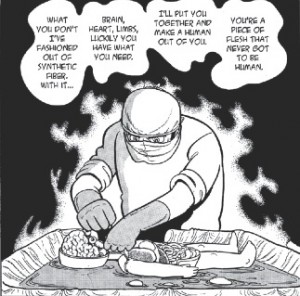
I also found the dynamic between Jack and his sidekick Pinoko, a short, slightly deformed child-woman, similarly troubling. Though Pinoko has the will and libido of an adult, she behaves like a toddler, pouting, wetting herself, running away, and lisping in a babyish voice. She’s mean-spirited and possessive, behaving like a jealous lover whenever Jack mentions other women, even those who are clearly seeking his medical services. These scenes are played for laughs, but have a creepy undercurrent; it’s hard to know if Pinoko is supposed to be a caricature of a housewife or just a vaguely incestuous flourish in an already over-the-top story. Thankfully, these Pygmalion-and-Galatea moments are few and far between, making it easy to bypass them altogether. Don’t skip the story in which Jack first creates Pinoko from a teratoid cystoma, however; it’s actually quite moving, and at odds with the grotesque domestic comedy that follows.

If you’ve never read anything by Tezuka, Black Jack is a great place to begin exploring his work. Tezuka is at his most efficient in this series, distilling novel-length dramas into gripping twenty-page stories. Though Tezuka is often criticized for being too “cartoonish,” his flare for caricature is essential to Black Jack; Tezuka conveys volumes about a character’s past or temperament in a few broad strokes: a low-slung jaw, a furrowed brow, a big belly. That visual economy helps him achieve the right balance between medical shop-talk and kitchen-sink drama without getting bogged down in expository dialogue. The result is a taut, entertaining collection of stories that offer the same mixture of pathos and medical mystery as a typical episode of House, minus the snark and commercials. Highly recommended.

This is a synthesis of two reviews that originally appeared at PopCultureShock on 10/26/2008 and 11/4/08. I’ve also reviewed volumes five and eleven here at The Manga Critic.

BLACK JACK, VOLS. 1-2 • BY OSAMU TEZUKA • VERTICAL, INC.

Filed Under: Manga Critic Tagged With: Classic, Medical, Osamu Tezuka, vertical

Black Jack, Vols. 1-2

December 15, 2010 by Katherine Dacey

Black Jack practices a different kind of medicine than the earnest physicians on Grey’s Anatomy or ER, taking cases that push the boundary between science and science fiction. In the first two volumes of Black Jack alone, the good doctor tests his surgical mettle by:

  • Performing a brain transplant
  • Separating conjoined twins
  • Operating on a killer whale
  • Operating blind
  • Operating on a man who’s been hit by a bullet train
  • Operating on twelve patients at once… without being sued for medical malpractice.

Osamu Tezuka’s own medical training is evident in the detailed drawings of muscle tissue, livers, hearts, and brains. Yet these images are beautifully integrated into his broad, cartoonish vocabulary, making the surgical scenes pulse with life. These procedures get an additional jolt of energy from the way Tezuka stages them; he brings the same theatricality to the operating room that John Woo does to shoot-outs and hostage crises, with crazy camera angles and unexpected complications that demand split-second decision-making from the hero.

At the same time, however, a more adult sensibility tempers the bravado displays of surgical acumen. Black Jack’s medical interventions cure his patients but seldom yield happy endings. In “The Face Sore,” for example, a man seeks treatment for a condition that contorts his face into a grotesque mask of boils. Jack eventually restores the man’s appearance, only to realize that the organism causing the deformation had a symbiotic relationship with its host; once removed, the host proves even more hideous than his initial appearance suggested. “The Painting Is Dead!” offers a similarly bitter twist, as Jack prolongs a dying artist’s life by transplanting his brain into a healthy man’s body. The artist longs to paint one final work — hence the request for a transplant — but finds himself incapable of realizing his vision until radiation sickness begins corrupting his new body just as it did his old one. Jack may profess to be indifferent to both patients’ suffering, insisting he’s only in it for the money, but that bluster conceals a painful truth: Jack knows all too well that he can’t heal the heart or mind.

The only thing that dampened my enthusiasm for Black Jack was the outdated sexual politics. In “Confluence,” for example, a beautiful young medical student is diagnosed with uterine cancer. Tezuka diagrams her reproductive tract, explaining each organ’s function and describing what will happen to this luckless gal if they’re removed:

As you know, the uterus and ovaries secrete crucial hormones that define a woman’s sex. To have them removed is to quit being a woman. You won’t be able to bear children, of course, and you’ll become unfeminine.

Too bad Tezuka never practiced gynecology; he might have gotten an earful (and a black eye or two) from some of his “unfeminine” patients.

I also found the dynamic between Jack and his sidekick Pinoko, a short, slightly deformed child-woman, similarly troubling. Though Pinoko has the will and libido of an adult, she behaves like a toddler, pouting, wetting herself, running away, and lisping in a babyish voice. She’s mean-spirited and possessive, behaving like a jealous lover whenever Jack mentions other women, even those who are clearly seeking his medical services. These scenes are played for laughs, but have a creepy undercurrent; it’s hard to know if Pinoko is supposed to be a caricature of a housewife or just a vaguely incestuous flourish in an already over-the-top story. Thankfully, these Pygmalion-and-Galatea moments are few and far between, making it easy to bypass them altogether. Don’t skip the story in which Jack first creates Pinoko from a teratoid cystoma, however; it’s actually quite moving, and at odds with the grotesque domestic comedy that follows.

If you’ve never read anything by Tezuka, Black Jack is a great place to begin exploring his work. Tezuka is at his most efficient in this series, distilling novel-length dramas into gripping twenty-page stories. Though Tezuka is often criticized for being too “cartoonish,” his flare for caricature is essential to Black Jack; Tezuka conveys volumes about a character’s past or temperament in a few broad strokes: a low-slung jaw, a furrowed brow, a big belly. That visual economy helps him achieve the right balance between medical shop-talk and kitchen-sink drama without getting bogged down in expository dialogue. The result is a taut, entertaining collection of stories that offer the same mixture of pathos and medical mystery as a typical episode of House, minus the snark and commercials. Highly recommended.

This is a synthesis of two reviews that originally appeared at PopCultureShock on 10/26/2008 and 11/4/08. I’ve also reviewed volumes five and eleven here at The Manga Critic.

BLACK JACK, VOLS. 1-2 • BY OSAMU TEZUKA • VERTICAL, INC.

Filed Under: Manga, Manga Critic, REVIEWS Tagged With: Classic, Medical, Osamu Tezuka, vertical

Not Love But Delicious Foods Make Me So Happy!

December 12, 2010 by Katherine Dacey

My Dinner With Fumi: that’s what I would have called the English-language edition of Not Love But Delicious Foods Make Me So Happy! The fifteen stories contained within this slim volume celebrate good food and good conversation, documenting Yoshinaga’s interactions with friends, assistants, and fellow artists at real restaurants around Tokyo. No culinary stone goes unturned, as Yoshinaga — or, as her fictional alter ego is called, Y-naga — visits a Korean restaurant, a French bistro, an Italian trattoria, a sushi joint, an all-you-can-eat dim sum buffet, and a bakery famous for its bagels. (Bagels in Tokyo? Call me a recovering New Yorker, but that sounds horribly wrong, especially since Y-naga views the absence of a hole in a the middle as a sign of quality.)

I can think of few mediums less suited to showcasing food than manga, but Yoshinaga’s drawings of steaming dumplings, seafood stews, and sashimi are convincing, despite the absence of color. She renders the food’s textures and shapes in meticulous detail, in the process suggesting the care with which each item was prepared. Her characters’ obvious enjoyment of the meals also helps sell the conceit; watching them rhapsodize over rare ingredients or extol the virtues of dessert makes the reader feel like another member of the party.

Much as I enjoyed the foodie shop-talk, what really sold me on Not Love But Delicious Foods was Yoshinaga’s willingness to poke fun at herself. Y-naga is a sartorial disaster, wearing a frumpy headband, thick glasses, and a scowl as she toils over her comics; only the prospect of a restaurant meal can persuade her to trade her sweatpants for a dress and to comb her hair. Once transformed, however, Y-naga is just as uncouth as her work attire would suggest, spilling copious amounts of food and wine on herself, talking with her mouth full, and flirting aggressively with a handsome dinner companion after drinking too much wine. Yet Y-naga’s dinner conversations reveal that she isn’t a buffoon; she’s surprisingly self-aware, rejecting one potential boyfriend because he’s indifferent to food (he doesn’t like to talk about it the way she does), farming out an incompetent assistant to other artists so that he can improve his skills, and apologizing profusely to a gay friend for “paying my rent by drawing manga with gay themes,” even though her books contain “no real gay themes.”

And that, I think, is the real strength of Not Love But Delicious Foods: the people remain central to the story, even though the Tokyo restaurant scene is the ostensible subject of the manga. As the characters chatter enthusiastically about what they’re eating, we realize that Yoshinaga’s real objective is showing us the important role that food plays in bringing people together, drawing them out, and cementing friendships. It’s a sentiment that’s expressed throughout the manga, as characters find common ground in their mutual enthusiasm for creme brulee and osso bucco. One contentious conversation even prompts the omniscient narrator to praise good food for its diplomatic value; in Yoshinaga’s world, detente is just a dish away. “But through the power of skirt steak, their hearts resumed beating as one,” the narrator observes. Couldn’t have said it better myself.

Review copy provided by Yen Press. Not Love But Delicious Foods Make Me So Happy! will be released on December 21, 2010.

NOT LOVE BUT DELICIOUS FOODS MAKE ME SO HAPPY! • BY FUMI YOSHINAGA • YEN PRESS • 160 pp. • RATING: OLDER TEEN (16+)

Filed Under: Manga Critic Tagged With: fumi yoshinaga, yen press

Not Love But Delicious Foods Make Me So Happy!

December 12, 2010 by Katherine Dacey

My Dinner With Fumi: that’s what I would have called the English-language edition of Not Love But Delicious Foods Make Me So Happy! The fifteen stories contained within this slim volume celebrate good food and good conversation, documenting Yoshinaga’s interactions with friends, assistants, and fellow artists at real restaurants around Tokyo. No culinary stone goes unturned, as Yoshinaga — or, as her fictional alter ego is called, Y-naga — visits a Korean restaurant, a French bistro, an Italian trattoria, a sushi joint, an all-you-can-eat dim sum buffet, and a bakery famous for its bagels. (Bagels in Tokyo? Call me a recovering New Yorker, but that sounds horribly wrong, especially since Y-naga views the absence of a hole in a the middle as a sign of quality.)

I can think of few mediums less suited to showcasing food than manga, but Yoshinaga’s drawings of steaming dumplings, seafood stews, and sashimi are convincing, despite the absence of color. She renders the food’s textures and shapes in meticulous detail, in the process suggesting the care with which each item was prepared. Her characters’ obvious enjoyment of the meals also helps sell the conceit; watching them rhapsodize over rare ingredients or extol the virtues of dessert makes the reader feel like another member of the party.

Much as I enjoyed the foodie shop-talk, what really sold me on Not Love But Delicious Foods was Yoshinaga’s willingness to poke fun at herself. Y-naga is a sartorial disaster, wearing a frumpy headband, thick glasses, and a scowl as she toils over her comics; only the prospect of a restaurant meal can persuade her to trade her sweatpants for a dress and to comb her hair. Once transformed, however, Y-naga is just as uncouth as her work attire would suggest, spilling copious amounts of food and wine on herself, talking with her mouth full, and flirting aggressively with a handsome dinner companion after drinking too much wine. Yet Y-naga’s dinner conversations reveal that she isn’t a buffoon; she’s surprisingly self-aware, rejecting one potential boyfriend because he’s indifferent to food (he doesn’t like to talk about it the way she does), farming out an incompetent assistant to other artists so that he can improve his skills, and apologizing profusely to a gay friend for “paying my rent by drawing manga with gay themes,” even though her books contain “no real gay themes.”

And that, I think, is the real strength of Not Love But Delicious Foods: the people remain central to the story, even though the Tokyo restaurant scene is the ostensible subject of the manga. As the characters chatter enthusiastically about what they’re eating, we realize that Yoshinaga’s real objective is showing us the important role that food plays in bringing people together, drawing them out, and cementing friendships. It’s a sentiment that’s expressed throughout the manga, as characters find common ground in their mutual enthusiasm for creme brulee and osso bucco. One contentious conversation even prompts the omniscient narrator to praise good food for its diplomatic value; in Yoshinaga’s world, detente is just a dish away. “But through the power of skirt steak, their hearts resumed beating as one,” the narrator observes. Couldn’t have said it better myself.

Review copy provided by Yen Press. Not Love But Delicious Foods Make Me So Happy! will be released on December 21, 2010.

NOT LOVE BUT DELICIOUS FOODS MAKE ME SO HAPPY! • BY FUMI YOSHINAGA • YEN PRESS • 160 pp. • RATING: OLDER TEEN (16+)

Filed Under: Manga, Manga Critic Tagged With: Cooking and Food, fumi yoshinaga, yen press

Bunny Drop, Vols. 1-2

December 8, 2010 by Katherine Dacey

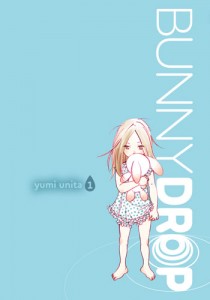
Fictional bachelor dads come in two flavors. The first is easily flummoxed by diapers, sippy cups, tantrums, and stomach aches, reacting in abject horror to bodily functions and extreme emotions (see Three Men and a Baby), while the second behaves more like a stand-up comedian than an engaged parent, commenting wryly on his charges’ behavior without doing much to guide or correct them (see Yotsuba&!). Daikichi, the singleton hero of Bunny Drop, is a pleasant corrective to these familiar stereotypes: he’s a sensitive, well-meaning thirty-year-old who steps up to the plate when his grandfather dies, leaving behind an illegitimate six-year-old daughter.

What begins as an impulsive decision — Daikichi is offended by his family’s reluctance to accept responsibility for gramps’ kid — quickly evolves into a serious commitment. Daikichi is humble enough to realize his limitations as a father, enlisting help from co-workers, friends, and family members in his efforts to find day care for Rin and impose some structure on her life, even though he isn’t entirely certain what kind of boundaries and routines are appropriate for a six-year-old. Yumi Unita wrings some humor out of Daikichi’s attempt to understand Rin’s unique point of view, but steers clear of easy laughs and easy victories. The early moments of rapport between Daikichi and Rin feel earned, not contrived, while Rin’s quirks reflect the bizarre circumstances of her early upbringing, as well as her deep fear of being abandoned.

Though Unita’s character designs are highly stylized and her panels free of busy detail, the spare, unfussy quality of her artwork is deceptive; her seemingly simple faces and bodies actually speak volumes about each character’s personality and history. The few lines on Daikichi’s face, for example, not only establish his age and his homeliness, they also give readers a window into his relationship with Rin. We see his growing attachment to the girl through the softening of his brow and jawline, and note the tension in his face when trying to negotiate new office hours for himself. (His co-workers are puzzled and angered by Daikichi’s decision to take care of Rin. “Just because it’s a relative’s child,” one underling complains, “why must you be the sacrifice, Kawachi-San?”)

With Rin, Unita focuses as much on the character’s body language as on her facial expressions. In the first volume, Rin appears closed off from everyone: rounded shoulders, downcast eyes, pursed lips, and folded arms. As Rin begins to trust Daikichi, however, her face and posture change: her limbs unfurl and her eyes brighten, and her repertory of faces soon includes pouty defiance and bravado. That same attention to detail extends to supporting cast members as well. Rin’s mother, whom Daikichi meets in volume two, comes across as impossibly young, swimming in an outfit too big for her slight frame, and fidgeting throughout her conversation with Daikichi, twisting her hair and avoiding eye contact in the manner of a sullen teenager.

The introduction of Rin’s mother suggests that future installments of Bunny Drop will continue to focus complex issues — what constitutes a family? who has the right to call himself a parent? what’s in the best interest of a damaged child? — in lieu of sitcom ones. (See sippy cups, bad dreams, and the stomach flu, above.) That Unita can take such potentially overwrought material and fashion a thoughtful, funny, and honest look at child-rearing is testament to her skill as a storyteller and — one suspects — as a parent. Easily one of 2010’s best new titles.

BUNNY DROP, VOLS. 1-2 • BY YUMI UNITA • YEN PRESS • RATING: TEEN (13+)

Filed Under: Manga Critic Tagged With: Josei, yen press

Bunny Drop, Vols. 1-2

December 8, 2010 by Katherine Dacey

Fictional bachelor dads come in two flavors. The first is easily flummoxed by diapers, sippy cups, tantrums, and stomach aches, reacting in abject horror to bodily functions and extreme emotions (see Three Men and a Baby), while the second behaves more like a stand-up comedian than an engaged parent, commenting wryly on his charges’ behavior without doing much to guide or correct them (see Yotsuba&!). Daikichi, the singleton hero of Bunny Drop, is a pleasant corrective to these familiar stereotypes: he’s a sensitive, well-meaning thirty-year-old who steps up to the plate when his grandfather dies, leaving behind an illegitimate six-year-old daughter.

What begins as an impulsive decision — Daikichi is offended by his family’s reluctance to accept responsibility for gramps’ kid — quickly evolves into a serious commitment. Daikichi is humble enough to realize his limitations as a father, enlisting help from co-workers, friends, and family members in his efforts to find day care for Rin and impose some structure on her life, even though he isn’t entirely certain what kind of boundaries and routines are appropriate for a six-year-old. Yumi Unita wrings some humor out of Daikichi’s attempt to understand Rin’s unique point of view, but steers clear of easy laughs and easy victories. The early moments of rapport between Daikichi and Rin feel earned, not contrived, while Rin’s quirks reflect the bizarre circumstances of her early upbringing, as well as her deep fear of being abandoned.

Though Unita’s character designs are highly stylized and her panels free of busy detail, the spare, unfussy quality of her artwork is deceptive; her seemingly simple faces and bodies actually speak volumes about each character’s personality and history. The few lines on Daikichi’s face, for example, not only establish his age and his homeliness, they also give readers a window into his relationship with Rin. We see his growing attachment to the girl through the softening of his brow and jawline, and note the tension in his face when trying to negotiate new office hours for himself. (His co-workers are puzzled and angered by Daikichi’s decision to take care of Rin. “Just because it’s a relative’s child,” one underling complains, “why must you be the sacrifice, Kawachi-San?”)

With Rin, Unita focuses as much on the character’s body language as on her facial expressions. In the first volume, Rin appears closed off from everyone: rounded shoulders, downcast eyes, pursed lips, and folded arms. As Rin begins to trust Daikichi, however, her face and posture change: her limbs unfurl and her eyes brighten, and her repertory of faces soon includes pouty defiance and bravado. That same attention to detail extends to supporting cast members as well. Rin’s mother, whom Daikichi meets in volume two, comes across as impossibly young, swimming in an outfit too big for her slight frame, and fidgeting throughout her conversation with Daikichi, twisting her hair and avoiding eye contact in the manner of a sullen teenager.

The introduction of Rin’s mother suggests that future installments of Bunny Drop will continue to focus complex issues — what constitutes a family? who has the right to call himself a parent? what’s in the best interest of a damaged child? — in lieu of sitcom ones. (See sippy cups, bad dreams, and the stomach flu, above.) That Unita can take such potentially overwrought material and fashion a thoughtful, funny, and honest look at child-rearing is testament to her skill as a storyteller and — one suspects — as a parent. Easily one of 2010’s best new titles.

BUNNY DROP, VOLS. 1-2 • BY YUMI UNITA • YEN PRESS • RATING: TEEN (13+)

Filed Under: Manga, Manga Critic, REVIEWS Tagged With: Drama, yen press

The Best Manga of 2010: The Manga Critic’s Picks

December 6, 2010 by Katherine Dacey 16 Comments

For all the upheaval within the manga industry — the demise of CMX, Del Rey, and Go! Comi, the layoffs at VIZ — 2010 proved an exceptionally good year for storytelling. True, titles like Black Butler, Naruto, and Nabari no Ou dominated sales charts, but publishers made a concerted effort to woo grown-ups with vintage manga — Black Blizzard, A Drunken Dream and Other Stories — edgy sci-fi — Biomega, 7 Billion Needles — underground comix — AX: A Collection of Alternative Manga, The Box Man — and good old-fashioned drama — All My Darling Daughters, Bunny Drop. I had a hard time limiting myself to just ten titles this year, so I’ve borrowed a few categories from my former PCS cohort Erin Finnegan, from Best New Guilty Pleasure to Best Manga You Thought You’d Hate. Please feel free to add your own thoughts: what titles did I unjustly omit? What titles did I like but you didn’t? Inquiring minds want to know!

10. CROSS GAME (Mitsuri Adachi; VIZ)

In this sometimes funny, sometimes melancholy coming-of-age story, a family tragedy brings teenager Ko Kitamura closer to neighbor Aoba Tsukishima, with whom he has a fraught relationship. Though the two bicker with the antagonistic gusto of Beatrice and Benedict, their shared love of baseball helps smooth the course of their budding romance. To be sure, Cross Game can’t escape a certain amount of sports-manga cliche, but Mitsuri Adachi is more interested in showing us how the characters relate to each other than in celebrating their amazing baseball skills. (Not that he skimps on the game play; Adachi clearly knows his way around the diamond.) The result is an agreeable dramedy that has the rhythm of a good situation comedy and the emotional depth of a well-crafted YA novel, with just enough shop-talk to win over baseball enthusiasts, too.

9. AX: A COLLECTION OF ALTERNATIVE MANGA (Various Artists; Top Shelf)

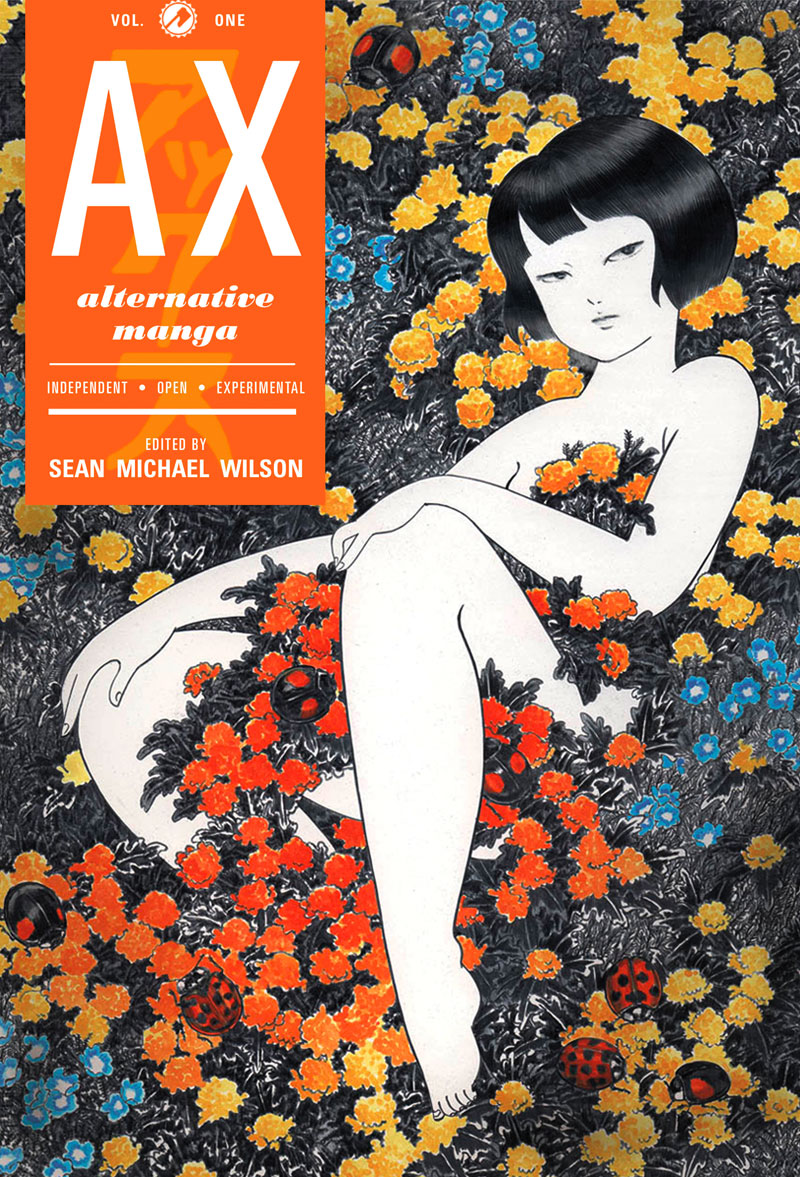
The next time someone dismisses manga as a “style” characterized by youthful-looking, big-eyed characters with button noses, I’m going to hand them a copy of AX, a rude, gleeful, and sometimes disturbing rebuke to the homogenized artwork and storylines found in mainstream manga publications. No one will confuse AX for Young Jump or even Big Comic Spirits; the stories in AX run the gamut from the grotesquely detailed to the playfully abstract, often flaunting their ugliness with the cheerful insistence of a ten-year-old boy waving a dead animal at squeamish classmates. Nor will anyone confuse Yoshihiro Tatsumi or Einosuke’s outlook with the humanism of Osamu Tezuka or Keiji Nakazawa; the stories in AX revel in the darker side of human nature, the part of us that’s fascinated with pain, death, sex, and bodily functions. Like all anthologies, the collection is somewhat uneven, with a few too many scatological tales for its own good, but the very best stories — “The Hare and the Tortoise,” “Push Pin Woman,” “Six Paths of Wealth,” “Puppy Love,” “Inside the Gourd” — attest to the diversity of talent contributing to this seminal manga magazine. –Reviewed at The Manga Critic on 5/21/10

8. NEKO RAMEN (Kenji Sonishi; Tokyopop)

If you’ve ever lived with a cat or dog, you know that no meal is complete without a pet hair garnish. Now imagine that your beloved companion actually prepared your meals instead of watching you eat them: what sort of unimaginable horrors might you encounter beyond the stray hair? That’s the starting point for Neko Ramen, a 4-koma manga about a cat whose big dream is to run a noodle shop, but author Kenji Sonishi quickly moves past hair balls and litter box jokes to mine a richer vein of humor, poking fun at his cat cook’s delusions of entrepreneurial grandeur. Taisho is the Don Quixote of ramen vendors, dreaming up ludicrous giveaways and unappetizing dishes in an effort to promote his business, never realizing that he is the store’s real selling point. The loose, sketchy artwork gives the series an improvisational feel, while the script has the pleasant, absurdist zing of an Abbott and Costello routine. –Reviewed at The Manga Critic on 6/2/10

7. AYAKO (Osamu Tezuka; Vertical, Inc.)

Combining the psychological realism of Dostoevsky with the social consciousness of Tolstoy and Zola, Osamu Tezuka uses conflicts within the once-powerful Tenge clan to dramatize the social, political, and economic upheaval caused by the American occupation of post-war Japan. No subject is off-limits for Tezuka: the Tenge commit murders, spy for the Americans, join the Communist Party, imprison a family member in an underground cell, and engage in incest. It’s one of Tezuka’s most sober and damning stories, at once tremendously powerful and seriously disturbing, with none of the cartoonish excess of Ode to Kirihito or MW. The ending is perhaps too pat and loaded with symbolism for its own good, but like Tezuka’s best work, Ayako forces the reader to confront the darkest, most corruptible corners of the human soul. As with Apollo’s Song, Black Jack, and Buddha, Vertical has done a superb job of making Tezuka accessible to Western readers with flipped artwork and a fluid translation.

6. BUNNY DROP (Yumi Unita; Yen Press)

Stop me if you’ve heard this one before: a thirty-something bachelor unexpectedly becomes a parent to a cute little girl, leading to hijinks, misunderstandings, and heart-tugging moments. That’s a fair summary of what happens in Bunny Drop, but Yumi Unita wisely avoids the pitfalls of the single-dad genre — the cheap sentiment, the unfunny scenes of dad recoiling in horror at diapers, runny noses, and tears — instead focusing on the unique bond between Daikichi and Rin, the six-year-old whom he impetuously adopts after the rest of the family disavows her. (Rin is the product of a liaison between Daikichi’s grandfather and a much younger woman.) Though Daikichi struggles to find day care, buy clothes for Rin, and make sense of her standoffish behavior, he isn’t a buffoon or a straight man for Rin’s antics; Unita portrays him as a smart, sensitive person blessed with good instincts and common sense. Clean, expressive artwork and true-to-life dialogue further inoculate Bunny Drop against a terminal case of sitcom cuteness, making it one of the most thoughtful, moving, and adult manga of the year.

5. BLACK BLIZZARD (Yoshihiro Tatsumi; Drawn & Quarterly)

Written in just twenty days, this feverish pulp thriller plays like a mash-up of The Fugitive, The 39 Steps, and The Defiant Ones as two convicts — one a hardened criminal, the other a down-on-his luck musician — go on the lam during a blinding snowstorm. The heroes are more archetypes than characters, drawn in bold strokes, but the interaction between them crackles with antagonistic energy; they’re as much enemies as partners, roles that they constantly renegotiate during their escape. Evocative artwork — slashing lines, dramatic camera angles, images of speeding trains — infuses Black Blizzard with a raw, nervous energy that nicely mirrors the characters’ internal state. Only in the final, rushed pages does manga-ka Yoshihiro Tatsumi falter, tidily resolving the story through an all-too-convenient plot twist that hinges on coincidence. Still, that’s a minor criticism of a thoroughly entertaining story written during a crucial stage of Tatsumi’s artistic development. –Reviewed at The Manga Critic on 9/9/10

4. HOUSE OF FIVE LEAVES (Natsume Ono; VIZ)

Timid ronin Akitsu Masanosuke can’t hold a steady job, despite his formidable swordsmanship. When a businessman approaches him with work, Masanosuke readily accepts, not realizing that his new employer, Yaichi, runs a crime syndicate that specializes in kidnapping. Masanosuke’s unwitting participation in a blackmailing scheme prevents him from severing his ties to Yaichi; Masanosuke must then decide if he will join the House of Five Leaves or bide his time until he can escape. Though Toshiro Mifune and Hiroyuki Sanada have made entire careers out of playing characters like Masanosuke, Natsume Ono makes a persuasive case that you don’t need a flesh-and-blood actor to tell this kind of story with heartbreaking intensity; she can do the slow-burn on the printed page with the same skill as Masaki Kobayashi (Hara Kiri, Samurai Rebellion) and Yoji Yamada (The Twilight Samurai) did on the big screen. –Reviewed at The Manga Critic on 8/20/10

3. TWIN SPICA (Kou Yaginuma; Vertical, Inc.)

Asumi Kamogawa is a small girl with a big dream: to be an astronaut on Japan’s first manned space flight. Though she passes the entrance exam for Tokyo Space School, she faces several additional hurdles to realizing her goal, from her child-like stature — she’s thirteen going on eight — to a faculty member who blames her father for causing a fiery rocket crash that claimed hundreds of civilian lives. Yet for all the setbacks she’s experienced, Asumi proves resilient, a gentle girl who perseveres in difficult situations, offers friendship in lieu of judgment, and demonstrates a preternatural awareness of life’s fragility. Twin Spica follows Asumi through every stage of training, from physics lectures to zero-G simulations, showing us how she befriends her fellow cadets and gradually learns to rely on herself, rather than her imaginary friend, Mr. Lion. Though Twin Spica was serialized in a seinen magazine, it works surprisingly well for young adults, too, an all-too-rare example of a direct, heartfelt story that’s neither saccharine nor mawkish.  –Reviewed at The Manga Critic on 5/3/10

2. ALL MY DARLING DAUGHTERS (Fumi Yoshinaga; VIZ)

The five vignettes in All My Darling Daughters depict women negotiating difficult personal relationships: a daughter confronts her mother about mom’s new, much younger husband; a college student seduces her professor, only to dump him when he tries to court her properly; a beautiful young woman contemplates an arranged marriage. Like all of Yoshinaga’s work, the characters in All My Darling Daughters love to talk. That chattiness isn’t always an asset to Yoshinaga’s storytelling (see Gerard and Jacques), but here the dialogue is perfectly calibrated to reveal just how complex and ambivalent these relationships really are. Yoshinaga’s artwork is understated but effective, as she uses small details — how a character stands or carries her shoulders — to offer a more complete and nuanced portrait of each woman. Quite possibly my favorite work by Yoshinaga.

1. A DRUNKEN DREAM AND OTHER STORIES (Moto Hagio; Fantagraphics)

Not coincidentally, A Drunken Dream and Other Stories was my nomination for Best New Graphic Novel of 2010 as well. Here’s what I had to say about the title over at Flashlight Worthy Books:

Moto Hagio is to shojo manga what Will Eisner is to American comics, a seminal creator whose distinctive style and sensibility profoundly changed the medium. Though Hagio has been actively publishing stories since the late 1960s, very little of her work has been translated into English. A Drunken Dream, published by Fantagraphics, is an excellent corrective — a handsomely produced, meticulously edited collection of Hagio’s short stories that span her career from 1970 to 2007. Readers new to Hagio’s work will appreciate the inclusion of two contextual essays by manga scholar Matt Thorn, one an introduction to Hagio and her peers, the other an interview with Hagio. What emerges is a portrait of a gifted artist who draws inspiration from many sources: Osamu Tezuka and Shotaro Ishimonori, Ray Bradbury and Isaac Asimov, Frances Hodgson Burnett and L.M. Montgomery.

For the complete list — including nominations from David “Manga Curmudgeon” Welsh, Brigid “MangaBlog” Alverson, Lorena “i heart manga” Ruggero, and Matthew “Warren Peace Sings the Blues” Brady — click here. To read my full review of A Drunken Dream, click here.

HONORABLE MENTIONS

Done because there are too menny… great manga, that is, to confine myself to a traditional top ten list. With apologies to Thomas Hardy, here are some of the other titles that tickled my fancy in 2010:

  • OTHER AWESOME DEBUTS: Not Love But Delicious Foods Make Me Happy (Yen Press), Saturn Apartments (VIZ), 7 Billion Needles (Vertical, Inc.)
  • BEST CONTINUING SERIES: Itazura na Kiss (DMP), Ooku: The Inner Chambers (VIZ), Suppli (Tokyopop), 20th Century Boys (VIZ)
  • BEST NEW ALL-AGES MANGA: Chi’s Sweet Home (Vertical, Inc.)
  • BEST NEW SERIES THAT’S ALREADY ON HIATUS: Diamond Girl (CMX), Stolen Hearts (CMX)
  • BEST NEW GUILTY PLEASURE: Demon Sacred (Tokyopop), Dragon Girl (Yen Press)
  • BEST REPRINT EDITION: Cardcaptor Sakura (Dark Horse), Little Butterfly Omnibus (DMP)
  • BEST MANGA I THOUGHT I’D HATE: Higurashi When They Cry: Beyond Midnight Arc (Yen Press)
  • BEST FINALE: Pluto: Tezuka x Urasawa (VIZ)

Filed Under: Manga Critic Tagged With: cmx, Dark Horse, DMP, Drawn & Quarterly, fantagraphics, fumi yoshinaga, moto hagio, Naoki Urasawa, Osamu Tezuka, SigIKKI, Tokyopop, Top Shelf, vertical, VIZ, yen press, Yoshihiro Tatsumi

The Best Manga of 2010: The Manga Critic’s Picks

December 6, 2010 by Katherine Dacey

For all the upheaval within the manga industry — the demise of CMX, Del Rey, and Go! Comi, the layoffs at VIZ — 2010 proved an exceptionally good year for storytelling. True, titles like Black Butler, Naruto, and Nabari no Ou dominated sales charts, but publishers made a concerted effort to woo grown-ups with vintage manga — Black Blizzard, A Drunken Dream and Other Stories — edgy sci-fi — Biomega, 7 Billion Needles — underground comix — AX: A Collection of Alternative Manga, The Box Man — and good old-fashioned drama — All My Darling Daughters, Bunny Drop. I had a hard time limiting myself to just ten titles this year, so I’ve borrowed a few categories from my former PCS cohort Erin Finnegan, from Best New Guilty Pleasure to Best Manga You Thought You’d Hate. Please feel free to add your own thoughts: what titles did I unjustly omit? What titles did I like but you didn’t? Inquiring minds want to know!

10. Cross Game
By Mitsuri Adachi • VIZ Media
In this sometimes funny, sometimes melancholy coming-of-age story, a family tragedy brings teenager Ko Kitamura closer to neighbor Aoba Tsukishima, with whom he has a fraught relationship. Though the two bicker with the antagonistic gusto of Beatrice and Benedict, their shared love of baseball helps smooth the course of their budding romance. To be sure, Cross Game can’t escape a certain amount of sports-manga cliche, but Mitsuri Adachi is more interested in showing us how the characters relate to each other than in celebrating their amazing baseball skills. (Not that he skimps on the game play; Adachi clearly knows his way around the diamond.) The result is an agreeable dramedy that has the rhythm of a good situation comedy and the emotional depth of a well-crafted YA novel, with just enough shop-talk to win over baseball enthusiasts, too.

9. AX: A Collection of Alternative Manga
Edited by Sean Michael Wilson • Top Shelf
The next time someone dismisses manga as a “style” characterized by youthful-looking, big-eyed characters with button noses, I’m going to hand them a copy of AX, a rude, gleeful, and sometimes disturbing rebuke to the homogenized artwork and storylines found in mainstream manga publications. No one will confuse AX for Young Jump or even Big Comic Spirits; the stories in AX run the gamut from the grotesquely detailed to the playfully abstract, often flaunting their ugliness with the cheerful insistence of a ten-year-old boy waving a dead animal at squeamish classmates. Nor will anyone confuse Yoshihiro Tatsumi or Einosuke’s outlook with the humanism of Osamu Tezuka or Keiji Nakazawa; the stories in AX revel in the darker side of human nature, the part of us that’s fascinated with pain, death, sex, and bodily functions. Like all anthologies, the collection is somewhat uneven, with a few too many scatological tales for its own good, but the very best stories — “The Hare and the Tortoise,” “Push Pin Woman,” “Six Paths of Wealth,” “Puppy Love,” “Inside the Gourd” — attest to the diversity of talent contributing to this seminal manga magazine. —Reviewed at The Manga Critic on 5/21/10

8. Neko Ramen
By Kenji Sonishi • Tokyopop
If you’ve ever lived with a cat or dog, you know that no meal is complete without a pet hair garnish. Now imagine that your beloved companion actually prepared your meals instead of watching you eat them: what sort of unimaginable horrors might you encounter beyond the stray hair? That’s the starting point for Neko Ramen, a 4-koma manga about a cat whose big dream is to run a noodle shop, but author Kenji Sonishi quickly moves past hair balls and litter box jokes to mine a richer vein of humor, poking fun at his cat cook’s delusions of entrepreneurial grandeur. Taisho is the Don Quixote of ramen vendors, dreaming up ludicrous giveaways and unappetizing dishes in an effort to promote his business, never realizing that he is the store’s real selling point. The loose, sketchy artwork gives the series an improvisational feel, while the script has the pleasant, absurdist zing of an Abbott and Costello routine. —Reviewed at The Manga Critic on 6/2/10

7. Ayako
By Osamu Tezuka; Vertical, Inc.
Combining the psychological realism of Dostoevsky with the social consciousness of Tolstoy and Zola, Osamu Tezuka uses conflicts within the once-powerful Tenge clan to dramatize the social, political, and economic upheaval caused by the American occupation of post-war Japan. No subject is off-limits for Tezuka: the Tenge commit murders, spy for the Americans, join the Communist Party, imprison a family member in an underground cell, and engage in incest. It’s one of Tezuka’s most sober and damning stories, at once tremendously powerful and seriously disturbing, with none of the cartoonish excess of Ode to Kirihito or MW. The ending is perhaps too pat and loaded with symbolism for its own good, but like Tezuka’s best work, Ayako forces the reader to confront the darkest, most corruptible corners of the human soul. As with Apollo’s Song, Black Jack, and Buddha, Vertical has done a superb job of making Tezuka accessible to Western readers with flipped artwork and a fluid translation.

6. Bunny Drop
By Yumi Unita; Yen Press
Stop me if you’ve heard this one before: a thirty-something bachelor unexpectedly becomes a parent to a cute little girl, leading to hijinks, misunderstandings, and heart-tugging moments. That’s a fair summary of what happens in Bunny Drop, but Yumi Unita wisely avoids the pitfalls of the single-dad genre — the cheap sentiment, the unfunny scenes of dad recoiling in horror at diapers, runny noses, and tears — instead focusing on the unique bond between Daikichi and Rin, the six-year-old whom he impetuously adopts after the rest of the family disavows her. (Rin is the product of a liaison between Daikichi’s grandfather and a much younger woman.) Though Daikichi struggles to find day care, buy clothes for Rin, and make sense of her standoffish behavior, he isn’t a buffoon or a straight man for Rin’s antics; Unita portrays him as a smart, sensitive person blessed with good instincts and common sense. Clean, expressive artwork and true-to-life dialogue further inoculate Bunny Drop against a terminal case of sitcom cuteness, making it one of the most thoughtful, moving, and adult manga of the year.

5. Black Blizzard
By Yoshihiro Tatsumi • Drawn & Quarterly
Written in just twenty days, this feverish pulp thriller plays like a mash-up of The Fugitive, The 39 Steps, and The Defiant Ones as two convicts — one a hardened criminal, the other a down-on-his luck musician — go on the lam during a blinding snowstorm. The heroes are more archetypes than characters, drawn in bold strokes, but the interaction between them crackles with antagonistic energy; they’re as much enemies as partners, roles that they constantly renegotiate during their escape. Evocative artwork — slashing lines, dramatic camera angles, images of speeding trains — infuses Black Blizzard with a raw, nervous energy that nicely mirrors the characters’ internal state. Only in the final, rushed pages does manga-ka Yoshihiro Tatsumi falter, tidily resolving the story through an all-too-convenient plot twist that hinges on coincidence. Still, that’s a minor criticism of a thoroughly entertaining story written during a crucial stage of Tatsumi’s artistic development. —Reviewed at The Manga Critic on 9/9/10

4. House of Five Leaves
By Natsume Ono • VIZ Media
Timid ronin Akitsu Masanosuke can’t hold a steady job, despite his formidable swordsmanship. When a businessman approaches him with work, Masanosuke readily accepts, not realizing that his new employer, Yaichi, runs a crime syndicate that specializes in kidnapping. Masanosuke’s unwitting participation in a blackmailing scheme prevents him from severing his ties to Yaichi; Masanosuke must then decide if he will join the House of Five Leaves or bide his time until he can escape. Though Toshiro Mifune and Hiroyuki Sanada have made entire careers out of playing characters like Masanosuke, Natsume Ono makes a persuasive case that you don’t need a flesh-and-blood actor to tell this kind of story with heartbreaking intensity; she can do the slow-burn on the printed page with the same skill as Masaki Kobayashi (Hara Kiri, Samurai Rebellion) and Yoji Yamada (The Twilight Samurai) did on the big screen. —Reviewed at The Manga Critic on 8/20/10

3. Twin Spica
By Kou Yaginuma • Vertical, Inc.
Asumi Kamogawa is a small girl with a big dream: to be an astronaut on Japan’s first manned space flight. Though she passes the entrance exam for Tokyo Space School, she faces several additional hurdles to realizing her goal, from her child-like stature — she’s thirteen going on eight — to a faculty member who blames her father for causing a fiery rocket crash that claimed hundreds of civilian lives. Yet for all the setbacks she’s experienced, Asumi proves resilient, a gentle girl who perseveres in difficult situations, offers friendship in lieu of judgment, and demonstrates a preternatural awareness of life’s fragility. Twin Spica follows Asumi through every stage of training, from physics lectures to zero-G simulations, showing us how she befriends her fellow cadets and gradually learns to rely on herself, rather than her imaginary friend, Mr. Lion. Though Twin Spica was serialized in a seinen magazine, it works surprisingly well for young adults, too, an all-too-rare example of a direct, heartfelt story that’s neither saccharine nor mawkish.  —Reviewed at The Manga Critic on 5/3/10

2. All My Darling Daughters
By Fumi Yoshinaga • VIZ Media
The five vignettes in All My Darling Daughters depict women negotiating difficult personal relationships: a daughter confronts her mother about mom’s new, much younger husband; a college student seduces her professor, only to dump him when he tries to court her properly; a beautiful young woman contemplates an arranged marriage. Like all of Yoshinaga’s work, the characters in All My Darling Daughters love to talk. That chattiness isn’t always an asset to Yoshinaga’s storytelling (see Gerard and Jacques), but here the dialogue is perfectly calibrated to reveal just how complex and ambivalent these relationships really are. Yoshinaga’s artwork is understated but effective, as she uses small details — how a character stands or carries her shoulders — to offer a more complete and nuanced portrait of each woman. Quite possibly my favorite work by Yoshinaga.

1. A Drunken Dream and Other Stories
By Moto Hagio • Fantagraphics
Not coincidentally, A Drunken Dream and Other Stories was my nomination for Best New Graphic Novel of 2010 as well. Here’s what I had to say about the title over at Flashlight Worthy Books:

Moto Hagio is to shojo manga what Will Eisner is to American comics, a seminal creator whose distinctive style and sensibility profoundly changed the medium. Though Hagio has been actively publishing stories since the late 1960s, very little of her work has been translated into English. A Drunken Dream, published by Fantagraphics, is an excellent corrective — a handsomely produced, meticulously edited collection of Hagio’s short stories that span her career from 1970 to 2007. Readers new to Hagio’s work will appreciate the inclusion of two contextual essays by manga scholar Matt Thorn, one an introduction to Hagio and her peers, the other an interview with Hagio. What emerges is a portrait of a gifted artist who draws inspiration from many sources: Osamu Tezuka and Shotaro Ishimonori, Ray Bradbury and Isaac Asimov, Frances Hodgson Burnett and L.M. Montgomery.

For the complete list — including nominations from David “Manga Curmudgeon” Welsh, Brigid “MangaBlog” Alverson, Lorena “i heart manga” Ruggero, and Matthew “Warren Peace Sings the Blues” Brady — click here. To read my full review of A Drunken Dream, click here.

HONORABLE MENTIONS
Done because there are too menny… great manga, that is, to confine myself to a traditional top ten list. With apologies to Thomas Hardy, here are some of the other titles that tickled my fancy in 2010:

  • Other Awesome Debuts: Not Love But Delicious Foods Make Me Happy (Yen Press), Saturn Apartments (VIZ), 7 Billion Needles (Vertical, Inc.)
  • Best Continuing Series: Itazura na Kiss (DMP), Ooku: The Inner Chambers (VIZ), Suppli (Tokyopop), 20th Century Boys (VIZ)
  • Best New All-ages Manga: Chi’s Sweet Home (Vertical, Inc.)
  • Best New Series That’s Already on Hiatus: Diamond Girl (CMX), Stolen Hearts (CMX)
  • Best New Guilty Pleasure: Demon Sacred (Tokyopop), Dragon Girl (Yen Press)
  • Best Reprint Edition: Cardcaptor Sakura (Dark Horse), Little Butterfly Omnibus (DMP)
  • Best Manga I Thought I’d Hate: Higurashi When They Cry: Beyond Midnight Arc (Yen Press)
  • Best Finale: Pluto: Tezuka x Urasawa (VIZ)

Filed Under: Manga, Manga Critic, Recommended Reading Tagged With: cmx, Dark Horse, DMP, Drawn & Quarterly, fantagraphics, fumi yoshinaga, moto hagio, Naoki Urasawa, Osamu Tezuka, SigIKKI, Tokyopop, Top Shelf, Vertical Comics, VIZ, yen press, Yoshihiro Tatsumi

3 Reasons to Read One Piece

December 2, 2010 by Katherine Dacey 19 Comments

Why would any sane person commit to reading a series that’s still going strong after sixty volumes? I can think of three compelling reasons why you should set aside your shonophobia — that’s Latin for “fear of incredibly long series with interminable fight scenes and characters who do their best” — and give Eiichiro Oda’s One Piece a shot.

1. THE ARTWORK

Though many shonen manga-ka love to populate their stories with flamboyantly ugly villains, Eiichiro Oda’s character designs are more memorable than his competitors’. That’s because Oda doesn’t just add a few scars and a crazy hairdo to distinguish the bad guys from the good; he creates every villain from scratch, making each garment, prop, tattoo, wart, and weapon a direct reflection of the character’s personality and personal history. The same goes for other supporting players: Oda emphasizes the greenness of one pirate’s kiddie followers by giving them vegetal hairdos, and the isolation of a pirate castaway by stuffing the character’s body into an empty treasure chest, with only Gaimon’s unkempt hair and feet poking out. (Gaimon gets one of the series’ best lines: “I used to have two eyebrows!” he exclaims, musing on his twenty years stranded on a remote island.)

Oda’s entire approach to drafting shows a similar thoughtfulness: his pirate ships, tropical islands, and sea coast villages are rendered in clean lines, with a minimum of screen tone. Oda relies instead on playful shapes to help set the stage, from a sea-going restaurant that looks like a cross between a carp and a Hong Kong dim sum parlor, to an island populated by rabbit-cobras, pig-lions, and rooster-foxes.

The only blind spot in Oda’s artwork is his female characters. Though he can draw a marvelous, gnarled pirate queen, as gloriously repulsive as any of the series’ other villains, his young, attractive girls are blandly interchangeable. Even as more female characters are introduced in later story arcs, their appearance seems more calculated to satisfy the male gaze than reveal much about their personality — besides, of course, the near-universal tendency among shonen artists to make a girl’s bust- and neckline a reliable predictor of her villainy.

2. THE LOVING SEND-UPS OF SHONEN CLICHES

One of the reasons I don’t read more shonen manga: I find the characters’ compulsion to shout the name of their fighting techniques kind of silly. (OK, a lot silly.) If anything, it brings back memories of the old Super Friends TV show in which the Wonder Twins clinked rings and announced that they’d be taking “the form of an ice sled!” or “the form of a green-striped tiger!” (If that was meant to be comedy and not a complete abdication of imagination on the writer’s part, I missed it.) Granted, InuYasha and Naruto boast cooler-sounding and more effectual powers, but the minute InuYasha yells “Wind Scar!”, I’m ripped out of the scene, pondering the need for such verbal displays.

In One Piece, however, Oda pokes fun at the practice by assigning his characters goofy powers with goofy names that are fun to say. Monkey D. Luffy’s Gum-Gum attacks are the most frequent and obvious example, as he pretzels himself into a Looney Tunes assortment of weapons and shields, but his crew mates also have a few tricks up their sleeves. The best of them, by far, is Tony Tony Chopper, a blue-nosed reindeer who also happens to be the ship’s doctor. His Human-Human powers enable him to assume a variety of forms, including a gargantuan were-reindeer that wouldn’t be out of place in the pages of Lycanthrope Leo.

Oda also walks a fine line between openly mocking his hero and using him to exemplify the “friendship, effort, and victory” motto that undergirds every Shonen Jump title. Monkey is, to put it nicely, one of the dumbest shonen heroes in the canon — and that’s part of his charm. Unlike, say, Naruto or Lag Seeing (of Tegami Bachi fame), Monkey’s single-minded pursuit of treasure is portrayed as a kind of insanity, not a sign of a stellar character. Monkey goes to extreme lengths to prove himself — not unusual for a shonen hero — but his behavior is clearly meant to be ridiculous. (In the very first pages of the series, he stabs himself in the face with a knife to demonstrate his imperviousness to pain, much to the horror of the assembled pirates.) Yet for all his ill-advised bravado, he’s a kind-hearted goof; anyone who demonstrates valor or integrity is invited to join his crew, regardless of the original circumstances under which they met Monkey. Again, those qualities don’t make Monkey unique, but they do make him appealing; he’s an indestructible hero who’s utterly fallible.

3. THE EXCELLENT ADAPTATION

Any text as thick with puns and pirate-speak as One Piece runs the risk of falling flat in translation, but the English-language adaptation is fluid, funny, and eminently readable. I can’t gauge how faithfully the VIZ edition adheres to the original Japanese, but the script’s buoyant, goofy tone complements the artwork perfectly, leading me to think that VIZ’s editorial team has given American audiences a reasonable approximation of the Japanese-language reading experience. Heck, they’ve even made Oda’s reader correspondence sound like a real, mischievous person answered those fan letters. Now that’s a good adaptation.

Filed Under: Manga Critic Tagged With: Comedy, One Piece, Pirates, Shonen, Shonen Jump, VIZ

3 Reasons to Read One Piece

December 2, 2010 by Katherine Dacey

Why would any sane person commit to reading a series that’s still going strong after sixty volumes? I can think of three compelling reasons why you should set aside your shonophobia — that’s Latin for “fear of incredibly long series with interminable fight scenes and characters who do their best” — and give Eiichiro Oda’s One Piece a shot.

1. THE ARTWORK

Though many shonen manga-ka love to populate their stories with flamboyantly ugly villains, Eiichiro Oda’s character designs are more memorable than his competitors’. That’s because Oda doesn’t just add a few scars and a crazy hairdo to distinguish the bad guys from the good; he creates every villain from scratch, making each garment, prop, tattoo, wart, and weapon a direct reflection of the character’s personality and personal history. The same goes for other supporting players: Oda emphasizes the greenness of one pirate’s kiddie followers by giving them vegetal hairdos, and the isolation of a pirate castaway by stuffing the character’s body into an empty treasure chest, with only Gaimon’s unkempt hair and feet poking out. (Gaimon gets one of the series’ best lines: “I used to have two eyebrows!” he exclaims, musing on his twenty years stranded on a remote island.)

Oda’s entire approach to drafting shows a similar thoughtfulness: his pirate ships, tropical islands, and sea coast villages are rendered in clean lines, with a minimum of screen tone. Oda relies instead on playful shapes to help set the stage, from a sea-going restaurant that looks like a cross between a carp and a Hong Kong dim sum parlor, to an island populated by rabbit-cobras, pig-lions, and rooster-foxes.

The only blind spot in Oda’s artwork is his female characters. Though he can draw a marvelous, gnarled pirate queen, as gloriously repulsive as any of the series’ other villains, his young, attractive girls are blandly interchangeable. Even as more female characters are introduced in later story arcs, their appearance seems more calculated to satisfy the male gaze than reveal much about their personality — besides, of course, the near-universal tendency among shonen artists to make a girl’s bust- and neckline a reliable predictor of her villainy.

2. THE LOVING SEND-UPS OF SHONEN CLICHES

One of the reasons I don’t read more shonen manga: I find the characters’ compulsion to shout the name of their fighting techniques kind of silly. (OK, a lot silly.) If anything, it brings back memories of the old Super Friends TV show in which the Wonder Twins clinked rings and announced that they’d be taking “the form of an ice sled!” or “the form of a green-striped tiger!” (If that was meant to be comedy and not a complete abdication of imagination on the writer’s part, I missed it.) Granted, InuYasha and Naruto boast cooler-sounding and more effectual powers, but the minute InuYasha yells “Wind Scar!”, I’m ripped out of the scene, pondering the need for such verbal displays.

In One Piece, however, Oda pokes fun at the practice by assigning his characters goofy powers with goofy names that are fun to say. Monkey D. Luffy’s Gum-Gum attacks are the most frequent and obvious example, as he pretzels himself into a Looney Tunes assortment of weapons and shields, but his crew mates also have a few tricks up their sleeves. The best of them, by far, is Tony Tony Chopper, a blue-nosed reindeer who also happens to be the ship’s doctor. His Human-Human powers enable him to assume a variety of forms, including a gargantuan were-reindeer that wouldn’t be out of place in the pages of Lycanthrope Leo.

Oda also walks a fine line between openly mocking his hero and using him to exemplify the “friendship, effort, and victory” motto that undergirds every Shonen Jump title. Monkey is, to put it nicely, one of the dumbest shonen heroes in the canon — and that’s part of his charm. Unlike, say, Naruto or Lag Seeing (of Tegami Bachi fame), Monkey’s single-minded pursuit of treasure is portrayed as a kind of insanity, not a sign of a stellar character. Monkey goes to extreme lengths to prove himself — not unusual for a shonen hero — but his behavior is clearly meant to be ridiculous. (In the very first pages of the series, he stabs himself in the face with a knife to demonstrate his imperviousness to pain, much to the horror of the assembled pirates.) Yet for all his ill-advised bravado, he’s a kind-hearted goof; anyone who demonstrates valor or integrity is invited to join his crew, regardless of the original circumstances under which they met Monkey. Again, those qualities don’t make Monkey unique, but they do make him appealing; he’s an indestructible hero who’s utterly fallible.

3. THE EXCELLENT ADAPTATION

Any text as thick with puns and pirate-speak as One Piece runs the risk of falling flat in translation, but the English-language adaptation is fluid, funny, and eminently readable. I can’t gauge how faithfully the VIZ edition adheres to the original Japanese, but the script’s buoyant, goofy tone complements the artwork perfectly, leading me to think that VIZ’s editorial team has given American audiences a reasonable approximation of the Japanese-language reading experience. Heck, they’ve even made Oda’s reader correspondence sound like a real, mischievous person answered those fan letters. Now that’s a good adaptation.

Filed Under: Manga, Manga Critic, Recommended Reading, REVIEWS Tagged With: Comedy, One Piece, Pirates, Shonen, Shonen Jump, VIZ

7 Billion Needles, Vols. 1-2

November 21, 2010 by Katherine Dacey

First published in 1950, Hal Clement’s Needle was a unique mixture of hard science fiction and police procedural. The story focused on an alien detective who crash-lands on Earth while chasing an intergalactic criminal. With his ship destroyed and his symbiant companion dead, The Hunter takes up residence inside a teenager’s body, eventually persuading his host to help him find the fugitive — no mean feat, as the fugitive can also hide, undetected, inside a human host.

The story was notable, in part, for Clement’s meticulous, detailed study of the alien’s physiology. Drawing on mid-century research on microorganisms, Clement imagined a highly intelligent, adaptable creature capable of manipulating its body to squeeze through tiny spaces and make use of its host’s sensory organs to learn more about its surroundings. Needle was also notable for the way in which Clement folded these speculative passages into an old-fashioned detective story; once The Hunter begins communicating directly with Bob, his host, the two retrace the fugitive’s steps, investigating everyone who might have come into contact with it and systematically ruling out suspects through careful observation of their behavior.

Nobuaki Tadano’s 7 Billion Needles (2008-10) draws inspiration from Clement’s novel, preserving the basic concept while tweaking the storyline to work in a graphic format. Gone are the long passages explaining how Horizon (as the alien detective is called in 7 Billion Needles) insinuates himself into his human host; in their place are more direct, dramatic scenes showing us how Horizon’s host, a sullen teenage girl named Hikaru, wrestles with the emotional and physical burden of helping him pursue Maelstrom, a shape-shifting creature so powerful he’s left a trail of dead planets in his wake.

As a result, 7 Billion Needles reads more like horror than hard science fiction, placing more emphasis on monster-hunting and raw adolescent emotion than the mechanics of Horizon and Hikaru’s symbiotic relationship. Tadano’s choices make good sense from the standpoint of pacing and visual drama; so much of the original novel took place inside Bob, it’s hard to imagine how an artist would have brought those passages to life in comic-book form. (That summary makes Needle sound impossibly dirty, but rest assured, it isn’t.) Tadano’s monster, too, is much better defined than Clement’s; Clement’s fugitive only appears in the final chapters of the book, the nature of his crime never fully explained, whereas Maelstrom, Tadano’s creation, is something out of a good B-movie, causing his host du jour to undergo grotesque transformations before going all-out alien.

The real genius of 7 Billion Needles, however, is the way Tadano uses teen angst as a key plot element. In the very first pages of volume one, we learn that Hikaru is an orphan, living with an aunt and uncle not much older than she is. As the story unfolds, Tadano seeds the conversation with nuggets of information about Hikaru’s past; in volume two, for example, we learn that Hikaru and her father had lived on a small island, where they became social pariahs, enduring threats, taunts, and vandalism from their neighbors. Not surprisingly, Hikaru is withdrawn at the beginning of 7 Billion Needles, openly defying teachers by wearing headphones in class and avoiding even the most basic interaction with her peers. Once she agrees to help Horizon, however, she must begin talking to other people — the only way Horizon can detect Malestrom’s presence is for Hikaru to interact with Maelstrom’s host. Her awkward attempts to connect with other students, and her fumbling efforts at friendship, add a raw emotional energy to 7 Billion Needles that is largely absent from Clement’s original story.

The series’ artwork is its only shortcoming. As Deb Aoki noted in her review of volume one, all the female characters have the same bland, plastic face, making them difficult to distinguish from one another. (Tadano’s rather weak efforts at creating a memorable supporting cast also contribute to the impression of sameness.) Some of the monster designs, too, lack inspiration — a key shortcoming in a genre known for its nightmarish, otherworldly imagery. When we first see Maelstrom in his true form, he looks like a tyrannosaurus rex; not until the second volume are we treated to a more terrifying and unsettling image of Malestrom as a grotesque composite of all the human beings he’s ingested. Perhaps most disappointing is Tadano’s over-reliance on the flash-boom, using big bursts of light and sound effects to indicate Horizon’s powers without really showing us what’s happening.

On the whole, however, 7 Billion Needles is an intelligent update on Needle, substituting the heat of adolescent angst and monster-slaying for the cool detachment of hard science and old-fashioned gumshoeing. Recommended.

Review copies provided by Vertical, Inc. Volume two will be released on November 23, 2010.

7 BILLION NEEDLES, VOLS. 1-2 • BY NOBUAKI TADANO • VERTICAL, INC. • RATING: 16+

Filed Under: Manga Critic Tagged With: Hal Clement, Seinen, vertical

  • « Go to Previous Page
  • Page 1
  • Interim pages omitted …
  • Page 72
  • Page 73
  • Page 74
  • Page 75
  • Page 76
  • Interim pages omitted …
  • Page 89
  • Go to Next Page »
 | Log in
Copyright © 2010 Manga Bookshelf | Powered by WordPress & the Genesis Framework