• Skip to primary navigation
  • Skip to main content
  • Skip to primary sidebar
  • Home
  • About Us
    • Privacy Policy
    • Comment Policy
    • Disclosures & Disclaimers
  • Resources
    • Links, Essays & Articles
    • Fandomology!
    • CLAMP Directory
    • BlogRoll
  • Features & Columns
    • 3 Things Thursday
    • Adventures in the Key of Shoujo
    • Bit & Blips (game reviews)
    • BL BOOKRACK
    • Bookshelf Briefs
    • Bringing the Drama
    • Comic Conversion
    • Fanservice Friday
    • Going Digital
    • It Came From the Sinosphere
    • License This!
    • Magazine no Mori
    • My Week in Manga
    • OFF THE SHELF
    • Not By Manga Alone
    • PICK OF THE WEEK
    • Subtitles & Sensibility
    • Weekly Shonen Jump Recaps
  • Manga Moveable Feast
    • MMF Full Archive
    • Yun Kouga
    • CLAMP
    • Shojo Beat
    • Osamu Tezuka
    • Sailor Moon
    • Fruits Basket
    • Takehiko Inoue
    • Wild Adapter
    • One Piece
    • After School Nightmare
    • Karakuri Odette
    • Paradise Kiss
    • The Color Trilogy
    • To Terra…
    • Sexy Voice & Robo
  • Browse by Author
    • Sean Gaffney
    • Anna Neatrour
    • Michelle Smith
    • Katherine Dacey
    • MJ
    • Brigid Alverson
    • Travis Anderson
    • Phillip Anthony
    • Derek Bown
    • Jaci Dahlvang
    • Angela Eastman
    • Erica Friedman
    • Sara K.
    • Megan Purdy
    • Emily Snodgrass
    • Nancy Thistlethwaite
    • Eva Volin
    • David Welsh
  • MB Blogs
    • A Case Suitable For Treatment
    • Experiments in Manga
    • MangaBlog
    • The Manga Critic
    • Manga Report
    • Soliloquy in Blue
    • Manga Curmudgeon (archive)

Manga Bookshelf

Discussion, Resources, Roundtables, & Reviews

Katherine Dacey

LIVES, Vol. 1

January 21, 2011 by Katherine Dacey

Everything you need to know about LIVES is summed up by the following category tags: “big breasts,” “meteor,” “stranded,” “strategically torn clothing,” and “survival.” (Kudos to the Baka-Updates moderator who felt the need to give “strategically torn clothing” its due as a category. But what, no “hungry predators”?)

Plot-wise, LIVES resembles Battle Royale, Gantz, and King of Thorn in using a catastrophic event — in this case, a meteor shower — to deposit normal people into a hostile environment — here, a dense jungle inhabited by carnivorous monsters. It doesn’t take long for the refugees to discover the particularly nasty secret behind these beasties: they were originally human beings as well, and some can still transform back into their bipedal selves, with no memory of terrorizing their fellow survivors.

Art-wise, Taguchi delivers the goods, with scene after scene of expertly staged carnage. His monsters are perhaps a little too neat, lightbox chimaeras that originated in the pages of National Geographic, but they’re agile and vicious enough to be convincing. His humans also offer balm for tired eyes: the hero, Shingo, has abs that would shame The Situation’s, and the harem of doe-eyed, big-bosomed ladies wear just enough clothing to prevent the story from shading into pornography. (In a hilarious touch, all of the women’s shoes are in immaculate condition, even though their tops and skirts have been reduced to scraps. Paging Imelda Marcos!)

What’s missing is subtext. LIVES is the umpteenth manga to suggest when man lives in a “state of nature” — no rulers, no rules of law — that a “war of all against all” prevails, creating an environment where lives are “solitary, poor, nasty, brutish, and short.” While other manga-ka have attempted to explore what happens to the human psyche when all social constraints disappear, Masayuki Taguchi focuses exclusively on those consequences that Thomas Hobbes forget to mention in The Leviathan: costume failures, near-rapes, faintly incestuous relationships, and hyper-violent showdowns between monsters and would-be meals. There’s nothing wrong with carnage and cheesecake; I’m all for brainless fun. But when the narrative falls into an all-too-predictable pattern of grope-chase-chomp-regroup in the very first volume, a little subtext goes a lot farther than a cool monster or a torn shirt in making things interesting.

Review copy provided by Tokyopop. Volume one will be released on February 1, 2011.

LIVES, VOL. 1 • BY MASAYUKI TAGUCHI • TOKYOPOP • 196 pp. • RATING: MATURE (18+)

Filed Under: Manga, Manga Critic, REVIEWS Tagged With: Horror/Supernatural, Sci-Fi, Tokyopop

PotW: Cyborgs, Monsters, & Alchemists (Oh my!)

January 18, 2011 by Katherine Dacey, MJ and David Welsh 1 Comment

It’s pretty scant on the shipping front this week, but the Manga Bookshelf gang has a few Picks to share!


From Kate: Since I don’t love any of this week’s new manga arrivals — and death is not an option — I’m going to cheat and name Mardock Scramble (VIZ) my pick of the week. I’m not a big sci-fi reader, but I’ve enjoyed all the Haikasoru novels I’ve read so far: Dragon Sword and Wind Child, Harmony, The Ouroboros Wave, Rocket Girls, and Summer, Fireworks, and My Corpse. The licensing team has done an excellent job of cherry-picking the best speculative fiction coming out of Japan, choosing titles that are both thought-provoking and fun to read. I’m particularly curious about Mardock Scramble because Kodansha will be publishing the manga adaptation later this year. From the summary at the Haikasoru website, Mardock sounds like an entertaining mixture of hard-boiled crime fiction and hard sci-fi, with a strong female protagonist to boot.

From MJ: This week is an easy one for me, since it brings us the newest volume of Hiromu Arakawa’s Fullmetal Alchemist, undeniably my favorite shounen fantasy series and one of my favorite manga series, period. With the series gearing up to climax (this is volume 24 of 27 total), we’re undoubtedly in for some pretty intense drama as Arakawa continues to reveal more of the truth behind her epic tale. One of this series’ greatest strengths has been Arakawa’s long-form storytelling, which, even over the course of 23 volumes, has never let go of its primary thread–our heroes’ quest to recover their original bodies. I, for one, am dying to know where she’s taking them.

You can find links to many of my posts about the series here.

From David: Since it’s a slim week, I’m going to take a chance with my pick and go with the third volume of Q Hayashida’s Dorohedoro (Viz). I’ve always thought the art in this series was amazing, but the early going didn’t really grab me the way that other series in the SigIKKI line have. But Sean (A Case Suitable for Treatment) Gaffney has been talking this up on Twitter, and he described it as “the biggest surprise of 2010” and indicated that it gets a lot more layered and interesting as it goes along. So my Pick of the Week is more of a “second chance of the week.”


With so little new manga shipping this week, readers, do you have a Pick?

Filed Under: PICK OF THE WEEK Tagged With: dorohedoro, fullmetal alchemist, mardock scramble

Manga Artifacts: Hotel Harbour View

January 14, 2011 by Katherine Dacey 12 Comments

Back in 1990, before anyone had hit on the magic formula for selling manga to American readers, VIZ tried a bold experiment. They released a handful of titles in a prestige format with fancy covers, high-quality paper, and a large trim size, and called them “Viz Spectrum Editions.” Only three manga got the Viz Spectrum treatment: Yu Kinutani’s Shion: Blade of the Minstrel, Yukinobu Hoshino’s Saber Tiger, and Natsuo Sekikawa and Jiro Taniguchi’s Hotel Harbour View. While neither the imprint nor the format survived, these three titles helped pave the way for VIZ’s later efforts to establish its Signature line.

Hotel Harbour View, by far the strongest of the three, is a stylish foray into hard-boiled crime fiction. In the title story, a man patronizes a once-elegant bar in Hong Kong, telling the bartender that he’s waiting for the person who’s supposed to kill him, while in the second story, “A Brief Encounter,” an assassin returns to Paris, where his former associates — including his protege — lie in wait for him.

As editor Fred Burke observes in his afterword, both stories are as much about style and genre as they are about exploring what motivates people to kill. The characters in both stories are deeply concerned with scripting their own lives, of behaving the way hit men and high-class call girls do in the movies. None of them wear simple street clothes; all of them are in costume, wearing gloves and suits and garter belts. (In one scene, for example, an assassin asks a bystander to hand him his hat, even though he lies dying in a pool of blood. “Just don’t feel right without it,” he explains.) Their words, too, are carefully chosen; every conversation has the kind of pointed quality of a Dashiell Hammett script, with characters trading quips and telling well-rehearsed stories about their past. A brief surveillance operation, for example, yields this tersely wonderful exchange between two female assassins:

“She’s French, isn’t she? Parisienne.”
“How can you tell?”
“She looks arrogant and stubborn. The sort who ruins men.”
“He loves her. That’s why he came back to Paris.”
“And how can you tell?”
“I’m a Parisienne, too.”

[As an aside, I should note that Gerard Jones and Matt Thorn’s excellent translation brings Sekikawa’s script to life in English; each character has a distinctive voice, and the dialogue is thoroughly idiomatic.]

The violence has a cinematic flavor as well; Taniguchi’s balletic gunfights call to mind the kind of technically dazzling shoot-outs that became a staple of John Woo’s filmmaking in the late 1980s and early 1990s. Taniguchi uses many of the same tricks. He follows a bullet’s trajectory from the gun barrel to its point of impact, showing us the victim’s terrified face as the bullet closes in on its target; stages elaborate duels in which passing trains demand split-second timing from the well-armed participants; and shows us a hit gone bad from dozens of different angles. In one the book’s most stylish sequences, we see a gunman’s reflection in a shattered mirror; as the “camera” pulls back from that initial image, we realize that we’re seeing things from the killer’s point of view, not the gunman’s. A dramatic cascade of glass destroys his reflection as he slumps to the floor — a perfect movie ending for a character obsessed with orchestrating his own death.

Like Taniguchi’s other work, there’s a slightly stiff quality to the artwork. His characters are drawn with meticulous attention to detail, yet their faces remain impassive even when bullets fly and old lovers betray them. That detachment can be frustrating in other contexts, but in Hotel Harbour View it registers as sang-froid; the characters’ composure is as essential to their performances as their costumes and studied banter, as each self-consciously fulfills their role in the drama.

Though Hotel Harbour View is out of print, copies are still widely available through online retailers; I ordered mine directly from Amazon. You’ll also find a robust market for second-hand copies; expect to pay between $4.00 and $20.00 for a copy in good to excellent condition.

Manga Artifacts is a monthly feature exploring older, out-of-print manga published in the 1980s and 1990s. For a fuller description of the series’ purpose, see the inaugural column.

HOTEL HARBOUR VIEW • SCRIPT BY NATSUO SEKIKAWA, ART BY JIRO TANIGUCHI • VIZ MEDIA • 94 pp. • RATING: MATURE (18+)

Filed Under: Manga Critic Tagged With: Jiro Taniguchi, Seinen, VIZ

Manga Artifacts: Hotel Harbour View

January 14, 2011 by Katherine Dacey

Back in 1990, before anyone had hit on the magic formula for selling manga to American readers, VIZ tried a bold experiment. They released a handful of titles in a prestige format with fancy covers, high-quality paper, and a large trim size, and called them “Viz Spectrum Editions.” Only three manga got the Viz Spectrum treatment: Yu Kinutani’s Shion: Blade of the Minstrel, Yukinobu Hoshino’s Saber Tiger, and Natsuo Sekikawa and Jiro Taniguchi’s Hotel Harbour View. While neither the imprint nor the format survived, these three titles helped pave the way for VIZ’s later efforts to establish its Signature line.

Hotel Harbour View, by far the strongest of the three, is a stylish foray into hard-boiled crime fiction. In the title story, a man patronizes a once-elegant bar in Hong Kong, telling the bartender that he’s waiting for the person who’s supposed to kill him, while in the second story, “A Brief Encounter,” an assassin returns to Paris, where his former associates — including his protege — lie in wait for him.

As editor Fred Burke observes in his afterword, both stories are as much about style and genre as they are about exploring what motivates people to kill. The characters in both stories are deeply concerned with scripting their own lives, of behaving the way hit men and high-class call girls do in the movies. None of them wear simple street clothes; all of them are in costume, wearing gloves and suits and garter belts. (In one scene, for example, an assassin asks a bystander to hand him his hat, even though he lies dying in a pool of blood. “Just don’t feel right without it,” he explains.) Their words, too, are carefully chosen; every conversation has the kind of pointed quality of a Dashiell Hammett script, with characters trading quips and telling well-rehearsed stories about their past. A brief surveillance operation, for example, yields this tersely wonderful exchange between two female assassins:

“She’s French, isn’t she? Parisienne.”
“How can you tell?”
“She looks arrogant and stubborn. The sort who ruins men.”
“He loves her. That’s why he came back to Paris.”
“And how can you tell?”
“I’m a Parisienne, too.”

[As an aside, I should note that Gerard Jones and Matt Thorn’s excellent translation brings Sekikawa’s script to life in English; each character has a distinctive voice, and the dialogue is thoroughly idiomatic.]

The violence has a cinematic flavor as well; Taniguchi’s balletic gunfights call to mind the kind of technically dazzling shoot-outs that became a staple of John Woo’s filmmaking in the late 1980s and early 1990s. Taniguchi uses many of the same tricks. He follows a bullet’s trajectory from the gun barrel to its point of impact, showing us the victim’s terrified face as the bullet closes in on its target; stages elaborate duels in which passing trains demand split-second timing from the well-armed participants; and shows us a hit gone bad from dozens of different angles. In one the book’s most stylish sequences, we see a gunman’s reflection in a shattered mirror; as the “camera” pulls back from that initial image, we realize that we’re seeing things from the killer’s point of view, not the gunman’s. A dramatic cascade of glass destroys his reflection as he slumps to the floor — a perfect movie ending for a character obsessed with orchestrating his own death.

Like Taniguchi’s other work, there’s a slightly stiff quality to the artwork. His characters are drawn with meticulous attention to detail, yet their faces remain impassive even when bullets fly and old lovers betray them. That detachment can be frustrating in other contexts, but in Hotel Harbour View it registers as sang-froid; the characters’ composure is as essential to their performances as their costumes and studied banter, as each self-consciously fulfills their role in the drama.

Though Hotel Harbour View is out of print, copies are still widely available through online retailers; I ordered mine directly from Amazon. You’ll also find a robust market for second-hand copies; expect to pay between $4.00 and $20.00 for a copy in good to excellent condition.

Manga Artifacts is a monthly feature exploring older, out-of-print manga published in the 1980s and 1990s. For a fuller description of the series’ purpose, see the inaugural column.

HOTEL HARBOUR VIEW • SCRIPT BY NATSUO SEKIKAWA, ART BY JIRO TANIGUCHI • VIZ MEDIA • 94 pp. • RATING: MATURE (18+)

Filed Under: Manga, Manga Critic, REVIEWS Tagged With: Jiro Taniguchi, Noir, VIZ

PotW Showdown: Cross Game vs. InuYasha

January 11, 2011 by David Welsh, MJ, Katherine Dacey and Michelle Smith 6 Comments

David leads us off this week, in our second group Pick of the Week with the Manga Bookshelf gang & special guest Michelle Smith! This week comes down to a showdown between a new series and a long-running favorite. Who will come out on top?


From David: I’m very happy to go first this week, because I’m fairly sure I won’t be the only person to choose the second volume of Mitsuru Adachi’s Cross Game (Viz), and I don’t want to seem like a copycat. I was so pleasantly surprised by the first multi-volume collection, with its slice-of-life blend of comedy and drama. If the prospect of a story about sports (baseball, in this case) triggers your fight-or-flight instinct, and I would be very much in sympathy if it does, I urge you to try and suppress the response. Adachi is the real deal as a manga-ka: a versatile original who earns laughs and tears with equal facility and surprising subtlety. Come to think of it, I don’t care if I seem like a copycat. The more people who sing this book’s praises, the merrier. Looking at Cross Game‘s inclusion in Deb Aoki’s round-up of the Critics’ Choice: Best Manga of 2010, it seems like the merriment is off to a great start.

From MJ: I expect you’re right, David, though it won’t be me (only because I haven’t read the first volume!), and in fact, it’s a bit of a difficult week for me, with nothing from ComicList piquing my interest, though I did find an exciting item elsewhere. I took a peek at Comicopia’s list where they claim to be expecting the second volume of Yumemakura Baku and Jiro Taniguchi’s Summit of the Gods from Fanfare-Ponent Mon. The series’ first volume was stunningly beautiful, and despite the fact that it sometimes feels like an illustrated novel rather than a comic (I’ll point to Kate’s review for a thoughtful discussion of the series’ strengths and flaws), it’s definitely a must-read. This volume has been due out for quite a while, so I was surprised to see it on the list. I’ll definitely be looking to pick one up!

From Kate: Cross Game and Summit of the Gods are both on my must-read list, but I’m going with a sentimental favorite this week: InuYasha. The final volume — that’s number 56, for folks who are still keeping track after all these years — arrives in stores on Wednesday. After so many story arcs, villains, and recovered jewel shards, it will be interesting to see how Rumiko Takahashi brings the whole thing to a close. I suspect that many readers have expectations for how and with whom the characters ride off into the sunset, making it a sure bet that someone will be disappointed in the conclusion. (Look for a surge in InuYasha fan-fic in the coming weeks…) I’m confident, however, that Takahashi will deliver a satisfying finale. InuYasha gets kicked around a lot by manga cognescenti– “It’s not as good as Lum or Ranma or Maison Ikkoku,” they insist — but InuYasha represents Takahashi at the top of her game, not least for its terrific cast of characters. There are manga I like more than InuYasha, but there are few fictional characters — in comics, anyway — that have as strong a claim on my loyalty as InuYasha and Sango.

From Michelle: For me it’s a toss-up between Cross Game—the bittersweet first volume of which I truly loved—and the final volume of InuYasha, a series I’ve been following for years. Mitsuru Adachi versus Rumiko Takahashi… who will reign supreme? While I love both equally, I think in the end I’m also going to have to come down on the side of InuYasha. Like Kate, it’s the characters that have earned my loyalty here rather than ingenious plotting—indeed, the series is rather notoriously repetitive—but I am looking forward to the storyline actually coming to a point where the nefarious villain is finally unable to escape. Perhaps the best testament I can make in favor of this series is that, even though it’s 56 volumes long, I can still easily imagine the day when I will undertake a marathon reread and enjoy luxuriating in its comfy goodness.


Readers, what’s your Pick of the Week?

Filed Under: PICK OF THE WEEK Tagged With: cross game, inuyasha, summit of the gods

The Best Manga You’re Not Reading: Blue Spring

January 11, 2011 by Katherine Dacey 5 Comments

As depicted in most shojo and shonen manga, the Japanese high school is the epitome of order, with students in neat, military-style uniforms diligently studying for exams, tidying up classrooms, staging plays, and participating in cultural festivals. Students who don’t fit into the school’s established pecking order — social, athletic, or academic — quickly find themselves ostracized by their peers for lack of purpose.

Taiyo Matsumoto, however, offers a very different image of the Japanese high school in his anthology Blue Spring. His subjects are the kids with “front teeth rotten from huffing thinner,” who “answer to reason with their fists and never question their excessive passions” — in short, the delinquents. Kitano High School, the milieu these kids inhabit, is a crumbling eyesore with graffiti-covered walls, trash-filled stairwells, and indifferent faculty. Students cut class and fill their after-school hours with girlie magazines, petty crime, and smack-talk at the local diner, marking time until they join the world of adult responsibility.

Gangs, bullies, disaffected teens playing at thug life — it’s familiar territory, yet in Matsumoto’s hands, these potentially cliche stories acquire a new and strange quality. Matsumoto eschews linear narrative in favor of digressions and fragments; as a result, we feel more like we’re living in the characters’ heads than reading a tidy account of their actions. Snatches of daydreams sometimes interrupt the narrative, as do jump cuts and surreal imagery: sharks and puffer fish drift past a classroom window where two teens make out, a UFO languishes above the school campus. Even the graffiti plays an integral part of Matsumoto’s storytelling; the walls are a paean to masturbation, booze, and suicide, cheerfully urging “No more political pacts–sex acts!”

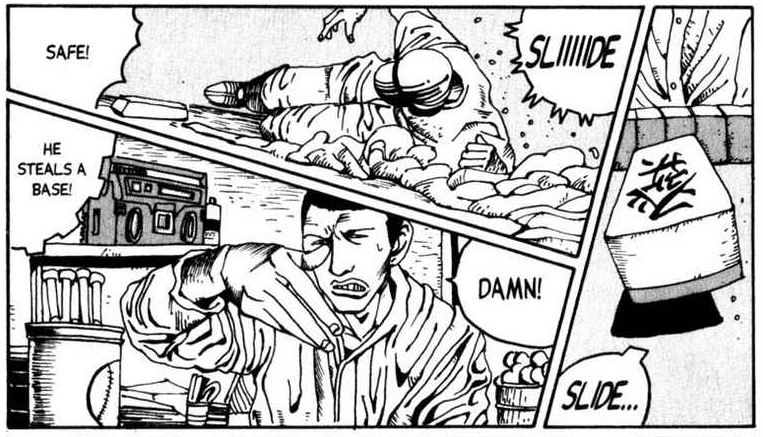
One of the most arresting aspects of Blue Spring is Matsumoto’s ability to manipulate time. In one of the book’s most visually stunning sequences, for example, Matsumoto seamlessly blends two events — a baseball game and a mahjong game — into a single sequence:

Matsumoto makes it seem as if the gambler’s action precipitated the slide into second base. It’s an elegant visual trick that establishes the simultaneity of the two games while suggesting the intensity of the mahjong play; the discarding of a tile is portrayed with the same explosive energy as stealing a base.

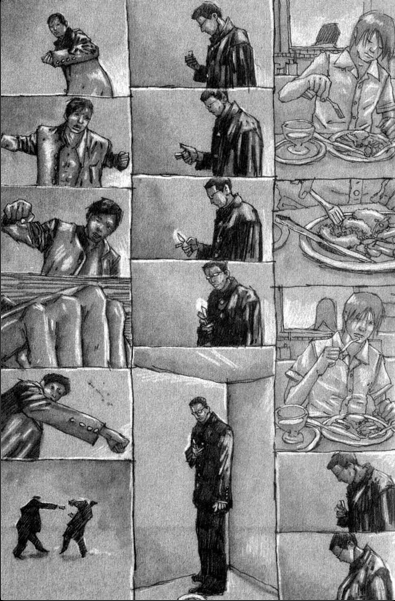
Some of Matsumoto’s time-bending sequences are more cinematic, evoking the kind of split-screen technique popularized in the 1960s by filmmakers like John Frankenheimer and Richard Fleischer. The prologue, for example, contains a series of short, vertical strips in which we see unnamed teenagers preparing for a day at school. Matsumoto deliberates re-frames the activity in each panel, drawing back to show the full scene in some, and pulling in close to reveal the blankness of a characters’ face in another:


It’s an effective montage, largely for the way it juxtaposes the banal with the violent; the fist-fight is presented in the same, matter-of-fact fashion as the student eating breakfast, suggesting that conflict is as routine for some of Blue Spring‘s characters as catching the train to school. The transitions, too, are handled deftly; the eye can process these little vignettes in a sequence while the brain grasps the entire prologue as a simultaneous collage of events, a representative cross-section of high school students going about their business on a typical day.

Matsumoto’s stark, black-and-white imagery won’t be to every reader’s taste; I’d be the first admit that many of the kids in Blue Spring look older and wearier than Keith Richards, with their sunken eyes and rotten teeth. But the studied ugliness of the character designs and urban settings suits the material perfectly, hinting at the anger and emptiness of the characters’ lives. Matsumoto offers no easy answers for his characters’ behavior, nor any false hope that they will escape the lives of violence and despair that seem to be their destiny. Rather, he offers a frank, funny and often disturbing look at the years in which most of us were unformed lumps of clay — or, in Matsumoto’s memorable formulation, a time when most of us were blue: “No matter how passionate you were, no matter how much your blood boiled, I believe youth is a blue time. Blue — that indistinct blue that paints the town before the sun rises.”

This is an expanded version of a review that appeared at PopCultureShock on 4/30/07.

BLUE SPRING • BY TAIYO MATSUMOTO • VIZ • 216 pp. • RATING: MATURE (18+)

Filed Under: Manga Critic Tagged With: Seinen, Taiyo Matsumoto, VIZ

The Best Manga You’re Not Reading: Blue Spring

January 11, 2011 by Katherine Dacey

As depicted in most shojo and shonen manga, the Japanese high school is the epitome of order, with students in neat, military-style uniforms diligently studying for exams, tidying up classrooms, staging plays, and participating in cultural festivals. Students who don’t fit into the school’s established pecking order — social, athletic, or academic — quickly find themselves ostracized by their peers for lack of purpose.

Taiyo Matsumoto, however, offers a very different image of the Japanese high school in his anthology Blue Spring. His subjects are the kids with “front teeth rotten from huffing thinner,” who “answer to reason with their fists and never question their excessive passions” — in short, the delinquents. Kitano High School, the milieu these kids inhabit, is a crumbling eyesore with graffiti-covered walls, trash-filled stairwells, and indifferent faculty. Students cut class and fill their after-school hours with girlie magazines, petty crime, and smack-talk at the local diner, marking time until they join the world of adult responsibility.

Gangs, bullies, disaffected teens playing at thug life — it’s familiar territory, yet in Matsumoto’s hands, these potentially cliche stories acquire a new and strange quality. Matsumoto eschews linear narrative in favor of digressions and fragments; as a result, we feel more like we’re living in the characters’ heads than reading a tidy account of their actions. Snatches of daydreams sometimes interrupt the narrative, as do jump cuts and surreal imagery: sharks and puffer fish drift past a classroom window where two teens make out, a UFO languishes above the school campus. Even the graffiti plays an integral part of Matsumoto’s storytelling; the walls are a paean to masturbation, booze, and suicide, cheerfully urging “No more political pacts—sex acts!”

One of the most arresting aspects of Blue Spring is Matsumoto’s ability to manipulate time. In one of the book’s most visually stunning sequences, for example, Matsumoto seamlessly blends two events — a baseball game and a mahjong game — into a single sequence:

Matsumoto makes it seem as if the gambler’s action precipitated the slide into second base. It’s an elegant visual trick that establishes the simultaneity of the two games while suggesting the intensity of the mahjong play; the discarding of a tile is portrayed with the same explosive energy as stealing a base.

Some of Matsumoto’s time-bending sequences are more cinematic, evoking the kind of split-screen technique popularized in the 1960s by filmmakers like John Frankenheimer and Richard Fleischer. The prologue, for example, contains a series of short, vertical strips in which we see unnamed teenagers preparing for a day at school. Matsumoto deliberates re-frames the activity in each panel, drawing back to show the full scene in some, and pulling in close to reveal the blankness of a characters’ face in another:


It’s an effective montage, largely for the way it juxtaposes the banal with the violent; the fist-fight is presented in the same, matter-of-fact fashion as the student eating breakfast, suggesting that conflict is as routine for some of Blue Spring‘s characters as catching the train to school. The transitions, too, are handled deftly; the eye can process these little vignettes in a sequence while the brain grasps the entire prologue as a simultaneous collage of events, a representative cross-section of high school students going about their business on a typical day.

Matsumoto’s stark, black-and-white imagery won’t be to every reader’s taste; I’d be the first admit that many of the kids in Blue Spring look older and wearier than Keith Richards, with their sunken eyes and rotten teeth. But the studied ugliness of the character designs and urban settings suits the material perfectly, hinting at the anger and emptiness of the characters’ lives. Matsumoto offers no easy answers for his characters’ behavior, nor any false hope that they will escape the lives of violence and despair that seem to be their destiny. Rather, he offers a frank, funny and often disturbing look at the years in which most of us were unformed lumps of clay — or, in Matsumoto’s memorable formulation, a time when most of us were blue: “No matter how passionate you were, no matter how much your blood boiled, I believe youth is a blue time. Blue — that indistinct blue that paints the town before the sun rises.”

This is an expanded version of a review that appeared at PopCultureShock on 4/30/07.

BLUE SPRING • BY TAIYO MATSUMOTO • VIZ • 216 pp. • RATING: MATURE (18+)

Filed Under: Manga, Manga Critic, Recommended Reading, REVIEWS Tagged With: Seinen, Taiyo Matsumoto, VIZ

Natsume, Kurozakuro, Panda, Prince

January 3, 2011 by Katherine Dacey, Michelle Smith, MJ and David Welsh Leave a Comment

With the addition of new authors to the Manga Bookshelf family of blogs, it seemed like the right time to refresh this weekly feature with more diversity of opinion. To that end, both Kate and David will now be joining in offer up their weekly Picks. And as a bonus, we have a Pick from Soliloquy in Blue‘s Michelle Smith. So take your pick of the Picks below or stretch your pocketbook and pick up all four!


From MJ: There isn’t a lot of excitement to be found for me in this week’s batch of incoming manga, though there are a couple of bright spots. A new volume of Sand Chronicles is always welcome, of course, but my eye is especially drawn to volume five of Natsume’s Book of Friends, one of my favorite new shoujo series last year. I got a bit bogged down with it during volume three, but here’s a snippet from my thoughts on volume four: “The volume begins on a strong note, by introducing a troubled yokai who ends up inhabiting the body of a snow bunny (not the kind found on ski slopes, but in children’s back yards) in order to try to reunite with his one-time companion who had been driven to the dark side by the cruelty of humanity. While that concept sounds at once unbearably cutesy and melodramatic, its execution is anything but. It’s subtle and moving, and in that moment, the series won me back completely.”

The emotional content of this series has really refined itself beautifully over the course of its run so far, and I’m really looking forward to picking up the this week’s volume.

From David: I missed the first volume of this series, and I have no idea if it’s particularly good or not, but I was very struck by the style of the covers of Kurozakuro (Viz), written and illustrated by Yoshinori Natsume. I tend not to be a big shounen fan, but I’ve done pretty well with the titles in Viz’s Shonen Sunday imprint. This one is about a boy who finds that he’s turning into an ogre and wants to eat people, which isn’t your standard young-man-with-a-dream problem. The preview on the Shonen Sunday site looks kind of promising, particularly in terms of the style of the illustrations.

From Kate: I’m going to put on my Good Comics for Kids hat and champion Panda Man and the Treasure Hunt, the second installment of a new graphic novel/activity book/chapter book series from VIZ Kids. The first volume of Panda Man was perfect for seven- or eight-year-olds: it had stylish artwork, plenty of slapstick, and enough bathroom humor to satisfy the most discerning fart joke connoisseur. Oh, and mazes, connect-the-dot exercises, and drawing tips, making it a great choice for keeping kids busy on a car ride or a plane trip. The second volume finds Panda Man going mano-a-mano with pirates in search of treasure. I’m guessing the plot may be a little disjointed — the first volume was more a collection of gags than a story — but I can’t imagine it will be anything less than entertaining. Even an adult can appreciate a hero whose primary weapons are smelly feet and an overactive GI tract; as someone who rode the NYC subway for years, I can attest to the awesome, crippling power of stinky toes!
From Michelle: For me, the automatic purchase this week is volume 40 of Takeshi Konomi’s The Prince of Tennis. I recently completed a marathon read to get current on the series, and though many ridiculous elements offer themselves up as reasons for mockery—chief among them Konomi’s decision to depict the pinnacle of tennis achievement with glowing auras and sparkles (both visible to spectators)—I would never for a moment dream of giving up on it before its completion, even though the product description warns me to expect “a wicked case of amnesia” in this latest volume. That’s my Prince of Tennis: incredibly silly and yet so irresistible.


So, readers, what’s your Pick this week?

Filed Under: PICK OF THE WEEK

The Best Manga You’re Not Reading: Gun Blaze West

December 31, 2010 by Katherine Dacey 6 Comments

Let me begin this review with a disclaimer: Ken Burns would not approve of the historical liberties taken by Gun Blaze West creator Nobuhiro Watsuki. The dialogue, for example: the characters speak in a distinctly modern patois, filled with phrases never uttered by Sitting Bull or General Custer. The scenery, for another: verdant Eastern forests abut rugged desert canyons, even though the story begins in Illinois. (I particularly liked Watsuki’s rendering of Saint Louis as a kind of Budapest on the Mississippi, complete with majestic buildings.) Even the saloon names feel a little off-kilter, as one group of outlaws patronize a joint called Bella Donna. Such incongruities may offend Mr. Burns, but they’re just part of this boisterous series’ charm. (Did I mention the knife-throwing samurai girl? Oh, Mr. Burns, the horror!)

Gun Blaze West focuses on Viu Bannes, a ten-year-old boy who dreams of visiting Gun Blaze West, a mythical city populated by the world’s greatest gunslingers. (On the map, it appears to be located in Seattle, making me wonder if Gun Blaze West is, in fact, populated by the West’s most caffeinated gunslingers.) When a down-on-his-luck cowboy wanders into town, Viu pesters him for shooting lessons. Marcus reluctantly agrees to show Viu the gunslinging ropes, but before Viu can complete his training, the notorious Kenbrown gang arrives in Winston Town, terrorizing the citizens and threatening Viu’s older sister. Viu and Marcus’s standoff with the Kenbrown gang ends with an unexpected turn of events — one that sets the stage for Viu’s subsequent cross-country odyssey.

As in many shonen adventure series, the hero is the least interesting member of the cast. Viu seems to have been ordered straight from the SJ catalog: he’s fast, strong, and so single-minded in pursuit of his dreams that he often comes across as stupid. He also spends a lot of time declaring that he’ll “do his best” and extolling the value of friendship — two other perennial Shonen Jump themes.

In spite of the numerous capitulations to formula, however, Gun Blaze West is one of the most enjoyable shonen titles that VIZ has published. The Western setting proves a welcome change of pace from feudal Japan, modern-day Tokyo, and fantasy realms where teens go mano-a-mano with demons and undead souls. Though the characters possess exaggerated skill and strength, there’s nothing supernatural about Viu and his friends; they come by their talents honestly, through practice, hard work, and mistakes. The story, too, proves surprisingly adult at times, exploring the consequences of violence and rash behavior more realistically than many titles in the Shonen Jump canon.

What really makes Gun Blaze West tick, however, is its playful intermingling of shonen and Western tropes. Gun Blaze West actually feels like a Western, minus some of the obvious anachronisms and geographical gaffes. Marcus is a classic oater type, the gunslinger who’s developed a strong distaste for violence; he’s reluctant to participate in a shoot-out of any kind, adopting a foolish persona to camouflage his skill. When the bullets start flying — and there several lengthy gun battles sprinkled throughout the series — the tone shifts dramatically to underscore Marcus’ abhorrence of fighting. The supporting cast, too, is filled with familiar Wild West archetypes: salty saloon keepers, feisty young women, straight-arrow lawmen, sadistic villains, and traveling circus performers. Even the plots stick closely to the John Ford playbook, whether a small town is under siege from criminals or a local business owner is being harassed by a rival’s private army of thugs.

If you’re a fan of Buso Renkin or Rurouni Kenshin, you know what to expect from Watsuki’s art: dynamic fight scenes, villains with memorable mugs, and nonstop sight gags. The art’s relentless, antic quality wears a little thin towards the end of the series; I found myself wishing that Watsuki would pause to savor the landscape or linger at the sight of a lonely gunslinger’s tombstone instead of uncorking another fart joke or chase scene. Yet for all the artwork’s implied dynamism, the images themselves are never too busy; like Eiichiro Oda and Akira Toriyama, Watsuki relies primarily on lines and evocative shapes to convey the physicality of the people and objects in his stories, rather than heavy patches of screentone. Watsuki isn’t quite Oda or Toriyama’s peer when it comes to backgrounds and peripheral characters — his repertory of towns and bit players is more limited — but his pages exude the same boisterous energy as theirs do.

Best of all, Gun Blaze West is short, clocking in at just three volumes. Given how many shonen titles overstay their welcome with repetitive, drawn-out story arcs, that kind of brevity is admirable; that Gun Blaze West finishes on a high note makes its brevity seem like a stroke of creative genius.

This is an expanded version of a review that originally appeared at PopCultureShock on 3/31/08.

GUN BLAZE WEST, VOLS. 1-3 • BY NOBUHIRO WATSUKI • VIZ • RATING: TEEN (13+)

Filed Under: Manga Critic Tagged With: Shonen, Shonen Jump, VIZ, Western

Highschool of the Dead, Vol. 1

December 27, 2010 by Katherine Dacey

A poor man’s Dawn of the Dead — that’s how I’d describe Highschool of the Dead, a slick, violent zombie story that borrows shamelessly from the George Romero canon. Whether that’s a good thing depends a lot on your relationship with Romero. If you thought Dawn of the Dead was a sly poke at American society — its consumerism, class divisions, and latent racism — Daisuke Sato and Shouji Sato’s manga will seem awfully thin, as the authors are more concerned with dishing out panty shots than revealing how threadbare the social fabric really is. If you found Romero’s film unnecessarily burdened with subtext, however, you might just cotton to the Satos’ ultra-violent update.

As the title implies, the story begins at an ordinary high school in Tokyo. When the staff contract a mysterious disease that transforms them into zombies, they wreak havoc, infecting hundreds of other people as they chomp, rend, and tear their way through campus. A small band of students take refuge on the roof, hoping for a helicopter rescue. What they discover, however, is that the entire city has descended into chaos, leaving them little choice than to find a safer place to wait out the crisis.

From a narrative point of view, Highschool of the Dead follows the zombie playbook to the letter. The zombies are slow and shambling; the the story takes place in a closed environment where the zombies’ sheer numbers give them a decided advantage; and the characters can barely stand each other, setting aside their mutual contempt only for the zombie-fighting cause. But while Romero made the most of his film’s shopping mall setting, the Satos treat their high school’s corridors and classrooms as just another indoor space filled with convenient weapons. (Call me crazy, but I don’t remember nail guns lying around the Newton North science labs.) The fight scenes are choppy and poorly staged, giving little indication of how the characters are moving through the space or where, exactly, they are in relation to the school’s main entrance. Even the violence-porn flourishes lack imagination: zombies die by baseball bat, power drill, broom handle, sword, and fire hose, but none of the characters improvises an interesting weapon out of something unique to the school.

The script is as predictable and clumsy as the fight scenes; the characters speak in exposition-heavy soundbites that bear little resemble to real conversation. (Sample: “Rumor has it that your childhood girlfriend ended up in your class when she stayed back and is going out with Igou now, right?”) Daisuke Sato assigns each character a few defining personality traits, raising the possibility that the characters’ economic and social disparities might inform the way they interact. The characterizations are so meager and inconsistent, however, that it’s tough to remember who’s who; I learned more from reading the Wikipedia article on Highschool of the Dead than from the manga itself, never a good sign when the characters, in fact, do have important backstories that shape their opinions of one another.

The biggest problem with Highschool of the Dead is its relentless commitment to cheesecake. The Satos work fanservice into as many scenes as possible, taking full advantage of every stairwell, fight, fall, and female death to flash derrieres and panties; only an episode of Strike Witches has more up-skirt imagery. Adding insult to injury is Shouji Sato’s willful disregard for basic female anatomy. Several of the female characters’ bust lines are so monstrously distended that it would be impossible for the characters to actually stand up and walk in real life, let alone fight zombies. (Hint to aspiring manga artists: large breasts do not look like grossly misshapen lemons or balloon animals.) I realize that costume failures and nubile girls are a staple of horror movies, but when the cheesecake is so poorly done, it’s hard to imagine who would find it arousing; the Satos could take a few tips from Robert Rodriguez on how to incorporate plausible, sexy women into a monster flick.

And when the scariest thing about a zombie story is the way the female characters’ breasts are drawn, well… I’d say the creators have fallen down on the job. The bottom line: unless you’re a die-hard zombie fan or panty-shot connoisseur, you’re better off seeking undead thrills elsewhere.

Review copy provided by Yen Press. Volume one of Highschool of the Dead will go on sale January 25, 2011.

HIGHSCHOOL OF THE DEAD, VOL. 1 • STORY BY DAISUKE SATO, ART BY SHOUJI SATO • YEN PRESS • 160 pp. • RATING: MATURE (18+)

Filed Under: Manga Critic Tagged With: yen press, Zombies

Highschool of the Dead, Vol. 1

December 27, 2010 by Katherine Dacey

A poor man’s Dawn of the Dead — that’s how I’d describe Highschool of the Dead, a slick, violent zombie story that borrows shamelessly from the George Romero canon. Whether that’s a good thing depends a lot on your relationship with Romero. If you thought Dawn of the Dead was a sly poke at American society — its consumerism, class divisions, and latent racism — Daisuke Sato and Shouji Sato’s manga will seem awfully thin, as the authors are more concerned with dishing out panty shots than revealing how threadbare the social fabric really is. If you found Romero’s film unnecessarily burdened with subtext, however, you might just cotton to the Satos’ ultra-violent update.

As the title implies, the story begins at an ordinary high school in Tokyo. When the staff contract a mysterious disease that transforms them into zombies, they wreak havoc, infecting hundreds of other people as they chomp, rend, and tear their way through campus. A small band of students take refuge on the roof, hoping for a helicopter rescue. What they discover, however, is that the entire city has descended into chaos, leaving them little choice than to find a safer place to wait out the crisis.

From a narrative point of view, Highschool of the Dead follows the zombie playbook to the letter. The zombies are slow and shambling; the the story takes place in a closed environment where the zombies’ sheer numbers give them a decided advantage; and the characters can barely stand each other, setting aside their mutual contempt only for the zombie-fighting cause. But while Romero made the most of his film’s shopping mall setting, the Satos treat their high school’s corridors and classrooms as just another indoor space filled with convenient weapons. (Call me crazy, but I don’t remember nail guns lying around the Newton North science labs.) The fight scenes are choppy and poorly staged, giving little indication of how the characters are moving through the space or where, exactly, they are in relation to the school’s main entrance. Even the violence-porn flourishes lack imagination: zombies die by baseball bat, power drill, broom handle, sword, and fire hose, but none of the characters improvises an interesting weapon out of something unique to the school.

The script is as predictable and clumsy as the fight scenes; the characters speak in exposition-heavy soundbites that bear little resemble to real conversation. (Sample: “Rumor has it that your childhood girlfriend ended up in your class when she stayed back and is going out with Igou now, right?”) Daisuke Sato assigns each character a few defining personality traits, raising the possibility that the characters’ economic and social disparities might inform the way they interact. The characterizations are so meager and inconsistent, however, that it’s tough to remember who’s who; I learned more from reading the Wikipedia article on Highschool of the Dead than from the manga itself, never a good sign when the characters, in fact, do have important backstories that shape their opinions of one another.

The biggest problem with Highschool of the Dead is its relentless commitment to cheesecake. The Satos work fanservice into as many scenes as possible, taking full advantage of every stairwell, fight, fall, and female death to flash derrieres and panties; only an episode of Strike Witches has more up-skirt imagery. Adding insult to injury is Shouji Sato’s willful disregard for basic female anatomy. Several of the female characters’ bust lines are so monstrously distended that it would be impossible for the characters to actually stand up and walk in real life, let alone fight zombies. (Hint to aspiring manga artists: large breasts do not look like grossly misshapen lemons or balloon animals.) I realize that costume failures and nubile girls are a staple of horror movies, but when the cheesecake is so poorly done, it’s hard to imagine who would find it arousing; the Satos could take a few tips from Robert Rodriguez on how to incorporate plausible, sexy women into a monster flick.

And when the scariest thing about a zombie story is the way the female characters’ breasts are drawn, well… I’d say the creators have fallen down on the job. The bottom line: unless you’re a die-hard zombie fan or panty-shot connoisseur, you’re better off seeking undead thrills elsewhere.

Review copy provided by Yen Press. Volume one of Highschool of the Dead will go on sale January 25, 2011.

HIGHSCHOOL OF THE DEAD, VOL. 1 • STORY BY DAISUKE SATO, ART BY SHOUJI SATO • YEN PRESS • 160 pp. • RATING: MATURE (18+)

Filed Under: Manga, Manga Critic, REVIEWS Tagged With: Horror/Supernatural, yen press, Zombies

The 2010 Manga Hall of Shame Inductees

December 24, 2010 by Katherine Dacey 34 Comments

While there’s no shortage of boring or cliche manga available in English — even with fewer titles being released this year — grade-A turkeys are going the way of the dodo. I had so much difficulty compiling this year’s Manga Hall of Shame Nominees, in fact, that I turned to Twitter for help. Some folks named The Melancholy of Suzumiya Haruhi-chan for being dull and incomprehensible; others fingered Saving Life for unsexy fanservice and dopey characters; one person chastised You Higuri for foisting Nighthead Genesis on the world; and one brave soul bucked conventional wisdom by naming AX: A Collection of Alternative Manga as her Worst of 2010. (You can see more reader nominations at #badmanga2010.) The conversation made me laugh, but it also helped me clarify my own thinking about the subject. Common to all five titles on this year’s list is a flagrant disregard for the reader; no matter how interesting the initial premise, these stories derailed quickly, thanks to lousy artwork, disjointed storytelling, and/or a juvenile fixation on body parts and bodily functions.

5. CHE GUEVARA: A MANGA BIOGRAPHY (Penguin)

In the opening pages of Che Guevara: A Manga Biography, the creators promise to reveal the flesh-and-blood person behind the iconic images on t-shirts and posters. The authors never deliver on that promise, however, instead relying heavily on Guevara’s own self-promoting essays for most of their information. That commitment to primary sources might be laudable if the authors made any effort to reveal the inconsistencies in Guevara’s beliefs, but Guevara’s heroism is never in doubt; he’s always portrayed as brave, strong, and capable, even when abandoning his first family or serving in Fidel Castro’s administration. (The authors also gloss over Guevara’s enthusiasm for the Stalinist regime, perhaps because it’s hard to put a positive spin on anyone or anything associated with that period in Soviet history.) More frustrating still is how choppy and uneven the manga is; the authors compress major battles and periods of Guevara’s life into one or two pages, leaving no room for them to explore these events with any nuance. Clumsy character designs and endless talking-head scenes complete the not-so-pretty picture.

4. SCARLET (BLU Manga)

Hiro Madarame may draw achingly pretty manga, but her stories are surprisingly ugly and unpleasant, filled with Tragically Gay Characters and manipulative, shrewish women who drive men to homosexuality. The nadir of this slim anthology is the titular story, which includes a brutal rape scene that’s disturbing both for its sadism (it wouldn’t be out of place in David Fincher’s ultra-gory Seven) and for the speed with which the victim and the attacker reconcile. It’s true that many domestic abuse victims go through cycles of leaving and reuniting with their tormentors, but Madarame presents this act of violence as testament to her characters’ deep attachment to one another, rather than evidence of their pathologically unhealthy relationship. Call me a curmudgeonly old feminist if you must, but romanticizing rape and possessive behavior — no matter what the gender or sexual orientation of the parties involved — just isn’t very sexy. –Reviewed at The Manga Critic, 8/31/10

3. PINK INNOCENT (Del Rey)

The title screams soft-core porn, but Pink Innocent is, in fact, G-rated shojo comedy. The story revolves around Kotona, a ditzy rich girl who stalks and smothers Reiji, a befuddled nerd who finds Kotona almost as annoying as readers will. The jokes are profoundly unfunny: Kotona destroys Reiji’s computers, burns down his apartment, and stars in her class production of Romeo and Juliet so that she can woo him. (One shudders to think what she’ll do in future volumes: carpet bomb his home by accident? Run over his brother with a car?) Adding insult to injury is the artwork: it’s sub-par Arina Tanemura, with sparkles on top of sparkles, and a heroine so saucer-eyed she resembles a chibi squid. Unless Orange Planet was a bigger hit than I remembered, it’s hard to fathom what inspired Del Rey to license Pink Innocent; shojo fans deserve better than this dumb, repetitive stinker.

2. “BLACK SUSHI PARTY PIECE” AND “ARIZONA SIZZLER,” FROM AX: AN ALTERNATIVE COLLECTION OF MANGA (Top Shelf)

David Welsh said it best when he declared, “While AX is one of the books I’m happiest to have bought this year, it does contain some seriously bad manga.” Many of the stories in AX push the boundaries of good taste, aesthetic and otherwise, but the best of them — “Puppy Love,” “Six Paths of Wealth,” “Push-Pin Woman” — are genuinely thought-provoking. Two, however, earn demerits for their sheer pointlessness. The first, “Black Sushi Party Piece,” is a festival of excrement, anuses, and Butt Head-ugly character designs, with no real ambition other than to turn the stomach. The second, “Arizona Sizzler,” features a desert showdown between an irritated young woman and an enormous set of genitals. I have no doubt that in the hands of someone like Terry Gilliam this kind of cock-and-balls story might be funny, but the crudeness of the execution robs “Sizzler” of any potential playfulness; instead, it seems like a dumb joke dragged out to epically unfunny lengths, the manga equivalent of a Benny Hill sketch. –Reviewed at The Manga Critic, 5/21/10

1. THE QWASER OF STIGMATA (Tokyopop)

The creators of Qwaser of Stigmata have erected a sturdy framework on which to hang boobs and bishonen: their story takes place at a parochial boarding school filled with nubile teens, allowing them to indulge every manner of fetish, from schoolgirls in short skirts to hotties of the cloth. Alas, Hiroyuki Yoshino and Kenetsu Sato’s only novel idea was to substitute Russian Orthodoxy for Catholicism, the go-to religion of manga-ka in search of cool outfits and arcane rituals. The rest of the story is a fever-dream of incoherent fight scenes, topless girls, and… breast feeding. (That’s the source of the characters’ super-strength: breast milk. I’m not making this up. Really.) The central plot, which revolves around a Russian icon, makes even less sense than the fight scenes; I’m not an expert on any form of Eastern Orthodoxy, but I don’t think it’s a stretch to say that an observant person would find it offensive. (Or silly.) The saddest part is that an imaginative artist could write a boffo manga about the Russian Orthodox Church, which has a long and rich history, filled with mystics, heretics, and believers so hard core they’d set fire to themselves before accepting small changes to the liturgy. –Reviewed at The Manga Critic, 8/11/10

So… I turn the floor over to you: what titles do you think belong in this year’s Manga Hall of Shame?

Filed Under: Manga Critic Tagged With: Bad Manga

The 2010 Manga Hall of Shame Inductees

December 24, 2010 by Katherine Dacey

While there’s no shortage of boring or cliche manga available in English — even with fewer titles being released this year — grade-A turkeys are going the way of the dodo. I had so much difficulty compiling this year’s Manga Hall of Shame Nominees, in fact, that I turned to Twitter for help. Some folks named The Melancholy of Suzumiya Haruhi-chan for being dull and incomprehensible; others fingered Saving Life for unsexy fanservice and dopey characters; one person chastised You Higuri for foisting Nighthead Genesis on the world; and one brave soul bucked conventional wisdom by naming AX: A Collection of Alternative Manga as her Worst of 2010. (You can see more reader nominations at #badmanga2010.) The conversation made me laugh, but it also helped me clarify my own thinking about the subject. Common to all five titles on this year’s list is a flagrant disregard for the reader; no matter how interesting the initial premise, these stories derailed quickly, thanks to lousy artwork, disjointed storytelling, and/or a juvenile fixation on body parts and bodily functions.

5. Che Guevara: A Manga Biography
By Kiyoshi Konno and Chie Shimano • Penguin Books
In the opening pages of Che Guevara: A Manga Biography, the creators promise to reveal the flesh-and-blood person behind the iconic images on t-shirts and posters. The authors never deliver on that promise, however, instead relying heavily on Guevara’s own self-promoting essays for most of their information. That commitment to primary sources might be laudable if the authors made any effort to reveal the inconsistencies in Guevara’s beliefs, but Guevara’s heroism is never in doubt; he’s always portrayed as brave, strong, and capable, even when abandoning his first family or serving in Fidel Castro’s administration. (The authors also gloss over Guevara’s enthusiasm for the Stalinist regime, perhaps because it’s hard to put a positive spin on anyone or anything associated with that period in Soviet history.) More frustrating still is how choppy and uneven the manga is; the authors compress major battles and periods of Guevara’s life into one or two pages, leaving no room for them to explore these events with any nuance. Clumsy character designs and endless talking-head scenes complete the not-so-pretty picture.

4. Scarlet
By Hiro Madarame • BLU Manga
Hiro Madarame may draw achingly pretty manga, but her stories are surprisingly ugly and unpleasant, filled with Tragically Gay Characters and manipulative, shrewish women who drive men to homosexuality. The nadir of this slim anthology is the titular story, which includes a brutal rape scene that’s disturbing both for its sadism (it wouldn’t be out of place in David Fincher’s ultra-gory Seven) and for the speed with which the victim and the attacker reconcile. It’s true that many domestic abuse victims go through cycles of leaving and reuniting with their tormentors, but Madarame presents this act of violence as testament to her characters’ deep attachment to one another, rather than evidence of their pathologically unhealthy relationship. Call me a curmudgeonly old feminist if you must, but romanticizing rape and possessive behavior — no matter what the gender or sexual orientation of the parties involved — just isn’t very sexy. —Reviewed at The Manga Critic, 8/31/10

3. Pink Innocent
By Kotori Momoyuki • Del Rey
The title screams soft-core porn, but Pink Innocent is, in fact, G-rated shojo comedy. The story revolves around Kotona, a ditzy rich girl who stalks and smothers Reiji, a befuddled nerd who finds Kotona almost as annoying as readers will. The jokes are profoundly unfunny: Kotona destroys Reiji’s computers, burns down his apartment, and stars in her class production of Romeo and Juliet so that she can woo him. (One shudders to think what she’ll do in future volumes: carpet bomb his home by accident? Run over his brother with a car?) Adding insult to injury is the artwork: it’s sub-par Arina Tanemura, with sparkles on top of sparkles, and a heroine so saucer-eyed she resembles a chibi squid. Unless Orange Planet was a bigger hit than I remembered, it’s hard to fathom what inspired Del Rey to license Pink Innocent; shojo fans deserve better than this dumb, repetitive stinker.

2. “Black Sushi Party Piece” and “Arizona Sizzlet,” AX: An Alternative Collection of Manga
Edited by Sean Michael Wilson • Top Shelf
David Welsh said it best when he declared, “While AX is one of the books I’m happiest to have bought this year, it does contain some seriously bad manga.” Many of the stories in AX push the boundaries of good taste, aesthetic and otherwise, but the best of them — “Puppy Love,” “Six Paths of Wealth,” “Push-Pin Woman” — are genuinely thought-provoking. Two, however, earn demerits for their sheer pointlessness. The first, “Black Sushi Party Piece,” is a festival of excrement, anuses, and Butt Head-ugly character designs, with no real ambition other than to turn the stomach. The second, “Arizona Sizzler,” features a desert showdown between an irritated young woman and an enormous set of genitals. I have no doubt that in the hands of someone like Terry Gilliam this kind of cock-and-balls story might be funny, but the crudeness of the execution robs “Sizzler” of any potential playfulness; instead, it seems like a dumb joke dragged out to epically unfunny lengths, the manga equivalent of a Benny Hill sketch. —Reviewed at The Manga Critic, 5/21/10

1. The Qwaser of Stigmata
Story by Hiroyuki Yoshino • Art by Kenetsu Satō • Tokyopop
The creators of Qwaser of Stigmata have erected a sturdy framework on which to hang boobs and bishonen: their story takes place at a parochial boarding school filled with nubile teens, allowing them to indulge every manner of fetish, from schoolgirls in short skirts to hotties of the cloth. Alas, Hiroyuki Yoshino and Kenetsu Sato’s only novel idea was to substitute Russian Orthodoxy for Catholicism, the go-to religion of manga-ka in search of cool outfits and arcane rituals. The rest of the story is a fever-dream of incoherent fight scenes, topless girls, and… breast feeding. (That’s the source of the characters’ super-strength: breast milk. I’m not making this up. Really.) The central plot, which revolves around a Russian icon, makes even less sense than the fight scenes; I’m not an expert on any form of Eastern Orthodoxy, but I don’t think it’s a stretch to say that an observant person would find it offensive. (Or silly.) The saddest part is that an imaginative artist could write a boffo manga about the Russian Orthodox Church, which has a long and rich history, filled with mystics, heretics, and believers so hard core they’d set fire to themselves before accepting small changes to the liturgy. —Reviewed at The Manga Critic, 8/11/10

So… I turn the floor over to you: what titles do you think belong in this year’s Manga Hall of Shame?

Filed Under: Manga, Manga Critic

Tezuka: A Bibliography for English Speakers

December 21, 2010 by Katherine Dacey 7 Comments

For the English-language reader interested in learning more about Osamu Tezuka, there’s a growing body of scholarship exploring his life and work. Frederik L. Schodt, who was a personal friend of Tezuka’s, has done more than just about anyone to introduce Tezuka’s manga to Western audiences, writing in an accessible style that eschews academic formality but is nonetheless rigorous and well-researched. Schodt reproduced a chapter from Tezuka’s Phoenix in Manga! Manga! The World of Japanese Comics (1983), paid tribute to Tezuka’s work with an essay in Dreamland Japan: Writings on Modern Manga (1996), and devoted an entire book to one of Tezuka’s best-known characters in The Astro Boy Essays: Osamu Tezuka, Mighty Atom, and the Manga/Anime Revolution (2007). Readers who find Schodt’s approach congenial should also investigate Helen McCarthy’s recent book The Art of Osamu Tezuka: God of Manga (2009); like Schodt, McCarthy is interested in bringing Tezuka’s work to a wider audience of comics fans and moviegoers, rather than subjecting Tezuka’s work to close readings.

Academics, too, have been exploring Tezuka’s work from a variety of perspectives, as numerous articles in The International Journal of Comic Art, The Journal of Popular Culture, and Mechademia attest. Natsu Onoda Power’s God of Comics: Osamu Tezuka and the Creation of Post World-War II Manga (2009) is among the most user-friendly of these recent scholarly tomes; she writes in a clear, unfussy style that provides readers insight into the historical, social, and economic conditions in which Tezuka lived and worked. Readers may also find Philip Brophy’s Tezuka: The Marvel of Manga (2007) a helpful bridge between mainstream and academic discourse about Tezuka. Though Marvel of Manga is as much a museum catalog as a scholarly work, Brophy’s contextual essays do a fine job of introducing the different stages of Tezuka’s career, as well as some of the themes that were central to Tezuka’s work.

…

Read More

Filed Under: Manga Critic Tagged With: Osamu Tezuka

Osamu Tezuka: A Bibliography for English Speakers

December 21, 2010 by Katherine Dacey

For the English-language reader interested in learning more about Osamu Tezuka, there’s a growing body of scholarship exploring his life and work. Frederik L. Schodt, who was a personal friend of Tezuka’s, has done more than just about anyone to introduce Tezuka’s manga to Western audiences, writing in an accessible style that eschews academic formality but is nonetheless rigorous and well-researched. Schodt reproduced a chapter from Tezuka’s Phoenix in Manga! Manga! The World of Japanese Comics (1983), paid tribute to Tezuka’s work with an essay in Dreamland Japan: Writings on Modern Manga (1996), and devoted an entire book to one of Tezuka’s best-known characters in The Astro Boy Essays: Osamu Tezuka, Mighty Atom, and the Manga/Anime Revolution (2007). Readers who find Schodt’s approach congenial should also investigate Helen McCarthy’s recent book The Art of Osamu Tezuka: God of Manga (2009); like Schodt, McCarthy is interested in bringing Tezuka’s work to a wider audience of comics fans and moviegoers, rather than subjecting Tezuka’s work to close readings.

Academics, too, have been exploring Tezuka’s work from a variety of perspectives, as numerous articles in The International Journal of Comic Art, The Journal of Popular Culture, and Mechademia attest. Natsu Onoda Power’s God of Comics: Osamu Tezuka and the Creation of Post World-War II Manga (2009) is among the most user-friendly of these recent scholarly tomes; she writes in a clear, unfussy style that provides readers insight into the historical, social, and economic conditions in which Tezuka lived and worked. Readers may also find Philip Brophy’s Tezuka: The Marvel of Manga (2007) a helpful bridge between mainstream and academic discourse about Tezuka. Though Marvel of Manga is as much a museum catalog as a scholarly work, Brophy’s contextual essays do a fine job of introducing the different stages of Tezuka’s career, as well as some of the themes that were central to Tezuka’s work.

A word about this bibliography: it isn’t comprehensive, nor is it intended to be. What I’ve done is compile a list of resources that a journalist, college student, or serious comic fan would find helpful in learning more about Tezuka’s life and work. The list is divided into three sections: the first focuses on articles and books about Tezuka, the second on websites, and the third on Tezuka’s manga in translation. Please feel free to suggest resources I have overlooked; this list is meant to be a living document, updated on a regular basis.

ARTICLES AND BOOKS ABOUT TEZUKA

Arnold, Andrew D. “Born Again.” Rev. of Phoenix, by Osamu Tezuka. Time 17 July 2004. Web. 21 December 2010.

Bird, Lawrence. “States of Emergency: Urban Space and the Robotic Body in the Metropolis Tales.” Mechademia 3 (2008): 127-48. Print.

Brophy, Philip, ed. Tezuka: The Marvel of Manga. Victoria: National Gallery of Victoria, 2007. Print.

Covert, Brian. “Manga, Racism & Tezuka.” Japan Times Weekly 18 April 1992: 1-4. Print.

Eiji, Otsuka. “Disarming Atom: Osamu Tezuka’s Manga at War and Peace.” Trans. Thomas LaMarre. Mechademia 3 (2008): 111-25. Print.

Gravett, Paul. “The Father Storyteller: The Life and Role of Osamu Tezuka, Originator of Story Manga.” Manga: Sixty Years of Japanese Comics. New York: HarperCollins, 2004. 34-47. Print.

Inuhiko,  Yomata. “Stigmata in Tezuka Osamu’s Works.” Trans. Hajime Nakatani. Mechademia 3 (2008): 97-109. Print.

Kuwahara, Yasue. “Japanese Culture and Popular Consciousness: Disney’s The Lion King vs. Tezuka’s Jungle Emperor.” Journal of Popular Culture 31.1 (1997): 37-48. Print.

LaMarre, Thomas. “Speciesism, Part II: Tezuka Osamu and the Multispecies Ideal.” Mechademia 5 (2010): 51-85. Print.

Kinsella, Sharon. Adult Manga: Culture and Power in Contemporary Japanese Society. Honolulu: University of Hawaii Press, 2000. Print.

Ma, Sheng-mei. “Three Views of the Rising Sun, Obliquely: Keiji Nakazawa’s A-bomb, Osamu Tezuka’s Adolf, and Yoshinori Kobayashi’s Apologia.” Mechademia 4 (2009): 183-96. Print.

MacWilliams, Mark Wheeler. “Japanese Comics and Religion: Osamu Tezuka’s Story of the Buddha.” Japan Pop! Inside the World of Japanese Popular Culture. Ed. Timothy J. Craig. New York: M.E. Sharpe, 2000. 109-37. Print.

McCarthy, Helen. The Art of Osamu Tezuka: God of Manga. Foreword by Katsuhiro Otomo. New York: Abrams, 2009. Print.

O’Luanaigh, Cian. “Osamu Tezuka: Father of Manga and Scourge of the Medical Establishment.” The Guardian 21 July 2010. Web. 21 December 2010.

Onoda, Natsu. “Drag Prince in Spotlight: Theatrical Cross-Dressing in Osamu Tezuka’s Early Shojo Manga.” International Journal of Comic Art 4.2 (2002): 124-38. Print.

——— . “Tezuka Osamu and the Star System.” International Journal of Comic Art 5.1 (2003): 161-94. Print.

Palmer, Ada. “‘You, God of Manga, Are Cruel!’: Karma and Suffering in the Universe of Osamu Tezuka.” Manga and Philosophy. Ed. Adam Barkman and Joseph Steiff. Chicago: Open Court, 2010. Print.

Patten, Fred. Watching Anime, Reading Manga: 25 Years of Essays and Reviews. Foreword by Carl Macek. Berkeley, CA: Stone Bridge Press, 2004. Print.

Power, Natsu Onoda. God of Comics: Osamu Tezuka and the Creation of Post-World War II Manga. Jackson, MS: University Press of Mississippi, 2009. Print.

Randall, Bill. “Achieving Godhood in Pen and Ink.” Rev. of Phoenix, by Osamu Tezuka. The Comics Journal 246 (2002): 109-13. Print.

——— . “Behold Japan’s God of Manga: An Introduction to the Work of Osamu Tezuka.” The Comics Journal 5 (2005): 46-57. Print.

Schilling, Mark. “Tezuka, Osamu.” The Encyclopedia of Japanese Pop Culture. Trumbull, CT: Weatherhill, 1997. 263-68. Print.

Schodt, Frederik L. The Astro Boy Essays: Osamu Tezuka, Mighty Atom, and the Manga/Anime Revolution. Berkeley, CA: Stone Bridge Press, 2007. Print.

——— . “A Tribute to the God of Comics.” Dreamland Japan: Writings on Modern Manga. Berkeley, CA: Stone Bridge Press, 1996. 233-74. Print.

Thorn, Matt. “Tezuka’s Modernism.” Introduction. Adolf: The Half-Aryan. By Osamu Tezuka. Trans. Oniki Yoji. San Francisco: Cadence Books, 1997. 7-11. Print.

WEB RESOURCES

Anthropology of Anime and Manga: Site includes a useful overview of Tezuka’s Phoenix saga, with links to English and Japanese resources.

Osamu Tezuka, Father of Manga: Site provides a biography, timeline, and a brief discussion of Tezuka’s influences.

Tezuka in English: Site maintained by American scholar Ada Palmer; provides a comprehensive list of Tezuka’s work in translation, as well as overview of Tezuka’s star system.

TezukaOsamu.net: Official website of Tezuka Productions, Inc. (Link is to English-language content.) Includes summaries of major works, as well as Japanese-language previews of manga such as The Three-Eyed One, Unico, IL, and New Treasure Island.

Wikipedia entry on Osamu Tezuka. See also the Wikipedia entries on Tezuka’s anime and manga, as well as the Wikipedia entry on Tezuka’s star system. The quality of the entries varies considerably; use in conjunction with other sources.

TEZUKA IN TRANSLATION

Adolf. San Francisco: Cadence Books, 1995-97. 5 volumes.
Apollo’s Song. 2nd ed. New York: Vertical, Inc., 2010. 2 volumes.
Astro Boy. Milwaukie, OR: Dark Horse, 2002-04. 23 volumes.
Ayako. New York: Vertical, Inc., 2010.
Black Jack. New York: Vertical, Inc., 2008-10. 12 volumes, ongoing.
The Book of Human Insects. New York: Vertical, Inc., 2011. [N.B. Announced at New York Comic-Con 2010. Also known as Human Metamorphosis.]
Buddha. New York: Vertical, Inc., 2006-07. 8 volumes.
Crime and Punishment. Tokyo: The Japan Times, Inc., 1990.
Dororo. New York: Vertical, Inc., 2008. 3 volumes.
Lost World. Milwaukie, OR: Dark Horse, 2003.
Metropolis. Milwaukie, OR: Dark Horse, 2003.
MW. 2nd ed. New York: Vertical, Inc., 2010. 2 volumes.
Nextworld. Milwaukie, OR: Dark Horse, 2003. 2 volumes.
Ode to Kirihito. 2nd ed. New York: Vertical, Inc., 2010. 2 volumes.
Phoenix. San Francisco: VIZ Media, LLC, 2004-08. 12 volumes.
Princess Knight. Tokyo: Kodansha International, 2001. 6 volumes.
Swallowing the Earth. Gardena, CA: Digital Manga Publishing, 2009.

Filed Under: Classic Manga Critic, Manga, Manga Critic Tagged With: Osamu Tezuka

  • « Go to Previous Page
  • Page 1
  • Interim pages omitted …
  • Page 71
  • Page 72
  • Page 73
  • Page 74
  • Page 75
  • Interim pages omitted …
  • Page 89
  • Go to Next Page »
 | Log in
Copyright © 2010 Manga Bookshelf | Powered by WordPress & the Genesis Framework