By Yushi Kawata and Yukito. Released in Japan as “Shin Seiki Evangelion – Pikopiko Chuugakusei Densetsu” by Kadokawa Shoten, serialization ongoing in the magazine Young Ace. Released in North America by Dark Horse Comics. Translated by Michael Gombos. Adapted by Carl Gustav Horn.
For the most part, if I have reviewed any of the endless Evangelion spinoffs at all, I’ve reviewed them as Briefs, mostly as for the most part it’s very difficult to try to work up 500+ words on the topic. The Evangelion manga is excellent, but its spinoffs and side stories have amounted to a creepy shoujo supernatural comic that barely felt like Eva at all (Campus Apocalypse), a Lowest Common Denominator romantic “comedy” (Shinji Ikari Raising Project), a mystery with BL overtones (Detective Diary), *another* lowest common denominator romantic comedy (Angelic Days, if anyone remembers it), and various gag anthologies. This new title is definitely on the “gag anthology” side, being a spinoff of one of the stories from the Evangelion Comic Tribute that was popular enough to get its own series.
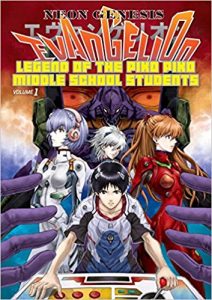
In my review of the Comic Tribute anthology (which I guess I did give a full review to), I noted that the stories by these creators were the best part of the book, so it makes sense that they’d get a chance to add more wacky humor and dense references. The “plot” is mostly irrelevant, but essentially we see NERV trying to defeat the Angels by training gaming nerds to defeat them, and Shinji, Asuka and Rei are the three biggest. What follows is a string of gags, both visual and verbal, which range from average to quite good, though I don’t know that I laughed out loud. Characterization is, for the most part, exaggerations of the “fanon” view, so Shinji is a bit meek and overserious, Asuka’s angry all the time, Rei is stoic, and Kaworu is super gay. But above all else, there’s the boke/tsukkomi comedy we’ve come to expect from Japan, and everyone (well, OK, just Shinji and Asuka) are quick with the retorts.
Those with an observant eye may note that Carl Horn adapted this himself, and it’s very much an adaptation in the nature of his Excel Saga work, i.e. he takes the original and crafts it into something else. If you like overly literal translations, you’ll hate this, but for the most part it works out very well, especially as the original is there to help, being filled with fourth wall breaking, bizarre gaming references, and stupid running gags (it’s just a t-shirt!). Adapting manga that’s solely devoted to comedy can be tricky, but they do a good job. Of course, the drawback is that there is only comedy here – if you like Evangelion for literally anything other than gags, you’re wasting a purchase with this. But the comedy is finny, everyone is exaggerated but not totally loathsome (except Gendo, of course), and the fanservice is surprisingly minimal, something actually pointed out by the characters as they lament their lack of a beach episode. Piko Piko Middle School Students is here to crack dumb jokes and chew bubblegum, and they’ve run out of bubblegum.


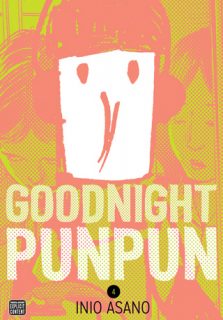

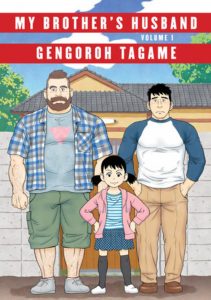 Yaichi is a single dad who works from home managing the rental property his parents left to him and his brother, Ryoji, after being killed in a car accident when the boys were teenagers. He considers his real job to be providing the best home he can to his daughter, Kana. On the day the story begins, Yaichi is expecting a guest—Mike Flanagan, the burly Canadian whom Ryoji married after leaving Japan ten years ago. Ryoji passed away the previous month and Mike has come to Japan to try to connect with Ryoji’s past and see for himself the many things he’d heard stories about from his husband.
 It’s the story of Minare Koda, a waitress with a gift of fluency that catches the attention of a local radio producer, Mato. After secretly recording her drunken rant about her thieving ex and playing it over the air, he eventually takes the chance of giving her her own weekly show in a late-night time spot where she has the freedom to do some really kooky things. The first episode, for example, is a surreal audio drama about murdering said ex, Mitsuo. The next week, it’s time to bury the body on Mt. Fuji!
 Yaichi is a single dad, earnestly raising his young daughter, Kana, whose life is upended by the arrival of Canadian visitor, Mike, husband to Yaichi’s estranged twin brother, Ryoji, who has just passed away. Yaichi greets Mike with awkwardness and not just a little homophobia, but is forced to invite him to stay after Kana, blissfully unaware of her father’s discomfort, insists that he must be welcomed into their home. Mike, stricken with grief, but anxious to connect with Ryoji’s family and childhood, gratefully accepts Yaichi’s grudging hospitality and settles into Ryoji’s old room.
  Asahi is spending a pleasant afternoon with her parents and she’s just about to go in and have some cookies when the backyard pond reaches out and ensares her, transporting her to another world. There, she meets a friendly boy named Subaru who unfortunately has some very ruthless parents, who immediately decide to offer Asahi to the water dragon god to obtain prosperity.
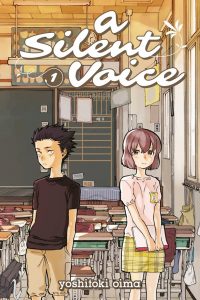 In elementary school, Shoya Ishida often engaged in foolhardy stunts to stave off boredom. When hearing impaired transfer student Shoko Nishimiya joins his class and causes disruption within the class, she becomes Shoya’s target. Initially, the other kids laugh at Shoya’s antics but when he goes too far and destroys several hearing aids to the tune of $14,000, they swiftly condemn him. Now he’s the one who’s ostracized and this status continues into high school, long after Shoko transferred out again. Full of self-loathing, he’s preparing to commit suicide, but a chance reunion with Shoko inspires him to try to change.
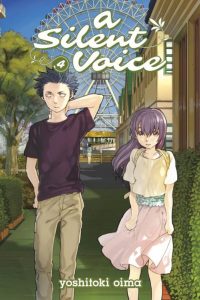 Back and forth things go, with this group continuing to try to establish themselves as friends without seeming to genuinely like each other much. Eventually, they decide to film a movie together. For one scene, they need to acquire permission to film at their old elementary school. Shoya is the unwilling emissary, and an encounter with his odious former teacher leaves him feeling so awful about himself that he ends up lashing out at all his friends, seemingly trying to drive them away as he feels he deserves. This has the unintended side effect of causing Shoko to feel like she’s the cause of his unhappiness, prompting a desperate act.
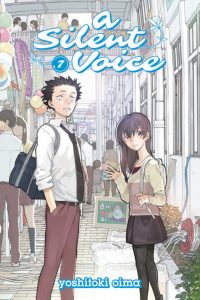 Less clear is what Oima was aiming for with their group of friends. Even though Naoka was far more outwardly nasty to Shoko, at least she was open about it and expressed a great deal of self-loathing because of her behavior. With the help of another friend, Miyoko, she is encouraged to have a bit more optimism, and will probably end up doing okay. Even though she could’ve been fleshed out further, I do like Naoka as a character. But man oh man, do I hate Miki. She makes everything about herself—at one point revising the bullying narrative so that she and Shoko were co-victims—and doesn’t seem to grow at all. Everything she does seems fake, because most of it is, and I was baffled when the boy she fancies declared her to be “kind” after some weepy episode. Miki should get hit by a bus.