• Skip to primary navigation
  • Skip to main content
  • Skip to primary sidebar
  • Home
  • About Us
    • Privacy Policy
    • Comment Policy
    • Disclosures & Disclaimers
  • Resources
    • Links, Essays & Articles
    • Fandomology!
    • CLAMP Directory
    • BlogRoll
  • Features & Columns
    • 3 Things Thursday
    • Adventures in the Key of Shoujo
    • Bit & Blips (game reviews)
    • BL BOOKRACK
    • Bookshelf Briefs
    • Bringing the Drama
    • Comic Conversion
    • Fanservice Friday
    • Going Digital
    • It Came From the Sinosphere
    • License This!
    • Magazine no Mori
    • My Week in Manga
    • OFF THE SHELF
    • Not By Manga Alone
    • PICK OF THE WEEK
    • Subtitles & Sensibility
    • Weekly Shonen Jump Recaps
  • Manga Moveable Feast
    • MMF Full Archive
    • Yun Kouga
    • CLAMP
    • Shojo Beat
    • Osamu Tezuka
    • Sailor Moon
    • Fruits Basket
    • Takehiko Inoue
    • Wild Adapter
    • One Piece
    • After School Nightmare
    • Karakuri Odette
    • Paradise Kiss
    • The Color Trilogy
    • To Terra…
    • Sexy Voice & Robo
  • Browse by Author
    • Sean Gaffney
    • Anna Neatrour
    • Michelle Smith
    • Katherine Dacey
    • MJ
    • Brigid Alverson
    • Travis Anderson
    • Phillip Anthony
    • Derek Bown
    • Jaci Dahlvang
    • Angela Eastman
    • Erica Friedman
    • Sara K.
    • Megan Purdy
    • Emily Snodgrass
    • Nancy Thistlethwaite
    • Eva Volin
    • David Welsh
  • MB Blogs
    • A Case Suitable For Treatment
    • Experiments in Manga
    • MangaBlog
    • The Manga Critic
    • Manga Report
    • Soliloquy in Blue
    • Manga Curmudgeon (archive)

Manga Bookshelf

Discussion, Resources, Roundtables, & Reviews

Archives for July 2014

Manga the Week of 8/6

July 31, 2014 by Sean Gaffney, Anna N, Ash Brown, Michelle Smith and MJ 5 Comments

SEAN: There is so much manga out in August it beggars belief. Over 50 different titles in the month. And the first week is the biggest. So buckle up.

ANNA: I can see myself undergoing some major psychological trauma trying to choose between titles for Pick of the Week.

SEAN: Dark Horse has nearly wrapped up Oh My Goddess, but it’s not there yet, so here’s Vol. 46.

There’s also the 4th Trigun Maximum omnibus, for those who want to be confused by the artwork over longer periods of time.

nightmare1

Seven Seas has the July title I discussed earlier, D-Frag! On the August end, so far so good, as we have a couple titles there as well. Alice in the Country of Joker: Nightmare Trilogy intrigues me, mostly as I wonder if we’ll see Joker, who hasn’t ventured much outside his one book.

There’s the third Dragonar Academy, which is a thing that exists.

There’s also a new series debuting, Kokoro Connect. As with D-Frag!, I’ve heard this is better than it sounds, and look forward to seeing how it stretches its basic high school comedy with the twist that is at the heart of its plot.

ASH: I’m actually rather curious about this one.

SEAN: And there’s another Witch Buster omnibus, for the manwha inclined.

Speaking of Manga-ish things, Udon Entertainment have out the first of their “Manga Classics” adaptations, in this case Pride & Prejudice and Les Miserables. The artists seem to be Chinese (I think?), but the style is certainly pure shoujo. I’ll be interested to see how compressed these adaptations are.

Vertical hits double digits with the 10th volume of Knights of Sidonia, which hopefully will not end with a third straight cliffhanger putting Izana in danger.

MICHELLE: I really will catch up with Knights of Sidonia, I swear!

ASH: Poor, poor Izana. Hang in there, you’re my favorite!

ANNA: I need to catch up too, it is a great series!

MJ: Yay! That’s all I have to say.

blackrosealice

SEAN: Hope you like Viz! Let’s start with the first of three debuts this week, the shoujo horror title Black Rose Alice. I understand it has vampires!

MICHELLE: I’m looking forward to this one! It’s by the creator of After School Nightmare.

ASH: Me, too! I’m a little burned out on vampires, but I’m making an exception for Black Rose Alice.

ANNA: I have read this and the vampires in Black Rose Alice are very different from the vampires people may be used to. As much as I love goofy vampire romance manga, I really enjoyed the surreal and odd elements of this title.

MJ: I’m very much looking forward to this, mainly on the strength of After School Nightmare, which is a long-time favorite of mine.

SEAN: Bleach hits Vol. 61, and I don’t think has had real vampires yet, though I’m sure we’ve seen the equivalent somewhere in its Rogue’s Gallery.

It was 2012 when we saw the last D.Gray-Man that wasn’t an omnibus. Rejoice! Vol. 24 is here!

I reviewed the first volume of Food Wars! when it came out digitally, noting the fanservice was appalling but the basic plot as quite fun. The print volume releases this week.

ASH: I’ve been waiting for the print release to give this one a try.

SEAN: The 7th Happy Marriage?! continues to test the validity of that title.

ANNA: Yay, more josei!

SEAN: And the third High School Debut 3-in-1 omnibus is more pure shoujo fun in a bargain package.

MICHELLE: Read it, y’all!

ANNA: I love this series, especially the fact that the hero Yoh always looks chronically sleep deprived.

kaze22

SEAN: The Excel Saga of shoujo, Kaze Hikaru, has its annual volume release! This is an awesome series that deserves more love, so I hope everyone goes out and buys it, if only so we can see it more than once a year.

MICHELLE: I concur 3,000%.

ASH: Kaze Hikaru is a great series.

ANNA: In a perfect world it would come out quarterly and dominate the manga best sellers list. It is wonderful.

SEAN: Nura: Rise of the Yokai Clan gets ready for its final arc as Vol. 22 arrives.

Yet another series that’s been a long while since a volume, Rosario x Vampire II gets lucky Vol. 13.

The last of our debuts this week is Spell of Desire. Midnight Secretary ends next month, so I suppose it’s a perfect time to bring in a new josei series by the same author (heavily disguised as shoujo).

MICHELLE: I liked the first volume of Spell of Desire more than I expected to. Maybe because the hunky guy is kind to kittens.

ANNA: I am delighted by this series, and the hilarious contrivance that results in the male lead having to make out with an innocent witch in order to control her magic.

SEAN: Toriko’s Vol. 23 continues to see our four young heroes pitted against deadly, world-destroying monsters. Also, there’s food.

Lastly, the 6th Voice Over: Seiyu Academy makes us wonder if we’ll ever get back to the supposed hero of the series.

Is this too much manga? Or not enough?

ASH: Never enough! (Also, never enough money…)
Filed Under: FEATURES, manga the week of

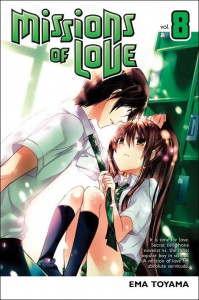
Missions of Love, Vol. 8

July 31, 2014 by Sean Gaffney

By Ema Toyama. Released in Japan as “Watashi ni xx Shinasai!” by Kodansha, serialization ongoing in the magazine Nakayoshi. Released in North America by Kodansha Comics.

I do enjoy mocking Missions of Love when I discuss it in my Manga the week of and Pick of the Week posts, saying that it’s gleefully trsahy and soap-operaish and that it’s like mainlining shoujo heroin. Which is true, but I worry that people may think this means that I’m enjoying it ironically in a Sharknado sort of way, and that could not be further from the truth. Trust me when I say that Missions of Love is an excellently crafted title that is a lot of fun to read. It just happens to also be gleefully trashy, etc. This new volume is particularly good in showing off the reasons why I enjoy it.

missions8

The big development in this volume is the return of Yukina’s preschool teacher, the one whose remark about her eyes led to a major breakdown by our heroine. Toyama has come back to this occasionally over the course of the series, usually when trying to give Shigure the upper hand by having him take off Yukina’s glasses. Now she runs across her former teacher (who looks as if he hasn’t aged a day in the last 10-11 years), and everything comes rushing back… including her old feelings, as she now realizes that the reason that his comment hurt so much is that she was in love with him. This is then followed by Shigure realizing that, although he’s dated a lot of women casually before, Yukina is the one who is *his* first real love.

Part of the reason this manga is so addictive is that the characters can turn personalities on a dime. This makes sense; they’re middle schoolers in love, at just the right sort of age where all that is still malleable. I know there were a few reviewers (possibly including me) who were very happy with Yukina as the ‘snow princess’ sort who did not understand this Earth thing called kissing, but she’s merely emotionally repressed, not emotionally stunted. When she loses control, as we see a few times in this volume, it can be quite explosive. (And quite erotic, as Shigure also finds. I’ve noted before that the style of this work seems to edge towards the top end of Nakayoshi’s readership… there’s nothing explicit, but there’s some very hot and heavy kissing here.)

The major surprise of the book comes towards the end, however. Yukina is now determined to repair the relationship with her old teacher, or at least tell him what happened. A jealous Shigure goes to confront him first… and finds the teacher is very adept at finding out who Shigure is, and equally adept at a ‘false front’. It’s menacing to Shigure, yes, but I appreciated the teacher noting that it’s Yukina’s decision about what to do with her life, and that neither Shigure nor Akira can make it for her. This is something you don’t often see in this genre, and it’s appreciated.

I didn’t even mention Akira and Mami much, who provide what is both the funniest and most heartwarming scene in the entire volume. (They’d clearly make a great couple once they get over their first loves.) Mami’s Yukina impression is AMAZING. And let’s not forget Yukina attempting to ask Mami’s advice by dragging her headfirst out of a classroom window. In case you were worried about the cast turning normal now that the romance has heated up, don’t worry, they’re all still strange. So while this still feels like it should be bad for you, read it anyway, because it’s damn tasty.

Filed Under: REVIEWS

Manga Giveaway: Mecha Manga Giveaway (Bokurano)

July 30, 2014 by Ash Brown

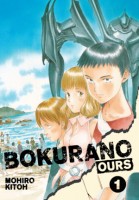
It’s the end of the month and therefore the start of another manga giveaway here at Experiments in Manga! For July’s giveaway you all have a chance to win the first volume in Mohiro Kito’s manga series Bokurano: Ours as published by Viz Media. As always, the giveaway is open worldwide!

Bokurano: Ours, Volume 1

I don’t know what it is about mecha manga and anime. For some bizarre reason, I never think that I’m going to like it, but I almost always end up enjoying what I pick up. Maybe my reluctance comes from the feeling that there’s just so much of it, giving the impression that the genre has been overdone and is lacking in originality. That’s a somewhat unfair train of thought on my part. Most well-established genres have the problem where a great deal of the media just isn’t very good or particularly notable, but they all have their gems.

Anyway. I recently started reading Mohiro Kito’s Bokurano: Ours, Volume 1, which is one of the more unusual mecha stories that I’ve come across. Granted, I haven’t gotten very far into the series yet, but I am liking its dark atmosphere and prominent psychological elements. Plus, it ran in IKKI, a magazine that publishes some manga that I really love. (And which sadly recently announced that it will be suspending publication in September.)

So, you may be wondering, how can you win a copy of Bokurano: Ours, Volume 1?

1) In the comments below, tell me a little about your favorite mecha manga, if you have one. (Never read mecha? Simply mention that.)
2) If you’re on Twitter, you can earn a bonus entry by tweeting about the contest. Make sure to include a link to this post and @PhoenixTerran (that’s me).

And there it is! Each person can earn up to two entries for this giveaway. As usual, everyone has one week to submit comments. If you prefer or have trouble with the comment form, entries may also be submitted via e-mail to phoenixterran(at)gmail(dot)com. (I will then post the entry in your name.) The giveaway winner will be randomly selected and announced on August 6, 2014. Good luck to you all!

VERY IMPORTANT: Include some way that I can contact you. This can be an e-mail address, a link to your website, Twitter username, or whatever. If I can’t figure out how to get a hold of you and you win, I’ll just draw another name.

Contest winner announced–Manga Giveaway: Mecha Manga Giveaway Winner

Filed Under: FEATURES Tagged With: Bokurano, manga, Mohiro Kito

Bookshelf Briefs 7/29/14

July 29, 2014 by Sean Gaffney, Michelle Smith and Anna N Leave a Comment

This week, Sean, Anna, & Michelle look at recent releases from Seven Seas, Harlequin, Viz Media, Kodansha Comics, & Vertical, Inc.

knightsknowledge1Alice in the Country of Clover: Knight’s Knowledge, Vol. 1 | By QuinRose and Sai Asai | Seven Seas – This is an Alice book, and you all know the drill by now. Reasons to check this out: 1) A better look at Alice’s feelings about moving to Clover than Cheshire Cat Waltz had; 2) Despite being an Ace book, showing everyone in love with Alice and trying their damnedest to win her, rather than just giving up when they see who the protagonist of the series is; Ace and Alice’s feelings for each other being unhealthy as hell, something both of them know but only Alice regrets. Other than that, it’s business as usual, with a new artist but the same basic shape, and lots of running around and getting stressed out from our heroine. Buy if you like the Alice series. -Sean Gaffney

ICO002113P_1The Amalfi Bride | Marito Ai and Ann Major | Harlequin – The strongest thing about this Harlequin manga is the price tag at only 99 cents! It is a passable middle of the road Harlequin title, but I found myself distracted by the very poor quality of the lettering. Regina is a uptight woman on vacation when she spots a devastatingly handsome man embracing an older woman. She assumes that the handsome man is a gigolo and proceeds to engage his services, while he assumes that they’re on a whirlwind date. It will not surprise regular Harlequin readers that Nico is secretly a Prince trying to run away from an arranged marriage. The character designs are attractive, but the illustrations aren’t very detailed. Still, for only a dollar, this is a decent Harlequin manga to try even though it ends up being somewhat forgettable. – Anna N

foodwars1Food Wars!: Shokugeki no Soma, Vol. 1 | Story by Yuto Tsukuda, Art by Shun Saeki | Viz Media – Fifteen-year-old Soma Yukihira is a talented chef who’s serious about improving his skills and exploring new flavors. But when his father learns Soma plans to do so at their family restaurant, he decides to close up shop and sends his son off to Totsuki Saryo Culinary Institute, the most elite culinary school in Japan. While a Shonen Jump-style cooking manga definitely has appeal, what I noticed most about Food Wars! was how much it reminded me of other things. We’ve got a cocky protagonist with a rivalry with his potentially super-famous dad (The Prince of Tennis), over-the-top reaction shots to food-tasting (Yakitate!! Japan), and a character with a palate so sophisticated she sees visions when she tastes things (Drops of God). Plus, there’s fanservice. Still, it was entertaining enough that I’ll continue reading it and hope it evolves more of its own voice. – Michelle Smith

rin-ne-15Rin-Ne, Vol. 15 | By Rumiko Takahashi | Viz Media – The danger of a series like Rin-Ne, where nothing really changes, nothing ever advances, and all is sacrificed to appease the great god Comedy, is that when a serious plot *does* show up, you keep waiting for the other shoe to drop, knowing that it’s going to end with some anticlimax that will have people face-faulting with their fingers in the air. It’s just how Takahashi rolls. Despite this, the final story in this volume, which shows Renge’s fall from grace (one guess who’s to blame, and the first one doesn’t count) and her tortured crush on Kain is briefly rather heartbreaking, and you wonder if, not being the two leads, they might actually work something out. Alas, status quo. Such is the way when you worship the god of Comedy. – Sean Gaffney

sevendeadly3The Seven Deadly Sins, Vol. 3 | By Nakaba Suzuki | Kodansha Comics – We’ve already seen that the look of the Sins don’t necessarily match the sketch on their wanted poster, but the introduction of King in this volume goes one step further; he genuinely is different, to the point where Ban, who he has a new, deadly grudge against, doesn’t even recognize him. The battle between the two of them is the highlight of the volume, showing off both personalities and teasing a backstory while not quite spelling it all out. The lowlight of the volume is the non-death of Sennett’s father, killed off in the last volume and back to life for no good reason except it would be too sad. Don’t pull your punches, Suzuki. Other than that, we’re still setting up the plot. Not bad. – Sean Gaffney

spell1Spell of Desire, Vol. 1 | By Tomu Ohmi | Viz Media – Kaoruko Mochizuki leads a quiet life running an herb shop in a small port town. This all changes when black-clad Kaname Hibiki shows up and announces, “I serve your mother and I am here to protect you.” As it turns out, the mother who abandoned Kaoruko as an infant went off to become the leader of a worldwide coven of black witches, and she has now transferred her powers to her daughter. Kaoruko has trouble controlling them, but never fear, Kaname can get her to calm down with his magical powers of smooching! Actually, though, I liked Spell of Desire more than I thought I would. Kaoruko is a likable protagonist, and although Kaname is clearly interested in bedding her, he’s not one of those creepy, domineering types. Plus, he carefully tends to sick kittens! In the end, this is rather unexpectedly recommended. – Michelle Smith

yesterday2What Did You eat Yesterday?, Vol. 2 | By Fumi Yoshinaga | Vertical, Inc.– The second volume of this manga focuses a bit more on the food preparation than the character development, but there are still the great slice of life moments that I love, like Shiro’s quiet exhilaration about perfectly planning his menu so he doesn’t waste any food and some quick glimpses into how Shiro and Kenji first started dating and living together. The meals and dishes describe give me the vicarious pleasure of reading a cookbook and learning about recipes I will likely never prepare. Am I the only one who sometimes reads cookbooks even if I’m not going to actually cook? Recommended as always. – Anna N

eat3What Did You eat Yesterday?, Vol. 3 | By Fumi Yoshinaga | Vertical, Inc. – Most of the plot of this cooking manga tends to revolve around Shiro, who has more flaws and less maturity than his partner Kenji. In particular, he still can’t quite deal with his parents, particularly now that they seem more accepting of his relationship than they were previously. It’s even spilling over into his workplace, where he’s usually level-headed and together, but dealing with a cute young intern (who his co-workers, knowing he’s single but not that he’s gay, thinks he’ll score with) proves beyond him. Luckily, he’s still master of grocery shopping and cooking in general, otherwise most of this volume would have been me shouting “You big loser!” over and over again. – Sean Gaffney

Filed Under: Bookshelf Briefs

Pick of the Week: Kodansha-fest

July 29, 2014 by Sean Gaffney, Michelle Smith, Ash Brown and Anna N Leave a Comment

potwSEAN: It’s still hot and muggy, and I now have poison ivy on top of it. I don’t need quality. I need manga pixie sticks. Ergo, there’s one obvious choice for my pick of the week: Missions of Love. Betcha can’t read just one. And feel good about yourself the next day.

MICHELLE: It’s true; even I read the first two volumes. My pick of the week goes to the third volume of My Little Monster, which has impressed me with the characterization of its lead and by making the traditional romance beats feel refreshed. I’ve really been enjoying it so far.

ASH: I’ll stick with the Kodansha theme and pick the fourth omnibus of Vinland Saga, one of my favorite series being released right now. I liked the first omnibus but loved the next two, so I’m really looking forward to seeing how the characters and story continute to develop.

ANNA: I have to agree with Ash! Vinland Saga is easily the standout title for me this week too.

What looks good to you this week?

Filed Under: PICK OF THE WEEK

Accel World: Kuroyukihime’s Return

July 29, 2014 by Sean Gaffney

By Reki Kawahara and Hima. Released in Japan by ASCII Mediaworks. Released in North America by Yen Press.

This is the other major series that Kawahara has written, after Sword Art Online, and it’s interesting to see how the two series compare and contrast. SAO was written 6 years earlier and published online as a web novel, and only picked up for publication once Accel World won a major award. So it’s likely that this is the series that really kickstarted his career, with SAO along for the ride, though I’d argue that SAO is currently more popular than Accel World. And I can see why this book did well: it’s a strong first volume, barring a few hiccups, with a hero who is meant to be a definite contrast to the generic male lead that Kirito proves to be much of the time.

accel1

And right there is hiccup Nunber One, as we get yet another volume I can’t read on public transit. The cast of Accel World are all 13-14 years old, this time mostly for plot reasons, but there’s still the same amount of fanservice and sexualization you tend to get in series like these. Just as the Fairy Dance manga had Kirito’s younger sister showering for the benefit of readers, here we get the hero imagining Kuroyukihime in the shower. While I’m at it, I might as well bring up hiccup number two, which is the presentation of the villain of this volume, Cyan Pile. Kawahara seems to have trouble with villains in general, but here in particular it suffers from us barely getting to know this character at all before the big revelation, and therefore the emotional torture that should be there (and is written as if we feel it) simply isn’t.

That said, there’s a lot to like here as well. Let’s start with the hero. The author has apparently said in interviews that Kirito and Haruyuki were meant to contrast with each other, and that’s certainly evident here. Short, fat, and with an incredibly negative self-image, Haruyuki is so far away from the typical harem protagonist that he is completely unable to notice that he has two girls crushing on him over the course of this volume. His only skill (which, given this is another series about a virtual gaming world, proves to be highly important) is his speed and agility when playing virtual squash in a court no one ever goes to (so he doesn’t have to deal with people). This brings him to the attention of Kuroyukihime (real name deliberately not given, though there are hints), who tells him about a game, Brain Burst, that may allow him to achieve amazing things.

The game is the other success of this series, after seeing the generic RPG world of Sword Art Online. Much time is devoted to how to play it and strategy, and we see right away that Haruyuki is very good at thinking on the fly and coming up with solutions in battle. (Well, almost right away… he gets his ass kicked the first time. There are rules.) That said, I think that the main reason I liked this so much (and I did really enjoy SAO too, if you’ll recall), is that it’s a book that shows the skills the author has developed in the 6 years between that book and this one. It just reads easily. It’s a light novel, with all the cliches that this entails, so don’t read it if you dislike those sorts of cliches. But most fans of the genre should enjoy this, and I’m interested to see where it goes with Haruyuki.

Filed Under: REVIEWS

My Week in Manga: July 21-July 27, 2014

July 28, 2014 by Ash Brown

My News and Reviews

It wasn’t entirely intentional, but last week Experiments in Manga ended up being full of Vertical reviews. (And by full, I mean that two reviews were posted.) The first was of Fumi Yoshinaga’s gay slice-of-life and food manga What Did You Eat Yesterday?, Volume 3. With each volume that is released, I fall in love with the series a little more. I also reviewed Yoshikazu Yasuhiko’s Mobile Suit Gundam: The Origin, Volume 6: To War which continues to delve into the pasts of the characters and the war between the Earth Federation and the Principality of Zeon. The volume also features Char quite a bit. (I’ll admit, that made me happy.)

Elsewhere online, The Lobster Dance posted the seventh and final part of “Revealing and Concealing Identities: Cross-Dressing in Anime and Manga.” Kathryn Hemmann, the co-author, has a nice roundup and summary of the multi-part essay, and Leah has some final comments of her own as well. San Diego Comic Con was last week, which means the winners of the 2014 Eisner Awards were named (spoilers: Osamu Tezuka and Hayao Miyazaki were honored) and new manga licenses from Drawn & Quarterly, Kodansha Comics, and Udon Entertainment were announced. Also, the list from the Best & Worst Manga panel has been posted, with more commentary on the choices planned to be posted at a later date.

Quick Takes

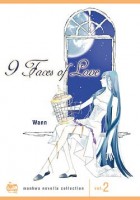
9 Faces of Love9 Faces of Love by Wann. As can probably be gathered from its title, 9 Faces of Love is a collection of nine short manhwa dealing with themes of love and the meaning of love. 9 Faces of Love is the second volume in Netcomics’ Manhwa Novella Collection series which is meant to feature short works by prominent Korean creators. I hadn’t previously read any of Wann’s works, but I’d definitely be interested in reading more; I really enjoyed 9 Faces of Love. It’s an excellent collection of short manhwa selected from Wann’s work between 1998 and 2005. Most of the stories deal with romantic love, but a few of them also deal with friendship and familial love. I initially picked up the volume for the android story “Automaton,” which happily ended up being quite good. While they deal with similar themes, there is a nice variety to the stories in 9 Faces of Love. Many incorporate science fiction, fantasy, or horror elements while others are more firmly grounded in reality. Some are sweet, some are sad, and some are actually somewhat disconcerting.

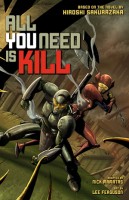
All You Need Is KillAll You Need is Kill adapted by Nick Mamatas, illustrated by Lee Ferguson and Fajar Buana. A few years ago I read Hiroshi Sakurazaka’s All You Need Is Kill light novel and greatly enjoyed it. So I was rather curious when Haikasoru announced a graphic novel adaptation, the release conveniently timed to coincide with the Hollywood film adaptation Edge of Tomorrow. (Granted, I was much more interested in Takeshi Obata’s All You Need Is Kill manga which has now also been licensed.) Sadly, I was rather disappointed with the graphic novel. I’m not sure that anyone who hasn’t read the original would be able to follow the comic very easily or make sense of the importance of some of the scenes that were included. For example, I loved the umeboshi eating contest in the novel, but in the comic it’s difficult to realize that that’s what’s going on or why it matters. Romantic elements are introduced at the end more as an afterthought in an effort to neatly tie things together, but it’s a little too late by that point. For the most part the artwork was decent, but the battle suit design left something to be desired. I did like the color palette used, though. My copy of the graphic novel also had a printing error. At least I’m assuming it was an error—one of the signatures was repeated. Though, I suppose that does emphasize the plot’s time loop.

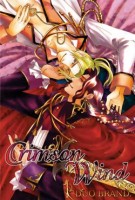
Crimson WindCrimson Wind by Duo Brand. A follow-up to White Guardian, Crimson Wind starts out as a sequel but really ends up being more of a prequel. The majority of the manga explores the backstories of General Sei and Baron Touri and their relationship with each other. Except for his attractive character design, I didn’t like Touri much at all in White Guardian and I like him even less in Crimson Wind. He’s a rapist and possessive, resorting to drugging the object of his desire when coercion and force isn’t enough to get what he wants. It’s not at all romantic even though Sei ends up falling for him. Most of the court intrigue and politics that made White Guardian interesting have been dropped in Crimson Spell; only the dubious love story remains. I would have much rather have seen the tale of how Sei became disillusioned and unhappy with the kingdom he pledged his life to protect. I may not have enjoyed the main story of Crimson Wind, however I really liked the short side story “Never Ever” which concludes the volume and features two completely different character who actually care for and respect each other.

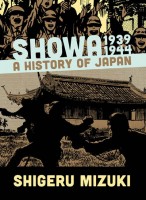
Showa: A History of Japan, 1939-1944Showa: A History of Japan, 1939-1944 by Shigeru Mizuki. With this volume of Showa: A History of Japan the manga begins to cover history that I’m a little more familiar with—the Pacific War. While the factual recounting of the events that led up to the war and the war itself is well told, what makes the series particularly engaging is the incorporation of Mizuki’s own experiences as a student and eventually as a drafted soldier during the time period. The artwork in Showa: A History of Japan easily slips between photorealism and more stylized drawings to very good effect. Mizuki’s illustrations of naval and sea battles are particularly impressive and he uses some very interesting two-page layouts for many of them. He conveys the reality of war but doesn’t glorify it or the numerous deaths, treating the combatants of both sides of the conflict with respect. Mizuki’s Eisner-winning, semi-autobiographical Onward Towards Our Noble Deaths (also available from Drawn & Quarterly), which deals with a similar time period and story, makes an excellent companion to this volume of Showa: A History of Japan.

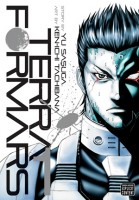
Terra Formars, Volume 1Terra Formars, Volume 1 written by Yu Sasuga and illustrated by Ken-ichi Tachibana. I have a peculiar love for Mars, and so when a manga has anything to do with the planet, however slight, it immediately catches my attention. I was looking forward to Terra Formars and really liked its basic premise. Efforts to terraform Mars using moss and cockroaches over hundreds of years has largely been successful, but now humans have a bit of a bug problem to deal with seeing as the cockroaches have evolved into a sentient race. Genetic experimentation has also allowed human and insect DNA to be combined, creating humans with bug-inspired superpowers. (Admittedly ridiculous, but kind of cool.) Terra Formars is an extremely violent and action-heavy manga requiring a tremendous amount of suspension of disbelief from it readers. There were parts of the manga that I loved, like the fight sequence paired with biblical verses about locusts. However, I really dislike the design of the cockroaches (inspired by Homo erectus), and not just because they’re unintentionally reminiscent of racist caricatures. They seem more mammalian than insectoid and feel out-of-place art-wise. At this point I’m torn over the series, but I’ll probably give it another volume or two to see what direction it takes.

GinTamaGin Tama, Episodes 50-74 directed by Shinji Takamatsu. It’s been a while since I’ve watched any of the Gin Tama anime, but I do like the series. I was in the mood for some absurd humor and antics, and so ended up binging on the first half of the second season. Like the manga which it more-or-less follows, the anime is mostly episodic. Occasionally there will be a set of episodes that form a larger story arc, but generally once someone is familiar with the characters and recurring jokes it doesn’t much matter in which order the anime is watched. Gin Tama is a series rife with parodies of and references to other pop culture media. (Mostly but not exclusively Japanese pop culture.) I’ve always been highly amused by Gin Tama, but the more manga that I read and the more anime that I watch the more of references I catch and appreciate. My interest in Japanese history has come in handy, too, since there are plenty of nods to historical figures and events in Gin Tama as well. For a comedy series, at times Gin Tama can also be surprisingly touching.

Filed Under: FEATURES, My Week in Manga Tagged With: All You Need Is Kill, anime, comics, Duo Brand, Fajar Buana, gin tama, Ken-ichi Tachibana, Lee Ferguson, manga, manhwa, Nick Mamatas, Shigeru Mizuki, Showa: A History of Japan, Terra Formars, Wann, Yu Sasuga

SDCC License Roundup

July 28, 2014 by Sean Gaffney

I was surprised at a couple of announcements at this year’s SDCC, enough that it deserves a new License Roundup post! I’ll start with Viz, who had no new titles (this is typical; they usually offload new licenses at AX), but who did note that the final Evangelion manga will be simultaneously published with Japan, just as they did with Vol. 13.

Kodansha had two new titles to announce this year, both of which are worth getting a bit excited about. The unsurprising one is Waltz no Ojikan, the new series by Natsumi Ando, creator of Kitchen Princess and Arisa. It’s a ballroom dancing manga, which I am pleased by, and is currently running in Nakayoshi.

Yamada-kun_to_7-nin_no_Majo_vol01_Cover

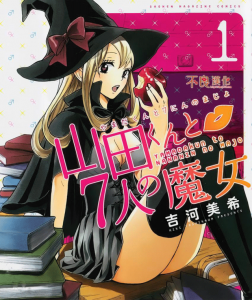
On the shonen side, we have a title that you can already find on Crunchyroll, but is now getting a print edition: Yamada-kun to 7-nin no Majo. I was very fond of the author’s previous series, Yankee-kun to Megane-chan, but it was a bit too long and had a bit too many delinquents for the NA market. This new series is also edging on the long side, but it has supernatural elements to it, and that’s usually enough in this day and age. it’s also funny, and sweet, and you get caught up in its plot quite a bit. Can’t wait.

Udon surprised a few of us. While they have made some entries in the manga market, primarily their focus has been on large, expensive artbooks, usually tying in with Capcom. This time, though, they have manga. And not just any manga: Kill La Kill, the hot new anime series from last year. the manga adaptation runs in Kadokawa Shoten’s Young Ace, and I have no doubt will be filled with action, yelling, and fanservice. Udon also announced three more of their ‘manga classics’ series, the first two of which debut next month. We’ll see The Scarlet Letter, Great Expectations, and Emma.

Digital Manga Publising unfortunately had to cancel their panel, but it does remind me that I forgot to mention on the AX roundup that they said the first digital Tezuka they’ll be doing is Mr. Cactus, a 1950s cowboy adventure.

Lastly, Drawn & Quarterly continue their excellent partnership with Shigeru Mizuki, as we see the release of Hitler, his biography of the Nazi leader, sometime in spring 2015. The other title is Trash Market, a collection of short stories by Tadao Tsuge, the brother of more famous avant-garde mangaka Yoshiharu Tsuge. If you like Garo-esque titles (or even know what Garo is), you should pick this one up.

Which of these interests you most?

Filed Under: NEWS, UNSHELVED

Umineko: When They Cry, Vol. 7

July 27, 2014 by Sean Gaffney

Story by Ryukishi07; Art by Soichiro. Released in Japan in two separate volumes as “Umineko no Naku Koro ni: Alliance of the Golden Witch” by Square Enix, serialized in the magazine Gangan Online. Released in North America by Yen Press.

Umineko is in many ways a dark mirror of Higurashi: When They Cry, and so it makes sense that we would switch protagonists at this point. In Higurashi, after three arcs following the POV of Keiichi Maebara, the fourth arc gave us a new character, Mamoru Akasaka, and saw how he interacted with a younger Hinamizawa during the dam wars. Umineko likewise switches away from Battler to a degree, bringing his younger sister Ange, now an 18-year-old, into the story. Ange is a lot more invested in what happened on the island, though, and is also far more biased in her viewpoints than Akasaka was. The first 4/5 of this book deal solely with Ange in two different time periods: as a teenager being bullied in her private school (the same school Shion attended, by the way), and as an 18-year-old in 1998, dealing with the fallout from Eva’s death and trying to find out what happened 12 years earlier.

umineko4-1

The first thing that comes to mind about this adaptation is how rearranged everything is from the original sound novel. In the Alliance novel, we intersperse Battler and Beatrice’s game with Ange throughout, never losing sight of their part in the narrative. Here, we get nothing but Ange (and Maria) for almost the entire volume, only coming back to Beatrice right as Ange is joining their game as “Gretel”. It makes it seem like this has become Ange’s story. But unlike Higurashi, where switching to a story focused on Rika showed off how she was becoming the main protagonist soon, Ange is never quite going to be the star. A large part of the narrative, yes, but it’s Beatrice and Battler’s story. Unlike, say, Kino no Tabi, it’s clear that Ryukishi07 approved of the rearranging of events here. But it does mean that we approach things from a different perspective, downplaying what’s happening in 1986 in favor of the events of 1998.

Speaking of that, while Higurashi had a brief manga-only flash-forward showing a surviving Shion trying to go on after everyone’s death, the main storyline of the visual novels never quite showed off a future of “everyone is dead and you really can’t change the future easily at all” like this does. Bernkastel notes she’ll search for a fragment where Ange’s family survives, but that it’s odds are infinitesimally small. Ange and Battler are both approaching the narrative, albeit in different ways, in a Higurashi perspective: if I figure out what happened, I can fix it so it never does. Umineko being partly a deconstruction of Higurashi, it’s not going to be as simple as that.

Be warned there is a lot of discussion of bullying here, both of Maria and Ange, though Ange gets the brunt of it. It’s actually intertwined with the discussion of magic, and who has the potential to be really good at it. Much as the 3rd arc was excellent at showing us what “Beatrice” can really be, this arc delves into the actual state of “magic” in the Umineko world, and what it can be used for. Ange gets to the point where she can conjure up one of the Seven Stakes, Mammon, to float around with her and be her friend, but she can’t really interact with anything. This is in contrast to Maria, who can make a stuffed bear like Sakutarou come to life, or Beatrice, who can then give Sakutarou human form.

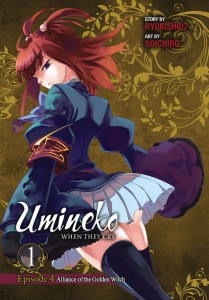
Aside from moving events around a bit, there are a few things I’m a little annoyed about with this adaptation. The fanservice which is never too far away from all of Ryukishi07’s works is shown off a lot here, possibly in celebration of the fact that this volume doesn’t have to deal with the adults at all. Right on the front cover we see a flash of Ange’s ass, and the stakes, particularly Mammon, are very fond of showing off their bodies to the reader. And while the sound novel has Ange discussing getting her family back quite a bit, the manga makes it seem several times as though it’s Battler who she’s really concerned with. This, of course, allows her to have a “brother complex”, one of Japan’s favorite motifs.

I haven’t mentioned the non-island adults in this volume, several of whom may surprise Higurashi readers. Okonogi is back, and this time he seems to be Ange’s ally… although, being Okonogi, he’s also Kasumi’s ally as well. Ryukishi07 enjoys playing with his readers like this, particularly as the Higurashi reader is inclined to mistrust everything he says, just as they’re drawn towards Bernkastel as “Rika”. Ange’s bodyguard was also spotted in the final Higurashi manga, though there he was working for the enemy trying to kill our heroes. Phew. Thank God he’s on Ange’s side now. As for Kasumi Sumadera, Kyrie’s younger sister, she’s shown to be almost completely insane from the get go. Which does at least lend itself to some amusing expressions.

As we wrap up this first omnibus, we’re about to start the game proper at long last, leading one to wonder if this one will finally let us see Kyrie the way the other three arcs focused on Natsuhi, Rosa and Eva? Will battler, with the addition of Ange/Gretel, be any better at figuring things out from the hints Beatrice drops? Will Beatrice and Battler continue to be an adorable love/hate couple? What the hell does Bernkastel want here? And can Ange, Maria, or Beatrice manage to escape the situations that have left them in despair? We’ll see next time around.

Filed Under: REVIEWS

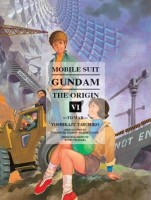
Mobile Suit Gundam: The Origin, Vol. 6: To War

July 25, 2014 by Ash Brown

Mobile Suit Gundam: The Origin, Volume 6: To WarCreator: Yoshikazu Yasuhiko
Original story: Yoshiyuki Tomino and Hajime Yatate

U.S. publisher: Vertical
ISBN: 9781939130204
Released: June 2014
Original release: 2010

While I don’t necessarily consider myself to be a fan of the massive Gundam franchise as a whole, I do think that it’s safe at this point to call myself a fan of Yoshikazu Yasuhiko’s manga series Mobile Suit Gundam: The Origin. This actually doesn’t surprise me too greatly as I already knew that I enjoyed other manga by Yasuhiko. The Origin is a retelling and expansion of the original 1979 anime series Mobile Suit Gundam which Yasuhiko also worked on. Part of The Origin was initially released in English by Viz Media, but the series is now being published by Vertical in a deluxe, hardcover format based on the Japanese collector’s edition of the manga. Mobile Suit Gundam: The Origin, Volume 6: To War was originally published in Japan in 2010 while the English translation was released in 2014. Due to licensing restrictions, the bonus content in this particular volume is fairly limited–only two color pieces by Yasuhiko, one of which is the basis for the cover art. Otherwise, To War easily meets the high standards of quality set by the previous volumes.

After the death of the anti-Federation leader Zeon Zum Deikun the political situation on Side 3 was thrown into turmoil as House Zabi and House Ral maneuvered for dominance. Caught up in the power struggle were Deikun’s two young children–Casval and Artesia–who ultimately were forced to live in exile, hiding who they really were. But now Casval has taken on another identity in order to seek his revenge against House Zabi, enrolling in Zeon Academy’s Space Force Officer Training School as Char. While at the academy he manages to befriend Garma, the youngest scion of House Zabi, the two of them becoming rivals in the classroom as well as out in the field. At the same time, tension continues to mount between Side 3 and the Earth Federation, the cries for independence growing louder and more violent. As the situation becomes more volatile all-out war between the two factions becomes increasingly more likely. House Zabi has already begun developing mobile suits for use in battle; the Federation is steadily falling behind technologically in the arms race which will determine the fate of humanity.

By this point in The Origin it has been well established just how incredibly capable Char is, both physically and mentally. He is extraordinarily calculating and a master manipulator, taking advantage of events as they develop and influencing the people around him, often without them realizing entirely what is happening. Char’s relationship with Garma is one of the main focuses of To War. Although it is already known that it will end very poorly for Garma, it’s interesting to see the complexities of their friendship–if that’s what it can really be called. There are moments in To War when Char seems to exhibit genuine kindness and affection towards Garma, but at the same time he never wavers from his ultimate goal and desire for revenge, aiming for the complete destruction of House Zabi. Perhaps what Char is really showing is arrogance and pity. Either way, the scenes are striking because there are no witnesses to Char’s actions; they serve as examples of the very few incidences in which Char’s behavior has not been carefully and completely crafted and calculated for a very specific purpose.

Though they are certainly an important part of The Origin, the developing relationship between Garma and Char and Char’s personal vendetta and war against House Zabi are actually small pieces of a much larger story. Yasuhiko’s multilayered approach to The Origin–showing how the private struggles of the individual characters dovetail with the more far-reaching events and the unstoppable progress of the war–is one of the things that makes the series so effective. In addition to the continued characterization, Yasuhiko also pays close attention to technological advances and weapons development in The Origin and what those mean for the impending war. To War also includes the first mobile suit battle between the Earth Federation and the Principality of Zeon, a critical turning point in its crusade for independence and domination. The gears of war will continue to turn and the personal and political machinations behind it will continue to advance in the next volume, Battle of Loum, as more is revealed about the characters and their pasts.

Filed Under: REVIEWS Tagged With: Gundam, Hajime Yatate, manga, vertical, Yoshikazu Yasuhiko, Yoshiyuki Tomino

Manga the Week of 7/30

July 24, 2014 by Sean Gaffney, Ash Brown, Michelle Smith, MJ and Anna N Leave a Comment

SEAN: A 5th week of the month is usually sparse, but we do have a few interesting things due out at the tail end of July.

anomal

Gen Manga offers you a choice of Indie Manga. Either you will think that One Is Enough, or perhaps you’d rather be with an Anomal. Choose wisely. (They do both look intriguing.)

ASH: You’re making me choose between boys’ love and yokai?! Sean, now that’s just mean.

MICHELLE: Wow, it occurs to me I haven’t read any boys’ love in ages.

MJ: Same here, and this needs to be rectified.

SEAN: If you prefer your manga a little more insane soap opera-ish, Kodansha gives you the 8th Missions of Love volume.

ASH: I’ll admit to actually enjoying Missions of Love. So much drama!

SEAN: They also have the third My Little Monster manga, where the heroine will no doubt stick to her promise to herself not to get involved with love. Aheh.

MICHELLE: This is the one thing from this week that I’ll definitely be picking up.

SEAN: And there’s also the 4th volume of Vinland Saga, which I suspect may get a lot of people excited, because Vikings make everything better.

ASH: I’m excited!! Vinland Saga is easily my favorite series being released by Kodansha at the moment.

ANNA: Vinland Saga is great. This reminds me that I need to read the copy of volume 3 that I’ve been saving for a day when I need to read about violence and Vikings.

SEAN: Seven Seas has been having a bad July in terms of ship dates. I mentioned Devils and Realist 2 earlier this month, it’s actually been moved back to next week.

ANNA: The first volume was pretty good. I’m curious to see if the main joke in the book gets a bit repetitive in the second volume.

SEAN: Lastly, Vertical has the 5th volume of sci-fi thriller From the New World.

What manga goes best with hot dogs and sauerkraut?

Filed Under: FEATURES, manga the week of

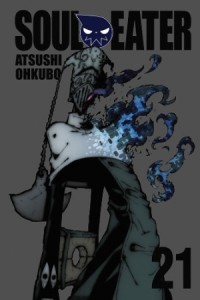
Soul Eater, Vol. 21

July 24, 2014 by Sean Gaffney

By Atsushi Ohkubo. Released in Japan by Square Enix, serialized in the magazine Shonen Gangan. Released in North America by Yen Press.

After the horror of the final chapter in Volume 20, I think readers needed a break, so it was nice to see the Spartoi out on a normal silly mission to help some Moby Dick-esque villagers harpoon a giant sky whale (ethics of this aside). It’s sort of a last hurrah for simple missions, and for that matter a last hurrah for Black*Star doing something dumb and silly. Because things are coming to a climax, and this volume’s cover is even darker than the grey of last volume, so we know things are going to get even worse, starting from when the group returns to find that an order has been given to have Crona executed.

souleater21

I like that the ethics of this are debated somewhat, and it’s clear that Maka wants a chance to talk Crona down from the insanity (this despite, as has been pointed out, by this point Crona has killed an ENTIRE CITY). And it’s a sign of Kid’s maturity that he allows them to do this rather than sticking to the strict letter of the law. (Speaking of Kid, it’s becoming more apparent that Shinigami-sama has been waiting for Kid to reach this stage of maturity, and I suspect that of all the characters who might die before the end, he’s near the top, if only so that Kid can inherit. He even implies as much to Maka’s father.

Speaking of Maka, she really gets to show off, albeit accidentally, when she finds the Kishin’s bolthole while searching for Crona using her soul sense. And naturally, given the prominence of it in art since the start, Kishin and his evil minions are on the Moon. And so, leaving Maka and company to deal with Crona, most of the older main characters (plus Kid, Liz and Patti) head off to the moon to go and stop Justin and his fellow insane believers. The latter half of the volume is very much an action-oriented scene, with lots of back and forth and signs of the unstoppability of the enemy being combined with hope for our heroes. The storyline has reached truly epic proportions.

Which is why I find it interesting that all my favorite moments in this volume were small things. Maka’s conversation with her father, where he gives her his wedding ring. The incredible sadness that is Liz and Patti, being forced to write their wills before they go off to a battle of almost certain death, discovering they have no one to leave anything to. The incredibly stupid “H-ey” pun that Yen sadly tries to translate and doesn’t quite pull off, though they at least point out the original in the footnotes. And Eruka Frog, hanging out in her cell at DWMA, realizing that Medusa’s snakes are no longer in her body and simply saying “She’s dead!”

Crona only had a brief role in this volume after the tour de force that was the previous cliffhanger, and I expect we’ll see a lot more of that plot in the future. But for the most part, enjoy the cast of Soul Eater, fighting on the Mountains of Madness on the Dark Side of the Moon.

Filed Under: REVIEWS

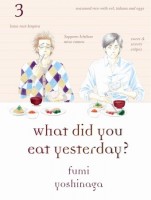
What Did You Eat Yesterday?, Vol. 3

July 23, 2014 by Ash Brown

What Did You Eat Yesterday?, Volume 3Creator: Fumi Yoshinaga
U.S. publisher: Vertical
ISBN: 9781939130402
Released: July 2014
Original release: 2009

As a fan of Fumi Yoshinaga’s manga, food, and stories with a queer bent to them, I was extraordinarily happy when her series What Did You Eat Yesterday? was licensed for release in English. The third volume of What Did You Eat Yesterday? was originally published in Japan in 2009 while the English-language edition was released by Vertical in 2014. I have been thoroughly enjoying the series so far and its mix of gay slice-of-life and recipes, so I was very much looking forward to reading the third volume. Personally, I like the series best when Yoshinaga focuses on the characters, but I would be lying if I tried to say that I didn’t also like all of the food found in the manga, too. What Did You Eat Yesterday? is most effective when Yoshinaga is able to combine and balance those two major aspects of the series. The ideal balance isn’t always achieved, but even when it isn’t What Did You Eat Yesterday? always has intriguing characters, delicious food, and just the right touch of humor to accompany it all.

With his father recovering from an illness, Shiro finds himself spending more time with his family than he has in a long while. Though it’s better than when he first came out to them, his parents are still coming to terms with their son’s homosexuality and their relationship can sometimes be a little strained. Granted, some of that uncomfortableness has very little to do with the fact that Shiro is gay and more to do with the fact that the entire family is made up of people with strong personalities. While Shiro is out to his family and close friends, he’s still closeted at work which, along with his incredible self-consciousness, occasionally gets him into trouble. Things are a little easier for him at home in the kitchen where he can relax and focus on what he really loves: cooking gourmet meals on a tightly kept budget. His boyfriend Kenji, who is much more open about his own sexuality, is always an appreciative audience for Shiro’s meals. It’s a good thing, too. The two of them have been living together for a few years now and food usually helps to smooth over some of the bumps in their relationship.

Generally in What Did You Eat Yesterday? the kitchen is Shiro’s domain. Kenji will gladly help out when asked and given direction, acting as a sort of sous-chef, but for the most part it’s all Shiro. However, in the third volume Kenji gets to take the lead for a chapter while Shiro is off visiting his folks for the New Year. He makes instant ramen. (Granted, with a bunch of extra trimmings.) In a delightful twist, it’s treated in the manga as though he’s having an affair. Instant ramen actually happens to be one of my comfort foods, but I’ve only recently begun trying to dress it up a bit. In addition to the food and its preparation being sumptuously drawn, one of the great things about What Did You Eat Yesterday? (at least I think it’s a great thing) is that the recipes included in the stories are detailed enough that they can be followed and produce results. After only three volumes there are already plenty of recipes that I’m interested in attempting from the series. A variation on Kenji’s ramen has been added to that growing list.

Food is certainly an important part of What Did You Eat Yesterday?, but so are the characters and their relationships. Family is a particularly prominent theme in the third volume. Shiro is on fairly good terms with his parents, but very little is actually known about Kenji’s family at this point. It’s unlikely that the two of them will have their own kids which will have implications for them later in life, something that is made all the more clear as Shiro deals with his parents as they age. What Did You Eat Yesterday? has one of the most realistic portrayals of a devoted, long-term gay couple that I’ve encountered in a manga (or comics in general). Honestly, when it comes right down to it, Kenji and Shiro’s relationship isn’t all that dissimilar from the heterosexual couples in the series, though they do face some particular challenges unique to their situation. Like any pair, they have their disagreements and small spats, but they also care about each other a great deal. Shiro in particular isn’t always the most overtly demonstrative with his affection, but often it’s the little things that really make a relationship work.

Filed Under: REVIEWS Tagged With: fumi yoshinaga, manga, vertical, what did you eat yesterday?

Two Harlequin Manga

July 21, 2014 by Anna N

I do enjoy a Harlequin manga now and then! Here are a couple random titles I bought for my kindle recently.

The Venetian’s Midnight Mistress by Carole Mortimer and Yuko Ichiju

This was an enjoyable Harlequin manga, but I expected something a tiny bit more dramatic and angst-ridden from a story called “The Venetian’s Midnight Mistress.” Dani is a driven interior designer with the type of complicated family situation that seems to drive Harlequin heroines into the arms of a tall, dark, and handsome man. Dani’s grandfather is a jerk. He’s unhappy that his only heir is a woman, and he treats Dani’s father horribly for only producing a female grandchild. He’s arranged his will with a penalty – if Dani doesn’t produce a son the family will get nothing. Dani’s worried about her reproductive choices robbing her parents of the fortune that they’re entitled to, but she’s already had a disastrous first marriage and doesn’t want to enter into a relationship again. Dani’s best friend Eleni has a tall, dark, handsome, and arrogant older brother named Niccolo, who says seductive things to Dani like “When I think about kissing you, it makes me kinda sick.”

Sure enough, Eleni throws a masquerade ball and Dani and Niccolo are overwhelmingly attracted to each other when they are both wearing masks. They hook up, and Dani is horrified to realize that she’s slept with Niccolo. She escapes, but Niccolo soon figures out who his mystery woman was and heads after her. Dani soon finds out that she’s pregnant and Niccolo promptly proposes, but her psychological issues with commitment are going to prevent her from being happy with her new fiance.

The art for this title was fine – a bit middle of the road and generic, but that’s what I tend to expect from most Harlequin manga. I wish there had been some slightly more exciting plot elements like amnesia, a terminal illness, or a kidnapping, but for a nice predictable read featuring a masked ball, this volume delivers.


The Italian Prince’s Proposal by Susan Stephens and Kaishi Sakuya

This volume focuses on a marriage of convenience. Emily is substitute singing for her ill sister in a club where she’s spotted by Prince Alessandro. He decides that she’s the perfect fake bride for him. He arranges a meeting and feeds her chocolate from his home country. She slaps him. Clearly they are perfect for each other! Alessandro needs a bride so his father can abdicate the throne and officially retire. Emily needs money to help out her ailing sister. As in most Harlequin volumes focusing on a marriage of convenience, the couple soon develop feelings for each other, but a terrible misunderstanding threatens to tear them apart!!

The character designs for this volume were attractive, and the art was clear and easy to follow, if not very detailed. I appreciated that Emily enjoyed the chocolate festivals and wine making rituals of Alessandro’s home country. Really, with abundant chocolate and wine, I feel like most women wouldn’t mind the whole marriage of convenience thing. This wasn’t a standout title for me, but it was still fun for me to read. I think I need to be a bit more careful to pick titles that are a bit goofier, because I tend to enjoy Harlequins when there are more outlandish plot points than I found in these two volumes.

Filed Under: REVIEWS Tagged With: harlequin manga

Pick of the Week: Almost Unanimous

July 21, 2014 by Ash Brown, Sean Gaffney, Michelle Smith, Anna N and MJ Leave a Comment

clothesfatASH: Every once in a while a week comes along that, despite there being plenty of manga to choose from, there’s one particular title that stands out for me. Any other week that might have been the most recent volume of MPD-Psycho since it’s been three years since the last one was released, but no. Without question, this week my pick goes to Moyoco Anno’s In Clothes Called Fat. Anno is an incredible creator; I’m thrilled that Vertical has been releasing more of her work in English. After seeing some previews, I have high expectations for this one.

SEAN: Tempted as I am by Accel World and the start of a new Umineko arc, I will instead go with: What Ash said.

Kodama_BLoodLad_V5MICHELLE: I’ll undoubtedly read this important work, but, if I’m honest, my heart belongs to the latest volume of Blood Lad, which has shown up unexpectedly soon. I never would’ve guessed that I’d enjoy this series as much as I do.

ANNA: I will also have to throw my support towards Moyoco Anno’s In Clothes Called Fat. Anno’s works always end up surprising me, and I’m happy that Vertical is bringing out such a great variety of her titles now.

MJ: I’d love to back Michelle up here, since I do love Blood Lad, or at least throw some page time to my beloved Pandora Hearts, but I really can’t choose anything but In Clothes Called Fat. I’ve been eagerly anticipating this release since it was first announced, and I’m thrilled to see it hitting the shelves this week. I can’t possibly pick anything else.

Filed Under: PICK OF THE WEEK

  • Page 1
  • Page 2
  • Page 3
  • Page 4
  • Go to Next Page »
 | Log in
Copyright © 2010 Manga Bookshelf | Powered by WordPress & the Genesis Framework