• Skip to primary navigation
  • Skip to main content
  • Skip to primary sidebar
  • Home
  • About Us
    • Privacy Policy
    • Comment Policy
    • Disclosures & Disclaimers
  • Resources
    • Links, Essays & Articles
    • Fandomology!
    • CLAMP Directory
    • BlogRoll
  • Features & Columns
    • 3 Things Thursday
    • Adventures in the Key of Shoujo
    • Bit & Blips (game reviews)
    • BL BOOKRACK
    • Bookshelf Briefs
    • Bringing the Drama
    • Comic Conversion
    • Fanservice Friday
    • Going Digital
    • It Came From the Sinosphere
    • License This!
    • Magazine no Mori
    • My Week in Manga
    • OFF THE SHELF
    • Not By Manga Alone
    • PICK OF THE WEEK
    • Subtitles & Sensibility
    • Weekly Shonen Jump Recaps
  • Manga Moveable Feast
    • MMF Full Archive
    • Yun Kouga
    • CLAMP
    • Shojo Beat
    • Osamu Tezuka
    • Sailor Moon
    • Fruits Basket
    • Takehiko Inoue
    • Wild Adapter
    • One Piece
    • After School Nightmare
    • Karakuri Odette
    • Paradise Kiss
    • The Color Trilogy
    • To Terra…
    • Sexy Voice & Robo
  • Browse by Author
    • Sean Gaffney
    • Anna Neatrour
    • Michelle Smith
    • Katherine Dacey
    • MJ
    • Brigid Alverson
    • Travis Anderson
    • Phillip Anthony
    • Derek Bown
    • Jaci Dahlvang
    • Angela Eastman
    • Erica Friedman
    • Sara K.
    • Megan Purdy
    • Emily Snodgrass
    • Nancy Thistlethwaite
    • Eva Volin
    • David Welsh
  • MB Blogs
    • A Case Suitable For Treatment
    • Experiments in Manga
    • MangaBlog
    • The Manga Critic
    • Manga Report
    • Soliloquy in Blue
    • Manga Curmudgeon (archive)

Manga Bookshelf

Discussion, Resources, Roundtables, & Reviews

Archives for June 2013

A Bouquet of Manga, Flowers Magazine

June 19, 2013 by Erica Friedman 2 Comments

61v9hCWPLDL._SL500_AA300_Flowers,  a Josei manga magazine from Shogakukan, is a veritable showcase of talent. Regardless of which series are running in the magazine at any given time, the list of authors is practically a checklist of manga history. Names that were publishing top-notch manga in the pages of Flowers magazine more than a decade ago are still publishing top-notch manga in the same magazine now.

In the current volume of Flowers, the award-winning, essential manga Heart of Thomas creator, Moto Hagio, contributes a brand new Sci-fi series Away. Saito Chiho, best known here for the manga version of Revolutionary Girl Utena, is working on a manga retelling of the classic Japanese tale of gender-switching, Torikaebaya. Tamura Yumi’s 7 Seeds was begun on the pages of Betsucomi in 2001, but continues in the pages of Flowers, since 2002. Also notable for western fans, Higa Aloha’s Shirokuma Cafe, which was given an anime adaption and streamed as Polar Bear Cafe, runs in this magazine.

Ancient Japan, the modern world and futurescapes live side by side in Flowers. Stories of alternate histories, such as Akaishi Michiyo’s Amakusa 1637 – which completely rewrote Japanese history – and Moto Hagio’s science fiction Barbara Ikai, will sit comfortably next to Yuu Watase’s  Fushigi Yugi Genbu Kaiden. Japan’s past, present  and future, talking animals, alternate states of being…this Josei magazine, while showcasing grace and beauty, is not at all afraid to ask, “What if it all goes wrong?” The predominant art style is one I’d like to call “Timeless” without irony. These artists have been working for decades and, in some cases, have been genre-defining. One can see the influences of decades of manga and centuries of visual references from Fine Art in the pages of Flowers.

Flowers magazine comes in at just over 500 pages for 570 yen ($6.04 at time of writing). The magazine has a website,  which contains interviews with, messages from and profiles of the creators, chapters of new stories for preview, and publishing schedules. (If you want to be sobered by the sheer mass of work by some of the women who publish in Flowers, click on a few bios and looks at the lists of books in print. Akaishi-sensei has something like 50+ books *in print* right now.) Flowers has a 2011 – 2012 monthly circulation of 33,000.

Looking at the cover above, it would be easy to dismiss Flowers as a repository of girlish fantasy but, if one did so, one would miss the crucible of talent that makes the Flowers stable some of the longest-running, most-popular and most-talented group of creators in manga today.

Flowers Monthly Magazine, from Shogakukan: http://flowers.shogakukan.co.jp/

Filed Under: Magazine no Mori Tagged With: Erica Friedman, Manga Magazines, Shogakukan

New releases, MMF call for entries

June 18, 2013 by Brigid Alverson

Here’s my look at the latest manga releases at MTV Geek, and Lissa Pattillo’s take in her last-ever On the Shelf column at Otaku USA. The Manga Bookshelf team takes a look at the new manga due out this week, and discusses their Pick of the Week.

MJ and Michelle Smith discuss some new releases from SuBLime and Digital in the latest installment of BL Bookrack.

Skip Beat will be the main dish at this month’s Manga Moveable Feast, and Laura puts out the call for entries at Heart of Manga.

Reviews: Ash Brown looks at a week’s worth of manga reading at Experiments in Manga. The Manga Bookshelf team post their latest Bookshelf Briefs.

Leroy Douresseaux on vol. 14 of Arata: The Legend (The Comic Book Bin)
Adam Stephanides on vols. 1-11 of Billy Bat (Completely Futile)
Ash Brown on vol. 22 of Blade of the Immortal (Experiments in Manga)
Rebecca Silverman on vol. 11 of Dengeki Daisy (ANN)
Helen on Full House (Narrative Investigations)
Rebecca Silverman on vol. 2 of Girl Friends (ANN)
Leroy Douresseaux on vol. 4 of His Favorite (I Reads You)
Carlo Santos on vol. 11 of Jormungand (ANN)
Sean Gaffney on Kisses, Sighs, and Cherry Blossom Pink (A Case Suitable for Treatment)
Anna N. on vol. 2 of Knights of Sidonia (Manga Report)
Carlo Santos on vol. 4 of Limit (ANN)
Leroy Douresseaux on vol. 11 of Loveless (The Comic Book Bin)
Lissa Pattillo on The Misfortune of Kyon and Kazumi (Kuriousity)
Rebecca Silverman on vol. 2 of Missions of Love (ANN)
Leroy Douresseaux on vol. 15 of Nura: Rise of the Yokai Clan (The Comic Book Bin)
Sean Gaffney on vol. 67 of One Piece (A Case Suitable for Treatment)
Lissa Pattillo on vol. 1 of Puella Magi Kazuma Magica: The Innocent Malice (Kuriousity)
Leroy Douresseaux on vol. 10 of Sakura Hime: The Legend of Princess Sakura (The Comic Book Bin)
Rebecca Silverman on vols. 2 and 3 of Strobe Edge (ANN)
Rebecca Silverman on vol. 1 of Sunny (ANN)
Chris Kirby on vol. 15 of Toriko (The Fandom Post)
Leroy Douresseaux on vol. 16 of Toriko (The Comic Book Bin)
Matthew Warner on vol. 4 of Yu-Gi-Oh! 5D’s (The Fandom Post)

Filed Under: MANGABLOG

Kisses, Sighs, and Cherry Blossom Pink

June 18, 2013 by Sean Gaffney

By Milk Morinaga. Released in Japan by Futabasha, serialized in the magazine Comic High! (earlier stories serialized by Ichijinsha in the magazine Comic Yuri Hine). Released in North America by Seven Seas.

When I was growing up, the generally accepted “yes, you can now be nostalgic about this” period was about 20 years. Happy Days being the primary example, but the same thing applied as the 1980s wore on. Then, sometime around the early 90s, nostalgia started to speed up. Suddenly we can’t get enough of revisiting things that only happened 5-10 years ago. And this makes sense, given how fast culture has been moving lately thanks to the Information Superhighway and such. (See what I told you about nostalgia?) What this means in practice is that we can be startled that things we read only a few years back suddenly seem like products of a bygone age, and Kisses, Sighs and Cherry Blossom Pink is an excellent example.

kissessighs_vol1_full

When these stories first came out in 2003 or so, it was fantastic. They were in a magazine devoted exclusively to ‘yuri’ stories, and many of them sailed along based solely on that premise. Girls! In love with other girls! And even kissing and stuff! This particular story was actually a group of one-shots that ended up centering around the same school, which is attended by Nana and her friends (Hitomi’s school gets far less attention, possibly as it seems to be far less yuri-friendly). It’s not just Nana – there’s ghosts in love, and unrequited love, and a Takarazuka ‘prince’ who’s actually a bit of a weirdo. It’s a whole yuri subculture. And, in 2003, this was fantastic.

Why does it seem to old and cliched now? It’s partly because Morinaga Milk essentially rewrote and improved Nana and Hitomi’s story in Girl Friends a few years later for Futabasha (after first wrapping it up, as we see in the second volume of this collection.) But it seems to me to be primarily that this sort of story is now old hat. There’s so much more yuri out there, and not all of it has to be “Girl meets girl, girl likes girl, they like each other, the end.” Actually, at the time this collection went FURTHER than a lot of the stories in Yuri Hime. Nana and Hitomi are sexually active, and we see that – again, something that was a real wow in 2003.

But nostalgic doesn’t necessarily mean bad, it simply means “wow, I can’t believe this is only 10 years old”. These stories are cute and sweet, and even the story that doesn’t end with two girls getting together still manages to be adorable. There’s not a lot of “couples buying refrigerators” here – indeed, the manga ends literally right before Nana and Hitomi will have to do that – because in 2003, this was enough. Girls being gay and in love (well, as gay as they’re allowed to be – the word ‘lesbian’ isn’t used much here) at their local schools, and some of them even (gasp!) staying together after they leave school.

I really enjoyed this series, as it brought back a lot of happy memories, and the stories set up a lot of other series that I’ve also enjoyed that followed its example. Nana and Hitomi are sweet, everyone is happy (though the final Nanan and Hitomi story does have a deus ex machina so blatant you could drive a moving truck through it), and the series is quaint. Quaint and twee, you’re in 2003. Nostalgia is the new nostalgia. Recommended.

Filed Under: REVIEWS

Pick of the Week: Subverting Expectations

June 17, 2013 by MJ, Michelle Smith, Sean Gaffney and Anna N 2 Comments

potw-6-17-13MJ: My obvious pick this week would be volume 16 of Pandora Hearts, and I am sure that’s what everyone expects (you can read about how much I love this volume in today’s Bookshelf Briefs). But sometimes it’s the unknown that has the greatest allure, and I’ll admit that I’m most anxious to get a look at Asumiko Nakamura’s Utsubora: the Story of a Novelist, out this week from Vertical. I’ve had a shaky relationship with Vertical’s titles from Manga Erotics F—the magazine this title comes from—but Vertical’s track record with me overall is pretty stunning (and the magazine has housed some of my favorites as well), so I’m more than willing to give them the benefit of the doubt. Familiar favorites are a wonderful thing, but nothing beats the mystery of the unknown. I can’t wait to see what this manga has in store!

MICHELLE: I was so sure that you were going to pick Pandora Hearts that I was all set to pick Utsubora myself. I’m definitely looking forward to checking it out, but I’ll go ahead and give Pandora Hearts my official love, as I’m really looking forward to getting caught up with that one.

SEAN: I’m deciding to go with the manga that’s down to a yearly release rather than the quarterly one, so despite my Higurashi obsession, my pick of the week is for GA Art Design Class. There’s an awful lot of 4-koma series about girls in high school out there, and this is one of the ones that makes me smile the most. The cast is amusing in just the right amount, it’s filled with cute, funny and heartwarming moments, and it’s taught me a hell of a lot about art. It’s likely not for you unless you enjoy moe 4-koma manga, but if you do it’s one of the best.

ANNA: I’m also going to have to throw in my vote for Utsubora: The Story of a Novelist simply because it is the only manga this week that I felt compelled to pre-order! The premise about an upcoming novelist who is suddenly found dead also sounds very intriguing. I think a bit of mystery will balance my usual shoujo and sci-fi manga reading habits.

What looks good to you this week?

Filed Under: PICK OF THE WEEK

Bookshelf Briefs 6/17/13

June 17, 2013 by Sean Gaffney, MJ and Anna N 2 Comments

This week, Sean, MJ, and Anna look at recent releases from Viz Media, Yen Press, Kodansha Comics, and Vertical, Inc.


crossgame6Cross Game, Vol. 6 | By Mitsuru Adachi | Viz Media – I’m finally finishing out this series! Picking up the 6th volume after a gap in my Cross Game reading reminded me again what a master of manga Adachi is. For a series where on the surface not much happens other than a bunch of kids preparing to play baseball, there’s so much subtext and subtle psychological development being portrayed, that this manga is a delight to read. Ko continues to hone his skills, but the sudden appearance of Akane, a dead ringer for his childhood love Wakaba, causes a bit of consternation in the neighborhood. Romance is more of an undercurrent in this volume as Aoba slowly realizes that people may appreciate her for something other than her pitching skills. – Anna N.

devil9A Devil And Her Love Song, Vol. 9 | By Miyoshi Tomori | Viz Media – Well, that went south in a hurry, didn’t it? The first half of this volume is actually quite heartwarming, despite the opening. It gives the message “forcing yourself on others is wrong”, but also allows the others to forgive Shintaro and allow him back into their inner circle. Moreover, Maria is bonding even more with her friends, and Shin is getting over his own hangups regarding the piano. He decides to do a big, extravagant performance for Maria, at the end of which he will tell her his real feelings. AND THEN IT ALL GOES SO WRONG. Leaving aside horrible assault guy, who ensures she never gets to the performance, it’s more of a classic “misunderstanding comfort as a confession” that leads to the depressing cliffhanger we get here. I really cannot wait for Vol. 10. – Sean Gaffney

saika2Durarara!! Saika Arc, Vol. 2 | By Ryohgo Narita, Akiyo Satorigi, and Suzuhito Yasuda | Yen Press – We continue to have two different stories going on here, and they aren’t quite interweaving with each other until the very end… or so we think. First off, there’s the attempts by Celty to find out what’s going on with Saika, the demon blade that’s slashing people and has professed a deep, stalkerish love for Shizuo. Secondly, and probably more interesting to me, there’s Anri and her attempts to deal with her teacher’s sexual harassment. Anri’s natural emotionless facade doesn’t make the discomfort of this situation any less striking, and the occasional dream she’s having of a happy birthday with her parents turns into a nightmare rather rapidly. Plus, for all that the blade supposedly loves Shizuo, it does seem to be going after Anri an awful lot. A fun, complicated mess (yes, that’s a compliment). – Sean Gaffney

fairytail26Fairy Tail, Vol. 26 | By Hiro Mashima | Kodansha Comics – Well, the villains are posing on the cover of this volume, so it is not a particular surprise that they come in and completely kick our heroes’ asses, as shonen villains often do at first. Even worse is the identity of the old man who seems to be behind the group of villains… and Makarov’s betrayed reaction. There are one or two jokes here, mostly revolving around Elfman and Evergreen, the couple that isn’t. But for the most part, this is simply pure serious fighting, with lots of people getting knocked unconscious and/or near death. And hovering over all of this is Zeref, who just wants to be left alone – supposedly – but Ultear isn’t having any of that. It looks like we’ve got a long way to go before any of this is wrapped up, to be honest. Oh and hey, was that a Laxus cameo I just saw? Foreshadowing! – Sean Gaffney

knights3Knights of Sidonia, Vol. 3 | By Tsutomu Nihei | Vertical, Inc. – I’ll admit, this volume really surprised me. No, not the deaths of even more pilots. And no, not the flashback which showed us the origins of Tanikaze’s birth (at least once I figured out it was a flashback – come on, use black borders like other mangaka do!). No, what really startled me was the middle of this volume, where all of a sudden it became a wacky romantic comedy with a love triangle. It’s actually even more amusing given the artist’s usual unexpressive style. That said, that’s just a moment, and for the most part this volume is serious business, as we try to figure out why Tanizake is piloting every single goddamn mission, learn more about the placenta they captured, which is a little TOO good at mimicking humans, and depressing the hell out of Izana. Still riveting. – Sean Gaffney

pandorahearts16Pandora Hearts, Vol. 16 | By Jun Mochizuki | Yen Press – Recent volumes of Pandora Hearts have been so chock-full of twists and revelations, that every time I’ve thought that I discovered what was really going on, I’ve been proven wrong in the next volume. This continues with volume sixteen, and it is by no means a bad thing. Things start out lightly, as though to provide a healing balm for last volume’s tragedies. Yet, just when I thought I’d been shocked to the core, something much more shocking is revealed, and oh… GAH. I’m kind of dying at this point. It’s all extremely well-plotted (better than I thought Mochizuki had in her, to be frank) and cleverly painful. Meanwhile, Xerxes Break continues to be the most endearing character ever, and his relationship with Sharon is almost too charming to bear. Thanks, Pandora Hearts, you always come through. Increasingly recommended. – MJ

Filed Under: Bookshelf Briefs

One Piece, Vol. 67

June 16, 2013 by Sean Gaffney

By Eiichiro Oda. Released in Japan by Shueisha, serialization ongoing in the magazine Weekly Shonen Jump. Released in North America by Viz.

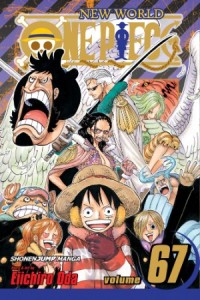
If you had not been following along with One Piece and were trying to come into this volume totally unspoiled, well, sorry. The cover totally spoils one of the funniest gags Oda’s come up with in some time, unashamedly. There’s a whole lot going on in Punk Hazard, and I’ll get to some of it later. But mostly what people remember from this volume is the bodyswapping. The reasoning behind it is somewhat flimsy – Law doesn’t want the Strawhats getting away, so does this to create chaos, I believe – but the consequences are pure gold, even if it means putting up with Sanji trying to feel himself up half the time. Even Smoker and Tashigi get in on the act, with a bodyswap that makes your head hurt even more. (Tashigi is still, I note, dealing with “we’ll obey our captain because she’s really hot!” from the crew, and is totally unable to do anything against Law. But then again, neither is Smoker.)

onepiece67

Oh yes, Law! One of the most popular of the Supernovas, we knew he’d show up again, but not quite so soon. He doesn’t seem to be entirely behind what’s going on here, but he’s involved in some way, and it’s interesting seeing him scheme and plan when compared with Luffy’s “well, whatever” style of piracy. As for who is behind things, well, it would appear to be ex-government scientist Caesar Clown, who is basically the Joker from Batman, only as a mad scientist. He is creepy as hell, and it’s pretty obvious that he’s the guy Luffy will have to fight a few volumes down the road. His plot involves kidnapping and experimenting on young children, which is pretty damn dark, but then I remember the other backstories that this series has given us.

I would be remiss in this review if I did not stop to talk about my favorite character. Robin gets a lot to do here, including, to my surprise and pleasure, a huge number of jokes. No, she’s not making goofy faces, but we do see her imagining Usopp and Zoro as Duck Ferry Rides, and joining with the others in stealing the villains’ clothes for warmth, and absolutely shutting Franky down when he tries to make his usual poses and faces in Chopper’s cute body. (Robin has always had a soft spot for Chopper. Also, I sense this may be Oda trying to sink the Franky/Robin ship a bit – she’s clearly REALLY IRRITATED here.) And of course she’s making her usual references to all her comrades possibly being dead on pools of blood. If it’s Robin humor you want, this is the volume for you.

And I haven’t even mentioned the goofy samurai who’s just a head, or Nami’s maternal instincts oddly popping up (I’ll buy it, but only just – I have to wonder if she’s thinking of her own childhood pre-Bellemere), or Brownbeard, of all people, making a comeback, or the really creepy chamber of corpses, or the bird woman and what role she’s playing. As ever, there’s just so much going on here. By the time you finish this volume of One Piece, you could have read 5 Bleaches! Absolutely recommended.

Filed Under: REVIEWS

BL Bookrack: June 2013

June 15, 2013 by MJ and Michelle Smith 1 Comment

Welcome to the June installment of BL Bookrack! This month, MJand Michelle take a look at two debut series from SuBLime Manga, Blue Morning and Sleeping Moon. In Brief: Help! God of Love and KINE IN! (DMG).


bluemorning1Blue Morning, Vol. 1 | By Shoko Hidaka | SuBLime | Rated M (Mature) – One word that I keep seeing used regarding Blue Morning is “psychological,” and much as I would like to say something new about the work, this label really is inescapable.

Akihito Kuze is the son of a viscount, but spent the early years of his childhood living away from Tokyo with his sickly mother. When his parents die six months apart, ten-year-old Akihito inherits the title and moves to the Kuze estate, where everything is capably managed by a cold young man named Tomoyuki Katsuragi. Akihito is instantly in awe of Katsuragi, but the latter shows the child neither warmth nor sympathy, but instead piles on the studies and repeatedly informs Akihito that he must be perfect in order to carry on the Kuze line. Akihito does his best to comply, and, as he grows, eventually develops an obsession to make Katsuragi notice and approve of him.

There’s a lot of really complicated and interesting character work going on here. Akihito’s early fascination with Katsuragi makes sense, given that he seemingly lived his early life mostly among women, as does the eventual evolution of his feelings. Katsuragi’s treatment of the boy makes sense, as well, once readers learn how the man came to be in the Kuze household in the first place, and the lengths to which he went to emulate his former master, while Akihito is going about, being his own person without a care. My one complaint is that a conversation about Katsuragi’s true parentage doesn’t make much sense, but perhaps it was meant to be cryptic and will be clarified in future volumes.

Complex, dark, and a bit twisted, Blue Morning is the best BL I’ve read so far this year. And, as if that weren’t reason enough to celebrate, this is a continuing series, with volume two due out in August!

– Review by Michelle Smith


sleepingmoon1Sleeping Moon, Vol. 1 | By Kano Miyamoto | Published by SuBLime | Rated Mature – Akihiko’s life has been long haunted by a curse said to kill his family’s male descendants at an early age. Though his own father unsuccessfully attempted to escape his fate by leaving home, the curse brings Akihiko, now nearing thirty, back to his roots to search for answers.

Using his research in comparative religion as an excuse to visit his family’s ancestral home, Akihiko is confronted both by the awakening of his inherited paranormal abilities and the awakening of his heart, as he finds himself drawn to two very different men. The first of these is Ren, Akihiko’s free-spirited but lonely cousin who shares his ability to see ghosts and other supernatural beings. The second is Eitaro, a young man living 100 years in the past, whom Akihiko visits in his dreams, and who bears a striking physical resemblance to Ren.

The premise I just described could so easily be the worst kind of supernatural romance, filled with overblown psychic powers and cross-generational mistaken identity. Fortunately, in Miyamoto-sensei’s capable hands, it is instead the best kind.

Akihiko’s reception in his family’s home is the kind one encounters only in stories of old, well-to-do families—an odd mix of unquestioned acceptance and extreme discomfort. That, together with his supernaturally-based connection to his cousin reminds me of nothing more than Mary Stewart’s Touch Not the Cat, a favorite novel from my teens.

This sort of strained (but undeniable) intimacy between people who’ve met only at distant family functions creates an immediate sense of history and makes relationships that spring up too quickly feel somehow perfectly natural—a decided advantage in this kind of romance. In particular, Ren’s desperate need to connect with someone, anyone, who shares his fate feels urgent and genuine, helping to ground the series despite its supernatural premise. Miyamoto’s artwork is a highlight as well, nicely capturing the sense of both past and present haunting Akihiko’s every move.

The second (and last) volume of this series is due out in September, and I admit I’m quite anxious for its arrival. Highly recommended.

– Review by MJ


In Brief:


helpHelp! God of Love | By Tsukiko Kurebayashi | Digital Manga Guild | Rated Mature (18+) – One of the great things about the Digital Manga Guild is that it’s in a position to make available a lot of manga that would otherwise never see any kind of English release. This has resulted in the discovery of hidden gems like Climb On To My Shoulders, and expanded the English-language catalogues of talented authors like est em (KINE IN!) and Keiko Kinoshita (You & Tonight). Unfortunately, there are untranslated manga that would be better left alone. This is one of those manga. Between its ultra-contrived melodrama and underdeveloped relationships, Help! God of Love is one of the most poorly constructed BL manga I’ve read to date, a circumstance not at all helped by its occasionally awkward English adaptation. Not recommended. – MJ


kineinKINE IN! | By est em | Digital Manga Guild | Rated Young adult (16+) – I’m always up for anything by est em, and even though the first thing I read by her—Seduce Me After the Show—remains my favorite, there is always something worthwhile to be found in her other works. I’ll admit that my faith was a little shaken by the opening chapters of KINE IN!, which revolve around a high school love triangle, but est em returns to form with the unrelated short stories that round out the volume. My particular favorites are “The Scenery of That Summer,” which is about a pair of step-brothers that meet for the first time for a funeral, and “The Salvia and the Barber,” in which a pair of sixty-year-olds decide to live together as family. Both stories are poignant and offer only a suggestion of romantic feeling. In fact, this entire volume is very chaste indeed, probably due to a recurring theme of love postponed. Definitely recommended. – Michelle Smith


Review copies provided by the publishers.

Disclosure: MJ is currently under contract with Digital Manga Publishing’s Digital Manga Guild, as necessitated for her ongoing report Inside the DMG. Any compensation earned by MJin her role as an editor with the DMG will be donated to the Comic Book Legal Defense Fund.

Other recent BL reviews from MJ & Michelle: Blue Morning (SuBLime)

Filed Under: BL BOOKRACK Tagged With: blue morning, help! god of love, KINE IN!, sleeping moon, yaoi/boys' love

Knights of Sidonia, Vol. 2

June 13, 2013 by Anna N

Knights of Sidonia, Volume 2 by Tsutomu Nihei

As I was reading the second volume of Knights of Sidonia, it occurred to me that Nihei ably manages a narrative balancing act of giving the reader just a little bit more information in each volume, but not so much that everything feels completely filled in. My curiosity about the history of Sidonia was fulfilled with a bit of backstory about why the massive ship seems to be moving through space alone, isolated except for occasional attacks by the Guana. I’m still intrigued to learn more about Nagate Tanikaze and why he happens to be so good (in a somewhat bumbling way) at piloting the Tsugumori. He also seems to be continually singled out by those in command.

I enjoy the general sense of scale expressed with the illustrations of interior of the giant spaceship – it does really seem massive. The human cost that occurs when it has to maneuver itself suddenly makes it clear that even safely inside a spaceship death can come at any instant. Reading this manga, I get the sense that Nihei plans out all the details of his worlds very meticulously. One negative thing is that generally the characters in this manga suffer a bit from samefaceitius, making it sometimes difficult to sort out who is who absent any extreme differences in hairstyle. However, this is a minor quibble next to the general awesomeness of seeing the Guarde units fly through space in their ringed locked arm formation.

This is not a happy manga about giant space robots fighting aliens. The evolutionary capabilities of the Guana give some scenes a horror comic vibe, and bad things certainly happen to good people. But there’s enough humor in the strained interpersonal interactions of the people aboard the Sidonia that when finishing up a volume of this manga, I’m not feeling oppressed by tragedy but very interested to see what happens next.

Also, for those of you reading this manga solely for talking bear appearances, there is some talking bear in this volume!

Filed Under: REVIEWS Tagged With: knights of sidonia, vertical

Manga the Week of 6/19

June 13, 2013 by Sean Gaffney, Michelle Smith, MJ and Anna N 4 Comments

SEAN: Sometimes the images we feature with this post work out perfectly. And sometimes we have weeks like this. Where the images I want to use are all in a row next to one another. Sigh. By the way, my shop’s getting in Yen early, so WE ARE AS WELL!

Kodansha has the final volume of their Kitchen Princess omnibus. If you hadn’t picked this up earlier, it’s now available in 4 handy volumes! And there are recipes!

MICHELLE: I regret to say that I still haven’t managed to read Kitchen Princess, despite owning the original edition in its entirety. I wonder how it compares to Arisa… is it less ridiculous?

MJ: This is one of those series I planned to catch up with in omnibus form, but have yet to pick up. Someone want to tell me how foolish I’ve been?

ANNA: Kitchen Princess is cute and sweet and a little bit weird. I need to finish the series too.

SEAN: And there’s the 28th volume of Air Gear. Which is a whole lot of Air Gear.

utsuboraVertical has a done-in-one series coming out. Utsubora: the Story of a Novelist is a psychological drama that comes from the pages of Manga Erotics F, a magazine that has given us more polarizing titles than any other, I believe. Will this one also divide readers who love it and hate it? Find out by reading it!

MICHELLE: Looks interesting!

MJ: I will usually try anything Vertical thinks I should–their track record is pretty good. So I will definitely check it out.

SEAN: Viz has the final volume of Children of the Sea, which was one of its first Ikki titles but ran up against the dreaded “the final volume isn’t out in Japan yet”. It’s been two and a half years, and honestly I think I may have to re-read. But I do recall being very fond of this series about love, loss and the sea.

MICHELLE: I have actually been hoarding Children of the Sea, so now I’m glad of a chance to read the series all in one go.

MJ: I have missed this series! Though, like Sean, I may have to start from the beginning again at this point.

ANNA: I’ve read a couple volumes of this and it is lovely.

SEAN: And the rest is all Yen. I am very fond of GA Art Design Class, which has a very entertaining cast of moe stereotypes, but more importantly, due to this series I have learned SO MUCH MORE about art. Vol. 5 is out. (And yes, it is still not Shoulder-a-Coffin Kuro.)

Higurashi22At least, what we’ve been waiting for: the home stretch of the main Higurashi Storyline. Not to spoil or anything, but this is, finally, the one with the Good End. Festival Accompanying Arc starts with this omnibus, which gives us Miyo Takano’s backstory, and needs a giant TRIGGER WARNING: ABUSE applied to it. But still good stuff.

MICHELLE: I just can’t make myself read Higurashi. It’s like you said in your recent Umineko review, Sean. We’re not supposed to like these people or care what happens to them personally; we’re just supposed to care about the mystery. But I guess I can’t simply stick around for that if I don’t like the protagonists at least a little.

SEAN: I’d argue that the big difference between Higurashi and Umineko is, in fact, that the characters ARE more likeable in Higurashi. Sure, they can be horribly screwed up, particularly in the earlier arcs, but we get to see them learn from past iterations and grow as people. Umineko is more about trying to figure out what’s going on and solving the mystery, and the development of a bunch of gold-happy adults is quite secondary. (The kids fare a bit better.)

MICHELLE: That does sound more like something I’d enjoy.

SEAN: Kingdom Hearts has a new volume out, called Chain of Memories. I still don’t know much about this except it has Donald and Goofy in a fantasy game world setting.

Pandora Hearts 16! MJ? Tag!

MICHELLE: How have I gotten so far behind on this one?! I’ve only read through twelve!

MJ: I’m sure nobody will be surprised to hear that I CAN’T WAIT. Seriously, though, things have really gotten intense. Every volume at this point is a source of great anticipation. So. Y’know. GIMME.

spicewolf8SEAN: For those who enjoyed the mindscrew that was Madoka Magica and want more, here’s the first of two spinoff manga licensed by Yen. Kazumi Magica features a different lead, but no doubt will still have the same old Kyuubey lurking around.

MJ: I found the manga to be a little disappointing, but I’ll probably give this spinoff a shot.

SEAN: Soul Eater has a big artbook coming out. Considering that one of the top three reasons I read Soul Eater is the amazing art, this is a pretty big deal. Even casual fans should give this one a look.

Spice & Wolf! Did you know it had a manga as well, to go along with the light novels? It does! It’s also caught up to Japan, so be prepared to wait a bit.

And lastly, there’s volume 3 of Triage X. If you like BTOOOM! but wanted more motorcycles, try this series.

MICHELLE: Ugh. I am very tempted to christen BTOOOM! “the-manga-that-must-not-be-named,” that’s how little I’d like to think about it in the future.

MJ: Heh.

SEAN: What manga are you getting for your father? (Please don’t say Triage X.)

Filed Under: FEATURES, manga the week of

Atomcat

June 13, 2013 by Sean Gaffney

By Osamu Tezuka. Released in Japan by Sekai Bunkasha, serialized in the magazine Nico Nico Comic. Released in North America by Digital Manga Publishing.

I have been noticing, around the internet, a lot less enthusiasm for this particular title as opposed to other Tezuka titles. Usually the comment will start by saying “Well, any Tezuka is good Tezuka, BUT…” and then moving on to note its fluffiness and lack of deep, tragic history. This is a marked contrast to the other type of Tezuka fan, which is the “we must have every single Tezuka work ever created translated into English as soon as possible!” sort. I have sympathy for both camps. Tezuka wrote a TON of stuff, and not all of it is going to be on the scale of Apollo’s Song or Buddha. At the same time, I do want to see his lighter comics that are just moments of everyday life or dumb humor. And that’s why I’m quite pleased to see Atomcat, which is both.

Atomcat

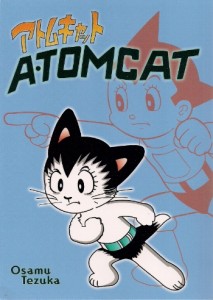
The story of a young boy and his Astro Boy-themed superhero cat, this manga actually intersperses moments from the actual Astro Boy manga (redrawn by Tezuka) as contrast and compare. Usually Tsugio reads about another aspect of Atom’s fairly crappy life, and sympathizes, then has to deal with his own issues, such as an eccentric father, overbearing mother, and the ever-present school bullies. He tries to take home a stray cat as a pet, but the cat is an absolute disaster, destroying everything in the house in a great comedy sequence. Taking it away so he can abandon it, he and the cat and struck by a car… driven by Princess Diana. Only not really, she and Prince Charles are actually ALIENS. The boy is fine, but the cat is dead, so they fix him using the boy’s memories… with are filled with Astro Boy. So now the cat is intelligent and has superpowers. This doesn’t help quite as much as you think, although he’s a few levels above Doraemon.

This is a very 1980s manga – leaving aside Charles and Di the space aliens, we also have the school bully being named Gaddafi. It’s also very much for kids – Unico was too, but it had an undercurrent of melancholy at its core that Atomcat simply doesn’t possess. This is broad comedy with lots of funny faces. Our hero’s father is an absentminded freak, and his wife is the typical cartoon wife – all she needs is a rolling pin to beat her husband with. Atomcat and Tsugio fight mummies and gangsters, search for island treasure, and plunge through the sewers of Japan.

There’s no real character arc here – Tsugio starts the series as a bit of a wimp, and ends that way as well, and the series does not so much end as stop. But it’s fun! The dialogue is snappy, the Astro Boy inserts work well with the themes of the stories, and there’s lots and lots of comedic slapstick, which Tezuka was very good at indeed. I read this title and thought of Mitsuru Adachi’s Cross Game, or Rumiko Takahashi’s Ranma 1/2. Everyone says they’re influenced by Tezuka, but we tend to look for it in series like Ayako. In reality, these manga artists were more likely to grow up reading stories like these – and these are the stories that influenced a future generation. Fluff, but IMPORTANT fluff.

Filed Under: REVIEWS

Twinkle Twinkle

June 12, 2013 by Ash Brown

Author: Kaori Ekuni
Translator: Emi Shimokawa
U.S. publisher: Vertical
ISBN: 9781932234015
Released: May 2003
Original release: 1991
Awards: Murasaki Shikibu Literary Prize

Kaori Ekuni’s novel Twinkle Twinkle was the first of her works to be translated into English. Ekuni is both a bestseller and a literary award winner in Japan. Initially she wrote poetry and children’s stories before beginning to write for a more general audience. Twinkle Twinkle, originally published in Japan in 1991, was her debut novel and earned Ekuni the Murasaki Shikibu Literary Prize in 1992. Also in 1992, Twinkle Twinkle was adapted into a film directed by Joji Matsuoka. The novel was translated into English by Emi Shimokawa and published by Vertical in 2003. (Twinkle Twinkle was actually the first book ever to be released by Vertical.) Despite being a well-known and admired author in Japan, before reading Twinkle Twinkle I was unfamiliar with Ekuni and her work. After reading Twinkle Twinkle I sincerely hope that more of her writing is translated. Currently the only other novel by Ekuni available in English is God’s Boat.

Shoko and Mutsuki married four months after they first met, much to the delight of their respective parents who feared that their progeny would never find someone to spend the rest of their lives (and hopefully have children) with. Although Shoko and Mutsuki are pleased with their arrangement, each is hiding a secret from their new in-laws. Shoko is an alcoholic and emotionally unstable while Mutsuki is gay and continues to see his long-term boyfriend Kon. Shoko and Mutsuki care for each other, but their marriage is one of convenience more than anything else. They are each free to live their lives how they choose while at the same time are able to keep up appearances for their families. It seems like a perfect marriage as long as they can prevent their parents from discovering the farce. But during their first year together things begin to unravel. Neither Shoko or Mutsuki quite realize what all of the consequences of their marriage might actually be.

Each chapter of Twinkle Twinkle alternates between Shoko and Mutsuki’s individual perspectives. It’s a great technique that lets readers see both sides of their relationship and how they view each other. It also allows a glimpse into the newlyweds’ internal states of being. Throughout the novel it is clear that both Shoko and Mutsuki deeply care about the other. They’re not exactly romantically involved and they may not be having sex together, but they both want the other to be happy and work to make that happen. It’s not always easy, though. Both of them have habits that either baffle or annoy the other and they’re not always sure what to do about it. As Twinkle Twinkle and the first year of their marriage progresses Shoko becomes increasingly unstable—anxious that she isn’t able to adequately fulfill her role. As for Mutsuki, as wonderful as he can be, he’s unable to ease Shoko’s fears; his kindness often makes matters worse.

Twinkle Twinkle is a very peculiar love story between two incredibly imperfect people. But it’s Shoko and Mutsuki’s faults and flaws that make the novel as effective as it is. No marriage is perfect and even a fake one takes a tremendous amount of effort to maintain. To make matters even more complicated there’s Kon, who at times is on better terms with Shoko than he is with Mutsuki. Kon is extremely important to both of them as well as to the story itself. Together Kon, Shoko, and Mutsuki form an intense triangle with relationship dynamics crucial to their development as people and to the development of the novel. Twinkle Twinkle is fairly light in its tone and is immensely readable, but Ekuni still manages to pack several hard-hitting punches into the narrative. Personally, I loved Twinkle Twinkle. It’s one of the best novels that I’ve read recently and I can easily see myself reading it again.

Filed Under: REVIEWS Tagged With: Kaori Ekuni, Murasaki Shikibu Literary Prize, Novels, vertical

Midweek manga roundup

June 12, 2013 by Brigid Alverson

Don’t know what to read? Check out the Manga Bookshelf bloggers’ Pick of the Week discussion.

At Heart of Manga, Laura looks at the new shoujo manga releases we can expect in June.

The Manga Out Loud podcast returns for a one-shot appearance, with hosts Ed Sizemore and Johanna Draper Carlson discussing the latest manga news and guest Tim Maughan talking about the Time of Eve anime.

Lori Henderson devotes her latest Manga Dome podcast to vol. 1 of Mobile Suit Gundam.

News from Japan: Good news for One Piece fans: It’s back in Shonen Jump this week, after creator Eiichiro Oda took a two-week hiatus for health reasons.

Reviews: Ash Brown checks in with the weekly report at Experiments in Manga. And the Manga Bookshelf team files their weekly set of Bookshelf Briefs.

Johanna Draper Carlson on vol. 3 of Demon Love Spell (Comics Worth Reading)
Johanna Draper Carlson on vols. 8 and 9 of A Devil and Her Love Song (Comics Worth Reading)
Justin on Jojo’s Bizarre Adventure: Phantom Blood (Organization ASG)
Nick Smith on vols. 1 and 2 of Kingdom Hearts (ICv2)
Alex Hoffman on Monokuro Kinderbook (Manga Widget)
Sean Gaffney on vol. 1 of No. 6 (A Case Suitable for Treatment)
Lesley Aeschliman on vol. 9 of Pokemon Black and White (Blogcritics)
Mark Thomas on vol. 30 of Skip Beat! (The Fandom Post)
Leroy Douresseaux on vol. 3 of Yu-Gi-Oh! Zexal (The Comic Book Bin)

Filed Under: MANGABLOG

It Came from the Sinosphere: The Lady Hermit

June 11, 2013 by Sara K. 1 Comment

lady01

Wow. A Hong Kong martial arts movie which puts a female-female relationship at the heart of the story.

The Story

A servant called Leng Yushang observes talented young woman called Cui Ping comes to town. Cui Ping is embarking on a career of helping innocent people and kicking butt. She is searching for “Zhong Kui Niang” (who I will henceforth refer to as “the Lady Hermit”) so she can become her disciple and learn how to kick butt even harder. The catch is that nobody knows where ‘the Lady Hermit’ is. The ‘Lady Hermit’ had been badly injured by the ‘Black Demon’, and hasn’t been seen since. Little does Cui Ping know that Leng Yushang is, in fact, the ‘Lady Hermit’ living incognito.

Of course, while Cui Ping tries to uphold justice, she gets into a lot of trouble (criminals generally are not amused when their activities are discrupted), so Leng Yushang has to interfere, and eventually, break her cover.

Background

Zhong Kui is a figure from Chinese mythology who fights and surppresses demons. “Zhong Kui Niang” means “Lady Zhong Kui,” implying the Leng Yushang, like Zhong Kui, is a mysterious vanquisher of evil.

This film stars the legendary martial arts actress Cheng Peipei as the “Lady Hermit.” You know how I always like to compare martial arts to dancing? Before starring in martial arts movies, Cheng Peipei studied ballet for six years. This is also the first film which casts Shi Szu in a leading role as “Cui Ping,” and thus put her on the map. I’ve read that Shaw Brothers intentionally wanted to make Shi Szu “the next Cheng Peipei,” so the purpose of the film was probably to transfer the aura of Cheng Peipei onto Shi Szu. Not that I’m complaining.

The Fighting

Since this was made during the golden era of the Shaw Brothers, of course all of the fighting is good from a technical standpoint. However, it was a bit difficult for me to get really involved in the action because the Lady Hermit and Cui Ping mow down their opponents too quickly. Instead of making the Lady Hermit and Cui Ping seem awesome, it just makes their opponents look terribly incompetent. The heroes really should struggle a bit more when vanquishing their foes.

lady04

Of course, I do like the fight at the suspension bridge, simply because it integrates great scenery and action so beautifully.

Cui Ping next to a suspension bridge.

Checkov’s Bridge: If there is a suspension bridge in an action scene, it will collapse while our protagonist is on it.

Which brings me to the topic of …

The Scenery

I love the scenery in this film!

A temple at night with hills and a harbor in the background.

First of all, it is beautiful scenery, but it’s not just that it’s beautiful – I love the way the characters really seem to live in the scenery.

Leng Yushang at sunset

Leng Yushang at sunset

In some movies, the scenery simply stuns the audience with its beauty. And I like that too. But in this movie, rather than stunning the audience, it naturally blends into the movie as a whole.

Even the bad guys are part of the scenery.

Even the bad guys are part of the scenery.

I think this might be partially because it is not isolated from the characters/actors. When filmmakers really want to emphasis the scenery, they place the scenery alone, without the characters.

A shot showing mountains.

This was the only scenic shot I found without any humans.

But this film does not do that often, and when it does, it chooses relatively soft scenery which blends smoothly with the preceeding and following shots. Often, the actors are incorporated into the overall visual image presented.

Cui Ping looks isolated and alone amid the trees and mountains.

Cui Ping looks isolated and alone amid the trees and mountains.

And I like the trick where characters are often introduced by reflections in the water.

This is the first sign that the Lady Hermit is on the scene!

This is the first sign that the Lady Hermit is on the scene!

And it’s also nice that there is variety in the scenic shots: grassy mountains, bamboo forests, temples at night…

Leng Yushang and Changchun walk through a misty bamboo forest.

You know how I like to compare martial arts flicks to dance musicals…

Doesn’t this screenshot feel a bit Busby Berkeley?

Six beautifully dressed women dance in a circle around a flower bush in a shot from overhead.

Female-Female Relationship For the Win

Since almost every wuxia story has a variety of female characters, it is not hard to find stories which pass the letter of the Bechdel test. But wuxia stories which depict deep female-female relationships are rare. The only other wuxia story I know about which puts female-female relationships front and center (rather than as an aside to the Much More Important Male-Female Relationships) is The Celestial Zone.

lady18

By the way, when I say male-female relationships tend to get more weight than female-female realtionships, I’m not just talking about the romantic relationships. For some reason, more weight gets put on daughter-father and sister-brother relationships than daughter-mother and sister-sister relationships.

The development of the relationship is what sucked me into the movie, as Cui Ping and Leng Yushang slowly reveal themselves to each other. The moment when Leng Yushang finally accepts Cui Ping as her student is sweet indeed.

lady13

Of course, the relationship is so compelling because both Leng Yushang and Cui Ping are individually interesting characters. Leng Yushang is collected, experienced, calm, quiet, grounded … and slowly healing old wounds. However, while she’s very discreet, she is not the least bit cold – she’s quite warm, friendly, and open when she is not being the ‘Lady Hermit’ or trying to hide her identity.

lady12

Meanwhile Cui Ping is young, energetic, brash, bold, and naive. She has very strong feelings about almost everything, which is what drives her to try to uphold justice, constantly improve her martial arts, and try so hard to find the “Lady Hermit.”

You might notice that these two are a bit like opposites, and I find their relationship compelling in the same way that good ‘opposites attract’ romances are compelling.

lady15

I really have to applaud both Cheng Peipei and Shi Szu’s performances, as I feel that their acting is what made the teacher-student relationship between the Leng Yushang and Cui Ping feel so intense.

… But There’s Something Which Irritated Me

And that is Changchun.

Well, not Changchun himself. As a character, he is so empty that there’s not much about him personally which can irritate me. It’s his position in the story which irritates me.

lady16

First of all, I don’t understand why the female characters are so attracted to him. There is nothing in the script which explains this, so the only explanation I can think of is that he is physically handsome, in which case they should have cast a better-looking actor.

Now, I do actually like the scenes between Changchun and Leng Yushang, since they seem genuinely tender without being over-the-top. Okay, maybe I can understand why Leng Yushang likes him.

What really irritates me is that a) Cui Ping gets a crush on Changchun and b) when Cui Ping discovers how sweet and tender Changchun and Leng Yushang are, even though she is not in a committed exclusive relationship with Changchun, she decides to break off her relationship with Leng Yushang.

WHAT!

Cui Ping went to great lengths to become Leng Yushang’s disciple, and her actions indicate that Leng Yushang is the most important person in the world to her. It’s understandable that she would be upset to see Leng Yushang and Changchun touching each other lovingly … but to break up with Leng Yushang over a mere crush seems to indicate that the teacher-student bond was not as important to her as the audience was led to believe.

Disclosure Time.

I will admit that, as an aromantic, I am particularly sensistive to this sort of thing (if you do not know much about aromantic people, here’s a primer). I have nothing against romance – I even like well-written fictional romances – but to me, full-blown romance is like sisterhood – very common, frequently interesting, but something I will probably never personally experience. That’s okay, because sibling relationships and romantic relationships are not the only kinds of relationships which can be psychologically fulfilling.

lady14

I do not like being told that romantic relationships are so special that it’s only natural that any other relationships – no matter how deep – can be dumped for romance – regardless of how shallow the romance is. If individual people want to only value romantic relationships, that’s their business (though I think they should inform their friends, families, and colleagues that they do not value non-romantic relationships). But to see such a wonderful teacher-student relationship disrupted over such an empty romance is heartbreaking.

lady17

Then again, Chang Yushang herself is hurt by Cui Ping’s actions, and it seems that Cui Ping is so upset not because her feelings for Changchun are so deep, but because her feelings for Leng Yushang are do deep.

And this brings us back to culture.

One of the reasons I enjoy Chinese-language fiction as much as I do is that, compared to mainstream English-language fiction, the value of romantic relationships is more balanced with other kinds of relationships. And ultimately, the movie does vindicate me, and show that the relationship between Leng Yushang and Cui Ping is far more important than anything going on with Changchun. In an American movie … I think that vindication would have been less likely.

Even son … sigh … I wish they had chosen a different plot device to acheive the same effect.

Availability in English

This movie is available on Region 3 DVD with English subtitles.

Conclusion

A beautiful movie about a beautiful relationship between two vivid characters. What more can I say?

This column will go on hiatus for two weeks.


The Dragon Boat Festival is happening on June 12th! Time for Sara to go watch some dragon boat races and eat some rice dumplings. She also finally has an excuse to visit the town of Longtan.

Filed Under: It Came From the Sinosphere Tagged With: Cheng Peipei, movie, shaw brothers, Shi Szu, wuxia

Drama Diary: IRIS Episodes 1-5

June 11, 2013 by Anna N 1 Comment

I tend to watch mostly romantic comedies when I am viewing k-drama, but IRIS is a bit different. This is a decidedly action-oriented series, and while there is a little bit of romance and comedy, more than anything else this series resembles a k-drama take on the Bourne Identity. Iris is also notable because it stars Byung-hun Lee, who is currently making a crossover bid to Hollywood movies this summer with his roles in GI JOE: Retaliation and Red 2. This series also has some interesting shifts in timeline as the plot unfolds. While in my more cynical moments I might think that the circular nature of the first few episodes was designed to provide an excuse to reuse footage of an expensive location shoot, the opening of the series certainly caught my attention.

iris

A young Korean agent in Hungary is given a solo mission, and told that it is very important. We see him scouting everything out and positioning himself to carry out an assassination. He carries out his mission, killing the North Korean Prime Minister. But he’s shot by a North Korean agent as he makes his getaway! He manages to get back to his safehouse and requests assistance, only to be told that he’s on his own. All of this happens in the first eight minutes of the episode!

Much like Superman, Kim Hyun Joon uses glasses to hide his true identity.

Much like Superman, Hyun Joon uses glasses to hide his true identity.

Our hero is injured again in a confrontation with North Korean agents, and he passes out. The episode flashes back to the past, where we meet a slightly younger and more idiotic version of Kim Hyun Joon, training as a member of Korean Special Forces and attending college classes, where an attractive woman, Choi Seung Hee, basically makes him look stupid over and over again. Our hero is the type to relentlessly pursue any woman who seems disinterested in him, but she’s able to fend off his advances and drink him under the table.

Not distracted by his handsomeness at all...

Not distracted by his handsomeness at all…

Hyun Joon trains with his best friend Jin Sa Woo aka “Second Lead Guy”. Sa Woo goes out for drinks with a man from his hometown, who brings along a beautiful female colleague, who just happens to be the student Kim Hyun Joon is crushing on. They talk, and Sa Woo also decides that he’s met his ideal woman.

Sa Woo, often confused about life.

Sa Woo, often confused about life.

Hyun Joon and Sa Woo are inducted into a secret branch of the Korean government, but not before they are subjected to some cloak and dagger shenanigans. Hyun Joon isn’t having any of that, and ends up proving his value as a secret agent due to his ability to resist the effects of mysterious injections, throw chairs against interrogation glass windows, and look like a seething badass in a wifebeater. It turns out that Seung Hee is actually an extremely gifted profiler and her interactions with the two men were part of a process to evaluate their suitability as secret agents. To make things even more complicated, Seung Hee is now their superior officer.

No one to take rules about fraternization between agents very seriously, Hyun Joon pursues Seung Hee relentlessly. They have a successful first mission and take off on a secret vacation together to Japan. The blissful lovers are called back to duty though, and Hyun Joon is given the solo mission that introduced the whole series at the start of the first episode. Hyun Joon is stranded, wounded, and accused of being an enemy agent by his country and a target of North Korean agents!

IRIS

IRIS has much better production values than the typical k-drama, and the action scenes are well-directed. IRIS also inspired two related series, IRIS II, and Athena: Goddess of War. If you’re looking for an action-filled drama to enjoy over the summer, you can’t go wrong with IRIS.

IRIS is streaming on Dramafever

Filed Under: Drama Diary, FEATURES & REVIEWS Tagged With: IRIS

No. 6, Vol. 1

June 11, 2013 by Sean Gaffney

By Atsuko Asano and Hinoki Kino. Released in Japan by Kodansha, serialization ongoing in the magazine Aria. Released in North America by Kodansha Comics.

Dystopias are, as a general rule, not my cup of tea. Those who read this blog on a regular basis already know that I’ll forgive a lot of a story if it has a happy ending; likewise, if a series is just unrelentingly grim, all I really feel is exhausted. But that isn’t to say that a series can’t still win me over with enough interesting things going on. No. 6 is indeed one of those series. It takes place in a supposed elite utopia that turns out to have many deep, dark secrets, and our hero quickly finds out how fast events can turn against him. It’s also shoujo – it runs in Aria, Kodansha’s upscale magazine that’s competing with titles like Asuka and Wings to get the teen “not quite BL” market.

number6

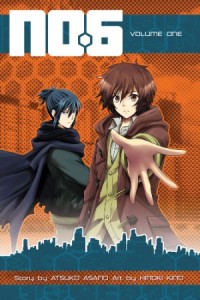
Our hero’s name is Shion, a stoic and reserved young man who is on the fast track for the elite school (and this is among a city of elites) until he lets a young fugitive, who seems to be called Rat, briefly stay at his place, and sews up his wounds. This causes him to lose that elite privilege, something which… really doesn’t bother him much. Several years later, he’s working part-time jobs and staring blankly at his female best friend, who blatantly says she wants to sex him up but is just not registering on his radar, when he comes across a hideous government conspiracy that is killing people by aging them to death. He’s rescued by Rat, and is forced to abandon his life and go on the run, where he’ll find out what the city is really like.

Passive characters like Shion have to be handled very carefully not to be boring. Luckily, these creators are doing a good job so far. Shion may be reserved, but he’s not unemotional, and I like his youthful enthusiasm (which sadly wears down as the volume goes on) and bluntness when he first meets Rat. The scenes with Safu, the aforementioned best friend, are also both quite funny and very telling. It’s not entirely clear if he’s uninterested because he’s not into girls (certainly he bonds better with Rat than he has with Safu) or if the concept of sexual love has simply never occurred to him, but it’s another thing that serves to make him watchable. (By the way, Safu will be dying at some point in this series, sacrificing her life for Shion. I don’t know any spoilers, but bank on this happening anyway, because DUR HEY.)

Rat is less successful, being more of a standard smug pretty boy who has learned not to trust anyone but can’t help but be drawn to our hero. Likewise, the government conspiracy itself, along with its Orwellian officers who administer it, are very much out of the school of Dystopias 101. The aging-to-death thing is pretty horrific, but we don’t know either of the victims long enough for it to really sink in. And the art is serviceable, but doesn’t really pull you in much.

That said, I’m interested to see what happens with Shion, who’s an intriguing enough character that I’ll try another volume of this. The genre isn’t my cup of tea, but the lead may be. And it’s a definite must-buy for anyone who likes conspiracy thrillers with overtones of possible BL romance.

Filed Under: REVIEWS

  • « Go to Previous Page
  • Page 1
  • Page 2
  • Page 3
  • Page 4
  • Go to Next Page »
 | Log in
Copyright © 2010 Manga Bookshelf | Powered by WordPress & the Genesis Framework