• Skip to primary navigation
  • Skip to main content
  • Skip to primary sidebar
  • Home
  • About Us
    • Privacy Policy
    • Comment Policy
    • Disclosures & Disclaimers
  • Resources
    • Links, Essays & Articles
    • Fandomology!
    • CLAMP Directory
    • BlogRoll
  • Features & Columns
    • 3 Things Thursday
    • Adventures in the Key of Shoujo
    • Bit & Blips (game reviews)
    • BL BOOKRACK
    • Bookshelf Briefs
    • Bringing the Drama
    • Comic Conversion
    • Fanservice Friday
    • Going Digital
    • It Came From the Sinosphere
    • License This!
    • Magazine no Mori
    • My Week in Manga
    • OFF THE SHELF
    • Not By Manga Alone
    • PICK OF THE WEEK
    • Subtitles & Sensibility
    • Weekly Shonen Jump Recaps
  • Manga Moveable Feast
    • MMF Full Archive
    • Yun Kouga
    • CLAMP
    • Shojo Beat
    • Osamu Tezuka
    • Sailor Moon
    • Fruits Basket
    • Takehiko Inoue
    • Wild Adapter
    • One Piece
    • After School Nightmare
    • Karakuri Odette
    • Paradise Kiss
    • The Color Trilogy
    • To Terra…
    • Sexy Voice & Robo
  • Browse by Author
    • Sean Gaffney
    • Anna Neatrour
    • Michelle Smith
    • Katherine Dacey
    • MJ
    • Brigid Alverson
    • Travis Anderson
    • Phillip Anthony
    • Derek Bown
    • Jaci Dahlvang
    • Angela Eastman
    • Erica Friedman
    • Sara K.
    • Megan Purdy
    • Emily Snodgrass
    • Nancy Thistlethwaite
    • Eva Volin
    • David Welsh
  • MB Blogs
    • A Case Suitable For Treatment
    • Experiments in Manga
    • MangaBlog
    • The Manga Critic
    • Manga Report
    • Soliloquy in Blue
    • Manga Curmudgeon (archive)

Manga Bookshelf

Discussion, Resources, Roundtables, & Reviews

Archives for September 2012

Pretty Guardian Sailor Moon, Vol. 7

September 16, 2012 by Sean Gaffney

By Naoko Takeuchi. Released in Japan as “Bishoujo Senshi Sailor Moon” by Kodansha, serialized in the magazine Nakayoshi. Released in North America by Kodansha Comics.

Sailor Moon continues to introduce us to the Outer Senshi and their way of dealing with things in this volume. It can be a bit hard to take, and the anime was never quite sure when to quit with the whole ‘no, we are right and you are wrong’ schtick. To be fair, one can argue that it’s all that the Outers know. We see, in their flashback (and note that their memories of past lives seem MUCH clearer than the Inner Senshi pasts have ever been) that they basically patrol their solitary planets looking for distant threats. They don’t even have cute animal companions to keep them company. And the one time they were able to do something, it was pushing the big red ‘PRESS THIS TO DESTROY UNIVERSE’ button of summoning Sailor Saturn. So it stands to reason they’d regard this as something that’s their job, and has to be done their way. Plus they’re two years older than Usagi and company. For a teenager, that’s, like, FOREVER.

That said, it’s Sailor Moon’s manga, and you know she’s going to be right in the end, so it can be a bit aggravating to see them try to do the whole ‘go away and let us handle this’ thing. Luckily, there are several moments that endear them to us. For one, I loved that, immediately after Setsuna’s memories awaken and she reclaims her powers as Pluto, she rushes to embrace Chibi-Moon. From a story perspective, Pluto’s death was devastating to Chibi-Moon the most, so it stands to reason that if you’re going to retcon it (and I don’t remotely understand how Pluto gets reincarnated in the past, but hey, timey-wimey ball and all that) you’d better reclaim that emotional moment. Pluto’s joy at seeing Chibi-Moon is equally fantastic. Of course, once that’s over she joins the Outers in their aloofness, but hey, can’t have everything.

I know that it’s a common theme throughout all 12 volumes of the manga, but it always seemed to me that S really ramped up the idea of possession as an attack to an insane degree. Here the Inners and Outers get pitted against each other by pumping up their negative emotions, we see Kaolinite (back when she was just Kaori, presumably) getting possessed by Pharaoh 90, and of course there’s Hotaru, whose success at fighting off the Evil Mistress Nine within her is even more admirable in this context, given that nobody else seems to have any luck fighting anything off at all. Speaking of Hotaru, her father in the manga is a really evil bastard, who it’s made clear seems to have been off the rails even BEFORE turning evil, so no redemption for him as you may have seen in the anime. That said, Hotaru’s reaction to all this is sweet and loving, even as a disembodied spirit.

Lastly, while bonds of friendship, love and respect are all very well and good, there’s a lovely reminder that being a senshi is a calling rather than a cute little fantasy. Most magical girl manga tend to have their heroines thinking of romance first and foremost – and indeed Usagi is fairly typical in that regard – but we’ve seen over and over again that this is a lifetime profession for Sailor Moon and the others – and that the lifetime is going to last MUCH LONGER than most. The Witches Five (brought back to life again, in one of the poorer plot choices in the entire series – don’t kill off minions if you need them again!) each taunt the Inners with the idea that there are other careers they could be doing – doctor, fortune-teller, florist, idol – that they’re sacrificing by choosing to be a senshi and help Sailor Moon instead. This is not a one-time theme, and will become even more important in the SuperS arc that follows this.

This isn’t a perfect volume of Sailor Moon – it’s a bit more messy and chaotic than it’s been in the past, and there’s more shouting at everyone else than I’d like (most of it designed to fill up pages while we wait for Mistress Nine to be powerful enough to break out). But, as noted above, it’s filled with food for thought, and now that we have all our ducks in a row we’re ready for a powerful climax. Will the Outers have to kill Hotaru to save the world? (Note: if you want this to remain secret, try not to look at the color pages for this volume.)

Filed Under: REVIEWS

Hating on Season Eight

September 15, 2012 by Michelle Smith

I was invited to participate in the “Anniversary of Hate” going on at The Hooded Utilitarian this month. My contribution, “Hating on Season Eight,” is now up, if you’d like to read some fangirl ranting about Buffy comics.

Filed Under: NEWS

Manga the Week of 9/19

September 12, 2012 by Sean Gaffney

First off, shut up all you Yotsuba fans. My blog, I get to choose the featured image. :)

Dark Horse is hitting us with a double dose of CLAMP – or should that be a quadruple dose, as both CLAMP books are omnibus volumes. First off, Card Captor Sakura finishes up with its fourth and final volume, and is as cute and fun as ever. Secondly, Angelic Layer arrives, CLAMP’s first big attempt at shonen, in the first of two big books. Angelic Layer is one of the few anime series where the anime is much better than the manga, but despite this, the manga is still worth checking out. And for those of you who want the polar opposite of these titles, there’s the 36th volume of Berserk. I’m pretty sure Guts is never going to be a Magical Girl. No, don’t send me fanart links.

Speaking of genuine Magical Girls, Kodansha brings us the 7th volume of Sailor Moon, still deep in the S arc. If you like Outers being aloof and Usagi wishing everyone could all just get along, you’ll love this! There’s also the second volume of Attack on Titan, which startled us all at the end of Volume 1 by killing off its hero. Can Mikasa succeed where he failed?

Viz Media has the 22nd and final volume of 20th Century Boys… though the series as a whole is not quite over yet. It’s been a long ride, and I’m glad they stuck it out.

And there’s a bevy of stuff from Yen Press! Higurashi returns from its summer break, and begins the penultimate arc, cheerfully called the Massacre Arc. This one was six volumes in Japan (and the final arc eight), so Yen has chosen to omnibus it, giving us the first two here. Speaking of omnibuses, there’s also the 2nd volume of action thriller Until Death Do Us Part, with Vol. 3 and 4 of the original Japanese series. Manwha gets a look in with new volumes of both Raiders and Jack Frost. BL fans will be pleased to know there’s a new Tale of the Waning Moon. Omamori Himari gets back to its prologue with a Volume Zero. And best of all, after a long wait we have the 4th volume of adorable art school manga GA Art Design Class. Which, unlike Sunshine Sketch, has actual art lessons in it!

Hrm, I know that I’m forgetting something, what could it be…

Oh right! That Yotsuba&! thing has reached its 11th volume somehow, be it via huge sales, amazing word of mouth, or just being really really sweet and adorable. Expect more of the same.

So, how many omnibus bricks are you all getting this week?

Filed Under: FEATURES, manga the week of

New releases in the store and on the web

September 12, 2012 by Brigid Alverson

Lissa Pattillo looks at this week’s new releases in her latest On the Shelf column at Otaku USA.

Good news for fans of Viz’s more mature series: They have put nine mature-rated series, including Nana, Tenjho Tenge, and Dorohedoro, on their Vizmanga.com website at the standard price of $4.99 per volume.

At Manga Therapy, Tony Yao has resolved to read more shoujo manga, and the readers offer some suggestions.

Three Steps Over Japan hits the magazine rack to check out Dragon Age, Comic Blade, Monthly Rival, and Newtype and Dragon.

Reviews: Three Steps Over Japan takes a look at A Fish Crawls on Land, by Hideo Azuma, the creator of Disappearance Diary.

Anna on Apartments of Calle Feliz (Manga Report)
Alex Hoffman on vol. 1 of Attack on Titan (Manga Widget)
Connie on vol. 7 of Dorohedoro (Slightly Biased Manga)
Drew McCabe on vol. 1 of GTO: 14 Days in Shonan (Comic Attack)
John Rose on vol. 20 of Hayate the Combat Butler (The Fandom Post)
Connie on vol. 7 of Itazura Na Kiss (Slightly Biased Manga)
Connie on vol. 41 of Oh My Goddess (Slightly Biased Manga)
Lesley Aeschilman on vol. 24 of Ranma 1/2 (Blogcritics)
Michael Buntag on vol. 4 of Sailor Moon (NonSensical Words)
Kate O’Neil on vol. 10 of Soul Eater (The Fandom Post)
Connie on vol. 7 of Tenjho Tenge (omnibus edition) (Slightly Biased Manga)
Connie on vol. 2 of X (omnibus edition) (Slightly Biased Manga)

Filed Under: MANGABLOG

Dorohedoro, Vol. 7

September 12, 2012 by Sean Gaffney

By Q Hayashida. Released in Japan by Shogakukan, serialization ongoing in the magazine Ikki. Released in North America by Viz.

Once again I am struck by how much this manga develops close bonds of friendship and respect between people who, were they in the real world, would be horrible monsters. En and his gang, Caiman’s ongoing search for Nikaido, even Kasukabe’s strangely distant yet loving relationship with his (as yet unseen) wife. The reason I bang on about how much I like Dorohedoro is that its world building makes it FEEL like a world. This is a place where life goes on even when the protagonists are not on screen, and has people whose priorities are more than simply helping the hero carry out his master plan. Let’s face it, finding your lost friend is all well and good, but there are pies to be sold!

And Dorohedoro also has a glorious sense of humor, not afraid to let everyone embarrass themselves in the name of broad comedy. Thus we have Pieman, Caiman’s alter ego while in En’s mansion, who looks like a refugee from Burger Time with fake breasts. Even better, not only does Caiman pretend to be Tanba’s new wife, but he finds himself getting too into the role, needing to actually remember what he’s here for. As for the pie battle itself (between Tanba and a rival merchant/ex-girlfriend), it ends the way you’d think, even with the use of supernatural aid on the enemies’ side.

There is also Risu and his attempts to connect with a gang of cross-eyed. I will admit that I still tend to find the parts of the manga with Risu a weak point of the book, mostly as he’s simply not as boisterous as our 4 protagonists and not as downtroddenly pathetic as Fujita. I know he has a story that will pay off down the road, however, so it’s worth paying attention. Likewise, I find Chota’s obsession with En to be a bit much, but then that’s how it’s supposed to be. And his imitation of Nikaido is quite funny (you just know this will end badly for him).

There’s darkness afoot, though – this is still a dark and gory manga. First we have Nikaido, still possessed for about half of this book, getting her back sliced open by… well, as she says it’s not caiman, but it’s certainly connected to him in some way, just as Risu is. Unpleasant stuff, especially given how happy-go-lucky Caiman is in general (there’s a nice heartwarming flashback to how he and Nikaido first meet, and he gets his name). Secondly, when chasing after Kasukabe and company, who have gone to visit his wife and found some nasty goons instead, Shin and Noi get the crap beaten out of them – indeed, Shin gets left for dead. Which no doubt will prove to be a mistake, as the cliffhanger shows a not-dead Shin preparing to wreak his revenge.

The beauty of Dorohedoro, in addition to his morally grey but fun characters and its amazing crapsack world, is that after finishing a volume you can’t wait to see what’s next. That’s absolutely the case here. Bring on Vol. 8, I have to know how Shin wins!

Filed Under: REVIEWS

New manga, Vampire trailer released

September 11, 2012 by Brigid Alverson

Lissa Pattillo picks the best of the latest manga releases in her On the Shelf column at Otaku USA. The Manga Village team reviews their picks as well.

And the Manga Bookshelf bloggers discuss their pick of this week’s new titles at Midtown Comics.

Check out the trailer for Yen Press’s Interview with the Vampire: Claudia’s Story.

Kate Dacey has a nice little Q&A on the history of modern manga at The Bubblegum Post. Over at The Hooded Utilitarian, Kate Dacey joins their roundtable on the worst comics ever with her take on Gandhi: A Manga Biography.

Jason Thompson devotes this week’s House of 1000 Manga column to the totally awesome Genju no Seiza.

Erica Friedman posts the latest Yuri Network News update at Okazu.

Reviews: It’s time for Bookshelf Briefs at Manga Bookshelf. Ash Browh has the weekly manga report at Experiments in Manga. Other reviews of note:

John Rose on vol. 10 of Black Butler (The Fandom Post)
Leroy Douresseaux on vol. 46 of Bleach (The Comic Book Bin)
Leroy Douresseaux on vol. 7 of Dorohedoro (I Reads You)
Milo on vols. 1-4 of Fist of the Blue Sky (Blog of the North Star)
Leroy Douresseaux on vol. 5 of Fluffy, Fluffy Cinnamoroll (The Comic Book Bin)
Adam Stephanides on vols. 1 and 2 of I Am the Beatles (Boku Wa Biitoruzu) (Completely Futile)
Brigid Alverson on vol. 1 of Lizzie Newton: Victorian Mysteries (MTV Geek)
Kate O’Neil on vol. 13 of The Melancholy of Haruhi Suzumiya (The Fandom Post)
Leroy Douresseaux on vol. 63 of One Piece (The Comic Book Bin)
Sean Gaffney on vol. 1 of Oreimo (A Case Suitable for Treatment)
Sean Gaffney on vol. 13 of Otomen (A Case Suitable for Treatment)
Lori Henderson on vol. 1 of Phoenix Wright: Ace Attorney (Manga Xanadu)
AstroNerdBoy on vol. 4 of Toradora (AstroNerdBoy’s Anime and Manga Blog)
Anna on vols. 1 and 2 of Twelve Hour Ruler (Manga Report)
Lesley Aeschliman on vol. 10 of Twin Spica (Blogcritics)
Connie on vol. 7 of Tyrant Falls in Love (Slightly Biased Manga)
Ash Brown on Wolf (Experiments in Manga)

Filed Under: MANGABLOG

It Came from the Sinosphere: The One

September 11, 2012 by Sara K. 3 Comments

A picture featuring Lele in a fancy dress with Eros Lanson in the background.

I have a recipe for you.

Ingredient List:

1/2 cup of Paradise Kiss by Ai Yazawa
1/2 cup of a BL comic (the more cliched and/or melodramatic, the better)
1/2 cup of Mars by Fuyumi Soryo
1 cup of a shoujo manga so trashy you are a little embarrassed to admit that you like it
1 tablespoon of Taiwanese culture

1. Put all ingredients in a food processor.
2. Set the machine to “Chinese language”
3. Blend thoroughly.

Voila! You have The One, a manhua by Nicky Lee.

I think there isn’t much point to trying to describe the plot, since it’s mostly ridiculous, but I’ll try anyway.

The Story

Lele’s parents were both fashion models, but they died when she was young, so she was raised by her grandmother and aunt. Her aunt, a modeling agent, is keen to get Lele into the business as soon as she is old enough, but Lele hates the idea of becoming a model. Then she sees photos featuring Angus Lanson, the Chinese-European-American model who is taking the world by storm. Lele then recognizes that modeling can be an art form. Oh, and Angus has a twin brother, Eros Lanson (you read that right, his name is “Eros”).

I don’t think that’s enough to convey the true ridiculousness of the story, so here’s what happened in volume 14 (spoiler warning). Another model, Feidna, had taken Lele’s place in the modeling world to get revenge for Lele taking Eros from her. Eros says he will break up with Lele if she doesn’t take her place in the modeling world back, so Lele goes to Paris. In order to get back her position. she has to work with a very feminine male model, and she has to become very masculine in order to accompany him. Oh, and they have to spend a couple of weeks together as “girlfriend and boyfriend” (he is the girlfriend, she is the boyfriend).

Background

The One is a Star Girls title (I have discussed Star Girls previously). Specifically, it’s currently the best selling Star Girls title. In fact, it currently the best-selling Taiwanese manhua aimed specifically at a female audience, period.

Nicky Lee has been making manhua for about 20 years. Aside from The One, her best-known work is Youth Gone Wild, which is 14 volumes long.

The Surfacing of Taiwanese Culture

I’ve said before that Star Girls manhua tends to follow Japanese shoujo very closely, but Taiwanese culture can surface in interesting ways.

For example, the super-gorgeous twins have both Chinese and European ancestry. In Taiwan, people of mixed Chinese and European ancestry are considered to be more beautiful than people of purely Chinese or purely European ancestry.

Also, though I can’t find it right now, there’s a reference to how scary Taiwan is due to all the stray dogs (something that is also noted in Pinoy Sunday). It is true that Taiwan has lots of stray dogs, and they used to scare me a lot before I got used to them. Supposedly the only place with even more stray dogs is Thailand (at least, that seems to be the only place with more complaints about stray dogs than Taiwan).

There are enough Taiwanisms in this manhua that I don’t think anyone who hadn’t lived in Taiwan could have written it.

And I don’t think it’s a coincidence that a manhua with a bunch of subtle Taiwanisms is also one of the best-selling manhua in Taiwan. In the Taiwan market, being able to feature Taiwanese culture is one of the clearest advantages local manhua artists have over Japanese artists.

Art

I think Nicky Lee has read something by Ai Yazawa.

Some pages showing the Ai Yazawa influence.

However, the Ai Yazawa influence is most apparent in the early volumes, and less apparent later on. In fact, in the most recent volumes, the Fuyumi Soryo influence is much more apparent, at least to me.

Some pages from volume 14, the most recent volume

My favorite parts, art-wise, are the cinematic sections without dialogue. They really show that Nicky Lee can tell a story visually. For example, there is a beautiful sequence (which, due to technical difficulties, I cannot get pictures of – sorry!) in which Lele leaves Eros. In the rain. In the heart of New York City. And not a word is said. Both the composition and the way the characters’ expressions are drawn in that scene are exquisite.

On Queerness

The way queerness is depicted in this story is a mixed bag.

On the one hand, there are queer characters. And, unlike some BL, homosexual identity is acknowledged – some characters actually do identify as gay.

On the other hand, pansexual/bisexual identity is NOT acknowledged. There are some characters who, to me, are clearly behaving in a bisexual/pansexual way … but nobody identifies as pansexual or bisexual. Instead, they are straight, or gay, or a gay going straight, or a straight going gay. Argh.

One of my favorite characters, Leo, actually identifies as gay. He is a bit of a stereotypical gay man … on the other hand he is also black (in my experience of mainstream American media, the vast majority of gay men depicted are white). He is also one of the most likeable characters in the entire story.

What bugs me most, however, is a story arc in which a woman woos away a man from his boyfriend. As far as I could tell, these two guys were not in an open relationship, therefore I think trying to woo one of them away is, at best, extremely questionable behavior. But Nicky Lee tells the story as if there is nothing questionable about this. I cannot imagine Nicky Lee telling this story the same way if the relationship involved were a heterosexual one. The only explanation I can think of is that Nicky Lee thinks that homosexual relationships are not as worthy of respect as heterosexual ones. And I strongly disagree with that.

My Take on the Story

I think the story is too ridiculous to take seriously. Okay, occasionally I can take it seriously but … not often.

Nonetheless, I have read all 14 volumes, and I enjoyed it. What gives?

Well, first of all, the story is not boring. The breezy style keeps things moving along.

In spite of all the cliches, I don’t know what is going to happen next, because the cliches are deployed in an unpredictable way.

The Lanson twins—they are so over the top it’s funny. For example (spoiler warning), in order to rescue Eros, who basically being kept prisoner by their father in Europe, Angus sells himself to another male model, agreeing to be his sex slave for two years. Months later the male model complains that Angus hasn’t given himself to him, and Angus answers that he’s fulfilled his every request and had lots of sex with him, and the male model replies that what he really wants is Angus’ heart. Just thinking about that arc makes me giggle.

There are also some moments which are just plain fun. For example, at one point during a shoot, Lele imagines tormenting Eros Lanson in a BDSM fashion (whip included) … and her feelings come out in the way that she touches the other models in the shoot. The director of the shoot finds Lele’s attitude incredibly hot.

And, as someone who has read more than a few shoujo manga, I am actually impressed by Nicky Lee’s ability to use so many melodramatic shoujo/BL tropes while keeping the story comprehensible.

Availability

This manhua has never been licensed in English, or any other European language.

Conclusion

Since I figured the most popular Taiwanese manhua aimed at a female audience couldn’t be the worst place to start, this was actually the first manhua I ever read. So it will always have some nostalgic value for me.

I think it’s a pity it hasn’t been licensed in English because, even though it’s not a masterpiece, I think hard-core shoujo fans might appreciate something like this. It’s strangely appealing in its own way.

Next Time: Black & White (idol drama)


Sara K. is going to be quite busy in the next month, so her posts might become fluffier than usual (though the next post will definitely not be fluffy). Nonetheless, she hope readers will enjoy them.

Filed Under: It Came From the Sinosphere Tagged With: manhua, nicky lee, star girls, taiwan, the one

Pick of the Week: Toradora! & more

September 10, 2012 by Sean Gaffney, Katherine Dacey, MJ and Michelle Smith 1 Comment

SEAN: As always after a week where 30+ titles ship all at once, this 2nd week of the month feels like a bit of a letdown. That said, there are a few interesting items. My pick of the week goes to the 5th volume of Toradora!, Seven Seas’ romantic comedy about a tiny girl with a hot temper and her not-boyfriend, a sensitive guy with the face of a gangster. Generally speaking, ‘tsundere girl who looks 8 years old but is 16 and will beat up the guy she likes’ is a overdone theme in Japanese anime and manga, but Taiga has managed to be less irritating than, say, Louise or Shana, and the cast of characters is also more appealing to me. Especially Minori, Taiga’s best friend, who needs to cross over with Bleach so that she and Orihime can be weird together.

KATE: Them’s some meager offerings! Click over to the graphic novel list, however, and you’ll find a worthy pick of the week: Madeline Rosca’s Clockwork Sky. If Rosca’s name sounds familiar, that’s because she was one of the first people to win the International Manga Award for Hollow Fields, a story set at an academy for mad scientists. Like Hollow Fields, Clockwork Sky has a heavy element of steampunk: the story unfolds in a technologically advanced version of Victorian England, complete with automated factories and robot detectives. The description promises an abundance of plotlines, from class warfare to rogue robots, so I’m optimistic that Clockwork Sky will be a fun read.

MJ: I admit I’m finding this week’s offerings at Midtown less than enticing. Fortunately, there are other places to turn for new manga these days, and by “other” I mean “digital”! Right now, I’m racing over to JManga to pick up the third volume of Setona Mizushiro’s Dousei Ai. As a big fan of Mizushiro’s After School Nightmare I’d long waited for some of her BL work to finally be translated into English, and this series’ first two volumes did not disappoint. If you’re looking for epic, complex BL, Dousei Ai is a must-read. I only wish it was available in print!

MICHELLE: Meager, indeed! According to Amazon, though, the seventh volume of Sailor Moon (my personal pick) is due on Tuesday, so you will likely be able to find it at your local comic store, provided that store isn’t Midtown!


Readers, what looks good to you this week?

Filed Under: PICK OF THE WEEK

Bookshelf Briefs 9/10/12

September 10, 2012 by Sean Gaffney, Katherine Dacey and Michelle Smith 1 Comment

This week, Sean, Kate, and Michelle look at recent releases from Seven Seas, Yen Press, VIZ Media, and Vertical, Inc.


Alice in the Country of Clover: Cheshire Cat Waltz, Vol. 2 | By QuinRose and Mamenosuke Fujimaru | Seven Seas – Ace, the cheery yet sociopathic character who’s quickly become my favorite in this series, tells Alice he finds her most attractive when she’s upset and stressed, as the conflict makes her pretty. That’s sort of how I feel about this series as a whole. When it’s talking about whether Alice and Boris will get over their fight and become closer and maybe even move in together, it’s just another generic reverse harem title. When it’s analyzing the mechanics of the world, putting Alice on a high wire act and pitting her friends against each other, and showing why leaving Wonderland and going back continues to possibly be horrible, it’s fascinating. Hence my favorite part of the book – Boris shooting at Alice’s vial and failing to even crack it, to his annoyance. -Sean Gaffney

Bamboo Blade, Vol. 14 | By Masahiro Totsuka and Aguri Igarashi | Yen Press – I was underwhelmed by the initial volumes of Bamboo Blade: I found the one-note characters and slapstick humor too familiar to be compelling. As the series unfolded, however, the artist’s ability to draw kendo matches improved steadily, yielding fight scenes that were fun to read and advanced the plot in a meaningful fashion. The final volume resolves the individual characters’ conflicts first, then features a lengthy, 100+ page epilogue in which we see the girls strut their stuff at a Burnish Academy tournament. It’s not brilliant by any means, but the matches are expertly staged, and the final pages of the story suggest that even Toraji is capable of growing up. -Katherine Dacey

The Flowers of Evil, Vol. 2 | By Shuzo Oshimi | Vertical, Inc. – Quite often I agree with MJ on matters of manga, but this series is one where our opinions differ wildly. She liked it and found the leads sympathetic; I pretty much hated it and found no one to sympathize with except Saeki, the innocent (though idealized) girl who has agreed to date Kasuga, a middle-schooler who’s being manipulated by a female classmate (Nakamura) into acknowledging his inner perversion. I know I probably should applaud the depiction of teenage sexuality and pretention, but this series is just so not my cup of tea that I can’t find anything good to say about it. It’s very disturbing to me that what Saeki believes is a sweet, if awkward, first date with Kasuga is in reality tainted by the fact that he’s been forced to wear her stolen gym clothes beneath his own. She’s being duped. To his credit, Kasuga hates himself for the ruse and the final moments of the volume find him on the verge of telling the truth in a horrible, messy way, but ugh, I just can’t see myself picking up volume three to see what happens next. – Michelle Smith

Is This a Zombie?, Vol. 2 | Comic by Sacchi, Character Design by Kobuichi • Muririn, Original Concept by Shinichi Kimura | Yen Press – Is This a Zombie? has the dubious distinction of being the worst comic I’ve read this year. The artwork is lousy, the jokes unfunny, the fanservice unrelenting, and the plot so nonsensical it often seems as if the characters themselves are confused by the rapid turn of events. In volume two, for example, there’s an extraordinarily silly fight scene in which we learn the identity of Ayumu’s killer. There are so many reversals and reveals packed into that chapter, however, that it reads more like something a six-year-old brainstormed than the work of a professional script writer. Add an unnecessary episode in which the characters go to the beach and participate in a food-eating contest, and presto! you have a recipe for a Manga Hall of Shame nomination. – Katherine Dacey

Library Wars: Love & War, Vol. 8 | By Kiiro Yumi and Hiro Arikawa | VIZ Media – And now, at last, after eight volumes, we get some resolution, as Tezuka’s horribly smug brother jogs Iku’s memory and forces her to realize who her prince is. And so now she’s freaking out, which is fun and yet also a bit predictable. Hopefully they’ll talk about it next volume after dealing with a molester who haunts libraries. What really impressed me, though, is Shibazaki’s plot thread. There’s lots of revelations here, some of which I found rather unpleasaant – but then that was the point – and you hope that someone (coughTezukacough) is able to take a hold of her and get her out of this ‘no one can ever really love me for who I am’ spiral she seems to be in. In comparison, Iku has it easier, but then Iku is a less complex person – as Shibazaki knows and envies. Good shoujo fluff. – Sean Gaffney

Oresama Teacher, Vol. 10 | By Izumi Tsubaki | VIZ Media – Longtime readers should now by now how much I love the humor in this title, and how I think it’s at its best when everyone is being as thick as planks. That said, I was surprised that my favorite moments in this volume were the more emotional ones. Hojo, the new Student Council member introduced here (another female character? How did that happen?) is comparatively ‘normal’, and thus we empathize even more with her obsession/frustration with Yui, who continues to vacillate between being cool and intelligent and being the dumbest, most clueless guy ever. As for our heroine, Mafuyu’s reaction to Takaomi reaching around to tie up her hair shows that, despite Western fandom’s dislike of student/teacher relationships, she’s still got it bad for him. All this, plus the return of SUPER BUN! – Sean Gaffney

Filed Under: Bookshelf Briefs

OreImo, Vol. 1

September 10, 2012 by Sean Gaffney

By Tsukasa Fushimi, Sakura Ikeda, and Hiro Kanzaki. Released in Japan as Ore no Imōto ga Konna ni Kawaii Wake ga Nai by ASCII Media Works, serialized in the magazine Dengeki G’s. Released in North America by Dark Horse Comics.

After reviewing I Don’t Like You At All, Big Brother!, I have to admit that I was not particularly looking forward to OreImo, which does not quite swim in the same waters but is in the same general area, featuring a sister who may harbor closer feelings for her brother than most would be comfortable with. So readers may be pleased to know that I didn’t really hate this, it cleared the low bar that I had set it when I came into it. That said, there’s a lot here that I found awkward, overdone or creepy too. Japanese harem manga lately seems to not only find originality unnecessary, but positively revels in its cliches, and you can see that going on here.

The premise of this work, which is also translated as “My Little Sister Can’t Be This Cute!”, is that our generic everyhero Kyousuke discovers that his pretty, popular and standoffish younger sister Kirino has a secret fetish for anime and otaku stuff. Specifically, she loves H-games. And even more specifically, she loves H-games based around older brother/younger sister incest. When confronted about this, she’s upset, but even more she’s relieved that she can finally talk to someone about it, even if it’s her brother. Kyousuke is (of course) a Really Nice Guy, so he tries to find ways to get her to make friends and be able to not repress everything until she’s unhappy. This is hard, as she’s a massive tsundere (see the cover image), but eventually she bonds with a grumpy goth and a busty Gundam fanatic, and all seems well. At least until their father finds her porn…

Let’s start with the things I liked. All the characters are more likeable than IDLYAA,BB. Kyousuke may be a generic everyhero, but at least he *is* the nice variety, trying to do his best for his little sister, bonding with his childhood friend who clearly has a massive crush on him (that he doesn’t see), and so forth. The emphasis in this title is clearly meant to be about the two kids growing closer and opening up as family, with the incest providing a plot setup but (I hope) not really the main thrust of everything that happens. It’s lower-key and sweeter, and the humor is more character based. I also liked the Gundam Girl, who seems poised to be this series’ Cool Big Sis, and who I suspect is hiding something behind those huge otaku-parody glasses.

Now for the bad. The art is terrible. This is not all that uncommon in light novel adaptations these days, but unfortunately it really caught my attention here. All the girls are 14 but look about 4-5 years younger, and the artist has this very odd habit of drawing smiling happy girls as if they’ve just been drugged. Also, I suspect someone took Ikeda aside after the first four chapters and said “Yo, tone it down”, as the overemphasis on asses and the incestual imaginings vanish rapidly when we reach the halfway point and things get less big brother-ey.

The other problem is simply that there’s not really much here that’s new and exciting. A harem comedy with a tsundere lead and a generic male who will, no doubt, get involved in all sorts of wacky misunderstandings, with the ‘gimmick’ being that the supposed cool and beautiful younger sister character is actually an otaku with a slight big brother fetish. The brother-sister incest thing is very big in Japan right now, as a quick look at the bestsellers charts may tell you, but in and of itself it’s not all that interesting. Indeed, I Don’t Like You At All, Big Brother! is at least upfront about its perversions. OreImo’s attempt to be the kinder, gentler incest title comes off as more boring than anything else.

Filed Under: REVIEWS

Otomen, Vol. 13

September 9, 2012 by Sean Gaffney

By Aya Kanno. Released in Japan by Hakusensha, serialization ongoing in the magazine Bessatsu Hana to Yume (“Betsuhana”). Released in North America by Viz.

Note that I say ‘serialization ongoing’ up there. One might be forgiven, after reading the final two chapters here, in thinking that Otomen ends with this volume, wrapping up on a high note where we finally see a bit more into Ryo’s psyche and see Asuka struggle with what he wants to do with his future. But fitting as it might be, it’s not the end – these chapters ran in early 2011 in Japan, and the manga is still going in Betsuhana, so we have at least three more volumes to go, including one Viz has scheduled for January.

This is not, however, to take away from what might be one of Kanno’s best volumes in this series. It was deliberately written to focus on Ryo, who also gets the cover, albeit disguised as a boy. 3/4 of the book has her meeting up with a judo club that’s being taught poorly by its physically skilled captain whose frustrations make him completely incapable of leading. After seeing him attack one of his students, Ryo throws him into a wall, where he “breaks his arm”. Now Ryo has to dress up as a boy and lead the judo team to victory against their opponents… who happen to by her own school. This means she will have to fight Asuka.

If this sounds incredibly cliched, clearly you haven’t read Otomen before, which specializes in taking the most hideously cliched plots imaginable and doing something with them. In this particular case there are two plots interweaving, both involving Ryo. The main one has her making the judo team into a force of awesome. They have skills, as Sakata (the captain Ryo took over for) has drilled things into them, albeit poorly. Seeing what she can make of them sends Sakata spiraling into despair and self-loathing (not helped by the fact that he doesn’t realize the boy teaching them is Ryo at first, so we get a standard ‘why do I have feelings for this guy?’ reaction) and declaring he’s quitting. Ryo, who can see the good guy underneath, asks if he’ll stay if Odo is victorious. Eventually we *don’t* get our expected Asuka vs. Ryo match, as Sakata breaks his cast (showing he was faking, as we suspected) and demands to fight Asuka himself.

Asuka has a smaller role here, but it’s important – Juta plants a seed of uncertainty in his head about Ryo, and Asuka can’t stop thinking about it. Even after he learns what Ryo is doing, he still puts on a false front in front of her. Because let’s face it, Ryo is not the most demonstrative of people. He’s said he loves her three times now, as well as dated her, and her reactions seems to be more of a cheery “Okee doke!” than anything else. Here, helped out by her father and Sakata, Ryo is starting to realize that her lack of direct expression is bothering Asuka, and she does something about it. THIS. This is what I wanted from this series all along – a direct, honest statement from Ryo that she is also in love with Asuka, as well as some insight into her inner thought process. Very well done.

Then there’s the last chapter. It’s Valentine’s Day, but this is Otomen, so naturally the guys are the ones giving out the chocolate. In between this, we see them all discussing plans for their future, as he’s expected to inherit the family business… but isn’t sure he really wants to do that. Making matters worse, everyone else seems to have a firm goal in mind – including Ryo, who is following in her father’s footsteps in becoming a police officer. This is another chapter that’s more about the heart than the laughs, though I did laugh at Asuka’s realization of what it is he truly wants – or more accurately, what he’s focused on when it happens (truly an otomen to the end). His response, however, is fantastic, and leads to that ending which I told you feels like the end of the series, but isn’t. I hope (and pray!) that finally we can move away from “are we truly a couple?” stories and show Asuka and Ryo growing and getting closer.

Of course, Asuka’s mother probably has a few things to say about this. We’re not done, and I will look forward to Otomen 14 in January. But this particular volume put its foot on the ‘heartwarming’ pedal and never let up, and finally gave focus to one of my favorite characters in the series. Very well done.

Also, anyone notice that the guys in Otomen blush constantly, and Ryo never does? There’s only one time in the volume we see her blush, and it’s not at either of the two places I expected.

Filed Under: REVIEWS

Manga Artifacts: The Unauthorized Astro Boy Comic

September 7, 2012 by Katherine Dacey 6 Comments

In 1963, NBC acquired the rights to broadcast Tetsuwan Atomu, or Mighty Atom, an animated children’s show that had been a hit on Japanese television earlier that year. NBC executives renamed it Astro Boy and began airing it in September on WNEW, NBC’s New York City affiliate. Astro Boy proved a success with young viewers, prompting NBC to order fifty-two more episodes from Mushi Studios and syndicate the show nationally (Schodt 88).

Two years later, NBC licensed the Astro Boy character rights to Gold Key Comics . Gold Key was a brand-new subsidiary of Western Publishers, best known to consumers for titles like The Poky Little Puppy and The Saggy Baggy Elephant. The company had considerable experience selling its Little Golden Books through non-traditional outlets — supermarkets, drug stores — and wanted to apply that knowledge to the newsstand comics market, then dominated by companies such as Dell Comics.

Without the knowledge or approval of Mushi Studios or Osamu Tezuka, Gold Key hired an artist to adapt the Astro Boy show into a comic. (No artist is credited for Astro Boy #1.) The result was a four-color, two-story issue that used Osamu Tezuka’s characters but bore little to no resemblance to the comic that had been running in Shonen magazine since 1952.

“Gangor the Monster,” the first of the two stories, is based on an episode of the Astro Boy show. The plot is simple: Gangor, a centipede-like robot, terrorizes the passengers aboard an ocean liner on which Astro and Professor Ochanomizu (called Dr. Packadermus J. Elefun in the English version) are traveling. Astro Boy soon discovers Gangor’s secret — Gangor is actually comprised of forty-seven identical robots — and quickly defeats it in a battle that unfolds underwater and in the air. As in many Silver Age comics, word balloons carry the burden of the storytelling; though we see several panels of Gangor in action, most of what we learn about Gangor is revealed in conversations between the main characters:

The second story, “Attack of the Mud People” is original, with no obvious precedent in the the show. In terms of tone and plot, it reads like a rejected DC Comics script: a pair of evil scientists unleash a horde of mud monsters on an unsuspecting city, demanding five million dollars in ransom. (Better still: the scientists have mustaches. They also happen to be identical twins. It’s a trifecta of villainy!) Astro Boy is nearly defeated by the monsters, as their dirt clogs his joints, preventing him from flying. In a flash of inspiration, he realizes the best way to stop the monsters is to make it rain — a feat he accomplishes with the aid of a little dry ice. As in “Gangor,” very little actually happens; most of the story consists of characters’ reaction shots as they flee in terror, or watch Astro Boy go mano-a-mano with the monsters.

As the page above demonstrates, both stories look more like generic Silver Age products than shonen manga; small wonder Tezuka deplored it as a cheap knock-off of his work. Yet for all their flaws, both stories offer a fascinating window into the American comics industry in the 1960s.

For one thing, they attest to the the growing importance of television as source material for comics publishers. A quick glance at Gold Key’s catalog turns up comics based on The Addams Family, Dark Shadows, Lost in Space, My Favorite Martian, Star Trek, and The Twilight Zone. Animated shows were an important part of the Gold Key catalog as well. In the 1960s and early 1970s, Gold Key had a partnership with Hanna-Barbera Studios, cranking out comic book versions of The Amazing Chan and the Chan Clan, The Flintstones, The Pink Panther, and Scooby Doo. As former Gold Key writer Mark Evanier explains, there was a standard procedure for taking a new show and turning it into a comic. The first few stories would faithfully reproduce early episodes; after that, the artist was given greater creative freedom to do as he saw fit with the characters:

Chase [Craig, the editor] handed me a pile of storyboards and told me to read them all to get a feel for the property but to write an adaptation of one in particular… Anyway, I was assigned to adapt it and later on if the comic continued, there would be original stories conceived fresh for the comics. As Chase explained to me, he preferred to launch a new H-B book in this manner. The studio had approval rights and the people there could get pointlessly picky about the material…but they rarely bothered looking at any issue after the first few. Therefore, it simplified the procedure to do the first issue as an adaptation and maybe the second. They couldn’t very well complain that a plot taken from the show was inappropriate.

We can see this process at work in the Astro Boy comic as well, with one story based on the show and one story drawn from the artist’s imagination. Of course, no one from Mushi Studios was reviewing the work, as in the model that Evanier describes above; the primary reason for re-telling “Gigantor,” presumably, was to cement the connection between the show and the comic.

These stories also attest to a powerful Western arrogance about the source material; every effort was made to conceal its Japanese origins, from renaming the characters to adding color. More telling still was that Tezuka himself was never identified as Astro Boy‘s creator; NBC was listed as the copyright holder (Schodt 88-89). It never occurred to anyone at either NBC or Gold Key that the very foreignness of the original material — the action-driven storytelling, the frank presentation of difficult issues — might appeal more to kids than a bowdlerized version in which every conflict was neatly resolved in sixteen pages, and no one ever died. For that version of Astro Boy, American readers would have to wait another thirty-seven years.

Works Cited

Evanier, Mark. “Goodbye, Charlie!” News From Me. N.p., 25 Apr. 2006. Web. 07 Sept. 2012. <http://www.newsfromme.com/archives/2006_04_25.html>.

“Gold Key Astro Boy #1 – Attack of the Mud People.” Magic Carpet Burn. N.p., 23 Mar. 2009. Web. 07 Sept. 2012. <http://magiccarpetburn.blogspot.com/2009/03/gold-key-astro-boy-1-attack-of-mud.html>.

“Gold Key Astro Boy #1 – Attack of the Mud People (Conclusion).” Magic Carpet Burn. N.p., 24 Mar. 2009. Web. 07 Sept. 2012. <http://magiccarpetburn.blogspot.com/2009/03/gold-key-astro-boy-1-attack-of-mud_24.html>.

“Gold Key Astro Boy #1 – Gangor the Monster Pt One.” Magic Carpet Burn. N.p., 21 Mar. 2009. Web. 07 Sept. 2012. <http://magiccarpetburn.blogspot.com/2009/03/gold-key-astro-boy-1-gangor-monster-pt.html>.

“Gold Key Astro Boy #1 – Gangor the Monster Pt Two.” Magic Carpet Burn. N.p., 22 Mar. 2009. Web. 07 Sept. 2012. <http://magiccarpetburn.blogspot.com/2009/03/gold-key-astro-boy-1-gangor-monster-pt_22.html>.

Schodt, Frederik L. The Astro Boy Essays: Osamu Tezuka, Mighty Atom, and the Manga/Anime Revolution. Berkeley: Stone Bridge Press, 2007. Print.

Filed Under: Manga Critic Tagged With: Astro Boy, Gold Key Comics, NBC, Osamu Tezuka

Yen Press has Doubt; Barrage coming to an end

September 6, 2012 by Brigid Alverson

Yen Press has licensed Yoshiki Tonogai’s horror manga Doubt, which it will publish in omnibus form; the series is up to volume 5 in Japan.

The next chapter of Barrage to run in Weekly Shonen Jump will be the last, which means that the series will wind up for North American readers of Shonen Jump Alpha two weeks later.

Sean Gaffney takes a look at next week’s new manga releases.

Laura takes a look at the newest shoujo series heading our way in September at Heart of Manga.

Three Steps Over Japan continues its barrage of magazine posts with commentary on Weekly Young Jump and G-Fantasy.

News from Japan: Tachibana Higuchi is wrapping up Gakuen Alice, which has been running for ten years now; the final chapter will appear in an upcoming issue of Hana to Yume.

Reviews

Sean Gaffney on vol. 6 of Bunny Drop (A Case Suitable for Treatment)
Erica Friedman on vol. 2 of Kuchibiru Tameiki Sakurairo (Okazu)
Anna on vol. 1 of Lady Lady (Manga Report)
Drew McCabe on vol. 5 of Psyren (Comic Attack)
Ken Haley on vol. 6 of Rurouni Kenshin (VizBig edition) (Sequential Ink)
Alex Hoffman on vol. 1 of Soul Eater NOT (Manga Widget)

Filed Under: MANGABLOG

Manga the Week of 9/12

September 5, 2012 by Sean Gaffney

As always, Midtown, Diamond and Amazon can’t quite mesh together. My store and most Diamond shops have Hayate the Combat Butler, Arata the Legend, House of Five Leaves, and Loveless out on 9/12. On the other hand, my store got in the Seven Seas stuff on 9/5, but Midtown isn’t getting it till 9/12. Best to just smile and nod.

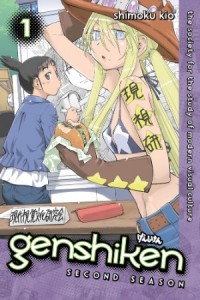
Kodansha debuts the new Genshiken volume. In Japan it’s just Genshiken 10, but Kodansha USA has made a break with the former series and started its sequel with a new subtitle and Vol. 1. Of course, you can’t get rid of the old cast that easily – Saki and Kousaka make cameos, and Madarame is still a large presence throughout. For the most part, though, this is Ogiue’s new club, with new members – and a shifting mindset, devoted less to typical guy porn and more to typical girl porn. It’s a must buy for fans of the series.

And Seven Seas has a troika of September releases. The 2nd volume of Boris spinoff Alice in the Country of Clover: Cheshire Cat Waltz. A new omnibus of killer loli series Gunslinger Girl, containing the Japanese 11 and 12. (The end of the series was recently announced in Japan, possibly as they’d simply run out of cast members.) And the 5th volume of Toradora!, still the tsundere series to read if you don’t like tsunderes all that much.

And that’s about it, really. A nice quiet week. Any plans?

Filed Under: FEATURES, manga the week of

No Duel Masters for you, North Americans! Also, no more Bandai!

September 5, 2012 by Brigid Alverson

ICv2 reports that Hasbro will not be releasing the Duel Masters manga in the U.S. in conjunction with its Kaijudo trading card game (which is a reboot of the original Duel Masters) because they want people to follow the new version, not the older one.

Bandai Entertainment, which announced it would stop publishing new manga and anime last January, has announced it will discontinue sales of manga and anime as of this fall.

Dave Ferraro and Patrick Markfort discuss two Shigeru Mizuki manga, Onward Towards Our Noble Deaths and NonNonBa, in their latest podcast at Comics-and-More.

Three Steps Over Japan takes a look at Comic Ryuu.

News from Japan: Dance in the Vampire Bund is returning to Comic Flapper for a new mini-series, to be followed by a new second story arc. The series Dolls, by manga-ka duo naked ape (Switch) will end in the November issue of Monthly Comic Zero-Sum.

Reviews

Kate O’Neil on chapters 12 and 13 of Barrage (The Fandom Post)
Kate Haddock on Blue Exorcist (The Collegian)
John Rose on vol. 1 of The Disappearance of Nagato Yuki-Chan (The Fandom Post)
Erica Friedman on vol. 1 of Kuchibiru Tameiki Sakurairo (Okazu)
Lesley Aeschliman on vol. 23 of Ranma 1/2 (Blogcritics)

Filed Under: MANGABLOG

  • « Go to Previous Page
  • Page 1
  • Page 2
  • Page 3
  • Page 4
  • Go to Next Page »
 | Log in
Copyright © 2010 Manga Bookshelf | Powered by WordPress & the Genesis Framework