• Skip to primary navigation
  • Skip to main content
  • Skip to primary sidebar
  • Home
  • About Us
    • Privacy Policy
    • Comment Policy
    • Disclosures & Disclaimers
  • Resources
    • Links, Essays & Articles
    • Fandomology!
    • CLAMP Directory
    • BlogRoll
  • Features & Columns
    • 3 Things Thursday
    • Adventures in the Key of Shoujo
    • Bit & Blips (game reviews)
    • BL BOOKRACK
    • Bookshelf Briefs
    • Bringing the Drama
    • Comic Conversion
    • Fanservice Friday
    • Going Digital
    • It Came From the Sinosphere
    • License This!
    • Magazine no Mori
    • My Week in Manga
    • OFF THE SHELF
    • Not By Manga Alone
    • PICK OF THE WEEK
    • Subtitles & Sensibility
    • Weekly Shonen Jump Recaps
  • Manga Moveable Feast
    • MMF Full Archive
    • Yun Kouga
    • CLAMP
    • Shojo Beat
    • Osamu Tezuka
    • Sailor Moon
    • Fruits Basket
    • Takehiko Inoue
    • Wild Adapter
    • One Piece
    • After School Nightmare
    • Karakuri Odette
    • Paradise Kiss
    • The Color Trilogy
    • To Terra…
    • Sexy Voice & Robo
  • Browse by Author
    • Sean Gaffney
    • Anna Neatrour
    • Michelle Smith
    • Katherine Dacey
    • MJ
    • Brigid Alverson
    • Travis Anderson
    • Phillip Anthony
    • Derek Bown
    • Jaci Dahlvang
    • Angela Eastman
    • Erica Friedman
    • Sara K.
    • Megan Purdy
    • Emily Snodgrass
    • Nancy Thistlethwaite
    • Eva Volin
    • David Welsh
  • MB Blogs
    • A Case Suitable For Treatment
    • Experiments in Manga
    • MangaBlog
    • The Manga Critic
    • Manga Report
    • Soliloquy in Blue
    • Manga Curmudgeon (archive)

Manga Bookshelf

Discussion, Resources, Roundtables, & Reviews

Archives for September 2012

Bunny Drop, Vol. 6

September 5, 2012 by Sean Gaffney

By Yumi Unita. Released in Japan as “Usagi Drop” by Shodensha, serialized in the magazine Feel Young. Released in North America by Yen Press.

Please do not discuss Bunny Drop beyond Vol. 6 in the comments. At all.

When I reviewed Vol. 5, I noted that I couldn’t wait to see what direction Unita would take things, even though I thought it would make me cringe. And I was 100% correct – this entire volume is like a giant train wreck, where both of the main ‘ships’ we could be rooting for are faced with tortured reality.

Last time around, we had been told about Kouki’s ‘bad boy’ period in middle school, and now we get to see it in the form of an extended flashback. Which is good, as it really gives us insight as to why Rin has decided that she’s no longer ‘romantically’ inclined towards him. The two of them walked that fine line between ‘like brother and sister’ and small crush last time, but seeing Akari’s wholehearted efforts to drive Rin away, you can’t help but feel horrible for her. Cyber-bullying isn’t just an American thing.

This is paralleled with the ongoing not-relationship between Daikichi and Kouki’s mother, who still doesn’t have a first name (and likely never will, sadly). Their conversation at the end of the volume is all about wishing things could be different but having to move forward anyway, and it almost feels like Nitani-san cares about Daikichi too much to get involved with him. They’ve been there for each other in order to raise their children, but this has perhaps led both of them to be too self-sacrificing – Nitani-san is marrying someone else so that Daikichi can move on and find anotehr as well. The whole scene is heartbreaking.

Rin and Kouki aren’t as sad, but they’re equally hemmed in by feelings that things have moved beyond a point where everyone can go back to how it was before. This is helped, of course, by Akari, who Rin confronts when she tricks Kouki into thinking she’s pregnant. There’s a nice effort to show Akari’s side of things, which isn’t sympathetic at all, but it’s quite understandable – and mercenary. Akari wants to be her own woman, and if that means abusing the love of a gullible high schooler for money, well hey. Unfortunately, all this seems to have done is shown Rin that she needs to get over Kouki, and she tells him so – though notably getting over him is not as simple as she thinks, judging by her red-eyed face the next day.

We all make bad choices in life, and wish that we could turn back the clock and do things better. But we can’t, and that’s what this volume is all about. There’s no going back in time so Nitani could meet Daikichi when she was younger. There’s no do-overs so Kouki isn’t sucked in by Akari’s schemes. And sometimes you can’t fix things, and you have to accept it and move on. Which is where we are now in this series that, while it still has a lot of quiet and cute moments, has come an awful long way from the saga of a young guy raising an adorable daughter.

Filed Under: REVIEWS

It Came from the Sinosphere: Pinoy Sunday

September 4, 2012 by Sara K. 5 Comments

Dado and Manuel are sitting down in a park

Before reading this review, maybe you should watch the trailer. Or maybe you shouldn’t – the trailer gives the impression that a lot of this movie is about Manuel acting creepily towards women, whereas in the actual movie that is just a minor theme.

So what is a Tagalog-language film, produced by a Japanese company (NHK), doing in a column dedicated to Chinese-language pop culture?

Fair question. Here is my answer:

– The director, Wi Ding Ho, is an ethnically-Chinese Malaysian
– The film is set and filmed in Taiwan, which is clearly a part of the Chinese-speaking world
– There are some scenes in Mandarin, as well as a little Taiwanese (English and Ilocano are also used in the film)
– My local DVD rental shop placed this film in the ‘Mandarin’ section, not the ‘Foreign Languages’ section

I picked to feature this film because one can learn a lot about a culture by observing how it interacts with outside cultures.

The Filipino Experience in Taiwan

I currently live only a block away from a Filipino enclave. Nonetheless I don’t know much about the Filipino experience in Taiwan, and I can’t evaluate whether this movie reflects it accurately. This what I do know.

There are a lot of Southeast Asians, including Filipinos, in Taiwan. Taoyuan City in particular has a large Southeast Asian population. I live not to far from a major Southeast Asian neighborhood, and it’s common for me to see signs written in 5+ languages. I often hear various Southeast Asian languages being spoken, and I also see a lot of older people accompanied by Southeast Asian caregivers. Aside from the caregivers, many of the Southeast Asians work in the various factories of Taoyuan county.

However, caregiver and factory worker are not the only experiences for Filipinos in Taiwan. I have also met a Filipino who studies Chinese at a Taiwanese university, a Filipina who owns and runs a pita bar in Taipei, and a Filipina waitress in a teahouse in Jiufen.

I have some things in common with the Filipinos in Taiwan, the most obvious being that we’re all foreigners. We have to work with the same immigration bureaucracy (when I go to the immigration office, I often wait alongside Filipinos and other Southeast Asians). We have to interact with Taiwanese people who make certain assumptions about us just because we’re foreigners. We have our own escapes to our native cultures.

At the same time, I recognize that I am more privileged than the vast majority of Filipinos in Taiwan. I have more education and make more money than the vast majority. I have a United States passport. Most importantly, I am in Taiwan because I chose to be in Taiwan, not because I need to make money to support my family (in fact, I don’t support my family, only myself). While it would suck to have to leave Taiwan due to immigration issues, it would not be a disaster.

I remember one time, while riding the train, I saw a Filipina have a mental breakdown, tears streaming down her face, while talking on a cellphone. Since she was speaking in a Filipino language, I didn’t understand most of what she was saying – but I did understand the words ‘passport’, ‘work permit’ and ‘visa’.

Maybe I Should Start Talking About The Movie…

The story of this movie is quite simple. Two Filipinos who work in a Taiwanese factory, Dado and Manuel, discover a nice sofa on their day off. They decide to bring the sofa back to their dorm so that they sit down and relax on it every day after work.

A reporter chases Manuel and Dado, who are pushing the sofa on a shopping cart

The sofa, of course, is a metaphor. Just as Dado and Manuel struggle to bring the sofa back to the workers’ dorm in the hope of having a slightly more comfortable life at the factory, they left the Phillipines in the hope of making enough money to eventually have a more comfortable life in the future.

The Actors

The lead actors, Bayani Agbayani and Epy Quizon, are both celebrities in the Phillipines. I’m sure Manga Bookshelf readers based in the Phillipines know a lot more about them than I do. I think they both performed quite well in this movie.

If you’ve seen Autumn’s Concerto, you’ll find a familiar face (Akio Chen) in this movie.

Epy Quizon and Akio Chen

Idol Taiwan vs. Ordinary Taiwan

I know this will come as a shock to you all, but the lifestyle shown in Taiwanese idol dramas is usually quite different from the way most people in Taiwan actually live. This movie gives a much more accurate impression of what the ordinary Taiwan is like (for everybody, not just Filipinos).

The Director from Malaysia

When I found out that the director is from Malaysia, not Taiwan, I thought ‘that makes so much sense!’

According to my observations, most Taiwanese people don’t really pay much attention to the Southeast Asians, at least not beyond a utilitarian sense. On the one hand, this means that they are not delivering zillions of hate-filled speeches about how the Southeast Asians are ruining Taiwan. On the other hand, this means that a Taiwanese person could spend years living just outside a Southeast Asian neighborhood and still know almost nothing about, say, Indonesian culture.

Foreigners (of all kinds) are much more likely to note and express curiosity about the Southeast Asian community. I know I was very curious when I first came to Taiwan, and I wish I had more time to satisfy that curiosity. Foreigners of all kinds also tend to end up in the same neighborhoods (my first residence in Taiwan had an Indonesian business in the same building, and as I have already noted, I am still physically close to Southeast Asian areas).

I am not, by the way, blaming the Taiwanese. I grew up in a mixed neighborhood with many Chinese-Americans, yet it is only now that I am discovering just how ignorant I was of that culture which had been sitting under my nose for most of my life. People visiting San Francisco are often more curious about the Chinese-American community than the non-Chinese people who grew up in San Francisco. I think the mere act of entering a new setting makes one aware of one’s surroundings in a more conscious way.

Wi Ding Ho himself is a foreigner in Taiwan. Moreover, he is from Malaysia. In Taiwan, about 98% of the population identify as huárén (ethnic Chinese), whereas in Malaysia only about 26% of the population identifies as huárén. Thus, Wi Ding Ho would have grown up being conscious of ethnicity in a very different way that most Taiwanese people.

A Global Experience (and Privilege)

Of course, this movie is not just the experience of Filipino people in Taiwan. It’s about the experience of people around the world who have left their homelands to sell their labor to the affluent in the hope of attaining a better life.

My family hired a Nepalese woman to take care of my grandmother. She left a husband and young child in Nepal. I know that her husband and child have asked her to return to Nepal, yet she has, so far, stayed with my grandmother. When her husband got injured, my family feared that she might return to Nepal to care for her … but it turned out that because her husband’s surgery required quite a bit of money, she had to keep on working for my family.

I am privileged. I presume the director, who graduated from the Tisch School of the Arts, is also privileged. I don’t know how this movie would have been different if it had been made by somebody less privileged, nor do I know what somebody less privileged would think of this movie.

Manuel's face shows that he has just experienced an unpleasant moment of truth

So, Is This a Good Movie?

The answer is yes. I enjoy watching this movie a great deal. It speaks to me. I think it represents something truthful about the experience of being a foreigner in general, and a foreigner in Taiwan specifically. However I think I would also like this movie very much even if I had never left the United States. Even though I did not analyze the movie that much, the fact that it drew this much discussion from me demonstrates how much it made me think.

It is a human movie.

Availability

This film is available on DVD with English subtitles. It also gets screened at various film festivals.

Conclusion

I’m just going to quote the director, Wi Ding Ho:

For two decades, I’ve lived as an outsider, first in North America where I studied, then in Singapore, and now Taiwan where I work. Like most, I always thought I could go back to a place of belonging. However on a recent trip home to Malaysia, I found myself alienated when I expected to feel most at peace. My long absence has rendered me a foreigner no matter where I go.

All over the world, more and more people are working in other countries. Some do it for survive and some do it for inspiration. Simple facts of life become more challenging and rewarding in a foreign country. Emotional needs become clearer, and sometimes that much harder to attain. For expatriate artists as well as migrant laborers, the sensation of living is more vivid in places that are home and far from home at the same time. Pinoy Sunday is an attempt to celebrate this dichotomy.

Next Time: The One (manhua)


Sara K. saw a really weird kind of mushroom today. She is too tired right now to say anything wittier than that. Thank goodness the draft of this post was already almost ready.

Filed Under: It Came From the Sinosphere Tagged With: Bayani Agbayani, Epy Quizon, Pinoy Sunday, Wi Ding Ho

Wrapping up the MMF; Sherlock comes to manga

September 3, 2012 by Brigid Alverson

At the Eeeper’s Choice Podcast site, Phillip wraps up the Kurosagi Corpse Deliver Service edition of the Manga Moveable Feast with an overview of vols. 9-12 and a final roundup of posts.

And now on to the next one: Anna will host the next MMF, which will focus on Shojo Beat manga, at her site, Manga Report. And she’s kicking it off with a manga giveaway!

Erica Friedman brings us the latest Yuri Network News update and post what looks like the beginning of a series on the history of Yuri.

The Manga Bookshelf bloggers discuss their Picks of the Week, and Matt Blind counts down the latest Manga Bestsellers (online sales).

The Manga Villagers make the best of last week’s slim pickings.

With Japanese anti-piracy laws possibly threatening posts that include manga images, Three Steps Over Japan kicks into overdrive with inside looks at three manga magazines: Monthly Zenon, Monthly Comic Alive, and Comic Heaven.

News from Japan: Good news for fans of Sherlock: Young Ace will launch a manga series based on the BBC show.

Reviews: It’s Monday, time for a new set of Bookshelf Briefs at Manga Bookshelf! Ash Brown shares a week’s worth of manga reading at Experiments in Manga.

Lesley Aeschliman on vol. 1 of Angelic Layer (Blogcritics)
Sean Gaffney on vol. 14 of Bamboo Blade (A Case Suitable for Treatment)
Carlo Santos on vols. 44 and 45 of Bleach (ANN)
Matthew Alexander on vol. 20 of Claymore (The Fandom Post)
Lissa Pattillo on vol. 6 of Durarara!! (Kuriousity)
Nicola on vol. 4 of Fluffy, Fluffy Cinnamoroll (Back to Books)
Leroy Douresseaux on vol. 6 of Itsuwaribito (The Comic Book Bin)
AstroNerdBoy on vol. 3 of Kannagi: Crazy Shrine Maidens (AstroNerdBoy’s Anime and Manga Reviews)
Drew McCabe on vols. 56 and 57 of Naruto (Comic Attack)
Lori Henderson on Olympos (Manga Xanadu)
TSOTE on vol. 7 of Saibara-Dake (Three Steps Over Japan)
John Rose on vol. 8 of Tenjho Tenge (The Fandom Post)
Leroy Douresseaux on vol. 11 of Toriko (The Comic Book Bin)

Filed Under: MANGABLOG

Pick of the Week: September Bounty

September 3, 2012 by Katherine Dacey, Sean Gaffney, Michelle Smith and MJ 2 Comments

KATE: After several lean weeks, the Midtown Comics list is bursting at the seams with great titles. I have no doubt that at least one of my fellow Battle Robot members will bang the drum for Osamu Tezuka’s Message to Adolf, which Vertical is re-issuing in a splendid, two-volume hardcover edition, so I’ll plug another Vertical title: volume nine of Chi’s Sweet Home. I adored Chi before I became a cat owner last November — c’mon, what’s not to like about cute kitten antics? — but I’ve developed an even deeper appreciation for the series after living with Francesca. Kanata Konami does a great job of showing the pet-owning experience from both the pet and the person’s point of view, never avoiding those moments that test an owner’s patience: barf, shredded toilet paper, pilfered food, accidents. In the last few volumes, Konami’s done a nice job of expanding Chi’s horizons beyond the confines of her apartment, preventing the story from becoming too cutely claustrophobic or repetitive. Best of all, Chi is one of those rare manga that I could hand to just about anyone — a six-year-old, my mom, a grumpy subway commuter — and know that they’d enjoy it.

SEAN: Tempted as I am to go with one of my many light, fluffy comfort manga which will no doubt make me smile more, I have to admit that the pick of the week is going to be Message to Adolf, the new Tezuka release from Vertical. I never did read the first release of this when Viz put it out back in the day, so am looking forward to seeing what late-period, mature Tezuka can be like. The premise alone sounds good – examining the life of three people named Adolf, one of whom you probably know – but the artwork is also more advanced and detailed, and the book’s design is gorgeous. At about 1200 pages total between the two volumes, this tome is a big investment, but I sense that it’s going to be worth it.

MICHELLE: I am completely on board with both Chi’s Sweet Home and Message to Adolf—I was fortunate enough to be able to read the old VIZ editions via inter-library loan a couple years ago—but I would be remiss if I did not voice my squee at a new volume of Yuu Watase’s Fushigi Yûgi: Genbu Kaiden appearing on this list! It’s been nearly three years since we’ve had a new installment in this series, which finds Watase revisiting the world of Fushigi Yûgi as a more experienced storyteller. I can’t wait to get caught up, and it makes me even happier that volume eleven isn’t too far behind!

MJ: After all that, I hardly know what to choose! I’ll be anxiously digging in to all three of my colleagues’ picks as soon as I can get my grubby little hands on them, but with such a bounty shipping in this week, I feel I should take the opportunity to spotlight another title. So in the end, I’ll give my nod to volume eight of Natsume Ono’s House of Five Leaves. I’ve made it a habit to champion this title whenever I have the chance, so why stop now? This series really shows off all of Ono’s greatest strengths—subtle relationships, nuanced characterization, complicated morality, and her lovely, distinctive artwork. Even in the midst of a very hectic week, when I sit down with a new volume of House of Five Leaves, I simply have to savor it, page by page. It’s an enduring favorite.

Readers, what looks good to you this week?

Filed Under: PICK OF THE WEEK

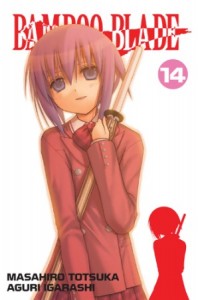
Bamboo Blade, Vol. 14

September 3, 2012 by Sean Gaffney

By Masahiro Totsuka and Aguri Igarashi. Released in Japan by Square Enix, serialized in the magazine Young Gangan. Released in North America by Yen Press.

Throughout the 14 volumes of Bamboo Blade, we’ve seen its heroine, Tamaki Kawazoe, grow and evolve. She’s always been an amazing kendo student, but that’s not her goal, or her passion, or even her hobby – it’s just what she does. Meeting with Kirino and the others has helped bring her out of her shell, and she’s learned the value or true friendship, but they aren’t able to challenge her enough in regards to kendo. Now, after her defeat by Erina in Vol. 13, we come to the final volume, where Tama-chan spends half of it asking: why do people do kendo?

Everyone’s answer is slightly different, but they all end the same. Azuma uses kendo to improve herself (and make up for her hopeless study habits); Miya-Miya, in addition to finding beating the hell out of everyone fun, wants to see how strong she can be and how far she can go. Saya, who’s suffered from being the ‘comedy character’ in a manga filled with them, finally admits that kendo gives her discipline she needs to grow up. Kirino, of course, simply lives and breathes kendo. It’s surprising to realize that, like Tama, she hasn’t had a real reason for doing kendo beyond “I love it!”, but given her simple and direct personality, this fits. Yuuji and Kojiro-sensei both chime in briefly, but are savvy enough to note that Tama-chan has to find this answer by herself.

Everyone’s final ‘real reason’ for doing kendo is elided out at first, and we only hear it once Tama-chan is back in her bedroom, watching a tape provided for her of her mother on a kendo TV show years ago. Her mother is asked the exact same question, and notes that she wants to make everyone feel the same joy and satisfaction in kendo that she does – its ideals, it’s disciplines, its purity – and that she teaches to to this. And then we flash to the end of everyone’s answer, the one thing all the other girls said. They want to be like Tama-chan. She is their goal, what they are pushing themselves to. And as she breaks down in cathartic tears (part grief over her mother’s death, part simply feeling the weight of everything, and part because she now has that goal), she knows what it is she wants to do kendo for. To be a teacher.

And this ties back in with Kojiro-sensei. I’ll admit, when the series began I had little time for him, putting up with his waffling and goofball tendencies because I liked the rest of the cast so much. But he’s grown just as much as Tama-chan has, and it’s also due to kendo. Seeing him strive to teach the girls how to use kendo to further themselves, and realizing what he can and cannot do in that regard (much of the series has been his angsting about not finding the right way to teach something), he knows he wants to keep doing this – but not with these girls, who he feels have learned all they can from him. He’s leaving for a different school to start with a new class of beginners. We only see Kirino’s reaction to this (and she outright says she’s refraining from saying what she thinks…), but I think they’ll understand his reasoning, just like they did with Tama-chan.

Despite the comedy throughout (even the last climactic battle features Saya (of course) getting herself in trouble by not having eaten for 48 hours prior out of nerves), Bamboo Blade has been almost the pinnacle of idealistic sports manga. If someone is at a loose end in life, or trying to make a change, or needing to find something within themselves… all this can be found through kendo. It’s a trend we see in a lot of sports manga, be it baseball, soccer, or what have you. but despite the idealism (or because of it), this is a manga that really makes you feel good about yourself, and have confidence in the lives of its cast. And it’s not just our 5 heroines – even the ‘rival’ characters such as Sakaki and Erina find strength and fulfillment in kendo, and in bringing kendo to others. Filled with emotional moments, goofy comedy, and of course awesome sports battles, anyone who likes to see humanity striving for a goal should read Bamboo Blade, where kendo will have the answers.

Filed Under: REVIEWS

Bookshelf Briefs 9/3/12

September 3, 2012 by Katherine Dacey and Sean Gaffney Leave a Comment

This week, Sean and Kate look at recent releases from Yen Press, VIZ Media, and Dark Horse Comics.


13th Boy, Vol. 12 | By SangEun Lee | Yen Press – For a series that featured a talking cactus in a doo-rag and a sassy stuffed rabbit, 13th Boy has a surprisingly restrained finale. Yes, there are dramatic moments, but author SangEun Lee focuses more on what her characters don’t say to one another than what they do; she honors the intensity of their feelings while reminding us that teenagers don’t usually express themselves in complete paragraphs outside the world of Dawson’s Creek. Readers who became attached to 13th Boys‘s supporting cast won’t leave disappointed, either; Lee includes a lengthy postscript explaining, in comic detail, what happened to Nam-Joo, Sae Bom, and Hee-So’s sisters. In short, 13th Boy‘s last installment offers readers a happy ending that’s ever-so-slightly tinged with sadness, remaining true to the spirit of earlier volumes. -Katherine Dacey

A Devil and Her Love Song, Vol. 4 | By Miyoshi Tomori | VIZ Media – OK, first of all, that teacher has to go. Seriously, I cannot take nine more volumes of him. That said, apart from him, there was an excellent attempt made at humanizing all the kids in this volume. There’s still the usual high school melodrama, with everyone believing the worst of everyone else – especially Maria – but her blunt forthrightness is actually starting to pay dividends, as we see one of the class pretty yet petty girls (she has princess curls, so you know she’s a brat) attempting to follow that path… and finding, as Maria has, that it’s full of thorns. So the other kids are finding that Maria is not this hideous ‘other’ that she was painted as, but Maria still can’t quite see herself as being just like them. Also, kisses out of nowhere. That can be bad for a girl’s fragile heart. Can’t wait for the next volume. –Sean Gaffney

The Earl and the Fairy, Vol. 3 | Story and Art by Ayuko, Original Concept by Mizue Tani | VIZ Media – The Earl and the Fairy is a quintessential Shojo Beat title: it has a handsome male lead who’s both a rogue and a romantic, a spunky heroine who won’t admit she likes him, and a pretty female rival who schemes to separate the heroine from her prince. In volume three, for example, Lydia finds herself locked in a battle of wits with Rosalie, a spoiled girl who’s enlisted a “bogey-beast” to dispatch any woman who shows so much as a faint interest in Edgar. Lydia and Rosalie’s catty exchanges wouldn’t be out of place in a high school melodrama, but the supernatural elements and Victorian setting add an element of dramatic interest that distracts the reader from the sheer predictability of the scenario. That the volume ends with a genuine cliffhanger is one its most pleasant surprises; we may not have much difficulty guessing the outcome, but there’s enough at stake for the reader to wait patiently for the next installment in December. -Katherine Dacey

Library Wars: Love & War, Vol. 8 | Story and Art by Kiiro Yumi, Original Concept by Hiro Arakawa | VIZ Media – I’ve been something of a skeptic about Library Wars — not because I disliked the premise, but because I found story too pat. Volume eight has almost made me into a convert, as it strikes a better balance between Ray Bradburian intrigue and shojo romance, introducing a subplot with a radical anti-censorship group and a possible court martial for Kasahara. What prevents it from being a slam dunk is Kasahara’s impenetrable cluelessness; she spends almost half of volume eight berating herself for not recognizing Dojo as the “prince” who inspired her to join the Library Forces — an epiphany that all but the least astute reader had in the very first chapter of the series. Let’s hope Kasahara’s Saul-on-the-road-to-Damascus moment frees Kiiro Yumi to move the story in a more compelling — and dramatically fruitful — direction in volume nine. -Katherine Dacey

Oh My Goddess!, Vol. 42 | By Kosuke Fujishima | Dark Horse Comics – Skuld graces the cover of this volume, and that’s appropriate as she’s the focus for most of it as well. Skuld’s growing power and growing maturity has been an ongoing plot point in this series, and it ties in well to the overall subplot of ‘inanimate objects need love too, and will reward you if you treat them right’. Skuld faces off against a demon with a better set of machines, but she triumphs because her machines are sentient beings with feelings to her, and she doesn’t destroy them so casually. We also see a sign she may pass her sisters some day – she doesn’t need the big spell buildup the other two do. Apart from her, though, the plot churns along slowly, as we advance from boss fight to boss fight, waiting for the inevitable climax. Which is very slow in arriving. –Sean Gaffney

Soul Eater, Vol. 10 | By Atsushi Ohkubo | Yen Press – There’s a whole lot going on in this volume. Our heroes finish their battle against Mosquito, with the help of Soul’s piano (it makes sense in context), but fail to obtain their objective… which is, of course, in the enemy’s hands. Maka finds that Crona may be a double agent. Black*Star is having issues with his power destroying him, and his bullheadedness leads to a fight with Death The Kid. And a new character from Marie’s past comes to the DWMA to try and ferret out a traitor. If you’ve read stories like these, you can guess how that’s going to end up. Impressively, the author manages to make these all work together, and invest some real emotion in their fates, especially B.J. and Black*Star. I still love the weird art deco art style, but it’s not longer just about that. This is a dark, addicting rush of a manga.-Sean Gaffney

Filed Under: Bookshelf Briefs

Manga Bestsellers: 2012, Week Ending 26 August

September 2, 2012 by Matt Blind 1 Comment

Comparative Rankings Based on Consolidated Online Sales

last week’s charts
about the charts

##

Manga Bestsellers

1. ↔0 (1) : Yu-Gi-Oh! GX 9 – Viz Shonen Jump, Aug 2012 [423.8] ::
2. ↔0 (2) : Sailor Moon 3 – Kodansha Comics, Jan 2012 [420.8] ::
3. ↔0 (3) : Sailor Moon 4 – Kodansha Comics, Mar 2012 [411.5] ::
4. ↑1 (5) : Sailor Moon 2 – Kodansha Comics, Nov 2011 [391.0] ::
5. ↓-1 (4) : Sailor Moon 1 – Kodansha Comics, Sep 2011 [328.8] ::
6. ↑3 (9) : Sailor Moon 6 – Kodansha Comics, Jun 2012 [325.5] ::
7. ↔0 (7) : Naruto 57 – Viz Shonen Jump, Jul 2012 [323.3] ::
8. ↔0 (8) : Vampire Knight 14 – Viz Shojo Beat, Jul 2012 [319.3] ::
9. ↓-3 (6) : Finder Series 6 Passion within the View Finder – DMP Juné, Jul 2012 [309.0] ::
10. ↔0 (10) : Death Note vols 1-13 box set – Viz Shonen Jump Advanced, Oct 2008 [304.6] ::

[more]

Top Imprints
Number of volumes ranking in the Top 500:

Viz Shonen Jump 90
Yen Press 88
Viz Shojo Beat 56
Kodansha Comics 51
Viz Shonen Jump Advanced 36
DMP Juné 31
Dark Horse 19
Seven Seas 14
Vertical 11
Viz Signature 11

[more]

Series/Property

1. ↔0 (1) : Sailor Moon – Kodansha Comics [1,109.6] ::
2. ↔0 (2) : Naruto – Viz Shonen Jump [736.5] ::
3. ↔0 (3) : Bleach – Viz Shonen Jump [684.4] ::
4. ↔0 (4) : Highschool of the Dead – Yen Press [539.0] ::
5. ↔0 (5) : Yu-Gi-Oh! – Viz Shonen Jump [534.3] ::
6. ↔0 (6) : Vampire Knight – Viz Shojo Beat [467.2] ::
7. ↔0 (7) : Black Butler – Yen Press [448.2] ::
8. ↑1 (9) : Ouran High School Host Club – Viz Shojo Beat [437.8] ::
9. ↓-1 (8) : Negima! – Del Rey/Kodansha Comics [433.1] ::
10. ↔0 (10) : Death Note – Viz Shonen Jump Advanced [428.6] ::

[more]

New Releases
(Titles releasing/released This Month & Last)

1. ↔0 (1) : Yu-Gi-Oh! GX 9 – Viz Shonen Jump, Aug 2012 [423.8] ::
7. ↔0 (7) : Naruto 57 – Viz Shonen Jump, Jul 2012 [323.3] ::
8. ↔0 (8) : Vampire Knight 14 – Viz Shojo Beat, Jul 2012 [319.3] ::
9. ↓-3 (6) : Finder Series 6 Passion within the View Finder – DMP Juné, Jul 2012 [309.0] ::
13. ↓-2 (11) : Bleach 44 – Viz Shonen Jump, Aug 2012 [288.8] ::
17. ↑3 (20) : Bleach 45 – Viz Shonen Jump, Aug 2012 [253.3] ::
18. ↓-3 (15) : Negima! 35 – Kodansha Comics, Jul 2012 [252.1] ::
22. ↔0 (22) : Rosario+Vampire Season II 9 – Viz Shonen Jump Advanced, Jul 2012 [221.7] ::
24. ↑1 (25) : Highschool of the Dead 7 – Yen Press, Jul 2012 [215.6] ::
27. ↑1 (28) : Alice in the Country of Clover Cheshire Cat Waltz 1 – Seven Seas, Jul 2012 [206.2] ::

[more]

Preorders

11. ↑1 (12) : Sailor Moon 7 – Kodansha Comics, Sep 2012 [298.5] ::
19. ↓-1 (18) : Sailor Moon 9 – Kodansha Comics, Jan 2013 [250.9] ::
20. ↓-1 (19) : Sailor Moon 8 – Kodansha Comics, Nov 2012 [249.2] ::
23. ↑8 (31) : Yotsuba&! 11 – Yen Press, Sep 2012 [221.4] ::
33. ↑1 (34) : Avatar: The Last Airbender The Promise 3 – Dark Horse, Oct 2012 [189.0] ::
36. ↓-7 (29) : Sailor Moon 10 – Kodansha Comics, Mar 2013 [185.8] ::
46. ↑7 (53) : Naruto 58 – Viz Shonen Jump, Sep 2012 [162.0] ::
70. ↑5 (75) : Negima! 36 – Kodansha Comics, Oct 2012 [124.2] ::
74. ↑28 (102) : Nausicaa of the Valley of the Wind 2 vol hardcover box set [complete] – Viz Ghibli Library, Nov 2012 [121.4] ::
90. ↑7 (97) : Only the Ring Finger Knows (novel) 5 – DMP Juné, Sep 2012 [110.1] ::

[more]

Manhwa

580. ↑41 (621) : Bride of the Water God 10 – Dark Horse, Jan 2012 [16.9] ::
606. ↑46 (652) : Time & Again 6 – Yen Press, Jul 2011 [16.0] ::
617. ↑5 (622) : Bride of the Water God 11 – Dark Horse, May 2012 [15.6] ::
699. ↑100 (799) : Time & Again 1 – Yen Press, Dec 2009 [11.9] ::
716. ↑50 (766) : Time & Again 5 – Yen Press, Mar 2011 [11.4] ::
718. ↓-102 (616) : Time & Again 3 – Yen Press, Jul 2010 [11.3] ::
748. ↓-12 (736) : Time & Again 2 – Yen Press, Mar 2010 [10.4] ::
839. ↑56 (895) : Let Dai 11 – Netcomics, Feb 2008 [7.7] ::
968. ↑140 (1108) : One Thousand & One Nights 10 – Yen Press, Apr 2010 [5.1] ::
992. ↑67 (1059) : One Thousand & One Nights 8 – Yen Press, Aug 2009 [4.7] ::

[more]

BL/Yaoi

9. ↓-3 (6) : Finder Series 6 Passion within the View Finder – DMP Juné, Jul 2012 [309.0] ::
90. ↑7 (97) : Only the Ring Finger Knows (novel) 5 – DMP Juné, Sep 2012 [110.1] ::
98. ↓-31 (67) : Samejima-Kun & Sasahara-Kun – DMP Juné, May 2012 [105.2] ::
101. ↑6 (107) : Ai no Kusabi (novel) 7 – DMP Juné, Sep 2012 [103.6] ::
142. ↓-24 (118) : In These Words – 801 Media, Jun 2012 [82.0] ::
168. ↑20 (188) : Private Teacher 3 – DMP Juné, May 2012 [72.9] ::
180. ↑19 (199) : His Arrogance – 801 Media, Dec 2008 [68.5] ::
209. ↑59 (268) : Alcohol, Shirt, & Kiss – DMP Juné, Mar 2007 [59.1] ::
220. ↓-10 (210) : Finder Series 5 Truth in the View Finder – DMP Juné, Dec 2011 [55.8] ::
229. ↑62 (291) : Ichigenme: The First Class Is Civil Law 1 – 801 Media, Feb 2007 [53.9] ::

[more]

Ebooks

7. ↔0 (7) : Naruto 57 – Viz Shonen Jump, Jul 2012 [323.3] ::
25. ↓-1 (24) : Naruto 56 – Viz Shonen Jump, May 2012 [212.2] ::
32. ↑6 (38) : Maximum Ride 5 – Yen Press, Dec 2011 [191.1] ::
38. ↓-1 (37) : Naruto 55 – Viz Shonen Jump, Mar 2012 [182.3] ::
56. ↑9 (65) : Naruto 54 – Viz Shonen Jump, Mar 2012 [139.4] ::
57. ↓-9 (48) : Blue Exorcist 1 – Viz Shonen Jump Advanced, Apr 2011 [139.1] ::
59. ↑32 (91) : Haruhi Suzumiya Melancholy of Haruhi Suzumiya 13 – Yen Press, Aug 2012 [136.5] ::
68. ↑11 (79) : Naruto 53 – Viz Shonen Jump, Dec 2011 [126.3] ::
95. ↑10 (105) : Maximum Ride 1 – Yen Press, Jan 2009 [107.7] ::
106. ↓-32 (74) : Maximum Ride 3 – Yen Press, Aug 2010 [100.5] ::

[more]

Filed Under: Manga Bestsellers Tagged With: Manga Bestsellers

  • « Go to Previous Page
  • Page 1
  • Page 2
  • Page 3
  • Page 4
 | Log in
Copyright © 2010 Manga Bookshelf | Powered by WordPress & the Genesis Framework