• Skip to primary navigation
  • Skip to main content
  • Skip to primary sidebar
  • Home
  • About Us
    • Privacy Policy
    • Comment Policy
    • Disclosures & Disclaimers
  • Resources
    • Links, Essays & Articles
    • Fandomology!
    • CLAMP Directory
    • BlogRoll
  • Features & Columns
    • 3 Things Thursday
    • Adventures in the Key of Shoujo
    • Bit & Blips (game reviews)
    • BL BOOKRACK
    • Bookshelf Briefs
    • Bringing the Drama
    • Comic Conversion
    • Fanservice Friday
    • Going Digital
    • It Came From the Sinosphere
    • License This!
    • Magazine no Mori
    • My Week in Manga
    • OFF THE SHELF
    • Not By Manga Alone
    • PICK OF THE WEEK
    • Subtitles & Sensibility
    • Weekly Shonen Jump Recaps
  • Manga Moveable Feast
    • MMF Full Archive
    • Yun Kouga
    • CLAMP
    • Shojo Beat
    • Osamu Tezuka
    • Sailor Moon
    • Fruits Basket
    • Takehiko Inoue
    • Wild Adapter
    • One Piece
    • After School Nightmare
    • Karakuri Odette
    • Paradise Kiss
    • The Color Trilogy
    • To Terra…
    • Sexy Voice & Robo
  • Browse by Author
    • Sean Gaffney
    • Anna Neatrour
    • Michelle Smith
    • Katherine Dacey
    • MJ
    • Brigid Alverson
    • Travis Anderson
    • Phillip Anthony
    • Derek Bown
    • Jaci Dahlvang
    • Angela Eastman
    • Erica Friedman
    • Sara K.
    • Megan Purdy
    • Emily Snodgrass
    • Nancy Thistlethwaite
    • Eva Volin
    • David Welsh
  • MB Blogs
    • A Case Suitable For Treatment
    • Experiments in Manga
    • MangaBlog
    • The Manga Critic
    • Manga Report
    • Soliloquy in Blue
    • Manga Curmudgeon (archive)

Manga Bookshelf

Discussion, Resources, Roundtables, & Reviews

Archives for February 2011

Welcome, Cathy!

February 23, 2011 by MJ 10 Comments

Not long ago, we asked readers what they’d like to see from the new, multi-site Manga Bookshelf. One of the requests made of us at the time was for some kind of “anime vs. manga” feature, in which anime adaptations would be compared against their manga source material. We all thought it was a great idea! Trouble is… none of us watch much anime.

Today, please welcome Cathy Yan, the newest contributor to Manga Bookshelf, who will be sharing her thoughts on anime with us monthly via her new column, “Don’t Fear the Adaptation.” The first of Cathy’s articles has been posted this morning, featuring Rumiko Takahashi’s classic seinen romantic comedy, Maison Ikkoku.

So check out Cathy’s post, and let her know what you think! Then don’t forget to add her on Twitter!

Filed Under: UNSHELVED Tagged With: cathy yan

Don’t Fear the Adaptation: Maison Ikkoku

February 23, 2011 by Cathy Yan 20 Comments

Hello, this is Cathy! I’m so excited to be a part of Manga Bookshelf! To kick off the anime reviews, I thought I’d start with something long, old, and beloved.


Maison Ikkoku | by Rumiko Takahashi | Manga: Shogakukan/Viz Media | Anime: Studio Deen/Viz Media

Buy at Amazon

Anyone who’s ever read manga has probably read a Rumiko Takahashi story, whether it be Rumic Theater, Ranma 1/2, or Inuyasha. She is easily one of the most recognizable and popular mangaka, one of the few that all American readers can name with ease. But in 1980, Takahashi was 23 and her first major work, Urusei Yatsura, was only just beginning to pick up. Armed with her own experiences of living in a small apartment with her two assistants, she sat down to write what became my favorite of her long epics: Maison Ikkoku.

Maison Ikkoku is about the residents of Ikkoku-kan, a boarding house in Tokyo. The protagonist, Yusaku Godai, is a 20 year old ronin student deep into his second year of trying to pass college entrance exams, when the story opens on the arrival of Kyoko Otonashi, the young widow who’s Ikkoku’s new manager. Yusaku instantly falls in love with Kyoko, but like all Takahashi romances, there are plenty of obstacles. The other residents of Ikkoku do their utmost to create embarrassing situations for the uncertain couple. The local tennis coach Shun Mitaka, a rich and suave playboy, declares his own intentions towards Kyoko within hours of meeting her and spends the rest of the series wooing her. Yusaku’s cheery ex-coworker Kozue Nanao eventually becomes his cheery girlfriend, though, much to everyone’s chagrin, she never cottons onto Yusaku’s feelings for Kyoko. Then of course, there’s Kyoko herself, who worries that loving a new man would be betraying the memory of her dead husband. Throw in three interfering families, an engagement made and broken by a fear of dogs, and a high school girl determined to marry Yusaku, and it’s easy to see how the story spanned seven years, fifteen volumes of manga, and 96 episodes of anime before coming to a satisfactory end.

Maison Ikkoku is ultimately a slice-of-life romantic comedy, but unlike Takahashi’s other series, it’s set firmly in the real world. The recurring characters, while exaggerated, are perfectly ordinary people with perfectly ordinary problems. Families get into screaming arguments, marriage is complicated by monetary concerns and societal approval, young men and women worry about their future careers. The path leading up to Ikkoku, the persimmon trees, the kotatsu, the fear of the economic downturn, Kyoko’s habit of sweeping the sidewalk free of leaves– all these are still elements of everyday Japanese life.

Yet the more humorous plot devices of Maison Ikkoku could have only existed in the Internet-less, cellphone-less world of the eighties. If gimmicks like mistaking the French restaurant “Ma Maison” for the local pub “Mamezou,” or Yusaku’s female friends pranking Kyoko so badly she ends up installing a public phone for the rest of the boarding home seem ridiculous at first glance, they’re enjoyable for nostalgia’s sake. In 2011, hijinks like that just don’t happen anymore– people just text each other!

The main love triangle

The relationship between Yusaku and Kyoko is the highlight of the entire series. The anime does a wonderful job of showing how it changes from obsession (on Yusaku’s part) and annoyance (on Kyoko’s part) to a mutual affection. Surrounded by secondary characters who are more or less caricatures, the main romantic players come across as surprisingly real. Yusaku might appear at first to be simply a lecherous loser just barely out of his teenage years, but with time, he emerges as a man who, if nothing else, will always do the right thing, even if it’s to his disadvantage. And Kyoko is never just a pretty face. While Mitaka and Yusaku are both guilty of idealizing her, they also embrace her faults: her tendency towards jealousy, her bad temper, her indecisiveness. In an adorable moment in episode 43, they even spend a night drunkenly swapping notes and consoling each other. Kyoko is secretive to a fault with her feelings, so it’s no surprise that most of the series consists of both men learning to reconcile their idea of Kyoko with the person she actually is. An admirably realistic portrayal of love, for sure, but gosh if the story isn’t repetitive! If you don’t find yourself tempted to throw your TV out the window by episode 58, you’re doing it wrong.

Despite the addition of numerous sidestories, Maison Ikkoku the anime feels more streamlined than its manga counterpart, simply because the anime has the benefit of hindsight. While the manga hesitates over how to resolve Kyoko’s and Yusaku’s relationship, the anime already knows how the story ends and stresses their romantic tension early on, most notably in episode 14 and and 22. Readers of the manga might actually wonder if Kyoko ends up with Yusaku; the anime, on the other hand, is emphatically a story about Kyoko and Yusaku, just with detours.

However, the anime never strays far from the manga’s wacky sitcom nature. Don’t expect Ichinose to be much more than a busy body with a fondness for alcohol, or for Yotsuya to stop being an infuriatingly mysterious leech. Just the opposite, as the Ichinose-Yotsuya-Akemi trio get far more screen time in the anime. On the other hand, Nikaido, an accidental resident introduced late in the manga, is absent from the anime, and his lines are given away to the other Ikkoku residents. Anime-only fans thus never experience the epic prank war that erupts between Nikaido and Yotsuya, but Nikaido’s absence is glossed over so well in the anime that it made me question Takahashi’s choice to introduce him at all in the manga.

With five opening and six ending songs, including a Japanese pop hit by Anzen Chitai and two songs by Gilbert O’Sullivan that never made it to the American release, the soundtrack is a perfect representative of the music from that time period. Likewise, the animation is classically eighties but holds up well despite its age. Among other things, the characters frequently change outfits — a rare feat even nowadays for an anime series! Despite its simplicity, the animation does an excellent job conveying the characters’ every emotion, no matter how nuanced, and manages to stay true to Rumiko Takahashi’s original art. Paired with an all around impressive performance from the entire Japanese voice acting cast, the characters of Maison Ikkoku have never been more alive as they are in the anime.

For those who have never read the original manga, Maison Ikkoku the anime is an excellent substitute or introduction. For those who are already fans of the manga, watching the anime is just like revisiting an old friend. Personally, three episodes — 27, 84, and 92 — make the anime adaptation for me. Episode 27’s masterful use of silence, a blinking light, and silhouettes elevate the anime treatment of Souchirou-san’s disappearance into something far more cinematic. I could write whole essays on how wonderfully episode 84 encapsulates repeating issues of trust, family, and determination, not to mention the little animation details — the classical music soundtrack, the Joan Miro in the hotel lobby — that build a world richer than the one in the manga. And Episode 92, split into three acts, each dedicated to one woman, is a great argument for why Takahashi writes some of the best women in anime.

Viz Media distributed both the manga and anime, and both are available through most major online retailers. As the series is pretty old now, it’s unlikely to be found in bookstores, but chances are good that if your local library is like mine and only stocks outdated anime or manga, the old Viz volumes (complete with cheesy titles like “The Hounds of War” or “Good Housekeeping”) will still be there.

Filed Under: Don't Fear the Adaptation Tagged With: anime, maison ikkoku

The Josei Alphabet: D

February 23, 2011 by David Welsh

“D” is for…

Daisy Luck, written and illustrated by Tsunami Umino, originally serialized in Kodansha’s Kiss, two volumes. This series follows four lifelong friends. One is a housewife, one works as a baker, one is a salarywoman, and one is unemployed.

Darling wa Nanamono ni Tsuki, written and illustrated by Yuki Yoshihara, originally serialized in Shogakukan’s Petit Comic, eight volumes. More funny smut from the prolific creator of Butterflies, Flowers (Viz), this time about the marriage of the daughter of a gay man and her attempts to keep things spicy. Published in German by Tokyopop and French by Panini.

Deka Wanko, written and illustrated by Kozeuko Morimoto, currently serialized in Shueisha’s You, seven volumes so far. This goofy detective series features a sleuth with a keen sense of smell and a fondness for frills. It’s been adapted into a live-action drama.

Doctor Lonely, adaptation of a novel by Glenda Sanders by Akiyo Izuka, originally published by Harlequin. A mail carrier finds her fantasies about an attractive doctor are muddled up by his nerdy reality.

Double House, written and illustrated by Nanae Haruno, originally serialized in Shueisha’s Young You, one volume. This story explores the complicated relationship between a young woman and a male-to-female transsexual. Erica (Okazu) Friedman has written about some of Haruno’s other works, including Pieta.

Licensed josei:

  • Dazzle, written and illustrated by Minari Endoh, published by Tokyopop, originally serialized in Ichijinsha’s Comic Zero-Sum.
  • Diabolo, written by Kaoru Ohashi, illustrated by Kei Kusunoki, published by Tokyopop, originally serialized in Shueisha’s Comic Crimson, three volumes.
  • Dolis, written and illustrated by Maki Kusumoto, published by Tokyopop, originally serialized by Shodensha, one volume.
  • Doll, written and illustrated by Mitsukazu Mihara, published by Tokyopop, originally serialized in Shodensha’s Feel Young, six volumes.
  • A Drunken Dream and Other Stories, written and illustrated by Moto Hagio, published by Fantagraphics, short stories originally serialized in various magazines, including Shogakukan’s Petit Flower, one volume.

What starts with “D” in your josei alphabet?

Reader recommendations and reminders:

  • Daite Daite Daite Darling, written and illustrated by Miwa Sakai, originally serialized in Hakusensha’s Silky, 15 volumes.
  • Do Da Dancin’!, written and illustrated by Satoru Makimura, originally serialized in Shueisha’s Young You, 9 volumes.
  • Do Da Dancin’! Venice Kokusaihen, written and illustrated by Satoru Makimura, currently serialized in Shueisha’s Office You, 8 volumes so far.

Filed Under: FEATURES

Upcoming 2/23/2011

February 22, 2011 by David Welsh

We’re back to a more substantial ComicList this week. You can click here for my Pick of the Week.

As for this week’s arrivals, there’s the third volume of 7 Billion Needles (Vertical), Nobuaki Tadano’s manga homage to Hal Clement’s novel, Needle. I’ve been enjoying the series for its balance of character development and monster mayhem, but the proportions seem a bit off in this installment.

Our sulky heroine Hikaru now finds herself host to not one but two powerful entities. Seeing as those beings have been acting in opposition forever, I was hoping for some focus on the new arrangement. Unfortunately, the triad is forced to adapt almost instantaneously, as outside forces demand their attention. Benevolent Horizon and malignant Maelstrom seem to have spun off and are causing evolutionary mayhem. This invites the intervention of a third powerful entity and drives our heroine and her tagalongs to try and set things right before the world is changed forever.

In short, there’s too much mayhem and not enough moping. I was enjoying Hikaru’s emotional progress, and it felt like that was shoved into the background in favor of incursions of instant monsters. It’s not devoid of emotional moments, but they tend to be drowned out in favor of the more visceral events. I’m hoping the fourth and final volume strikes a better balance, but, even if it doesn’t, this will have amounted to a very appealing series overall. And, if your reaction to either of the earlier volumes was that there wasn’t enough mayhem, this is a good opportunity to reintroduce yourself to the series.

(Comments are based on a review copy provided by the publisher.)

Other highlights for the week include:

  • Secret Avengers #10 (Marvel): I was a huge Marvel fanboy back in the day, so it’s nice to have a comic I really enjoy from one of my favorite franchises. This one features a stealthy group of super-heroes actually behaving in functionally proactive ways. It’s only failing is that it needs more scenes with Valkyrie.
  • 20th Century Boys volume 13 (Viz): This was Kate Dacey’s Pick of (last) Week, and I can’t endorse it any better than she did.
  • Goldilocks and the Seven Squat Bears (Yen Press): I’m recommending this one based entirely on the fact that it’s by Émile Bravo, who provided the art for the beautiful and moving My Mommy Is in America and She Met Buffalo Bill (Fanfare/Ponent Mon). This is reason enough.

What looks good to you?

Filed Under: DAILY CHATTER

Interlude: Blogging

February 21, 2011 by MJ 34 Comments

I rarely go off-topic here at Manga Bookshelf, but I read a blog post earlier today that irresistibly compelled me to do so. Furthermore, I’m going to claim that I’m on topic after all, since Manga Bookshelf is, first and foremost, a blog.

What so enraged inspired me is this: Teach, or Your Blog Will Die, a “Miscellaneous Blog Tip” at ProBlogger, from Two Hour Blogger‘s Martyn Chamberlin.

In his post, Mr. Chamberlin urges aspiring bloggers to recognize the importance of teaching through their blogs. He (quite rightly) explains that “personality” is not enough to draw or maintain readership, and offers up some sage advice for ensuring consistent, professional content. Though I think his hardline “teaching” mandate is more useful in some fields than in others, I thought his approach was pretty reasonable until I hit this particular bullet point:

  • Write thorough, two-hour posts that explore these topics, one at a time.
  • Two hours is overkill for some posts (though not nearly enough for others), which gave me a moment of pause. Thankfully, the next point began on a reassuringly sane note.

  • Publish consistently.
  • Great advice here, no? Consistent content is absolutely the key to building and maintaining readership. All worries quickly placated, I dove optimistically into the next sentence.

    Don’t publish something unless it’s the best thing you’ve ever written. This means you’ll either be deleting a lot of drafts, or you’ll be spending entire days revising your content.

    Wait, what?

    I realize that there is no one method of writing in the world that can work for every person, but my first thought upon reading that next sentence was that it was the single most destructive piece of advice for new bloggers that I had ever heard. “Don’t publish something unless it’s the best thing you’ve ever written?” That sentiment could be more succinctly conveyed by saying, “Don’t publish,” since, for most writers, that would be the result.

    Telling a blogger that every piece must be his or her newest masterpiece is the best recipe for writer’s block I’ve ever seen, leading inevitably to the real killer of most blogs: lack of regular content. Yes, building readership requires that your content be smart and compelling, but most importantly it must be new, daily or as close to it as possible. Otherwise, by the time you’ve managed to complete your next masterpiece, the only person still reading will be your mom.

    The internet is a vast and disorganized place, with more new content being generated in a second than most of us could possibly comprehend. That any one of us manages to reach even one other person via the tiny speck of a single blog is kind of a miracle, really. And while Chamberlin’s advice is about as sound as it gets in terms of trying to bring that miracle forth, keeping that one reader around after he/she’s read just one post is approximately a million times harder. Fortunately, though online readership can be fickle, most people are creatures of habit, and the best way to draw them back, time and again, is to become a part of their daily routine.

    With that in mind, here’s my advice for building and maintaining readership as a new blogger:

    1. Check out Chamberlin’s first two bullet points. I suspect they apply to nearly any kind of blogging, and hey, why recreate the wheel? I’ll add that you should write about something you love. That’ll help bring out the passion Chamberlin so rightly asks for.

    2. Publish something new every day, at least five days a week if possible. Give real time and attention to your masterpieces when they come, but let them be just part of a solid schedule of concise, entertaining, on-topic writing that may run the gamut from Serious Business to light-hearted linkblogging. Don’t go crazy to the point of spamming your readers, but a well-constructed, on-topic daily post (or two!) isn’t going to piss off anyone.

    3. Write your schedule down. This doesn’t have to be public (though it certainly can be) but it should be something you can stick to, week after week. If you discover that your schedule is too ambitious, change it, until you’ve got something you know you can maintain. A missed feature here or there isn’t going to do much damage, but it takes very little to fade from someone else’s habit, so try to build expectations you know you can follow through on.

    4. Engage your readers by encouraging them to interact, both with you and with each other. End posts with a question whenever appropriate, especially when blogging in first person. Though you may feel the invitation to comment is implied, you’ll be surprised to find how much more often it happens when you ask a question directly.

    5. Write, write, and write some more, and when the post is due, publish, even if it’s not a masterpiece. The truth is, as diligently as you may toil to create brilliant, beautiful prose, pondering thoughtfully on the Great Works Of Our Time, sometimes what people really want to do is dish about their crushes on fictional characters. Like it or not, your hard-won masterpiece may not be what’s bringing in the traffic. Deal with this. Learn to embrace it.

    6. Read and comment on other people’s blogs. You may think you don’t have time, what with all those posts to write, but the best way to establish yourself in any community is to actually be part of that community. Talk to other fans in comments. Get yourself on Twitter. Include a link to your blog when you sign your name, but talk to people about what they’ve said, and not just about yourself.

    I’ll be the first to admit that daily posting is hard. It’s the single biggest reason I begged Kate and David to join me. On any given day, I know someone‘s going to post, and their brilliant reviews and think-pieces allow me to spend my time on fewer “masterpieces” and more quick-n-easy bits of fluff. This is a great argument for being part of a group blog. Even in our tiny niche of a topic, in this nerdy corner of the blogosphere, daily content is the key to our continued existence.

    So don’t paralyze yourself with ridiculous expectations. Write good content, and let your best come when it can.

    What do you think, readers? Any advice from you for would-be manga bloggers?

    Filed Under: UNSHELVED Tagged With: rants, unsolicited advice

    Manhwa Monday: Dinosaur wars

    February 21, 2011 by MJ 3 Comments

    Welcome to another Manhwa Monday!

    This week, Korea JoongAng Daily reports that cartoonist Kim Soo-jung’s popular manhwa character Dooly has become a subject of controversy between the local governments of Dobong and Bucheon, both of whom want to use the 10 million-year-old dinosaur as a mascot.

    “Dobong District has been planning a Dooly theme park with a museum dedicated to the dinosaur since 2007. Lee, the Dobong District Office director, said that construction on the museum, estimated at 13 billion won ($11.6 million), is slated to start next year, with a target completion date of 2015.

    Bucheon, meanwhile, has spent the past eight years transforming its image from that of an industrial city to one dedicated to animation. In 1998, the city established the Korea Manhwa Contents Agency (Komacon) and the Bucheon International Comics Festival. Dooly has served as the city’s mascot since 2003.”

    Check out the article for more.

    On this side of the Pacific, NETCOMICS continues to show signs of life, publishing another new chapter of Sooyeon Won’s Full House.

    At The Hooded Utilitarian, Michelle Smith and I discuss in-depth Jeon JinSeok and Han SeungHee’s One Thousand and One Nights, complete with sheep jokes and pretty pictures.

    This week in reviews: On his video podcast, Otaku, no Video, Brent P. Newhall talks about volume one of One Fine Day (Yen Press). At Manga Maniac Cafe, Julie enjoys volume six of 13th Boy (Yen Press). Angela Eastman checks out the final volume of Very! Very! Sweet (Yen Press) at Mania.com.

    That’s all for this week!

    Is there something I’ve missed? Leave your manhwa-related links in comments!

    Filed Under: Manhwa Bookshelf, Manhwa Monday

    Pick of the Week: Girls’ comics sweep

    February 21, 2011 by David Welsh and Katherine Dacey 7 Comments

    It’s all shoujo, sunjeong, and BL this round, as the Manga Bookshelf bloggers make their Picks of the week!


    From MJ: My choice this week is probably pretty obvious, considering how much love I’ve already heaped onto SangEun Lee’s supernatural romance, 13th Boy. This quirky manhwa is easily one of my favorite currently-running teen series, made up of drama, humor, and outright weirdness in pretty much equal parts. Check out my thoughts on the last volume here. “… one thing I consistently enjoy about this series is how deftly Lee combines drama and cracktastic humor so that neither ever dominates the story … served up together with a helping of true whimsy, every piece of this meal is utterly delectable.” Yen Press ships out the series’ sixth volume this week, which looks to be packed with extra talking-cactus goodness–truly the way to my romance-loving heart.

    From David: As a gay man who’s extremely picky about yaoi and boys’-love titles, I generally like to do advanced research before I commit to a title. I haven’t done full due diligence on Riyu Yamakami’s Then Comes Love (Digital Manga), but it does sound promising. Okay, so my ears perked up when I saw the word “outs” in the product description. Any time there’s the possibility that sexual identity matters even a little, I feel compelled to at least investigate a book further. So while I can’t promise I’ll pick up Then Comes Love, I’m curious to hear from people who may be familiar with the title, which sounds to me that it’s about people with lives and stuff.

    From Kate: Do I have to pick just one? Because I’m torn between two Yen Press titles: the final volume of Dragon Girl, and <the sixth volume of 13th Boy. Dragon Girl is dumb as hammers, trotting out every cliche from the shojo manga handbook: secret siblings, omnipotent school councils, aloof guys that only the heroine can reach. I couldn’t hate it, though, because it’s fundamentally good-natured and just a little weird: how many stories can you name in which the heroine’s father is a handsome, globe-trotting ethnobotanist who wears an earring and a leather vest *and* used to lead the pep squad? (Come to think of it, I’d read a manga about Rinna’s dad. *Ahem.*)

    I feel the same way about 13th Boy: on many levels, it’s the kind of story I normally loathe, as it features a bossy girl who single-mindedly pursues an unavailable boy. What won me over was the lively supporting cast, a cast that includes a walking, talking cactus who wears a do-rag, adores his owner, and occasionally transforms into a handsome teen. Beatrice (yes, I know: Beatrice?) may have started out as a comic-relief character, but he’s evolved into 13th Boy‘s most sympathetic figure, a lovelorn young man who’s willing to make big sacrifices for the chance to tell his owner how he feels. I don’t know about you, but Beatrice’s dilemma is making me wonder what, exactly, the spider plant in my kitchen is thinking.


    Amazon.com Widgets


    So, readers, what are your picks this week?

    Filed Under: PICK OF THE WEEK Tagged With: 13th boy, dragon girl, yaoi/boys' love

    Skyblue Shore Volumes 1 and 2

    February 21, 2011 by Anna N

    Are hot janitors a Thing? After reading Dengeki Daisy and Skyblue Shore, which both feature handsome yet tortured twentysomething janitors, I am now convinced that anyone who wants to find cute men in Japan needs to start staking out custodial closets in local high schools. Skyblue Shore is a fun shoujo manga, with some hints of darkness that keep it from being overly sweet.


    Skyblue Shore Volume 1 by Nanpei Yamada

    Tomo used to visit the beach daily as a little girl. One day she met a boy who gave her an agate that he found while beach combing. While she went back to the beach daily, she never saw him again. Years later, Tomo’s grown older and she’s left her love of the beach behind. She’s on her way to school when someone starts feeling her up on the bus. A tall, dark and handsome man notices what’s going on and throws the groper off the bus, yelling that no one is going to touch one of his students. He leaves behind a keychain that has the same type of agate that Tomo keeps as a souvenir. This is a fairly formulaic beginning to a manga. Stories about children who reconnect as teenagers are common but even while Skyblue Shore evokes plenty of shoujo cliches, it does so in a refreshing way. The teenage Tomo is a fairly typical shoujo heroine. She’s pretty, popular, and enthusiastic but considers herself average. What makes her stand out a bit from her character type is her tendency to exhibit a strong nurturing streak due to the fact that she’s had to take care of her flighty mother. Tomo stumbles across a sullen boy who has a hairtie that exhibits the same construction techniques as the mysterious stranger’s broken keychain. Ten offers to fix her keychain and she trails him back to a shack on the roof of the school. She barges in and finds an apartment furnished with things from the beach, with elaborate driftwood assemblages. Ten, is of course, the boy who gave Tomo the agate when they were children. While he figures out who she is fairly quickly, she doesn’t connect Ten with her long-lost friend. His older brother Riku is the junior janitor at the school who has a habit of defending high school girls from perverts.

    The pairing of an enthusiastic girl and sullen boy can be found plenty of times in shoujo manga. But I enjoyed seeing the relationship between this particular couple in Skyblue Shore. Ten starts taking Tomo beachcombing, and she’s delighted to rediscover one of her favorite childhood pastimes. She exhibits the same degree of excitement about being on the beach that she had as a little girl, but what happened to change Ten from being a happy little boy to a prickly teenager who hides behind his hair? Tomo spends more time with Riku, and promptly develops a hopeless crush on him despite his tendency to treat her like a little sister. Ten clearly cares about Tomo too, so the classic love triangle is all set up. Tomo starts appearing by Ten’s side after school, asking if he’s found any treasures at the beach. When Ten tells Riku that he’s taken on Tomo as his apprentice beachcomber, he says “I think…she’s been waiting a long time for me.”

    I enjoyed all the details about the sea that Yamada included. Ten shows Tomo how to bleach sand dollars, and you can practically smell the salty air when the characters go down to the beach. Yamada’s character designs are clean and attractive, and I like the way she varied the body types of the brothers. Riku is clearly more mature, with more of a weighty, adult look while it is clear that Ten and Tomo haven’t finished growing yet.

    Skyblue Shore Volume 2 by Nanpei Yamada

    Skyblue Shore might initially seem like a charming, slice of life shoujo series that is only differentiated from other similar manga by the beach setting. Where it starts to stand out is the theme of past psychological trauma and potential insanity that is interwoven with all of the nice scenes of Tomo and Ten hunting for agates. A dark female character with unhealthy ties to Riku is introduced in the person of Michiru, who only sporadically attends school. When she comes back she definitely doesn’t approve of Tomo and Riku’s friendship. Tomo observes some close encounters between Riku and Michiru, and is dismayed. While Riku doesn’t cross any lines, it is obvious that they have a shared history and Michiru seems very emotionally damaged. Ten can see straight through Michiru and warns Tomo to be careful of who she makes friends with. Riku shares the fact that he and Ten lost their sister to the sea when Tomo almost drowns. She comforts him, and he asks her to be a good friend to Ten and Michiru. She starts to treat Michiru like a bit of a project, trying to bring her out of her shell and getting her to socialize with some of the other students. When Michiru stops coming to school, Tomo gets her to come by using the only threat she can. She says “Unless you drag your lazy carcass to school, I’m going to claim Riku for myself!”

    Riku and Ten are clearly emotionally damaged by their loss, even though Riku might seem to do a better job of appearing normal. It doesn’t seem quite fair for Tomo to be put in the position of emotional caretaker for her group of friends. The blend of slice-of-life stories inter cut with past revelations of tragedy reminded me a little bit of Oyayubihime Infinity without the fantasy elements. Skyblue Shore is only six volumes long, and I’m curious to see if the characters actually manage to work through their various emotional issues and achieve some form of happiness.

    Review copies provided by the publisher.

    Filed Under: UNSHELVED

    From the stack: A Single Match

    February 21, 2011 by David Welsh

    If I had to pick a favorite boutique comics publisher, it would probably be Drawn & Quarterly, simply for the volume of work they’ve released that I really, really enjoy. If I isolate the portion of their catalog devoted to Japanese comics, their success rate is somewhat lower. I appreciate their efforts to bring avant-garde manga to English-reading audiences, but I don’t always particularly enjoy the individual works.

    I like the work of Yoshihiro Tatsumi, particularly his autobiography, A Drifting Life., and his early genre work, Black Blizzard. I found Seiichi Hayashi’s Red Colored Elegy more of its time than enduring. Susumu Katsumata’s Red Snow was pure pleasure, but Imiri Sakabashira’s The Box Man struck me as a fleeting, flashy fever dream. I’m happy to report that Oji Suzuki’s collection of short stories, A Single Match, wound up on the positive end of the spectrum, though that wasn’t an instantaneous verdict.

    Suzuki has a very distinct rhythm and sensibility, and it isn’t immediately accessible. His stories have a quality that’s both dreamlike and naturalistic, and it took a few stories for me to yield to the style. In dreams, you find yourself recognizing people and places you’ve never been before, accepting circumstances that are totally alien to your experience and constructing memories that you claim as your own, even though you know that they aren’t. It’s a bit unsettling to see that illogically coherent frame of reference captured so precisely on paper, and since the experience of dreams isn’t an entirely comfortable one to begin with, the feeling of unease can be magnified.

    “Tale of Remembrance” is an extraordinary example of this real-but-not approach. Narrative perspective seems to shift before you realize it. Inky blackness frames indelible images like a forlorn, faceless girl floating in the sky. Specific impressions that seem like memory are transformed into unsettling visual metaphors. Emotional undercurrents run from tender to suggestively menacing. It’s quite a reading experience, and it’s certainly not the only one of its kind in this collection.

    Even the more ostensibly straightforward stories like “Mountain Town” keep you on uncertain footing. In this piece, a boy accompanies his father to return a scooter that he’d used for a part-time job. The journey is fraught with tension, unspoken and verbalized. The boy seesaws between uncomplicated comfort in his father’s company and painful awareness of the man’s shortcomings. Suzuki’s illustrations here are generally fairly concrete, though there are flashes of abstraction, like a memory is being filled in with a raw, emotional conceptualization.

    As much as I ended up enjoying this collection, I have to admit to initial unease and impatience. It’s not a work that grabs you from the first page, and I’m not even sure the works are best appreciated as a single reading experience. They were published in Seirindo’s legendary alternative anthology, Garo, and I found myself wondering how they would have read in that context. The notion of getting a small dose of Suzuki’s work in the midst of a variety of other styles and subjects was appealing to me. When I read the stories again, I’ll sprinkle them in between other works to see if my theory is correct.

    And I certainly will read them again. It’s nice to be challenged by a work, especially when the work rewards you for rising to that challenge. And I would happily read any of Suzuki’s work that Drawn & Quarterly chooses to publish, though maybe not all at once.

    Filed Under: REVIEWS

    Any excuse

    February 20, 2011 by David Welsh

    … to use this panel to illustrate a post. Any excuse at all.

    In this case, it’s because MJ, Kate Dacey and I have formed our manga blogging battle robot to talk over the 12th and 13th volumes of Osamu Tezuka’s Black Jack (Vertical) over at Manga Bookshelf.

    Filed Under: Link Blogging

    Black Jack, Vols. 12-13

    February 20, 2011 by Katherine Dacey, David Welsh and MJ 8 Comments

    In the mold of Kate and David’s recent co-review of Salvatore, Kate takes the lead along with David and MJ, in a collaborative look at Tezuka’s Black Jack.


    Black Jack, Vols. 12-13 | By Osamu Tezuka | Published by Vertical, Inc. | Buy at Amazon

    KATE: One of the things that strikes me most about Black Jack is its consistency: every volume has one or two dud stories, but on the whole, the series is uniformly good, even when Tezuka is essentially repeating himself with a theme-and-variation on an earlier plot. If you were going to point to one story in volumes twelve or thirteen as an example of what Tezuka does best, what would it be and why?

    DAVID: While I agree that it’s a consistently entertaining series, I do have a clear favorite from these two volumes. It’s “A Night in a Cottage” from the 13th volume. Black Jack is out driving on a lonesome road at night, and he meets a very pregnant woman who’s harboring a great deal of emotional pain. There are some great twists in this story, which I won’t spoil, but what I like best about it is how Tezuka constructs things so that Black Jack’s mythology is stripped away. The woman knows nothing about Black Jack’s notoriety, so he can abandon some of his public posture, and readers can see what parts of his personality endure when he isn’t playing for an audience. It’s really written well, and it’s kind of a gift for fans of the character.

    MJ: I don’t know if I can say that this story is what Tezuka does best, because it feels a little atypical for the series, but I’d say my favorite here is “The Pirate’s Arm.” It’s the story of a student gymnast whose arm develops gangrene. Black Jack must amputate the arm, but he replaces it with a prosthetic that appears to have the ability to talk. Frequently, the series’ more heartwarming stories aren’t necessarily its best, but this one really works for me. It’s surprisingly subtle, with a real payoff in the end.

    DAVID: I liked that one a lot, partly because I could imagine it providing inspiration to future mangaka.

    KATE: Both of those stories were on my short list, too, though my favorite was “Wildcat Boy,” from volume 12. It’s no secret that Tezuka loved the movies, and “Wildcat” is a thoughtful tribute to two cinema legends: Francois Truffaut and Satyajit Ray. As one might guess from the title, the story features a patient who was raised by ocelots — at least, that’s what I think they are — and views human beings with suspicion. You don’t need to know anything about “The Wild Child” or “The World of Apu,” however, to appreciate the story, as it’s a compelling, if slightly ham-fisted, meditation on that age-old question: is civilization really man’s natural state? Like many “Black Jack” stories, the final twist reveals Jack to be wiser and more attuned to the natural world than his money-grubbing might suggest.

    So far, we’ve focused on specific stories we liked. Were there any stories in volumes 12 or 13 that you felt didn’t work? If so, why?

    MJ: I really liked that story too, Kate. And if it’s ham-fisted, I think it might be necessarily so. Though I think we three tend to appreciate subtlety a great deal, I suspect Tezuka knew his readers well.

    As for stories that don’t work well here, the first that jumps to mind for me is “A Challenge of the Third Kind,” in which Black Jack is summoned to operate on an alien. While the concept is not so far out of line with the leaps of logic the series establishes as standard, there’s a line crossed here somewhere that strains that standard to the point of exasperation. Even as a gag manga, I had difficulty enjoying that story, and I’m a pretty generous reader when it comes to this kind of fantasy.

    DAVID: As for low points in these two volumes, I’d pick “Looking Good” from volume 12. For me, a good Black Jack story must include one of these three things: sufficiently gruesome medical content; an emotionally compelling patient; or creepy Pinoko antics. “Looking Good” had none of these things, and, beyond that, it didn’t really have much in the way of internal logic.

    It’s about a thug who’s running a protection racket on local school festivals, which is potentially hilarious, whether you like school festivals in manga or not. (I’m very much in the pro-festival camp, though that doesn’t mean I don’t relish them when they go very wrong.) It seems like the story never quite came together on basic terms, nor did it live up to its goofy potential.

    KATE: I’m with MJ: I find Tezuka’s forays into science fiction and the supernatural kind of clumsy. I can believe that Black Jack would operate on himself in the Australian outback or perform a full-body skin graft because both acts are proof of his surgical mojo. But when it involves aliens or ghosts? Too gimmicky for me; those stories suggest a “very special Halloween edition of House, MD” or a Scooby Doo episode. (Just add meddling kids and stir!)

    “The Cursed Operation,” which appears in volume 13, is a good example of what I mean. After a mummy arrives at a hospital for x-rays, strange things start to happen. Jack scoffs at the doctors and nurses who refuse to carry out their duties, declaring his intent to clear the hospital’s surgical backlog by operating on several patients at once. Strike one: the spooky happenings are neither scary nor funny. Strike two: Tezuka has already used the “operating on a bunch of people at once” plot in earlier volumes. Strike three: Tezuka tries to freshen up the “operating on a bunch of people at once” plot by including the ancient mummy as a patient. As a result, the story feels perfunctory; it’s the kind of story that Tezuka could produce on autopilot, and it shows; there’s nothing remotely surprising or interesting about the outcome.

    Shifting gears a bit, I wanted to ask you about the art. Do you have a favorite scene or character from volumes 12 and 13? What makes it work for you?

    DAVID: I was very taken with “Death of an Actress” in volume 13. The character design is delightful, and I always love Tezuka’s way of rendering a beautiful woman. I enjoy that because that beauty is very much in Tezuka’s unique style. If you held these beauties up against more conventional renderings of that kind of woman, they wouldn’t stand a chance, but within this context, it conveys. I also love the Hollywood glamor of the story, the fading glory, and the cruel, showbiz cynicism that comes across very efficiently. It’s not the flashiest piece in either volume, but I thought the drawings worked really well with the content.

    MJ: David, I agree very much with what you say here about the way Tezuka draws a beautiful woman. I think I have a special fondness for his rendering, maybe because it’s unconventional.

    That said, I do have a favorite scene of my own. It’s from the story you mention earlier, David, “Night Cottage.” There’s a wordless page near the end, when Black Jack is waking up in the cottage that is just so expressive. The morning sun pushing through the trees, Black Jack’s moment of panic when he realizes his companion is gone–I think it’s a beautifully crafted scene. Also, I especially enjoy the character of Black Jack when he’s *not* in control, so this brief, silent moment is one I like a great deal.

    KATE: For me, it’s all about the character designs. Tezuka is often accused of being too “cartoony” (whatever that means), but in Black Jack, his flair for physical exaggeration works exceptionally well. Tezuka is able to pack a tremendous amount of information into his character designs, which allows him to jump into each story with a minimum of exposition. Going back to “Wildcat Boy,” for example, we almost don’t need to be told that Apu has been raised by wild animals; it’s evident in the way Tezuka draws Apu’s hands, which look more like claws than fingers, and Apu’s teeth, which are sharp and pointed. Even as Black Jack attempts to “civilize” Apu, the boy never loses his feral appearance; in a nice touch, he arches his back and hisses.

    MJ: I think it’s true that Tezuka’s style is “cartoony,” but I also don’t think of that as a negative. The ability to evoke a fully-realized character using broad strokes is part of his genius, as far as I’m concerned. It’s depressing to me that this something people cite as a problem with his work.

    DAVID: Speaking of character design, I’m compelled to mention something I always mention when I write about this series: Pinoko. I love her. She’s so creepy and sad, yet strangely cute. If I had to vote for my favorite kid sidekick of all time, she’d win by a mile, because she’s so very, very wrong on so many levels.

    MJ: Oh, I so agree, David. I think we’re reminded of that especially here in “Teratoid Cystoma, Part 2,” in which Black Jack is asked to operate on a cystoma similar (but not quite similar enough) to Pinoko in her original form. I’m struck here by how much she’s treated like a child, and maybe even how much she acts like one, in a story that serves as such a clear reminder of her origins.

    KATE: Even though I’m firmly in the anti-Pinoko camp, I also found “Teratoid Cystoma, Part 2” quite moving. Pinoko’s desire to have a friend (or “brother,” as she says) who shares the same history is surprisingly touching; it underscores just how unnatural and isolating her situation is, and how misunderstood she feels. Jack’s reaction, too, is oddly affecting; though he balks at playing Pinoko’s father, his desire to protect her from disappointment is evident in the delicate (and somewhat deceptive) way he tries to manage her expectations about the operation.

    So what I guess I’m saying is that “Teratoid Cystoma, Part 2” might be on my short list of great Black Jack stories, even though I’m not a Pinoko fan.

    And is it just me, or does Pinoko sound oddly like Sean Connery in the English translation?

    DAVID: I can honestly say I’ve never made the Connery connection.

    KATE: Itsssh those schlurry “ess” sounds that irresistibly reminds me of Connery.

    MJ: I can definitely see the Connery connection, though I think in my head she’s a bit more… Cindy Brady. Probably Connery is preferable. :D

    DAVID: I’m entirely behind the Cindy Brady comparison. They both seem to not be quite human and make me uneasy.

    KATE: As our heated debate over Pinoko suggests, Black Jack really belongs to the world of pop culture more than many of Tezuka’s other mature works. There’s a pulpy, operatic quality to the stories in Black Jack that reminds me of my favorite television shows, and I get the feeling that’s exactly what Tezuka intended. I love his more self-consciously literary works, too, but Black Jack is probably his most entertaining series, and the easiest to recommend to civilians and continuity freaks, as anyone — and I mean anyone — could pick up either volume 12 or 13, read a story, and get the gist of the series.


    Images Copyright © Tezuka Productions. Translation Coypright © Vertical Inc.

    Filed Under: MANGA REVIEWS Tagged With: black jack, Osamu Tezuka

    Harlequin Manga – Pregnant Women and Showbiz Babies

    February 19, 2011 by Anna N

    It has been far too long since I’ve read some harlequin manga! Much like the romance novels themselves, these manga are perfect to read when you want to switch your brain off for a little while. I’m coming down with a cold, so I relished the opportunity to read about pregnant women who somehow manage to attract the attention of millionaires. I think millionaires must really like motherly types, I have no other logical explanation. All of these books are available for rental at emanga.com.

    Claiming his Pregnant Wife – Sometimes it can be tricky to adapt books, even formulaic ones like Harlequin novels. This is a middling example of Harlequin manga, just because there were so few transitions between scenes it felt more like an outline of a story than the story itself. Erin is a tourist in Italy when she becomes stranded and happens to meet a beautiful Italian man named Francesco. They start to date during her vacation and she discovers that he’s been hiding the fact that he’s an incredibly wealthy businessman. They quickly marry, but their new marriage starts to disintegrate when Erin suspects him of being a womanizer like her father. Some of the character motivations seemed to come out of left field – all of a sudden Erin starts not trusting Francesco due to her psychological issues with her parents’ marriage, but this isn’t really hinted at earlier in the manga. It generally had a very choppy feel, with characters suddenly introduced, and various reasons for the couple to be apart worked through. The art was a little static, and looked rushed, with the characters sometimes displaying awkward poses. Not the best example of a Harlequin manga.

    The Millionaire’s Pregnant Mistress – This title had more of the loopy plot developments that I expect and enjoy in a good Harlequin manga. Tess is a hard-working chambermaid at a resort hotel who had a one night stand with a rich guest. He turns out to be Benjamin Adams, a millionaire movie producer who is haunted by the death of his wife and unborn son. He wasn’t haunted enough to stop himself from having a one-night stand with a maid though! He makes sure to tell Tess just how emotionally damaged he is after she tells him that she’s pregnant by saying “”Your existence itself will dig deeper into my wounds!” Benjamin decides that he doesn’t want a repeat of his past tragedy and will move her into his mansion to make sure she and the baby are safe during the pregnancy. While he’s planning on taking responsibility for the baby, he doesn’t plan to give Tess anything other than support payments after the baby is born. Tess has a hard time adjusting to the millionaire lifestyle and keeps trying to work at the hotel while she’s living at the mansion. Benjamin and Tess bond over their shared love for the movie Psycho (!) and begin to strike up a friendship. While the art in this title showed most people having problems with triangle-shaped chins, overall the art was a little more fluid and Tess’s glossy hair, limpid eyes, and devotion to her beater of a car made her an appealing heroine.

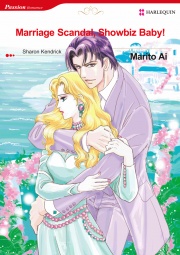
    Marriage Scandal, Showbiz Baby!

    I was happy when I started reading this volume and saw that instead of the rushed, less detailed art provided for many of these harlequin titles, it opened with a detailed scene of married but estranged actors confronting each other on the red carpet, complete with glossy hair and borders of floating flowers. If there aren’t flowers used as backgrounds in every few pages of a Harlequin manga I feel cheated. Jennifer is an actor and married to Italian superstar Matteo. They’re in the process of divorcing because Matteo romanced the actress that played the evil temptress in their most recent movie. Apparently she is also a temptress in real life. Temptress! There’s a series of flashbacks that show how they first fall in love, when Jennifer was appearing in a play and lured Matteo in because she didn’t care about his fame and wealth. Matteo liked a challenge! Now, as they split up Jennifer’s harpy of a mother keeps lecturing her about the evils of men, and Matteo’s trusty staff don’t put her phone calls through to him. Harpy! Betrayal! Jennifer gets cornered at a party by another womanizing actor named Jack, whose hairstyle, plucked eyebrows, and eyeliner somehow reminded me of John Taylor circa 1983. Duran Duran! Actually many of the fashions in this series ranging from Jennifer’s side-ponytail to the harpy mother’s blouse with attached bow evoked a certain over the top 1980s glamour, which I found amusing because this manga was produced in 2008. Matteo saves her, they get trapped in an elevator, and they make love. Love in an elevator! Jennifer finds herself pregnant, and she and Matteo begin to rebuild their relationship. Because if you need to trap a man, get pregnant! This was highly entertaining, and the lush art did a great job of evoking the fabulous lifestyles of the protagonists.

    Filed Under: UNSHELVED

    Random weekend question: comebacks

    February 19, 2011 by David Welsh

    I’m seriously considering selling my copy of Osamu Tezuka’s Swallowing the Earth (DMP). Copies are going for a small fortune on Amazon, and opportunism may overcome my tendency to hoard. This leads me to ask which books you’d like to see back in print from the sad limbo of licensed titles that have faded from active publication.

    I’d have to go with Viz’s Four Shôjo Stories, a collection featuring the work of Moto Hagio, Keiko Nishi, and Shio Satô. Copies are expensive, and it seems like something that should be more readily available. In fact, there are a fair number of really interesting, old Viz books that I’d like to see make a comeback, but this one tops my list.

    What’s your choice?

    Filed Under: DAILY CHATTER

    License request day: Zipang

    February 18, 2011 by David Welsh

    From the Manga Moveable Feast to a lively but technologically challenged Manga Out Loud podcast, it’s all about World War II this week. Barefoot Gen (Last Gasp) addresses history directly and brutally, and Ayako (Vertical) invents a tale of history’s victims, so one might be forgiven the impulse to rewrite history. That leads us to this week’s license request.

    Kaiji Kawaguchi’s Zipang, which yielded an astonishing 43 volumes in Kodansha’s Morning, sends visitors from the present into the past and explores the potential consequences of that kind of junket. In this case, it’s a contemporary Defense Force vessel, the Mirai, which takes a wrong turn on the way to Hawaii and winds up in the Pacific on the eve of the decisive Battle of Midway.

    The crew of the Mirai encompasses a number of different viewpoints on the tricky subject of time travel, from those who yearn to rewrite history whenever the opportunity presents itself to those who don’t so much want to divert a butterfly, lest that butterfly be headed someplace really, really important. I admit that I’m not especially interested in either war stories or treatises on the elasticity of time, but this book is supposed to be really, really good.

    It won the Kodansha Manga Award in 2002. It was one of the Official Selections at the 2007 Festival International de la Bande Desinée. Four volumes were apparently published as a part of Kodansha’s Bilingual Comics project back in the day, but I can’t find confirmation of that claim, and I can only imagine what they’d cost, if they do exist. You’re in better shape if you’re able to read French, as Kana is publishing the book in that language, and they’re up to the 29th volume at this point.

    Highly regarded as Kawaguchi is, his only work to see complete publication in English was Eagle: The Making of an Asian-American President (Viz, originally serialized in Shogakukan’s Big Comic), which I think is out of print. Its five volumes don’t seem to be fetching the prices that some out-of-print titles do, but I’m not sure how easy it is to find all five volumes. Casterman’s Sakka imprint published it in French in 11 volumes.

    The likelihood of this request being fulfilled seems rather slim. It’s long, it’s manly, and I’d wager it displays a shortage of girls in body stockings doing cartwheels. This is the kind of title that makes publishers ask you why you’re wishing bankruptcy on them when you bring it up. But if I could go back in time and rewrite the history of manga in English, I would divert whatever butterfly I could to improve the chances of books like this.

    Filed Under: LICENSE REQUESTS, Link Blogging

    Manga Moveable Feast: Barefoot Gen and Manga! Manga!

    February 17, 2011 by Anna N

    I thought for the Manga Moveable Feast, I write a little bit about where I first encountered Barefoot Gen, in the back of the classic Frederik L. Schodt book Manga! Manga! The World of Japanese Comics. This might be a thinly disguised way of attempting to hide the fact that I didn’t hunt down the collected volumes so my only way of participating in the MMF is to go with what’s on my shelves, but the manga excerpts translated in the Schodt book were also some of the first manga I read. After presenting an overview of the history of manga, Schodt chose the following creators to illustrate the variety stories found in manga for an English speaking audience: Osamu Tezuka’s Phoenix, Reiji Matsumoto’s Ghost Warrior, Riokyo Ikeda’s Rose of Versailles, and Keiji Nakazawa’s Barefoot Gen.

    I can’t think of a more jarring transition than flipping from the tribulations of Marie Antoinette to the aftermath of the atomic bomb. The story opens at the start of a normal day, with Gen getting ready to go to school. The bomb drops and his neighborhood becomes a nightmare of destruction, filled with injured people he can’t even begin to help. The schoolboy runs from person to person, seeing a woman with her face melted off, a burned man begging for water, and a little girl with a face full of glass shards. Finally Gen finds his family only to discover his father and most of his siblings trapped beneath a house while a fire rages nearby. Gen gets his pregnant mother away, and she gives birth to his little sister. The child’s first sight is the devastation of war.

    Going back and reading this excerpt many years after first encountering it, I’m finding it easier to read. I think when I first read this sample of Barefoot Gen back in the eighties, I didn’t have the background in the visual vocabulary of manga to easily parse the contrast between the stylized, cartoony art style and the images of the bomb’s aftermath. After reading more Tezuka in the intervening years (whose deceptively simple artwork is used to portray any number of heavy situations), I’m finding these pages of Barefoot Gen less strange than I remember. Barefoot Gen is the essence of a didactic manga, with the sole aim to show the horrors of Hiroshima. I wonder if its value as a cultural artifact might be equal to or greater than its literary value. Shodt effectively added Barefoot Gen to the manga canon for English readers by just including it in his book.

    Filed Under: UNSHELVED

    • « Go to Previous Page
    • Page 1
    • Page 2
    • Page 3
    • Page 4
    • Interim pages omitted …
    • Page 6
    • Go to Next Page »
     | Log in
    Copyright © 2010 Manga Bookshelf | Powered by WordPress & the Genesis Framework