• Skip to primary navigation
  • Skip to main content
  • Skip to primary sidebar
  • Home
  • About Us
    • Privacy Policy
    • Comment Policy
    • Disclosures & Disclaimers
  • Resources
    • Links, Essays & Articles
    • Fandomology!
    • CLAMP Directory
    • BlogRoll
  • Features & Columns
    • 3 Things Thursday
    • Adventures in the Key of Shoujo
    • Bit & Blips (game reviews)
    • BL BOOKRACK
    • Bookshelf Briefs
    • Bringing the Drama
    • Comic Conversion
    • Fanservice Friday
    • Going Digital
    • It Came From the Sinosphere
    • License This!
    • Magazine no Mori
    • My Week in Manga
    • OFF THE SHELF
    • Not By Manga Alone
    • PICK OF THE WEEK
    • Subtitles & Sensibility
    • Weekly Shonen Jump Recaps
  • Manga Moveable Feast
    • MMF Full Archive
    • Yun Kouga
    • CLAMP
    • Shojo Beat
    • Osamu Tezuka
    • Sailor Moon
    • Fruits Basket
    • Takehiko Inoue
    • Wild Adapter
    • One Piece
    • After School Nightmare
    • Karakuri Odette
    • Paradise Kiss
    • The Color Trilogy
    • To Terra…
    • Sexy Voice & Robo
  • Browse by Author
    • Sean Gaffney
    • Anna Neatrour
    • Michelle Smith
    • Katherine Dacey
    • MJ
    • Brigid Alverson
    • Travis Anderson
    • Phillip Anthony
    • Derek Bown
    • Jaci Dahlvang
    • Angela Eastman
    • Erica Friedman
    • Sara K.
    • Megan Purdy
    • Emily Snodgrass
    • Nancy Thistlethwaite
    • Eva Volin
    • David Welsh
  • MB Blogs
    • A Case Suitable For Treatment
    • Experiments in Manga
    • MangaBlog
    • The Manga Critic
    • Manga Report
    • Soliloquy in Blue
    • Manga Curmudgeon (archive)

Manga Bookshelf

Discussion, Resources, Roundtables, & Reviews

Archives for May 2009

We Were There, Volume 2

May 6, 2009 by MJ 23 Comments

It’s my fortieth birthday today, and as I was pondering what I’d like to post, I decided that there is nothing closer to my heart on a day like this than my distant past, which brings me to a series that feels more authentic to my teenage heart than anything I’ve read in a long time.

We Were There, Vol. 2
By Yuki Obata
Published by Viz Media

wwt2
Buy This Book

“Beloved. For the first time I understood what that word truly meant in the winter of my 15th year.”

…

Read More

Filed Under: MANGA REVIEWS Tagged With: manga, we were there

Click 4 by Youngran Lee: B-

May 4, 2009 by Michelle Smith

From the back cover:
Carefree player and rich kid Taehyun knows that he feels something for Joonha whether he’s a boy or a girl. But he hasn’t reckoned on the arrival of music star Jinhoo, Joonha’s friend from childhood, who’s back in Seoul to stay. That’s because Joonha seems ready to pick up right where he and his old pal left off. But can a close friendship remain just friendship when one of the boys is now a girl?

Good-natured and oblivious, Jinhoo seems to take it all in stride—that is, until Heewon, the trash-talking crazy girl, confronts him with a devastating revelation…

Review:
There’s not much I can say about this series that I haven’t already. I’m not terribly fond of any of the characters, and yet I find it pretty engrossing. I think it helps that the art is so clean and easy on the eyes and the layouts so simple—it makes it easy to just focus on the emotions and dialogue and zip right on through.

Most of the action in this volume is pretty boring. Taehyun is in love with Joonha, even though he’s unsure of her gender, and she admits to him that she lived for a guy as sixteen years. Taehyun’s minion is inexplicably in love with the violent Heewoon, and does her bidding a few times. Joonha bickers with Jinhoo’s girlfriend. The good stuff is in the interactions between Joonha and Jinhoo, especially a moment they share toward the end where Jinhoo confesses he’s still nervous that Joonha will spontaneously disappear again.

Also, despite the faults of this series, it seriously delivers come cliffhanger time. I think practically every volume has ended with a new step toward Jinhoo’s eventual discovery of Joonha’s secret. This time, I don’t know how can possibly avoid realizing that his old friend is now a girl, but we shall see.

Filed Under: REVIEWS Tagged With: netcomics, Youngran Lee

Live for Love

May 4, 2009 by MJ Leave a Comment

By Itsuki Sato
Digital Manga Publishing, 200 pp.
Rating: M (18+)

Seven years ago, just as his life was falling apart, Yoshiyuki Nomura was approached out of the blue by a small-time private detective, Yasuie, who offered him employment and, more importantly, escape. Yoshiyuki agreed and the two have been working together ever since, though they have more work shampooing cats than anything else. Their relationship with each other is easy and playful and Yoshiyuki has never thought much about Yasuie’s touchy-feely nature and frequent sexual teasing, but when Yoshiyuki’s estranged adoptive parents seek him out to schedule a marriage interview, Yasuie freaks out and rapes Yoshiyuki, claiming afterwards that he’s always loved him and begging him to stay with the agency. Being raped, of course, only makes it easier for Yoshiyuki to leave and he returns to his family, ready to go through with the marriage interview.

It’s really difficult not to become weary of the overabundance of rape in yaoi manga and in this case it really is a shame, because Live for Love is otherwise an extremely charming story. The relationship between Yoshiyuki and Yasuie is frankly adorable and unusually well developed for a yaoi one-shot, filled with playful banter and obvious affection. The humor, too, really hits the mark, as the men resign themselves to the fact that their business has devolved into a cheap cat-grooming salon. Even the art is charming, with attractive character designs and an ease of expression that matches the story’s off-the-cuff feel. What’s saddest is that the rape serves no real purpose other than to hasten Yoshiyuki’s departure from the detective agency, which could have easily been achieved by other means that might have also made his eventual return to Yasuie much easier to believe.

For those who can stomach the nonconsensual sex, Live for Love is smart, engaging, and fun, with good humor and endearing characters who deserve better treatment than they get.

Review copy provided by the publisher. Review originally published at PopCultureShock.

Filed Under: BL BOOKRACK Tagged With: yaoi/boys' love

Manga Minis & New Look!

May 4, 2009 by MJ 2 Comments

First of all, I have a review in today’s Manga Minis, for DMP one-shot, Live for Love. This was a rough call for me, because while I really dislike one of the common BL elements present in this story (why, why must someone always be raped?) I really enjoyed the rest of it on a fun, fluffy kind of level, much more so than usual for this type of story. So there you have it.

Secondly, and I’m very happy about this, the site has a new look! After seeing Kate Dacey’s fancy new blog, I was inspired to give this place a slightly more professional look, particularly to make it easier for people to find recent reviews. Please drop me a comment or e-mail if you run into any problems with the site!

I’ve got lots of new content coming this week, including new reviews and discussion topics. We should be hearing more from guest blogger Deanna Gauthier in the next month as well! Stay tuned!

Filed Under: NEWS Tagged With: manga, wordpress

Real, Vols. 1-4

May 3, 2009 by Katherine Dacey

Slam Dunk may have been the series that put Takehiko Inoue on the map and introduced legions of Japanese kids to basketball, but for me, a long-time hoops fan who grew up watching Larry Bird lead the Celtics to numerous NBA champtionships, Slam Dunk was a disappointment, a shonen sports comedy whose goofy hero desperately needed a summer at Robert Parrish Basketball Camp for schooling in the basics. Real, on the other hand, offered this armchair point guard something new: a window into the fiercely competitive world of wheelchair basketball. Watching Inoue’s characters run a man-to-man defense and shoot three-pointers from their chairs gave me a fresh appreciation for just how much strength, stamina, and smarts it takes to play the game, with or without the use of ones’ legs.

Much of the series’ appeal lies with Inoue’s superb draftsmanship. As he does in both Slam Dunk and Vagabond, he immerses us in the action, making us feel as if we’re on the court with his characters, bumping rims and talking trash. No detail is squandered; even a close-up of a character’s eyes or hands helps us picture where his teammates are on the court, and imagine how the play might unfold.

The other thing that Real does incredibly well is give us a window into its characters’ emotional lives, something that the antic, frantic Slam Dunk never pauses to do. (In Inoue’s defense, I don’t expect a shonen comedy to shed much light on its hero’s interior life, especially one as dense and single-minded as the flame-haired Hanamichi Sakuragi.) Its three principle characters—Togawa Kiyoharu, a track-and-field standout whose promising career was snuffed by bone cancer, Nomiya Tomomi, a high school dropout responsible for paralyzing a girl in a motorcycle accident, and Takahashi Hisanobu, a high school basketball star sidelined by a spinal cord injury—are complex individuals whose foul tempers and bouts of self-loathing make them seem like ordinary people coping with extraordinary circumstances, rather than cardboard saints.

Consider Takahashi. Until the day he was hit by a truck, Takahashi embodied the big-man-on-campus stereotype, leading the basketball team, dating several girls at once, acing his exams, and enforcing the school’s social pecking order by ruthlessly hazing weaker students. The accident robs him not only of his mobility, but also his identity; Takahashi predicated his entire sense of self on what others thought of him. Once confined to a bed, however, he lashes out at anyone who shows him kindness: how dare these C- and D-list folk offer him pity? (In one of the series’ only running jokes, Takahashi evaluates everyone on a five-point scale, including the tough, homely nurse assigned to his ward. She rises in his estimation after ticking off a long list of American boyfriends.) As he begins the grueling process of rehabilitation, Takahashi’s sense of self is further undermined by the realization that learning to move again will require discipline, something he lacks. (In fact, Takahashi held his more disciplined teammates in contempt, viewing their work ethic as a sign of weakness.) His fear and anger begin curdling into self-pity, leaving him physically and emotionally paralyzed.

Degraded as the character may seem, however, Inoue never invites us to pity Takahashi. We feel his sense of loss and futility, yet it’s clear from Takahashi’s repellent behavior that he still has a strong will to live, giving us hope that his journey will end in redemption. What isn’t so obvious is how Takahashi will get his groove back, as Inoue doesn’t draw neat draw parallels between his story and Kiyoharu’s. (Nomiya, the dropout, emerged from his accident unscathed, and faces a somewhat different battle than the wheelchair-bound Takahashi and Kiyoharu.) Though it’s frustrating to wait and see what will happen to Takahashi, the slow and almost haphazard way in which his story unfolds gives the narrative a true-to-life rhythm that mitigates against a pat, uplifting resolution to the drama.

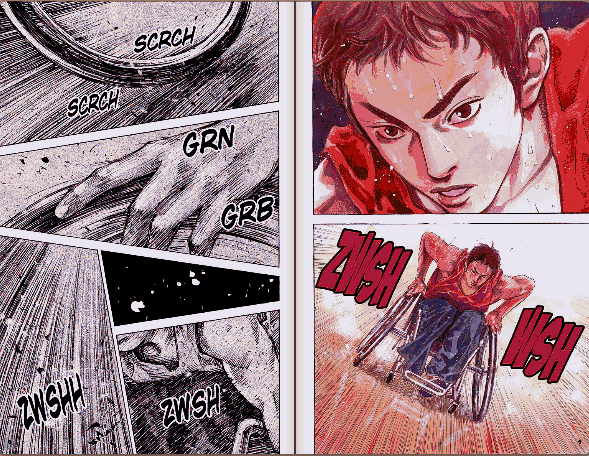
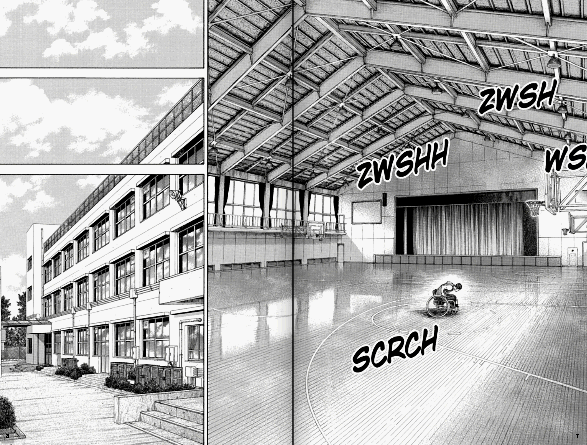
Inoue may take his time developing each character’s backstory, but he’s surprisingly efficient at establishing their personalities in just a few panels. The opening two pages of volume one, for example, speak volumes about Kiyoharu:

realpage1

realpage2

Through a combination of facial gestures and body language, those first five panels capture Kiyoharu’s fierce determination and incredible physical strength — he’s a consummate athlete pushing his body to its limits. Inoue then pulls back from Kiyoharu’s hands and face to reveal a lone figure dwarfed by an empty gymnasium. Kiyoharu’s discipline may make him a first-class basketball player, but as this image suggests, that discipline isolates him from other people — a theme that Inoue develops in volumes three and four, when Kiyoharu estranges his teammates with a grueling practice schedule and tough talk about winning.

Viz has done a terrific job of packaging Real, wrapping each issue in a beautifully designed cover and printing the artwork on creamy, high-quality paper that makes both the grayscale and full-color images pop. (I’m not really sold on the French flaps’ utility, though they certainly look cool.) John Werry’s fluid translation gives a distinct voice to each of the three principles — no mean feat, given how belligerent all three of them can be. Each volume includes a helpful set of cultural notes, as well as sidebars explaining the rules of wheelchair basketball; if anything, the American edition might have benefited from a more extensive appendix at the end of each volume.

I’m hoping that the deluxe presentation will encourage folks to give Real a try, regardless of their interest in basketball. It’s a sports story for those of us who care more about good writing and good artwork than the inner workings of a zone defense. But if you like to wax poetic about the Celtics/Lakers rivalry of yore, Real is your kind of series, too, as it will remind you just how beautiful the game can be when played with passion.

Review copies provided by VIZ Media, LLC.

REAL, VOLS. 1 – 4 • BY TAKEHIKO INOUE • VIZ • RATING: OLDER TEEN (16+)


Filed Under: Manga, Manga Critic, REVIEWS Tagged With: Basketball, Sports Manga, Takehiko Inoue, VIZ, VIZ Signature

Real, Vols. 1-4

May 3, 2009 by Katherine Dacey

real4Slam Dunk may have been the series that put Takehiko Inoue on the map and introduced legions of Japanese kids to basketball, but for me, a long-time hoops fan who grew up watching Larry Bird lead the Celtics to numerous NBA champtionships, Slam Dunk was a disappointment, a shonen sports comedy whose goofy hero desperately needed a summer at Robert Parrish Basketball Camp for schooling in the basics. Real, on the other hand, offered this armchair point guard something new: a window into the fiercely competitive world of wheelchair basketball. Watching Inoue’s characters run a man-to-man defense and shoot three-pointers from their chairs gave me a fresh appreciation for just how much strength, stamina, and smarts it takes to play the game, with or without the use of ones’ legs.

Much of the series’ appeal lies with Inoue’s superb draftsmanship. As he does in both Slam Dunk and Vagabond, he immerses us in the action, making us feel as if we’re on the court with his characters, bumping rims and talking trash. No detail is squandered; even a close-up of a character’s eyes or hands helps us picture where his teammates are on the court, and imagine how the play might unfold.

…

Read More

Filed Under: Manga Critic Tagged With: Seinen, Takehiko Inoue, VIZ

Off*Beat, Volumes 1 & 2

May 3, 2009 by MJ 19 Comments

Off*Beat, Vols. 1 & 2 | By Jen Lee Quick | Published by Tokyopop

offbeat
Buy This Book

Christopher “Tory” Blake is a genius teenager in Queens, unchallenged in school, damaged by his absent father’s failures, and living with his well-meaning mom who worries that she gives her son too much freedom for his own good. After his parents’ break-up, Tory began keeping meticulous diaries of every detail in his life, minute-to-minute, including everyone and everything around him, which he keeps in file boxes in his closet. …

Read More

Filed Under: MANGA REVIEWS Tagged With: manga, off*beat

Jack Frost, Volume 1

May 2, 2009 by MJ 10 Comments

Jack Frost, Vol. 1
By JinHo Ko
Published by Yen Press

jackfrost_1
Buy This Book

When Noh-A Joo is decapitated on her first day at Amityville Private High School, she isn’t terribly surprised. After all, it’s the same recurring nightmare she’s been having since she started high school. This time, however, the dream doesn’t end, and Noh-A finds out that not only has she died and left her real world forever but that she’s stuck for eternity in a burned-out wasteland where blood-thirsty creatures live in perpetual war. …

Read More

Filed Under: MANGA REVIEWS Tagged With: jack frost, manhwa

The Sharing Knife: Legacy by Lois McMaster Bujold: B+

May 2, 2009 by Michelle Smith

From the front flap:
Fawn Bluefield, the clever young farmer girl, and Dag Redwing Hickory, the seasoned Lakewalker soldier-sorcerer, have been married all of two hours when they depart her family’s farm for Dag’s home at Hickory Lake Camp. Alas, their unlikely marriage is met with prejudice and suspicion, setting many in the camp against them. A faction of the camp even goes so far as to threaten permanent exile for Dag.

Before their fate as a couple is decided, however, Dag is called away by an unexpected malice attack on a neighboring hinterland threatening Lakewalkers and farmers both. What his patrol discovers there will not only change Dag and hew new bride, but will call into question the uneasy relationship between their peoples—and may even offer a glimmer of hope for a less divided future.

Review:
When I reviewed the first installment in The Sharing Knife series, Beguilement, I lamented its lack of a more traditional fantasy novel plot. It’s not that it wasn’t good; it just wasn’t what I expected. This second volume, Legacy, definitely fulfills more of that traditional fantasy role while dealing with the aftermath of Dag and Fawn’s marriage in interesting ways.

Since the two books were originally conceived of as one, this one picks up two hours later, with the newly married Dag and Fawn on their way to Hickory Lake, the Lakewalker camp where Dag’s family resides. When they arrive, all sorts of questions are answered, though it’s the new ones that crop up that prove the more interesting.

Bujold again excels at writing in such a way that it is incredibly easy to visualize the scene and her worldbuilding is unique and thorough. I enjoyed all the details of life at Hickory Lake, including the way the camp is laid out, the clever patrol-tracking system in place in the commander’s cabin, further information on sharing knives and the origin of malices, and the process for settling camp grievances. I also thought it was neat that, like Fawn’s family back in West Blue, Dag’s family is still unable to really see him for his own worth.

More compelling than this, however, is the fact that the novel deals with the question of what Dag and Fawn ought to do now that they are married. What will become of Fawn when Dag goes out on patrol? What if he doesn’t come back; can he trust the camp to provide for her? Will she ever be accepted, even if she displays her cleverness and desire to be useful over and over again? Indeed, it’s Fawn who makes the intuitive leap later in the novel that saves the lives of ten people, yet others almost immediately seek to award credit to Dag somehow. Even those who like her, like the camp’s medicine maker, Hoharie, stop short of recommending a permanent place for her in camp life.

On the more fantasy side of things, Dag is contending with his “ghost hand,” ground that originally belonged to his left hand, now missing, which can be called upon in times of urgency to perform unexpected feats of magic. (Or, as shown in the too-detailed marital consummation scene early in the book, for sexy purposes. At least the rest of such encounters are less explicit.) When a jaunt as captain, commanding several patrols as they strive to exterminate a highly-advanced malice, ends with him using this hand in a couple of new ways, Dag begins to realize that perhaps his life is going to change directions.

What with the way Fawn’s being treated at the camp, the way farmers largely remain ignorant of the malice threat, the threat of banishment arising from his family’s petition to dissolve his and Fawn’s marriage, and the knowledge that maybe he could be something other than a patroller, Dag eventually decides to head out and travel the world with Fawn by his side. Somehow I had absorbed the spoiler that this would eventually happen, but I like that the decision ultimately makes sense.

Overall, I liked Legacy more than Beguilement. I like the lead characters and hope that the small band of supporting Lakewalkers who were on their side in the camp council hearing will be seen again. It looks like Dag and Fawn will be acquiring some traveling companions in the next book, too, which I’m look forward to.

Additional reviews of The Sharing Knife: Legacy can be found at Triple Take.

Filed Under: Books Tagged With: Lois McMaster Bujold

Mansfield Park by Jane Austen: B

May 1, 2009 by Michelle Smith

From the back cover:
From its sharply satiric opening sentence, Mansfield Park deals with money and marriage, and how strongly they affect each other. Shy, fragile Fanny Price is the consummate “poor relation.” Sent to live with her wealthy uncle Thomas, she clashes with his spoiled, selfish daughters and falls in love with his son. Their lives are further complicated by the arrival of a pair of sophisticated Londoners, whose flair for flirtation collides with the quiet, conservative country ways of Mansfield Park. An outsider looking in on an unfamiliar and often inhospitable world, Fanny eventually wins the affection of her benefactors, endearing herself to the Bertram family and readers alike.

Review:
I feel very much that I ought to love Mansfield Park, Austen fan that I am, but I simply can’t. With any Austen novel—satirical as they are—one is bound to encounter excessively foolish and self-aggrandizing characters. I fully expect that and am accustomed to disliking a few in each novel. I did not, however, expect to dislike nearly everyone, which is lamentably the case with this novel.

Fanny herself is the biggest problem. She’s meek, weak, weepy, and irksomely virtuous, to the point where other characters annoyed me simply because they gave her fodder for her hand-wringing. Her cousin Edmund, our ostensible romantic hero, isn’t much better. He’s a wet blanket, too, fond of lecturing others about what is right, but also a hypocrite, since his objections to the scandalous idea of producing a play at Mansfield Park are easily overcome when he learns one additional man is required to play the suitor of his lady friend, Miss Crawford.

Everyone else is self-absorbed, indolent, or deluded to varying degrees. Though Fanny’s personality is the biggest blow to my enjoyment of the novel as a whole, the character I hate most is actually Mrs. Norris (though at least with her I can feel assured that this doesn’t run counter to Austen’s intentions). She’s Fanny’s aunt, a frequent visitor to her sister and brother-in-law at Mansfield Park, and is fond of claiming charitable acts for herself that she actually had no part in executing, getting into everyone’s business, and making snide remarks about Fanny at every opportunity. No wonder J. K. Rowling named Filch’s cat after this odious woman! The only character I truly like is Fanny’s uncle, Sir Thomas, for he’s one of those gruff but kind paternal types that I can’t help but love.

The plot itself, like Austen’s other novels, involves the social interactions of several country families, with the importance of marrying well uppermost on everyone’s minds. The back cover blurb quoted above says that Fanny “wins the affection of her benefactors,” but that implies that Fanny actually does something to bring this about. In reality, Fanny pretty much sits back, sticks to her principles in refusing one undesirable suitor, and, when he is proven a rake and her female cousin disgraced, is suddenly valued for all of her propriety.

Thus brings us to the inevitable conclusion, wherein Edmund realizes that Fanny would make a better wife than Miss Crawford. There’s no romance leading up to this, since he spends the majority of the novel longing for the latter and often employs Fanny as his confidante in this regard. Though I am probably supposed to be happy for Fanny at this outcome, I instead find it pretty icky. True, Fanny has sheltered romantic feelings for Edmund throughout the novel, but he has always treated her very properly like a close relation. In fact, as he ponders the match, he holds hopes that her “warm and sisterly regard for him would be foundation enough for wedded love.” To that I must say, “Ew.”

Although I had plenty to complain about, Mansfield Park is still an Austen novel, which means that the writing is excellent and the characters vividly drawn and memorable. Though it’s my least favorite of the four I’ve read so far it by no means decreases my regard for her in general.

Filed Under: Books Tagged With: Jane Austen

Ikigami: The Ultimate Limit, Vol. 1

May 1, 2009 by MJ 8 Comments

By Motoro Mase
Published by Viz, 216 pp.
Rating: Mature

“Obedience is the key to happiness,” proclaims the government of this manga’s dystopian society–a tenet upheld by the National Welfare Act, a law that dictates standard immunizations for every first grader in the country (a country that greatly resembles modern Japan). What is special about these immunizations is that approximately one in one thousand of them contains a tiny capsule that settles itself in the recipient’s pulmonary artery. Then, on a pre-determined date sometime between the affected citizen’s eighteenth and twenty-fourth year, the capsule ruptures, killing the person instantly. Because nobody knows who has received a capsule, the law is said to make people value life more and conduct more productive lives, ever mindful of the shadow of death.

Anyone who opposes the law is injected with the capsule, as Fujimoto, the series’ protagonist, witnesses for himself on the first day of training for his new job. Fujimoto’s job is as a Messenger–a government employee responsible for delivering ikigami or “death papers” to those who are destined for government-mandated death, informing them of the exact date and time of their unfortunate fate. The ikigami are delivered to the person’s residence precisely twenty-four hours before the appointed time so that the individual may decide how to spend the last twenty-four hours of his or her life–one of the primary subjects of this volume. In the final chapter, Fujimoto’s manager explains to him, “Depending on how a person lives their last day, the ikigami can be a death sentence, or an invitation to really live,” and though on the surface, this might seem to make sense, it also highlights the most problematic philosophy presented in the story.

Fujimoto delivers two ikigami during the course of this volume, one to a store checkout clerk who is haunted by his past as a target of his former schoolmates’ intense bullying, and one to a musician just on the brink of artistically unfulfilling commercial success. The most interesting portions of this volume are the stories of these two young men and their individual reactions to receiving an ikigami. Though their choices in the last twenty-four hours of their lives seem quite different on the surface–one turns to revenge, the other to liberation–both are acting on their deepest regrets, and it is this that is the great tragedy of Ikigami.

Despite the government’s insistence that the National Welfare Act helps people value their lives, to a great extent this only seems to happen in these young men’s final moments, which begs the question of whether or not the “obedience” these people are so proud of is actually just the product of plain, ordinary fear, so deeply ingrained into their way of life that it is maintained unconsciously, with little thought given to its cause. After all, appreciating life and fearing death are not the same thing. Giving this very well-plotted manga its due, however, it seems quite likely that this could end up being the point, as by the end of the volume Fujimoto is clearly having non-government-approved thoughts about his role in all this, and there are enough hints throughout the book to suggest that he may not continue to walk the straight-and-narrow.

Everyman Fujimoto is the perfect guide to take readers through this grim world–part Death Note, part 1984 (though more starkly real than either of them). It is the government that is the serial killer in this story, doling out doom with a tight, corporate smile while failing to recognize (let alone address) the real suffering of its constituents.

That Yosuke Kamoi, the young man whose school years with a group of bullies left him permanently disfigured, could have lived the life he did in this “obedient” society, proves just how little part the government plays in people’s day-to-day lives. Yosuke lived his life tormented by his peers, with his negligent Big Brother only stepping in to deliver the final blow. For most of these people, the ikigami is something that happens to others–distant, anonymous people who have nothing to do with their lives. Despite the government’s best efforts, the darkest oppressor hanging over these people’s daily existences is that which they create for themselves and for each other. It is this that makes Ikigami feel so real and enhances its sense of horror.

Mase’s art is bold, stark, and heavy on contrast, effectively portraying the bleak reailty of its world. The characters’ faces are wonderfully expressive and specific, with a level of nuance one might expect from live actors, and the character designs provide the detailed realism found primarily in seinen manga.

This manga is smart, compelling, often chilling, and relentlessly dark though never for its own sake. With its fascinating concept, tense storytelling, and sharp, clean art, Ikigami is a real page-turner–impossible to put down through the very last panel.

Review copy provided by the publisher. Review originally published at PopCultureShock.

Filed Under: MANGA REVIEWS Tagged With: ikigami, manga

  • « Go to Previous Page
  • Page 1
  • Page 2
  • Page 3
  • Page 4
 | Log in
Copyright © 2010 Manga Bookshelf | Powered by WordPress & the Genesis Framework