• Skip to primary navigation
  • Skip to main content
  • Skip to primary sidebar
  • Home
  • About Us
    • Privacy Policy
    • Comment Policy
    • Disclosures & Disclaimers
  • Resources
    • Links, Essays & Articles
    • Fandomology!
    • CLAMP Directory
    • BlogRoll
  • Features & Columns
    • 3 Things Thursday
    • Adventures in the Key of Shoujo
    • Bit & Blips (game reviews)
    • BL BOOKRACK
    • Bookshelf Briefs
    • Bringing the Drama
    • Comic Conversion
    • Fanservice Friday
    • Going Digital
    • It Came From the Sinosphere
    • License This!
    • Magazine no Mori
    • My Week in Manga
    • OFF THE SHELF
    • Not By Manga Alone
    • PICK OF THE WEEK
    • Subtitles & Sensibility
    • Weekly Shonen Jump Recaps
  • Manga Moveable Feast
    • MMF Full Archive
    • Yun Kouga
    • CLAMP
    • Shojo Beat
    • Osamu Tezuka
    • Sailor Moon
    • Fruits Basket
    • Takehiko Inoue
    • Wild Adapter
    • One Piece
    • After School Nightmare
    • Karakuri Odette
    • Paradise Kiss
    • The Color Trilogy
    • To Terra…
    • Sexy Voice & Robo
  • Browse by Author
    • Sean Gaffney
    • Anna Neatrour
    • Michelle Smith
    • Katherine Dacey
    • MJ
    • Brigid Alverson
    • Travis Anderson
    • Phillip Anthony
    • Derek Bown
    • Jaci Dahlvang
    • Angela Eastman
    • Erica Friedman
    • Sara K.
    • Megan Purdy
    • Emily Snodgrass
    • Nancy Thistlethwaite
    • Eva Volin
    • David Welsh
  • MB Blogs
    • A Case Suitable For Treatment
    • Experiments in Manga
    • MangaBlog
    • The Manga Critic
    • Manga Report
    • Soliloquy in Blue
    • Manga Curmudgeon (archive)

Manga Bookshelf

Discussion, Resources, Roundtables, & Reviews

Archives for May 2014

Bookshelf Briefs

May 12, 2014 by Sean Gaffney and Michelle Smith Leave a Comment

This week, Sean and Michelle look at recent releases from Yen Press, Viz Media, Kodansha Comics, and One Peace Books.

arcana12Dawn of the Arcana, Vol. 12 | By Rei Toma | Viz Media – Things are happening quickly in this penultimate volume of Dawn of the Arcana, and when I say “quickly” I mean I was often left going, “Wait, what?” Last volume, Nakaba suddenly became quene of Senan, and here, without much preamble, she intercepts Caesar’s invading force (he was sent by his father) and, again without much preamble, they begin a revolution that swiftly ends with Caesar killing his father and becoming king of Belquat, just in time for a rather perplexing cliffhanger moment to ensue. I’m not saying that this isn’t good or interesting, because it is, but I can’t help but think how much better it would be if we were seeing some serious effort involved in these momentous undertakings. It could really have been something wonderfully epic, but in its current state it’s like Basara Lite. Still recommended, though. – Michelle Smith

inu3Inu x Boku SS, Vol. 3 | By Cocoa Fujiwara | Yen Press – There’s a lot of emphasis in this volume on both the wacky antics of the main cast and the heartwarming relationships between them. Ririchiyo is opening up more than ever, and starting to admit her feelings, though dealing with them is tough. And Carta is just adorable. And yet the entire volume feels ominous, as there are also several hints that this isn’t going to last, and in fact that we may lose some of the cast soon. The discussion about reincarnation in particular reads as a ‘let me tell you about this now as it will be important later.’ Complete with the ominous text at the end of the book, it would seem that all of the wacky and heartwarming moments in this volume may taste very bitter soon.-Sean Gaffney

popular3No Matter How I Look At It, It’s You Guys’ Fault I’m Not Popular!, Vol. 3 | By Nico Tanigawa | Yen Press – There’s both hope and despair in this volume of WatMote, which I enjoyed more than Volume 2. We meet a girl (seems to be a class president type) who actually seems to be looking out for Tomoko’s well-being, and we also see her genuinely enjoying the school festival with Yuu-chan. The despair comes from things like Tomoko’s teacher forcing attention onto her (which makes her cry she’s so upset) and the tragic fantasy of starting a ‘do nothing club’ with fellow loners, only to realize that even that isn’t real. There’s lots of funny stuff in this manga, but I think most people reading it are doing so with a bit of wincing sympathy and no small amount of worry.-Sean Gaffney

sankarea6Sankarea: Undying Love, Vol. 6 | By Mitsuru Hattori | Kodansha Comics – Sankarea continues to be a balancing act between wacky harem comedy, heartwarming family romance, and pure undiluted horror. We get all three of those in this volume, as Chihiro deals with his zombified cat, Bub, causing havoc in a way he’s determined to fix (partly as he loves his cat, but partly as he worries it could happen to Rea). Meanwhile, Rea is determined to get Darin to act more like a normal 14-year-old girl. The big thing in this volume, though, is that Rea is different from the other zombies, as she did things out of order. How much of a difference this will make in the end I’m not sure, but given Rea and Darin are going to EvilCorp, I suspect next volume will be more serious.-Sean Gaffney

strobe10Strobe Edge, Vol. 10 | By Io Sakisaka | Viz Media – There never really was any uncertainty about how Strobe Edge would end, so in that respect it feels like it’s taken a long time to get here, especially with Ninako’s recent hesitancy to go for it with Ren because of how it might damage his friendship with Ando. And yet, because the series officially concludes halfway through this volume, it somehow manages to feel a little too quick, too. Weird how that happens. Happily, a bonus chapter at the end of the volume reinforces the ending, and gives us another glimpse of how well suited Ren and Ninako are for each other. There’s also a bonus chapter focusing on Ren’s small, enthusiastic friend Manabu, which would’ve been nice to see earlier in the series. All in all, not a surprising conclusion, but a satisfying one all the same. – Michelle Smith

whispered1Whispered Words, Vol. 1 | By Takashi Ikeda | One Peace Books – Kazama Ushio loves girly girls and is initially oblivious to the fact that her tall, athletic, and uncute best friend, Sumika Murasame, is in love with her. The moments focusing on the incremental progression of the central romance are the highlight of this 3-in-1 omnibus, but there’s also a lot of episodic randomness and unsuccessful attempts at comedy. I would’ve been disappointed had not Sean mentioned that the series is due to take a more serious turn; I predict that will suit me better. I’m also hoping for improved editing in volume two, because it was truly awful here. I lost count of how many times the wrong word was used (“through” instead of “throw,” “choose” instead of “choice”) or text was strangely formatted, but what really bothered me most were the numerous instances of untranslated dialogue. Get it together, One Peace! – Michelle Smith
Filed Under: Bookshelf Briefs

My Week in Manga: May 5-May 11, 2014

May 12, 2014 by Ash Brown

My News and Reviews

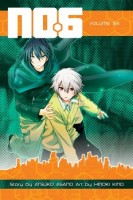
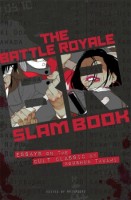
Last week was a busy week for me, especially as I was travelling to and from Canada for the Toronto Comic Arts Festival, but I still managed to post a few things. The Fullmetal Alchemist Giveaway Winner was announced, for one. The post also includes a select list of some shounen and seinen manga written and/or illustrated by women mangaka. I reviewed Hinoki Kino’s No. 6, Volume 6 which is a particularly important volume in the series as it starts to approach its climax. And I also reviewed The Battle Royale Slam Book: Essays on the Cult Classic Novel by Koushun Takami, the first nonfiction book to be released by Haikasoru. I thought it was pretty great.

No links this week as I have been completely preoccupied with TCAF and all its goings-on. I’ll have a lengthy write-up about it later this week, but I’ll just say now that I absolutely adore TCAF. Since est em was one of the featured guests, I spent quite a bit of time with her manga last week. The quick takes below feature most of her manga that are currently available or have been licensed in English. (Granted, some are out of print now.) I hope that there will someday be even more est em manga translated; I really love her work. Plus, having now met her, I can say that she’s a very cool and interesting person, too!

Quick Takes

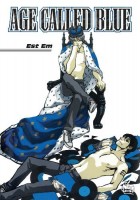
Age Called BlueAge Called Blue by est em. Originally released online in English and then in print by NetComics, Age Called Blue is also now available digitally from Digital Manga. Most of the volume focuses on Billy and Nick who are bandmates, roomates, friends, as well as something a bit more. Age Called Blue further develops the story and characters introduced in the manga “Rockin’ In My Head” which is included in est em’s earlier collection Seduce Me After the Show. I love the music connection in Age Called Blue. Their band, The Idiots, is something that is incredibly important to Billy, but Nick is incredibly important to him as well. Unfortunately, Nick isn’t the most responsible person and is constantly disappearing or getting into some sort of trouble, which threatens to tear the band apart just as they have the opportunity to make something of themselves. With all of the chaos caused by Nick, Billy struggles with his feelings for the other young man which can be at odds with his passion for his music. Also included in Age Called Blue is the story of how the two of them first met, which is incredibly charming. Two unrelated stories are also collected in the volume, both exhibiting their own sorts of passion.

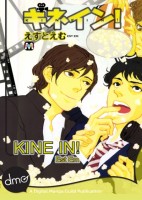
Kine InKine In! by est em. The first est em release by Digital Manga Guild, the main story in Kine In! is about Ken and Mari, who are twins, and their neighbor and close friend Joe. The three of them share an interest in films and film-making and so frequently go to the movies together. However, things become a little awkward for them after a couple of love confessions are made–Mari admits to her brother that she likes Joe, Joe tells Ken that he likes him, and Ken isn’t sure how to respond to either of them. And so he chooses to figure out his feelings and express himself by making his own film with Joe and Mari’s help. Three shorter one-shot manga are also included in Kine In! One of the themes that is prominent throughout the volume has to do with familial love and the importance of those family bonds. Many of the families shown in Kine In! are unusual in some way. “The Salvia and the Barber” features another trio of friends whose relationship goe beyond friendship while “The Scenery of that Summer” follows a young man meeting his step-brother for the first time after his father dies. “Mixed Juice,” which focuses on the relationship between a college student and his professor, is the only story that breaks from this thematic pattern.

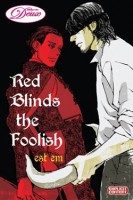
Red Blinds the FoolishRed Blinds the Foolish by est em. Although I have always enjoyed est em’s manga tremendously, it’s Red Blinds the Foolish that made me absolutely fall in love with her work. The main story in this volume is about Rafita, a brilliant young bullfighter, and Mauro, a butcher who processes the bulls killed in the arena. The two of them become intimately and passionately involved which has dramatic repercussions. Bullfighting is a crucial part of the manga and of their relationship; it is used to explore the paradoxes, complexities, and nuances of the connection between the two men. est em’s artwork is exquisite and the details she puts into the matador’s costumes are especially gorgeous. Even when dealing with heavier subjects like death and violence, Red Blinds the Foolish is beautiful and sensual. The afterword of Red Blinds the Foolish is a short travelogue of est em’s research trip to Spain to see the bullfights. Two of the other stories collected in the volume, “Baby, Stamp Your Foot” (about a novelist and his lover who makes shoes by hand) and “Tiempos extra” (about a violent soccer fan and a security guard), were actually first released in a gay men’s manga magazine as opposed to a boys’ love magazine. I particularly appreciate est em’s manga because of this crossover appeal.

Seduce Me After the ShowSeduce Me After the Show by est em. Seduce Me After the Show was est em’s professional debut in Japan and was likewise the first of her manga to be licensed in English. The volume was my introduction to her work, and I’ve been collecting her manga ever since. Even so early in her career est em’s storytelling was already very sophisticated and mature. Her artwork is beautifully expressive, elegant, and sensuous. It suits the main story, which features a dancer, particularly well. Backgrounds are either simple or nonexistent which makes the characters and their relationships the focus of the short manga collected in the volume. There’s no overarching plot connecting the stories found in Seduce Me After the Show but atmosphere-wise many of the manga share a sense of melancholy and loss. However, this doesn’t necessarily mean that they are sad or depressing, though they are thoughtful and contemplative. Another similarity is that most of the characters in Seduce Me After the Show are artists of one sort or another–dancers, actors, painters, musicians, and so on. Also of note: “I Saw the Blue”, the prequel to the story “Café et Cigarette” in Seduce Me After the Show, is collected in Age Called Blue.

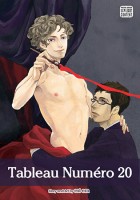
Tableau Numéro 20Tableau Numéro 20 by est em. The most recent est em manga to be released in English is her collection Tableau Numéro 20, which includes five unrelated boys’ love, or boys’ love-esque, stories. Like many of her other manga, the stories in Tableau Numéro 20 frequently feature music, art, and dance. The titular manga and its related story “Le Visiteur” include a beautiful man who literally emerges from a painting, making them the most fantastical manga by est em that I’ve read. So much of her work and all of the other stories in Tableau Numéro 20 are based in reality, so it was interesting to see another side of est em’s creativity. Perhaps because both est em and I share an interest in Spanish culture, my favorite manga in Tableau Numéro 20 was “Rasgueado” which is about a flamenco dancer and guitarist. I’m always impressed by est em’s artwork and how expressive it is. The passion and energy on the page is almost palpable. Even when there is no dialogue there is a narrative being told through the characters’ body language and facial expressions. In “Rasgueado” in particular there are sequences of music and dance that are completely wordless that are brilliantly effective.

UltrasUltras by est em. Along with Red Blinds the Foolish, as a whole Ultras is one of my favorite manga collections by est em. Currently it’s only available digitally, but I really do hope that it gets a print release sometime in the future. (As unlikely as that may be.) The titular “Ultras” is a story about Alfonso and Leon, two soccer fans who, after a drunken night of celebration when Spain wins the European Championship, end up in bed together. This wouldn’t necessarily be an issue except that it turns out that they are hardcore supporters of rival local teams. It’s refreshing to have a story where the plot’s anxiety isn’t about the characters being gay;  in this case it’s the problem is that they’re fans of the “wrong” team. I also appreciate that the characters are well-developed and have lives outside of their relationship and soccer (though those are indeed both very important things in the manga). Al, for example, is actually an elementary school teacher and it’s adorable. And when Leon’s grandfather finds out about the two of them it’s simply one of the best scenes ever. “Ultras” and the related “Tiempos Extra” are my favorite manga in Ultras, but I enjoyed the other four stories as well. They all have a contemporary, modern sort of feel to them.

Filed Under: FEATURES, My Week in Manga Tagged With: est em, manga

Pick of the Week: Short & Sweet

May 12, 2014 by Anna N, Michelle Smith, Ash Brown, Sean Gaffney and MJ Leave a Comment

potw-5-12ANNA: Did you get your mother manga for Mother’s Day? Is it time to go shopping for yourself? There are a lot of mid-series volumes coming out this week, does one of them end up in your shopping bag? In the absence of any new series to pounce on, I’m probably going to have to highlight 07-Ghost which I’ve fallen shamefully behind on.
MICHELLE: Same here. I wish I could extoll its virtues more enthusiastically, but at least I haven’t given up on reading it someday!

ASH: There may be fewer manga to choose from this week, but one of those choices is Blade of the Immortal, so I’m happy!

SEAN: I’ll go with the debut of Monster Soul, which looks very shoneney.

MJ: I am also going to go with Monster Soul! As I mentioned in this week’s column, I so enjoyed Hiro Mashima as a person during his last appearance at New York Comic Con, I’ve regretted never really getting into his work. It seems to me that this is my chance!

What looks good to you this week?

Filed Under: PICK OF THE WEEK

Devils and Realist, Vol 1

May 11, 2014 by Anna N

Devils and Realist Vol 1 by Madoka Takadono and Utako Yukihiro

Devils and Realist is an amusing fish out of water supernatural tale about a young scientific aristocrat and the devils who torment him. The realist of the title is William Twining, an elite member of the English aristocracy who prides himself on his elite status and his logical mind. He makes an uncomfortable discovery when he goes home for a school holiday. His uncle, who was in charge of his fortune has rendered him penniless. William discovers that his house is almost entirely empty and he only has one lone servant left in Kevin Cecil, who is staying on without being paid and learning how to garden for vegetables in the absence of any other food.

William is determined to come up with the money to pay for his tuition, because it would never do for someone of his standing to apply for a scholarship. As he and Kevin scour the house trying to find something valuable, they happen across a hidden room, with a door that is unlocked by William’s blood when he suffers an accident trying to break it down. A mystical spell is invoked and the demon Dantalion appears in grand fashion, only to tell William that he’s now a central figure in the electoral politics of Hell, because William possesses “the Blood of Solomon”. William isn’t ready to believe that he has a mystical connection with a bunch of demons, and invents a series of comically rational explanations for all the supernatural phenomena he’s starting to encounter. Dantalion is joined by other demons, all of who want to win William to their side. William remains stubbornly focused on finishing up his schooling in the human world, leading to additional wacky complications.

There are some parallel themes here with Black Butler, but I found that series to be a bit mean spirited and creepy.
Devils and Realist is more of a gently comedic take on the genre, with William’s stubbornness manifesting in various ways. There are hints that William’s ancestors might not be all that innocent and Dantalion has some hidden motivations that might serve to illuminate his character in later volumes. The art for Devils and Realist is attractive, with particular attention paid to the character designs of the parade of demons which makes it much easier to distinguish them. I enjoyed this volume, and I’ll try volume 2 before deciding to go all in on following this series. I could see William’s realism being used for jokes getting a bit tiring after multiple volumes when he’s surrounded by an army of demons, so I’m interested to see if the author comes up with some other plot devices to keep things fresh.

Filed Under: REVIEWS

The Battle Royale Slam Book: Essays on the Cult Classic by Koushun Takami

May 11, 2014 by Ash Brown

The Battle Royale Slam BookEditor: Nick Mamatas and Masumi Washington
Publisher: Viz Media
ISBN: 9781421565996
Released: April 2014

Battle Royale has recently seen something of a revival in North America in recent years. Koushun Takami’s controversial novel was originally published in Japan in 1999. Both the novel and its manga adaptation illustrated by Masayuki Taguchi first appeared in English in 2003. The novel was released again with a slightly revised translation and additional supplementary material in 2009 by Viz Media’s speculative fiction imprint Haikasoru. (This tenth anniversary release was my introduction to Battle Royale.) However, it wasn’t until 2012 that the film version of Battle Royale and its sequel Battle Royale II: Requiem received an official release in the United States. And now, in 2014, we’re seeing the releases of a new English translation of Takami’s novel by Haikasoru, the recent Battle Royale: Angels’ Border manga illustrated by Mioko Ohnishi and Youhei Oguma, and The Battle Royale Slam Book: Essays on the Cult Classic by Koushun Takami, which is also notable for being Haikasoru’s first foray into nonfiction. Takami’s original novel left a huge impression on me, so I was very excited to read all of these new Battle Royale releases.

The Battle Royale Slam Book, edited by Nick Mamatas and Masumi Washington, collects sixteen essays (seventeen including the introduction by Mamatas) which examine various aspects of the entire Battle Royale franchise. The core of that franchise is of course Takami’s original novel, but The Battle Royale Slam Book also explores many of its manga and film adaptations as well. The contributors to the volume include award-winning writers, academics, fans, and many others from around the world–the United States, Canada, United Kingdom, and even Japan itself are particularly well-represented. I was specifically excited to see an essay by Toh EnJoe included in the volume, but the rest of the lineup is great, too: Nadia Bulkin, Carrie Cuinn, Raechel Dumas, Isamu Fukui, Sam Hamm, Masao Higashi, Brian Keen, Gregory Lamberson, Kathleen Miller, Konstantine Paradias, Jason S. Ridler, Adam Roberts, John Skipp, Steven R. Stewart, and Douglas F. Warrick. All of their essays were written specifically for inclusion in The Battle Royale Slam Book.

The Battle Royale Slam Book includes several types of essays ranging from academic ruminations to literary and film criticisms to the authors’ more personal experiences with Battle Royale in all of its iterations. The topics of the individual contributions are also varied, though some recurring themes do emerge. Many of the essays focus on some of Battle Royale‘s most controversial aspects, such as extreme violence and the deaths of school-aged youth, gender portrayals and sexism, and so on. Other essays position Battle Royale within a greater context, exploring its place within and relationship to not only Japanese popular culture but Western popular culture as well. School literature, professional wrestling, teen films, and other similar subjects are all addressed. The volume also examines the historical context of Battle Royale and its themes. The Battle Royale Slam Book shows how the Battle Royale phenomena has been influenced by, uses, and challenges literary and genre conventions in addition to showing its impact and continuing influence on individual people.

Several assumptions are made with The Battle Royale Slam Book, primarily that the readers are adults already familiar with Battle Royale, have a basic understanding of the novel’s premise, or have been exposed to at least one of its adaptations. It’s also helpful but not absolutely necessary to have some grounding in literature and film, and especially with speculative fiction and horror. The Battle Royale Slam Book will probably appeal most to those who are already interested in or who have already experienced Battle Royale in some form. Though the contributors don’t hesitate to point out the flaws and challenges presented by the Battle Royale novel, manga, and films, it is very clear that they are all either fans or are fascinated by the material and the responses to it. There is criticism to be found, but in general the volume tends to take a positive approach. The Battle Royale Slam Book was written for people like me who want to learn more about Battle Royale, its influences, and impacts. I found The Battle Royale Slam Book to be utterly fascinating and would highly recommend the volume to similarly minded individuals.

Filed Under: REVIEWS Tagged With: Battle Royale, Haikasoru, Koushun Takami, Masumi Washington, Nick Mamatas, Nonfiction, viz media

No. 6, Vol. 6

May 9, 2014 by Ash Brown

No. 6, Volume 6Creator: Hinoki Kino
Original story: Atsuko Asano

U.S. publisher: Kodansha
ISBN: 9781612623603
Released: April 2014
Original release: 2013

I was rather pleased when Kodansha Comics licensed Hinoki Kino’s manga adaptation of Atsuko Asano’s No. 6. The original No. 6 was a nine-volume series of science fiction novels written between by 2003 and 2011. (Sadly, they haven’t officially been translated into English.) Also in 2011, two adaptations of No. 6 began–Kino’s manga series, which also ended up being nine volumes long, and an eleven-episode anime series directed by Kenji Nagasaki. The anime was actually my introduction to No. 6. Parts of the anime’s original ending frustrated me a great deal, but I was so taken with the characters and setting that I wanted to explore another interpretation of the story. No. 6, Volume 6 was originally published in Japan in 2013 while the English-language edition of the volume was released in 2014. The series has now passed its halfway point and is approaching its climax. The fifth volume ended in the middle of a critical scene, so I was particularly anxious to read the sixth.

The Security Bureau of the city of No. 6 has arrested Shion’s close childhood friend Safu and is currently holding her within the Correctional Facility. Shion is willing to do almost anything he can to rescue her, but he won’t be able to do it on his own no matter how hard he tries. Instead, he must rely on those he has met in West Block, a large population of refugees living outside the city walls. Rat has devised a daring plan to infiltrate the Correctional Facility. Shion and Rat allow themselves to be rounded up during the Manhunt–an effort by No. 6 to forcibly control and instill fear into those living in West Block–and are thereby able to gain access to the least secured area of the facility. If they hope to proceed any further they will have to depend on outside help and bribery; nothing is free in West Block, especially when those who give their aid may very well lose their lives for doing so. Everyone involved in the rescue have their own motives and agendas against the holy city of No. 6 so, at least for the time being, they are comrades.

No. 6, Volume 6 is a particularly important volume in the series for several reason: more of No. 6’s dark secrets are uncovered, a part of Rat’s past and the reason behind his hatred for the city is revealed, and the characters, specifically Shion but also Rat, have reached a crucial turning point in their development. All three of these things are interrelated and tied closely together. Shion grew up living an extremely privileged life in the supposedly perfect and pristine No. 6. However, the Manhunt and his experiences in West Block have shown him the terrible things that the city is capable of. Shion’s innocence is shattered further when he discovers that even the foundation of No. 6 was based on the blood of others. This history and Rat’s connection to it is something that up until this point in the series Rat has kept hidden from Shion, partly because he tends to distrust and close himself off from other people, but also because he was trying to protect the other young man. However, these are terrible truths that Shion must now face and come to terms with.

Seeing Shion begin to really change in the previous volume was heartbreaking, but here in No. 6, Volume 6 the difference between who Shion is now and who he was before is terrifying. The violence he is willing to commit with such eerie calm is chilling. His mother, still inside the city, is understandably worried about her son and his survival. However Rat, who is with him, is less concerned with Shion’s physical safety and more concerned about the potential loss of Shion’s personality and his very self. It’s almost as if the two of them have changed roles. Never before has Rat appeared so vulnerable or exhibited such kindness. He fears for Shion and is afraid of who Shion is becoming. At one point in the sixth volume the question is asked “Who do you want so much that it kills you?” In many ways, that question is the crux of No. 6. Rat is changing. Shion is changing. For the better and for the worse. For themselves and for each other. As a result the dynamics of their relationship is also evolving. They may or may not survive their confrontation with No. 6; tragically, even if they do, it is likely that they will be so different that little of their past lives and selves will remain intact.

Filed Under: REVIEWS Tagged With: Atsuko Asano, Hinoki Kino, kodansha, Kodansha Comics, manga, no. 6

Manga the Week of 5/14

May 8, 2014 by Sean Gaffney, Michelle Smith, Ash Brown, Anna N and MJ Leave a Comment

SEAN: Ah, blissful quiet 2nd week, when I can catch up on stuff from the first week. Not that there aren’t titles of interest here.

There’s a new Blade of The Immortal, Vol. 29. I’ll just let Ash chime in here.

ASH: Oh, Blade of the Immortal? That’s my cue! We’re now down to the final few volumes as the series approaches it’s ultimate climax. It’s been one heck of a ride and I don’t expect that Samura will let up on the intensity just because the series is coming to a close.

SEAN: And if you missed Dark Horse’s Samurai Executioner back when it came out around 10 years ago, well here’s a new omnibus release for you to see what you missed. It’s pretty much pure Koike, you know what you’ll see here.

DMP has the 4th volume of Dog x Cat, another of those series whose last volume came out so long ago that I don’t think even its biggest fans remember what was happening.

MICHELLE: I utterly forgot that series existed.

MJ: I had sort of… blissfully forgotten that it existed.

SEAN: I’ll be honest, I like Fairy Tail a lot, but I’ll be glad when the monthly releases are in the past. I’m all Fairy Tail‘d out right now. For those who aren’t, here’s Vol. 38.

Monster Soul1SEAN: Speaking of Hiro Mashima, we get the debut of one of his few remaining unlicensed series, Monster Soul. This is what he wrote in between Rave Master and Fairy Tail. Best of all, I think it’s only 2 volumes long.
MJ: Perhaps this is my chance to finally jump onto the Hiro Mashima wagon! I liked him so much as a person when he appeared at NYCC a couple of years back, but I’ve never really gotten into his work. I should try!

SEAN: In other shonen news, we get the 2nd volume of The Seven Deadly Sins, which will presumably feature a few more sins.

And Sherlock Bones hits Vol. 5, with more sleuthing and probably more dog jokes as well. I miss Kindaichi. Dogs just aren’t the same, even if they are reincarnations of Holmes.

SEAN: Vol. 4 of From the New World comes out from Vertical. Has the series gotten into the dark SF aspects even more?

ASH: Yes, it has! It’s fantastically creepy and ominous, although the fanservice can still be a little much at times.

SEAN: Lastly, double digits for Viz’s 07-GHOST, which we now know will be 17 total, as it ended a few months ago in Japan.

MICHELLE: Like I say every time a new volume of 07-Ghost comes out… I really will catch up on this someday!

ANNA: I feel like Michelle and I are 07-Ghost procrastination twins, because I do enjoy the series and do want to get caught up on it someday. I recently took the step of searching through my house for unread volumes and putting them in a pile, so I can see where I need to fill in to get a complete run. Progress!

SEAN: Is there a series here that speaks to your heart?

Filed Under: FEATURES & REVIEWS, manga the week of

Manga Giveaway: Fullmetal Alchemist Giveaway Winner

May 7, 2014 by Ash Brown

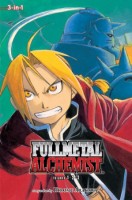
Fullmetal Alchemist, Omnibus 1And the winner of the Fullmetal Alchemist Giveaway is…Naomi!

As the winner, Naomi will be receiving a copy of the first Fullmetal Alchemist omnibus released by Viz Media which collects the first three volumes of Hiromu Arakawa’s excellent manga. Because Fullmetal Alchemist is such a great series, and because Arakawa is such a great mangaka, for this giveaway I asked participants to tell me about some of their other favorite women mangaka. The responses were fantastic and I highly recommend reading the Fullmetal Alchemist Giveaway comments for all of the details. As usual, I also took the giveaway as an opportunity to compile a list. In this particular case, a list of some great shounen and seinen manga which are written or illustrated by women and are available in English.

Some great shounen and seinen manga by women mangaka:
Angelic Layer by CLAMP
Afterschool Charisma by Kumiko Suekane
Black Butler by Yana Toboso
Blue Exorcist by Kazue Kato
Blood+ by Asuka Katsura
Bloody Cross by Shiwo Komeyama
A Bride’s Story by Kaoru Mori
Code: Breaker by Akimine Kamijyo
Chobits by CLAMP
Chi’s Sweet Home by Kanata Konami
D. Gray-Man by Katsura Hishino
Deadman Wonderland written by Jinsei Kataoka, illustrated by Kazuma Kondou
Dorohedoro by Q Hayashida
Drug & Drop by CLAMP
Emma by Kaoru Mori
ES: Eternal Sabbath by Fuyumi Soryo
Flowers & Bees by Moyoco Anno
Fullmetal Alchemist by Hiromu Arakawa
Gangsta by Kohske
Hikaru no Go written by Yumi Hotta, illustrated by Takeshi Obata
House of Five Leaves by Natsume Ono
Inu x Boku SS by Cocoa Fujiwara
InuYasha by Rumiko Takahashi
Kekkaishi by Yellow Tanabe
Lament of the Lamb by Kei Toume
Magi by Shinobu Ohtaka
Maison Ikkoku by Rumiko Takahashi
Mermaid Saga by Rumiko Takahashi
Mushishi by Yuki Urushibara
Nabari no Ou by Yuhki Kamatami
Noragami: Stray God by Toka Adachi
Pandora Hearts by Jun Mochizuki
Ranma 1/2 by Rumiko Takahashi
Reborn! by Akira Amano
Saiyuki by Kazuya Minekura
Sakuran by Moyoco Anno
Tactics by Sakura Kinoshita and Kazuko Higashiyama
To Terra… by Keiko Takemiya
Tsubasa by CLAMP
What Did You Eat Yesterday? by Fumi Yoshinaga
Wolfsmund by Mitsuhisa Kuji
xxxHolic by CLAMP
Zombie-Loan by Peach-Pit

This list is by no means exhaustive! Phenomenal women mangaka have created tons of great manga, far to many for me to list here. Also, thank you to everyone who shared their favorite women mangaka creators with me! I hope to see you again for the next manga giveaway, too.

Filed Under: UNSHELVED Tagged With: fullmetal alchemist, Hiromu Arakawa, manga

Umineko: When They Cry, Vol. 6

May 6, 2014 by Sean Gaffney

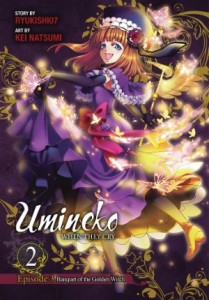
Story by Ryukishi07; Art by Kei Natsumi. Released in Japan in two and 1/2 separate volumes as “Umineko no Naku Koro ni: Banquet of the Golden Witch” by Square Enix, serialized in the magazine Gangan Joker. Released in North America by Yen Press.

In general, I find that the Umineko manga does a bang-up job of adapting the original source. It can’t possibly have all the verbiage that the visual novels have, but it usually manages to include all the important points (something the anime adaptation was very good at avoiding), and it plays fair with the reader in regards to the mystery (something the anime didn’t even bother to try). Where the manga can truly stand up is when it dramatizes those moments in the VN where you really wish you could see more than just sprites on a screen, where you want some action and heartbreak.

umineko6

Say what you will about Kei Natsumi’s love of exaggerated faces twisted to the extreme (Beatrice and Virgilia in the Golden Land comes to mind), she’s very good at laying out a page. There are lots of two-page spreads here designed to rivet the reader and keep them on the edge of their seats, the best of which is the moment when the fourth wall shatters. The last few Umineko ‘worlds’ have involved a meta world where Battler and Beatrice debate how things are being carried out while, on the island, the murders actually occur. The same thing is going on here, only Eva-Beatrice has ‘hijacked’ Beatrice’s game and is going around merrily torturing everyone.

Beatrice, at a low ebb after being yelled at by Battler for being uncaring and cruel, has been doing her best to stop the worst of these excesses, and when that fails she just straight up helps George and Jessica get a final moment with their loved ones, even at the cost of her life. It’s quite a character building moment for the Endless Witch, and Battler knows it. (Most of the shipping that exists in fandom started with this arc.) So, in the meta world, Beatrice asks if she’s redeemed herself enough to be Battler’s opponent. He notes she has, but that he’s not her opponent in this case… then reaches out, smashes into the island world, and grabs Eva-Beatrice by the scruff of her neck and drags her to him. It is *the* most badass moment in this volume, and beautifully handled.

(By the way, for those who enjoy being spoiled, Page 516 makes it clear that Kei Natsumi knows what’s really going on.)

Meanwhile, it becomes clear through most of this volume that Eva-Beatrice = Eva Ushiromiya, using the ‘witch’ identity to help commit murder. Why? DID YOU SEE ALL THAT GOLD? Some fans have trouble with ‘all that money’ as a motivating factor, to them, I recommend Higurashi, which is a lot more idealistic than this series. That said, some of the murders clearly are NOT the work of Eva, as her witch self points out to Battler – Eva couldn’t have killed Nanjo. In fact, none of them could have. So who did? Beatrice? Well, if Eva-Beatrice was Eva, then who is our Beatrice?

In the end, Battler (though he has improved greatly in his analysis) can’t get past this, and Beatrice sacrifices herself in order to stop Eva-Beatrice from winning the game. Thus they both end up in the Golden Land, which is essentially heaven. And it really points out all the difficulties with an idealized heaven that many people have if they look at it closely. In particular, Natsuhi and Eva hugging each other while despairing over their offspring marrying the servants is so horribly WRONG in every way you almost recoil at the change in their personalities. And sure enough, the Golden Land *is* false, a trap designed to make Battler accept witches. (How much Beatrice actually wants to go through with this trap is perhaps apparent in her faces right before she starts to cackle, which show someone desperately sad.)

Luckily, we have Ange coming to the rescue. Ignored in other arcs because she stayed home with a cold, almost forgotten by readers, Ange is older now and ready to kick Battler’s ass. And Beatrice’s as well, but most of this seems driven by a sense of jealousy and being left behind, which makes perfect sense. We do see the Ange of 1998 interacting with a dying Eva (who survived!), and she is at a point where she is the perfect pawn for Bernkastel to bring in to stop Beatrice. Of course, one wonders how much Bern is on anyone’s side…

By the end of this volume, I think even the most unspoiled should have a pretty good idea about the concept of Beatrice, if not the actual identity. And, just as Higurashi abandoned Keiichi in its 4th arc to focus on a new protagonist, so Umineko does the same, with Ange driving much of the next arc. Of course, that arc brings us full circle. At the start of this review, I raved about what a great manga adaptation can add to the source. With Alliance of the Golden Witch, we’ll find out what happens when a manga adaptation adds things you REALLY don’t want added to the source.

Filed Under: REVIEWS

My Week in Manga: April 28-May 4, 2014

May 5, 2014 by Ash Brown

My News and Reviews

I was in Texas for much of last week, attending a conference for work, but I was still able post a few things here at Experiments in Manga. The most recent manga giveaway is underway, for one. This month you all have a chance to win the first omnibus of Hiromu Arakawa’s Fullmetal Alchemist. All you have to do is tell me a little about some of your favorite women mangaka. April’s Bookshelf Overload was also posted; there were all sorts of great releases last month. And finally, the first in-depth manga review of May goes to the very recently released Vinland Saga, Omnibus 3 by Makoto Yukimura. Vinland Saga is one of my favorite series currently being published in English. The entire series is epic and third omnibus is awesome.

Because I was traveling and caught up in conference goings-on, I may have missed some news. (If there’s something that caught your interest last week, do let me know!) However, I did come across a few things that made for good reading. I particularly enjoyed Tony Yao’s post at Manga Therapy, The Ambiguously Amazing Hange Zoe which discusses things like Attack on Titan, gender, and ambiguity. I recently reviewed Jen Lee Quick’s Off*Beat, Volume 2 in preparation for the release of the third and final volume. The series’ editor Lillian Diaz-Przybyl offers some Editorial Thoughts on the End of Off*Beat, one of Chromatic Press’ flagship titles. RocketNews24 offers a list of the twenty most popular manga in Japan, based on publication numbers. Justin Stroman interviews Eric Eberhardt (Viz Media’s Director of Digital Publishing) about Viz’s new digital imprint VIZ Select.

And for those of you in the Toronto area next week and weekend, do be sure to check out the Toronto Comic Arts Festival! There will be some phenomenal programming and incredible creators in attendance (including Moyoco Anno, Est Em, and Akira Himekawa among many, many more), and it’s free! TCAF is the only comic festival/conference that I go to and I highly, highly recommend it.

Quick Takes

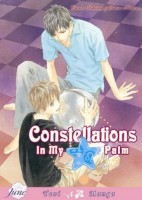
Constellations in My PalmConstellations in My Palm written by Chisako Sakuragi and illustrated by Yukine Honami. I happen to really enjoy Honami’s artwork–a somewhat softer style with light but expressive lines–so I’ve slowly been getting around to reading the various boys’ love manga that she’s worked on. As far as I know, Constellations in My Palm is the only manga that Sakuragi has written. It’s a fairly realistic romance and tends to be somewhat quiet and subdued. It’s narrated by Mizuho, a college student, whose younger cousin Enji moves in with his family as he is about to start college, too. When they were younger they were very close, but it’s been seven years since they’ve been in contact with or seen each other. Mizuho and Enji both care about each other, but their relationship has become awkward and strained. Constellations in My Palm has some wonderful moments in it, but I was largely frustrated by the manga. So much of the story is driven by misunderstandings, and many of them aren’t even the result of miss-communication. Generally, it’s Mizuho who’s the culprit–even when he’s told something straight to his face, repeatedly, he simply can’t or chooses not to believe it. As Mizuho has some self-esteem issues this does fit his character, but it doesn’t make it any less exasperating.

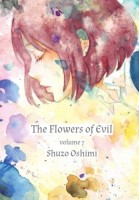
The Flowers of Evil, Volume 7The Flowers of Evil, Volumes 7-9 by Shuzo Oshimi. I’ve been waiting for the entirety of the third arc of The Flowers of Evil to be released before reading it. I’m glad that I did, because once I started I didn’t want to put the manga down. After the resolution of the incident at the summer festival, there is a timeskip of three years. Kasuga and his family have moved to a different town in order to start over, but he is still haunted by his past. His relationship with his parents is broken and almost nonexistent. His new classmates tolerate him, but he remains distant and disconnected (and understandably so). But then he meets and, despite his weirdness and strange behavior, is befriended by Tokiwa–a popular and attractive girl whom all of the boys have a crush on. Like Kasuga, she’s hiding parts of herself from others, too. On the surface, the third arc is almost tame when compared to what came before it, but it is still extremely effective. It has a very different sort of intensity than the previous arcs. The story has become more subtle but retains a constant undercurrent of dread. Even when good things happen it seems as though they could only possibly be a prelude to some sort of disaster. The Flowers of Evil is an incredibly engaging series and just keeps getting better and better.

Say I Love You, Volume 1Say I Love You, Volume 1 by Kanae Hazuki. I didn’t really know much about Say I Love You before reading the first volume; I was vaguely aware of the series because of its recent anime adaptation (which I haven’t seen yet), but that’s about it. There’s not really much of a “hook” per se in Say I Love You. The characters are fairly normal. The story isn’t particularly unusual. The the two leads are Mei Tachibana–who although she avoids making friends is very aware of others and their feelings–and Yamato Kurosawa–whose popularity stems from his good looks but who otherwise is extremely average. So far the manga is simply about a group of teenagers living out their high school years. This includes all of the cliques and the bullying, the stress caused by interpersonal relationships, the self-consciousness and the issues of self-esteem. But that realism is probably the series’ strength. Say I Love You has some humorous moments, but I wouldn’t really describe it as a comedy at this point since in general Hazuki takes a more serious approach with the series. I’m actually very curious to see how Mei and Yamato’s relationship continues to develop, as well as how the relationships between the other characters evolve as well.

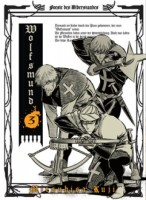
Wolfsmund, Volume 3Wolfsmund, Volumes 3-4 by Mitsuhisa Kuji. At first Wolfsmund seemed to me as though it was going to be an episodic series, but with the third and fourth volumes the manga has focused in on an overarching narrative. However, the bleakness and brutality that has been present from the very start of Wolfsmund remains constant. These volumes see the beginning of the Swiss rebellion against the Austrian occupation and all of the violence and death that entails, including the incredible siege of the Wolf’s Maw at Sankt Gotthard Pass. The uprising has been in the planning stages for quite some time, but now the rebels finally have the opportunity to take action. 14th-century warfare is not pretty. There are very good reasons why attacking an overtaking a fortress are difficult tasks to accomplish–they are built to withstand assault and are designed to allow defenders to wreak havoc on invading forces and to cause tremendous amounts of damage. The rebels must face skilled soldiers, traps, fire, molten lead, boiling water, and more. And on top of that Wolfram, the bailiff of the Wolf’s Maw, is a vicious and sadistic leader who is not above torture. In fact, he seems to delight in it. Wolfsmund continues to be a dark and intense manga that is definitely meant for maturer audiences.

Filed Under: FEATURES, My Week in Manga Tagged With: Chisako Sakuragi, Flowers of Evil, Kanae Hazuki, manga, Mitsuhisa Kuji, Say I Love You, Shuzo Oshimi, Wolfsmund, Yukine Honami

Love to Be Love

May 5, 2014 by Erica Friedman 1 Comment

BeLove9We’ve talked a lot here on Magazine no Mori about what manga salarymen in Japan read. Today, we’re going look at a magazine with an adult female homemaker readership, Be Love magazine, from Kodansha. It’s a truism that Josei manga rarely does well as anime.

Stories in most magazines for adult women follow career, family, romance, all of which make pretty “meh” anime, but are often very successful as live-action TV dramas.Be Love magazine includes a very notable exception to the rule – Tsuetsugu Yuki’s extremely popular game manga series, Chihayafuru (which was ran as an anime TV series, original DVD animation and a Light Novel series.) It’s not terribly surprising, then, that on the tail of Chihayafuru‘s success, Be Love has another Karte-related series, as well, “Houkago Karte.” Also following up a popular series, the creator of Chi’s Sweet Home, Konami Kanata, has another domestic cat series, “Fukufuku Nyaan” that runs in Be Love.

First published in 1980, Be Love now has a monthly circulation of 120,405 according to the Japanese Magazine Publisher’s Association. It sells for 460 yen ($4.49 at time of writing) an issue, for approximately 420 pages. An indication of the audience for this magazine being homemakers are the contest prizes and giveaways from the magazine, which include items like microwaves, vacuum cleaners and matching pot sets, making this magazine the manga equivalent of afternoon soap operas.

Be Love does have a website, with a focus on purchasing released volumes of manga (with a rather lovely search for titles “like this” and “in the same genre,” as well as sample chapters from various manga series, series news, character intros, messages from the creators, and downloads like computer wallpapers.

As a whole, it is very hard to put a single label on the magazine.It has manga about adults and about children and adults with children; the stories tend to be realistic with an edge of fantasy, rather than purely fantastic. The magazine has decidedly less focus on romance than other Josei magazines, but makes up for it with other complex emotional situations. Be Love, from Kodansha: http://kc.kodansha.co.jp/magazine/index.php/02766

Filed Under: Magazine no Mori

Pick of the Week: Beginnings & Endings

May 5, 2014 by MJ, Sean Gaffney, Michelle Smith, Anna N and Ash Brown Leave a Comment

potw-5-5MJ: I’m going to surprise myself a bit here by going for a title I hadn’t even heard about before this week’s column! That would be volume one of Whispered Words, out this week from One Peace Books. What this basically boils down to is that pretty much every yuri manga that Sean has ever recommended has turned out to be something I loved. So why would this be any different? This has quickly become my must-buy item for the week!
SEAN: Whispered Words is fantastic, and you won’t regret it, particularly as it gets more serious. Your picking it allows me, even though my real POTW is obviously that as well, to pick the final volume of Otomen. I’ve enjoyed mocking it almost as much as I have reading it, but the fact remains that this series has been filled with tons of funny, romantic, heartwarming moments about how men and women can do whatever the hell they want without worrying about gender roles. Also, Ryo. Ryo forever in my heart.

MICHELLE: It is Whispered Words 100% for me! I’d actually heard of Sasameki Koto, but missed the news of its license, so this is a very pleasant surprise for me, too. I hope it does well enough for One Peace to publish the full series.

SEAN: The 2nd omnibus, with Vols. 4-6 is scheduled for November and available for preorder! My guess is the last 3 volumes will be in a 3rd omnibus in Spring 2015.

MICHELLE: Ah, there it is! Somehow I missed it! Even more securely my pick of the week, then!

ANNA: It seems like everyone else has the yuri fans covered, but I couldn’t help noticing that there’s a great shoujo series ending with the 10th volume of Strobe Edge. This is one of those series that got better and better as it went along, and the concluding volume is very satisfying. It is my pick!

ASH: I’ll be joining Sean this week in picking the final volume of Aya Kanno’s Otomen for all of the reasons that he outlines. Also because Ryo carrying Asuka princess-style on the cover is one of the most perfect things ever. Hopefully the series has done well enough for Viz that the publisher might consider releasing more of Kanno’s work–I’ve particularly got my eye on her manga inspired by Shakespeare’s Richard III.

What looks good to you this week?

Filed Under: PICK OF THE WEEK

Gangsta Vols 1 and 2

May 4, 2014 by Anna N

Gangsta Volumes 1 and 2 by Kohske

I was pretty intrigued by Gangsta when I first heard that Viz was going to be translating this title. I always am interested in series that get the deluxe treatment of the Viz Signature line. The art looked very stylish, and I generally enjoy the few examples of seinen written by women authors that we get translated over here, so I was already intrigued for a few months before finally getting my hands on a couple volumes.

First of all, to totally judge a manga by its cover, I was immediately captivated by the cover designs! The front and back covers of both volumes show the same scene from different perspectives, showcasing the personalities of the main characters Nic and Worick. The first volume shows Nic glaring out at the reader, with Worick turned away. On the back Worick has his finger raised over his lips to prevent someone from telling a secret. Worick and Nic are handymen, mercenaries, couriers, and assassins taking on jobs no one else will. Their day opens in a way that conveys the gritty and corrupt nature of the city of Ergastulum, as a hooker gets beat up and the police chief asks the handymen to deal with recent gang activity, promising them “all their goods” as payment.

As the day unfolds, more gets revealed about Nic and Worick. Nic is a “Tag” or “Twilight,” who appears to be an ex-soldier who was the subject of some sort of enhancement experiments that have turned him into a deadly warrior. Nic is deaf, and Kohske has come up with some clever ways of portraying this, by representing his sign language with a different style of word balloons and carefully drawing them as emanating from his hands as he gestures. Nic is incredibly deadly, but he is viewed as subhuman by almost everybody but Worick. The duo quickly becomes a platonic (so far) threesome, as the handymen decide to liberate Ally, the hooker who was being beat up by her john before. When the police chief objects, Nic yells that the handymen will take whatever they want.

What follows is a mix between slice of life communal living issues, drug deals, and over the top action scenes as Ally putters around the handymen’s apartment, reading sign language dictionaries and answering their phone. She gradually learns a little more about Worick and Nic, including the fact that Worick occasionally hires himself out as a gigalo and that his past might be very far from the circles where he runs in now.

There are a few elements of Gangsta that reminded me of other series, but not in a bad way. The intense friendship of Nic and Worick set against a gritty background with mysterious drugs enhancing human abilities gave me some slight Wild Adapter flashbacks, although Gangsta isn’t very shonen-ai (yet). I’m sure there’s some Gangsta doujinshi out there that is though! Worick’s mysterious and privileged past made me remember Antique Bakery a bit. And the 3 rules for Twilight behavior are basically Asimov’s 3 Laws of Robotics. But Kohske hints at so many different plots to be explored in future volumes, I’m wanting to see the shared past of the handymen explored, wondering if Ally is better off with them than without them, and curious to see how Nic manages to deal with the latest in a procession of super human enemies.

Kohske’s art is gritty and stylish, showcasing the dynamic nature of the fights the handymen find themselves embroiled in as well as the run down area of the city where they live. The illustrations in this book are for sure not style over substance, as there are nuanced and varying character designs for all the members of the expanding cast. Nic’s growling antagonism and Worick’s intelligently constructed careless facade are both nimbly portrayed, as are the wordless exchanges and day to day moments that say volumes about the friendship they share. After enjoying the first two volumes, I’m certainly going to see about reading the rest of this series.

Filed Under: REVIEWS Tagged With: Gangsta, viz media

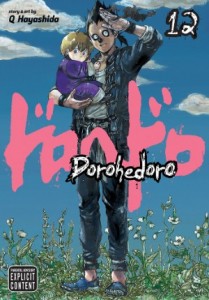
Dorohedoro, Vol. 12

May 4, 2014 by Sean Gaffney

By Q Hayashida. Released in Japan by Shogakukan, serialization ongoing in the magazine Ikki. Released in North America by Viz.

This volume of Dorohedoro is particularly good at showing off all the myriad reasons why it’s become one of the more addicting seinen manga out there. There are some amazingly violent fight scenes, some hysterical humor, a dose of complete insane weirdness, and some truly visceral horror – and not body horror this time around. I had wondered at first how long the series could keep its premise up, now I worry that with the series ending in Japan soon it won’t have time to tell me everything that I need to know.

dorohedoro12

Let’s start with the violence, which spirals out after En’s death. And En definitely appears to be dead this time, though there’s a suggestion they can reverse it if they find Judas’ Ear, who is missing. En’s people are somewhat gutted by this – even Noi, who notes that she hated En for forcing her into all of this, but still feels at a loss. As for Fujita, he’s absolutely devastated, having flashbacks and trauma from finding the body. Luckily, Shin knows that everything will be solved by finding the parties responsible and killing them. Finding the cross-eyes is the next step, and killing them mostly goes well, at least until the climax. Hayashida knows just how to choreograph fights, and also that her audience does not mind seeing splattered limbs.

Her audience also wants a healthy does of humor and weirdness, both of which dovetail nicely with the creation of a living En doll to try to lead them to the location of the real En, assuming he is alive. This involves baking a giant pizza, out of which the doll En them rises. If you can’t quite understand what I’m talking about, that’s because it makes no sense unless you see it. Any time Turkey appears things are odd, but this one takes the biscuit. We then get a very amusing chase scene, as the Doll En has a mind of its own and is not interested in letting Shin and Noi keep up with it. If you combine this with the ongoing humiliation of Natsuki (involving nudity this time, natch), we’ve got a lot of laughs in here.

But what I suspect folks will take away from this volume is the flashback that explains Nikaido’s past, who she’s so reluctant to do magic, and the horrors of time travel. Some lessons, particularly when you’re a child, need to be learned firsthand, and this is a particularly horrifying and bitter one for Nikaido, whose friend is lost forever thanks to her own folly about time magic. It contrasts with the cover art with Asu and a child Nikaido, with a blue sky and blooming flowers belie the serious contents within.

And so, in the end, we have something for everyone, a little bit of plot advancement, a lot of weird humor, and some terrifying existential terror. In other words, all the reasons to read Dorohedoro, encapsulated in one book. At least until the next volume, when I assume we’ll find more. We even see the gyoza fairy again!

Filed Under: REVIEWS

Vinland Saga, Vol. 3

May 3, 2014 by Ash Brown

Vinland Saga, Omnibus 3Creator: Makoto Yukimura
U.S. publisher: Kodansha
ISBN: 9781612624228
Released: April 2014
Original release: 2007-2008
Awards: Japan Media Arts Award, Kodansha Manga Award

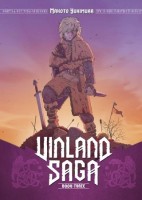
Vinland Saga, an award-winning manga series by Makoto Yukimura, is a title that I’ve been wishing for a release in English for years. Thanks to Kodansha Comics, it’s finally available, and in a deluxe hardcover edition no less. I couldn’t be happier. If I loved the first omnibus, I loved the second omnibus even more. Vinland Saga has easily become one of my favorite manga series currently being released in English. The third Vinland Saga omnibus, published by Kodansha in 2014, collects the fifth and sixth volumes of the original Japanese edition, released in 2007 and 2008 respectively. Vinland Saga, Omnibus 3 also includes a brief section of questions answered by Yukimura about the series which is exclusive to the English release. Vinland Saga is Kodansha’s first foray into deluxe manga releases and features color pages as well as a slightly larger trim size than most of its other manga which allows Yukimura’s artwork to present itself as strongly as his storytelling skills. Vinland Saga is an excellent series and has won both a Japan Media Arts Award as well as a Kodansha Manga Award.

The Danish invasion of England is steadily progressing. The English forces are preparing to surrender, which doesn’t sit well at all with Thorkell the Tall. A Viking mercenary fighting on the side of the English with an insatiable thirst for battle, he would much rather see the war continue indefinitely. One way he can encourage the conflict to continue is by taking Canute, the son of Denmark’s King Sweyn and second in line to the throne, captive. Canute is currently being escorted by Askeladd and his band of mercenaries. They initially escaped Thorkell’s pursuit by fleeing to Wales. Askeladd planned to rejoin with the main Danish force, but to do so required traveling through English-controlled territory. To make their situation even worse, winter and a heavy snowstorm forced them to halt their march in a small English village. Their presence behind enemy lines is discovered far sooner than they had wished or expected. Askeladd and his men are once again faced with confronting Thorkell and his mercenaries in bloody battle.

The struggle for the control of Canute and his fate is pivotal to the story of Vinland Saga. It also provides a phenomenal opportunity for battle sequences and they are brutal. Yukimura doesn’t hold back or spare any details, depicting broken bones, severed limbs, crushed skulls, blood and gore as needed or required. Askeladd’s plans are falling apart around him and his men are beginning to lose confidence in their leader. Already in disarray, they are in an extremely bad position when Thorkell and his band catch up with them. The battle as a whole is intense, but then comes the fight between Thorkell and Thorfinn. Their confrontation in the second omnibus was impressive to begin with, but their duel in the third is even more so. Thorfinn is skilled, quick, small, and volatile while Thorkell is a literal giant of a man who primarily relies on his strength. Their fight is incredible to watch unfold. Thorfinn holds his own against Thorkell surprisingly well, but Thorkell’s physical feats are astounding.

The battles and duels in Vinland Saga are well-executed and thrilling, but just as important to the series is the development of the story and of the characters. Particularly astonishing in Vinland Saga, Omnibus 3 is the remarkable growth of Canute. Up until this point he has seemed sheltered and coddled; he abhors the senseless violence around him which makes the others view him as weak. However, Canute is all too aware of his unfortunate situation. Askeladd and Thorkell are surprised to discover that Canute carries very little value as a hostage, nor will his survival necessarily be appreciated by the king. Ultimately, it is up to Canute himself to take control of his own destiny. His true strength is revealed and it is utterly magnificent. This marks a turning point not only for Canute but for the entirety of Vinland Saga. Yukimura mixes historical fiction with meticulously researched historical fact and the results are extraordinarily engaging. Vinland Saga is the epic that I’ve been waiting for and I can’t wait to read more.

Filed Under: REVIEWS Tagged With: Japan Media Arts Award, kodansha, Kodansha Comics, Kodansha Manga Award, Makoto Yukimura, manga, Vinland Saga

  • « Go to Previous Page
  • Page 1
  • Page 2
  • Page 3
  • Page 4
  • Go to Next Page »
 | Log in
Copyright © 2010 Manga Bookshelf | Powered by WordPress & the Genesis Framework