• Skip to primary navigation
  • Skip to main content
  • Skip to primary sidebar
  • Home
  • About Us
    • Privacy Policy
    • Comment Policy
    • Disclosures & Disclaimers
  • Resources
    • Links, Essays & Articles
    • Fandomology!
    • CLAMP Directory
    • BlogRoll
  • Features & Columns
    • 3 Things Thursday
    • Adventures in the Key of Shoujo
    • Bit & Blips (game reviews)
    • BL BOOKRACK
    • Bookshelf Briefs
    • Bringing the Drama
    • Comic Conversion
    • Fanservice Friday
    • Going Digital
    • It Came From the Sinosphere
    • License This!
    • Magazine no Mori
    • My Week in Manga
    • OFF THE SHELF
    • Not By Manga Alone
    • PICK OF THE WEEK
    • Subtitles & Sensibility
    • Weekly Shonen Jump Recaps
  • Manga Moveable Feast
    • MMF Full Archive
    • Yun Kouga
    • CLAMP
    • Shojo Beat
    • Osamu Tezuka
    • Sailor Moon
    • Fruits Basket
    • Takehiko Inoue
    • Wild Adapter
    • One Piece
    • After School Nightmare
    • Karakuri Odette
    • Paradise Kiss
    • The Color Trilogy
    • To Terra…
    • Sexy Voice & Robo
  • Browse by Author
    • Sean Gaffney
    • Anna Neatrour
    • Michelle Smith
    • Katherine Dacey
    • MJ
    • Brigid Alverson
    • Travis Anderson
    • Phillip Anthony
    • Derek Bown
    • Jaci Dahlvang
    • Angela Eastman
    • Erica Friedman
    • Sara K.
    • Megan Purdy
    • Emily Snodgrass
    • Nancy Thistlethwaite
    • Eva Volin
    • David Welsh
  • MB Blogs
    • A Case Suitable For Treatment
    • Experiments in Manga
    • MangaBlog
    • The Manga Critic
    • Manga Report
    • Soliloquy in Blue
    • Manga Curmudgeon (archive)

Manga Bookshelf

Discussion, Resources, Roundtables, & Reviews

VIZ

Blue Exorcist, Vol. 1

April 22, 2011 by Katherine Dacey

Have you ever seen the pilot episode of Law & Order? Most of the regular characters are present, and the script follows the three-act structure familiar to anyone who’s watched an episode of any Law & Order series, but the pacing is slack; the dialogue fizzles where it should crackle; and the actors struggle to create believable relationships between the characters, even as the script demands that they explain things to one another that, presumably, they’d already know from working together. Small wonder that “Everybody’s Favorite Bagman” languished for nearly a year before NBC rescued the show from limbo and ordered a full season of episodes.

So it is with Blue Exorcist, which has a first chapter that might charitably be described as a “pilot episode.” In these opening thirty pages, Kato introduces orphan Rin Okimura, a hot-tempered young man; Yukio, Rin’s snot-nosed fraternal twin; and Father Fujimoto, their guardian. Rin, we learn, is a direct descendant of Satan, and is in imminent danger of going over to the dark side. Father Fujimoto, however, has kept this information from his young charge, seeing fit only to explain the complexities of Rin’s lineage when Satan’s minions try to spirit Rin back to Gehenna, the demon realm. (Like all manga priests, Father Fujimoto spends more time fighting demons than preparing Sunday sermons or ministering to the sick, hungry, and bereaved.) An epic confrontation between Satan and Father Fujimoto leaves Rin’s mentor dead, forcing the boy to decide whether to cast his lot with Satan or with humanity.

There’s no reason why this opening prelude has to be such a bumpy, predictable ride, but Kato seems so intent on relating Rin’s entire Tragic Past in one installment that she trades naturalism for economy. (Sample: “I see you’ve returned. An overnight trip to the job center? How diligent of you.” And how helpful of Father Fujimoto to ask Rin a question to which he already knows the answer!) In the second chapter, however, Kato finds her stride with the material: the dialogue is looser and funnier; the characters’ relationships are more firmly and plausibly established; and she introduces her first genuinely memorable character, Mephisto Pheles. The plot is stock, with Rin vowing to avenge Father Fujimoto by enrolling in an exorcism “cram school,” but Kato enlivens the proceedings with humorous twists and nifty artwork.

And oh, the artwork! It’s crisp and expressive, filled with small but suggestive details. Mephisto, for example, carries a patched umbrella and wears a polka-dot cravat — two minor flourishes that help establish him as a slightly decadent figure, elegant but down at the heels. The not-very-imaginatively named True Cross Town provides another instructive example of Kato’s meticulous and thoughtful draftsmanship: she lavishes considerable attention on architectural details and infrastructure, stacking layers of houses and buildings on top of one another to form a giant urban ziggeraut:
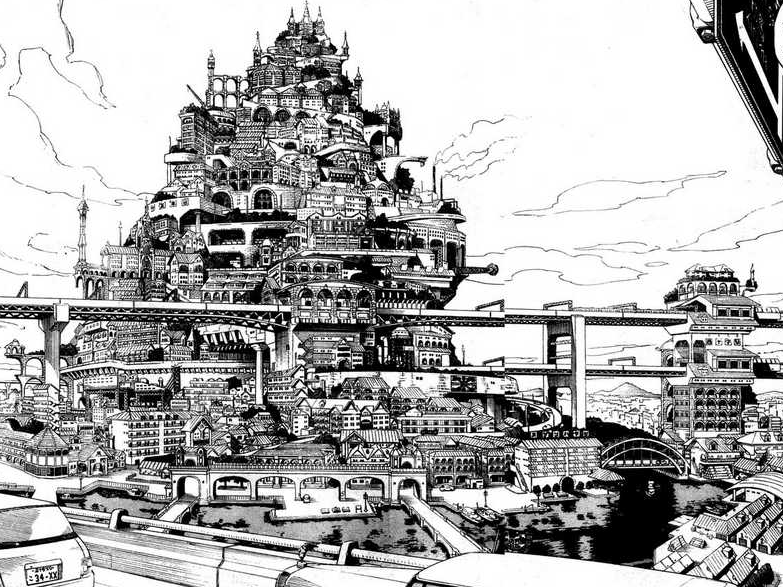
In short, Kato has created an imaginary urban landscape that seems to have evolved naturally over time, with old and new buildings side-by-side and modern modes of transport straddling canals and rivers. That kind of thoroughness may not serve much purpose in the context of a manga about demon fighters, but it lends Blue Exorcist a temporal and geographic specificity that’s sometimes missing in other areas of the story — like the religious bits.

Whatever my reservations about the first chapter, I freely admit that I’d fallen head-over-heels for Blue Exorcist by the end of the second. The brisk pacing, sharp artwork, and cheeky tone of these later chapters convinced me that Kazue Kato is in firm control of her story, and has successfully laid the foundation for the series’ first major story arc. Bring it on, I say!

BLUE EXORCIST, VOL. 1 • BY KAZUE KATO • VIZ MEDIA • 198 pp. • RATING: OLDER TEEN (16+)

Filed Under: Manga, Manga Critic, REVIEWS Tagged With: blue exorcist, Kazue Kato, Shonen, Shonen Jump, VIZ

Tidbits: Shonen Jumpin’ Jehosaphat

April 11, 2011 by Michelle Smith

Sometimes I just crave some shounen manga! Here, then, are a few short reviews of some shounen I have lately read: the third volume of Bakuman。, the 31st through 34th of Bleach, the second of Genkaku Picasso, and the thirteenth through fifteenth of Slam Dunk. All are fairly recent releases and all published under VIZ’s Shonen Jump imprint; Bakuman。 and Genkaku Picasso also have new volumes due out in May.

Bakuman。3 by Tsugumi Ohba and Takeshi Obata
This was my favorite volume of Bakuman。 so far!

It begins with Mashiro and Takagi struggling to create a mainstream battle manga, over the objections of their editor, because they believe this is the ticket to popularity in Shonen Jump. They improve a lot between attempts, but in the end, Takagi requests some time alone over summer break to think of a new story, leaving Mashiro free to work as an assistant for Eiji Nizuma, their rival.

MJ adores Eiji, and when he first appeared in this volume I was wondering how that could be, since he comes across as bratty and weird. Once you get to know him, though, it turns out he’s actually kind of endearing. He simply says what he thinks, and is incapable of being malicious or devious. After watching him happily and genuinely soak up feedback from his assistants—apparently his editor at Jump is too in awe of his genius to offer any useful guidance—I kind of love him, too!

To top it off, we see some growth from the female characters. Miho makes some progress in her dream of becoming a voice actress, although right now she seems to be succeeding mostly on account of her good looks. Miyoshi comes up with the goal of being a novelist, though her primary function in this volume is to captivate Takagi with her general awesomeness and make Mashiro doubt that his partner is working on the promised story at all.

In the end, the future of the partnership appears to be in jeopardy, even though both guys have independently hit upon the idea of a detective manga as the way to go. I’ve always found this series interesting for its inside glimpse into the publication process, but now I’m starting to find it interesting for the characters, as well. I eagerly await volume four!

Bleach 31-34 by Tite Kubo
You might not think that battles against creepy supernatural foes with bizarre powers could be boring, but it turns out that Bleach somehow manages it.

Volumes 31 through 33 are chiefly comprised of fights against weird-looking dudes during which nearby structures often go “boom” and crumble. It’s pretty much impossible to tell what’s going on, so I just sort of coast along until there’s a panel that shows someone actually being hurt by something. There are but two bright spots in these volumes. One is the predictable but still gratifying revelation that Nel, the toddler who’s been accompanying Ichigo in his journey across Hueco Mundo, is actually a badass (and buxom) former Espada. The second is an honestly riveting scene in which a hollowfied Ichigo appears before Orihime for the first time and terrifies her.

Things improve a bit in volume 34 with the timely arrival of some Soul Reaper captains. Okay, yes, their explanation for their arrival is pretty flimsy, but I will accept any excuse if it means Byakuya will be around. This also leads to a crazy battle of one-upsmanship between one of the stranger Soul Reapers, Kurotsuchi, and his Arrancar opponent. It goes something like this:

Arrancar: Fear my leet skills! I will turn your innards into dust!

Kurotsuchi: Oh, actually, I infected [Uryuu] with surveillance bacteria the last time we were fighting, so I’ve been watching your battle and, aware of your abilities, have replaced all my insides with fakes. Too bad. Now my gloopy pet will eat you.

Arrancar: Lo, I have been et. But before that happened I implanted [Nemu] with my egg, which will hatch and grow a new me! Plus, there are bits of me still in your pet, which will allow me to use it to attack you.

Gloopy pet: *splat*

Kurotsuchi: Oh, but before you did that I programmed my pet to self-destruct if anyone ever tried to use it against me. Also, I filled Nemu’s body full of drugs for the same reason, so now you’re going to see everything in extreme slow mo while I kill you.

Arrancar: Crap.

Honestly, it’s so outrageous one kind of can’t help admiring it!

Genkaku Picasso 2 by Usamaru Furuya
I really wish I could like Genkaku Picasso more. Mostly this is because Usamaru Furuya’s art is really impressive—true, in their normal states the characters don’t look all that exciting (and the lip-glossy sheen on the boys’ lips is somewhat distracting) but the illustrations created by artistic protagonist Hikari Hamura are detailed and gorgeous, and I like that Furuya continues drawing in that style when Hikari and his ghostly advisor, former classmate Chiaki, enter into the drawings in order to help solve the problems plaguing their classmates.

The problem is that I just don’t like any of the characters! Hikari is creepy, anti-social, and perverted, and is always reluctant to help out his classmates, putting Chiaki in the role of always being the one who reminds him that he has to help them, otherwise he’s going to rot away. (He cheated death in volume one and this is the manner in which he must pay for that.) I could possibly like Chiaki if she were given something to do besides pester Hikari all the time, but that’s not the case.

The manner in which the classmates are helped by Hikari and Chiaki is also odd. The pair enters a drawing based on the “heart” of said classmate and attempts to figure out what is worrying them. One boy has created a fictional girlfriend, for example, while another girl sees herself as a mecha rather than an actual girl. While inside the drawing, Hikari and Chiaki attempt to reason with the classmate, while in the real world, the classmate answers them aloud, making them look totally freaking crazy to the people who happen to be around. If I was hanging out with my friend and he began to break up with his imaginary girlfriend right in front of me, I think I would be quite alarmed.

That said, there is one bright spot in this volume—the tale of Yosuke, a girl born in a body of the wrong gender. Perhaps it’s a little too optimistic, but I liked it anyway, especially the fact that the “heart” of the transgender kid is the calmest and healthiest place we’ve seen yet.

If Genkaku Picasso were any longer, I might not continue it, but since there’s only one volume left, I shall persevere.

Slam Dunk 13-15 by Takehiko Inoue
Ordinarily, if a series took two-and-a-half volumes to cover less than an hour of action, I might be annoyed. Not so with Slam Dunk, which takes that long to finish Shohoku High’s exciting prefectural tournament match against Kainan, a team that has made it to Nationals every year in recent memory.

There’s an interesting phenomenon that occurs when one reads Slam Dunk. Hanamichi Sakuragi, the hot-headed protagonist, has matured somewhat since the beginning of the series, though he’s still inclined to proclaim himself a genius at every opportunity. Hence, it’s pretty satisfying to see him humbled, and to watch him realize that he hasn’t yet got the skills to carry the team or hog the spotlight. And yet, there comes a point where the humbling has been sufficient, and one wants to see him triumph.

When Captain Akagi sprains his ankle during the game, Sakuragi, realizing how immensely important this game is to Akagi, does his best to fill the captain’s shoes. How can you not root for someone trying so hard to make someone else‘s dream come true? Yes, it’s the talented Rukawa who is single-handedly responsible for tying up the game by halftime, but Sakuragi is just trying so damned hard that his bluster actually becomes a source of strength for his teammates. When he finally makes an impressive slam dunk in front of a cheering crowd, I convince that I got a little sniffly.

Shohoku ends up losing the game, though this doesn’t put them out of the running for Nationals just yet. The disappointing experience makes Sakuragi more serious than ever before and he returns to school with a shaved head (as penance for an unfortunate mistake during the final seconds of the game) and a fierce desire to improve.

Why do I love sports manga so much? I’m honestly not sure I can articulate it, but with Slam Dunk part of it is the fact that the hero, who previously had no goals in life, has found a place to belong and something to care about. That kind of story pushes my personal buttons in a big way.

Review copies for Bakuman。, Genkaku Picasso, and volume fourteen of Slam Dunk provided by the publisher.

Filed Under: REVIEWS Tagged With: Shonen Jump, Takehiko Inoue, Takeshi Obata, VIZ

The Best Manga You’re Not Reading: Kekkaishi

April 7, 2011 by Katherine Dacey 33 Comments

I have a challenge for all you Shonen Jump readers: pick up a copy of Kekkaishi. It may not be as sexy as Death Note, or as goofy as One Piece, or as battle-focused as Bleach, but what it lacks in flash, it makes up in heart, humor, and good old-fashioned storytelling.

The premise of Kekkaishi is simple: Yoshimori Sumimura, a seemingly unremarkable fourteen-year-old boy, is a kekkaishi, or barrier-master. When he isn’t consuming unhealthy amounts of coffee-flavored milk, dozing off in class, or baking architecturally magnificent cakes (one of his pet obsessions), he’s patrolling the grounds of his school, which sits atop the Karasumori, a locus of magical energy that proves irresistible to ayakashi (demons) looking to augment their power. Yoshimori traps unwanted visitors within cube-shaped barriers, then vaporizes them, barrier and all.

Joining him on patrol are his sixteen-year-old neighbor Tokine Yukimura—a more disciplined kekkaishi whom Yoshimori secretly adores—and a small complement of demons that includes two dog spirits, Madarao and Hakubi, and a half-human, half-ayakashi, Gen Shishio. Further complicating matters are the families themselves: the Sumimuras and Yukimuras detest one another. Though their clans have been tasked with protecting the Karasumori for nearly 500 years, the oldest generation carries on an energetic feud, making it difficult for Yoshimori and Tokine to work together harmoniously. In short, Kekkaishi reads like an entertaining mash-up of Bleach, InuYasha, and Romeo and Juliet. (Or maybe Romeo Must Die. Take your pick.)

Each volume unfurls at a brisk clip, in part because Tanabe doesn’t feel the need to explain the entire mythology of the Karasumori site all at once. Nor does she resort to the kind of lazy, expository dialogue found in many shonen series with complicated backstories. (You know the kind: “As you know, Tokine, we’ve been combating ayakashi together for almost a year, and our faithful demon dog sidekicks have played an indispensable role in helping us rid the site of ayakashi. Don’t you think, childhood friend and neighbor of mine?”) Instead, Tanabe reveals details about the Karasumori site’s past gradually as she introduces new characters and confronts her principal cast members with new demonic challenges. In fact, the kekkaishis’ greatest adversaries—the Kokuburo, a group of powerful demons whose plan for world domination involves taking over the Karasumori site—don’t even appear in the first volume of the series.

What makes Kekkaishi such a joy to read is Yellow Tanabe’s consummate skill as both an illustrator and storyteller. Her artwork is clean and attractive, with bold lines and nicely composed pictures. Though her character designs are immensely appealing—and seem ready-made for the inevitable assortment of lunchboxes, t-shirts, shijikis, and coffee milk drinks that the series inspired—it’s her action sequences that really shine. Kekkaishi is one of the few shonen series where the fight scenes are (a) dynamic (b) thrilling (c) easy to follow (d) essential to the plot and (e) just the right length. There’s also a wonderful sense of play in Tanabe’s combat. Yoshimori and Tokine use kekkaishi not only as traps, but also as aerial stepping-stones that allow them to pursue demons mid-air.

There’s another appealing—and slyly didactic—aspect to these fight scenes as well. Though Yoshimori possesses greater spiritual powers than Tokine, it’s Tokine who frequently saves the day. Why? Because she practices creating barriers with the same diligence as she does her homework. Yoshimori, on the other hand, struggles to master his powers, sometimes embarking on marathon training sessions and other times neglecting to practice at all.

Kekkaishi offers readers more modest pleasures as well. Tanabe creates a colorful cast of supporting characters that include Yoshimori and Tokine’s sparring grandparents, who prove surprisingly spry for a couple of sexagenarians; Yoshimori’s father, who reminds me of James Dean’s apron-clad dad in Rebel Without a Cause; Masahiko Tsukijigaoka, a genial ghost who was a baker in life; Heisuke Matsudo, a nattily-dressed friend of Yoshimori’s grandfather with a specialty in weird science; and Mamezo, the grouchy guardian spirit of the Karasumori site who looks a bit like Kermit the Frog on a bender. Tanabe’s villains are a less colorful and distinctive bunch than, say, Naraku’s various incarnations, but I find that refreshing. For once the hero—and pals—are as vivid and appealing as the bad guys without having sordid or unnecessarily complicated backstories.

Like all shonen series, Kekkaishi suffers from an occasional dry spell. In volumes seven and eight, for example, the series seemed to have lost its mojo; I found the fight scenes tedious and felt Tanabe had fumbled in her depiction of Tokine, who went from being an appealing, competent character to a mere tag-along. But Tanabe quickly righted the ship in volume nine, introducing new characters, fleshing out the Kokoburo’s motives for capturing the Karasumori, staging some ecological intrigue at the Colorless Marsh, and revealing that Yoshimori’s dad has some demon-busting skills of his own. Though volume nine features two dramatic fight scenes, it’s the quieter, character-building moments that really shine, raising the emotional stakes by revealing unexpected facets of the heroes’ personalities; what happens in volume ten is all the more devastating because Tanabe makes us care deeply about her characters’ welfare.

If I still haven’t persuaded you that Kekkaishi is more fun than a barrel of demon monkeys, let me sing the praises of Yellow Tanabe’s omake. I don’t usually read sidebars or gag strips for reasons that David Welsh so aptly summarized in a memorable blog entry:

The content is generally pretty repetitive. They’re working really hard, and they’re sorry they’re behind on their fan mail. This volume isn’t as good as they’d have liked, but they’re trying, and reader support keeps them going. They wish they had a kitty. That sort of thing.

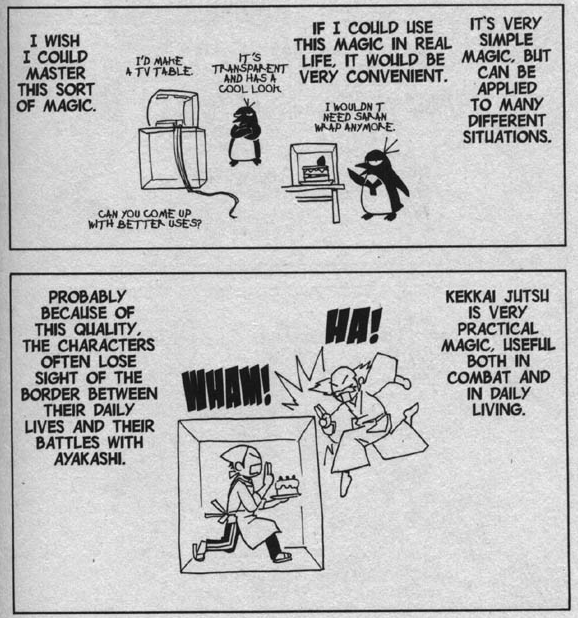
Tanabe’s omake steer clear of the usual bowing and scraping before the fandom. Instead, she depicts herself as a slightly tubby penguin with a perpetual scowl and an implacable panda for an editor. Not much happens in a typical strip, but the back-and-forth between penguin and panda is amusing and, for anyone who’s ever been on the receiving end of editorial criticism, all too true. She also has a lot of fun explaining her creative decisions:

And if you’re still on the fence, let me pull out my trump card: Kekkaishi is complete. Done. Finished. Finito.

After a successful eight-year run in Weekly Shonen Sunday, the series wrapped on April 6th with the publication of its 334th chapter. And by successful, I mean successful in Japan, where the series inspired a 52-episode television series and a robust assortment of video games, and nabbed nabbed the 2007 Shogakukan Award for Best Shonen Series. Here in the US, however, Kekkaishi has barely made a ripple. VIZ has been making a concerted effort to promote the series, featuring sample chapters on its Shonen Sunday website, licensing broadcasting rights to Cartoon Network, and releasing two budget editions: one digital (for the iPad), and one print. (Look for the first three-in-one edition on May 3, 2011.) I’m not sure why Kekkaishi hasn’t caught on with American audiences yet, but now is a great time to jump into this addictive series. I dare you not to like it!

This is a revised version of an essay that originally appeared at PopCultureShock on 5/14/07.

Filed Under: Manga Critic Tagged With: Horror/Supernatural, Shonen, shonen sunday, VIZ, Yellow Tanabe, Yokai

The Best Manga You’re Not Reading: Kekkaishi

April 7, 2011 by Katherine Dacey

I have a challenge for all you Shonen Jump readers: pick up a copy of Kekkaishi. It may not be as sexy as Death Note, or as goofy as One Piece, or as battle-focused as Bleach, but what it lacks in flash, it makes up in heart, humor, and good old-fashioned storytelling.

The premise of Kekkaishi is simple: Yoshimori Sumimura, a seemingly unremarkable fourteen-year-old boy, is a kekkaishi, or barrier-master. When he isn’t consuming unhealthy amounts of coffee-flavored milk, dozing off in class, or baking architecturally magnificent cakes (one of his pet obsessions), he’s patrolling the grounds of his school, which sits atop the Karasumori, a locus of magical energy that proves irresistible to ayakashi (demons) looking to augment their power. Yoshimori traps unwanted visitors within cube-shaped barriers, then vaporizes them, barrier and all.

Joining him on patrol are his sixteen-year-old neighbor Tokine Yukimura—a more disciplined kekkaishi whom Yoshimori secretly adores—and a small complement of demons that includes two dog spirits, Madarao and Hakubi, and a half-human, half-ayakashi, Gen Shishio. Further complicating matters are the families themselves: the Sumimuras and Yukimuras detest one another. Though their clans have been tasked with protecting the Karasumori for nearly 500 years, the oldest generation carries on an energetic feud, making it difficult for Yoshimori and Tokine to work together harmoniously. In short, Kekkaishi reads like an entertaining mash-up of Bleach, InuYasha, and Romeo and Juliet. (Or maybe Romeo Must Die. Take your pick.)

Each volume unfurls at a brisk clip, in part because Tanabe doesn’t feel the need to explain the entire mythology of the Karasumori site all at once. Nor does she resort to the kind of lazy, expository dialogue found in many shonen series with complicated backstories. (You know the kind: “As you know, Tokine, we’ve been combating ayakashi together for almost a year, and our faithful demon dog sidekicks have played an indispensable role in helping us rid the site of ayakashi. Don’t you think, childhood friend and neighbor of mine?”) Instead, Tanabe reveals details about the Karasumori site’s past gradually as she introduces new characters and confronts her principal cast members with new demonic challenges. In fact, the kekkaishis’ greatest adversaries—the Kokuburo, a group of powerful demons whose plan for world domination involves taking over the Karasumori site—don’t even appear in the first volume of the series.

What makes Kekkaishi such a joy to read is Yellow Tanabe’s consummate skill as both an illustrator and storyteller. Her artwork is clean and attractive, with bold lines and nicely composed pictures. Though her character designs are immensely appealing—and seem ready-made for the inevitable assortment of lunchboxes, t-shirts, shijikis, and coffee milk drinks that the series inspired—it’s her action sequences that really shine. Kekkaishi is one of the few shonen series where the fight scenes are (a) dynamic (b) thrilling (c) easy to follow (d) essential to the plot and (e) just the right length. There’s also a wonderful sense of play in Tanabe’s combat. Yoshimori and Tokine use kekkaishi not only as traps, but also as aerial stepping-stones that allow them to pursue demons mid-air.

There’s another appealing—and slyly didactic—aspect to these fight scenes as well. Though Yoshimori possesses greater spiritual powers than Tokine, it’s Tokine who frequently saves the day. Why? Because she practices creating barriers with the same diligence as she does her homework. Yoshimori, on the other hand, struggles to master his powers, sometimes embarking on marathon training sessions and other times neglecting to practice at all.

Kekkaishi offers readers more modest pleasures as well. Tanabe creates a colorful cast of supporting characters that include Yoshimori and Tokine’s sparring grandparents, who prove surprisingly spry for a couple of sexagenarians; Yoshimori’s father, who reminds me of James Dean’s apron-clad dad in Rebel Without a Cause; Masahiko Tsukijigaoka, a genial ghost who was a baker in life; Heisuke Matsudo, a nattily-dressed friend of Yoshimori’s grandfather with a specialty in weird science; and Mamezo, the grouchy guardian spirit of the Karasumori site who looks a bit like Kermit the Frog on a bender. Tanabe’s villains are a less colorful and distinctive bunch than, say, Naraku’s various incarnations, but I find that refreshing. For once the hero—and pals—are as vivid and appealing as the bad guys without having sordid or unnecessarily complicated backstories.

Like all shonen series, Kekkaishi suffers from an occasional dry spell. In volumes seven and eight, for example, the series seemed to have lost its mojo; I found the fight scenes tedious and felt Tanabe had fumbled in her depiction of Tokine, who went from being an appealing, competent character to a mere tag-along. But Tanabe quickly righted the ship in volume nine, introducing new characters, fleshing out the Kokoburo’s motives for capturing the Karasumori, staging some ecological intrigue at the Colorless Marsh, and revealing that Yoshimori’s dad has some demon-busting skills of his own. Though volume nine features two dramatic fight scenes, it’s the quieter, character-building moments that really shine, raising the emotional stakes by revealing unexpected facets of the heroes’ personalities; what happens in volume ten is all the more devastating because Tanabe makes us care deeply about her characters’ welfare.

If I still haven’t persuaded you that Kekkaishi is more fun than a barrel of demon monkeys, let me sing the praises of Yellow Tanabe’s omake. I don’t usually read sidebars or gag strips for reasons that David Welsh so aptly summarized in a memorable blog entry:

The content is generally pretty repetitive. They’re working really hard, and they’re sorry they’re behind on their fan mail. This volume isn’t as good as they’d have liked, but they’re trying, and reader support keeps them going. They wish they had a kitty. That sort of thing.

Tanabe’s omake steer clear of the usual bowing and scraping before the fandom. Instead, she depicts herself as a slightly tubby penguin with a perpetual scowl and an implacable panda for an editor. Not much happens in a typical strip, but the back-and-forth between penguin and panda is amusing and, for anyone who’s ever been on the receiving end of editorial criticism, all too true. She also has a lot of fun explaining her creative decisions:

And if you’re still on the fence, let me pull out my trump card: Kekkaishi is complete. Done. Finished. Finito.

After a successful eight-year run in Weekly Shonen Sunday, the series wrapped on April 6th with the publication of its 334th chapter. And by successful, I mean successful in Japan, where the series inspired a 52-episode television series and a robust assortment of video games, and nabbed nabbed the 2007 Shogakukan Award for Best Shonen Series. Here in the US, however, Kekkaishi has barely made a ripple. VIZ has been making a concerted effort to promote the series, featuring sample chapters on its Shonen Sunday website, licensing broadcasting rights to Cartoon Network, and releasing two budget editions: one digital (for the iPad), and one print. (Look for the first three-in-one edition on May 3, 2011.) I’m not sure why Kekkaishi hasn’t caught on with American audiences yet, but now is a great time to jump into this addictive series. I dare you not to like it!

This is a revised version of an essay that originally appeared at PopCultureShock on 5/14/07.

Filed Under: Manga, Manga Critic, Recommended Reading, REVIEWS Tagged With: Horror/Supernatural, Shonen, shonen sunday, VIZ, Yellow Tanabe, Yokai

Ai Ore!, Vol. 1

March 29, 2011 by Katherine Dacey 22 Comments

Androgyny is as much a part of rock-n-roll as sex, drugs, and three-minute guitar solos, so it seems only natural that a music-obsessed manga-ka would write about a female guitarist who struts like Mick Jagger, or a male singer who can wail like Whitney Houston. Putting two such androgynous rock-n-rollers together in the same manga seems like a stroke of genius — think of what Moto Hagio could do with those characters! — until you realize that Ai Ore! is written by the author of Sensual Phrase, quite possibly the silliest manga ever written about rock musicians.

Ai Ore! begins promisingly enough. Mizuki — a tall, masculine girl — reluctantly allows Akira — a short, feminine boy — to join her band Blaue Rosen. At first, Mizuki seems to be the dominant one; not only is she taller and stronger than Akira, she’s also more charismatic, commanding her friends’ loyalty through the strength of her personality, rather than her sexual allure. (Akira, by contrast, relies on his delicate good looks to get what he wants.) Mizuki claims to hate men, but it doesn’t take long before her cover is blown: she’s besotted with Akira.

So far, so good: Mizuki is a believable character, embracing a masculine persona to camouflage how uncomfortable she feels in her own skin. (As someone who was also tall and broad-shouldered in high school, I can attest to the special misery of being bigger than many of my female peers: I vacillated between striding the halls like General MacArthur and secretly wishing I was four inches shorter.) Even Mizuki’s desire to be softer and prettier for Akira makes sense; she can’t imagine that a boy would be interested in a girl who was unconventionally feminine, despite abundant evidence that both her female and male peers find her attractive.

No, where the story really goes off the rails is in its dogged insistence on including every shojo cliche in the Hana to Yume playbook. A few chapters into the series, for example, we learn that Mizuki’s ambivalence about men stems from a distressing childhood experience in which she became so infatuated with a cute boy that she felt physically ill. (In a line straight out of Guys and Dolls, Mizuki declares, “Men are bad for your health!”) Shinjo doesn’t bother to conceal the mystery prince’s identity from readers, nor does she use that revelation to bring her leads closer together; the whole episode feels completely perfunctory, as if Shinjo were ticking off plot points from a checklist. The same goes for a story line that sends Mizuki, Akira, and a bus full of girls on a retreat. You probably don’t need me to tell you that their destination is a resort with hot springs, or that Akira infiltrates the group by pretending to be girl, or that Mizuki’s virtue is threatened by one of Akira’s classmates who’s tagged along for the express purpose of putting the moves on Mizuki.

It’s too bad that the story settles for such predictable plot twists; there’s a germ of a good idea in here, a chance to challenge the way teenagers define “feminine” and “masculine” by celebrating kids who can’t be neatly pegged as either. Instead, Mizuki and Akira revert to stereotypical female and male roles in the drama, with Mizuki sobbing and trembling and needing rescues, and Akira playing the hero. Now where’s the rock-n-roll in that?

Review copy provided by VIZ Media, LLC. Volume one will be available on May 3, 2011.

AI ORE!, VOL. 1 • BY MAYU SHINJO • VIZ • 300 pp. • RATING: OLDER TEEN (16+)
Filed Under: Manga Critic Tagged With: Mayu Shinjo, shojo, shojo beat, VIZ

Ai Ore!, Vol. 1

March 29, 2011 by Katherine Dacey

Androgyny is as much a part of rock-n-roll as sex, drugs, and three-minute guitar solos, so it seems only natural that a music-obsessed manga-ka would write about a female guitarist who struts like Mick Jagger, or a male singer who can wail like Whitney Houston. Putting two such androgynous rock-n-rollers together in the same manga seems like a stroke of genius — think of what Moto Hagio could do with those characters! — until you realize that Ai Ore! is written by the author of Sensual Phrase, quite possibly the silliest manga ever written about rock musicians.

Ai Ore! begins promisingly enough. Mizuki — a tall, masculine girl — reluctantly allows Akira — a short, feminine boy — to join her band Blaue Rosen. At first, Mizuki seems to be the dominant one; not only is she taller and stronger than Akira, she’s also more charismatic, commanding her friends’ loyalty through the strength of her personality, rather than her sexual allure. (Akira, by contrast, relies on his delicate good looks to get what he wants.) Mizuki claims to hate men, but it doesn’t take long before her cover is blown: she’s besotted with Akira.

So far, so good: Mizuki is a believable character, embracing a masculine persona to camouflage how uncomfortable she feels in her own skin. (As someone who was also tall and broad-shouldered in high school, I can attest to the special misery of being bigger than many of my female peers: I vacillated between striding the halls like General MacArthur and secretly wishing I was four inches shorter.) Even Mizuki’s desire to be softer and prettier for Akira makes sense; she can’t imagine that a boy would be interested in a girl who was unconventionally feminine, despite abundant evidence that both her female and male peers find her attractive.

No, where the story really goes off the rails is in its dogged insistence on including every shojo cliche in the Hana to Yume playbook. A few chapters into the series, for example, we learn that Mizuki’s ambivalence about men stems from a distressing childhood experience in which she became so infatuated with a cute boy that she felt physically ill. (In a line straight out of Guys and Dolls, Mizuki declares, “Men are bad for your health!”) Shinjo doesn’t bother to conceal the mystery prince’s identity from readers, nor does she use that revelation to bring her leads closer together; the whole episode feels completely perfunctory, as if Shinjo were ticking off plot points from a checklist. The same goes for a story line that sends Mizuki, Akira, and a bus full of girls on a retreat. You probably don’t need me to tell you that their destination is a resort with hot springs, or that Akira infiltrates the group by pretending to be girl, or that Mizuki’s virtue is threatened by one of Akira’s classmates who’s tagged along for the express purpose of putting the moves on Mizuki.

It’s too bad that the story settles for such predictable plot twists; there’s a germ of a good idea in here, a chance to challenge the way teenagers define “feminine” and “masculine” by celebrating kids who can’t be neatly pegged as either. Instead, Mizuki and Akira revert to stereotypical female and male roles in the drama, with Mizuki sobbing and trembling and needing rescues, and Akira playing the hero. Now where’s the rock-n-roll in that?

Review copy provided by VIZ Media, LLC. Volume one will be available on May 3, 2011.

AI ORE!, VOL. 1 • BY MAYU SHINJO • VIZ • 300 pp. • RATING: OLDER TEEN (16+)

Filed Under: Manga, Manga Critic, REVIEWS Tagged With: Mayu Shinjo, Musical Manga, shojo beat, VIZ

Kamisama Kiss, Vols. 1-2

February 27, 2011 by Katherine Dacey 14 Comments

Has Japan experienced a recent surge in pachinko-related child abandonment? I ask because Kamisama Kiss is, by my count, the fourth manga I’ve read in which a parent (a) racks up gambling debt (b) angers his creditors and (c) skips town, leaving his son or daughter to deal with the consequences. Nanami, Kamisama‘s plucky heroine, comes home from school to discover an eviction notice on the kitchen table alongside a hastily scrawled letter: “I’m going on a trip. Sorry. Don’t look for me. Dad.”

With no place to go — apparently, she has no relatives or friends with a couch — Nanami begins camping out in a local park, where she rescues a nervous man from an aggressive dog. As an expression of gratitude for “saving” him, Mikage offers Nanami a place to stay. What Nanami doesn’t know is that Mikage is the deity of a small, decrepit shrine, and is responsible for maintaining it, hearing visitors’ prayers, and warding off evil spirits — responsibilities he passes on to Nanami by planting a kiss on her forehead.

Once ensconced in the shrine, Nanami meets Mikage’s familiar, a haughty fox demon named Tomoe. You don’t need a PhD in Manga to guess what sort of chap Tomoe is: he’s good-looking, perpetually cranky, and quick to insult his new boss. The two bicker constantly about issues great and small, from Tomoe’s snotty tone of voice to Nanami’s inability to defend herself against demons. Over time, however, the two form a reluctant partnership, pledging to protect the shrine together.

If the story feels a little shopworn, the characterizations are vivid and engaging. Julietta Suzuki does a credible job of showing us how Nanami and Tomoe discover that they’re more alike than different; as their antagonistic banter reveals, both are stubborn, loyal, and concerned with other people’s welfare. Making those tart exchanges more entertaining is the fact that Nanami and Tomoe are equally matched; Nanami isn’t as verbally adroit as Tomoe, but she’s perfectly capable of tricking or browbeating him into following her orders.

Where Kamisama Kiss runs aground is in the predictability of its plotting. Every crisis — a threat to the shrine, the introduction of a romantic rival — builds to a crucial moment in which one character realizes that he or she can’t do without the other. Of course, neither is willing to label those feelings as love, forcing the story into an indefinite holding pattern in which the leads teeter on the brink of romance for dozens of chapters. Even the introduction of demonic rivals doesn’t do much to distract from the obvious plot turns, though it does provide Suzuki a swell excuse to draw fancy kimonos, angel wings, and androgynous boys. (I particularly liked the tengu who hid in plain sight by pretending to be a teen idol. Now I’d read a manga about him.)

I liked Kamisama Kiss, but found it totally forgettable — the umpteenth story in which characters from two very different worlds fall in love in spite of their differences. To be sure, there’s a certain pleasure in seeing an author put her romantic leads through their paces, but Suzuki adheres so strictly to the opposites-attract formula that the story practically writes itself.

Review copies provided by VIZ Media, LLC. Volume two will be released on March 2, 2011.

KAMISAMA KISS, VOLS. 1-2 • BY JULIETTA SUZUKI • VIZ • RATING: TEEN (13+)

Filed Under: Manga Critic Tagged With: Julietta Suzuki, shojo, shojo beat, VIZ, Yokai

Kamisama Kiss, Vols. 1-2

February 27, 2011 by Katherine Dacey

Has Japan experienced a recent surge in pachinko-related child abandonment? I ask because Kamisama Kiss is, by my count, the fourth manga I’ve read in which a parent (a) racks up gambling debt (b) angers his creditors and (c) skips town, leaving his son or daughter to deal with the consequences. Nanami, Kamisama‘s plucky heroine, comes home from school to discover an eviction notice on the kitchen table alongside a hastily scrawled letter: “I’m going on a trip. Sorry. Don’t look for me. Dad.”

With no place to go — apparently, she has no relatives or friends with a couch — Nanami begins camping out in a local park, where she rescues a nervous man from an aggressive dog. As an expression of gratitude for “saving” him, Mikage offers Nanami a place to stay. What Nanami doesn’t know is that Mikage is the deity of a small, decrepit shrine, and is responsible for maintaining it, hearing visitors’ prayers, and warding off evil spirits — responsibilities he passes on to Nanami by planting a kiss on her forehead.

Once ensconced in the shrine, Nanami meets Mikage’s familiar, a haughty fox demon named Tomoe. You don’t need a PhD in Manga to guess what sort of chap Tomoe is: he’s good-looking, perpetually cranky, and quick to insult his new boss. The two bicker constantly about issues great and small, from Tomoe’s snotty tone of voice to Nanami’s inability to defend herself against demons. Over time, however, the two form a reluctant partnership, pledging to protect the shrine together.

If the story feels a little shopworn, the characterizations are vivid and engaging. Julietta Suzuki does a credible job of showing us how Nanami and Tomoe discover that they’re more alike than different; as their antagonistic banter reveals, both are stubborn, loyal, and concerned with other people’s welfare. Making those tart exchanges more entertaining is the fact that Nanami and Tomoe are equally matched; Nanami isn’t as verbally adroit as Tomoe, but she’s perfectly capable of tricking or browbeating him into following her orders.

Where Kamisama Kiss runs aground is in the predictability of its plotting. Every crisis — a threat to the shrine, the introduction of a romantic rival — builds to a crucial moment in which one character realizes that he or she can’t do without the other. Of course, neither is willing to label those feelings as love, forcing the story into an indefinite holding pattern in which the leads teeter on the brink of romance for dozens of chapters. Even the introduction of demonic rivals doesn’t do much to distract from the obvious plot turns, though it does provide Suzuki a swell excuse to draw fancy kimonos, angel wings, and androgynous boys. (I particularly liked the tengu who hid in plain sight by pretending to be a teen idol. Now I’d read a manga about him.)

I liked Kamisama Kiss, but found it totally forgettable — the umpteenth story in which characters from two very different worlds fall in love in spite of their differences. To be sure, there’s a certain pleasure in seeing an author put her romantic leads through their paces, but Suzuki adheres so strictly to the opposites-attract formula that the story practically writes itself.

Review copies provided by VIZ Media, LLC. Volume two will be released on March 2, 2011.

KAMISAMA KISS, VOLS. 1-2 • BY JULIETTA SUZUKI • VIZ • RATING: TEEN (13+)

Filed Under: Manga, Manga Critic, REVIEWS Tagged With: Julietta Suzuki, shojo, shojo beat, VIZ, Yokai

7 Short Series Worth Adding to Your Manga Bookshelf

February 23, 2011 by Katherine Dacey 37 Comments

I like getting lost in a long, twisty story as much as the next person, but I often lose interest in a manga around the five- or ten-volume mark. As a service to other people afflicted with Manga ADHD, therefore, I’ve compiled a list of seven shorter series that enjoy pride of place on my shelves.

There were a few ground rules that guided my list-making. First, the series needed to be complete in five volumes or fewer. Second, every volume of the series needed to be readily available through a major retailer like Amazon. Third, the list needed to be diverse, covering a range of genres and demographics. Had I expanded the list to include out-of-print favorites — Antique Bakery, Apocalypse Meow, Club 9, Domu: A Child’s Dream, The Name of the Flower, Planetes — it would have been an unwieldy beast, and one sure to disappoint: why recommend a book that’s selling for $100 on eBay?

So without further ado… here are seven short series worth adding to your manga bookshelf.

A DISTANT NEIGHBORHOOD

JIRO TANIGUCHI • FANFARE/PONENT MON • 2 VOLUMES

A Distant Neighborhood is a wry, wistful take on a tried-and-true premise: a salaryman is transported back in time to his high school days, and must decide whether to act on his knowledge of the past or let events unfold as they did before. We’ve seen this story many times at the multiplex — Back to the Future, Peggy Sue Got Married — but Taniguchi doesn’t play the set-up for laughs; rather, he uses Hiroshi’s predicament to underscore the challenges of family life and the awkwardness of adolescence. (Hiroshi is the same chronological age as his parents, giving him special insight into the vicissitudes of marriage, as well as the confidence to cope with teenage tribulations.) Easily one of the most emotional, most intimate stories Taniguchi’s ever told. (A Distant Neighborhood was one of my picks for Best Manga of 2009; click here for the full list.)

ICHIGENME… THE FIRST CLASS IS CIVIL LAW

FUMI YOSHINAGA • DMP • 2 VOLUMES

One of the things that distinguishes Fumi Yoshinaga’s work from that of other yaoi artists is her love of dialogue. In works like Antique Bakery and Solfege, she reminds us that conversation can be an aphrodisiac, especially when two people are analyzing a favorite book or confessing a mutually-shared passion for art, cooking, or manga. True to form, the sexiest scenes in Ichigenme: The First Class Is Civil Law are conversations between law professors and their students. We feel the erotic charge of more experienced scholars engaging their proteges in intense debates over legal procedure and philosophy, even when the topics themselves are rather dry. Not that Yoshinaga skimps on the smut: there’s plenty of bedroom action as the carefree Tohdou helps his uptight, closeted classmate Tamiya explore his sexuality, but the series’ best moments are fully clothed. An entertaining manga that gets better with each reading. (Reviewed at PopCultureShock on 3/14/08.)

ODE TO KIRIHITO

OSAMU TEZUKA • VERTICAL, INC. • 2 VOLUMES

While investigating an outbreak of a mysterious disease, an earnest young doctor contracts it himself, becoming a hideous dog-man who craves raw meat. Kirihito’s search for the cause — and the cure — is the backbone of this globe-trotting adventure, but Kirihito’s quest to reclaim his humanity is its heart and soul; his travels bring him into contact with hustlers, racists, and superstitious villagers, each of whom greets him with a mixture of suspicion and fear. As its dog-man premise suggests, Ode to Kirihito is Tezuka at his bat-shit craziest: in one storyline, for example, Kirihito befriends a nymphomaniac circus performer who transforms herself into human tempura. But for all its over-the-top characters and plot developments (see “nympho human tempura,” above), Ode to Kirihito is one of Tezuka’s most moving stories, a thoughtful meditation on the the fluid boundaries between man and animal, sanity and insanity, good and evil. (Reviewed at The Manga Critic on 4/7/10.)

THE SECRET NOTES OF LADY KANOKO

RIRIKO TSUJITA • TOKYOPOP • 3 VOLUMES

Kanoko, the sardonic heroine of The Secret Notes of Lady Kanoko, is a student of human behavior, gleefully filling her notebooks with detailed observations about her classmates. Though Kanoko would like nothing more than to remain on the sidelines, she frequently becomes embroiled in her peers’ problems; they value her independent perspective, as Kanoko isn’t the least bit interested in dating, running for student council, or currying favor with the alpha clique. Kanoko’s sharp tongue and cool demeanor might make her the mean-girl villain in another shojo manga, but Ririko Tsujita embraces her heroine’s prickly, opinionated nature and makes it fundamental to Kanoko’s appeal. The perfect antidote to shojo stories about timid good girls and boy-crazy spazzes. UPDATE 4/16/11: TOKYOPOP announced that it would be shutting down its US publishing operations on May 31, 2011. Unfortunately, that means that Lady Kanoko will likely remain incomplete at two volumes. The stories are largely self-contained, so it is still possible to enjoy Lady Kanoko without reading the last volume.

7 BILLION NEEDLES

NOBUAKI TADANO • VERTICAL, INC. • 4 VOLUMES

Nobuaki Tadano gives Hal Clement’s Needle a manga makeover, moving the action from a remote island in the South Seas to Japan, and replacing Clement’s wholesome, Hardy Boy protagonist with a sullen teenage girl who’s none too pleased to discover that an alien bounty hunter has taken control of her body. The decision to make Hikaru a troubled loner with a difficult past is a stroke of genius; her social isolation proves almost as formidable an obstacle for her to overcome as the monster that she and Horizon (as the bounty hunter is known) are pursuing. Her personal struggles also add a level of raw, emotional authenticity to the story — something that was largely absent from the fascinating, though clinically detached, original. Oh, and the monster? It’s a doozy. (7 Billion Needles was one of my picks for Best Teen-Friendly Comic of 2010; see Good Comics for Kids for the full list. Volumes one and two were reviewed at The Manga Critic on 11/21/10; volume three was reviewed on 2/17/11. The fourth and final volume will arrive in stores on April 26, 2011.)

TO TERRA

KEIKO TAKEMIYA • VERTICAL, INC. • 3 VOLUMES

If Richard Wagner wrote space operas, he might have composed something like Keiko Takemiya’s To Terra, an inter-generational drama about a race of telepathic mutants who’ve been exiled from their home world. Under the leadership of the charismatic Jomy Marcus Shin, the Mu embark on a grueling voyage back to Terra to be reunited with their human creators. Their principle foe: an evil supercomputer named Mother. Takemiya’s richly detailed artwork makes To Terra an almost cinematic experience, suggestive of 2001: A Space Odyssey and Star Wars. But don’t be fooled by those blinking computers and blazing starships: To Terra is an unabashedly Romantic saga about two ubermensch locked in a struggle of cosmic proportions. No doubt Richard would approve. (To Terra was one of my picks for Best Manga of 2007; read the full list at PopCultureShock. For more information on To Terra‘s history, click here.)

TOTO! THE WONDERFUL ADVENTURE

YUKO OSADA • DEL REY • 5 VOLUMES

Shonen series often run to 10, 20, or 40 volumes, but Toto! The Wonderful Adventure proves that good stories come in shorter packages, too. Yuko Osada brazenly steals ideas from dozens of other sources — Castle in the Sky, One Piece, Last Exile, The Wizard of Oz — to produce a boisterous, fast-paced story about a tyro explorer who crosses paths with sky pirates, military warlords, and a high-kicking senjutsu expert named Dorothy. Though the jokes are hit-or-miss, Toto! boasts crisp artwork, strong female characters, and an infectious sense of bonhomie among the series’ protagonists; Kakashi and his traveling companions are impossible to dislike. (Reviewed at The Manga Critic on 9/16/10.)

HONORABLE MENTIONS

CAT-EYED BOY (Kazuo Umezu • VIZ • 2 volumes): Readers looking for an introduction to Kazuo Umezu’s work could do a lot worse than this two-volume collection of stories about a strange little boy who’s half-human, half-demon. Umezu gives free reign to his imagination, conjuring some of the most bizarre monsters in the J-horror canon. The results aren’t always as shocking as they might be, but Cat-Eyed Boy is by turns funny, scary, and sad. (Reviewed at The Manga Critic on 10/3/10.)

LADY SNOWBLOOD (Kazuo Koike and Kazuo Kimimura • Dark Horse • 4 volumes): Now that everyone’s forgotten Kill Bill, the epic mess “inspired” by Kazuo Koike’s Lady Snowblood, it’s possible to read this series for what it is: a deliciously trashy story about a beautiful assassin who manipulates, cajoles, seduces, and stabs her way through Meiji-era Japan. Expect copious nudity, buckets of blood, and fight scenes so outrageous they have to be seen to be believed.

ONE POUND GOSPEL (Rumiko Takahashi • VIZ • 4 volumes): In this charming sports comedy, a struggling boxer is torn between his love for food and his love for a pretty young nun who wants him to lay down his fork, lose some weight, and win a few matches. The series is a little episodic (Takahashi published new chapters sporadically), but the dialogue and slapstick humor have a characteristically Takahashian zing.

For additional suggestions, see:

  • 5 Underrated Shojo Manga, which includes Setona Mizushiro’s X-Day;
  • My 10 Favorite CMX Titles, which includes such short series as Astral Project, Chikyu Misaki, Kiichi and the Magic Books, The Name of the Flower, and Presents. Note that many of these series are out of print and may be hard to find through retailers like Amazon;
  • My 10 Favorite Spooky Manga, which includes such short series as Dororo, Gyo, Mail, and School Zone.

Filed Under: Manga Critic Tagged With: Dark Horse, del rey, DMP, fumi yoshinaga, Historical Drama, Horror/Supernatural, Kazuo Koike, Kazuo Umezu, Keiko Takemiya, Osamu Tezuka, Romance/Romantic Comedy, Rumiko Takahashi, Sci-Fi, Seinen, shojo, Shonen, Tokyopop, vertical, VIZ, Yaoi

7 Short Series Worth Adding to Your Manga Bookshelf

February 23, 2011 by Katherine Dacey

I like getting lost in a long, twisty story as much as the next person, but I often lose interest in a manga around the five- or ten-volume mark. As a service to other people afflicted with Manga ADHD, therefore, I’ve compiled a list of seven shorter series that enjoy pride of place on my shelves.

There were a few ground rules that guided my list-making. First, the series needed to be complete in five volumes or fewer. Second, every volume of the series needed to be readily available through a major retailer like Amazon. Third, the list needed to be diverse, covering a range of genres and demographics. Had I expanded the list to include out-of-print favorites — Antique Bakery, Apocalypse Meow, Club 9, Domu: A Child’s Dream, The Name of the Flower, Planetes — it would have been an unwieldy beast, and one sure to disappoint: why recommend a book that’s selling for $100 on eBay?

So without further ado… here are seven short series worth adding to your manga bookshelf.

A Distant Neighborhood
By Jiro Taniguchi • Fanfare/Ponent Mon • 2 volumes
A Distant Neighborhood is a wry, wistful take on a tried-and-true premise: a salaryman is transported back in time to his high school days, and must decide whether to act on his knowledge of the past or let events unfold as they did before. We’ve seen this story many times at the multiplex — Back to the Future, Peggy Sue Got Married — but Taniguchi doesn’t play the set-up for laughs; rather, he uses Hiroshi’s predicament to underscore the challenges of family life and the awkwardness of adolescence. (Hiroshi is the same chronological age as his parents, giving him special insight into the vicissitudes of marriage, as well as the confidence to cope with teenage tribulations.) Easily one of the most emotional, most intimate stories Taniguchi’s ever told. (A Distant Neighborhood was one of my picks for Best Manga of 2009; click here for the full list.)

Ichigenme: The First Class
By Fumi Yoshinaga • DMP • 2 volumes
One of the things that distinguishes Fumi Yoshinaga’s work from that of other yaoi artists is her love of dialogue. In works like Antique Bakery and Solfege, she reminds us that conversation can be an aphrodisiac, especially when two people are analyzing a favorite book or confessing a mutually-shared passion for art, cooking, or manga. True to form, the sexiest scenes in Ichigenme: The First Class Is Civil Law are conversations between law professors and their students. We feel the erotic charge of more experienced scholars engaging their proteges in intense debates over legal procedure and philosophy, even when the topics themselves are rather dry. Not that Yoshinaga skimps on the smut: there’s plenty of bedroom action as the carefree Tohdou helps his uptight, closeted classmate Tamiya explore his sexuality, but the series’ best moments are fully clothed. An entertaining manga that gets better with each reading. (Reviewed at PopCultureShock on 3/14/08.)

Ode to Kirihito
By Osamu Tezuka • Vertical, Inc. • 2 volumes
While investigating an outbreak of a mysterious disease, an earnest young doctor contracts it himself, becoming a hideous dog-man who craves raw meat. Kirihito’s search for the cause — and the cure — is the backbone of this globe-trotting adventure, but Kirihito’s quest to reclaim his humanity is its heart and soul; his travels bring him into contact with hustlers, racists, and superstitious villagers, each of whom greets him with a mixture of suspicion and fear. As its dog-man premise suggests, Ode to Kirihito is Tezuka at his bat-shit craziest: in one storyline, for example, Kirihito befriends a nymphomaniac circus performer who transforms herself into human tempura. But for all its over-the-top characters and plot developments (see “nympho human tempura,” above), Ode to Kirihito is one of Tezuka’s most moving stories, a thoughtful meditation on the the fluid boundaries between man and animal, sanity and insanity, good and evil. (Reviewed at The Manga Critic on 4/7/10.)

The Secret Notes of Lady Kanoko
By Ririko Tsujita • Tokyopop • 3 volumes
Kanoko, the sardonic heroine of The Secret Notes of Lady Kanoko, is a student of human behavior, gleefully filling her notebooks with detailed observations about her classmates. Though Kanoko would like nothing more than to remain on the sidelines, she frequently becomes embroiled in her peers’ problems; they value her independent perspective, as Kanoko isn’t the least bit interested in dating, running for student council, or currying favor with the alpha clique. Kanoko’s sharp tongue and cool demeanor might make her the mean-girl villain in another shojo manga, but Ririko Tsujita embraces her heroine’s prickly, opinionated nature and makes it fundamental to Kanoko’s appeal. It’s the perfect antidote to shojo stories about timid good girls and boy-crazy klutzes.

7 Billion Needles
By Nobuaki Tadano • Vertical, Inc. • 4 volumes
Nobuaki Tadano gives Hal Clement’s Needle a manga makeover, moving the action from a remote island in the South Seas to Japan, and replacing Clement’s wholesome, Hardy Boy protagonist with a sullen teenage girl who’s none too pleased to discover that an alien bounty hunter has taken control of her body. The decision to make Hikaru a troubled loner with a difficult past is a stroke of genius; her social isolation proves almost as formidable an obstacle for her to overcome as the monster that she and Horizon (as the bounty hunter is known) are pursuing. Her personal struggles also add a level of raw, emotional authenticity to the story — something that was largely absent from the fascinating, though clinically detached, original. Oh, and the monster? It’s a doozy. (Volumes one and two were reviewed at The Manga Critic on 11/21/10.)

To Terra
By Keiko Takemiya • Vertical, Inc. • 3 volumes
If Richard Wagner wrote space operas, he might have composed something like Keiko Takemiya’s To Terra, an inter-generational drama about a race of telepathic mutants who’ve been exiled from their home world. Under the leadership of the charismatic Jomy Marcus Shin, the Mu embark on a grueling voyage back to Terra to be reunited with their human creators. Their principle foe: an evil supercomputer named Mother. Takemiya’s richly detailed artwork makes To Terra an almost cinematic experience, suggestive of 2001: A Space Odyssey and Star Wars. But don’t be fooled by those blinking computers and blazing starships: To Terra is an unabashedly Romantic saga about two ubermensch locked in a struggle of cosmic proportions. No doubt Richard would approve. (To Terra was one of my picks for Best Manga of 2007; read the full list at PopCultureShock. For more information on To Terra‘s history, click here.)

Toto! The Wonderful Adventure
By Yuko Osada • Del Rey • 5 volumes
Shonen series often run to 10, 20, or 40 volumes, but Toto! The Wonderful Adventure proves that good stories come in shorter packages, too. Yuko Osada brazenly steals ideas from dozens of other sources — Castle in the Sky, One Piece, Last Exile, The Wizard of Oz — to produce a boisterous, fast-paced story about a tyro explorer who crosses paths with sky pirates, military warlords, and a high-kicking senjutsu expert named Dorothy. Though the jokes are hit-or-miss, Toto! boasts crisp artwork, strong female characters, and an infectious sense of bonhomie among the series’ protagonists; Kakashi and his traveling companions are impossible to dislike. (Reviewed at The Manga Critic on 9/16/10.)

HONORABLE MENTIONS

Cat-Eyed Boy (Kazuo Umezu • VIZ • 2 volumes): Readers looking for an introduction to Kazuo Umezu’s work could do a lot worse than this two-volume collection of stories about a strange little boy who’s half-human, half-demon. Umezu gives free reign to his imagination, conjuring some of the most bizarre monsters in the J-horror canon. The results aren’t always as shocking as they might be, but Cat-Eyed Boy is by turns funny, scary, and sad. (Reviewed at The Manga Critic on 10/3/10.)

Lady Snowblood (Kazuo Koike and Kazuo Kimimura • Dark Horse • 4 volumes): Now that everyone’s forgotten Kill Bill, the epic mess “inspired” by Kazuo Koike’s Lady Snowblood, it’s possible to read this series for what it is: a deliciously trashy story about a beautiful assassin who manipulates, cajoles, seduces, and stabs her way through Meiji-era Japan. Expect copious nudity, buckets of blood, and fight scenes so outrageous they have to be seen to be believed.

One Pound Gospel (Rumiko Takahashi • VIZ • 4 volumes): In this charming sports comedy, a struggling boxer is torn between his love for food and his love for a pretty young nun who wants him to lay down his fork, lose some weight, and win a few matches. The series is a little episodic (Takahashi published new chapters sporadically), but the dialogue and slapstick humor have a characteristically Takahashian zing.

For additional suggestions, see:

  • 5 Underrated Shojo Manga, which includes Setona Mizushiro’s X-Day;
  • My 10 Favorite CMX Titles, which includes such short series as Astral Project, Chikyu Misaki, Kiichi and the Magic Books, The Name of the Flower, and Presents. Note that many of these series are out of print and may be hard to find through retailers like Amazon;
  • My 10 Favorite Spooky Manga, which includes such short series as Dororo, Gyo, Mail, and School Zone.

Filed Under: Manga, Manga Critic, Recommended Reading Tagged With: Dark Horse, del rey, DMP, fumi yoshinaga, Historical Drama, Horror/Supernatural, Kazuo Koike, Kazuo Umezu, Keiko Takemiya, Osamu Tezuka, Romance/Romantic Comedy, Rumiko Takahashi, Sci-Fi, Tokyopop, Vertical Comics, VIZ

Toriko, Vol. 1

February 3, 2011 by Katherine Dacey 12 Comments

Imagine, if you can, an extreme sports edition of Iron Chef, one in which the contestants have to catch and cook the show’s theme ingredient. That’s essentially what Toriko is: an over-the-top food manga in which a hunter and a chef find — and eat — the world’s rarest delicacies.

Toriko, the titular character, is a peculiar mix of id and super-ego. On the one hand, he’s pure instinct: he hunts with his nose, uses brute strength to overwhelm his opponents, and gobbles every meal with animalistic gusto. On the other, he’s a hunter-philosopher who disdains slaughter for sport; Toriko may wrestle six-armed gorillas into submission, but he only kills creatures for food.

His sidekick, Komatsu, is a small, nervous chef who plays Chester to Toriko’s Spike, twitching and talking up a storm whenever they embark on a new mission or face danger. Komatsu is initially assigned to supervise Toriko; Komatsu’s boss, head of the International Gourmet Organization (IGO), wants to make sure that Toriko successfully fulfills an order for garara gator, an eight-legged, bus-sized monster prized for its delicate meat. Though Komatsu spends most of their expedition screaming, cowering, and clinging to Toriko, Komatsu is moved by Toriko’s passion. “When I saw you on the hunt close up,” Komatsu tells Toriko, “I decided it’s worth risking my life to follow you.” He elaborates:

I want to understand where those ingredients come from and what they look like in their natural habitat. By the time the high-level prey are shipped to us, they’re already slaughtered and just pieces of meat.

I never thought I’d see a Shonen Jump character extol the value of slow foods, but that’s a big part of Toriko‘s appeal: the concept screams Ted Nugent, but the underlying philosophy says Michael Pollan. Toriko still barks like a shonen manga, of course, with lengthy fight scenes, colorful opponents, and jokes a-plenty. But there’s a more thoughtful dimension to the story than is warranted by the material; many of the characters’ soliloquies wouldn’t be out of place in Oishinbo or The Omnivore’s Dilemma, as Toriko and Komatsu wax poetic about the flavor and succulence of freshly-caught meat.

Toriko‘s other strength is the artwork; look past that god-awful cover, and what you’ll find is some excellent cartooning. The monsters are fierce and slightly repulsive but plausibly edible, while the humans run the gamut from ridiculously virile — Toriko looks like a youthful Sylvester Stallone — to thoroughly decadent — the IGO’s Bureau Chief wears a leisure suit, aviator shades, and an ill-advised shag. Artist Mitsutoshi Shimabukaro renders each setting with enough detail to make it feel like a distinctive habitat; his mangrove swamp, where the garara gator lives, looks just pre-historic enough to harbor a pterodactyl or two. Not all of the visual gambits work: Toriko lives in a candy house, for example, a choice that seems out of character for a manly meat-eater, while a rainbow fruit tree falls flat in grayscale. Shimabukaro never belabors a sight gag, however, nimbly moving to the next set-piece before the failures even register.

I’d be the first to admit that Toriko won’t be every locavore’s idea of fun. I nearly lost my appetite watching Toriko lay waste to an entire banquet’s worth of food, and found some of the hunting scenes too protracted. If you’ve got a hearty constitution and a deep, abiding love of cooking competitions, however, this macho food-fest might just tickle your taste buds.

TORIKO, VOL. 1 • BY MITSUTOSHI SHIMABUKARO • VIZ MEDIA • 207 pp. • RATING: TEEN (13+)

Filed Under: Manga Critic Tagged With: Shonen, Shonen Jump, VIZ

Toriko, Vol. 1

February 3, 2011 by Katherine Dacey

Imagine, if you can, an extreme sports edition of Iron Chef, one in which the contestants have to catch and cook the show’s theme ingredient. That’s essentially what Toriko is: an over-the-top food manga in which a hunter and a chef find — and eat — the world’s rarest delicacies.

Toriko, the titular character, is a peculiar mix of id and super-ego. On the one hand, he’s pure instinct: he hunts with his nose, uses brute strength to overwhelm his opponents, and gobbles every meal with animalistic gusto. On the other, he’s a hunter-philosopher who disdains slaughter for sport; Toriko may wrestle six-armed gorillas into submission, but he only kills creatures for food.

His sidekick, Komatsu, is a small, nervous chef who plays Chester to Toriko’s Spike, twitching and talking up a storm whenever they embark on a new mission or face danger. Komatsu is initially assigned to supervise Toriko; Komatsu’s boss, head of the International Gourmet Organization (IGO), wants to make sure that Toriko successfully fulfills an order for garara gator, an eight-legged, bus-sized monster prized for its delicate meat. Though Komatsu spends most of their expedition screaming, cowering, and clinging to Toriko, Komatsu is moved by Toriko’s passion. “When I saw you on the hunt close up,” Komatsu tells Toriko, “I decided it’s worth risking my life to follow you.” He elaborates:

I want to understand where those ingredients come from and what they look like in their natural habitat. By the time the high-level prey are shipped to us, they’re already slaughtered and just pieces of meat.

I never thought I’d see a Shonen Jump character extol the value of slow foods, but that’s a big part of Toriko‘s appeal: the concept screams Ted Nugent, but the underlying philosophy says Michael Pollan. Toriko still barks like a shonen manga, of course, with lengthy fight scenes, colorful opponents, and jokes a-plenty. But there’s a more thoughtful dimension to the story than is warranted by the material; many of the characters’ soliloquies wouldn’t be out of place in Oishinbo or The Omnivore’s Dilemma, as Toriko and Komatsu wax poetic about the flavor and succulence of freshly-caught meat.

Toriko‘s other strength is the artwork; look past that god-awful cover, and what you’ll find is some excellent cartooning. The monsters are fierce and slightly repulsive but plausibly edible, while the humans run the gamut from ridiculously virile — Toriko looks like a youthful Sylvester Stallone — to thoroughly decadent — the IGO’s Bureau Chief wears a leisure suit, aviator shades, and an ill-advised shag. Artist Mitsutoshi Shimabukaro renders each setting with enough detail to make it feel like a distinctive habitat; his mangrove swamp, where the garara gator lives, looks just pre-historic enough to harbor a pterodactyl or two. Not all of the visual gambits work: Toriko lives in a candy house, for example, a choice that seems out of character for a manly meat-eater, while a rainbow fruit tree falls flat in grayscale. Shimabukaro never belabors a sight gag, however, nimbly moving to the next set-piece before the failures even register.

I’d be the first to admit that Toriko won’t be every locavore’s idea of fun. I nearly lost my appetite watching Toriko lay waste to an entire banquet’s worth of food, and found some of the hunting scenes too protracted. If you’ve got a hearty constitution and a deep, abiding love of cooking competitions, however, this macho food-fest might just tickle your taste buds.

TORIKO, VOL. 1 • BY MITSUTOSHI SHIMABUKARO • VIZ MEDIA • 207 pp. • RATING: TEEN (13+)

Filed Under: Manga, Manga Critic, REVIEWS Tagged With: Shonen, Shonen Jump, VIZ

Tidbits: Catching Up with Shojo Beat

January 18, 2011 by Michelle Smith

New and recent Shojo Beat releases are piling up, which means it’s time for another Tidbits column! In this installment, you’ll find reviews of three newer series—volume three of Dengeki Daisy, plus volumes five and six of Honey Hunt and Kimi ni Todoke: From Me to You—while two old favorites, Ouran High School Host Club and Skip Beat!, bring up the rear!

Dengeki Daisy 3 by Kyousuke Motomi: B
In one of her author’s notes, Kyousuke Motomi writes that Dengeki Daisy was originally intended to be only three chapters long. This was pretty obvious in the second volume, where the sudden introduction of a lot of plot felt pretty awkward, but things have evened out by this third volume.

Though the threat that someone is after the software that Teru Kurebayashi’s brother, Soichiro, was working on before his death persists, the focus here is mostly on Teru’s relationship with Tasuku Kurosaki, the surly custodian at her school who secretly doubles as DAISY, the anonymous contact Soichiro recommended Teru seek out in times of trouble.

Teru’s been living at Kurosaki’s place after her own was burglarized, but feels as if she’s imposing. She’s unable to tell whether he cares that she’s moving out, and he’s unable (or unwilling) to admit that he’ll miss her, so she goes through with the move, only to realize her new roommate has rented the place next door. I would find this terribly cheesy in any other series, but somehow I’m okay with it here.

Similarly, a couple who obviously has feelings for one another and yet stubbornly refuses to confess would normally annoy me, but there’s something about these two that I find sympathetic. Kurosaki’s been giving Teru mixed signals, so she can’t tell exactly what she means to him. Kurosaki has the advantage of knowing Teru’s feelings—she’s confided in DAISY—but feels unworthy because of something he did in his past that he’s unsure he’ll be forgiven for. Their relationship progresses at just the right speed, and though I might wish they’d spend less time saying mean things to one another they don’t mean, it’s nice getting both characters’ perspective on their strong feelings, rather than solely the female’s point of view.

I was a little unsure about Dengeki Daisy after the disappointing second volume, but this one has assured me that it’s a keeper.

Honey Hunt 5-6 by Miki Aihara: B-
When Honey Hunt is at its dramatastic best, it can be a fun read, but sometimes it’s so immensely frustrating I contemplate hurling it across the room.

Yura Onozuka is the daughter of celebrity parents, and after they divorce in spectacular fashion, she vows to best her mother in show business. Even though her success as an actress comes quite easily, this is still the most interesting aspect of the story, since she seems to have found something she truly enjoys and is surprisingly good at. Unfortunately, lately Yura has begun to lose focus on her career goals, instead spending most of her time mooning over her pop-star boyfriend, Q-ta.

Probably I am supposed to find the efforts of Yura’s manager, Keiichi, to break up the lovebirds sneaky and wrong, but I honestly applaud him. I find Q-ta creepy—he says things like “I wish she’d give up acting so she could be all mine”—and want to shake Yura violently by the shoulders every time she ignores someone telling her she should forget about him and concentrate on her work. As much as Q-ta wants her to give up everything to be with him, the minute he gets the chance to work with his idol, he bails on a special date without a moment’s hesitation. His career is important but hers isn’t.

What makes it worse is that when Q-ta asks Yura to accompany him to New York—even though things are starting to go quite well for her professionally—she drops everything and goes! She says at one point that she’ll at least fulfill her current obligations and graduate high school, but we never see her actually do these things. To her, it’s more important to be needed by some dude than to do something for herself. Ugh.

Honey Hunt went on hiatus after these chapters, so at present, the story remains in limbo. As much as it gets on my nerves, if the series should ever relaunch (as Aihara claims it will), I will undoubtedly continue reading in the hopes that Yura gets a clue at last.

Kimi ni Todoke: From Me to You 5-6 by Karuho Shiina: A-
Unintentionally scary-looking Sawako Kuronuma began to come out of her shell when befriended by her well-liked classmate, Shota Kazehaya, and she has recently come to realize that what she feels for him is not only admiration but love. This discovery is spurred in part by the machinations of Kurumi, another girl who loves Kazehaya.

I love how mangaka Karuho Shiina deals with Kurumi, because the girls actually end up bonding over their feelings for Kazehaya. They both like the same qualities in him—his ability to see the best in people, his honesty—and come to understand each other through their shared appreciation of the same person. If not for their rivalry, they might even have become friends, but, as Sawako wonders, would they have understood each other so well without it?

Never entirely setting aside progress between Sawako and Kazehaya, the romantic woes of Sawako’s friend, Chizu, soon take center stage. It’s pretty common for a shoujo manga to focus on the heroine’s pals once the main couple has reached a kind of stasis, but here it feels organic and not like filler (I’m talking to you, Love*Com). Sawako, having awoken to the possibilities of romance, wants for her friends to be happy, too. She believes the guy for Chizu is Ryu, a childhood friend who adores her, but Chizu’s heart belongs to Toru, Ryu’s older, newly engaged brother.

Chizu is a really fabulous character—she experiences any and all emotions with gusto, and somehow appears tough and girly simultaneously—and easily carries the story about her unrequited love. Like Sawako, I think Ryu’s the guy for her, and I would totally read a spin-off manga about the two of them. Chizu’s starring turn gives me hope for a similarly illuminating focus on Ayane, who seems to have no difficulty acquiring boyfriends but hasn’t yet managed to find love.

Ouran High School Host Club 15 by Bisco Hatori: B
The president of the Host Club, Tamaki Suoh, has been uncharacteristically serious lately, so the other members organize a Curry Creation Orienteering Tournament to cheer him up, with the secondary purpose of teaching a new student how to express her own opinions. Lesson learned, she promptly disappears, but not before Tamaki admits to her (and himself) that he’s in love with Haruhi and “probably [has] been for a long time.”

Later, Hunny and Mori, the two third-years in the club, announce that they’re about to graduate and that they’ll be pursuing different majors at Ouran’s affiliated university. The fact that mangaka Bisco Hatori has finally acknowledged the passage of time is a sign that the series is winding down, and I am amused by some of the characters’ baffled reactions. “For some reason I feel as though we’ve spent several long years together already,” muses Haruhi.

For the most part, this is all hijinks as usual, but Ouran can usually be counted upon for at least a few pages of genuine romantic progress between good-hearted but excitable Tamaki and pragmatic Haruhi. On a couple of occasions throughout in the volume, Haruhi tentatively reaches out to comfort Tamaki, who’s always spazzing about one thing or another, only to withdraw at the last moment. Finally, in a very sweet scene, she discovers him dozing in the club room and pats his hair while he sleeps. That might not seem like much, but for someone as undemonstrative as Haruhi, it’s truly a significant step! Moments like that are what keep me reading this series.

Skip Beat! 21-22 by Yoshiki Nakamura: B+
Skip Beat! is one of those series that doubles as a panacea for me; I highly recommend it for raising one’s spirits when one has been sidelined with a stomach bug.

Kyoko Mogami has achieved a small measure of success as an actress, most notably as Mio, a villainous role in a drama. She’s been tapped to essentially recreate that character for a new drama, but it just doesn’t feel right. These two volumes deal with Kyoko’s efforts to get into her new role, Natsu, and differentiate her from Mio. Meanwhile, the director is demanding, her co-stars are snooty, and one in particular seems bent on getting Kyoko fired.

The process of Kyoko learning to understand and then wholly inhabit a role always makes for a great read. For help, she turns to the more experienced Ren Tsuruga—a successful actor who loves Kyoko but keeps mum because of their age difference—and with only a little bit of scolding and advice ends up discovering the essential qualities that make Natsu tick.

I love how Nakamura draws Kyoko in character, too—she’s clearly identifiable as the same person, but her expressions and body language change completely. Maybe the awed reactions from the director and co-stars are a little much once she returns with her new take on the part, but I can’t be bothered to care. Skip Beat! is a story about a talented girl who works very hard to achieve her goals—who doesn’t want to see her succeed in spectacular fashion?

Review copies for Honey Hunt 6 and Skip Beat! 22 provided by the publisher.

Filed Under: Manga, Shoujo, Tidbits Tagged With: Bisco Hatori, Karuho Shiina, Kyousuke Motomi, Miki Aihara, shojo beat, VIZ

Manga Artifacts: Hotel Harbour View

January 14, 2011 by Katherine Dacey 12 Comments

Back in 1990, before anyone had hit on the magic formula for selling manga to American readers, VIZ tried a bold experiment. They released a handful of titles in a prestige format with fancy covers, high-quality paper, and a large trim size, and called them “Viz Spectrum Editions.” Only three manga got the Viz Spectrum treatment: Yu Kinutani’s Shion: Blade of the Minstrel, Yukinobu Hoshino’s Saber Tiger, and Natsuo Sekikawa and Jiro Taniguchi’s Hotel Harbour View. While neither the imprint nor the format survived, these three titles helped pave the way for VIZ’s later efforts to establish its Signature line.

Hotel Harbour View, by far the strongest of the three, is a stylish foray into hard-boiled crime fiction. In the title story, a man patronizes a once-elegant bar in Hong Kong, telling the bartender that he’s waiting for the person who’s supposed to kill him, while in the second story, “A Brief Encounter,” an assassin returns to Paris, where his former associates — including his protege — lie in wait for him.

As editor Fred Burke observes in his afterword, both stories are as much about style and genre as they are about exploring what motivates people to kill. The characters in both stories are deeply concerned with scripting their own lives, of behaving the way hit men and high-class call girls do in the movies. None of them wear simple street clothes; all of them are in costume, wearing gloves and suits and garter belts. (In one scene, for example, an assassin asks a bystander to hand him his hat, even though he lies dying in a pool of blood. “Just don’t feel right without it,” he explains.) Their words, too, are carefully chosen; every conversation has the kind of pointed quality of a Dashiell Hammett script, with characters trading quips and telling well-rehearsed stories about their past. A brief surveillance operation, for example, yields this tersely wonderful exchange between two female assassins:

“She’s French, isn’t she? Parisienne.”
“How can you tell?”
“She looks arrogant and stubborn. The sort who ruins men.”
“He loves her. That’s why he came back to Paris.”
“And how can you tell?”
“I’m a Parisienne, too.”

[As an aside, I should note that Gerard Jones and Matt Thorn’s excellent translation brings Sekikawa’s script to life in English; each character has a distinctive voice, and the dialogue is thoroughly idiomatic.]

The violence has a cinematic flavor as well; Taniguchi’s balletic gunfights call to mind the kind of technically dazzling shoot-outs that became a staple of John Woo’s filmmaking in the late 1980s and early 1990s. Taniguchi uses many of the same tricks. He follows a bullet’s trajectory from the gun barrel to its point of impact, showing us the victim’s terrified face as the bullet closes in on its target; stages elaborate duels in which passing trains demand split-second timing from the well-armed participants; and shows us a hit gone bad from dozens of different angles. In one the book’s most stylish sequences, we see a gunman’s reflection in a shattered mirror; as the “camera” pulls back from that initial image, we realize that we’re seeing things from the killer’s point of view, not the gunman’s. A dramatic cascade of glass destroys his reflection as he slumps to the floor — a perfect movie ending for a character obsessed with orchestrating his own death.

Like Taniguchi’s other work, there’s a slightly stiff quality to the artwork. His characters are drawn with meticulous attention to detail, yet their faces remain impassive even when bullets fly and old lovers betray them. That detachment can be frustrating in other contexts, but in Hotel Harbour View it registers as sang-froid; the characters’ composure is as essential to their performances as their costumes and studied banter, as each self-consciously fulfills their role in the drama.

Though Hotel Harbour View is out of print, copies are still widely available through online retailers; I ordered mine directly from Amazon. You’ll also find a robust market for second-hand copies; expect to pay between $4.00 and $20.00 for a copy in good to excellent condition.

Manga Artifacts is a monthly feature exploring older, out-of-print manga published in the 1980s and 1990s. For a fuller description of the series’ purpose, see the inaugural column.

HOTEL HARBOUR VIEW • SCRIPT BY NATSUO SEKIKAWA, ART BY JIRO TANIGUCHI • VIZ MEDIA • 94 pp. • RATING: MATURE (18+)

Filed Under: Manga Critic Tagged With: Jiro Taniguchi, Seinen, VIZ

Manga Artifacts: Hotel Harbour View

January 14, 2011 by Katherine Dacey

Back in 1990, before anyone had hit on the magic formula for selling manga to American readers, VIZ tried a bold experiment. They released a handful of titles in a prestige format with fancy covers, high-quality paper, and a large trim size, and called them “Viz Spectrum Editions.” Only three manga got the Viz Spectrum treatment: Yu Kinutani’s Shion: Blade of the Minstrel, Yukinobu Hoshino’s Saber Tiger, and Natsuo Sekikawa and Jiro Taniguchi’s Hotel Harbour View. While neither the imprint nor the format survived, these three titles helped pave the way for VIZ’s later efforts to establish its Signature line.

Hotel Harbour View, by far the strongest of the three, is a stylish foray into hard-boiled crime fiction. In the title story, a man patronizes a once-elegant bar in Hong Kong, telling the bartender that he’s waiting for the person who’s supposed to kill him, while in the second story, “A Brief Encounter,” an assassin returns to Paris, where his former associates — including his protege — lie in wait for him.

As editor Fred Burke observes in his afterword, both stories are as much about style and genre as they are about exploring what motivates people to kill. The characters in both stories are deeply concerned with scripting their own lives, of behaving the way hit men and high-class call girls do in the movies. None of them wear simple street clothes; all of them are in costume, wearing gloves and suits and garter belts. (In one scene, for example, an assassin asks a bystander to hand him his hat, even though he lies dying in a pool of blood. “Just don’t feel right without it,” he explains.) Their words, too, are carefully chosen; every conversation has the kind of pointed quality of a Dashiell Hammett script, with characters trading quips and telling well-rehearsed stories about their past. A brief surveillance operation, for example, yields this tersely wonderful exchange between two female assassins:

“She’s French, isn’t she? Parisienne.”
“How can you tell?”
“She looks arrogant and stubborn. The sort who ruins men.”
“He loves her. That’s why he came back to Paris.”
“And how can you tell?”
“I’m a Parisienne, too.”

[As an aside, I should note that Gerard Jones and Matt Thorn’s excellent translation brings Sekikawa’s script to life in English; each character has a distinctive voice, and the dialogue is thoroughly idiomatic.]

The violence has a cinematic flavor as well; Taniguchi’s balletic gunfights call to mind the kind of technically dazzling shoot-outs that became a staple of John Woo’s filmmaking in the late 1980s and early 1990s. Taniguchi uses many of the same tricks. He follows a bullet’s trajectory from the gun barrel to its point of impact, showing us the victim’s terrified face as the bullet closes in on its target; stages elaborate duels in which passing trains demand split-second timing from the well-armed participants; and shows us a hit gone bad from dozens of different angles. In one the book’s most stylish sequences, we see a gunman’s reflection in a shattered mirror; as the “camera” pulls back from that initial image, we realize that we’re seeing things from the killer’s point of view, not the gunman’s. A dramatic cascade of glass destroys his reflection as he slumps to the floor — a perfect movie ending for a character obsessed with orchestrating his own death.

Like Taniguchi’s other work, there’s a slightly stiff quality to the artwork. His characters are drawn with meticulous attention to detail, yet their faces remain impassive even when bullets fly and old lovers betray them. That detachment can be frustrating in other contexts, but in Hotel Harbour View it registers as sang-froid; the characters’ composure is as essential to their performances as their costumes and studied banter, as each self-consciously fulfills their role in the drama.

Though Hotel Harbour View is out of print, copies are still widely available through online retailers; I ordered mine directly from Amazon. You’ll also find a robust market for second-hand copies; expect to pay between $4.00 and $20.00 for a copy in good to excellent condition.

Manga Artifacts is a monthly feature exploring older, out-of-print manga published in the 1980s and 1990s. For a fuller description of the series’ purpose, see the inaugural column.

HOTEL HARBOUR VIEW • SCRIPT BY NATSUO SEKIKAWA, ART BY JIRO TANIGUCHI • VIZ MEDIA • 94 pp. • RATING: MATURE (18+)

Filed Under: Manga, Manga Critic, REVIEWS Tagged With: Jiro Taniguchi, Noir, VIZ

  • « Go to Previous Page
  • Page 1
  • Interim pages omitted …
  • Page 7
  • Page 8
  • Page 9
  • Page 10
  • Page 11
  • Interim pages omitted …
  • Page 26
  • Go to Next Page »
 | Log in
Copyright © 2010 Manga Bookshelf | Powered by WordPress & the Genesis Framework