• Skip to primary navigation
  • Skip to main content
  • Skip to primary sidebar
  • Home
  • About Us
    • Privacy Policy
    • Comment Policy
    • Disclosures & Disclaimers
  • Resources
    • Links, Essays & Articles
    • Fandomology!
    • CLAMP Directory
    • BlogRoll
  • Features & Columns
    • 3 Things Thursday
    • Adventures in the Key of Shoujo
    • Bit & Blips (game reviews)
    • BL BOOKRACK
    • Bookshelf Briefs
    • Bringing the Drama
    • Comic Conversion
    • Fanservice Friday
    • Going Digital
    • It Came From the Sinosphere
    • License This!
    • Magazine no Mori
    • My Week in Manga
    • OFF THE SHELF
    • Not By Manga Alone
    • PICK OF THE WEEK
    • Subtitles & Sensibility
    • Weekly Shonen Jump Recaps
  • Manga Moveable Feast
    • MMF Full Archive
    • Yun Kouga
    • CLAMP
    • Shojo Beat
    • Osamu Tezuka
    • Sailor Moon
    • Fruits Basket
    • Takehiko Inoue
    • Wild Adapter
    • One Piece
    • After School Nightmare
    • Karakuri Odette
    • Paradise Kiss
    • The Color Trilogy
    • To Terra…
    • Sexy Voice & Robo
  • Browse by Author
    • Sean Gaffney
    • Anna Neatrour
    • Michelle Smith
    • Katherine Dacey
    • MJ
    • Brigid Alverson
    • Travis Anderson
    • Phillip Anthony
    • Derek Bown
    • Jaci Dahlvang
    • Angela Eastman
    • Erica Friedman
    • Sara K.
    • Megan Purdy
    • Emily Snodgrass
    • Nancy Thistlethwaite
    • Eva Volin
    • David Welsh
  • MB Blogs
    • A Case Suitable For Treatment
    • Experiments in Manga
    • MangaBlog
    • The Manga Critic
    • Manga Report
    • Soliloquy in Blue
    • Manga Curmudgeon (archive)

Manga Bookshelf

Discussion, Resources, Roundtables, & Reviews

VIZ

Oresama Teacher 1-2 by Izumi Tsubaki

June 30, 2011 by Michelle Smith

Sometimes, one just wants to read a silly, goodhearted comedy. And on that front, Oresama Teacher delivers admirably.

Mafuyu Kurosaki used to be the bancho of her school (though she didn’t realize it at the time) until she got nabbed by the cops and expelled. Her mother finds a school in the country that will accept Mafuyu, and ships her off for a fresh start. Although Mafuyu is a skilled and savvy fighter, the allure of life as a normal girl is appealing, and she embraces the opportunity to start over, full of self-assurance developed from her days as a gang leader.

Alas, she soon encounters her childhood first love (Tamaoki Saeki), who was responsible for steering her toward the path of delinquency in the first place. Worse, he’s now her homeroom teacher, and embroils Mafuyu and her lone-wolf classmate Hayasaka (another brawler) in his wager with the principal that he can boost the school’s enrollment by quelling the disciplinary issues arising from the lax admittance policy. Mafuyu and Hayasaka are the muscle to keep the other delinquents in line, essentially. Mafuyu is not very keen on this, especially because she’s enjoying how Hayasaka treats her like an ordinary girl, so masquerades as a couple of other people (a boy called Natsuo and Super Bun, a rabbit-mask-wearing girl whom Hayasaka idolizes) when administering the necessary smackdowns.

I almost wrote “hilarity ensues” at the end of the prior paragraph, because that’s just what one does after detailing a suitably wacky premise like this one, but the thing is… Oresama Teacher really is funny, and that’s got everything to do with the characters. I don’t care much for Saeki—mangaka Izumi Tsubaki resists the temptation to endow him with redeeming qualities—but he works as the instigator of over-the-top situations, and some of his interactions with Mafuyu are very amusing (like the scene in which they discover that neither of them can cook).

More to my liking is the relationship between Mafuyu and Hayasaka, which persists despite both of them frequently misunderstanding the other’s motivations. When she tries to find out more information about Saeki (in order to confirm he really is the same boy who used to live next door), for example, Hayasaka assumes she’s looking for material with which to blackmail him. At first, Hayasaka resists the idea that they are friends, but his prickly attitude gradually starts to dissipate. He’s incredibly dense and easy to fool with lame disguises, but Mafuyu, used to being looked up to by her followers/friends, likes the way he treats her as an equal. At one point, he begins to suspect that she is his idol, Super Bun, forcing Mafuyu to dissuade him of the notion just so he’ll stop looking at her all dreamy-like. It’s lonely being revered.

I never did read Tsubaki’s other Shojo Beat series, The Magic Touch, as general consensus seemed to be that it wasn’t that great, but I’m exceedingly glad I didn’t let that stop me from checking out Oresama Teacher, which is a genuinely entertaining read. Tsubaki herself doesn’t seem all that keen on the story—she makes several references in her author’s notes to the fact that various elements of the series were dictated by her editors—but you can’t tell while reading it. And anything that makes me snicker as much as these two volumes did is definitely a keeper.

Review copies provided by the publisher.
Filed Under: REVIEWS Tagged With: shojo beat, VIZ

Rocket Girls by Housuke Nojiri

June 13, 2011 by Michelle Smith

From the back cover:
Yukari Morita is a high school girl on a quest to find her missing father. While searching for him in the Solomon Islands, she receives the offer of a lifetime—she’ll get the help she needs to find her father, and all she need do in return is become the world’s youngest, lightest astronaut. Yukari and her half-sister Matsuri, also petite, are the perfect crew for the Solomon Space Association’s launches, or will be once they complete their rigorous and sometimes dangerous training.

Review:
I was really looking forward to reading Rocket Girls. I’ve long been intrigued by VIZ Media’s venture into Japanese sci-fi, Haikasoru, but this is the first title in the lineup that I’ve read (unless you count Brave Story, which I read before it was grandfathered into the imprint). Alas, I ended up disappointed.

The basic plot is that Yukari Morita, a high school student weighing 37 kg. (81 lbs.) has traveled to the Solomon Islands during summer vacation to search for her deadbeat father. She ends up meeting scientists from the Solomon Space Association just when they’ve determined that they need a really light person to pilot their rocket, and when the director promises to help her find her father, she agrees. Later, her similarly petite half-sister Matsuri joins up to serve as backup. The SSA folks have a lot of trouble getting a rocket into orbit, but eventually succeed (sort of) and Yukari becomes a national hero.

I guess I was hoping for the novel equivalent of Twin Spica or something, but Rocket Girls doesn’t even come close to achieving the passion and poignancy on display in that series. In fact, it almost totally lacks any depth whatsoever. The book is about 80% dialogue, with very little insight into Yukari’s thoughts, let alone anyone else’s. As a result, many of the characters’ reactions and decisions are inexplicable. Here are some examples:

  • The director of the space program, Isao Nasuda, calls up Yukari’s mother to obtain her permission for Yukari to become an astronaut. Without asking any questions at all, her mother agrees. I could accept a similarly carefree mom in a manga comedy, but it’s harder to swallow in a sci-fi novel.
  • Very quickly, Yukari finds her father, who had no idea she even existed (having disappeared during his honeymoon). His reaction? “How about that?” What, that’s it?!
  • Yukari decides she doesn’t fancy dying in an unsafe spacecraft, but her father won’t come back to Japan with her if she outright quits, so she decides to gain weight so that Matsuri will have to take her place. And then, suddenly, she’s done with that idea. I think this is because one of the scientists guys waxed poetic about his spacefaring dreams, but I’m not sure.
  • Yukari then decides to become hyper-vigilant about the safety of the craft and goes on a hunger strike protesting some new fuel mixture. And then later, when she’s strapped in and ready to take off, the team finds a problem. Her response? “If we let every little thing scare us, we’ll never launch.” Uh, then what was that whole protest about? She even had a sign.

At first, I was bothered that none of the adults seemed to have any empathy for Yukari. They treated her as a tool and spoke dispassionately of bringing her to her breaking point so they could test the jungle-survival capabilities of the new skintight spacesuit they’d designed for her. But then I realized that I had lost all empathy for Yukari, too! Probably I was supposed to care when she nearly died during the flight, but I did not. I just wanted the book to end. After a kind of cool but very brief visit to Mir, I got my wish.

Is one slightly nifty bit near the end enough to recommend the book? I think not. There is also a sequel, but I’ve no intention of reading it.

Filed Under: Books, Sci-Fi Tagged With: Housuke Nojiri, VIZ

Grand Guignol Orchestra, Vol. 3

June 9, 2011 by Katherine Dacey 4 Comments

In his review of TRON: Legacy, critic Andrew O’Hehir made a distinction between movies that are boring because they make the viewer keenly aware of time’s passage — what he calls “intentional and challenging boredom” — and movies that are boring because they overstimulate the viewer — what he calls the boredom of “endless distraction and wall-to-wall entertainment.” Kaori Yuki’s latest effort, Grand Guignol Orchestra, is a prime example of the latter, a relentlessly melodramatic horror story that never pauses to catch its breath. And while that kind of manga can be engrossing, Yuki’s unwillingness to vary the tone or pace robs Grand Guignol Orchestra of its power to shock, amuse, or arouse anything resembling a real human emotion.

In other words, it’s boring.

The third volume isn’t boring for lack of effort. There’s a lengthy set-piece in which Eles, Gwindel, and Lucille engage in hand-to-hand combat with an evil, cross-dressing nun who is, in fact, a castrato; there are several flashbacks to Lucille and Gwindel’s tortured pasts; and there’s a third-act auction in which noblemen bid for the privilege of watching a young woman be transformed into a zombie. And if those plot twists weren’t enough to hold the reader’s attention, Yuki throws in a few more for good measure: characters double- and triple-cross each other, former enemies unite against a common foe, and zombies swarm a castle, chomping on everyone in sight.

For all the sound and fury, volume three is dramatically inert. Every conversation is overwrought to the point of cartoonishness, draining the truly horrific and sad moments of their visceral power. Worse still, Yuki feels the need to include closed captions for the emotionally impaired, a function she’s assigned to the hapless Eles; when Eles isn’t playing the piano or being held hostage by one of Lucille’s enemies, her primary job is to think about the other characters: “Oh, so that’s why so-and-so has been depressed!” or “They don’t hate each other; they just can’t be together!” And so on.

The artwork, like the script, seems calculated to overwhelm rather than seduce. Yuki is a big proponent of the costume-as-character school of manga writing, substituting epaulets, eye patches, and lace for actual personality traits. As a result, every character, no matter how inconsequential to the story, wears a wackadoo outfit of one sort or another: a habit with a plunging neckline, a clown mask and a cock-eyed top hat. Yuki’s artwork is certainly arresting; her linework is very sensual, and her flair for drawing costumes undeniable, but her desire to populate every scene with elaborately dressed nuns, zombies, and masqueraders comes across as numbing excess in a story that lacks any form of narrative restraint.

I realize that many people will read this review and think I’m a killjoy, that I’ve lost my ability to enjoy a manga for what it is and not what I want it to be. And, to some extent, those readers are right; after five years of grinding out manga reviews, I’m no longer enthusiastic about stories that rely on spectacle to command my attention. But what I find more frustrating about Grand Guignol Orchestra is that there’s nothing real or interesting lurking beneath its busy surface; it’s hysteria masquerading as drama, and the constant stimulation of all-caps dialogue, sudden plot reversals, and Baroque murders becomes its own form of tedium to be endured, rather than something to be savored and enjoyed.

Review copy provided by VIZ Media, LLC.

GRAND GUIGNOL ORCHESTRA, VOL. 3 • BY KAORI YUKI • VIZ MEDIA • 196 pp. • RATING: OLDER TEEN (16+)

Filed Under: Manga Critic Tagged With: Grand Guignol Orchestra, Kaori Yuki, shojo, shojo beat, VIZ, Zombies

Grand Guignol Orchestra, Vol. 3

June 9, 2011 by Katherine Dacey

In his review of TRON: Legacy, critic Andrew O’Hehir made a distinction between movies that are boring because they make the viewer keenly aware of time’s passage — what he calls “intentional and challenging boredom” — and movies that are boring because they overstimulate the viewer — what he calls the boredom of “endless distraction and wall-to-wall entertainment.” Kaori Yuki’s latest effort, Grand Guignol Orchestra, is a prime example of the latter, a relentlessly melodramatic horror story that never pauses to catch its breath. And while that kind of manga can be engrossing, Yuki’s unwillingness to vary the tone or pace robs Grand Guignol Orchestra of its power to shock, amuse, or arouse anything resembling a real human emotion.

In other words, it’s boring.

The third volume isn’t boring for lack of effort. There’s a lengthy set-piece in which Eles, Gwindel, and Lucille engage in hand-to-hand combat with an evil, cross-dressing nun who is, in fact, a castrato; there are several flashbacks to Lucille and Gwindel’s tortured pasts; and there’s a third-act auction in which noblemen bid for the privilege of watching a young woman be transformed into a zombie. And if those plot twists weren’t enough to hold the reader’s attention, Yuki throws in a few more for good measure: characters double- and triple-cross each other, former enemies unite against a common foe, and zombies swarm a castle, chomping on everyone in sight.

For all the sound and fury, volume three is dramatically inert. Every conversation is overwrought to the point of cartoonishness, draining the truly horrific and sad moments of their visceral power. Worse still, Yuki feels the need to include closed captions for the emotionally impaired, a function she’s assigned to the hapless Eles; when Eles isn’t playing the piano or being held hostage by one of Lucille’s enemies, her primary job is to think about the other characters: “Oh, so that’s why so-and-so has been depressed!” or “They don’t hate each other; they just can’t be together!” And so on.

The artwork, like the script, seems calculated to overwhelm rather than seduce. Yuki is a big proponent of the costume-as-character school of manga writing, substituting epaulets, eye patches, and lace for actual personality traits. As a result, every character, no matter how inconsequential to the story, wears a wackadoo outfit of one sort or another: a habit with a plunging neckline, a clown mask and a cock-eyed top hat. Yuki’s artwork is certainly arresting; her linework is very sensual, and her flair for drawing costumes undeniable, but her desire to populate every scene with elaborately dressed nuns, zombies, and masqueraders comes across as numbing excess in a story that lacks any form of narrative restraint.

I realize that many people will read this review and think I’m a killjoy, that I’ve lost my ability to enjoy a manga for what it is and not what I want it to be. And, to some extent, those readers are right; after five years of grinding out manga reviews, I’m no longer enthusiastic about stories that rely on spectacle to command my attention. But what I find more frustrating about Grand Guignol Orchestra is that there’s nothing real or interesting lurking beneath its busy surface; it’s hysteria masquerading as drama, and the constant stimulation of all-caps dialogue, sudden plot reversals, and Baroque murders becomes its own form of tedium to be endured, rather than something to be savored and enjoyed.

Review copy provided by VIZ Media, LLC.

GRAND GUIGNOL ORCHESTRA, VOL. 3 • BY KAORI YUKI • VIZ MEDIA • 196 pp. • RATING: OLDER TEEN (16+)

Filed Under: Manga, Manga Critic, REVIEWS Tagged With: Grand Guignol Orchestra, Kaori Yuki, shojo, shojo beat, VIZ, Zombies

Tenjo Tenge: Full Contact Edition, Vol. 1

June 3, 2011 by Katherine Dacey 26 Comments

When I tell people that I review manga, they often ask me, “Isn’t it all porn and ninjas?” No, I assure them, there are manga about cooking, gambling, dating, teaching, crime solving, alien fighting, computer programming, ghost busting, mind reading, wine tasting, dog training, and just about any other topic you can imagine; if there’s an audience to be served, Japanese publishers will find a way to reach them through comics.

“But it seems like every manga I’ve seen has a girl in a short skirt waving a sword,” they reply. I usually offer a counter-example — say, Ouran High School Host Club or What’s Michael? — but I know the kind of manga they have in mind. It’s filled with female characters who have women’s bodies and girls’ faces; schoolgirls who wear their uniforms twenty-four hours a day; fighters who use swords, even though the story is set in the present; and supporting characters who dress like Edo-era refugees, even though their cohorts are wearing sneakers and hoodies. In short, what they’re seeing in their mind’s eye looks a lot like Tenjo Tenge.

Plot-wise, Tenjo Tenge isn’t much more complicated than “girls in skirts waving katanas.” The story takes place at Todo Academy, one of those only-in-manga institutions where students study martial arts technique to the exclusion of anything else. (If anyone attends a math class in Tenjo Tenge, I missed it.) First-year students Soichiro Nagi and Bob Makihara fully expect to rule the roost with their awesome fighting skills, but are quickly disabused of the notion when they run afoul of Todo’s Executive Council. Mindful of their greenhorn status, the boys join the Juken Club, an organization lead by Maya Natsume, a third-year student who’s handy with a sword. In so doing, however, Soichiro and Bob become targets for the Executive Council, which carries on an energetic, bloody feud with Maya and her younger sister.

Flipping through the first volume of VIZ’s “Full Contact” edition, it’s easy to see why DC Comics censored the original English print run. The story abounds in the kind of gratuitous nudity and sexual encounters that make an unadulterated version a tough sell at big chain stores like Wal-Mart and Barnes & Noble. DC Comics’ solution was an inelegant one: they re-wrote the script, drew bras and panties on naked girls, and cut some of the most offensive passages. As an advocate of free speech, I can’t condone the bowdlerization of any text, especially in the interest of a more commercially viable age-rating , but as a woman, it’s hard to celebrate the restoration of a graphic rape scene or images of naked girls throwing themselves at the heroes.

Whether those scenes are really necessary to advancing the plot is another issue. The rape, in particular, is an ugly exercise in exploitation, pitting a grown man against a teenager who has a twelve-year-old’s face and a porn star’s body. Though Oh!Great shows us the victim’s terrified expression in several panels, he lavishes far more attention on her anatomy, twisting her body into the kind of grotesque, provocative poses that were a stock-in-trade of Hustler. What makes this passage especially nasty is its underlying intent; we’re not being asked to identify with the victim, or burn with outrage over her violation, but to be aroused by her naked body. In a word: yuck.

From time to time, Oh!Great gives the Natsume sisters a chance to strut their martial arts stuff, suggesting that both girls are as tough and cunning as their male counterparts, but he can’t resist tearing off their clothes, or showing us their panties, especially when they’re in the middle of intense, hand-to-hand combat. And if the characters’ complete objectification wasn’t bad enough, Oh!Great draws such grossly misshapen bodies that it’s hard to imagine who would find them sexy; say what you will about Ryoichi Ikeda and Kazuo Koike’s Wounded Man — and yes, there’s plenty to say about the exploitation of its female characters — but Ikeda knew how to draw beautiful women. Oh!Great’s female characters, on the other hand, look like blow-up dolls, incapable of standing on their own two feet, let alone brandishing a sword or high-kicking an opponent.

Tenjo Tenge fans who were angered by the first English-language edition will be pleased with VIZ’s new translation. Many of the elements that had been eliminated or camouflaged in the first version have been restored; characters drop f-bombs and drop trou without editorial intervention. As an added enticement, VIZ has formatted the story as a series of two-in-one omnibuses, complete with glossy color plates and oversized trim. Given the care with which the new Tenjo Tenge was prepared, I wish I could say that the uncensored version convinced me that I’d unfairly dismissed the genius of Oh!Great the first time around. Alas, the answer is no; the story comes is too perilously close to the porn-and-ninjas stereotype for my taste.

Review copy provided by VIZ Media, LLC. Volume one of Tenjo Tenge will be released on June 7, 2011.

TENJO TENGE: FULL CONTACT EDITION, VOL. 1 • BY OH!GREAT • VIZ MEDIA • 386 pp. • RATING: MATURE (18+)

Filed Under: Manga Critic Tagged With: Martial Arts, Oh!Great, Tenjo Tenge Full Contact Edition, VIZ

Tenjo Tenge: Full Contact Edition, Vol. 1

June 3, 2011 by Katherine Dacey

When I tell people that I review manga, they often ask me, “Isn’t it all porn and ninjas?” No, I assure them, there are manga about cooking, gambling, dating, teaching, crime solving, alien fighting, computer programming, ghost busting, mind reading, wine tasting, dog training, and just about any other topic you can imagine; if there’s an audience to be served, Japanese publishers will find a way to reach them through comics. “But it seems like every manga I’ve seen has a girl in a short skirt waving a sword,” they reply. I usually offer a counter-example — say, Ouran High School Host Club or What’s Michael? — but I know the kind of manga they have in mind. It’s filled with female characters who have women’s bodies and girls’ faces; schoolgirls who wear their uniforms twenty-four hours a day; fighters who use swords, even though the story is set in the present; and supporting characters who dress like Edo-era refugees, even though their cohorts are wearing sneakers and hoodies. In short, what they’re seeing in their mind’s eye looks a lot like Tenjo Tenge.

Plot-wise, Tenjo Tenge isn’t much more complicated than “girls in skirts waving katanas.” The story takes place at Todo Academy, one of those only-in-manga institutions where students study martial arts technique to the exclusion of anything else. (If anyone attends a math class in Tenjo Tenge, I missed it.) First-year students Soichiro Nagi and Bob Makihara fully expect to rule the roost with their awesome fighting skills, but are quickly disabused of the notion when they run afoul of Todo’s Executive Council. Mindful of their greenhorn status, the boys join the Juken Club, an organization lead by Maya Natsume, a third-year student who’s handy with a sword. In so doing, however, Soichiro and Bob become targets for the Executive Council, which carries on an energetic, bloody feud with Maya and her younger sister.

Flipping through the first volume of VIZ’s “Full Contact” edition, it’s easy to see why DC Comics censored the original English print run. The story abounds in the kind of gratuitous nudity and sexual encounters that make an unadulterated version a tough sell at big chain stores like Wal-Mart and Barnes & Noble. DC Comics’ solution was an inelegant one: they re-wrote the script, drew bras and panties on naked girls, and cut some of the most offensive passages. As an advocate of free speech, I can’t condone the bowdlerization of any text, especially in the interest of a more commercially viable age-rating , but as a woman, it’s hard to celebrate the restoration of a graphic rape scene or images of naked girls throwing themselves at the heroes.

Whether those scenes are really necessary to advancing the plot is another issue. The rape, in particular, is an ugly exercise in exploitation, pitting a grown man against a teenager who has a twelve-year-old’s face and a porn star’s body. Though Oh!Great shows us the victim’s terrified expression in several panels, he lavishes far more attention on her anatomy, twisting her body into the kind of grotesque, provocative poses that were a stock-in-trade of Hustler. What makes this passage especially nasty is its underlying intent; we’re not being asked to identify with the victim, or burn with outrage over her violation, but to be aroused by her naked body. In a word: yuck.

From time to time, Oh!Great gives the Natsume sisters a chance to strut their martial arts stuff, suggesting that both girls are as tough and cunning as their male counterparts, but he can’t resist tearing off their clothes, or showing us their panties, especially when they’re in the middle of intense, hand-to-hand combat. And if the characters’ complete objectification wasn’t bad enough, Oh!Great draws such grossly misshapen bodies that it’s hard to imagine who would find them sexy; say what you will about Ryoichi Ikeda and Kazuo Koike’s Wounded Man — and yes, there’s plenty to say about the exploitation of its female characters — but Ikeda knew how to draw beautiful women. Oh!Great’s female characters, on the other hand, look like blow-up dolls, incapable of standing on their own two feet, let alone brandishing a sword or high-kicking an opponent.

Tenjo Tenge fans who were angered by the first English-language edition will be pleased with VIZ’s new translation. Many of the elements that had been eliminated or camouflaged in the first version have been restored; characters drop f-bombs and drop trou without editorial intervention. As an added enticement, VIZ has formatted the story as a series of two-in-one omnibuses, complete with glossy color plates and oversized trim. Given the care with which the new Tenjo Tenge was prepared, I wish I could say that the uncensored version convinced me that I’d unfairly dismissed the genius of Oh!Great the first time around. Alas, the answer is no; the story comes is too perilously close to the porn-and-ninjas stereotype for my taste.

Review copy provided by VIZ Media, LLC. Volume one of Tenjo Tenge will be released on June 7, 2011.

TENJO TENGE: FULL CONTACT EDITION, VOL. 1 • BY OH!GREAT • VIZ MEDIA • 386 pp. • RATING: MATURE (18+)

Filed Under: Manga, Manga Critic, REVIEWS Tagged With: Martial Arts, Oh!Great, Tenjo Tenge Full Contact Edition, VIZ

Kamisama Kiss 2 by Julietta Suzuki

May 31, 2011 by Michelle Smith

From the back cover:
Nanami Momozono is alone and homeless after her dad skips town to evade his gambling debts and the debt collectors kick her out of her apartment. So when a man she’s just saved from a dog offers her his home, she jumps at the opportunity. But it turns out that his place is a shrine, and Nanami has unwittingly taken over his job as a local deity!

Nanami doesn’t want to miss out on the fun when a hot teen idol joins the student body. Tomoe reluctantly agrees to let her go, as long as she conceals her divine mark. After all, what could possibly go wrong at high school…?

Review:
Nanami has been out of school for three months, living in the shrine that is her new home, but the appalling lack of worshippers means her days are very dull indeed. When she sees a TV news story about a famous pop idol transferring to her high school, her school spirit is suddenly reinvigorated and she decides to return, even though Tomoe (her fox-eared familiar) insists she wear a stupid-looking headscarf to cover the mark that identifies her as a tochigami (deity of a specific area of land), lest yokai detect her presence and attack.

The pop idol, Kurama, turns out to be a jerk, but he’s intrigued by Nanami’s ability to resist his charms. The other students aren’t too friendly, either, and tease Nanami about her poverty. Enter Tomoe to save the day, clearing her name when she is accused of theft, delivering a delicious lunch when she’s too poor to afford something from the cafeteria, and generally making it appear as if she’s now under the care of a wealthy family. When Tomoe later finds himself in need, having been shrunk by another deity who has taken over the shrine, Nanami is grateful to be able to give back to him, watching over him as his child’s body struggles to contain his powers. In the end, when the other deity is ousted, Tomoe chooses to reenter into a contract with Nanami.

I’m still unsure exactly what to make of Kamisama Kiss. I definitely like its sense of humor—it’s pleasantly absurd, like when Kurama (who predictably turns out to be a yokai) is chased through the halls of the school by one of Tomoe’s fireballs while in the form of an ostrich—and the supporting cast (like the two onibi-warashi who occupy the shrine along with Nanami and Tomoe), but the main characters have yet to really intrigue me. It’s nice that Tomoe and Nanami are building a more friendly relationship, and that both clearly care about each other, but there’s nothing to really distinguish this development from all the other stories in which two argumentative sorts wind up falling for each other.

I think part of the problem is that I am still mentally comparing it to Suzuki’s other series released in English, the very charming Karakuri Odette. I shouldn’t, because they’re very different types of stories, but every now and then Nanami gets an expression on her face that reminds me so much of Odette that I can’t help myself.

Because Karakuri Odette turned out to be so good, I am reasonably confident that Kamisama Kiss will eventually win me over, but in the meantime I’m left a little bit disappointed.

Review copy provided by the publisher.
Filed Under: Manga, REVIEWS, Shoujo, Supernatural Tagged With: Julietta Suzuki, shojo beat, VIZ

Pick of the Week: Signature Style

May 16, 2011 by David Welsh, Katherine Dacey and Michelle Smith 3 Comments

MJ is on the road this week, so we’ve assembled a slightly smaller version of the Manga Bookshelf Battle Robot to take on Wednesday’s new arrivals. As always, we’re basing our recommendations on what will go on sale this week at Midtown Comics. And — not surprisingly, given the team’s reading habits — David, Michelle, and I are bullish about the new VIZ Signature offerings. Read on for our recommendations.


DAVID: It’s hard for me to pick among the three VIZ Signature titles that are arriving this week, as I like them all for their own reasons. Like an over-compensating parent, I’ll focus on the one I feel like I may be neglecting: the third volume of Shunji Aono’s I’ll Give it My All… Tomorrow. This shaggy, funny tale of a mope’s attempt to become a mangaka is the perfect tonic for Bakuman. Even more exciting is MJ’s promise that “in volume three stuff actually happens.” Slice-of-loser-life isn’t usually my genre of choice, but I love this book for its combination of biting humor and surprising sympathy. As Johanna Draper Carlson puts it, “I can relate, as can most adults who’ve grown up and made trade-offs.”

KATE: My vote goes to Gente: The People of Ristorante Paradiso, a series I initially found too drowsy to engage me. The latest installment, however, reminded me of a good Italian film: it has some comic moments, but the prevailing mood is wistful, as adults contemplate failed relationships, flirt with attractive strangers, and struggle to confess deeply buried feelings. At the risk of sounding like a grouchy old bat, one of the things I like best about Gente is that Natsume Ono makes age and experience look sexy; for someone who’s read a few too many stories about shy fifteen-year-olds who pine in secret for hot jerks, it’s refreshing to read a manga about real adult relationships. If only Marcello Mastrioanni had lived long enough to star in an adaptation… now *that* would have been hot.

MICHELLE: I’ll cast my vote for the other VIZ Signature offering, volume three of Saturn Apartments.  I described the first volume as a “low-key dystopia,” but the tone warmed up to “homey” levels in the second volume. After setting up the world and fleshing out its characters, I’m wondering where Hisae Iwaoka will take the story next, since volume two alluded to some mysterious action upon Earth’s surface. Even if it remains mellow, I’ll be happy, but should Saturn Apartments actually develop some intrigue, I can only assume that will be even better!


So, readers, what looks good to you this week? Inquiring minds want to know!

Filed Under: PICK OF THE WEEK Tagged With: gente, I'll give it my all... tomorrow, saturn apartments, VIZ

Hikaru no Go 21-23 by Yumi Hotta and Takeshi Obata

May 5, 2011 by Michelle Smith

Nearly seven years after it began, the English edition of Hikaru no Go has finally reached the final volume. I was originally both curious and skeptical about the final arc of the series, in which Hikaru and long-time rival Akira Toya represent Japan in the first Hokuto Cup (against China and Korea), but this was mostly because I’d liked where the anime chose to bring the story to a close. Having now finished the manga, though, I find it comes to quite a satisfying conclusion, after all.

Volume 21 wraps up the qualifying rounds, with a few final moments of character insight for Ochi—who, even though he wins his game, can’t stand the thought that he’d be the weak link on the team—and Waya, who realizes he hasn’t got Ochi’s pride, and was relieved not to have to play against tougher opponents. Once the Japanese team is set, consisting of Hikaru and Akira plus Yashiro, a player from the Kansai go Association, they spend the days leading up to the tournament crashing at Akira’s house, staying up all night studying game records and devouring the bento boxes Hikaru’s sweet mother prepared for them. (Hikaru treats his mother somewhat dismissively here, but after learning that Yashiro receives no support from his parents regarding his career, he has a change of heart and sort of, kind of invites her to watch him play.)

Right before the tournament begins, Hikaru learns that one of the Korean players, the handsome Ko Yong Ha, has made disparaging remarks about Shusaku, who was actually, of course, Sai. While Akira wonders why Hikaru takes the insult so personally (he will never actually learn the answer), Hikaru gets all fired up and ends up getting in a tough spot in his first game against China. There’s a nice moment where he realizes he’s going to have to stage his own comeback—“There’s nobody else here to do it”—and though he fails, his performance is impressive enough to convince Kurata, the Japanese team leader, to agree to Hikaru’s request to play in first position against Korea, so he can challenge Ko Yong Ha head-on.

For Hikaru, of course, this isn’t about personal glory. It’s about honoring Sai’s legacy. “The whole reason I play Go is…” he starts to say, but he doesn’t complete this thought until later. While he and Ko Yong Ha play a riveting game—and how awesome is it to see a packed crowd raptly following the analysis of the game, including familiar faces like Tsutsui (looking rather foxy, I must add)?—Toya Meijin and Yang Hai, the leader of the Chinese team, talk about Sai, the mysterious player who appeared on the Internet a few years ago, and indulge in some fanciful speculation that he might’ve been the spirit of Shusaku.

It’s kind of neat that they got it right, but will never know it, and it’s wonderful that Sai was responsible for reinvigorating a genius player like the Meijin, and inspiring who knows how many others. Indeed, though Hikaru ends up losing the game by a close margin (I actually love that the Japanese team didn’t cruise to an unlikely victory), his performance is shown to inspire a pair of insei and in this way, Sai’s legacy continues.

As Hikaru explains, he began playing go “so I could link the distant past to the far future.” The conclusion of the series, though open-ended, shows that he is succeeding in this goal, even though his current match ended in defeat. As Akira wisely points out, “It doesn’t end here, y’know. In fact, it’s barely started.” This idea is echoed by the lovely cover to the final volume, on which Hikaru and Akira gaze with clear eyes at the path that lies ahead.

For more discussion of Hikaru no Go, please check out the commemorative roundtable at Manga Bookshelf!

Filed Under: REVIEWS Tagged With: Shonen Jump, Takeshi Obata, VIZ

5 Reasons to Read InuYasha

April 29, 2011 by Katherine Dacey 26 Comments

InuYasha was the first comic that I actively collected, the manga that introduced me to the Wednesday comic-buying ritual and the very notion of self-identifying as a fan. Though I followed it religiously for years, trading in my older editions for new ones, watching the anime, and speculating about the finale, my interest in the series gradually waned as I was exposed to new artists and new genres. Still, InuYasha held a special place in my heart; reading it was one of my seminal experiences as a comic fan, making me reluctant to re-visit InuYasha for fear of sullying those precious first-manga memories. VIZ’s recent decision to re-issue InuYasha in an omnibus edition, however, inspired me to pick it up again. I made a shocking discovery in the process of re-reading the first chapters: InuYasha is good. Really good, in fact, and deserving of more respect than it gets from many critics.

What makes InuYasha work? I can think of five reasons:

1. The story arcs are long enough to be complex and engaging, but not so long as to test the patience.

There’s a Zen quality to Rumiko Takahashi’s storytelling that might not be obvious at first glance; after all, she loves a pratfall or a sword fight as much as the next shonen manga-ka. Don’t let that surface activity fool you, however: Takahashi has a terrific sense of balance, staging a romantic interlude between a demon-of-the-week episode and a longer storyline involving Naraku’s minions, thus preventing the series from devolving into a punishing string of battle arcs. The other great advantage of this approach is that Takashi carves out more space for her characters to interact as people, not just combatants; as a result, InuYasha is one of the few shonen manga in which the characters’ relationships evolve over time.

2. Takahashi knows how to stage a fight scene that’s dramatic, tense, and mercifully short.

‘Nuff said.

3. InuYasha‘s villains are powerful and strange, not strawmen.

Though we know our heroes will prevail — it’s shonen, for Pete’s sake — Takahashi throws creative obstacles in their way that makes their eventual triumph more satisfying. Consider Naraku. In many respects, he’s a standard-issue bad guy: he’s omnipotent, charismatic, and manipulative, capable of finding the darkness and vulnerability in the purest soul. (He also has fabulous hair, another reliable indication of his villainy.) Yet the way in which Naraku wields power is genuinely unsettling, as he fashions warriors from pieces of himself, then reabsorbs them into his body when they outlive their usefulness. Naraku’s manifestations are peculiar, too. Some are female, some are children, some have monstrous bodies, and some have the power to create their own demonic offspring, but few look like the sort of golem I’d create if I wanted to wreak havoc. And therein lies Naraku’s true power: his opponents never know what form he’ll take next, or whether he’s already among them.

Sesshomaru, too, is another villain who proves more interesting than he first appears. In the very earliest chapters of the manga, he’s a bored sociopath who has no qualms about using InuYasha’s mama trauma to trick his younger brother into revealing the Tetsusaiga’s location. As the story progresses, however, Sesshomaru begins tolerating the company of a cheerful eight-year-old girl who, in a neat inversion of the usual human-canine relationship, is dependent on her dog-demon master for protection, food, and companionship. Takahashi resists the urge to fully “humanize” Sesshomaru, however; he remains InuYasha’s scornful adversary for most of the series, largely unchanged by his peculiar fixation with Rin.

And did I mention that Sesshomaru has awesome hair? Oh, to be a villain in a Takahashi manga!

4. InuYasha‘s female characters kick ass.

Back in 2008, Shaenon Garrity wrote a devastatingly funny article about the seven types of female characters in shonen manga, from The Tomboy to The Little Girl to The Experienced Older Woman. I’m pleased to report that none of these types appear in InuYasha; in fact, InuYasha boasts one of the smartest, toughest, and most appealing set of female characters in shonen manga. And by “tough,” I don’t mean that Kagome, Kikyo, and Sango brandish weapons while wearing provocative outfits; I mean they persist in the face of adversity, even if their own lives are at stake. They’re strong enough to hold their own against demons, ghosts, and heavily armed bandits, and wise enough to know when words are more effective than weapons. They’re not adverse to the idea of romance, but recovering the Shikon Jewel takes precedence over dating. And they’re woman enough to cry if something awful happens, though they’d rather shed their tears in private than show their pain to others.

5. The horror! The horror!

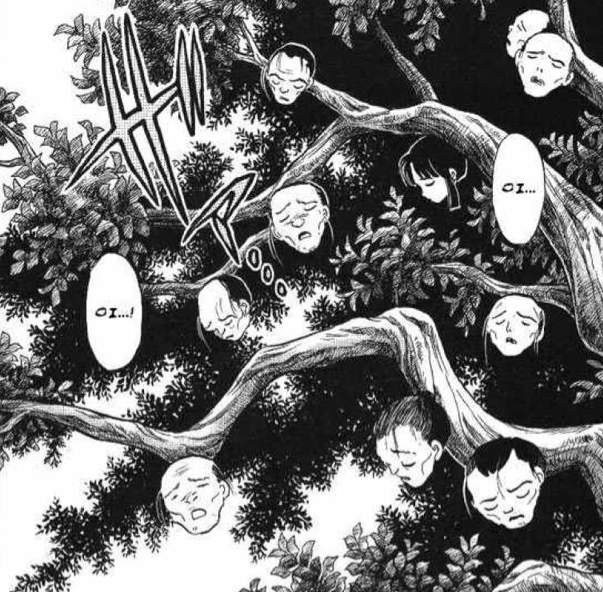
Takahashi may have the coolest resume of anyone working in manga today; not only did she study script writing with Kazuo Koike, she also worked as an assistant to Kazuo Umezu — an apprenticeship that’s evident in the early chapters of InuYasha. In between Kagome and InuYasha’s first encounters with Naraku are a handful of short but spooky stories in which seemingly benign objects — a noh mask, a peach tree — are transformed by Shikon Jewel shards into instruments of torture and killing. Takahashi’s horror stories are less florid than Umezu’s, with fewer detours into WTF? territory, but like Umezu, Takahashi has a vivid imagination that yields some decidedly scary images. Here, for example, is the demonic peach tree from chapter 79, “The Fruits of Evil”:

Takahashi doesn’t just use these images to shock; she uses them to illustrate the consequences of ugly emotions, impulsive actions, and violent behavior, to show us how these choices slowly corrode the soul and transform us into the most monstrous version of ourselves. (Also to show us the consequences of substituting human bones and blood for Miracle Gro. Kids, don’t try this at home.)

What Takahashi does better than almost anyone is walk the fine line between terror and horror. Gothic novelist Ann Radcliffe, author of The Mysteries of Udolpho (1794) and The Italian (1797), was one of the first writers to argue that terror and horror were different states of arousal. “Terror and Horror are so far opposite, that the first expands the soul and awakens the faculties to a high degree of life; the other contracts, freezes and nearly annihilates them,” she wrote in an 1826 essay, “On the Supernatural in Poetry.” Critiquing Radcliffe’s work in 1966, Devendra P. Varma explained that difference more concretely: “The difference between Terror and Horror is the difference between awful apprehension and sickening realization: between the smell of death and stumbling against a corpse.” And that’s exactly where Takahashi operates: she gives us tantalizing, suggestive glimpses of scary things, then keeps them obscured until the denouement of the story, allowing our imaginations to supply most of the grisly details. We read her work in a heightened state of awareness, which only intensifies our pleasure — and revulsion — when the true nature of Kagome and InuYasha’s foes are revealed.

* * * * *

If you haven’t looked at InuYasha in a while, or missed it during the height of its popularity, now is a great time to give it a try. Each volume of the VIZBIG edition collects three issues, allowing readers to more fully immerse themselves in the story. And if you’re a purist about packaging, you’ll be happy to know that VIZ is finally issuing InuYasha in an unflipped format — a first in the series’ US history.

Filed Under: Manga Critic Tagged With: Horror/Supernatural, inuyasha, Rumiko Takahashi, Shonen, shonen sunday, VIZ, Yokai

5 Reasons to Read InuYasha

April 29, 2011 by Katherine Dacey

InuYasha was the first comic that I actively collected, the manga that introduced me to the Wednesday comic-buying ritual and the very notion of self-identifying as a fan. Though I followed it religiously for years, trading in my older editions for new ones, watching the anime, and speculating about the finale, my interest in the series gradually waned as I was exposed to new artists and new genres. Still, InuYasha held a special place in my heart; reading it was one of my seminal experiences as a comic fan, making me reluctant to re-visit InuYasha for fear of sullying those precious first-manga memories. VIZ’s recent decision to re-issue InuYasha in an omnibus edition, however, inspired me to pick it up again. I made a shocking discovery in the process of re-reading the first chapters: InuYasha is good. Really good, in fact, and deserving of more respect than it gets from many critics.

What makes InuYasha work? I can think of five reasons:

1. The story arcs are long enough to be complex and engaging, but not so long as to test the patience.

There’s a Zen quality to Rumiko Takahashi’s storytelling that might not be obvious at first glance; after all, she loves a pratfall or a sword fight as much as the next shonen manga-ka. Don’t let that surface activity fool you, however: Takahashi has a terrific sense of balance, staging a romantic interlude between a demon-of-the-week episode and a longer storyline involving Naraku’s minions, thus preventing the series from devolving into a punishing string of battle arcs. The other great advantage of this approach is that Takashi carves out more space for her characters to interact as people, not just combatants; as a result, InuYasha is one of the few shonen manga in which the characters’ relationships evolve over time.

2. Takahashi knows how to stage a fight scene that’s dramatic, tense, and mercifully short.

‘Nuff said.

3. InuYasha‘s villains are powerful and strange, not strawmen.

Though we know our heroes will prevail — it’s shonen, for Pete’s sake — Takahashi throws creative obstacles in their way that makes their eventual triumph more satisfying. Consider Naraku. In many respects, he’s a standard-issue bad guy: he’s omnipotent, charismatic, and manipulative, capable of finding the darkness and vulnerability in the purest soul. (He also has fabulous hair, another reliable indication of his villainy.) Yet the way in which Naraku wields power is genuinely unsettling, as he fashions warriors from pieces of himself, then reabsorbs them into his body when they outlive their usefulness. Naraku’s manifestations are peculiar, too. Some are female, some are children, some have monstrous bodies, and some have the power to create their own demonic offspring, but few look like the sort of golem I’d create if I wanted to wreak havoc. And therein lies Naraku’s true power: his opponents never know what form he’ll take next, or whether he’s already among them.

Sesshomaru, too, is another villain who proves more interesting than he first appears. In the very earliest chapters of the manga, he’s a bored sociopath who has no qualms about using InuYasha’s mama trauma to trick his younger brother into revealing the Tetsusaiga’s location. As the story progresses, however, Sesshomaru begins tolerating the company of a cheerful eight-year-old girl who, in a neat inversion of the usual human-canine relationship, is dependent on her dog-demon master for protection, food, and companionship. Takahashi resists the urge to fully “humanize” Sesshomaru, however; he remains InuYasha’s scornful adversary for most of the series, largely unchanged by his peculiar fixation with Rin.

And did I mention that Sesshomaru has awesome hair? Oh, to be a villain in a Takahashi manga!

4. InuYasha‘s female characters kick ass.

Back in 2008, Shaenon Garrity wrote a devastatingly funny article about the seven types of female characters in shonen manga, from The Tomboy to The Little Girl to The Experienced Older Woman. I’m pleased to report that none of these types appear in InuYasha; in fact, InuYasha boasts one of the smartest, toughest, and most appealing set of female characters in shonen manga. And by “tough,” I don’t mean that Kagome, Kikyo, and Sango brandish weapons while wearing provocative outfits; I mean they persist in the face of adversity, even if their own lives are at stake. They’re strong enough to hold their own against demons, ghosts, and heavily armed bandits, and wise enough to know when words are more effective than weapons. They’re not adverse to the idea of romance, but recovering the Shikon Jewel takes precedence over dating. And they’re woman enough to cry if something awful happens, though they’d rather shed their tears in private than show their pain to others.

5. The horror! The horror!

Takahashi may have the coolest resume of anyone working in manga today; not only did she study script writing with Kazuo Koike, she also worked as an assistant to Kazuo Umezu — an apprenticeship that’s evident in the early chapters of InuYasha. In between Kagome and InuYasha’s first encounters with Naraku are a handful of short but spooky stories in which seemingly benign objects — a noh mask, a peach tree — are transformed by Shikon Jewel shards into instruments of torture and killing. Takahashi’s horror stories are less florid than Umezu’s, with fewer detours into WTF? territory, but like Umezu, Takahashi has a vivid imagination that yields some decidedly scary images. Here, for example, is the demonic peach tree from chapter 79, “The Fruits of Evil”:

Takahashi doesn’t just use these images to shock; she uses them to illustrate the consequences of ugly emotions, impulsive actions, and violent behavior, to show us how these choices slowly corrode the soul and transform us into the most monstrous version of ourselves. (Also to show us the consequences of substituting human bones and blood for Miracle Gro. Kids, don’t try this at home.)

What Takahashi does better than almost anyone is walk the fine line between terror and horror. Gothic novelist Ann Radcliffe, author of The Mysteries of Udolpho (1794) and The Italian (1797), was one of the first writers to argue that terror and horror were different states of arousal. “Terror and Horror are so far opposite, that the first expands the soul and awakens the faculties to a high degree of life; the other contracts, freezes and nearly annihilates them,” she wrote in an 1826 essay, “On the Supernatural in Poetry.” Critiquing Radcliffe’s work in 1966, Devendra P. Varma explained that difference more concretely: “The difference between Terror and Horror is the difference between awful apprehension and sickening realization: between the smell of death and stumbling against a corpse.” And that’s exactly where Takahashi operates: she gives us tantalizing, suggestive glimpses of scary things, then keeps them obscured until the denouement of the story, allowing our imaginations to supply most of the grisly details. We read her work in a heightened state of awareness, which only intensifies our pleasure — and revulsion — when the true nature of Kagome and InuYasha’s foes are revealed.

* * * * *

If you haven’t looked at InuYasha in a while, or missed it during the height of its popularity, now is a great time to give it a try. Each volume of the VIZBIG edition collects three issues, allowing readers to more fully immerse themselves in the story. And if you’re a purist about packaging, you’ll be happy to know that VIZ is finally issuing InuYasha in an unflipped format — a first in the series’ US history.

Filed Under: Manga, Manga Critic, Recommended Reading, REVIEWS Tagged With: Horror/Supernatural, inuyasha, Rumiko Takahashi, Shonen, shonen sunday, VIZ, Yokai

Please Save My Earth at The Hooded Utilitarian

April 28, 2011 by Michelle Smith

For our second joint venture at The Hooded Utilitarian, MJ and I take a look at the sci-fi shoujo classic, Please Save My Earth.

Summarizing a series this long is a daunting undertaking, but MJdoes an admirable job:

“Please Save My Earth is a 21-volume soft sci-fi epic about seven Japanese children (six teenagers and one elementary school student) who discover that they are the reincarnations of a group of alien scientists who once studied the Earth from a remote base on the Moon. Their discovery is made through a series of shared dreams, in which the children re-experience their past lives, including the destruction of their home planet and their eventual deaths from an unknown illness that spread rapidly through the group during their final days. Now reborn on earth, the children seek each other out, burdened with unfinished business from their past lives while simultaneously struggling with the present.”

To check out the rest of our conversation, which touches upon the series’ themes, characters, humor, and artwork, please visit The Hooded Utilitarian.

Filed Under: FEATURES Tagged With: Saki Hiwatari, VIZ

Rumiko Takahashi’s Rumic Theater

April 26, 2011 by Katherine Dacey 11 Comments

Most American readers know Rumiko Takahashi through her work in Shonen Sunday, but Takahashi has a foot in the seinen world as well. Maison Ikkoku ran in Big Comic Spirits from 1980-87, alongside Area 88 and Wounded Man, while short stories such as “To Grandmother’s House We Go” and “One Hundred Years of Love” appeared in Big Comic Spirits‘ sister publication Big Comic Original. In Japan, Takahashi’s seinen shorts have been collected into four volumes: 1 or W, The Tragedy of P, The Executive’s Dog, and Red Bouquet. Here in the US, however, only two have been translated into English: The Tragedy of P, which was re-titled Rumic Theater (1996), and 1 or W, which was published as Rumic Theater: One or Double (1998). (N.B. One or Double includes a handful of shonen and josei stories that appeared in Shonen Sunday and Petit Flower, respectively.)

These two translated volumes showcase Takahashi’s ability to work in almost genre. There are sports comedies (“The Grandfather of All Baseball Games”), domestic dramas (“Hidden in the Pottery,” “House of Garbage,” “The Tragedy of P”), rom-coms (“The Merchant of Romance,” “The Diet Goddess”), pop-culture spoofs (“Shake Your Buddha”), and ghost stories (“To Grandmother’s House We Go,” “One or Double”). As with Takahashi’s work in Shonen Sunday, many of these stories fold supernatural elements into everyday situations. In “Extra-Large Size Happiness,” for example, a woman’s relationship with her mother-in-law is strained by the sudden and frequent appearance of a household spirit that only she can see, while in “Reserved Seat,” a ghostly grandma takes possession of her grandson’s body so that she can honor her season tickets at the Takarazuka Revue.

Takahashi is a master at establishing her premise in just a few pages, allowing plenty of room for character development and broad comedy without compromising narrative momentum. One of the reasons Takahashi can be so economical is that she invests even the smallest moments with telling detail, making sure that every aspect of a character’s behavior is consistent with the story’s premise. In “Excuse Me for Being a Dog,” for example, the hero — who turns into a shiba inu whenever he suffers a nosebleed — acts like a canine even in his human form: he investigates an abandoned book bag with his nose, curls his lip at strangers, and recoils in the presence of pungent odors. Takahashi doesn’t make a big deal of these behavioral tics, but their inclusion in the story elevates Shiro’s condition from a wacky plot contrivance to a fundamental aspect of his existence. (OK, it’s also a wacky plot contrivance.)

Takahashi’s deep affection for her characters also contributes to the stories’ success. Though they bicker and tease and goad one another, the characters’ good will and mutual affection is seldom in question, even when their judgment is. Takahashi is as generous with her least sympathetic characters as she is with her leads, allowing them moments of wisdom and decency that often challenge the other characters’ perception of them. In “The Story of P,” for example, a man agrees to care for his eccentric client’s pet penguin, despite the fact the Hagas’ apartment complex doesn’t allow pets. For most of the story, Mrs. Haga plays cat-and-mouse with her neighbor Mrs. Kakei, the head of tenants’ association and a reputed animal hater. (Mrs. Kakei keeps tabs on the other tenants, notifying the management of any pet violations.) Yet in the last pages of the story, we learn that Mrs. Kakei has complicated, emotional reasons for ratting out her neighbors that stem, in part, from a genuine concern for animal welfare and not a humorless love of rules.

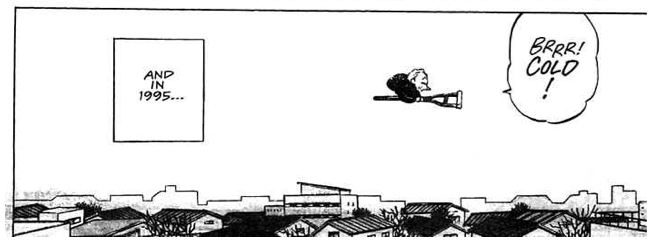
Art-wise, Takahashi produces some of the cleanest, most accessible layouts in manga. Her characters’ faces are easy to read, and her scenes are staged for maximum clarity and emotional impact; no one times a scare or a punch line better than Takahashi. Even more striking is the sense of mischief and play that informs her artwork. The elderly heroine of “One Hundred Years of Love,” for example, gains the ability to fly after surviving a near-death experience. Takahashi draws the old woman astride an enormous crutch, soaring over an urban landscape. At first, Mrs. Hoshino mutters about the weather, but soon she embraces the possibilities of flight, buzzing an unsuspecting eight-year-old apartment dweller:


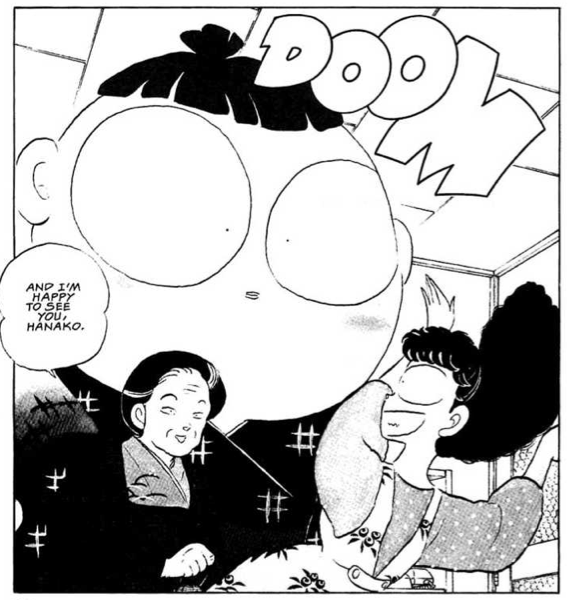
That same sense of mischief is evident in “Extra-Large Size Happiness,” in which a giant yokai pops into the frame — directly behind the frazzled heroine’s mother-in-law. Readers familiar with InuYasha‘s Shippo and Myogi will immediately recognize this round, genial figure:

The similarities between this nameless yokai and Myoga could be construed as a flaw or weakness of Takahashi’s style, but there’s an argument to be made that Takahashi employs a “star system” of her own. Granted, Takahashi never constructed a neat theoretical framework to explain the recurrence of certain characters in her stories, as Osamu Tezuka famously did for his. Flipping through the pages of Rumic Theater, however, it’s easy to imagine these characters as actors who specialize in certain types of roles, retaining something of their own “off-screen” personality and appearance in every story; as David Welsh observed in his recent essay on Ranma 1/2, “The fun is in seeing the specialists find variations on their distinctive themes.” And here, in Rumic Theater, the fun comes from seeing Takahashi’s regulars tackle more grown-up themes — marital discord, neighborhood politics, growing old — than might otherwise be permissible in the context of a long-form adventure such as InuYasha or Ranma 1/2 .

Filed Under: Manga Critic Tagged With: Manga Movable Feast, Rumic Theater, Rumiko Takahashi, Seinen, VIZ

Manga Artifacts: Rumiko Takahashi’s Rumic Theater

April 26, 2011 by Katherine Dacey

Most American readers know Rumiko Takahashi through her work in Shonen Sunday, but Takahashi has a foot in the seinen world as well. Maison Ikkoku ran in Big Comic Spirits from 1980-87, alongside Area 88 and Wounded Man, while short stories such as “To Grandmother’s House We Go” and “One Hundred Years of Love” appeared in Big Comic Spirits‘ sister publication Big Comic Original. In Japan, Takahashi’s seinen shorts have been collected into four volumes: 1 or W, The Tragedy of P, The Executive’s Dog, and Red Bouquet. Here in the US, however, only two have been translated into English: The Tragedy of P, which was re-titled Rumic Theater (1996), and 1 or W, which was published as Rumic Theater: One or Double (1998). (N.B. One or Double includes a handful of shonen and josei stories that appeared in Shonen Sunday and Petit Flower, respectively.)

These two translated volumes showcase Takahashi’s ability to work in almost genre. There are sports comedies (“The Grandfather of All Baseball Games”), domestic dramas (“Hidden in the Pottery,” “House of Garbage,” “The Tragedy of P”), rom-coms (“The Merchant of Romance,” “The Diet Goddess”), pop-culture spoofs (“Shake Your Buddha”), and ghost stories (“To Grandmother’s House We Go,” “One or Double”). As with Takahashi’s work in Shonen Sunday, many of these stories fold supernatural elements into everyday situations. In “Extra-Large Size Happiness,” for example, a woman’s relationship with her mother-in-law is strained by the sudden and frequent appearance of a household spirit that only she can see, while in “Reserved Seat,” a ghostly grandma takes possession of her grandson’s body so that she can honor her season tickets at the Takarazuka Revue.

Takahashi is a master at establishing her premise in just a few pages, allowing plenty of room for character development and broad comedy without compromising narrative momentum. One of the reasons Takahashi can be so economical is that she invests even the smallest moments with telling detail, making sure that every aspect of a character’s behavior is consistent with the story’s premise. In “Excuse Me for Being a Dog,” for example, the hero — who turns into a shiba inu whenever he suffers a nosebleed — acts like a canine even in his human form: he investigates an abandoned book bag with his nose, curls his lip at strangers, and recoils in the presence of pungent odors. Takahashi doesn’t make a big deal of these behavioral tics, but their inclusion in the story elevates Shiro’s condition from a wacky plot contrivance to a fundamental aspect of his existence. (OK, it’s also a wacky plot contrivance.)

Takahashi’s deep affection for her characters also contributes to the stories’ success. Though they bicker and tease and goad one another, the characters’ good will and mutual affection is seldom in question, even when their judgment is. Takahashi is as generous with her least sympathetic characters as she is with her leads, allowing them moments of wisdom and decency that often challenge the other characters’ perception of them. In “The Story of P,” for example, a man agrees to care for his eccentric client’s pet penguin, despite the fact the Hagas’ apartment complex doesn’t allow pets. For most of the story, Mrs. Haga plays cat-and-mouse with her neighbor Mrs. Kakei, the head of tenants’ association and a reputed animal hater. (Mrs. Kakei keeps tabs on the other tenants, notifying the management of any pet violations.) Yet in the last pages of the story, we learn that Mrs. Kakei has complicated, emotional reasons for ratting out her neighbors that stem, in part, from a genuine concern for animal welfare and not a humorless love of rules.

Art-wise, Takahashi produces some of the cleanest, most accessible layouts in manga. Her characters’ faces are easy to read, and her scenes are staged for maximum clarity and emotional impact; no one times a scare or a punch line better than Takahashi. Even more striking is the sense of mischief and play that informs her artwork. The elderly heroine of “One Hundred Years of Love,” for example, gains the ability to fly after surviving a near-death experience. Takahashi draws the old woman astride an enormous crutch, soaring over an urban landscape. At first, Mrs. Hoshino mutters about the weather, but soon she embraces the possibilities of flight, buzzing an unsuspecting eight-year-old apartment dweller:


That same sense of mischief is evident in “Extra-Large Size Happiness,” in which a giant yokai pops into the frame — directly behind the frazzled heroine’s mother-in-law. Readers familiar with InuYasha‘s Shippo and Myogi will immediately recognize this round, genial figure:

The similarities between this nameless yokai and Myoga could be construed as a flaw or weakness of Takahashi’s style, but there’s an argument to be made that Takahashi employs a “star system” of her own. Granted, Takahashi never constructed a neat theoretical framework to explain the recurrence of certain characters in her stories, as Osamu Tezuka famously did for his. Flipping through the pages of Rumic Theater, however, it’s easy to imagine these characters as actors who specialize in certain types of roles, retaining something of their own “off-screen” personality and appearance in every story; as David Welsh observed in his recent essay on Ranma 1/2, “The fun is in seeing the specialists find variations on their distinctive themes.” And here, in Rumic Theater, the fun comes from seeing Takahashi’s regulars tackle more grown-up themes — marital discord, neighborhood politics, growing old — than might otherwise be permissible in the context of a long-form adventure such as InuYasha or Ranma 1/2 .

Filed Under: Manga, Manga Critic, Recommended Reading, REVIEWS Tagged With: Manga Movable Feast, Rumic Theater, Rumiko Takahashi, Seinen, VIZ

Blue Exorcist, Vol. 1

April 22, 2011 by Katherine Dacey 14 Comments

Have you ever seen the pilot episode of Law & Order? Most of the regular characters are present, and the script follows the three-act structure familiar to anyone who’s watched an episode of any Law & Order series, but the pacing is slack; the dialogue fizzles where it should crackle; and the actors struggle to create believable relationships between the characters, even as the script demands that they explain things to one another that, presumably, they’d already know from working together. Small wonder that “Everybody’s Favorite Bagman” languished for nearly a year before NBC rescued the show from limbo and ordered a full season of episodes.

So it is with Blue Exorcist, which has a first chapter that might charitably be described as a “pilot episode.” In these opening thirty pages, Kato introduces orphan Rin Okimura, a hot-tempered young man; Yukio, Rin’s snot-nosed fraternal twin; and Father Fujimoto, their guardian. Rin, we learn, is a direct descendant of Satan, and is in imminent danger of going over to the dark side. Father Fujimoto, however, has kept this information from his young charge, seeing fit only to explain the complexities of Rin’s lineage when Satan’s minions try to spirit Rin back to Gehenna, the demon realm. (Like all manga priests, Father Fujimoto spends more time fighting demons than preparing Sunday sermons or ministering to the sick, hungry, and bereaved.) An epic confrontation between Satan and Father Fujimoto leaves Rin’s mentor dead, forcing the boy to decide whether to cast his lot with Satan or with humanity.

There’s no reason why this opening prelude has to be such a bumpy, predictable ride, but Kato seems so intent on relating Rin’s entire Tragic Past in one installment that she trades naturalism for economy. (Sample: “I see you’ve returned. An overnight trip to the job center? How diligent of you.” And how helpful of Father Fujimoto to ask Rin a question to which he already knows the answer!) In the second chapter, however, Kato finds her stride with the material: the dialogue is looser and funnier; the characters’ relationships are more firmly and plausibly established; and she introduces her first genuinely memorable character, Mephisto Pheles. The plot is stock, with Rin vowing to avenge Father Fujimoto by enrolling in an exorcism “cram school,” but Kato enlivens the proceedings with humorous twists and nifty artwork.

And oh, the artwork! It’s crisp and expressive, filled with small but suggestive details. Mephisto, for example, carries a patched umbrella and wears a polka-dot cravat — two minor flourishes that help establish him as a slightly decadent figure, elegant but down at the heels. The not-very-imaginatively named True Cross Town provides another instructive example of Kato’s meticulous and thoughtful draftsmanship: she lavishes considerable attention on architectural details and infrastructure, stacking layers of houses and buildings on top of one another to form a giant urban ziggeraut:

In short, Kato has created an imaginary urban landscape that seems to have evolved naturally over time, with old and new buildings side-by-side and modern modes of transport straddling canals and rivers. That kind of thoroughness may not serve much purpose in the context of a manga about demon fighters, but it lends Blue Exorcist a temporal and geographic specificity that’s sometimes missing in other areas of the story — like the religious bits.

Whatever my reservations about the first chapter, I freely admit that I’d fallen head-over-heels for Blue Exorcist by the end of the second. The brisk pacing, sharp artwork, and cheeky tone of these later chapters convinced me that Kazue Kato is in firm control of her story, and has successfully laid the foundation for the series’ first major story arc. Bring it on, I say!

BLUE EXORCIST, VOL. 1 • BY KAZUE KATO • VIZ MEDIA • 198 pp. • RATING: OLDER TEEN (16+)

Filed Under: Manga Critic Tagged With: blue exorcist, Kazue Kato, Shonen, Shonen Jump, VIZ

  • « Go to Previous Page
  • Page 1
  • Interim pages omitted …
  • Page 6
  • Page 7
  • Page 8
  • Page 9
  • Page 10
  • Interim pages omitted …
  • Page 26
  • Go to Next Page »
 | Log in
Copyright © 2010 Manga Bookshelf | Powered by WordPress & the Genesis Framework