• Skip to primary navigation
  • Skip to main content
  • Skip to primary sidebar
  • Home
  • About Us
    • Privacy Policy
    • Comment Policy
    • Disclosures & Disclaimers
  • Resources
    • Links, Essays & Articles
    • Fandomology!
    • CLAMP Directory
    • BlogRoll
  • Features & Columns
    • 3 Things Thursday
    • Adventures in the Key of Shoujo
    • Bit & Blips (game reviews)
    • BL BOOKRACK
    • Bookshelf Briefs
    • Bringing the Drama
    • Comic Conversion
    • Fanservice Friday
    • Going Digital
    • It Came From the Sinosphere
    • License This!
    • Magazine no Mori
    • My Week in Manga
    • OFF THE SHELF
    • Not By Manga Alone
    • PICK OF THE WEEK
    • Subtitles & Sensibility
    • Weekly Shonen Jump Recaps
  • Manga Moveable Feast
    • MMF Full Archive
    • Yun Kouga
    • CLAMP
    • Shojo Beat
    • Osamu Tezuka
    • Sailor Moon
    • Fruits Basket
    • Takehiko Inoue
    • Wild Adapter
    • One Piece
    • After School Nightmare
    • Karakuri Odette
    • Paradise Kiss
    • The Color Trilogy
    • To Terra…
    • Sexy Voice & Robo
  • Browse by Author
    • Sean Gaffney
    • Anna Neatrour
    • Michelle Smith
    • Katherine Dacey
    • MJ
    • Brigid Alverson
    • Travis Anderson
    • Phillip Anthony
    • Derek Bown
    • Jaci Dahlvang
    • Angela Eastman
    • Erica Friedman
    • Sara K.
    • Megan Purdy
    • Emily Snodgrass
    • Nancy Thistlethwaite
    • Eva Volin
    • David Welsh
  • MB Blogs
    • A Case Suitable For Treatment
    • Experiments in Manga
    • MangaBlog
    • The Manga Critic
    • Manga Report
    • Soliloquy in Blue
    • Manga Curmudgeon (archive)

Manga Bookshelf

Discussion, Resources, Roundtables, & Reviews

VIZ

Oishinbo A la Carte: Vegetables

December 14, 2009 by Katherine Dacey

oishinbo_veggiesI mean no disrespect to Tetsu Kariya or Akira Hanasaki when I say that the Vegetables volume of Oishinbo A la Carte irresistibly reminded me of 1970s television. Back in the day when there were only three networks, hour-long dramas doggedly followed the same formula: they dramatized a problem — say, drinking and driving, or falling in with a bad crowd — then resolved it with a little action and a lot of talking, culminating in a freeze-frame shot of the entire cast laughing at corny situational humor. Oishinbo follows this template to a tee, using hot-button issues such as bullying and pollution to preach the healing power of vegetables. The stories are as hokey and predictable as an episode of CHiPs or Little House on the Prairie, but entertaining in their sincerity.

Take “The Joy of a New Potato,” for example. The story begins with big-shot executive Misaki Hacho treating the Ultimate Menu team to an expensive meal. Shortly afterwards, Yamaoka discovers that Misaki has fallen on hard times, selling his business interests and trading his lavish home for a two-room flat. Kurita and Yamaoka invite Misaki’s family on a country outing, teaching his children how to harvest and cook potatoes. Though the denouement of the story is predictable and a little credulity-straining — Misaki’s son declares the potato outing “a hundred times better” than the extravagant birthday party that dad threw him the previous year — the message is heartfelt: doing things with your children is more important than doing things for them. Other stories in this vein include “The Bean Sprout Kid,” in which Yamaoka defends a quiet, frail boy from his classmates; “Good Eggplant, Bad Eggplant,” in which Tomio’s son overcomes his lifelong hatred of aubergines; “The Story of Vegetables, Now and Then,” in which a wealthy industrialist learns an important lesson about pesticides; “The Breath of Spring,” in which a cook woos her estranged lover with an asparagus dish; and “The Taste of Chicken, The Taste of Carrots,” in which a grandmother’s homemade chicken soup inspires a picky eater to add veggies to her diet.

…

Read More

Filed Under: Manga Critic Tagged With: Seinen, VIZ

Oishinbo A la Carte: Vegetables

December 14, 2009 by Katherine Dacey

I mean no disrespect to Tetsu Kariya or Akira Hanasaki when I say that the Vegetables volume of Oishinbo A la Carte irresistibly reminded me of 1970s television. Back in the day when there were only three networks, hour-long dramas doggedly followed the same formula: they dramatized a problem — say, drinking and driving, or falling in with a bad crowd — then resolved it with a little action and a lot of talking, culminating in a freeze-frame shot of the entire cast laughing at corny situational humor. Oishinbo follows this template to a tee, using hot-button issues such as bullying and pollution to preach the healing power of vegetables. The stories are as hokey and predictable as an episode of CHiPs or Little House on the Prairie, but entertaining in their sincerity.

Take “The Joy of a New Potato,” for example. The story begins with big-shot executive Misaki Hacho treating the Ultimate Menu team to an expensive meal. Shortly afterwards, Yamaoka discovers that Misaki has fallen on hard times, selling his business interests and trading his lavish home for a two-room flat. Kurita and Yamaoka invite Misaki’s family on a country outing, teaching his children how to harvest and cook potatoes. Though the denouement of the story is predictable and a little credulity-straining — Misaki’s son declares the potato outing “a hundred times better” than the extravagant birthday party that dad threw him the previous year — the message is heartfelt: doing things with your children is more important than doing things for them. Other stories in this vein include “The Bean Sprout Kid,” in which Yamaoka defends a quiet, frail boy from his classmates; “Good Eggplant, Bad Eggplant,” in which Tomio’s son overcomes his lifelong hatred of aubergines; “The Story of Vegetables, Now and Then,” in which a wealthy industrialist learns an important lesson about pesticides; “The Breath of Spring,” in which a cook woos her estranged lover with an asparagus dish; and “The Taste of Chicken, The Taste of Carrots,” in which a grandmother’s homemade chicken soup inspires a picky eater to add veggies to her diet.

No volume of Oishinbo would be complete with at least one epic food battle, and Vegetables opens with a doozy: a three-part contest revolving around cabbage and turnips. For most of the showdown, Yuzan appears to have the upper hand, preparing simple dishes that emphasize the unique flavors of the star ingredients. Yamaoka’s fortunes change, however, when Arakawa’s mother comes to the city for a visit, bringing wild grape juice and walnuts with her. The bold flavors of the grapes and walnuts inspire Yamaoka to take a page from his father’s book, trading elaborate preparations for straightforward ones that enhance the “muddiness” of the turnip.

As I noted in my review of the first volume, the structure of the A la Carte edition of Oishinbo is both its strength and weakness. On the one hand, organizing each volume around a particular kind of food makes for a fun, educational introduction to Japanese cuisine; a better title for the US edition would be Oishinbo: Beyond Pocky and California Rolls, given the sheer diversity of the food described in each volume. On the other hand, the series’ thematic organization robs the series of its continuity; we never have a chance to see Kurita and Yamaoka’s relationship evolve from co-workers to spouses, as we’re constantly seeing them at different stages of their courtship, nor do we have any sense of how the Ultimate Menu vs. Supreme Menu contest is unfolding.

Still, it’s difficult to deny Oishinbo‘s appeal. Imagine Iron Chef crossed with Mostly Martha, and you have some idea of why this sincere, somewhat hokey, series is as addictive as gyoza: it reminds us that food is an essential ingredient in all human relations, the glue that binds friends, families, and lovers in times of joy and crisis alike. The best of the A la Carte series.

Review copy provided by VIZ Media, LLC.

OISHINBO A LA CARTE: VEGETABLES • STORY BY TETSU KARIYA, ART BY AKIRA HANASAKI • VIZ • 266 pp. • RATING: TEEN

Filed Under: Manga, Manga Critic, REVIEWS Tagged With: Cooking and Food, VIZ, VIZ Signature

Black Bird 2 by Kanoko Sakurakoji: B-

November 23, 2009 by Michelle Smith

blackbird2Misao is the bride of demon prophecy, and marrying her will bring her childhood friend Kyo, leader of the Tengu clan, prosperity. Misao is drawn to Kyo, but she resists this arrangement because she can’t be sure whether Kyo actually loves her for herself or because of the benefits she could bring him.

The answer to this question arrives in the form of Kyo’s eight vassals, a group of young men who’ve got intimate knowledge of Kyo’s past, his real feelings for Misao, and how hard he worked to become clan leader so that he could have the right to claim her as his bride. The original heir, Kyo’s older brother Sojo, also makes an appearance and nearly ravishes Misao, but not before allowing her a glimpse of her forgotten childhood memories.

The backstories of the characters are fleshed out nicely in this volume, and I’m pleased with the rate at which information is doled out to the reader. One confusing point, though, is that Kyo is shown in flashbacks and the testimony of the vassals to be a kind, nurturing guy, but his present-day treatment of Misao runs contrary to this assessment. Sure, he comes to her rescue as needed, but he also says things like, “Shall I shut your mouth for you?” and punishes her for being a flirtatious drunk. Worse is Misao’s reaction: she accepts his use of force as his way of communicating and finds that it makes his gentle moments that much more meaningful. That’s seriously disturbing!

Ultimately, I do enjoy this series but its creepy moments ensure I feel rather guilty doing so.

Review copy provided by the publisher. Review originally published at Manga Recon.

Filed Under: REVIEWS Tagged With: Kanoko Sakurakoji, shojo beat, VIZ

Honey Hunt 3 by Miki Aihara: B+

November 19, 2009 by Michelle Smith

honeyhunt3After being deserted by her celebrity parents, Yura Onozuka decides to best her mother at her own game: acting. After bombing several auditions, she’s landed the lead role in a commercial with a TV series tie-in and, after struggling through the first table read, manages to go back in and nail it thanks to the efforts of her friends Q-ta and Haruka Minamitani, a pair of fraternal twin pop stars, who both help by either encouraging her or smoothing things over with her less-than-impressed costars.

Yura has developed a crush on Q-ta and doesn’t realize that Haruka, one of those “kind on the inside, surly on the outside” types, has feelings for her. When he gets the idea that seeing him in concert will make her fall for him, he promises to answer all her questions about Q-ta if she’ll come to his shows. She does go, and is enthralled by his performance, but her mind’s still on Q-ta, forcing Haruka to finally make his intentions clear.

Honey Hunt is briskly paced and lighthearted, with Yura attracting near-instant notice in her career and in romance alike. It’s also completely engaging—the Minamitani boys are both genuinely sweet and Yura herself, though given to bouts of insecurity, is sensible and sympathetic. One thing I particularly like is that she always thanks those who’ve done nice things for her; too many shojo heroines get all embarrassed and feisty in similar circumstances.

If you’re in the mood for frothy fun, Honey Hunt would surely fit the bill. Too bad there’s a five-month wait for volume four!

Review copy provided by the publisher. Review originally published at Manga Recon.

Filed Under: REVIEWS Tagged With: Miki Aihara, shojo beat, VIZ

Honey Hunt 1-2 by Miki Aihara: B+

November 18, 2009 by Michelle Smith

honeyhunt1It’s not easy being the daughter of famous parents, as Yura Onozuka well knows. Her mother’s a sought-after actress and her father a renowned composer, and people are always expecting Yura to have that special celebrity air. She walks a tightrope at school, trying to appear neither aloof nor smug, and the only person who really sees her for herself is her childhood friend, Shin. She dreams of leaving her parents behind, but they beat her to the punch, as she learns when her mother comes home one day and spontaneously announces that she’s divorcing Yura’s father and selling the family home, and that he’s having a baby with his girlfriend. Yura thinks to turn to Shin, only to catch him in her mother’s arms. The betrayal is too much and she ends up declaring on live TV that both her parents can go to hell.

Determined to beat her mother at something, she accepts an offer from her father’s manager, Keiichi, to represent her and starts staying with him while going out on auditions and bombing terribly. Along the way, she meets a pair of twin brother pop stars, Q-ta and Haruka, and advice from Q-ta gives her the confidence she needs to intrigue the director of a commercial enough to finally get a callback. It’s not until Yura’s cast as the main character that she learns that a TV series is part of the deal and that, though he pledged to keep her parentage a secret, Keiichi broke that promise pretty much immediately, since it’s his job to make her popular. Most of the second volume involves Yura coming to terms with this reality and also trying to work out how to intentionally access the “switch” in her that flips and allows her to become a character.

honeyhunt2Superficially, Honey Hunt has some similarities to Skip Beat!. Both Yura and Kyoko have been betrayed by male childhood friends they had feelings for, both have cruel mothers, and both seek to achieve fame as a means of revenge. In execution, though, it’s really a lot different. For one thing, with two fairly sweet male rockers hanging around and offering encouragement, the potential for and emphasis on romance is much stronger. Also, Yura is much calmer than Kyoko is. In fact, one of the best things I like about her is that she’s refreshingly normal. She has bouts of insecurity, true, and sometimes her refusal to believe that people could like her for herself gets a little tiresome, but on the whole she’s smart, interesting, sympathetic, and free of over-the-top smackworthy behavior. If Yura were a real person, I’d be happy to know her.

Miki Aihara’s art is generally good. Her interior backgrounds are lovely, and she’s a master of the profile angle. Sometimes, though, the three-quarter view seems to give her a bit of trouble; either that, or the characters’ eyes are supposed to look kind of misshapen and weird at those moments. In any case, I like Yura’s character design a lot, I like how the twins will occasionally look very much alike when taken unawares, and I like how Yura’s confidence when really getting into a role is portrayed.

It’s kind of unusual for me to like a shoujo heroine this much; I’ve been feeling lately that I’ve been rather down on them, so it’s nice to be able to really like one for a change! While the story interests me, it’s really for Yura that I’ll continue reading.

Honey Hunt is published in English by VIZ and three volumes have been released so far. The series is up to five volumes in Japan and is still ongoing.

Filed Under: REVIEWS Tagged With: Miki Aihara, shojo beat, VIZ

Vampire Knight 8 by Matsuri Hino: B

November 2, 2009 by Michelle Smith

vampireknight8Have you ever seen anyone claim, in defense of Vampire Knight, “It gets better! Wait until you get to chapter 35!”? Well, it turns out that they’re half right.

Chapter 35 is a game-changer, with the full details of Yuki’s forgotten past coming to light along with unexpected revelations and their attendant complications. I found part of what occurs easy to predict, given the final moments of volume seven, but was genuinely surprised by a few things and absolutely delighted by Zero’s tortured reaction. (And yes, I am being terribly vague on purpose. It really is that big of a spoiler.)

However, I wouldn’t say that the series is necessarily better as a result of this dramatic turn. Kaname’s evil relative, Rido, has emerged as the villain of the piece, but he’s a recent addition and woefully undeveloped. Shifting allegiances are tough to pin down, Kaname behaves inscrutably, and the political maneuverings of the vampire realm can be confusing.

These flaws aren’t anything new—and are ameliorated somewhat by the gorgeous art—so I’d advise against developing unrealistically high expectations. Shocking developments aside, volume eight essentially offers more of the same.

Review copy provided by the publisher. Review originally published at Manga Recon.

Filed Under: REVIEWS Tagged With: Matsuri Hino, shojo beat, VIZ

Ouran High School Host Club 13 by Bisco Hatori: B

November 2, 2009 by Michelle Smith

ouran13Feelings. That’s entirely what this volume is about. First, you’ve got Haruhi taking a love quiz and finally realizing that what she feels for Tamaki isn’t just admiration of his many good qualities, but actually love. Not that she’s ready to deal with that just yet, so she resolves to take his advice and start accumulating more life experience. Next, Hikaru informs Tamaki that he loves Haruhi, which sends Tamaki into a tizzy that still doesn’t result in him realizing his own feelings.

Even though I get the sense that not too much about this series is planned in advance, Hatori-sensei does at least offer a credible explanation for Tamaki’s family fixation and exactly why he may be unable to acknowledge his feelings for Haruhi. I also like how Haruhi realizes that Tamaki’s been encouraging her to be less apathetic for quite some time now and how he, who is pursuing his new career goals with much energy, has actually become her role model in a lot of ways.

This series is nothing if not lighthearted, but sometimes the side trips into comedy (or unnecessary appearances by other host club members) get in the way of the love story. Still, it’s fundamentally a warm, fuzzy, and satisfying read.

Review copy provided by the publisher. Review originally published at Manga Recon.

Filed Under: REVIEWS Tagged With: Bisco Hatori, shojo beat, VIZ

Ouran High School Host Club 12 by Bisco Hatori: B+

November 1, 2009 by Michelle Smith

ouran12From the back cover:
Hikaru and Kaoru’s fight over Haruhi is taking its toll on Hunny and Mori, who are trying to watch over the estranged twins. Meanwhile, unbeknownst to Tamaki, Kyoya starts looking for Tamaki’s mother in France.

Review:
Three plot threads are simultaneously underway in this volume, though they converge nicely by the end. In the first, Kyoya is using the class trip to France to look for Tamaki’s mother. In the second, Kaoru and Hikaru are fighting over their feelings for Haruhi and Kaoru launches a plan to spur Hikaru into action. And in the third, Tamaki is trying to decide what he wants to do with his life, and a job offer from his dad gives him a lot to consider.

Although I like the twins and enjoyed the chapters focusing on them—wherein Kaoru rightly sees the need for him and Hikaru to establish themselves as individuals but has a rather convoluted way of going about it—the heart of this series for me will always be Haruhi and Tamaki. Tamaki has backed out on the class trip to France at the last minute, but everyone else believes he has gone. There’s a priceless scene around the middle of the book where Haruhi’s on the phone with Kyoya asking how Tamaki’s doing and then spots him lurking in front of her house. There’s a lot more to the scene than that, but I don’t want to spoil it.

Haruhi and Tamaki proceed to have a lovely scene with just the two of them, wherein he gives her license to ask anything about his childhood. He also confides in her that his desire to make people happy comes from a vow to his mother and that he’d also like to carry this oath further into a career. Haruhi’s encouragement clearly means the world to him, and it’s also clear that Haruhi admires him and is getting a bit flustered in his presence (something that completely failed to happen during an outing with Kaoru in the volume’s earlier chapters). When Kyoya is later able to report that Tamaki’s mother is doing well (sniffle alert!), Tamaki decides to embrace his place in the Suoh family and accept his father’s offer to work with a chain of hotels the Suoh corporation owns.

So here we have a volume that features several characters maturing, two reticent characters displaying fondness for Tamaki, a classic bit of comedy, and a scene that brought tears to my eyes. I guess that may not seem like much, but for a largely episodic series like this one, it really is quite a lot. It also, as someone mentions in uncredited narration, is starting to feel like the beginning of the end. I think the timing’s perfect—we’ve had quite a while to enjoy these characters in a variety of situations and now it’s time for some of them to grow up enough to realize that it’s not a bad thing if relationships evolve from their current states. From all present indicators, it would seem the ending is shaping up to be a satisfying one.

Filed Under: REVIEWS Tagged With: Bisco Hatori, shojo beat, VIZ

Vampire Knight 5-7 by Matsuri Hino: B

October 30, 2009 by Michelle Smith

vampireknight5Vampire Knight is a series with a plot that makes sense while you’re reading it, but is difficult to summarize in a coherent manner. In these three volumes, the story moves away from Zero and his angst to focus more squarely on Yuki, who is increasingly more insistent upon uncovering her missing memories. She correctly surmises that Kaname is hiding things from her and confronts him several times, only to have him evade the question. Meanwhile, whenever she attempts to remember on her own, she experiences blood-drenched hallucinations. Her visions get progressively worse, prompting Kaname to whisk her away at the end of volume seven with the words, “It’s time to wake up… before you go mad.”

vampireknight6Other things are going on in the background: political factions in the vampire world are at odds over their government, with some wanting to restore the monarchy (which would make Kaname king) and others in support of the senate; Zero is suspected of killing a pureblood vampire, but is not actually the culprit; Ichiru, Zero’s brother, enrolls at Cross Academy with the apparent goal of doing something nefarious to Yuki; and, most importantly, a rival heir to the Kuran lineage awakens and inhabits the body of his son, currently attending the school. This last personage is shaping up to be the main villain of the piece, and it’s likely that Kaname has taken various steps to both up his own power and increase Yuki’s status amongst his brethren (by acknowledging her as his lover, he essentially guarantees her a vampire guard) all in order to protect her from this creepy foe.

vampireknight7As it has progressed, the story of Vampire Knight has become increasingly engaging, and I think it’s pretty safe to say that I’m addicted by this point. Zero has stabilized somewhat—a drink of Kaname’s blood, offered solely for Yuki’s sake, has stalled the progress of his insanity—while Kaname has grown both darker and more vocal about his feelings for Yuki, declaring his love for her outright at one point. Hino has also stopped writing scenarios in which Yuki blindly rushes into a dangerous situation and then promptly requires rescue. In these three volumes, it only happens once. These factors combine to make Kaname’s feelings for Yuki more believable, thus enabling me to be more invested in their interactions, which are growing progressively more sexay. I wouldn’t say yet that I actually like Yuki, but at least I no longer feel the desire to grab her by the shoulders and shake vigorously.

The art continues to be gorgeous, dark and gloomy and full of beautifully despondent boys. Hino’s also adept at cliffhangers; the one at the end of volume seven is the most suspenseful yet. While it may not be the best shojo series in existence, Vampire Knight offers an appealing blend of angst and gloom that has me hooked.

Filed Under: REVIEWS Tagged With: Matsuri Hino, shojo beat, VIZ

Short Takes: Haunted House, Mermaid Saga, and School Zone

October 29, 2009 by Katherine Dacey

Boo! This week, I’m taking the highly imaginative step of writing about spooky manga. The twist? All three titles are penned by trailblazing female artists. First up is Mitsukazu Mihara’s Haunted House (Tokyopop), a comedy about a normal teen whose parents have clearly embraced Addams Family Values. Next on the agenda is Rumiko Takahashi’s Mermaid Saga (VIZ), an older series that mixes horror and folklore to good effect. (You can read the first chapter for free at the Shonen Sunday website.) And last but not least is Kanako Inuki’s School Zone (Dark Horse), a three-volume series about a school built atop a cemetery — always a bad idea, kids, even when the land is being offered at bargain-basement prices.

hauntedhouseHAUNTED HOUSE

BY MITSUKAZU MIHARA • TOKYOPOP • 192 pp. • RATING: OLDER TEEN (16+)

Remember that brief but excruciating period in your adolescence in which everything your parents said, did, or wore proved horribly embarrassing? Sabato Obiga, the hero of Haunted House, is living through that very stage. The crucial difference between his experience and yours, however, is that his family is genuinely odd: they look and act like something out of a Charles Addams cartoon, from their dramatic attire — Mom dresses like Morticia Addams, Dad like an undertaker — to their penchant for ghoulish pranks. Though Sabato desperately wants to date, his family members do their best to sabotage each new relationship by staging ridiculous scenes in front of his girlfriend du jour. In the first chapter, for example, Mom blithely picks up the family cat and announces that she’ll be “cooking something special on account of our guest,” while in a later chapter, his parents don hockey masks for a visit to the video store where he works. (Note to fellow animal saps: no cats were harmed in the making of this comic.)

…

Read More

Filed Under: Manga Critic Tagged With: Dark Horse, Josei, Mitsukazu Mihara, Rumiko Takahashi, Shonen, shonen sunday, Tokyopop, VIZ

Rin-Ne, Vol. 1

October 18, 2009 by Katherine Dacey

rinne1_coverI read a Rumiko Takahashi manga for the same reason I watch an Alfred Hitchcock thriller: I know exactly what I’m going to get. Certain plot elements and motifs recur throughout each artist’s work — Hitchcock loves pairing a brittle blond with a rakish cad on the run from authorities, for example, while Takahashi loves pairing a female “seer” with a demonically-tinged boy — yet the craft with which Hitchcock and Takahashi develop such tropes prevents either artist’s work from feeling stale or repetitive. Takahashi’s latest series gives ample proof that while she may have a limited repertory, she’s the undisputed master of the supernatural mystery.
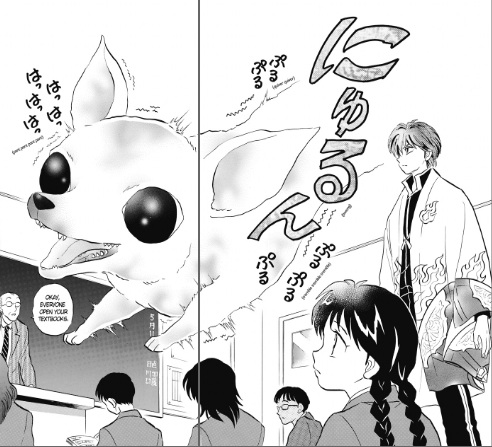
Sakura Mamiya and Rinne Rokudo, Rin-ne‘s oil-and-water leads, are a classic Takahashi pair: Sakura is a seemingly ordinary teenager with the ability to see ghosts, while Rinne is a hot-headed boy who’s part human and part shinigami. The two meet cute in Sakura’s tenth-grade classroom when Rinne arrives to claim his long-empty seat. “Looks like he made it,” Sakura whispers to a friend before realizing that she’s the only person who can see the tall, flame-haired boy in a fancy ceremonial robe. Sakura then watches Rinne  attempt to banish an enormous Chihuahua demon to the afterlife — an exorcism that goes horribly (and comically) awry when the dog’s spirit merges with the spirit of a love-starved teen. Now forced to contend with an even more powerful, angry ghost, Rinne uses Sakura to lure it to the Wheel of Reincarnation, an enormous portal that separates the material and spirit worlds.

…

Read More

Filed Under: Manga Critic Tagged With: Rumiko Takahashi, Shonen, shonen sunday, VIZ

Rin-Ne, Vol. 1

October 18, 2009 by Katherine Dacey

I read a Rumiko Takahashi manga for the same reason I watch an Alfred Hitchcock thriller: I know exactly what I’m going to get. Certain plot elements and motifs recur throughout each artist’s work — Hitchcock loves pairing a brittle blond with a rakish cad on the run from authorities, for example, while Takahashi loves pairing a female “seer” with a demonically-tinged boy — yet the craft with which Hitchcock and Takahashi develop such tropes prevents either artist’s work from feeling stale or repetitive. Takahashi’s latest series gives ample proof that while she may have a limited repertory, she’s the undisputed master of the supernatural mystery.

Sakura Mamiya and Rinne Rokudo, Rin-ne‘s oil-and-water leads, are a classic Takahashi pair: Sakura is a seemingly ordinary teenager with the ability to see ghosts, while Rinne is a hot-headed boy who’s part human and part shinigami. The two meet cute in Sakura’s tenth-grade classroom when Rinne arrives to claim his long-empty seat. “Looks like he made it,” Sakura whispers to a friend before realizing that she’s the only person who can see the tall, flame-haired boy in a fancy ceremonial robe. Sakura then watches Rinne  attempt to banish an enormous Chihuahua demon to the afterlife — an exorcism that goes horribly (and comically) awry when the dog’s spirit merges with the spirit of a love-starved teen. Now forced to contend with an even more powerful, angry ghost, Rinne uses Sakura to lure it to the Wheel of Reincarnation, an enormous portal that separates the material and spirit worlds.

rinne_chihuahua

After their dramatic introduction, Sakura and Rinne forge a reluctant partnership. Sakura provides material assistance and ethical guidance to Rinne, while Rinne banishes the spirits that plague Sakura’s high school. Sakura soon learns that Rinne’s grandmother, a shinigami, fell in love with a young man whose spirit she was sent to collect. In exchange for extending his life by fifty years, Rinne’s grandmother agreed to “fulfill her shinigami duties at ten times her usual quota.” When she failed to reach that target, Rinne was forced to enter the family trade, operating on the fringes of both the human and spectral worlds with limited ability to function in either realm — hence his weak exorcism skills.

Where, exactly, Takahashi plans to take the story is still something of a mystery. As she did with InuYasha, she’s using the first few volumes to establish the premise, explain how the Wheel of Incarnation works, and develop the chemistry between her lead characters by subjecting them to a host of unhappy spirits. The first eight chapters have a pleasant, spook-of-the-week feeling, as Sakura and Rinne tangle with a ghostly cell phone caller, a damashigami (a shinigami who meets his quota by luring innocent people to their deaths), and an ochimusa (a disgraced warrior). At the same time, however, Takahashi is clearly laying the groundwork for a more extended storyline, introducing several supporting characters, leaving key questions about Sakura’s past unanswered, and creating space for a Naraku-esque villain to fill.

The first volume’s leisurely pace also allows Takahashi plenty of room to showcase her comedic talents. Though InuYasha, Mermaid Saga, and Rumic World have canted more strongly towards horror, Rin-ne is decidedly humorous, incorporating supernatural elements into everyday settings in delightfully absurd ways. Takahashi’s demon Chihuahua is a great example: the demon continues to behave like a nervous, short-haired toy even after it grows to enormous size, and remains susceptible to the savory appeal of milk bones. Rinne’s grandfather is another example of the supernatural made ridiculous; as Rinne’s grandmother wistfully notes, her husband was reincarnated as a mackerel — the destiny for which he was slated when she fell in love with him.

Though utterly enjoyable, Rin-ne has its flaws. Takahashi relies a little too heavily on interior monologues to cue us into what’s happening; Sakura is frequently called upon to mutter, “So that’s why no one can see him!” even when the illustrations make it plain that Rinne is invisible to humans when he dons his flame-patterned haori. Takahashi isn’t above recycling bits from other works, either; Rokumon, a familiar introduced in chapter six, bears a strong resemblance to InuYasha‘s Shippo in both appearance and plot function, comic relief in the form of a child-like animal spirit. Sakura, too, seems more like a Kagome clone than a character in her own right, though she’s a little edgier and more skeptical than her jewel-seeking predecessor.

Still, it’s hard to dismiss a manga that’s crafted with as much skill and good humor as Rin-ne. The story and characters may remind readers of other works in the Takahashi canon, but that strikes me as a good thing — yet another opportunity to spend time with the kind of spunky heroines, rash-but-kind heroes, and oddball supporting characters that give Takahashi’s work its distinctive flavor.

Review copy provided by VIZ Media, LLC. Volume one of Rin-ne will be available on October 20, 2009.

RIN-NE, VOL. 1 • BY RUMIKO TAKAHASHI • VIZ • 182 pp. • RATING: OLDER TEEN (16+)

Filed Under: Manga, Manga Critic, REVIEWS Tagged With: Action/Adventure, Rumiko Takahashi, shonen sunday, VIZ

The Gentlemen’s Alliance Cross 10 by Arina Tanemura: C

October 16, 2009 by Michelle Smith

gentlemen's10After resolving some convoluted-sounding subplots involving Haine’s family—featuring maternal amnesia, uncertain paternity, and mansions afire—The Gentlemen’s Alliance Cross moves into the home stretch as Haine is pressed to finally choose between the identical twins with whom she is in love. Alas, just when she finally grasps the idea that the nice twin (Takanari) is probably a better choice than the scheming git (Shizumasa), he’s captured by his brother’s minions and imprisoned. Like any self-respecting shojo heroine, Haine vows to rescue him.

Being the penultimate volume of the series, volume ten offers a variety of dramatic moments and revelations, including arranged marriages, envelopes with surprising contents, and a tale of childhood betrayal that explains the current animosity between the twins. My favorite, though, is the surprise leukemia.

The end product of all these dire events tumbling one atop the other can be described as little else than a mess, and I was much more compelled to snicker at the ridiculous developments than sympathize with anyone involved. Still, I was pretty impressed by how easy it was to jump in and follow the story at this point and ended up liking Takanari, too, though I must question his taste in girls.

Review copy provided by the publisher. Review originally published at Manga Recon.

Filed Under: REVIEWS Tagged With: Arina Tanemura, shojo beat, VIZ

Vampire Knight 1-4 by Matsuri Hino: B-

October 14, 2009 by Michelle Smith

vampireknight1The first memory Yuki Cross can remember happened ten years ago when she was five: she’s attacked by one vampire but saved by another, the beautiful and pureblooded Kaname. Kaname brings the human girl to the home of a human he knows and his frequent visits throughout her childhood result in her growing very attached to him. Six years later, the introduction of a boy named Zero, sole survivor of a vampire attack against his vampire-hunting family, diverts Yuki’s attentions from Kaname somewhat, since she’s compelled to try to cure Zero of his misery and hatred. When Yuki’s adopted father decides to open Cross Academy as a way to foster peaceful relations between humans (the day class) and vampires (the night class), the three central characters attend, with Zero and Yuki serving as the disciplinary committee (tasked with keeping the peace as well as the secret about the true nature of the students in the night class) and Kaname as the main draw for the vampire contingent, since it turns out purebloods inspire devotion amongst their brethren.

vampireknight2Yuki still carries a torch for Kaname, even confesses to yearning for him, but she’s also very protective of Zero, especially when she learns his secret: as a result of the pureblood’s bite he suffered as a child, he’s turning into a vampire. What’s more, vampires that used to be humans are fated to go insane, at which time they’re hunted down by the vampire elite. Yuki, in earnest shoujo heroine fashion, declares that she will not let this happen and offers Zero her blood so that he may satisfy his cravings without preying on others. Kaname isn’t keen on this arrangement—uttering the gem of a line, “I can’t keep my composure when my dear girl has been pierced by someone else”—and knows he should rightly be preparing to hunt Zero down, but looks the other way because Zero’s the only one in the day class who could protect Yuki if danger should ensue. Aside from the introduction of the vampire responsible for killing Zero’s family, this is essentially where matters stand at the end of the fourth volume.

vampireknight3Thus far, Vampire Knight is an exceptionally pretty bowl of angsty soup that offers a sprinkling of legitimately good scenes amidst a broth of cheesy and/or eyeroll-inducing ones. Yuki is a big problem, since she is completely and totally ineffectual. She’s one of those types who’ll rush headlong into a dangerous scene, usually intent on helping, and make matters worse by getting attacked or having her anti-vampire gun plucked from her grasp within two seconds of her arrival. She’s got a special weapon—the Artemis Rod—and occasionally demonstrates feats of athletic prowess, but proves incapable of saving herself time and time again. One wonders why on earth this dismally dim girl has two hot vampire boys competing for her affections.

The boys are somewhat more compelling, though not exactly likable. Zero is perpetually unhappy and often sour in disposition, though Yuki’s fretting on his behalf occasionally inspires brief displays of affection. I don’t begrudge him his angst—he is turning into the thing he hates, after all—but his seemingly constant vampireknight4dilemma about whether to give up or try to keep living for Yuki’s sake doesn’t do much for me. Kaname, for his part, is refined yet inscrutable. Even dialogue like, “I can’t bear losing you. Ever.” doesn’t manage to convince me that he’s in any sort of real emotional turmoil. The enjoyable flashbacks in volume three help somewhat to establish his connection with Yuki, though not greatly.

And yet, Vampire Knight possesses attributes that make it not only readable, but also somewhat of a guilty pleasure. For one, the art is very lovely, with bishounen eye candy galore. It’s slathered with screen tone, something I don’t normally like, but that ultimately works well in cultivating a gloomy and oppressive mood. Too, Hino occasionally creates scenes of surprising sexiness and drama, like the first time Zero drinks Yuki’s blood or the shocking final pages in volume four. This series may be blatantly silly at times, but as long as my (awesome) local library continues to carry it, I’m likely to keep reading.

Filed Under: REVIEWS Tagged With: Matsuri Hino, shojo beat, VIZ

Boys Over Flowers: Jewelry Box by Yoko Kamio: B

September 28, 2009 by Michelle Smith

jewelryboxAfter Boys Over Flowers ended its serialization in 2003, Yoko Kamio published two follow-up stories—one about the wedding of Shizuka and another told from Rui’s perspective—that take place a year after the events of volume 36. These stories were released (along with some supplemental material) in 2008 as volume 37 of the series and immediately topped the shojo charts. VIZ has opted to give this volume the subtitle Jewelry Box instead.

The first story, in which Tsukushi and Tsukasa briefly reunite in France while attending Shizuka’s wedding, is a bit of a disappointment, since their first time seeing each other in a year is full of crazy derelicts trying to stab Tsukushi and Tsukasa calling her an idiot. The second story, though, is quite good, focusing on Rui and maintaining that lovely, melancholic air that he possesses. Rui is wondering whether he’ll ever fall in love again, and though he concedes that things with Tsukushi are over, there are still faint traces of his feelings remaining that spur him to do things for her that he’d do for no one else. Tsukushi and Tsukasa also meet up again in this story and, though fans are still denied an undeniably conclusive happy ending, there’s at least a strong suggestion of one.

The supplemental material is comprised of a series chronology, character growth analysis, quiz, and interview with Kamio. The chronology in particular is extremely helpful and furnished most of the facts in my first paragraph.

Fans of Boys Over Flowers shouldn’t expect anything earth-shattering in this release, but it’s worth the read and can serve as a handy resource, to boot.

Review copy provided by the publisher. Review originally published at Manga Recon.

Filed Under: REVIEWS Tagged With: VIZ, Yoko Kamio

  • « Go to Previous Page
  • Page 1
  • Interim pages omitted …
  • Page 14
  • Page 15
  • Page 16
  • Page 17
  • Page 18
  • Interim pages omitted …
  • Page 26
  • Go to Next Page »
 | Log in
Copyright © 2010 Manga Bookshelf | Powered by WordPress & the Genesis Framework