• Skip to primary navigation
  • Skip to main content
  • Skip to primary sidebar
  • Home
  • About Us
    • Privacy Policy
    • Comment Policy
    • Disclosures & Disclaimers
  • Resources
    • Links, Essays & Articles
    • Fandomology!
    • CLAMP Directory
    • BlogRoll
  • Features & Columns
    • 3 Things Thursday
    • Adventures in the Key of Shoujo
    • Bit & Blips (game reviews)
    • BL BOOKRACK
    • Bookshelf Briefs
    • Bringing the Drama
    • Comic Conversion
    • Fanservice Friday
    • Going Digital
    • It Came From the Sinosphere
    • License This!
    • Magazine no Mori
    • My Week in Manga
    • OFF THE SHELF
    • Not By Manga Alone
    • PICK OF THE WEEK
    • Subtitles & Sensibility
    • Weekly Shonen Jump Recaps
  • Manga Moveable Feast
    • MMF Full Archive
    • Yun Kouga
    • CLAMP
    • Shojo Beat
    • Osamu Tezuka
    • Sailor Moon
    • Fruits Basket
    • Takehiko Inoue
    • Wild Adapter
    • One Piece
    • After School Nightmare
    • Karakuri Odette
    • Paradise Kiss
    • The Color Trilogy
    • To Terra…
    • Sexy Voice & Robo
  • Browse by Author
    • Sean Gaffney
    • Anna Neatrour
    • Michelle Smith
    • Katherine Dacey
    • MJ
    • Brigid Alverson
    • Travis Anderson
    • Phillip Anthony
    • Derek Bown
    • Jaci Dahlvang
    • Angela Eastman
    • Erica Friedman
    • Sara K.
    • Megan Purdy
    • Emily Snodgrass
    • Nancy Thistlethwaite
    • Eva Volin
    • David Welsh
  • MB Blogs
    • A Case Suitable For Treatment
    • Experiments in Manga
    • MangaBlog
    • The Manga Critic
    • Manga Report
    • Soliloquy in Blue
    • Manga Curmudgeon (archive)

Manga Bookshelf

Discussion, Resources, Roundtables, & Reviews

shonen sunday

Introducing Shonen Sundays

June 7, 2010 by MJ 4 Comments

Yesterday saw the first posts in a new month-long series, Shonen Sundays, a joint project with Michelle Smith of Soliloquy in Blue. To quote her introductory post:

“MJ (of Manga Bookshelf) and I have often talked about our ardent love for shounen manga … Unfortunately, our conversations have been somewhat limited because neither of us has read the other’s favorite series. With that in mind, the idea for Shounen Sundays was born.

Here’s how it works: each Sunday in June, MJand I will post a review of a shounen manga that is new to us, two that are among the other’s favorites and two of our own choosing.”

Check out Michelle’s post for more.

This past weekend, I reviewed the first two volumes of Arata: The Legend …

Read More

Filed Under: NEWS Tagged With: shonen sunday

Arata: The Legend, Vols. 1-2

June 6, 2010 by MJ 12 Comments

Arata: The Legend, Vols. 1-2
By Yuu Watase
Published by Viz Media
Rated T (Teen)

In a world full of magic and gods, young Arata of the Hime Clan has been framed for the murder of his people’s beloved princess and is now on the run from her twelve godlike “protectors” who actually committed the crime. Arata Hinohara is a modern-day schoolboy just entering high school, where a bully from his past threatens to ruin the new friendships he’s just begun to form. When otherworld Arata flees into an enchanted forest in order to evade his pursuers, the two Aratas suddenly change places, each finding himself in a truly foreign world.

Though much of the story’s setup and look will be very familiar to fans of Watase’s well-known shojo epic Fushigi Yugi (and its currently-running prequel, Fushigi Yugi Genbu Kaiden), Arata: The Legend has considerable charm of its own. By exchanging her “schoolgirl in a strange land” for a schoolboy in a strange land, Watase plays right into her greatest strengths–period-inspired fantasy, action sequences, and pretty young men.

In otherworld Arata, Watase has inserted all the characteristics of the standard shonen hero. Brash, boyish, goodhearted, and strong, this Arata would be at home in nearly any shonen manga universe, protecting his loved ones with all his might. With modern-day Arata, however, she’s gone off the beaten path, at least to start.

Arata Hinohara is deeply scarred by the intense bullying that haunted him through junior high. Anxious not to stand out at his new high school, he hides his athletic abilities and avoids joining any clubs. He tentatively accepts the new friendships offered to him, but is wary of pushing them too far.

When, just a month into the new school year, the ringleader of his junior high misery suddenly joins his class, it’s a nightmare come true. And as his new friends abandon him, one by one, bitterness and cynicism take over his mind. Still, Arata’s raw hurt keeps him vulnerable, turning him not into a typical hard-as-nails loner (as much as he might wish it), but just a deflated, lonely boy who desperately needs someone to believe in him.

Though this may not be exactly profound, it’s a nice change of pace for a shonen adventure/fantasy and it goes a long way towards helping old material feel new again. With the first two volumes focusing heavily on Arata Hinohara, it will be interesting to see what Watase does with otherworld Arata in the next volume as he heads off for his first day at high school.

While Watase’s shojo fantasies have always featured a lot of action, this series allows her to really shine, with fights, chases, and weapons galore. There’s a natural, easy feel to the artwork in this series, even when compared to her other current work like Fushigi Yugi Genbu Kaiden, as though by choosing to draw shonen action heroes, she’s finally really hit her stride. Her gift for pretty, poignant faces is used to great advantage as well–something that surely can’t be hurting Weekly Shonen Sunday‘s crossover numbers.

Though Arata: The Legend may offer nothing truly new, its vulnerable hero and attractive, expressive artwork help to create a thoroughly enjoyable fantasy with a surprisingly fresh feel.

Review copy of volume two provided by the publisher.

Filed Under: MANGA REVIEWS Tagged With: arata: the legend, shonen sunday

Short Takes: Haunted House, Mermaid Saga, and School Zone

October 29, 2009 by Katherine Dacey

Boo! This week, I’m taking the highly imaginative step of writing about spooky manga. The twist? All three titles are penned by trailblazing female artists. First up is Mitsukazu Mihara’s Haunted House (Tokyopop), a comedy about a normal teen whose parents have clearly embraced Addams Family Values. Next on the agenda is Rumiko Takahashi’s Mermaid Saga (VIZ), an older series that mixes horror and folklore to good effect. (You can read the first chapter for free at the Shonen Sunday website.) And last but not least is Kanako Inuki’s School Zone (Dark Horse), a three-volume series about a school built atop a cemetery — always a bad idea, kids, even when the land is being offered at bargain-basement prices.

hauntedhouseHAUNTED HOUSE

BY MITSUKAZU MIHARA • TOKYOPOP • 192 pp. • RATING: OLDER TEEN (16+)

Remember that brief but excruciating period in your adolescence in which everything your parents said, did, or wore proved horribly embarrassing? Sabato Obiga, the hero of Haunted House, is living through that very stage. The crucial difference between his experience and yours, however, is that his family is genuinely odd: they look and act like something out of a Charles Addams cartoon, from their dramatic attire — Mom dresses like Morticia Addams, Dad like an undertaker — to their penchant for ghoulish pranks. Though Sabato desperately wants to date, his family members do their best to sabotage each new relationship by staging ridiculous scenes in front of his girlfriend du jour. In the first chapter, for example, Mom blithely picks up the family cat and announces that she’ll be “cooking something special on account of our guest,” while in a later chapter, his parents don hockey masks for a visit to the video store where he works. (Note to fellow animal saps: no cats were harmed in the making of this comic.)

…

Read More

Filed Under: Manga Critic Tagged With: Dark Horse, Josei, Mitsukazu Mihara, Rumiko Takahashi, Shonen, shonen sunday, Tokyopop, VIZ

Rin-Ne, Vol. 1

October 18, 2009 by Katherine Dacey

rinne1_coverI read a Rumiko Takahashi manga for the same reason I watch an Alfred Hitchcock thriller: I know exactly what I’m going to get. Certain plot elements and motifs recur throughout each artist’s work — Hitchcock loves pairing a brittle blond with a rakish cad on the run from authorities, for example, while Takahashi loves pairing a female “seer” with a demonically-tinged boy — yet the craft with which Hitchcock and Takahashi develop such tropes prevents either artist’s work from feeling stale or repetitive. Takahashi’s latest series gives ample proof that while she may have a limited repertory, she’s the undisputed master of the supernatural mystery.
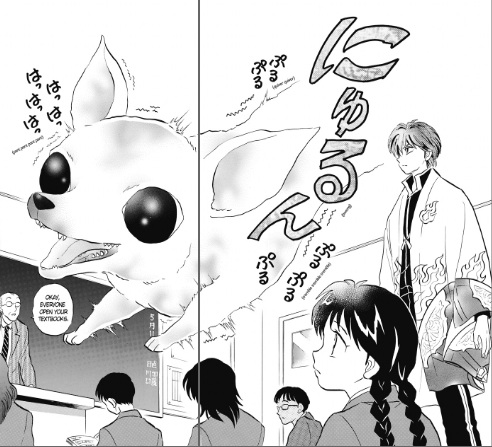
Sakura Mamiya and Rinne Rokudo, Rin-ne‘s oil-and-water leads, are a classic Takahashi pair: Sakura is a seemingly ordinary teenager with the ability to see ghosts, while Rinne is a hot-headed boy who’s part human and part shinigami. The two meet cute in Sakura’s tenth-grade classroom when Rinne arrives to claim his long-empty seat. “Looks like he made it,” Sakura whispers to a friend before realizing that she’s the only person who can see the tall, flame-haired boy in a fancy ceremonial robe. Sakura then watches Rinne  attempt to banish an enormous Chihuahua demon to the afterlife — an exorcism that goes horribly (and comically) awry when the dog’s spirit merges with the spirit of a love-starved teen. Now forced to contend with an even more powerful, angry ghost, Rinne uses Sakura to lure it to the Wheel of Reincarnation, an enormous portal that separates the material and spirit worlds.

…

Read More

Filed Under: Manga Critic Tagged With: Rumiko Takahashi, Shonen, shonen sunday, VIZ

Rin-Ne, Vol. 1

October 18, 2009 by Katherine Dacey

I read a Rumiko Takahashi manga for the same reason I watch an Alfred Hitchcock thriller: I know exactly what I’m going to get. Certain plot elements and motifs recur throughout each artist’s work — Hitchcock loves pairing a brittle blond with a rakish cad on the run from authorities, for example, while Takahashi loves pairing a female “seer” with a demonically-tinged boy — yet the craft with which Hitchcock and Takahashi develop such tropes prevents either artist’s work from feeling stale or repetitive. Takahashi’s latest series gives ample proof that while she may have a limited repertory, she’s the undisputed master of the supernatural mystery.

Sakura Mamiya and Rinne Rokudo, Rin-ne‘s oil-and-water leads, are a classic Takahashi pair: Sakura is a seemingly ordinary teenager with the ability to see ghosts, while Rinne is a hot-headed boy who’s part human and part shinigami. The two meet cute in Sakura’s tenth-grade classroom when Rinne arrives to claim his long-empty seat. “Looks like he made it,” Sakura whispers to a friend before realizing that she’s the only person who can see the tall, flame-haired boy in a fancy ceremonial robe. Sakura then watches Rinne  attempt to banish an enormous Chihuahua demon to the afterlife — an exorcism that goes horribly (and comically) awry when the dog’s spirit merges with the spirit of a love-starved teen. Now forced to contend with an even more powerful, angry ghost, Rinne uses Sakura to lure it to the Wheel of Reincarnation, an enormous portal that separates the material and spirit worlds.

rinne_chihuahua

After their dramatic introduction, Sakura and Rinne forge a reluctant partnership. Sakura provides material assistance and ethical guidance to Rinne, while Rinne banishes the spirits that plague Sakura’s high school. Sakura soon learns that Rinne’s grandmother, a shinigami, fell in love with a young man whose spirit she was sent to collect. In exchange for extending his life by fifty years, Rinne’s grandmother agreed to “fulfill her shinigami duties at ten times her usual quota.” When she failed to reach that target, Rinne was forced to enter the family trade, operating on the fringes of both the human and spectral worlds with limited ability to function in either realm — hence his weak exorcism skills.

Where, exactly, Takahashi plans to take the story is still something of a mystery. As she did with InuYasha, she’s using the first few volumes to establish the premise, explain how the Wheel of Incarnation works, and develop the chemistry between her lead characters by subjecting them to a host of unhappy spirits. The first eight chapters have a pleasant, spook-of-the-week feeling, as Sakura and Rinne tangle with a ghostly cell phone caller, a damashigami (a shinigami who meets his quota by luring innocent people to their deaths), and an ochimusa (a disgraced warrior). At the same time, however, Takahashi is clearly laying the groundwork for a more extended storyline, introducing several supporting characters, leaving key questions about Sakura’s past unanswered, and creating space for a Naraku-esque villain to fill.

The first volume’s leisurely pace also allows Takahashi plenty of room to showcase her comedic talents. Though InuYasha, Mermaid Saga, and Rumic World have canted more strongly towards horror, Rin-ne is decidedly humorous, incorporating supernatural elements into everyday settings in delightfully absurd ways. Takahashi’s demon Chihuahua is a great example: the demon continues to behave like a nervous, short-haired toy even after it grows to enormous size, and remains susceptible to the savory appeal of milk bones. Rinne’s grandfather is another example of the supernatural made ridiculous; as Rinne’s grandmother wistfully notes, her husband was reincarnated as a mackerel — the destiny for which he was slated when she fell in love with him.

Though utterly enjoyable, Rin-ne has its flaws. Takahashi relies a little too heavily on interior monologues to cue us into what’s happening; Sakura is frequently called upon to mutter, “So that’s why no one can see him!” even when the illustrations make it plain that Rinne is invisible to humans when he dons his flame-patterned haori. Takahashi isn’t above recycling bits from other works, either; Rokumon, a familiar introduced in chapter six, bears a strong resemblance to InuYasha‘s Shippo in both appearance and plot function, comic relief in the form of a child-like animal spirit. Sakura, too, seems more like a Kagome clone than a character in her own right, though she’s a little edgier and more skeptical than her jewel-seeking predecessor.

Still, it’s hard to dismiss a manga that’s crafted with as much skill and good humor as Rin-ne. The story and characters may remind readers of other works in the Takahashi canon, but that strikes me as a good thing — yet another opportunity to spend time with the kind of spunky heroines, rash-but-kind heroes, and oddball supporting characters that give Takahashi’s work its distinctive flavor.

Review copy provided by VIZ Media, LLC. Volume one of Rin-ne will be available on October 20, 2009.

RIN-NE, VOL. 1 • BY RUMIKO TAKAHASHI • VIZ • 182 pp. • RATING: OLDER TEEN (16+)

Filed Under: Manga, Manga Critic, REVIEWS Tagged With: Action/Adventure, Rumiko Takahashi, shonen sunday, VIZ

  • « Go to Previous Page
  • Page 1
  • Page 2
 | Log in
Copyright © 2010 Manga Bookshelf | Powered by WordPress & the Genesis Framework