• Skip to primary navigation
  • Skip to main content
  • Skip to primary sidebar
  • Home
  • About Us
    • Privacy Policy
    • Comment Policy
    • Disclosures & Disclaimers
  • Resources
    • Links, Essays & Articles
    • Fandomology!
    • CLAMP Directory
    • BlogRoll
  • Features & Columns
    • 3 Things Thursday
    • Adventures in the Key of Shoujo
    • Bit & Blips (game reviews)
    • BL BOOKRACK
    • Bookshelf Briefs
    • Bringing the Drama
    • Comic Conversion
    • Fanservice Friday
    • Going Digital
    • It Came From the Sinosphere
    • License This!
    • Magazine no Mori
    • My Week in Manga
    • OFF THE SHELF
    • Not By Manga Alone
    • PICK OF THE WEEK
    • Subtitles & Sensibility
    • Weekly Shonen Jump Recaps
  • Manga Moveable Feast
    • MMF Full Archive
    • Yun Kouga
    • CLAMP
    • Shojo Beat
    • Osamu Tezuka
    • Sailor Moon
    • Fruits Basket
    • Takehiko Inoue
    • Wild Adapter
    • One Piece
    • After School Nightmare
    • Karakuri Odette
    • Paradise Kiss
    • The Color Trilogy
    • To Terra…
    • Sexy Voice & Robo
  • Browse by Author
    • Sean Gaffney
    • Anna Neatrour
    • Michelle Smith
    • Katherine Dacey
    • MJ
    • Brigid Alverson
    • Travis Anderson
    • Phillip Anthony
    • Derek Bown
    • Jaci Dahlvang
    • Angela Eastman
    • Erica Friedman
    • Sara K.
    • Megan Purdy
    • Emily Snodgrass
    • Nancy Thistlethwaite
    • Eva Volin
    • David Welsh
  • MB Blogs
    • A Case Suitable For Treatment
    • Experiments in Manga
    • MangaBlog
    • The Manga Critic
    • Manga Report
    • Soliloquy in Blue
    • Manga Curmudgeon (archive)

Manga Bookshelf

Discussion, Resources, Roundtables, & Reviews

Manga Moveable Feast

Usamaru Furuya Manga Moveable Feast: Roundup Three

January 28, 2012 by Ash Brown

© Usamaru Furuya

We’re nearing the end of the Usamaru Furuya Manga Moveable Feast, so here’s the third roundup to help you catch up with what’s been going on these last couple of day!

I posted two reviews here at Experiments in Manga. One for the first volume of Short Cuts, which I thought was hilarious, and one for the first volume of Genkaku Picasso. Personally, I find Genkaku Picasso, Volume 1 to be one of Furuya’s weaker manga, but it’s still intriguing and the next two volumes in the series do improve.

At A Case Suitable for Treatment (now a part of the Manga Bookshelf network), Sean Gaffney reviews both volumes of Short Cuts, his first exposure to Usamaru Furuya’s work:

It takes on a lot of funny subjects, especially the kogal movement in Japan, but it’s never mean about them. You get the feeling that Furuya likes these girls, and is rooting for them. And we do as well.

Lori Henderson of Manga Xanadu returns to the Feast, this time with a review of Genkaku Picasso, Volume 1, having first read a preview in Shonen Jump, but only now reading the entire volume:

What makes Genkaku Picasso work so well are its characters. Furuya has created a quirky lead with a cast of characters to match. Hikari Hamura, aka Picasso, so named for a spelling error and his love of drawing, is a fun yet endearing lead.

Kristin Bomba, writing for Comic Attack, takes a look at Furuya’s No Longer Human, Volume 2:

Furuya has a wonderful ability to illustrate the human condition, in particular the darker parts of it, making No Longer Human an excellent read.  I can’t say it’s for everyone […] but if you want a good story that is so fantastical it feels absolutely real, a story of one person’s struggle to do more than exist, then be sure to check this series out.

MJ and Michelle Smith also discuss No Longer Human as part of a regular feature at Manga Bookshelf, “Off the Shelf”. They have a marvelous conversation addressing Furuya’s artistry and the women in Yozo’s life among other topics:

Disaster is clearly just around the corner, in the same sure way as you’d expect in, say, a Dickens novel. Yoshino is doomed just as it seems Oba is truly doomed, and nobody’s even trying to hide it. Furuya makes the most of this, too.

And there we have it…for now! Tomorrow is the final day of the Feast and there will be one last wrap up post before it’s done. Please let me know of any Feast content that I might have missed so that I can include it in the archive. Please enjoy the rest of the Feast!

Filed Under: UNSHELVED Tagged With: Manga Moveable Feast, Usamaru Furuya

Genkaku Picasso, Volume 1

January 27, 2012 by Ash Brown

Creator: Usamaru Furuya
U.S. publisher: Viz Media
ISBN: 9781421536750
Released: November 2010
Original release: 2009

After a seven year drought, Genkaku Picasso became the first in a (very small) flood of new titles by Usamaru Furuya to be translated into English. The first volume of Genkaku Picasso was released in Japan in 2009; the entire series was originally serialized in the manga magazine Jump SQ between 2008 and 2010. The English edition of Genkaku Picasso started publication in 2010. Once again, it was Viz Media that brought Furuya’s work to English-reading audiences, having previously published Short Cuts and excerpts from his debut manga, Palepoli. I’ve had Genkaku Picasso sitting on my shelf for quite some time, but it’s only now for the Usamaru Furuya Manga Moveable Feast that I’ve finally gotten around to reading it. Furuya is well known for his work in underground and alternative manga, but Genkaku Picasso is one of his more mainstream series.

Hikari Hamura, nicknamed Picasso by his classmates (much to his frustration), would much prefer that everyone would just leave him alone to his drawing. However, after a strange accident leaves him with the even stranger ability to visualize the contents of another person’s heart, Picasso must learn to use his artistic talents to help others or else he’ll rot away. Drawing what he sees, he can dive into the artwork and their subconscious. The problem is that the visions aren’t particularly straightforward. That and Picasso doesn’t really feel like reaching out to others and is much more comfortable keeping to himself. It’s not easy, and there tends to be quite a few misunderstandings, but Picasso doesn’t seem to have much of a choice. He might not want to, but he has to get to know his classmates better even if he does find them and the prospect terribly annoying.

One of the things that impresses me the most about Furuya’s work as whole is that he deliberately creates a particular aesthetic to fit an individual manga and story. In the case of Genkaku Picasso, Furuya primarily uses two different art styles. The first, representing reality, is a more mainstream, slightly stylized manga style which utilizes screentone and such. The other is based on the approach of pencil sketches and includes hand shading techniques and crosshatching. Used for Picasso’s artwork and the characters’ subconsciouses, it is also a reflection of Furuya’s own fine arts background. I find it interesting that the more realistic style is used to capture the unreal in Genkaku Picasso while the comic style is used to show the ordinary. Granted, even Picasso’s “ordinary” is slightly off-balance and surreal, which the artwork helps to show.

I wouldn’t exactly say that I was disappointed with the first volume of Genkaku Picasso, but I didn’t find it nearly as captivating or compelling as the other works of his that I have read. I really like the premise of the series, but after one volume I haven’t been convinced by the manga itself, yet. I feel like it wants to be deep and profound, but the first volume somehow comes across as superficial, even when Picasso is delving into the supposed darkness of other people’s hearts. The problems are resolved too quickly and easily. Still, there are plenty of elements in Genkaku Picasso that I enjoy. Although there hasn’t been much real development yet, I do like the characters. Picasso and his classmates Sugiura and Akane make an amusing trio (quartet if you count Chiaki). Genkaku Picasso also has a quirky sense of humor that shows up frequently. Picasso’s social awkwardness (mostly self-imposed) and bluntness is delightfully endearing. So while I may not have been overwhelmed by the first volume of Genkaku Picasso, it does intrigue me and I do want to continue on with the series.

Filed Under: REVIEWS Tagged With: genkaku picasso, manga, Manga Moveable Feast, Shonen Jump, Usamaru Furuya, viz media

Off the Shelf: No Longer Human

January 27, 2012 by MJ and Michelle Smith 10 Comments

MICHELLE: This month’s Manga Moveable Feast, currently in progress, is devoted to the works of Usamaru Furuya, prompting MJand me to devote this week’s column to the most recent of his series to see publication in English, No Longer Human.

Based on a book by Osamu Dazai that’s described as “a decadent novelist’s autobiographical masterpiece,” No Longer Human depicts the story of Yozo Oba, a young man with no comprehension of what it feels like or how to be an ordinary person. We first meet him as a high school student, where he has learned that being the class clown is the one thing that enables him to connect to his classmates.

Soon he falls in with a group of misfits plotting political rebellion, but he’s more comforted by being among outsiders than he is honestly devoted to their cause. There, he meets the first of several women who will be drawn to him and agree to feed and care for him. This becomes his pattern in life. By the middle of the second volume, he’s twenty and living with a much older woman while drawing a gag manga and helping out at the bar she owns. He realizes that he’s “a genius parasite on women,” but sees that as his only option left to survive.

MJ: As in most “decadent masterpieces,” Oba’s excesses drive him deeper and deeper into tragedy, as he drinks and sleeps his way from one safe haven to another, usually leaving the women who care for him in significantly worse condition than he found them (and in one case, even dead). The narrative lets us know that things are only going to continue to get worse, yet it’s impossible to look away.

Though there have since been at least two other graphic novel adaptations of Dazai’s original, where Furuya goes very much right, in my opinion, is in his decision to move the pre-WWII story into the present, which I think is at least partially responsible for his ability to present such a self-indulgent tragedy in a way that makes it genuinely readable. I realize the original is a classic, but I feel like the novel might suffer more from a contemporary reading than Furuya’s adaptation does.

(click images to enlarge)

Note: No Longer Human reads from left-to-right

MICHELLE: I was surprised by just how readable it was, actually. Just looking at the plot, you’d expect it to be depressing, but it’s so skillfully done that I enjoyed it very much! But yes, you’re absolutely right that updating the story was a smart choice, especially as it enabled a bit of self-insertion on Furuya’s part. Ordinarily, I’m kind of annoyed when mangaka break the fourth wall—particularly if they do so in a silly way—but here, Furuya’s interludes of discovering and being transfixed by Oba’s story are absolutely essential in setting the mood. We feel like he’s captivated right along with us.

MJ: Yes, he’s sort of sharing it with us like a guilty pleasure, and it really works as one. I think the story benefits greatly from being presented as an outrageous internet diary that’s impossible to stop reading. There’s something about this story that makes me feel like I’ve stayed up all night reading, strung out on caffeine and cheese puffs, and, frankly, that really suits it. I kind of wish I’d read it like that for real, actually.

Talking about it like this, it would be easy to gloss over Furuya’s artistry, though, which is put to pretty spectacular use in this series, wouldn’t you agree?

MICHELLE: I can imagine the back cover blurb now. “It had me craving cheese puffs.” – MJ, Manga Bookshelf

As for Furuya’s artistry, I whole-heartedly agree. His talent was on prodigious display in Genkaku Picasso, the only other series of his that I’ve read, but it really suits a darker story like this one.

I was particularly struck by the depictions of Oba as a marionette controlled by his father’s money and/or putting on a show for his peers. It’s such a vivid symbol of someone going through the motions of trying to be normal! And even though Furuya occasionally uses some symbolism that might seem overly obvious—like the surfeit of bugs lurking beneath the petals of the flowers Oba admires with his fiancée (we must return to this point)—it’s done with such finesse that it doesn’t seem trite.

MJ: My previous experience with Furuya has consisted only of Lychee Light Club, which I found visually striking on a nearly theatrical level, but juvenile and kind of emotionally empty. It’s nice to see his gifts utilized so differently here. There was a lot of sexually-charged violence in Lychee Light Club, and certainly there’s no lack of sexual themes in No Longer Human, but it’s approached so differently… it really feels like a much more mature work.

MICHELLE: I did wonder how this compared to Lychee, which I still need to read.

I wanted to ask… did you find the sexual content as supremely unsexy as I did? Beyond not being idealized at all, there are some closeups of things like twirling tongues that look downright disgusting, almost like something drawn by Junji Ito! I wonder if this is Furuya’s way of depicting the impure motives of Oba in these situations. It would be completely out of place to portray what he’s doing as titillating, let alone dreamy.

MJ: I don’t know if I’d say that I found it supremely unsexy, but it definitely does not read as something that’s supposed to be titillating. It’s interesting, too, even though the character confesses early on that his frequent, semi-anonymous sexual encounters are the only things that make him feel good (“When I’m here seems like the only time the smile on my face in genuine”), from the reader’s perspective, he seems just as detached during those trysts as he is the rest of the time. I almost feel like he’s fooling himself when he says that, and that this is reflected in Furuya’s artwork.

MICHELLE: There’s definitely a lot of emphasis on what makes Oba comfortable in a relationship. With the ladies in the “massage parlors,” it’s because he doesn’t have to use any subterfuge. With the members of the political group, it’s because everyone is a misfit in some way. And the two loving/honestly affectionate relationships he has are with women who exhibit a sort of elegant melancholy. Outsiders themselves, in a way.

But speaking of fooling himself, what on earth is going on with the abrupt change in the end of volume two?! Oba has maintained all along that he has no interest in and cannot fathom embarking upon ordinary relationships, and yet here he is, falling in love with and ultimately proposing to a virginal girl who works in a smoke shop. I’m sure he’s got an idealized version of her, but man, I just wanted to shake her and go, “Yoshino, no!” That poor girl is in for a very rude awakening. What will be her price for associating with Oba?

MJ: Yes, disaster is clearly just around the corner, in the same sure way as you’d expect in, say, a Dickens novel. Yoshino is doomed just as it seems Oba is truly doomed, and nobody’s even trying to hide it. Furuya makes the most of this, too. I’m glad you mentioned that last page in the volume, with a swarm of insects seemingly prepared to devour a flower. It’s a melodramatic image, I suppose, but so perfect for the tone of the story.

MICHELLE: Exactly! He just seems so much like a different person here from his behavior, which is emphasized by the drastic haircut Furuya has given him. It really comes out of nowhere, narratively speaking, but I have faith that Furuya is going to make it all make sense in the end. I suppose it helps knowing that, theoretically, all of this did happen to the same protagonist in the original novel (and in the life that it’s based upon?).

MJ: Well, I don’t know if I’d say he feels like a different person, but definitely a different version of a person who keeps reinventing himself over and over, in order to survive. Or perhaps I should say, “in order to survive without having to ever put himself out or curb his own desires,” because really, that’s what his survival is about. So here he is, seemingly falling in love for real for the first time ever, yet in a way, what I see is a guy who has finally figured out how to reinvent himself on the inside–enough to fool even himself. And really, that can’t go well.

MICHELLE: Maybe it’s all the drinking he’s doing that’s enabling him to fool himself to such an extent, to actually believe in one of these personas he’s crafted for himself. And I think there’s a line in there, too, about how living with Mama (do we ever learn her real name?) is so peaceful and great that he starts to believe that all the world is the same. But ultimately, he’s still pursuing the kind of parasite arrangement that’s been sustaining him the past few years, but viewing it through the illusion of love.

MJ: And in a way, maybe that’s the only direction he could really go at this point. After having finally become too disgusted even with himself in his usual arrangements, he’s gotten by with Mama (no, I don’t think we know her real name) because she lets him off the hook so completely. He’s able to be a child, a lover, an employee, whatever, but ultimately she’s just letting him play at those roles without expecting him to be any of them.

He can’t go back to what he was exactly, so what else would he do but move on to something he could play at wholeheartedly with someone who is unlikely to notice? Yoshino’s lack of experience makes her the perfect fit for this phase, because she won’t burst his bubble, at least not for a while.
MICHELLE: And I’m sure she’ll temporarily inspire him to clean up his act—stop drinking, stop blowing the income he makes from his manga—but it just can’t last long. And maybe one could look at that like a good thing, but I kind of hate him for inflicting himself on her. It’s like, what he sees as the best thing that’s ever happened to him, I see as the worst thing he’s ever done.

MJ: Yeah, I agree. Not that the other women have deserved him or anything, but to some extent they’ve enabled him by giving in to their own issues and insecurities. They’ve knowingly let him manipulate them (even if they hid it from themselves as best they could), but Yoshina isn’t worldly enough to grasp what’s happening or what kind of guy he is. And on some level, he knows that, and is taking advantage of it.

I feel almost cruel, not giving him any benefit of the doubt here, but the guy hasn’t given me anything else to work with!

MICHELLE: Whereas I don’t feel cruel at all! He’s been very frank about his own shortcomings and survival tactics throughout.

I rather wish I knew more about the source material or the other adaptations, so as to pinpoint which elements have been introduced by or presented best by Furuya, but on the other hand, I don’t want to muddy my mind with other versions of the story when I like this one so much.

MJ: I admit I suspect I wouldn’t have much patience for the novel at this point in my life. There was a time when I really loved self-indulgent tragedy, but those days are long past. I think Furuya’s wry adaptation may be exactly the thing for me now, and I feel content to leave it at that, at least for the moment. Perhaps I’ll change my mind after I’ve read the end. I’m pretty anxious to read volume three at this point.

MICHELLE: So am I! And I think I’m going to go back and read Lychee soon, too. I was unsure about it, but now I feel confident I could admire it, even if it doesn’t reach the heights of No Longer Human. Too bad CMX folded before they could release any of 51 Ways to Save Her.

MJ: I’m regretful about that now, too. Let’s hope someone else picks it up soon!

For more Furuya talk, be sure to check out this month’s Manga Moveable Feast, hosted by Ash Brown at Experiments in Manga.

All images Copyright © Usamaru Furuya 2009, Translation Copyright © 2011 Vertical, Inc.

Filed Under: OFF THE SHELF Tagged With: Manga Moveable Feast, MMF, no longer human

Usamaru Furuya Manga Moveable Feast: Roundup Two

January 26, 2012 by Ash Brown

© Usamaru Furuya

We’re about halfway through the Usamaru Furuya Manga Moveable Feast, so it’s time for the second roundup!

Here at Experiments in Manga I posted a review for Secret Comics Japan, a manga anthology that includes excerpts from Furuya’s debut manga Palepoli. The review is for the volume as a whole, but I do briefly mention Palepoli in it. The last Wednesday of every month I run a manga giveaway. In order to coordinate with the Feast, January’s giveaway is for Genkaku Picasso, Volume 1. All you have to do to enter is tell me how you were introduced to Usamaru Furuya and his work. My giveaways are always open world-wide, so I hope you’ll enter! I also made a (shocking!) confession: I volunteered to host the Usamaru Furuya Manga Moveable Feast before I had even read any of his manga.

Jim Hemmingfield was kind enough to contribute a guest post for the Feast at Experiments in Manga. (This is a first for the site, so I was particularly excited about it.) Jim provides a terrific overview of Furuya’s manga, including works that have yet to be licensed in English. Furuya is one of Jim’s favorite mangaka. It’s a long post, but worth reading. To quote briefly the end of the article:

Usamaru Furuya is a unique and visionary artist; probably one of the finest artists you will find working in comics today and I hope this feast helps to spread the word.

Over at Manga Xanadu, Lori Henderson reviews the first two volumes of No Longer Human. Lori didn’t originally plan to read the series, but found it to be a manga worthy of recommendation:

I wasn’t going to read No Longer Human. I’m one of those people who hears “literary classic”, and my brain shuts down. I’ve never been big on the drama and tragedy that usually permeates these kinds of books, but I’m making an effort to “expand my horizons”, so I decided to at least give the first volume a chance. What I found was a compelling human drama that didn’t feel like homework at all.

Linda of Animemiz’s Scribblings takes time to reflect on having a limited exposure to Usamaru Furuya and his works. Linda briefly looks at Lychee Light Club and Sion Sono’s film Love Exposure, in which Furuya plays the role of the leader of the Zero Church cult. In the post, Linda makes the following comment, which I couldn’t agree with more:

If there were any live action movies adaption that would reflect the vision from my limited exposure to Furuya works, then Shion Sono should be the right candidate.

At Completely Futile, Adam Stephanides reviews the first two volumes of Furuya’s The Children’s Crusade which just recently finished serialization in Japan. It hasn’t been licensed in English yet, but I sincerely hope that it will be!

The characters’ lively, expressive faces as drawn by Furuya contribute substantially to the characterizations. And the art in general is excellent, both in visual storytelling and page design, and is frequently cinematic in scope and detail. Furuya isn’t particularly well known for his action scenes, but the ones here are dynamic.

The Feast is well under way and there have been some wonderful contributions. If you can’t wait for the next roundup, be sure to keep an eye on the archive page—I update it as soon as I learn about a new article or review. And if I’ve missed something, please let me know!

Filed Under: UNSHELVED Tagged With: manga, Manga Moveable Feast, Usamaru Furuya

Guest Post: An Examination and Appreciation of the Works of Usamaru Furuya

January 25, 2012 by Ash Brown

As the host of the Usamaru Furuya Manga Moveable Feast, I am delighted to welcome Jim Hemmingfield to Experiments in Manga as a guest writer. I am absolutely thrilled that Jim agreed to contribute to the Feast!

Jim Hemmingfield is a manga fan who lives in London. He’s been collecting manga since the early 90s and is mainly interested in the more alternative artists. He would like to blog more but hardly has any time. Occasionally he posts to the Same Hat Tumblr. You can also find him on Twitter @jimhemmingfield.

* * *


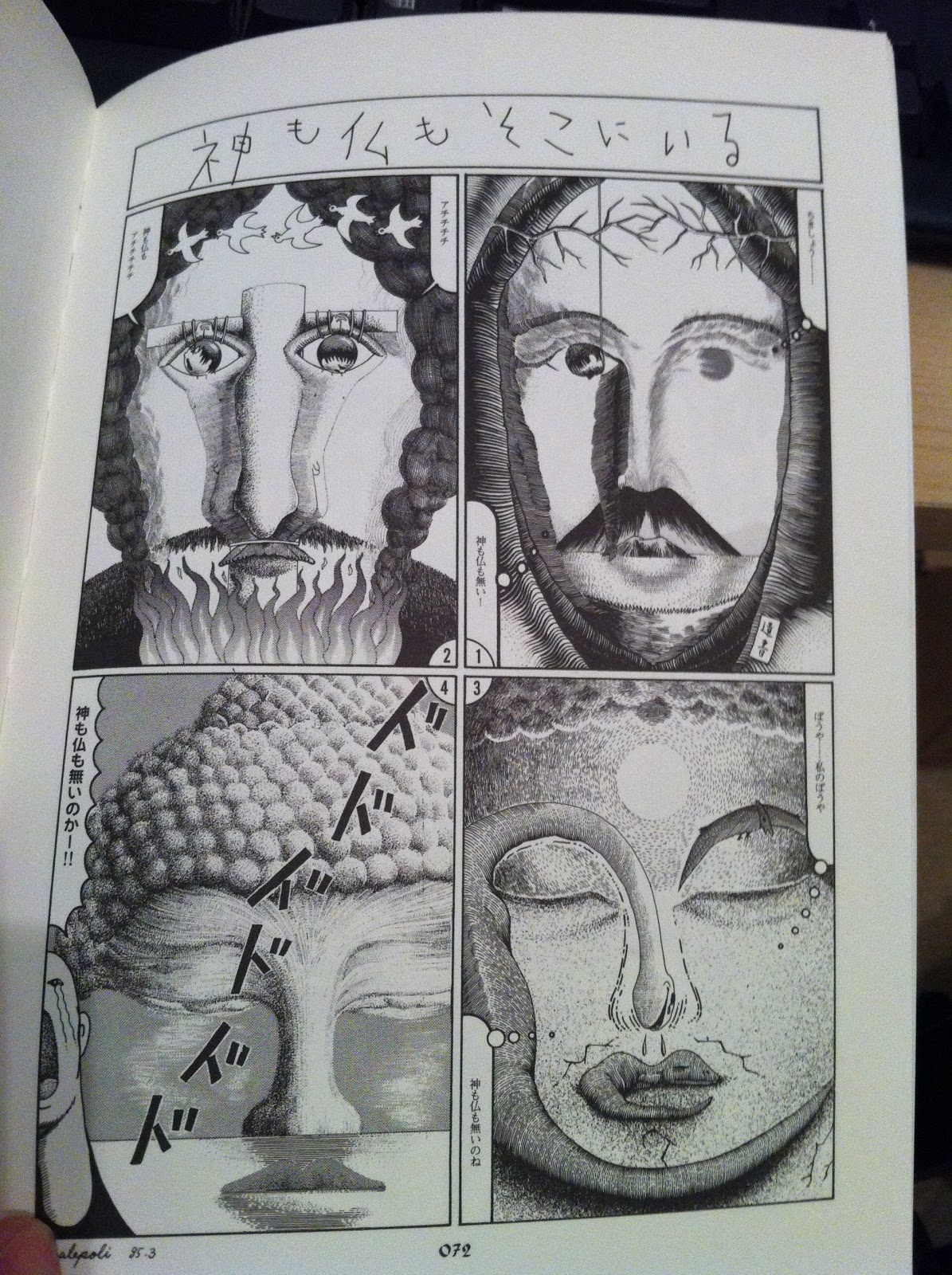
A page from Palepoli

Out of all the manga-ka to see the light of day in the US, Usamaru Furuya is certainly the most idiosyncratic; or, at least, the most versatile in his idiosyncrasies. He also seems to be one of the more successful of the alt-manga crowd in the US due to a recent resurgence of titles being released. It would, however, be an injustice to simply tag Furuya as an alt-manga artist. Instead, Usamaru Furuya is a unique creator, as happy to work in the mainstream as he is in the underground. It’s fairly common for manga-ka to produce works for different demographics (Shonen, Shojo, Seinen etc.) but I’m not sure that many have pushed the boundaries like Furuya; and, if they have, they haven’t made it to our shores. I’d go so far as to say, without learning Japanese (or possibly French?) you would be hard pressed to find such a versatile and individual manga-ka as Furuya. The only travesty is that we still haven’t had a chance to witness some of his finest moments.

A bit of background on Furuya is necessary to understand how he managed to achieve this standing. In the book Manga (published by Taschen, edited by Julius Wiedemann and Masanao Amano) there is a DVD which includes an interview with Furuya, detailing both his background and career. Whilst at Elementary School and Junior High, Furuya enjoyed drawing manga and began to submit illustrations to magazines. Unlike so many manga-ka’s stories who begin cartooning early and never stop, Furuya’s interest in manga dwindled throughout High School and College. Furuya states at this stage became less interested in manga and had little exposure to it.

Instead, he developed an interest in fine arts and theatre. He majored in oil painting at College and began to act in theatre at the same time. From here he became interested in dance, taking his inspiration from Saburo Teshigawara. His interests at this point, he says, were using his body to express. He also became interested in mono-ka, an art movement that I can find no information about online, which Furuya says is similar to the Italian Arte Povera. This is a type of 3D art, such as installations, and that was the type of art Furuya was most interested in creating around that time.

These interests continued after College. Furuya would continue to perform experimental dances which would incorporate less and less movement, to the point that they could hardly be described as dance. He would also display 1 or 2 3D pieces per year in galleries. As creating these pieces took such a long time, Furuya began to take on additional work, doing illustrations for text books, such as drawings of insects and plant photosynthesis. When he started doing this Furuya’s love of drawing was reignited. He believes that when he went to college drawing is what he really wanted to do but he was distracted by the new ways of expression he discovered and was possibly influenced by peers and tutors to pursue them leading him away from illustration. Whatever the cause, if not for the uncommon path Furuya travelled, his manga would probably not be as unique and interesting as they are.

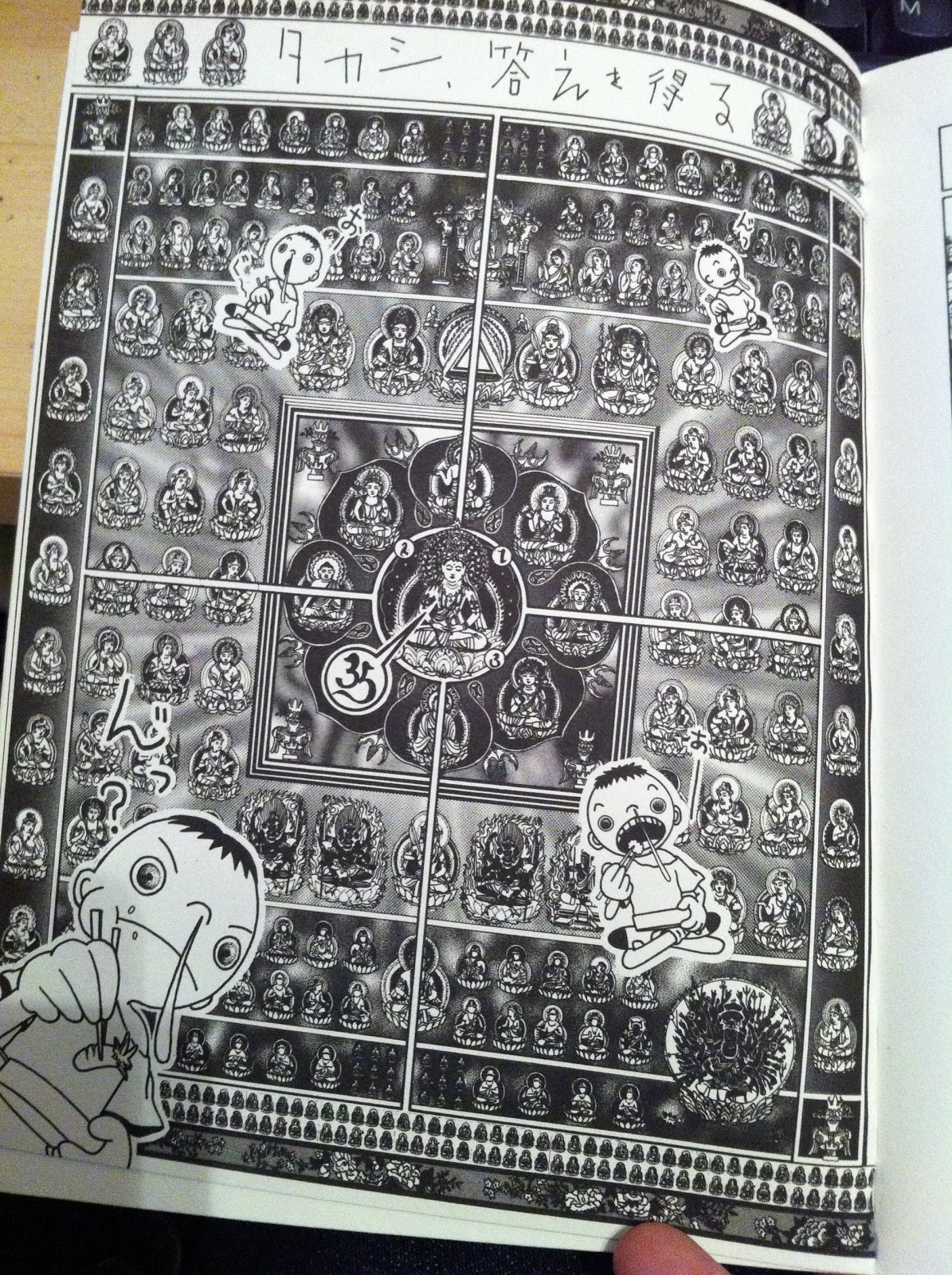
Furuya was 24 when he began producing his first manga, Palepoli, which was serialised in the seminal underground manga anthology Garo. Palepoli was my second exposure to Furuya’s work, in the sadly now out of print Secret Comics Japan (published in 2000 by Viz). Palepoli is a Yonkoma style manga, generally a gag strip, always consisting of four panels. Furuya started with this format as he was only starting out and was nervous about creating a longer narrative. He says that he also tried to take the fundamentals of art to create a manga and that he would take an entire day to draw one frame, meaning each page would take four days to complete. Unlike traditional Yonkoma, which consist of four horizontal panels that read top to bottom, Furuya had Palepoli set out like a four panel grid. Furuya’s art background, coupled with the amount of time he spent on each page, meant that, although some strips would ape traditional manga styles, most of the strips had a unique, highly detailed and stylised look. The gags, although funny, dealt with a variety of dark, disturbing and occasionally grotesque subject matter. Also, some of the formalism on display, such as the trick drawings which look like one thing close up but another from further away, makes for some breathtaking artistry. I’m surprised one of these strips didn’t make it into Secret Comics Japan. A lot of Palepoli has a very unique Japanese-ness to it but the surreal-ness and artistry of the work overall makes me think it would be accepted and appreciated by both mature manga readers and the art comix crowd. Out of all of Furuya’s unpublished works Palepoli is the one I would like to see the most. I’m lucky enough to own a Japanese copy which, although I don’t understand, gives me tremendous enjoyment to look through but the idea of owning a fully translated copy would really make my day.

Another of Furuya’s earlier experimental pieces was Plastic Girl, which is also high on my list of Furuya titles I would love to see licensed. Plastic Girl is unlike any other manga I’ve seen and, like Palepoli, would go down well with the alternative, art comix crowd. Unlike most manga, Plastic Girl is a full colour book, published in a large size and clocking in at a slender 46 pages. Again, Furuya employs his art background to craft an amazingly beautiful book, using a variety of different styles and utilising different materials for each section including painting on wood, cloth and canvas. The book has 23 different chapters, each spread over two pages and Furuya employs different styles for most (occasionally some are repeated). My personal favourite is one that is painted to look like 2 stained glass windows. All of it is gorgeous and, from what I can gather, the narrative is symbolic, surreal and occasionally disturbing, like many of Furuya’s works. (There is a review from someone who can read Japanese at Completely Futile). Unfortunately, though the imagery is fairly tame for the most part, I can see this being a hard sell in the west as it differs so much from the general perception of manga. I definitely can’t see it being picked up by any of the major manga publishers.

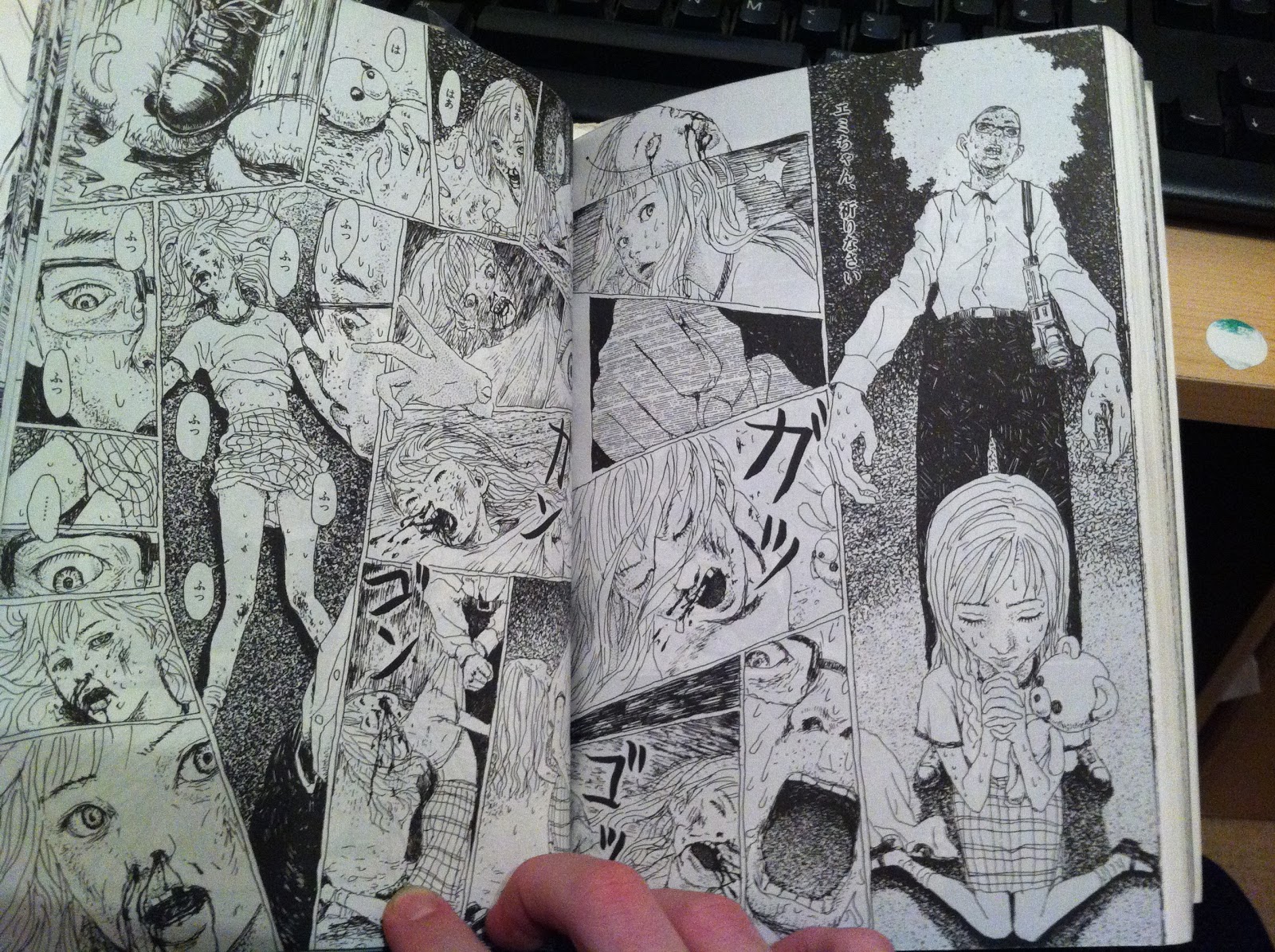
“Emi-chan” from Garden

Palepoli and Plastic Girl are probably Furuya’s most artistic and experimental books, but that’s not to say his other works aren’t also worth exploring. There are several unlicensed works that look like they would be far more interesting than the majority of manga licensed in the US. His short story collection Garden, which contains several stories of differing length, collected from alternative publications Comic Cue and Manga Erotics, is possibly more conventional in terms of the art and layout overall, although Furuya continues to switch up his style for each story. He also continues to explore the darker side of the human psyche as well as inserting comical stories and ones that look as though they are more fantasy orientated. The last story in particular, although I have only seen it in its original Japanese, plumbs some of the darkest depths of Furuya’s mind. It makes for a disturbing read (even without being able to understand the dialogue) but the shaky line Furuya uses fits the mood perfectly. The story is so extreme that in the original tankobon the pages are sealed together. The reader has the choice as to whether or not they wish to cut open the pages in order to read it. It is broke up into several sections so if it gets to extreme you do not need to continue. I’m unsure if this was Furuya’s choice or the publishers but it is an interesting choice. I have actually seen this in one other book, King Terry’s Heta-Uma Dictionary, although the sealed pages are no more shocking than the rest of the book (i.e. not really shocking at all) unlike the work in Garden. All in all, there are at least three stories in Garden that make it un-publishable in English which is a real travesty. A review of Garden can also be found at Completely Futile.

After Garden (and another short story collection called Wsamarus 2001 that I have no information on) Furuya began to work on slightly longer form narratives and began to work for more varied magazines. Saying this, Short Cuts, one of Furuya’s series that has been published in English (out of print but fairly cheap to get hold of) was serialized in Young Sunday not long after Palepoli and around the same time the stories in Garden were appearing in much more underground/niche publications. In the DVD interview, Furuya gives his reasons for working for a variety of publishers. He states that he wants to create a wide variety of works and that each one is dependent on certain rules and regulations. In other words, Furuya likes the restrictions that will be placed on him by some publishers, allowing him to create something within those set boundaries. This is why he is happy to work for a broad spectrum of magazines. Two of his more recent works, Genkaku Picasso and Lychee Light Club were published in Jump SQ (part of Shuiesha’s Jump line of Shonen magazines) and Manga Erotics F respectively, two distinctly different publications (both titles are available in English from Viz and Vertical), showing Furuya is still happy to take his work to wherever it is best suited.

Out of all of Furuya’s works I believe his longest is called Pi. At nine volumes long it could still be seen as a fairly short series in comparison to many manga. Pi was published in Shogakukan’s Big Comic Spirits, a fairly popular Seinen anthology. I know little about this title except that it revolves around a man obsessed with finding the perfect breasts. Along with Genkaku Picasso (I’m not a big Shonen reader), this is the Furuya title that appeals the least but, artistically, it is up to Furuya’s high artist standard.

Along with the titles mentioned earlier, the Furuya works I would most like to see are his darker ones like the recently released Lychee Light Club (published in US by Vertical). This is Furuya’s adaption of the Tokyo Grand Guignol play so it combines two of Furuya’s interests. In style and content it is similar to another one of my favourite manga artists Suehiro Maruo. Furuya has acknowledged by dedicating the book to Maruo as well as the TGG troupe leader Norimizu Ameya. I would say that Furuya incorporates more black humour in Lychee Light Club than I have seen in Maruo’s work. Still it is treads fairly dark territory and has several gory moments. Furuya is currently working on a prequel to Lychee Light Club which he is serialising online.

Trick drawing from Palepoli

Another title I would be eager to read, that does not seem to mine the darker side of Furuya’s psyche, is The Music of Marie. This title is described as a fantasy epic that revolves around a world where men are watched over by a mechanical goddess in the sky called Marie who brings them contentment with her music. It sounds like an enchanting story that seems to evoke early Hayao Miyazaki works, especially Nausicaa. At only 2 volumes long I would see it being an ideal choice for Vertical if they wish to publish more Furuya after they have finished No Longer Human, which I would highly recommend. I have also heard many people say that Furuya’s art in The Music of Marie is arguably his best. For those of you lucky enough to be able to read French, the series has been published by Casterman.

These are only a short selection of Furuya works that deserve some more attention. There are many more fascinating titles by Usamaru Furuya, all of which I feel would easily find an audience in the west and this is without mentioning those already available, all of which are worth your time and money. As I said to begin, Usamaru Furuya is a unique and visionary artist; probably one of the finest artists you will find working in comics today and I hope this feast helps to spread the word.

Filed Under: UNSHELVED Tagged With: manga, Manga Moveable Feast, Usamaru Furuya

Usamaru Furuya Manga Moveable Feast: Roundup One

January 24, 2012 by Ash Brown

© Usamaru Furuya

It’s the first roundup for the Usamaru Furuya Manga Moveable Feast!

On Sunday I posted an introduction to the Feast, which includes a brief biography of Usamaru Furuya and an overview of what to expect at Experiments in Manga this week. Yesterday was My Week in Manga, a regular feature here at Experiments in Manga. I took the opportunity to present quick takes of most of Furuya’s manga available in English as well as some the films in which he has been involved.

Justin of Organization Anti-Social Geniuses wins the prize for being the first and only person other than myself to contribute to the Feast, so far. (At least, that I know of.) Thanks, Justin! Justin reviews No Longer Human, Volume 2, noting that Yozo is a difficult character to really like, but that Furuya’s work is still compelling:

There’s no doubt however that panel after panel [Furuya] continues to make the characters stand out in a way where you will feel a powerful emotion, whether it is dislike or sympathy, and that of course makes the work a solid read every time, along with following Yozo’s story.

The Feast may be off to a slow start, but it is still early in the week. I have high hopes that things will pick up as the Feast progresses. If you know of any Feast content that I have missed, please let me know! I’d like to keep the archive as up to date as possible.

Filed Under: UNSHELVED Tagged With: Manga Moveable Feast, Usamaru Furuya

Usamaru Furuya Manga Moveable Feast: An Introduction

January 22, 2012 by Ash Brown

© Usamaru Furuya

Welcome, everyone, to the Usamaru Furuya Manga Moveable Feast!

The first Manga Moveable Feast of the year begins today, January 22, and will end next Sunday, January 29. The Feast gives the manga blogging community an opportunity to explore and examine together a particular manga or creator. This month we will be focusing on mangaka Usamaru Furuya and his works and Experiments in Manga will be hosting.

Who is Usamaru Furuya?
Usamaru Furuya was born on January 25, 1968 in Tokyo. (That’s right! His birthday is Wednesday, so let’s throw a great Feast in his honor.) He made his manga debut in 1994 with Palepoli which was serialized in the monthly alternative manga magazine Garo.

Furuya was interested in creating manga since his childhood, even enrolling in Osamu Tezuka Manga Correspondence School and submitting to the portrait section of Shōnen Gaho. But in high school, his focus shifted to oil painting. He went on to study art at Tama Art University where he also developed an interest in drama, sculpture (particularly abstract three-dimensional figures), and butoh dance. For a time, Furuya was a member of the butoh performance groups Karas and Sankai Juku. After graduating from Tama Art University, Furuya worked as a high school art teacher before returning to manga, bringing his fine arts background with him.

Furuya has also worked a bit in the film industry. After creating the manga adaptation of Sion Sono’s 2002 cult classic Suicide Club, Furuya would play a role (“the man in the cafe”) in the film’s 2006 sequel Noriko’s Dinner Table. He also acted in another of Sono’s films, 2008’s Love Exposure, playing the part of Miyanishi. Furuya was also involved with the 2005 film adaptation of Otsuichi’s horror short story collection Zoo (which I have reviewed here). He was responsible for the screenplay, storyboard, and character design for the story “Hidamari no Shi” (translated as “Song of the Sunny Spot” in the English short story collection), the only animated short in the collection. There very well may be other examples, but these are the instances I am familiar with.

Blog: 古屋兎丸ブログ「ウサギ☆ひとりクラブ
Twitter: @usamarus2001

Furuya’s Manga in English
Usamaru Furuya’s official introduction to English-reading audiences was all thanks to Viz Media. First came excerpts from Palepoli in Japan Edge in 1999 and then in Secret Comics Japan in 2000. (Regrettably, the entirety of Palepoli has never been released in English, although the selections in the previously mentioned volumes are different from each other.) Furuya’s series Short Cuts was serialized in Viz’s now defunct manga magazine PULP before the two individual volumes were collected in 2000 and 2003, respectively.

CMX Manga announced in 2009 the licensing of Furuya’s 51 Ways to Save Her. Unfortunately (or perhaps fortunately) the company folded before any of the series made it into in English. The recent resurgence of Furuya’s manga in English began in 2010 with Viz Media’s publication of the first volume of Genkaku Picasso. The final two volumes of the series were released in 2011.

2011 also saw Vertical stepping up with some Furuya manga, beginning with the one-volume Lychee Light Club, based on the Tokyo Grand Guignol’s theater piece. (Vertical has also expressed interest in licensing the prequel Our Light Club.) Most recently, Vertical began the publication of Furuya’s No Longer Human, a manga adaptation of Osamu Dazai’s novel by the same name (which I have reviewed here). The third and final volume is currently scheduled to be released next month.

Who knows what the future may hold, but I sincerely hope it includes more of Furuya’s works being licensed and released in English.

Feasting at Experiments in Manga
This is the first time that Experiments in Manga has hosted the Feast, so what should you expect? There will be new content related to the Feast posted every day. Mostly, the posts will consist of my own in-depth reviews of Furuya’s manga, so nothing too terribly exciting. I’ve previously reviewed Lychee Light Club, so for the Feast I’ll mostly be focusing on the first volumes of Furuya’s series. There should also be at least one guest post to look forward to! (Another first for Experiments in Manga.) Also, my monthly manga giveaway will begin on Wednesday and you’ll be able to enter for a chance to win Furuya’s Genkaku Picasso, Volume 1.

There will be three roundup posts during the Feast—one each on Tuesday, Thursday, and Saturday—as well as a final send-off on Sunday. These posts will highlight other participants’ contributions to the Feast. I will also be updating the archive page throughout the Feast. (I’ve already populated it with a ton of pre-Feast reviews and articles, so check it out.)

It will be very boring if I’m the only person posting content, so I encourage you all to take part in the Feast. Simply notify me of your contributions by e-mail at phoenixterran(at)gmail(dot)com or through my Twitter account @PhoenixTerran and I’ll make sure that you’re included in the roundups and archive.

Please enjoy the Feast!

Filed Under: UNSHELVED Tagged With: manga, Manga Moveable Feast, Usamaru Furuya

Usamaru Furuya Manga Moveable Feast: Call for Participation

January 1, 2012 by Ash Brown

© Usamaru Furuya

A happy new year to you all!

I am very pleased (and very nervous) to officially announce that Experiments in Manga will be hosting the first Manga Moveable Feast of the year. What exactly is the Manga Moveable Feast? Each month, the manga blogging community gathers to celebrate, discuss, and examine a particular manga, creator, genre, or theme. Anyone and everyone is invited and encouraged to participate.

January 2012’s Manga Moveable Feast (which will be held January 22-January 29) will feature mangaka Usamaru Furuya and his work. If you would like to join in the Feast and need somewhere to post your contribution, as the host I would be happy to coordinate with you. You can reach me by e-mail at phoenixterran(at)gmail(dot)com.

During the Feast, you can notify me of contributions by e-mail or via Twitter. Simply include @PhoenixTerran (that’s me!) and the #MMF or #MangaMoveableFeast hashtag. If you have previous articles or reviews that you would like to be included on the Usamaru Furuya Manga Moveable Feast archive page, please just let me know and I will add the links.

I am both terrified and excited to be hosting the Usamaru Furuya Manga Moveable Feast. Please be kind to me; I will do my best!

Filed Under: UNSHELVED Tagged With: Manga Moveable Feast, Usamaru Furuya

Usamaru Furuya Manga Moveable Feast: Archive

January 1, 2012 by Ash Brown

© Usamaru Furuya

The January 2012 Manga Moveable Feast (January 22-January 29), hosted right here at Experiments in Manga, features Usamaru Furuya and his works. This page serves as the Feast’s archive and will link to posts contributed to the Feast.

Call for Participation
An Introduction
Roundup One
Roundup Two
Roundup Three
An Epilogue
A Final Farewell

Reviews:
The Children’s Crusade, Volumes 1-2 (Completely Futile)
Genkaku Picasso, Volume 1 (Experiments in Manga)
Genkaku Picasso, Volume 1 (Manga Xanadu)
Genkaku Picasso, Volumes 2-3 (BookDragon)
Genkaku Picasso, Volumes 1-3 (Otaku Ohana)
No Longer Human, Volume 1 (Experiments in Manga)
No Longer Human, Volume 2 (Comic Attack)
No Longer Human, Volume 2 (Organization Anti-Social Geniuses)
No Longer Human, Volume 2 (Slightly Biased Manga)
No Longer Human, Volumes 1-2 (Manga Bookshelf)
No Longer Human, Volumes 1-2 (Manga Connection)
No Longer Human, Volumes 1-2 (Manga Xanadu)
Secret Comics Japan (Experiments in Manga)
Short Cuts, Volume 1 (Experiments in Manga)
Short Cuts, Volumes 1-2 (A Case Suitable for Treatment)

Other contributions:
English, Please!: Palepoli (Slightly Biased Manga)
An Examination and Appreciation of the Works of Usamaru Furuya (Experiments in Manga)
Manga Giveaway: Genkaku Picasso Giveaway (Experiments in Manga)
My Limited Exposure with Usamaru Furuya (Animemiz’s Scribblings)
My Week in Manga (Experiments in Manga)
Usamaru Furuya’s Genkaku Picasso & Why It’s Currently the Only Shounen Manga on My Shelves (All About Manga)

From the archives (pre-Feast content):
Interview with Usamaru Furuya (Shonen Jump Magazine)
Met Usamaru Furuya in Toronto! (Same Hat!)
A Short Appreciation of Manga-ka Usamaru Furuya (Comics 212)
TCAF 2011: Spotlight on Usamaru Furuya (Kuriousity)
This Genius’s Horror Edition of MMF: Usamaru Fuyura (Organization Anti-Social Geniuses)
Usamaru Furuya TCAF 2011 Autograph Signing Session (Flash Frame Omake)

Flowers
Flowers (Completely Futile)

Garden
Garden (Completely Futile)

Genkaku Picasso
Genkaku Picasso, Volume 1 (About.com: Manga)
Genkaku Picasso, Volume 1 (Anime News Network)
Genkaku Picasso, Volume 1 (BookDragon)
Genkaku Picasso, Volume 1 (Burning Lizard Studios)
Genkaku Picasso, Volume 1 (A Case Suitable for Treatment)
Genkaku Picasso, Volume 1 (Comic Attack)
Genkaku Picasso, Volume 1 (Hooded Utilitarian)
Genkaku Picasso, Volume 1 (The Manga Critic)
Genkaku Picasso, Volume 1 (The Manga Curmudgeon)
Genkaku Picasso, Volume 1 (Organization Anti-Social Geniuses)
Genkaku Picasso, Volume 1 (Mania.com)
Genkaku Picasso, Volume 1 (Read About Comics)
Genkaku Picasso, Volume 1 (Slightly Biased Manga)
Genkaku Picasso, Volume 2 (A Case Suitable for Treatment)
Genkaku Picasso, Volume 2 (Comic Attack)
Genkaku Picasso, Volume 2 (The Manga Critic)
Genkaku Picasso, Volume 2 (Slightly Biased Manga)
Genkaku Picasso, Volume 3 (A Case Suitable for Treatment)
Genkaku Picasso, Volume 3 (Comic Attack)
Genkaku Picasso, Volume 3 (The Fandom Post)
Genkaku Picasso, Volume 3 (Slightly Biased Manga)
Genkaku Picasso, Volumes 1-3 (Good Comics for Kids)
Genkaku Picasso, Volumes 1-3 (Graphic Novel Reporter)
Genkaku Picasso, Volumes 1-3 (Mama Reads Manga)
Genkaku Picasso, Volumes 1-3 (Manga Report)
Genkaku Picasso, Volumes 1-3 (Manga Worth Reading)
Genkaku Picasso, Volumes 1-3 (Reading Is Delicious)

Lychee Light Club
Lychee Light Club (Ani-Gamers)
Lychee Light Club (A Case Suitable for Treatment)
Lychee Light Club (Comics-and-More)
Lychee Light Club (Experiments in Manga)
Lychee Light Club (The Fandom Post)
Lychee Light Club (Genji Press)
Lychee Light Club (Graphic Novel Reporter)
Lychee Light Club (Kimi-chan Experience)
Lychee Light Club (The Manga Curmudgeon)
Lychee Light Club (Manga Worth Reading)
Lychee Light Club (Manga Village)
Lychee Light Club (Manga Widget)
Lychee Light Club (Organization Anti-Social Geniuses)
Lychee Light Club (Otaku USA)
Lychee Light Club (Slightly Biased Manga)

The Music of Marie
The Music of Marie, Volumes 1-2 (Completely Futile)
The Music of Marie, Volumes 1-2 (Organization Anti-Social Geniuses)
The Music of Marie, Volumes 1-2 (Ryu’s Dreams)

No Longer Human
Dehumanizer Dept. (Genji Press)
No Longer Human, Volume 1 (A Case Suitable for Treatment)
No Longer Human, Volume 1 (Comic Attack)
No Longer Human, Volume 1 (Comics-and-More)
No Longer Human, Volume 1 (The Fandom Post)
No Longer Human, Volume 1 (Genji Press)
No Longer Human, Volume 1 (Kuriousity)
No Longer Human, Volume 1 (The Manga Critic)
No Longer Human, Volume 1 (Manga Maniac Cafe)
No Longer Human, Volume 1 (Otaku Champloo)
No Longer Human, Volume 1 (Otaku USA)
No Longer Human, Volume 1 (Slightly Biased Manga)
No Longer Human, Volume 2 (Genji Press)
No Longer Human, Volume 2 (Otaku USA)
No Longer Human, Volumes 1-2 (BookDragon)

Love Exposure
Love Exposure (Animemiz’s Scribblings)

Plastic Girl
Plastic Girl (Completely Futile)

Secret Comics Japan
Looking Back at Secret Comics Japan (Same Hat!)
Secret Comics Japan (Comics-and-More)
Secret Comics Japan (Slightly Biased Manga)

Short Cuts
Short Cuts, Volume 1 (Slightly Biased Manga)
Short Cuts, Volume 2 (Slightly Biased Manga)
Short Cuts, Volumes 1-2 (The Manga Critic)

Suicide Club
Suicide Club (Completely Futile)
Suicide Club (Organization Anti-Social Geniuses)

Other Feast Archives

Filed Under: Usamaru Furuya Manga Moveable Feast Tagged With: manga, Manga Moveable Feast, Usamaru Furuya

Roundtable: Sailors Moon & V, first volumes

December 30, 2011 by MJ, Michelle Smith, Sean Gaffney and David Welsh 2 Comments

MJ: Back in March, the Manga Bookshelf Battle Robot got together to share some squee about Kodansha Comics’ announcement regarding their upcoming re-release of Naoko Takeuchi’s Sailor Moon. nine months later, this re-release is well underway. The debut volumes of of both Pretty Guardian Sailor Moon and its predecessor, Codename Sailor V dominated Matt Blind’s Manga Bestseller charts for months, with preorders of later volumes hitting the top charts well before they’ve been released.

As a newcomer to the series, I’ve been anxious to reconvene the Battle Robot’s original discussion now that I’ve had some real exposure to the series, so I’m quite pleased to say that Michelle, David, and Sean (a newcomer to the Bookshelf since our first go-around!) have agreed to join me once more!

I’ll talk about my impressions of the series in a moment, but first, I’d like to ask the rest of you–all fans of the series previously to one extent or another–how well the series has held up for you since your first experiences with it. Has this re-read stood up to your expectations?

SEAN: Oh, definitely. I’ve always liked the manga better than the anime, even though I’ve enjoyed both immensely. And since I’ve been involved in the fandom since 1996 or so, I did not have any issues with Usagi’s characterization the way that some people have. Honestly, the re-read of Vol. 1 of both Moon and V just made me realize how much I wanted to read the rest.

MICHELLE: I actually liked it *more* than I thought I would, because I was unprepared for what a difference actually reading it in English would make. There’s an immediacy to having understandable words on the page that you just don’t get when looking back and forth between a physical book in Japanese and a translation on a screen. Like Sean, I have loved Sailor Moon for a long time, so Usagi was exactly what I expected her to be at this early stage. It must help having advanced knowledge of her more competent moments!

DAVID: This is actually my first time around with the manga. I’ve seen a lot of the anime, though. This is really rare for me, but I actually like the anime more, and I think it’s because of what Michelle just said about Usagi’s competence. I’m reading a lot of titles right now that feature spunky, can-do heroines, and this early evolution of Usagi strikes me as a huge, can’t-do whiner. Is that blasphemy? I love the other sailors, though.

SEAN: This is an issue that I’ve thought about for some time. I discussed it a bit in my reviews of Teru Teru x Shonen as well. When you have a story where your goal is to take a very flawed heroine and gradually make her grow up and improve, how annoying can you make her at the start without losing your audience? I know with both Sailor Moon and TTxS, I had people tell me, “I don’t care if she gets better, I found her so aggravating I don’t want to read how it happens.” As David noted, the process might be helped here by the addition of the other senshi, who the reader can identify with as well. (Ami was the most popular senshi in many polls in both Japan and North America, for reasons that should be obvious.) It also might not be helped by seeing the Sailor V manga as well, as Minako is flawed in different ways, and I think Western fans approve of ‘shallow ditz’ more than ‘whining crybaby’ by default.

I also read the Super S manga first, so had exposure to Usagi’s epicness before I went back to read the early stuff.

DAVID: I think the comparison with Sailor V definitely doesn’t help, because her reaction to the circumstances feels more natural. She’s excited that she can become glamorous and powerful and, to a lesser extent, help people. If Usagi had something compelling going on in her life, the added responsibilities might actually seem like a burden, but she seems put out because it’s cutting into her nap time. It reminds me of how right Joss Whedon got this dynamic so right with Buffy, whose destiny was really gruesome and dangerous, and Cordelia, who went from being very shallow to really enjoying making a difference. Usagi is a very “Math is hard!” type. I’m looking forward when manga Usagi catches up with anime Usagi, who was a lot more likable and credible.

MJ: This might sound crazy, but I was actually really surprised after I read volume one and then saw everyone describing Usagi as annoying. I get that she’s slow to embrace her destiny and complains about it a lot, but it didn’t affect me the same way. I guess maybe I’m used to working with teens who complain that you’re ruining their lives if you ask them to practice between lessons or enunciate when they sing. By comparison, Usagi’s whining seem pretty reasonable. She doesn’t strike me as overly immature for her age, and I thought her little mental freak-out near the end of the volume over the fact that she’s supposed to be the leader of this group of girls, each to whom she feels stunningly inferior, read as very natural and relatable. I actually kind of…. like Usagi. I wonder what that says about me! Heh.

SEAN: I’m trying to think of comparable heroines… Miaka from Fushigi Yuugi, if I recall, had a similar issue with fans calling her a ‘whiner’. It seems to be far more of an issue here than in Japan… impulsiveness is not as much of a sin as reluctance or running away.

MICHELLE: Oh, maybe consuming the story out of order has a hand in my feelings, too, since my exposure to Sailor Moon was the third season of the anime. I guess all we can really do is assure people that Usagi does mature while still essentially remaining herself.

SEAN: Actually, while we’re discussing the anime, and how some of us saw that first, I wanted to mention the only character who is noticeably different between her anime and manga incarnations: Rei Hino. Rei in the manga tends towards the cool and collected, and might occasionally be grumpy or irritated with people, but for the most part is meant to show ‘aloof’ more than anything else. Rei in the anime, is, well, a hothead, who is contrasted with Usagi – and also compared, as the fights the two of them get into (and the arguments over Mamoru) make us realize their similarities. At least in this first volume, Usagi does not really have this – the other three senshi we meet are all more together or have better attitudes. I do wonder if the manga might be better presented in five huge volumes, one for each arc – I think Usagi grows a LOT in future volumes, and seeing this is easier once you get Vol. 2 and 3 down as well. And as I said earlier, I wonder why Rei was the only one gives major changes for the anime. (You can argue Minako was made flakier, and to an extent that’s true, but Rei’s seems DIFFERENT in a way that Minako does not.)

MJ: I’ve never seen the anime, outside of maybe one episode, so I came to the first volume of the series (and Sailor V too, of course) without really knowing what to expect. Even though Sailor Moon is iconic, I never had a clear sense of why people really loved it, even when friends would try to tell me. So I feel like I came to it with no expectations at all.

Honestly, I was charmed from the very first pages. It helps of course that I adore older shoujo art styles, but it wasn’t just that. There is a sense of, oh… girlish joy woven into the fabric of these books that I haven’t experienced to this extent since my pre-teen years when I was consuming things like Maida’s Little Shop and the Betsy-Tacy books as rapidly as I could acquire them. Of course Maida Westabrook and Betsy Ray weren’t fighting evil, but theirs were the kind of books that, even in their dated settings, seemed to take for granted that girls were brilliant, capable people with nothing to be ashamed of. They could run their own businesses or become famous writers, but they could also angst over friendships and romantic prospects, make mistakes, hate cooking, and leave their family’s religion, without tarnishing their awesomeness as girls in the slightest.

Sailor Moon and Codename: Sailor V are the same kind of books for me. The short skirts and concern over prettiness that I worried might be a problem for me, ultimately are exactly the opposite. These girls are allowed to care about feeling pretty and other typical teen things, but there’s never the sense that they need to care about these things in order to please boys, or for any reason other than because they enjoy it. In a way, this may even be related to why I like Usagi. She doesn’t feel terribly ashamed for wanting to nap instead of being ordered around by a cat with big claims on her destiny, and on some level I’m with her on that.

MICHELLE: MJ, I’m so glad that you love these books. I remember in our first roundtable attempting to reassure you that the girls calling themselves pretty really makes all the difference in the world; it’s like an empowerment thing. As I read your comment, I wondered whether people who approach this manga will fall into two camps: those who love it while spewing copious hearts and those who wonder what all the fuss is about. Is there a middle ground of people who simply kind of like it? I’m not sure.

Sean’s point illustrates why I’d recommend reading the manga and watching the anime. Personally, I like the manga version of Rei a lot more, and her squabbles with Usagi in the anime are kind of irritating. But there’s more humor in the anime, more fleshing out of character relationships (or at least more flirting when Haruka and Michiru come along), and more time for the villains. Several of Queen Beryl’s henchmen are dispatched in the first volume of the manga but stick around for dozens of anime episodes. Some of the villains are fun characters so it’s nice to have the opportunity to spend a little more time with them.

DAVID: I definitely feel like I fall into the middle ground that you theorized about, Michelle. I like a lot of these girls, and I like the fact that they still get to be teen-aged girls with specific lives and interests outside of their shared destiny. I tend to be of the belief that a little vanity and a little glamor should be a universal quality in super-hero fiction, which Sailor Moon certainly is. There should always be moments when the protagonists kind of step back and realize that their lives are pretty fabulously cool in a lot of ways, and I definitely get that vibe here.

I also really like the fact that none of the Sailors, even Usagi, are shrinking violets when the time for battle comes. They might not know exactly what they’re doing yet, but they know it has to be done, and they don’t tremble. After some awkward moments in the first volume of the generally wonderful Princess Knight where Osamu Tezuka seemed to be suggesting that a girl can’t be feminine and tough at the same time, Sailor Moon is definitely a tonic in that regard.

MICHELLE: Your first paragraph reminds me of a great exchange between Buffy and Faith (and for once I am not the first person to inject Buffy into a conversation!) in season seven where they’re commiserating about their dangerous destiny and Faith says, “Thank God we’re hot chicks with super powers.” “Takes the edge off,” Buffy agrees.

That sentiment definitely manifests in Sailor Moon, as I can think of several painful or pivotal moments for Usagi during which she has transformed into a serene and lovely version of herself.

SEAN: That’s a key thing about the series: Mamoru may give encouragement, or tell her not to doubt herself, He never saves her. She’s always the soldier, even when she’s the princess. In fact, that’s the unique thing about this incarnation as opposed to past lives: she *is* a soldier, as well as the princess to be protected. And this is one of the main reasons why they don’t die again (well, OK, they do, but they get better.) Mamoru may be a dashing prince and boyfriend, but he loves her strength. (Also, note how the series shows that a) you don’t need a boyfriend to validate yourself, but also b) if you get one, that having a handsome and understanding boyfriend IS great.)

MJ: So to switch gears a little, let’s talk about Sailor V. I read this first, and though I liked it quite a lot, I did get pretty weary of its string of similar villains, whose only purpose in villainy seemed to be making people their slaves. After a while, it almost seemed like a running joke. Is it just me?

SEAN: Sailor V is a bit schizophrenic simply due to how it was conceived and played out. The magazine it ran in (Run Run) came out, I think, only 6 times a year. This necessitated every single chapter reintroducing the basic plot for new readers. (You see that a lot in some Hakusensha shoujo, such as Natsume’s Book of Friends or S.A.). Then once she was told to create Sailor Moon, she drew V sporadically for the next 7 years. And by sporadically I mean ‘about 5-6 chapters in the entirety of 7 years’. I think as she did this, she realized she wanted to wrap it up in such a way that it could end with V joining the cast of Sailor Moon (as indeed she does). Thus, Volume 2, which comes out everywhere but comic shops this week, has a much stronger plot and is slightly more serious than Volume 1 is.

As for the one-shot villains being a running joke, Takeuchi doesn’t come close to the creators of the anime. How can one top Doorknobdar, for example? XD Most shoujo magical girl genres feature incredibly silly one-shot minor villains, and stronger major villains who are not as silly. We’ll meet Minako’s main nemesis in Volume 2 as well.

MICHELLE: I had forgotten the doorknob one! I remembered “Hurdler,” who is basically a tennis shoe imbued with demonic power who menaces a bunch of runners. Probably I remember that one because it appears in the episode depicting how Haruka and Michiru met which I *may* have watched about four times as often as the rest of the series.

So yeah, I’m not sure if Takeuchi intended the enslavement plot to be a joke or what, but you’re definitely not the only one to wonder what the point of it all was, MJ. Not only that, they’re all singing sensations. Was Takeuchi making a dig at the idol biz?

DAVID: I have to admit that I found myself favoring the low-rent cheese of V. it doesn’t speak well of me, and I can see why Takeuchi was asked to do a proper version of the story, but I just… like it.

MJ: I think Takeuchi’s “low-rent cheese” is some of the most fun I’ve seen, so I can get on board with that, David.

So, other than Usagi’s character development, what should I be looking forward to in future volumes of Sailor Moon?

DAVID: Well, I’m not sure what’s on the horizon exactly, but I know that it will involve lots more Sailors and sidekicks, and, in my book, the more crowded a super-hero book is, the better.

SEAN: As you’d expect, you’ll see Minako and Artemis join the cast. Get ready for a lot of destiny talk, as well as epic fantasy flashbacks. There will also be some bloodshed – Takeuchi is not afraid of violence when it suits her plot. Vols. 2 and 3 will be less episodic and more serious – though there will still be humor. And a very interesting – and controversial – plot will drop in as the first arc ends. Literally.

MICHELLE: Ha. I’d say *that* particular plot is even more controversial than Usagi herself!

I am tempted to squee about the eventual debut of the Starlights (volume eleven), but they’re around so briefly in the manga that I’m not sure you’ll love them as much as I do after prolonged anime exposure. Actually, they bring around a controversial plot in their own way, or at least something that’s controversial among the fandom…

SEAN: Are there still Seiya/Usagi fans? Sheesh…

MICHELLE: Yep. There was some big brouhaha at Ask a Pretty Soldier just recently having to do with that pairing.

MJ: Oh, fandom. I’m not sad to have missed out on all of that.

Thanks to all of you for joining me here. I look forward to reading both series’ second volumes!

Filed Under: FEATURES Tagged With: Manga Moveable Feast, MMF, roundtables, sailor moon

Off the Shelf: Natsume Ono

November 17, 2011 by MJ and Michelle Smith 5 Comments

MJ: Well, hello, Michelle! Is it really time for another Manga Moveable Feast?

MICHELLE: It seems like every time I turn around there’s a new one!

MJ: Agreed! But when that Feast revolves around the likes of Natsume Ono, I’m not going to complain. So, we’ve each read some Ono this week in preparation for the Feast. Michelle, would you like to begin?

MICHELLE: Sure! It’s been a pretty busy time for me lately and while my tired brain balked at the daunting prospect of getting into Ono’s longer works, her collections of short stories presented an option that I can only describe as “undemanding,” and I mean that in the nicest way.

First, I read La Quinta Camera, which is a series of linked short stories revolving around an apartment in Italy. Four of its rooms are occupied by middle-aged men of incredibly “singular” personalities—Massimo, the landlord, who is nurturing and kind; Luca, the small hippy busker, who is sweet and child-like; Celestino, the short and mustachioed guy, who is annoying yet much-loved; and Al, the truck driver who is either asleep or at work. Massimo routinely takes in exchange students to let the fifth room and, as the story opens, Danish language student Charlotte arrives.

It’s a bit of a surprise when, in chapter two, Charlotte has moved out and been replaced by Alessandro, but this introduces the central gimmick of the book: in each chapter, there’s a new tenant. In a sort of… gentle and vague way, focus shifts amongst the residents during the course of six chapters, during which time Luca finds and loses love, Charlotte offers to have Al’s babies, and Massimo’s girlfriend announces that she’s pregnant, which means everyone must move out.

Objectively, I realize that works like House of Five Leaves are better than La Quinta Camera, but I have to say that I liked it a lot. I just simply like stories where people are nice to each other… where they remember to leave Christmas messages for the lonely Japanese kid left alone in their apartment over the holiday. With its light touch and pleasant feeling, his is the kind of brain balm I sometimes require.

MJ: There’s a real warmth to Ono’s short stories that indeed serve as kind of a healing balm, in my view. I don’t see this as being a lesser type of storytelling (even if I tend to prefer something a bit more epic), and it’s especially lovely in Ono’s hands. Sure, love something powerful, but a light touch can often be just what’s needed.

MICHELLE: I think I’m probably just not in the mood for something powerful as often as you are, hence my fondness for less-than-awesome media tie-in fiction. There’s some pressure to be profound when responding to Great Works that one just doesn’t feel when reading a book about Buffy. And so La Quinta Camera performed a similar function for me.

Anyhow, I suspect you have read something a bit more epic this week.

MJ: Well, I’m not sure if “epic” is an appropriate word for House of Five Leaves, though it’s long-form storytelling of course. But it’s rather leisurely, really, much like Ono’s shorter works but with expanded opportunity for exploration.

I tried to read volume four a while back, and somehow couldn’t latch on to it. I know now that it must have been me, because there’s a whole lot going on in this volume, and it clicked immediately with me on my second try.

Much of the volume revolves around Ginta, a new sort-of-member taken on reluctantly by the Five Leaves. He’s the cast-off son of a wealthy family who tricks his way into the Leaves, but not without revealing a whole lot more of himself than he intended. We also learn new things about the Leaves’ leader, Yaichi, in this volume, and it’s definitely not pretty.

What makes House of Five Leaves so consistently intriguing, though, is the failed samurai that provides the series’ heart. With Masa at its core, there’s always an odd mingling of warmth and unease running through the story. These feelings are where Masa lives, and one has the sense that this has always been the case. There’s a heartbreaking flashback in this volume, in which we see Masa being basically thrown out of his home for being so ill-suited as a samurai. Yet it’s hard to imagine exactly what he should be. He’s all ambiguity (and a little self-loathing), and certainly not a hero, yet it’s impossible not to care for him, and it’s obvious that Ono does.

I’ve loved this series from the beginning, and it’s only become more dear to me over time. It’s probably my favorite of Ono’s work, and that’s saying quite a lot. I look forward to the next volume.

MICHELLE: I read and loved the first volume, but when I recently attempted to read volume two (with a goal of catching up on the series) I had a similar experience in which it just failed to engage me somehow. With Ono’s short stories I found that having a dedicated amount of time to just sit and consume them in one sitting was ideal, so perhaps that’s where I went wrong with Five Leaves. I’ve definitely not given up on the series.

MJ: I’m glad you haven’t given up. It really is one of my favorite currently-running series.

So, speaking of Ono’s short stories, we both read Tesoro this week, just released from Viz. Want to talk about that a bit?

MICHELLE: Sure!

Tesoro (the Italian word for “treasure”) is a collection of fourteen stories by Natsume Ono. The earliest works were published as doujinshi, while more recent stories appeared in IKKI. Unlike La Quinta Camera, the stories here are not overtly serialized, though there are some recurring characters and common themes (like curmudgeonly guys who really love their wives).

For the most part, though, the stories seem to be short expressions of ideas that don’t go very far in developing the characters. Some stories are whimsical—the introductory piece, for example, consists entirely of a bear taking the bus to get some donuts then going home again—while some are more serious, like the story of an orphaned girl who sees a potential father in every famous man of whom she becomes aware. It’s an intriguing concept, and one can definitely see seeds of Ono’s eventual storytelling abilities, but it’s lacking the warmth that imbued even the loose-limbed La Quinta Camera with touching moments.

I definitely enjoyed it, don’t get me wrong. But I think it would be more enjoyable to those already familiar with Ono rather than for those who are wondering who she is and what the fuss is all about.

MJ: I agree, though, like you, I certainly enjoyed Tesoro. One of my favorite stories in the volume was “senzo titolo #3,” about a father taking his young son to see his estranged father for the first time. There’s a lot packed into this little story–apprehension, excitement, some lingering resentment–all without ever actually seeing the grandfather ourselves. It’s a little glimpse of Ono at her best. There are a lot of moments like that here.

I think you’re absolutely right, though. This is a collection for fans to linger over, rather than an effective introduction to the author.

Did you have a favorite story?

MICHELLE: Oh, I loved “senzo titolo #3” because I loved how the dad started singing the Coke jingle in public and the kid was embarrassed. :) I thought that was a nice little true-to-life moment.

I think my favorite is “Moyashi Couple” (or “bean sprout” couple), because the husband is seen as a grouch by the neighbors but once he learns the neighbors think he and his wife don’t get along, he makes sure that they go out and about in public to disprove that notion. There’s a really nice line in it about the neighbors being able to tell that he’s actually kind because, though he usually walks in an impatient swagger, when he’s with his wife he automatically assumes a more leisurely pace so as to be able to walk beside her. Maybe I’m just a sucker for crusty guys with hearts of gold, but I think that’s the story I won’t forget from this collection.

MJ: I liked that too, and probably for similar reasons. I was also fond of “The Frooms,” about a boy with two domineering older sisters, whose dad tries (and fails miserably) to equalize things. It’s funny and poignant all at once. Poor dad!

MICHELLE: Oh yes, I love how that poor dad is just flabbergasted that his big plan to give his son a dazzling gift is derailed.

It occurs to me that these are like drabbles. Little ideas that suggest what a longer extrapolation on the theme could be like without actually, y’know, extrapolating.

MJ: That’s an excellent point, Michelle! They do indeed have the same, wispy quality. This is what a real “slice of life” looks like.

MICHELLE: Exactly! Perhaps the term has never been more literally applied!

MJ: So while I’d be more likely to hand a new reader something like Ristorante Paradiso, Tesoro really is a treat for Ono’s existing fans.


Read more about the work of Natsume Ono at this month’s Manga Moveable Feast, hosted by Manga Widget’s Alex Hoffman.

Filed Under: OFF THE SHELF Tagged With: Manga Moveable Feast, MMF, Natsume Ono

Off the Shelf: Love Hina

October 12, 2011 by MJ and Michelle Smith 5 Comments

MICHELLE: We have gathered here today with special guest Kate Dacey to talk about Ken Akamatsu’s shounen romantic comedy Love Hina. In the spirit of the occasion, I feel like I should start things off by falling down a flight of stairs and ending up accidentally clutching you both upon the bosom.

MJ: Also, we should probably all be in the bath.

MICHELLE: And my pants should have fallen down somewhere along the line.

MJ: I can shriek in horror, and Kate can make pithy comments while smoking a cigarette.

KATE: That’s the perfect role for me; I’ve sounded like Bea Arthur since I was ten years old.

So what did you guys think of the book?

MICHELLE: Would you like to go first, MJ, or shall I?

MJ: Well, do you want the short version or the long one? The short version pretty much boils down to, “I guess it could have been worse,” though I’m not sure how much of a recommendation that is.

MICHELLE: How about the long version, slightly abridged?

MJ: Okay, okay. So. For those who might be unfamiliar, Love Hina tells the story of a tragically awkward and academically unremarkable young man named Keitaro who has already spent too much of his adult life trying and failing to get into the University of Tokyo (Todai) in order to fulfill a childhood promise made to a girl. Having been kicked out of his parents’ home, he heads for the safety of his grandmother’s Inn, which has (conveniently) been converted into an all-female dormitory, complete with an open bath and a cast of lively young women, each clumsier than the last. Through a series of wacky circumstances, Keitaro becomes the manager of the dormitory, allowing him the opportunity to spend yet another year studying for college entrance exams while also grasping as many bosoms as possible.

I have to admit that I nearly decided to abandon this book, when not even half a chapter in, our hero was already getting felt up in the bath by an unsuspecting girl. I looked at the three-volume omnibus in my hands and thought, “I’ll never make it through this. Never.” And I suppose it says something that I actually did.

Interestingly, I discovered what it is that I dislike about this kind of series, and it surprised me a little. While I don’t necessarily love the constant parade of nude young girls, it’s not the nudity or the sexual innuendo that really bothers me. It’s the falling. At a certain point, I just thought I would scream if I had to watch someone else fall down. Sexual situations are fine, but after a while, I could no longer tolerate their pervasively accidental nature. Really, it eventually made me angry. And I suspect that without all the falling, these three volumes could have been reduced to just one.

On the upside, the series’ primary romance has its genuinely sweet moments. They aren’t really interesting enough to make up for the book’s truly maddening qualities, but it did make it readable.

How’s that?

MICHELLE: Excellent! And interesting, because though I didn’t single out falling as the single most annoying attribute, I did get extremely annoyed at all the accidents. Any accident that can happen, will happen. Like when Keitaro attempts to fix the hole in his ceiling that communicates with Naru’s room above—and which provides much opportunity for panty-glimpsing—and an extremely unlikely series of accidents occurs that result in him glimpsing the phrase “fifteen years ago” in her diary, which makes him wonder if she could be the first love with whom he promised to make it into Tokyo University (though he fails to realize she would have been two at the time!).

MJ: For the record, I still think it will turn out to be her, through some kind of wacky circumstances. And falling.

What about you Kate?

KATE: The thing I found most grating was how inconsistent the characters were. Take Motoko: she’s fierce and principled, the sort of girl who has a very limited tolerance for foolish behavior. That she would suddenly turn into a puddle simply because she falls on top of Keitaro strained credulity, not least because Keitaro is so utterly incompetent. That the other female characters have similar moments is even more frustrating, as there’s nothing about Keitaro that ought to endear him to the Hinata dormitory residents.

I also took a pretty dim view of all the jokes about the underage girls — frankly, I found them pretty gross. There’s nothing quite like the sight of a twenty-year-old male loser ogling a young teen to really raise my feminist ire.

MICHELLE: And yet… I think I was helped by Jason’s introductory post and Sean’s review to see past all of the ridiculous fanservice and unfunny hijinks and really appreciate the sweeter moments of the series. Sure, it’s creepy that Keitaro gets turned on by a seventh grader’s undies and I can’t say that I actually like him most of the time, but get him together with Naru and let things actually go right just for a minute, and I can see the potential for them as a couple.

I guess what I’m trying to say is that I sigh as I read Love Hina (and not in a dreamy way), but I don’t despise it. In fact, I find it much more readable than Mao-chan. I couldn’t even get through the first volume of that one.

MJ: I admit I was a bit stunned by the story’s abundance of underage girls, and perhaps more so that we apparently aren’t supposed to think anything of them being constantly exposed in front of Keitaro. On one hand, it seems very natural that young girls might have a crush on an older guy (maybe not this older guy, but that’s what we’ve got) but it all comes out feeling creepy when it’s being relayed by way of the male gaze.

KATE: You’re a more patient woman than I am, Michelle! The prevailing tone reminded me too much of a Benny Hill episode for me to give a fig about Keitaro; I wanted nothing more than a big foot to descend from the sky and flatten him, Monty Python style.

MICHELLE: He’s definitely extremely pathetic and I don’t feel any sympathy for him for the ludicrous and/or perverted situations he ends up in, but I guess the calm scenes won me over at least a little, though now that I stop and think about it I wonder what exactly Naru is supposed to be gaining from associating with such a loser.

KATE: I’m so glad you mentioned Naru, Michelle! She may be the only character I actually like in Love Hina (aside from Keitaro’s sardonic, chain-smoking auntie). It’s maddening to think that Ken Akamatsu will find a way for Keitaro and Naru to be together, not least because the relationship is totally unequal: Naru is brilliant and attractive, while Keitaro can barely tie his shoes, let alone solve a quadratic equation. I don’t mean to suggest that book smarts are the only measure of a man’s worth, but when the male lead is so dumb and clueless, it’s insulting to female readers to see the series’ strongest, most appealing female character positioned to become his girlfriend.

MJ: I can relate to both of you, actually. While, like Michelle, I was able to enjoy the romantic plot with Keitaro and Naru, I found it really difficult to stomach Keitaro most of the time. I really do see him as a loser, and not because he’s having trouble getting into a super-competative university, or because he’s inexperienced with girls. I see him as a loser because he is a slave to his own desperation, and it ends up making him disgusting. I think if he had some kind of personality other than just “desperate” I could like him, but he’s really given nothing, so all we’re left with is a clumsy, groping, panty-sniffing loser.

MICHELLE: Yeah, I’m trying to think of a positive quality he possesses, but I’m coming up blank. I mean, he does try hard at certain things, it’s just that this never really works out well. He’s earnest about redeeming himself in Shinobu’s eyes for letting her believe he had already gotten into university, but then he turns around and gets all excited when he believes she’s invited him to bathe with her. One step forward, two steps back.

MJ: I think it’s probably fair to point out that we’re clearly not the audience for this manga. I’ll fully admit to an intolerance for the kind of sexually-charged antics that are the life’s blood of Love Hina. I’ve had the same issue with quite a number of BL manga with this type of sensibility, so it isn’t entirely an issue with the male gaze, either. It just really isn’t my thing. I suspect it all began with a childhood hatred of Three’s Company. Yes, Jack Tripper scarred me for life.

One of the things I particularly enjoy about the Manga Moveable Feast is the opportunity to read things I might otherwise have ignored, and in that spirit, I’m happy to have tried Love Hina. But I’m afraid it falls pretty flat with me.

MICHELLE: Oh, totally. And I hope it comes through that we all tried to like it, but that it just didn’t resound with us for various reasons.

I confess that I am a little curious to see how it ends. I guess I like it enough to care about how it wraps up. But I don’t think I like it enough to read all the volumes in between, which will undoubtedly be full of boobies and pratfalls with a small sprinkling of encouragement delivered by Naru. And there is so much other brilliant manga out there that I already don’t have time to read, I feel like I shouldn’t squander any more precious moments on Love Hina.

MJ: Well said, Michelle. I feel much the same way.

Many thanks to Kate for joining us in this special edition of Off the Shelf! Be sure to check in at PLAYBACK:stl for the complete Love Hina MMF archive!

Filed Under: OFF THE SHELF Tagged With: Love Hina, Manga Moveable Feast

3 Things Thursday: Fruits Basket Favorites

July 28, 2011 by MJ 44 Comments

It’s Manga Moveable Feast time once again, which so often inspires me to think about 3 things. This week, I have with me a special guest for 3 Things Thursday, Soliloquy in Blue‘s Michelle Smith, who, like me, is a big fan of this month’s MMF topic, Natsuki Takaya’s shoujo epic Fruits Basket.

We’ve already talked at length about the series as a whole, but one thing we’d like to linger on just a little bit longer is some discussion of our very favorite characters in the series. Fruits Basket is a treasure trove of complex, deeply moving characters, each of which could easily inspire hours of discussion. We don’t have hours, but we do have some favorites, and this seemed like the ideal time to share them. We’ve each picked three, so let’s start with Michelle’s! (Click images to enlarge.)

Michelle’s 3 Favorite Fruits Basket Characters

1. Yuki Sohma – My love for Yuki springs largely from a sense of pride in how much he blossoms over the course of the series. As he recounts the story of his childhood to Manabe, Yuki says, “There was something I wanted… loving parents… a home that no one would ever want to leave. A happy home. A warm place… with everyone smiling at me.” But Yuki was denied this. His parents valued him not for himself, but as a tool to gain favor within the Sohma family. Family members revered and reviled him just because of his status as the rat, something he had no control over. Even when he left the main house to live with Shigure and attend high school, the other students saw him not for himself, but as a princely figure.

Only Tohru saw and accepted the real Yuki. And once he found that with her, once he had that warm and happy home, he was finally able to move beyond the past and begin figuring out what kind of person he wanted to be in the future. One of my favorite Yuki moments occurs directly on the heels of his conversation with Manabe, where Yuki articulates his desire to give support to someone in the future, not just receive it.

2. Ayame Sohma – As a teenager, Ayame was self-absorbed and didn’t realize, until Hatori pointed it out to him, that the things he said and did could actually hurt other people. One of those he hurt was Yuki, who had reached out to him as someone he might be able to tell about his unhappy life as Akito’s companion. Ayame failed him then, but now regrets that deeply and tries his best to form a relationship with the little brother whom he once ignored. Sure, he’s kooky and outlandish, but he’s also absolutely sincere in his love for Yuki, and little by little wins his confidence.

My favorite Ayame moment occurs in volume thirteen, when he interrupts the parent-teacher conference Yuki and his mother are attending, deflects all of their mother’s hostility onto himself, and helps Yuki find the courage to tell her that he will be the one deciding his own fate. I also love that Ayame immediately texts Hatori to let him know Yuki said he is reliable.

3. Hatori Sohma – Hatori, the quietly suffering woobie. How I love him. There are no shortage of sad characters with painful backgrounds in Fruits Basket, but the first such story we learn about in detail involves Hatori and Kana, a special, optimistic woman who loved Hatori and accepted him, curse and all. What she couldn’t accept was the guilt after Akito reacted violently to their relationship and severely wounded Hatori, putting him in the dreadful position of eventually wiping all of her memories of their time together in order to ease her suffering. Because this revelation occurs so early in the series, everything Hatori does from that point on is tinged with sadness as we know what he’s gone through. He’s also the only one who can reign in Ayame’s enthusiasm or dare to talk with Shigure about his schemes.

So, while I wouldn’t exactly call this my favorite Hatori memory, it’s certainly an indelible one.

MJ’s 3 Favorite Fruits Basket Characters

1. & 2. Arisa Uotani & Saki Hanajima – Like David, I’m a sucker for great female friendships, and no friends could be greater than Fruits Basket‘s Uotani and Hanajima. Though they are each fantastic characters in their own right, nothing beats them as a team, looking after (and being looked after by) their dearest treasure in the world, Tohru Honda. They’re happiest as a trio, of course, but fiercest as a deadly duo that doesn’t take crap from anyone. Not that Takaya limits them to a life of badassery, mind you. They’re also just as kind, broken, and unexpectedly vulnerable as anyone else in the series, and that’s saying quite a bit. I would happily read an entire series chronicling the lives of Uotani and Hanajima, their adventures, loves, and triumphs as young adults and beyond. They’re just that awesome.

Still, I admit I love them best when they’re kicking ass. Don’t you?

3. Momiji Sohma – And should one require more evidence that David and I share a brain, my third favorite character in the series—and my very favorite Sohma—is little rabbit Momiji. We meet Momiji as a hoppity, cheerful boy, but it isn’t long before we learn that he’s one tough kid. Having watched his own mother beg to have her memories of him erased, he lives as a stranger from her, keeping a brotherly eye on his little sister from afar, whom he hopes he might one day be allowed to spend time with. He’s also the first person to put himself between Akito and Tohru—a favor Tohru returns in kind.

Though Momiji is at his best when he’s happy (and awesomely brave when he’s being rebellious), one of my very favorite Momiji moments is this scene from volume eleven. After standing up to Akito, against the grain of their supernatural bond, and watching Tohru, in turn, stand up for him, he finds himself suddenly overcome by being just a kid, unable to hold back his tears. It’s a rare glimpse at the most vulnerable side of Momiji, and I dare you not to tear up when reading it in context.


Readers, which three characters from Fruits Basket do you love best? Let us know in comments!

Filed Under: 3 Things Thursday Tagged With: fruits basket, Manga Moveable Feast, MMF

Off the Shelf: Fruits Basket

July 27, 2011 by MJ and Michelle Smith 16 Comments


MJ: It’s time once again for the Manga Moveable Feast, this month featuring Natsuki Takaya’s Fruits Basket, which just happens to be a favorite series for both of us! Though one of the Feast’s greatest draws for me is the opportunity to try things I otherwise might not, I have to admit that sometimes it’s nice to simply have an excuse to wallow in things I already love. I suspect you feel the same, Michelle, yes?

MICHELLE: Oh, definitely. Particularly when it’s something like Fruits Basket, where there’s just so much going on. It really provides ample opportunity for wallowing, and even for sounding scholarly while one does it!

MJ: Well, I don’t know what my chances are of sounding scholarly, but I’m sure I’ll be able to natter on and on. Where shall we start?

MICHELLE: How about with some background regarding our own introductions to the series? Mine’s a bit of a long story, so you can go first if you like!

MJ: Well, as you know I got into manga much later than most, so by the time I’d even learned what it was, Fruits Basket was already a phenomenon in the US. My online friends who read manga raved about it. There was even a girl in my office, who, when she found out I was into manga, rushed to tell me about her own love for Fruits Basket. Like most long-time nerds, I was instinctively suspicious of anything popular with the masses, and I was still battling my own issues with “girly” things at the time (yes, I rant because I understand), so I assumed Fruits Basket was not for me.

Then, in October of 2008, I went to the New York Anime Festival for the first time. I’m incredibly shy in person—a condition that seems to have worsened over the past ten years or so—and though I’d met a few manga bloggers previously online, I was much too terrified to approach anyone. Thankfully, a couple of them introduced themselves to me, one being the lovely Ysabet Reinhardt MacFarlane, who as you probably know is a major fan of Fruits Basket. So on the final day of the convention, overtaken by some kind of gratitude-induce madness, I found a copy of the first volume of the series and bought it.

When I got home, I hardly knew what to do. How could I have purchased something like that? What insanity had possessed me? In mortification and despair, I sat down to read it, and shockingly discovered that it was good. I had one major issue with it (we’ll get to that later), but really, I was so intrigued by the story’s odd set of characters, that I simply couldn’t wait to read more. Fortunately, my dear friend Deanna (who also introduced me to Wild Adapter, if you recall) felt my distress and sent me her entire collection of the series in the mail. I think I consumed the whole thing in the course of a day or two—what was published in English, anyway. Then I joined other US fans in the agonizing wait for the series’ last few volumes.

MICHELLE: I think I knew most of that, but not Ysabet’s involvement!

I was introduced to shoujo manga and anime in late 2001 and attended my first convention, Shoujocon, in July of 2002. The big hit in the anime-viewing rooms that year was Gravitation, and I too fell under the sway of its charms. So much so that when I got home, I sought out a fansub videotape of its OVA, which had not been shown at the convention.

The Gravitation OVA is only two episodes long and, completely unbeknownst to me, the kindly fansubber had decided to fill the extra space on the tape with the first two episodes of Fruits Basket. I had seen merchandise for the show at Shoujocon, but knew nothing about it, so it came as a wonderful surprise when I immediately fell in love. My timing was good, because the first DVD of the Fruits Basket anime came out in October 2002. I vividly remember watching it with my friend in her apartment, replaying the most amusing Shigure bits. (He’s a lot less complicated in the anime.) Around the same time, I bought a bunch of the manga in Japanese and, with the help of text translations, started making my way through it.

The fourth and final volume of the anime was released on DVD in May of 2003, and during that year I also read volumes two through ten of the manga in Japanese. Finally, in February 2004, the first TOKYOPOP edition came out in English. Throughout 2004 and 2005 I read the English editions while continuing to keep up with the Japanese, but eventually, when we were only four or five volumes behind, I stopped importing and just started following new developments via summaries posted on a mailing list. I didn’t actually read the final volumes until this week, since knowing how it ended allowed me to postpone the moment when it would really be over.

So, to sum up this incredibly lengthy saga… I’ve been a Fruits Basket fan for almost a decade!

MJ: So, I think most manga fans are probably familiar with at least the general premise of Fruits Basket, but I think it’s worth establishing just in case. Recently orphaned (and exceedingly cheerful) high school sophomore Tohru Honda, through a series of wacky circumstances, comes to live with three pretty young men, one of whom is the typical “prince” at her school. As it turns out, the three are part of a family possessed by spirits of the Chinese zodiac, which causes affected family members to transform into animals when physically stressed or when hugged by a member of the opposite sex.

On the surface, this sounds like the most simplistic romantic comedy—at best a series of madcap scenes featuring lots of running around, accidental hugging, and cute animal transformations, at worst yet another tale of an intellectually vacant shoujo heroine who is inexplicably pursued by a series of dreamy bishounen. And though it might be possible to maintain these expectations a volume or two in, it soon becomes clear that both Fruits Basket and its characters are something else entirely.

MICHELLE: I think the first inklings that we are in for something far darker start in volume two, when Tohru visits the main house to talk to Hatori. He cautions her to leave Shigure’s house and not involve herself with the Sohma family any further. “I’m sure Shigure didn’t make clear the gravity of our condition,” he says. “The Sohma family continues to be possessed by vengeful spirits. It’s not the fun and games you might think. It’s bizarre… sinister… cursed. Before you regret getting involved with the Sohma… get out.”

That’s a pretty chilling development for what had seemed to be a simple romantic comedy! It only gets darker from here—though elements of humor definitely remain—as Tohru learns more about the curse and how it has affected those afflicted. By the end, we see that even Akito, long set up as the villain of the series, is not immune to damage resulting from frantically trying to maintain a tight grip on the family members sharing the so-called “bond.”

MJ: The hints are there even earlier on, I think. In the first volume, when Tohru witnesses Kyo’s transformation for the first time, she’s told that the head of the family may order to have her memory erased, as he did years ago with some children who accidentally discovered Yuki’s secret. It’s discussed almost casually, but that’s actually what makes it feel so sinister. Though we still know so little, we’re suddenly aware that we’re not in some kind of whimsical fantasy where it’s natural that people might transform into animals. What’s going on with the Sohmas is serious enough, and has been going on long enough, that they’d think very little of erasing children’s memories to protect it. Personally, I found that a bit chilling, though it isn’t given great weight until later on.

MICHELLE: I sometimes forget, especially as the series progresses, that Hatori actually has the ability to erase memories. And yet that ability plays such a huge factor in his own personal tragedy—recounted in volume two—as well as Yuki’s childhood anguish. As the series goes on, he’s usually called forward to tend to physical injuries caused by Akito’s paranoid rage, but not to protect the family secret in that way.

Speaking of protecting the family secret, we eventually learn that Tohru was allowed to remain at Shigure’s house because Akito was desperate to prove that the bond between “God” and the cursed members of the Zodiac was real and strong, and not something that could be put into jeopardy by the presence of one girl. It’s an interesting perspective that shows all of Akito’s cryptic pronouncements about the tight family bond in a new light—no, this doesn’t make Akito any less unstable or dangerous, but now we know it wasn’t so much calculated menace as sheer terror of being left behind.

MJ: I think you’re right, and I feel like the series gets pretty much to the heart of things in terms of Akito’s motivations being out of fear just as much as anyone else’s. I think what makes the curse so insidious is the fact that it’s been passed down for generations, so nobody involved now is really making the rules. Akito’s ruling by and out of desperate fear because that’s what “God” is taught to do. The bond has been perpetuated so long and twisted so hard, generation after generation, it can’t possibly be okay for anyone. The zodiac animals get the bulk of our sympathy because Akito is the one who is in the position to inflict the most pain, but Akito’s running on a particular brand of terror and pain that belongs only to the one who must be “God.”

Don’t get me wrong, I don’t have tons of sympathy for Akito. Regardless of what we’re handed, we still all make our own choices. But I think in Akito’s position, many of us would be too weak to be any better, and I’m not willing to claim with certainty that it could never have been me.

MICHELLE: That’s a great description of why the curse situation is so awful for everyone. Perhaps those most responsible for the misery of our characters are those who continue to place them on a pedestal because of their supposedly exalted status. We know the zodiac can’t help but feel drawn to Akito—there’s that memorable scene where Shigure and the others cluster around a pregnant Ren—but I wonder if they have the same effect on the rest of the family. Maybe the servants and extended family couldn’t help but revere them, but how much healthier it would’ve been for everyone involved if they were simply treated as ordinary people.

MJ: Ah, but there’s the thing, right? They can’t really be treated like ordinary people because they live in a world where ordinary people don’t transform into animals. This isn’t in the story at all, but when I’m thinking about how this all started, generations and generations ago, I’m imagining that the original Sohma members of the zodiac might have had to cultivate fear and awe in the other Sohmas in order to save themselves from persecution, even within the family.

Obviously in the universe of Fruits Basket, we’re meant to believe that the curse is a real thing and accept that as a supernatural force, but when you think about it, mankind has always dealt with the unknown by creating myth around it–usually myth based on fear and awe. So if we look at the Sohma’s curse in that light, it seems likely that those originally carrying the curse (and the people who loved them) might have done the same thing to protect themselves. Just a glimpse into Momiji’s life or Kyo’s gives us an idea of the way some members of the family react even with that protection in place.

MICHELLE: I see your point. I suppose I tend to personally downplay that aspect of the curse just because it seems that everything else that comes along with it is so much worse, but on a most fundamental level, it’s the transformation that truly cripples their ability to form relationships with outsiders and sometimes even their own families. (As a side note, I’d be interested to know where in the story (as in which volume) the characters stop transforming as a result of wacky hijinks. I’m thinking it’s pretty early on, actually.)

Momiji and Kyo are both rejected by their families because they are cursed, and that’s not something they’re ever going to be able to forget. Momiji at least seems to harbor no ill will towards his family, soldiering on to find his own happiness somewhere apart from them, but that doesn’t make it any less terrible. I’m grateful that Takaya gave us Hiro’s loving family as at least one example where one of the zodiac has been raised in an environment of warmth and love.

MJ: I think it is pretty early on that the wacky transformations disappear, and by the time we’re getting around to discovering things like Kyo’s true form, if they’d still been happening I think they would have seriously damaged the story. Though some of the later, softer transformations are favorite moments for me. Pretty much every time Momiji hugs Tohru, it’s the sweetest thing in the world (even when it’s very sad), and Tohru’s reaction to Hatori’s transformation will always be hilarious and charming.

MICHELLE: Momiji’s hugs are indeed both adorable and heartbreaking. He just wants to hug her so bad, he doesn’t even care what will happen as a result. I think, though, that I probably prefer older Momiji, whose method of choice for breaking hearts is his sad smile.

(I begin to think we could write a whole column about Momiji.)

MJ: I know I could!

(click images to enlarge)

So, I mentioned early on that there was one major issue I had with Fruits Basket when I first began reading the series, and that issue does persist throughout. While it’s always easy to talk about what we love in a column like this, it can be harder to bring up the things that we don’t. Do you have any caveats you would attach to this series?

MICHELLE: When you’ve loved something for as long as I have loved Fruits Basket, I think one starts to just accept all the less-awesome parts. So, no, there aren’t major issues or caveats I would attach to the series, though I have a feeling you’re going to point something out that’ll make me go, “Oh, yeah. That.”

There are definitely some minor things about the story that I think could’ve been handled better, though. As much as I am happy that Yuki found someone in Machi, for example, I can’t deny that she isn’t very developed as a character and reads much like (in David Welsh’s words) a “consolation prize.”

MJ: I was surprised at that, actually, when David first said it, because I’m incredibly fond of Machi, but when I thought about it, I realized that what really endeared me to her so emphatically was the fact that she bought Yuki a bag of fertilizer. It’s such a small thing, but with that one action, I completely fell for her as a character. In retrospect, I realize that may not actually constitute effective character development, but for some reason it spoke volumes to me when I first read the series.

MICHELLE: It at least shows that she knows how much Yuki’s hobby is important to him, and that he’s on her mind enough that when she happened to spot it in a store window, she thought of him.

MJ: I just thought, y’know, who would do that? Who buys someone a bag of fertilizer as a present? Then I realized the answer was, “Someone right for Yuki.”

MICHELLE: So, what is this major issue?

MJ: Ah, yes, my Issue. I had one major issue when I read the first volume of the manga, and that was Tohru’s utterly sincere declaration that marriage is every girl’s greatest dream. At the time, I hoped very much that one of the points Takaya intended to make with the story was to prove Tohru wrong on this, but alas, the entire series, and particularly the last few volumes, is dedicated to making sure this dream comes true for as many of her characters as possible.

Now, obviously this isn’t the most urgent statement the series is making, and I do think Takaya has a lot to say about human connection, the importance of acceptance, and a whole lot of other really worthwhile topics along those lines. But on this particular issue, she and I strongly disagree. In fact, I think the one other real issue I have with Fruits Basket is inextricably tied to this one. I’m bothered by the way Takaya so carefully heteronormatizes (can that be a word?) everyone at the last minute, as though any issues regarding gender and/or sexuality are just part of the dysfunction of the curse and can be cast off as easily as soiled robes the moment it is broken. It’s obvious, though, that this is done specifically to make sure that everyone can be paired off tidily to conform to the series’ matrimonial ideals.

As thoughtfully as Takaya explores so many aspects of identity and human relationships, and as much as I love this series, this is one area in which I really feel she fails me as a reader.

MICHELLE: I completely forgot that Tohru had made any such declaration. So while I obviously couldn’t help but notice “Gee, everyone is pairing off here at the end,” I didn’t tie it into reinforcement of matrimonial ideas so much as a shoujo-style idea of what a happy ending entails. Marmalade Boy does something similar, for example.

However, I admit that I did have a moment’s pause when Tohru agrees to go away with Kyo after graduation, saying, “I want to always be by your side,” which is essentially the same sort of thing I recently complained about in my review of Backstage Prince. The difference being, of course, that Tohru has expressed a desire to find a job and will likely (hopefully) do something with her life other than sit around and be a wife.

So, while I certainly can’t disagree that everyone ending up perfectly straight after exhibiting not-exactly-heterosexual behavior is kind of disappointing, I’d stop short of ascribing it all to “yay marriage.” Maybe it’s just “yay shoujo romance.”

MJ: Tohru’s declaration in the first volume struck me so hard, it was almost the only thing specific I had to say about the volume at the time, so it’s really impossible for me not to follow that thread to the end, but I can understand your interpretation. I would say, though, that reading the last volume, I did not get the impression that Tohru was intent on pursuing a job, and since the only information we’re given about her future is that she’s a very contented grandmother, I don’t think this was a priority for Takaya in terms of her storyline.

Tohru’s earlier talk about getting a job is focused entirely on her lack of other means with which to support herself, something which her friends are hoping she won’t have to do, as they eye up Yuki and Kyo as potential marriage prospects for her. So I would be surprised if that was really part of her future in the author’s eyes.

Moving on, though, let’s get back to the more pleasant pastime of discussing what we love! Michelle, do you have a favorite theme in Fruits Basket?

MICHELLE: I haven’t actually read that first volume since 2004, which was before I started reviewing, so my initial reaction to that line (which probably involved scoffing) is lost to the mists of time.

As for themes… Sometimes I feel like a broken record, but I do so love stories where someone finds where they belong. Essentially, that’s the entire theme of Fruits Basket, since the game from which the series derives its name involves children being selected based on the fruit name they’ve been assigned. In the beginning, this theme manifests as Tohru finding her place with the Sohma family, but later on, it starts to change, as the main characters start to embrace the freedom to choose their own paths for themselves. When they all finally start looking toward the future—planning their lives with genuine enthusiasm—it’s so simply triumphant for all of them that I find it really affecting.

MJ: That is one of the series’ nicest themes, though I think as someone who is still searching for this on some level (and maybe always will be), I suppose my personal reaction to it is somewhat angsty. I think my favorite theme is related, though, so overall we’re on the same page!

I am particularly fond of Takaya’s emphasis on self-acceptance and self-awareness in the series. Nearly every character in Fruits Basket is fixated on his or her own flaws (or perceived flaws), often to the point of finding someone else to blame for them. Kyo and Yuki of course are the poster boys for this, each blaming the other for being everything he thinks he should be or wants to be. And since the zodiac “bond” is primarily maintained through repeated application of shame, this is an issue that touches everyone. Even Tohru is not immune, as she obsesses over whether she’s being unfaithful to her mother’s memory.

I have a lot of reasons for connecting with this particular theme, but most of all, I think it’s one that Takaya handles particularly well, resorting to trite platitudes as little as possible.

And speaking of trite platitudes (or the lack thereof) I’d also like to mention how beautifully I think Takaya writes Tohru. It would be so easy for a character like that to fall into the worst kind of Pollyanna stereotype, and Takaya never lets this happen. She writes Tohru as a real character, and as a result, her healing influence on the Sohma family feels really genuine.

I once said in a review, “Few of us can claim to see the world through eyes as open, joyful, and compassionate as Tohru Honda’s, but the great appeal of Fruits Basket is in that it manages to make us believe we can, at least for an hour or so.” That’s really how I feel about Tohru, the way Takaya has written her.

MICHELLE: It definitely takes skill to write a character like Tohru and make her not only likeable, but realistic. Too often, characters are mad for a heroine who possesses no redeeming qualities to engender that devotion, but that’s absolutely not true here. We see, time and time again, exactly how much these characters need someone like Tohru in their lives, and even if they are resistent to her particular brand of optimism (like Rin, for example) they still value that a person like her is able to exist and are slowly healed by her proximity.

And yet, Tohru has demons of her own. It occurs to me that she has taught the Sohmas how to see beyond their pain and carry on with life, but it’s this very thing that she herself keeps doing when it would be better to stop and be selfish for a moment! So, they teach her something in return. By the end of the series, she’s prepared to accept that Kyo doesn’t love her, and has built herself up to smile when she next sees him again, but she’s finally confronted with something too meaningful to her to just give up on like that.

MJ: I think one of my favorite scenes near the end is that very moment you describe, when Tohru is released from the hospital and runs away from Kyo, because she realizes she can’t follow through with her resolve to smile when she sees him. Though I think perhaps I love even more her earlier declaration that if her mother did, indeed, tell Kyo she wouldn’t forgive him, she’d have to go against her. It’s the first time in the whole series that she really makes a choice for herself that isn’t motivated by the desire to please her mother, and that makes me very happy.

Of course, it’s just a bonus that we know this decision would have pleased her mother more than anything else in the world. But it’s meaningful that Tohru does not know that, and makes the decision anyway.

MICHELLE: I plan to talk about that very scene in further detail in this Saturday’s Let’s Get Visual column!

But yes, the decision to go against her mother is definitely a big moment, but I also appreciate her conviction later that Kyoko couldn’t have really meant that she wouldn’t forgive Kyo for letting her die. She believes it so, so strongly, so absolutely that I hope it convinces Kyo that she is right (as we indeed later see is the case).

Speaking of things that viewers are allowed to know but the characters don’t, I really appreciate that Takaya gives us a chapter (131) almost entirely devoted to the origins of the curse. It was supposed to be something created with bonds of love, but over time, people changed and the feeling of love was replaced by pain. The God who originally created it regrets all of that, but is also grateful to those who shouldered that exhausted promise for so long.

This nicely illustrates the fact that it’s impossible to make someone love you, and if you have to make them stay with you rather than allowing them personal choice, how is that worth anything at all? I wonder whether Akito’s change of heart was in any way fueled by a vague consciousness of the original God’s feelings.

MJ: That’s an interesting question, Michelle. I think I’d have to reread a few volumes again to see if I could come up with an answer.

And going back to Tohru’s best moments, I realized as I was thinking about this, that the moment I realized I really loved Tohru was when she physically pushes Akito away from Yuki in the school hallway, when she can see that Yuki’s in pain. Tohru’s a great character, and extremely likable from the start, but I think that’s when I became aware that I genuinely loved her. It’s a completely spontaneous reaction—hardly more than a reflex—that, on the surface, seems completely opposed to her natural gentleness, but that’s what makes it so great. It’s really the first time in the story we see the strength of her will demonstrated in this way, and it is awesome.

(click on images to enlarge)

Tohru’s action here reminds me somewhat of Orihime Inoue’s power to heal people by (essentially) mentally rejecting their injuries. She’s utterly rejecting Akito’s presence in Yuki’s world at that moment, because she just can’t accept that Yuki should feel that pain.

MICHELLE: Thinking about that scene gives me goosebumps, actually. Tohru really is possessed of extraordinary selfless determination, especially in her efforts to find a way to break the curse and free those whom she has come to love. No wonder Yuki sees her like a mother!

MJ: Speaking of that, I can’t help but be influenced by some of the entries we’ve seen for the MMF so far, especially David’s, and it’s been really interesting reading comments to his posts. One of the topics that’s come up a couple of times is the original love triangle between Tohru, Yuki, and Kyo. Obviously there’s a shift in the middle of the series, when Yuki becomes aware that it’s Kyo who Tohru is actually attracted to in a boyfriend kind of way, and of course right around that time, he’s got Akito telling him that he’s using Tohru as a mother figure.

There’s a lot of stuff there, and it’s fascinating to watch Yuki process everything and get to where he does by the end, but I was absolutely stunned to see someone say in comments to one of David’s posts that she never thought at any point in the series that Yuki was romantically interested in Tohru. Because wow, I certainly did. In fact, at the time, I considered his scene with Tohru at the end of volume ten to be a freakin’ confession! Whatever conclusions Yuki comes to later in the manga, it was clear (to me at least) that he believed himself to be in love with Tohru earlier on, and certainly that he was attracted to her—something he discusses at length later with Manabe. What’s your take on this?

MICHELLE: It’s rather difficult for me to remember exactly what I thought of the love triangle in early days, but I think I did believe that Yuki had romantic feelings for Tohru. Even so, and as much as I grew to love Yuki very much, I was always rooting for Kyo and Tohru to get together. Maybe even then I sensed that there was something different about Yuki’s feelings for her.

Regarding the new spin Yuki’s conversation with Manabe puts on some of the more romantic-seeming moments (in essence, that he was actively trying to summon romantic feelings)… I have to wonder how much of this was planned from the start, or if it’s some kind of retcon. The same holds true with Kyo’s initial meeting of Tohru. Did Takaya plan from the start that Kyo was experiencing everything that took place while already knowing full well who Tohru was? Did she plan that Yuki was just faking it? It’ll be strange/interesting to go back and reread the series from the beginning and see whether there’s any evidence one way or the other.

MJ: Actually, I’ve reread most of the series over the past week, and I’d say that it reads to me as genuinely planned, in both cases. Kyo has some really uncomfortable moments early on with Tohru that are very revealing on a second read. I have no doubt that was planned from the start, rereading it now.

And while it’s perhaps not quite as obvious early on that Yuki might be confused about his feelings for Tohru, reading it all right alongside his conversation with Manabe, it feels true. I think what really sells that for me is Yuki’s deliberate use of his “prince” manners when he’s making the moves on Tohru. Like, he knows how he’s supposed to act to make a girl’s heart flutter, so he puts that into motion. But we all know that’s actually not his personality at all. In those moments, he’s playing a part, just like he does at school during the first half of the series. If it’s retcon, it’s really good retcon, because you can’t tell at all.

It helps that I think he’s genuinely confused in those moments. I mean, it’s not as if he doesn’t love Tohru or doesn’t find her attractive. He does, and that’s what makes it so hard for him to sort out what it all means. And I would even go so far as to say that, regardless of the fact that he was looking for a mother in her, he probably was a little in love with her as well. These kinds of feelings are not so cut-and-dried. After all, it’s not as if she’s actually his mother.

Now, off-canon here, keeping in mind that I’m not really a believer in the idea that there’s just one perfect person for everyone, personally, I think there’s every chance that Yuki could have ended up with Tohru, had Kyo not been in the picture. It might not have been the same kind of relationship in some ways, and maybe there would be more of a contented, domestic vibe than a super-passionate one, but had Kyo not been there, it seems likely to me that Tohru and Yuki might have fallen in love in their own way (like they maybe already did, though it was eclipsed by Tohru’s feelings for Kyo) and ended up being very happy together. That’s not the story Takaya was telling, obviously, but I think it could have been, given the characters she created.

MICHELLE: I am so relieved to hear that. So many other aspects of the series have been exquisitely planned, I suppose I should have had faith. And that’s an excellent point in regards to Yuki’s adoption of princely manners and how that equates to playing a part. Maybe that was what I was picking up on when I just couldn’t really believe that they ought to end up together.

If Kyo hadn’t been there and if Yuki had been able to be his real self around Tohru, then yes, I suppose I think it’s possible they could’ve ended up together. But then she might’ve just as easily wound up with Momiji! (See how it always comes back around to Momiji?)

MJ: As well it should! Regardless of the fact that I was pretty invested in Tohru and Kyo’s romantic relationship by the end, I could have been deliriously happy had the plot suddenly shifted to Tohru/Momiji! I really do adore Momiji. I’d like to read a sequel to the series that continues on with his story.

MICHELLE: Me, too. But only if it’s, like, a string of just really awesome things that happen to him.

Speaking of follow-ups to Fruits Basket, I am honestly baffled that Takaya’s Twinkle Stars (complete in Japan in eleven volumes) has not been licensed here. I’ve read the first two volumes in English and the third in French and, okay, it’s not Fruits Basket in terms of epic scope, but it’s still plenty interesting, with a heroine who tries to be cheerful despite the massive amounts of darkness she’s already experienced in her life.

MJ: I’d certainly read it, if it’s even half as compelling as Fruits Basket.

MICHELLE: Well, hopefully we will all get the opportunity to read it in a no-importation-required kind of way in the near future. Takaya’s also recently begun Liselotte to Majo no Mori, which I don’t know much about (only a couple of chapters have been published so far) but man, does it ever look gorgeous. Behold:

MJ: Gorgeous, indeed!

Any final thoughts about Fruits Basket?

MICHELLE: Don’t be fooled by first impressions. Fruits Basket is amazing, and pretty much required reading as far as I’m concerned.

MJ: Well said, Michelle! I wholeheartedly agree.

Filed Under: OFF THE SHELF Tagged With: fruits basket, Manga Moveable Feast, MMF

MMF: Wild Adapter Roundup the Last

June 26, 2011 by Michelle Smith 3 Comments

Sadly, it’s time to bid farewell to the Wild Adapter MMF. But we’re not going down without a few final submissions!

First up is Jason S. Yadao at the Honolulu Star Advertiser, who writes in his Otaku Ohana column about his decision several years ago to pass on Wild Adapter and his newfound regard for the series. “It’s definitely worth tracking down, though. Take it from the guy who took four years to get it—both in the “have them physically in my hands” sense and the “ahhh, now I understand what the appeal is” sense.”

At my blog, Soliloquy in Blue, MJand I devote our monthly Let’s Get Visual column to Wild Adapter, specifically the tricks Minekura uses to control access to Kubota’s thoughts and to create a snug and private moment for her characters to inhabit.

Justin Stroman reviews the first two volumes of the series for Organization Anti Social Geniuses. He didn’t care much for the prologue aspect of volume one (I believe his exact words are “meh”), but the characters and pacing won him over in volume two.

Lastly, Anna at Manga Report provides the second Saiyuki reread post of the Feast (though she has reviewed Wild Adapter in the past), and compliments several aspects of Minekura’s storytelling that also apply to Wild Adapter. She also notes, “I’m not even sure if this manga ever actually ended, because it seems to spawn any number of sequel and prequel series. But the point of Saiyuki is the journey, not the destination.”

MICHELLE: A lot of good stuff there, eh, MJ?

MJ: Yes, there really is. I’m especially pleased to see some participation from readers who are new to the series here at the end. If there’s one outcome I’d hope for from all this, it would be that a few more readers might spend some time reading this month’s contributions and take a chance on the series themselves.

MICHELLE: That would be nice! Lousy series generally don’t get chosen for the MMF, after all.

MJ: Indeed! Many thanks to everyone who participated in this month’s Feast, especially our battle robot cohort David Welsh, who went over and above this past week on behalf of Wild Adapter.

And speaking of both David and non-lousy series, shall we take a moment to introduce next month’s Feast?

MICHELLE: Let’s do. David will be hosting a Fruits Basket MMF at his blog, Manga Curmudgeon, the week of July 24-30. Fruits Basket is a series that requires little introduction, but it has the distinction of being something that’s both very popular and very good. If you’re interested in participating, watch David’s blog for announcements!

MJ: Aaaaand, that’s a wrap! Thanks, everyone!

MICHELLE: Don’t forget to tip your waitress.

The complete archive of the Wild Adapter MMF can be found here.

Filed Under: UNSHELVED Tagged With: Manga Moveable Feast, MMF, wild adapter

  • « Go to Previous Page
  • Page 1
  • Page 2
  • Page 3
  • Page 4
  • Page 5
  • Go to Next Page »
 | Log in
Copyright © 2010 Manga Bookshelf | Powered by WordPress & the Genesis Framework