• Skip to primary navigation
  • Skip to main content
  • Skip to primary sidebar
  • Home
  • About Us
    • Privacy Policy
    • Comment Policy
    • Disclosures & Disclaimers
  • Resources
    • Links, Essays & Articles
    • Fandomology!
    • CLAMP Directory
    • BlogRoll
  • Features & Columns
    • 3 Things Thursday
    • Adventures in the Key of Shoujo
    • Bit & Blips (game reviews)
    • BL BOOKRACK
    • Bookshelf Briefs
    • Bringing the Drama
    • Comic Conversion
    • Fanservice Friday
    • Going Digital
    • It Came From the Sinosphere
    • License This!
    • Magazine no Mori
    • My Week in Manga
    • OFF THE SHELF
    • Not By Manga Alone
    • PICK OF THE WEEK
    • Subtitles & Sensibility
    • Weekly Shonen Jump Recaps
  • Manga Moveable Feast
    • MMF Full Archive
    • Yun Kouga
    • CLAMP
    • Shojo Beat
    • Osamu Tezuka
    • Sailor Moon
    • Fruits Basket
    • Takehiko Inoue
    • Wild Adapter
    • One Piece
    • After School Nightmare
    • Karakuri Odette
    • Paradise Kiss
    • The Color Trilogy
    • To Terra…
    • Sexy Voice & Robo
  • Browse by Author
    • Sean Gaffney
    • Anna Neatrour
    • Michelle Smith
    • Katherine Dacey
    • MJ
    • Brigid Alverson
    • Travis Anderson
    • Phillip Anthony
    • Derek Bown
    • Jaci Dahlvang
    • Angela Eastman
    • Erica Friedman
    • Sara K.
    • Megan Purdy
    • Emily Snodgrass
    • Nancy Thistlethwaite
    • Eva Volin
    • David Welsh
  • MB Blogs
    • A Case Suitable For Treatment
    • Experiments in Manga
    • MangaBlog
    • The Manga Critic
    • Manga Report
    • Soliloquy in Blue
    • Manga Curmudgeon (archive)

Manga Bookshelf

Discussion, Resources, Roundtables, & Reviews

Kodansha Comics

Until Your Bones Rot, Vol. 1

October 20, 2017 by Katherine Dacey

When Lois Duncan passed away in 2016, fans and critics alike fondly remembered her as the author of I Know What You Did Last Summer, the first great psychological thriller for teens. Duncan’s story took a tried-and-true plot and retooled it for younger readers, focusing on a quartet of teens who commit and conceal a crime, only to be stalked by an anonymous avenger. While the plot was pure potboiler, Duncan’s characterizations were remarkably realistic, convincingly depicting the confusion, uncertainty, and rashness of the teenage mind under extreme duress.

Until Your Bones Rot explores similar terrain as I Know What You Did Last Summer. Bones’ teen protagonists — Shintaro, Akira, Haruko, Ryu, and Tsubaki — are bound by a gruesome crime they committed when they were eleven years old. Artist Yae Utsumi doesn’t immediately reveal what, exactly, they did, though he plants tantalizing clues throughout volume one: a fleeting glimpse of a nighttime ritual, a nightmarish vision of a bloodied face. The plot is set in motion by an anonymous phone call threatening to expose the group unless they meet the caller’s demands. Though the five initially work together to protect their secret, fault lines soon develop within the group, particularly between Akira — the group’s alpha male — and Shintaro, the odd man out.

Utsumi handles the set-up with finesse, but his tone is less assured. Some passages feel like they’ve been ripped from Love Hina, with bikini-clad girls fawning over the nebbishy Shintaro; other passages read more like MPD Psycho, with characters doing disgusting things to dead bodies; and still other passages play out like a Very Special Episode of The OC in which one character silently copes with an abusive boyfriend. None of these scenes feel like they belong to the same story; about the only common thread that binds them is Utsumi’s fanservice, which gratuitously eroticizes a scene of sexual assault.

It’s a pity that the first volume is so uneven, as Utsumi makes a game attempt to create believable characters. Tsubaki and Shintaro, in particular, behave like real teenagers whose emotional and sexual attraction to one another is so overwhelming that they don’t know how to have a normal conversation or behave like friends; their one-on-one interactions suggest that both were deeply scarred by their participation in the murder, but lack the words — or the maturity — to say how it effected them, instead turning to each other for physical comfort. That’s a level of psychological nuance that Lois Duncan herself might have appreciated, even if Utsumi takes a few narrative shortcuts to establish the dynamic between Tsubaki and Shintaro.

And that, in a nutshell, is what makes Until Your Bones Rot so frustrating: Utsumi clearly understands the teenage mind, but can’t decide if he’s writing a finely observed psychological thriller or a junior-league Saw. The push-pull of these two different storytelling modes robs the most gory scenes of their horror and the most dramatic scenes of their poignancy, yielding a muddled stew of blood, boobs, and tears. Someone should make him read I Know What You Did Last Summer for a few pointers on how to walk the line between Grand Guignol and Afterschool Special more convincingly.

UNTIL YOUR BONES ROT, VOL. 1 • STORY AND ART BY YAE UTSUMI • TRANSLATION BY URSULA KU • KODANSHA COMICS • RATED 16+ (SEX, PARTIAL NUDITY, GRAPHIC VIOLENCE)
Filed Under: Manga, Manga Critic, REVIEWS Tagged With: Horror/Supernatural, Kodansha Comics

A First Look at Shojo FIGHT!

September 26, 2017 by Katherine Dacey

We’re in the middle of a sports-manga renaissance in the US, with publishers offering an unprecedented range of titles from Kurokuro’s Basketball and Haikyu!! to Yowamushi Pedal and Welcome to the Ballroom. Leading the pack is Kodansha Comics, which is making an astonishing range of titles available through their digital-only and digital-first initiatives. And astonishing it is: alongside obvious choices like the baseball-centric Ace of the Diamond, you’ll also find soccer manga (Days, Giant Killing, Sayanora, Football), rugby manga (All Out!!), mixed-martial arts manga (All-Rounder Meguru), and card game manga (Chihayafuru). Kodansha’s latest acquisition is Shojo FIGHT!, a volleyball series that reads like Dynasty with knee pads.

I mean that as a compliment.

The first chapter briskly introduces us to the three principle members of the Hakuumzan Private Academy Middle School volleyball team: Neri, a talented but difficult personality who has trouble playing well with others (literally and figuratively); Koyuki, a telegenic setter who moonlights on the Junior National team; and Chiyo, a jealous teammate who slots into the Joan Collins role of Queen Bitch. As we learn in the opening pages, Neri’s temper frequently relegates her to the bench, even though her teammates firmly believe that she’s in a league of her own as both a setter and a hitter — a point that Chiyo lords over the emotionally vulnerable Koyuki. Koyuki, for her part, feels isolated from her teammates who say nice things to her face but trash her playing when she’s not around. Though Chiyo bluntly dismisses Neri as “a wolf in sheep’s clothing,” Koyuki makes a concerted effort to befriend Neri, whom she views as a peer on the court.

The dynamic between these three players would be enough for an entire series, but Yoko Nihonbashi surrounds them with a boisterous cast of supporting characters who run the gamut from Odagiri, a shy Neri fangirl, to the Shikisama brothers, two gifted volleyball players who are, of course, handsome, sharp-witted, and fiercely loyal to their childhood friend… well, I’ll let you figure out that particular triangle on your own, though it’s not hard to guess who she is. While these figures are sketched more hastily than the principle trio, Nihonbashi offers tantalizing clues about how they will figure into the conflict between Neri and her teammates.

What will make or break this series for most readers is the art. As numerous folks have observed, Nihonbashi’s thick lines, wide-eyed characters, and computer-generated fills more closely conform to Americans’ perception of what OEL manga looks like — think Peach Fuzz or Van Von Hunter — than a licensed seinen or shojo title. I think that’s a valid observation, though it’s worth noting that Nihonbashi is a Japanese artist writing for Evening magazine, not a Tokyopop Rising Star of Manga. The boldness of Nihonbashi’s linework, and her dense but well structured layouts, aren’t the least bit amateurish or unpolished. If anything, they demonstrate a good understanding of game mechanics and a flair for drawing expressive, animated faces that telegraph the characters’ emotional states; the malicious twinkle in Chiyo’s eye speaks more loudly than her poisonous words — and that’s saying something.

My suggestion: try before you buy! The first 50 pages of Shojo FIGHT! can be viewed for free at the Kodansha Comics website. There’s enough drama packed into that opening chapter to hook any soap opera fan or sports enthusiast, and if the sudsy plotting isn’t enough to pique your interest, Neri will be: she’s prickly and complicated but appealing, not least because she seems like a real teenage athlete struggling to reconcile her desire to dominate the court with her desire to be part of the team.

The entire first volume goes on sale today (September 26th) via Amazon, B&N, ComiXology, and other digital book platforms.

Filed Under: Manga, Manga Critic, REVIEWS Tagged With: Kodansha Comics, Seinen, Shojo Fight!, Sports Manga, Volleyball, Yoko Nihonbashi

Vinland Saga, Vol. 9

September 24, 2017 by Ash Brown

Vinland Saga, Omnibus 9Creator: Makoto Yukimura
Translator: Stephen Paul
U.S. publisher: Kodansha
ISBN: 9781632364456
Released: June 2017
Original release: 2016
Awards: Japan Media Arts Award, Kodansha Manga Award

Having read and greatly enjoyed Makoto Yukimura’s near-future science fiction series Planetes, I was very curious to see how he would apply his character-driven approach to Vinland Saga, a manga with a historical setting. The resulting work is phenomenal–in addition to earning multiple awards, including a Japan Media Arts Award and a Kodansha Manga Award, Vinland Saga quickly became and remains one of my favorite manga series currently being released in English. The ninth hardcover omnibus of Vinland Saga was published in 2017 by Kodansha Comics with a translation by Stephen Paul. It collects the seventeenth and eighteenth volumes of the original Japanese series, both of which were released in 2016, in addition to the continuation of “Ask Yukimura,” a section of questions and answers providing further insight into the series and its creation which is exclusive to the English-language edition of Vinland Saga. “Ask Yukimura” was absent from the eighth omnibus, so I was very happy to see its return.

Hild, a skilled hunter, may have saved Thorfinn’s life as he and his companions were accosted by a man-eating bear, but now that she knows exactly who he is, she is determined to take that life from him. Thorfinn has killed countless people during his time employed as a mercenary in pursuit of his own revenge, drastically altering the lives of the victims’ surviving family members and loved ones. It’s a past that continues to haunt him and Hild isn’t the only person to have come to harm due to his actions or who he will have to confront once again. Thorfinn hopes to atone for the death, violence, and destruction he has helped to bring down upon others by establishing a new nation of peace away from the wars, conflict, and struggles for power that plague Europe. But it is a very difficult thing to try to put a stop to a cycle of systemic retribution condoned by society. Thorfinn has convinced others of the worthiness of his cause, but now he must convince Hild who has every right to want him dead.

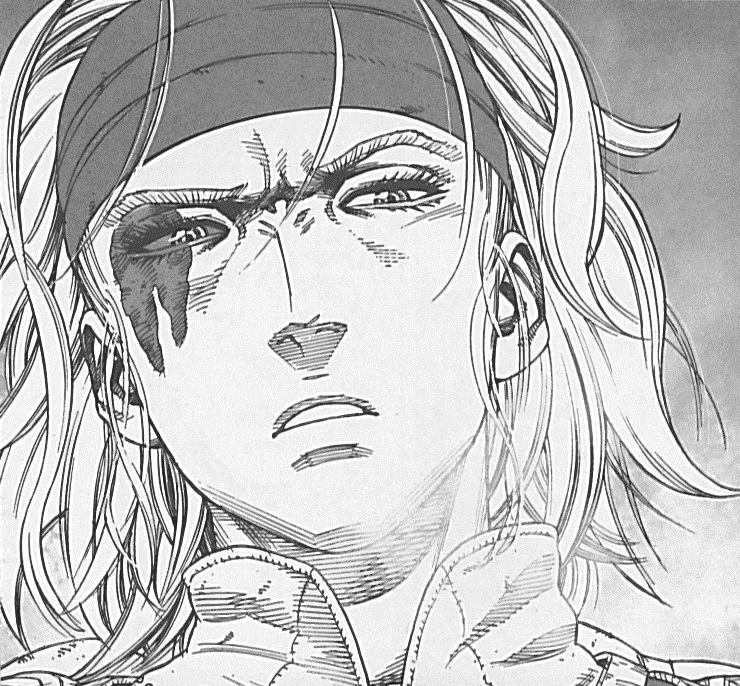
Vinland Saga, Omnibus 9, page 191All-consuming revenge is one of the major themes of Vinland Saga. Yukimura explores how such a single-minded pursuit can dramatically change a person, impacting them on a deep, psychological level, and examines how that internalized violence is reflected in and perpetuated by the world at large. Much of Vinland Saga up until this point has been devoted to Thorfinn’s private struggles and growth as he has tried to come to terms with the irrevocable damage that he has wrought not only upon others but upon himself. With the introduction of Hild, Vinalnd Saga turns its focus outward, delving into the long-lasting and increasingly far-reaching effects of Thorfinn’s past misdeeds. Although this isn’t the first time that the series has shown this sort of tragedy, never before has it been made so cuttingly personal in the manga. Hild isn’t some nameless character met passing; Yukimura shows the entirety of Hild’s story–her life before her family was killed in front of her eyes and how she grew to become the fierce opponent who Thorfinn has no option but to face.

The parallels between Hild and Thorfinn’s individual quests for revenge are numerous although there are still significant differences and Thorfinn is much further along on his personal journey–while he’s chosen a path of peace, it remains to be seen what choices Hild will ultimately make fore herself. But even though Thorfinn is pursuing pacifism, he continues to be drawn into violent confrontations. A large part of why I find Vinland Saga such a tremendous series is due to the compelling character development that it exhibits, but another reason the manga is so incredibly engaging is the result of Yukimura’s spectacular action and fight sequences. They are exciting as well as meaningful, serving not only to move the plot along but frequently to provide an external expression of the characters’ internal struggles. How they fight and what they are willing to risk goes far to reveal who they truly are and what they value most. Vinland Saga continues to greatly impress me; I’m so glad that it’s being translated and look forward to future volumes with immense anticipation.

Filed Under: REVIEWS Tagged With: Japan Media Arts Award, kodansha, Kodansha Comics, Kodansha Manga Award, Makoto Yukimura, manga, Vinland Saga

Elegant Yokai Apartment Life, Vol. 1

September 18, 2017 by Katherine Dacey

Elegant Yokai Apartment Life suffers from multiple personality disorder, lurching awkwardly from one situation to the next without comfortably settling into one storytelling mode long enough for the reader to decide if it’s a sitcom, a soap opera, or a horror show.

In fairness to creators Hinowa Kouzuki and Waka Miyama, few stories purely embody a single genre; the labels that the publishing and entertainment industries have coined — rom-com, dramedy — give ample proof that hybridization is a common strategy for enlivening familar plots. For such hybrid forms to work, however, the tonal shifts must be intrinsic to the story, arising naturally from the interactions between the characters and their environment. Elegant Yokai‘s narrative swerves, however, feel more like a desperate attempt to appeal to as many different constituencies as possible: there’s fanservice for guys (a female ghost who wears only panties and a well-placed towel) and girls (a hot onmyoji with a ponytail and a silver fox with an eye patch), yokai drawn from folklore and urban myth, a potential love interest for the hero, a raft of comic-relief characters who get brief turns in the spotlight, a subplot borrowed from a 1983 Afterschool Special, and tragic backstories for several characters just in case the idea of a “ghostly boarding house” doesn’t tickle your funny bone.

The most frustrating part of this narrative abundance is that so much of it feels… extra. Any one of these elements could be excised from the story without fundamentally changing the premise, making room for more character development. That point is crucial: Elegant Yokai‘s lead is less a person than a reader surrogate, walking from one situation to another in a state of mild befuddlement about his supernatural neighbors. Author Hinowa Kouzuki has saddled Inaba with motivations that explain how he ended up rooming with yokai, but hasn’t actually given him any discernible personality traits. Kouzuki and Miyama’s few attempts to flesh out Inaba’s character are clumsy and, frankly, illogical: what well-adjusted person marks his middle school graduation by fighting his BFF in an abandoned lot because he’s “always wanted to do that”? (Shouldn’t Inaba quote one of the rules of Fight Club or something?)

The artwork suffers from a similarly overdetermined quality. The human characters are less drawn than assembled from bits and pieces of other artists’ work — a dash of CLAMP here, a bit of Yuu Watase there — while the yokai have been shamelessly copied from Rumiko Takahashi and Hayao Miyazaki’s oeuvre. Making deliberate allusions to other artists’ work is, of course, a time-honored tradition, but here, these nods feel less like tribute and more like theft; readers tempted to compare Miyama’s art with Miyazaki’s are bound to find hers a poor substitute.

It’s only in the final chapter of volume one that we get a glimpse of what Elegant Yokai might have been. The story trains the spotlight on Inaba’s fellow apartment dwellers Kuga and Shiro, a boy and his dog who were murdered by Kuga’s mother. Once a month, Kuga’s mother — also a ghost — shows up at the apartment building to reclaim her son. Over time, however, her human form has deteriorated and memories have faded, reducing her to a pitiful demonic state, more scribble monster than angry wraith. The frankness with which Kouzuki and Miyama depict her crime prevents these scenes from descending into bathos; these moments are the only ones that elicit an authentic emotional response from the reader, not least because Kuga and Shiro’s predicament has a demonstrable effect on the other characters. Too bad the rest of volume one is such a frantic, disjointed mess.

ELEGANT YOKAI APARTMENT LIFE, VOL. 1 • STORY BY HINOWA KOUZUKI, ART BY WAKA MIYAMA • TRANSLATED BY ADAM HIRSCH • 206 pp. • RATED T (13+)

Filed Under: Manga, Manga Critic, REVIEWS Tagged With: Comedy, Horror/Supernatural, Kodansha Comics, Yokai

That Time I Got Reincarnated As a Slime, Vol. 1

August 28, 2017 by Katherine Dacey

I’m a sucker for a great title, a tendency that’s yielded a bumper crop of disappointments through the years; I still haven’t purged the memory of a Screaming Broccoli album I purchased in 1988, or the 90 minutes I spent watching So I Married an Axe Murderer. I’m pleased to report That Time I Got Reincarnated As a Slime proved a better gamble than punk-rock vegetables, offering enough solid jokes and weird plot developments to sustain this reader’s interest. What surprised me the most about Reincarnated, however, wasn’t the premise — that’s clearly advertised in the title — nor the hero’s appearance — again, see title — but the story’s fundamentally optimistic message: there are always second chances in life.

The first chapter introduces us to Mikami, a 37-year-old virgin trapped in a lousy job. On a fateful afternoon, he impulsively saves a junior colleague from a knife-wielding attacker, an act of heroism that costs Mikami his life — as a human being, at least — and leads to his reincarnation in a fantasy realm that looks remarkably like World of Warcraft, Game of Thrones, and a hundred MMORPGs. Guided by an unseen dungeon master, Mikami reinvents himself as Rimuru, a slime monster who absorbs his enemies’ powers by eating them — a trick that quickly enables Rimuru to do remarkable things from healing the wounded to spinning thread.

What’s more remarkable about Rimuru is that he immediately puts his powers to work — for other people. (Well, monsters, really.) In chapter two, for example, he teaches a community of goblins how to defend themselves against a numerically superior opponent, helping them build sophisticated fortifications that repel a snarling pack of direwolves. (Paging George R.R. Martin!) Rimuru also bestows names on each member of the tribe, an act that transforms the once small and homely goblins into strapping specimens. That would be a good joke in and of itself, but it lands with greater impact because Rimuru’s act of generosity is consistent with what we saw of his human self, both in the prologue and in a brief flashback to his interactions with colleagues.

And speaking of jokes, Stephen Paul’s crisp translation plays an instrumental role in bridging the gap between the original novels and their manga adaptation by creating a distinctive, sardonic voice for Rimuru that situates him somewhere between audience surrogate and hero. The tone of Rimuru’s monologues captures the mixture of enthusiasm, wonder, and bewilderment with which he approaches new situations, great and small. After bestowing the names Gobta, Gobchi, Gobstu, Gobte, and Gobto on a family of goblins, for example, Rimuru heads off criticism from the reader by declaring, “I didn’t claim I was some kind of naming virtuoso!”, while a fortune teller’s romantic predictions prompt him to ask the same questions we’re thinking: “Do slimes even have genders? How do they multiply? Cell division?”

What Paul’s translation can’t do is goose the pacing. Manga-kaTaiki Kawakami makes a game effort to handle the first volume’s exposition as efficiently as possible, which results in many static panels of Rimuru learning the rules of play from the unseen dungeon master. Though the dialogue is punchy, the story unfolds in fits and starts, seesawing between short, intense bursts of action and leisurely scenes of Rimuru chatting with other characters, pondering one of his new-found abilities, or describing something that happened off camera. These info-dump passages are all the more tedious because Rimuru lacks the limbs, eyes, or mouth to adequately register surprise or awe at what he learns; what features he has — two pencil-line eyebrows — are frozen in a perma-scowl.

The other disappointing element of the manga adaptation is the paucity of female characters in volume one, a problem that series creator Fuse cheerfully acknowledges. “It’s quite possible not to have a heroine in a traditional sense,” he opines in the manga’s epilogue, “but not having any female characters whatsoever is a problem. There’s no beauty in the manga.” Kawakami’s strategy for addressing this issue is not to introduce an important character a little sooner than she appeared in the novels, or expand one of the minor female characters into a more essential figure, but to pile on the fan service by turning any gathering of female characters into a harem scene; I’m still scrubbing my eyeballs after reading a chapter in which an attractive elfling uses Rimuru as a boob shelf. (Worse still: someone cracks wise about E.I.L.F.s, a quip that wouldn’t have been funny in 2003, let alone 2017.)

For all its flaws, however, Reincarnated has its heart in the right place, using Rimuru’s adventures to demonstrate that it’s possible to make the most of any situation, no matter how improbable or unpromising it may seem at the outset. Better still, Reincarnated imparts its moral with tongue firmly in cheek, never lapsing into sappy earnestness about doing one’s best, or sacrificing yourself for the greater good. Of course, we haven’t seen what will happen if and when Rimuru stumbles into a second chance at romance, though volume one offers a few tantalizing clues about a future love interest. Here’s hoping that Rimuru begins his second — and potentially more terrifying — journey of romantic self-discovery without losing his wit or his wits.

THAT TIME I GOT REINCARNATED AS A SLIME, VOL. 1 • CREATED BY FUSE • MANGA BY TAIKI KAWAKAMI • CHARACTER DESIGNS BY MITZ VAH • TRANSLATED BY STEPHEN PAUL • KODANSHA COMICS • RATED: TEEN (13+) • 240 pp.

Filed Under: Manga, Manga Critic Tagged With: Fantasy, Gaming Manga, Kodansha Comics, That Time I Got Reincarnated As a Slime

Full-Time Wife Escapist Vols 1 and 2

July 8, 2017 by Anna N

Full-Time Wife Escapist Volume 1 and 2 by Tsunami Umino

Kodansha seems to be putting out so many digital titles, I’m having a hard time keeping track of them all. I’m always curious to check out josei titles and Full-Time Wife Escapist is a unique title, as it isn’t as overtly focused on romance as some of the other josei titles that have been translated over here.

Mikuri is in a bind after attending graduate school in psychology. She’s having difficulty finding a full-time job, and makes ends meet as a temp. When her temp job ends, she’s caught in a difficult situation because her parents are moving to the country, where there will be even less work for her. She picks up some shifts here and there doing housework and meets a man named Tsuzaki, and she becomes his regular part-time housekeeper. They become closer when she takes care of him during an illness. Mikuri and Tsuzaki come up with the solution where Mikuri will move in as his platonic paid wife, taking over housekeeping duties, making him lunch and dinner, and generally making his bachelor apartment more comfortable.

Tsuzaki is a bit of a loner at work, and somewhat emotionally stunted and has a way of relating to other people that make them assume that he’s cranky, but it seems more like he just hasn’t developed his social skills very well. The transnational nature of the relationship is one of the aspects of this manga that makes it both interesting and refreshing. When Mikuri and Tsuzaki go to visit his parents, they set the terms of Mikuri’s overtime by negotiating back and forth. It is interesting to see tasks that would be unacknowledged emotional labor in a real relationship being assigned a dollar value in this one.

Mikuri’s background in psychology shows her observing other people as opposed to getting real insight on herself. She does have some amusing daydream sequences when her mind wanders and she projects herself into some dream tv interviews that offer some commentary on her life choices. Her aunt Yuri, an unmarried career woman, serves as a counterpoint to Mikuri’s more aimless lifestyle. I enjoy manga when it gets a little didatic, and there are some great asides in Full-Time Wife Escapist where the characters start discussing the economic conditions facing younger adults in Japan, providing some real world background and context to Mikuri’s unconventional lifestyle choice.

The first volume sets up the unique relationship situation in The Full-Time Wife Escapist fairly quickly, and the second volume shows some of the issues that happen when the couple continues to try to portray their relationship as real to friends and colleagues, who sense that something is a bit off in the way the couple relate to each other. At the same time, the close proximity of the fake couple is showing some awareness developing between them. This series has a nice slice-of life pace to the storytelling, as everyday activities like preparing dinner have a new slant due to the unique relationship. At the same time, there are some moments of pathos, as Tsuzaki reflects that if Mikuri ever decides to get married for real, he’s going to be alone for the rest of his life.

Tsuzaki’s friend Kazami starts appearing a bit more and more, and he and Mikuri have a few easy friendly conversations. Kazami starts envying the married lifestyle, but he’s not interested in settling down at all. Intriguing changes are signaled for the next few volumes. I enjoy a good josei romance series, but one of the things I appreciate about The Full-Time Wife Escapist is that it is focused more on transactions and slowly developing friendships than overt romance. It’ll also be interesting to see if Mikuri’s unconventional wife for hire lifestyle is sustainable over the long term.

Filed Under: Manga Reviews, REVIEWS Tagged With: full-time wife escapist, Josei, Kodansha Comics

Land of the Lustrous, Vol. 1

July 7, 2017 by Katherine Dacey

Land of the Lustrous is a gorgeous trainwreck, the kind of manga that doesn’t make sense on a panel-by-panel basis, but ravishes you with artwork so beautiful and strange it’s hard to look away.

I’ll be honest: I read the first volume three times, and found it almost impenetrable. As best I could tell, Land of the Lustrous depicts an interplanetary war between two races: the Gems, whose androgynous, humanoid appearance belies their true, rock-like nature, and the Lunarians, who frequently raid Earth, hoping to capture Gems for decorative purposes. (What kind of decorations remains a mystery; my vote is for bedazzled jeans and hoodies.) Since there are only 28 Gems, they’ve organized themselves into “fighter-medic” pairs to defend Earth from the Lunarians. One Gem — Phosphophyllite, who registers only 3.5 on the Mohs scale — is too weak to perform either task, so the group’s leader pronounces Phos their official naturalist, and tasks Phos with writing a history of Earth.

You’d be forgiven for thinking that Land of the Lustrous was a satire on the dissertation-writing process, given how much time Phos spends procrastinating and grumbling about the book, but these scenes are interspersed with awkward flirtations, violent combat, and a brief episode in which Phos turns into a cute, sentient space slug. These abrupt shifts in tone frustrate the reader’s ability to get a handle on what, if anything, Land of the Lustrous is trying to say — a problem compounded by the dialogue, which is sometimes so windy that it’s a drag on the story, and sometimes so burdened with exposition that it barely passes for conversation.

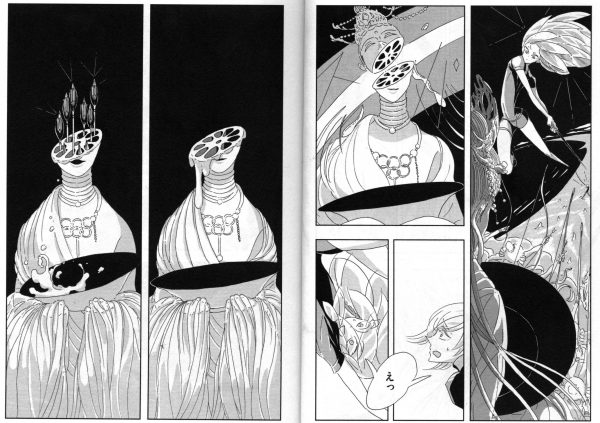
When the characters stop talking and start doing things, however, Land of the Lustrous is a show-stopper, a testament to the richness of Haruko Ichikawa’s imagination. The Lunarians’ first appearance, for example, establishes them as an inscrutable menace. Their soldiers glide silently above the ground, led by an enormous, stone-faced Bodhissattva who’s flanked by undulating lines of archers with bows drawn, their arms and arrows criss-crossing the horizon to form a graceful lattice. (Busby Berkeley would have approved of the Lunarians’ formation.)

What happens next is even more astonishing:

In this sequence, a Gem slices through the general’s head, only to reveal a lotus pod filled with lethal “seeds” — a beautiful but unsettling moment reminiscent of Aubrey Beardsley’s work in its commingling of the sensual and the grotesque; we’re not certain if the Lunarians are animal, vegetable, or mineral. Making this sequence even more disorienting is the dramatic shift in perspective: we see the impending attack from the general’s point of view, then shift to the attackers’ for the moment of contact and its aftermath. The eerie stillness of the final two panels reveals the extent to which the Lunarian general’s transformation has confounded the Gems, who are transfixed by the viscous flow of blood — or is that sap? — from his head.

Looking at these images, I wonder what a more assertive editor might have done to reign in Ichikawa’s worst storytelling tendencies: would the tone and pacing have been more even? The world-building more coherent? The dialogue more revelatory? In the absence of such editorial interventions, however, the most original aspects of Ichikawa’s work sink beneath a torrent of banal conversation and stale comic bits that pass for character development. A few moments of unnerving imagery interrupt the tedium long enough to make an impression on the reader, but are too brief and scattered to yield a truly satisfying experience.

LAND OF THE LUSTROUS, VOL. 1 • BY HARUKO ICHIKAWA • TRANSLATED BY ALETHEA AND ATHENA NIBLEY • KODANSHA COMICS • RATED: TEEN (13+) • 192 pp.

Filed Under: Manga, Manga Critic, REVIEWS Tagged With: Haruko Ichikawa, Kodansha Comics, Sci-Fi

Descending Stories: Showa Genroku Rakugo Shinju, Vol. 1

May 23, 2017 by Katherine Dacey

In the opening pages of Descending Stories, we’re introduced to Yotaro, an amiable ex-con with an unusual plan for going straight: he wants to become a rakugoka, or rakugo artist. To learn the ropes of this venerable performing tradition, Yotaro cajoles Yakumo, a rakugo master, into accepting him as an apprentice — something that Yakumo has resisted doing in the past, even when more suitable candidates have presented themselves. Descending Stories then follows Yotaro’s first clumsy efforts at telling stories, making people laugh, and resisting the temptations of his old life.

Rakugo, for the uninitiated, is Japan’s answer to continuous vaudeville. In lieu of acrobats and jugglers, however, yose (venues) offer customers a steady flow of rakugokas who regale the audience with humorous stories, each adhering to a clearly defined format that begins with the makura (prelude), moves to the hondai (main story), and concludes with the ochi (punchline). Unlike a vaudeville artist — or a manzai duo, for that matter — the rakugoka remains seated while delivering his material, using only two simple props — a fan and a cloth — to convey what’s happening.

In theory, rakugo sounds like an ideal topic for a manga: it’s a storytelling genre that relies almost exclusively on facial expressions and physical gestures to bring the story to life, actions that translate well to a silent, static medium like comics. The audible dimension of a rakugo performance also lends itself to graphic depiction, as a well-chosen typeface can suggest the register, volume, gender, and age of the person speaking. Yet the rakugo performances in Descending Stories capture little of the magic that would explain the genre’s enduring appeal in Japan. Too often, Haruko Kumota cross-cuts between a snippet of performance and a snippet of conversation in which audience members praise the rakugoka‘s technique, or comment on how much everyone else seems to be enjoying themselves. The net result feels more like watching a football game on television than attending a theatrical performance; we can see what’s happening, but the relentless stream of chatter and clumsy framing of the action keep us at arm’s length.

The flatness of these performances stand in sharp contrast to the vibrant story that surrounds them. Though the principal cast is small — Yotaro, Yakumo, and Konatsu, Yakumo’s adopted daughter — Kumota squeezes plenty of dramatic juice out of their interactions. In chapter three, for example, Konatsu accuses Yakumo of murdering her biological father, Sukeroku, who was also an accomplished performer. She vows to exact revenge by taking up rakugo herself, a gesture designed to provoke the staunchly traditionalist Yakumo. “Women can’t perform rakugo,” he tells her:

That’s just the way it is. They can’t enjoy stupidity, for one thing. Even if they can, their art doesn’t deepen as they age. And should they somehow master the art… well, there’s nothing more unpleasant than a woman who can do a good impression of a man. There’s just too much to overcome.

Yet Yakumo is no soap opera villain, intent on crushing the spirit of a plucky heroine; he’s a realist who bears deep — and as yet unrevealed — wounds from collaborating with Konatsu’s dad. He recognizes the depth of Konatsu’s pain, and her sincere desire to preserve her father’s legacy by memorizing and performing his material. As a conciliatory gesture, Yakumo begins reciting “The Naughty Three,” one of Sukeroku’s stories. This eight-panel sequence offers a fleeting glimpse of Yakumo’s true artistry, showing us how he twists his face and bends his torso to portray the story’s main characters. Only a solitary panel of Konatsu sobbing, “My father… He’s alive,” undercuts the effectiveness of the scene, baldly stating what’s apparent from the illustrations.

And that, in a nutshell, is what makes Descending Stories simultaneously frustrating and compelling. On the one hand, Kumota tries so hard to persuade us that rakugo is a funny, spellbinding, and vital tradition that the performances never take flight on the page; even the best scenes are marred by comments that feel like a poke in the ribs: “Didja get it?” On the other hand, Kumota creates such passionate, complex characters that it’s fundamentally impossible to dislike Descending Stories; I want to know whether Yotaro becomes a rakugoka, or if Konatsu finds an outlet for her own storytelling gift. My suggestion: read the omake for insights into rakugo, and read the main chapters for the drama.

DESCENDING STORIES: SHOWA GENROKU RAKUGO SHINJO, VOL. 1 • BY HARUKA KUMOTA • KODANSHA COMICS • RATING: YOUNG ADULT (13+)

Filed Under: Manga, Manga Critic, REVIEWS Tagged With: Descending Stories, Haruko Kumota, Kodansha Comics, Rakugo

Toppu GP, Vol. 1

April 17, 2017 by Katherine Dacey

In a week when The Fate of the Furious is roaring into theaters, it seems only fitting that Kodansha is releasing the first volume of Toppu GP, a manga that extols the virtues of “family values and hot rides” almost as doggedly as Vin Diesel and the rest of his car-boosting gang. The similarities don’t end there, either: both series boast cartoonish villains, pretty girls in skimpy outfits, and dialogue so ham-fisted you could serve it for Easter dinner.

I love them both.

The “family” unit in Toppu GP consists of Toppu, the eleven-year-old hero; Myne, the local motorcycle racing champion; and Teppei, Toppu’s father. Toppu is a classic shonen type: he’s sullen, brilliant, and reluctant to try anything outside of his nerdy comfort zone. (He likes to build elaborate Gundam models.) There are hints, however, that Toppu is destined for the track: he accurately gauges Myne’s qualifying times without benefit of a stopwatch, for example, and instinctually rides to victory in his second race by copying Myne’s technique.

Myne, too, is a familiar type, the sexy “big sister” who squeals and fusses over a smart, promising boy a few years her junior. (Toppu even calls her “Big Sis,” emphasizing the degree to which she’s part of his “family.”) She strides around in a tight-fitting tracksuit dispensing advice and hugs to her protege, goading him to victory with bribes. And just in case we find her more competent than adorable, she suffers from one of those only-in-manga ailments: pathological clumsiness so acute it strains credulity.

The third family member is Teppei, a single parent who’s raising Toppu while writing a novel. Though Teppei professes to be working hard on his book, his actions suggest he’d rather hang out at the track than sit at a typewriter; he spends most of volume one playing coach and mechanic to his kids, dispensing wisdom about the art of motorcycle racing. Dad’s editor must be a forgiving guy.

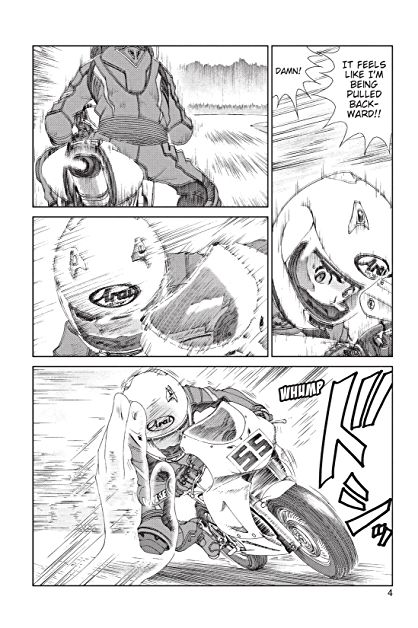
In contrast to the characters, who are painted in broad strokes, the layouts are executed with thrilling precision. Veteran artist Kosuke Fujishima drops us into the action through deft use of perspective and speedlines, capturing the bikes’ velocity and the riders’ positions, as well as the sheer danger of high-speed maneuvers in close proximity. Fujishima complements these images with a handy primer on G-forces, using an invisible hand to show us what Toppu and Myne feel when they accelerate down a straightaway or bank a sharp turn at high speed:

Perhaps the most astonishing aspect of Fujishima’s layouts are their economy. While many shonen artists might be tempted to stretch Toppu’s racing debut over several chapters, Fujishima uses just a handful of panels to show us how Toppu succumbs to the pleasures of competition. This transformation is bookended by two closeups, the first of Toppu’s terrified face as he pulls back on the throttle for the first time, and the second of Toppu’s gleaming eyes as he completes his final lap of the track. We see just enough action between these two panels to grasp the disparity between how quickly the race is unfolding and how slowly time passes for Toppu as he struggles to gain control of the bike, snapping back to “real” time only when Toppu realizes just how much he’s enjoying himself.

In a nod toward gender parity, Fujishima dedicates an entire chapter to showcasing Myne’s tenacity on the track as well. Though Fujishima employs many of the same strategies for immersing us in Myne’s race as he does Toppu’s, Fujishima periodically interrupts the competition with goofy, arresting images of Myne as a tracksuit wearing, sword-wielding avenger and a fiery, Medusa-haired biker. These fleeting visions are a nice bit of comic relief, echoing iconic scenes from Kill Bill and Ghost Rider, but they serve an equally important purpose: showing us how Myne’s rivals see her in competition.

As dazzling as these racing sequences are, I’d be the first to admit that the familial banter between Myne, Toppu, and Teppei feels as perfunctory as the dastardly scheming of the the Niimi brothers, the series’ first villains. (They resent Toppu’s meteoric rise in the standings and want to put him in his place.) The dialogue, too, often veers into the faintly pompous, with characters declaring how much they love “the roar of the exhaust pipe,” “the smell of burning gas and oil,” and “the gaze of the crowd” when they’re at “home.” But when Toppu or Myne jump on their bikes, the series shifts into high gear, offering the same kind of thrills as The Fate of the Furious: fast rides, fierce competition, and the ever-present threat of crashing. Recommended.

A word about buying Toppu GP: Kodansha is simultaneously publishing Toppu GP with the Japanese edition; readers can purchase new installments through Amazon and ComiXology on a weekly basis. Folks who prefer print will find the first volume available in stores now, with volume two to follow in September.

TOPPU GP, VOL. 1 • BY KOSUKE FUJISHIMA • KODANSHA COMICS • RATED T, FOR TEENS (13+)


Filed Under: Manga, Manga Critic, REVIEWS Tagged With: Kodansha Comics, Kosuke Fujishima, Moto GP, Shonen

Altair: A Record of Battles, Vol. 1

April 4, 2017 by Katherine Dacey

Altair: A Record of Battles seems tailor-made for fanfic: it’s got a cast of achingly pretty men, a labyrinthine plot, and an exotic setting that freely mixes elements of Turkish, Austrian, and Bedouin cultures. Like other series that inspire such fan-ish activity — Hetalia: Axis Powers comes to mind — Altair is more interesting to talk about than to read, thanks to an exposition-heavy script and an abundance of second- and third-string characters; you’ll need a flowchart to keep track of who’s who.

The first volume begins promisingly enough. While visiting the Türkiye capitol, a diplomat from the neighboring Balt-Rhein Empire is assassinated in the streets, an arrow lodged in his back. Though the murder weapon suggests that someone in the Balt-Rhein military engineered the hit, Emperor Goldbalt’s mustache-twirling subordinate Louis Virgilio points the finger at Türkiye, insisting they produce the killer or face the ultimate consequence: war. Mahmut, the youngest member of the Türkiye generals’ council, impulsively decides to visit Goldblat’s court in an effort to prevent bloodshed and reveal the true culprit in Minister Franz’s death.

No matter how intensely the characters ball their fists or glower at each other, however, their drawn-out arguments over troop mobilization, international diplomacy, and rules of order are only moderately more entertaining than an afternoon of watching C-SPAN. Author Kotono Kato further burdens the script with text boxes indicating characters’ rank and title, and diagrams showing the distribution of power under the Türkiye “stratocracy,” details that add little to the reader’s understanding of why Balt-Rhein and Türkiye are teetering on the brink of war. Only a nighttime ambush stands out for its dynamic execution; it’s one of the few scenes in which Kato allows the pictures to speak for themselves, effectively conveying the ruthlessness of Mahmut’s enemies without the intrusion of voice-overs or pointed dialogue.

The characters are just as flat as the storytelling. Kato’s flair for costume design is symptomatic of this problem: she’s confused surface detail — sumptuous fabrics, towering hats, sparkling jewels — with character development. With the exception of Mahmut, whose passionate intensity and youthful arrogance are evident from the very first scene, the other characters are walking, talking plot devices whose personalities can be summed up in a word or two: “brash,” “devious,” “enthusiastic,” “mean.” (Also “hot” and “well dressed,” for anyone who’s keeping score.) The shallowness of the characterizations robs the Türkiye/Balt-Rhein conflict of urgency, a problem compounded by Kato’s tendency to wrap things up with epilogues that are as baldly worded as a textbook study guide. At least you’ll be prepared for the quiz.

The bottom line: History buffs will enjoy drawing parallels between the Türkiye and Balt-Rhein Empires and their real-life inspirations, but most readers will find Altair too labored to be compelling — unless, of course, they’re looking for fresh opportunities to ‘ship some handsome characters.

ALTAIR: A RECORD OF BATTLES, VOL. 1 • BY KOTONO KATO • KODANSHA COMICS • RATED T, FOR TEENS • DIGITAL ONLY

Filed Under: Manga, Manga Critic, REVIEWS Tagged With: Fantasy, Kodansha Comics, Kotono Kato

Ichi-F: A Worker’s Graphic Memoir of the Fukushima Nuclear Power Plant

March 16, 2017 by Ash Brown

Ichi-F: A Worker’s Graphic Memoir of the Fukushima Nuclear Power PlantCreator: Kazuto Tatsuta
Translator: Stephen Paul
U.S. Publisher: Kodansha
ISBN: 9781632363558
Released: March 2017
Original release: 2014-2015
Awards: Manga Open

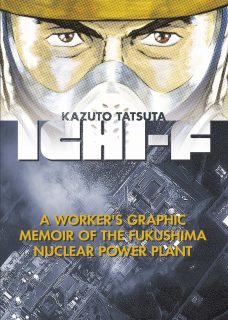
Although Ichi-F: A Worker’s Graphic Memoir of the Fukushima Nuclear Power Plant isn’t Kazuto Tatsuta’s first manga, it is very likely the one for which he will be best known. Based on his experiences as a worker at the Fukushima Daiichi Nuclear Plant, the memoir provides an important and highly personal perspective on the ongoing recovery efforts following Japan’s combined earthquake, tsunami, and nuclear disasters of March 2011. Initially submitted as an amateur work, Ichi-F won the Manga Open Grand Prize in 2013 which led to its continuation as a three-volume series published between 2014 and 2015. The English-language edition of Ichi-F was released by Kodansha Comics in March 2017. The entire series, including Tatsuta’s original one-shot, has been collected into a single, massive omnibus formatted to read left-to-right. Also included is an introduction by the journalist Karyn Nishimura-Poupée and an exclusive interview with the creator. A tremendous amount of work from the translator Stephen Paul and others at Kodansha has gone into Ichi-F in an effort to make the manga as accurate and as widely accessible as possible.

On March 11, 2011 a massive earthquake centered off of the northeast coast of Japan triggered a devastating tsunami which ultimately lead to multiple meltdowns at the Fukushima Daiichi Nuclear Power Plant. Many people in Fukushima were required to evacuate and have yet been able to return to their homes due to the radiation levels in the area. Cleanup and recovery work, including the decommissioning of the plant, continues to this day and will continue for quite some time. Most of the people directly involved in the work are from the Fukushima area but others like Tatsuta (a pen name taken from the region for purposes of anonymity) are outsiders drawn by the promise of high wages, personal curiosity, and altruism. Despite the need for workers, it took Tatsuta more than a year after the disaster to secure clearance for employment at Ichi-F, one of the local names for the Fukushima Daiichi plant. Initially he was assigned to a shelter where he helped to manage a rest area for the construction workers, but eventually he would become one of those construction workers himself, at one point even serving on a team working inside one of the plant’s reactor buildings.

Ichi-F, page 39Ichi-F is primarily about the day-to-day lives and work of those employed at the nuclear power plant but Tatsuta also addresses some of the related recovery efforts and the issues caused by them in the Fukushima region as well as the some of the complications surrounding the publication of his memoir. In part the manga was created in response to the misleading, sensationalistic, and often inaccurate way that Fukushima and the surrounding areas are portrayed in the media. This is not to say there haven’t been problems with the decommissioning and cleanup–even Tatsuta’s account reveals social conflicts and questionable employment practices, not to mention that exposure to high levels of radiation is inherently dangerous–but some of Fukushima’s poor representation is due to ignorance and fearmongering. In fact, excepting the radiation concerns, much of the work outlined in Ichi-F, while being incredibly important, is outright mundane. Tatsuta explains in detail the safety procedures and regulations intended to protect the workers at the plant, showing just how difficult, time-consuming, and challenging the cleanup efforts are. Careful vigilance, caution, and concerted effort are absolutely necessary, especially to counter desensitization to the dangers involved, and there is always room for improvement.

Tatsuta’s own personal experiences while working in Fukushima are what inform Ichi-F. As such, it cannot provide a comprehensive look at the disaster and recovery efforts as a whole, but it does offer an individual perspective critical to the larger context. Tatsuta is an insider telling a story that’s often left untold because it isn’t particularly dramatic or exciting–the manga is a thorough, informative account of the work being done to decommission the Fukushima Daiichi Nuclear Power Plant. The manga can be a bit text-heavy at times, and the way that it has been modified to read left-to-right occasionally interrupts the narrative’s visual flow, but the memoir is both fascinating and accessible. Ichi-F is also the story of the people involved in the cleanup and the close relationships that Tatsuta develops while in Fukushima. What in many ways started out as just a job ends with Tatsuta caring deeply about and for his colleagues at the plant, the locals and residents of Fukushima, and the area itself. While the lasting effects of the nuclear disaster in Fukushima are tragic and some areas remain incredibly hazardous, conditions are slowly improving and recovery and revitalization is happening partly thanks to the efforts of Tatsuta and the other workers shown in Ichi-F.

Filed Under: REVIEWS Tagged With: Ichi-F, Kazuto Tatsuta, kodansha, Kodansha Comics, manga, Manga Open, Nonfiction

A Springtime With Ninjas Vol. 1

February 22, 2017 by Anna N

A Springtime with Ninjas Volume 1 by Narumi Hasegaki

I had high hopes for this title because I greatly enjoy both ninjas and shoujo manga, but I was underwhelmed by A Springtime With Ninjas. I think part of my disappointment was because I was hoping that the heroine and hero of the manga were both ninjas, but it turned out to be a decently executed manga that had some funny moments with a very conventional clueless rich girl heroine who was unfortunately not a ninja at all.

Benio is a sheltered rich girl who lives with the a horrible curse – she has to marry the first man who kisses her. She’s trapped in her home, at the mercy of a procession of tutors and she longs to go to school and experience normal life as a high schooler. Her uncle announces that he’s found a friend for her, and produces Tamaki, a flirtatious ninja bodyguard. Benio immediately finds him offputting, cherishing the memory of a friendship she had as a child when a boy who came over to play with her. Surprising no one who has read a shoujo manga before, it is pretty clear that Tamaki is her long lost friend.

Benio and Tamaki eventually get clearance to go to school, and he fends off Benio’s would-be suitors with his elite ninja skills. There were some amusing lines of dialogue like “The sanctity of this princess’s lips bears more weight to me than your lives.” Also, it was fun to see random high school club presidents suddenly manifest ninja abilities. The art is attractive, and the action scenes are clear and easy to follow. But there isn’t really any distinct quality or style to the art that would help offset storylines that kept giving me a sense of deja vu. I ended up putting down this manga being reminded of all the other shoujo manga that I’ve read that cover some of the same story tropes but end up being a little bit more funny, or have a more interesting take on ninjas or sheltered heiresses.

Filed Under: Manga Reviews, REVIEWS Tagged With: a springtime with ninjas, Kodansha Comics

A First Look at Tokyo Tarareba Girls

February 13, 2017 by Katherine Dacey

Are you breathlessly awaiting the next installment of Princess Jellyfish? Still fuming over Tokyopop’s cancellation of Suppli? Eagerly searching for a manga romance whose heroine is old enough to drink? Then I have the cure for what ails you: Akiko Higashimura’s Tokyo Tarareba Girls, which makes its digital debut tomorrow (2/14) courtesy of Kodansha Comics. This fizzy, fast-paced comedy is every bit as good as Higashimura’s Princess Jellyfish, deftly mixing wacky misunderstandings and witty banter with moments of genuine rue and self-reflection.

The first chapter begins with the narrator declaring, “I spent all my time wondering ‘What if,’ and then one day I woke up and was 33.” As Rinko fills us in on her career, female readers will feel an immediate sense of identification with her — she’s smart, capable, and constantly imagining her future instead of being fully invested in the present, something many of us are guilty of doing in our twenties and early thirties. Though Rinko has forged her own career path, she frets over being single. Rinko isn’t alone in her frustration, since Kaori and Kayuki — her gal pals and drinking buddies — are in the same boat.

The plot is set in motion by a cryptic message from Rinko’s co-worker Hayasaka. In a brief flashback to 2004, we see Rinko and Hayasaka on an uncomfortable date: she focuses on his shyness, his clothing, and his fumbling efforts to be suave, while he ignores her squirming and tries to give her an unwanted gift. Ten years later, both still work for the same company, although there’s a lingering note of tension — or is that romantic frisson? — between them. When Hayasaka sends Rinko a text asking, “I would like to discuss something with you. Could I trouble you for some time later this week?” Rinko immediately declares a “four-alarm” emergency and reaches out to her girls for counsel: after all this time, is Mr. Hayasaka planning to propose? And if so, should she say yes?

If you’re thinking been there, seen that, I get it. Tokyo Tarareba Girls sounds like a hundred other comedies about single women navigating a paired-off world, from Bridget Jones’ Diary to How to Be Single. What prevents Tarareba Girls from reading like a Sex in the City clone is Higashimura’s storytelling chops.

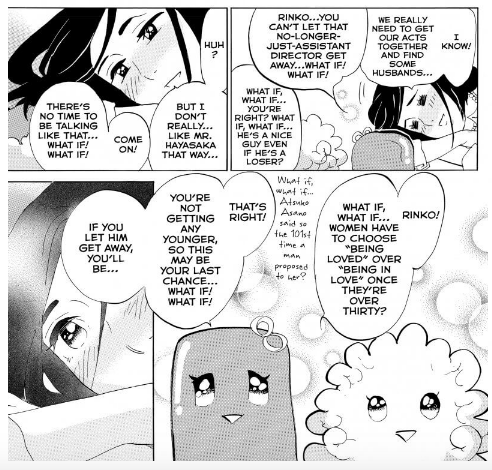
Consider Higashimura’s strategy for making us privy to Rinko’s thoughts. Though Rinko often functions as the series’ narrator, Higashimura looks for more imaginative ways to dramatize Rinko’s emotional life than simple disclosure. In one scene, for example, Rinko’s food — yes, you read that right — cheerfully engages her in a conversation about her romantic dilemma:

Coming from one of her gal pals, this exchange would sound too on-the-nose, a bald statement of the manga’s main thesis. But coming from an izakaya dish? That’s genius! It allows us a window into Rinko’s state of mind (and her state of intoxication) without falling back on such shop-worn devices as the “Dear Diary” entry or the “Little did I know then…” voice-over.

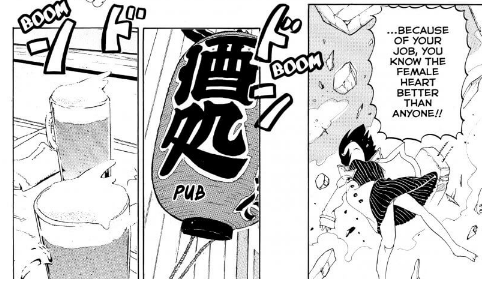
Elsewhere in chapter one, Higashimura uses a similar technique of transposing Rinko’s inner thoughts onto the outer world, using the visual language of action movies — explosions, falling debris — to evoke the intensity of Rinko’s embarrassment over misunderstanding a friendly overture:

This sequence, too, is genius: anyone who’s ever read too much into an email, a voice mail, a text, or a friendly conversation knows exactly how Rinko feels in that moment and can laugh — or cringe — in self-recognition. At the same time, however, the reader can also see that Rinko’s romantic delusions are blinding her to the real lesson of turning 33: that she should learn what — or who — she really wants instead of settling for Mr. Not Quite Right.

The first chapter ends with the introduction of a prickly, truth-telling character whose appearance adds a welcome jolt of energy to the story; his barroom sermon about self-defeating female behavior is a show-stopper, both for its blunt honesty and for the impact it has on Rinko and her pals. Whether he becomes Rinko’s enemy or love interest, his memorable exit leaves the reader wanting to know what happens next — further proof of Higashimura’s storytelling mojo.

TOKYO TARAREBA GIRLS, VOL. 1 • BY AKIKO HIGASHIMURA • KODANSHA COMICS • RATED OT, FOR OLDER TEENS (16+) 

Filed Under: Manga, Manga Critic, REVIEWS Tagged With: Akiko Higashimura, Josei, Kodansha Comics, Romance/Romantic Comedy

Deathtopia, Vol. 1

February 1, 2017 by Katherine Dacey

It’s never a good sign when you enjoyed the Baka-Updates thread about a manga more than the actual manga, but that’s the case for Deathtopia, a title that scores a hat trick for being gory, exploitative, and boring. Part of the problem is the story: it’s the umpteenth example of an ordinary teen discovering that he’s been chosen to save the world. Koh Fujimura, the hero of Deathtopia, is the only person who can detect the presence of “Them,” a group of super-human predators that commit sadistic, stagey murders. Aiding him in the quest to ferret out these menaces are Maya Hoshimiya, Yui Kisagari, and Saki Yagami, a trio of buxom special agents who favor bustiers and short skirts over traditional uniforms. (Call me crazy, but where do you holster a gun if you’re not wearing any pants?)

All of this would be easier to swallow if manga-ka Yoshinobu Yamada had bestowed any personality on his characters, or supplied them with motives for the work they do. None of the cast, however, show any traces of wit or curiosity; all of them behave like well-programmed robots, dutifully marching from one grotesque crime scene to the next. Yamada allows Koh a few moments of fear and confusion, but these beats land with the emotional force of a Linux manual since we know almost nothing about him. Even the character designs are generic: there’s a pretty girl with short hair and hot pants, a pretty girl with a pony tail and a school uniform, and a pretty girl with long hair and a suit. (Actually, she’s the only one who looks like a law-enforcement agent, since she’s wearing comfortable shoes.) The bad guys, by contrast, are so uniformly and cartoonishly ugly it’s a wonder that Koh, Maya, Yui, and Saki can’t identify them at 50 paces.

Perhaps the most telling sign that Yamada is more interested in cheesecake than plot is that he draws the female characters’ breasts with more individuality than their faces. Yamada further diminishes his female characters by reducing them to types — the psychopathic bitch, the aloof older woman — and making his teenage male hero miraculously “better” at monster-hunting, despite his young age and lack of training. The only evidence of Maya, Yui, and Saki’s superior skill is supplied by Koh himself in the form of a voice-over; he muses that “These women are amazing! Even I can tell that their every move is calculated,” although that statement is undermined by the way Yamada stages a subsequent shoot-out.

The manga’s best gambit is shamelessly pilfered from John Carpenter’s They Live! (1988). In this Reagan-era cult classic, sunglasses enabled the hero to see that aliens were living amongst us, using subliminal messaging to subdue and control humanity:

In Deathtopia, Koh gains a similar ability after eye surgery: he sees the monsters as humans with scribbly, mouthless faces, drifting unnoticed through Tokyo streets. Only when Koh dons glasses does he lose sight of “Them”; in an original touch, glass blocks his monster vision. For all the promise this idea holds, however, Yamada makes no attempt to explore its allegorical potential, instead lavishing most of his attention on dismembered corpses and topless girls. Carpenter, by contrast, used They Live! to explore the evils of consumerism and conformity and deliver one of the longest, goofiest, and most admired fight sequences in B-movie history.

In sum, Deathtopia is the sort of manga you might think was cool if you hadn’t read any manga, or were just hoping to steal a glimpse of naked girls. Anyone who’s read Alive: The Final Evolution, Bloody Monday, Death Note, Platinum End, or even Yamada’s Cage of Eden, however, won’t find much to distinguish Deathtopia from these other teenage male fantasies, as it lacks the verve, polish, and imagination of the best examples in this genre.

DEATHTOPIA, VOL. 1 • BY YOSHINOBU YAMADA • KODANSHA COMICS • RATED M, for MATURE

Filed Under: Manga, Manga Critic, REVIEWS Tagged With: Action/Adventure, Kodansha Comics, Yoshinobu Yamada

Happiness, Vols. 1-2

January 27, 2017 by Katherine Dacey

The first chapter of Happiness reads like a teenage boy’s answer to Are You There, God? It’s Me, Margaret. Makoto, the principle character, is doing his best to cope with the indignities of being fourteen: he’s bullied by the popular kids, pestered by his well-meaning but clueless mother, and embarrassed by his lustful reactions to pretty girls. Though he has one friend — the equally uncool Nunota — Makoto spends most of his time alone.

A nighttime trip to the convenience store, however, jolts Makoto out of his routine. In a dark alley, a female vampire tackles and pins him to the ground, offering the following ultimatum: “Do you want to die like this, or do you want to be like me?” With tears and snot streaming down his face, Makoto whimpers, “I don’t want to die,” thus beginning his transformation from ordinary teen to bloodsucker.

If Makoto thought that wet dreams and wedgies were awful, he soon discovers that they pale in comparison with the first stages of vampirism. He suffers from an unquenchable, almost violent thirst and finds direct sunlight blisteringly painful. Worse still, his sense of smell is now so acute that he swoons and sweats in the presence of bloody noses, cuts, and girls, a symptom that sends him into an even deeper spiral of shame. The only potential upside to his condition is his supernatural strength: though he still looks like a 100-pound weakling, he can leap from great heights and deliver a lethal karate chop when the scent of blood is in the air.

Given Makoto’s age, it’s not surprising that author Shizuno Oshimi treats his hero’s transformation as a metaphor for puberty itself. In the manga’s earliest scenes, Oshimi frankly documents Makoto’s efforts to cope with hormonal surges and maternal helicoptering, capturing Makoto’s discomfort in his own skin. As Makoto begins turning into a vampire, however, his increasingly urgent thirst for blood amplifies the very aspects of puberty that most embarrass him — his keen interest in sex, his inability to conceal his arousal from others — making him feel even more powerless.

To capture Makoto’s turbulent emotions, Oshimi employs a variety of artistic styles. Some panels are rendered in smudgy pastels, suggestive of a foggy evening, while other panels are rendered in swirling, pulsating lines reminiscent of The Scream. These visual interludes last only a page or two, but vividly capture the nausea, pain, and confusion Makoto experiences in the grips of bloodlust.

Perhaps no scene is as evocative as that first encounter between Makoto and the female vampire. Oshimi uses rapid shifts in perspective and a few fleeting images — a shadowy figure plunging through space, a dark smear of blood — to indicate what’s happening. The extreme close-ups and feverish pacing neatly mimic Makoto’s growing sense of panic as he considers the possibility of dying in an alleyway — and not just any death, but a potentially humiliating one. (And really, what could be worse than that from a fourteen-year-old’s perspective?)

The pacing, like the artwork, is expertly handled. Oshimi has a knack for lulling readers into a false sense of security that Makoto will transcend (or master) his vampirism and silence his tormentors. Then — bam! Oshimi inserts a twist or introduces a new character who contradicts our sense of how socially maladroit or invulnerable Makoto really is. The appearance in volume two of a new bloodsucker, for example, reveals the extent to which vampires pose an active threat to one another — something that Makoto in his solipsistic misery never considered when he agreed to become a vampire himself.

And speaking of volume two, Oshimi does an excellent job of expanding and developing the cast of characters. By volume’s end, there’s more at stake than Makoto’s desire to escape humiliation; Makoto must decide whether to become a full-fledged vampire or fight for his humanity, a decision complicated by his budding friendship with a female classmate. How Makoto resolves this dilemma remains to be seen, though his struggle should provide plenty of dramatic grist for volume 3 (available February 14th).

The bottom line: Happiness is a rare vampire manga with bite: it’s smart, stylish, and unsettling, drawing readers into Makoto’s world with an honest look at the horrors of being fourteen. And what could be scarier than that?

HAPPINESS, VOLS. 1-2 • BY SHIZUNO OSHIMI • KODANSHA COMICS • RATING: OT, for OLDER TEENS (16+)

Filed Under: Manga, Manga Critic, REVIEWS Tagged With: Happiness, Horror/Supernatural, Kodansha Comics, Shizuno Oshimi, Shonen, Vampires

  • « Go to Previous Page
  • Page 1
  • Page 2
  • Page 3
  • Page 4
  • Interim pages omitted …
  • Page 7
  • Go to Next Page »
 | Log in
Copyright © 2010 Manga Bookshelf | Powered by WordPress & the Genesis Framework