• Skip to primary navigation
  • Skip to main content
  • Skip to primary sidebar
  • Home
  • About Us
    • Privacy Policy
    • Comment Policy
    • Disclosures & Disclaimers
  • Resources
    • Links, Essays & Articles
    • Fandomology!
    • CLAMP Directory
    • BlogRoll
  • Features & Columns
    • 3 Things Thursday
    • Adventures in the Key of Shoujo
    • Bit & Blips (game reviews)
    • BL BOOKRACK
    • Bookshelf Briefs
    • Bringing the Drama
    • Comic Conversion
    • Fanservice Friday
    • Going Digital
    • It Came From the Sinosphere
    • License This!
    • Magazine no Mori
    • My Week in Manga
    • OFF THE SHELF
    • Not By Manga Alone
    • PICK OF THE WEEK
    • Subtitles & Sensibility
    • Weekly Shonen Jump Recaps
  • Manga Moveable Feast
    • MMF Full Archive
    • Yun Kouga
    • CLAMP
    • Shojo Beat
    • Osamu Tezuka
    • Sailor Moon
    • Fruits Basket
    • Takehiko Inoue
    • Wild Adapter
    • One Piece
    • After School Nightmare
    • Karakuri Odette
    • Paradise Kiss
    • The Color Trilogy
    • To Terra…
    • Sexy Voice & Robo
  • Browse by Author
    • Sean Gaffney
    • Anna Neatrour
    • Michelle Smith
    • Katherine Dacey
    • MJ
    • Brigid Alverson
    • Travis Anderson
    • Phillip Anthony
    • Derek Bown
    • Jaci Dahlvang
    • Angela Eastman
    • Erica Friedman
    • Sara K.
    • Megan Purdy
    • Emily Snodgrass
    • Nancy Thistlethwaite
    • Eva Volin
    • David Welsh
  • MB Blogs
    • A Case Suitable For Treatment
    • Experiments in Manga
    • MangaBlog
    • The Manga Critic
    • Manga Report
    • Soliloquy in Blue
    • Manga Curmudgeon (archive)

Manga Bookshelf

Discussion, Resources, Roundtables, & Reviews

Reviews

Young Lady Albert Is Courting Disaster, Vol. 4

December 31, 2023 by Sean Gaffney

By Saki and Haduki Futaba. Released in Japan as “Albert-ke no Reijō wa Botsuraku o Goshomō Desu” by Kadokawa Beans Bunko. Released in North America by J-Novel Heart. Translated by Ray Krycki.

I’m starting to feel really bad for Patrick. The most obvious reason being that it’s not entirely clear, at least until the end of this volume, that Alicia would actually choose him over Lady Mary. The relationship between Alicia and Mary has not been yuri per se, but certainly Mary is the most important person in her life, and she has a tendency to tackle hug, and fondle, and adore her. Meanwhile, Patrick has to actually run a country, so is not as free for snuggles. More worrying for Patrick is that he is now the only fully, 100% sensible one in the cast. He didn’t think this was the case. He was sure it was him and Adi against the eccentrics and airheads of this world. But when push comes to shove, Adi has been around Mary far too long and thinks far too much like her for this to be true. Sorry, Patrick. Everyone is bananas except you. Someone has to do the nasty work.

Things are looking up for Mary Albert. She’s survived the first game (despite her best efforts to be exiled), and the second game has come and gone with only mild sadism and shotacon friends as the result. Unfortunately, the game also had an anime adaptation. Which introduced a friend character for Alicia, consoling her when Mary was being too much of an evil villainess. And now we get Veltina, a new arrival to Mary’s group due to a school exchange program. Veltina clearly has memories of the anime from a previous life, great hatred for Mary Albert, and a huge crush on Adi. On the bright side, she makes an absolutely terrible villainess herself, and taking care of her is ludicrously easy. On the down side, Mary is starting to get this odd heartburn when people get too close to Adi…

Everyone knows that if you write a villainess book where the heroine came from an otome game, and the plot resolves, then you need to have the otome game sequel, or spinoff media, or side story… anything to keep the series going. Here it’s the anime, but it’s amusing how little it actually matters. The author just says “oh, there was an anime, she must remember it” a few times and then proceeds to forget about it. So does Mary, who occasionally tries to find a good time to ask her but it never comes up. Which is fine, as in the end it doesn’t matter. We’re not here to see how Mary Albert can escape the terrible fate of whatever new plot hits her life – she’s not Katarina, or Aileen. We’re here for the comedy, as not only is Mary unable to tell that she’s feeling jealousy, but Adi is ALSO unable to realize this. You’d think that, having been married for some time now, the self-doubt would have disappeared, but that’s not how it works. Their resolution of it is sweet. Also, Alicia turns out to be the best gardener ever, which may be my favorite joke.

There’s four more volumes, and I’m not sure how many more antagonists we can reasonably introduce at this point. But the books remain a hoot, and always put a smile on my face.

Filed Under: REVIEWS, young lady albert is courting disaster!

Loyal Soldier, Lustful Beast

December 30, 2023 by Sean Gaffney

By Sumire Saiga and Saya Shirosaki. Released in Japan as “Gunjin wa Ai no Kemono” by Sonya Bunko. Released in North America by Steamship. Translated by M. Jean. Adapted by H. Qi.

(This book is meant for readers over the age of 18,. and the review uses a few words that are a bit naughty.)

Steamship is one of Seven Seas’ many different imprints, and specializes in what my grandmother might have called “smutty books”. Until now, they have specialized in manga titles, all under the “josei” umbrella and basically a romance-novel style manga, only with added sexual content. Now we get this stand-alone novel, which is the first light novel under the imprint. We got a sexually explicit light novel licensed a few years ago, but that one was more on the “for guys” end, and I think Amazon pulled it relatively quickly. This one is probably safe, if only as if you removed all the sex scenes from it, it would still have a coherent and interesting plotline. Well, eventually. This book is a slow starter, and does not exactly have prose that compels you to read on, so it took me a while to get into it. In addition, a word of warning, there’s as certain amount of “codependency is good if it’s romantic” here.

Giselle is a young woman of marriageable age, but unfortunately she’s seen as a bit drab, so all the potential marriage meetings she’s been to have ended in failure. Then her brother, a soldier in the royal army, brings home a colleague, who was kidnapped and enslaved as a young boy, and still has a bit of a slave mindset to him. Giselle takes pity on him and tries to teach him how to think for himself and not just do whatever anyone tells him to. In fact, she’s falling in love with him, and he with her. This is, needless to say, a bit of a problem given that he’s an ex-slave and she’s a noble. As if that weren’t enough, the King has asked for her to join his court as one of the royal concubines. This is not really an order that can be refused. What will become of her relationship with Wallace?

So, first of all, the sex is fine. There’s quite a bit of it, mostly featuring different positions and quite a bit of cunnilingus. Wallace had a tendency to put everyone before himself, so blowjobs are not really on the table, and even asking if he can do her from behind is saved till the end when they’re far more familiar with each other. The main reason to read this, though, is the intrigue. The King straight up admits that he’s using Giselle as a hostage to keep Wallace loyal to him, and the threat ends up driving the latter half of the book. As I indicated earlier, Wallace worships the ground Giselle walks on, and would happily murder anyone if she asked him to. Meanwhile, Giselle has always felt drab and unloved, except maybe by her brother, so suddenly getting someone who adores her and is also fantastic in bed is quite a cocktail. Hopefully a lack of constant danger will allow these two to mature as a couple to where they aren’t the only thing in each other’s lives.

Despite pedestrian prose (AO3 has spoiled me) and a tendency towards romance tropes (there’s a sexual assault here, though Wallace arrives in time to break it up, and he’s always a gentleman to her in bed), this got better as it went along, and I’d recommend it to those looking for a good smutty book.

Filed Under: loyal soldier lustful beast, REVIEWS

My Magical Career at Court: Living the Dream After My Nightmare Boss Fired Me from the Mages’ Guild!, Vol. 2

December 29, 2023 by Sean Gaffney

By Shusui Hazuki and necomi. Released in Japan as “Black Madōgushi Guild o Tsuihō Sareta Watashi, Ōkyū Majutsushi to Shite Hirowareru: White na Kyūtei de, Shiawase na Shinseikatsu o Hajimemasu! ” by SQEX Novels. Released in North America by J-Novel Heart. Translated by Mari Koch.

As with the previous volume, how much you enjoy this will depend on two things. The first is how much you care about people who are ridiculously the best at everything they do. Noelle especially, but also Luke, are both prodigies, and show it off throughout the story. This means there are multiple scenes of them being praised to the skies. I know this can annoy some readers. The bigger issue may be the romantic tension, which is using a combination of two devastating “put this off as long as possible” moves – she’s oblivious, he’s a coward. These are both also really, really emphasized throughout, and in my opinion grate far more than the OP stuff. If you can get past both of these, this remains a fun series about a woman in her dream job not realizing how incredible and loved she really is.

After the events of the last book, and after reassuring the now recovered wyvern that she doesn’t really need anything right now from him, Noelle returns to the Magical Court, where she remains busy. She gets a new teacher who everyone calls the hardest teacher they’ve ever had, and while she initially struggles, she ends up being fantastic. She is invited to the Royal Invitational Tournament to fight the World’s Greatest Swordsman, a match everyone expects her to lose instantly. And she and Luke are headed off to the worst dungeon in the world, which just had a new level open after 20 years, and they must face off against a last boss. Still, can’t be worse than Noelle’s last boss, amirite?

The romance here is frustrating but understandable. Noelle is firmly in “I am a commoner” mode, helped along at times by various jerkass nobles, and never even considers a romance with Luke as she knows it’s impossible. Luke has been in love with her almost since they met, but a) has the same problem in reverse, and b) worries that he will ruin their friendship forever if he confesses and it goes wrong. and, to be fair to Luke, we even see that a bit here – after being forced by his superiors to take Noelle on a date to the theater, it turns out it’s a theater where an underground drug ring is operating, and he and Noelle are forced to step in and stop the bad guys. As a result, the present he got her joins the dozens of other presents he’s bought her over the years in a room that is basically a shrine to his failure. The only way he can really make this work is for Noelle to get so insanely powerful so fast she gets a title… but before that, she may end up being poached by the Royal Family for their guard. So yes, Luke’s a coward, but I get it.

This has 5 volumes in Japan, so don’t expect it to end soon. Next time we’ll get a tournament arc and an elf queen, so also don’t expect it to be original. But it’s fun, provided you remember my caveats.

Filed Under: my magical career at court, REVIEWS

Spy x Family: Family Portrait

December 28, 2023 by Sean Gaffney

By Aya Yajima, based on the series by Tatsuya Endo. Released in Japan as “SPY×FAMILY: Kazoku no Shōzō” by Jump Books. Released in North America by Viz Media. Translated by Casey Loe.

It’s always difficult to review these spinoff/tie-in novels. By their very definition, they cannot affect the main series in any way. There can’t be plot progression, or significant character development. Usually, there also can’t be a dramatic plotline or cool action scenes either. The novel is not here to provide anything that can’t be done better in the parent manga. Instead, it’s here to give us fun stories using the series’ sandbox to play around in. The author thinks of cute ideas, gets approval from the creator and the Jump editorial staff, and then writes them down. Then Tatsuya Endo reads the stories and gives us an illustration for each of them. If you want to call it a success or failure, then as a product it’s a definite success. This feels very Spy x Family-esque. As something a fan of the series can read and think “I think the world of the manga is better for these short stories”, it’s probably a failure. These are very basic.

The book consists of four “main” stories and one very short story. In the first story, Anya, Damian, and the class go on a “Nature’s Classroom” expedition, and an overconfident Anya causes her and Damian to get lost in the woods. In the rain. In the second story, Yuri is asked to babysit Anya, and ends up taking her to a children’s career fair, where kids can pretend to be any number of things, from a police officer to a jewelry maker. In the third short story, Franky meets a blind singer in the hospital when recovering from an injury, and consoles her about an upcoming operation, while also bemoaning his appearance. The fourth story is the “title” story, as our family, on an outing, is seen by a painter, who wants to paint them. Unfortunately, he’s incredibly famous, and Yor is worried that if her portrait is seen everywhere, it will jeopardize her assassin job. In the final short, two waitresses moan about the lack of good men and gush over regular patrons the Forgers being the “perfect” loving family.

The best story in the book is easily the one with Yuri and Anya, and Endo agrees with me. It’s a clever idea, makes good use of the characters, and is funny. Its only problem is it stars Yuri, and I hate Yuri, so I did not enjoy it. But that’s on me. Aside from that, the stories suffer from having the most obvious resolution there is. Anya and Damian find a cave, and both get closer when the rainstorm brings lightning. Franky’s story would be touching if it had not already been done eighty times before, and the family portrait story, while fun, also has a punchline that I predicted the moment the painter said “can I paint you?”. In addition, Loid and Yor really don’t get much to do here except in that one story, and the book feels a bit empty without them – Anya can’t carry everything on her own, much less Yuri or Frankly.

This is, as I said, perfectly good product, but it’s also the definition of inessential.

Filed Under: REVIEWS, spy x family

Dahlia in Bloom: Crafting a Fresh Start with Magical Tools, Vol. 8

December 27, 2023 by Sean Gaffney

By Hisaya Amagishi and Kei. Released in Japan as “Madougushi Dahlia wa Utsumukanai” by MF Books. Released in North America by J-Novel Heart. Translated by Osman Wong.

It’s bad enough when Dahlia deliberately invents something that will revolutionize the world (no, not like that), but it’s even worse when Dahlia does it accidentally. The theme to this book is “Dahlia invents ______ but doesn’t immediately see the commercial application for it”, and while we’ve seen that plot before it’s never been hammered home quite as much as it is here. Dahlia invents memory foam. Dahlia invents beanbag chairs. Dahlia invents better breast pads. Dahlia invents… well, no one is quite sure what it’s good for, but we’ll think of something later. It’s that last one that gets her in trouble, as “what it’s good for” is magical fodder for magical horses, meaning that expeditions need far less room for hay/etc. Dahlia and Volf both think this is really cool. Guido thinks this is really terrifying, as the nation next door who hates them has a LOT of magical horses, and would kill to have this new invention. Or, more accurately, kidnap. Dahlia needs better protection.

I pretty much summed up the bulk of the plot above, though we do get one other major arc. Dahlia goes on an expedition with Volf and company to watch them take down Giant Monster Crabs (they hit its weak point for massive damage, trust me), and while there she meets the old vice-captain of the group, now retired. Bernigi is rather grumpy at first, as he’s unsatisfied with how “soft” the unit is with all Dahlia’s new inventions. As we learn more about him we see that he’s also still grieving for his son, who had the standard “I will get into a fight with my dad and then go fight monsters and get killed and so leave everything unresolved” plot. He also has a wooden prosthesis as he lost a leg in battle, and it’s not a great one. Fortunately, it breaks in front of Dahlia, and she (for once) deliberately invents something fantastic. Oh yes, and it turns out Bernigi’s got a grandson who’s very familiar to the readers.

Fans of the Dahlia/Volf relationship will once again be pleased but also frustrated. Dahlia is told that loved ones frequently embroider designs onto a man’s undershirt to give some blessing and protection. She decides to do this for Volf, and ends up embroidering a design that is a flower (dahlia) and a wolf (Volf) intertwined. It’s so good she ends up using it as the Emblem of her company. But she remains 100% oblivious to the meaning of this, even when told point blank. They’re pals! As for Volf, Guido tells him point blank to marry Dahlia in order to protect her from foreign infiltrators kidnapping her and forcing her to invent, and his first thought is “what else could we do?”. They’re buddies! Volf remains SLIGHTLY ahead of Dahlia in terms of self-awareness, as when Guido suggests adopting Dahlia instead, making her and Volf siblings, he feels vaguely uncomfortable but is not sure why. They’re so cute. I want to strangle them.

The 9th volume just came out in Japan (with a new artist), so we should see that soon. I’m 100% sure it won’t end with Dahlia and Volf hooking up, though,. The slowest of slow burns.

Filed Under: dahlia in bloom, REVIEWS

I Could Never Be a Succubus!, Vol. 1

December 26, 2023 by Sean Gaffney

By Nora Kohigashi and Wasabi. Released in Japan as “Watashi wa Succubus Ja Arimasen” by Hero Bunko. Released in North America by J-Novel Club. Translated by Roy Nukia.

Sure, it’s always nice when a book that you have high expectations for manages to justify them, but I’ve always been even more fond of books I expected to be utter trash being… well, slightly better than utter trash. I’m not about to say that I Could Never Be a Succubus! should take its place alongside Ascendance of a Bookworm or The Apothecary Diaries. It has consent issues and sometimes suspends disbelief more than I’d like. But I mean, the premise of this series, so I’d heard, was that a noble girl, on seeing the hero who is supposed to defeat the demon lord, arrive at her academy, asks if she can have his underpants. My expectations were THROUGH THE FLOOR. I only read this as I thought it would be amusingly bad. Instead I found it amusing but very readable, and it even has a bit of depth to it. And a great deal of this is due to my completely misreading how this premise was going to go.

A year before the main events in this book, the hero’s party battled the demon lord, and only survived due to the sacrifice of one of their members. A year later, Lisalinde is a student at the national academy. Gorgeous, polite, with great academics and strong magical powers, she’s loved by (almost) all of the student body. Then the hero’s party arrives. They’re still recovering from the battle, so are temporarily enrolling as students. And yes, as I stated above, Lisalinde, on seeing the hero, impulsively asks for his underpants. She’s appalled at herself. She has no idea why it happened. And what’s more, the more she gets to know the hero and his party members, the more perverse thoughts she starts to have. Has she REALLY not met them before? What’s going on?

So, sorry to spoil (it’s on Page 3), but Liselinde, aka Liz, is the party member who sacrificed herself to save the hero and the others. As a result, she’s lost her last two years of memories. Which means she has no idea that she is, in fact, a succubus. Who has already seduced the hero. And the lady knight who is his fiancee. And the adorable cleric who is his other fiance. This book goes back and forth between the present and the past, and that’s why it’s so funny, because Liz in the present is a seemingly normal girl struggling with terrifying impulses, while the Liz of the past, well aware she’s a succubus, will seduce anything that moves, and does so. (There’s no explicit sex in this, but there is a giant pile of IMPLICIT sex.) Liz can be a lot – she’s been known to drug food and drink with aphrodisiacs – but she clearly loves her fellow party members, and it’s obvious that they all miss her and want to get her memories back. I am assuming that there is a very good reason they can’t just tell her – but we don’t get it in this book.

There are six volumes of this to date in Japan, and I’m not sure how long it can sustain its premise. But if you enjoy ecchi comedies with a lovable sex maniac girl doing the cast… or if you love ecchi comedies with a pure young maiden horrified at her dirty mind… well, Liz gives you both.

Filed Under: i could never be a succubus!, REVIEWS

The Crown of Rutile Quartz, Vol. 1

December 25, 2023 by Sean Gaffney

By Surume Enoki and ttl. Released in Japan as “Rutile Quartz no Taikan: Ō no Tanjō” by DRE Novels. Released in North America by J-Novel Club. Translated by Alice Camp.

This is another book that I enjoyed, but was not wowed by. It’s always hard to review those titles. “This was pretty good, all things considered” is not exactly a blurb you can put on a back cover. This is a good coming of age royal fantasy series. If isekai are about the hero gaining cool powers and a harem of hot babes, then the small but notable genre of “military/royal fantasy” usually involves the hero being either royalty or the close advisor to royalty, and instead of a harem there’s a relationship between the royal and their advisor. Also, redheads feature heavily. I’m not sure why. In any case, this is squarely in that genre. Slain, the new king, is a decent guy, proves a quick study, has some military ideas that no one there has considered, and gets the girl. It’s a feel good sort of book. That said, nothing here is surprising, except maybe one thing that I’ll get to later. It’s “pretty good”, but not in a bad way. If that helps.

Slaine is a young man whose mother has just passed away. He never knew his father, so is rather surprised when suddenly a royal escort appears in his small village. It turns out that his mother had once been a servant in the royal palace, and left after a dalliance with the King. What’s more, the entire royal family has just been killed in a fire, leaving Slaine as the heir apparent. Needless to say, he feels he is not remotely ready. But his mother was a scribe, meaning he can read and write due to her teachings, and he has read history books. He also has nobles who are willing to be patient with him, and a talented aide, Monica, at his side. He’s actually getting the hang of things faster than expected. So provided another neighboring country doesn’t declare war and invade them, they should be fine. Oh dear.

The thing that interested me most in this was the way magic was used. At the start of the book I wondered if it wouldn’t have any magic at all, and just be an alternate-world royal book, but that was unlikely to sell to a light novel publisher. So yes, there is magic, but it’s not a constant in this world. Only about one in 30 people have magic at all, and even then it’s not super powerful. Neither Slaine nor Monica have any magic. We see water magicians around the castle, and they use their magic powers to do things like fill barrels, or clean. This of course also leads to Slaine’s idea on how to win the battle against the foreign country invading them, which works well enough, though everyone’s praise of his idea reminds me of those isekai books where people are stunned at the idea of crop rotation. I also wish we’d gotten a bit more with Monica, Slaine’s aide, who has a chapter or two at the back that quickly shows why she went from “uncaring and emotionless baron’s daughter” to “please take me”, but you get the sense it was written after the fact when someone pointed out we knew next to nothing about her.

So, this wasn’t great, it wasn’t terrible. It was pretty good. It passed the time. If there’s another volume (it’s a Drecom book, so this is it for the moment) I’ll read more.

Filed Under: crown of rutile quartz, REVIEWS

Fake Saint of the Year: You Wanted the Perfect Saint? Too Bad!, Vol. 3

December 24, 2023 by Sean Gaffney

By kabedondaikou and Yunohito. Released in Japan as “Risō no Seijo? Zannen, Nise Seijo Deshita! Kuso of the Year to Yobareta Akuyaku ni Tensei Shitanda ga” by Kadokawa Books. Released in North America by J-Novel Club. Translated by Rymane Tsouria.

There have been a LOT of series recently with a guy who dies and is reincarnated as a woman, or is isekai’d into a woman’s body, etc. So many that we’re even seeing a few that are explicitly (at least according to the author) a “transsexual fantasy” (see I Guess This Dragon Who Lost Her Egg to Disaster Is My Mom Now). That said, Ellize is here to nip all that in the bud. She makes several things clear over the course of this volume, and the ones that do not have anything to do with her baffling and depressing death wish have to do with her sexuality. She’s a guy. She’s attracted to girls. She has absolutely no desire to admit that lesbians exist. And so therefore she plans on rejecting Verner no matter how high his “affection score” is with her. That said, the ending of this book seemingly makes all that irrelevant.

After the events of the last book, it’s clear that it’s time to take care of the Witch once and for all. Especially as the Witch – or rather, her most intelligent monster minion – is starting to make moves like “let’s kidnap someone and make them a patsy for Ellize to kill”. Which also involves kidnapping several students, and leads to… Eterna awakening as the Saint. OK, not a problem, Ellize can gloss over this. Things get a bit trickier when they journey to an island nation and find the grave of the First Saint… which turns out to have the first saint in suspended animation, and Ellize can free her. Now they have TWO real Saints and ONE fake Saint, and need to work out how to defeat the Witch without starting the cycle all over again. Oh yes, and Verner has figured it out: Ellize is not the Saint.

I’ll be honest, I thought this was the last book, and when the fourth volume in the series appeared on the JNC streaming site it startled me. Everything was set up for things to finish here. The trouble is… everything was set up for things to finish here tragically. Indeed, that’s the ending we get. The book ends with Ellize dying in order to prevent the Witch from taking over the next Saint, and the tragedy is that she mistakenly thinks that this will make everyone happy (because the world is saved) rather than destroy everyone around her (because they all love her). If this were the ending, it would be bitter indeed. I’m not sure what happens in the fourth book, which we are told *is* the final one, but I assume Ellize is not going to spend the whole book dead. Something will have to be done. And I sincerely hope that something will also fix Ellize’s “nothing matters because I’ll be dead soon” attitude.

This series has its flaws, mostly from when Ellize remembers to be skeezy, but it’s still more interesting than I expected. It’s worth sticking around for the finale next time.

Filed Under: fake saint of the year, REVIEWS

Innocent, Vol. 1

December 24, 2023 by Katherine Dacey

Innocent is hard to pin down. On the one hand, it’s a meticulously researched period drama starring real-life figures such as Charles-Henri Sanson, Casanova, Robert-François Damiens, and Jeanne Bécu, the sort of thing you might see on Masterpiece Theater or HBO. On the other, it’s a lurid portrayal of a young man’s corruption, filled with over-the-top scenes of torture and debauchery that, intentionally or not, recall Justine, or The Misfortunes of Virtue. The tonal mismatch between its historical aspirations and its treatment of the principal character never gel into a coherent story, however, resulting in a handsome but repellant mess that isn’t serious enough to move the reader or ridiculous enough to be enjoyed as camp.

The series opens in 1793, then jumps back in time to reveal how Sanson evolved from a sensitive young man into the Royal Executioner of France. In making Sanson his protagonist, author Shin’ichi Sakamoto has a major hurdle to overcome: Sanson executed almost 3,000 people and championed the guillotine as a more efficient, humane tool for dispatching convicts. To ensure the reader’s sympathy lies firmly with Charles-Henri, therefore, Sakamoto commingles fact and fiction, depicting Sanson as a beautiful, raven-haired teen with flowing locks and trembling lips, the epitome of a guileless young man. Everything makes Charles-Henri’s enormous eyes glisten with tears: the cruel comments of boarding school classmates, the sound of a flute, the sight of a beautiful young aristocrat. He’s also prone to outbursts of teenage indignation and fits of nausea, unable to stomach his father’s lessons on how to decapitate a person with a single blow.

For all the feverish dialogue and graphic violence, there’s almost no meaningful character development, as Sakamoto seems more intent on demonstrating Charles-Henri’s capacity for suffering than in depicting a flesh-and-blood person’s efforts to resist his destiny. In one of the most egregious examples of this tendency, Père Sanson tortures his son with techniques cribbed from the Book of Martyrs: he shackles Charles-Henri to a chair, deprives him of food and water, pierces his skin, and pulverizes his legs with a sledgehammer in an effort to bend Charles-Henri to his will. The true horror of the scene, however, is undercut by the way in which Sakamoto luxuriates in Charles-Henri’s wounded body with same fervid zeal as Titian painted the Crucifixion; Charles-Henri is stripped to waist and strapped to a pole, his hands tied above his head as he cries out in bewilderment. And if those Baroque flourishes aren’t enough to ruin the scene’s emotional authenticity, the cartoonishly evil Père Sanson is; he’s less a fully-realized character than a foil for Charles-Henri’s innocence, prone to making over-the-top pronouncements that would be right at home in a Nicholas Cage flick.

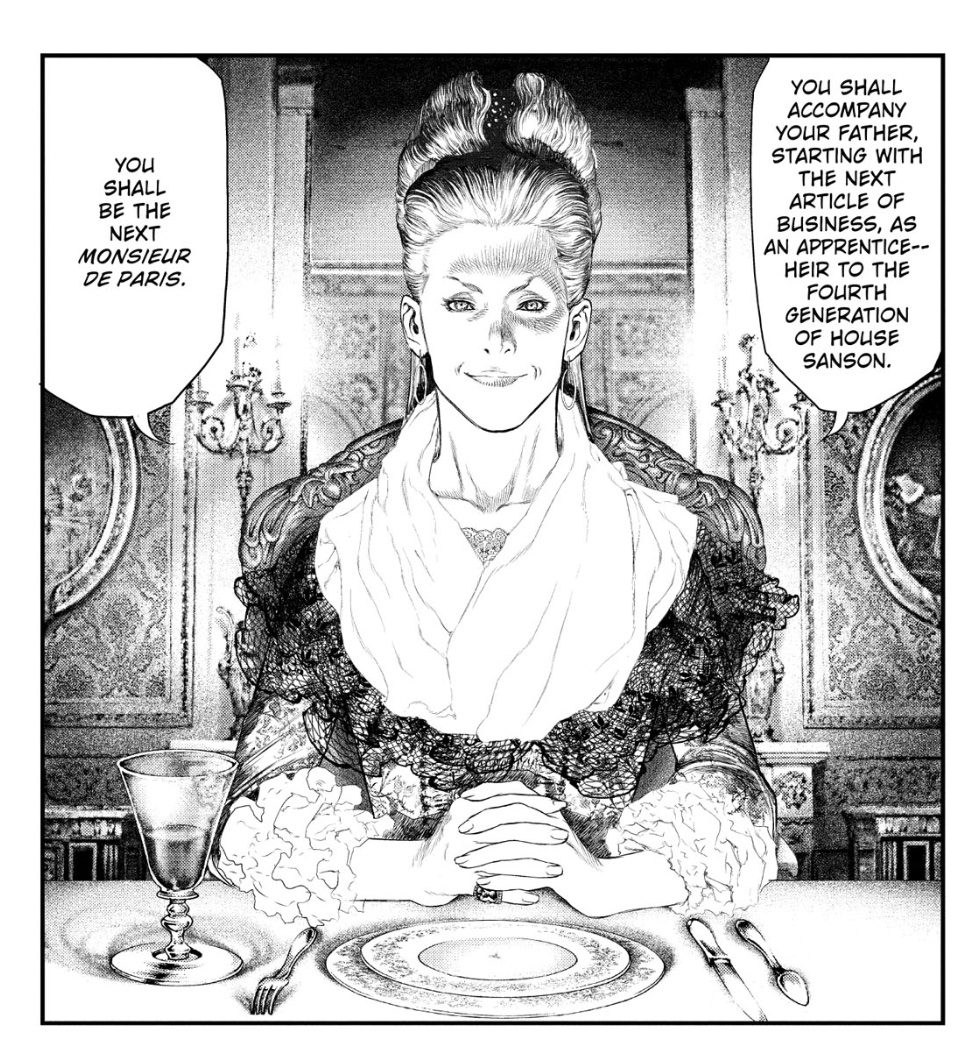
If the narrative disappoints, the artwork does not. Sakamoto draws sumptuous costumes and grand estates, lavishing considerable attention on small but historically meaningful details—a china pattern, the buckle of a shoe—in a meticulous effort to evoke the material culture of eighteenth century France. His real gift, though, is making obscure historical figures come to life on the page. Anne-Marthe Sanson, the matriarch of the Sanson clan, is a prime example: she looks like a bird of prey with a piercing stare and sharp nose, an impression reinforced by the way her fichu drapes across her chest like a ruff. In several key scenes, Sakamoto illuminates her from below, casting her face into shadowy relief to reveal the full extent of her hawkish vigilance:

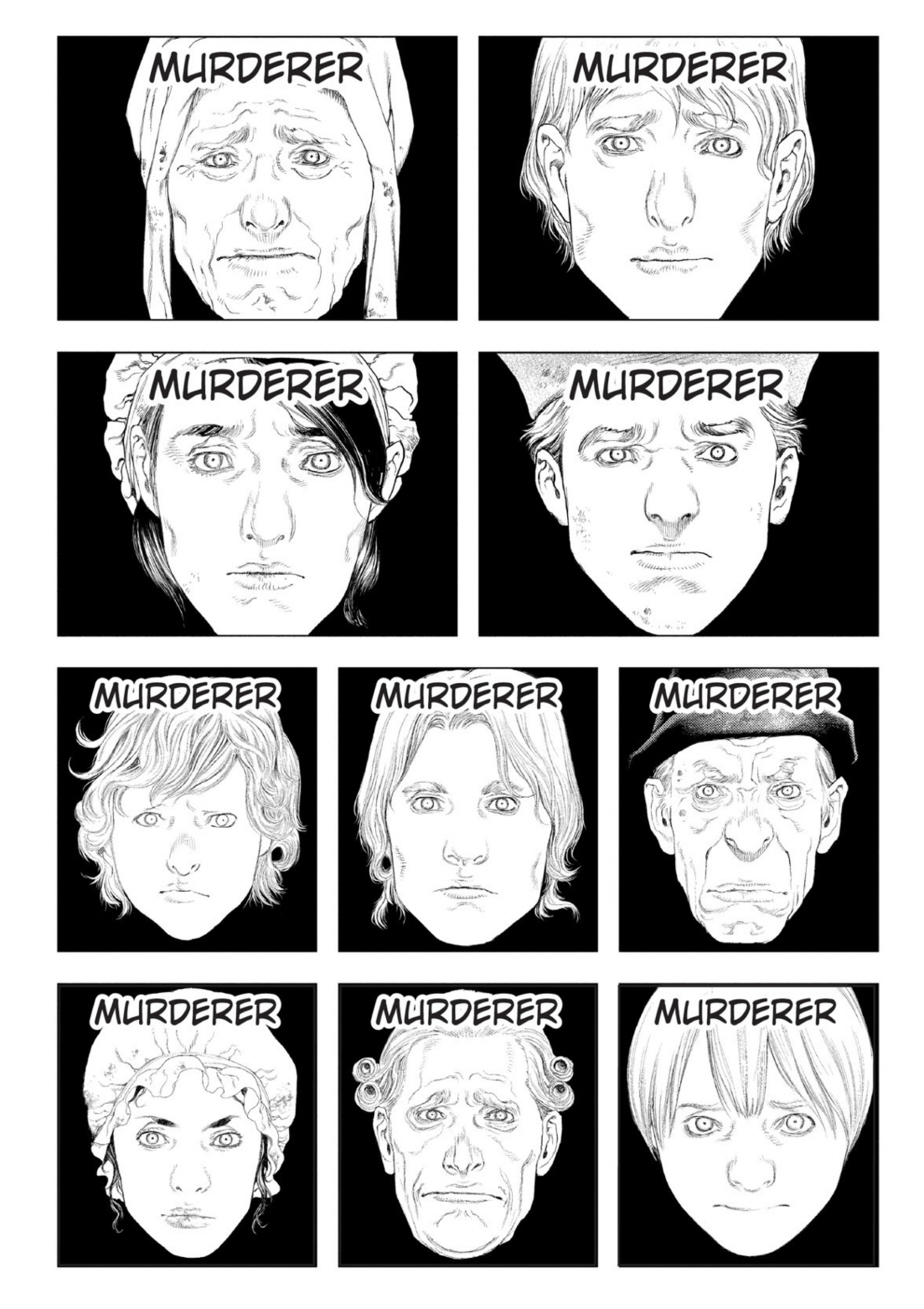
Sakamoto also has a flair for using abstraction, fantasy, and non-sequiturs to reveal his characters’ innermost thoughts. Not all of these gambits work; in one visually jarring moment, for example, Sakamoto depicts Charles-Henri in modern streetwear, an image that serves no obvious dramatic purpose. Other scenes, however, are devastatingly effective in conveying the full extent of Charles-Henri’s paranoia and loneliness. After botching the execution of an acquaintance, Sanson looks out at the crowd and sees a motley assortment of faces staring at him:Sakamoto then repeats this motif, adding more and more faces:It’s a simple but powerful sequence: we feel the collective weight of the crowd’s revulsion and the individual opprobrium of everyone who witnessed Sanson’s orgiastic display of violence. At the same time, however, we feel Sanson’s growing sense of terror and confinement, imprisoned in a role he loathes and unable to escape the scrutiny of commoners and noblemen alike.

These kind of emotionally resonant scenes are few and far between, however, as Sakamoto is more interested in showing Charles-Henri’s martyrdom than making him into a real person; you’d be forgiven for thinking that Sanson was a real-life saint and not someone who’s remembered today for his enthusiastic embrace of the guillotine. Not recommended.

INNOCENT, VOL. 1 • STORY AND ART BY SHIN’ICHI SAKAMOTO • TRANSLATED BY MICHAEL GOMBOS • LETTERING AND RETOUCH BY SUSIE LEE AND STUDIO CUTIE • DARK HORSE • 632 pp. • RATED 18+ (Violence, nudity, language)

Filed Under: Manga, Manga Critic, REVIEWS Tagged With: Ancien régime, Dark Horse, Historical Drama, Shin'ichi Sakamoto

Though I Am an Inept Villainess: Tale of the Butterfly-Rat Body Swap in the Maiden Court, Vol. 6

December 22, 2023 by Sean Gaffney

By Satsuki Nakamura and Kana Yuki. Released in Japan as “Futsutsuka na Akujo dewa Gozaimasu ga: Suuguu Chouso Torikae Den” by Ichijinsha Novels. Released in North America by Airship. Translated by Tara Quinn.

There’s a lot of terrific humor in this volume, most of it stemming from the series’ premise. I’ve talked about this before, but it’s even more true in this book: both Reirin and Keigetsu are absolutely, 100% terrible at pretending to be each other. For the most part they’ve been helped in the past by a) no one knowing bodyswapping was a thing, and b) no one knowing the two well enough to be able to pick out the obvious poor performance. Now that both of these things are no longer true, the best gags in the book come from Reirin’s misplaced confidence that she’s got Keigetsu down pat, or Keigetsu’s inability to not let her cynical anger seep in through everything she does. That said, it’s a good thing that there’s some humor in this book, as the basic premise of this arc is evil and terrible, and the consequences, for some people, are rather chilling.

We pick up where we left off. Reirin has just been rescued from her attempted murder, and has swapped bodies with Keigetsu in order to repair all the damage she blames herself for and take back everything they’ve lost. In practice, this means finding out why exactly Kasui snapped and tried to kill Reirin, plus what she’s actually desperately looking for. She also needs to try to stop Reiga and Hourin from trying to kill her – or rather, using their maidens to try and kill her – and if the way to solve that problem is by getting the maidens on their side, then it’s something she’s going to have to do, even if it means allying with (ugh) Houshun. And then there’s Anni the shaman, the cause of everything that’s led up to this and possibly the most evil person we’ve seen in the series to date.

I continue to absolutely love Ran Houshun, even though she’s also possibly the most terrifying of the maidens. I’m used to hearing Reirin rattle off “Though I am an inept villainess” when she’s gloating over her supposed attempts at being bad, which usually are nothing of the sort. With Houshun it’s chilling when she utters the same phrase, because she’s about to let her Consort and “mentor” be beaten nearly to death by all of her court ladies. And yet it’s also triumphant, because Hourin is a piece of shit who’s spent years abusing and torturing those same court ladies, and for once vigilante justice feels like (at least narratively) the correct answer. As for the others, Kasui gets the closure that is all she can get, really, and can finally achieve a real bond with her own (non-evil) consort. And as for Seika and Reiga, they also get a good scene, but it pales next to Houshun, who’s simply better at this. You can see why Reirin hates her.

I enjoyed this so much I will forgive the use of a deus ex machina “this gets people so drunk they tell everyone the plot out loud” device, though I do hope this is the last we see of it. The next volume promises to be lighter in time, and (theoretically?) only one volume rather than an arc. Can’t wait.

Filed Under: REVIEWS, though i am an inept villainess

My Stepmom’s Daughter Is My Ex: “A Proposal Isn’t Enough”

December 21, 2023 by Sean Gaffney

By Kyosuke Kamishiro and TakayaKi. Released in Japan as “Mamahaha no Tsurego ga Motokano datta” by Kadokawa Sneaker Bunko. Released in North America by J-Novel Club. Translated by Gierrlon Dunn.

For a series whose strongest point is not its fanservice, this series sure has a lot of it. That said, at least the fanservice serves a narrative purpose. Even the sex scene in the book – not between our two leads, I hasten to add, but between Aso and Hoshibe – ends up demonstrating, somewhat painfully, that the blush of first love is not always perfect, and that sometimes simple physical difficulties can “ruin” your perfect memories. Meanwhile Yume has been revving the fanservice up, in an effort to get Mizuto to drop his stoic poker face, and ends up going overboard, to the point where he finally snaps and screams at her in desperation. As for Isana… well, yeah, that is fanservice pure and simple, but it also serves to underline for Mizuto that he can’t simply pretend to be a logical robot who makes every decision using bullet points. And that’s important, because there’s a rather annoying thing undercutting this wannabe romantic reuniting… they’re both family now.

It’s Christmas, and Yume has a lot to worry about. She’s set a deadline of the new year to either get Mizuto to rekindle their relationship or just give up, and he’s not cooperating very well, to the point where she’s forced to do things like wave her cleavage at him and hope he reacts. Her birth father wants to meet with her and Mizuto, and given that he’s never particularly cared about Yume before, she’s not quite sure why. And Mizuto has started spending all his time at Isana’s place. The last is for a very good reason – having seen Isana’s art and how good it is, he realizes that she needs a manager in order to achieve anything, as she has no real drive to succeed of her own. So it’s time for Pixiv accounts and Twitter alts, as well as drawing more and more so that she improves. But doesn’t everyone still think they’re dating?

The “is this incest or not?” part of the conversation is not really resolved here, mostly as, well, the premise of the series means that “not” is going to have to be the correct answer. I think the fact that they’ve only been siblings for 9 months takes the curse off it a bit. More difficult is that these two are both big, BIG nerds, and it not only comes out in their school work and reading but also in how they live their lives. Mizuto has never really felt passionate about much till he gets the idea to “manage” Isana’s art, and he proves to be very adept at it. Unfortunately, he’s also listening to Yume’s dad, who is projecting hard onto Mizuto and giving him advice that may not be that helpful. As for Yume, she doesn’t want to cut Mizuto off from Isana, who is her friend as well, but can’t quite work out how close they should be after he and Yume become a couple without resorting to math. Never decide how friendly your lover can be with other women using math.

The author is quick to assure us the series is not ending despite the couple confessing (reconfessing?) at the end, so we’ll see what the fallout is. But this was an in-character, if not entirely satisfying, way for these two to fix things.

Filed Under: my stepmom's daughter is my ex, REVIEWS

Spy Classroom Short Story Collection: The Spy Teacher Who Loved Me

December 20, 2023 by Sean Gaffney

By Takemachi and Tomari. Released in Japan as “Spy Kyoushitsu” by Fujimi Fantasia Bunko. Released in North America by Yen On. Translated by Nathaniel Thrasher.

(As a warning, this book deals with the sexual assault of an underage girl near its end, and this review briefly discusses that.)

Spy Classroom has, as one of its main goals, to strike a careful balance between gripping, and frequently deadly, spy drama and the wackiest and goofiest of comedy. Sometimes it manages to hit this goal a bit better than others. The first story in this book is a good example: it’s almost entirely light-hearted, then gets more serious towards the end, then gets very serious as we’re reminded how screwed up Annette is. By contrast, the Erna story pinballs between very dark themes and “ha ha, Erna suffering emotionally is funny” so fast that I could not keep up, and it jars. That said, on the whole these short stories are stronger than the first collection, both tying into the girls’ backstories (Thea especially) and expanding on some of the books – the 4th short story is blatantly “there wasn’t room for this in the fourth volume”, as the author admits. And, as a Lily fan, I’m pleased with this, though it does not really remove my irritation of how she’s treated in the actual 4th book.

The wraparound story has Thea trying to decipher a note left to her by Hearth, the spy who mentored Klaus and also rescued Thea from kidnappers. Unfortunately, several of Lamplight get a very wrong idea about the note. In between this, we see Annette being the best waitress ever in order to see if a former spy front is now a legitimate restaurant; Sara gets a secret admirer and Thea tries to make sure that she has the best date ever while also making sure the guy is good enough; on the cruise to not-America in preparation for the 4th book, Erna discovers a suicide cult that makes her their leader; and during the events of the 4th book’s climax, we see how Lily managed to escape getting brutally murdered by Purple Ant’s people.

Some of the comedy in this is very amusing – Annette being a fantastic waitress, and everyone’s reaction to this, is probably the highlight. I think I’d have appreciated Erna’s story more if the suicide cult had not been… well, a suicide cult, and its attempts to show off how the war destroys the underbelly of society needed greater depth, I feel. Sara essentially takes over Thea’s story, and we are reminded that she is the one girl in Lamplight that everyone loves unreservedly. Reading Lily’s story I wondered if the author has read the Excel Saga manga, as Lily very much reminds me of Excel at times (what are you, Steel God Jeeg?), and her truly monstrous stamina is terrifying. And then there’s Thea’s backstory, as she confronts repressed memories of being raped by her kidnappers. Fortunately, the author knows this is NOT the time to insert some laughs, and it’s handled fairly well.

So yeah, good stuff. That said, I’d like to read the next few books of the actual series soon. How are things with our FILTHY TRAITOR? :)

Filed Under: REVIEWS, spy classroom

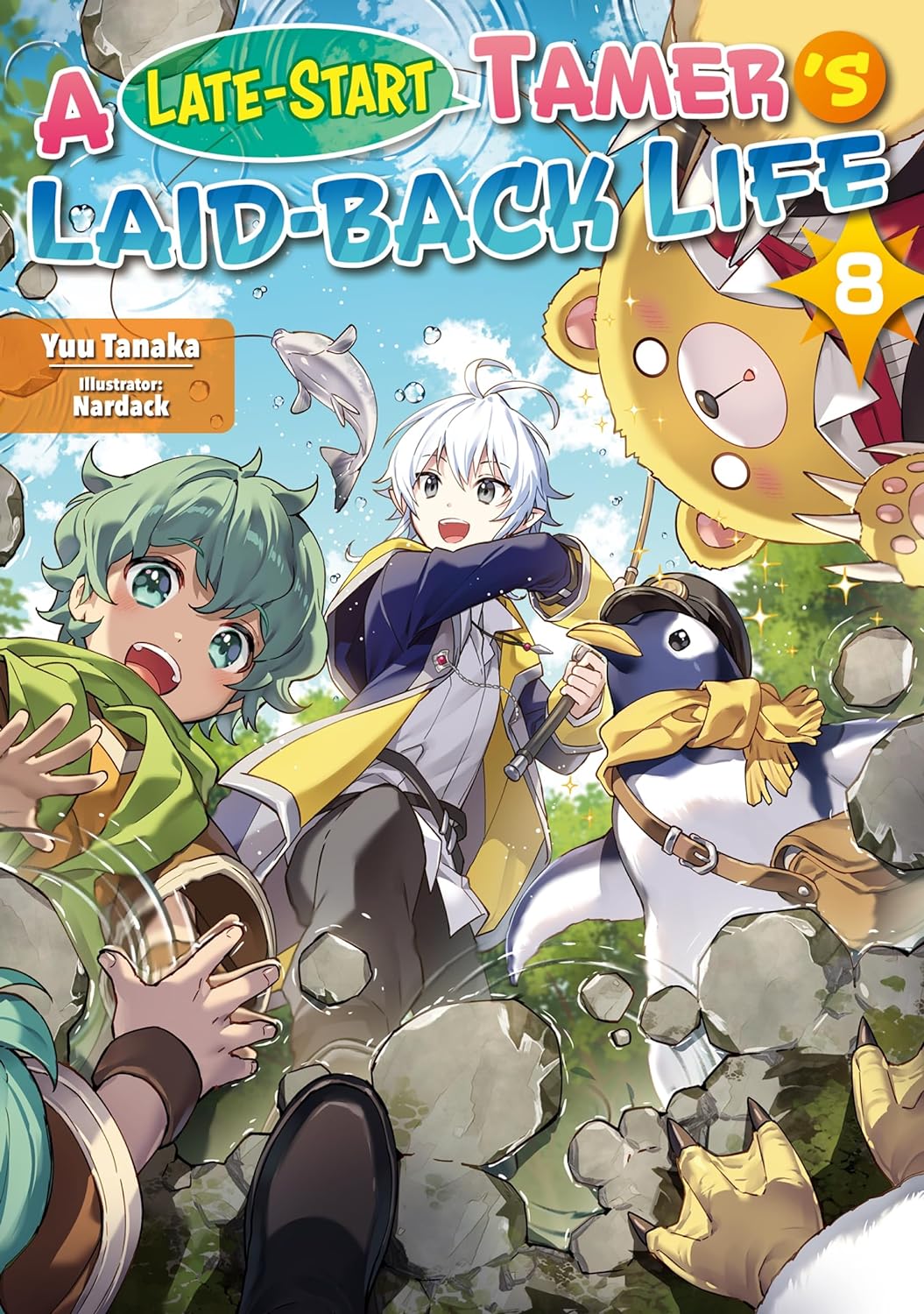
A Late-Start Tamer’s Laid-Back Life, Vol. 8

December 19, 2023 by Sean Gaffney

By Yuu Tanaka and Nardack. Released in Japan as “Deokure Tamer no Sono Higurashi” by GC Novels. Released in North America by J-Novel Club. Translated by A.M. Cola.

At one point in this book, the game is doing a huge mock battle with a massive bird enemy, featuring lots of derring-do and feats of strength, and Yuto manages to win the day by a combination of (accidental) self-sacrifice and being very clever, and he and his tamed monsters look very good doing it. At other points in the book, Yuto discovers rice and also gets a penguin as a tamed monster. It’s not a surprise to readers of this book that the latter two events get a far bigger reaction from other players than the first one. This is a series that revels in its little moments, to the point where the epilogue blatantly has the game devs talking about how their new competitor, about to be released, is deliberately designed to be as different from Law of Justice Online as possible. Yes, Yuto is very cool at times, much as he doesn’t think so. But more importantly, he can cook and has cute pets. Priorities.

The book starts with Yuto completing his underwater expedition with the three other girls in his temporary party, and arriving at a swampy paddy… which, much to his delight, contains an ingredient called “Paddy”, which can be used to make rice! Rice has been one of the foodstuffs that no one has been able to come across in the game, so this discovery is huge! It also leads to more of Yuto’s wacky cooking experiments. After this, we get another event, as Yuto and several others are sent to defend a small fortress that is being beset by birds, Hitchcock-style. Yuto spends most of this time finding bird-repelling things and being baffled that everyone is treating him as the leader of the group. He even manages to do some actual fighting, though it does, of course, kill him. And then there’s his new, tamed monster… a penguin!

It has been both amusing and a bit annoying seeing the evolving relationship between Yuto and Alyssa, his main contact with the information group Quick-Eared Cats. At the start of the series, she was mildly shocked at all the stuff that he’s brought to her and claimed was nothing. But by now his very appearance in their home base causes her to get ulcers and have panic attacks. I kind of wish they stayed closer, but I get it. Yuto’s number one character trait is being oblivious to his own greatness, and that means he has no idea that the things he’s bringing to her are worth a fortune – which means they’ll make the money back eventually, but it puts the Cats in an awkward position of being deep in debt right after every visit of his. As for the penguin, it’s basically written in to be a joke about the Tomihiko Morimi book Penguin Highway, but it also looks like it will be one of the stronger characters in future volumes.

Somehow I’m guessing the new game coming out to challenge LJO is going to struggle. Why shoot other players to death when you can watch a beat, a mole, and a penguin frolic around?

Filed Under: late start tamer's laid back life, REVIEWS

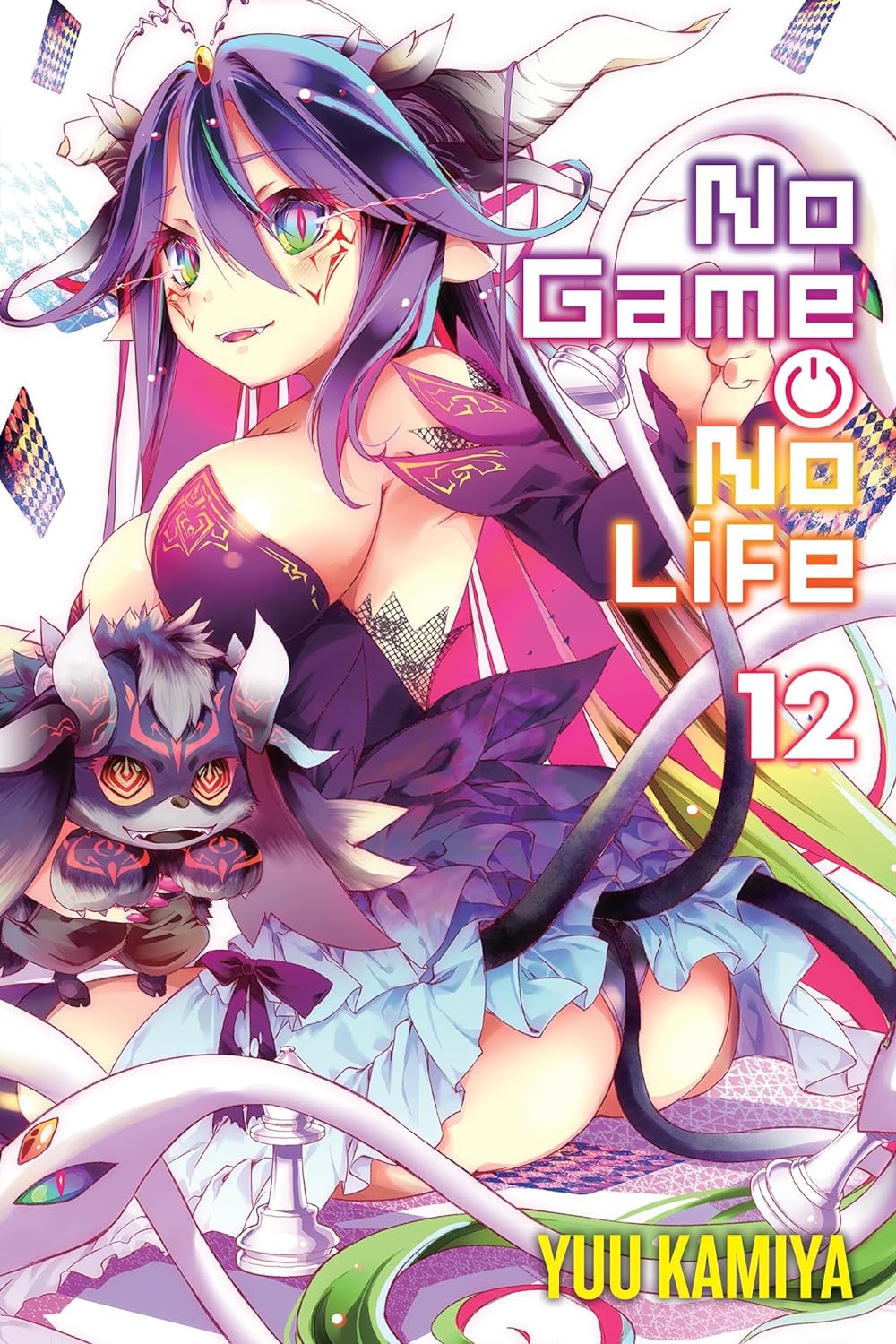
No Game No Life, Vol. 12

December 18, 2023 by Sean Gaffney

By Yuu Kamiya. Released in Japan by MF Bunko J. Released in North America by Yen On. Translated by Richard Tobin.

After a few volumes where I found myself sayhing “I know, I know, it’s skeezy as hell, but you just gotta power through it”, this new volume ends up being one of the strongest in quite some time. Now, this does not mean that it’s not filled with exactly what you’d expect from No Game No Life, after all. There’s tons of Steph being humiliated, especially in the back half, and there’s also two of Sora’s “harem” giving him what amount to naked selfies so he can masturbate. It’s still not something you’d recommend to your grandma. But this volume does a great job showing off the good points of the main characters, particularly Sora and Steph, while also continuing to set up the massive conflict teased in the previous book, and also possibly setting up for a major fracture between [ ] and their strongest ally in the next volume. The whole point of these games has been “no one actually dies” – that’s why they were created. But can someone get around that?

We begin with a massive 7-day celebration of Sora and Shiro’s one-year anniversary in arriving in Disboard, as well as a birthday celebration for both of them. While neither of them are wild about this at the start, it ends up being a fun and touching party… that is interrupted by the arrival of Schira Ha, here as a representative of the Devil, and announcing that their army will finally be destroying the world. Which, um, they’ve tried before, and it hasn’t gone well. Also, the Devil is represented in Disboard by a cute little puffball thing. That said, they do have a massive tower where the goal is to get past all 100 levels, and the reward is the race piece of all the devils. The game itself is a dungeon crawl, which Sora and Shiro should have no issues with, but the game requires hope… and that’s more of an issue.

If you know my reviews of prior books, you know this is where I talk about Steph. She’s terrific at the start of the book, being emotionally sensitive, highly capable, and also knowing Sora and Shiro better than anyone else. Naturally, seeing this, I knew we were in for a giant string of “Steph gets humiliated” later on, and that’s just what happens, as she’s forced into bikini armor… which then gets destroyed, leaving her naked. But I also love the idea that SHE is the powerhouse of their dungeon group, rather than any of the far more powerful others, mostly as, while she’s certainly gotten embarrassed and exasperated and irritated, Steph doesn’t get depressed. Which leads to a heaping pile of hope. That said, the ending of the volume, where Sora has to tell her that this game will be ending with them actually having to kill someone, promises that will change soon.

All this plus their nation is losing people by the day as everyone runs away! It’s a nasty cliffhanger, and we may wait another 18 months to get it resolved, but for fans of this series, this is a must read.

Filed Under: no game no life, REVIEWS

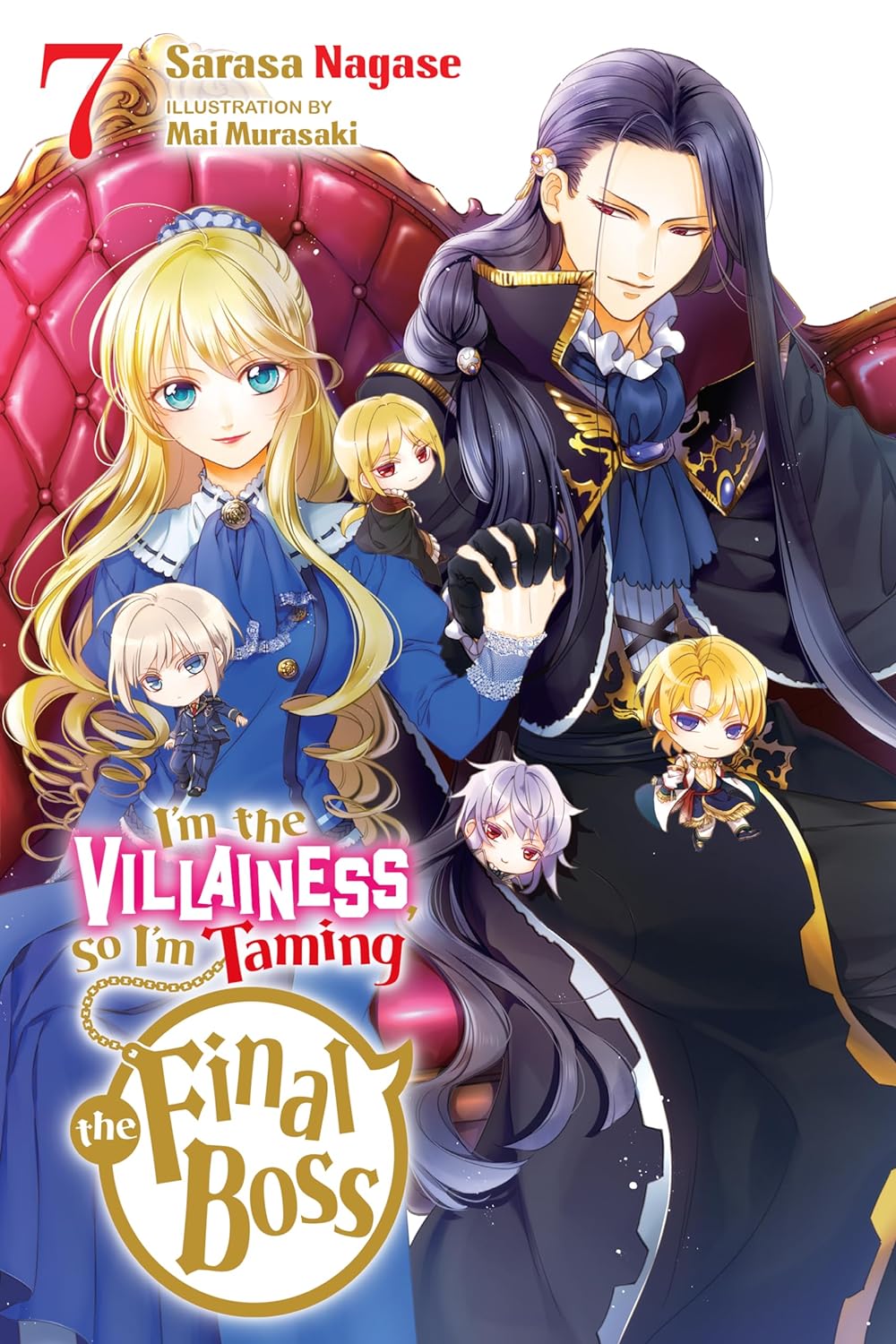
I’m the Villainess, So I’m Taming the Final Boss, Vol. 7

December 17, 2023 by Sean Gaffney

By Sarasa Nagase and Mai Murasaki. Released in Japan as “Akuyaku Reijo Nanode Rasubosu o Katte Mimashita” by Kadokawa Beans Bunko. Released in North America by Yen On. Translated by Taylor Engel.

This is a short story volume, but it contains the basic theme for the entire series, which is that when Aileen is doomed, or on the verge of execution, or otherwise has to work really hard to achieve anything, she’s fantastic, amazing, stupendous. When she’s surrounded by her loving husband, loyal allies and BFFs, she has a tendency to… well, there’s no getting around it, she’s a sub. The end of the book discusses Aileen and Claude’s first time, which we briefly heard about at the end of Book 6, and it’s immediately apparent that Aileen is in terrible denial about the fact that, in bed, Claude can not only wrap her around his… not-so-little “finger”, but she also just gives in to him, which embarrasses and humiliates her. And also turns her on, we’re meant to understand. If this is a surprise to you at all, this must be your first volume. That said, there’s more to this volume than that.

The short stories in this book are in chronological order, with the earliest happening after Book 1 and the latest ones taking place at the end of Book 6. Most of them are short, and it wouldn’t surprise me to hear that they were extras with a store exclusive or DVD release. There are bulkier ones, though. One goes into much greater detail about how Walt and Kyle went from the Church’s honed weapons who are there to kill the Demon Lord to his most trusted bodyguards. (If your response is “because the Church is evil, congrats, you read Japanese light novels.) Because this is an otome game world, Valentine’s Day exists, and we get to see the ladies of the book (minus Lilia, who is notably absent from most of this volume) dole out candies and chocolates to all. And, as I mentioned above, Aileen and Claude have had their first time. He’s very, very happy. She’s a wreck.

I mentioned the lack of Lilia. She does show up at the very beginning, in a scene taking place before the start of Book 1. It mostly just shows off her perfect heroine vibes that she’s deliberately cultivating. More interesting is the end, where we see all the main couples do something. Aileen and Claude consummate, Isaac and Rachel decide to elope (their parents are against it) and buy a house. Auguste proposes to Serena, who reacts in exactly the way you’d expect a furious tsundere to react. Roxanne gets reassurance that she’s not just “the top of the harem” but the only wife. And Sahra… um, exists, I guess. They can’t all be gems. But Lilia is determined to avoid her fate. She declares she’s staying “All Ages”, despite being married to Cedric. What’s more, the thing that gets her over the moon more than anything this volume is not Cedric doing anything, but Aileen re-enacting, just for her, one of the villain CGs from the game. Lilia is far more like Maria Campbell than we’d expected, adn Cedric is still coming in second to the villainess in her heart.

So that was not essential, but it was pretty fun! Claude fans will love seeing him 100% in charge here. Presumably back to more “if Aileen doesn’t fix this immediately she’ll be executed” next time.

Filed Under: i'm the villainess so i'm taming the final boss, REVIEWS

  • « Go to Previous Page
  • Page 1
  • Interim pages omitted …
  • Page 45
  • Page 46
  • Page 47
  • Page 48
  • Page 49
  • Interim pages omitted …
  • Page 346
  • Go to Next Page »
 | Log in
Copyright © 2010 Manga Bookshelf | Powered by WordPress & the Genesis Framework